
Generative AI marketing use cases: what actually works for B2B teams
Read about generative AI marketing use cases, tools, workflows, risks, and B2B SaaS strategies that actually drive pipeline, not just content volume.
.avif)
Content Marketer



.svg)


TL;DR
- Generative AI marketing use cases have moved well past content generation into workflow automation, campaign execution, and autonomous agents that act on real buying signals, but most B2B teams haven't caught up yet.
- The majority of teams are still using GenAI for blog drafts and LinkedIn captions, which means they're automating the least valuable part of their marketing stack and calling it a strategy.
- The 15 use cases that actually drive pipeline range from SDR personalization and account-based content to predictive campaign optimization because they connect activity to revenue.
- A mediocre AI model running on strong first-party data will outperform a powerful model on generic prompts every single time, so your data layer matters significantly more than your LLM subscription.
- The generative AI marketing best practices worth following, share one uncomfortable truth: if your entire strategy can be replicated with a single prompt, it was never a strategy.
Every new technology goes through the same awkward phase: people discover it can do one thing reasonably well, then spend the next two years forcing it to do only that.
Spreadsheets became calculators, the internet became a place to upload brochures, smartphones became devices for checking email.
Generative AI's version of this is content.
Ask most marketers how they're using AI and you'll hear some variation of blog posts, social captions, email drafts, or ad copy. Useful? Sure. A little underwhelming? Also yes.
Because the biggest opportunity sitting in front of B2B marketing teams has very little to do with writing. It's about understanding buyers faster, acting on intent sooner, and building systems that make better decisions without adding more headcount.
The teams pulling ahead are producing more signal (and content).
Let’s look at some generative AI marketing tools!
Generative AI in marketing isn't about content anymore
Most marketers still think generative AI equals content generation. I don't blame them, because that's where the whole conversation started. In 2023, the primary use case was drafting blog posts and social captions with ChatGPT. By 2024, teams graduated to productivity gains across email, landing pages, and ad copy. In 2025, the conversation shifted again toward workflow automation and integrating generative AI for marketing campaigns into repeatable processes.
Now, the most interesting generative AI marketing applications look nothing like a content writing tool. The best AI agents for marketing are autonomous systems that execute multi-step campaigns with minimal human oversight. Enterprise AI agents are projected to be embedded in 40% of business applications by the end of this year, and the marketing function is where this lands first.
Content creation, the thing most teams still associate with generative AI, is now the least interesting use case. It's a commodity. The real shift is that GenAI has moved from writing assistant to execution layer, handling everything from audience segmentation and ad targeting to real-time campaign adjustments and sales alerts.
For years, marketing teams were bottlenecked by execution. They had more ideas than bandwidth. Now the bottleneck has shifted upstream to decision-making. The problem isn't whether you can create enough content. The problem is whether you can figure out what deserves to be created in the first place. The explosion of AI-generated content marketing has made this question more urgent, because when everyone can produce content at scale, differentiation evaporates.
Why most marketing teams are using GenAI wrong
The ChatGPT trap
Here's a pattern I see in nearly every marketing team I talk to. They've adopted generative AI, which feels like progress. But when you look at what they're actually using it for, it's almost always the same short list: writing blog posts, generating LinkedIn captions, rewriting emails, creating social media graphics.
Almost nobody is using generative AI to analyze buying signals, identify account intent, build audience intelligence, or improve attribution. The gap between how teams could use GenAI and how they do use it is enormous. AI's biggest impact comes from prioritizing high-intent accounts, optimizing campaigns in real time, and forecasting pipeline outcomes, not generating bulk content.
The ChatGPT trap is comfortable because the outputs feel productive. You can see the blog post. You can send the email. The work feels done. But activity and pipeline are faaaar from the same thing, and confusing the two is where teams lose months of effort.
Activity does NOT equal pipeline
More content doesn't automatically create more demand. More emails don't create more opportunities. More AI outputs don't equal more revenue. This isn't controversial, but it's the assumption that quietly underpins most generative AI marketing strategies in B2B.
After nearly a decade in B2B SaaS marketing, one pattern stays constant: the teams that win aren't the ones creating the most content. They're the teams connecting marketing activity to revenue. GenAI is a force multiplier for strategy. It's not a replacement for having one.
Also read: Will AI replace digital marketers?
15 generative AI marketing use cases that actually drive revenue
These aren't theoretical. Each use case maps to a real B2B SaaS workflow where generative AI moves the needle on pipeline, not just on content volume.
- Content research and topic discovery. Instead of brainstorming topics from gut instinct, teams are feeding sales call transcripts, support tickets, and competitor content into LLMs to extract real customer pain points. Tools like Perplexity and Gemini surface patterns across large datasets that would take a human analyst weeks to compile.
- Content creation at scale. Yes, this one still matters, just not as the primary use case. Generative AI for marketing content shines when you need fifty landing page variants, ten ad copy options, or weekly blog drafts from a structured brief. Jasper and Claude handle this well when paired with clear brand guidelines.
- Personalization across campaigns. Dynamic messaging based on industry, company size, buyer stage, and engagement history. GenAI lets you create multiple versions of the same message, each tuned to a specific persona, industry, use case, or buyer stage, without manually rewriting everything.
- AI-powered ad creative generation. LinkedIn ads, Google ads, and retargeting assets generated in bulk, then A/B tested at scale. Nearly 40% of all video ads will be built or enhanced with GenAI.
- SDR and outbound personalization. Prospect research, email creation, and follow-up sequences personalized using firmographic and behavioral data. This is where generative AI use cases in marketing overlap with sales in the most productive way.
- Account-based marketing content. Personalized account pages, industry-specific landing pages, and executive outreach materials tailored to individual target accounts. When you're running ABM across hundreds of accounts, GenAI is the only way to make personalization feasible without a small army of writers.
- Customer journey mapping. LLMs analyze touchpoint data across CRM, website, and ad platforms to visualize how accounts actually move through your funnel, rather than how you think they move.
- Website personalization. Dynamic content blocks that change based on visitor firmographics, previous engagement, or intent signals. The visitor from a 500-person fintech company sees different messaging than the visitor from a 10,000-person healthcare org.
- Conversational marketing. AI-powered chat systems qualify leads, answer questions, and book meetings. Modern conversational AI goes well beyond scripted chatbots by understanding context and intent in the way a good SDR would.
- AI chatbots and AI agents. This goes beyond basic chat. Agentic AI systems can independently handle multi-step workflows: qualify a lead, match them to an ICP, route them to the right SDR, and prep a briefing document, all before a human touches it.
- Voice and video generation. Platforms like HeyGen and Synthesia let teams create spokesperson videos, product demos, and sales outreach clips without cameras or production crews. HeyGen excels at marketing-focused avatar videos, while Synthesia is stronger for enterprise training and internal communications.
- Sales enablement content. Case studies, one-pagers, objection-handling scripts, and competitor battlecards generated from CRM data and product documentation. B2B sales teams are always asking for help with these, and GenAI can turn a structured brief into a polished first draft in minutes.
- Campaign planning. GenAI models analyze historical campaign performance, audience behavior, and competitive positioning to recommend campaign structures, messaging frameworks, and channel allocations.
- Market research. Synthesizing analyst reports, competitor announcements, review site data, and industry trends into actionable summaries. Perplexity and Gemini handle this particularly well when paired with specific research questions rather than open-ended prompts.
- Predictive content optimization. AI tools use historical data to predict customer behavior and campaign performance, helping teams focus on the content most likely to convert rather than producing everything and hoping something works.
How B2B SaaS teams are building GenAI workflows
The teams seeing the strongest results from generative AI marketing automation aren't thinking about individual tools. They're building layered workflows that connect data, intelligence, execution, and measurement into a single system.
- Layer 1: Data. CRM records, product usage signals, website intent data, and ad engagement metrics. This is your foundation, and most teams underinvest here dramatically.
- Layer 2: Intelligence. LLMs, AI copilots, and predictive systems that interpret the data layer and generate actionable insights. This is where tools like ChatGPT, Claude, and Gemini sit.
- Layer 3: Execution. Email campaigns, ad creative, content production, and sales workflows that act on what the intelligence layer surfaces. This is where the best generative AI tools for marketing teams earn their keep.
- Layer 4: Measurement. Attribution, pipeline influence, and revenue impact tracking that closes the loop and tells you what's actually working.
The biggest misconception in AI marketing is that people think better models create better marketing. In reality, better data creates better marketing. A mediocre model with great first-party data will outperform a powerful model with generic prompts every single time. This is why the teams investing in data infrastructure before they invest in AI tooling are pulling ahead, and why platforms built on first-party signals become significantly more valuable as the AI layer matures.
The best generative AI marketing tools by use case…
Choosing the right generative AI marketing platform depends entirely on what you're trying to accomplish. Here's how the most popular AI marketing tools break down by category.
Content tools
| Tool | Best for | Pricing tier | Strengths | Weaknesses | Ideal team size |
|---|---|---|---|---|---|
| ChatGPT | Versatile content and research | Free to $200/mo | Broad capabilities, custom GPTs | Generic without strong prompts | Any |
| Claude | Long-form and strategic content | Free to $200/mo | Nuanced writing, large context window | Fewer integrations | Small to mid |
| Jasper | Brand-consistent content at scale | $39/mo+ | Brand voice, templates, workflows | Less flexible for research | Mid to enterprise |
Creative tools
| Tool | Best for | Pricing tier | Strengths | Weaknesses | Ideal team size |
|---|---|---|---|---|---|
| Midjourney | High-quality image generation | $10/mo+ | Visual quality, artistic range | No direct enterprise integrations | Small to mid |
| Adobe Firefly | Enterprise-grade creative assets | Included in CC, enterprise plans | Commercially safe, brand training | Requires Adobe ecosystem | Mid to enterprise |
| Canva AI | Quick design and social assets | Free to $30/mo | Accessible, template-rich | Less customizable for complex work | Any |
Adobe Firefly Enterprise new customer acquisition grew 50% year-over-year, which tells you something about where enterprise creative workflows are heading. With Firefly for Business and Custom Models, enterprises can harness generative AI while maintaining brand integrity and governance.
Video tools
| Tool | Best for | Pricing tier | Strengths | Weaknesses | Ideal team size |
|---|---|---|---|---|---|
| HeyGen | Marketing videos and localization | Free to $149/mo+ | Avatar realism, 175+ languages | Credit system can be confusing | Small to mid |
| Synthesia | Enterprise training and comms | Custom pricing | Governance, templates, multilingual | Less creative flexibility | Mid to enterprise |
Research tools
| Tool | Best for | Pricing tier | Strengths | Weaknesses | Ideal team size |
|---|---|---|---|---|---|
| Perplexity | Real-time research with citations | Free to $20/mo | Source transparency, speed | Less depth on niche topics | Any |
| Gemini | Multimodal research and analysis | Free to $20/mo | Google data integration, large context | Still maturing for B2B | Any |
Workflow and automation
| Tool | Best for | Pricing tier | Strengths | Weaknesses | Ideal team size |
|---|---|---|---|---|---|
| Zapier AI | Connecting tools with AI steps | Free to $69/mo+ | Massive integration library | Can get complex quickly | Any |
| n8n | Custom AI workflow automation | Free (self-hosted) to $50/mo+ | Open-source, flexible | Requires technical setup | Mid to enterprise |
ABM & Revenue intelligence
| Tool | Best for | Pricing tier | Strengths | Weaknesses | Ideal team size |
|---|---|---|---|---|---|
| Factors.ai | Account intelligence and attribution | Free plan to custom pricing | Account ID, intent signals, attribution | Focused on measurement, not outreach | Mid to enterprise |
| HubSpot AI | CRM-integrated marketing automation | $45/mo+ | All-in-one ecosystem, Breeze AI | Less specialized for ABM | Any |
| Salesforce Einstein | Enterprise AI across sales and marketing | Custom pricing | Deep CRM integration, predictive | Complex setup, expensive | Enterprise |
What a modern generative AI marketing stack actually looks like
Most AI stacks today look like junk drawers that have tangled wires you’ve not used in 25 years. It has… twenty disconnected AI subscriptions sitting side by side with no workflows connecting them, no governance policies, and no way to measure whether any of it is working. I've audited marketing tech stacks where the team was paying for seven different AI tools and couldn't explain how any of them connected to pipeline.
And then you sit there looking like…

The companies seeing results are consolidating around systems, not individual tools. A modern generative AI marketing stack has four layers, and each one needs to talk to the others.
• Content layer (creation). This is where tools like ChatGPT, Claude, Jasper, and Adobe Firefly live. They produce the raw creative and written output. Most teams get this layer right, or at least they get it started.
• Intelligence layer (analysis). This is where your account intelligence, intent data, buyer signals, and competitive insights live. Platforms like Perplexity Claude, and Gemini power this layer by turning raw data into something a marketer can act on.
• Automation layer (execution). This is where workflow tools like Zapier AI and n8n connect the intelligence layer to the content layer, triggering campaigns, updating audiences, and routing alerts to sales when high-intent accounts hit engagement thresholds.
• Attribution layer (measurement). This is where you prove that the whole system is working. Multi-touch attribution, pipeline influence reporting, and revenue impact analysis close the loop. Without this layer, you're flying blind with a very expensive autopilot.
The mistake most teams make is overinvesting in the content layer and underinvesting in everything else. Creation without intelligence is just noise, and noise at scale is still just louder noise (wow, never thought I'd say that about AI marketing).
Generative AI marketing automation: yes, we're wayyy past ChatGPT prompts
The phrase "generative AI marketing automation" used to mean "I have a ChatGPT tab open while I write emails." That definition is past its expiration date. Now, real automation looks like multi-step workflows that run with minimal human intervention.
Automated content workflows follow a clear sequence: research feeds a brief, the brief generates a draft, the draft goes through human review, and approved content publishes automatically. Each step is connected, not manual. Tools like Jasper and n8n can orchestrate this end to end when set up properly.
Campaign automation works differently. An intent signal from your website or ad platform triggers an audience build, which feeds into an ad campaign launch, which gets optimized in real time based on engagement data. Marketing automation AI operates autonomously, making real-time decisions about content selection, budget allocation, and audience targeting without constant human oversight.
Agent-based workflows take this even further. Here's a concrete example of how this works with Factors.ai in the loop:
- A website visitor is identified by Factors.ai's account intelligence
- The account is enriched with company data, intent signals, and behavioral history
- AI summarizes the account's activity and buying stage
- Sales is notified via Slack or CRM with a complete account briefing
- The SDR reaches out with context, not cold
That's what autonomous marketing looks like in practice. It's not a chatbot answering FAQs. It's a system that turns anonymous traffic into qualified pipeline without anyone manually exporting CSV files or checking dashboards every morning.
AI-generated content marketing: where it works and where it breaks
What AI is excellent at…
Generative AI handles certain content tasks remarkably well. Repurposing a webinar into a blog outline, summarizing long reports for sales decks, drafting first versions of landing pages, and reformatting content across channels are all jobs where AI saves real time without sacrificing quality.
Low-risk, high-reward use cases include drafting content structures, repurposing content, and simplifying copy for non-expert audiences. These are execution tasks. They follow patterns, they benefit from speed, and they don't require original thinking. AI is very, very good at pattern execution.
What AI is terrible at…
Original opinions. Category creation. Strategic positioning. Founder storytelling. The kind of thinking that makes a reader stop scrolling and actually care about what your company has to say.
Generative models are pattern machines, and if you don't give them a strong pattern to follow, they'll default to the internet's average: safe, vague, and interchangeable. The internet doesn't need another AI-written article explaining what ABM is. It needs more marketers saying something worth remembering.
The AI-generated content marketing challenges are real and growing. Hallucinations introduce factual errors that damage credibility. Brand dilution happens when every piece of content sounds like it was generated by the same model, because it probably was. And quality risks compound over time, because the moment your audience realizes they're reading AI-generated filler, trust erodes in ways that are very hard to rebuild.
The biggest challenges of generative AI in marketing
- Data quality problems
Your AI outputs are only as good as the data feeding them. When your CRM is cluttered with duplicate records, outdated contacts, and incomplete fields, every AI-driven workflow inherits those problems. AI's ability to analyze large datasets won't get you anywhere unless that data is accurate and high-quality. Garbage in, garbage out remains the most important principle in B2B AI, and no amount of model sophistication changes that.
- Hallucinations
AI models confidently generate information that isn't true, and they do it in a way that's almost impossible to distinguish from accurate output unless a human reviewer catches it. In B2B marketing, a single hallucinated stat in a case study or product comparison can damage a deal. Hallucinations aren't a bug being fixed in the next update. They're an inherent property of how these models work, and that means human review isn't optional.
- Compliance risks
Regulated industries face particular exposure. Smart teams write a one-page AI use policy for marketing that defines assist versus authorship and clarifies where AI can help, where human ownership is mandatory, and where compliance and legal must review. The teams that skip this step discover its importance at the worst possible time.
- Brand consistency issues
Overreliance on AI-generated content happens when teams use AI as a substitute for human judgment rather than a tool to support it. In marketing, that means publishing copy with minimal review or depending on AI for brand messaging decisions that still require human context. When six different team members are prompting the same tool with different briefs, the result is a brand voice that sounds like nobody in particular.
- Attribution blind spots
Most generative AI tools create outputs but don't track whether those outputs contributed to pipeline. Without an attribution layer connecting AI-generated content to revenue, you're guessing about ROI. This is the gap that most teams don't notice until they're in a budget review and can't justify the AI spend.
- Tool sprawl
Teams adopt tools faster than they can integrate them. The result is a stack with fifteen AI subscriptions that don't communicate with each other, creating data silos that reduce the effectiveness of every individual tool. I've seen marketing teams where the AI tools cost more per month than the marketing manager's salary.
- Over-automation
Many teams are accidentally creating more operational chaos with AI than they had before. They've automated output, but they haven't automated decision quality. When you automate bad processes, you just get bad outcomes faster.
Generative AI marketing best practices
These aren't aspirational principles. They're the patterns I see in the B2B SaaS teams that are getting real results from their generative AI marketing strategies.
• Rule 1: Start with workflows, not tools. Identify the specific workflow problem you want to solve before you evaluate any technology. "We need to reduce the time between intent signal and sales outreach from three days to three hours" is a workflow problem. "We need an AI tool" is a shopping trip.
• Rule 2: Keep humans in approval loops. Every piece of AI-generated content that reaches a prospect should pass through a human reviewer. Full automation of customer-facing content is a brand risk that isn't worth the time savings.
• Rule 3: Use first-party data wherever possible. GenAI can ingest CRM data, customer interviews, and sales call transcripts to help generate content that reflects real buyer language, behavior, and intent. First-party data makes your AI outputs structurally better than competitors running on generic prompts.
• Rule 4: Measure pipeline, not productivity. "We created 400% more content this quarter" means nothing if pipeline didn't move. The metric that matters is revenue influence, and every generative AI investment should be evaluated against it.
• Rule 5: Create governance before scale. Write your AI use policy, define what AI can and can't author, establish review processes, and document your workflows. Doing this after you've scaled is like building a foundation under a house that's already standing.
• Rule 6: Build repeatable systems. A one-off prompt that produces a great blog post isn't a system. A documented workflow that consistently produces quality output from research through publication is a system. The difference is the gap between experimentation and operational maturity.
• Rule 7: Don't automate your differentiation. If the thing that makes your brand distinctive is something AI can replicate for every competitor, you've automated your way into irrelevance. Your unique perspective, positioning, and strategic thinking should remain human. If your entire marketing strategy can be replicated with one prompt, it was never a strategy.
How does Factors.ai fit into the generative AI marketing workflow?
Generative AI becomes significantly more valuable when it's grounded in real buyer signals rather than generic inputs. This is where Factors.ai connects to the broader generative AI marketing workflow naturally.
Factors.ai is built on a strong first-party data foundation, identifying more than 75% of companies visiting your website (the highest in the industry), and tracking how those accounts move across pages, channels, and campaigns to give teams a reliable account-level view of buyer activity, even when visitors never fill out forms.
The platform handles several capabilities that feed directly into the GenAI workflow. Account identification reveals which companies are engaging with your website and content. Intent signals show which of those accounts are actively researching solutions you offer. Factors tracks first touch, last touch, and influenced attribution, so every campaign gets credit for what it actually did, and budget goes where it deserves.
Factors also collects account-level intent signals from LinkedIn, Google, Meta, and Bing ad campaigns and surfaces buyer intent from G2 product, category, and review pages. This creates the data layer that makes every other AI tool in your stack smarter.
GenAI creates outputs. Factors.ai provides context. Without context, AI becomes another content machine churning out more of what nobody asked for. With context, it becomes a revenue engine that knows which accounts to prioritize, which campaigns are working, and where your budget should go next. As agentic AI systems mature, the platforms that supply reliable, real-time account intelligence will become the backbone of every autonomous marketing workflow.
The future of generative AI marketing
- AI agents will replace marketing admin work
An AI agent is a system that can set goals, plan a sequence of actions, execute those actions across platforms, evaluate the results, and adjust its approach, all without requiring step-by-step human instruction. Campaign setup, audience management, reporting, and basic optimization will all move to agents within the next two years.
- AI visibility will become a new marketing channel
With tools like Perplexity and Google's AI Mode changing how buyers research solutions, optimizing for AI-generated answers (sometimes called GEO, or Generative Engine Optimization) will become as important as traditional SEO. If your brand isn't showing up in AI-generated research summaries, you're invisible to a growing segment of buyers doing their pre-purchase homework.
- Hyper-personalization will become expected, not impressive
Account-level personalization that would have been considered impressive in 2024 will be the baseline now. Buyers will expect every interaction to reflect their specific context, and teams that can't deliver it will lose to those who can.
- Content production will become fully commoditized
When everyone can produce high-quality content at scale, the differentiator shifts from production capability to insight quality. The teams that win will be the ones with better data, sharper perspectives, and clearer strategic thinking, not the ones with the fastest AI writing tool.
- Attribution will become more important than ever
As marketing teams use more AI-driven channels and autonomous workflows, the need to understand what's actually driving revenue gets more critical, not less. 88% of marketers now report using AI in their day-to-day roles, yet only about one-third of organizations have moved beyond isolated experiments to scale AI across their operations. The gap between using AI and measuring its impact is the next frontier.
- GTM teams will become smaller but more effective
The primary benefit of agentic AI is the decoupling of output from human hours. Autonomous agents can execute thousands of personalized interactions simultaneously, letting businesses scale marketing efforts without a linear increase in headcount. The teams that figure this out earliest will have a structural speed advantage that's very hard to close.
The marketers who thrive in the next five years will be the ones who know where AI should stop. Because the competitive advantage was never typing faster. It's still judgment. It's still taste. It's still knowing what deserves attention. And no model has figured that out yet.
In a nutshell…
Generative AI marketing use cases have evolved well beyond content generation, and the B2B teams getting real results are the ones treating AI as infrastructure for revenue operations, not a faster way to write blog posts. The 15 use cases that matter most connect directly to pipeline: SDR personalization, account-based content, predictive optimization, campaign automation, and intent-driven workflows. Your stack needs four layers to work (data, intelligence, execution, measurement), and the biggest mistake teams make is overinvesting in creation tools while ignoring the data and attribution layers that make everything else effective.
If you take one action from this piece, audit your current AI usage against pipeline impact. Count how many of your AI-powered workflows directly connect to revenue, and how many just produce more content. The gap between those two numbers tells you exactly where to focus next. Start with first-party data, build repeatable workflows, keep humans in the approval loop, and measure outcomes that your CFO would actually care about.
FAQs about generative AI marketing use cases
Q1. What are the most common generative AI marketing use cases?
The most common generative AI marketing use cases in B2B include content creation at scale, campaign personalization, AI-powered ad creative generation, SDR outbound personalization, conversational marketing, predictive analytics, workflow automation, and ABM execution. The use cases gaining the most traction are the ones that connect directly to pipeline rather than simply increasing content volume, including agent-based workflows that autonomously identify, qualify, and route high-intent accounts.
Q2. What are the best generative AI tools for marketing?
The best generative AI tools for marketing span several categories. For content, ChatGPT, Claude, and Jasper lead the field. For creative assets, Adobe Firefly, Midjourney, and Canva AI are the strongest options. Video tools like HeyGen and Synthesia handle avatar-based content and localization. Perplexity and Gemini excel at research. For workflow automation, Zapier AI and n8n connect the stack together. And for revenue intelligence, Factors.ai, HubSpot AI, and Salesforce Einstein provide the data and attribution layers that make everything else more effective.
Q3. How is generative AI impacting B2B SaaS marketing?
The generative AI impact on B2B SaaS marketing shows up in several ways. Teams are reducing execution costs, accelerating content production cycles, improving personalization across campaigns, and enabling account-based workflows that scale without proportional headcount increases. The most significant shift is that smaller teams can now operate at the scale and sophistication that previously required much larger organizations, provided they invest in the right data infrastructure and workflow design.
Q4. Can generative AI replace marketers?
Generative AI can automate execution tasks like drafting, formatting, and data analysis, but strategy, positioning, messaging, judgment, creativity, and deep customer understanding still require human expertise. The teams using AI most effectively treat it as a capability amplifier, not a headcount replacement. The marketers who will struggle are the ones whose roles were already limited to execution tasks that AI handles well.
Q5. What are the biggest challenges of AI-generated content marketing?
The most significant AI-generated content marketing challenges include hallucinations that introduce factual errors, brand inconsistency when multiple team members use AI without shared guidelines, compliance risks in regulated industries, content saturation that makes differentiation harder, and over-reliance on generic outputs that sound interchangeable with every competitor's content. The compounding problem is that as more teams use the same tools with similar prompts, the collective output becomes increasingly homogeneous.
Q6. How should B2B marketing teams implement generative AI?
Start with a specific workflow problem rather than a tool evaluation. Connect AI to first-party data sources like your CRM, website analytics, and ad platforms before using it for any customer-facing output. Keep human oversight in every approval loop, especially for content that reaches prospects. Measure business outcomes like pipeline influence and revenue attribution instead of productivity metrics like content volume. And build governance policies before you scale, because retrofitting guardrails onto mature AI workflows is far more painful than building them in from the start.
Q7. What's the difference between generative AI marketing automation and traditional marketing automation?
Traditional marketing automation executes rules set by humans: if a lead downloads a whitepaper, send email sequence A. Generative AI marketing automation learns from data patterns, adapts continuously, and can make independent decisions about content selection, audience targeting, and campaign optimization. The newest evolution, agentic AI, goes even further by planning multi-step actions, executing across platforms, and adjusting its approach based on results without requiring human instruction at each step.
Q8. What does a generative AI marketing stack look like?
A modern stack has four connected layers. The data layer includes your CRM, website analytics, ad platforms, and intent data sources. The intelligence layer uses LLMs and AI copilots to interpret that data. The execution layer deploys email, ads, content, and sales workflows based on what the intelligence layer surfaces. And the attribution layer tracks pipeline influence and revenue impact to close the feedback loop. The teams seeing the best results are consolidating around integrated systems rather than collecting disconnected point solutions.
Q9. How do you measure the ROI of generative AI in marketing?
Stop measuring productivity metrics and start measuring pipeline metrics. Track how AI-powered workflows influence qualified pipeline, conversion rates at each funnel stage, sales cycle velocity, and revenue attribution by channel and campaign. Compare these outcomes against the same metrics from before AI implementation. The most honest ROI assessment looks at whether AI investments actually changed business outcomes, not just whether they changed how much content your team produced.

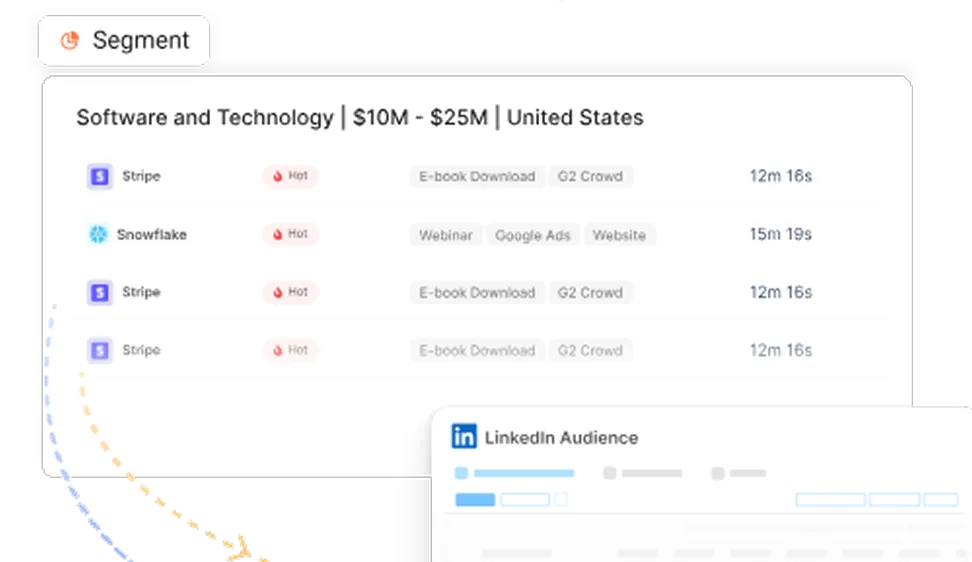
See how Factors can 2x your ROI
Boost your LinkedIn ROI in no time using data-driven insights


.avif)

See Factors in action.
Schedule a personalized demo or sign up to get started for free
LinkedIn Marketing Partner
GDPR & SOC2 Type II






.svg)



.avif)

