
GTM Engineering vs. RevOps: Why They’re Not the Same Job (Even If LinkedIn Really Wants Them to Be)
Find the key differences between GTM Engineering and RevOps and why confusing the two can derail your growth and lead to costly hiring mistakes.

Growth Marketer



.svg)


TL;DR
- RevOps = alignment and execution; GTM Engineering = automation and scale, confusing the two causes costly hiring mistakes.
- GTM Engineers need firsthand sales experience and build systems from scratch; RevOps optimizes what already exists.
- Roles differ in compensation, tooling, and team alignment. RevOps works across functions, and GTM Engineering sits closer to Product and Data.
- Your growth stage determines who to hire: RevOps for order, GTM Engineering for leverage, never the other way around.
Picture this.
You’re in a meeting, someone brings up hiring a “GTM Engineer,” and suddenly half the room nods like they understand… while the other half quietly panics and starts questioning all their life choices.
Did we miss something?
Is this a real role?
Is everyone hiring them except us?
Yeah. That’s the vibe around GTM Engineering right now.
The truth?
RevOps and GTM Engineering are connected, but they’re not interchangeable.
And if you treat them like the same job, you’ll end up hiring someone amazing… for the wrong thing.
So let’s break this down in a way that actually makes sense.
Related read: Top GTM engineering tools for marketing and sales teams.
First, let’s get our definitions straight
Before we stir the pot, here's the quick, no-nonsense version:
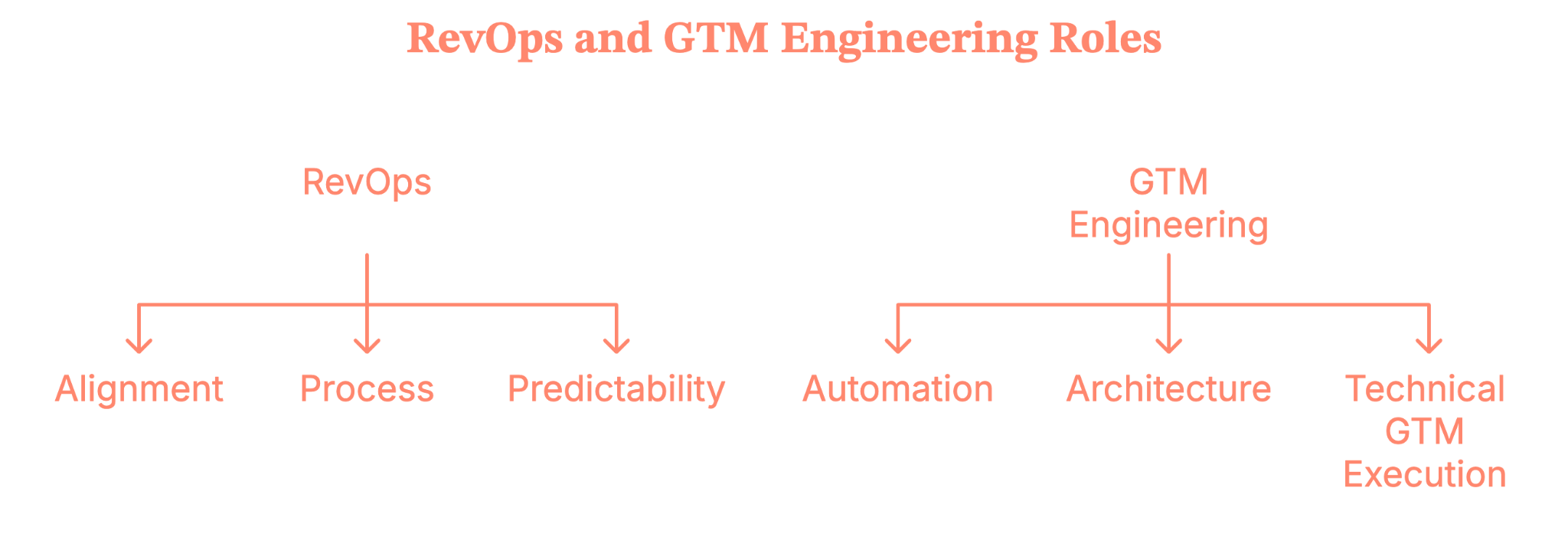
RevOps = alignment + process + predictability.
They make sure Sales, Marketing, and CS are speaking the same language, running the same playbook, and not tripping over one another.
GTM Engineering = automation + architecture + technical GTM execution.
They build AI-powered workflows, scripts, agents, and automations that create revenue leverage at scale.
Both roles touch tools.
Both touch data.
Both help you grow.
But they’re not interchangeable, and treating them like they are is how you end up hiring a Zapier power-user when you needed someone who understands pipeline governance (or vice versa).
Related read: Website visitor to warm outbound play using GTM engineering
What RevOps actually does (No, it’s not just dashboards)
Now imagine this, you’ve hit that awkward growth stage where:
- Data stops making sense,
- Your CRM becomes a black hole,
- Teams debate whose pipeline number is “right.”
- Someone sincerely suggests, “Maybe we need another field.”
This is the moment RevOps becomes real.
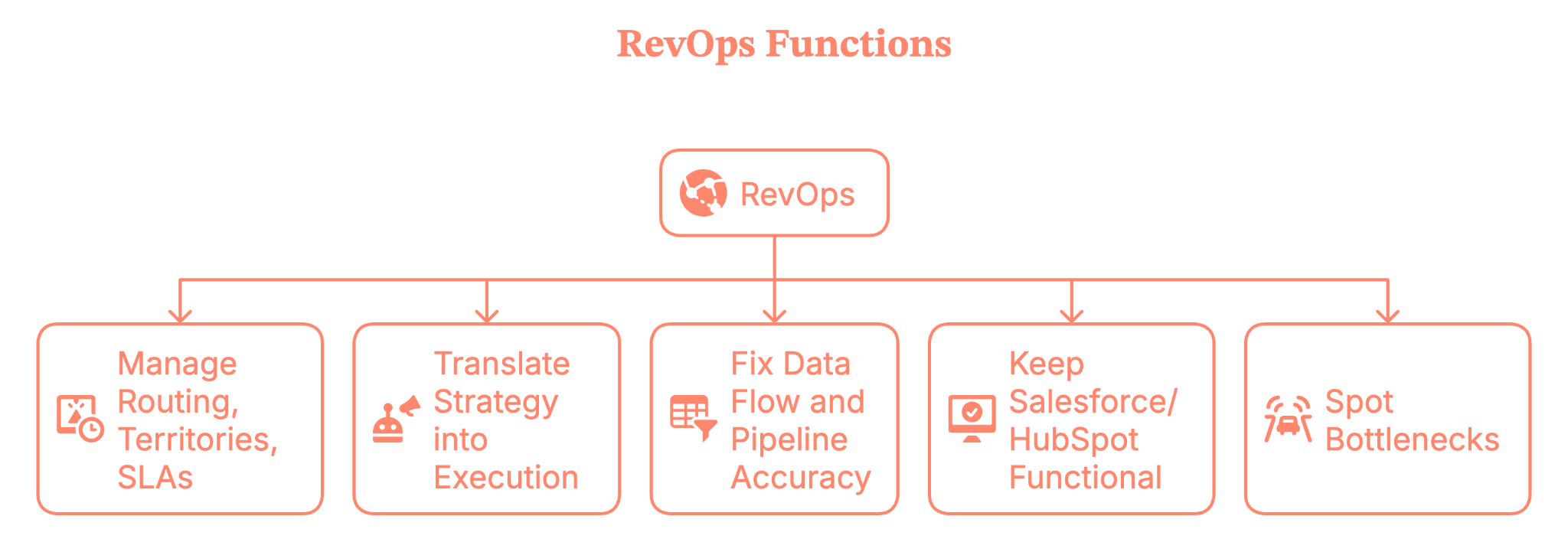
RevOps is the function that:
- Manage routing, territories, SLAs, and your GTM governance
- Translate strategy (CEO/CRO/CMO) into execution
- Fix data flow and pipeline accuracy
- Keep Salesforce/HubSpot and the entire stack functional
- Spot bottlenecks before they sabotage your quarter
If GTM is the engine, RevOps is the person making sure the wheels don’t fall off while everyone else is yelling “faster!”
{{INLINE_BOFU}}
Okay… So what’s a GTM engineer then?
Here’s where the waters get muddy.
Some people say “GTM Engineer” and mean:
- Building prospect lists
- Scraping contacts
- Automating outbound with Clay, n8n, Make, or Zapier
- Wiring together tools for faster outreach
Is it useful work? Absolutely.
But is it a new role? Not really. That’s classic Sales Ops with modern toys.
But true GTM Engineering is something else entirely.
A real GTM Engineer:
- Builds net-new automation using AI, APIs, and scripts
- Creates automated workflows that actually touch prospects
- Works closely with Product, Data, and Platform teams
- Turns GTM ideas into executable systems
- Helps scale motions that humans can’t keep up with manually
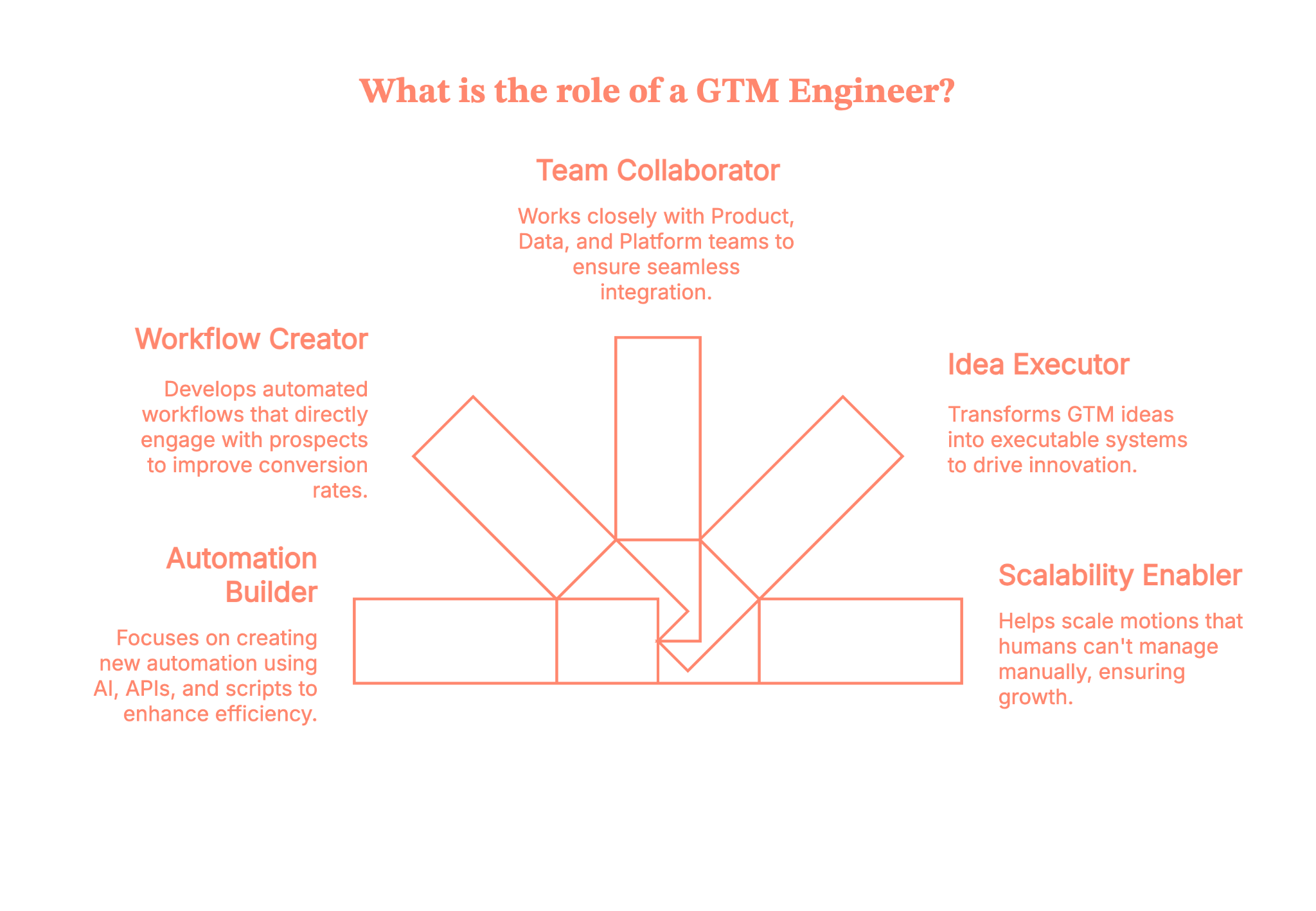
Where RevOps operates inside the existing system, GTM Engineering builds the systems that don’t exist yet.
This is not “run Clay better.” This is “architect GTM like an engineer.”
And it belongs in the category of “new job family created by the AI-native GTM era.”
Why GTM Engineering isn’t just revOps with a trendy title
According to Brendan Short, the founder of The Signal (.club), there are eight reasons why GTM Engineer is not just RevOps rebranded.
Let’s lay this out clearly, because this is where companies make expensive hiring mistakes.
1. The experience factor
A strong RevOps leader doesn’t need SDR or AE experience.
A strong GTM Engineer almost always does, because they automate messaging, outreach, enrichment, tiering, and buyer interactions.
You simply cannot automate what you don’t understand firsthand.
2. The incentives are different
RevOps is compensated like an operations role.
GTM Engineering should be compensated like a revenue role, with pay tied to outcomes rather than task completion.
Different incentives create different behaviors, which ultimately create different results.
3) They build new infrastructure; they don’t patch old workflows
RevOps focuses on optimizing existing systems such as Salesforce and HubSpot.
GTM Engineers build entirely new systems using LLMs, APIs, microservices, agents, and data pipelines.
These require completely different technical skills.
4) They are not responsible for classic RevOps work
GTM engineers do not manage comp plans, forecast models, territory logic, or admin-heavy tasks. Those responsibilities belong to RevOps.
5) Their work touches customers, even if indirectly
GTM Engineers automate actions that reach real buyers, not just internal reports. This raises the stakes and lowers the margin for error.
6) They sit closer to Product and Data than to Sales or CS
GTM engineers need access to internal APIs, event systems, and warehouse infrastructure — areas RevOps rarely works in.
7) They are built for a post-SaaS, AI-native GTM world
Buyer behavior changes quickly, volume is high, and speed matters. GTM Engineers help teams operate at a pace humans alone can’t maintain.
8) Their output is leverage, not insights
RevOps provides clarity through reporting and structured processes. Whereas GTM Engineering provides scalable automation that compounds over time.
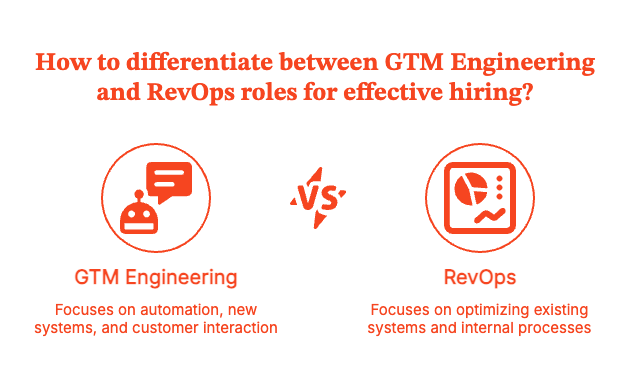
Together, they’re powerful, but confusing them makes hiring far more difficult.
So, why is everyone confused right now?
Well, the short answer is LinkedIn hype cycles.
The long answer is,
- Tools like Clay and n8n make GTM feel more “technical.”
- Influencers start rebranding their workflows as “GTM Engineering.”
- Founders worry they’re behind.
- Operators assume they need a deeply technical hire instead of a strategic one.
- Titles start driving decisions instead of needs
It’s like when Excel wizards started calling themselves “financial engineers.”
Yes... same energy, but a different decade.
Where teams get this wrong (and create their own chaos)
A little tough love:
Using Clay doesn’t make you a GTM strategist. And knowing n8n doesn’t make you a GTM leader.
Tools are not a strategy.
If you let “GTM Engineers” define your GTM… you end up with a tool-driven motion instead of a customer-driven one.
And that’s how companies burn cycles chasing clever automations while ignoring why customers buy them in the first place.
What you actually need, based on your growth stage
Let’s make this simple enough to tape to your founder’s desk.
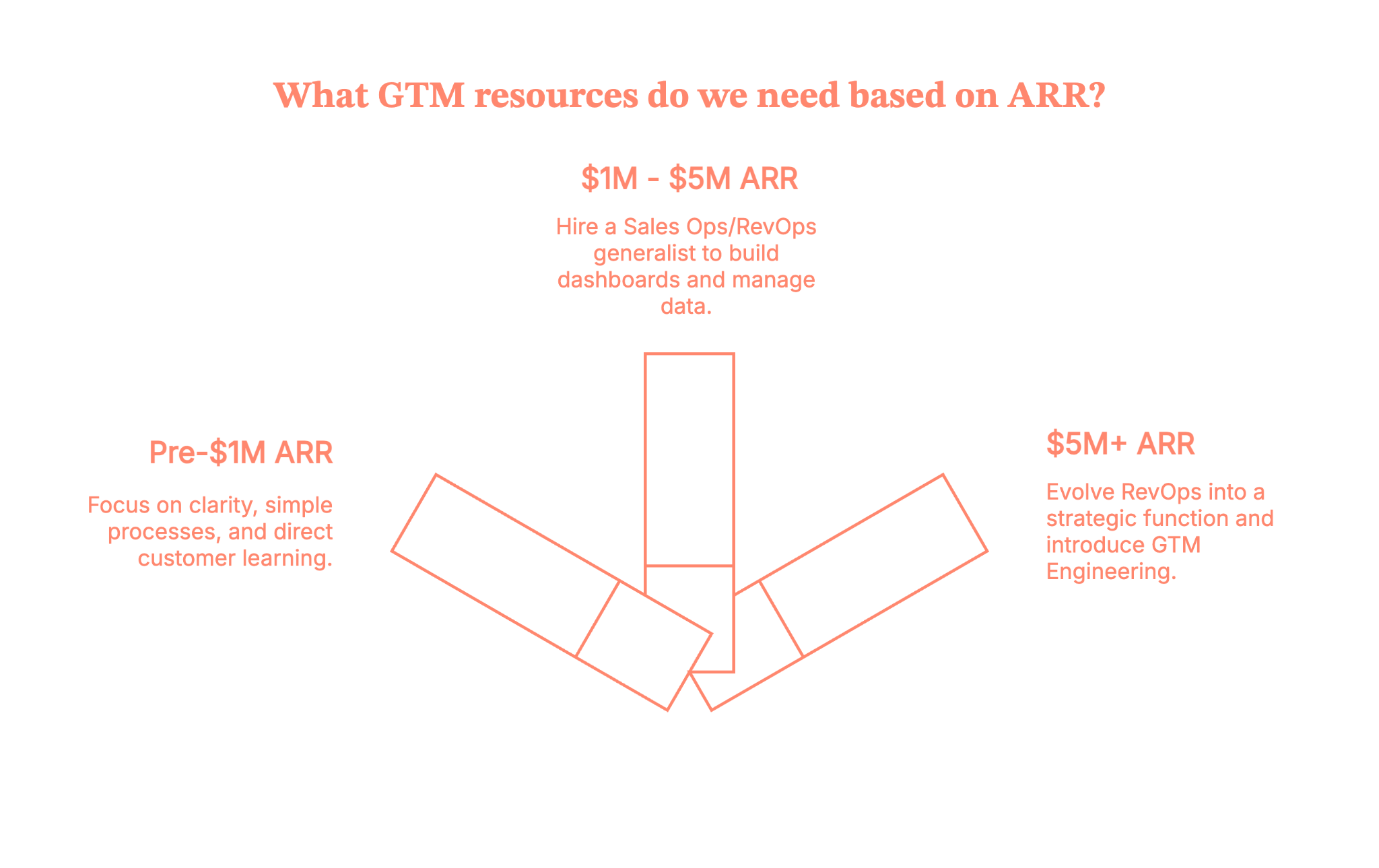
Pre-$1M ARR
You need:
- Clear ICP
- Simple repeatable processes
- Low-maintenance tools you can manage (Notion, Clay, ChatGPT)
No RevOps yet and definitely no GTM Engineering. You need clarity, discipline, and direct customer learning.
$1M – $5M ARR
This is where a Sales Ops or RevOps generalist becomes essential. You need someone to
- Build dashboards
- Build your CRM
- Clean your data
- Build early GTM processes
- Prevent operational chaos
Their value comes from judgment and prioritization, not advanced tooling.
$5M+ ARR
Now things get fun.
Once you reach this stage, complexity increases. You have:
- Multiple motions
- More channels
- Large teams
- More data
- Rising automation needs
This is when RevOps evolves into a strategic function and when GTM Engineering finally becomes relevant.
You bring these roles in not because LinkedIn says so, but because your business genuinely requires them.
So… which one should you hire first?
The rule is simple, and it rarely fails.
If your business needs alignment, you should hire RevOps first. On the other hand, if your business needs scale, you should hire GTM Engineering first.
When companies confuse the two, they hire the wrong person and unintentionally build the wrong GTM motion.
Unfortunately, this mistake shows up on LinkedIn every single week.
Wrapping this up (Before another new job title drops)
Let’s call things what they are.
- Founders are responsible for setting the strategy.
- RevOps is responsible for turning that strategy into predictable and aligned systems.
- GTM Engineering is responsible for building the technical automation that scales those systems.
Buzzwords will change, titles will trend, and tools like Clay will continue to inspire new job names, but the fundamentals remain the same.
Revenue still needs to be operated. Buyers still need to be understood. And GTM still needs real people who know how to make the motion work.
So do not hire based on hype; hire based on what your business genuinely needs right now.
When you get the roles right, the entire GTM engine runs smoother and grows faster.
Flip your GTM from “nice reports” to “net new revenue” with Factors.ai GTM engineering
With Factors’ GTM engineering services, your tools finally start acting like one smart revenue system instead of a messy pile of apps. You’ll identify up to 75% of accounts visiting your website, enrich the right buyers with verified emails, and hand reps ready-to-send outreach in minutes.
Instead of copy-pasting across tabs, your team runs in a tight loop: detect → enrich → prioritize → alert → execute → write-back. Everyone’s working from the same context, nobody’s asking “Who owns this?”, and intent isn’t cooling off while ops cleans up spreadsheets.
Want to see it on your data? Book a demo and watch the full flow in action. It is configured around how your outbound team actually works (we’ll even bring sample plays you can steal and ship).
How we work
- Done-with-you: we co-build flows with your RevOps team (hands on the keyboard, full enablement).
- Done-for-you: we design, implement, and document; your team just runs the machine day-to-day.
Ready to tighten your loop and let the system do the busywork?
FAQs on GTM Engineering vs. RevOps
Q. What does a GTM Engineer actually do, and how is that different from RevOps?
A GTM Engineer designs and builds revenue systems: AI-powered workflows, data pipelines, automations, enrichment flows, and outbound engines that touch real prospects and customers. Their work lives in tools like Clay, CRMs, APIs, event streams, and data warehouses, turning go-to-market ideas into working automation.
RevOps, by contrast, owns process, governance, and cross-functional alignment: routing, territories, SLAs, forecasting structure, CRM architecture, and reporting. RevOps keeps the machine reliable and consistent; GTM Engineering builds new “engines” that extend what that machine can do.
Q. Is “GTM Engineer” a real job or just a hyped-up title?
Some Redditors argue that “GTM Engineer” is mostly branding on top of Growth/RevOps work, especially when the role is just Clay/Zapier automation with light strategy. Others see it as an emerging specialty: a hybrid of sales, marketing, ops, and technical automation that deserves its own label, especially as AI tooling becomes more central.
Q. When should a company hire RevOps vs. a GTM Engineer?
If you’re fighting messy data, misaligned teams, unclear ownership, or broken handoffs, you’re in RevOps territory. You need someone to define the process, own the CRM, standardize reporting, and keep Sales, Marketing, and CS marching together.
A GTM Engineer makes more sense once you already have basic revenue operations in place and now need scale: higher outbound volume, complex routing/enrichment, AI-driven workflows, or sophisticated multi-tool automations that your existing team can’t maintain.
Early-stage companies usually start with RevOps (or RevOps-ish generalists) and add GTM Engineering as motion complexity and automation demand increase.
Q. Does a GTM Engineer need to know how to code or come from sales?
Here are the two patterns we observed:
- Many GTM Engineers come from sales, SDR, or RevOps and later pick up technical skills. That background helps them automate outreach, qualification, and follow-up in a way that actually matches how reps work.
- Technical depth varies: some roles lean heavily on low-code tools; others expect scripting, API work, and basic data engineering.
Pure software-engineering ability without go-to-market experience often underperforms. You can’t automate a motion you don’t really understand from the front lines.

See how Factors can 2x your ROI
Boost your LinkedIn ROI in no time using data-driven insights



.avif)

.avif)

See Factors in action.
Schedule a personalized demo or sign up to get started for free
LinkedIn Marketing Partner
GDPR & SOC2 Type II


.svg)



.avif)

