
What is GTM Engineering
Learn how GTM engineering automates sales and marketing workflows using AI, data, and systems thinking, turning buyer intent into real pipeline.

Growth Marketer
.avif)
Content Marketer



.svg)


TL;DR
- GTM engineering automates your GTM motion, connecting data, AI, and workflows to replace manual revenue processes.
- It goes beyond traditional RevOps; GTM engineers build systems that trigger real seller actions, not just dashboards.
- Real-time orchestration means faster pipeline: website visitor identification, contact and account scoring, and next-step triggers fire within minutes.
- Skills span both code and conversion: GTM engineers wire APIs and AI while knowing what drives meetings and deals.
If your go-to-market still runs on spreadsheets, heroics, and ‘’just one more manual export,’’ GTM engineering is how you swap duct tape for durable systems.
Good news, there is a better way to do it. GTM engineering blends technical chops with revenue strategy to automate and scale buying journeys, from the first signal of intent to a closed-won deal (and the renewals after). Put simply, you create systems that help the work get done, not just dashboards that tell you what’s happening.
Introduction to GTM engineering
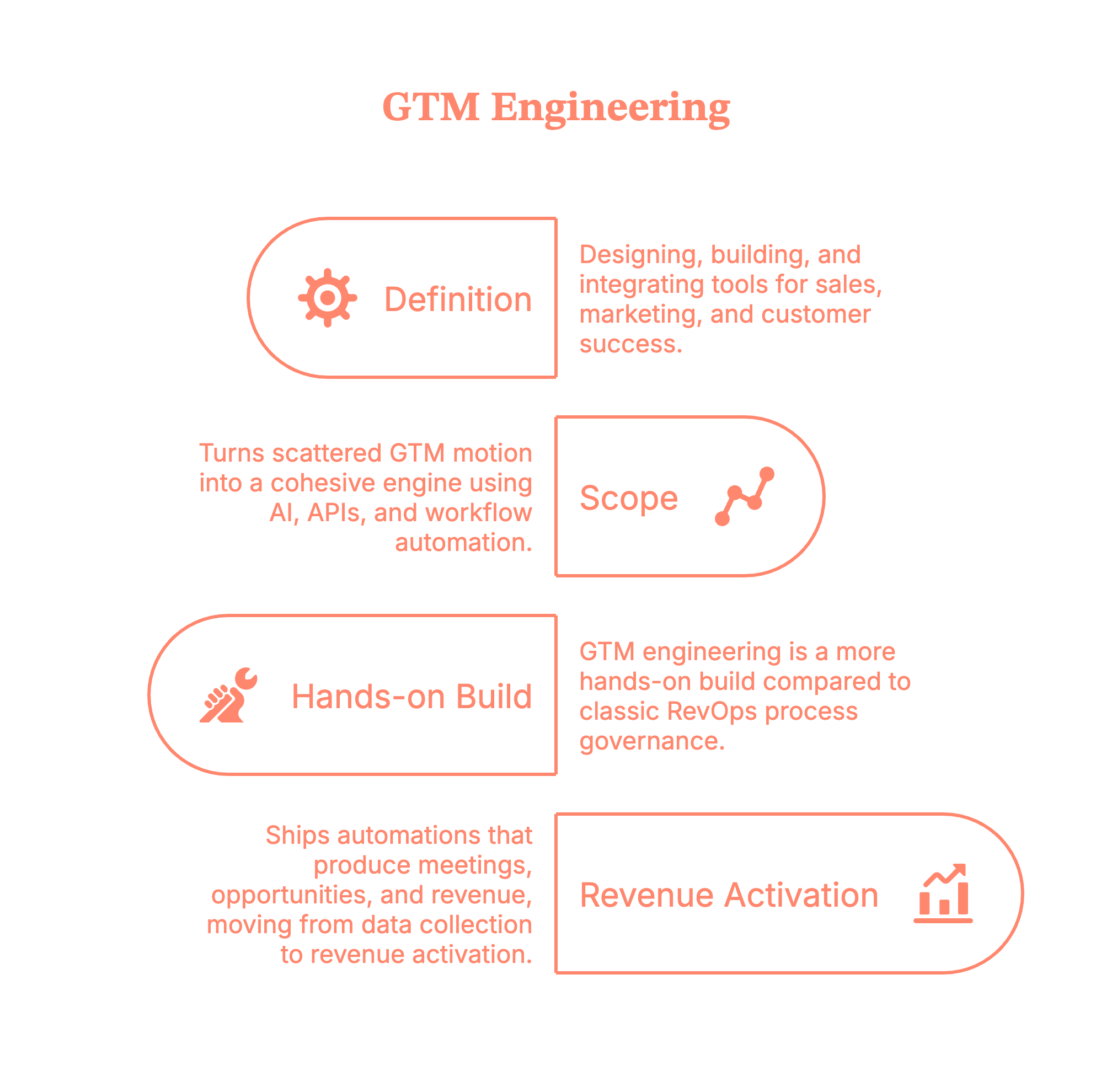
GTM engineering is the discipline of designing, building, and integrating the tools, data pipelines, and automations that power sales, marketing, and customer success. It turns scattered GTM motion into a cohesive engine using AI, APIs, and workflow automation.
Not ‘just RevOps.’ Compared to classic RevOps process governance, GTM engineering is a more hands-on build: it ships automations that produce meetings, opportunities, and revenue, moving from data collection to revenue activation.
Why has GTM engineering surged since 2023
AI agents, better enrichment, and a rising appetite for automation proved that more effort won’t fix manual research, slow campaigns, or dirty data; better systems will. Teams that adopted GTM engineering began connecting intent signals to seller actions in minutes, rather than days.
In plain English, a GTM engineer connects the dots between intent signals, AI agents, and your stack so your team acts faster, smarter, and at scale.
Related read: Top GTM engineering tools for marketing teams.
GTM engineering is a critical function in your modern marketing stack (and why it matters)
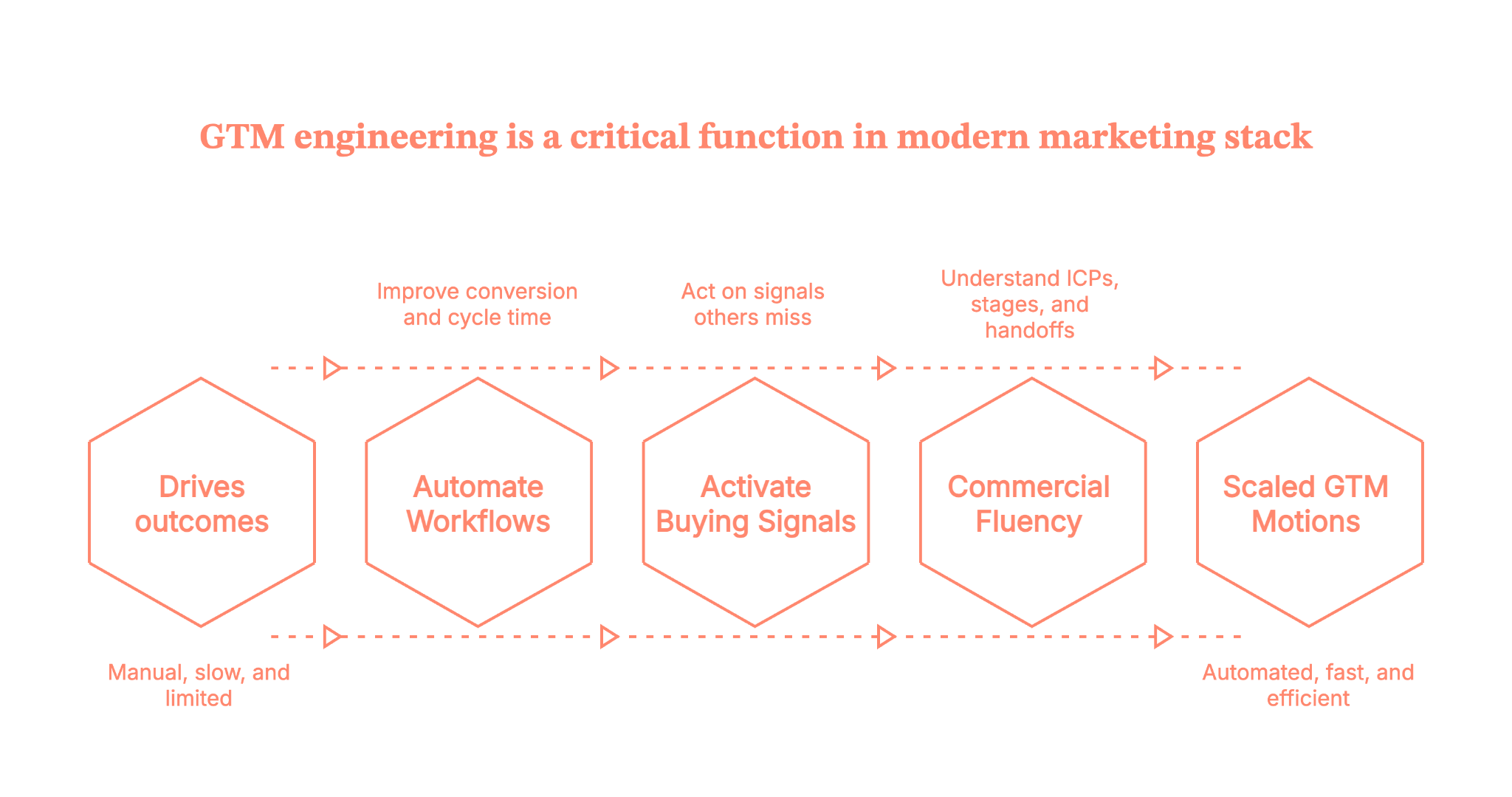
- Drives outcomes, not just visibility. Workflows improve conversion and cycle time (vs. more reporting).
- Automates & scales GTM motions (lead capture, enrichment, scoring, routing, outreach, follow-ups) with AI and integrations.
- Creates advantage by activating buying signals others miss, or can’t act on quickly.
- Requires commercial fluency across ICPs, stages, and handoffs; it’s technical and revenue-literate.
In practice, this is real-time intent alerts, with waterfall enrichment, and agents that identify website visitors, prioritize contacts, and trigger outreach, without headcount chaos.
{{INLINE_TOFU}}
The GTM engineer’s role in RevOps (Revenue Operations)
GTM engineers sit inside/alongside RevOps and work with Sales, Marketing, and CS to turn strategy into systems:
- Design & implement automations for enablement, scoring, and deal-flow orchestration (score → route → sequence → alert).
- Own data hygiene (normalization, de-dupe, identity resolution) and build repeatable processes that scale.
- Integrate AI & 3rd-party data to increase pipeline velocity and lift conversion rates.
Copy-paste-able patterns you can ship:
- Instant Slack/Teams intent alerts when target accounts spike.
- Website Visitor Identification → infer likely account + roles/geo/pages → trigger compliant outreach. Read more about this on our blog Website visitor to warm outbound play using GTM engineering services.
- Contact relevance & tiering agents → surface buying-committee contacts with talking points + priority scores.
- Account tiering & ICP qualifiers combine job changes, hiring, and funding signals to prioritize and route.
GTM engineering pods & collaboration (How teams actually work)
A modern GTM pod typically includes GTM engineers + AEs/SDRs + Growth/Marketing + RevOps:
- Engineers build the data/automation backbone.
- Sales & SDRs act on actionable signals (not noisy alerts).
- Marketing fuels and personalizes customer journeys with the right content at the right moment.
CS is stage two of the pipeline: post-meeting engagement alerts, closed-lost re-engagement when old opps return, and nurture flows that share the same orchestration fabric, so handoffs feel seamless.
What great GTM engineers know (skills that move revenue)
- Software/data engineering basics to wire APIs, webhooks, events, and identity resolution.
- AI/automation: design agents and low/no-code workflows (LLMs, enrichment, routing, content).
- Commercial judgment across ICP, stages, attribution, and prioritize what creates the pipeline.
- Enrichment that activates revenue: use waterfall enrichment to lift coverage, then pipe verified data into CRM for scoring and triggers (vs. letting fields rot).
The GTM tech stack for the growth teams
Here’s the GTM tech stack in plain language, what each layer actually does, how they work together, and what ‘good’ looks like.
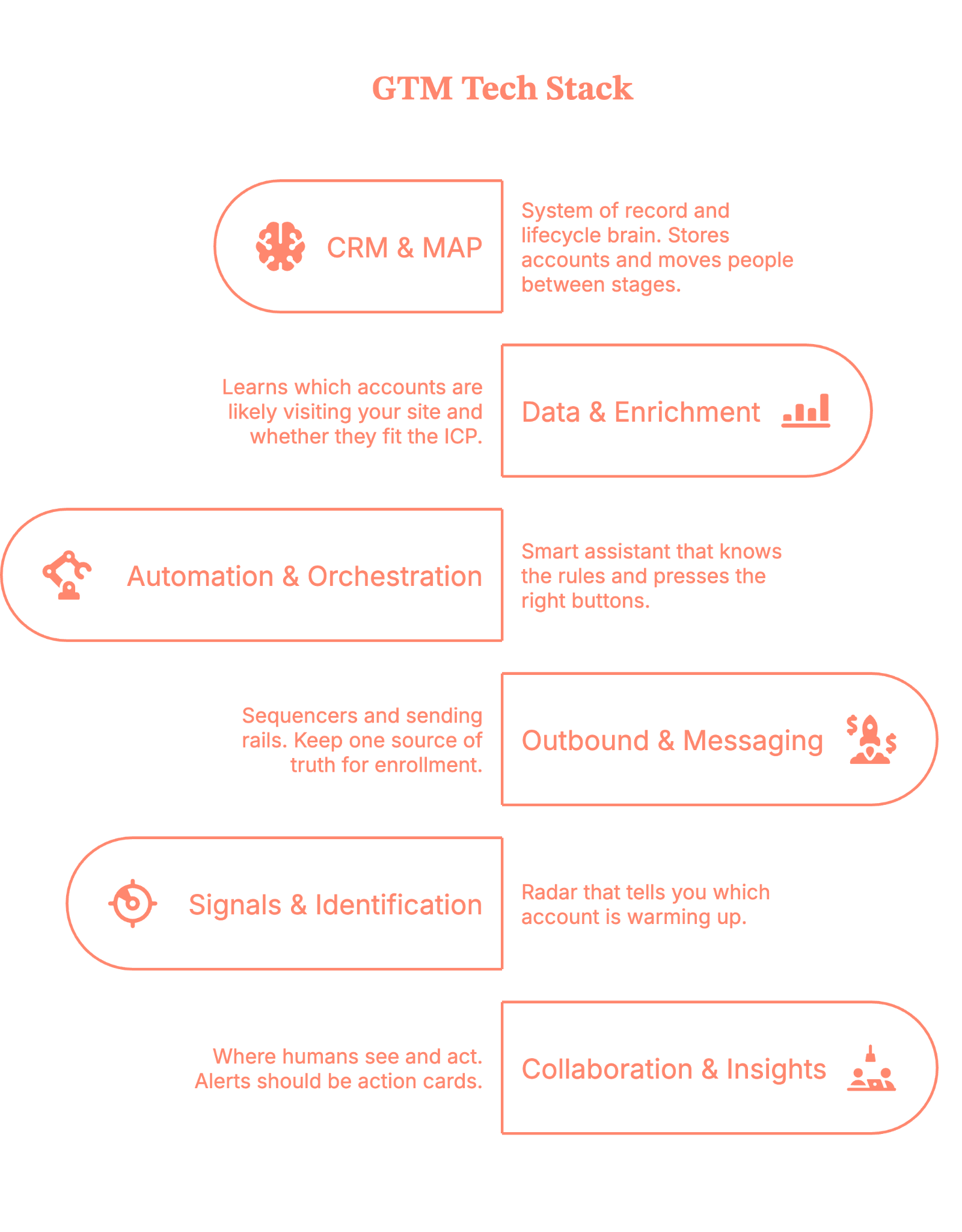
1. CRM & MAP (Salesforce/HubSpot + lifecycle automation)
- Your system of record and lifecycle brain. It stores accounts/contacts/opportunities and moves people between stages (Lead → MQL/SQL → Opportunity → Customer).
- When a form is submitted or a meeting is booked, lifecycle rules update status, owners, and SLAs.
Tip: Keep fields opinionated, enforce deduplication on email and domain, and make lifecycle state changes idempotent so that retried events don’t double-create leads.
2. Data & Enrichment (Clay + providers, Clearbit/ZoomInfo/Factors.ai equivalents, product telemetry)
- This is how you learn which accounts are likely visiting your site and whether they fit the ICP.
- Use waterfall enrichment (try provider A, then B, then C) and log provenance.
- Bring in product telemetry (such as trials and feature use) as an intent signal, not just web visits.
- Treat each attribute with a trust tier (e.g., Tier 1 = verified, Tier 2 = inferred), so your account scoring and routing can prefer higher‑confidence data.
3. Automation & Orchestration (Make/Zapier; LLM agents for research, message generation, routing)
- You can think of this like a smart assistant. When something happens, it knows the rules and presses all the right buttons for you across your tools.
- LLM agents can draft research, prioritize contacts, or propose next steps, but wrap them with guardrails (templates, allow‑listed claims, retrieval) and idempotency (an action key so the same event won’t trigger twice if it’s retried).
4. Outbound & Messaging (Outreach/Salesloft/Apollo, Smartlead, LinkedIn workflows)
- Your sequencers and sending rails. Keep one source of truth for enrollment to avoid double‑sequencing someone from two tools.
- Personalize with structured snippets (why now, why us) coming from the decision engine rather than free‑text improvisation.
5. Signals & Identification (website visitor ID, job‑change alerts, funding/hiring signals)
- This is your radar. Reverse‑IP/site ID and partner/product signals tell you which account is warming up.
- External signals (job changes, funding, hiring) add a ‘why now’ context. Debounce short‑burst activity so a 3‑page refresh doesn’t look like a spike.
6. Collaboration & Insights (Slack/Teams alerts, dashboards, pre‑call intelligence)
- Where humans see and act. Alerts should be action cards (account, reason, recommended next step, SLA timer) rather than FYIs.
- Dashboards display system health (coverage, routing accuracy, and p95 time-to-first-touch) and business impact (meetings/100 ICP visits and win rate by tier).
How GTM Engineers Drive Impact (with examples)
- Faster speed‑to‑lead: real‑time alerts + auto‑assembled context → SDRs act in minutes, not days.
- Higher coverage: visitor identification + relevance & tiering agents surface the right people inside the right accounts.
- Predictable routing & follow‑through: ICP qualification and geo rules route to the right owner with no manual triage.
- Closed‑lost resurrection: alerts when old prospects return, with page‑level intent for tailored follow‑up.
Metrics that actually move the needle for a GTM engineer
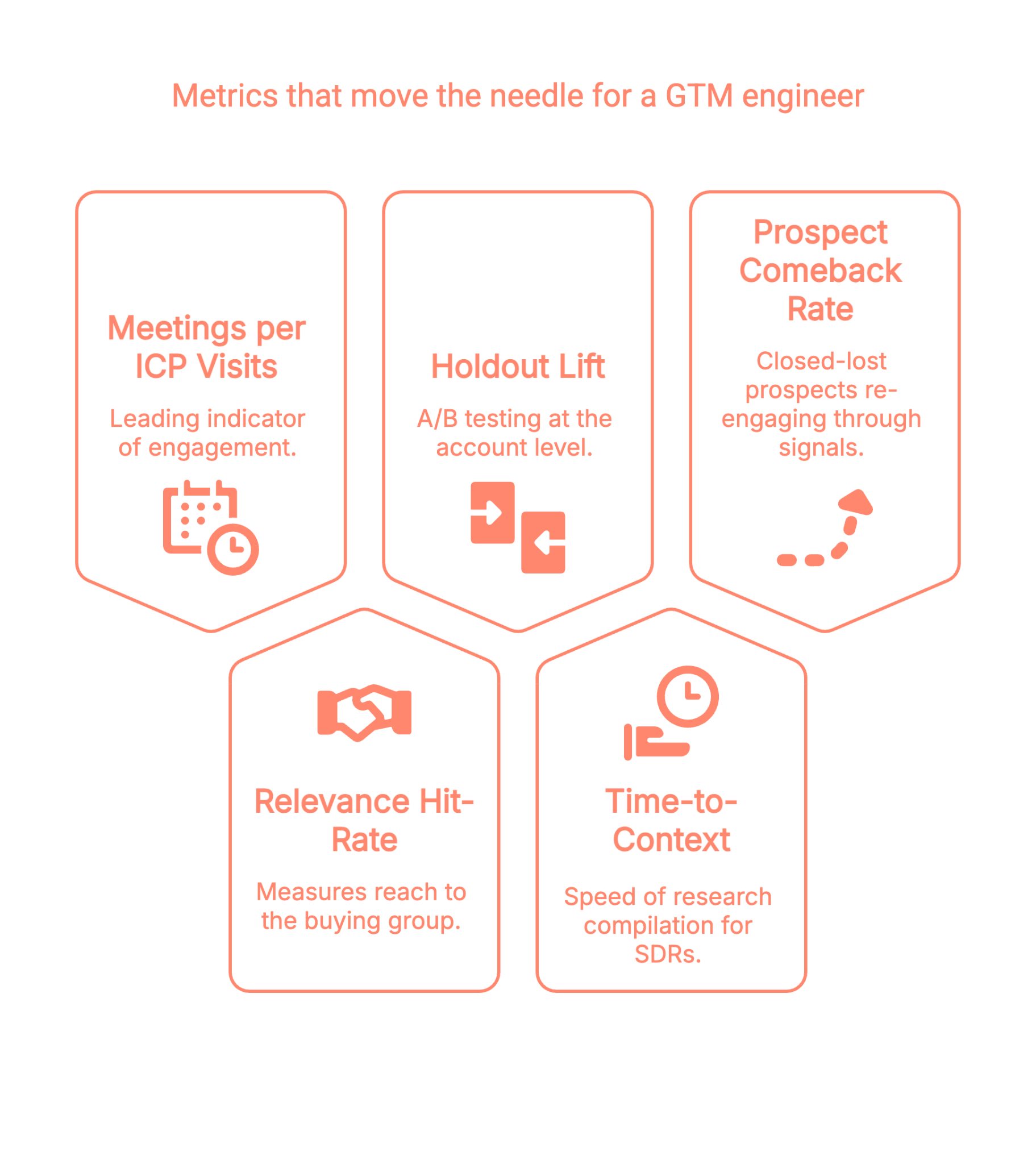
- Meetings per 100 ICP visits (leading indicator).
- Relevance hit‑rate (did we reach the buying group?).
- Holdout lift (A/B at account level).
- Time‑to‑context (seconds to compile research for an SDR).
- Prospect comeback rate (closed‑lost that re‑engaged through signals).
Introducing GTM Engineering services from Factors.ai
Picture this: your SDR opens Slack to a single alert that says which account just spiked, who likely visited, why they care, and the next best step.
That’s Factors.ai’s GTM Engineering in action, real-time alerts, ICP-aware scoring, and write-backs to your CRM so warm outbound actually scales.
Here’s the kicker: we don’t just ‘alert and pray.’ Factors.ai identifies up to 75% of visiting accounts (versus ~8–10% with person-level tools), and even pinpoints up to 30% of the likely contacts behind those visits, so reps reach the right people quickly. Teams using these workflows engage up to 3× more high-fit accounts and see better ROI without adding headcount chaos.
What you get (done-for-you, not DIY): Website Visitor ID, Contact Relevance & Tiering, Account Tiering, Account Map, Meeting Assist, and Closed-Lost Re-engagement, all tailored to your ICP, sales motion, and stack, and maintained by us like an extension of your team.
Clear roles, documented workflows, and milestone tracking included (so this doesn’t die in someone’s Notion).
If you want your intent data to turn into booked meetings (not just pretty charts), book a demo, and we’ll show your accounts lighting up, with the exact contacts and talk tracks your reps can use today.
GTM Engineering Explained: The Engine Behind Scalable Revenue
GTM (Go-To-Market) Engineering is a specialized discipline that builds the technical infrastructure behind revenue operations, automating sales, marketing, and customer success activities that drive actual outcomes. Unlike traditional RevOps, which often focuses on process governance and reporting, GTM engineering is hands-on: writing automations, connecting APIs, and turning noisy signals into seller actions that generate meetings, pipeline, and revenue.
The rise of AI agents, enrichment tools, and real-time signal tracking since 2023 has made GTM engineering indispensable. It enables near-instant response to buyer intent, surfacing high-fit contacts and routing them through a streamlined system that personalizes outreach, scores leads, and triggers smart engagement, without bloated headcount or spreadsheet sprawl.
It requires a rare blend of technical fluency (in data pipelines, APIs, and LLMs) and commercial acumen (understanding ICPs, funnel stages, and conversion triggers). From website visitor ID to deal orchestration, GTM engineers build the ‘invisible systems’ that accelerate time-to-context and maximize every high-intent signal, powering both speed and precision at scale.
FAQs on GTM Engineering
Is this just RevOps with a shiny title?
No. RevOps sets rules and reporting; GTM engineering builds the software-like workflows that create pipeline. Many teams need both.
How is this different from ‘growth engineering’?
Growth engineering classically focused on product-led activation/retention; GTM engineering focuses on revenue systems across sales/marketing/CS. An overlap exists, but the scope and outputs differ.
What tools do I need?
Start with CRM, enrichment, orchestration, outreach, and alerts; add LLM agents where they remove research/writing toil.
If you have to remember just one thing, it should be this: GTM engineering turns intent signals into seller actions reliably and at scale. When the system works, your representatives talk to the right people at the right moment with the right context. The rest is just… plumbing you no longer think about.

See how Factors can 2x your ROI
Boost your LinkedIn ROI in no time using data-driven insights


.avif)

See Factors in action.
Schedule a personalized demo or sign up to get started for free
LinkedIn Marketing Partner
GDPR & SOC2 Type II


.svg)



.avif)

