
Introducing Scout
Say hello to Scout by Factors. Stop digging through siloed CRM and ad data. Use Scout to instantly find, visualize, and automate your first-party account data.
.avif)
Content Marketer

PMM



.svg)


TL;DR
- Revenue teams are drowning in data, yet still spend hours figuring out which accounts to act on each week.
- The real gap is not access to information, it is the lack of systems that turn signals into action fast enough.
- Scout runs on your first-party data across CRM, website, ads, and intent signals, so it already understands your pipeline before you ask anything.
- It does three jobs in one system: Watch answers questions instantly from your own data; Studio builds reports and dashboards you can actually share; Patrol runs agents that act on signals automatically.
- The biggest shift is this: work starts before you ask the question, so decisions and actions happen at the same time.
- Instead of teams manually stitching together insights, Scout drafts outreach, updates CRM, triggers campaigns, and prioritizes accounts on its own.
- The goal is simple to understand but hard to achieve without this layer: less time researching, more time closing.
Here's something that should not be true in 2026: the moment you identify a high-intent account, nothing happens. The account sits in a list. Someone has to write the outreach. Someone else remembers to add them to the LinkedIn campaign. A third person (if you're lucky enough to have one) goes and enriches the CRM with funding rounds and hiring signals that are already two weeks old by the time they land. And somewhere in all of that, the window closes, and everyone goes home with a frown.
Most account intelligence tools tell you things. Scout does things. When a high-intent account hits your pipeline, Scout doesn't wait around for anyone; it drafts personalised outreach for every contact, fires them into your LinkedIn campaigns, enriches your CRM with funding rounds, hiring signals, and tech stack data, and triggers whatever workflow comes next. And the question of which accounts to focus on? Scout answers that, too. BUT answering questions was never the point. By the time you're reading the answer, the work is already underway.
Scout is built on the data your business has already been collecting: your CRM, your website activity, your ad platforms, your G2 intent signals, and it knows your pipeline before you ask it anything. That's what makes the action possible. It's not guessing which accounts matter or pulling from generic third-party signals nobody else can access. It's using your first-party data. Finally doing something more than sitting in a dashboard waiting to be interpreted by a person who has seventeen other urgent and important things to do.
Scout Watch: for when you have a question that can’t wait and needs to be answered right now
You know what this is about. Someone pings you to ask why a deal went south. Or your VP wants to know which accounts visited the pricing page this week. Or you need to figure out what your ten best-converted accounts had in common before you get on a call in twenty minutes. And then, sweat beads appear out of nowhere.
Normally, that question kicks off a process: open the CRM, check the website data, pull up the campaign dashboard, and try to remember where that spreadsheet is saved.
Scout Watch collapses all of that into a single plain-language question.
Think of Scout Watch as that colleague who has read every note your team has ever written about an important account. One knows everything Factors knows, which at this point, is quite a lot. The other knows nothing about your business.
Scout Map: for when you need to show (off) your work
Getting to an answer is one problem, but turning it into something you can actually share with your team, your manager, or a cross-functional meeting is a different one. Right now, that second step usually means rebuilding a report from scratch in a spreadsheet, or asking RevOps to pull something together, or cobbling it into a slide that is already out of date by the time it lands in an inbox.
Scout Studio is the BI capability you always wanted but never had the data team to build. Tell it what you need in plain language, and it builds a report from your actual data, formatted and ready to share.
Did we mention? It doesn’t need a data team or weeks of setup. Just ask Scout Studio to build the report you would normally have spent a Tuesday afternoon rebuilding from a template that was already two versions out of date.
Scout Patrol: for when you want it to run without you, so you can bask in the sun on a sunny Wednesday afternoon
This is where it gets genuinely useful for teams at scale.
Scout Patrol lets you deploy agents that watch your pipeline continuously, detect signals as they happen, and trigger the right action automatically, without anyone having to be the one who notices. (Did we just see you shed a tear of joy?)
There are 18 pre-built agents ready to go, covering account intelligence, sales, intent signals, attribution, retention, and ops. You can also build your own in plain language using the built-in prompt framework (no code required, obviously).
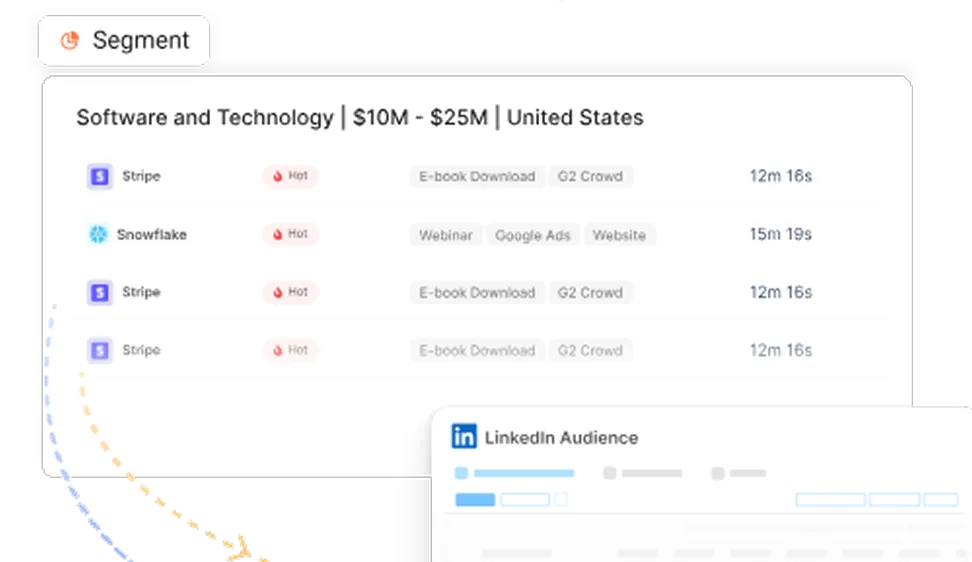
Agents deliver their output wherever your team already works, whether it’s a Slack alert, a CRM workflow trigger, a column in your segment view, a report, or the public API. You set it up once, and it runs every time the signal fires. But guess what? You stop being the person who missed it.
Watch knows. Studio shows. Patrol does.
One data layer underneath all three.
Who is Scout for, tho?
Scout is built for the people who sit at the intersection of data and action:
- AEs trying to prioritize their week without spending half of it on research
- Demand gen managers who need to prove which channels are actually moving pipeline
- RevOps leads who are tired of being the bottleneck every time someone needs a report
- CSMs who want to know which accounts are quietly shopping for alternatives before they show up in a churn number
It’s also for the teams who already use Factors. Because if that is you, Scout is not a new product to onboard, it’s already built on your data. There is nothing to connect or configure and no checklist to complete before you can use it. You open Scout Watch and ask your first question. That’s the whole onboarding.
What are the possibilities with Scout?
There is a better way for revenue teams to operate, where answers are instant, reviews run on their own, and the right signals reach the right people in time to act.
Scout is how you get there And Scout is live now.
If you are already on Factors, your data is already inside it. Open Scout Watch and ask your first question.
FAQs for Introducing Scout
Q1. What exactly is Scout?
Scout is an account intelligence system that sits on top of your existing data and turns it into answers, reports, and actions without manual effort. It combines three modes in one system so teams can move from question to execution without switching tools.
Q2. How is this different from tools that just show dashboards?
Most tools stop at showing you what happened. Scout goes further by telling you what to do next and triggering that action automatically when signals appear.
Q3. What data does Scout use?
Scout runs on your own data, including CRM activity, website behaviour, ad engagement, and intent signals. That is why the answers are grounded in your pipeline and not generic outputs.
Q4. What does Scout Watch do?
Scout Watch lets you ask plain-language questions about your pipeline and get immediate answers pulled from your actual data. It replaces the need to dig through multiple tools for every query.
Q5. What does Scout Studio do?
Scout Studio builds reports, dashboards, and attribution views in minutes. You describe what you need, and it creates something ready to share without involving a data team.
Q6. What does Scout Patrol do?
Scout Patrol runs agents that monitor your pipeline continuously and act on signals automatically. These agents can prioritise accounts, detect churn risk, trigger workflows, and surface next steps without anyone checking manually.
Q7. Do teams still need to do manual research?
Very little. Scout reduces research time from long manual workflows to near-instant outputs, so teams can spend more time on conversations and execution.
Q8. Who is this built for?
It is built for revenue teams across sales, marketing, RevOps, and customer success who need to move from data to action without delays.
Q9. Does Scout require a long setup or onboarding?
If you are already using Factors, Scout is available immediately on top of your existing data. If you are new, setup is mainly about connecting your data sources once.
Q10. What changes after adopting Scout?
The biggest change is speed and timing. Signals do not sit idle anymore, and teams stop reacting late. The system moves as soon as the data moves, which is where most pipeline wins are actually decided.

See how Factors can 2x your ROI
Boost your LinkedIn ROI in no time using data-driven insights


.avif)


See Factors in action.
Schedule a personalized demo or sign up to get started for free
LinkedIn Marketing Partner
GDPR & SOC2 Type II

.svg)



.avif)

