
LinkedIn Document Ads vs Single-Image Ads: Which Drives More Engagement?
Compare LinkedIn Document Ads vs Single Image Ads. Learn which format drives better engagement, leads, and B2B pipeline growth.
.avif)
Content Marketer



.svg)


TL;DR
- LinkedIn document ads deliver deeper engagement through in-feed swiping, dwell time, and multi-page storytelling, making them ideal for complex B2B offers that need education before conversion.
- Single-image ads on LinkedIn remain the fastest, most reliable format for direct-response campaigns with a clear, immediate CTA.
- Comparing these formats on CTR alone is misleading. Pipeline influence, cost per engaged company, and downstream opportunity creation tell the real story.
- The strongest B2B strategy sequences both formats: single-image ads for reach, document ads for nurture, then retargeting with demo CTAs.
- Factors.ai connects LinkedIn ad engagement to account-level journeys, pipeline velocity, and influenced revenue, so you can compare formats on the metrics that actually matter.
Most B2B marketing mistakes don’t look dramatic. They look like choosing the ad with the prettier numbers.
Higher CTR? Must be winning. Lower CPC? Gotta scale it, bro. Nice little spike in clicks? Someone update the Slack channel asap.
Meanwhile, another campaign is sitting in the corner doing the unglamorous work of actually educating buyers, warming accounts, and giving people enough substance to remember your brand three weeks later when budget conversations begin.
That tension shows up perfectly in the LinkedIn battle between single-image ads and document ads.
Single-image ads are the extroverts. Fast, visible, easy to consume, built to stop the scroll and earn the click. Document ads are more like the smart person at the dinner party who doesn’t say much at first, then ends up being the one everyone remembers. They ask for a little more attention, but they often give more back.
The problem is… most teams judge both formats using the same scorecard, which is exactly how bad decisions get made. If you only reward cheap clicks, you’ll lean toward image-heavy content. If you only celebrate downloads, you’ll overvalue gated content. If you care about pipeline, influenced revenue, and whether the right accounts are moving closer to a buying decision, the picture gets more interesting.
I’ve seen marketers kill document ads too early because the CTR looked ‘weak,’ and overfund image ads that drove lovely traffic from people who were never going to buy anything. Neither mistake is rare.
So… this is not just another lazy ‘which format is better?’ article (or so I hope?!). It’s a breakdown of what LinkedIn document ads and single-image ads are actually good at, how they work across the funnel, and how smart B2B teams use both without getting hypnotized by surface-level metrics.
Why this comparison matters for B2B marketers
Most B2B teams default to single-image ads on LinkedIn. It makes sense. They're familiar, fast to produce, and every marketer on the team has launched one before. The creative workflow is simple: pick a strong image, write a headline, choose a CTA, and you're live in minutes. There's a reason they've been the backbone of LinkedIn advertising for years.
But LinkedIn document ads have quietly become one of the most interesting engagement formats on the platform. They let you put a multi-page PDF, a slide deck, a guide, or a report directly into someone's feed. Users can swipe through the content without ever leaving LinkedIn. That in-feed browsing behavior creates a type of engagement that single-image ads simply can't replicate.
Here's why this comparison deserves more than a passing mention in your next campaign planning session. In B2B, clicks alone are notoriously weak signals. A click tells you someone was curious enough to tap a button, but it doesn't tell you whether they actually consumed your message, understood your value proposition, or moved any closer to a buying decision. The metrics that matter in complex B2B sales cycles look very different: scroll depth, document opens, swipe completion, dwell time, form fills, and account-level engagement patterns across multiple touchpoints.
If your audience needs education before conversion, and in enterprise SaaS or high-consideration B2B, they almost always do, format choice has a direct impact on how effectively you can deliver that education. A single-image ad can spark interest. A document ad can build understanding. Those are two very different jobs, and conflating them leads to budget decisions that optimize for the wrong outcomes.
This is also where measurement becomes critical. Most campaign dashboards show you CTR, CPC, and maybe cost per lead. But if you're trying to understand which format is actually influencing pipeline, you need to look at engaged companies, influenced pipeline value, view-through journeys, and multi-touch attribution. Tools like Factors.ai exist specifically to bridge that gap, connecting LinkedIn engagement signals to the account-level outcomes that revenue teams care about. Without that layer of visibility, you're essentially choosing ad formats based on incomplete scorecards.
What are LinkedIn document ads?
LinkedIn document ads let brands promote PDFs, slide decks, reports, guides, and one-pagers directly in the LinkedIn feed. Unlike a standard ad that sends traffic to an external landing page, document ads allow users to preview and consume content natively. Someone scrolling through their feed can swipe through your entire deck without ever leaving the platform.
That in-feed experience is what makes the format distinctive. You're not asking a prospect to click away, wait for a page to load, and then decide whether your content was worth the interruption. You're delivering the content right where they already are. It's a lower-friction interaction, which is especially valuable in B2B, where every additional step in a user journey creates drop-off.
Document ads on LinkedIn can be either gated or ungated. If you gate them with a Lead Gen Form, users who want to see the full content submit their details directly on the platform. If you leave them ungated, they function as a pure awareness and education play, letting anyone browse the full document. The choice between gated and ungated depends on where the campaign sits in your funnel and how much you value reach versus lead capture.
The format works best when you have content that genuinely rewards deeper consumption. Some strong examples include industry benchmark reports, ROI calculator guides, case study decks that walk through a customer journey, ABM playbooks, and product comparison sheets. These are the kinds of assets where a single-image and headline can't do the content justice. The reader needs to see multiple pages, absorb data points, and follow a narrative before the value becomes clear.
For what it's worth, we've found document ads particularly effective for promoting things like account intelligence guides and ad benchmark reports. Content that's inherently data-rich and benefits from a flip-through format tends to perform well here. If your asset reads more like a presentation than a poster, it's probably a better fit for a document ad than a single-image.
What are LinkedIn single-image ads?
Single-image ads on LinkedIn are exactly what they sound like: one image, one headline, one CTA. They're the most straightforward ad format on the platform, and they've been a staple of B2B LinkedIn advertising for as long as most of us can remember. You pick a visual, write compelling copy, choose your call to action, set your targeting, and launch. The whole process can take less than an hour if your creative assets are ready.
Here’s why single-image ads are a preferred format for a lot of marketers:
- That simplicity is super valuable… when you need to get a campaign live quickly, whether it's a last-minute webinar promotion, a new feature announcement, or a time-sensitive offer, single-image ads are the path of least resistance. There's no deck to design, no multi-page flow to sequence, and no worry about whether page three of your carousel is compelling enough to keep someone swiping.
- Single-image ads are strongest when the message is immediately clear… for example, if it’s a webinar signup, a demo CTA, a free trial offer, a brand awareness message, or a limited-time campaign, these are all scenarios where a single powerful visual and a direct headline can do the job without needing additional pages of context. The user sees the ad, understands the offer, and either clicks or scrolls past. There's an efficiency to that directness.
Quick note: LinkedIn recommends using square image formats for cross-device delivery. Ads that render well on both desktop and mobile get more consistent performance, and square assets tend to hold up better across screen sizes. It's a small detail that makes a meaningful difference in how your creative actually shows up in someone's feed.
Where single-image ads start to feel limited is when the offer itself requires explanation. If you're selling a complex B2B product with a multi-stakeholder buying process, condensing the entire value story into one image and a headline can feel like trying to explain your entire product roadmap on a Post-it note. That constraint is fine for bottom-of-funnel retargeting, where the prospect already knows who you are. It's less fine for cold audiences who need context before they'll engage.
LinkedIn document ads vs single-image ads: how do they compare on engagement?
This is the section most B2B marketers are really here for. When you put LinkedIn document ads and single-image ads side by side, the engagement dynamics are fundamentally different. Not better or worse across the board, but different in ways that matter depending on what you're trying to achieve.
- Attention span
Single-image ads tend to win first-glance attention. A strong visual with a bold headline can stop the scroll instantly. In a fast-moving feed, that initial pattern interrupt is valuable, and single-image ads are optimized for it. You get one shot to catch someone's eye, and the format is built around making that moment count.
Document ads, on the other hand, win sustained attention. Once someone starts swiping through a deck, they're investing active attention over multiple pages. That's a qualitatively different type of engagement. A user who swipes through five pages of your benchmark report has spent meaningfully more time with your brand than someone who glanced at a single-image for two seconds before scrolling on. In B2B, where brand recall and trust accumulate over repeated, substantive interactions, that sustained attention is worth something.
- Interaction depth
The interaction model for each format creates very different engagement profiles. With a single-image ad, the user essentially has two choices: click or ignore. There's a binary quality to it. Either the ad was compelling enough to drive an action, or it wasn't. That makes measurement clean, but it also means you're capturing a relatively narrow slice of engagement data.
Document ads create a much richer interaction surface. Users can swipe through pages, browse at their own pace, dwell on specific slides, and in some cases, download the full document. Each of those micro-interactions gives you a signal about intent. Did someone swipe past page one and stop? Or did they make it to page seven before dropping off? That behavioral data tells you something useful about how interested that person, or more importantly that account, actually is.
- Education value
This is where the gap becomes most significant for complex B2B offers. If you're selling something that requires explanation, whether that's a new product category, a technical solution, or a multi-module platform, a single-image ad is structurally limited. You can hint at value, but you can't teach.
Document ads allow in-feed storytelling. You can walk a prospect through a problem, show data that makes the problem feel urgent, introduce your approach, and deliver a clear CTA, all within the same swipeable experience. That's the kind of education that traditionally required someone to click through to a landing page, scroll through a long-form page, and somehow maintain interest through the entire journey. Document ads compress that sequence into a native feed experience, which tends to reduce friction significantly.
Here's a summary of how the two formats compare across the key engagement dimensions:
For expensive B2B products with looooong sales cycles, engagement depth often beats vanity CTR. A document ad with a 0.4% CTR but high swipe completion and strong account-level engagement might be quietly doing more pipeline work than an image ad with a 0.8% CTR that generates clicks from people who bounce five seconds after landing. The numbers that look better in a dashboard aren't always the numbers that matter in a pipeline review.
SO, which format drives better lead generation: doc ads or single-image ads?
This is one of those questions where the honest answer is "it depends," but the useful answer requires unpacking what you actually mean by "better." If you mean faster leads at a lower cost per lead, single-image ads on LinkedIn often win. If you mean higher-quality leads that convert to opportunities at a better rate, document ads frequently have the edge. The distinction matters more than most campaign reports acknowledge.
- Single-image ads tend to drive quicker clicks. The format is built for direct response. Someone sees the ad, the offer is clear, and they click through to a form or a landing page. There's minimal friction between the impression and the conversion event, which generally translates to a higher volume of leads in a shorter timeframe. For webinar signups, gated asset downloads with a simple value proposition, or retargeting campaigns aimed at warm audiences, that speed is exactly what you want.
- Document ads, however, often produce leads that are further along in their understanding of your product and problem space. When someone swipes through four or five pages of a benchmark report or a case study deck before filling out a Lead Gen Form, they've already self-educated. They've seen the data, absorbed the narrative, and made a conscious decision that the content was worth exchanging their contact information for. That self-education step is doing qualification work that your SDR team would otherwise have to do manually.
I've seen this pattern consistently enough to believe it's not a fluke. Users who consume three to five pages of a document ad before converting tend to show stronger downstream behavior. They're more likely to book a meeting, engage with follow-up emails, and eventually create an opportunity in your CRM. The lead might cost slightly more on a CPL basis, but if the opportunity creation rate is 2x higher, the economics flip in your favor pretty quickly.
This is precisely the kind of comparison that surface-level metrics miss entirely. If you're only looking at CPL, single-image ads look like the clear winner most of the time. But when you layer in opportunity creation rate, pipeline influenced, revenue per engaged account, and view-through lift, the picture often changes. Factors.ai makes this comparison possible by connecting LinkedIn engagement data to downstream pipeline and revenue events. You can see not just which format generated cheaper leads, but which format generated leads that actually became customers.
There's a phrase I come back to often in these conversations: the cheapest lead is often the most expensive mistake. A low CPL feels great in a weekly report. But if those leads never convert to meetings, never enter pipeline, and soak up SDR follow-up time for weeks before going dark, you haven't saved money. You've burned it slowly enough that nobody noticed until the quarter ended.
Best use cases for each ad type
Ever seen someone use the wrong word in the wrong context? It’s a little… awkward. And that’s exactly why you need to know when to use each of the two formats. Both LinkedIn ad formats have scenarios where they're clearly the right choice, and forcing the wrong format into the wrong context is one of the most common ways B2B teams waste ad spend.
When to use LinkedIn document ads
Document ads earn their place when the buying journey requires education, context, or trust-building before a prospect will take a meaningful action. Here are the situations where they tend to work best:
- Selling complex B2B software
If your product has a learning curve, multiple use cases, or a value proposition that takes more than one sentence to explain, a document ad gives you the space to make your case properly. Enterprise SaaS, security platforms, and data infrastructure tools all benefit from this.
- Educating multiple stakeholders
In deals with buying committees, different people need different information. A well-structured deck can address the CFO's ROI question on page two and the IT leader's integration question on page five. One asset, multiple audiences, all in the feed.
- Running ABM campaigns
Account-based marketing campaigns live or die on relevance and depth. A generic single-image ad rarely feels personalized enough for a targeted account list. A tailored deck with industry-specific data and use cases feels significantly more intentional.
- Promoting reports or playbooks
If you've invested in creating a benchmark report, a strategy playbook, or an industry guide, a document ad is the natural distribution format. It gives the content room to breathe and lets prospects sample the value before committing to a download.
- Needing higher-quality intent signals
When you care about engagement depth, not just engagement volume, document ads provide richer behavioral data. Swipe depth, time spent per page, and completion rates all give you signals that a simple click can't.
When should you use single-image ads?
Single-image ads remain one of the most reliable LinkedIn ad formats for specific campaign types. These are the scenarios where they consistently perform well:
- Quick campaign launches
When you need to go live fast, whether it's a last-minute event promotion or a time-sensitive announcement, single-image ads have the shortest production cycle. You don't need a designer to build a ten-page deck.
- Clear, immediate CTAs
If the action you want is obvious and doesn't need explanation, like "Register for our webinar" or "Start your free trial," a single-image ad delivers that message without unnecessary complexity.
- Retargeting warm traffic
People who've already visited your site, engaged with your content, or attended a previous event don't need another five-page education piece. They need a clear nudge. A single-image ad with a compelling offer is often the most efficient way to deliver it.
- Webinar and event promotions
Event marketing thrives on urgency and simplicity. A single-image with a date, a speaker name, and a registration link tends to outperform more complex formats for driving event signups.
- Limited budgets
When your ad budget is tight, single-image ads let you test creative variations quickly without the production overhead of building multiple document assets. You can iterate on messaging, visuals, and CTAs with minimal cost per experiment.
The key insight here is this… choosing the right format for the right context is itself a strategic decision. I've seen teams burn through thousands of pounds promoting a complex ABM playbook as a single-image ad, then wonder why the landing page bounce rate was through the roof. The format was wrong for the content, and no amount of budget could fix that mismatch.
How does Factors.ai help optimize both formats?
Most B2B teams compare LinkedIn document ads and single-image ads using the same handful of metrics: CTR, CPC, and CPL. Those numbers are easy to pull from LinkedIn Campaign Manager, and they give you a rough sense of surface-level performance. The problem is that they're incomplete, and when you're making budget allocation decisions based on incomplete data, you're essentially guessing.
The question is NOT… which ad format had a better click-through rate. It's which ad format reached the right companies, influenced the right buying committees, and contributed to meetings that eventually became pipeline. That's a much harder question to answer, and it's the one that actually determines whether your LinkedIn spend was productive.
Factors.ai fills the gap between LinkedIn engagement metrics and the downstream outcomes your revenue team cares about. Here's what that looks like in practice, broken down by the specific comparisons it enables:
- Company-level engagement visibility
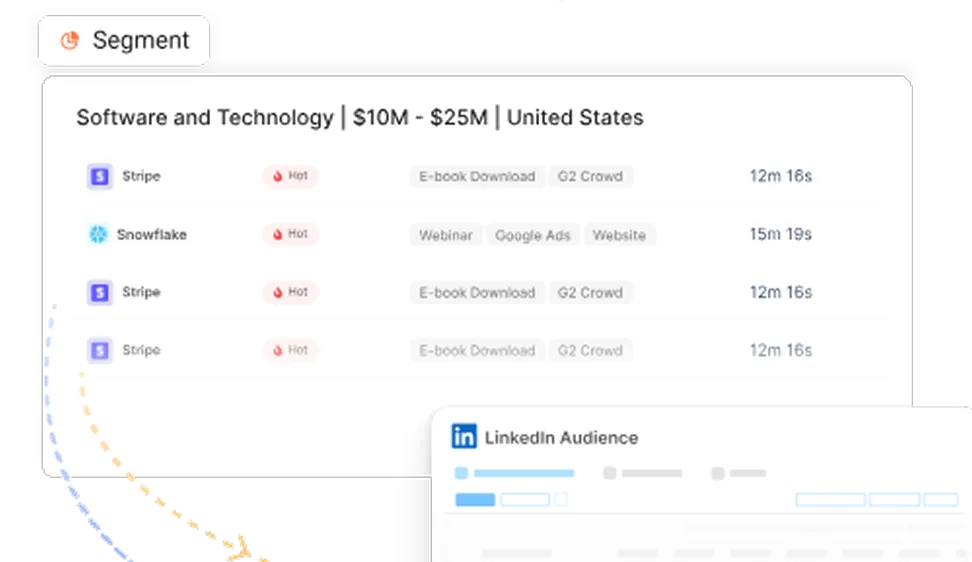
Factors shows you which companies engaged with your document ads versus your single-image ads. Not just which individuals clicked, but which target accounts showed sustained engagement at the organizational level. That distinction matters enormously for ABM.
- Buying committee reach
You can see whether a particular ad format reached multiple stakeholders within the same account. If your document ad was viewed by three people from the same company, that's a different signal from one person clicking a single-image ad.
- Influenced meetings
Factors connects ad engagement to downstream meeting activity. You can compare which format had a higher rate of influenced meetings booked, regardless of whether the meeting came from a direct click or a view-through interaction.
- Pipeline velocity
Beyond just "did this create pipeline," you can see whether one format accelerated the deal cycle. Did accounts that engaged with document ads move through stages faster than those that saw single-image ads?
- Segment and region analysis
Performance often varies by geography, industry, or company size. Factors lets you slice the comparison by segment, so you're not making one-size-fits-all format decisions when your audience is anything but uniform.
A few specific product capabilities make this analysis a little more useful. LinkedIn AdPilot automates campaign optimization based on account-level signals, not just individual engagement. The Company Intelligence API surfaces firmographic and behavioral data that enriches your ad performance analysis. Cross-channel attribution connects LinkedIn touchpoints to the rest of the buyer journey, including website visits, email engagement, and CRM activity. And audience sync lets you retarget document ad viewers with follow-up campaigns, creating a sequenced experience rather than a one-shot interaction.
The net effect is that you stop choosing between formats based on which one had a lower CPC last month. You start choosing based on which one actually influenced revenue. That's a fundamentally different conversation, and it's the one most B2B marketing teams should be having.
Testing framework: How do you choose the winner?
Opinions about ad formats are plentiful. Data about ad formats is harder to come by. If you genuinely want to know whether LinkedIn document ads or single-image ads perform better for your specific audience, offer, and buying cycle, you need to run a structured test. Not a casual experiment where you try both formats with different audiences and different budgets, but a controlled comparison that isolates format as the variable.
Here's a framework that works. It's not complicated, but it does require discipline.
Step 1: Set up two parallel campaigns
Create Campaign A using document ads and Campaign B using single-image ads. Both campaigns should run simultaneously for a minimum of 30 days. Shorter tests rarely generate enough data to draw meaningful conclusions, especially in B2B where conversion cycles are measured in weeks, not hours.
Step 2: Hold everything else constant
This is where most tests fall apart. For the comparison to be valid, the following elements must be identical across both campaigns:
- Target audience (same segments, same account lists)
- Total budget (split evenly or use equal daily budgets)
- Offer (both ads should promote the same thing)
- Bidding model (same bid strategy for both)
- CTA (same call to action in both formats)
If you change the audience or the offer between the two campaigns, you're no longer testing the format. You're testing a dozen variables at once and attributing the result to whichever one you happened to be thinking about.
Step 3: Measure the right things
Here's where the framework earns its value. Don't stop at CTR and CPC. Track these metrics across both campaigns:
- CTR (click-through rate): the most basic engagement signal.
- CPC (cost per click): how much each click costs you.
- Cost per engaged company: how much it costs to generate meaningful engagement from a target account.
- Demo requests: how many of those engaged users take the next step.
- Opportunities created: how many demo requests converted to qualified pipeline.
- Pipeline value: the total dollar value of the pipeline influenced by each format.
The first two metrics tell you which format is more efficient at generating surface-level activity. The last four tell you which format is actually contributing to revenue. I've seen plenty of tests where Campaign B (single-image) won on CTR and CPC, but Campaign A (document ads) won on pipeline value by a significant margin. If you'd stopped measuring at CPC, you'd have scaled the wrong format.
Step 4: Interpret with context
After 30 days, look at the results holistically. Don't cherry-pick the metric that confirms your pre-existing preference. If document ads had a higher CPC but generated 3x more pipeline, that's a clear signal. If single-image ads drove more leads but none of them converted past the initial meeting, that's equally informative.
CTR can help you pick ads, but pipeline really helps pick winners. That's the single most important distinction in B2B ad testing. Your weekly dashboard might favor one format, but your quarterly business review might tell a completely different story. Make sure you're listening to both.
Document ads vs. single-image ads: The final(ish) verdict
After everything I've covered, the answer is that neither format is universally better. That probably isn't the definitive proclamation you were hoping for, but it's the truth, and I'd rather be useful than… dramatic.
If your offer is simple, urgent, or conversion-ready, single-image ads are hard to beat. They load fast, they're easy to produce, and they work well for audiences who already know what you do and just need a reason to act now. For retargeting campaigns, event promotions, and bottom-of-funnel CTAs, they remain one of the most efficient LinkedIn ad formats available.
If your offer requires trust-building, education, or buy-in from multiple stakeholders, LinkedIn document ads deserve a much larger share of your budget than they're probably getting right now. For SaaS, enterprise software, fintech, martech, and any high-consideration product, document ads are consistently underused and underrated. They do the mid-funnel education work that shortens sales cycles and improves lead quality, and they do it inside the feed where your audience is already spending time.
For what it's worth, the strongest B2B LinkedIn strategies I've seen in 2026 don't pick one format and ignore the other. They sequence both. The pattern looks something like this: use single-image ads for reach and initial awareness. Use document ads to nurture and educate the accounts that showed interest. Then retarget engaged accounts with a direct demo CTA using a single-image ad.
That sequencing creates a journey rather than a single touchpoint. And in B2B, where nobody buys from one ad impression, the journey is what matters.
One more thing worth saying: the marketers who consistently make the best format decisions aren't the ones with the strongest opinions about document ads versus single-image ads. They're the ones with the best measurement infrastructure. When you can see which format is actually influencing pipeline, by account, segment, and stage of the funnel, the decision almost makes itself. Investing in that visibility, through tools like Factors.ai or whatever measurement stack fits your organisation, pays for itself many times over.
In a nutshell…
Here's what this all comes down to. LinkedIn document ads and single-image ads serve different purposes, attract different types of engagement, and influence pipeline in different ways. Treating them as interchangeable is the fastest way to misallocate your LinkedIn ad budget.
Single-image ads give you speed, simplicity, and strong direct-response performance. They're ideal when the CTA is clear and the audience is already warm. Document ads give you depth, education, and richer intent signals. They're ideal when the prospect needs context before they'll commit, which describes most enterprise B2B buying journeys.
The metrics you use to compare the two matter as much as the formats themselves. CTR and CPC will tell you one story. Pipeline influenced, cost per engaged company, and opportunity creation rate will tell you a more complete, and often very different, one. Invest in measurement that captures both layers.
If you're running B2B LinkedIn ads in 2026, the move is straightforward: stop defaulting to one format out of habit. Run a controlled 30-day test using the framework in this article. Measure beyond surface metrics. Sequence both formats into a cohesive journey. And use account-level intelligence from tools like Factors.ai to let the data, not your instinct, guide your budget allocation.
The teams that treat format selection as a strategic decision, rather than a creative preference, are the ones that consistently turn LinkedIn spend into pipeline. That's the goal, and now you've got a framework to get there.
Frequently asked questions about LinkedIn document ads vs single-image ads
Q1. What are LinkedIn document ads?
LinkedIn document ads let advertisers promote PDFs, slide decks, or presentations directly inside the LinkedIn feed. Users can swipe through the content natively without leaving the platform, which makes them especially effective for delivering multi-page content like benchmark reports, case studies, and playbooks. They can be gated with a Lead Gen Form to capture contact details or left ungated for pure awareness campaigns.
Q2. Are LinkedIn document ads better than single-image ads?
For complex B2B offers, they often are. Document ads typically create deeper engagement and stronger mid-funnel intent because users actively consume multiple pages of content before converting. That self-education step tends to produce warmer, more qualified leads. However, single-image ads remain better suited for simple, direct-response campaigns where the CTA is immediately clear.
Q3. Do document ads cost more on LinkedIn?
Not necessarily. CPC and CPL can vary depending on your targeting, creative quality, and bidding strategy. In some cases, document ads have a higher CPC because the interaction is more involved. But when you factor in lead quality, opportunity creation rate, and pipeline value, the true cost of acquisition with document ads is often lower. Surface-level cost metrics don't capture the full picture.
Q4. Are single-image ads still effective?
Absolutely. Single-image ads remain one of the most reliable LinkedIn ad formats for direct-response campaigns. They're fast to produce, easy to iterate on, and work particularly well for webinar signups, demo CTAs, retargeting warm audiences, and any scenario where the message is immediately clear. They haven't lost their relevance; they've gained a complement in document ads.
Q5. Which format is best for lead generation?
Single-image ads tend to generate leads faster and at a lower initial cost per lead. Document ads tend to generate higher-quality leads that convert to pipeline at better rates. The best answer, genuinely, is to test both with the same audience and offer and then measure not just CPL but downstream metrics like demo bookings, opportunities created, and pipeline value. Speed and quality are different goals, and your format choice should match whichever one your funnel needs most.
Q6. Can Factors.ai measure LinkedIn ad performance beyond CTR?
Yes. Factors.ai connects LinkedIn engagement data to account-level pipeline outcomes. You can see which companies engaged with each ad format, whether ads reached multiple stakeholders within the same account, which format influenced meetings booked, and how each format contributed to pipeline velocity and revenue. It goes well beyond CTR and CPC to give you the visibility needed to make format decisions based on business impact, not vanity metrics.

See how Factors can 2x your ROI
Boost your LinkedIn ROI in no time using data-driven insights


.avif)

See Factors in action.
Schedule a personalized demo or sign up to get started for free
LinkedIn Marketing Partner
GDPR & SOC2 Type II





.svg)



.avif)

