
LinkedIn Thought Leader Ads: The Complete Guide for B2B Marketers
See how B2B teams are using LinkedIn Thought Leader Ads in 2026, with real examples, benchmarks, and tips on what actually works.
.avif)
Content Marketer



.svg)


TL;DR
- Thought Leader Ads sponsor an existing LinkedIn member's post and distribute it to a paid audience through Campaign Manager.
- In a Factors.ai survey of 125+ US-focused B2B marketing leaders, 53% said they amplify organic posts with Thought Leader Ads.
- Don't choose posts only because they got a lot of organic likes. Start with who you want to reach, what they care about, and who has the credibility to talk about it.
- Thought Leader Ads can work at the top and middle of the funnel. The role of the content should change as the buyer gets closer to evaluation.
- Treat engagement as a signal, not proof of intent. Website activity, account engagement, CRM activity, and progression through pipeline give you much more context.
- LinkedIn reports 252% higher CTR and 62% lower CPC for Thought Leader Ads compared with conventional single-image posts. Those are LinkedIn benchmarks, not a guarantee of what your campaigns will produce.
What are LinkedIn Thought Leader Ads?
A LinkedIn Thought Leader Ad is paid promotion of an organic post from a LinkedIn member's profile.
Instead of creating the ad from your company page, you promote an existing post from a person. The author's name, profile, post copy, and existing engagement remain attached to it. The advertiser chooses who sees the post and how much budget to put behind it.
The author must approve the sponsorship. LinkedIn also allows authors to enable auto-approval for future requests from advertisers they are comfortable working with.
For standard Thought Leader Ads, the creative is effectively locked to the original post. You can't add separate introductory copy, a headline, or a CTA button in Campaign Manager. If the author included a link in the original post, that link remains clickable when the post is sponsored. Standard Thought Leader Ads can't be created from multi-image posts, polls, or document posts.
LinkedIn currently supports Thought Leader Ads with Brand Awareness, Engagement, and Video Views objectives. The platform also has thought-leader versions of event, article, and newsletter ads under the relevant formats.
How do you set up LinkedIn Thought Leader Ads?
Setting up a Thought Leader Ad in LinkedIn Campaign Manager comes down to getting the right permissions, creating an eligible ad set, choosing the member post you want to promote, and getting the author’s approval.
LinkedIn’s official setup documentation was updated in August 2026, so use it as the source of truth if Campaign Manager changes. LinkedIn’s guide to creating Thought Leader Ads
- Check your permissions
- You need 'Super Admin', 'Content Admin', or 'Sponsored Content Poster' access on the LinkedIn Page associated with the ad account.
- You also need 'Creative Manager' access or higher on the ad account.
- The LinkedIn member whose post you want to sponsor must approve the sponsorship request.
- Create an eligible ad set
- Choose 'Brand Awareness', 'Engagement', or 'Video Views' as the objective.
- Select an ad format that matches the post you want to sponsor. LinkedIn currently supports single image, video, article/newsletter, and event formats for Thought Leader Ads.
- Set your audience, budget, schedule, bidding, and placements as you normally would for a LinkedIn campaign.
- Find the post you want to promote
- Go to 'Ads in this ad set' and click 'Browse existing content'.
- Select 'LinkedIn members', then open the 'Posts' tab.
- Search by the member’s name or paste the post URL.
- LinkedIn currently lets you search posts from employees as well as 1st- and 2nd-degree connections.
- Request approval from the author
- Select the post and click 'Request approval'.
- LinkedIn emails the author, or you can copy the approval link and send it to them directly.
- Campaign Manager shows whether the request is 'Pending, Approved, or Declined'.
- Authors can also approve all pending and future sponsorship requests if you plan to promote their posts regularly.
- Check the post before you launch
- For standard Thought Leader Ads, the original post is the creative. You can’t add separate introductory copy, a headline, or a CTA button in Campaign Manager.
- If you want the ad to link to your website, the URL needs to be in the original organic post.
- Multi-image posts, polls, and document posts aren’t eligible for standard Thought Leader Ads.
- LinkedIn keeps the latest creative requirements here: Thought Leader Ad specifications
- Launch once the post is approved
- After the member approves the request, the post becomes available to sponsor.
- Add it to the ad set, review your audience and budget, and launch the campaign.
- If the author later revokes permission, LinkedIn will stop that ad from running.
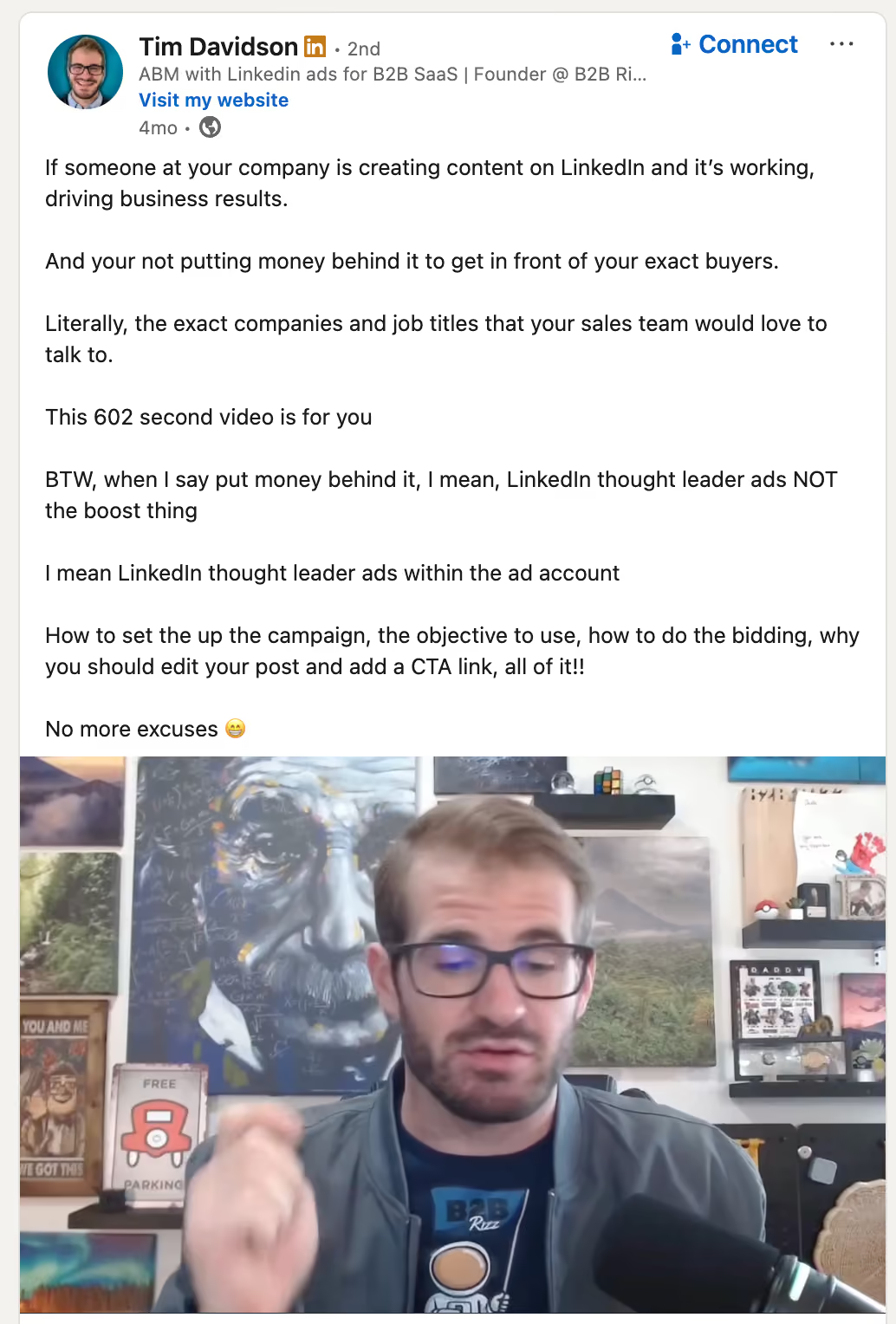
For a practical Campaign Manager walkthrough, Tim Davidson (Founder and CEO of B2BRizz) published a 10-minute video showing how he sets up Thought Leader Ads, including campaign structure, audience setup, bidding, and preparing the original post before sponsorship. His exact campaign recommendations are his own rather than LinkedIn requirements, but the walkthrough is useful if you want to see the process rather than read another set of instructions.
Recommended read: LinkedIn ad copy and creative best practices
How much do LinkedIn Thought Leader Ads cost?
Thought Leader Ads don’t have their own fixed price. They run through LinkedIn’s ad auction, with costs affected by the audience you are competing for, the campaign objective, bidding strategy, and the level of competition for those impressions. LinkedIn lets advertisers control the daily or total budget and uses a combination of bid value and expected engagement to determine which ads win an auction.
There are now some useful Thought Leader Ad benchmarks, although they should be treated as directional rather than universal.
ZenABM’s 2026 LinkedIn benchmark report analyzed 119 image Thought Leader Ads. The median TLA in its dataset had a $2.29 LinkedIn CPC and $49.37 CPM, with a 2.68% overall CTR. The median landing-page CTR was much lower at 0.29%, which is another reason not to treat every LinkedIn engagement as a website visit.
Why are B2B marketers investing in LinkedIn Thought Leader Ads?
Thought Leader Ads are growing at the same time B2B marketers are putting more emphasis on awareness and consideration rather than expecting every LinkedIn impression to generate an immediate lead.
In Factors.ai's LinkedIn benchmark research, the share of campaigns using Brand Awareness and Engagement objectives increased from 17.5% to 31.3%, while the share using Lead Generation fell from 53.9% to 39.4%. The analysis covered LinkedIn performance data from 100+ Factors.ai customers, alongside a survey of 125+ US-based B2B marketing leaders.
And 53% of these marketers surveyed said they were already using Thought Leader Ads to amplify organic posts.
There is a buyer-side reason for that investment too.
The 2025 Edelman–LinkedIn B2B Thought Leadership Impact Report found that 71% of hidden decision-makers believe thought leadership is more effective than traditional sales or marketing material at demonstrating a vendor's potential value. Another 64% said they trust thought leadership more than product sheets and conventional marketing when assessing a company's capabilities.
This is extremely relevant in B2B because the people who influence a purchase aren't always the people your sales team is actively talking to. Finance, procurement, compliance, legal, IT, and other stakeholders may encounter the company's thinking long before they enter a formal buying process.
LinkedIn's own campaign data also makes the format interesting to test. LinkedIn reports 252% higher CTR and 62% lower CPC for Thought Leader Ads compared with single-image ads, along with higher Lead Gen Form completion rates in campaigns using the format.
What should you promote with LinkedIn Thought Leader Ads?
A common way to choose Thought Leader Ads is to look through your executives’ posts, find the ones with the most likes and comments, and put money behind the winners.
Organic performance is useful evidence, but it shouldn’t be the entire strategy. A post can perform well and still be irrelevant to the audience you actually want to reach. The topic, author, and B2B target audience need to make sense together.
Before you put budget behind a post, there are a few things worth getting right.
Match the Thought Leader Ad topic to the audience
In a recent webinar, Praveen Das (CMO and Co-founder of Factors.ai) spoke with Alex Goodwin, Director of Demand Generation at Fingerprint, about how Fingerprint has evolved its approach to sponsored thought leadership.
Fingerprint initially pushed different executive posts into the same broad LinkedIn brand audience. Over time, Alex saw engagement decline because the same people didn’t care about every topic the company discussed.
His example is straightforward. Someone in demand generation may care about reducing acquisition costs, but not about product marketing strategy. Both fall under “marketing,” but they are relevant to different people.
The lesson is to start with the subject and ask who would genuinely care about it. Fingerprint has seen better engagement when the content goes deeper for a smaller, more relevant audience rather than trying to appeal to everyone.
Choose an author who has credibility on the topic
The CEO is not automatically the best person to sponsor. Fingerprint considers whether a topic makes more sense coming from the CEO, CTO, VP of Product, or someone in engineering. A technical audience may trust the person closest to the problem more than the most senior person in the company.
Alex summed it up well: “The topic needs to line up with the poster, which needs to line up with the audience.”
Build the paid audience around the Thought Leader Ad
Once the topic and author are clear, build the audience around the post.
Instead of creating one broad audience and feeding every executive post into it, ask who would genuinely benefit from seeing this particular one. For broader topics, that may still be your wider ICP. For more specific posts, it could be one industry, job function, named-account list, or part of the buying committee.
This is especially useful in ABM. Fingerprint maps executives, decision-makers, influencers, and end users separately because they care about different parts of the buying decision.
You don’t need one Thought Leader Ad to speak to all of them.
Don’t choose Thought Leader Ads based on organic engagement alone
Organic engagement still matters. It tells you the post resonated with someone.
But look at who engaged, not just how many people did.
A post for CISOs with 40 reactions may be more useful than a founder post with 1,000 reactions if your paid campaign is aimed at security leaders in target accounts. Before sponsoring a post, check whether the right people engaged with it organically, whether the topic matches the paid audience, and whether the author has a natural connection to the subject.
There’s also a broader paid-and-organic point here. Alex describes Fingerprint’s LinkedIn strategy as building credibility through executive viewpoints and proprietary research without constantly talking about the company itself. When someone later sees a paid post and looks up the author or company, there is already a body of useful content behind it.
Watch Alex explain how Fingerprint moved from broad sponsorship to more targeted Thought Leader Ads, and why the topic, author, and audience need to line up. Jump to 51:01–54:41.
Where should LinkedIn Thought Leader Ads sit in the B2B funnel?
Thought Leader Ads are most useful across awareness and consideration. Early on, they help get a credible point of view in front of buyers who may not know your company yet. As buyers become more familiar with you, the content can get more specific and help build confidence in the people and expertise behind the product.
Use Thought Leader Ads for awareness when buyers don’t know you yet
Our LinkedIn benchmark report places Thought Leader Ads in the unaware stage, where the goal is to build brand awareness and mental availability before target accounts begin actively evaluating vendors. The report specifically calls out promoting executive POV content to target ICPs as one of the ways marketers are using paid LinkedIn at this stage.
This is where broader thought leadership makes sense. A strong opinion on the category, proprietary research, a practitioner lesson, or a useful explanation of an emerging problem can give buyers a reason to notice you before they have any reason to visit a product page.
You are not trying to close the deal here. You are trying to make sure the company and the people behind it aren't completely unfamiliar when the buyer eventually enters the market.
Thought Leader Ads become more useful when buyers are considering solutions
This is where the format gets particularly interesting.
Our benchmark research found that 44% of surveyed marketers said LinkedIn Ads add the most value during the consideration stage. At that point, buyers are comparing vendors, building internal cases, and looking for evidence that the companies they're evaluating actually understand the problem.
The content can become more specific too. Instead of a broad category opinion, you might promote a post about an implementation challenge, a common mistake, an evaluation trade-off, or another issue buyers are actively working through.
This is also where Joshua Stout, founder of Beyond the Funnel and a LinkedIn Certified Marketing Expert, would prioritize Thought Leader Ads if he had to choose only one stage. In a recent Factors.ai webinar with Praveen Das, he explained that he sees them as particularly useful in the middle of the funnel because they can add credibility after someone has already shown meaningful interest in the company.
“If I had one spot to run Thought Leader Ads, it would probably be middle of funnel.”
Don't rely on Thought Leader Ads as your main bottom-of-funnel format
Once someone is close to a decision, the advertising usually needs to become more explicit.
Customer proof, ROI, implementation details, testimonials, and a clear next step tend to matter more than another broad thought-leadership post. Our benchmark report reflects that shift as well. In the selection stage, it highlights things such as implementation success stories, peer testimonials, and final-stage proof aimed at the economic buyer.
A Thought Leader Ad can still reinforce confidence in an open opportunity, especially if the post addresses a concern the buying committee cares about. But I wouldn't force the format into a direct-response role just because it performed well earlier in the journey.
How should you target LinkedIn Thought Leader Ads?
Start with the people the post was written for, not with every targeting filter LinkedIn makes available.
For broader campaigns, that could mean a combination of company size, industry, job function, seniority, and geography.
For LinkedIn ABM, an account list often gives you a cleaner starting point. Joshua recommends using company lists wherever you have them rather than relying entirely on LinkedIn's native industry classifications, which can be fairly broad.
Ask:
- Which function cares about this problem?
- At what seniority level?
- Is this relevant to practitioners, decision-makers, or both?
- Does the author's role match the audience?
- Is the post broad enough for the whole account, or should it go to one part of the buying committee?
This is where LinkedIn Thought Leader Ads can become more useful than simply sponsoring a founder's most popular post to every target account.
Should a LinkedIn Thought Leader Ad link to your website?
It depends on the post.
If someone can get the full value from the post itself, you don't need to send them anywhere else. This works well for an opinion, an observation from experience, original data, or a point of view that stands on its own.
A link is useful when there is a natural next step. You might be discussing a larger piece of research, an event, a detailed guide, or something else the reader may want to explore further. In those cases, giving them a way to continue makes sense.
Joshua Stout has tested both approaches. In our conversation with him, he said he hasn't seen a consistent advantage from keeping everything on LinkedIn. He has also seen promoted Thought Leader posts drive website visits efficiently.
Don't add a link simply because you want more website traffic. The destination should follow naturally from what the person is talking about. Sending someone from a useful post to a generic product page usually adds very little.
Keep in mind that LinkedIn doesn't let the advertiser add a separate destination URL to a standard Thought Leader Ad. If the original organic post contains a URL, it remains clickable when the post is sponsored. Thought Leader Ads also don't support a separate CTA button.
Should you retarget people who engage with Thought Leader Ads?
Sometimes, but engagement with a Thought Leader Ad is not automatically a strong enough signal to retarget someone.
Joshua has tested a common sequence where marketers run Thought Leader Ads at the top of the funnel, build an audience from everyone who engages, and then move those people into nurture or more direct campaigns. He has become much more selective about that approach.
He explains:
“I don’t really like to retarget them as much. Some people may disagree with this, but I don’t think there’s a lot of intent there. When I try to retarget people that engaged with Thought Leader Ads or only watched 50% or 25% of a video, and now I’m trying to nurture them and serve them additional content, I just don’t see the greatest results. I feel that I’m spending money on people that didn’t necessarily say they were interested in the product. Even though they may have engaged with it, they might not be anywhere near the point of saying, ‘Hey, I want to check this out further.’”
His preference is to retarget based on buyer intent signals. In the same conversation, Joshua mentioned website visits, company-page visits, CTA clicks, and people who watched at least 97% of a top-of-funnel video, rather than treating a partial view or a general engagement as enough on its own.
The distinction matters because a good Thought Leader Ad can earn attention without creating product interest. Someone may like the argument, agree with the person posting it, or find the content useful without wanting to evaluate the company behind it.
For B2B teams, the picture gets stronger when that LinkedIn engagement is followed by other activity. A person visits the website. Several people from the same account start engaging. The account returns to high-intent pages. CRM activity picks up. Those signals together tell you far more than a reaction to a single post.
Thought Leader Ad engagement can therefore be useful for building retargeting audiences, but the threshold should match what you plan to do next. The more direct the follow-up, the stronger the intent signal should be.
How should you measure LinkedIn Thought Leader Ads?
Thought Leader Ad performance is easier to understand in three stages. First, check whether you reached the accounts and people you wanted. Then look at whether those accounts showed stronger intent after seeing or engaging with the ad. Finally, track whether the accounts showing the strongest intent progressed into meetings, opportunities, and pipeline.
That gives you a better picture than judging the campaign only by CTR or engagement rate.
Did the right accounts see and engage with your Thought Leader Ads?
Start with the campaign itself.
Reach, impressions, clicks, engagement rate, and video views tell you how the ad performed. For B2B campaigns, the more important question is who those impressions and engagements came from.
Look at whether you reached:
- the target accounts you care about
- the right industries and company sizes
- relevant job functions and seniority levels
- the parts of the buying committee the post was intended for
A post with a lower overall engagement rate can still be more valuable if the engagement is concentrated among the companies and people you actually want to reach.
Did engaged accounts show stronger intent afterwards?
The next step is to look beyond the LinkedIn interaction.
Through LinkedIn's Company Intelligence API, Factors.ai brings paid and organic LinkedIn engagement into the account-level view. You can see those interactions in the same timeline as other account activity and follow how engagement changes over time.
For example, after an account sees or engages with a Thought Leader Ad, does it:
- return to your website
- visit product, pricing, demo, or other high-intent pages
- engage with more LinkedIn content
- show activity from more people within the same company
- start appearing more frequently across other intent signals
Factors.ai's engagement scoring treats behaviors such as pricing-page, product-page, and demo-page visits as stronger indicators of buying interest than a simple ad interaction.
This is where Thought Leader Ad engagement becomes more useful. A like on its own tells you someone paid attention. A like followed by repeated website visits, pricing-page activity, and engagement from several people at the same account tells you something very different.
Did high-intent accounts progress into pipeline?
The final step is to see whether the accounts showing stronger intent eventually turn into commercial outcomes.
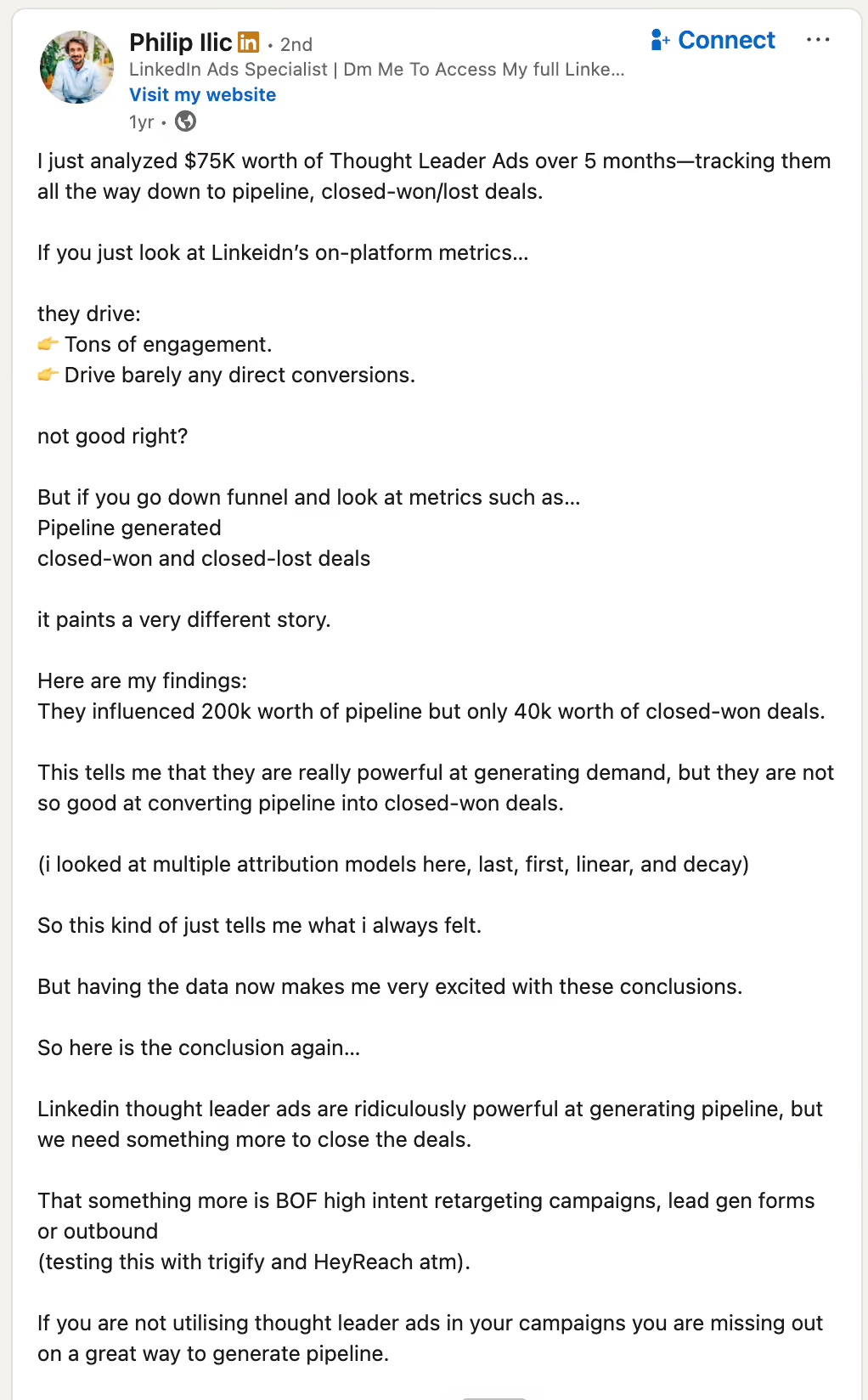
Philip Ilic - Co-founder of Kiin Intelligence - shared a useful example of why this matters. After analyzing roughly $75,000 in Thought Leader Ad spend over five months, he found that the campaigns looked relatively modest if he judged them only by direct conversions. Once he followed those accounts further down the funnel, the ads had influenced roughly $200,000 in pipeline and $40,000 in closed-won revenue.
LinkedIn’s native reporting is useful for understanding what happened on LinkedIn, including impressions, clicks, engagement, and other campaign activity. It becomes harder to answer what happened to those accounts afterwards. Did they return to your website? Visit a pricing or product page? Did more people from the same company start engaging? Did the account eventually enter an opportunity?
That is where Factors.ai can close the gap. Through LinkedIn’s Company Intelligence API, Factors brings paid and organic LinkedIn engagement into the account timeline alongside website and CRM activity. You can follow an account from its LinkedIn interactions through later website visits and eventually to meetings, opportunities, pipeline, and revenue.
This also gives you a more useful way to evaluate Thought Leader Ads. Instead of asking whether one ad directly created a deal, you can see which engaged accounts went on to show stronger intent and which of those accounts eventually progressed into pipeline.
Common LinkedIn Thought Leader Ad mistakes to avoid
- Sponsoring every popular post to the same audience: A post performing well organically doesn’t mean everyone in your paid audience will care about it. The topic, author, and audience still need to line up.
- Choosing the author based on seniority alone: The CEO may be the right person for some subjects, but a CTO, product leader, marketer, or engineer may have much more credibility with a specialist audience. Choose the person who has a natural reason to talk about the topic.
- Treating engagement as buying intent: A like or comment tells you someone paid attention. It doesn’t automatically mean they want to evaluate your product. Stronger retargeting and sales actions should usually wait for additional signals such as website activity, high-intent page visits, or repeated engagement.
- Judging Thought Leader Ads only by direct leads: These ads often play a larger role in awareness and consideration. Look at whether the right accounts are engaging, whether their activity increases afterwards, and whether high-intent accounts eventually progress into pipeline.
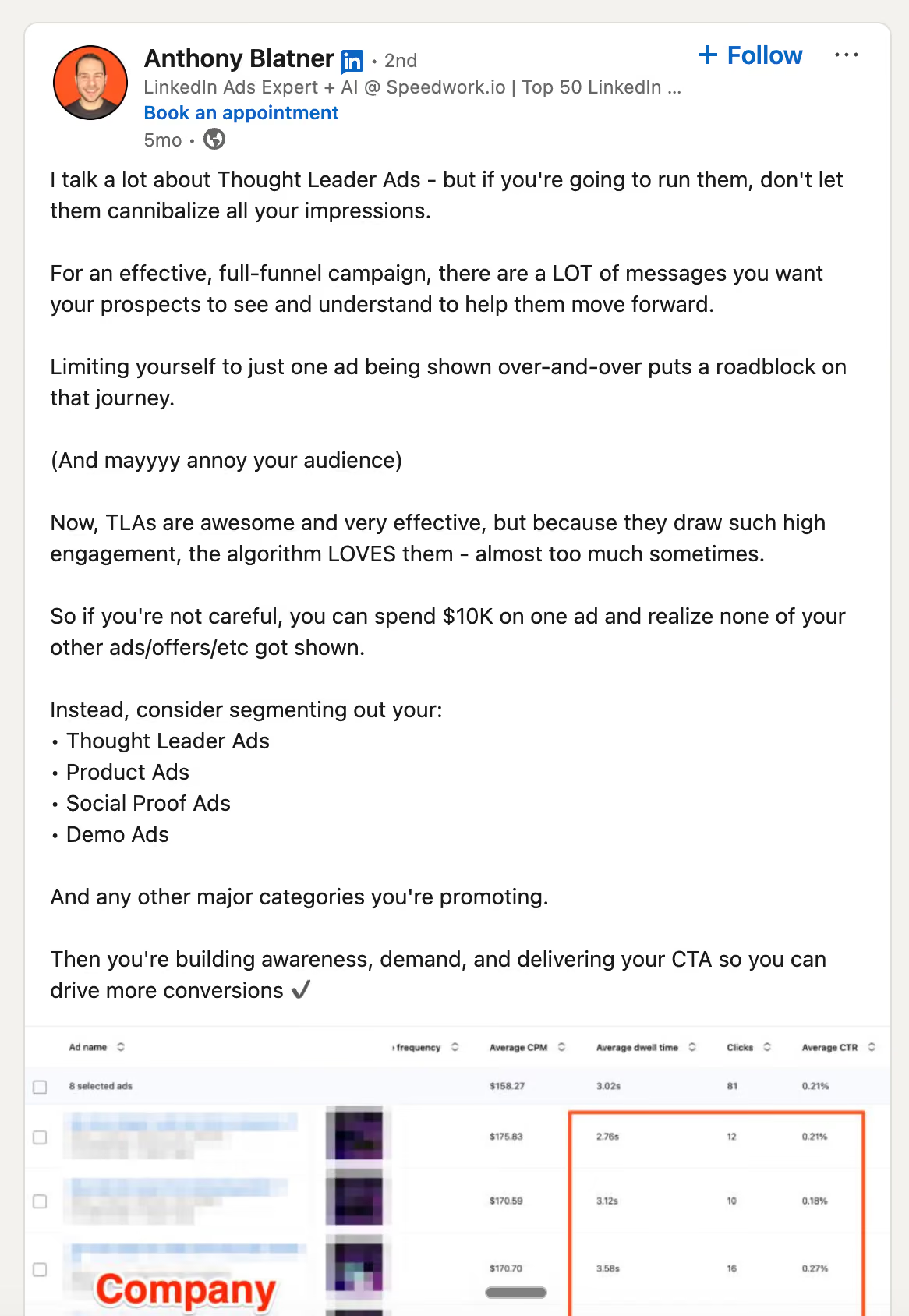
- Letting Thought Leader Ads take over your campaign delivery. Because TLAs can generate high engagement, LinkedIn may start serving them much more heavily than the other ads in the same campaign. Anthony Blatner - the Managing Director of Speedwork - warns that this can leave product ads, customer proof, offers, and other messages with very little delivery. His recommendation is to separate major creative categories when necessary rather than letting one high-engagement TLA absorb most of the impressions.
Are LinkedIn Thought Leader Ads worth it?
For most B2B teams with a strong organic content program, Thought Leader Ads are worth testing.
They give you something ordinary Sponsored Content cannot quite replicate, which is the ability to put paid distribution behind the expertise and opinions of the people inside your company, while still controlling who sees the content.
But the format alone isn't what makes the campaign work. The posts still need to be worth reading. The person publishing them needs to have some credibility on the subject. And paid distribution needs to reach an audience that actually cares about what they are saying.
That is also why the strongest Thought Leader Ad programs tend to sit somewhere between organic social and paid media rather than being treated as another isolated ad format. Organic content tells you what people respond to. Paid distribution gets selected posts in front of more of the right buyers. Account-level measurement can then show whether those buyers become more engaged and eventually move closer to a purchase.
If there is one idea to take from this guide, it is this: don't put budget behind a post simply because it performed well. Put budget behind the right person's point of view when you know who should see it and why they should care.
FAQs about LinkedIn Thought Leader Ads
Can you promote a LinkedIn post from someone outside your company?
Yes. LinkedIn allows Thought Leader Ads to sponsor posts from employees, industry experts, customers, and content creators. The person does not need to work for your company, but they must approve the sponsorship before the post can run as an ad.
Do Thought Leader Ads need to come from executives?
No. The author can be an executive, subject-matter expert, employee, customer, or creator. What matters more is whether the person has credibility on the topic and whether the post is relevant to the audience you plan to reach.
What happens if the author revokes permission for a Thought Leader Ad?
If the author revokes permission, any live ads using that post stop running. LinkedIn lets authors manage sponsorship permissions at any time, including previously approved posts.
Can authors automatically approve future Thought Leader Ad requests?
Yes. Authors can enable auto-approval for a specific advertiser rather than approving every sponsorship request individually. They can approve pending requests, future requests, or both, and turn auto-approval off later if needed.
How many Thought Leader Ads should you run at the same time?
There is no single number that works for every campaign. Run enough posts to test different topics and authors, but watch how LinkedIn distributes impressions between them. If one high-engagement Thought Leader Ad starts taking most of the delivery, separating different creative types into different campaigns or ad sets can give the rest of the content a fairer chance to run.

See how Factors can 2x your ROI
Boost your LinkedIn ROI in no time using data-driven insights


.avif)

See Factors in action.
Schedule a personalized demo or sign up to get started for free
LinkedIn Marketing Partner
GDPR & SOC2 Type II







.svg)



.avif)

