
The 2026 Guide to Marketing Intelligence Tools: Turning Data into Pipeline
Struggling with attribution and dark funnel data? This 2026 guide explains how marketing intelligence tools connect campaigns to revenue.

Writer
.avif)
Content Marketer



.svg)


TL;DR:
- You probably have plenty of marketing data. But you’re probably also missing clarity about what actually drives revenue.
- Most B2B buying happens anonymously. Naturally, traditional analytics can’t show you the full picture.
- Marketing intelligence tools connect buyer behavior to the pipeline, not just to clicks.
- The right stack directs your focus on the accounts and campaigns that truly matter.
- When marketing and sales work the same account signals, fewer leads are wasted and more deals close.
Here's a question that I'm sure you keep dealing with when drowning in dashboards: “Which of my campaigns actually influenced revenue?”
Welcome to 2026, where marketers suffer from data fatigue: too much data, too little intelligence.
You and I spend our days juggling GA4, CRM reports, separate intent feeds, paid media dashboards, and competitive tools. Yet most of the buyer journey seems to be hidden in the shadows, lurking on LinkedIn, browsing reviews on G2, or engaging in communities without filling out any forms.
This part of the customer acquisition funnel seems almost invisible, incessantly leaking revenue and driving us to our wits' end.
We don't need more dashboards. We need actionable intelligence: insight that explains why something happens and what to do next.
What is a modern marketing intelligence solution (a.k.a marketing intelligence tools)?
Have you ever opened a report and been completely confused? Ask most folks in marketing agencies, and they will say yes.
A reporting tool is not the same as a marketing intelligence or competitive intelligence platform. The latter answers questions like:
- Why did these marketing campaigns move the pipeline?
- Which accounts showed real buying intent?
- Where should we reallocate spend to drive more revenue?
Marketing intelligence integrates disparate signals across ad platforms, web engagement, CRM outcomes, and buyer intent. It brings actionable meaning and insight out of these signals.
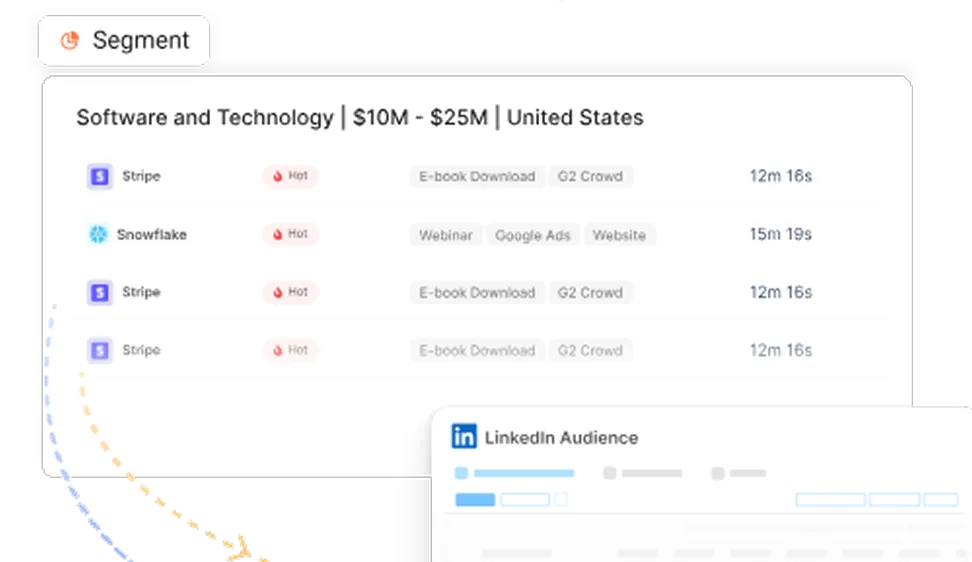
For instance, Factors.ai unifies intent signals from sources you already use, such as LinkedIn ads, website activity, CRM touchpoints, and G2 interactions. It studies momentum across these channels to reveal the full buyer journey from anonymous visitor to closed deal.
Marketing intelligence vs. competitive intelligence tools
These terms are often used interchangeably, which is a mistake. These tools serve completely different purposes in every marketer’s tech stack:
| Aspect | Marketing Intelligence | Competitive Intelligence |
|---|---|---|
| Data Sources | CRM, web analytics, intent signals, campaign performance | Public web signals, competitor sites, news, and pricing changes |
| Who Uses It | Marketing Ops, Demand Gen, Revenue Teams | Strategy, Product, Competitive Strategy |
| Outputs | Multi-touch insights, revenue attribution, buyer behavior | Competitor moves, market positioning, industry trends |
| Focus | Internal + external signals tied to revenue | External signals about competitors |
Competitive intelligence focuses on external signals, such as customer sentiment toward competitors, pricing changes, product movements, and market shifts.
Marketing intelligence connects internal GTM data with external marketing data to measure the effectiveness of your efforts in the real world.
For example, Semrush and Wappalyzer are excellent at identifying raw numbers about competitor traffic and technology signals. Still, they don’t tell you which campaigns drove your campaign performance to actual revenue gains.
{{INLINE_MOFU}}
Top marketing intelligence tools for marketing agencies in 2026
Let's slot these tools and their automation capabilities into a few categories.
Unified Analytics & Attribution
- Factors.ai
Factors.ai is an AI-powered marketing intelligence and ABM platform that helps marketers uncover anonymous buyer intent, track the entire customer lifecycle, and connect marketing touchpoints directly to revenue.
By unifying data from websites, CRM, ad platforms, and intent sources, this tool extracts fragmented engagement data into actionable account-level insights. If you're looking to move beyond vanity metrics and into pipeline-driven decision-making, pick Factors.
Key Features:
- Identifies up to 97% of anonymous website traffic via IP resolution and proprietary enrichment.
- Consolidates intent signals from your website, CRM, LinkedIn, G2, and more.
- Advanced segmentation, scoring, and prioritization based on firmographics, technographics, and behavioral signals.
- Automates actions across CRM and marketing automation platforms, enabling faster response to buying signals.
- Connects campaigns and touchpoints directly to closed-won deals.
- Notifies sales teams when high-intent accounts take key actions (e.g., pricing page visits).
Pros:
- User-friendly interface.
- Strong anonymous visitor identification.
- Deep LinkedIn and ABM optimization capabilities.
- Excellent for sales–marketing alignment.
- Real-time actionable insights.
Cons:
- Does not provide user-level personal data without third-party enrichment.
- Not B2C-friendly.
Pricing:
A free version exists with essential features. For information on the pricing of the paid plan, you have to talk to Sales.
- Funnel.io
Funnel.io centralizes data from hundreds of sources into a single, clean dataset. It solves the data fragmentation problem by automating data collection, transformation, and syncing into BI tools or warehouses.
Key Features:
- Integrates with 500+ ad platforms, CRMs, analytics tools, and marketing sources.
- Automatically cleans, structures, and standardizes data.
- Enables teams to build their own attribution or reporting logic.
- Pushes clean data into Looker, Tableau, BigQuery, Snowflake, etc.
- Eliminates the need for manual CSV imports.
Pros:
- Ideal for data unification.
- Highly flexible in functionality.
- Reduces manual reporting workload.
- Strong enterprise adoption capabilities.
Cons:
- Not an intelligence or insights platform. Only plumbs data for your analysis.
- No built-in attribution modeling.
- Requires BI tools for visualization.
- Steeper learning curve.
Pricing:
Custom pricing based on data volume and connectors.
- Salesforce Marketing Cloud Intelligence (Datorama)
Salesforce Marketing Cloud Intelligence (formerly Datorama) provides enterprise-grade marketing analytics and reporting capabilities. It mostly serves large organizations looking for centralized performance monitoring across different business units, regions, and marketing channels.
Key Features:
- Unified reporting across paid, owned, and earned media.
- Build custom KPIs and taxonomies.
- Automated anomaly detection and forecasting.
- Deep CRM and ecosystem connectivity.
- Role-based access, permissions, and compliance.
Pros:
- Highly customizable.
- Strong enterprise-level scalability.
- Native Salesforce ecosystem fit.
- Powerful visualization capabilities.
Cons:
- Definitely on the more expensive side.
- Comes with long implementation cycles.
- Not purpose-built for B2B intent capture or ABM deployment.
- Limited anonymous visitor tracking.
Pricing:
Custom enterprise pricing.
Competitive intelligence tools
These tools don't strictly deliver marketing intelligence, but are required for accurate positioning and messaging.
- Crayon
Crayon is designed to monitor competitors’ digital footprints, messaging changes, and product updates. It helps revenue teams stay informed about market movements and adjust positioning accordingly.
Key Features:
- Tracks changes across websites, landing pages, ads, and messaging.
- Dynamic sales enablement content for reps.
- Identifies trends and strategic shifts.
- Real-time change detection.
- Syncs with CRM and sales tools.
Pros:
- Provides excellent competitive visibility.
- Offers strong sales enablement features.
- Enables automated change tracking.
- Comes with an exceptionally intuitive UI.
Cons:
- Not a marketing intelligence or attribution tool.
- No intent data.
- No revenue attribution.
- Limited GTM analytics.
Pricing:
Custom pricing.
- Klue
Klue is a competitive enablement platform. It helps revenue teams win deals by aggregating competitor insights and turning them into actionable sales content.
Key Features:
- Offers insights into why deals are won or lost.
- Can build centralized competitor messaging.
- Tracks competitor changes.
- Enables sales, product, and marketing alignment.
- CRM Integrations with Salesforce, HubSpot, etc.
Pros:
- Strong sales enablement.
- Easy to deploy out of the box.
- Solid internal collaboration features.
Cons:
- Not a marketing analytics platform.
- No attribution.
- No intent capture.
- No anonymous visitor tracking.
Pricing:
Custom pricing.
- AlphaSense
AlphaSense delivers market intelligence and financial research to help organizations analyze macro trends, investor sentiment, and competitive landscapes. The tool is used most often by strategy, finance, and executive teams.
Key Features:
- Enables natural language queries across documents.
- Tracks trends, reports, and filings.
- Runs sentiment analysis to identify tone shifts in the market.
- Competitive research to extract company-level insights.
- Custom alerts to notify teams of major developments.
Pros:
- Extremely powerful research engine.
- Offers deep market intelligence.
- Provides high-quality data sources.
Cons:
- Not designed for marketing ops.
- No attribution.
- No campaign intelligence
- Quite expensive, might break the budget.
Pricing:
Custom enterprise pricing.
C. Martech solutions for intent & growth
- 6sense
This account intelligence platform uses AI to predict which companies are operating actively in-market, what they’re researching, and when to engage them.
Key Features:
- Predictive intent modeling via AI to analyze buying-stage behavior.
- Account identification to recognize anonymous visitors.
- Trigger campaigns based on an account's buying stage.
- Intelligent ad targeting via integrated display and ABM ads.
- Deep sales intelligence with enhanced activity prioritization and alerts.
Pros:
- Strong ABM engine.
- Robust predictive capabilities.
- Large intent data ecosystem.
Cons:
- Complex setup.
- Steep learning curve.
- Heavy on the budget.
- Opaque AI models; mostly black-box.
- Limited transparency in attribution.
Pricing:
- Custom enterprise pricing. Talk to Sales.
- HubSpot
HubSpot is an all-in-one CRM and marketing platform built to assist SMBs and mid-market B2B teams in their marketing efforts. It enables email marketing, automation, analytics, and pipeline tracking from a single interface.
Key Features:
- CRM for contact, company, and deal management.
- Mechanisms to run email campaigns, workflow automation, and lead nurturing.
- Attribution reporting on first-touch, last-touch, and linear models.
- CMS to help build websites, blogs, and landing pages.
- Lead scoring to establish rules-based behavioral scoring.
Pros:
- Low learning curve.
- Easy to set up.
- Multifaceted functions in one UI.
- Strong onboarding and educational resources (HubSpot Academy).
- Large integration ecosystem.
Cons:
- Limited scalability for complex enterprise funnels.
- Weak anonymous visitor and account-level tracking.
- Basic attribution models.
- Not designed to offer intent or predictive insights.
Pricing:
- Free CRM tier available.
- Paid plans can range from hundreds to several thousand dollars per month as features and contacts scale.
Critical features to look for in 2026
You can no longer judge marketing intelligence tools by how many dashboards they offer. Their only real value lies in how precisely they connect buyer behavior to revenue outcomes.
So, here's what to look for when choosing your intelligence tools for marketing or corporate strategy teams in 2026.
- Identity resolution
Most B2B journeys begin anonymously.
Prospects research vendors for days before they fill out a form or speak to Sales. A modern marketing intelligence tool should be able to identify which companies are visiting your site, even if no forms are filled out.
Note: In our B2B Benchmark Report, we found that 92% of B2B buyers start with at least one vendor in mind. Download the report to know more.
Without identity resolution, your ‘pipeline attribution’ is basically running on guesswork.
Choose platforms that combine:
- Reverse IP detection.
- First-party behavioral signals.
- Firmographic and technographic enrichment.
Marketing teams need to move beyond traffic metrics (sessions, pageviews) to account-level intent (which company, how often, and what content they consume). Tools like Factors.ai can help reveal those coveted identities, which fundamentally change how ABM and sales prioritization work.
- Multi-touch attribution
Last-click attribution breaks down in long B2B sales cycles involving multiple stakeholders and weeks of research.
In 2026, any marketing intelligence platform has to model:
- First-touch (what created awareness).
- Mid-funnel influence (content, reviews, ads).
- Late-stage conversion triggers.
Multi-touch attribution shows you:
- Which channels consistently help grow the revenue pipeline?
- Which assets speed up deal velocity?
- Which campaigns influence enterprise deals vs. SMB deals?
- AI-powered insights
Charts tell you what happened. AI can give you ideas for what to do next (though the final decision is yours).
In 2026, intelligence tools should, at a minimum:
- Detect abnormal spikes in account activity.
- Predict the likelihood of conversion by surfacing patterns.
- Recommend next best actions (e.g., notify sales, increase bid, trigger outreach).
For example, if a tool flags that companies visiting your pricing page after engaging with G2 reviews convert 2× faster, it can automatically prioritize similar accounts. It can also recommend reducing expenses on low-converting channels.
- Real-time activation
Intelligence needs to go beyond dashboards and contribute to the actual pipeline.
Your chosen platform should bring to the table:
- Real-time alerts to Slack or CRM.
- Automated campaign triggers.
- Sales handoff based on live intent signals.
For example, if a high-value account shows a surge in engagement, the system should notify sales immediately.
- Privacy-first architecture
Third-party cookies are done.
Privacy laws keep tightening.
That means your marketing intelligence will primarily come from:
- First-party data.
- Company-level identification (not personal PII).
- Server-side and consent-aware tracking.
The best platforms identify accounts while preserving buyer journey visibility.
In 2026, ‘GDPR-compliant’ is a baseline requirement.
Strategic implementation: Building your intelligence stack
| Stack Layer (Bottom → Top) | Primary Role | Example Tools | What It Solves | Key Outcome | Typical Timeline |
|---|---|---|---|---|---|
| 1. Core CRM + MAP | System of record for revenue and lifecycle data | Salesforce, HubSpot | Centralizes contacts, companies, deals, and campaign activity | Single source of truth for pipeline and revenue | 2–4 weeks |
| 2. Intent & Attribution Layer | Unifies behavioral and intent signals and ties them to revenue | Factors.ai, 6sense | Connects anonymous and known activity to real accounts and opportunities | Visibility into what actually influences deals | 1–3 weeks |
| 3. Competitive Intelligence Layer | Monitors external market and competitor activity | Crayon, AlphaSense, Similarweb | Tracks competitor messaging, pricing, and market trends | Stronger positioning and sales enablement | 1–2 weeks |
| 4. Analytics + BI Layer | Normalizes and visualizes data for forecasting and exec reporting | Funnel.io, Looker, Tableau | Cleans data and powers dashboards across teams | Accurate forecasting and strategic decisions | 2–6 weeks |
- Fastest to value: Intent & Attribution and Competitive Intelligence layers.
- Most foundational: CRM + MAP (everything depends on clean data).
- Most resource-intensive: Analytics + BI; depends on data quality and complexity.
Most B2B teams can set up a functional intelligence stack in 30–60 days if the right integrations are prioritized and the scope of action stays within reasonable limits.
Use cases that actually matter
Many marketing intelligence tools look impressive in demos, but not all of them can deliver on real-world revenue targets. The ones that are worth the money generally tend to show a positive impact in the following scenarios.
- ABM campaign optimisation
ABM often fails because teams pick the right accounts and then run the wrong campaigns.
Without market analysis and intelligence, teams end up sending all target accounts the same ads and emails at the same time.
But with market research and insights on business metrics in hand, your ABM strategies can become adaptive. Instead of checking if a campaign drives enough engagement, you can start asking,
“Which accounts moved closer to revenue after seeing this campaign?”
For example, let’s say a SaaS company running LinkedIn ABM discovers that:
- Accounts that saw product comparison ads and then visited pricing pages converted 2–3× faster.
- Accounts that only saw brand ads stalled in the early stages.
To adapt to these patterns, marketers can:
- Shift spend from awareness ads to bottom-funnel creative.
- Change messaging by account tier.
- Trigger SDR outreach only when the right buying behavior occurs.
- Identifying high-intent accounts
Most pipelines run dry because the right accounts aren’t recognized in time.
The modern B2B buyer rarely fills out a form on their first visit. They research your company on G2, scroll on LinkedIn, read competitor websites, and study your pricing page (often more than once).
Marketing intelligence tools carry the analytics and attribution capabilities to surface patterns from within such events. For instance, they can flag:
- Multiple visits from the same company.
- Content progression (blog → case study → pricing).
- Cross-channel signals (ads + website + reviews).
Once you have this information, your team can:
- Prioritize outreach based on behavior, not guesswork.
- Spot in-market accounts weeks earlier.
- Avoid wasting SDR cycles on cold accounts.
- Improving paid media efficiency
Paid media is where intelligence tools pay for themselves the fastest.
Most teams optimize on CTR (Click-through Rate), CPC (Cost Per Click) and for the highest number of conversions.
But monitoring these metrics doesn't answer this question,
“Did this campaign influence real revenue?”
Attribution and account-level tracking do. It lets teams narrow down on:
- Which ads showed up in closed-won deals?
- Which audiences never make it past MQL?
- Which channels correlate with larger deal sizes?
For instance, let's say your team finds that current strategies are contributing to high-engagement LinkedIn audiences but low pipeline contribution.
However, smaller niche audiences seem to lead to higher conversion into SQL and revenue.
The solution? Your team:
- Cuts “vanity engagement” campaigns.
- Reallocates budget to high-intent clusters.
- Designs creative for deal acceleration, not just awareness.
- Aligning marketing + sales on the same signals
Marketing sees leads.
Sales sees accounts.
In real-world organizations, neither trusts the other’s data.
Marketing intelligence tools act as a translation layer between the two.
Instead of “this person downloaded an ebook, sales sees,“this account just surged in activity across product pages and reviews.”
Instead of “we generated 300 MQLs", management sees “these 12 accounts are responsible for 60% of the influenced pipeline.”
When both teams work from the same account signals, attribution logic, and the same definitions of intent, they end up with better prioritization, faster response times, fewer pipeline arguments, and more closed deals.
Summary
By 2026, marketing teams can clearly see traffic, clicks, and conversions. But when someone asks, “Which campaigns actually influenced revenue?” answers are hard to find.
A huge part of the B2B buying journey happens quietly: people researching on LinkedIn, comparing tools on G2, and reading competitor sites without ever filling out a form. This is where a lot of marketing impact goes unseen.
Marketing intelligence tools make that invisible journey visible. Instead of just reporting on metrics, they collate signals from your website, ad platforms, CRM, and intent data to show how real buyers move from first touch to closed deal. They can answer questions like: Which accounts are actually in-market? Which campaigns are helping deals move forward? Where should we stop spending money?
Marketing intelligence is different from competitive intelligence. The former tells you what your competitors are doing. The latter tells you what your buyers are doing and how your efforts affect revenue.
In 2026, marketers need a CRM as the source of truth, an intent and attribution layer to connect behavior to revenue, competitive intelligence for market context, and BI tools for forecasting and reporting. A tailored stack can help teams improve ABM campaigns, find high-intent accounts earlier, reduce wasted ad spend, and align marketing and sales on the same signals.
FAQs for marketing intelligence tools
Q. What are marketing intelligence tools?
Marketing intelligence tools are software products that collect, unify, and analyze data from across marketing channels, buyer behavior, and revenue systems. They analyze data to identify which campaigns influence pipeline and revenue. Unlike basic reporting tools, these platforms tie engagement signals directly to business outcomes.
Q. How are marketing intelligence tools different from analytics or reporting tools?
Analytics/reporting tools answer what happened (traffic, sessions, clicks). Marketing intelligence tools answer why it happened. They relate campaign interaction, buyer activity, and CRM outcomes to highlight which touchpoints influenced revenue and suggest what to do next.
Q. What is multi-touch attribution in marketing intelligence?
Multi-touch attribution monitors how multiple interactions (ads, content, reviews, site visits) contribute to a deal over time. In complex B2B buying journeys with multiple stakeholders, this replaces last-click attribution. It also offers insight into which channels and assets help close revenue.
Q. How do marketing intelligence tools improve paid media ROI?
By connecting ad engagement to real pipeline and closed deals, marketing intelligence tools allow teams to:
- Minimize spending on high-engagement but low-revenue campaigns.
- Reallocate the budget to audiences that convert to SQLs.
- Tailor content for deal acceleration, not just clicks.
- Replace vanity metrics (CTR/CPC) with revenue-based optimization.
Q. How do marketing intelligence tools help align marketing and sales?
Marketing intelligence tools offer a shared view of intent signals and attribution logic across different teams. Instead of marketing teams saying “we generated 300 MQLs,” and sales teams saying “we see accounts, not leads,” both teams use the same account-level behaviors to do their job. This improves prioritization, timing, and conversion outcomes.
Q. Why can’t basic analytics tools show which campaigns influenced revenue?
Basic analytics focus on sessions and conversions tied to last clicks. They don’t:
- Identify which accounts visited anonymously.
- Connect CRM outcomes to multi-touch engagement.
- Unite external intent with internal pipeline data.
Since these tools do not do much for identity resolution or enable multi-touch attribution, they leave massive gaps in operational intelligence.
Q. What features should I look for in a marketing intelligence platform in 2026?
In 2026, look for these features when demo-testing a marketing intelligence platform:
- Identity resolution (map anonymous traffic to accounts).
- Multi-touch attribution across channels.
- AI-powered insights (next best actions).
- Real-time activation (alerts, automated triggers).
- CRM integration (Salesforce/HubSpot).
- Privacy-first architecture (no PII, GDPR/CCPA compliant).

See how Factors can 2x your ROI
Boost your LinkedIn ROI in no time using data-driven insights


.avif)

See Factors in action.
Schedule a personalized demo or sign up to get started for free
LinkedIn Marketing Partner
GDPR & SOC2 Type II

.svg)



.avif)

