
MarTech in 2026: How to Build a Lean, Revenue-Driven Stack
A no-BS guide to MarTech in 2026. Learn how to cut tool sprawl, choose the right marketing intelligence and attribution tools, and prove ROI with revenue metrics.

Writer
.avif)
Content Marketer



.svg)


TL;DR:
- Your martech stack doesn’t need to be bigger; it needs to be smarter and leaner.
- MarTech ≠ AdTech: AdTech buys attention, MarTech turns it into pipeline and revenue.
- The market is huge (15k+ tools) and consolidating. Buying by job-to-be-done is non-negotiable.
- Shortlist tools by category: automation, intelligence, attribution (e.g., Factors.ai), and AI automation.
- Implement with simple 14-day playbooks: connect data, standardise naming, build one exec dashboard, automate a few key journeys.
- Prove ROI with SQL rate, pipeline $, win rate, CAC payback, LTV: CAC, not opens and clicks.
- Run 30-day pilots with clear success criteria; if a tool doesn’t move revenue, don’t keep it.
Marketers, how often do you resonate with the sentence, “My martech stack feels more like a SaaS rescue shelter”?
You know what I mean, a stack full of abandoned tools, overlapping features, and mystery invoices.
Well, you’re not alone.
Most B2B marketing teams operate with tens of tools. And yet, the revenue pipeline is often flat, attribution is fuzzy, and the CFO keeps asking why marketing spends more on software than on branding.
MarTech in 2026 is bigger and smarter than ever. Ironically, it is also more confusing than ever.
That’s where this no-BS guide steps in.
I built this to help people in the trenches: marketing ops, demand gen, and analytics leads at B2B SaaS and services firms who don’t need more tools; they need the right tools.
What Is MarTech (and How It Differs from AdTech)?
MarTech is all the software you use to create, automate, personalize, analyze, and measure your marketing efforts. That covers email, SMS, landing pages, reporting, attribution, AI automation, lead scoring, and dashboards.
Basically, if it touches a marketing workflow, it’s MarTech.
Examples you’ll know of: HubSpot, Marketo, Braze, Factors.ai, Salesforce Marketing Cloud, Funnel, Adverity, Looker, Zapier/Make.
It’s much easier to understand than AdTech, which focuses on buying media, optimizing ads, managing bigs, and working with different ad networks. That’s what Google Ads, Meta Ads Manager, DV360, and The Trade Desk do.
The State of MarTech in 2026: Bigger, Smarter, More Consolidated
If the modern MarTech ecosystem were a city, it would be Mumbai or Manhattan: crowded, expensive, and expanding vertically (and uncontrollably).
- There are 15,384 martech solutions in 2025; up 9% YoY from 14,106 in 2024.
- A staggering 1,211 tools were removed (either through acquisition or simply shutting down) ≈8.6% churn.
- Gartner warns that over 40% of agentic AI projects will be scrapped by 2027 because they were “overhyped” or delivered minimal business value.
Enterprise adoption of AI-native tools is growing fast, but usage depth is low. Everyone’s buying AI market intelligence software, but they don’t seem to know what to do with it…yet.
For you, fellow marketer, that means not just more choice than ever before, but also more noise.
The 2026 Category Map for Market Intelligence Tools
Ever woke up thinking, “Wow, we need another tool.” Me neither. Early morning thoughts usually include, “Why is attribution still lying to me?” or “Why are our leads stalling at SQL?”, "Why aren't these marketing campaigns working?", or "Where are the actionable insights I was promised?"
You pick the right marketing automation tools to give you real competitive intelligence when you think of the job to be done. Forget market trends and industry trends for a bit; what does the tool need to get done for you to thrive?
Here’s a framework that actually maps how operators buy MarTech in the real world:
| Job To Be Done | Outcome You Want | Tool Category | Example Platforms |
|---|---|---|---|
| Orchestrate journeys, automate engagement, scale lifecycle campaigns | Higher engagement, increased SQLs, reduced manual work | Marketing automation SaaS | HubSpot, Marketo, Braze, Salesforce Marketing Cloud |
| Unify data, build dashboards, track emerging market trends & competitors | Single source of truth, better insights, faster decisions | Marketing intelligence tools | Funnel, Adverity, Fivetran • Klue, Crayon |
| Understand what drives pipeline & revenue; reduce wasted spend | Accurate attribution, smarter spend, tighter CAC | Attribution & analytics | GA4, Looker • Factors.ai (multi-touch, account-based attribution) |
| Automate workflows, deploy AI agents, reduce manual load | Faster execution, lower headcount cost, fewer repetitive tasks | AI automation tools | Adobe Agents, Zapier/Make, emerging agentic AI |
{{INLINE_TOFU}}
How to Choose Marketing Intelligence Software in 2026
Don't sign another six-figure martech contract just yet. Before that, run every vendor through this filter. If they fail more than 2–3 of these, you'll probably regret buying the marketing intelligence platform. If it meets all of these, you're buying a competitive edge.
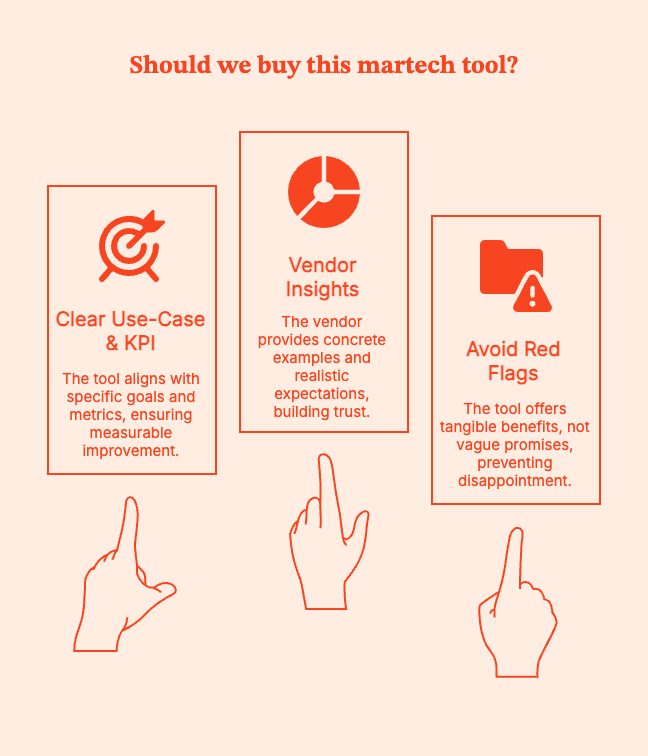
- Clear use-case & KPI: What will this tool move?
Finish this sentence. If you can't, don't buy it.
“We’re buying this tool to [do X], so that we can improve [metric] by [Y%] in [Z months].”
B2B firms usually look at these KPIs:
- SQL rate (lead → opportunity)
- Pipeline generated (by channel/campaign)
- Win rate
- CAC and payback period
- LTV:CAC
Ask vendors:
- “Which specific KPIs do your most successful customers track with your product?”
- “Can you show examples of before/after metrics (anonymized, of course)?”
- “What results should we not expect in the first 90 days?”
Red flags: Vague answers like “better engagement” or “AI-powered experiences” that do not connect to SQLs, opps, or revenue.
- Data model & PII handling
You're not just buying a tool's features but also its data model and risk profile.
With GDPR, CCPA, and many U.S. state laws, mishandled PII creates liability. Fines under GDPR can be up to 4% of global annual turnover or €20M (whichever is higher).
Ask vendors:
- “Do you act as a processor or controller under GDPR?”
- “Where is data stored geographically?
- “How do you handle deletion/‘right to be forgotten’ requests?”
- “What exactly do you store on leads, contacts, and accounts?”
Red flags: If they say, “We’re still working on our DPA,” or “we don’t really store PII… just names, emails, and IPs.”
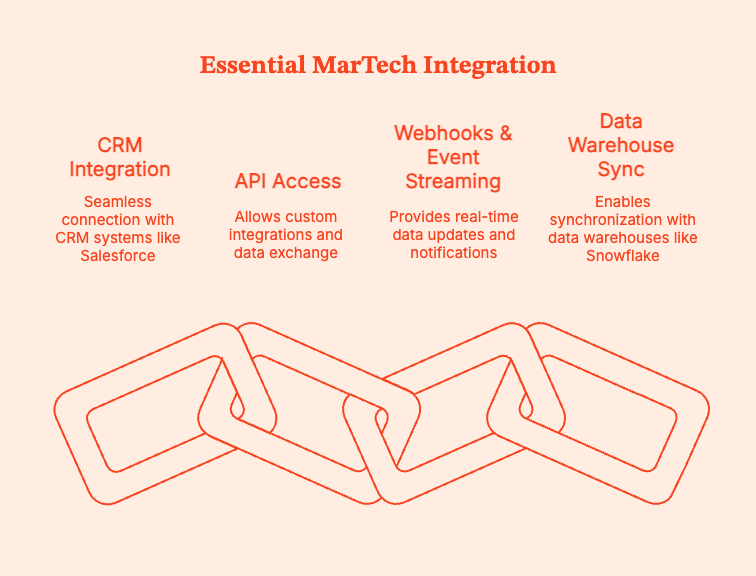
- Integration with CRM / warehouse / CDP
Any tool that cannot connect to your CRM and data warehouse is dead weight. The right marketing intelligence platform will do exactly that.
Data professionals spend ~44% of their time just on data preparation and integration. Integration-hostile tools simply further complicate this conundrum.
Here's what you cannot do without:
- Native integration with your CRM (Salesforce, HubSpot, Dynamics, etc.)
- API access for custom needs
- Webhooks or event streaming for close to real-time updates
- Ability to sync with your warehouse or data lake (Snowflake, BigQuery, Redshift, Databricks)
Ask vendors:
- “Do you have production customers using [our CRM] + [our MAP] with no custom middleware?”
- “What data syncs both ways, and what’s read-only?”
- “What’s the typical integration time with stacks like ours?”
Red flags: They say, “We integrate with everything via Zapier,” or “Yes, we can integrate, you just need a small services project…” RUN.
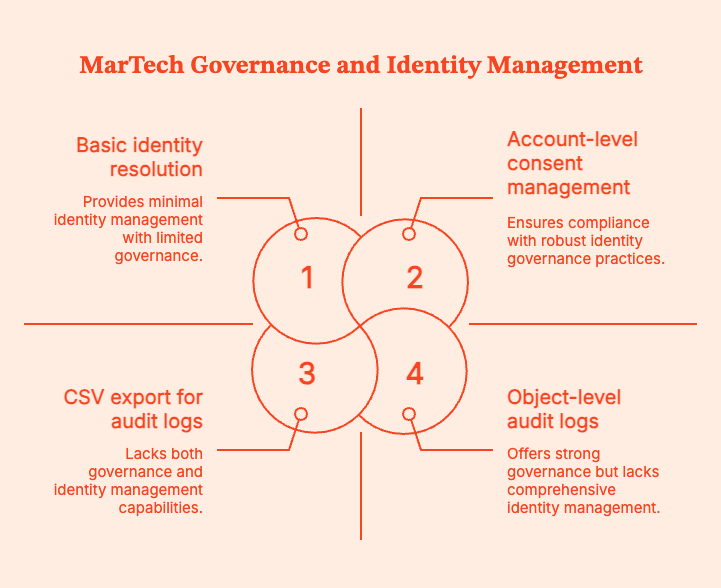
- Governance & audit logs
Governance is non-negotiable, especially when AI or automation enters your stack.
Managers and teams need to know:
- Who created or edited workflows, segments, models?
- When AI acted autonomously vs. when a human approved.
- What data was changed and why?
A 2024 IBM Cost of a Data Breach report found that the average breach costs $4.88M globally. Poor access controls and auditability will make it harder to detect and minimize the impact of customer data breaches.
Ask vendors:
- “Do you have object-level audit logs for workflows, models, and campaigns?”
- “Can we restrict who can publish AI-generated changes?”
- “Can we export logs for compliance?”
Red flags: Anyone says, “We can send you CSV exports if you need history.”
- Identity & consent
In B2B, your real unit of value isn’t just a “lead,” it’s an account. Your tools need to:
- Stitch people to accounts.
- Resolve anonymous traffic by identifying likely accounts (reverse IP, B2B intent data).
- Respect consent and preferences across channels.
Reverse IP and account intelligence tools like Factors.ai can help find companies visiting their sites and connect their activity to CRM accounts. I've personally used it to close large attribution and intent gaps.
You might like to read: Top 7 Marketing Attribution Tools in 2025
Ask vendors:
- “How do you resolve identities across web, email, ads, and CRM?”
- “Do you support account-level journeys and reporting?”
- “Can your platform ingest and respect consent flags from our existing systems?”
Red flags: They say, “We treat everyone as just users with emails”.
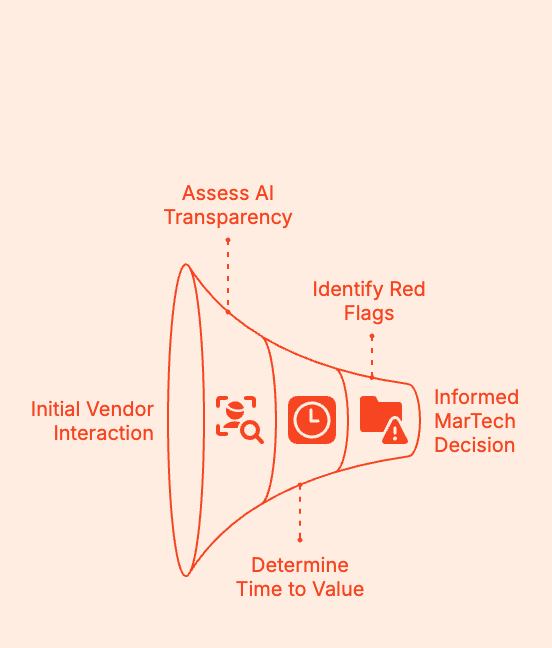
- AI transparency
You need to identify AI tools that deliver valuable insights, driving revenue growth. Don't be fooled by marketing hype.
Ask vendors:
- “List specific tasks your AI can perform end-to-end without human intervention.”
- “What is human-in-the-loop vs. fully automated?”
- “Why was the lead scored high?”
- “If your AI makes a wrong decision, how do we roll back or correct it?”
Red flags: They say, “It just learns from your data,” or “it’s like having a marketing co-pilot.”.
- Time to value (TTV)
Let's say a tool takes 6–9 months to implement, plus another 3–6 months to meaningfully impact the pipeline. That is a 12-month bet.
With a median initial contract length of often 12 months, you might be renewing a tool before you’ve truly seen ROI.
So, ask vendors:
- “What have customers with a stack like ours achieved in the first 30, 60, 90 days?”
- “What is your typical onboarding timeline for [company size/type]?”
- “What’s not realistic to expect in the first quarter?”
Red flags: The vendor says, “It depends,” with no examples from similar customers.
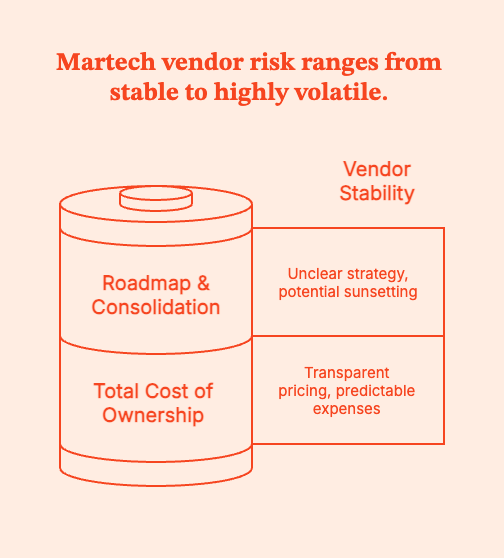
- Total cost of ownership (TCO)
The annual licence is usually the tip of the pricing iceberg.
Real TCO includes:
- Licence/subscription
- Onboarding/implementation fees
- Required seats (marketing, sales, ops, analytics)
- Services (vendor PS, agency hours, contractors)
- Data/storage/compute or AI “credit” overages
- Internal time (ops, analytics, IT)
Zylo’s 2024 SaaS Management Index found that “at least 50% of SaaS licences are underutilised or unused” in many enterprises.
Ask vendors:
- “What’s the typical all-in cost (licences + services) for customers similar to us?”
- “How many FTEs do we realistically need to operate this tool well?”
- “Coverages, add-on modules, mandatory PS?”
Red flags: “We’ll work something out with your rep,” and 14 different SKUs for basic functionality.
- Roadmap & consolidation risk
Martech vendors are being bought, rolled into suites, or quietly sunset. Especially if they incorporate AI or machine learning.
It's possible that your chosen tool might:
- get sunset,
- become a buried feature in a suite,
- pivot away from your use case.
Ask vendors:
- “Where does your product sit in your company’s long-term strategy?”
- “Have you sunset any major features in the last 24 months?”
- “If you were acquired tomorrow, what protections would we have (data export, contract terms)?”
Red flags: Entirely inbound-driven product plans (“we build whatever customers ask”), or obvious “built to flip” intent.
Shortlists to Evaluate: My Recommendations
For more details, we’ve also laid out the 9 Best B2B Marketing Tools and Platforms.
1. Marketing Automation SaaS
- HubSpot
- Marketo
- Braze
- Salesforce Marketing Cloud
2. Marketing Intelligence Tools
- Funnel
- Adverity
- Fivetran
- Klue
- Crayon
- Brandwatch / Sprout Social (for social intel)
3. Attribution & Analytics
- GA4 + Looker
- Factors.ai (multi-touch attribution, account journeys, revenue modeling)
- HockeyStack
- Improvado
4. AI Automation Tools
- Adobe Agents
- Zapier / Make
- Early-stage GTM agents (with caution; proof > promises)
Implementation Playbook: Automation for Data-Driven Decisions
| Phase | Days | What to Do | Output / Milestone | Success Signals |
|---|---|---|---|---|
| Plan | 1–2 | Pick 2–3 revenue-critical journeys (demo, trial, pricing) and define triggers & success metrics | Clear journey map = “Who enters → What they get → What success means” | Alignment across marketing → ops → sales |
| Prepare | 3–4 | Import *only consented* contacts; fix fields (job title, region, lifecycle, source) | Clean, segmented audience with correct lifecycle stages | No “zombie lead” contamination |
| Build | 5–7 | Create 3 flows — Welcome, Nurture, Reactivation — with short, value-forward messaging | All 3 flows completed with logic + content | First batch of leads ready to enter flows |
| Enhance | 8–9 | Add routing: alerts for high intent, tasks for SDRs, simple scoring rules | SDR notified when buying signals spike | Time-to-follow-up drops sharply |
| QA | 10–11 | Check links, triggers, CRM sync, device rendering, unsubscribe/preferences | Zero delivery/UX blockers | Sales won’t get bad-fit or confused leads |
| Launch + learn | 12–14 | Launch → monitor SQL rate, opp creation, cycle speed daily for 5 days | First automated leads progressing through funnel | Increase in SQLs and opps attributable to automation |
Implementation Playbook: Intelligence for Competitive Advantage
| Phase | Days | What to Do | Output / Milestone | Success Signals |
|---|---|---|---|---|
| Connect | 1–2 | Sync CRM + ad platforms + automation platform into single pipeline | All performance + funnel data flowing | No manual reporting patchwork |
| Normalize | 3–5 | Standardize naming (region, channel, segment, stage, objective, campaign type) | Unified taxonomy adopted across channels | Reporting filters become usable |
| Build | 6–9 | Create ONE executive dashboard (Leads → SQL → Opp → CW, CAC, attribution influence) | CRO-friendly dashboard with 60-sec readability | Leaders voluntarily reference it |
| Analyze | 10–11 | Track anomalies and trends every week across CPL, SQL%, spend, opp cost, and pipeline contribution | Weekly “show me what changed and why” | Decisions driven by insights, not opinions |
| Share | 12 | Present 30-minute readout: 🔹What’s working 🔹What’s not 🔹What we’re changing next | Leadership alignment + budget flexibility unlocked | No more “marketing doesn’t know what’s going on” |
| Operationalize | 13–14 | Turn repeated insights into playbooks (“When this happens → do this”) | Reusable playbooks for budget shifts and optimization | Weekly iteration loop becomes a habit |
Proving ROI
Your CFO and CRO don't care about the number of leads. Stop reporting stats that describe activity and report stats that describe revenue impact.
An email got a 42% open rate. No one cares.
A landing page got a 2.7% CTR. Congratulations! Where's the deal closed?
Metrics that matter are tied to sales outcomes and cash flow.
Don’t forget to take these 10 Key Customer Engagement Metrics into account.
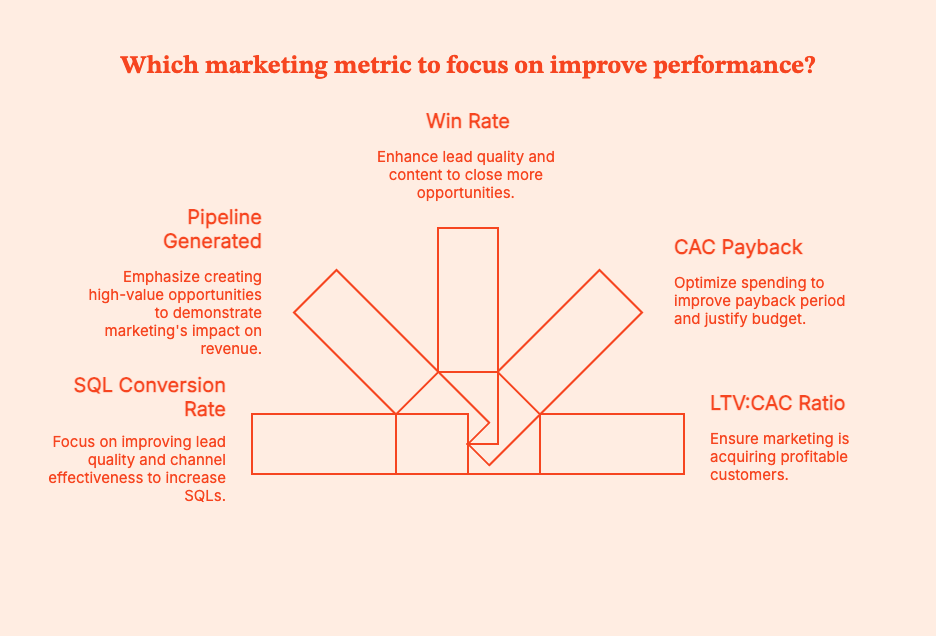
- SQL Conversion Rate
SQL Rate = (Number of leads that turned into Sales Qualified Leads ÷ Total leads) × 100
Pro-Tip: To know which channels and journeys generate SQLs vs. just “marketing-qualified traffic”, use Factors.ai to connect form fills + product usage + sales touches + web behavior. You'll find which touchpoints move contacts to SQL.
- Pipeline Generated (in $)
What it tells you: Pipeline is the total dollar value of opportunities that marketing helped create or influence. Pipeline is the common language between marketing and sales. If marketing grows a pipeline reliably, the CFO will see the value of spending.
- Win Rate
Are leads entering opportunities that can actually close?
Win Rate =Total Opportunities/Closed Won Opportunities
An improving win rate implies that:
- Lead quality is up
- ICP targeting has sharpened
- Content is helping deals move faster
4. CAC Payback
CAC Payback = Gross margin per month/Cost to acquire a customer
Pro-Tip: If payback improves after a new spend or tool, no one questions the budget.
5. LTV:CAC Ratio
LTV: CAC = Customer Acquisition/Cost Lifetime Value
This metric proves that marketing is closing profitable customers.
30-Day Pilot Plan Template
Entry Criteria: Do Not Start Without These
| Entry Requirement | Definition | Why It Matters |
|---|---|---|
| Clean data | Contact + account data is de-duplicated, lifecycle stages are accurate, lead source/UTM consistent | Dirty data will mess up your SQL rate, attribution, and pipeline impact |
| Clear KPI | Single primary target metric, e.g., “improve SQL rate by 15% in 30 days” or “reduce CAC payback below 12 months.” | You need this "north start" if you don't want the test to drift and become impossible to measure. |
| Defined use-case | Narrow scope (e.g., trial → SQL nurture, demo → opp acceleration, reverse IP → outbound intent) | Enables fast launch and easy to measure impact |
| Baseline metrics captured | Snapshot of performance before pilot begins | “before vs after” comparisons: no ambiguity |
Pilot Execution (30 Days)
| Week | Focus | Key Activities | Outputs |
|---|---|---|---|
| Week 1 | Setup & activation | Configure the tool, connect CRM + MAP + ad platforms, import clean data, map workflows | Tool is operational, integrations working, data is data-ing |
| Week 2 | Launch use-case | Deploy the targeted use case (example: nurture flow, anomaly alerts, reverse IP → SDR alerting) | “Day 1” of usage on real leads/accounts |
| Week 3 | Evaluate performance | Track SQL movement, pipeline created/influenced, cohort performance, cycle time | First indicators of whether the tool is improving efficiency |
| Week 4 | Optimize & score | Apply learnings (tests/adjustments), compute KPI changes, compare to baseline | Clear performance report + recommendation |
Exit Criteria: Is the Tool Worth the Money?
Judge the pilot only on business outcomes, not ‘vibes’ or effort.
| Metric | Success Looks Like? |
|---|---|
| SQL quality & volume | Lift in SQL rate (+10–20%) or more opportunities from the same lead volume |
| Pipeline & revenue efficiency | CAC payback reduced, more pipeline per dollar spent, higher win rate, improved deal velocity |
| Cycle time | Faster progression from lead → SQL → opportunity |
| Operational lift | Sales alerted faster, fewer routing errors, better attribution visibility |
| Negative/neutral outcome (“stop” signal) | No material lift in SQLs/opp creation, weak adoption, high service cost, data problems |
Go/ No-Go Decision Framework
| Scenario | Verdict | Next Steps |
|---|---|---|
| Pilot met or exceeded the KPI target | Go | Scale rollout and negotiate contract |
| Pilot did not hit the KPI target, but has a clear optimization path | Conditional Go | Extend the pilot 15–30 days with a specific goal in mind |
| Pilot failed. No strong hypothesis for improvement | Stop (No-Go) | Do not expand, do not renew. Sunk cost is NOT justification |
Please learn from my previous failures when I say: a failed pilot saves you more money than a long-term commitment to something that doesn’t move revenue.
Future-Proofing Your MarTech Stack
Your Martech stack will (hopefully) evolve with a constantly shifting tech horizon. When deciding on a tool, take these signals into account:
- AI-native agents are finally becoming practical. Tools that work dynamically are already worth US$5.4 billion in 2024, set to grow rapidly. The “AI marketing” market was estimated at US$47.3B in 2025, with forecasts pointing to > US$107B by 2028.
AI is not a fad. Its infra is getting better, and modern stacks should incorporate AI-driven workflows. - Privacy-first, data-first pipelines are here to stay. Orgs collect more data than ever before: first-party metadata, behavioral, and account-level. It is the org's responsibility to manage that data responsibly, securely, and compliantly.
- Warehouse-native marketing is rising. That means fewer silos and more data fluidity. Unified, data-driven marketing stacks (with analytics, attribution, CRM, customer feedback, and automation connected to the same warehouse or data layer) are increasingly the backbone of serious marketing departments.
- Immersive interfaces like VR / XR / new channels are flagged among global tech “megatrends.”
Build a stack that’s modular, privacy-conscious, and data-centered. Stay “upgrade-ready” for when immersive or alternative-channel marketing becomes viable.
Summary:
Most B2B marketing teams aren’t suffering from a lack of tools. They’re suffering from too many of them. Tech stacks with 25 to 60+ products are common, but pipeline is flat, attribution is sketchy, and nobody can explain half the invoices.
What is MarTech? It’s the software to create, automate, personalise, and measure marketing (email, journeys, analytics, attribution, AI, dashboards).
The landscape in 2026 is massive, AI-heavy, and consolidating fast. That’s why you can’t buy by category anymore.
Choose your tools based on use-case, data/PII, integrations, governance, identity, AI transparency, time to value, TCO, roadmap, peer proof, and practical shortlists across categories.
You can use plug-and-play implementation playbooks (14-day automation and intelligence setups), which show you how to measure success (SQL rate, pipeline, win rate, CAC payback, LTV: CAC), and offer a 30-day pilot framework so you stop buying tools based on vibes.
Future-proof your martech stacks with AI agents, warehouse-native marketing, and privacy-first data.
FAQs for MarTech Solutions
Q. What is “martech”?
Martech (short for marketing technology) includes all the software (offline and online) used to create, automate, personalize, and measure marketing experiences.
If it touches a marketing workflow, it’s martech.
Q. How is martech different from adtech?
AdTech covers tools for media buying and activation. Think paid ads, bidding, targeting, DSPs. MarTech includes tools for owned data, mapping user journeys, personalization, and measurement.
AdTech gets attention. MarTech turns attention into revenue.
Q. Which marketing automation SaaS should I shortlist in 2025–2026?
A quick shortlist for choosing martech in the US B2B domain:
- HubSpot
- Marketo
- Braze
- Salesforce Marketing Cloud
Q. What are “marketing intelligence tools”?
Marketing intelligence tools integrate and clean data, standardize naming, extract insights, and track competitive trends. These tools often come in two branches:
- Data intelligence: Funnel, Adverity, Fivetran
- Competitive/market intelligence: Klue, Crayon
Q. Do AI automation tools actually work?
Some do. Some are cosplaying at it. For instance, Adobe’s agents can autonomously implement on-site actions. But tools will just give you bots that say they’re “taking actions” but really just send a Slack notification.
To find the good AI tools, run tightly scoped pilots with clear KPIs.
Q. Has the martech market consolidated or expanded?
It’s actually done both.
- The market is bigger than ever (15,384 products in the 2025 ChiefMarTec landscape).
- But platforms are consolidating into suites, especially around automation, identity, and loyalty/CDP.
Q. What tools are marketers actually using in 2025?
A few real-world stacks would be:
- HubSpot or Klaviyo for automation
- GA4/Looker for analytics
- Ahrefs/Semrush for SEO
- Canva/Figma for creative
- Zapier/Make for workflow automation
Q. How do I avoid tool sprawl?
After every procurement call, ask yourself, “What is the job to be done — and what KPI will this improve?”
- Buy tools by job, not category.
- Demand native integrations + SSO.
- Run a 30–60 day proof-of-value pilot.
- Look at peer proof from G2 / Gartner Peer Insights.
Q. Where do I track martech trends?
These are reliable sources to track MarTech trends:
- ChiefMartec landscape.
- Industry reports (Grand View Research, MarketsandMarkets)
- MarTech.org coverage and research
- Gartner Hype Cycles
You can also learn from LinkedIn, Slack groups, and Reddit, because real people have no reason to lie about a product.

See how Factors can 2x your ROI
Boost your LinkedIn ROI in no time using data-driven insights


.avif)

See Factors in action.
Schedule a personalized demo or sign up to get started for free
LinkedIn Marketing Partner
GDPR & SOC2 Type II

.svg)



.avif)

