
13 PPC management services tips that actually move pipeline (not just clicks)
Practical PPC management services tips for B2B teams. From bid strategies to attribution fixes, here's how to stop wasting ad spend and start generating revenue.
.avif)
Content Marketer



.svg)


TL;DR
- Most B2B PPC campaigns optimize for clicks and form fills. The ones that work optimize for pipeline and revenue.
- Offline conversion tracking, value-based bidding, and CRM feedback loops are the foundation of PPC management services that actually deliver ROI.
- Google's AI Max, Performance Max, and Demand Gen trio is the new default campaign stack for 2026.
- LinkedIn Ads cost more per click but generate 4.2x more pipeline revenue per dollar than Google when you factor in deal sizes and close rates.
- Your negative keyword list is probably doing more for your budget than your best ad copy.
- If you're evaluating a PPC management company, ask how they measure success. If they say "clicks" or "impressions," run.
If you've ever checked your Google Ads dashboard, seen a beautiful click-through rate, and then opened your CRM to find... absolutely nothing useful... welcome. You're among friends here.
We’ve all watched B2B teams pour thousands into pay-per-click management services, celebrate vanity metrics in Monday standups, and then wonder why the pipeline looks the same as it did three months ago… the clicks are clicking… the leads are leading, but nothing is closing.
So, what’s the problem, mate? It’s never the ads themselves… but everything around the ads, including (but never limited to): targeting, measurement, feedback loops (that don't exist, btw), and landing pages that try to be everything to everyone and end up converting no one.
This guide covers 13 PPC management tips that actually work for B2B SaaS teams, and no, there are not some ‘best practices’ recycled from 2019. These are PPC management strategies you can implement this quarter, whether you're running campaigns in-house or working with a PPC management agency (or so I hope).
Here are the 13 PPC management services tips:
- Stop optimizing for form fills; optimize for revenue instead
This approach is the single biggest mistake in B2B PPC, and I will die on this hill.
When you tell Google to optimize for form fills, it does exactly that. It finds people who are really, really good at filling out forms. Students. Job seekers. Competitors. Your aunt who clicked out of curiosity.
What you actually want is closed-won revenue. And the only way to get there is by connecting your CRM pipeline stages (MQL, SQL, Opportunity, Closed-Won) back to your ad platforms through offline conversion tracking.
Teams that implement offline conversion tracking with value-based bidding consistently see around 3x more pipeline at roughly 31% lower cost per lead. That's not a marginal improvement. That's a different business.
The setup: upload conversions daily via GCLID tracking or Enhanced Conversions for Leads. Extend your attribution window to 60-90 days (Google defaults to 30, which is laughable for B2B sales cycles). And remember, GCLIDs expire after 90 days, so enterprise deals with longer cycles need workarounds.
- Assign dollar values to every funnel stage
Once offline conversion tracking is live, the next step is telling Google (and LinkedIn) what each conversion is actually worth.
Here's a simple framework:
MQL = $100, SQL = $900, Opportunity = $3,000, Closed-Won = your actual deal value.
The exact numbers depend on your ACV and close rates, but the principle holds. Directive Consulting uses a formula for this:
Proxy Value = Close Rate x ACV x Margin x Stage Probability.
This is what value-based bidding means in practice. You're telling the algorithm to chase revenue, not volume. And the difference in output is wild.
Quick note: Enhanced CPC is now deprecated. Your viable options are Maximize Conversion Value or Target ROAS for bottom-funnel campaigns, and Maximize Conversions or Target CPA for upper-funnel. Start with Maximize Conversion Value. Graduate to Target ROAS once you have enough signal.
- Structure campaigns around buyer intent, not just keywords
I cannot tell you how many B2B Google Ads accounts I've seen where everything is dumped into one or two campaigns. All keywords, match types, and intents. It’s ONE big chaotic party where "what is CRM software" and "buy CRM software" are competing for the same budget.
Here's the structure that works:
- Brand campaigns (5-7% of budget): These should be running (always). They typically deliver 1,200%+ ROAS because people searching your brand name are already warm.
- High-intent product campaigns: Keywords like "[category] software" or "[use case] tool." These are your pipeline drivers.
- Competitor campaigns: "[Competitor] alternative" and "[Competitor] pricing." Don't bid on top-level competitor brand names, though. Most of those searchers are existing customers trying to log in. Target the comparison and alternative queries instead.
- Problem-aware campaigns: "How to reduce [pain point]" queries. Lower intent, but great for building remarketing audiences.
- Remarketing: Sequenced over 90 days (more on this in tip #10).
B2B SaaS companies that don't segment by intent level end up wasting 40-60% of their Google Ads budget. That's real money going to real waste.
- Get comfortable with Google's new ‘power pack’
Google's recommended campaign trio for 2026 is this:
AI Max for Search + Performance Max + Demand Gen.
They are calling it the ‘Power Pack,’ and as corny and Powerpuff Girl-like as that sounds, the results will make at least a few of your eyebrow strands stand at attention.
So, what is it? AI Max for Search (launched May 2025) matches ads to queries based on intent rather than just keywords. Google reports 14% more conversions at a similar CPA, and that number jumps to 27% for campaigns that were previously running only exact and phrase match. It's also one of the primary ways your ads show up in AI Overviews.
Oh! Btw, Performance Max got a serious transparency upgrade in 2025. You now get campaign-level negative keywords (up to 10,000), full search term reports, and channel-level reporting that actually shows you what's running on Search vs. Display vs. YouTube.
Demand Gen delivers 58% lower CPMs than LinkedIn for equivalent audiences, which makes it a solid channel for retargeting with video content like case studies and product walkthroughs.
Suggested allocation: Performance Max 30-40%, AI Max for Search 30-40%, Demand Gen 10-20%.
- Your negative keyword list is your secret weapon
Here's a stat that should make you uncomfortable (but in a good way): an analysis of 150+ B2B SaaS accounts found that 57% of every ad dollar goes to search terms that never convert. Every 10% increase in wasted spend raises CPA by 38-65%.
Your standard B2B SaaS negative keyword list should include "free," "open source," "jobs," "careers," "salary," "tutorial," "course," "login," "support," "cheap," "DIY," and "small business." This is your starter kit. Your actual list should be much longer.
Google now supports account-level negative keywords, so you can set these once and they apply everywhere. Build a habit of reviewing search terms weekly for the first three months, you can then shift to biweekly once you've caught the worst offenders.
This is the PPC management equivalent of cleaning your house. Nobody wants to do it. Everybody benefits when it's done.
- Don't send paid traffic to your homepage
I feel like this should be obvious by now, but based on the number of B2B accounts still doing it... it feels like it’s not <insert a very polite eye-roll>.
Your homepage tries to be everything. It talks to investors, job seekers, existing customers... and when a buyer who just searched ‘contract management software for legal teams’ lands on it, they bounce. Because the page doesn't answer their specific question.
Dedicated landing pages with message matching convert at 5-15%. Homepages? Somewhere around 1-3% on a good day. The median SaaS landing page converts at 3.8% according to Unbounce's analysis of 41,000+ pages. And top performers break 20%.
Build separate pages for competitor terms (comparison pages), problem-aware terms (educational pages), and high-intent terms (demo or trial pages). Keep forms to 5 fields or fewer. Load time under 2 seconds. Social proof above the fold. Done.
- LinkedIn Ads are expensive per click, but cheap per deal
If I had a dollar for every time someone told me, "LinkedIn Ads are too expensive"... I'd have enough to fund a pretty solid villa in the Bahamas.
While LinkedIn CPCs are higher (typically between $5 and $10+) than Google's (~$3–$8) in B2B, concentrating only on CPC ignores the larger picture.
For complex B2B sales, LinkedIn regularly generates higher-quality leads. Research indicates that when transaction sizes are large and buying committees are engaged, conversion rates are much higher and client acquisition costs are lower.
The takeaway is that Google prevails in terms of volume. But when it comes to quality (and B2B), LinkedIn wins. Both should be part of your PPC management services strategy, distributed according to your revenue economics.
- Use LinkedIn's funnel-staged campaign architecture
Throwing the same demo CTA at everyone on LinkedIn is like proposing on a first date. Technically possible… but usually doesn't go well.
Break your LinkedIn campaigns into three stages:
- Top of funnel:
Ungated value content. Broad targeting. Audience size of 50K-300K. Thought Leader Ads (boosting employee content) deliver 1.7x higher CTR than company page ads, so use those here. Short-form vertical video gets 71% more impressions than horizontal. - Middle of funnel:
Lead Gen Forms with webinars, guides, and reports. Matched Audiences retargeting website visitors. Lead Gen Forms auto-fill and convert at 2-3x higher rates than landing page forms. Retargeting audiences (30-60 day windows). Focus on utility-driven assets like ROI calculators, comparison frameworks, and diagnostic assessments. This stage should achieve a 2.74% visitor-to-lead conversion rate using LinkedIn Lead Gen Forms, which outperform standard landing pages by removing mobile friction. - Bottom of funnel:
Demo offers, case studies, and CRM-based account targeting, smaller audiences, stronger intent, and higher budgets per impression.
Note:
Follow up on Lead Gen Form submissions within 5 minutes. Lead quality degrades rapidly after that. If your SDR team takes 48 hours to respond, your LinkedIn budget is basically funding a very expensive email list that nobody reads.
- Bring ABM into your PPC with Customer Match and Account Targeting
Upload your target account decision-maker emails to Google Customer Match (minimum 1,000 matched users) and LinkedIn Account Targeting (minimum 300 matched records). This is where PPC campaign management services and ABM start working together.
ABM-targeted Google campaigns deliver roughly 200% higher ROI compared to broad targeting. And when you layer LinkedIn account targeting with CRM-based audiences, you're reaching buying committees directly instead of spraying budget across an entire industry.
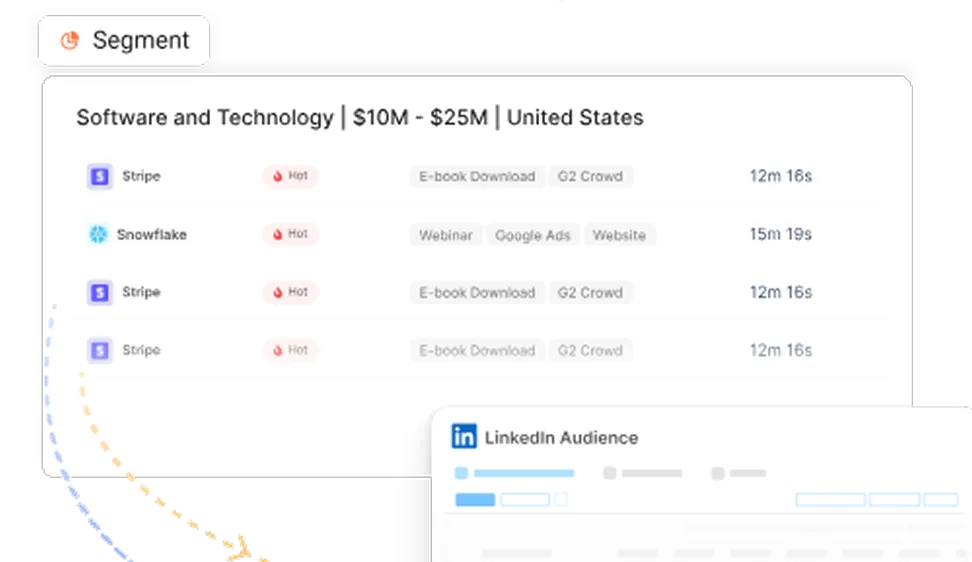
Tools like Factors.ai make this easier by automatically syncing high-intent audiences from your website, CRM, and third-party intent sources directly into LinkedIn and Google through its AdPilot products. Dynamic audience sync means your target lists update as buying signals change, so you're always targeting accounts that are actually in-market, not accounts that showed interest six months ago.
- Build a 90-day sequenced remarketing strategy
B2B sales cycles average 84 days. Enterprise deals stretch to 6-12 months. And the average B2B deal now requires 266 touchpoints before it closes. That number is up nearly 20% from just two years ago.
So, running one remarketing campaign with a single "Book a demo" CTA and calling it a day? That's not a strategy… that's hope, at best.
Here's what a proper sequence looks like:
- Days 1-7: Educational content, blog posts, industry reports. You're saying "hey, we know things."
- Days 7-30: Case studies, ROI calculators, comparison guides. You're saying "hey, we've helped people like you."
- Days 30-90: Demo CTAs, migration guides, pricing content. You're saying "hey, let's talk."
LinkedIn retargeting can reach 9.5% conversion rates when sequenced properly. And Google Demand Gen is perfect for distributing YouTube case studies at those 58% lower CPMs compared to LinkedIn.
- Don't sleep off on Microsoft/Bing Ads
I know, I know. Bing feels like the Internet Explorer of search engines. But Microsoft Ads delivers 253% ROI for B2B marketers, which is actually the highest among all B2B PPC platforms. CPCs average $1.54, and cost per lead comes in around $41.44.
The audience skews toward enterprise decision-makers who use Edge as their default browser on company laptops (because IT said so). And Google Ads campaigns can be imported with one click.
If you're already running Google, there's literally no reason not to test Microsoft. It takes 30 minutes to set up and might become your most efficient channel.
- Adapt your strategy for AI Overviews
This one's big for 2026. When AI Overviews appear in Google search results, paid CTR drops by 68%. But brands that get cited in AI Overviews see 91% more paid clicks. So the gap between winners and losers is widening.
Non-branded CPCs jumped 29% in 2025, and non-branded search budgets have dropped from 37% to 33% of total spend.
The practical implications: SEO and PPC are now deeply interdependent, and AI Max for Search is one of the primary pathways for your ads to appear alongside AI-generated answers.
If your PPC management company isn't talking about AI Overviews yet, that's a red flag.
- Measure what matters: pipeline, not vanity metrics
Your weekly PPC report should clearly tell you how much pipeline you generated.
Here’s a list of the metrics that are useful to understand how your PPC campaigns are doing:
- Pipeline generated ($): The only metric your CFO cares about.
- LTV:CAC ratio: Minimum 3:1. Top quartile hits 5:1+.
- Cost per SQL and cost per opportunity: These tell you if lead quality is real.
- CAC payback period: Top-performing SaaS companies get this under 80 days. The private SaaS average is 23 months, which is... not great.
Nearly 90% of B2B teams still use single-touch or basic multi-touch attribution models, despite their growing inaccuracies. As of late 2023, Google formally deprecated first-click, linear, time-decay, and position-based attribution across Google Ads and GA4.
Today, Data-Driven Attribution (DDA) is the only automated multi-touch model available. Unlike rule-based models that assign fixed percentages to touchpoints, DDA uses machine learning to analyze your account's unique conversion paths and assign fractional credit based on how much each interaction actually increased the probability of a conversion.
Factors.ai's cross-channel attribution connects every touchpoint from first click to closed deal across web, ads, CRM, and third-party sources. You can finally answer "what actually drove that deal" without a 47-tab spreadsheet and a prayer.
When to hire a PPC management agency (and what to look for)?
Running PPC in-house gives you deep brand knowledge and excellent sales alignment, but a senior PPC manager also costs $125K–$215K in salary, plus 30% in benefits and tool subscriptions. A two-person team exceeds $400K/year before you've spent a dollar on ads.
If you consider the alternative, a good (read: competent) PPC management firm offers access to premium technologies, specialist knowledge, and cross-account benchmarking without the HR burden. For most B2B SaaS teams, a hybrid approach works best: the agency handles execution, testing, and scaling, while internal teams handle strategy, brand voice, and sales alignment.
Here’s what you should prioritize when evaluating a PPC management agency:
- Maturity of measurement:
Can they set up Enhanced Conversions, import CRM outcomes, and use Data-Driven Attribution? If not, next. - Value-based approach:
Do they map conversion values to lifecycle stages? Or are they still optimizing for the cheapest CPL? - Case studies from B2B SaaS clients:
Are they able to show pipeline results? Because just some CTR improvements aren’t going to cut it. - Contract flexibility:
Month-to-month contracts keep agencies accountable, but twelve-month lock-ins often protect mediocrity. - Account ownership:
You must own your Google Ads account (non-negotiable).
Warning signs you need to look out for:
- Guaranteed results (nobody can promise that)
- Reporting only vanity metrics, the agency owns your ad account
- Cookie-cutter strategies
- AND never meeting the person who actually manages your campaigns
In a nutshell…
PPC management services work when they're connected to revenue. FULL STOP.
The tips in this guide aren't about spending more, which you’d agree with (if you read the whole blog)... they're about spending smarter. Track the right conversions, bid on value, segment by intent, sequence your remarketing, measure pipeline, and pick partners (human or platform) that understand B2B buying is not a one-click impulse purchase.
B2B buyers take 84 days and 266 touchpoints to close. Your PPC strategy should respect that reality instead of pretending every click is a future customer.
If your current setup doesn't connect ad spend to pipeline, start there. Everything else gets easier once that foundation is in place.
FAQs for PPC management services
Q1. What are PPC management services?
PPC management services cover the strategy, execution, and optimization of pay-per-click advertising campaigns. For B2B teams, this includes keyword research, ad copywriting, bid management, conversion tracking, audience targeting, landing page optimization, and performance reporting across platforms like Google Ads, LinkedIn Ads, and Microsoft Ads. The goal is to turn ad spend into pipeline and revenue, not just clicks.
Q2. How much do PPC management companies charge?
Pricing varies widely. Flat-fee retainers range from $1,250 to $20,000+ per month depending on scope and ad spend. Percentage-of-spend models charge 10-20% of your monthly ad budget. The minimum recommended ad spend for B2B SaaS is $3,000-$10,000 per month, and specialized agencies often require $10,000-$15,000 minimums. Setup fees typically run $1,000-$2,000.
Q3. Should I manage PPC in-house or hire a PPC management agency?
It depends on your stage. Early-stage companies (pre-$1M ARR) usually benefit from an agency or fractional expert. Growth-stage companies ($1M-$10M ARR) typically do best with a hybrid model where in-house owns strategy and an agency handles execution. At scale ($10M+ ARR), most companies build in-house core teams and bring in agency specialists for specific campaigns or channels.
Q4. What's the average CPC for B2B SaaS on Google Ads?
B2B SaaS search CPCs average around $15.36 according to Firebrand's eight-year agency study, which is 57% above the overall B2B tech baseline. The all-industry average is $5.26 according to WordStream. LinkedIn CPCs for SaaS/tech average around $8.04, but LinkedIn's higher lead quality and larger deal sizes often make it more cost-effective on a per-deal basis.
Q5. How do I know if my PPC campaigns are working?
Look at pipeline metrics, not vanity metrics. Cost per SQL, cost per opportunity, pipeline generated, LTV:CAC ratio (aim for 3:1+), and CAC payback period tell you if campaigns are actually driving revenue. If your PPC management company only reports on clicks, CTR, and raw lead volume, you're missing the full picture.
Q6. What's the best PPC management company for B2B SaaS?
There's no universal answer because it depends on your stage, budget, and channels. But the best PPC management companies for B2B SaaS share common traits: they set up offline conversion tracking, use value-based bidding, show pipeline-level case studies (not just CPL improvements), offer month-to-month contracts, and ensure you own your ad accounts.

See how Factors can 2x your ROI
Boost your LinkedIn ROI in no time using data-driven insights


.avif)

See Factors in action.
Schedule a personalized demo or sign up to get started for free
LinkedIn Marketing Partner
GDPR & SOC2 Type II




.svg)



.avif)

