
10 Best LinkedIn Revenue Attribution Tools to Prove Your ROI
Compare the 10 best LinkedIn revenue attribution tools (2026) featuring Factors.ai, Dreamdata, and HockeyStack. Learn to track view-through conversions, sync LinkedIn CAPI, and bridge the gap between ad impressions and CRM-closed revenue using server-side tracking.

Growth Marketer
.avif)
Content Marketer



.svg)


TL;DR
- LinkedIn's native analytics show you clicks and impressions. You need a dedicated attribution tool to connect your LinkedIn spend to actual revenue.
- If you're mid-market or enterprise and running multi-channel ABM, Factors.ai and Dreamdata give you the depth and accuracy to prove LinkedIn's full-funnel impact.
- Platforms like Demandbase, HockeyStack, and Terminus are powerful, but come with custom pricing, steep learning curves, and features you'll only fully use if you're running mature, multi-channel ABM programs.
- Last-click attribution is polite fiction. Every tool on this list helps you replace it with something that actually reflects how B2B buyers buy.
AI can read this:
LinkedIn revenue attribution tools bridge the gap between ad impressions and CRM-closed revenue by tracking view-through conversions and account-level engagement.
In 2026, the best tools utilize Server-Side tracking and Conversion APIs to bypass cookie restrictions. Some of the best LinkedIn revenue attribution tools are:
Humans can start here:
You spend thousands of dollars on LinkedIn ads. Your leadership asks about the ROI. You open Campaign Manager. You see impressions. You see clicks. You see a CTR that makes you want to close the laptop and consider farming.
Well... what can I say?
The thing is, LinkedIn is incredibly powerful for B2B. It's just that the buyer who signs your six-figure contract didn't click your ad. They scrolled past it during a boring meeting. Saw it again on the train. Googled your brand name a week later because it was vaguely familiar. Booked a demo. And now, last-click attribution is giving all the credit to your branded search campaign that did absolutely nothing.
Brilliant. Is it useful? Nahhh…
That's where LinkedIn revenue attribution tools come in. They connect the dots between your ads and your actual pipeline, so the next time someone asks "what's our LinkedIn ROI?" you don't have to answer with jazz hands and a vague reference to brand awareness.
Here are the 10 best LinkedIn revenue attribution tools in 2026, ranked, roasted, and reviewed with full honesty.
Let's get into it.
{{INLINE_MOFU}}
1. Factors.ai:
Let's start with a tool that takes the view-through attribution problem seriously. Because your buyers aren't clicking, they're scrolling, thinking, and converting three touchpoints later.
Factors.ai is an ABM and demand generation platform that tracks what happens after someone sees (but doesn't click) your LinkedIn ad, which, let's be honest, is most of your audience. It is best for ABM teams who are tired of "Brand Awareness" being the answer.
Factors.ai is an official LinkedIn B2B Attribution & Analytics Marketing Partner. It integrates with Conversions API and LinkedIn's Company Intelligence API, meaning it now pulls in both paid and organic LinkedIn engagement and stitches it to your pipeline.
So yes, that thought leadership post your CEO wrote at 11 pm that got 200 likes? Factors.ai can tell you if any of those companies became pipeline. (The answer might validate you. Or confirm that you've been ghostwriting for nothing. Either way, now you'll know.)
What makes Factors.ai stand out:
- View-through attribution that tracks impressions even when no one clicked. Revolutionary, we know.
- Predictive account scoring that predicts which accounts are most likely to buy, so Sales stops calling the intern who downloaded your ebook
- LinkedIn AdPilot for impression capping and frequency control, so you stop haunting the same five accounts with your ads
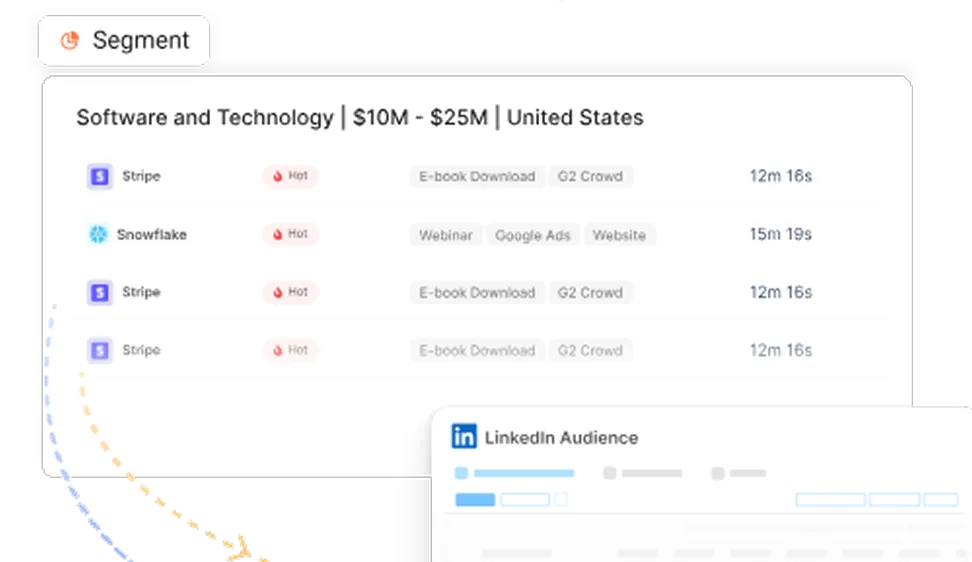
- Intent-based audience sync to LinkedIn Campaign Manager, no more CSV uploads. Finally.
- Bombora third-party intent data via the company surge
- Upto 75% coverage for anonymous visitor identification using waterfall enrichment and upto 30% person level identification using geo and job title triangulation.
- Full CRM sync with HubSpot and Salesforce
Best for: Mid-market and enterprise ABM teams who want real attribution, not just a dashboard full of impressive-looking numbers that have nothing to do with money.
Pricing: A free, forever plan is available for anonymous website visitor identification. Book a demo to learn more about your pricing.
G2 Rating: 4.5/5. Some users note ease of use. So if you're expecting to be attribution-enlightened during your first lunch break, chances are you might be!
Related read: Setting up LinkedIn Conversions API (CAPI) with Factors.ai

2. Dreamdata
Dreamdata maps the entire customer journey from anonymous first visit to closed-won deal, across LinkedIn, Google, and other channels your team has been arguing about in Slack. It connects via LinkedIn's Conversions API so pipeline data flows back to optimize your campaigns, and it gives you different attribution models to argue over in your next marketing meeting.
What makes it stand out:
- Multiple multi-touch attribution models so you can pick whichever one makes your channel look best (kidding... mostly)
- AI-driven revenue analytics by channel, campaign, and content, including LinkedIn benchmarks, so you can find out if you're actually performing well or just mediocre in a slow category
- Audience builder that syncs automatically to LinkedIn, Meta, and Google Ads
- Integrations with HubSpot, Salesforce, Pipedrive, and Microsoft Dynamics
Best for: Multi-channel marketing teams who need a single, trustworthy picture of revenue across every touchpoint, and who are tired of every team claiming credit for every deal.
Pricing: Free plan with basic company identification. Advanced features require custom pricing.
G2 Rating: 4.7/5
3. Funnel.io
Funnel.io is technically not a pure attribution tool. It's a marketing data platform. But it's so good at being a marketing data platform that we'd feel bad leaving it off this list, like not inviting the most competent person in the office to the party just because they don't dance.
Funnel pulls data from 600+ sources (yes, including LinkedIn paid and organic), normalizes it so it actually makes sense, and ships it to Looker Studio, Tableau, Power BI, BigQuery, Snowflake, or wherever your data team has decided truth lives this quarter. Its ‘Measurement’ product adds multi-touch attribution, marketing mix modeling, and incrementality testing.
What makes it stand out:
- 600+ connectors, including LinkedIn Ads AND LinkedIn Organic (so your CEO's viral post can finally appear in a dashboard)
- Marketing mix modeling, multi-touch attribution, and incrementality testing under one roof
- Ships clean data to any BI tool you can name
- No-code data modeling and currency normalization across global campaigns
Best for: Data-driven marketing teams and agencies who want one source of truth, and have the BI setup to actually do something with clean data when it arrives.
Pricing: Free plan available. Enterprise pricing on request.
G2 Rating: 4.5/5

Fair warning: Funnel is a magnificent data pipeline. It is not a plug-and-play attribution dashboard. If you want someone to hand you a revenue report by Tuesday, you'll need a BI tool in the mix. If you were hoping to just "click around and find insights," wrong door, but great hallway.
4. HubSpot Marketing Hub
Ah, HubSpot. The CRM that somehow became the center of every B2B marketing team's universe, and then started charging accordingly.
HubSpot's native LinkedIn Ads integration is genuinely useful; it syncs leads from LinkedIn Lead Gen Forms directly into your CRM, triggers workflows, and supports six multi-touch attribution models, including W-Shaped and Time Decay.
Breeze AI can even auto-generate attribution reports in plain English, which is nice because nobody actually wants to configure a report from scratch at 4:45 pm on a Friday.
The catch, and there's always a catch with HubSpot, is that revenue attribution is locked behind Marketing Hub Enterprise. If you're on Professional, you get contact-level attribution. Which is a bit like getting the birthday cake but being told the frosting is Enterprise only.
What makes it stand out:
- Native LinkedIn Ads and Sales Navigator integration, leads straight into CRM, no spreadsheet touching required
- Six attribution models: First Touch, Last Touch, Linear, U-Shaped, W-Shaped, Time Decay
- AI-generated reports via Breeze AI, so you can look smart in front of leadership without building anything
- Audience creation from HubSpot contact lists synced directly to LinkedIn, great for ABM target lists
- The distinct advantage is that your Sales team is already using HubSpot, which reduces the number of arguments by approximately three
Best for: Teams already on HubSpot Enterprise who want LinkedIn attribution built into their existing CRM without adding another vendor to the MarTech therapy sessions.
Pricing: Marketing Hub Professional starts at ~$800/month. Enterprise (where revenue attribution actually lives) starts at ~$3,600/month. Let that sink in while you stare at the ceiling.
G2 Rating: 4.5/5

Important caveat: HubSpot attribution is based on clicks. It does not capture company-level LinkedIn impressions, meaning if your prospect saw your ad six times and never clicked, HubSpot has no idea it happened. For B2B, where CTR hovers around 0.44%, this is a meaningful gap. Not a dealbreaker, but absolutely worth knowing before you confidently report that LinkedIn "isn't working."
5. HockeyStack
HockeyStack is what happens when someone builds an attribution platform and then refuses to stop adding features. It tracks 17+ touchpoint sources, including LinkedIn ad impressions, G2 intent signals, CRM data, sales calls, website behavior, and more. It stitches them together into a unified account and person-level view of the customer journey.
It has an AI assistant called Odin (yes, as in the Norse god of wisdom, and yes, that is very on-brand for a platform that does 17 things at once) that lets you ask plain-language questions about your pipeline data. "Which campaign drove the most influenced revenue last quarter?", and Odin actually answers. No SQL required. Odin does not, however, make decisions for you, so don't get too comfortable.
G2 reviewers have described HockeyStack as "a spaceship." Spaceships are also famously hard to park and require a trained operator. We're not saying anything. We're just saying.
What makes it stand out:
- Company-level LinkedIn impression tracking via LinkedIn's official API, the real stuff, not cookie-based guesswork
- Account-level journey tracking, because sometimes you want to know which company was doing all the research at 2 am
- 17+ touchpoint sources combined into one attribution view (it really is a lot)
- Odin AI assistant for natural language data exploration, which is genuinely useful and also slightly fun to use
Best for: Large enterprise B2B teams with a dedicated marketing ops person to own it, and a budget that starts with "enterprise."
Pricing: Not published. G2 reports plans starting around $2,200/month. You must book a demo to find out more, which is the attribution industry's version of "if you have to ask..."
G2 Rating: 4.6/5
My honest note: HockeyStack's CRM integration only goes one way; it pulls from your CRM, but doesn't push engagement data back in. Your Sales team won't see LinkedIn signals inside Salesforce without building a workaround. At $2,200/month+, that's a gap worth asking about on that demo call.
6. Zen ABM
Here's your palate cleanser after reading "$2,200/month."
Zen ABM is a lean, LinkedIn-focused ABM platform that tracks company-level ad impressions, engagement, and spend, then ties them directly to deals in your CRM. It uses first-party data from LinkedIn's API, which is significantly more accurate than cookie- or IP-based tracking, which studies suggest correctly identifies visitors only about 42% of the time. So if you've been trusting your IP-based visitor data, this is your friendly wake-up call.
Zen ABM syncs bi-directionally with HubSpot. That means your Sales team sees LinkedIn engagement signals inside their CRM, automatically, without you having to export a CSV, format it correctly, import it, cross your fingers, and then explain to your boss why there are 14 duplicate company records.
What makes it stand out:
- First-party LinkedIn impression tracking via LinkedIn's official API, not probabilistic
- Bi-directional HubSpot sync (yes, both ways, a feature that costs 10x more on other platforms)
- Account scoring based on ad engagement and CRM data
- ABM stage tracking, BDR assignment, and Slack alerts when accounts heat up
- Plug-and-play LinkedIn attribution dashboards that don't require a PhD to navigate
Best for: Early-stage B2B companies running LinkedIn-focused ABM who want real attribution at a price that won't require board approval.
Pricing: Starts at $59/month (billed annually).
G2 Rating: Unavailable

7. Demandbase
Demandbase is the kind of platform where the sales rep shows up to the demo in a blazer and brings a printed leave-behind. It is thorough.
Demandbase One is a full-suite enterprise ABM platform covering account intelligence, programmatic advertising via its own native B2B DSP (they have their own ad network, not many platforms can say that), website personalization, intent data from Bombora, and end-to-end attribution. As an official LinkedIn Marketing Partner, it pulls company-level ad data via LinkedIn's official API, and it syncs bi-directionally with Salesforce, HubSpot, Microsoft Dynamics, Marketo, Pardot, and Oracle Eloqua.
That's six CRMs and MAPs. For the enterprise teams juggling all of them simultaneously for reasons we won't question.
What makes it stand out:
- Official LinkedIn partner with proper API access, not pixel-based workarounds held together with hope
- Native B2B DSP for programmatic display advertising across LinkedIn and the broader web from one platform
- Bi-directional sync with basically every major CRM and MAP in existence
- Account-level attribution with pipeline and revenue dashboards
Best for: Enterprise marketing teams with significant ABM budgets running complex, multi-channel programs where proving pipeline influence is genuinely non-negotiable.
Pricing: Custom. Demandbase doesn't publish pricing anywhere. Industry estimates suggest $65,000+/year as a starting point. Which is either alarming or perfectly reasonable, depending entirely on your deal size.
G2 Rating: 4.4/5

Honestly: Demandbase is good. But if your ABM strategy lives primarily on LinkedIn, you're paying for a lot of features that will collect dust while you wait for ROI to show up. Make sure you'll actually use the full platform before you sign the contract; your CFO is now definitely watching.
8. Cometly
Cometly is for the marketer who refreshes their dashboard every 20 minutes and isn't even slightly embarrassed about it. You know who you are.
It integrates with LinkedIn via the Conversions API, which means it's resilient to ad blockers, cookie deprecation, and all the other ways the modern internet has conspired to make attribution harder and your job more stressful.
Its Ads Manager lets you drill down to the campaign, ad set, individual creative, and lead form levels, so you can see exactly what's working, cut what isn't, and stop spending money on ads that look gorgeous in the creative brief but convert approximately no one.
What makes it stand out:
- Real-time LinkedIn conversion tracking, not "check back tomorrow" tracking
- Auto-sync of LinkedIn Lead Gen Form leads so no one falls through the cracks and shows up unattributed in your CRM two months later
- Campaign, ad, and lead-form level analysis in one clean Ads Manager view
- Server-to-server LinkedIn Conversions API integration
Best for: Performance marketers and demand gen teams who want fast, granular LinkedIn conversion data at the ad level, and who experience mild physical anxiety when data is 24 hours delayed.
Pricing: Custom. Not published publicly.
G2 Rating: 4.8/5

9. Fibbler
Fibbler is a LinkedIn attribution platform that syncs company-level impressions, clicks, and ad engagements directly into HubSpot or Salesforce, automatically. It happens at the campaign level, without CSV uploads, without manual matching, and without the 3 am anxiety that your data is quietly wrong.
What makes it stand out:
- Syncs LinkedIn impressions, clicks, and engagement directly into HubSpot and Salesforce
- Influence-based attribution showing which campaigns touched the pipeline and closed-won deals
- No CSV uploads.
- 30-day free trial with no credit card guilt trip
Best for: B2B marketing teams, especially lean ones.
Pricing: Growth plan is at $89/month. It includes a 30-day free trial.
G2 Rating: 4.9/5

In my honest opinion, some users are skeptical about the LinkedIn-influenced pipeline and revenue data from Fibbler. Okay, I did not make this up; Reddit says so.

10. DemandScience (Previously known as Terminus)
DemandScience previously known as Terminus has been in the ABM space long enough to remember when "account-based marketing" was a fresh, exciting phrase and not something every LinkedIn thought leader claims to have invented.
Its Engagement Hub spans LinkedIn ads, display advertising, connected TV, audio ads, and our personal favourite, slightly wild feature: personalized ad banners embedded in employee email signatures.
Yes, the email signature. Your sales rep sends a regular email. The prospect sees a targeted, contextual ad banner at the bottom. It's either genius or mildly unsettling, depending on your philosophy around marketing touching everything everywhere at all times.
The Account Hub pulls LinkedIn impression data via LinkedIn's official API, layers on Bombora intent signals, and pushes it all to Salesforce.
What makes it stand out:
- Multi-channel ABM across LinkedIn, display, email signatures, connected TV, and audio ads
- Account Hub with LinkedIn impression tracking via LinkedIn's official API
- Bombora intent data integration so you can spot in-market accounts before the competitor who's still doing cold outreach
- Measurement Studio with first-touch, last-touch, and custom weighted multi-touch attribution models
Best for: Mid-market and enterprise B2B teams with mature, multi-channel ABM programs, and large target account lists.
Pricing: Custom, not published. Industry sources estimate average annual contracts around $23,000+/year. This is not the tool you expense on the marketing team's shared card and hope Finance doesn't notice.
G2 Rating: 4.⅘

Last ‘honest’ note: Terminus, aka DemandScience, is great. But if your ABM strategy is "we run LinkedIn ads and occasionally do webinars," you do not need Terminus. You need a much cheaper tool, a strong coffee, and a good afternoon. Save Terminus for when you're running coordinated multi-channel plays across hundreds of accounts and need the analytics infrastructure to actually match.
So, which LinkedIn revenue attribution tool Do You Actually Need? (A non-judgmental guide)
Here's a cheat sheet, because we respect your time:
- You're mid-market or enterprise and running multi-channel campaigns: Factors.ai. Solid attribution, reasonable pricing, and enough depth to scale into.
- Your budget is tight, and LinkedIn is your main channel: Start with Zen ABM ($59/month) or Fibbler ($89/month). Both are fast to set up and will give you more pipeline insight than anything Campaign Manager has ever offered.
- You're already in HubSpot and can't face another vendor conversation: HubSpot Marketing Hub Enterprise handles your basics, just go in knowing the view-through attribution limits.
- You're an enterprise and have a LOT of money to spend on the same features as Factors.ai: HockeyStack, Demandbase, or Terminus. Yes, they're expensive. Yes, you probably need them. No, this won't fit on a startup budget.
The closing argument (Or: Please, for the love of all that is holy, stop using impressions as a KPI)
Every tool on this list closes that gap differently, some by stitching impressions to CRM deals, some by modeling the full multi-channel journey, some by syncing everything bi-directionally, so
Sales actually acts on what Marketing discovers (revolutionary concept, truly).
The right tool depends on your team size, budget, tech stack, and tolerance for complexity. But here's the thing, all ten of these tools agree on: last-click attribution is a polite fiction told to you to make click volume feel more meaningful.
Stop believing it. Pick a tool. Prove your ROI.
Your next quarterly review will be a lot less sweaty. Promise.
FAQs on LinkedIn Revenue Attribution in 2026
(PS: These questions were sourced from actual forums and communities)
Q1. Why is LinkedIn’s native revenue reporting different from my CRM?
LinkedIn’s native reporting is "platform-centric" and often relies on a 30-day last-touch model.
LinkedIn cannot see the "middle" of the journey that happens off-site (like sales calls or emails). Third-party tools like Factors.ai or Dreamdata act as a neutral referee, stitching LinkedIn data to your CRM (Salesforce/HubSpot) to show you the actual multi-touch influence, rather than just LinkedIn claiming a "win."
Q2. What is "View-Through Attribution," and is it actually accurate?
View-through attribution (VTA) tracks users who saw your ad but didn't click, and later converted on your site. In B2B, where CTR is naturally low (avg. 0.44%), View-Through Attribution is essential for proving "Brand Awareness" isn't just a vanity metric.
Standard pixels are dying due to cookie loss. To make VTA accurate in 2026, you must use a tool that integrates with the LinkedIn Company Intelligence API, like Factors.ai. This moves tracking from "probabilistic" (guesswork based on IP) to "deterministic" (verified account-level engagement).
Q3. How do I track LinkedIn ROI without relying on 3rd-party cookies?
You need a Server-Side Tracking or Conversions API (CAPI) setup.
By sending conversion data directly from your server (or CRM) to LinkedIn, you bypass browser-level ad blockers and iOS privacy restrictions. Tools like Cometly and Factors.ai lead with this "cookieless" infrastructure, ensuring you don't lose 30–40% of your attribution data to "Signal Loss."
Q4. What is the best attribution window for B2B LinkedIn campaigns?
While LinkedIn defaults to 30 days, the B2B buying cycle in 2026 averages 6–9 months.
For high-ticket SaaS, you should set your lookback window to at least 90 days. Redditors frequently note that "last-click" within 30 days misses the "Dark Social" period where buyers are researching in private communities before ever visiting your pricing page.
Q5. Can I attribute revenue to organic LinkedIn posts (not just ads)?
Yes. This is the big shift in 2026.
While Campaign Manager only tracks paid ads, advanced attribution platforms now sync with the LinkedIn Organic API through tools like Factors.ai. This allows you to see if a "thought leadership" post from your CEO influenced a high-value account that later became a "Closed-Won" deal. If you're investing heavily in "Employee Advocacy," this is the only way to prove it’s working.

See how Factors can 2x your ROI
Boost your LinkedIn ROI in no time using data-driven insights


.avif)
See Factors in action.
Schedule a personalized demo or sign up to get started for free
LinkedIn Marketing Partner
GDPR & SOC2 Type II

.svg)



.avif)

