
AI marketing automation tools: the complete B2B buyer’s guide
Compare the best AI marketing automation tools for B2B teams. Covers agentic AI, campaign platforms, revenue intelligence, real use cases, and how to build a stack.
.avif)
Content Marketer



.svg)


TL;DR
• Most B2B teams have a workflow orchestration problem, and unfortunately, buying another AI tool won’t fix that unless you’ve mapped where automation actually creates leverage.
• AI marketing automation tools fall into four distinct categories: campaign platforms, content engines, revenue intelligence, and agentic workflow builders. Knowing which category you need matters more than which vendor you pick.
• The real shift is from rule-based to reasoning-based, where AI agents plan, execute, and optimize workflows without someone babysitting a dashboard.
• Start by automating reporting and attribution before content creation, not because they’re flashier, but because they consume the most strategic time, and nobody talks about this enough.
• The best AI marketing automation tools are the ones connected to your actual customer data, and most teams figure this out about six months too late, after they’ve already signed the contract; don’t be that team.
Every few months, marketing gets a new silver bullet.
Let me jog your memory… there were growth hacks, no-code, product-led growth, revenue intelligence, and more recently… AI copilots and AI agents.
The names change, demos get prettier, but the promise stays remarkably consistent: "This will save your team hours every week."
And occasionally, it does.
Most of the time, though, teams end up with one more login, one more dashboard, and one more Slack notification reminding them that something needs attention. We wanted automation. What we got was another thing to manage.
That's why conversations around AI marketing automation feel SO different now. The interesting question is whether your marketing system can make good decisions without someone constantly nudging it along.
That's the jump from automation to intelligence. Oh! And it's also where most buying guides stop being useful. They compare features, pricing, and integrations, but skip the harder question: WHICH of these tools will actually remove work rather than rearrange it?
Let's get into it.
What does ‘AI marketing automation’ mean?
After a lot of time in this space, I’ve noticed that marketers often confuse automation with intelligence. Running the same email nurture to 5,000 leads on a schedule isn’t AI. Automating a webinar follow-up sequence you designed in 2021 and haven’t touched since isn’t AI either. The real shift happens when systems start making decisions: prioritizing accounts, surfacing anomalies, recommending actions, doing things you didn’t specifically program them to do.
So here’s a simple three-tier framework for what’s actually on the market:
- Traditional marketing automation is rule-based. If a lead downloads an ebook, trigger email sequence B. It’s useful, but it doesn’t learn anything.
- AI-assisted automation adds a layer of intelligence on top. Think predictive lead scoring, smart send-time optimization, or AI-generated subject lines. The system suggests improvements, but a human still makes the call.
- Agentic AI marketing automation is the category generating the most excitement right now. Agentic AI systems don’t operate through simple rules. They analyze current context, determine the next best action, and take steps to increase engagement, conversions, and cost savings. They can adjust audience segmentation, reallocate budget across channels, refine campaign targeting, and generate attribution reports, all with minimal human input.
The best AI marketing automation tools sit somewhere along this spectrum. Understanding where each tool lands helps you avoid overpaying for sophistication you won’t use, or underbuying for workflows that genuinely need intelligence.
Why is traditional marketing automation breaking down?
Here’s something most teams already sense but rarely say aloud: the more tools and dashboards we’ve accumulated, the harder it’s gotten to answer basic questions. Which accounts are actually buying? Which campaigns influence pipeline? What should we do next?
Traditional marketing automation was built for a world where buyer journeys were relatively linear. Prospect visits your site, downloads a guide, enters a nurture sequence, talks to sales. The problem is that modern B2B buyers don’t do this anymore. They research anonymously across multiple channels. Multiple stakeholders from the same account engage at wildly different times. A significant chunk of the buying journey now happens in what people call the dark funnel: LinkedIn conversations, Slack communities, peer recommendations, none of which your marketing automation platform actually tracks.
Legacy systems struggle with this for a few specific reasons. Rule-based workflows can’t adapt when buyer behavior shifts. Static lead scoring decays the moment your ICP evolves. Generic nurture journeys treat a VP of Engineering the same as a marketing coordinator. And channel silos mean your LinkedIn data, website analytics, CRM records, and ad platforms never form a coherent picture of what’s happening at the account level.
Most B2B marketing teams today have more data than ever, yet they still make campaign decisions based on incomplete information and gut instinct. This isn’t a content-generation problem. It’s a workflow and intelligence problem, which is exactly the gap that AI tools for marketing process automation are designed to close.
The evolution from automation to agentic AI
The journey from basic automation to where we are now happened in three reasonably distinct stages, even though most marketing teams are still living somewhere between stage one and two.
- Stage one was traditional automation: if X happens, do Y. Simple, predictable, and entirely dependent on a human designing every rule in advance.
- Stage two introduced AI-assisted automation. Systems started optimizing existing workflows rather than just executing them. Think send-time optimization, predictive lead scoring, or content recommendations based on engagement patterns. The human still sets the strategy, but the AI makes it run more efficiently.
- Stage three is where things get genuinely interesting. Unlike traditional AI tools that respond to prompts and wait for the next instruction, agentic AI acts. It plans, decides, and executes multi-step tasks with minimal human input. An agent doesn’t just recommend shifting budget from Google Ads to LinkedIn. It does it, monitors the results, and adjusts again.
The biggest misconception in marketing right now is that AI agents are just chatbots with a new name. They’re not. The real value appears when AI moves from answering questions to completing workflows. Marketing teams don’t need another assistant. They need systems that close the gap between insight and action.
The use cases are already emerging in production environments: campaign optimization agents that adjust targeting in real time, audience discovery agents that find look-alike accounts based on pipeline data, pipeline monitoring agents that flag when a high-value account suddenly goes quiet, and attribution agents that connect marketing activity to revenue without waiting for a quarterly review.
Data cited by McKinsey indicates that nearly 90% of chief marketing officers are testing AI applications, while fewer than 10% have deployed end-to-end workflows that generate measurable value. That gap between experimentation and execution is where the actual competitive advantage lives.
The four categories of AI marketing automation tools
Most AI marketing automation tools articles lump everything together, which makes it nearly impossible to evaluate options clearly. Here’s a framework that actually works.
Campaign automation platforms
These are the workhorses most B2B teams already use: HubSpot, Marketo, Salesforce Marketing Cloud. They manage email sequences, landing pages, forms, lead scoring, and CRM integration. Increasingly, they’re layering AI features on top of existing capabilities. In 2024, HubSpot rebranded and expanded its AI capabilities under Breeze AI, a unified platform that brings together all AI-powered features across the HubSpot ecosystem.
Also read: How to use AI for marketing
Content automation platforms
Jasper, Writer, Copy.ai, and similar tools focus on scaling content production. They generate blog drafts, email copy, social posts, and ad creative using generative AI for B2B marketing automation. Useful for teams that need volume, but they don’t solve the strategic question of what to create or who to target.
Revenue and pipeline automation platforms
This is where platforms like Factors.ai, 6sense, and Demandbase operate. They focus on account identification, buying signal detection, pipeline attribution, and audience activation. Factors.ai is a B2B demand generation and marketing analytics platform that unifies account intelligence, web analytics, multi-touch attribution, and ad optimization. It identifies which companies are engaging with your website and campaigns, maps their journeys across channels, and helps marketing and sales teams prioritize and convert high-intent accounts.
Agentic workflow platforms
This is the newest category, and it includes tools like Gumloop, Zapier AI, n8n, and CrewAI. These platforms don’t specialize in marketing specifically, but they let you build custom AI agents that handle multi-step processes across your entire stack. Gumloop is a platform for automating repetitive and complex workflows end-to-end with AI, where builders drag, drop, and connect modular components onto a canvas to build powerful automations.
Most B2B teams need tools from at least two of these categories. The mistake is assuming one platform covers all four (duh).
Best AI marketing automation tools for B2B teams
This section covers the top AI marketing automation tools worth evaluating, with honest assessments of what each does well and where it falls short. I’ve organized them by the category they primarily serve, though several span more than one.
Factors.ai
• Overview. Factors.AI is an AI-first account intelligence platform offering account ID, intent data, marketing attribution, and predictive scoring in one stack, at a lower cost than 6sense or Demandbase.
• Key AI features. The platform de-anonymizes website traffic using IP resolution and identity graph technology. The account intelligence layer aggregates all touchpoints, including website visits, ad clicks, email opens, CRM activity, and third-party intent signals, into unified account profiles.
• Ideal company size. Best for mid-market teams wanting predictive AI without enterprise pricing.
• Pricing model. Free plan for basic website account identification, and paid tiers (Basic, Growth, and Enterprise) with annual contracts.
• Pros. Strong attribution, account identification, LinkedIn ad optimization, affordable relative to enterprise ABM tools.
• Cons. Less suited for teams running primarily outbound motions without inbound traffic. Integration ecosystem is growing but narrower than legacy platforms.
HubSpot
• Overview. The most widely adopted all-in-one marketing platform for SMBs and mid-market teams, now with a substantial AI layer through Breeze AI.
• Key AI features. Breeze Agents automate work end-to-end, including Content Agent, Social Media Agent, Prospecting Agent, and Customer Agent. AI-powered workflow building from natural language, predictive lead scoring, and content remix tools round out the feature set.
• Ideal company size. SMB to mid-market (10 to 500 employees).
• Pricing model. Free tier available. Marketing Hub Professional starts at approximately $800/month. Enterprise plans scale further.
• Pros. Ecosystem depth, ease of use, strong CRM integration, active AI roadmap.
• Cons. AI features are still maturing. Enterprise-grade attribution and ABM capabilities lag behind specialized tools. Gets expensive as you scale contacts.
Marketo (Adobe)
• Overview. Marketo Engage is an AI-driven marketing automation platform tailored for B2B tech companies. It uses artificial intelligence to drive revenue and keep buyers engaged.
• Key AI features. Predictive audiences, AI-powered content personalization, engagement scoring, and advanced multi-stream nurture programs.
• Ideal company size. Mid-market to enterprise.
• Pricing model. Custom pricing, typically starting at $1,000+/month depending on database size.
• Pros. Deep nurture program capabilities, strong enterprise integrations, robust analytics.
• Cons. Steep learning curve, slower AI innovation compared to HubSpot, requires dedicated admin resources.
Salesforce Marketing Cloud
• Overview. The enterprise marketing platform within the Salesforce ecosystem, offering email, journey building, advertising, and data management across complex organizations.
• Key AI features. Einstein AI for predictive scoring, content generation, send-time optimization, and journey analytics. Deep CRM and Data Cloud integration.
• Ideal company size. Enterprise (500+ employees with existing Salesforce investment).
• Pricing model. Custom enterprise pricing, typically $1,250+/month.
• Pros. Unmatched CRM integration for Salesforce shops, broad channel coverage, enterprise-grade data infrastructure.
• Cons. Complexity is significant. Implementation timelines can stretch into months. Still overkill for smaller organizations.
Jasper
• Overview. Jasper offers a scalable marketing solution for scaling content production, from blogs and emails to social media posts, while maintaining quality and SEO optimization.
• Key AI features. Brand voice training, multi-format content generation, campaign brief to asset workflows, team collaboration.
• Ideal company size. Any team producing content at volume.
• Pricing model. Starts around $49/month per seat for Creator plans. Business plans are custom.
• Pros. Fast content generation, brand voice consistency, strong template library.
• Cons. Content still requires human editing for B2B depth. Doesn’t solve distribution or attribution.
Clay
• Overview. Clay has rapidly become a leading GTM engineering platform used by over 10,000+ companies. By combining 150+ data sources with powerful AI research agents, Clay enables teams to personalize outreach at scale.
• Key AI features. Waterfall enrichment across multiple data providers, Claygent AI research agent, automated personalization, signal-based outreach triggers.
• Ideal company size. Teams with a dedicated RevOps or growth operator.
• Pricing model. Starts at $149/month for Starter plans. Scales based on credit usage.
• Pros. Unmatched enrichment depth, flexible outbound automation, strong integration ecosystem.
• Cons. Clay is genuinely excellent enrichment infrastructure, but it doesn’t replace a system. It’s one gear in a twenty-gear machine. Requires real operational investment to maintain.
Customer.io
• Overview. Its core strength is event-driven automation: users trigger actions in your product, and Customer.io reacts with the right message. Think onboarding sequences, trial nudges, churn prevention, all driven by behavior.
• Key AI features. AI-powered insights help marketers uncover opportunities, streamline tasks, and optimize strategies while maintaining control over messaging. Liquid templating for dynamic content, behavioral segmentation, built-in CDP.
• Ideal company size. Product-led SaaS companies, typically mid-market.
• Pricing model. Starts at $100/month, scaling with profile count.
• Pros. Best-in-class behavioral automation, multi-channel messaging, strong data model.
• Cons. Requires developer involvement for implementation. Not ideal for teams without technical resources.
Gumloop
• Overview. Gumloop is an AI-native, no-code automation platform designed to help businesses build complex workflows and LLM agents without technical knowledge. Its underlying abstraction is closer to an execution engine for AI logic than a simple integration layer.
• Key AI features. Visual node-based workflow builder, AI agent creation, browser automation combined with LLM reasoning, 130+ integrations.
• Ideal company size. Teams building custom AI agents, from startups to enterprise.
• Pricing model. Free tier available. Gumloop closed a $50 million Series B led by Benchmark in early 2026. Paid plans use credit-based pricing, with enterprise tiers available.
• Pros. Extreme workflow flexibility, combines automation and AI reasoning, active development.
• Cons. That flexibility creates friction. Gumloop has a real learning curve, and its credit-based pricing can get expensive if you run large or frequent workflows.
Zapier AI
• Overview. Zapier deserves a spot because of its unmatched ability to automate workflows between over 5,000 apps.
• Key AI features. AI-powered workflow suggestions, natural language automation building, cross-platform triggers and actions.
• Ideal company size. Any team needing cross-platform automation without engineering.
• Pricing model. Free tier available. Paid plans from $19.99/month.
• Pros. Massive integration library, low barrier to entry, fast setup.
• Cons. Less suited for complex, multi-step AI reasoning workflows. AI capabilities are narrower than dedicated agentic platforms.
6sense
• Overview. 6sense ABM is an AI-driven revenue orchestration platform designed to surface in-market accounts and predict buyer intent. It offers strong orchestration and analytics, but may come with high costs and complex adoption.
• Key AI features. The 6sense Signalverse captures one trillion signals, including intent, company, and contact data, to fuel AI that pinpoints who’s ready to buy.
• Ideal company size. Enterprise (500+ employees with complex ABM programs).
• Pricing model. 6sense doesn’t publish pricing publicly. Estimated $60K to $300K+/year depending on tier.
• Pros. Deep intent data, predictive accuracy, advertising integration, enterprise-grade infrastructure.
• Cons. Expensive, long implementation cycles, may be overbuilt for mid-market teams.
AI agents for marketing automation: what’s actually being built today
The phrase “AI agents in marketing automation” gets thrown around loosely, so let me ground it in specific workflows that B2B teams are actually building right now.
Campaign creation agent
An AI agent for marketing campaign creation takes a brief (target audience, goal, channel) and generates campaign assets: ad copy variations, landing page drafts, email sequences, and audience segments. It doesn’t replace a strategist, but it compresses the time between “we need a campaign for this segment” and “here’s a first draft ready for review” from days to hours.
Pipeline intelligence agent
This agent monitors CRM data, website engagement, and intent signals to detect buying patterns. When an account that fits your ICP suddenly spikes in website visits or content consumption, the agent flags it, scores it, and routes it to sales. This is where AI marketing automation agents create the most immediate revenue impact for B2B teams.
Attribution agent
Attribution debates sometimes resemble group projects where everyone claims credit for the final result. An attribution agent automates the tracking of influence across touchpoints, surfaces revenue impact by channel and campaign, and generates reports without someone spending half a day in a spreadsheet. It doesn’t resolve the philosophical debate about which model is “right,” but it removes the operational bottleneck. No attribution model answers every question perfectly, and anyone who tells you otherwise is probably selling one.
Also read: AI automation tools
Content production agent
Generative AI for B2B marketing automation shines here. A content production agent creates first drafts, updates existing content based on performance data, and repurposes long-form assets into channel-specific formats. The key caveat: content agents are only as good as the brief they receive and the review process that follows.
Reporting agent
Here’s my strong opinion, and I’ll stand by it: most marketing teams should automate reporting before they automate content. Reporting consumes enormous amounts of high-value strategic time. A reporting agent builds executive summaries, flags anomalies in campaign performance, and generates weekly pipeline updates automatically. This alone can free up several hours per week for the kind of thinking that actually moves pipeline.
Personalization agent
This agent customizes messaging by account, adjusting email content, landing page copy, and ad creative based on firmographic data, engagement history, and buying stage. In a world where B2B buyers expect relevant communication, personalization agents handle the operational complexity of delivering it at scale.
How to evaluate AI marketing automation tools
The best AI tool is rarely the one with the flashiest demo. It’s the one connected to your customer data. I’ve watched teams spend months evaluating tools based on feature lists, only to realize after purchase that the platform couldn’t access the data it needed to work.
Here’s the evaluation framework I’d use if I were building a stack from scratch today:
- Data access. Can it connect to your CRM, product analytics, ad platforms, and website data? If the tool operates in a data silo, its AI won’t have enough context to be useful.
- Workflow flexibility. Can you customize workflows to match your actual processes, or are you forced into the vendor’s prescribed approach?
- AI transparency. Can you understand why the AI made a specific recommendation? Black-box scoring that nobody trusts is worse than no scoring at all.
- Attribution capability. Does the platform connect marketing activity to pipeline and revenue, or does it stop at MQL counts?
- Security and governance. What data does the AI access? Where is it stored? What are the retention policies? These questions matter more than most evaluation checklists acknowledge.
- Agent autonomy. How much can the AI do without human approval? The right answer depends on your team’s risk tolerance and the quality of your data.
- ROI measurement. Can you measure the platform’s impact on revenue, not just activity metrics?
Treat this as a checklist before signing any contract. The tools that score well on data access and attribution tend to create more long-term value than those that lead with content generation or very pretty dashboards.
Also read: 10 marketing automation trends
AI marketing automation tools comparison
This comparison covers the ten platforms above across the dimensions that matter most for B2B teams evaluating their options.
A few patterns emerge from this. Campaign automation platforms offer the broadest feature sets but weaker attribution. Revenue intelligence platforms offer strong pipeline visibility but narrower workflow automation. Agentic platforms offer maximum flexibility but require more setup investment. The AI marketing automation tools comparison this year, hasn’t shifted dramatically from last year, except that the agentic category has gained significant ground.
Also read: AI in marketing and sales
Building an AI-powered marketing automation stack
Most teams don’t have a tool problem. They have an orchestration problem. Buying fifteen AI tools creates fragmentation rather than efficiency, and I’ve seen this play out repeatedly across B2B SaaS companies of every size.
Example stack for SMB (under 50 employees)
- HubSpot. Core marketing automation, CRM, email, and forms.
- Jasper. Content generation to supplement a small content team.
- Zapier. Cross-platform automation to connect tools without engineering.
- Factors.ai. Account identification and attribution to understand what’s driving pipeline.
At this stage, simplicity matters more than sophistication. Four tools that talk to each other will outperform twelve that don’t.
Example stack for mid-market (50 to 500 employees)
- HubSpot. Core MAP with Breeze AI for workflow automation.
- Factors.ai. Account intelligence, attribution, and audience activation.
- Clay. Enrichment and outbound personalization.
- Customer.io. Behavioral product-led automation if you run a PLG motion.
- The mid-market is where orchestration starts to get complicated. The key is making sure your data flows between tools rather than living in separate dashboards.
Example stack for enterprise (500+ employees)
- Salesforce Marketing Cloud. Campaign management and journey orchestration.
- Marketo. Advanced nurture programs and lead lifecycle management.
- Factors.ai. Pipeline attribution and account intelligence.
- Data warehouse. Snowflake or BigQuery as your central data layer.
- Agent orchestration layer. Gumloop or similar agentic platform for custom AI workflows.
At enterprise scale, the orchestration layer becomes the most important piece. Your tools need to share context through a unified data layer, or the AI running on top of them makes decisions with incomplete information.
The six mistakes companies make with AI automation, every single time…
I’ve spent enough years in B2B SaaS marketing to develop some firmly held opinions about what goes wrong. Here are the six patterns I see most often.
- Mistake 1: automating bad processes. If your lead routing is broken, automating it just makes it break faster. AI amplifies whatever process you feed it, including the flawed ones. Before automating anything, document and pressure-test the workflow manually.
- Mistake 2: starting with content generation. Content is the most visible use case for generative AI, which is why most teams start there. But it’s rarely the highest-leverage starting point. Reporting, attribution, and lead scoring automation typically deliver more measurable impact because they free up strategic time rather than just producing more output.
- Mistake 3: ignoring attribution. You can automate campaign creation, email personalization, and audience segmentation beautifully, and still have no idea which of those activities influenced revenue. Without attribution, AI automation becomes an efficiency exercise disconnected from business outcomes. This gets skipped sooo often.
- Mistake 4: no governance framework. Who approves what the AI publishes? What happens when an agent sends an email to the wrong segment? Governance isn’t about slowing things down. It’s about building guardrails so you can move faster with confidence.
- Mistake 5: no human review layer. AI agents should reduce human effort, not eliminate human judgment. The teams that get this right build review checkpoints into their workflows, allowing agents to handle execution while humans retain strategic oversight.
- Mistake 6: measuring outputs instead of revenue. Counting how many emails your AI sent, how many blog posts it generated, or how many workflows it triggered is measuring activity, not impact. The evaluation question for every AI tool should be: did this contribute to pipeline and revenue?
What’s coming next for AI marketing automation
45% of B2B marketers worldwide are prioritizing investment in AI-powered marketing tools. AI adoption is already widespread: 95% are using AI-powered tools in some capacity, though most applications remain experimental. The gap between adoption and maturity is where the next wave of competitive differentiation will emerge.
Several trends are shaping what comes next. AI agents, autonomous systems that think, act, and optimize on their own, are becoming mainstream in marketing workflows. By the end of 2026, agentic AI systems will be able to plan, execute, and optimize full marketing campaigns without constant human input. Multi-agent orchestration, where specialized agents collaborate across a workflow, is moving from theory to production. AI-driven budget allocation is getting precise enough that teams trust it with real spend decisions.
The winning marketing teams of the next five years won’t necessarily hire more people. They’ll build better systems. The marketer’s job will shift from executing campaigns to designing workflows, supervising AI agents, and making strategic decisions about where human judgment adds the most value.
How Factors.ai fits into the AI automation ecosystem
The biggest bottleneck in B2B marketing isn’t creating campaigns anymore. It’s knowing which accounts deserve attention right now, not in six weeks when the data finally gets reviewed. That’s where platforms like Factors create leverage.
Factors.ai is built for B2B teams focused on marketing intelligence, attribution, and running targeted ABM campaigns. It unifies behavioral signals to identify high-intent accounts. Rather than forcing marketers to stitch together five separate tools for account identification, intent tracking, attribution, pipeline analytics, and audience activation, Factors brings these capabilities into a single workflow.
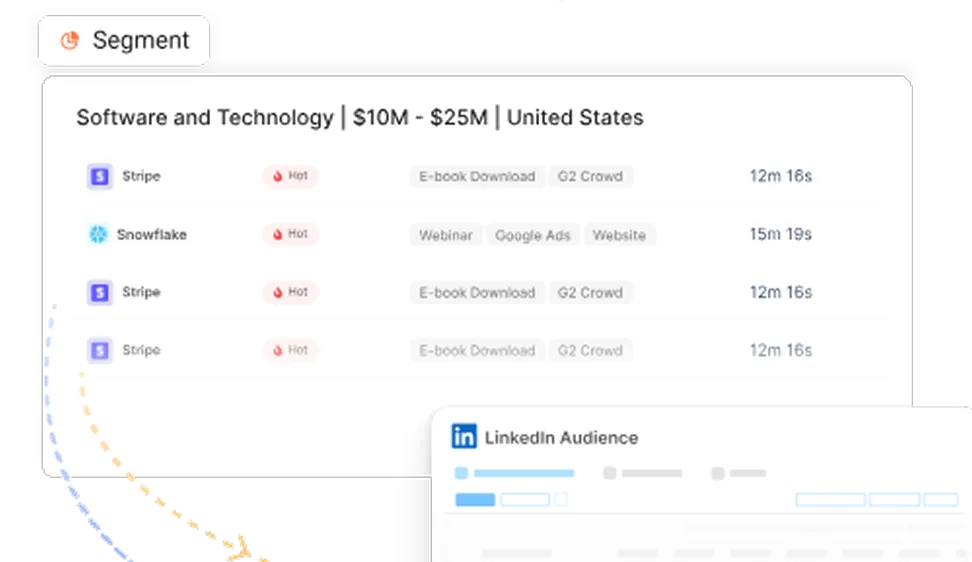
Factors lets you push your highest-intent account lists directly to LinkedIn and Meta as matched audiences, automatically updated as account scores change. Your ads follow your warmest accounts across channels, without anyone manually exporting CSVs or updating audience lists every week. In a stack where most tools generate more data to sift through, Factors focuses on surfacing the signal that drives action: which accounts are engaged, what’s influencing pipeline, and where to allocate resources next.
For teams evaluating the top AI marketing automation tools, the practical question isn’t whether you need account intelligence. It’s whether you’re getting it from a platform that connects intelligence to activation or one that stops at a dashboard and leaves the next step to you.
Where does this all land?
The B2B teams that pull ahead in the next few years won’t be the ones using the most AI. They’ll be the ones who mapped their actual workflows first, chose tools connected to their customer data, and built the organizational discipline to supervise AI agents rather than just deploy them and hope for the best. The stack you need is probably simpler than you think. The execution rigor required to make it work is almost certainly harder than the vendor made it sound.
FAQs for AI marketing automation tools
Q1. What are AI marketing automation tools?
AI marketing automation tools are software platforms that use artificial intelligence to automate, optimize, or independently manage marketing workflows. They range from AI-assisted email send-time optimization to fully autonomous agents that plan, execute, and refine campaigns with minimal human input. The key differentiator from traditional automation is that these tools can learn, adapt, and make decisions based on data patterns rather than just following preset rules.
Q2. What is the difference between marketing automation and AI marketing automation?
Traditional marketing automation executes rule-based workflows designed entirely by humans. If a lead does X, trigger Y. AI marketing automation adds intelligence: predictive scoring, dynamic segmentation, automated optimization, and in the case of agentic systems, the ability to plan and execute multi-step workflows independently. The practical difference is that AI automation improves over time based on outcomes, while traditional automation performs exactly the same way until someone manually updates the rules.
Q3. What are AI agents for marketing automation?
AI agents for marketing automation are autonomous systems that handle complete workflows rather than individual tasks. A campaign creation agent might generate audience segments, draft ad creative, and set bidding parameters based on a campaign brief. A pipeline intelligence agent monitors CRM and web data to flag accounts showing buying signals. These agents differ from chatbots or copilots because they take action across multiple steps rather than responding to a single prompt.
Q4. Which are the best AI marketing automation tools?
The best tools depend on your team size, budget, and primary use case. For campaign automation, HubSpot and Marketo remain strong choices. For revenue intelligence and attribution, Factors.ai and 6sense lead the category. For content generation, Jasper is widely adopted. For enrichment and outbound workflows, Clay is the standout. For building custom agentic workflows, Gumloop has emerged as a leading AI-native platform. The right combination typically includes tools from at least two different categories.
Q5. How does generative AI help marketing automation?
Generative AI helps by creating content assets (emails, blog drafts, ad copy, social posts) at scale and by enabling natural-language interfaces for workflow building. In B2B marketing automation specifically, it accelerates content production, enables personalization at the account level, and allows non-technical users to build sophisticated workflows by describing what they need in plain language rather than configuring complex rule trees.
Q6. Can AI automate campaign creation?
AI can automate significant portions of campaign creation, including audience segmentation, copy generation, asset formatting, and bidding strategy. However, the strategic inputs (defining goals, choosing positioning, approving messaging) still require human judgment. The most effective approach treats AI as a production accelerator with human review checkpoints rather than a fully autonomous campaign launcher.
Q7. How do AI marketing automation tools improve lead generation?
They improve lead generation by identifying anonymous website visitors, scoring accounts based on behavioral and intent signals, personalizing outreach at scale, and optimizing ad targeting in real time. Rather than casting a wide net with generic campaigns, AI tools help teams focus resources on accounts that show genuine buying interest, which improves conversion rates and shortens sales cycles.
Q8. What should enterprises look for in AI marketing automation software?
Enterprise buyers should prioritize data integration depth (CRM, data warehouse, ad platforms), AI transparency (understanding why the system makes specific recommendations), security and governance frameworks, scalable pricing that doesn’t penalize growth, and strong attribution capabilities that connect marketing activity to revenue. Implementation timeline and change management support also matter significantly at enterprise scale.
Q9. What is agentic AI marketing automation?
Agentic AI marketing automation refers to AI systems that operate with a degree of autonomy to accomplish marketing goals. Unlike basic automation that follows rules or AI assistants that respond to prompts, agentic systems plan their approach, execute across multiple steps, monitor results, and adjust their strategy based on outcomes. They represent the next evolution beyond AI-assisted tools, moving toward systems that can manage entire workflows with strategic human oversight rather than constant human direction.

See how Factors can 2x your ROI
Boost your LinkedIn ROI in no time using data-driven insights


.avif)

See Factors in action.
Schedule a personalized demo or sign up to get started for free
LinkedIn Marketing Partner
GDPR & SOC2 Type II

.svg)



.avif)

