
Boosting Marketing Efficiency with GTM Engineering
Learn how GTM engineering improves marketing efficiency by automating lead routing, enrichment, and attribution across sales and marketing systems

.avif)
Content Marketer



.svg)


TL;DR:
- Lead scoring assigns numerical values to prospects based on firmographic fit (company size, industry, tech stack) and behavioral signals (page visits, content downloads).
- Clay centralizes data enrichment from 100+ providers and automates scoring with formula columns.
- Pair it with a visitor identification tool like Factors.ai to capture anonymous website traffic at the account level, then let Clay find the new contacts and route them based on score.
- Start with five to seven scoring attributes, set threshold bands for routing, and refine quarterly based on conversion data.
Think of a campaign you recently launched and generated fifty qualified leads from. The emails synced to your CRM, and that was it.
Sales leaders say the inbound leads are ‘low quality.’ Marketing says Sales isn't following up fast enough. The ops team is stuck in the middle, trying to fix broken zaps and CSV uploads.
This is the standard state of affairs for many B2B companies, from early-stage companies to established enterprises. We throw more money at the problem, hoping for different results. But the problem isn't usually the ad copy or the sales script. It's the pipes.
The connection between your systems is broken. That is where GTM engineering comes in to fix the mess and drive GTM engineering marketing efficiency.
First, What is GTM Engineering in B2B Marketing?
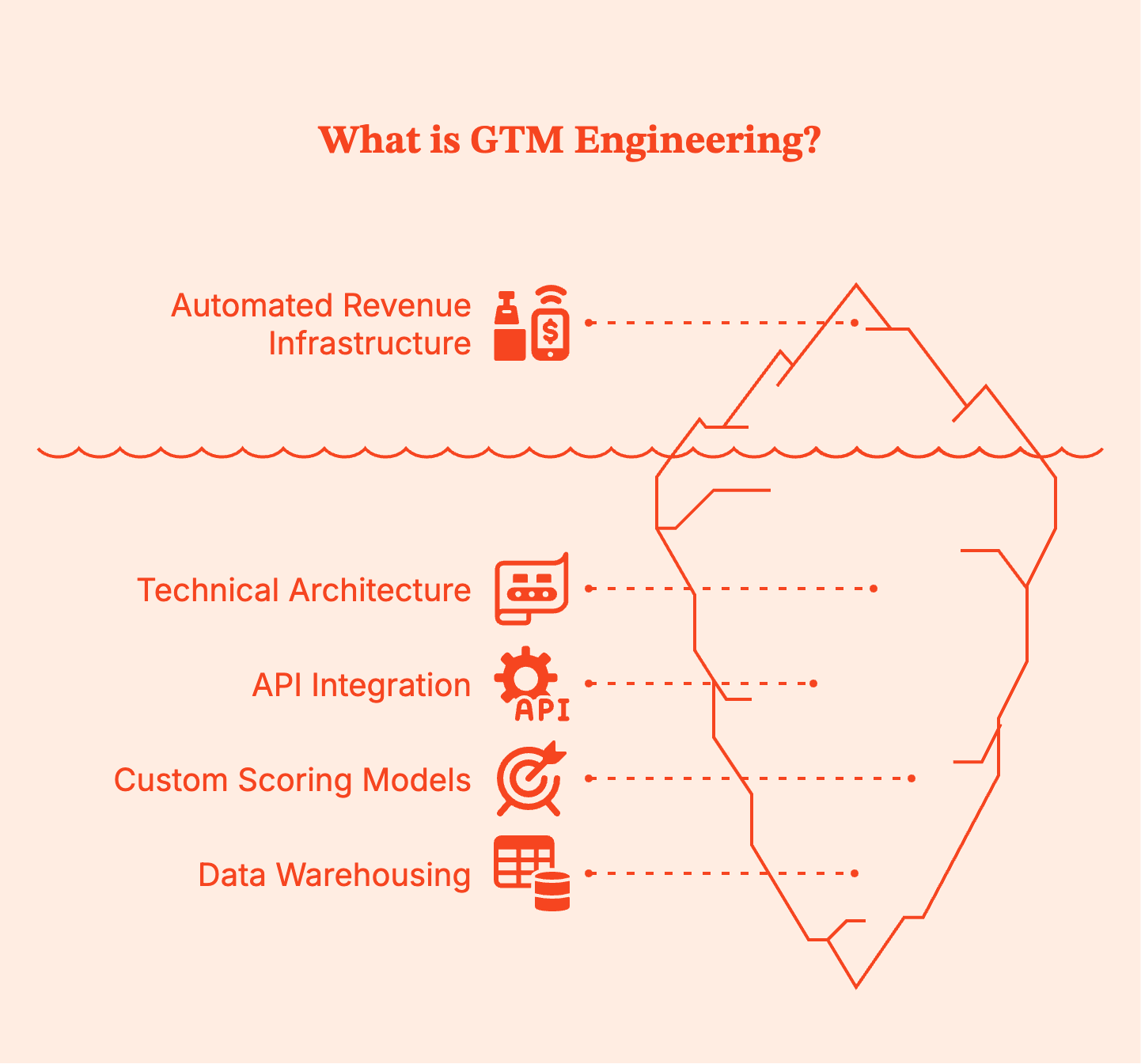
GTM engineering is the practice of using code, data, and automation to build scalable revenue infrastructure. The goal is simple: make data flow seamlessly across the entire customer lifecycle without human intervention.
People often confuse GTM engineering with Revenue Operations (RevOps) or Marketing Operations. But there’s a difference:
- RevOps often focuses on process, gtm strategy, and tool administration.
- Marketing Ops manages the platforms, such as setting up email campaigns or configuring the CRM.
- GTM Engineering goes deeper. It involves using technical skills to write scripts to connect APIs, building custom scoring models, and architecting data warehouses that feed operational tools.
To put this in perspective, let’s consider an example. A marketer decides to target a specific vertical. In this case, a RevOps pro maps out the sales stages, but the GTM engineer builds the full automation system that identifies those vertical-specific visitors, enriches their data, and routes them to the correct email sequences instantly.
Why Does Marketing Efficiency Break Without GTM Engineering?
Efficiency drops when data hits a wall. In most B2B setups, you have a CRM, a marketing automation platform (MAP), ad networks, and sales engagement tools. They all live in their own little bubbles.
Here is where the money leaks in your funnels:
- Leads sitting un-routed: Leads frequently wait hours or days before reaching the right person because old territory rules in lead routing systems don't work anymore. A prospect fills out a form, but instead of going to a rep, they sit in a general queue. Every hour of delay hurts your chance of converting them.
- Enrichment happening too late: Reps often receive just a name and an email. They have to stop selling to research potential customers on LinkedIn, guess the company size, or look for buying committees. This manual work kills sales efficiency.
- Attribution stuck at last-click: Demand gen teams typically rely on what their ad platforms report. Google claims credit for the last click, but this ignores the months of blog posts and webinars that actually built the trust throughout complex buyer journeys.
These problems get worse when your systems operate in silos.
- Systems operate in silos: Your CRM, marketing automation platform, and ad tools often live in different worlds. Marketing might keep nurturing existing accounts that Sales is already closing. The left hand doesn't know what the other half is doing.
- Why more spend doesn’t fix broken workflows? If your bucket has a hole, pouring in more water won't fill it. Increasing your ad budget when your lead routing is broken just creates more waste, not more revenue for the business. You have to fix the connections first.
{{INLINE_TOFU}}
How GTM Engineering Improves Marketing Efficiency?
GTM engineering improves marketing efficiency by removing friction from the funnel. It replaces ‘people doing robot work’ with actual robots. When you engineer your sales motion, you stop relying on Google Sheets and manual reminders and instead build workflows that run 24/7.
- Automation reduces manual effort. Scripts instantly check every incoming lead against icp criteria. Bad leads get filtered out before they clog the CRM. Good leads get flagged for immediate attention.
- Enrichment becomes automatic. You do not ask buyers for their company size or tech stack on a form. That creates friction. Instead, you ask for an email. The engineering layer calls an enrichment API, retrieves firmographic data, and appends it to the record.
- Workflows scale. Adding more salespeople to handle more leads is linear and expensive. Improving the code that manages those leads provides exponential leverage. A robust routing script handles 10 leads or 10,000 leads with the same speed and accuracy.
Automating Lead Routing and Scoring at Scale
To truly scale, you must automate lead routing and scoring beyond simple "if/then" rules. This is table stakes for modern B2B teams.
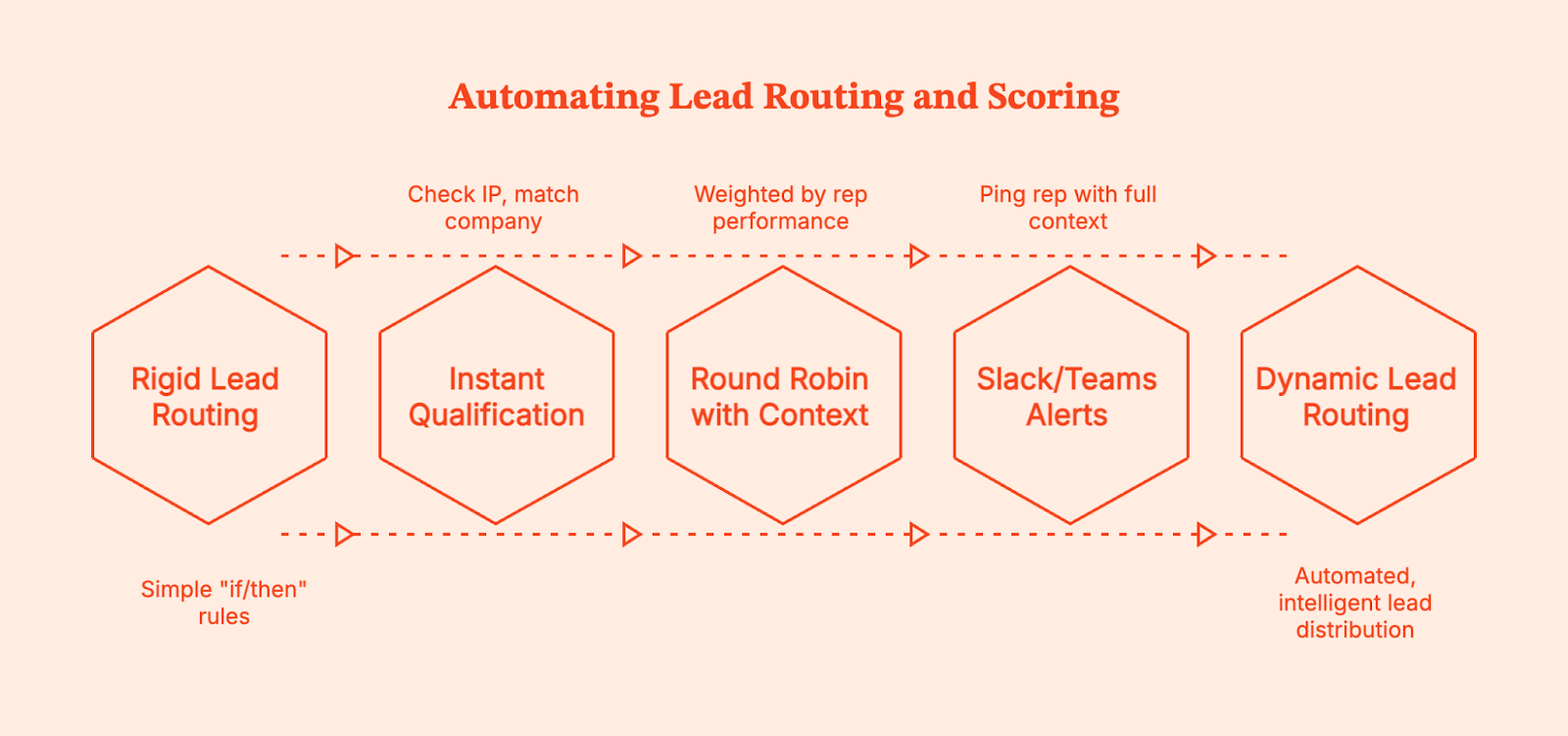
Traditional routing is often too rigid. It usually looks like: ‘If region equals North America, assign to John.’ But what if John is on vacation? What if the lead is a massive enterprise account that implies a higher potential deal size, meaning it should go to Sarah, your senior rep, regardless of region?
GTM engineering allows for dynamic logic:
- Instant Qualification: A lead hits the site. The system checks their IP, matches the company, checks the CRM to see if they are existing customers, scores them based on intent signals, and routes them instantly.
- Round Robin with Context: Leads are distributed fairly, but weighted by rep performance or availability.
- Slack/Teams Alerts: The moment a high-score lead takes action, the rep gets a ping with full context to automate outreach.
Connecting Marketing and Sales Systems End-to-End
The goal is to connect marketing and sales teams so they share a single data source. While many think this is a nice-to-have, it's essential for pipeline health.
Point-to-point integrations (like a basic Zapier connection) are often brittle because if one field changes, the whole thing breaks.
GTM engineering builds a unified data layer instead. Meaning:
- Website data (pages visited, time on site) flows into the CRM.
- CRM data (deal stage, revenue value) flows back into Ad Platforms for better targeting.
- Sales activity (calls, emails) is visible to Marketing for campaign optimization.
When the systems are connected end-to-end, the handoff becomes a continuous flow. Sales knows exactly what the prospect read before they hop on the call. Marketing knows exactly which campaigns drove the highest win rate.
Turning Anonymous Website Visitors into Warm Outbound Plays
Most B2B websites convert at 2% or 3%. That means 97% of your traffic leaves without saying a word. This is wasted potential for any sales-led or plg companies.
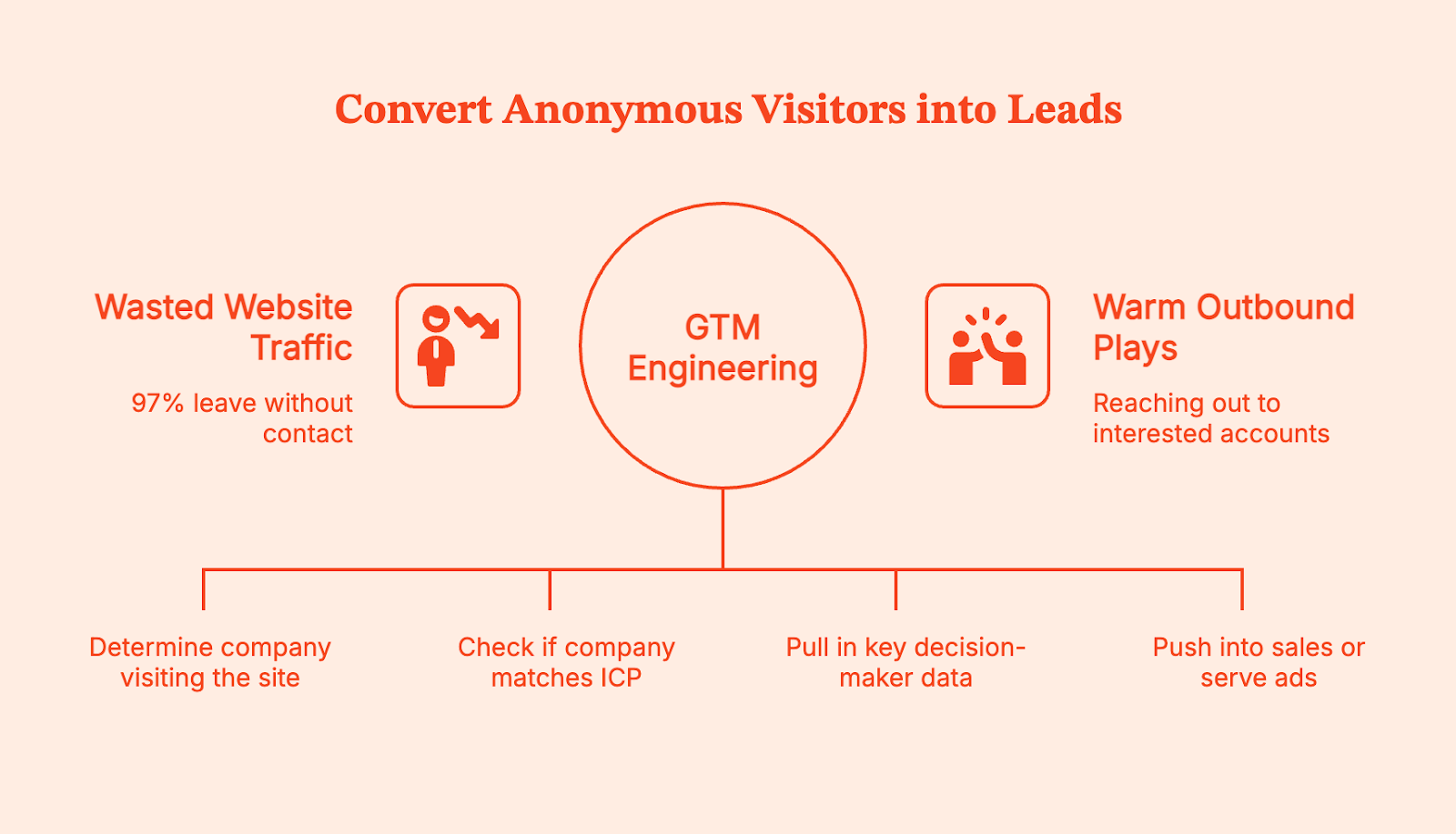
GTM engineering helps you turn a website visitor to warm outbound play. Here is the deep dive into the workflow:
- Identify: Use a tool (like Factors.ai) to identify the company visiting your site, even if they don't fill out a form.
- Filter: Automatically check if they match your Ideal Customer Profile (ICP)
- Enrich: Pull in contact data for key decision-makers at that company.
- Activate: If they showed high intent (e.g., visited the pricing page), automatically push them into a sales sequence or serve them a specific LinkedIn ad.
With this setup, you’re no longer cold-calling prospects. You are reaching out to accounts that are already looking at you, ultimately beating the competition.
Reducing CAC with GTM Automation and Better Targeting
Inefficiency is expensive. Every hour a rep spends researching a lead is money down the drain. Every ad dollar spent on an account that is already a customer is a waste.
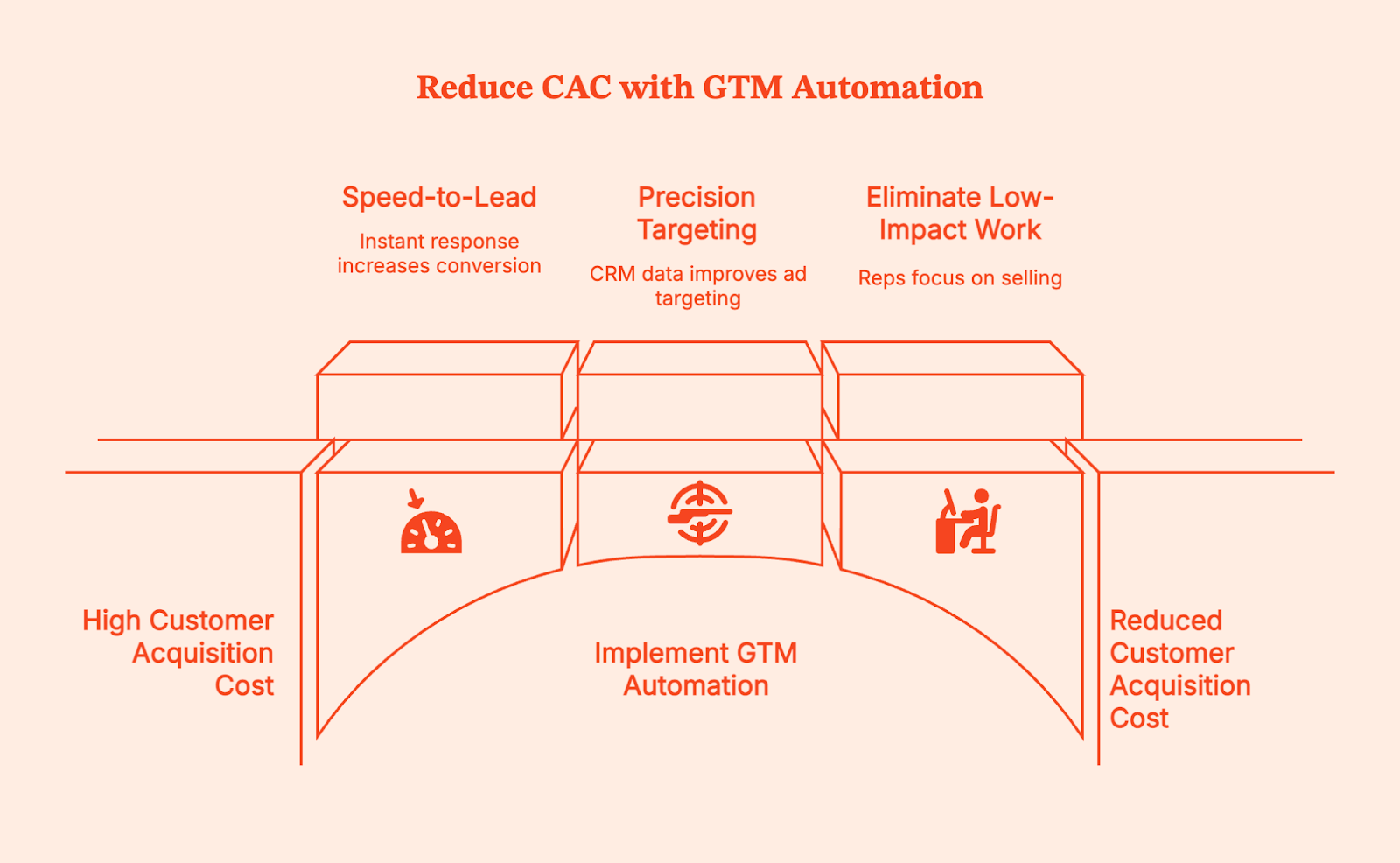
Fortunately, you can reduce CAC with GTM automation by focusing your resources where they matter.
- Speed-to-Lead: Responding within five minutes leads to higher conversion rates. GTM Engineering makes this instant.
- Precision Targeting: By feeding CRM data back into ad platforms, you stop bidding on bad fits.
- Eliminating Low-Impact Work: Reps spend time selling, not on data entry.
When you cut out the waste and increase the conversion rate through speed and context, your acquisition costs naturally drop, and your success becomes predictable.
Attribution and Revenue Visibility with GTM Engineering
Attribution is usually a mess because standard tools only see part of the picture. Google Analytics sees the click; Salesforce sees the close. They rarely agree on what happened in between.
GTM engineering stitches these identities together using AI tools and data science. It enables multi-touch attribution that tracks influence across the entire long sales cycles. You stop looking at vanity metrics and start seeing revenue drivers. You can see which blog posts actually influence closed deals, or how outbound calls interact with inbound marketing efforts.
This visibility changes how you spend money. You might find that a specific LinkedIn campaign has a high Cost Per Lead but a very low Customer Acquisition Cost. This allows you to create feedback loops that refine your demand generation.
GTM Engineering Use Cases for B2B SaaS Teams
When you implement this correctly, the benefits ripple across the entire organization, including post sales and self-serve motions.
- Marketing teams get cleaner data and better targeting. They stop fighting with Sales about lead quality because the definition of a ‘qualified lead’ is codified in the system logic.
- Sales teams get more meetings and better context. They spend less time doing admin work in the CRM and more time selling. They know why a lead was routed to them, which helps them frame the conversation.
- RevOps teams transition from being support tickets to being architects. They stop spending their days fixing broken data and develop skills to build systems that run themselves.
How Factors.ai Enables GTM Engineering for Marketing Teams
Factors functions as the intelligence layer for your GTM engineering stack. Having the right tools is the first step to doing your job effectively.
We start by de-anonymizing your traffic, then identify the companies visiting your site, and tell you exactly what they are doing. But we go further by combining the data with your CRM and ad platforms to create a unified account timeline.
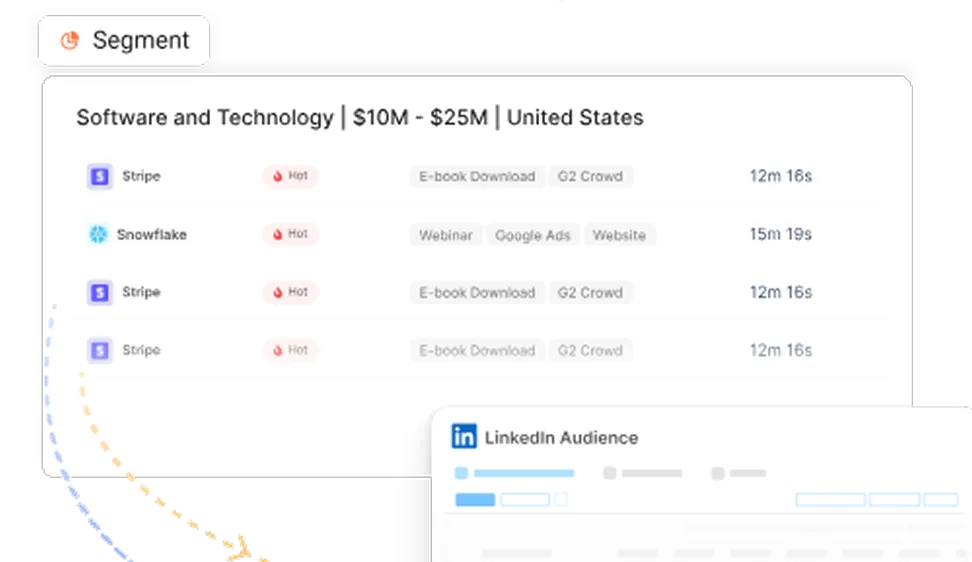
Then, we help you act on it. You can set up automated workflows that push this data where you need it. If a high-intent prospect visits your pricing page, we can Slack your Account Executive immediately. If an ICP account engages with your top-of-funnel content, we can push them into a specific LinkedIn retargeting audience.
Factors gives you the building blocks to engineer a marketing machine that is efficient, automated, and revenue-focused for any early-stage or growth company.
FAQs for Boosting Marketing Efficiency with GTM Engineering
Q: What does GTM engineering mean in marketing?
A: It is the technical process of connecting your data, tools, and workflows using automation to make your Go-To-Market strategy run efficiently without manual work.
Q: Is GTM engineering only for large B2B companies?
A: No. Even small teams benefit from automation. If anything, small teams need it more because they have fewer people to do the manual work.
Q: How does GTM engineering improve marketing efficiency?
A: It automates repetitive tasks like lead routing and data entry, ensuring leads are handled instantly and data is always accurate, allowing for a human touch where it matters most.
Q: Can GTM engineering reduce CAC?
A: Yes. By improving conversion rates through faster follow-ups and better targeting, you lower the cost required to acquire each customer.
Q: How is GTM engineering different from RevOps?
A: RevOps is the strategy and process alignment; GTM engineering is the technical execution and automation that makes that strategy work.
Q: What tools are required to implement GTM engineering?
A: You typically need a CRM (like Salesforce or HubSpot), a data enrichment tool, and an orchestration/intelligence layer like Factors.ai to connect the dots.

See how Factors can 2x your ROI
Boost your LinkedIn ROI in no time using data-driven insights


.avif)

See Factors in action.
Schedule a personalized demo or sign up to get started for free
LinkedIn Marketing Partner
GDPR & SOC2 Type II

.svg)



.avif)

