
How to Increase Traffic to Your Blog: Practical Ways for Organic Growth
Stuck with low blog traffic? Learn how to get blog traffic in 2025 with SEO, content, and distribution strategies that actually work.

Writer



.svg)


TL;DR:
- The three pillars of organic traffic growth: SEO. Consistent helpful content. Deliberate distribution.
- SEO basics for quick initial movement: long-tail keywords, match intent, robust on-page SEO, and strong internal linking.
- Realistically, your fastest move will come if you update and republish existing posts, then add internal links to newer content.
- Don’t wait for Google to pick up. Promote your content in communities, use one relevant social channel, and build an email list early.
- Pick 3–5 tactics and commit for 90 days. Blog traffic is a marathon, not a sprint.
You know when you’ve spent hours writing a blog, hit “publish,” refreshed Google Analytics, and all you got was… crickets for blog traffic?
I know it too. A little too well.
So often, even the best-written blog gets barely any views. As a writer and marketer, it’s frustrating, demotivating, and really dampens your desire to do your best.
The truth is, blogs often don’t get much traffic because it takes more than great content. It takes a strategy.
If you want to increase traffic to your blog, without burning out, here’s what you need:
- Smart SEO (Search)
- Consistent, helpful content (Supply)
- Deliberate distribution (Demand)
No magical hack. No ‘publish 100 posts in a weekend.’
Just a short, realistic playbook with blog traffic tips that work.
Let’s break it down.
Why Traffic from Existing Blog Posts is Still Low
Before jumping into tactics, how about a quick diagnosis?
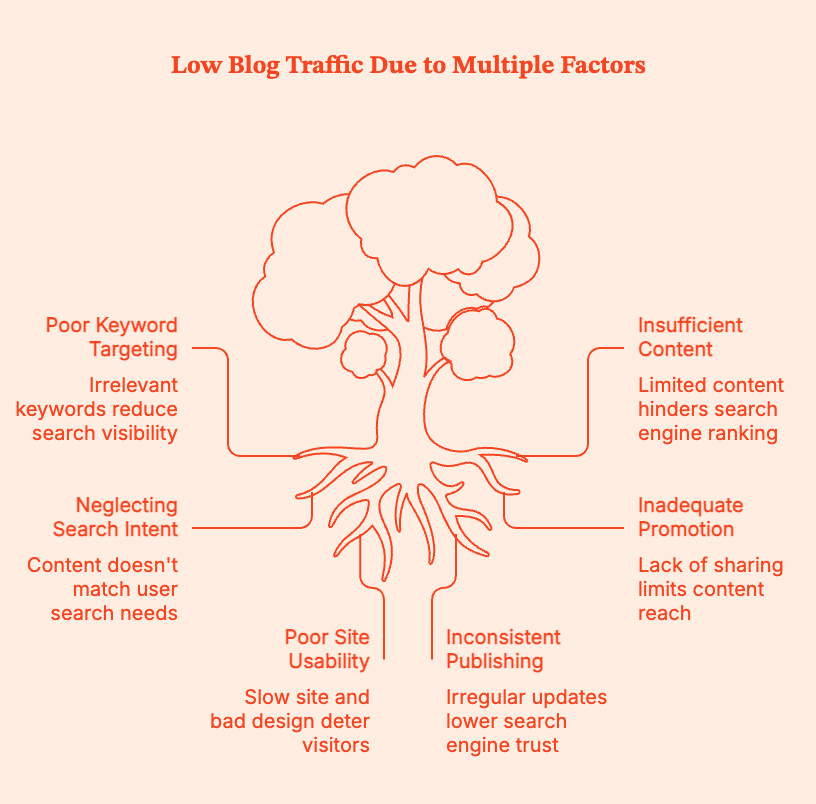
The four main sources of blog traffic
Most of your traffic will come from:
1. Organic / search traffic
This includes visitors coming from Google or other search engines.
If organic traffic is low, it means that:
- you aren't targeting the right keywords (and missing your target audience).
- you don't have enough content for Google to rank posts.
- your keyword research doesn't match what people mean when they type queries.
2. Social traffic
This includes visitors coming from platforms like Instagram, Pinterest, X/Twitter, LinkedIn, or Facebook.
If social traffic is low, it means that:
- no one is resharing your content.
- you're not using the right platforms for your industry/niche.
- you're posting content that isn't getting people's attention.
3. Referral traffic
This includes traffic from third-party websites like guest posts, links in other blogs, Reddit threads, Quora answers, Pinterest pins, directories, and so on.
If referral traffic is low, it means that:
- no other websites are placing links to your content.
- you might not be targeting the right guest posts or collaborations.
4. Direct traffic
This includes views from people who actually type in your URL, click a bookmark, or come from sources GA can’t quite identify (can even email/app traffic).
If direct traffic is low, it means:
- your blog is not a go-to resource.
- your email list is small and infrequently used.
If your traffic is low, the root cause is usually one (or more) of these:
| Root issue | What you’re doing | How it shows up |
|---|---|---|
| You’re not targeting keywords anyone actually searches for. | You write what you feel like, not what your audience is Googling. | Posts are titled like “My thoughts on productivity lately” instead of “How to plan your week when you have ADHD” |
| Your content isn’t matching search intent. | You ignore what the searcher actually wants (how-to, review, comparison). | Someone searches “best budget travel backpacks,” and you give them a philosophical piece on “why travel matters.” |
| You’re not promoting posts or participating in communities. | You hit publish and… that’s it. You rarely share your work where your readers hang out. | You’re not active in relevant communities, Q&A sites, email lists, or social platforms; your blog is invisible off-site. |
| Your blog is slow or hard to navigate. | You’ve never checked site speed, mobile experience, or readability. | Pages take forever to load on mobile, pop-ups attack, fonts are tiny, and paragraphs are giant walls of text. |
| You publish inconsistently or rarely update old content. | You treat publishing like a mood, not a schedule, and forget old posts exist. | You post once, then disappear for three weeks; you never update posts that are getting impressions, so Google isn’t sure your site is “alive.” |
Pro-Tip: Use a combination of Google Analytics + Google Search Console to see where traffic is coming from and what's working. Google Analytics shows where traffic is currently coming from, and Google Search Console tells you what queries you're already showing up for and where you're actually winning.
Pro-Tip II: Don’t fix everything. Fix only the bottleneck. For instance,
- If you have low organic traffic, focus on keyword research + SEO.
- If you have decent impressions but low clicks, focus on titles, meta, and search intent.
- If you have a few posts that do well, update and internally link them as much as possible.
...you get the drift.
How to increase traffic to your blog with valuable blog content (and more)
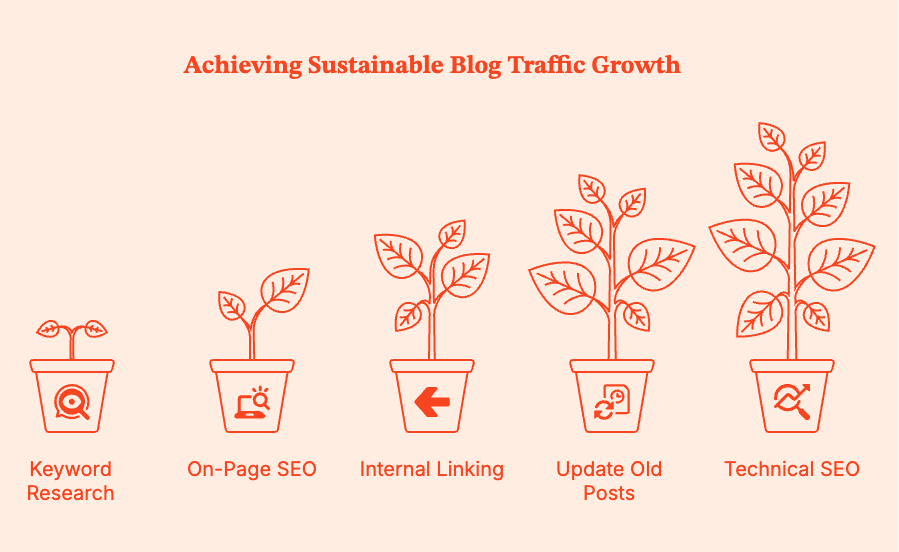
To increase blog traffic, consider mounting your strategy on these three pillars:
Pillar 1: SEO: Get Found in Search
Search engine optimization (SEO), once implemented properly, delivers active, sustainable, month-on-month growth. It takes off the slowest, but consistently gets you more blog traffic once it does.
It's like growing an apple tree: for a few months, nothing is happening. Then one day you have all the apples.
- Do basic keyword research
The secret to good keyword research: look for the overlap between what people search for and what you can actually rank for.
If you're just starting to create high-quality content, don't target keywords that are:
- too competitive (dominated by big players)
- too vague ("my thoughts on...)
Instead, target low-competition, long-tail keywords where small blogs can win. Go on intent-driven searches with:
- clear problems
- defined audiences
- less competition
- higher conversion potential
Example:❌ “How to start a blog”
✅ “How to start a vegan baking blog for beginners"
You can rank much faster for long-tail queries, as readers searching for them know exactly what they are looking for. Also, Google rewards relevant content over vague, "cover everyone you can" targeting.
Tools to help you find these keywords:
Free:
- Google Keyword Planner (broad search volumes)
- Google Suggest/Autocomplete (real-time user queries)
- Google "People Also Ask" (intent goldmine)
- AnswerThePublic (question-based keywords)
Affordable:
- LowFruits (excellent for spotting weak SERPs)
- Keywords Everywhere (cheap, fast insights)
Premium:
- Ahrefs
- Semrush
- Optimize each post for on-page SEO
Fundamentally, your on-page SEO tells Google: “Here’s exactly what this post is about, and here’s why it satisfies the searcher’s intent.”
Use your target keyword naturally in your blogs in the:
- Blog Post Title (H1)
- URL slug
- First 100 to 150 words
- 1 to 2 H2s
- Image alt text
- Meta description
Closely match search intent:
| Search phrase pattern | What the searcher expects |
|---|---|
| "How to…" | A clear, step-by-step guide. |
| "Best…" | A list of options, comparisons, and pros/cons. |
| "X vs Y" | A direct comparison, clarity, and a recommendation. |
| "What is…" | A definition plus examples and context. |
- Internal links & updating old posts
Internally link your web pages and blog posts. Start by asking:
- Which of my posts are getting the most traffic?
- Which new posts need more authority?
Then, link from high-authority posts → to newer or weaker posts.
This will accelerate each page's rank value, help Google understand your site structure, and improve session depth (keep people reading for longer).
Update and republish old posts
Google loves fresh content. So update your older blogs with new data, trends, and user expectations. Here are a few ideas:
- Add recent statistics.
- Replace outdated quotes and screenshots.
- Tighten up intros and conclusions; align them closer with search intent.
- Add newer internal links.
- Improve formatting and readability.
- Address “People Also Ask” questions.
- Technical basics
Make sure your web pages respect the reader's time and sanity. A quick checklist for your website:
- Loads fast (use Google PageSpeed Insights).
- Works on mobile (most people read from mobile devices).
- Has readable fonts (no 12pt elegant script).
- Uses simple navigation.
- Uses optimized images (smaller files, loads faster).
- Doesn’t drown readers in pop-ups (intrusive UX sucks).
Technical SEO is essential housekeeping. Remember that while a clean home doesn’t win the award, a messy one disqualifies you instantly.
This might also help: B2B SEO Checklist: What To Do Before Starting B2B SEO
Pillar 2: Content & consistency
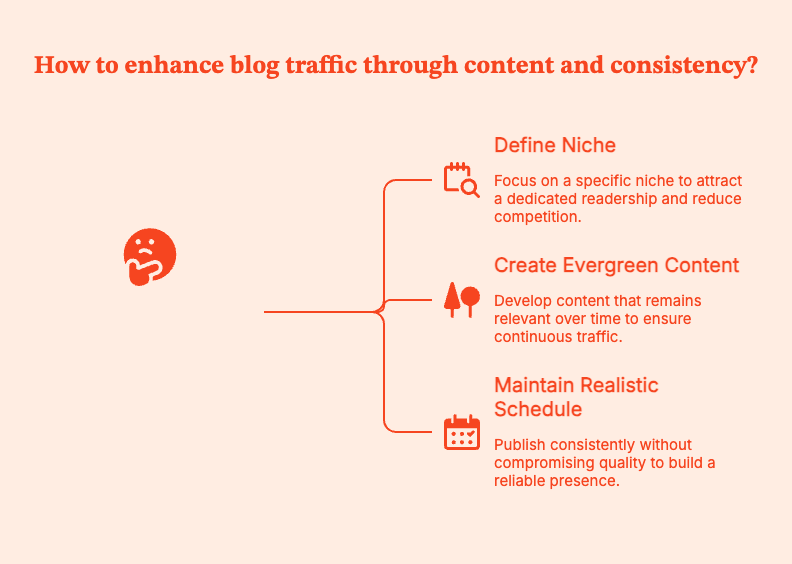
SEO brings people in for the first time. Good content keeps them coming back, and it's the returning users that deliver long-term traffic to your blog. It's cliche but true: content is king.
- Pick a clear niche and readership
Contrary to popular opinion, the best move is not to start writing for everyone. The brand that puts out a recipe this week, a productivity tip the next, and a personal finance piece after that... doesn't get recognized.
When you write for everyone, no one knows it’s for them. These blogs don't make readers think "This is exactly what I’ve been looking for.”
To do so, clearly define your niche and your readership. What do they want to see/read?
Be more specific. Instead of a generic "food blog", try “A dairy-free weeknight cooking blog for busy parents”.
Benefits of writing in a well-defined niche:
- Less competition to rank for keywords.
- Easier to build a distinct brand identity.
- Quicker community building, the right readers know your value.
- Returning users. When people know what you're good at, they'll come back for more of it.
Pro-Tip: Have a look at which keyword themes work best (according to data)
- Publish helpful, evergreen content
This is the kind of content that quietly performs for months or even years after you publish it. People keep coming back, long after you publish it. Often, guides, tutorials, checklists, resource lists, and troubleshooting posts fall under this category.
This is content that readers bookmark because they'll need it again.
Quick tips on creating evergreen content:
- Do deep research. Take one question and answer it completely.
- Be specific to build trust. Use screenshots, examples, and reliable anecdotes.
- Add practical steps that readers can start taking as soon as they finish reading your piece.
- Readers skim first, read second. Go heavy on H2s, short paragraphs, bullets, and visual anchors to help them stay.
- Be realistic about your publishing schedule
You need to publish consistently, but don't put out bad content to meet a calendar.
A sustainable schedule, especially if you're starting out, is
- 2–3 strong posts per week.
- Aim for 30 solid posts in about 3 months.
Pillar 3: Distribution
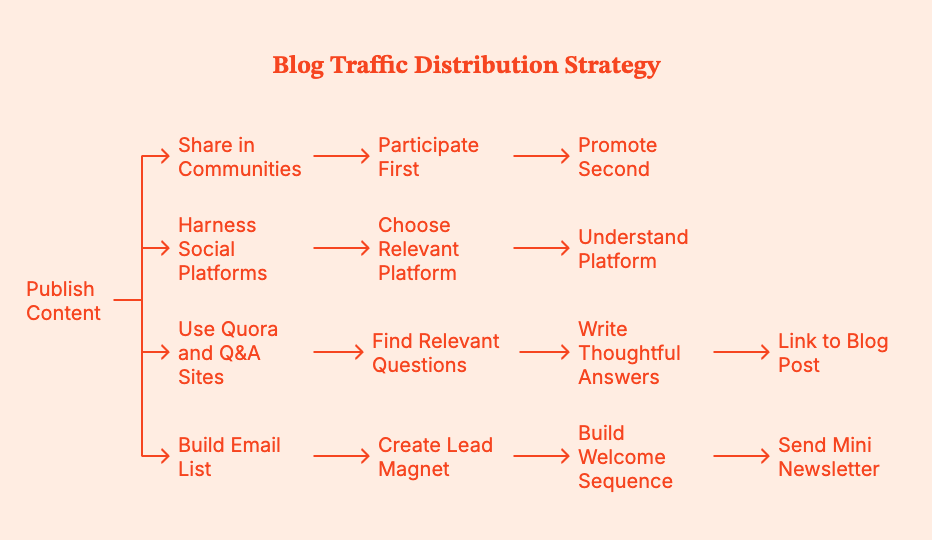
Published your content? You're only half done.
SEO is a long game. Distribution is about getting traffic today.
- Share in the right communities
Communities comprise people already interested in the topic you're writing about. Reddit, niche Facebook groups, industry forums, and Discord groups can get you readers in the hundreds, sometimes even thousands.
But you have to participate first and promote second. Don't just drop your link without context. You'll get ignored or even banned.
Instead, show up consistently to answer questions, contribute insights, and be a real human. That's when people want to read what you post.
- Harness social platforms that suit your niche
Every platform will not work for every niche. So choose ones where your readers spend most of their time.
- Pinterest: Great for visual niches (travel, food, decor, DIY, beauty, parenting).
- Instagram: Great for lifestyle, wellness, travel, and visual storytelling.
- LinkedIn: Ideal for business, marketing, careers, and thought leadership.
- X/Twitter: Works best for tech, entrepreneurship, and innovative ideas.
Pick the most relevant platform and understand everything about establishing visibility, connection, and directing people to your blog.
- Use Quora and Q&A sites for referral traffic
People are literally on Quora to find answers to their questions. Your blogs can be those answers.
Find questions around which you have expertise. Write thoughtful, specific answers, and link to a relevant blog post only if it directly adds value.
If you're lucky, these answers can even rank on Google and push consistent referral traffic for years. Think of this as SEO with fewer gatekeepers.
- Build an email list early
An email list shifts less often than search and social media platforms. So build one.
Quick steps:
- Create one lead magnet, like a checklist, cheat sheet, or mini guide.
- Build a short welcome sequence. This could be 2–3 emails that introduce who you are and how you want to add value.
- Send a mini newsletter with every new published post.
Email lists drive repeat traffic, establish trust amidst readers/users/customers, and ease them into future products and partnerships.
{{INLINE_TOFU}}
Advanced Traffic Boosters: Optional but Powerful
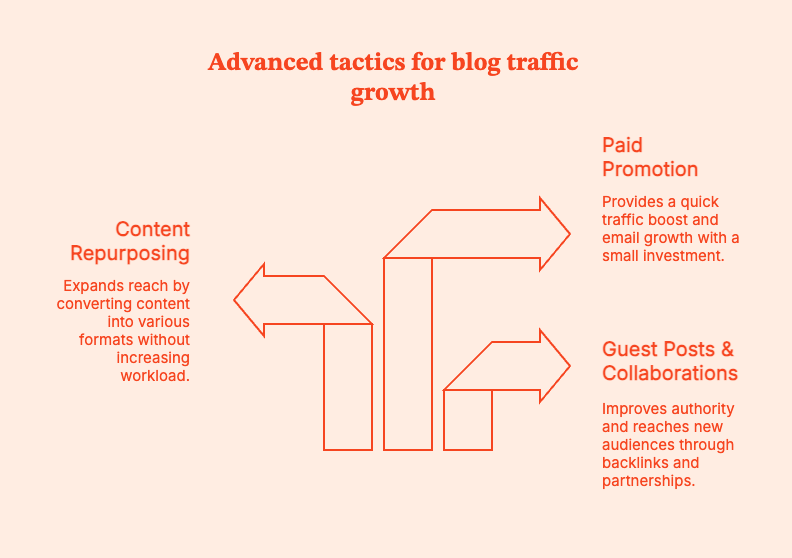
Once you have SEO + strong content + consistent distribution in place, try layering in a couple of more advanced tactics to accelerate growth.
- Guest posts & collaborations
Guest posts will give you backlinks, which improve your authority with Google. They also get your content in front of a whole different audience, build credibility, and start gathering trust.
Target relevant newsletters, third-party blogs, podcasts, and joint webinars.
- Repurpose your content
Repurpose each blog post into a YouTube video, TikTok or Reels snippets, an Instagram carousel, a podcast episode, slides for LinkedIn, and a downloadable resource.
Convert the same idea to different formats and attract wider reach. Multiply your content without multiplying your workload.
- Paid promotion
Nothing big. Put $20–$50 behind a cornerstone post or a lead magnet to kickstart traffic and email growth.
Paid traffic isn't required per se, but it does help remedy the "slow start" problem most new blogs will face.
How Long Does it Take to See Real Traffic?
Don't fall for comforting lies like “30 days to 100K pageviews.”
For most blogs relying on SEO, meaningful traffic usually takes 4–12 months of consistent work.
Only 1.74% of newly published pages rank in the top 10 within a year. 72.9% of pages in Google’s top 10 are more than 3 years old. Source
So it's normal if your blog feels slow to pick up traffic. Don't panic.
A realistic time for your blog traffic:
| Timeline | What’s Happening |
|---|---|
| Month 1–3 | • You publish. Almost nobody shows up. • Google is crawling and indexing your posts; rankings are minimal. • You might get a few visits from social or friends. • Search traffic is tiny or nonexistent. |
| Month 4–6 | • Posts begin appearing on page 2–3 for long-tail keywords. • Traffic bumps up somewhat. • Graphs show a gentle upward slope instead of a flat line. |
| Month 6–12 | • A few posts may finally reach page 1, especially long-tail terms. • Impressions grow → clicks grow → backlinks begin to appear. • Internal linking, updating old posts, and email list building start compounding. |
| After 12 months | • Existing content continues earning traffic on its own. • New posts rank faster thanks to increased domain authority. • One good post now sends readers to 3 or 4 others via internal links + email. |
Instead of obsessing over daily traffic, focus on:
- Consistently adding high-quality, search-focused content to your site.
- Connecting related posts so Google (and humans) can discover more of your content.
- Choosing realistic, long-tail topics your blog can actually rank for.
- Nudging your audience back to your blog when you publish something new.
- Showing up where your readers hang out.
90-day blog traffic plan: A quick, practical playbook
Consider this playbook, you’ll usually see movement within 60–90 days:
| Month | Focus | What to do |
|---|---|---|
| Month 1 | Set up tracking + SEO basics | • Install Google Analytics + Search Console • Fix site speed • Publish 8 to 10 optimized posts • Add internal links |
| Month 2 | Get your content in front of readers | • Join 1 or 2 active communities • Start an email list • Update 2 old posts • Promote posts consistently |
| Month 3 | Grow reach + authority | • Guest post 1 to 2 times • Publish 6 to 8 more posts • Strengthen internal links |
At every step, remember to measure the ROI of your B2B content. Factors.ai takes content analytics seriously with extensive breakdowns + filters, custom dimensions + KPIs, and content groups.
You can get granular insight into your assets, such as answers to questions like “What geographies are consuming most of my work?”, “Is my blog being read more frequently on a phone or on a desktop? Should I optimize accordingly?”, “What campaigns, channels, and sources is web traffic originating from? “What about my SEO efforts and organic traffic?”.
How about a demo to see what Factors can really do?
Bottomline: Don't panic. Don't rush. Strategize.
Blog traffic flows from focus rather than frenzy. To keep your trajectory consistent upward, implement closely-aligned SEO (so the right people can find the content), build helpful, well-structured content, and distribute content across the right channels.
In gaining organic traffic, don't count on "overnight" success because it doesn't really exist. Dig into the archives of successful blogs, and you'll find years of steady publishing, updating old posts, and showing up even when traffic was low.
Pick three to five tactics from this guide that fit your time, your skills, and your niche. Commit to them for the next 90 days. Publish consistently. Promote decidedly. Keep updating what is already written.
In blogging as in life, momentum beats miracles.
Summary
If you’re wondering how to increase traffic to your blog in 2025, the answer is three pillars that compound over time: SEO (Search), content consistency (Value), and distribution (Reach).
Start by finding where your blog traffic is coming from by using Google Analytics and Google Search Console. Do not target keywords that are too competitive, publish without matching search intent, neglect internal links, or rely on Google alone without content promotion.
For SEO, key in on low-competition, long-tail keywords. Write blogs that match intent, and master on-page basics: titles, headings, intro, meta description, image alt text. Link every new post to older relevant posts, and update older posts to link forward. Update and republish old content.
For content, pick a clear niche and write posts that solve real problems with examples and clear steps. Aim for a realistic publishing schedule.
For distribution, share your posts in the right communities without spamming. Post on at least one social platform that fits your niche. Answer relevant questions on Quora/Reddit, and start an email list early.
Expect traffic growth over months, not days. Build a 90-day plan to publish optimized content, improve internal links, and promote deliberately on the right channels.
Frequently Asked Questions on How to increase traffic to your blog
Q. How long does it take to start getting traffic to a new blog?
On average, blogs see early traffic in 1 to 3 months, usually from social media platforms, relevant communities, and long-tail queries. Consistent search traffic usually shows up between 6 and 12 months with consistent publishing and optimization.
Pro Tip: Pick one long-tail keyword per post. Aim for 8 solid posts a month for the first 90 days.
Q. What is the fastest way to increase traffic to your blog?
If you want to increase blog traffic quickly:
- Update posts you already have (better title, stronger intro, clearer structure, more internal links).
- Re-promote them after updating.
Pro-Tip: Open Google Search Console, filter for queries where you rank positions 8 to 20. Rewrite the title/meta description to improve clicks.
Q. How many blog posts do I need before I’ll see real traffic?
There is no one number. But generally blogs see initial traction after publishing 20 to 30 high-quality posts, especially if they target low-competition keywords.
Pro-Tip: Create a “cluster” of 1 pillar post + 6 to 10 supporting posts. Then, interlink them. It'll help Google understand your topics and authority.
Q. Is SEO or social media more important for blog traffic?
SEO is best for long-term traffic. Social media platforms are best to ignite short-term interest. Treat social as a distribution for your best posts.
Pro-Tip: Allocate most of your weekly effort into keyword-targeted posts and internal linking. This will keep traffic coming even when you are offline.
Q. Do I need to post every day to grow my blog traffic?
Daily posting is optional and often unsustainable. Target 1 to 3 strong posts per week, and use the rest of the time to update one older post and add 5 to 7 internal links.
Q. How can I increase blog traffic for free (without ads)?
The Holy Trifecta is long-tail SEO + internal linking + community distribution (Reddit/forums/Facebook groups) + email list.
Pro-Tip: For every new post, share in one relevant community, answer one related Quora/Reddit question, and email your list.
Q. Does guest posting still work to get blog traffic in 2025?
Yes, but only if you publish on websites with a relevant audience. You also have to write on topics that naturally lead readers back to your blog.
Pro-Tip: Pitch one specific post idea to the third-party site. In the article to be published, include a link to a relevant resource on your site (a checklist or hub page).
Q. How can I use Pinterest to drive traffic to your blog?
It's best to treat Pinterest like a search engine. Use keyworded pin titles/descriptions + consistent publishing + fresh creative.
Pro-Tip: Craft 3 to 5 pin designs per blog post, schedule them over a few weeks, and link each pin to a post with strong visuals and clear headings.

See how Factors can 2x your ROI
Boost your LinkedIn ROI in no time using data-driven insights


.avif)


.avif)
See Factors in action.
Schedule a personalized demo or sign up to get started for free
LinkedIn Marketing Partner
GDPR & SOC2 Type II






.svg)



.avif)

