
Lead-Based Marketing: The B2B Approach to Smarter Demand Generation
Learn how lead-based marketing powers B2B demand generation: sourcing, scoring, and converting high-value leads into revenue.

Writer



.svg)


TL;DR
- Lead-based marketing prioritises high-intent, high-fit leads instead of raw traffic.
- The B2B buyer journey is multi-stakeholder and nonlinear, requiring long-term nurturing and intent tracking across 4 stages: Awareness → Consideration → Decision → Purchase.
- Lead sourcing works when inbound (SEO, content, webinars, LinkedIn) and outbound (events, cold outreach, firmographic/technographic targeting) align with clean data and a clear ICP.
- Lead scoring and qualification (BANT + behaviour-based signals) flag leads as MQLs, SQLs, and PQLs. Only sales-ready leads reach the sales team.
- Demand gen creates interest; lead-based marketing converts it into opportunities with a combination of intent data and automation.
- Conversion rate optimization (CRO) across landing pages, emails, CTAs, and forms can minimize user-end friction and transform MQLs into SQLs and real opportunities.
- Platforms like Factors.ai unify ads, website activity, CRM data, and intent signals into one timeline. This improves lead sourcing, prioritisation, routing, and revenue attribution.
B2B marketers, are you swimming in data, tools, dashboards, and traffic, and still being asked, “Why are we not converting more pipeline?”
You’ve got clicks, impressions, and thousands of website visits. But it’s not enough, is it?
That’s because healthy conversion rates come from qualified leads, i.e., the right people, with the right intent, caught at the right time.
Finding these people requires lead-based marketing.
Consider this the next step in the evolution of lead generation strategies. Marketing and sales teams are quickly realizing that even a few sales-qualified leads can deliver more predictable revenue and growth than thousands of clicks that go nowhere.
This article dives into the modern-day lead generation process, and how it helps narrow the target audience, find potential customers, and zero in on high-quality leads.
What is Lead-Based Marketing? (Lead Marketing Definition)
Lead marketing (or lead-based marketing) is a structured, data-based process of finding, nurturing, and converting qualified leads. Lead generation efforts chase the leads most likely to yield a sale, instead of just boosting raw traffic or impressions.
In a sales funnel, each marketing qualified lead is scored and segmented into MQL (Marketing Qualified Lead), SQL (Sales Qualified Lead), or PQL (Product Qualified Lead) to indicate their readiness for purchase.
Here’s a simple workflow: Marketing Signals → Lead Scoring → Handoff to Sales → Opportunity
Teams start with finding “leads in marketing” (meets your criteria and is showing positive behaviour) and transition to “lead sales” (passed to sales for outreach).
Marketing efforts create interest, scoring & qualification ensure the right leads move forward, and sales closes the deal.
Understanding the B2B Lead Journey (Qualified Leads + Marketing Campaigns)
The B2B buyer journey is non-linear. You juggle multiple stakeholders, long sales cycles, complex solutions, and regulatory or budget constraints. The buyer journey stretches across weeks or months, and often involves multiple people operating at different stages of the customer journey:
Awareness → Consideration → Decision → Purchase
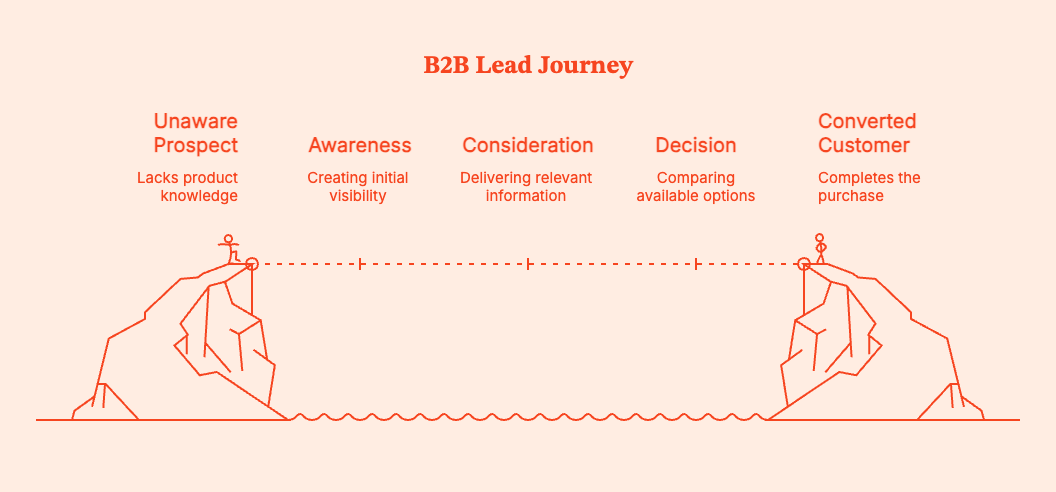
At Awareness, you’re creating visibility.
At Consideration, you're delivering relevant information to a narrowed set of interested parties.
At Decision, the team is comparing options.
At Purchase, you make the sale.
Content, channels, and strategies vary by each stage:
- At Awareness: blog posts, SEO, social proof for buyer trust.
- At Consideration: webinars, case studies, retargeting ads.
- At Decision: demos, personalised offers, negotiation.
It's not easy to keep precise track of all content and operations at each stage, especially if the sale involves multiple modules/buyers. A tool like Factors can help with that. Connect it to your data banks, and it will unify all signals across each touchpoint in the marketing + sales funnel.
Factors keeps you updated on where a lead is in the journey, so you act accordingly to save the sale. Marketing and sales intelligence now carry the same context at all times.
{{INLINE_TOFU}}
Lead Sourcing: How to Find and Attract Marketing Qualified Leads
Lead sourcing is the process of generating leads for your marketing engine. Without the right leads, marketing teams will fail to sell, no matter how cutting-edge their nurturing, scoring, or sales processes are.
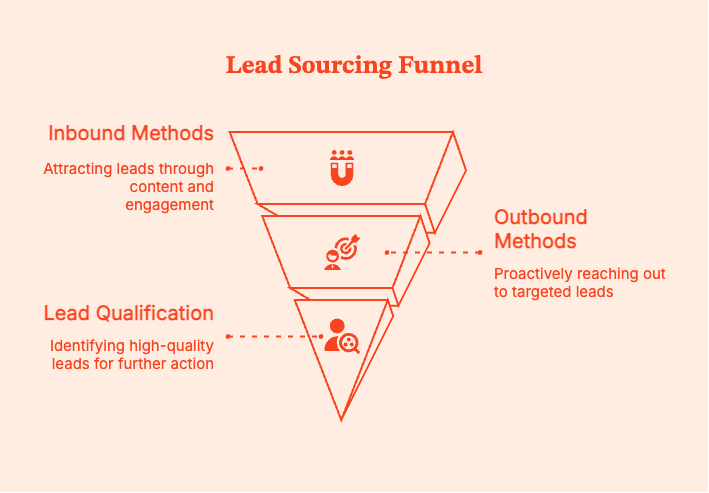
High-quality leads emerge from two buckets, inbound and outbound. For the best results, use both and ensure every decision is data-first.
- Inbound Methods
Inbound methods identify leads who are already looking for solutions like yours. It’s the most efficient tactic, compounds over time, and provides long-term growth.
- SEO and content marketing
Consistent blogging and ranking for the right keywords is great for gathering inbound leads. The idea is to show up with answers when buyers are researching their problem. If someone types “how to get better results from SEO” and finds your guide, it's a match made in heaven.
- Webinars and LinkedIn campaigns
Webinars filter for intent. No one signs up for a webinar on a Thursday afternoon unless they actually care about the problem to be solved. LinkedIn is also great for curating B2B deals. Over half (53%) of B2B marketers use LinkedIn to identify prospects and source contact details.
- Referrals, partnerships, and intent data
Partnerships and referrals produce high-quality leads because trust is implicit. If another brand vouches for you, the lead is more receptive to the deal.
Then there's B2B intent data, that highlights which companies are researching topics related to your product so you can reach out before your competitors do.
If you need some help with learning How To Use Intent Data To Drive Pipeline, we got you.
2. Outbound Methods
Outbound sourcing focuses on proactive discovery. You don't wait for leads to find you, but go out and find them.
But outbound efforts need to maintain a tricky balance. Done badly, it just looks like spam. Done well, it almost guarantees regular pipelines.
- Events, trade shows, and field marketing
The most relevant events will yield high-value B2B leads, especially for mid-market or enterprise firms.
Field marketing offers face-to-face connection, which speeds up brand credibility, trust, and qualification.
- Cold outreach and targeted sequences
Cold outreach only gets results when you've put in solid research and accurate data. Bad data will kill your outreach campaigns and destroy your credibility in the eyes of potential and existing customers.
- Firmographic and technographic targeting
Firmographic targeting is like demographic targeting, but for companies instead of people.
A tool like Factors.ai can help you set filters like industry, company size, revenue, headcount, and technology stack. It will help you find companies and leads matching your Ideal Customer Profile (ICP).
You'll have to invest in an ICP Marketing Strategy, but the payoffs will be worthwhile, because you're talking to people who actually need your product.
For example, if your product integrates with HubSpot, a company already using HubSpot is worth way more than a company that does not.
Checklist for Sourcing Success
Here’s a quick checklist to keep your sourcing efforts intentional:
- Do you have a clear ICP?
- Is your data verified and clean?
- Have you tested and optimized your sourcing channels?
- Are you using a specific tool (like Factors) with intent models, signals, and enrichment layers to help identify which accounts are warm before outreach?
From Leads in Marketing to Lead Sales: Scoring, Qualification, and Handoffs
You’ve got leads. But not all leads are born equal. Which of these actually matter, and will close a deal?
The answer: lead scoring and qualification.
- Lead Qualification
This is the process of determining if a lead is worth a salesperson's time. It works under two broad approaches: BANT Qualification or Behavioural/Intent-based Qualification.
- BANT Qualification looks at:
- Can they afford you?
- Are they the decision maker or can they influence one?
- Are they trying to solve the problem you fix?
- Are they buying now or in six quarters?
- Behavioural/Intent-based Qualification looks at lead behavior:
- Visiting your pricing page twice in one week.
- Rewatching your product demo.
- Attending a webinar on a niche feature.
- Reading your integration documentation.
Actions like these hint that the lead is warming up and may be ready for sales. Tools like Factors.ai specialise in detecting these subtle signals and filtering them.
2. MQLs, SQLs, and PQLs
First time? Here's a quick look at the different types of leads:
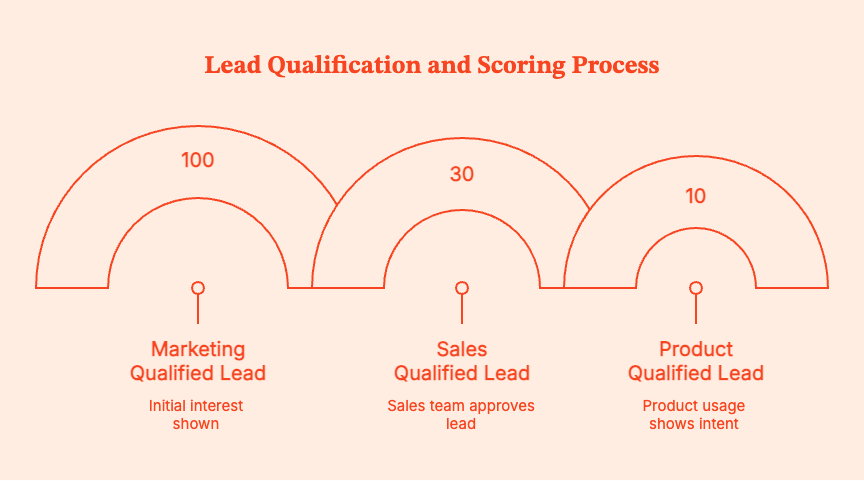
- Marketing Qualified Lead (MQL)
This person fits your ICP and shows some level of interest.
Example:
Someone from a mid-market SaaS company downloads your “2025 B2B Marketing Benchmarks” report and visits your homepage a few days later. Not sales-ready, but can be nurtured.
- Sales Qualified Lead (SQLs)
This is when sales says, “Yes, please" to a lead.
Example:
Someone views your pricing page, fills out a demo form, or clicks a retargeting ad for a comparison guide.
- Product Qualified Lead (PQLs)
Mostly relevant for PLG companies. This is someone who has used your product and shown buying intent.
Example:
A free user who invites three teammates, integrates with Slack, and hits a usage limit.
3. Lead Scoring
Here, marketers assign points to behaviours, attributes and actions to rank leads by likelihood to convert.
Example:
- +10 points for viewing the pricing page
- +8 points for attending a webinar
- +5 points for opening a nurture email
- +3 points for visiting the blog
- +0 points for “downloaded the PDF your CEO insisted on writing”
Again, Factors can automate scoring by pulling data from ads, CRMs, websites, and emails to highlight the right leads at the right time.
4. Sales–Marketing Handoff
If marketing and sales don’t agree on what “qualified” means, you'll end up with complaints like, “Why did you send me this lead?” Marketing can also complain:“We sent you 100 leads. Why haven’t you closed any?”
A clean handoff requires marketing and sales to align on:
- What qualifies as an SQL.
- Which behaviours indicate sales readiness.
- How quickly a lead should be routed.
- Who owns the follow-up and within what timeframe.
Shared dashboards can help reach this alignment. For instance, Factors' Milestones feature offers sales context with data on:
- What led this account to engage.
- Which stakeholders interacted with which assets.
- Which campaigns influenced them.
- What signals indicate rising intent.
- Where they are in the buyer journey.
Integrating Lead-Based Marketing with Demand Generation
Don't treat demand gen and lead-based marketing like distant cousins who only see each other at QBRs. Demand gen creates the interest. Lead-based marketing captures, qualifies, and converts that interest into revenue. Use both, consistently.
Demand Generation vs Lead-Based Marketing
Let’s break it down:
| Aspect | Demand Generation | Lead-Based Marketing |
|---|---|---|
| Primary Purpose | Create awareness and interest | Capture, qualify and convert that interest |
| What It Focuses On | Content, ads, SEO, webinars, social engagement | Lead scoring, intent signals, nurturing, sales-readiness |
| How It Works | Gets your brand on the radar and attracts potential buyers | Identifies who actually cares and moves them through the funnel |
| Key Question It Answers | “How do we get more of the right people to notice us?” | “Which of these people are ready to talk to sales?” |
| Team Most Involved | Marketing | Marketing + Sales working together |
| Typical Outputs | Traffic, impressions, engagement, awareness | MQLs, SQLs, opportunities, pipeline |
| Tone / Vibe | “Hey, check us out.” | “You’re interested? Let’s get you what you need.” |
| End Goal | Build visibility and demand | Turn demand into measurable revenue. |
You Need Both
- Only demand generation: Lots of traffic, impressions, and clicks. No clarity on who’s ready to buy.
- Only run lead-based marketing: chasing the same 200 accounts until the end of time.
Use both, and you get a system that grows AND converts.
A Real-World Example
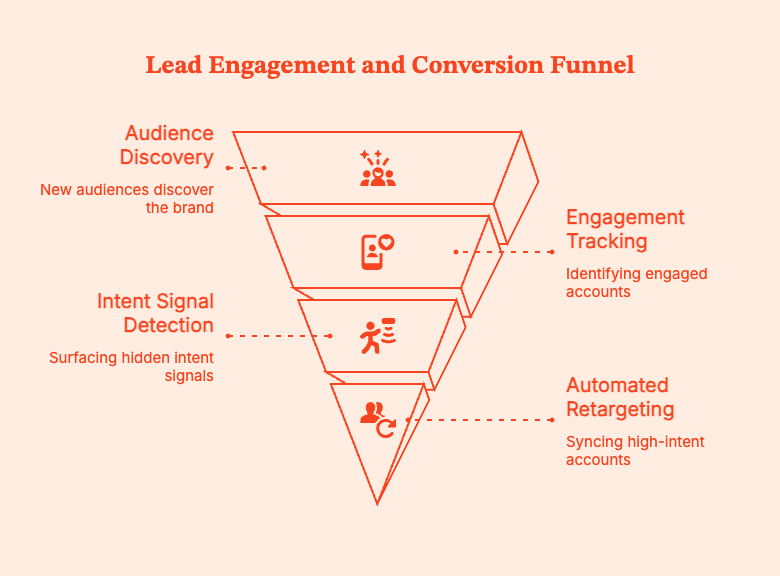
You've launched a LinkedIn awareness campaign promoting a new ebook for B2B marketers. Your impressions go up. New audiences discover your brand. Some accounts click, some visit your page, some watch three seconds of your video.
Next, you run lead-based marketing:
- Factors.ai identifies who actually engaged. You get account-level intel about which companies viewed your posts, who visited your site, especially at odd times (they're really interested).
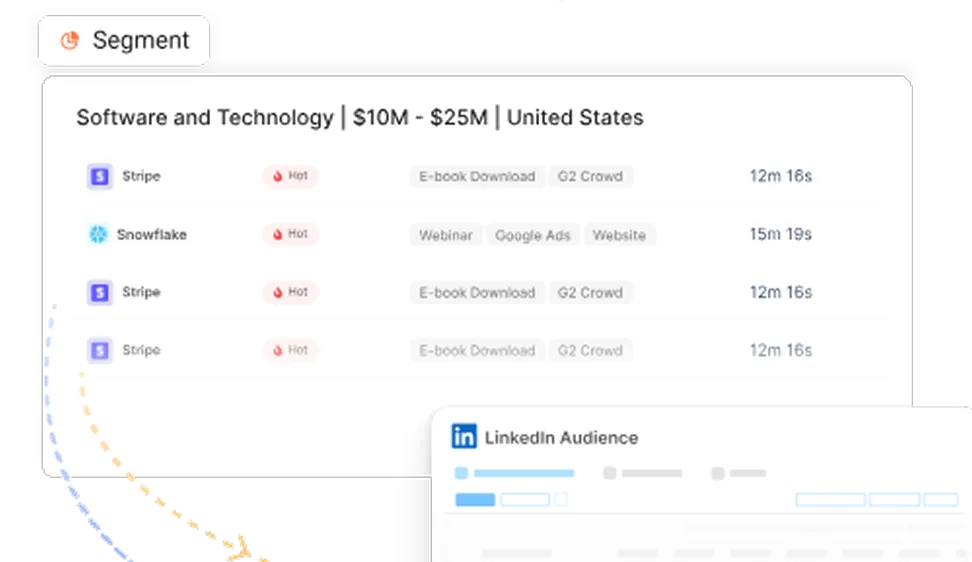
- High-intent accounts are automatically synced to new campaigns. Factors pushes these accounts into your retargeting audiences or nurture flows: demand-to-lead conversion on autopilot
- Factors surfaces intent signals you probably would not notice yourself. For example, a company didn’t click your LinkedIn ad but had three people from the team reading your blog.
Close the Loop With AI: AdPilot
An AI tool like AdPilot gives you a bit of an unfair advantage. It makes LinkedIn ads work for you by helping to build precise audiences, run intent-driven campaigns, send quality conversion signals, and closely track ROI.
Conversion Optimization: Turning Leads into Opportunities
Generating leads is just step 1.
You convert them to opportunities that can yield revenue, a.k.a you perform conversion rate optimization (CRO). CRO is the continuous process of improving every interaction a lead has with your brand: your landing pages, emails, forms, ads, and follow-up cadence.
Why CRO Matters in B2B
B2B buyers are cautious, risk-averse, and usually not solo decision-makers. You have to navigate long sales cycles, internal approvals, competing priorities, and usually one person who wants to pause everything "for now". To make a sale in this environment, your conversion path needs to remove friction at every possible step.
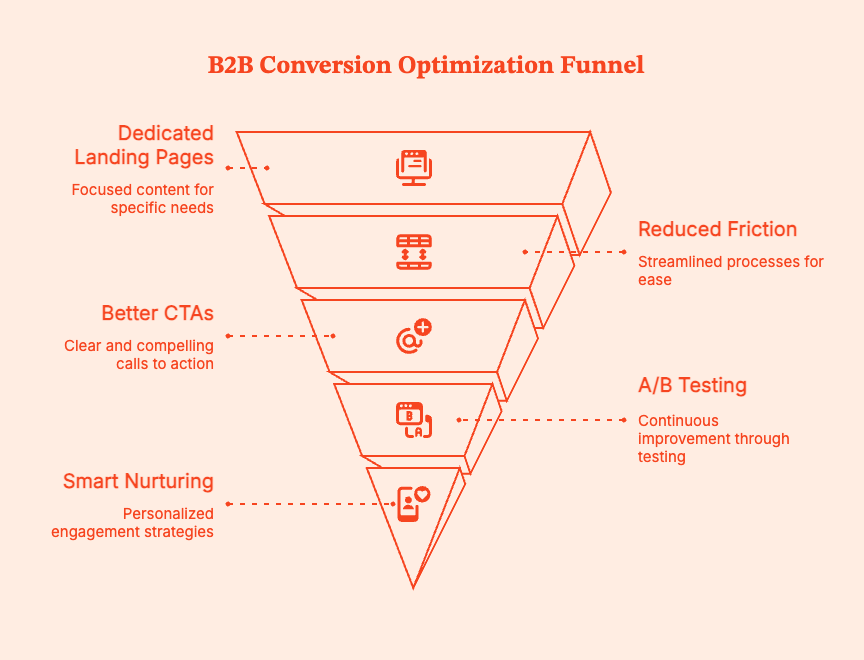
We'll discuss this in detail elsewhere, but here are a few quick best practices to keep CRO effective and profitable:
- Use Dedicated Landing Pages. Your homepage pleases everyone and converts no one. Dedicated landing pages match the visitor's intent, address specific pain points, emphasize one CTA, and build a focused experience.
- Reduce Friction. Every extra form will kill conversions. Remove unnecessary form fields, use progressive forms (like HubSpot), give multiple forms to interact with (demo, trial, PDF, video), and ensure that your CTA IS visible, obvious, and benefits-first.
- Better CTAs. You need clarity more than cleverness. “Get the ROI breakdown” beats “Unlock insights.” Tell the visitor what they get and why it matters.
- A/B Test Everything: headlines, CTAs, colors, form lengths, button placement, social proof, hero images.
- Smart Nurturing Between MQL and SQL. Most leads won’t convert on the first visit. But nurturing will get the lead to convert eventually. Use personalised email sequences, retarget ads based on visited pages, build industry-relevant case studies, and deploy dynamic website content personalised by account.
- Use Factors.ai To Find Drop-Off Points. It will show you where leads abandon forms, find which landing pages perform best, flag pages where intent spikes, sync high-intent accounts back into LinkedIn or Google Ads, and even track drop-offs from ad click to CRM entry.
Tools & Platforms To Power Lead-Based Marketing
Lead-based marketing needs a solid tech stack to support it. Here’s a high-level view (a deeper dive has to wait for a standalone article):
- CRM: Salesforce, HubSpot
- Marketing Automation: Marketo, Pardot
- Analytics / Attribution: Google Analytics
- Enrichment/Data Providers: Clearbit, Apollo
- Intelligence Layer: Factors.ai
In this matrix, Factors.ai is the intelligence layer binding ad data, website activity, and CRM signals into one view. It uses AI agents to surface high-intent leads and also automates routing and follow-up operations. A single platform gives you complete context and actionability.
| Solution | What You Get | What You Might Miss Without Factors |
|---|---|---|
| CRM + Marketing Automation | Leads, nurture workflows | Unified view of intent across channels |
| Enrichment tools | Data on companies/contacts | Ability to tie data to behaviour and act fast |
| Intelligence Layer (Factors.ai) | Lead scoring, routing, unified signals | Delay, missed leads, lack of prioritisation |
Key Metrics and ROI Measurement for Lead-Based Marketing
How do you prove that your lead-based marketing is working? You move beyond vanity metrics like impressions or downloads and focus on pipeline-driving, revenue-generating metrics.
Here are the metrics B2B teams actually need to track.
- Cost Per Lead (CPL): Total Spend / Number of Leads Generated.
Pro-Tip: A higher CPL only helps if those leads are higher quality. Cheap leads often cost you more in time, nurturing, and dead-end sales calls. - MQL to SQL Conversion Rate: MQL → SQL Conversion Rate = Percentage of marketing-qualified leads that sales accepts as worthy of outreach.
- SQL to Opportunity Conversion Rate: Once sales accepts a lead, how often does it turn into a true opportunity? If this number is low, your leads might be curious but not committed.
- Pipeline Value Generated: The total dollar amount of opportunities created from your leads. This is also the KPI your CEO actually cares about, no matter how much they talk about engagement rate.
- Pipeline Velocity (Conversion Velocity): How quickly leads move through the funnel.
(Number of Opportunities × Deal Value × Win Rate) / Sales Cycle Length - ROI (Revenue Influenced / Marketing Investment): Revenue Influenced or Attributed / Total Marketing Spend.
From Data to Demand: Building a Connected B2B Growth Engine
Lead-based marketing seems to be gaining ground, but it's more than a flighty trend or a buzzword. It’s the silver bullet for turning your data, tools, and traffic into real revenue.
It boils down to data + alignment + context.
Lead-based marketing helps sales and marketing teams get on the same page about what counts as a "good lead". When these systems talk, you truly understand your buyer's journey. Add a tool like Factors to layer the insights, and now you've eliminated guesswork from your revenue Ops.
Bottomline: B2B buyers expect speed and relevance; being reactive isn’t enough. You need to anticipate, identify, prioritise, and act. Your lead-based engine does exactly that, and turns demand gen into revenue growth.
Summary
Lead-based marketing is a modern B2B strategy that chases quality over quantity by finding, scoring, and nurturing high-intent leads. Instead of chasing website traffic, it focuses on the right people, with the right intent, at the right time.
The B2B buyer journey is rarely linear and often involves multiple stakeholders. Prospects move through Awareness, Consideration, Decision, and Purchase while interacting with content, ads, landing pages, and sales touchpoints.
Companies use tools like Factors.ai to track users and their intent across ads, CRM, email, and website behaviour into a single view.
Inbound channels like SEO, content marketing, webinars, and LinkedIn attract prospects already researching solutions. Outbound channels such as events, cold outreach, and firmographic or technographic targeting help teams proactively find companies fitting the ICP.
Lead qualification separates generic user interest from genuine buying intent. Leads go through MQL, SQL, and PQL stages, supported by a consistent scoring system. Smooth sales–marketing handoff is essential for reducing friction and improving conversion.
Demand gen builds awareness; lead-based marketing converts that interest into opportunities. AI-driven tools like AdPilot activate high-intent accounts in paid campaigns.
Finally, conversion rate optimization improves every touchpoint, from landing pages to CTAs and nurture flows. It helps more leads become opportunities.
Key metrics to track are CPL, MQL-to-SQL rate, pipeline value, velocity, and ROI.
FAQs for Lead-based Marketing: The B2B Approach to Smarter Demand Generation
What is lead-based marketing?
It’s a smarter, more focused approach to B2B marketing where you identify the right leads, nurture them properly, and move them all the way to revenue. Quality over quantity.
How is it different from demand generation?
Demand gen gets people curious and interested. Lead-based marketing identifies who actually cares enough to move toward a real sales conversation. One creates interest, the other converts it to a deal.
What tools do I need?
At a minimum: a CRM, marketing automation, analytics, and data enrichment. To tie everything together, you need an intelligence layer like Factors.ai to connect the dots and flag true buyer intent.
What are the key success metrics?
Lead quality, MQL-to-SQL conversions, SQL-to-opportunity conversions, total pipeline value, how quickly leads move through the funnel, and overall ROI.
When should a company adopt lead-based marketing?
Most companies are drowning in unqualified leads. Sales and marketing often aren’t aligned, or teams can’t clearly see how buyers are moving after interacting with their assets. Lead-based marketing optimizes the user journey and creates a smarter, more predictable pipeline.

See how Factors can 2x your ROI
Boost your LinkedIn ROI in no time using data-driven insights


.avif)

.avif)
See Factors in action.
Schedule a personalized demo or sign up to get started for free
LinkedIn Marketing Partner
GDPR & SOC2 Type II






.svg)



.avif)

