
LinkedIn Conversation Ads: Sliding Into DMs Without Sounding Like an Ad
Learn how Conversation Ads on LinkedIn compare to LinkedIn Message Ads, best practices for LinkedIn messaging ads, and when to use sponsored messages effectively.

Growth Marketer
.avif)
Content Marketer



.svg)


TL;DR
- LinkedIn Conversation Ads work best for long, complex B2B buying journeys, especially when multiple stakeholders are involved, and buyers want to explore before committing.
- They are not designed for instant conversions. If your goal is quick leads or low CPL, Message Ads or Feed ads are often a better fit.
- The real value of Conversation Ads lies in intent signals, like clicks, choices, and engagement paths, not just form fills.
- To judge them correctly, you need full-funnel visibility. When engagement is connected to downstream behavior and revenue, Conversation Ads become a meaningful driver of the pipeline.
Let’s be honest.
Most LinkedIn ads get scrolled past faster than a Monday motivation post. You know the ones. Big promise. Bigger stock photo. Zero memory of it five seconds later.
But LinkedIn Conversation Ads are different.
They don’t fight for attention in the feed.
They don’t interrupt someone mid-scroll.
They land straight in the inbox.
And when they’re done right, they don’t feel like ads at all. They feel like the start of a conversation. The kind you might actually reply to.
If you’ve been curious about LinkedIn message ads, LinkedIn sponsored messages, or how to make LinkedIn messaging ads convert without sounding spammy, you’re in the right place.
Let’s break it down, simply, practically, and without the buzzwords.
What are LinkedIn Conversation Ads (and how are they different from message ads)?
LinkedIn offers two inbox-based ad formats under Sponsored Messaging. They’re often lumped together, but they behave very differently.
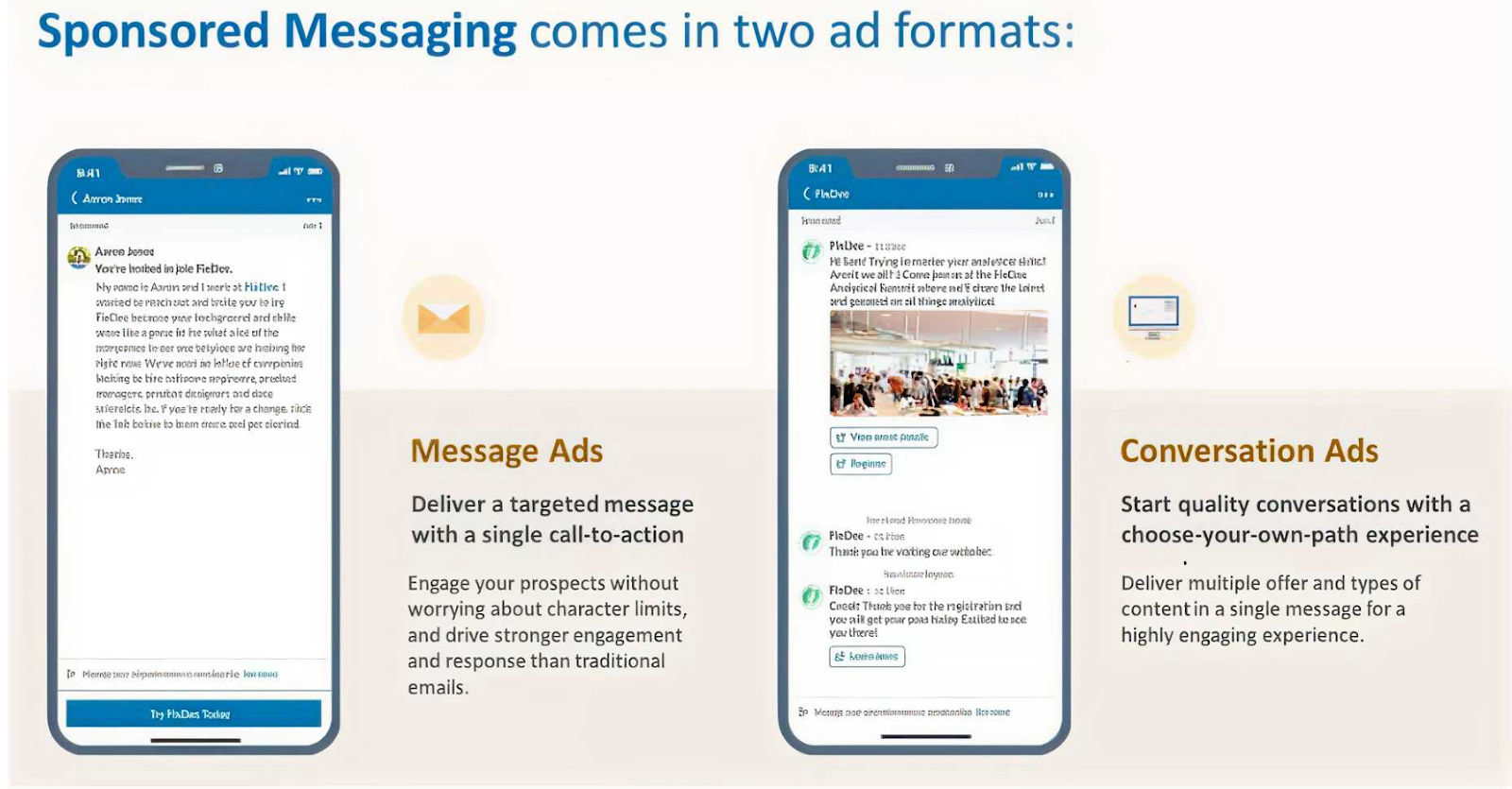
1. LinkedIn Message Ads
Think of Message Ads as a single-message push.
You send one message. You include one CTA. You hope they click. That’s it.
They work best when:
- You have one clear goal (book a demo, download a guide)
- You want direct, cost-effective outreach
- Your audience prefers short, no-nonsense messaging
Message Ads aren’t bad. They’re just… direct. Sometimes too direct.
2. LinkedIn Conversation Ads
Conversation Ads are more like choose-your-own-adventure. Instead of forcing one action, you give users multiple response paths:
- FAQs
- Content
- Demos
- Webinars
- Pricing
- Even “just browsing.”
The buyer decides what happens next. They work best when:
- You want interactive engagement
- You’re running ABM or high-intent campaigns
- You want prospects to engage on their terms, not yours
In short: Message Ads talk to people. Conversation Ads speak with them.
And in B2B, that difference matters more than we admit.
Why Conversation Ads work so well in B2B
Here’s the truth about B2B buyers: They hate being sold to, but they love being informed.
Conversation Ads lean into that reality. Instead of forcing a demo request upfront, they let buyers:
- Explore content at their own pace
- Self-qualify without pressure
- Signal intent through clicks and choices
And those choices? They’re gold.
Every click inside a conversation tells you what the buyer actually cares about:
- Are they curious?
- Are they researching?
- Are they close to buying?
That’s far more valuable than a single “Submit” button.
{{INLINE_TOFU}}
The anatomy of high-performing LinkedIn Conversation Ads
So what actually drives engagement? Let’s break down the patterns that show up again and again in high-performing Conversation Ads.
1. Start with the right CTA (Hint: It’s not “Book a Demo”)
Across successful campaigns, the best-performing CTAs are surprisingly… gentle.
They sound like:
- See how it works
- Get started for free
- Find out more
- Book a demo (but usually not as the first step)
Curious, why does this work? Because
- Early-funnel CTAs reduce pressure
- They invite curiosity instead of commitment
- They feel helpful, not transactional
- Think of CTAs as doors, not demands.
Once someone walks through willingly, the rest gets easier.
2. Personalization starts with targeting (Not copy)
Here’s a hard truth: Great copy cannot save bad targeting.
For Conversation Ads, LinkedIn Ads targeting does most of the heavy lifting. The most effective campaigns usually layer:
- Job title + function (not just one)
- Seniority (decision-makers matter here)
- Skills and expertise tied to the problem you solve
- Location, when buying behavior differs by region
Conversation Ads feel personal by nature. If the targeting is off, that illusion breaks instantly.
Right message. Right inbox. Right moment.
Related read: Top LinkedIn Ads targeting mistakes in B2B.
3. Avoid buzzwords. Say the real thing.
One pattern that shows up again and again in underperforming ads is the use of too many buzzwords and too little substance.
Words like AI-powered, optimize, streamline, and game-changer are everywhere, and buyers have learned to mentally skip them.
What works better?
- Specific problems
- Concrete outcomes
- Relatable frustrations
Bad: “Our AI-powered platform optimizes workflows.”
Better: “Still managing this in spreadsheets? Here’s how your team can save 20 hours a week.”
Specific beats impressive. Every single time.
The psychology behind winning Conversation Ads
Conversation Ads work because they tap into the basic human psychology, not clever tricks.
The most common triggers are simple:
- FOMO – “See what top teams are doing differently.”
- Curiosity – “Want to know how this works?”
- Reciprocity – “Get the report, no strings attached.”
The strongest ads often combine two triggers:
- Curiosity + social proof
- Reciprocity + urgency
- FOMO + data-backed claims
The key thing to remember? Don’t manipulate. If the problem is real, people will lean in.
Related read: Best AI tools for LinkedIn Advertising.
Best practices for LinkedIn Message Ads and Conversation Ads
Let’s make this practical.
LinkedIn Conversation Ads Best Practices
- Keep messages short and skimmable
- Offer multiple response options, not dead ends
- Lead with value, not a sales ask
- Let intent reveal itself through clicks
- Optimize for learning, not just leads
LinkedIn Message Ads Best Practices
- Use them when you have one clear CTA
- Be concise and respectful of time
- Avoid sounding like a cold email blast
- Match message tone to seniority level
Just remember, different tools, different jobs.
Related read: Scaling ABM using LinkedIn Ads
Where most teams still get LinkedIn Conversation Ads wrong
Here’s the gap most marketers don’t see. Conversation Ads generate multiple downstream actions, like:
- Website visits
- Content reads
- Return visits
- Assisted conversions
And not just form fills.
So, if you’re only measuring:
- Clicks
- CPL
- Last-touch conversions
Then, you’re missing most of the story.
What changes when you run LinkedIn Ads with Factors.ai
Launching a LinkedIn Ad Campaign is only half the job. The harder part is figuring out which drove conversions and contributed to revenue.
But here is the catch: buyers do not convert in straight lines. Usually, this is what happens after a prospect clicks your LinkedIn Ad,
- They don’t convert immediately.
- They visit your website days later.
- They read a case study.
- They come back through search.
- Sales finally pick them up weeks later.
And somewhere along the way, LinkedIn quietly loses credit. Read more about this in our LinkedIn Ads B2B Benchmarks Report of 2025.
This is exactly the gap LinkedIn Adpilot from Factors.ai built to close.
See what happens after they click your LinkedIn Ad
Most reporting stops at impressions, clicks, or form fills. That is useful, but incomplete.
Factors.ai helps you see:
- What prospects do after they engage
- How different interactions influence the pipeline
- Which touchpoints actually contribute to deals
Instead of guessing which efforts mattered, you can see the complete picture of how accounts move through your funnel after clicking your LinkedIn Ads.
Simply put, see the true ROI of LinkedIn Ads with Factors.ai
Compare LinkedIn against other channels
Once you can see influence, comparison becomes easier.
Factors.ai lets you analyze how LinkedIn performs alongside other channels and how ad-engaged accounts move through the funnel. This helps teams decide where to invest more and where to pull back.
Build audiences without guesswork
Manually maintaining account lists takes time and still goes stale.
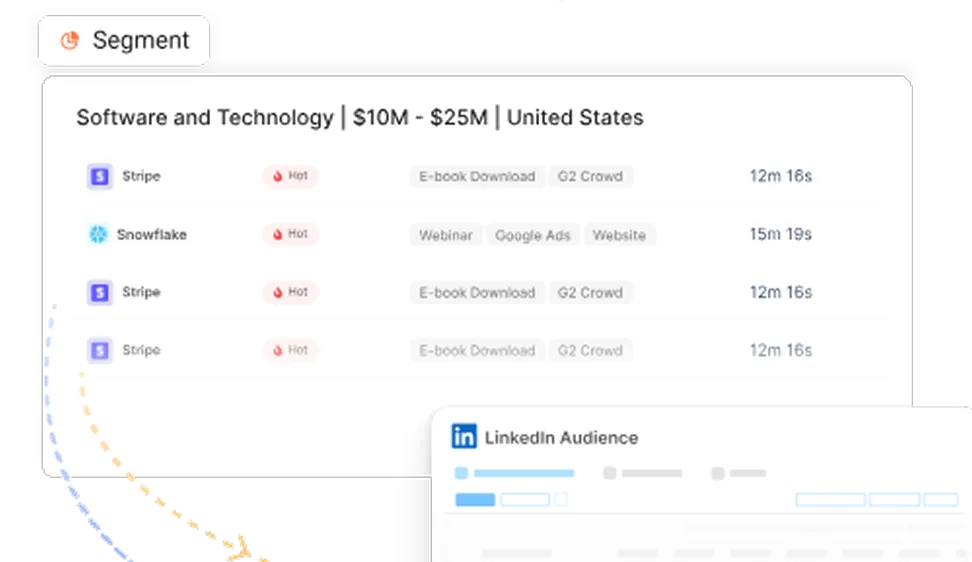
With Factors.ai, LinkedIn audience lists are built and updated automatically using real engagement and intent signals. Instead of guessing who should see your ads, you target accounts that are actually showing interest.
Result: Less waste and cleaner targeting.
Control where your LinkedIn Ads budget really goes
Most teams do not realize this until they see the data. 20% of accounts often consume 80% of the ad impressions. The result is uneven reach and fast budget burn.
Factors.ai’s LinkedIn Adpilot helps you:
- Control impressions and clicks per account
- Reach more accounts with the same budget
- Avoid overserving the same few companies
More coverage. Same spend.
Read more about this in the LinkedIn Smart Reach blog.
Optimize campaigns using conversion feedback
Factors.ai also supports the LinkedIn Conversion API. That means you can:
- Send online and offline conversion signals back to LinkedIn
- Optimize campaigns based on real outcomes
- Scale performance without relying on third-party cookies
All without a complicated setup.
So… should you be running LinkedIn Conversation Ads?
Short answer: Yes. But only if you use them for what they are actually good at.
Conversation Ads work best in buying journeys that take time. They are the best when multiple stakeholders are involved, when buyers want to explore before committing, and when your goal is to educate, qualify, and learn rather than push an immediate demo.
They are not built for instant wins. If you need quick, single-action conversions or you are optimizing purely for cost per lead, Message Ads will usually perform better. Different formats solve different problems.
Where most teams go wrong is not in how they write these ads, but in how they measure them.
Conversation Ads rarely drive a straight line from click to conversion. Instead, they influence interest over time through content views, return visits, and assisted conversions across channels. When revenue is calculated only by last-click results, that influence gets ignored.
But when you connect engagement to downstream behavior and revenue, the picture changes. You can see what sparked curiosity, what kept buyers engaged, and how those early conversations helped deals move forward.
Run Conversation Ads to understand buyer intent, not to force action. Measure them with the full buyer journey in mind, and they become a meaningful driver of the pipeline rather than just another inbox placement.
FAQs on LinkedIn Conversation Ads
Q1. What exactly are LinkedIn Conversation Ads, and how are they different from Message Ads?
LinkedIn Conversation Ads are interactive inbox ads that let prospects choose what they want to do next. Instead of sending one message with one CTA, you offer multiple options like viewing content, checking pricing, or learning more before booking a demo.
Message Ads, on the other hand, are simpler. One message, one CTA, one outcome. They work well when you already know exactly what action you want the reader to take.
If Message Ads are a straight pitch, Conversation Ads are a guided conversation where the buyer stays in control.
Q2. Do Conversation Ads actually feel like real conversations?
They feel conversational, but they are not live chats.
Conversation Ads follow a pre-built flow with buttons and branching paths. The experience feels interactive because buyers choose what to click, but they are not typing free-form responses.
That is also their strength. You can guide buyers without needing someone to reply in real time, while still learning what they care about based on their choices.
Q3. Should I always choose Conversation Ads over Message Ads?
No, and that is a common mistake.
Conversation Ads work best when buyers need time, context, or education. Message Ads work better when the action is simple and obvious.
If you only have one clear CTA and want quick action, Message Ads are usually the better choice. If you want to support research, qualification, or intent discovery, Conversation Ads are a stronger fit.
It is not about which format is better. It is about which one matches the buying situation.
Q4. Are LinkedIn Conversation Ads still effective, or are people tired of them?
They are still effective, but they are easier to get wrong now.
Many marketers report weaker performance when Conversation Ads feel generic, overused, or overly sales-driven. Buyers are quick to ignore anything that looks like a templated pitch in their inbox.
What still works is relevance. Tight targeting, helpful options, and clear value. When the message matches the buyer’s context, Conversation Ads continue to drive engagement and intent signals.
Q5. What metrics should I actually look at for Conversation Ads?
Open rates are usually high, but they do not tell the full story.
The real value comes from interaction metrics like which options people click, what content they engage with next, and whether they return later through other channels.
Conversation Ads are better judged by downstream behavior and assisted conversions, not just immediate form fills. If you only measure last-click leads, you will almost always undervalue them.

Powered by Bombora
Enter your domain and we'll send you a free list of companies showing buying intent in your vertical.
.avif)
Powered by Bombora
Enter your domain and we'll send you a free list of companies showing buying intent in your vertical.
.avif)

See how Factors can 2x your ROI
Boost your LinkedIn ROI in no time using data-driven insights


.avif)
See Factors in action.
Schedule a personalized demo or sign up to get started for free
LinkedIn Marketing Partner
GDPR & SOC2 Type II

.svg)



.avif)

