
Best AI Agents for B2B Marketing Teams
Learn what AI agents really are, where they help B2B teams, and how to evaluate tools so automation triggers on real intent

Writer
.avif)
Content Marketer



.svg)


TL;DR
- AI agents act, using real-time signals to decide what to do next without waiting for you.
- The ‘agentic shift’ is moving from AI that helps you write to AI that can run multi-step workflows across tools like your CRM and outreach systems.
- Agents work best in five places: inbound qualification, research and enrichment, intent-triggered outbound, marketing-to-sales handoffs, and multi-touch attribution.
- Most agent setups fail because of weak signals and agentic bloat, where too many disconnected agents create conflicting actions and a messy CRM.
- factors.ai is the account-intelligence layer that unifies intent signals (including G2) with first-party behavior, so agents can trigger on patterns instead of isolated events.
- If you build your own agents, keep it simple: one goal, one trusted trigger, one allowed action, clear guardrails, and measure success in pipeline, not activity.
You probably think your chatbot is pretty smart: it answers questions, books demos, maybe even qualifies leads.
But while it's sitting there waiting for someone to type "pricing?" into the chat box, your competitor's AI agent has just identified your dream account, showing buying intent, and started a sequence.
You're both using "AI." But you're not playing the same game.
Your chatbot responds when asked; your competitor’s AI agent acts when the signal is right. It watches for intent spikes, pulls account context, checks fit, and launches outreach without anyone telling it to.
You are playing the ‘waiting’ game while your competitor wins.
Up until 2024, most "AI" in B2B marketing meant chatbots and email writers. Tools that made you faster but still put you in the driver's seat for every decision. That's changed. Now, it’s the AI-autonomous era.
So, how is your competitor extracting the best from their AI agents? Let's check it out.
What is an AI agent?
An AI agent is a software system that can autonomously make decisions and take actions to reach a specific goal, without you telling it what to do at every step. using data from your tools and what it observes in real-time.
You give it an objective, and it figures out how to get there. It pulls data from your tools, monitors what's happening, decides what action to take next, and then takes that action. And it doesn’t stop there; it goes further down – checking results, adjusting, and moving forward.
When you have an AI agent specifically to carry out marketing activities, it’s called an AI marketing agent.
For example, you tell an AI agent: "Find high-intent accounts this week and get them into a personalized outreach sequence."
It will:
- Watch for signals like site visits, ad clicks, or intent spikes
- Pull context from your CRM and enrichment tools
- Decide which accounts are worth targeting
- Draft personalized messages based on what it knows
- Launch the outreach
- Monitor responses and adjust follow-ups based on engagement
The key difference from other tools: it doesn't just execute one task and stop. It runs in a loop; it observes, decides, acts, and then repeats.
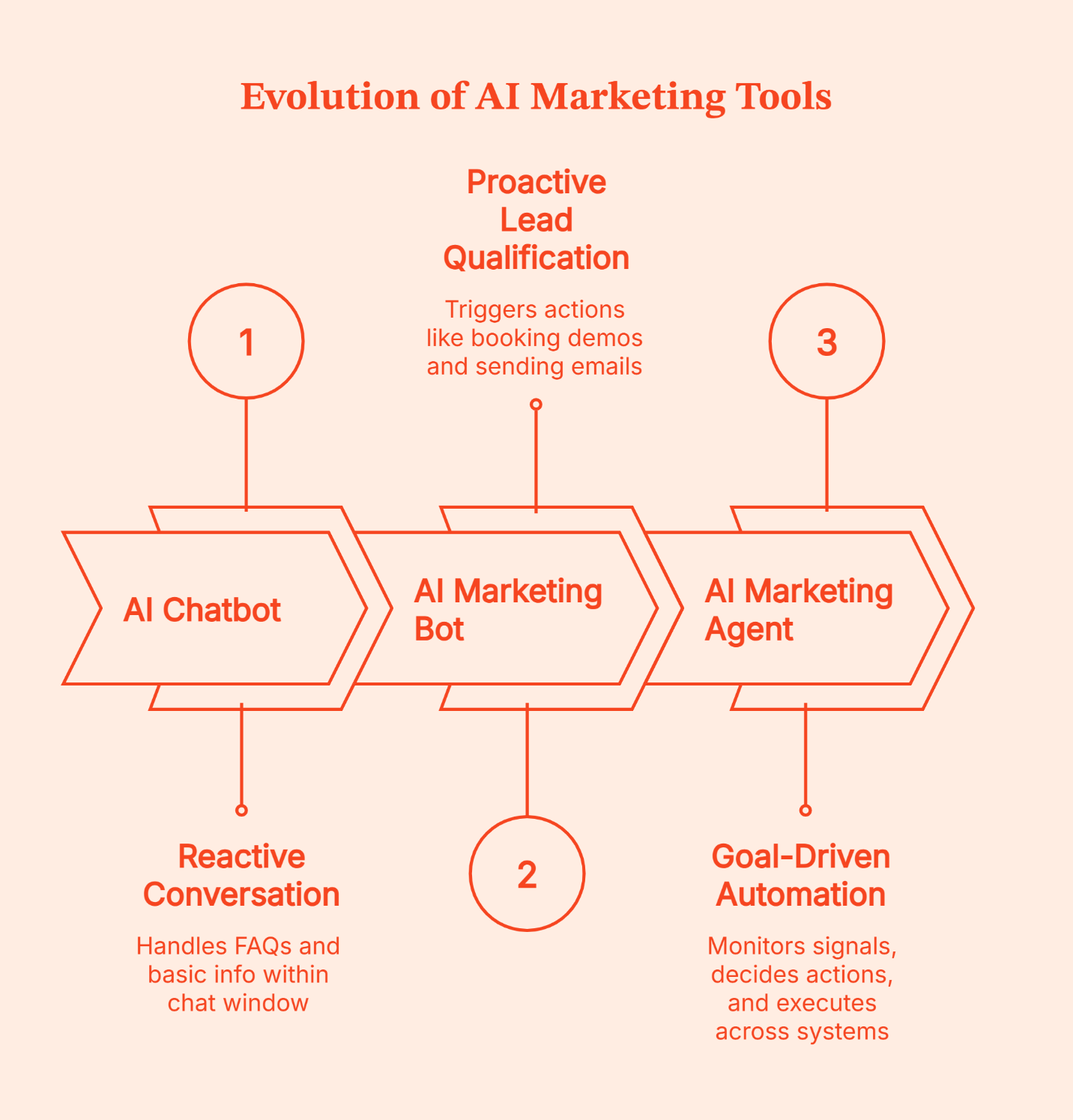
What is the difference between an AI chatbot, an AI marketing bot, and an AI agent?
The difference between ‘chatbot’, ‘ marketing bot’, and ‘marketing agent’ is easy to get mixed up, mostly because a lot of AI tools market themselves as ‘AI agents’ when they're really just doing a few different tasks with a couple of extra tricks (like pulling data from a CRM or triggering an email).
But all three have different levels of capability.
What is an AI chatbot?
AI chatbots mainly handle conversations and simple interactions, such as in customer support and service, and stay within the chat window. It is usually front-facing and is adapt at:
- Answering FAQs
- Routing visitors to the right page or team
- Collecting basic info like email or company name
It is reactive and answers only when prompted.
What is an AI marketing bot?
An AI marketing bot goes one step further. It's still built around flows and rules, but it can trigger actions beyond just replying. It can:
- Qualify leads based on answers
- Book demos
- Create a contact in your CRM
- Send a follow-up email sequence
It is proactive and uses natural language processing (NLP) to sound human while handling variations in how people ask questions. But it's still following a script; if something unexpected happens, it usually can't adapt.
What is an AI marketing agent?
An AI marketing agent supersedes both. It is goal-driven. Once you give it a goal, it figures out the path across systems. To do this, it:
- Monitors signals across multiple systems (website, CRM, ads, intent data)
- Decides which accounts or leads need attention
- Pulls relevant context and history
- Chooses the best next action (email, Slack alert, ad retarget, sequence enrollment)
- Executes that action
- Keeps monitoring and adjusting
- It's proactive and adaptive. It doesn't need you to map out every scenario.
How do AI agents help B2B marketing teams?
If you look closely, B2B teams struggle most with handling actions without enough context.
So, rather than showing you a long list of AI-powered agents, here are the specific, real-world moments where these AI agents earn their keep (with an AI bot vs AI agent example for each). These are the points in your automated workflows where judgment tops speed.
Also read: AI Market Research Tools: From Hype Threads to 10 Tools Worth Using
1. Inbound qualification that doesn’t pollute your CRM
Real-world scenario: Someone lands on your pricing page, opens chat, and asks for pricing. Classic high intent, right?
Not always.
| What happens | If you use a bot | If you use an agent |
|---|---|---|
| Visitor asks about pricing | Shares the pricing link and asks for email | Checks if the company matches ICP and whether the account is already known |
| Visitor shares email | Creates a lead automatically | Decides whether to create a lead, route to SDR, or keep it as an anonymous interest |
| Visitor is a student or competitor | Still gets captured as ‘lead’ | Filters out low-value traffic and avoids CRM noise |
| Next step | Pushes the booking link no matter what | Routes based on intent plus account fit (alert AE, set nurture, or wait) |
2. Research and enrichment without the rabbit hole
Real-world scenario: A target account is on your site. You want context fast: who they are, what they do, what tech stack they use, and whom to reach out to.
| What happens | If you use a bot | If you use an agent |
|---|---|---|
| New account shows interest | Does nothing unless someone asks | Starts enrichment when the account hits a defined intent threshold |
| Data collection | Pulls one data source | Pulls multiple sources, dedupes, and fills gaps |
| Output | A list of raw contacts | A short brief: who to target, why now, and suggested angles |
| Next step | Human stitches everything together | Sends an account snapshot to the right owner |
3. Intent-triggered outbound that doesn’t feel like spam
Real-world scenario: A buyer doesn’t fill a form; they just browse comparison pages, pricing, and integrations over a week.
| What happens | If you use a bot | If you use an agent |
|---|---|---|
| Account shows repeat intent | No action because there’s no form fill | Detects rising intent and checks if the account is in your target list |
| Message choice | Uses a generic template | Drafts outreach based on what the account actually looked at |
| Timing | Fires based on a timer (not in real-time) | Fires based on behavior, like a second pricing visit or a key page sequence |
| Outcome | Outreach feels random and irrelevant to the buyer | Higher relevance, fewer complaints, more replies |
4. Faster handoffs between marketing and sales teams
Real-world scenario: Marketing sees engagement. Sales hears about it two weeks later. Or never.
| What happens | If you use a bot | If you use an agent |
|---|---|---|
| New buying activity happens | Logged somewhere in a dashboard | Pushed to Slack or Teams with context |
| Routing | One rule for everyone | Routes by account, territory, stage, and activity |
| Follow up | Depends on dashboards | Happens while the account is still warm |
| Tracking | Hard to connect to revenue | Actions and outcomes can be tied back to pipeline |
5. Keeping multi-touch attribution honest
Real-world scenario: Your dashboard says paid search drove the demo. The sales team says they’ve been lurking for a month. Both are kind of right.
| What happens | If you use a bot | If you use an agent |
|---|---|---|
| Touchpoints happen across channels | Work in silos | Connected into a single journey view |
| Decision making | Happens at gut feel | Happens with a clearer view of what influenced the account |
| eOptimization | You fund the last touch | You shift the budget to what creates demand |
| Reporting | No clear attribution and a generic sentiment like, “We think it worked” | Cleaner feedback loops into pipeline and revenue |
Did you notice? All five of these use-cases have something in common. The AI agent was only able to work smartly when it knew three things:
- Who the account is (not just a random visitor)
- What they’ve been doing across channels
- When the intent is strong enough to act
Without the Who, What, and When, these AI automation routines suck up energy without generating any quantifiable output.
This is exactly why the B2B teams that get the best results out of their AI agents don’t use them as standalone tools. They treat them as workers who use a shared source of primary information.
Let’s understand how this is achieved in the next section.
💡Does your marketing strategy need a complete overhaul? Find the key indicators in this guide
{{INLINE_TOFU}}
Top AI agents for US B2B teams
From the dozens of ‘AI agents’ floating in the market right now, the best (and the most useful) way to shortlist them is by job.
Ask yourself: What part of your workflow do you want an AI agent to own?
Here are four categories that appear in B2B tech stacks, along with the AI tools B2B marketing teams keep coming back to.
1. Lead research and enrichment agents: Clay, Relevance AI
This is the ‘stop opening 17 tabs’ category.
If your team spends hours building lists, finding the right people, enriching records, and stitching context together, these AI tools can take a lot of that workload off your plate.
- Clay: This tool pulls data from many sources and automates GTM workflows based on that data.
- Relevance AI: This one is known as an 'AI workforce' where AI agents handle prospect research and enrichment-style tasks.
Where they work best: When you already know which accounts you care about, and you want deeper context and cleaner records fast.
2. Conversational demand generation agents: Drift, Intercom
This is the ‘qualify while the buyer is still on the site’ category.
Used well, these AI tools do two jobs at once: they help the buyer get answers quickly, and they help your team route serious intent without waiting for a form fill.
Also read: AI marketing vs traditional marketing: What actually drives growth?
- Drift: Drift positions its AI chat as a way to engage visitors in real time and convert website conversations into a qualified pipeline.
- Intercom: This tool has pushed hard into the 'AI agent' framing, aiming for one unified customer agent that can handle different roles and hand off when needed.
Where they work best: When chat is connected to routing, CRM context, and clear qualification rules. Otherwise, you just create more leads that no one trusts.
3. The intelligence and attribution agent: factors.ai
This is the category most teams skip, then wonder why the rest of the agent stack feels spammy.
Your outbound agent, your chat agent, and your enrichment agent can all 'do work'. But they still need a shared answer to one question:
Which accounts are really showing intent right now, and what should we do about it?
This category is expertly handled by factors.ai. Factors.ai identifies high-intent accounts, connects the dark funnel signals across touchpoints, and triggers the right workflow in the systems you already use.
Factors.ai is well-known for its waterfall model, which identifies more than 75% of anonymous website visitors at the account level.
Why this matters for agentic marketing: Once you have account-level context and intent signals in one place, you can stop your AI agents wasting time on random triggers and deploy them on accounts with real buying behavior.
4. Autonomous SDR agents: Artisan, AiSDR
This is the “outbound execution” category.
Tools such as Artisan and AiSDR aim to run outbound in a more autonomous way, ideally with better personalization and always on follow-up.
Where they work best: When they’re fed clean targeting and real intent. Give them the wrong accounts and they’ll still do their job – with the same vigor.
Top AI agents for B2B marketing and sales team
| Category | Tools | What they’re best at | What can go wrong | Best fit teams |
|---|---|---|---|---|
| Research and enrichment | Clay, Relevance AI | Fast prospect research, enrichment, list building, account briefs | Messy data in, messy data out. Enrichment without prioritization becomes busywork | Lean growth teams, RevOps, outbound teams scaling targeting |
| Conversational demand gen | Drift, Intercom | Real-time qualification and routing from website conversations | Too many low-quality “leads” if chat is not connected to ICP logic and routing | Demand gen teams with meaningful site traffic and clear ICP |
| Intelligence and attribution | factors.ai | Account identification, intent-driven orchestration, and tying actions back to pipeline | If signals aren’t connected to workflows, insights stay trapped in dashboards | Teams running multi-channel demand gen and wanting cleaner handoffs |
| Autonomous outbound SDR | Artisan, AiSDR | Always on outbound and follow-up execution | Spam at scale if targeting and triggers are weak | Teams with clear targeting, guardrails, and strong deliverability discipline |
A grounded way to think about these tools is:
- They’re strong when you already have clear targeting and guardrails.
- They get risky when they’re fed weak triggers, because they can scale the same “sounds fine” outreach problem you’re trying to escape.
That’s why they tend to perform best when placed downstream of a robust account intelligence layer. This way, outbound kicks in only when the account shows intent, and not just because it’s on a list.
Why does AI bot marketing fail without account intelligence?
AI bot marketing fails for the most obvious yet overlooked reason: actions are triggered without enough context. Meaning, you automate the wrong follow-ups, for the wrong accounts, at the wrong time.
To correct this, marketing teams promptly add more automation instead of pausing.
- An enrichment agent to clean up bad leads
- A routing agent for error handling
- A scoring agent to prioritize
- An attribution agent to explain what worked
- A CRM agent to keep records updated
This creates agentic bloat – a phenomenon where you have too many agents running in parallel, each making local decisions from partial data.
Agentic bloat is a clear case of conflicting AI automation creating more chaos, even when every agent is supposedly working.
You’ve got an Agentic bloat if:
|
Agentic bloat doesn’t happen because your agents are ‘bad’. It’s just that they’re acting on partial context.
Most bots and agents see only one slice of the buyer journey, such as a chat conversation, a single web visit, or an email reply. When that slice looks like intent, they do what they’re designed to do and take the next step.
But without account-level intelligence, they can’t answer basic questions like:
- Is this a target account or random traffic?
- Have we already engaged them?
- Are they showing intent now, or just browsing?
and they default to generic actions that scale the wrong AI workflows.
The cleanest way to prevent such agentic bloat is to make every agent listen to the same account timeline.
This is where factors.ai helps.
Factors.ai pulls your key buyer signals into one place, at the account level, so every action is triggered from a shared view of what’s happening.
So instead of “visited pricing page once, send email,” you can run AI workflows like this:
- Account is on your ICP list
- Shows high-intent activity on G2
- Visits your pricing or comparison pages
- Factors.ai alerts the SDR in Slack to trigger the right follow-up
- If the account is not ICP, no action is taken
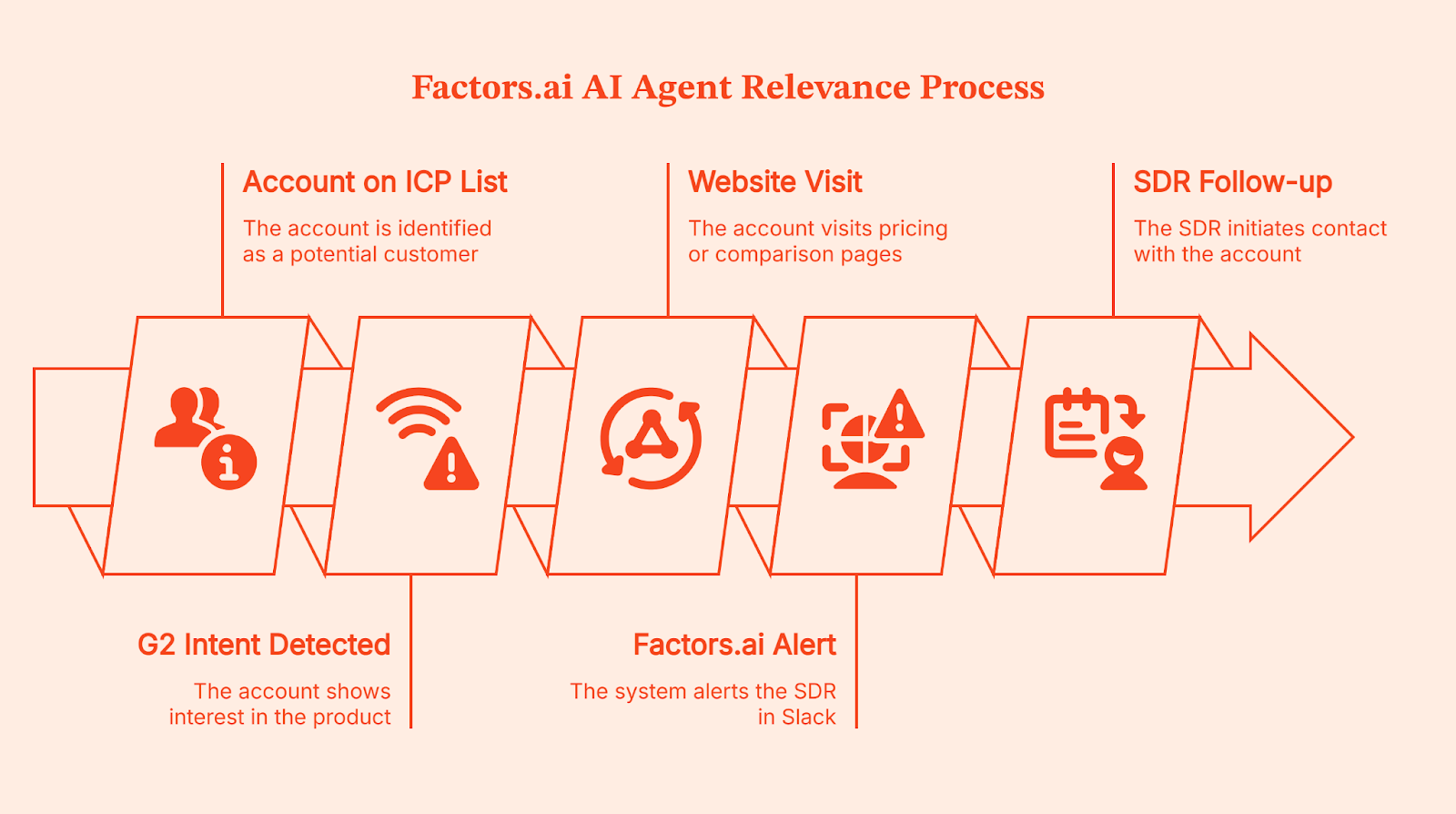
This simple change makes your AI agents relevant; they stop reacting to isolated events and start acting on patterns.
This is also why the G2 Buyer Intent integration matters. Factors.ai brings account-level intent signals from third-party platforms like G2 and combines them with your first-party signals like website behavior and your GTM context from your CRM. It then triggers automations from that combined view and measures influence on the pipeline.
That’s what Upflow, an FRM platform for B2B businesses, did. Once they shifted to factors.ai, it started identifying and acting on the intent signals from all its online channels, such as website, CRM, LinkedIn, G2, and others. This transformed Upflow’s approach to lead generation and nurturing, which, in turn, increased their pipeline by 35%.
💡Read the detailed case-study on how Upflow captured hot leads from channels like G2 and LinkedIn here.
Brands like Drivetrain and Descope were also struggling with similar intent-level integration. So they brought factors.ai into the loop, and it gave them a comprehensive view of intent from the ICP list, web search signals, LinkedIn, and G2. Their sales teams now had a clear ‘crystal ball’ view of which accounts to focus on first.
💡Learn how B2B teams convert G2 intent into pipeline by syncing it with website and CRM data using Factors.ai in this guide.
Key features of the best AI agents
All AI agents look good when used in controlled environments (viz-a-viz, a demo). But they might not be able to withstand the dynamics of buyer behavior when deployed in real-time.
Here are a few features that your AI agents must consist of, to keep up with the complex workflows of buyer behavior:
1. Multi-step reasoning
Can the AI agent handle real responses that involve complex logic like ‘not now’, ‘send this to my boss’, or ‘we already use a competitor’? A good AI agent is great at taking the next step. It doesn’t just shove the same CTA again.
2. Identity resolution
Does it know who it’s talking to, at least at the account level, before it takes action? This is where AI tools like factors.ai matter. Factors.ai can identify over 75% of anonymous website visitors at the company level, which gives AI agents the context to act based on account fit and intent.
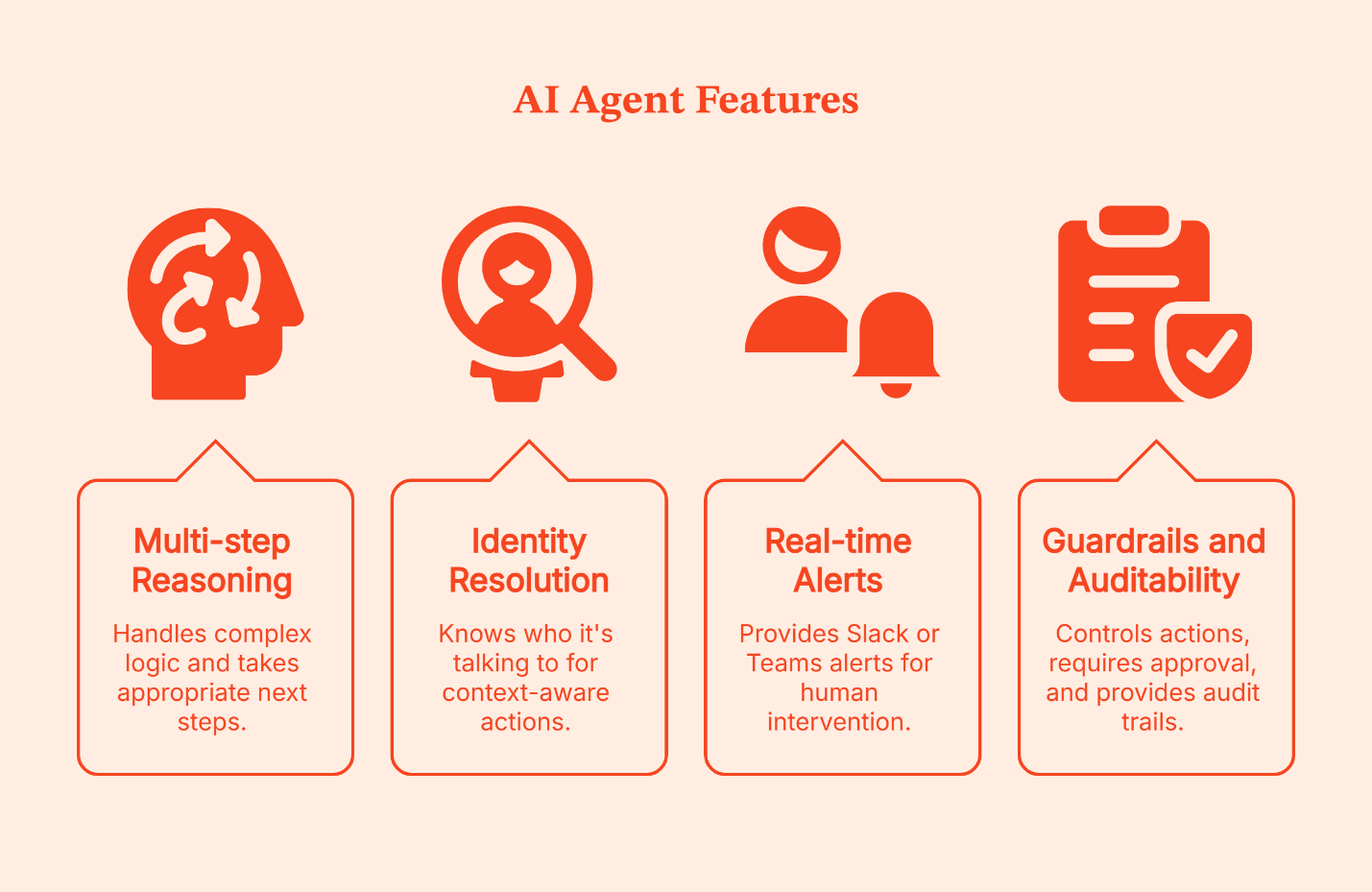
3. Real-time Slack or Teams alerts
The best setups are ‘human in the loop’. AI Agents do the detection and triage, then hand off at the right moment.
4. Guardrails and auditability
You should be able to control what the AI agent can do, require approval for risky actions, and see an audit trail of why it took a step. If you can’t answer, ‘Why did it do that?’ you shouldn’t trust it at scale.
How to evaluate AI agents for B2B marketing
Now that you’ve shortlisted your AI agents, it’s time to run them through this quick checklist. It’ll save you from opting for a ‘smart AI assistant’ that does nothing for the pipeline.
1. Does it take action, or just make suggestions?
If it can’t execute in your existing tools, it’s just a recommendation engine – not an agent.
2. Does it understand accounts as well as the users?
B2B buying is account-based. If it can’t tie activity back to the company, it’ll misfire.
3. Can it connect to your CRM, ads, and GTM data?
AI agents that live in a silo create clutter. The useful ones pull context from the systems your team already trusts.
4. Can humans override or guide decisions?
Look for approvals, guardrails, and the ability to step in when needed.
5. Is ROI measurable in pipeline or revenue?
A ‘Messages sent’ action doesn’t show ROI. You want a clean line from agent action to influenced pipeline and a closed win.
💡Related Read: Learn how to integrate website visitors with your CRM in this guide
Building AI agents for B2B marketing (without getting carried away)
I get it: With so many complexities and workflows in B2B marketing, building AI agents feels like the most practical option. And if you've got technical expertise, you can definitely create agents of your own.
You can go only one of two ways: Grab a pre-built agent or use a workflow builder to set up workflows around specific tasks. Pretty straightforward, right?
But the mistake I see most often when creating agents is treating them like smarter AI assistants. That's the wrong frame. An assistant gives suggestions; an agent takes action. The moment your custom agent can update the CRM, trigger ads, or initiate outreach - without you intervening, you’re not testing anymore. You’re changing your go-to-market.
If you're building your own AI agents, start with this simple order:
- Decide the goal: What do you want the agent to achieve? Say it in one clear sentence.
- Define the trigger: What exact signal should make the agent act? Be specific about what “high intent” looks like.
- Choose the action: What is the agent allowed to do in your tools? For example: send a Slack alert, update the CRM, or start an outreach step.
- Add guardrails: What should the agent never do, and what should require approval first? This is how you prevent mistakes.
- Measure agent performance: Track results in pipeline and revenue. Don’t judge it by how many messages it sent or how many tasks it completed.
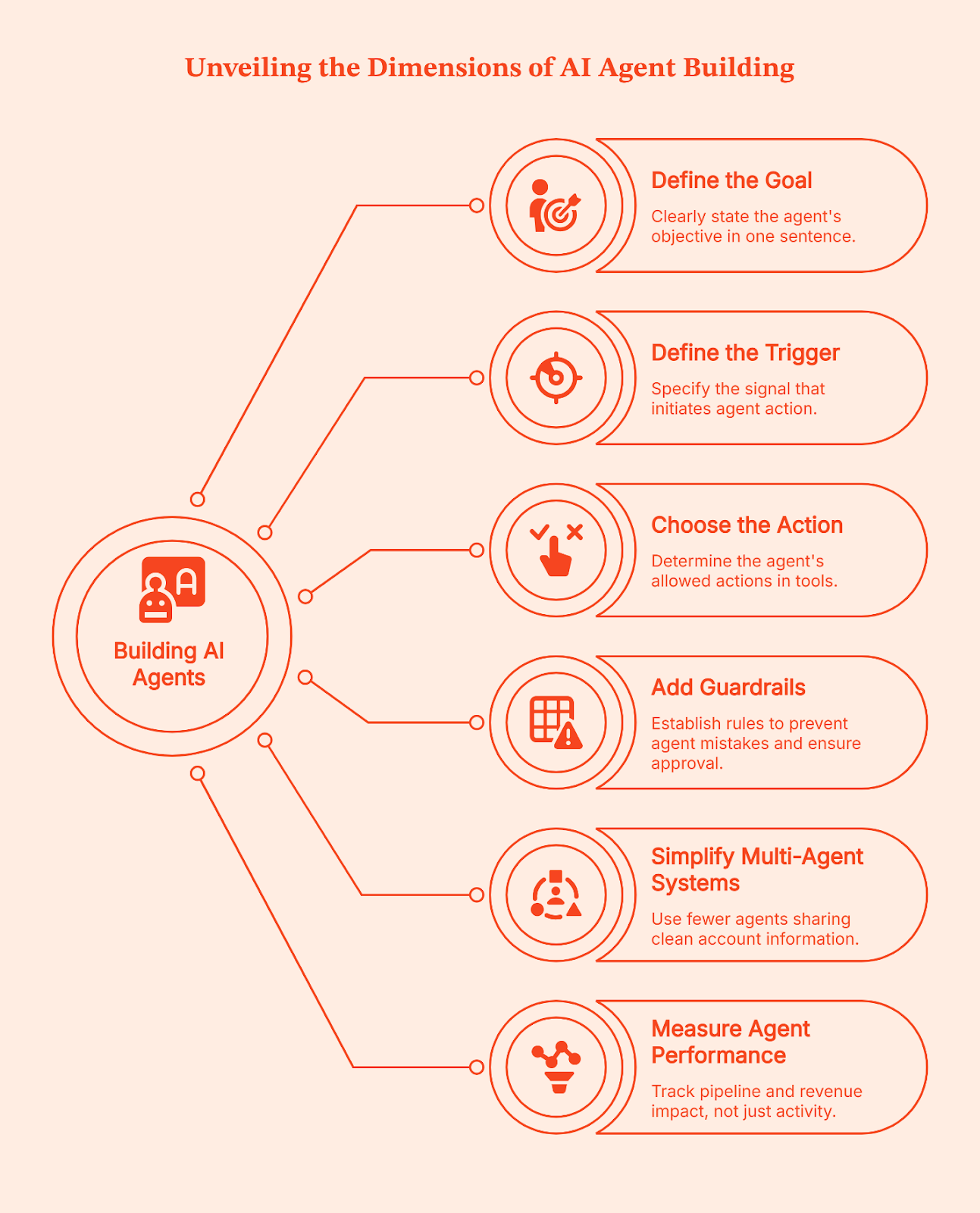
This is also where multi-agent systems go wrong. People add multiple agents and make agents communicate with each other, thinking it will handle complex tasks. Usually, it just creates more moving parts. A cleaner approach is to have fewer agents share a single source of clean information about the account. This way, agent behavior stays consistent even across tools. This is where teams use an account intelligence layer like factors.ai before they scale outbound execution.
You can use almost any AI model to generate content. The hard part is making the AI agent act at the right moment, on the right account, for the correct reason.
Final words: One rule that keeps your AI agents useful
The uncomfortable fact about AI agents is that they don’t create good judgment; they just scale whatever judgment you already have.
- If your strategy is fuzzy, AI agents will automate fuzz.
- If your targeting is loose, they’ll scale loose targeting.
- If your triggers are random, they’ll turn random into an avalanche.
That’s why so many enterprise teams feel like they’re ‘doing more’ with AI and somehow getting less back.
Instead, treat your AI agents like the best assistants you never had.
You set the direction. You decide what intent means for your ICP. You define which moments deserve human attention and which don’t. Then, you partner your AI agents with account intelligence tools like factors.ai to make your strategy accurately executable.
And then you let the AI agents do what they’re genuinely good at: watching for patterns, doing the repetitive tasks, and moving fast when the signal is real.
FAQs on Best AI Agents for B2B Marketing Teams
Q: What is an AI marketing bot's role in 2026?
An AI marketing bot (or AI agent, in this case) serves as an autonomous worker. Unlike basic chatbots, these AI agents can navigate your CRM, research LinkedIn profiles, and draft hyper-personalized content (using generative AI) based on the visitor’s specific website behavior – captured in real-time by tools like Factors.ai.
Q: Which are the best artificial intelligence (AI) agents for small B2B teams?
Community support on Reddit suggests starting with Clay for data and Factors.ai for visitor identification. This 'lean stack' allows a team of one to perform like a department of ten by automating lead research and discovery.
Q: Is AI bot marketing still effective with current privacy laws?
Yes, because the best tools focus on account-level Intelligence. Factors.ai identifies the company (not the individual person’s PII), ensuring compliance with US privacy standards while still providing actionable data for your AI agents.
Q: How do I track the ROI of my AI agents?
Tracking bot activity is easy, but tracking revenue impact is messy. Leading marketing teams use factors.ai for multi-touch attribution. It maps every bot interaction, from a LinkedIn comment to a web chat, back to the final closed-won deal in your CRM.
Q: Are AI bots for marketing considered spam in the US?
Not if they are ‘intent-triggered’. The best AI agents use tools like Factors.ai to ensure they only engage with accounts already showing interest, effectively moving from cold outreach to warm orchestration.
Q: Should I build an AI agent from scratch?
No. Most B2B teams should start with a pre-built AI agent and focus on clean signals and guardrails, because that’s what decides whether it creates pipeline or just more confusion.
Q: What is Agent Mode?
Agent mode is a setting that lets an AI system move beyond answering questions and start taking actions in a loop, like researching, updating tools, and triggering next steps. It works like an 'execution mode' for AI to achieve a goal instead of just chatting.
Q: How does generative AI fit into AI agents for B2B marketing?
Generative AI is the 'content engine' used by the AI agent to draft messages, summaries, and next steps. But to generate specific and genuinely relevant content, it needs real-time account context and intent signals,
Q: Do I need prompt engineering to use AI agents for marketing?
Prompt engineering helps, but it’s not the main requirement. AI agents fail more often when they are acting on a weak context. That’s why signal quality and attribution matter more, which is where teams rely on platforms like factors.ai.

See how Factors can 2x your ROI
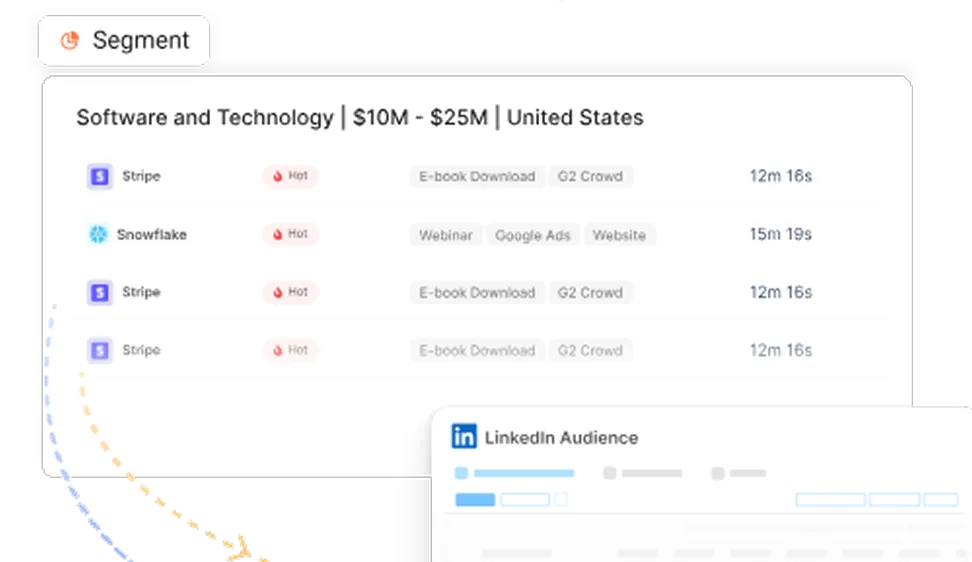
Boost your LinkedIn ROI in no time using data-driven insights


.avif)

See Factors in action.
Schedule a personalized demo or sign up to get started for free
LinkedIn Marketing Partner
GDPR & SOC2 Type II

.svg)



.avif)

