
How GTM Engineering Improves CRM Data Hygiene and Reduces CAC
Learn how GTM Engineering improves CRM data hygiene, fixes HubSpot–Salesforce syncs, automates enrichment, and reduces CAC for modern B2B teams.

Writer
.avif)
Content Marketer



.svg)


TL;DR
- Clean, unified data is the real driver of lower CAC because it powers accurate routing, scoring, and targeting.
- GTM Engineering fixes the root issues by standardizing fields, automating enrichment, and keeping HubSpot and Salesforce in sync.
- Automated intent, enrichment, and feedback loops help sales and marketing focus on real buyers instead of chasing insufficient data.
- Teams that build a structured GTM system outperform SDR-heavy models and turn their CRM into a true growth engine.
It’s Monday morning. You’re still feeling good about last week’s results. Pipeline looked healthy, routing behaved, and for a few sweet hours, it felt like the system finally got its life together.
Coffee in hand, you open Salesforce.
And that feeling fades fast.
The marketing team swears a campaign brought in 140 leads, but Salesforce says 92. HubSpot somehow assigned three different owners to the same account. A high-intent lead skipped enrichment, as if it were optional homework, and fell into the wrong bucket.
If you’ve been in RevOps or GTM services long enough, you know this exact punch in the gut. The day hasn’t even started, and the data is already giving attitude.
This is where CRM data hygiene for GTM becomes vital. Not just theoretical or “we’ll fix it later,” important. But, vital.
GTM data accuracy isn’t a low-key entry for the admin/IT staff. It’s the backbone of everything Go-to-Market teams do. Accuracy, completeness, freshness, structure, intent tagging, and account mapping. These little pieces decide how fast routing fires, how scoring works, who gets attention, and how much money you burn trying to hit your number.
What Happens When Your GTM Data Isn’t Clean and Consistent
GTM data does more heavy lifting than it gets credit for, because it decides what your team sees and how your system behaves. When a field is wrong, a workflow jumps too early. When data enrichment is missing, a strong account gets treated like a weak one. When HubSpot and Salesforce disagree on formatting, you get two versions of reality and a team stuck guessing which one to trust.
And the mess keeps growing because every new tool, channel, intent feed, and AI-generated activity adds its own fields and events - all of them just slightly different. A few tiny mismatches and suddenly handoffs slow down, prioritization slips, and CAC rises slowly (almost eerily) in the background.
That’s why CRM data hygiene matters. Clean, structured, enriched data gives your system a solid foundation so your team moves faster and your pipeline doesn’t absorb the hidden cost of messy data.
Why Poor CRM Data Hygiene Increases CAC for B2B Teams
You won’t see sudden jumps in CAC. Instead, it creeps in…
- When your CRM fills up with outdated data that doesn’t reflect buyers' behavior in real time.
- Old or incomplete data pushes your ads toward people who are least likely to convert, and you pay for every wasted click.
- Even small gaps can nudge CAC higher (as your targeting starts to drift) and lead to higher costs across your campaigns.
Your sales team feels the pressure, too. When a lead shows up without firmographics or incorrect contact details attached, your sales reps have no choice but to turn into part-time detectives.
Checking such minute details eats into sales productivity because reps spend more time fixing customer data than talking to real buyers. That’s why clean customer data becomes non-negotiable as your volume grows.
Let’s not forget about the sync issues. The HubSpot dashboard shows one thing, Salesforce shows another, and both are right from their POV. This disconnect is often caused by mismatched attribution and inefficient routing, and suddenly, your team is working with two different stories.
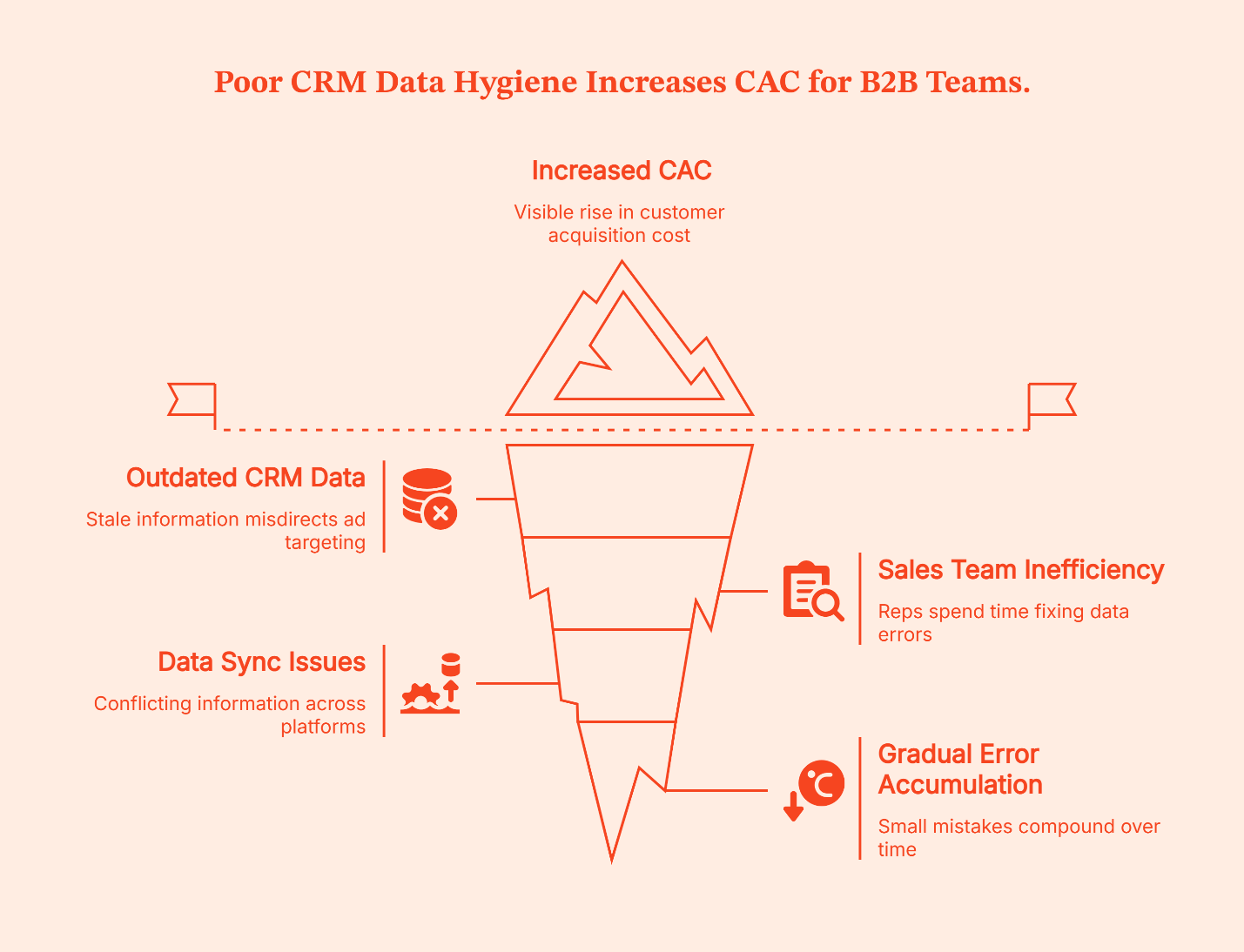
None of this happens overnight. It’s a slow climb powered by hundreds of tiny errors that compound every day.
GTM automation breaks this cycle. It designs workflows using clean, enriched, and validated data before it reaches routing or scoring, preventing errors from spreading. This way, your sales team gets better information, handoffs become smoother, and CAC stays steady.
{{INLINE_TOFU}}
How GTM Engineering Fixes HubSpot–Salesforce Sync Issues
Ever played Chinese whispers – the telephone game as a kid? Fixing data sync between HubSpot and Salesforce is pretty much the grown-up version. You start with a clear message. It goes through several steps. By the time it reaches the end, you’re looking at something that barely resembles the original.
These little distortions usually come from small, boring things:
- A field format that doesn’t match.
- A duplicate rule firing at the wrong time.
- A workflow sending an update to the other system, which refuses to read it.
While each issue is tiny, together, they make the sync feel unpredictable.
GTM Engineering steps in as the coordinator. It ensures both systems speak the same language by cleaning up field definitions, tightening object mappings, and removing legacy logic that creates loops or incorrect updates. AI checks catch insufficient customer data before it is synced.
But to get real consistency, both platforms need to rely on one shared record of what’s correct. That’s where Factors comes in. It gives both systems the same clean account-level details, so HubSpot and Salesforce finally stop contradicting each other.
💡 Check out how GTM engineering automates sales and marketing workflows in this guide
CRM Data Enrichment at Scale: A GTM Strategy for Revenue Teams
Data enrichment is the step that fills in the details your form never catches. Details like:
- Company size.
- Their tech stack.
- Intent signals.
- The buying stage.
These small details tell your team who the lead is and whether they’re worth chasing. They also enable personalized messaging because reps know who they’re talking to. Without these data fields, routing slows down and scoring becomes guesswork. And guessing is expensive.
Sure, your SDRS can do this manually. But manual data enrichment only works until the volume is low. The moment pipeline volume climbs, your setup falls behind. By the time someone updates a record, that record is already outdated.
GTM Engineering solves this with automation, rules, and API-based enrichment. The moment a new record enters the system, the gaps get filled, and data fields get standardized. This instant standardization improves data accuracy, which sharpens both routing and scoring.
In a growing setup, changes like this make a huge difference. Your CRM stops feeling like a messy shared notebook and starts acting like a dynamic Google Map that adjusts the route based on your position.
| ClearFeed faced a similar challenge for its CRM enrichment at scale. Their CRM data had partial records and anonymous traffic that SDRs couldn’t act on. So, they brought in Factors.ai. With Factors, they enriched those journeys in real time, filled the missing firmographics, and routed complete account profiles to the right reps. Based on the AI-driven insights from Factors, ClearFeed saw a surge in meetings, with 20% being directly influenced by Factors. Read ClearFeed’s case study here. |
💡Learn how to build cleaner CRM workflows and reduce sync issues in this guide
Automating Data Hygiene With Go To Market Systems (and Where Factors Fits)
It’s impossible to manually monitor CRM updates to ensure data hygiene. There’s too much movement and not enough hands to manage it. An easier (and more efficient) way to do this is by automating data hygiene with GTM systems.
These systems design a setup where workflows, rules, AI agents, data enrichment layers, and AI-powered solutions fix issues before anyone even notices them. They also protect data integrity, so minor slips don’t escalate into larger routing or reporting issues. Once this system is in place, it gives your sales and marketing teams a clear, reliable view of who’s leaning in without the discrepancies. With accurate customer data, it becomes much easier to reduce CAC through GTM automation.
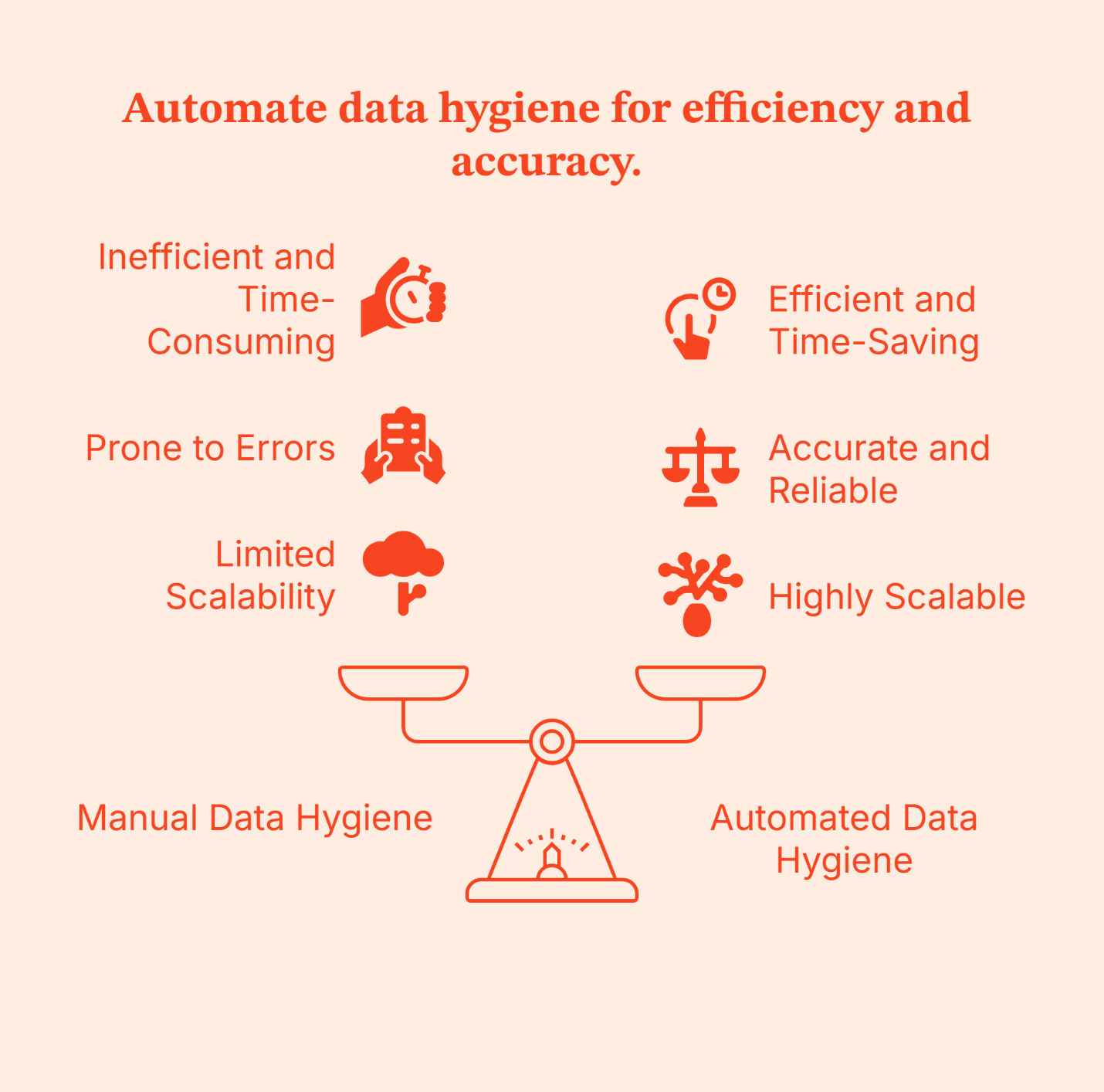
You can turn to Factors.ai to see this in action:
- Its company Intelligence keeps every account up to date with fresh firmographics and buying signals.
- LinkedIn CAPI sends clean, verified conversions back into your ad ecosystem, keeping targeting sharp.
- Attribution and Journey Mapping show what actually influenced a deal.
- Account-level scoring and intent recognition help your system understand who’s ready, who’s interested, and who needs more time.
All of these lead to fewer manual touchpoints, fewer messy records, and a clean CRM that gives you the most accurate view of your client journey. Factors.ai is your personal backstage crew, keeping things running while your team stays focused on revenue work.
Case Study: How Automated Enrichment Improves Sales Processes
All of this seems reasonable on paper (or in this case, a blog post). But if you are anything like me, you’d also be looking for actual proof (in real-world scenarios) about the effectiveness of automated GTM systems.
So, I headed to the Factors.ai customer stories to see whether GTM engineering truly helped reduce CAC through smarter automation. And I was not disappointed.
Rocketlane’s case study caught my attention immediately.
| Rocketlane, a professional services automation platform, was grappling with the ‘customer data hygiene in CRM at scale’ problem: Their traffic was growing, and new accounts kept appearing in their CRM, but they couldn’t tell which ones mattered. Without good firmographic tags or intent signals, high-intent accounts blended in with everyone else. Marketing was spending money on audiences that never converted, and the sales team was wasting time figuring out who was worth a follow-up. Once Rocketlane switched to automated enrichment and GTM workflows with Factors.ai, things changed fast. Factors.ai’s company Intelligence started pulling in accurate account fields the moment a company engaged. Journey mapping brought together touchpoints that were previously scattered. Scoring rules highlighted real buying interest instead of surface-level activity. The impact was instantly visible: Rocketlane identified over 6,500 accounts and 23% higher MQLs from ABM campaigns. Their team finally knew which accounts were worth pursuing, making outreach more focused, more relevant, and far more effective. Read Rocketlane’s case study here. |
How to Connect Sales and Marketing Systems Into One GTM Motion
I believe if sales and marketing teams had to ask for one wish from a genie, it would be to work as one unit. And honestly, I can’t blame them. The systems meant to align them often pull them in different directions.
The good news is: you don’t need a genie (or magic) to bring the marketing and sales team on the same page. You just need to follow a set of practical steps to make this happen.
It starts with unifying signals. Website intent, ad clicks, form fills, demo views, pricing page visits, and CRM activity are all combined into a single profile. Instead of seeing random touchpoints, your system sees a timeline. This alone reduces leakage because high-intent accounts no longer get lost between tools.
GTM Engineering uses that timeline to trigger the real work:
- Unified routing means every account is assigned using the same rules, not one rule in HubSpot and another in Salesforce.
- Unified scoring means intent signals from your website and ads feed directly into the CRM, so scores update in real time.
- Unified reporting means the same definitions for leads, MQLs, meetings, and opportunities across every dashboard. That stops your teams from debating which numbers are “correct.”
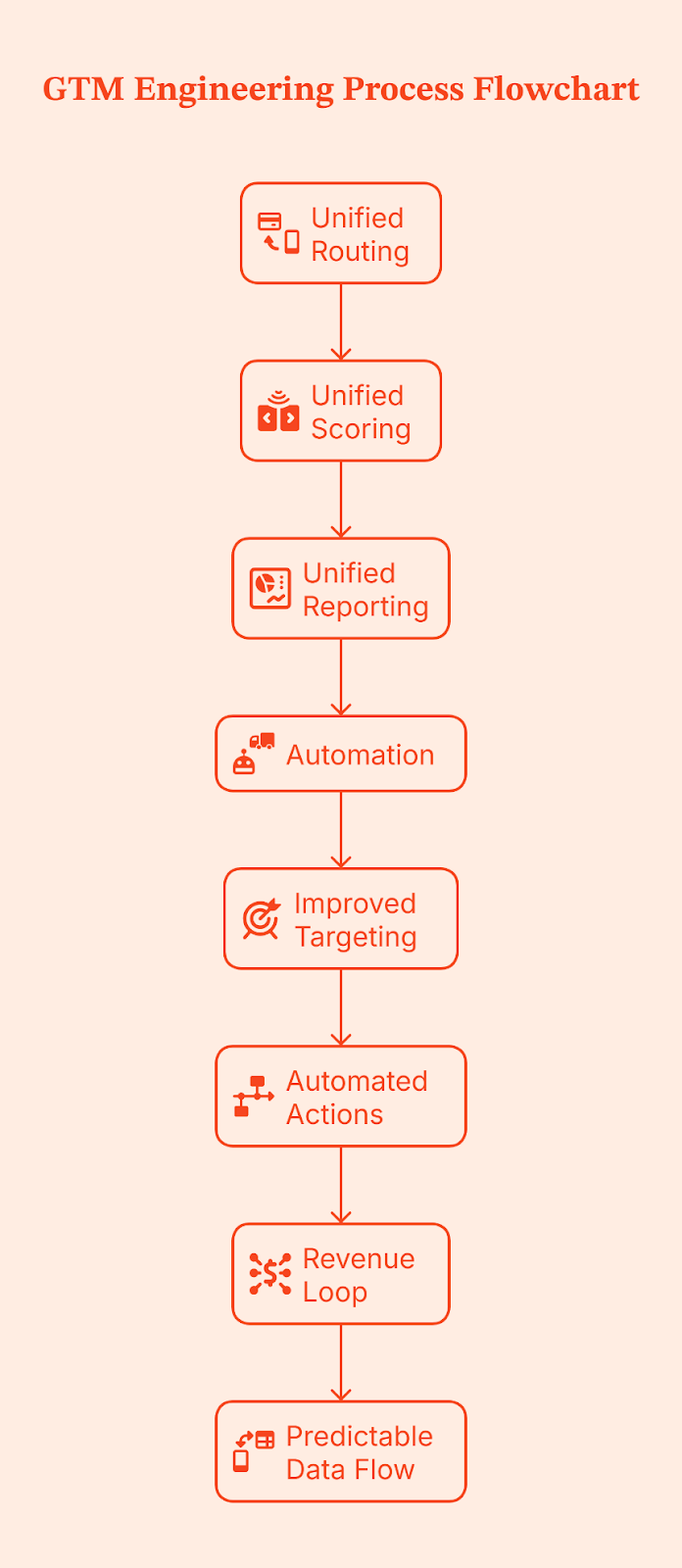
Then you add automation to close the loop. LinkedIn AdPilot and Google AdPilot push clean conversion data back into the CRM, so targeting improves on its own. When an account hits a scoring threshold, routing fires. When intent cools, nurture flows take over. The system becomes a revenue loop instead of a funnel that leaks at every stage.
With this unified setup, data flow between HubSpot and Salesforce becomes predictable rather than reactive.
The GTM Engineering Blueprint for Lower CAC
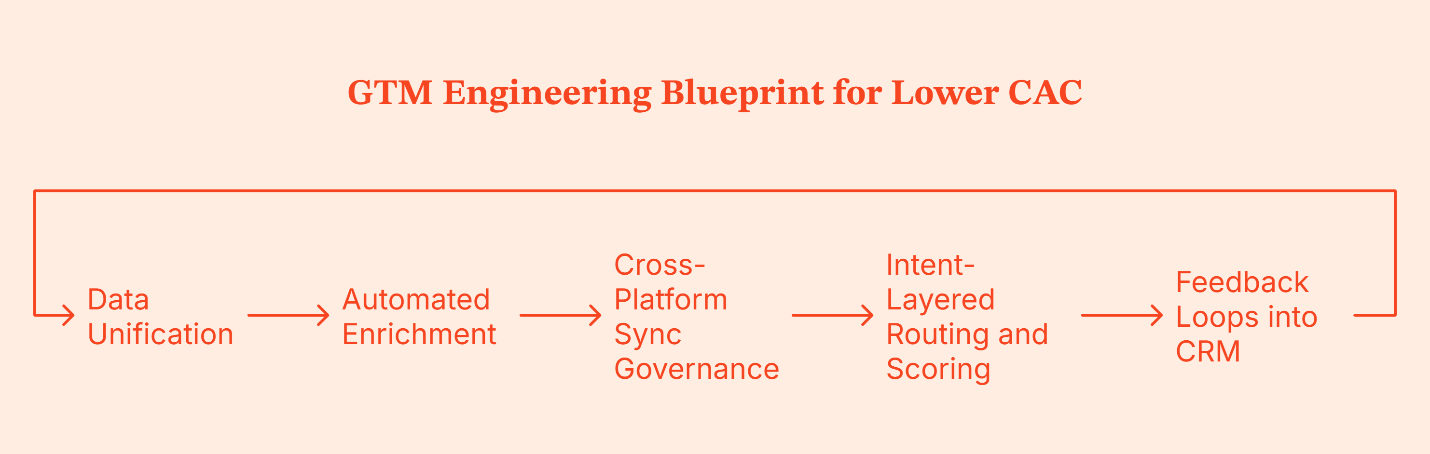
If you’ve made it this far, the pattern is already clear for you. If you want to lower your CAC, you will need a structured GTM system. GTM Engineering does this in a simple five-part blueprint:
- Data unification
All signals land in one place, so targeting stops drifting and spending stays focused.
- Automated enrichment
Missing firmographics and intent fields automatically fill in, resulting in cleaner routing and fewer wasted touches.
- Cross-platform sync governance
HubSpot and Salesforce follow the same rules, so your team no longer has to clean up mismatched fields and broken workflows. This alignment sets clear standards for how fields, owners, and lifecycle stages behave across both systems.
- Intent-layered routing and scoring
Accounts get routed and scored based on real behavior, helping reps reach high-intent buyers sooner, improving your win rate, and lowering cost per opportunity.
- Feedback loops back into the CRM
AdPilot and conversion signals feed back into your CRM, tightening targeting and keeping CAC from rising over time.
Metrics to Track: How to Measure Data Hygiene ROI
Now that you have your GTM system in place, the next step is to assess whether your data hygiene efforts are paying off. Pay attention to these details:
| Metric | What It Checks | How to Measure It | What Good Looks Like |
|---|---|---|---|
| Pipeline cleanliness score | Completeness of key fields that workflows depend on | Run a CRM field-completeness audit across lifecycle stage, firmographics, and scoring fields | High completeness across all required fields |
| Sync health score | How well HubSpot and Salesforce stay aligned | Compare field-level changes across both systems weekly | Minimal mismatches or sync failures |
| Enrichment coverage | How many accounts have full firmographics and intent | Report on filled vs blank enrichment fields | Most accounts are enriched with the data your workflows depend on |
| Duplicate rate | How often does the same account appear twice | Use CRM dedupe tools or a RevOps audit | Duplicate records are kept to a small, manageable minimum |
| CAC before and after automation | Direct impact of automation on acquisition cost | Compare CAC monthly or quarterly | A clear downward trend after workflow and data fixes |
| Pipeline velocity after enrichment | The speed at which good accounts move through stages | Compare the stage-to-stage time before and after enrichment | Faster movement of strong accounts with fewer stalled deals |
| Attribution completeness | How much of the buyer journey is visible | Check opportunities with at least one valid touchpoint | A more complete and reliable view of the buyer journey |
| Salesforce–HubSpot sync accuracy | Whether both systems show the same values | Weekly diff on owner, stage, lifecycle, and intent fields | Consistent alignment, with both platforms showing the same story |
These signals indicate whether your GTM system is becoming cleaner, faster, and cheaper to run.
Final Recommendation: Why GTM Engineering Is a CAC Strategy
If there’s one takeaway from all of this, it’s this: CAC drops when your GTM system stops wasting resources. GTM Engineering does that by giving marketing and sales a shared layer of clean data, unified logic, and automated execution.
Teams that adopt this approach see fewer leads slipping through cracks and spend more time driving revenue instead of fixing avoidable issues because:
- Signals flow into one place.
- Routing speeds up because there's no mismatch in ownership rules.
- Scoring becomes predictable because it uses behavior and enrichment.
- Ad spend stops drifting because LinkedIn and Google push clean conversions back into the CRM.
Compare that to teams relying on people power. They compensate by adding more SDRs, manual data entry, checks, and handoffs, but they only mask the problem. Their data remains messy, routing remains slow, and CAC continues to climb.
GTM Engineering fixes these for you. If you want your CRM to feel dependable again, Factors.ai can help you set up the structure that makes it happen.
FAQs
Q. What is CRM data hygiene in GTM?
It refers to keeping CRM records accurate, enriched, unified, and actionable so GTM teams can route, target, and measure effectively.
Q. How does GTM Engineering improve CRM data quality?
Through automated enrichment, unified schemas, sync rules, AI-based routing, and system-to-system governance.
Q. What are the most common HubSpot↔Salesforce sync issues?
Most sync issues come from mismatched field formats, outdated object mappings, duplicate rules fighting each other, and workflows updating values that the other system can’t read.
Q. For data enrichment, what should I enrich and when should I do it?
Enrich firmographics, intent signals, titles, and tech stack the moment a record enters your system so routing, scoring, and targeting don’t rely on guesswork.
Q. How do I ‘fix data sync between HubSpot and Salesforce’?
You fix it by standardizing fields across both systems, cleaning up old logic, aligning lifecycle rules, and using automated checks that catch bad updates before they break the sync.
Q. Can better hygiene actually reduce CAC?
Yes. Clean, timely customer data keeps your targeting sharp, speeds up handoffs, and prevents wasted touches, all of which bring CAC down without increasing spend.

See how Factors can 2x your ROI
Boost your LinkedIn ROI in no time using data-driven insights


.avif)

See Factors in action.
Schedule a personalized demo or sign up to get started for free
LinkedIn Marketing Partner
GDPR & SOC2 Type II

.svg)



.avif)

