
Factors.ai vs ZenABM: Which ABM platform drives real pipeline growth?
Compare Factors.ai vs ZenABM across ABM, attribution, visitor identification, CRM workflows, LinkedIn Ads, AI agents, analytics, and compliance to see why Factors.ai is the stronger GTM platform.
.avif)
Content Marketer



.svg)


If you're caught between a full-funnel GTM system and a lean, LinkedIn-focused ABM tool, you're probably asking the right question: Do I need everything or just what works?
Factors.ai combines LinkedIn ABM precision with full-funnel GTM execution. You get company-level ad engagement, web visitor identification, multi-touch attribution, CRM orchestration, predictive scoring, account scoring, product and intent signals, plus Scout AI agents that execute GTM workflows once your team approves.
ZenABM focuses heavily on LinkedIn engagement visibility and account-level scoring.
Now, I can’t help but add that Factors does that too but extends it across your entire revenue journey: ads, website, CRM, outbound workflows, pipeline attribution, buying committee mapping, and automated GTM actions in one system.
One of the above tools builds a system, and the other solves a short-term problem.
This guide compares both platforms across functionality, pricing, compliance, and support, so you can decide if you need comprehensive GTM orchestration or a streamlined LinkedIn-to-revenue engine.
TL;DR
- Factors.ai is a full-funnel ABM platform powered by Scout AI agents. It identifies 75%+ website visitors, captures intent from six signal sources, activates LinkedIn and Google Ads dynamically, and measures revenue impact across every touchpoint. Pricing starts at a free tier and scales to enterprise.
- ZenABM is a LinkedIn-native ABM tool with Zena AI agent. It deanonymizes LinkedIn ad engagement, scores accounts, stages them automatically, and syncs everything to your CRM. Pricing starts at $59/month with a 37-day free trial.
- Factors.ai excels at cross-channel visibility, predictive scoring, and omnichannel activation. Best for mid-market and enterprise teams running multi-source GTM motions.
- ZenABM excels at simplicity, speed, and LinkedIn-specific depth. Best for teams whose ABM motion centers entirely on LinkedIn Ads.
Factors.ai vs ZenABM: Functionality and features
The moment you compare these two, the positioning becomes clear. They're not really competitors, they solve different problems for different GTM maturity levels.
Factors.ai vs ZenABM: Quick feature overview
Factors.ai: Full-funnel architecture
Factors.ai operates on a single principle: every signal matters, and they should all talk to each other.
- Account Identification and Intent Capture
Factors identifies 75%+ of anonymous website visitors through waterfall enrichment across Bombora, RB2B, Leadfeeder, 6sense, Demandbase,Clearbit and Snitcher. Each visitor gets matched sequentially until a match surfaces.
This is just the entry point. Factors captures intent from six distinct sources:
- First-party signals come from your own systems: website behavior, CRM engagement, product usage, form interactions.
- Second-party signals come from trusted partners: LinkedIn organic reach, G2 buyer intent, paid ads (Google, Meta, Bing, LinkedIn).
- Third-party signals come from external providers: Bombora company-level intent data and enrichment.
All six signal types converge at the account level. Factors unifies them into a single score, updates it in real time as new signals arrive, and segments accounts based on intent intensity and funnel readiness.
- LinkedIn and Google AdPilot
Both ad platforms integrate natively as activation layers, not just reporting dashboards.
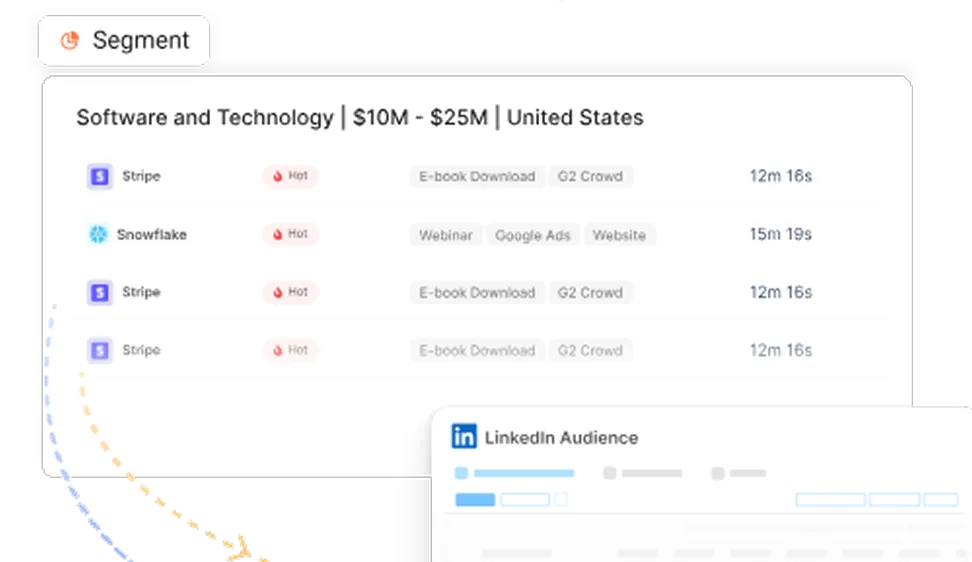
LinkedIn AdPilot operates at the account level. It syncs high-intent accounts to your LinkedIn campaigns daily, controls how many times each account sees your ads (preventing overexposure), suppresses accounts that don't fit your ICP, and sends conversion data back to LinkedIn's algorithm, both online conversions (form fills, demo bookings) and offline conversions (closed deals from your CRM).
Google AdPilot does the same for Google Search and Display, with Conversion API integration so conversion events hit Google with rich account-level context.
The outcome: your ad platforms stop optimizing toward generic engagement metrics (clicks, impressions) and instead optimize toward accounts that actually buy.
- Multi-Touch Attribution and Funnel Analytics
Factors tracks every account from first anonymous web visit through closed deal closure. It answers the questions leadership asks:
- Which campaigns actually influenced this opportunity?
- Was the first touchpoint a web visit or a LinkedIn ad?
- Did organic search or paid advertising drive initial awareness?
- How long was the actual sales cycle from first signal to signature?
Funnel analytics visualize progression across MQL → SQL → Opportunity → Closed Won. The platform flags bottlenecks, e.g., "Your opportunities stall 60% of the time before close; typical stall point is day 30", and shows which signals (web engagement, product usage, CRM stage movement) typically push deals forward.
- Scout AI Agents
Scout operates across the full revenue cycle without being asked.
- Account Intelligence: Scout automatically researches target accounts, identifies buying committees within each account, maps stakeholder influence and decision-making power, and flags which accounts are ready for immediate outreach.
- Engagement Orchestration: Scout monitors account movement through your funnel in real time. When a key account hits a buying signal threshold, Scout triggers a sales alert. It recommends next-best actions based on the account's intent level and current funnel stage, e.g., "This account just moved to Interested; recommend CEO-level outreach."
- Deal Acceleration: Scout tracks post-meeting activity, detects when deals stall (no activity for 14 days), and suggests reactivation plays for closed-lost opportunities, e.g., "Competitive loss; suggest product roadmap conversation to rebuild interest."
Unlike Zena (which answers questions when asked), Scout agents run continuously, surfacing insights and recommendations without waiting for you to query the platform.
ZenABM: LinkedIn-Specific ABM Execution
ZenABM solves one problem extremely well: turning LinkedIn ad engagement into actionable account intelligence.
- LinkedIn Ad Deanonymization
ZenABM connects to LinkedIn Campaign Manager and pulls engagement data at the company level. When someone from Acme Corp views or clicks your LinkedIn ad, ZenABM ties that back to Acme's account record.
This happens at impression, click, and engagement level, across all your LinkedIn campaigns. The platform groups campaigns into "ABM initiatives" so you can organize by product, persona, or region.
- Automatic Account Staging
ZenABM scores accounts on engagement intensity (how many interactions) and stage progression (are they moving deeper into your defined stages?).
Out-of-the-box stages include: Aware → Engaged → Interested → Selecting → Piloting → Customer.
Accounts move automatically as their engagement changes. An account that suddenly goes quiet drops back down. One that intensifies activity moves forward.
This creates a live, engagement-based funnel that's easy for stakeholders to visualize.
- Zena AI Agent
Unlike Scout (which runs autonomously), Zena responds to natural language queries:
- "Which campaigns drove the most pipeline?"
- "Show me accounts in Interested stage from tech companies"
- "What's our engagement score trend over the past 30 days?"
Results appear as instant reports, eliminating the need to manually build dashboards.
- CRM Sync and Webhooks
ZenABM pushes account scores, stages, intent signals, and engagement timelines directly to HubSpot or Salesforce custom properties.
SDRs see engagement data on account records. They can filter their outreach list to only "Interested" stage accounts. They can sort by engagement score to prioritize warm accounts.
The sync is bi-directional: if an SDR marks an account as qualified, that flows back to ZenABM and affects scoring and reporting.
- Analytics Dashboard
ZenABM's dashboard shows:
- Campaign performance (reach, engagement rate, cost per engagement)
- Account-level view (which campaigns each account engaged with, timeline of interactions)
- Revenue attribution (which accounts became opportunities, which influenced deals, deal size)
- Zena-powered natural language reporting
The focus is tight: LinkedIn data only. No web visitor tracking, no Google Ads, no product analytics.
Factors.ai vs ZenABM: Functionality Verdict
Factors.ai is built for GTM teams that are mature enough to think in systems. If your funnel involves website, ads, CRM, and product, and you need those signals to drive decisions, Factors.ai connects them.
ZenABM is built for teams that have already decided: LinkedIn Ads are our ABM channel. They want the cleanest, fastest way to get from "Company X engaged" to "Sales team, here's your target list."
In short:
- Factors.ai = Full-funnel visibility with Scout AI orchestration
- ZenABM = LinkedIn analytics with Zena AI reporting
Factors.ai vs ZenABM: Pricing comparison
Pricing reveals intent. Factors.ai prices for scale and multi-function. ZenABM prices for accessibility and simplicity.
Factors.ai vs ZenABM: Pricing
Factors.ai pricing strategy
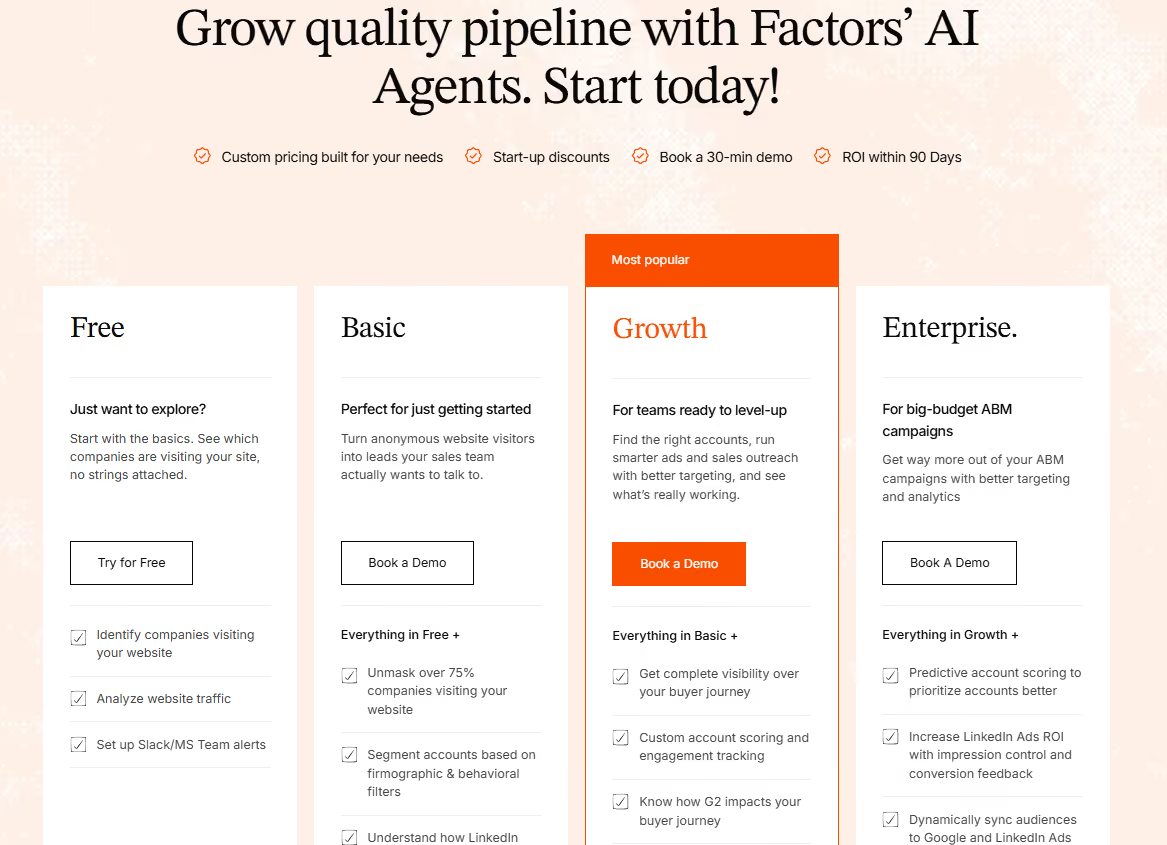
Factors doesn't charge per user seat or per company identified at the lowest tiers. Instead, it bundles identification, enrichment, CRM sync, analytics, and alerts into usage-based plans.
Think of it as: the more companies you want to identify and activate, the higher the plan.
The entry price includes:
- Visitor identification for 8,000 companies/month
- Multi-source intent signals
- CRM bidirectional sync
- LinkedIn and Google Ads integrations
- Dedicated customer success manager
- 100+ custom reports
- Workflow automation
For teams replacing four-point tools (visitor ID tool, enrichment provider, analytics platform, ad activation tool), the ROI stacks quickly.
GTM Engineering Services (optional) start at a separate cost. These include custom ICP modeling, RevOps workflow design, SDR enablement, and buying group mapping. This is where Factors extracts additional value for teams without in-house RevOps bandwidth.
ZenABM Pricing strategy
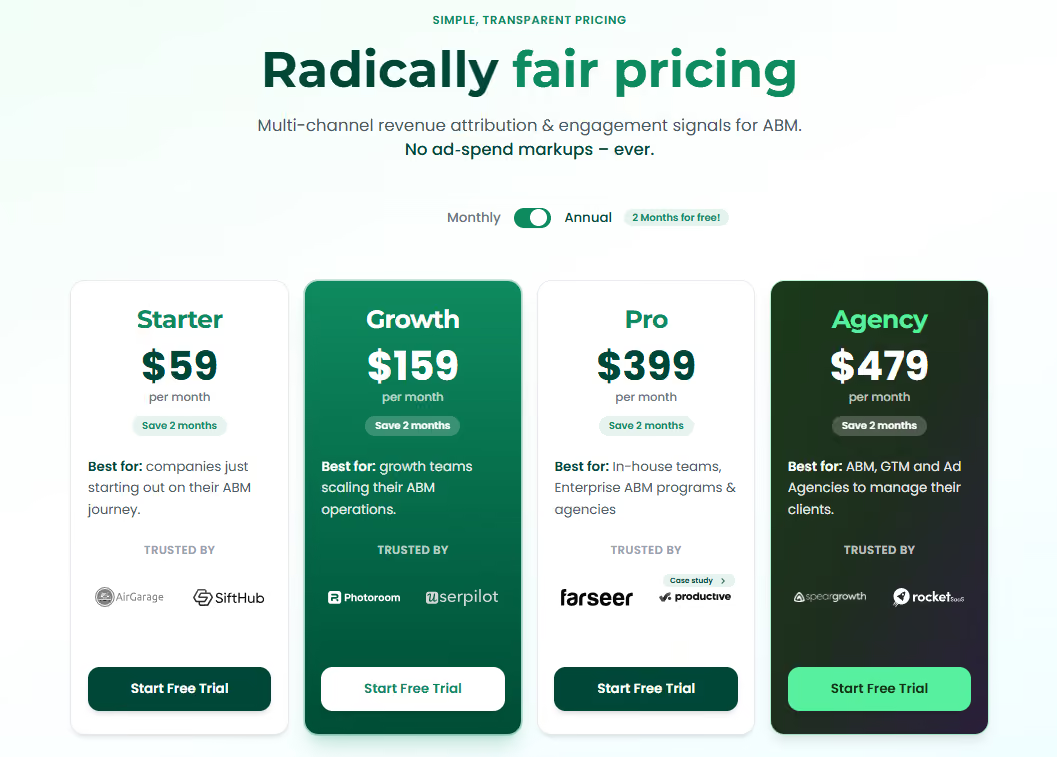
ZenABM prices for entry-level adoption. The $59 starter plan is genuinely accessible; it's where a single marketer or small team can trial the product with minimal commitment.
The catch: the $59 plan caps at 1 ABM campaign and 10 Zena chats per day.
To unlock multi-campaign support (which most growing ABM programs need), you move to Growth ($159/mo) or Pro ($399/mo). The Agency plan ($479/mo) adds multi-client support for agencies.
All plans include:
- HubSpot and Salesforce integration
- Webhooks for custom automation
- Zena AI (with daily chat limits)
- API access (on higher tiers)
No hidden per-company or per-seat overages. You pay the monthly fee and get access.
The 37-day free trial is notable, it's longer than Factors' 14-day trial and signals ZenABM's confidence in product stickiness.
Factors.ai vs ZenABM: Pricing Verdict
ZenABM wins on affordability. At $59/mo with unlimited seats, it's the lowest entry price for ABM analytics on the market.
Factors.ai wins on value consolidation. If you're stacking multiple tools, the all-in-one approach saves money and complexity over time.
For a single-channel LinkedIn ABM motion: ZenABM at $159-399/mo is hard to beat.
For a multi-channel GTM motion: Factors.ai's bundled approach is more cost-efficient than the alternative of buying visitor ID + enrichment + attribution + activation separately.
In short:
- ZenABM = Accessible LinkedIn-first pricing
- Factors.ai = Enterprise GTM consolidation
Factors.ai vs ZenABM: CRM integration and pipeline mapping
This is where the philosophies diverge sharply.
Factors.ai vs ZenABM: CRM integration comparison
Factors.ai: Bi-directional CRM alignment
Factors.ai reads from your CRM and writes back to it. This creates a feedback loop.
- When an account is in SQL stage in Salesforce, Factors knows that. It weights intent signals differently for SQLs vs. MQLs. It tells Scout AI to focus on deal acceleration plays for SQLs, not lead nurturing plays for MQLs.
- Factors pushes enriched account records, engagement timelines, buying group maps, and deal influence data back to Salesforce. It creates custom objects for buying committees, so your sales team doesn't have to manually find stakeholders.
- Every account record in your CRM becomes a hub. Marketing sees which campaigns drove engagement. Sales sees the full timeline of interactions. RevOps sees exactly which signal (web visit, form fill, ad click, G2 review) moved the deal forward.
- SDRs can build automation: "If account is in Interested stage AND has had 3+ web visits in the past week AND comes from our target industry, send me a Slack notification."
With this, CRM becomes the operating system for GTM, not just a transaction ledger.
ZenABM: Push-only CRM sync
ZenABM pushes engagement data into your CRM but doesn't read back from it.
This is a deliberate trade-off: simplicity over bi-directionality.
- What flows into CRM: Account scores (1-100), stage labels (Aware/Engaged/Interested/Selecting), engagement history (timeline of LinkedIn touchpoints), and intent signals (which content each account engaged with).
- What doesn't flow back: ZenABM doesn't know if an account is already in SQL stage. It doesn't adjust scoring based on CRM pipeline position. It treats all LinkedIn engagement equally.
- SDR Workflow: SDRs see the engagement data in Salesforce or HubSpot, use it to decide whom to outreach, and manually mark accounts as qualified. Those qualifications can flow back via webhooks, but ZenABM doesn't natively use them to recalibrate scoring.
This design keeps ZenABM lightweight and fast. You get clean, actionable data without RevOps orchestration overhead.
Factors.ai vs ZenABM: CRM Integration Verdict
Factors.ai treats CRM as the center of your GTM system. Every signal flows through it. Every decision pulls from it. This requires more setup but enables true omnichannel GTM orchestration.
ZenABM treats CRM as the handoff point. Marketing identifies engaged accounts on LinkedIn, pushes them to CRM, sales takes it from there. It's simpler and faster but creates a data silo: LinkedIn insights don't inform email campaigns, product usage doesn't inform LinkedIn retargeting.
For teams with simple GTM motions (LinkedIn Ads → CRM → Sales): ZenABM's one-way sync is sufficient.
For teams with complex GTM motions (Website + Ads + Product + Email + CRM, all informing each other): Factors.ai's bi-directional architecture is necessary.
In short:
- Factors.ai = CRM as GTM command center
- ZenABM = CRM as outreach handoff point
Factors.ai vs ZenABM: Intent signals and ad activation
This comparison gets at the heart of how each platform thinks about ABM.
Factors.ai vs ZenABM: Intent and activation comparison
Factors.ai: Multi-signal intent orchestration
Factors treats intent as a blend of signals, not a single data point.
An account might show high web engagement but low G2 intent. Another might have moderate LinkedIn activity but sudden CRM stage movement. A third might have Bombora signals indicating active buying but no outreach yet.
Scout AI synthesizes these and decides: which accounts need nurturing, which need sales outreach, which need different messaging?
- LinkedIn AdPilot operates within this context. Instead of running generic LinkedIn Ads campaigns, you run intent-based campaigns:
- Retarget accounts with high website engagement (warm traffic)
- Suppress accounts already in your sales pipeline (don't waste impression on known leads)
- Control impression frequency for high-value accounts (avoid ad fatigue)
- Test different messaging with different intent clusters
- Google AdPilot scales this to paid search, enabling remarketing to accounts showing search intent.
- Conversion Feedback: When an SDR marks a lead as qualified (CRM conversion), that signal flows back to your ad platforms. Over time, LinkedIn and Google learn which accounts are most likely to convert and bias their optimization accordingly.
The result: every dollar of ad spend optimizes toward accounts that actually buy, not just those that click.
ZenABM: LinkedIn Engagement as intent proxy
ZenABM operates on a simpler model: LinkedIn engagement = intent signal.
If an account viewed your LinkedIn Ads, it signals interest. If it clicked multiple ads, that signals higher intent. If it engaged with organic posts, add that to the mix.
Zena scores accounts on this engagement, stages them on movement velocity, and pushes the results to your CRM.
This works for LinkedIn-first teams because it mirrors their ABM motion: you run LinkedIn Ads, monitor who engages, and prioritize them for outreach.
The limitation: engagement on LinkedIn doesn't capture the full market picture. An account might be actively in-market but hasn't seen your ads yet. An account might be researching you on G2 or your website but never touched your LinkedIn Ads. ZenABM misses both signals.
- No autonomous recommendations: Zena answers questions; it doesn't suggest which accounts to prioritize for outreach or which messaging to use. You make those decisions based on the engagement data.
- No ad optimization: ZenABM doesn't optimize your LinkedIn Ads automatically. You manage campaigns, monitor which ones engage accounts, and manually adjust spend or messaging.
Factors.ai vs ZenABM: Intent and Activation Verdict
Factors.ai wins for teams running sophisticated ABM motions across multiple channels. The multi-signal approach catches accounts early (before they engage with your ads), and the autonomous activation keeps your ads spending smart.
- ZenABM wins for teams whose ABM motion is laser-focused on LinkedIn Ads. If LinkedIn is your channel and engagement is your metric, ZenABM is precise and fast.
- The philosophical difference: Factors.ai asks, "How do we find and activate every account in-market, regardless of channel?" ZenABM asks, "How do we maximize value from the accounts engaging with our LinkedIn campaigns?"
Both are valid. Your choice depends on whether you're optimizing a single channel or orchestrating a multi-channel motion.
In short:
- Factors.ai = Multi-channel intent orchestration with Scout autonomy
- ZenABM = LinkedIn engagement precision with Zena insights
Factors.ai vs ZenABM: Analytics and reporting
Analytics separate tactical visibility from strategic clarity.
Factors.ai vs ZenABM: Analytics and reporting comparison
Factors.ai: Full-funnel attribution
Factors answers: "Which campaigns, channels, and signals actually drove this deal?"
The platform tracks every interaction from first anonymous web visit through closed deal. It shows:
- First-touch channel (which campaign introduced this account?)
- Last-touch channel (which campaign was the final push?)
- Multi-touch influence (which channels contributed throughout the journey?)
- Cycle time (how long from first touch to close?)
- Funnel drop-off detection: Factors visualizes where deals stall. If 50% of SQLs convert to opportunities but only 20% convert to closed deals, the platform flags the opportunity → closed deal stage as a leak. Scout AI recommends intervention (e.g., executive outreach, product demo, pricing negotiation).
- Custom dashboards: You can build dashboards by industry, geography, persona, or campaign. Each tells a different story about what drives pipeline in your market.
- Scout-powered insights: Scout synthesizes the data. Instead of you reading dashboards, Scout tells you: "This week, web engagement drove 40% more pipeline than LinkedIn Ads. Your target accounts in healthcare are 30% more likely to convert than in finance. Inbound motion is stalling at the SQL stage."
The limitation: Factors doesn't natively offer lift analysis (incrementality testing), which proves whether your ads actually moved the needle or would have closed anyway.
ZenABM: LinkedIn campaign reporting
ZenABM answers: "Which LinkedIn campaigns are driving engagement and which accounts are closest to converting?"
The dashboards show:
- Campaign performance: reach, engagement rate, cost per engagement
- Account performance: which accounts engaged, engagement timeline, movement through ABM stages
- Revenue correlation: which engaged accounts became opportunities, average deal size, pipeline influenced
- Account cards: Click on an account and see everything ZenABM knows: all campaigns they engaged with, engagement timeline, current stage, engagement score, intent signals inferred from ad content.
- Zena natural language queries: Ask Zena questions like "Which accounts just moved to Interested?" or "Show me Q2 campaigns ranked by pipeline influence." Results appear as instant reports.
- Stage velocity: Track how fast accounts move through your stages. If accounts are getting stuck in Interested, Zena alerts you and you can adjust messaging or timing.
The limitation: all insights are LinkedIn-specific. You can't see if these accounts are also engaging with Google Ads, your website, or G2. You get a clean picture of one channel, not the whole market.
Factors.ai vs ZenABM: Analytics Verdict
- Factors.ai for CMOs and RevOps leaders who need to prove multi-channel ROI to leadership. If your CFO asks, "Which campaigns actually drove revenue?", Factors gives you the audit-ready answer.
- ZenABM for performance marketers and demand gen teams who live in LinkedIn Ads and want instant clarity on what's working. If your question is "Which LinkedIn campaigns should I double down on?", ZenABM is faster.
In short:
- Factors.ai = Full-funnel attribution for strategic GTM decisions
- ZenABM = LinkedIn campaign reporting for tactical optimization
Factors.ai vs ZenABM: Onboarding and support
How quickly you go live, and how much hand-holding you need, shapes the true cost of adoption.
Factors.ai vs ZenABM: Onboarding and support comparison
Factors.ai: Structured onboarding
Factors treats onboarding as part of the product. Every customer gets a dedicated CSM and a structured process.
- Week 1: ICP definition and enrichment strategy. What companies are you targeting? Where does your data come from? Which enrichment providers should we layer?
- Week 2: CRM and ad platform setup. Connect your Salesforce or HubSpot, map custom properties, set up LinkedIn and Google Ads integrations.
- Week 3: Build automations and alerts. Define workflows: "If account shows intent spike, alert SDR. If account moves to SQL, pause LinkedIn retargeting."
- Ongoing: Weekly 30-minute strategy calls. Your CSM reviews adoption, identifies gaps, and optimizes configurations based on what's working.
This takes more time upfront but ensures Factors integrates into your GTM operating rhythm, not sitting idle as a reporting tool.
GTM Engineering Services (optional): If you don't have in-house RevOps, Factors can design your entire GTM workflow, from ICP modeling to alert triggers to enrichment logic. This accelerates time to ROI but adds cost.
ZenABM: Plug-and-play activation
ZenABM's onboarding is intentionally minimal.
- Step 1: Connect LinkedIn Campaign Manager (OAuth).
- Step 2: Connect HubSpot or Salesforce (OAuth).
- Step 3: Define your ABM campaigns by grouping LinkedIn campaign IDs into initiatives.
- Step 4: Set intent signals (which content signals different intent levels).
Your first account scores and stages appear in your CRM within an hour.
If something breaks (API error, sync stall), email support helps. But most teams never need to call support because the setup is so straightforward.
Learning curve: A marketer can go live on their own. You don’t need RevOps expertise or multi-week implementation.
The trade-off: less guidance on how to structure your ABM motion. ZenABM assumes you know what you're doing with LinkedIn Ads; they just add the intelligence layer.
Factors.ai vs ZenABM: Onboarding verdict
Factors.ai for teams that need hand-holding and want to optimize GTM strategy, not just tools. If you have RevOps bandwidth and want an external expert to validate your approach, the white-glove onboarding pays for itself.
ZenABM for teams that just want to go live fast. You understand LinkedIn Ads, you have a CRM, and you want visibility into engagement. ZenABM gets you there in hours.
In short:
- Factors.ai = Strategic onboarding with ongoing partnership
- ZenABM = Self-serve setup for immediate activation
Factors.ai vs ZenABM: Compliance and security
Data trust is non-negotiable for a revenue platform.
Factors.ai vs ZenABM: Compliance and security comparison
Factors.ai: Enterprise-grade compliance
Factors.ai operates to SOC 2 Type II and ISO 27001 standards, the certifications enterprise procurement requires.
- SOC 2 Type II means an independent CPA firm has audited Factors' security controls over a period of time (typically 6+ months), verified they're effective, and issued a report. This covers security, availability, and confidentiality.
- ISO 27001 means Factors maintains an information security management system that meets international standards for protecting data.
- GDPR with supplementary safeguards: Factors.ai is US-based but handles EU data with Standard Contractual Clauses and additional encryption safeguards to align with GDPR requirements.
- Incident Response: Factors maintains a formal incident response plan with a dedicated Data Protection Officer. If a breach occurs, Factors has procedures to investigate, contain, and notify affected parties.
- Data Export: Factors provides API access to your data, reducing lock-in risk. If you leave, your account data is yours to export.
This level of certification takes investment. It signals that Factors takes data security seriously and is willing to be audited by third parties to prove it.
ZenABM: GDPR compliance (Limited public validation)
ZenABM is GDPR-compliant and confirms this in their data policy. However, there's no public mention of SOC 2, ISO 27001, or third-party security audits.
This isn't unusual for earlier-stage platforms. Compliance certifications are expensive and time-consuming. Many platforms postpone them until they hit enterprise customer requirements.
- GDPR compliance: ZenABM processes EU data within GDPR requirements and provides a data processing agreement on request.
- Data security: Standard protections (HTTPS encryption, access controls) are likely in place, but without published SOC 2 documentation, there's no independent verification.
- Incident response: ZenABM includes an incident response plan and claims 24-hour restoration capability, but again, no third-party audit validates these claims.
- For mid-market teams: ZenABM's compliance posture is sufficient. For enterprise procurement, the lack of SOC 2 certification will trigger requests for custom security assessments, extending sales cycles.
Factors.ai vs ZenABM: Compliance verdict
Factors.ai for enterprise buyers and regulated industries. SOC 2 Type II and ISO 27001 certifications speed procurement and give your security/legal teams confidence.
ZenABM for mid-market teams where GDPR compliance is the bar. If your customers don't require SOC 2, ZenABM's compliance posture is fine.
In short:
- Factors.ai = Enterprise compliance with third-party validation
- ZenABM = GDPR compliance without third-party audit
Factors.ai vs ZenABM: Which tool to choose when?
Both platforms help GTM teams move faster. The decision hinges on your channel focus and GTM complexity.
Factors.ai vs ZenABM: Decision framework
Choose Factors.ai if:
You're running ABM or demand generation across multiple channels. Your GTM motion isn't just LinkedIn, it includes website, email, paid search, and product signals. You want these signals to inform each other, not sit in silos.
You have RevOps resources (or can hire someone) and want to treat your CRM as the operating system for GTM, not just a transaction ledger.
You need multi-touch attribution to prove ROI to your CFO. "LinkedIn drove $2M in pipeline" is good. "LinkedIn + website + product drove $2M, with website as first touch" is better for strategic conversations.
You're at growth stage or beyond and can justify $400+/month for a consolidated platform that replaces 3-4 point tools.
You run both LinkedIn and Google Ads and want optimization across both channels within one system.
Choose ZenABM if:
You're confident LinkedIn Ads is your primary ABM channel and you want the cleanest, fastest way to get from "Company X engaged with my LinkedIn Ads" to "Sales, here's your priority list."
You're early-stage or SMB and need to go live fast. You don't have RevOps bandwidth for complex multi-channel orchestration. You just need visibility and action.
You want to minimize onboarding friction. You'd rather plug in and go live in hours than spend weeks with a CSM configuring workflows.
You're paying per-month and want a fixed cost with no surprises. You don't want to worry about per-company overage fees.
You want to ask Zena "Which campaigns drove the most pipeline?" and get an instant answer without building dashboards.
You're managing multiple LinkedIn Ads accounts (as an agency) and need per-client isolation and multi-client dashboards.
The ‘use both’ setup
Some sophisticated teams use both:
- ZenABM for deep LinkedIn ABM analytics and account engagement scoring from paid LinkedIn traffic.
- Factors.ai for full-funnel visibility: website visitor identification, multi-channel attribution, and Scout AI orchestration.
This covers both depth (LinkedIn) and breadth (all channels), though it adds complexity and cost. You're paying for both platforms but eliminating the analytics overlap.
In a nutshell…
Factors.ai is for GTM teams that view their revenue stack as a system. Website, ads, CRM, and product all feed each other. Scout AI agents run continuously, researching accounts, mapping buying committees, and recommending actions. Every decision pulls from multi-source intent signals. You're not optimizing a channel; you're orchestrating a motion.
This works for companies that:
- Have defined ABM or demand generation programs with multiple campaigns
- Run paid ads on multiple platforms (LinkedIn + Google, at minimum)
- Have marketing and sales alignment around account targeting
- Want to prove multi-channel ROI to leadership
- Can afford $400+/month and have RevOps bandwidth
ZenABM is for GTM teams that have already answered their biggest question: "We're running ABM on LinkedIn." They want the fastest, cheapest way to get from engagement signal to sales outreach.
This works for companies that:
- Run LinkedIn Ads as their primary or only paid channel
- Are early-stage or SMB with lean teams
- Need visibility into campaign performance and account engagement
- Want to go live in hours, not weeks
- Can live with LinkedIn-only visibility
Neither platform is objectively "better." They solve different problems for different GTM maturity levels.
Pick Factors.ai if you need a system, and pick ZenABM if you need a quick solution.
FAQs for Factors.ai vs ZenABM
Q1. What is the main difference between Factors.ai and ZenABM?
The biggest difference is platform scope. Factors.ai is a full-funnel GTM and ABM platform that combines visitor identification, attribution, CRM orchestration, ad activation, and AI-driven account intelligence. ZenABM focuses primarily on LinkedIn engagement tracking and account scoring.
Q2. Is Factors.ai better for multi-channel ABM?
Yes. Factors.ai supports LinkedIn Ads, Google Ads, website intent signals, CRM activity, G2 intent, product signals, and third-party intent data within a single system. ZenABM is largely limited to LinkedIn engagement data.
Q3. Does ZenABM support Google Ads attribution?
No. ZenABM focuses on LinkedIn Ads visibility and CRM syncing. It does not provide native Google Ads activation or cross-channel attribution.
Q4. Which platform is easier to set up?
ZenABM is easier and faster to deploy. Most teams can connect LinkedIn Campaign Manager and their CRM within a few hours. That said, Factors.ai involves a more structured onboarding process because it integrates across multiple GTM systems.
Q5. Which platform is better for multi-channel ABM?
Factors.ai is significantly stronger for multi-channel ABM because it supports LinkedIn Ads, Google Ads, CRM orchestration, website identification, email workflows, and automated account segmentation together. ZenABM is largely LinkedIn-only.
Q6. Does Factors.ai support visitor identification?
Yes. Factors.ai identifies up to 75% of anonymous website visitors using waterfall enrichment across multiple providers. It also combines those insights with CRM and ad engagement data.
Q7. Which platform is better for enterprise teams?
Factors.ai is the stronger fit for enterprise teams because it includes SOC 2 Type II and ISO 27001 compliance, multi-touch attribution, AI-powered orchestration, and deeper CRM integrations.
Q8. Can Factors.ai replace multiple GTM tools?
Yes. Factors.ai combines visitor identification, attribution, account scoring, LinkedIn and Google Ads activation, CRM orchestration, and GTM workflows into one platform. Many teams use it to consolidate multiple point solutions.
Q9. Is ZenABM a good choice for LinkedIn-first ABM teams?
Yes. ZenABM is a strong fit for companies whose ABM strategy revolves around LinkedIn Ads and who want a lightweight platform for engagement visibility and account prioritization.
Q10. Which platform has better AI capabilities?
Factors.ai has more advanced AI functionality through Scout AI agents, which proactively research accounts, map buying committees, surface deal risks, recommend next actions, and automate workflows. ZenABM’s Zena AI mainly provides conversational analytics and reporting.
Q11. Is Factors.ai better for enterprise companies?
Yes. Factors.ai is built for enterprise GTM teams with SOC 2 Type II, ISO 27001 certification, multi-touch attribution, advanced CRM orchestration, and cross-channel analytics.

Powered by Bombora
Enter your domain and we'll send you a free list of companies showing buying intent in your vertical.
.avif)
Powered by Bombora
Enter your domain and we'll send you a free list of companies showing buying intent in your vertical.
.avif)

See how Factors can 2x your ROI
Boost your LinkedIn ROI in no time using data-driven insights


.avif)

See Factors in action.
Schedule a personalized demo or sign up to get started for free
LinkedIn Marketing Partner
GDPR & SOC2 Type II

.svg)



.avif)

