
Factors.ai vs 6Sense: Which ABM platform actually moves pipeline?
Factors.ai is a 6Sense alternative. Factors.ai is a multi-channel ABM demand generation platform with rapid 2-week onboarding. 6Sense is an enterprise predictive intelligence layer for display ads. Compare ABM features, pricing, analytics, CRM integration, and support.
.avif)
Content Marketer

Growth Marketer



.svg)


TL;DR
- 6Sense acts as an enterprise predictive intelligence layer optimized for programmatic display ads. Factors.ai is an agile, multi-channel ABM, demand generation, and attribution platform built for LinkedIn, Google Ads, and sales activation.
- Factors.ai goes live in under 2 weeks with a hands-on, white-glove onboarding team. 6Sense implementations frequently drag on for up to 6 months, burning two quarters of pipeline runway.
- Factors.ai offers person-level identification for US traffic (via RB2B) and custom multi-touch attribution. 6Sense focuses heavily on account-level data and rigid, pre-built reporting dashboards.
- Factors.ai features transparent, tiered pricing (including a free tier). 6Sense relies on opaque, multi-year negotiated contracts that typically start at $60,000 or more annually.
Factors.ai vs 6Sense: Quick glance table
| Feature | Factors.ai | 6Sense |
|---|---|---|
| Platform Type | Full-funnel GTM & multi-channel demand generation and ABM | B2B revenue intelligence & enterprise display ABM |
| Best For | Mid-market to enterprise B2B SaaS running LinkedIn & Google ABM | Large enterprise organizations with massive display budgets and internal RevOps |
| Account Identification | 75% match rate using a multi-source waterfall enrichment model | Up to 64% coverage using single-source identification |
| Person-Level ID | Yes, upto 40% (via RB2B for US traffic); pulls name, title, LinkedIn URL, and work email | No; primarily restricted to company-level data |
| LinkedIn Activation | Official Partner; auto-syncs audiences, controls frequency, tracks organic post engagement | Basic audience sync by intent/firmographics; no organic tracking |
| Google Ads Activation | Advanced (Customer Match sync, Enhanced Conversions, stage-specific targeting) | Highly limited or unavailable |
| Onboarding Timeline | Up to 2 weeks | Up to 6 months |
A lot of B2B marketing meetings follow a familiar script.
The CMO wants to know what's driving pipeline. Sales says marketing's leads are cold. Marketing says sales never follows up. Someone says, "Maybe we should look at 6sense."

Six months later, half of Q1 disappeared into implementation, the dashboards look gorgeous, and everyone is still asking:
"Did any of this actually move pipeline?"
This isn't a shot at 6sense. Plenty of teams get value from it. But the gap between buying the platform and seeing results can be bigger than expected.
Factors.ai and 6sense are trying to solve the same problem: identify in-market accounts, activate them across channels, and measure what actually works.
Where they differ is in how they do it, who they're built for, and what your first ninety days look like.
This Factors.ai vs 6sense comparison should help you make that call.
Factors.ai vs 6Sense: Functionality and features
If you had to compress the difference into one sentence: 6Sense is built for enterprise display ABM at scale. Factors.ai is built for multi-channel ABM that actually connects to revenue.
Both identify accounts. Both use intent signals. Both integrate with CRMs. But the execution philosophy is different enough that they're genuinely not solving the same problem for the same buyer.
Factors.ai vs 6Sense: Comparison Table
| Feature | Factors.ai | 6Sense |
|---|---|---|
| Platform type | Full-funnel GTM and demand generation platform with LinkedIn, Google, and AI-powered outreach | B2B revenue intelligence platform with predictive scoring and display ABM |
| Best for | Mid-market to enterprise B2B SaaS teams running multi-channel ABM | Enterprise organizations with dedicated RevOps and ABM programs at scale |
| Account identification | 75% match rate using waterfall enrichment across 4-5 data providers | Up to 64% coverage from single-source identification |
| Person-level identification | Person-level ID via RB2B for US-based B2B visitors; surfaces name, title, work email, LinkedIn URL, and firmographics directly | Limited; primarily company-level |
| Account scoring | Custom scoring models, predictive AI scoring, and feature-level intent signals | Predictive scoring based on ICP fit and engagement; limited customization |
| LinkedIn Ads activation | Official LinkedIn Marketing Partner; auto-sync audiences, impression pacing, CAPI conversion feedback, organic engagement tracking | Auto-sync audiences by intent and firmographics; limited conversion tracking; no organic post engagement |
| Google Ads activation | Customer Match audience sync and Google Enhanced Conversions | Limited or no Google Ads activation |
| CRM integrations | Bi-directional sync with Salesforce, HubSpot, Pipedrive, Clay, Google Sheets, and more | Standard integrations with Salesforce and HubSpot; additional setup required for most tools |
| Analytics and reporting | Custom report builder, multi-touch attribution, lift analytics, ACV, sales cycle, and win rate analysis | Pre-built dashboards with limited customization; basic attribution reporting |
| Implementation time | Up to 2 weeks | Up to 6 months |
That implementation gap deserves a moment of attention. Six months is a long time in a GTM cycle. That's an entire half-year of runway before the platform is even running. For mid-market teams where agility matters, that timeline is a deal-breaker before a single feature gets compared.
Factors.ai's functionality and features
Factors.ai is built on one principle: every signal your buyers generate should feed directly back into your campaigns and your sales team's workflow. Nothing sits in a dashboard waiting to be acted on manually.
- Account identification and visitor intelligence
Factors.ai identifies up to 75% of anonymous website visitors using a layered waterfall model that pulls from multiple data providers simultaneously. This isn't about showing you the same accounts you'd get from any single source.
On top of company-level identification, Factors now deanonymizes US-based B2B visitors at the person level through RB2B. For every identified visitor, you get first and last name, job title, LinkedIn URL, work email, company name, industry, employee count, and revenue range. SDRs get a Slack alert the moment a target-account decision-maker hits the site, with their LinkedIn URL and work email already in the payload. Marketing can build ICP-fit segments by title or firmographic and activate them directly via ads or sequences. CS can see who at a customer account is visiting churn-risk pages. RevOps can slice attribution reports by enriched person-level attributes instead of anonymous account traffic.
- Intent signals across every channel
Factors.ai captures intent from a genuinely wide range of sources: website behavior, CRM engagement, product usage, G2 intent, paid channel activity across LinkedIn, Google, Meta, and Bing, plus third-party intent from Bombora. These signals are scored at the account level by AI, taking into account ICP fit, funnel stage, and engagement intensity.
The result is a prioritized account list that updates in real time. No manually refreshed spreadsheets. No waiting for a weekly report.
- LinkedIn AdPilot: where intent meets activation
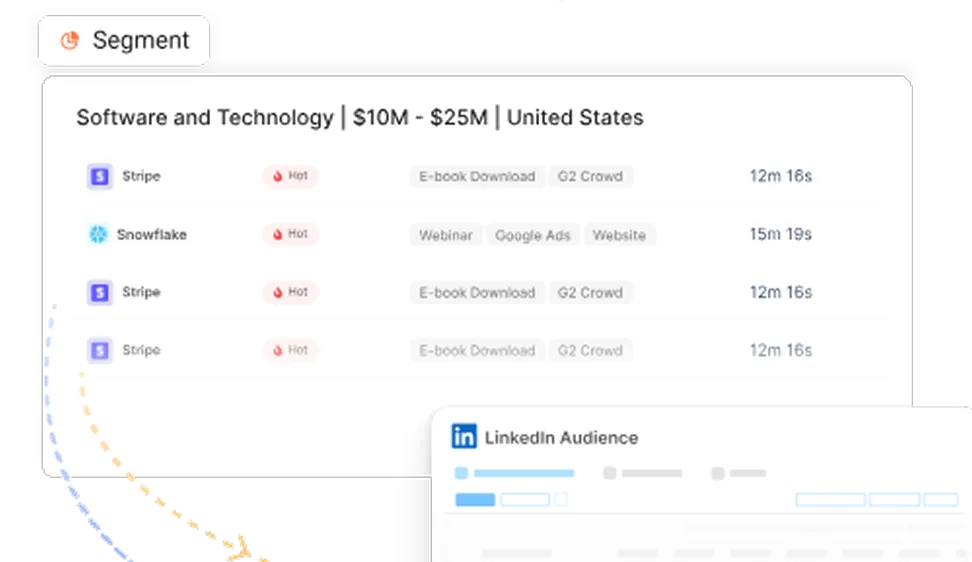
As an official LinkedIn Marketing Partner, Factors.ai's LinkedIn AdPilot automatically syncs high-intent audiences to LinkedIn campaigns based on live buying signals. Audiences update daily, so the accounts your ads reach tomorrow reflect what happened on your website and in your CRM today.
LinkedIn AdPilot’s Smartreach also controls impression frequency at the account level, which prevents your budget from burning on over-served accounts that aren't progressing. The CAPI (Conversions API) integration feeds enriched conversion events back to LinkedIn, so LinkedIn's algorithm optimizes toward accounts that actually convert rather than accounts that just click.
Organic engagement tracking is included, so you see which companies engage with your LinkedIn posts alongside your paid campaigns. Rare in this category, and genuinely useful.
- Google AdPilot
The same logic applies to Google Ads. Customer Match audience sync, Google Enhanced Conversions, and buyer-stage-specific targeting ensure your Google campaigns aren't just running in isolation. They're informed by the same account intelligence powering everything else by Google AdPilot.
- AI Agents for sales intelligence
Factors.ai's AI Agents, called Scout, handle account research, buying group mapping, post-meeting activity tracking, and closed-lost reactivation. When a high-intent account revisits your pricing page or a contact re-engages after a lost deal, the relevant sales rep gets a real-time Slack or Teams alert. The agent doesn't just flag the account. It surfaces the right contacts and provides outreach context so the rep knows why this account matters right now.
- Full-funnel attribution
Custom report builder, drag-and-drop dashboards, multi-touch attribution from first touch to closed won, lift analysis by channel and segment, ACV impact, sales cycle influence, and win rate by campaign. Factors.ai doesn't just show you what accounts are doing. It shows you what that activity is worth.
6Sense's functionality and features
6Sense is a genuine enterprise-grade platform. It pioneered predictive intent scoring in the ABM space and has years of longitudinal data that helps it identify accounts in buying cycles before they raise their hand.
Its core strength is display advertising at scale. The platform runs programmatic display campaigns targeted at intent-based account lists, which is useful for brand awareness at the top of the funnel. It connects to Salesforce and HubSpot, integrates with marketing automation platforms, and provides dashboards that enterprise teams use to report on pipeline influence.
Where 6Sense gets complicated is execution. Its pricing is negotiated through sales, with no public transparency. Its implementation timelines are long. Its Google Ads activation is limited. And its analytics customization is restricted to pre-built dashboards that don't offer the same depth as Factors.ai's custom report builder.
For a large enterprise with a dedicated ABM team, RevOps resources, and six months to get the platform running, 6Sense can be a powerful system. For a growth-stage team that needs results this quarter, the math gets harder.
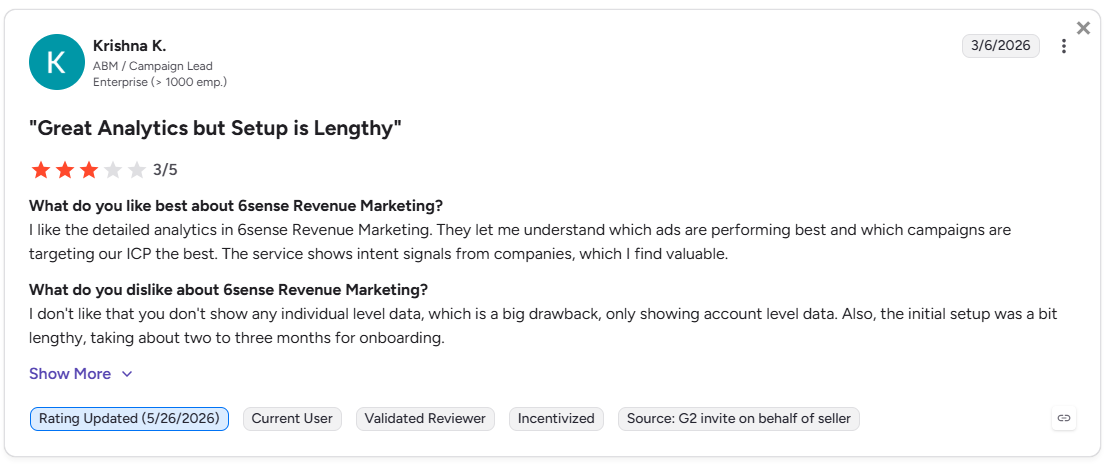
Factors.ai vs 6Sense: Verdict on functionality and features
If your GTM motion runs on LinkedIn and Google Ads, requires tight CRM integration, and needs attribution that connects campaigns directly to revenue, Factors.ai is the stronger platform. If you're running a large-scale enterprise ABM program primarily through display advertising and have the team and timeline to support a long implementation, 6Sense has the depth for that use case.
In short:
Factors.ai = multi-channel ABM activation with LinkedIn, Google, and built-in marketing attribution.
6Sense = enterprise display ABM with strong predictive intelligence and a long runway to value.
Factors.ai vs 6Sense: Pricing comparison
This is where the comparison gets stark, and honestly, where most mid-market teams make their final call.
Factors.ai vs 6Sense: How the pricing models compare
| Feature | Factors.ai | 6Sense |
|---|---|---|
| Pricing model | Usage and seat-based tiers; monthly or annual | Negotiated enterprise contracts; no public pricing |
| Free plan | Yes, 200 companies/month, up to 3 seats | Not available |
| Transparency | Transparent tiers on website | Opaque; requires a sales conversation |
| Contract structure | Monthly or annual, no hidden fees | Multi-year enterprise contracts typical |
| Free trial | Free plan available, paid trial available on request | No public free trial |
| Entry-level plan | Basic plan, 3,000 companies/month | Estimated $60,000+ annually for base access |
| Add-on services | GTM Engineering Services, Campaign management services | Add-ons priced separately at enterprise tiers |
Factors.ai pricing
Factors.ai follows a structured model that grows with your GTM operation. You don't pay for the entire platform before you know if it works.
- Free plan: Identifies up to 200 companies per month. Includes visitor tracking, Slack integration, starter dashboards, and up to 3 seats. It's a real working plan, not a locked demo.
- Basic plan: 3,000 companies per month with up to 5 seats. Adds LinkedIn intent signals, advanced dashboards, GTM workflows, and integrations with Google, LinkedIn, Facebook, Bing, HubSpot, and Salesforce.
- Growth plan (most popular): 8,000 companies per month, up to 10 seats. Unlocks ABM analytics, account scoring, LinkedIn attribution, G2 intent signals, workflow automations, 100 custom reports, and a dedicated CSM.
- Enterprise plan: Unlimited companies, up to 25 seats. Adds predictive account scoring, LinkedIn AdPilot, Google AdPilot, Milestones reporting, white-glove onboarding, and advanced integrations including Segment, Rudderstack, and custom connections.
Optional Campaign management services and GTM Engineering Services are available as an add-on for teams that want Factors.ai to build out their ICP modeling, RevOps workflows, SDR enablement, and enrichment automation. It's the difference between a tool you configure yourself and a GTM system someone builds with you.
Also, read Top GTM engineering tools for 2026.
6Sense pricing
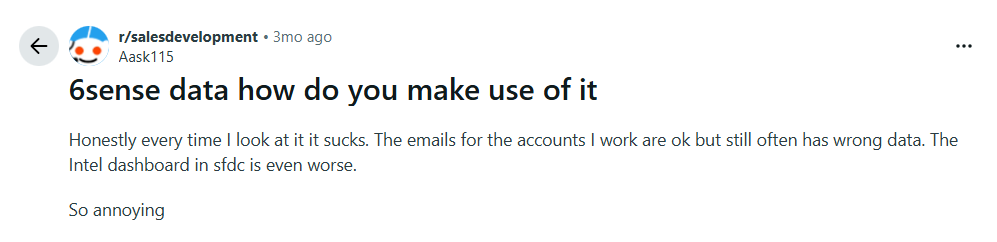
6Sense doesn't publish pricing. Based on widely reported estimates and reviews on G2 and TrustRadius, entry-level access typically starts at $60,000 or more annually, with most enterprise deployments running well above that once add-ons for data, seats, and advanced features are included. Multi-year contracts are standard.
The challenge isn't just the cost. It's the opacity. Going into a procurement process without knowing what you'll pay until you're three conversations into a sales cycle is a tax on time that mid-market teams don't have. The negotiated model also means two companies paying very different amounts for the same product, which creates real headaches when budget reviews come around.
Factors.ai vs 6Sense: What is the verdict on pricing
Factors.ai offers clear, scalable pricing that reflects how much of your GTM motion you want it to power. 6Sense is built for enterprise procurement cycles where negotiated contracts are the norm and budget isn't the primary constraint.
In short:
Factors.ai = transparent, tiered pricing that scales with your team.
6Sense = enterprise contract model with costs that only become clear after a sales process.
Factors.ai vs 6Sense: CRM integration and pipeline mapping
A platform that identifies intent but can't connect that intelligence back to your CRM is just a fancy list generator. The real value of an ABM tool is in how cleanly it slots into your existing sales and marketing stack.
Factors.ai vs 6Sense: Integration depth compared
| Feature | Factors.ai | 6Sense |
|---|---|---|
| CRM integrations | Bi-directional sync with Salesforce, HubSpot, Pipedrive, and Marketo | Salesforce and HubSpot; additional setup required |
| Sync direction | Bi-directional: pull CRM stage data to inform ad audiences; push engagement data back to CRM | Primarily push-based; limited feedback loops |
| Pipeline mapping | Tracks account progression from MQL to Closed Won, with attribution tied to campaigns at every stage | Pipeline stage tracking linked to intent scores |
| Account intelligence in CRM | AI agent alerts, buying group signals, and engagement intensity synced to CRM records | Intent data and predictive scores available in CRM |
| Ad audience refresh from CRM | Yes; accounts move between LinkedIn and Google audiences based on CRM stage changes | Limited; audience updates based primarily on intent signals |
| Enrichment | Multi-source enrichment via 4-5 data providers | Primarily proprietary enrichment |
| Automated workflow triggers | Triggers alerts and CRM tasks based on engagement intensity and funnel stage changes | CRM updates based on intent scores |
Why does the bi-directional sync matter?
Most ABM platforms push data to your CRM. That's useful. Factors.ai also pulls data from your CRM to inform what happens in your ad platforms. That distinction is more important than it sounds.
When a contact moves from MQL to SQL in your CRM, Factors.ai can automatically shift that account into a different LinkedIn audience. When a deal is marked Closed Lost, that account can be suppressed from your ads or moved into a re-engagement audience. Your campaigns respond to what's actually happening in your pipeline, not just to what a third-party intent model predicts.
6Sense's integration is strong at the enterprise level, particularly with Salesforce. But it operates more as an intelligence layer above your CRM than as one tightly woven into your ad workflows. For teams where LinkedIn Ads and Google Ads are core pipeline drivers, that difference shows up in performance.
Factors.ai vs 6Sense: Verdict on CRM and pipeline mapping
Both platforms connect meaningfully to major CRMs. Factors.ai's edge lies in the real-time, bidirectional connection between CRM stages and ad audience management. 6Sense's edge is the depth of its enterprise Salesforce integration and the breadth of its marketing automation platform support.
In short: Factors.ai = CRM integration that feeds back into ad activation in real time.
6Sense = strong enterprise CRM intelligence with less emphasis on closing the ad feedback loop.
Factors.ai vs 6Sense: Intent signals and ad activation
B2B Intent signal detection is only as valuable as what you do with it. The gap between the two platforms is widest here.
Factors.ai vs 6Sense: Comparing intent and activation
| Feature | Factors.ai | 6Sense |
|---|---|---|
| Intent signal sources | Website activity, CRM engagement, product usage, G2 intent, LinkedIn Ads, Google Ads, Meta, Bing, LinkedIn organic, Bombora third-party intent | Proprietary G2 Buyer Intent, Bombora, web activity, CRM data |
| LinkedIn Ads activation | Auto-sync intent-based audiences, impression pacing, frequency control, CAPI conversion feedback, organic engagement tracking | Audience sync by intent and firmographics; limited conversion tracking; no organic tracking |
| Google Ads activation | Customer Match sync, Google Enhanced Conversions, buyer-stage targeting | Limited; not a core activation channel |
| Audience refresh frequency | Daily automated updates based on live signals | Intent-signal-based; less frequent refresh cadence |
| Buying group detection | Identifies multiple contacts within an account showing engagement signals | Buying team identification available at enterprise tier |
| Conversion feedback loops | Sales and CRM outcomes feed back into LinkedIn and Google for smarter optimization | Limited native conversion feedback |
| Impression and frequency control | Account-level frequency caps to prevent budget waste | Less granular control |
| Real-time sales alerts | AI-driven Slack and Teams alerts for engagement changes or deal signals | Intent-based alerts to sales team |
Where 6Sense built its reputation...
6Sense pioneered the “dark funnel” concept: the idea that most B2B buying activity happens before a prospect ever raises their hand, and that you can predict purchase intent by watching anonymous research behavior. Its proprietary data network is genuinely impressive at identifying companies that are thinking about buying a solution before they show up in your CRM.
For brand-level display advertising: reaching accounts in the awareness stage before they know who you are, that predictive model is powerful. 6Sense's display campaigns can get your brand in front of the right accounts early in the buying cycle.
...and where the gap opens up
Where 6Sense struggles is the activation layer that follows that intelligence. Its Google Ads integration is limited. Its LinkedIn activation doesn't track organic engagement or offer the same level of CAPI feedback. And because 6Sense built its activation primarily around display, teams running heavy LinkedIn and Google campaigns often need additional tooling to bridge the gap.
Factors.ai was built with activation as a first-class capability, not an add-on. The LinkedIn AdPilot and Google AdPilot aren't integrations bolted onto an intelligence layer. They're core to how the platform operates. Intent signals immediately feed into audience updates, impression pacing, conversion feedback, and sales alerts. The loop is closed by design.
Mic drop.
Verdict on intent and ad activation
6Sense has stronger predictive modeling for top-of-funnel awareness. Factors.ai has stronger activation for teams running performance-oriented ABM across LinkedIn and Google.
In short: Factors.ai = intent that immediately activates across LinkedIn, Google, and your sales workflow. 6Sense = predictive intelligence that's strongest for display-first ABM programs.
Factors.ai vs 6Sense: Analytics and reporting
Attribution debates sometimes resemble group projects where everyone claims credit for the final result. A good analytics platform settles the debate with data instead of politics.
Factors.ai vs 6Sense: Analytics comparison
| Feature | Factors.ai | 6Sense |
|---|---|---|
| Attribution model | Multi-touch attribution from first touch to closed revenue | Basic attribution; limited multi-touch customization |
| Funnel analytics | MQL to SQL to Opportunity to Closed Won with campaign-level attribution at each stage | Funnel stage tracking linked to intent and engagement |
| Custom dashboards | Drag-and-drop report builder; segment by industry, geography, persona, or campaign | Pre-built dashboards; limited export and customization |
| Lift analysis | Measures campaign lift across channels and segments | Not available at standard tiers |
| Customer journey timelines | Unified timelines combining web, CRM, ad, and product data | Account-level journey tied to intent stages |
| AI-powered querying | Natural language querying and AI-generated insights in development | Revenue AI for pipeline forecasting |
| LinkedIn view-through attribution | Yes; includes impressions and organic engagement in attribution | Limited |
| ACV and win rate analysis | Yes; tracks how campaigns influence deal size and close rate | Available at enterprise tier |
What does good attribution actually look like?
Multi-touch attribution means every campaign interaction, from the first LinkedIn impression to the last demo confirmation email, shares credit for a deal proportionally. Without it, you end up over-crediting the last touch (usually a sales email) and under-crediting every brand and nurture campaign that built the relationship.
Also, read Top 12 attribution models in B2B
Factors.ai's custom report builder lets GTM teams ask specific questions: which campaign source produces the fastest sales cycle? Which audience segment has the highest win rate? Does LinkedIn or Google produce better ACV? These aren't hypothetical questions. They're the questions CMOs ask in QBRs, and they require granular attribution data to answer confidently.
6Sense's pre-built dashboards are solid for high-level pipeline reporting but don't offer the same flexibility. Teams with specific attribution questions often find themselves exporting data into a separate BI tool, which adds friction and introduces gaps.
Verdict on analytics
For teams that need to prove ROI at the campaign level and connect every marketing touchpoint to revenue, Factors.ai's attribution capabilities are significantly more flexible. 6Sense's analytics are strong for enterprise pipeline forecasting but weaker on custom attribution and channel-specific reporting.
In short: Factors.ai = granular, customizable attribution that answers specific revenue questions. 6Sense = solid pipeline visibility without the flexibility to go deep on channel-level analysis.
Factors.ai vs 6Sense: Onboarding and support
Buying a platform is the easy part. Getting it to actually work for your team is where most ABM investments stall.
Factors.ai vs 6Sense: Support model compared
| Feature | Factors.ai | 6Sense |
|---|---|---|
| Onboarding time | Up to 2 weeks | Up to 6 months |
| Dedicated CSM | Included from day one across all paid plans | Available at enterprise tier; varies by contract |
| Support channels | Private Slack channel, email, 24/5 availability | Email and ticket-based; self-service knowledge base |
| Strategy reviews | Weekly check-ins included | Depends on contract tier |
| Implementation assistance | GTM playbooks, enrichment setup, ad activation, and workflow configuration included | Managed implementation available but typically tied to higher contract tiers |
| Proactive recommendations | Yes; CSM provides optimization recommendations proactively | Limited proactive engagement |
| GTM Engineering Services | Optional add-on for full RevOps workflow design and automation | Not offered |
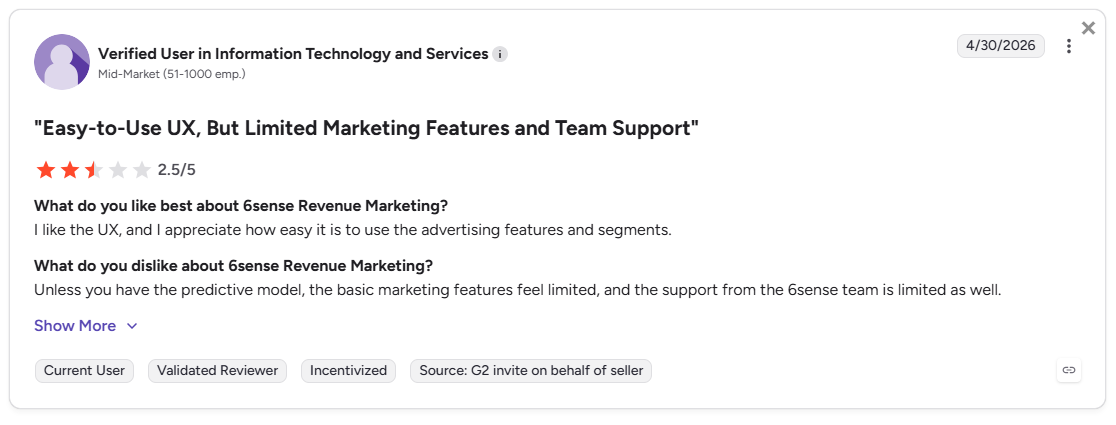
The two-week vs six-month gap… and why am I going ON and ON about it?!
That implementation gap isn't a minor detail. At six months, you're looking at two quarters of pipeline potential lost before the platform even goes live. Teams using 6Sense frequently report that the bulk of Q1 is consumed by implementation, integration cleanup, and stakeholder training.
Factors.ai's two-week onboarding is structured, hands-on… and white-glove. A dedicated CSM works through your ICP, funnel stages, and current integrations, configures alerts and workflows, and makes sure your ad platforms are connected before the weekly check-in cadence begins. There's no long setup phase where you're waiting for something to be live.
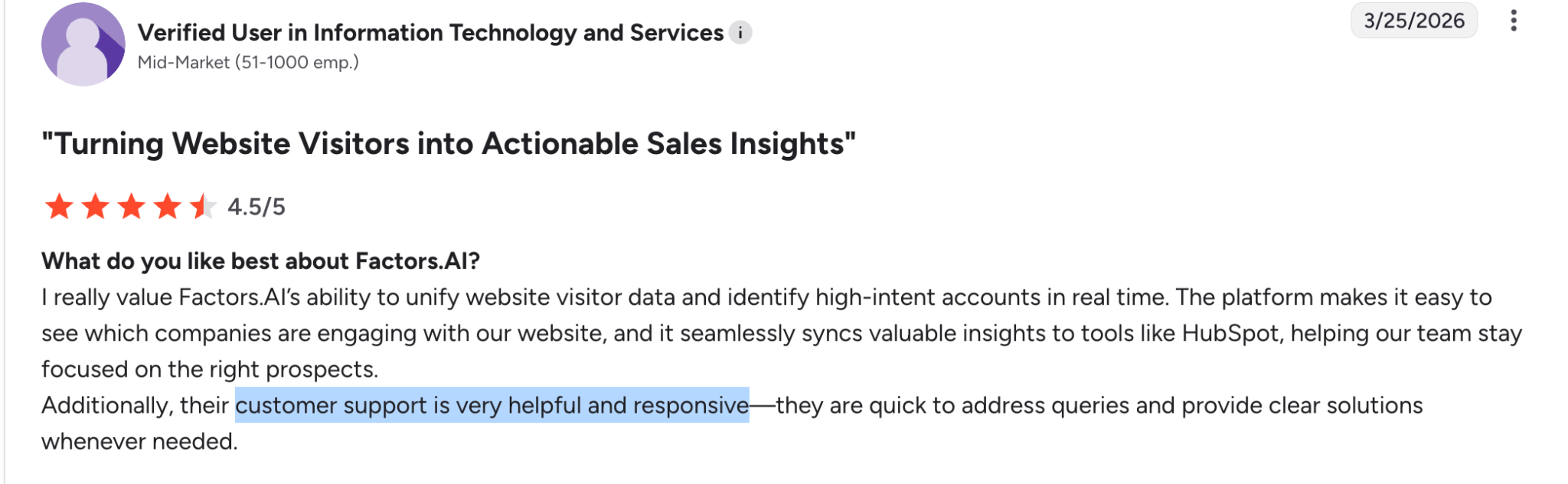
The private Slack channel is a meaningful support differentiator (no, it’s not just a nice-to-have; everybody will actually reply and help you). When something breaks during a campaign, you're talking to a real person, not submitting a ticket and waiting forty-eight to seventy-two hours for a response.
For teams that don't have in-house RevOps, GTM Engineering Services fills that gap. Factors.ai can design and build your entire GTM workflow, from ICP modeling to enrichment automation to SDR enablement, as an add-on service. 6Sense doesn't offer an equivalent.
Factors.ai vs 6Sense: Verdict on onboarding and support
If speed to value matters, and for most mid-market teams it absolutely does, Factors.ai's two-week onboarding and proactive CSM model wins clearly. 6Sense's support is appropriate for enterprise teams with dedicated implementation resources, but it's a poor fit for teams that need to show results this quarter.
In short: Factors.ai = structured, fast onboarding with a dedicated CSM from day one.
6Sense = enterprise implementation timeline with support that scales to contract size.
Factors.ai vs 6Sense: Compliance and security
Neither platform should make you nervous in a procurement review. But the details matter for teams dealing with enterprise contracts or regulated industries.
Factors.ai vs 6Sense: Compliance overview
| Area | Factors.ai | 6Sense |
|---|---|---|
| GDPR | Compliant | Compliant |
| CCPA | Compliant | Compliant |
| SOC 2 Type II | Certified | Certified |
| ISO 27001 | Certified via GCP infrastructure | Not publicly confirmed |
| Data encryption | AES-256 at rest, TLS in transit | AES-256 at rest, TLS in transit |
| Data hosting | Google Cloud Platform, US (us-west-1b) | US-based cloud infrastructure |
| Data Processing Agreement | Available | Available |
| Access control | IAM-based role access, two-factor authentication, IP-based logging | Enterprise-grade access controls |
Both platforms clear the standard bar for enterprise procurement. Factors.ai's ISO 27001 certification via GCP and the availability of signed Data Processing Agreements make it straightforward to clear vendor security reviews, even in regulated industries.
One practical note: Factors.ai hosts its data in GCP's US region, with Standard Contractual Clauses for EU-US transfers, so EU-based customers can use it without data residency complications. Teams in regulated verticals should confirm specifics with both vendors during the evaluation process.
Factors.ai vs 6Sense: Verdict on compliance
Both platforms are enterprise-appropriate from a compliance standpoint. Factors.ai's published ISO 27001 certification and formal incident response documentation give it a slight edge in detailed vendor review processes.
In short: Factors.ai = SOC 2 Type II, ISO 27001, GDPR, CCPA, with transparent DPAs.
6Sense = SOC 2 Type II, GDPR, CCPA compliant; ISO status not publicly confirmed.
What does Reddit say about 6Sense?


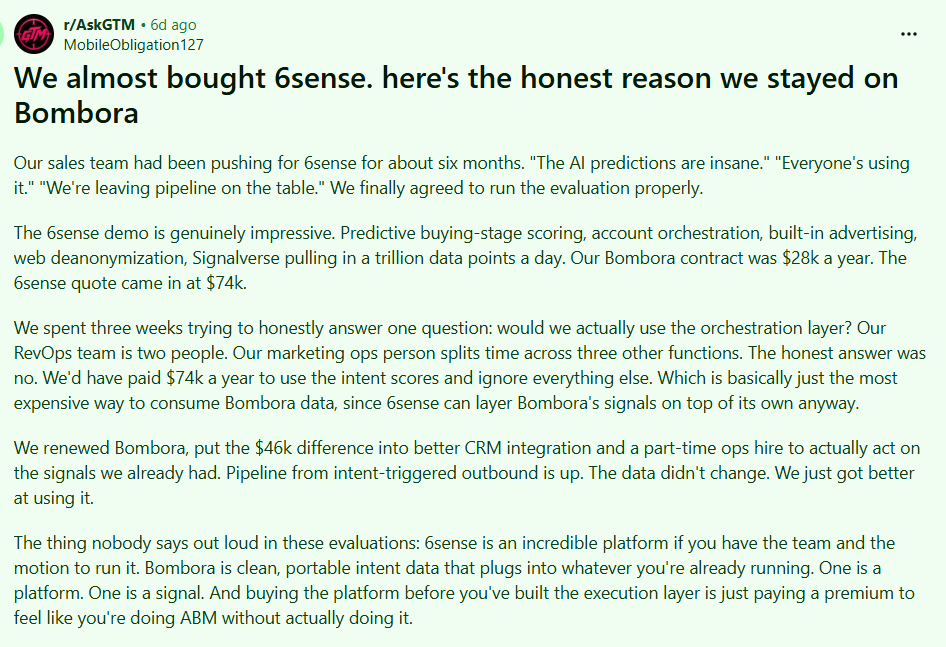
What do GTM teams say about Factors.ai?
23% higher conversions after switching to Factors.ai.
"The impact of Factors.ai on Rocketlane is that we're not just doing better, we're working smarter and more efficiently. Returns on our campaigns have improved, and our understanding of our data means we can make better decisions."
Steve Colberg, Head of Growth, Rocketlane
35% of pipeline influenced by G2 and Factors.ai signals.
"Thanks to Factors.ai's intent signals, Q1 2024 was our best quarter ever for meetings booked and conversions."
Aashima Lamba, Senior Manager Demand Generation, Upflow
25% increase in LinkedIn Ads ROI.
"Factors' value is almost impossible to quantify because of how deeply it's integrated into our stack. It's become a critical tool for building a clear understanding of our users, their actions, and their journey across our digital footprint."
Shane Poyar, Growth Marketing and Operations Manager
Factors.ai vs 6Sense: which one makes sense for your team?
| Scenario | Choose Factors.ai if... | Choose 6Sense if... |
|---|---|---|
| Team size and stage | You're a mid-market or growth-stage B2B team that needs results this quarter | You're a large enterprise with a dedicated ABM team and RevOps function |
| Primary ad channels | LinkedIn and Google Ads are core to your pipeline strategy | Display advertising is your primary awareness channel |
| Analytics needs | You need granular, custom attribution tied to specific campaigns and channels | You need high-level pipeline forecasting and intent-based dashboards |
| Implementation timeline | You need to be live and producing results within two weeks | You have a six-month runway for implementation and training |
| Budget | You want transparent pricing that scales with usage | You're in a procurement process where negotiated enterprise contracts are standard |
| Support model | You want a dedicated CSM and private Slack channel from day one | You have internal resources to manage a platform post-implementation |
| Compliance | You need SOC 2, ISO 27001, and GDPR compliance with published DPAs | Enterprise compliance standards are sufficient |
6Sense built its reputation as the category-defining ABM platform for a reason. Its predictive intelligence is strong, and for a large enterprise running brand-level ABM at scale, it's could be beneficial.
But for the majority of B2B SaaS teams who are trying to get more out of their LinkedIn and Google Ads budget, connect their CRM to their campaigns, and actually prove which activities are moving pipeline, Factors.ai covers more of that ground, faster, at a lower cost, and with a support model that doesn't require a dedicated implementation project manager to navigate.
The teams switching from 6Sense to Factors.ai aren't doing it because 6Sense broke. They're doing it because Factors.ai went live in two weeks instead of six months, and the attribution actually answered the questions their CMO was asking.
FAQs for Factors.ai vs 6Sense
Q1. What's the real difference between Factors.ai and 6Sense?
The core difference is activation depth and speed to value. 6Sense is strong at predictive intelligence and display ABM for enterprise teams. Factors.ai covers multi-channel activation across LinkedIn and Google, with tighter CRM integration, more flexible attribution, and a two-week implementation timeline rather than six months.
Q2. Is 6Sense worth the price for mid-market B2B teams?
For most mid-market teams, the answer is genuinely no. The implementation timeline alone costs two quarters of potential pipeline, and the pricing is structured for enterprise procurement budgets. Factors.ai covers the core ABM use cases at a fraction of the cost and operational complexity.
Q3. Does Factors.ai replace 6Sense entirely?
It depends on your use case. If you rely heavily on 6Sense's display advertising network for brand awareness at scale, Factors.ai doesn't replicate that specifically. For LinkedIn and Google Ads activation, attribution, visitor identification, and CRM-connected ABM, Factors.ai covers more ground, more affordably.
Q4. How long does Factors.ai actually take to set up?
Under two weeks for standard implementations. The onboarding team configures integrations, sets up ad platforms, builds initial workflows, and runs the first check-in call within that window. For more complex RevOps setups, GTM Engineering Services can extend the scope without extending the timeline significantly.
Q5. Does 6Sense offer a free trial?
No. 6Sense requires a sales consultation and doesn't offer a public trial. Factors.ai offers a free-forever plan covering up to 200 companies per month, and a 14-day paid-plan trial is available on request.
Q6. Which platform has better LinkedIn Ads integration?
Factors.ai, by a meaningful margin. As an official LinkedIn Marketing Partner, it offers intent-based audience syncing, impression pacing, frequency control, CAPI conversion feedback, and organic post engagement tracking. 6Sense's LinkedIn integration handles audience syncing but lacks organic tracking and granular conversion feedback.
Q7. How does Factors.ai handle account scoring differently from 6Sense?
Factors.ai offers custom scoring models that you configure based on your ICP, plus predictive AI scoring that factors in live behavior and firmographics. It also surfaces feature-level intent signals, meaning you can see which specific product areas a prospect is researching. 6Sense's scoring is primarily based on its proprietary intent model, with less customization available below the enterprise tier.
Q8. What happens if I already use 6Sense data within Factors.ai?
Factors.ai uses 6Sense data as one of multiple enrichment sources in its waterfall identification model. You don't lose access to 6Sense's data quality. You gain additional coverage from Snitcher, Demandbase, Clearbit, and Bombora layered on top of it.
Q9. Can Factors.ai handle enterprise-scale ABM programs?
Yes. The Enterprise plan covers unlimited companies, up to 25 seats, predictive scoring, LinkedIn and Google AdPilot, and advanced integrations. GTM Engineering Services can design the RevOps infrastructure for complex multi-team programs. The platform scales; the implementation timeline doesn't.
Q10. Which platform is better for proving ROI to leadership?
Factors.ai. Its custom report builder, multi-touch attribution, lift analysis, and ACV/win rate analytics give you the specific data points that CMOs and CFOs ask for in quarterly reviews. 6Sense's pre-built dashboards are strong for pipeline visibility but don't offer the same flexibility when someone asks, "Which specific campaign created this deal?"

See how Factors can 2x your ROI
Boost your LinkedIn ROI in no time using data-driven insights


.avif)
See Factors in action.
Schedule a personalized demo or sign up to get started for free
LinkedIn Marketing Partner
GDPR & SOC2 Type II






.svg)



.avif)

