
How GTM Engineering Is Replacing SDR Teams with AI-Powered Automation
Learn how GTM engineering is replacing SDR teams with AI workflows, signal-based outbound, and agentic automation. Data-backed, B2B-focused guide.

Writer

Growth Marketer



.svg)


TL;DR
- Outbound is struggling because buyers research silently, reply rates are declining, and sales teams spend most of their time on admin instead of real conversations.
- GTM Engineering replaces manual SDR work with signal-based workflows and agentic outbound that reacts instantly to buying signals.
- An advanced GTM stack runs on a simple flow: it captures signals, turns them into the right messages, runs workflows automatically, and keeps the CRM and pipeline accurate.
- Factors.ai powers this motion by using GTM engineering services. It helps by unifying signals from your website, product, CRM, LinkedIn, and ads so outreach happens at the right moment with the right context.
If you talk to any B2B sales rep, they’ll say, “outreach today feels like shouting in a stadium full of prospects while they have their headphones on.” And they are not wrong; the crowd is there, but no one’s listening anymore.
A 2025 benchmark study reports that average cold-email reply rates declined from 6.8% in 2023 to 5.8% in 2024. And when you look at open rates, the gap is even more striking. Woodpecker report says advanced personalization drives roughly 17% open rate, while emails with no personalization drop to around 7%.
Meanwhile, outbound volume keeps rising. Companies are sending more messages trying to beat the noise.
But are the buyers even listening? According to a recent Gartner survey, 61% of B2B buyers prefer a fully rep-free buying experience.
Which raises the question: when buyers aren’t even listening, how do you reach them? This is where GTM Engineering steps in. It uses signals, automation, and timing to scale in a way manual teams can’t match. You reach your prospects with a system guided by intent and real-time data, almost like speaking straight into their headphones right when they are ready to hear from you.
What GTM Engineering Actually Is (And Why It Matters Now)
GTM engineering focuses on fixing and smoothing outbound ‘system’ processes instead of solving them by hiring more reps. It intersects where product, data, marketing, RevOps, and growth engineering overlap, and builds autonomous workflows that act on their own.
These workflows detect a buying signal, choose the right personalized message, run the right sequence, and update the CRM without waiting for human intervention.
Traditional SDR teams rely heavily on people. They depend on manual research, manual outreach, and a lot of repetitive work. In contrast, GTM engineering leans on workflows and automation to remove the repetitive labor that normally slows sales teams down. So, instead of relying on people to research, follow up, and update tools all day, the system handles the busywork so teams can focus on real conversations and real pipeline.
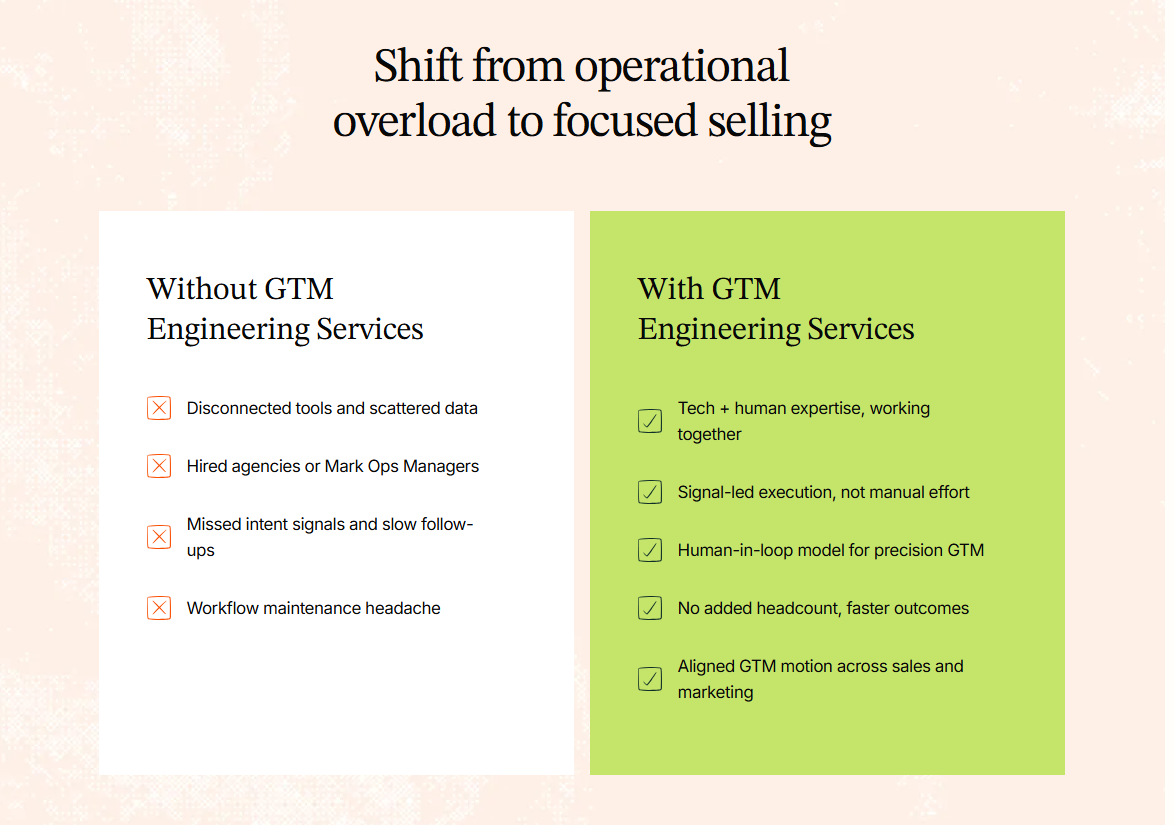
Because SDR outreach is packed with manual work, it has grown more expensive while delivering less impact. That’s why more teams are moving away from people-driven processes and turning to scalable workflows that run at the speed of data. This shift is what’s pushing GTM Engineering into the spotlight as a core revenue function, rather than just a support arm.
The Shift: From Manual SDR Outreach to AI SDR Agentic Outbound
Picture this: A prospect visits your pricing page at 11.47 pm. No one from your team is online, but your AI SDR notices the signal and gets moving. It picks the right message based on who the visitor is, launches a short sequence, logs every step in the CRM, and keeps following up until the thread reaches a natural close. No one had to press a button or upload a list. Neither did the system wait for instructions. It just acted.
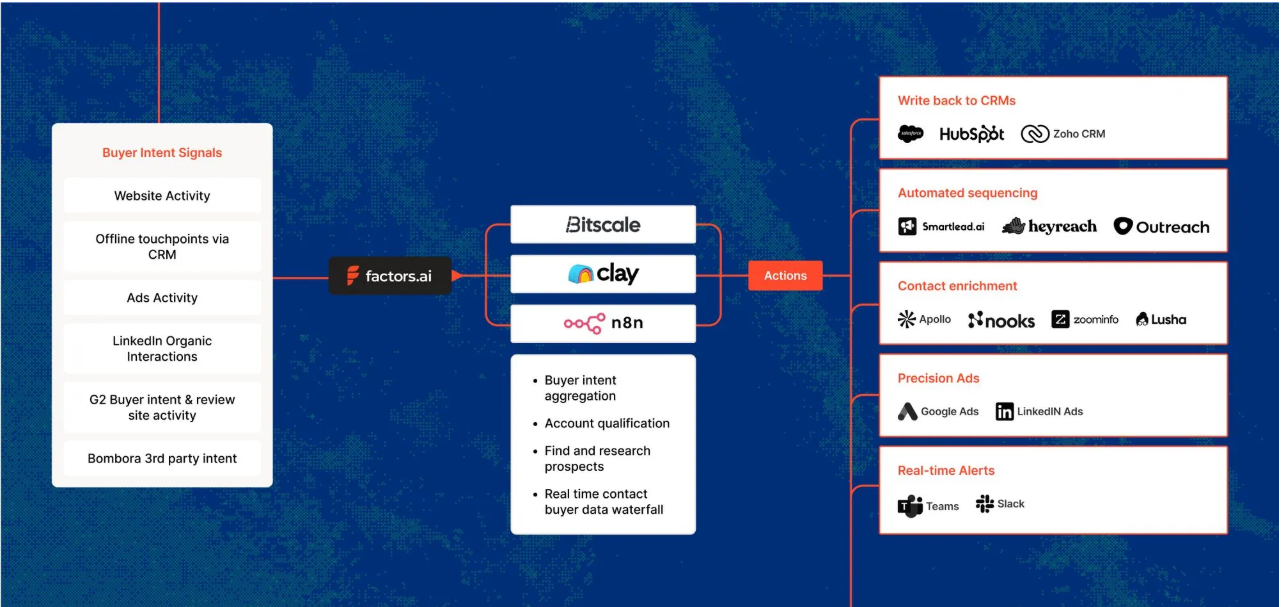
This is called “agentic” outbound, a system that doesn’t wait for inputs. It notices what’s happening, decides what to do next, and takes action in real time.
The upside to this approach is huge:
- You reach prospects faster because nothing sits in the queue.
- You get consistently high accuracy because machines don’t get tired or cut corners.
- It runs around the clock, so timing never gets in the way.
- It stays compliant because the logic is inbuilt into the workflow, instead of depending on your sales team to remember the rules.
Related read: Website visitors to warm outbound play using GTM engineering.
Why Manual SDR Outbound Is Breaking (Data + Behavior Trends)
Look around, and you’ll notice outbound doesn’t work the way it used to. Most buyers ignore cold emails until after they’ve done their own research, which means your message often hits them at the wrong moment. AI filters also make things tougher (like screening and deprioritizing cold emails). Low-quality messages are flagged or auto-deleted before an SDR has a chance.
Then there’s the human side. SDR turnover lies anywhere between 39 to 60 percent, depending on the report you read. Ramp times are long, and quotas keep rising. The actual job of prospecting has slowly turned into admin work and copy-paste tasks across five different tools. SDRs spend more time updating fields than writing meaningful messages. At the same time, outbound volume keeps climbing while results keep sliding. It’s a treadmill that gets faster every year, but the output stays flat. That’s why teams are rethinking the fundamentals of how outbound campaigns should work.
{{INLINE_TOFU}}
The New Standard: Signal-Based Outbound Workflows
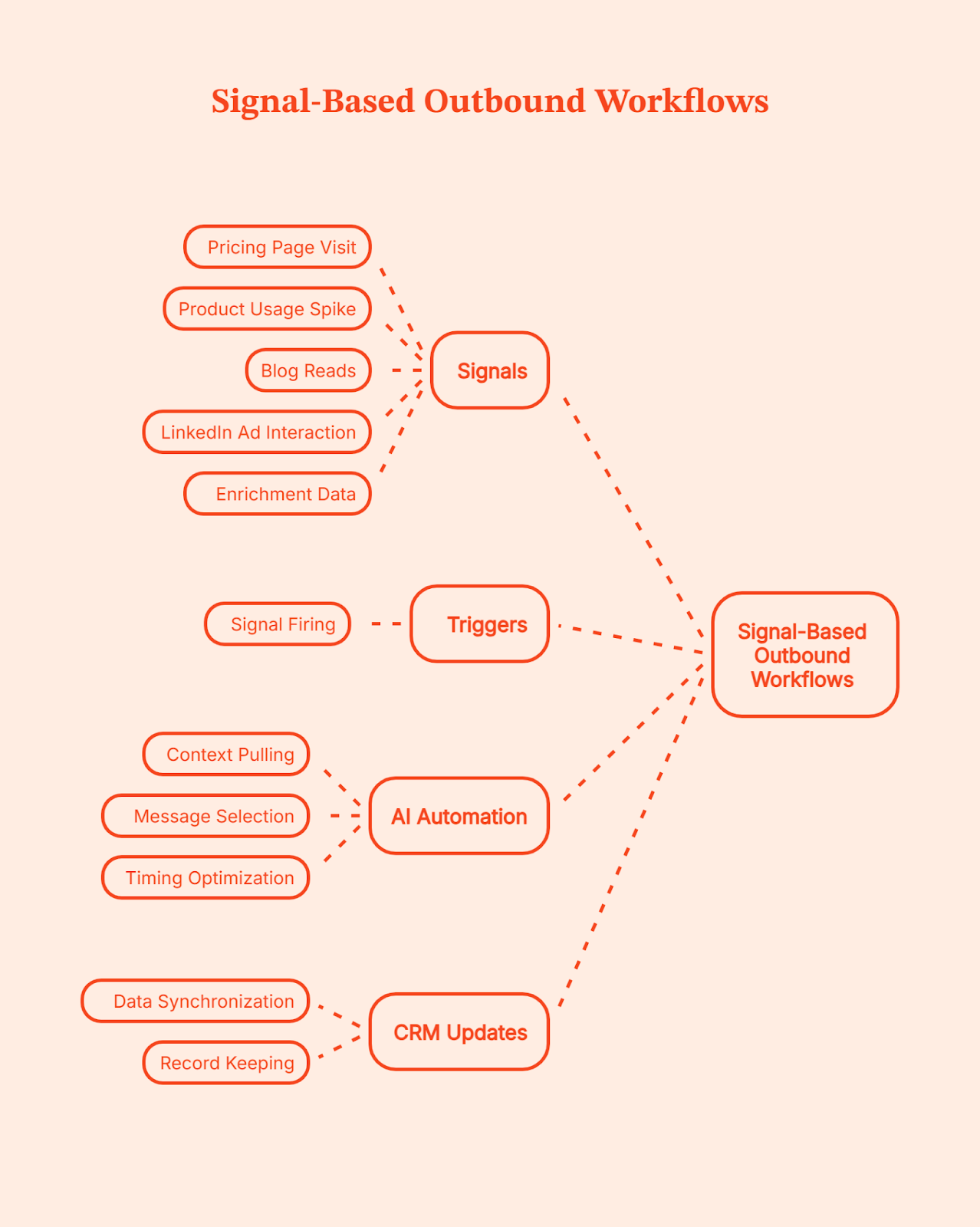
Signal-based outbound is simple. Instead of blasting a long list, you wait for signs that a prospect is actually interested. These signs show up everywhere. A visit to your pricing page. A spike in product usage. A string of blog reads. A LinkedIn Ad interaction. Even fresh enrichment data in the CRM. Each one hints that an account is warming up.
When a signal fires, it triggers an outbound motion. The AI pulls context, picks the right message, sends it at the right moment, and updates the CRM on its own. No guesswork. No heavy research. No long queues. It’s outbound-driven by real behavior rather than cold lists.
Drivetrain’s journey captures this shift perfectly. Before Factors, their team spent hours doing Tier 1 and Tier 2 research just to figure out who to contact. They were casting a wide net and hoping the right accounts would surface. But without visibility into intent signals, many high-potential accounts slipped by unnoticed.
Once they adopted a signal-based workflow, everything changed. Factors pulled signals from their website, G2, LinkedIn, and CRM data. When a company showed meaningful intent, the workflow kicked in instantly. SDRs didn’t need to dig through spreadsheets or click into endless profiles. They got real-time alerts, clear prioritization, and context-rich insights. Outreach became sharper, faster, and far more relevant.
The result: Just in a few months, Drivetrain saw a 6% drop in CAC, 3x-ed its sales outreach engagement, and saved 60+ hours/week for its sales team.
💡Want to know more about B2B intent signals and their importance? Here’s a quick guide: An Introduction To B2B Intent Signals
How AI Helps Scale Personalized Outbound
AI has changed what personalization actually means. It no longer stops at first names or simple ‘mail merge’ fields. Today’s systems can create hyper-specific messages that feel like they were written after a full research session. AI can pull a quote from a blog the prospect read, mention a buying committee member who viewed a key page, reference a spike in product usage, or weave in insights from LinkedIn activity. It connects signals across your website, CRM, and social data to understand what the account cares about right now.
Instead of surface-level personalization, the AI stitches context into a short narrative around the prospect’s journey and uses it to write messages that feel relevant instead of generic. You keep the human tone, but the system does the heavy lifting, so every message lands with the right context. That’s how you get automated personalized messages at scale.
The GTM Engineering Stack: What You Need to Replace SDR Ops
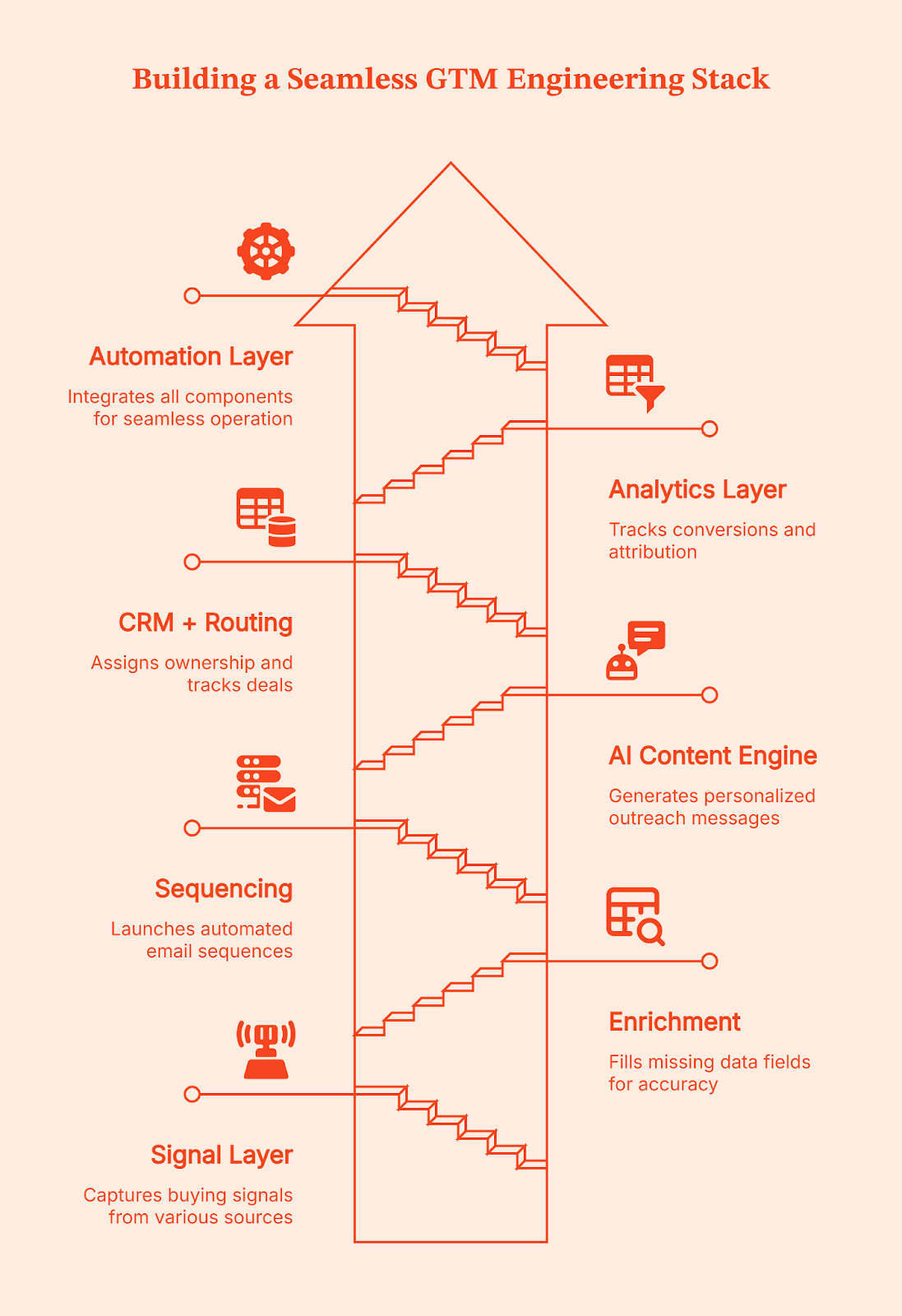
A solid GTM Engineering setup helps you avoid tool fatigue. If you’ve ever juggled ten tabs while building a sequence, you know the pain. The whole point here is to build a simple system where every part talks to the next:
- Signal Layer: Factors (This is where buying intent shows up)
This is where everything starts. Factors.ai captures buying signal across your website, product, content, G2, LinkedIn, and CRM. This way, you know exactly who is showing intent and what triggered it. Every downstream action depends on this layer being accurate and timely.
- Enrichment: Clearbit or Apollo (This is where signals are turned into usable records)
A signal alone isn’t enough. You still need clean, usable data to act on it. Enrichment tools fill in missing details like job title, role, company size, and firmographics. They also keep records fresh over time. This prevents workflows from breaking and keeps sales from wasting time on half-complete or outdated leads.
- Sequencing: Outreach, Instantly, or Apollo (This is where outreach is executed)
This is the execution layer. Once a signal is confirmed and enriched, sequencing tools handle the actual outreach. They send emails, manage follow-ups, track replies, and pause or stop when someone responds. These tools don’t decide who to contact or why. They simply execute the sequence they’re given, quickly and consistently.
- AI Content Engine: LLM-powered messaging (This is where messages are personalized at scale)
This layer handles personalization at scale. Instead of sales reps copying templates and tweaking lines by hand, the system generates messages using the signal, CRM context, and account details. The goal is to send the right message, to the right account, at the right moment, without manual effort.
- CRM + Routing: HubSpot or Salesforce (This keeps ownership and flow clean)
The CRM is the system of record. It assigns ownership, logs activity, tracks deals, and keeps everyone aligned. Routing rules make sure leads go to the right sales rep automatically, without manual handoffs. The goal is that nothing should get lost and everything is routed to the right person.
- Analytics Layer: Attribution + Conversion Tracking (This is where you get to know what’s working)
This layer tells you what actually works. It shows which signals turned into demos, which workflows created pipeline, and which actions didn’t move the needle. Without this visibility, teams just scale their activities instead of outcomes. With it, decisions get sharper over time.
- Automation Layer: Factors Workflows + Agentic Outbound (This is where system reacts without intervention)
This ties the entire system together. When a signal appears, workflows kick off enrichment, sequencing, routing, and follow-ups automatically. Agentic outbound takes the next step without waiting for someone to notice or click a button. The system reacts in real time, instead of someone stepping up to do the job.
Think of this GTM engineering stack as a clean relay. Each layer passes the baton to the next without slowing down. Signals guide the timing, enrichment fills the gaps, sequencing sends the message, and the AI engine shapes the context.
Where Factors.ai Fits In: Signals, Automation, and Unified GTM Ops
Have you ever run into musicians playing on the street? A guitarist in one corner, a singer a few steps ahead, a flutist around the bend. Each sounds good on their own, but the magic only happens when they play in sync.
That’s how most GTM teams operate today. Signals live in different places across the website, product, CRM, LinkedIn, and ads. Useful on their own, but disconnected.
Factors.ai works as the orchestra conductor here. It brings every buying signal into one coordinated view so you can see which accounts are active, what they are looking at, and how close they might be to buying. With LinkedIn conversions data flowing in, the picture gets sharper and clearer.
This is where Factors’ GTM Engineering Services kick in. The service team takes these unified signals and designs the workflows around them. They decide when outreach should trigger, what context should be pulled in, how routing should work, and which actions should happen next.
Once those workflows are set up and signals show up, Factors.ai takes the step for you. They trigger real actions across your existing stack. An email can start, a rep can be notified on Slack, an update can be pushed into the CRM, or a LinkedIn touchpoint can fire. SDRs don’t have to hunt for context or jump between tools because Company Intelligence gives them a clean, account-level view they can act on immediately.
The real win is how everything starts to connect. Marketing gets a clearer picture of what’s working, sales can spot the people who are leaning in, and RevOps finally sees the system moving the way it should. When this kind of clarity clicks, teams rely less on large SDR crews and more on workflows that run reliably in the background. Factors turns a scattered GTM motion into one steady, unified system built through engineering without adding headcount.
Real-World Results from Signal-Driven GTM with Factors
All this is good. But, unless you see the practical implementation of GTM Engineering, should you even bother? That’s what Fyle felt too until they tried it on their own setup.
Here’s what prompted them to try Factors: Their marketing team ran a warm outbound campaign, but most visitors left before booking a demo, and manual research slowed everything down. But once they plugged Factors into their workflow, things changed fast. They saw:
- 75 percent of demo requests coming from Factors-sourced signals
- 20 percent conversion from demo drop-off alerts
- Email response rates rising from under 5 percent to 20–30 percent
It felt like they suddenly had a bigger SDR team without hiring anyone new.
Squadcast had a similar experience. They were getting good website traffic but not enough insight into who was actually interested. After switching to intent signals from Factors, their SDRs said sales calls felt smoother because they met prospects at their journey points. The company reported:
- 30 percent increase in average deal size
- 25 percent decrease in prospecting time
- Noticeably less resistance in sales conversations
Using intent signals from Factors, SDRs can step right into the buyer’s discovery moment, which makes each call feel more useful and less like a cold pitch. The outcome was SDRs making better use of their time.
That’s the pattern you see across teams using GTM automation well.
The system handles detection, enrichment, prioritization, and timing. SDRs handle conversations, nuance, and closing. So, it really isn’t automation versus people, it’s opting for automation so people can do the work that actually matters.
How to Transition From SDR Teams to a GTM Engineering Model
Shifting from a manual SDR-heavy setup to a GTM Engineering model doesn’t have to be disruptive. Listed below is a simple, step-by-step path that helps smoothen your transition.
Step 1: Map your buying signals
List out every action that shows interest, such as website visits, product usage spikes, LinkedIn activity, ad engagement, and CRM updates.
Step 2: Build a unified account graph
Combine those signals into a single view so you can see which accounts are warming up and how they’re moving through the journey.
Step 3: Set up agentic workflows
Let workflows react to signals automatically. If an account hits a key page, the system should decide the next step and take action.
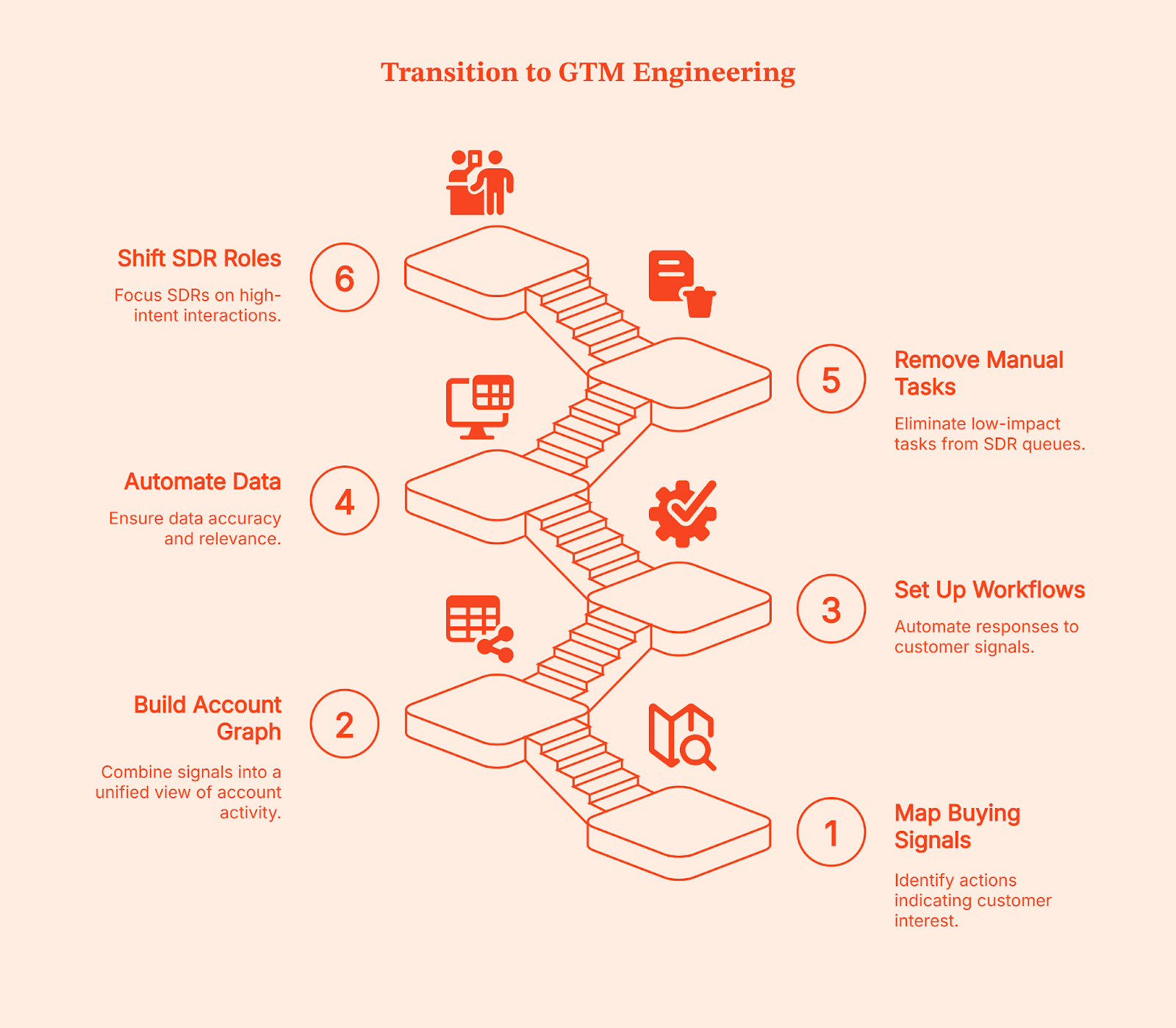
Step 4: Automate enrichment and classification
Keep account data clean by automating enrichment, tagging, and ICP checks. It removes the guesswork for reps.
Step 5: Remove manual tasks from SDR queues
Move research, list-building, and administrative work into automated workflows. This frees the team from low-impact tasks.
Step 6: Shift SDRs to high-intent roles
Let reps focus only on demos, qualification, and real conversations with accounts showing clear intent. The system handles the rest.
💡Related read: How to effectively target B2B prospects on LinkedIn based on their job title
Common Mistakes When Implementing AI Outbound
Even if you follow every step perfectly, most teams run into the same problems when they first adopt AI for outbound. The good news is they’re easy to avoid.
- Over-automating without signal logic: Automation alone doesn’t work. You need signals (remember the traffic signal?) that tell the system when to act.
- Buying AI tools without a unified GTM layer: If your tools don’t talk to each other, the workflow breaks and outreach becomes inconsistent.
- Creating robotic outbound: AI should stitch context, not send generic templates. Relevance matters more than volume.
- Not measuring incremental pipeline: Track how much pipeline comes from signals, not just activity metrics.
- Keeping legacy SDR KPIs: If you’re still measuring dials and email volume, you’ll push your reps toward the wrong behavior in an AI-driven model.
The Future of GTM Teams: Small SDR Pods, Big Automation Engines
It’s not hard to see how outbound is changing. GTM teams of the future won’t be built around large SDR floors. Instead, they’ll run on small SDR pods supported by a strong layer of GTM engineers, RevOps specialists, and always-on AI workflows.
Related read: GTM Engineering vs RevOps
Most of the heavy lifting, like research, prioritization, message generation, and first-touch outreach, will run in the background while your team focuses on relevant conversations. It’s not unrealistic to expect that nearly 70% of outbound will run without human intervention.
SDRs won’t be judged on dials or volume anymore. They’ll act as conversation specialists who jump in when an account is already warmed up. Their job becomes simpler and more meaningful because the system handles the noise. And at the center of that system sits signal intelligence. Factors.ai already plays this role today, and it’s quietly shaping how GTM teams evolve behind the scenes.
What This Means for Modern GTM Teams
Speed is now your competitive advantage.
For most B2B teams, outbound stopped working because systems became slower than buyers. By the time a sales rep researches an account, enriches data, and queues a sequence, the buying moment has often passed.
GTM Engineering helps to remove that delay. Signals are captured as they happen, workflows decide the next step, and outreach launches while intent is still fresh. SDRs enter only when the account is already leaning in, not when interest has to be manufactured.
This is why teams adopting GTM Engineering don’t scale by adding more SDRs. They scale by reducing reaction time. The system handles detection, prioritization, and first touch. People handle conversations and judgment.
It’s simple: The gap between buyer intent and seller action is where deals are won or lost. Teams that engineer their GTM shrink that gap. Teams that don’t keep hiring to chase it.
FAQs on GTM Engineering is Replacing SDR Teams
Q. Is GTM Engineering replacing SDR teams?
Not entirely. It’s replacing the manual, repetitive parts of SDR work so reps can focus on qualified conversations instead of admin and cold lists.
Q. What is AI SDR agentic outbound?
It’s outbound that acts on its own. The system notices a buying signal, picks the right message, runs the sequence, and updates the CRM without waiting for human input.
Q. Does AI outbound convert as well as humans?
Yes, as long as it runs on real intent signals. When outreach lands at the right moment with the right context, it often converts better because it’s consistent and instant.
Q. What tools do I need for signal-based outbound?
You need a signal layer, enrichment, sequencing, an AI messaging engine, a CRM, analytics, and an automation layer. Together, they form a simple, connected outbound system.
Q. How do SDRs and AI workflows coexist?
AI handles the busywork. SDRs jump in when an account is warm and ready to talk. It turns them into conversation specialists instead of task managers.
Q. What role does Factors.ai play in GTM engineering?
Factors.ai sits at the center. It captures signals, unifies account activity, and triggers workflows so outbound happens at the right time with the right context.
Q. Can automation replace human personalization?
It can replace the research and context-gathering, but humans still add tone, nuance, and relationship-building. Both work best together.
Q. What should I automate first in outbound?
Start with the repetitive stuff: signal alerts, enrichment, list building, and first-touch outreach. These give you the biggest lift with the least disruption.

See how Factors can 2x your ROI
Boost your LinkedIn ROI in no time using data-driven insights


.avif)
.avif)
See Factors in action.
Schedule a personalized demo or sign up to get started for free
LinkedIn Marketing Partner
GDPR & SOC2 Type II







.svg)



.avif)

