
10 Best Visitor Queue Alternatives For B2B Teams
Visitor Queue was acquired in January 2026. Here are 10 better alternatives, including Factors.ai, Leadfeeder, Lead Forensics, compared on features, pricing, compliance, and support.
.avif)
Content Marketer



.svg)


TL;DR
- Visitor Queue was acquired by Leadinfo in January 2026 and is no longer sold as a standalone product. If you are on it, it is time to evaluate other options.
- Company-level IP identification tells you which business visited, not which person. Some tools add decision-maker contact data for the company, but those contacts are not necessarily the person who visited.
- Factors.ai is the strongest overall alternative. It pairs company identification (up to 75% of company visits, depending on traffic) with person-level deanonymization (via RB2B) for US traffic,
- Factors.ai, with RB2B integration, now supports US-based B2B person-level deanonymization, surfacing name, title, work email, LinkedIn URL, and firmographics on previously anonymous visitors.
- What you pay for identification alone is rarely the full cost. Factor in what you'll spend to enrich, activate, and report on that data separately.
Before we get into the alternatives, let's talk about the problem most sales teams have suffered through at least once… they pull up last week's website report, and there are EIGHT-HUNDRED company visits. Sounds a-mazing!.
Then begins the archaeological expedition 🔍
Three hours on LinkedIn… twenty tabs open. Somebody muttering "I'm pretty sure this VP of Revenue visited the pricing page." You eventually come away with a few names, two replies, and everyone calls it a ✨productive✨afternoon.
And, to be fair, that's roughly the problem Visitor Queue was built to solve. Company-level identification, a clean UI, sensible pricing. For teams asking "Who's visiting our website?" for the first time, it did the job.
Then January 2026 happened.
Visitor Queue was acquired by Leadinfo. The old product is gone, the domain redirects, customers are being migrated, and new buyers are effectively shopping under a different banner.
Which… isn't the worst thing in the world.
Because most teams outgrow IP-based identification wayyy faster than they expect. Knowing that someone from Acme visited your site is mildly interesting… but knowing who showed up, what they cared about, and how to act before they book a demo with your competitor? That's where things get fun.
So, if you're evaluating Visitor Queue, or suddenly found yourself back in buying mode, this guide covers the 10 best Visitor Queue alternatives for 2026.
We'll start with Factors.ai (because I may be a little biased). And ALSO because I think it's the strongest option if you want the full picture.
What Visitor Queue did and where it ran out of runway
Visitor Queue identified companies visiting your website by matching IP addresses to a database of 220M+ company profiles. You'd install a JavaScript pixel, and within minutes, your dashboard would show company names, industries, employee counts, page views, and time on site.
It was genuinely useful for teams that previously had zero visibility into anonymous traffic. The interface was clean, the setup took under 30 minutes, and pricing started at $31/month, which made it easy to justify to budget-conscious stakeholders.
Here's where the friction started, though.
- It stayed at the company level. You knew Acme Corp visited your pricing page three times this week. You didn't know which of their 300 employees did it, what role they held, or whether they were the actual decision-maker. G2 reviewers consistently flagged this: one noted that Visitor Queue would surface 15 different contact emails for a single company, leaving SDRs to guess who the actual visitor was. That's not a lead. That's a research project.
- Bot traffic consumed paid credits. Multiple Capterra reviewers flagged this specifically: if your plan covered 700 unique companies but bot traffic ate through 700 visits, you'd see zero real prospects. You were paying for noise.
- No intent context. Knowing someone visited doesn't tell you why. Visitor Queue didn't layer in third-party intent signals, CRM engagement history, or ad interaction data. You got a list, not a signal.
- No activation path. The workflow ended at "here's who came by." Getting that data into CRM workflows, ad audiences, or SDR sequences required connecting separate tools, none of which were native.
Those aren't small gaps for teams trying to build pipeline in 2026. They're the whole point.
Top Visitor Queue alternatives and competitors in 2026
To make your evaluation easier, here is how the top visitor identification and account intelligence platforms better than Visitor Queue, stack up side-by-side:
How to pick a Visitor Queue alternative: What actually matters
Before comparing tools, it helps to be clear on which problem you're actually solving. Most visitor identification platforms compete on the same surface-level claims, so the differentiation lives in the details.
Keep this table open when you read the alternatives below. The right tool is the one that solves your specific gap without adding three more tools to compensate.
10 best Visitor Queue alternatives for B2B teams in 2026
1. Factors.ai: Best for full-funnel B2B GTM teams
If Visitor Queue was showing you that a company visited, Factors.ai shows you who visited, what they engaged with across your entire GTM motion, and what to do about it right now.
It's a meaningful upgrade in scope, and that's precisely why it leads this list.
What makes Factors.ai different
Factors isn't just a visitor identification tool that happens to have some extras bolted on. It's a full-stack ABM and account intelligence platform where visitor identification is the starting layer.
Waterfall enrichment across multiple data providers. Factors.ai uses a waterfall enrichment model across 4-5 data providers to identify up to 75% of companies visiting your website, depending on your traffic mix. It's the foundation everything else is built on.
Person-level deanonymization via RB2B. This is new, and it changes what "visitor identification" means. Factors now integrates with RB2B to deanonymize US-based B2B visitors at the individual level. For every identified person, you get first name, last name, job title, LinkedIn URL, work email, company name, industry, employee count, and revenue range. That payload goes directly into Slack alerts, so an SDR gets notified the moment a target-account decision-maker hits the pricing page, with LinkedIn URL and work email already in the message. Marketing can build segments of ICP-fit visitors by title or function and activate them immediately via ads or sequences. RevOps can slice attribution reports by enriched person-level attributes, not just anonymous account traffic.
All enriched fields carry the RB2B prefix in Factors and are available across Account Timeline, Segments, Reports, Real-time Alerts, and Agents. You toggle it on in Settings, and person-level identity starts flowing.
Multi-source intent signals. Factors combines first-party signals (website behavior, product activity, form interactions), second-party signals (LinkedIn Ads, paid search, CRM engagement, G2 Buyer Intent), and third-party signals (Bombora company-level intent) into a single account view. That's a faaaar more complete picture than IP identification alone.
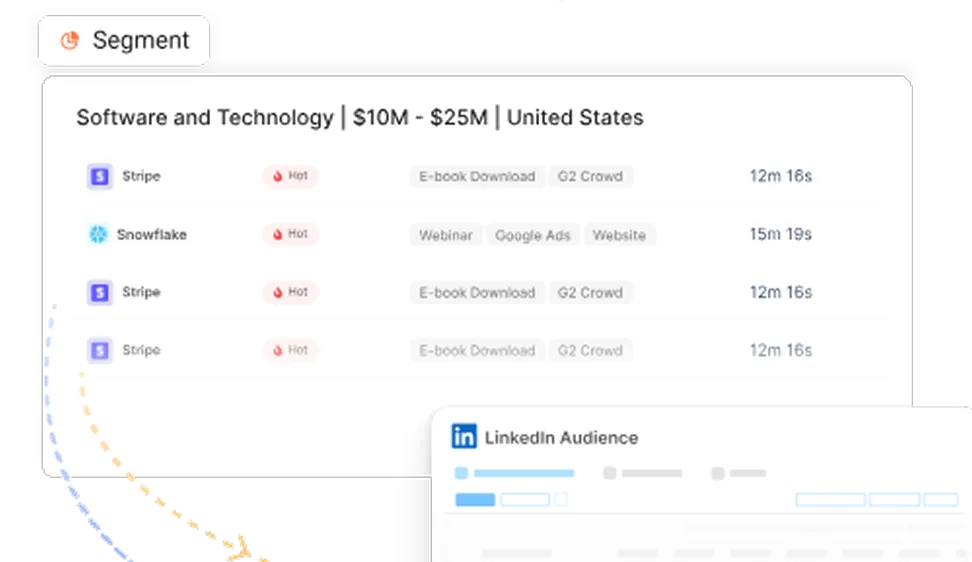
LinkedIn and Google AdPilot. High-intent accounts identified by Factors can be pushed directly into LinkedIn and Google Ads audiences, automatically, daily, without manual uploads. AdPilot controls impression frequency, suppresses low-fit accounts, and feeds conversion signals back to ad platforms via CAPI, so LinkedIn optimizes toward accounts that actually close, not just form fills.
Multi-touch attribution. Factors tracks every account touchpoint from first visit to closed-won revenue, across web, ads, CRM, and product. You can see which channels influenced pipeline and which campaigns drove actual deals, not just clicks.
AI Scout agents. Scout handles account research, buying-group mapping, closed-lost reactivation, and post-meeting tracking. It can surface anomalies in your pipeline, answer natural language queries about campaign performance, and send real-time Slack or Teams alerts when high-intent behavior spikes.
What Factors.ai users say
"We were able to identify and close a $45k deal in just 15 days. This was a big win we would've missed if it weren't for Factors."
- Saurabh Wahegaonkar, AudienceView (G2)
"With Factors.ai, we're no longer in the dark. Data consolidation is magic, no more juggling platforms. Our ABM campaigns and outreach got a big boost. It's our single source of truth."
- Anirudhh Sridharan, Pipeline Marketing Lead, Everstage (G2)
"Factors has given us the clarity we always needed with LinkedIn Ads. We can see how campaigns influence every stage of the buyer journey."
- Arun Pattabhiraman, CMO, Sprinklr (G2, 4.5 stars)
Factors.ai pricing
Factors uses a usage-and-seat-based model that scales with how much of your GTM motion you want connected.
Optional GTM Engineering Services handles RevOps workflow design, ICP modeling, enrichment automation, and SDR enablement for teams without in-house bandwidth.
Factors.ai compliance
SOC 2 Type II and ISO 27001 certified (via GCP infrastructure), GDPR compliant, AES-256 encryption at rest, TLS in transit, dedicated Data Protection Officer, formal incident response plan. Suitable for enterprise procurement requirements and regulated industries.
Support
White-glove onboarding, dedicated Slack channel, dedicated CSM on Growth and Enterprise plans, weekly review calls, and optional GTM Engineering Services. This isn't a "read the docs and figure it out" setup.
G2 rating: 4.5/5 (75% of them gave us a 5-star rating. See for yourself)
Best for: Growth-stage to enterprise B2B SaaS teams running ABM campaigns across LinkedIn and Google, teams that need multi-touch attribution, and RevOps functions that want a single source of truth across web, CRM, ads, and pipeline.
2. Leadfeeder by Dealfront: For GDPR-first European teams
Leadfeeder, now part of the Dealfront platform, is probably the most established name in B2B visitor identification and a natural first stop when evaluating Visitor Queue replacements.
The platform identifies companies visiting your website, enriches them with firmographic data, and pushes that context into your CRM for sales follow-up. Its strongest differentiator is its GDPR-native European data infrastructure, it's purpose-built for teams that need full legal compliance for EU traffic, which is why it remains the default choice for European B2B companies.
Dealfront, as a combined entity (Echobot + Leadfeeder), also gives you access to 60M+ company profiles and 400M+ contacts with 40+ real-time buying intent signals, strong native CRM integrations, and LinkedIn ad audience matching at 90%+ accuracy.
The limitations: company-level identification only. No person-level data. No native ad activation layer comparable to AdPilot. Analytics are solid for pipeline attribution, but don't extend to full multi-touch revenue tracking across channels. If you are looking for alternatives, read our Leadfeeder alternatives blog to know which tool best fits your stack.
Pricing: Free Lite plan (7-day history, 100 companies). Paid plans start at $99/month (billed annually) for 50 identified companies and scale by volume. Enterprise pricing by contact.
G2 rating: 4.3/5 across 730+ reviews.
Best for: B2B teams in Europe or selling into European markets that need GDPR compliance as a non-negotiable, with solid CRM workflow integration.
3. Lead Forensics: best for company-level identification with built-in contact data
Lead Forensics is one of the longest-established names in B2B website visitor identification. It says it owns and maintains its B2B IP database, and it is built around visitor identification as a core sales workflow rather than as one module inside a wider platform.
It identifies the companies visiting your site and can provide contact details for relevant decision-makers at those companies, including job titles, emails, direct dials and LinkedIn profiles. These contacts are not necessarily the people who visited your site. That suits outbound-focused sales teams that want contact data in the same tool, without a separate enrichment step. Lead Forensics also includes real-time alerts, lead scoring, a built-in lead manager and CRM integrations.
Things to keep in mind: Lead Forensics identifies companies, not individual visitors. Its pricing is quote-based and depends on your website traffic, so you will need a demo and free trial to get a figure. Lead Forensics states that it does not provide native multi-touch attribution.
Pricing: Quote-based, calculated from your website traffic. Lead Forensics lists two plans, Essentials and Automate, with unlimited users and a one-week free trial. Confirm current packaging and contact-data inclusions with Lead Forensics.
Best for: B2B sales and marketing teams that want company-level visitor identification, decision-maker contact data and lead management in one tool.
Also, read Lead Forensics alternatives and competitors.
4. RB2B: Best for US person-level identification on a budget
RB2B does exactly one thing, and it does it well: it tells you which individual is on your website, not just which company, for US-based visitors.
Instead of a company name, you get the person's name, LinkedIn profile URL, job title, and company. Those get delivered as real-time Slack alerts, which means SDRs can reach out within minutes of a high-intent visit, while the prospect is still warm. (Factors.ai actually uses RB2B as an enrichment layer within its platform, so if you want this capability embedded in a broader GTM system, you don't need RB2B as a standalone tool.)
The limitations are real. RB2B only works for US traffic. It has no built-in outreach tools, no ad activation, no attribution, and limited integrations beyond Slack, HubSpot, and Salesforce via Zapier. It's a signal source, not a platform.
Pricing: Free tier (150 identifications/month). Pro plan starts at $79/month for 300 monthly resolutions. Annual pricing available.
G2 rating: ~4.5/5 across early reviews.
Best for: US-focused outbound sales teams that want to go straight from "someone's on the site" to "a named person with a LinkedIn URL" without a complex setup.
Check out RB2B alternatives in 2026.
5. Albacross: best for ABM-focused European teams
Albacross is a Swedish platform that sits at the intersection of visitor identification and account-based marketing, with a particular strength in European B2B data. It's a genuine step up from pure IP identification tools, offering intent scoring, behavioral data, and the ability to target identified accounts with display advertising through its native ABM module.
The platform is GDPR-compliant by design and integrates with HubSpot, Salesforce, Pipedrive, Marketo, and Zapier. AI-powered buyer persona recommendations are a useful differentiator for marketing teams that want account prioritization without building custom scoring models from scratch.
Pricing is less transparent than Albacross's European peers: the self-service plan runs around €79/month for up to 100 identified companies, with the Growth tier requiring a custom quote. G2 reviewers consistently flag that Salesforce integration requires going through Zapier rather than a native connector, which adds friction for enterprise sales teams.
If you are currently using Albacross and are looking to evaluate other platforms, you might want to read our blog on Albacross alternatives in 2026.
Pricing: Self-service at €79/month (100 companies). Growth plan: custom pricing, unlimited companies.
Best for: European ABM-focused marketing teams that want company-level identification paired with intent scoring and light display advertising capabilities.
6. Snitcher: For SMBs that want simplicity and fair pricing
Snitcher is the rare tool that earns an unusually high G2 score (4.8/5 across 160+ reviews) for a relatively simple product. It identifies companies visiting your website, layers that data directly into Google Analytics 4 via its native Spotter API integration (a genuinely unique capability in this category), and surfaces contact details for outreach.
All plans include the full feature set. No premium-gating behind higher tiers. No native integrations locked to enterprise plans. HubSpot, Salesforce, Pipedrive, Slack, and Zapier all come standard.
Its scope is intentionally narrow. There's no person-level identification, no ad activation, and no multi-touch attribution. It's a company-level identification tool that does its job cleanly, costs fairly, and doesn't make you read three pages of documentation to figure out what you're actually buying.
Notably, Factors.ai uses Snitcher as one of its waterfall enrichment sources, so teams that start with Snitcher and later need more depth tend to graduate upward rather than switch sideways.
Pricing: Starts at $49/month for 50 identified companies. Scales to $279/month for 2,000 companies. 14-day free trial available.
G2 rating: 4.8/5 across 160+ reviews.
Best for: Budget-conscious SMB and mid-market B2B teams that want clean company identification with GA4 integration and zero configuration complexity.
7. Warmly: best for real-time on-site engagement
Warmly takes a different angle than most tools on this list: rather than handing you a list of companies to research later, it engages those visitors while they're still on your site through AI chat and person-level identification.
The platform layers 20+ data providers in a waterfall to achieve around 65% company-level and 15–25% person-level identification. Its AI Chat (Inbound Agent) qualifies visitors, answers questions, and books meetings automatically. A TAM Agent handles audience building, buying committee identification, and intent scoring for outbound.
The trade-off is cost. Warmly's pricing starts at $16,000/year for its entry-level Nurture Agent and scales to $25,000/year for the Marketing Ops Agent. That's a significant jump from Visitor Queue's $31/month starting point, and it's structured for teams with mature outbound motions rather than teams that are still figuring out their ICP.
If you feel Warmly dropping the ball, then it is time to look for other alternatives. You might want to read the Warmly.ai alternatives blog to evaluate your options.
Pricing: Annual pricing starting at $16,000/year (Nurture Agent) to $25,000/year (Marketing Ops Agent).
Best for: Sales-led mid-market teams that want to catch and convert high-intent visitors in real time, with a budget for dedicated AI engagement infrastructure.
8. Leadinfo: the platform that acquired Visitor Queue
Since Visitor Queue's January 2026 acquisition, Leadinfo is now technically the direct successor. Existing Visitor Queue customers are being migrated here, so if you were already in the ecosystem, this is your immediate path forward.
Leadinfo has more going for it than just "it absorbed the product you had." It offers 70+ integrations (compared to Visitor Queue's more limited set), AI bot detection, autopilot outreach campaigns, a Leadbot chat widget, and better European data coverage. For teams in the EU, the data residency and GDPR alignment is built into the foundation.
The limitations are similar to what you'd expect: company-level identification only, no person-level, and contact enrichment depth varies by geography. Pricing has shifted to euro-denominated tiers starting at €49/month for 50 identified companies.
If you were happy with Visitor Queue and don't need more depth, Leadinfo is the path of least resistance. If you were hitting Visitor Queue's ceiling, this isn't the upgrade you're looking for.
Pricing: Starts at €49/month for 50 identified companies, scaling by volume.
Best for: Existing Visitor Queue customers migrating to the successor platform, or European B2B teams wanting company identification with a broader integration set.
9. Clearbit (Breeze Intelligence): best for HubSpot-native enrichment
Clearbit was acquired by HubSpot in 2023 and rebranded as Breeze Intelligence. If you're already deep in the HubSpot ecosystem, it's the lowest-friction way to add company identification and data enrichment to your existing workflows.
Breeze Intelligence adds company data to form fills, auto-shortens forms using known contact data, and enriches CRM records with firmographic detail. It's less a standalone visitor identification tool and more an enrichment layer that happens to reveal some visitor company context.
Company-level only. No person-level identification. Credit-based pricing means costs can escalate quickly at scale. Some features are HubSpot add-ons rather than core inclusions. The rebranding also created some uncertainty around roadmap and pricing transparency that hasn't fully settled.
Pricing: Starts at $45/month (annual) for 100 credits. Scales with usage volume.
Best for: B2B teams already on HubSpot that want native enrichment without adding another tool to the stack.
10. ZoomInfo WebSights: best for teams already in the ZoomInfo ecosystem
ZoomInfo's visitor identification module, WebSights, extends its massive contact database (500M+ verified contacts, 100M+ companies) to website visitors. If your team is already using ZoomInfo for outbound prospecting, WebSights gives you a tighter loop between "who's on our site" and "who do we have data on."
The firmographic depth is strong because it's drawing from the same database your SDRs already use. But it's company-level identification, not person-level, and it functions as an add-on rather than a standalone product. The real friction is ZoomInfo's pricing model, notoriously opaque, often described by buyers as aggressive in the sales process, and expensive relative to standalone alternatives.
Reddit threads and G2 reviews both point to a consistent pattern: ZoomInfo as an organization is difficult to negotiate with, and bundling WebSights into an existing contract isn't always the deal it appears to be on the surface.
Pricing: Custom quotes. Add-on to existing ZoomInfo contracts. You can also read the ZoomInfo pricing blog to dive deeper into pricing and specifications.
Best for: Enterprises already on ZoomInfo contracts who want visitor identification folded into the existing data environment without adding a new vendor.
Also, read ZoomInfo alternatives
Head-to-head: How do the top Visitor Queue alternatives compare?
Why do teams move from Visitor Queue to Factors.ai, specifically?
Visitor Queue and Factors.ai aren't in quite the same category, and that's exactly the point. Visitor Queue answered "which company visited?" Factors answers "who visited, what are they researching, where are they in the buying journey, and what's the best next action right now?"
That shift matters most for teams that have already validated that someone is visiting their site and now need to know what to do about it. Here's where the upgrade becomes concrete.
Person-level signals, not just company data. Factors' RB2B integration surfaces name, title, work email, and LinkedIn URL on US-based B2B visitors who would otherwise be anonymous. An SDR gets a Slack alert the moment a target-account VP hits the pricing page, with their LinkedIn URL already in the payload. That's a same-day conversation, not a three-day research project.
Intent data that pre-dates the visit. Factors layers in Bombora third-party intent, G2 Buyer Intent, and CRM engagement history alongside website behavior. So when an account shows up on your site, you can see whether they've been researching your category across the web for the past two weeks, not just that they visited today.
Ads that respond to pipeline signals. LinkedIn AdPilot and Google AdPilot move identified accounts into audiences automatically, control impression frequency to prevent ad fatigue, and feed conversion outcomes back to the platform via CAPI. Your ad spend concentrates on accounts that are actually progressing, not accounts that happened to have a corporate IP address.
Attribution that survives the full funnel. Factors tracks every touchpoint from first anonymous visit through MQL, SQL, Opportunity, and Closed Won. You can tell your CFO exactly which campaigns influenced that $300K deal (not just which ones generated clicks)
What to look for in your Visitor Queue alternative: A buyer's checklist
Before you sign anything, run this checklist. It catches the gaps that vendor demos tend to skip over.
- Identification depth: Does the tool identify companies only, or individuals? Person-level data is only possible for US traffic on most platforms without GDPR complications.
- Bot filtering: Does the platform filter bot traffic before it counts against your credit or company limits? Visitor Queue users flagged this as a meaningful budget drain.
- Integration coverage: Which CRMs, ad platforms, and MAPs does it connect to natively? "Zapier-only" for a key integration is a workflow tax that compounds over time.
- Compliance posture: Do you need GDPR-native EU data processing? SOC 2 Type II certification for enterprise procurement? Know your requirements before the sales call.
- Activation capability: Can the tool do something with identified visitors, or does it just list them? Pushing accounts into ad audiences, triggering Slack alerts, or syncing to CRM sequences natively is worth far more than a longer company list.
- Pricing model risk: Per-company pricing scales against your traffic. If you're growing, run the math at 2x and 5x your current volume before committing.
- Support model: Dedicated CSM vs. email-only vs. community docs. For complex GTM setups, the implementation quality matters as much as the feature set.
- Trial quality: Does the trial give you enough volume and integration access to validate the tool with real data, or is it a limited demo environment?
FAQs for Visitor Queue alternatives
Q1. Is Visitor Queue still available?
Visitor Queue was acquired by Leadinfo in January 2026. The Visitor Queue.com domain now redirects to LeadInfo’s website. Existing customers are being migrated to Leadinfo, and new users should sign up directly with Leadinfo. Visitor Queue as a standalone product is no longer sold, and pricing has shifted to Leadinfo's euro-denominated tiers.
Q2. What's the difference between company-level and person-level visitor identification?
Company-level identification (Visitor Queue, Leadfeeder, Lead Forensics) tells you that someone from Acme Corp visited your site using IP-to-company matching. Some of these tools, such as Lead Forensics, add contact details for decision-makers at the company, but those contacts are not necessarily the person who visited. Person-level identification (RB2B, Factors.ai via RB2B integration) tells you that Jane Smith, VP of Marketing at Acme Corp, visited your pricing page. It is currently limited to US traffic.
Q3. Which Visitor Queue alternative works best for European teams?
Dealfront/Leadfeeder and Albacross are the strongest options for GDPR-compliant identification of EU traffic. Both are built on EU-native data infrastructure and process data within European regions. Leadinfo (the Visitor Queue successor) is also EU-hosted and GDPR-aligned. Factors.ai is US-hosted and GDPR compliant with supplementary EU transfer safeguards.
Q4. What does Factors.ai's RB2B integration actually do?
It deanonymizes US-based B2B website visitors at the person level, surfacing first name, last name, job title, LinkedIn URL, work email, company name, industry, employee count, and revenue range. All enriched fields are available across Account Timeline, Segments, Reports, Real-time Alerts, and Agents inside Factors. You turn it on under Settings → Integrations → Factors Visitor Identity Enrichment → RB2B.
Q5. Is Visitor Queue cheaper than its alternatives?
Visitor Queue's entry price of $31/month (now Leadinfo at €49/month) was among the most affordable in the category. Most alternatives start higher: Snitcher at $49/month, Leadfeeder at $99/month, and Factors.ai with a free tier and paid plans scaling from there. But "starting price" rarely reflects what you'll actually spend once you add enrichment, CRM sync, and activation tools that aren't native to the cheaper platforms.
Q6. Which tool is best for small B2B teams with a limited budget?
Snitcher is the strongest SMB option: clean interface, all features on all tiers, starts at $49/month, GA4 integration baked in, and a 4.8/5 G2 rating. Factors.ai's free plan (200 companies/month, 3 seats) is worth considering too, particularly if you expect your GTM motion to grow beyond basic company identification in the next 6–12 months.
Q7. Can Factors.ai replace Visitor Queue entirely?
Yes, and then some. Factors.ai identifies visitors (company-level, up to 75% of company visits depending on traffic, plus person-level for US traffic via RB2B), layers in multi-source intent signals, activates identified accounts via LinkedIn and Google Ads, and tracks attribution all the way to revenue. It's a superset of what Visitor Queue did, embedded in a full-funnel GTM platform.
Q8. Why do teams outgrow company-level identification tools?
Because knowing that a company visited doesn't close deals. The workflow breaks down at the point where you need to know who to contact, what they care about, and when to reach out. Tools that stop at the company-level leave SDRs doing manual LinkedIn research, marketers running un-segmented retargeting, and RevOps reporting on traffic instead of pipeline. The teams that graduate past this are usually the ones that realize their visitor identification tool isn't the bottleneck, their ability to act on the data is.
Q9. How do I evaluate person-level identification tools before buying?
Ask three questions on every sales call: what percentage of your traffic will be identified at the person level (not company level), how is that identification done (IP-only, deterministic matching, identity graph, probabilistic inference), and what's the geographic scope (US-only is common for person-level tools due to GDPR). Run a trial with enough traffic volume to validate the actual match rate rather than relying on vendor claims.
Q10: Is company-level visitor data actually enough to book meetings?
Honestly? Rarely on its own. Knowing "Acme Corp visited your pricing page" just creates a massive research project for your SDRs. They end up wasting hours guessing which VP did it and cold emailing 15 different people. To actually book meetings efficiently, you either need a tool that handles person-level tracking (like Factors.ai via RB2B) or a separate database tool to manually enrich that company list.
Q11. Do person-level tracking tools like RB2B violate GDPR regulations?
Yes, which is exactly why they are strictly gated to US-based traffic. GDPR has incredibly strict rules regarding tracking individual PII (Personally Identifiable Information) without explicit consent. If you have heavy European traffic, you'll want to stick to company-level tracking tools. You can simply turn off the RB2B enrichment and still use Factors.ai for account-level information. And FYI, Factors.ai is GDPR compliant.

See how Factors can 2x your ROI
Boost your LinkedIn ROI in no time using data-driven insights


.avif)


See Factors in action.
Schedule a personalized demo or sign up to get started for free
LinkedIn Marketing Partner
GDPR & SOC2 Type II






.svg)



.avif)

