
Account-Based Marketing Attribution: How to Actually Know What’s Working
Learn what ABM attribution is, why it matters, the real challenges, and how to implement it. Know how Factors.ai helps B2B teams close the attribution gap.

Growth Marketer

Chief Marketing Officer



.svg)


TL;DR
- ABM attribution connects all touchpoints across an account so you can see what actually influenced the pipeline and revenue.
- The biggest blockers are messy data, invisible offline touches, and disconnected tools.
- A strong setup requires sales and marketing alignment, clean account-level tracking, the right model, and ongoing iteration.
- Factors.ai closes the attribution gap with account identification, multi-touch tracking, offline visibility, and clear revenue reporting.
If you’ve ever run an ABM campaign and thought, “Okay… but which part of this beautiful Franken-strategy actually moved the needle?” Welcome to the club.
ABM sometimes feels like assembling a carefully crafted monster in the lab. Stitching together channels, touchpoints, and personalized plays, hoping the whole thing comes to life exactly the way you imagined. You flip the switches, monitor every spark… and then wait to see which part actually moved the account. (Happens more often than we admit.)
So today, we’re unpacking ABM attribution, the part everyone talks about but secretly hopes someone else will figure out.
Let’s talk about it, candidly, casually, and with just enough humor to make ABM data feel slightly less intimidating (because let’s be honest, attribution could use a little personality).
Before we dive in, let’s ground ourselves with the basics.
What is ABM (Account-Based Marketing)?
Think of Account-Based Marketing like booking VIP meetings instead of handing out flyers in a crowded street. You’re not trying to reach everyone, but you’re focusing on the accounts that actually matter.
- You zero in on high-value companies.
- You customize every touch so it feels intentional.
- You loop sales in from the very beginning.
- And you measure progress by how deeply the account engages and not by how many random leads fill out a form.
If you’re exploring the tech side of ABM, here’s a quick breakdown of the top ABM tools teams use to run and scale these programs effectively.
And what is attribution?
That’s simply the art of figuring out which marketing activities influenced a conversion, opportunity, or deal.
Combine the two, and you get ABM attribution.
ABM attribution is nothing but connecting all the dots across an entire account to understand what sparked interest, what nurtured it, and what ultimately nudged it into revenue territory.
This shift from volume metrics to account-level impact is exactly what separates ABM from traditional demand generation. This is something we’ve unpacked in detail in our ABM vs Demand Generation article.
Great. Now let’s dig deeper.
What ABM attribution actually is (Explained without jargons)
Accounts aren’t single people. They’re messy, cross-functional buying committees with different motives and attention spans. You might have:
- A VP skimming your ROI guide
- A senior manager lurking on your product pages at 2 a.m.
- A champion forwarding your case study internally
- A procurement person reading the fine print
- A C-level exec who finally joins the demo
And all of them contribute to the deal.
ABM attribution is the process of stitching all of those cross-channel, cross-person interactions together and saying, “Here’s how this account moved. Here’s what influenced it. Let’s do more of that.”
Without this, ABM is just… vibes. But with it, ABM becomes a strategy.
{{INLINE_TOFU}}
Why ABM attribution matters (a lot more than people admit)
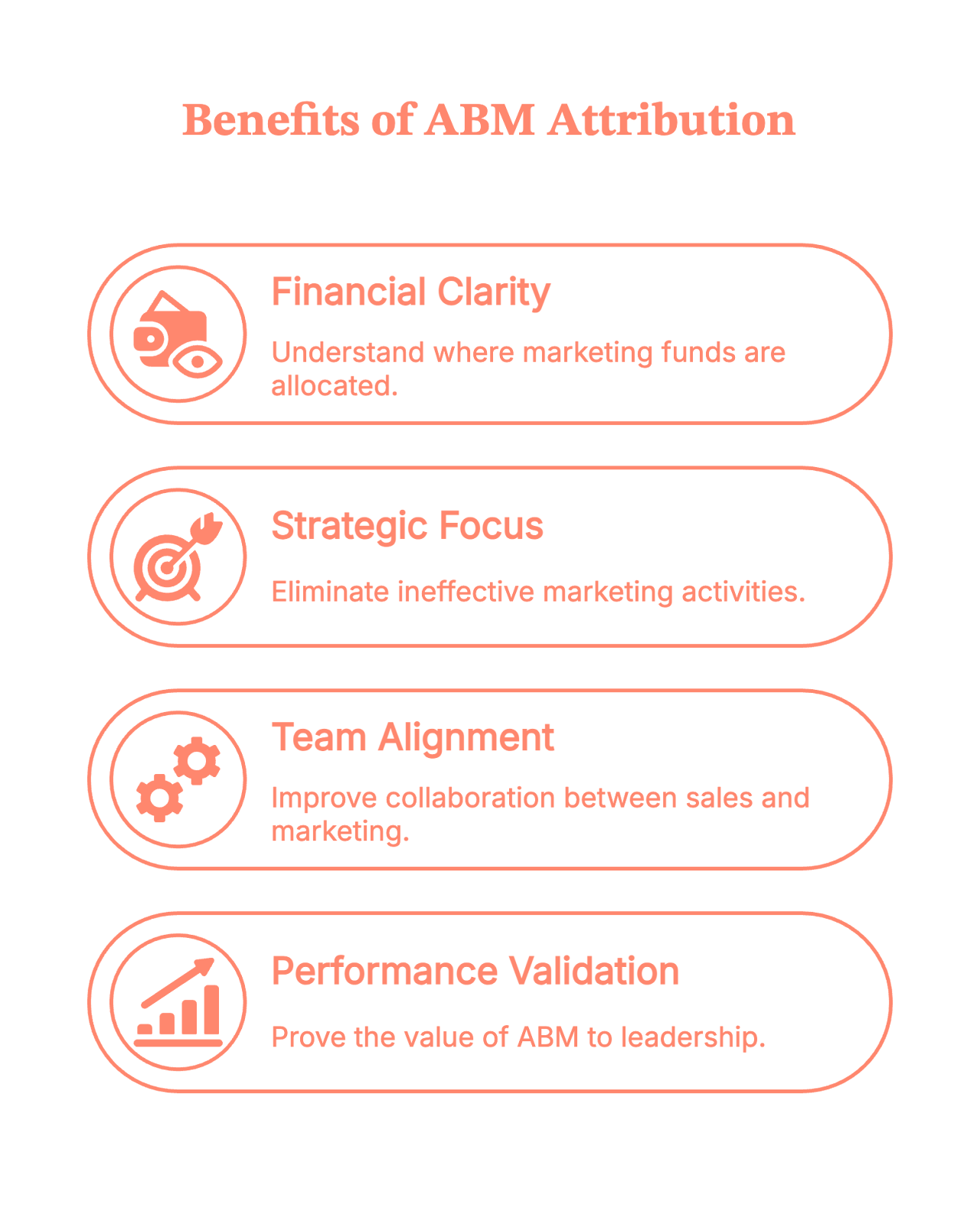
1. You finally know where your money is actually going
ABM campaigns are… not cheap. Personalization takes time, tools, and very patient marketers. Attribution keeps everyone honest.
2. You stop doing “random acts of marketing”
Without attribution, everything seems to be working. With attribution, you see what’s actually working.
3. Sales and marketing stop arguing (well, mostly)
Shared account-level insights = fewer “marketing didn’t bring quality leads” conversations.
4. You can prove ABM works to leadership
And yes, we know this is often half the battle.
What the Community says (because Reddit always has opinions)
Spend five minutes scrolling through marketing Reddit, and you’ll notice a theme: everyone loves the idea of ABM… right up until someone asks how to measure it.
A few familiar takes pop up again and again:
- “Show ROI at the account level or leadership won’t buy in.”
- “ABM is great, but without attribution it’s just fancy targeting.”
- “Half my ABM wins happen offline. Hard to track, but essential.”
- And the crowd favorite: “Attribution is where ABM goes from vibes to revenue.”
In short, the community isn’t anti-ABM; they’re just tired of running programs they can’t prove. Attribution is what turns enthusiasm into confidence.
The real-world challenges of ABM attribution (a.k.a. why it feels hard)
ABM attribution sounds great in theory… until you try to map every touchpoint across an entire buying committee and realize the journey is anything but neat.
So let’s look at the real friction points. The stuff that actually slows teams down when they try to make attribution work in the wild.
Many of these challenges arise because ABM fundamentally differs from the traditional funnel. This breakdown of ABM vs Traditional Marketing shows why the attribution process ends up so different.
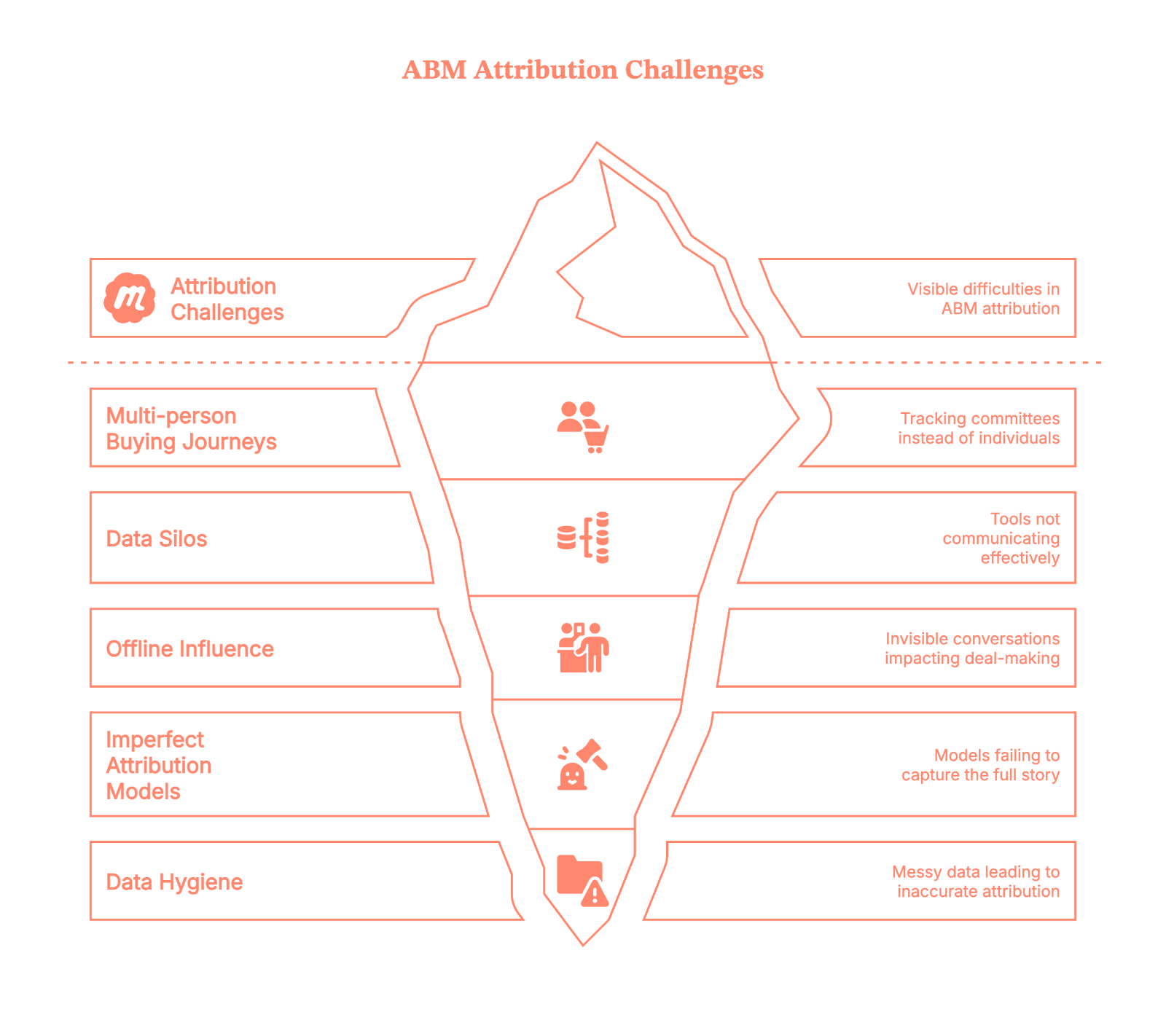
Challenge 1: Multi-person, multi-touch buying journeys
In ABM, you’re not tracking one person; instead, you’re tracking a committee. Touchpoints pile up fast. They are in the form of:
- LinkedIn ads
- Website visits
- Email nurturing
- SDR outreach
- Events
- Offline conversations (yes, these still happen!)
And with all this, attribution becomes tricky. Because…
- The journey isn’t linear.
- People engage anonymously.
- Not every touch gets logged.
- And buyers jump in and out depending on their role.
Challenge 2: Tools don’t speak the same language
Your ABM tool has data.
Your CRM has different data.
Your website analytics has other data.
Your sales reps store half the truth in their inboxes.
Everything is fragmented, and stitching it together feels like assembling IKEA furniture without instructions.
Challenge 3: Offline influence is invisible
Conversations at events, personal outreach, referrals, internal champions… these are often the real deal-makers.
But guess what?
None of that naturally shows up in your attribution reports.
Challenge 4: Attribution models are imperfect
First-touch? Too simplistic.
Last-touch? Doesn’t tell the full story.
Multi-touch? Great… until someone asks who gets how much credit.
W-shaped? U-shaped? Time decay? Weighted? Custom models?
It’s easy to get stuck in “model paralysis.”
Challenge 5: Data hygiene, the Achilles’ heel
Incorrect contact mapping, missing UTM parameters, untracked sessions, and inconsistent naming are the usual chaos.
If the data is messy, the attribution is messy.
How to implement ABM attribution without losing your mind
Alright, challenges aside. Here’s the part where we go from theory to “you can actually do this.”
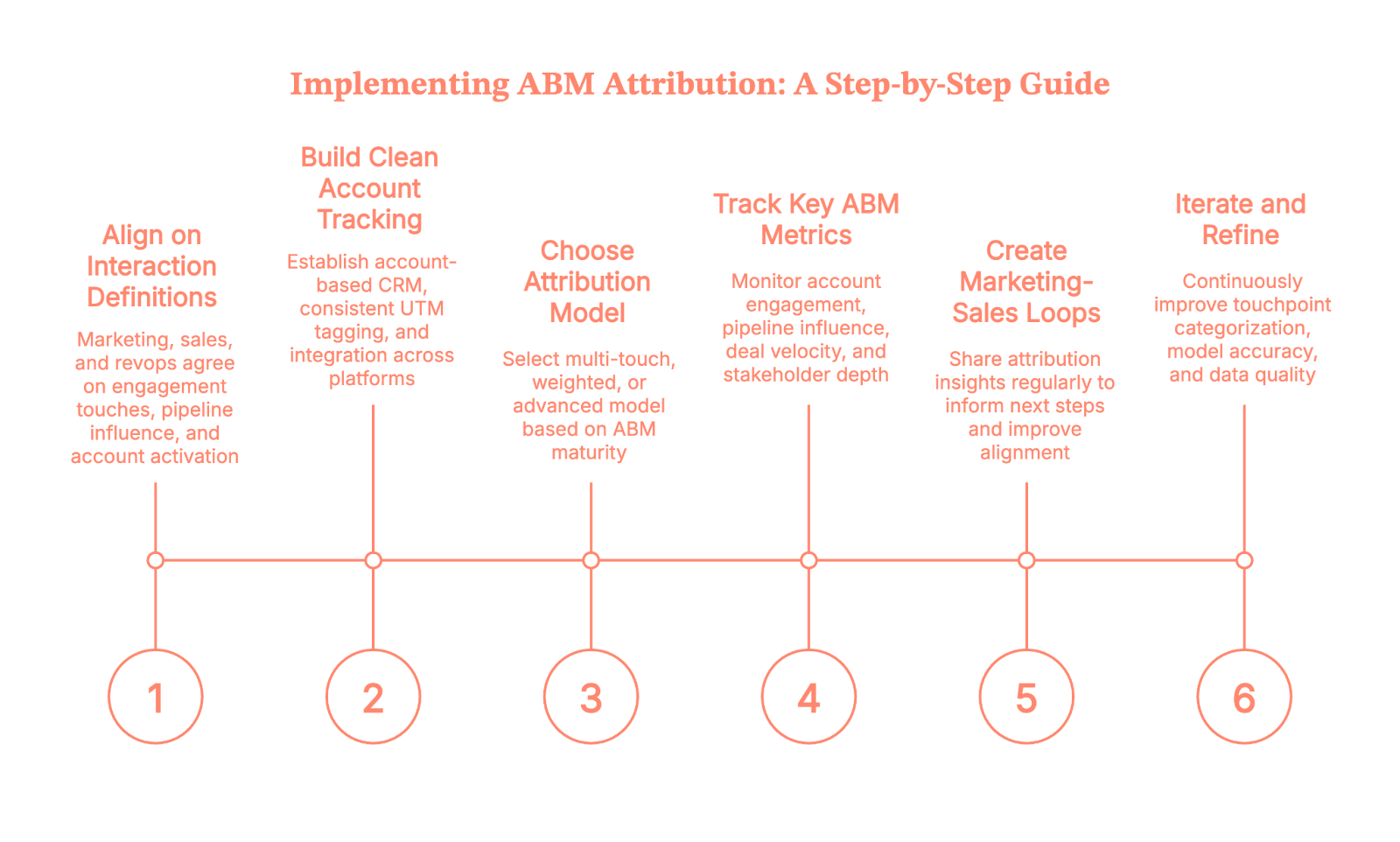
Let’s walk through it step-by-step.
Step 1: Align on what counts as a meaningful interaction
Before you build dashboards, get marketing, sales, and revops aligned on the following:
- What counts as an “engagement touch”
- Which interactions matter at different stages
- What is considered an “influenced pipeline”
- When an account is deemed “activated”
This avoids future “that’s not what I meant” arguments.
Step 2: Build clean account-level tracking
This is foundational. You’ll want:
- An account-based view (not just leads)
- Proper CRM structure
- Consistent UTM tagging
- Integration across ABM platform, CRM, and analytics tools
Think of this as cleaning your kitchen before you start cooking, annoying, but absolutely necessary.
Step 3: Pick an attribution model that matches your ABM maturity
- If you’re starting out, use simple multi-touch.
- If you’re scaling, then use weighted or custom models that account for key ABM engagement moments.
- If you’re advanced, then layer in predictive or machine-learning models to identify influence patterns automatically.
Yes, you can always switch later. Attribution models aren’t set in stone. As data volume, signal quality, and closed-won insights improve, more advanced models simply become more accurate.
Step 4: Track the right ABM Metrics (Not just “leads”)
ABM attribution isn’t about counting people. It’s about understanding accounts. Track:
- Account engagement score
- Pipeline created or influenced
- Deal velocity
- Stakeholder depth (how many people engaged)
- Stage progression tied to marketing/sales activities
- High-intent behaviors (e.g., pricing page visits)
These tell a truer story.
Step 5: Create loops between marketing & sales
Share attribution insights fortnightly or monthly:
- “Here are the touches that influenced the latest deals.”
- “Here’s what triggered conversions in high-value accounts.”
- “Here’s where deals stalled and why.”
When attribution informs next steps, you’ve built a real ABM engine.
Step 6: Iterate like you mean it
It won’t be perfect the first time.
Or the second.
Or the fifth.
But each iteration will sharpen:
- Touchpoints categorization
- Model accuracy
- Data quality
- Sales-marketing alignment
- Personalization strategies
Consistency wins this game.
As you put these steps into practice, pairing attribution with strong execution matters. These 6 ABM tactics to drive conversions can guide what to prioritize in your activation plan.
Where many ABM teams get stuck: The attribution gap
Even with all the right intentions, most ABM teams encounter one frustrating wall: THE ATTRIBUTION GAP.
It’s the uncomfortable space between “we know engagement is happening” and “we can prove it influenced revenue.” Gaps often come from:
- Anonymous website activity
- Multi-touch journeys
- Offline influence
- Data silos
- Untracked channels
- CRM inconsistencies
This is where technology makes or breaks your ABM strategy.
And yes, this is exactly where Factors.ai steps in.
How Factors.ai helps close the ABM attribution gap for B2B teams
Let’s get practical. Factors isn’t just another analytics dashboard; it’s specifically built to solve the attribution problems ABM teams struggle with most.
Here’s how it bridges those gaps:
1. Account-level website analytics (Even for anonymous website visitors)
Factors.ai offers one of the strongest account-level website visitor identification in the market, with coverage reaching up to 75%. It uses a waterfall enrichment setup that pulls from four different data sources, so the insights aren’t just broad… they’re accurate.
Once an account is identified, Factors layers in geo-location and job-title triangulation, which helps surface more than 30% of the actual individuals behind those visits.
In other words, you finally get to see:
- Which companies are showing up
- What pages they’re exploring
- How often do they return
- Which actions signal real intent
All those previously “invisible” touches?
They start showing up loud and clear.
2. Cross-channel, multi-touch attribution (Done automatically)
Factors pulls together data from all your channels, like:
- Paid ads
- Organic traffic
- Events
- LinkedIn engagement
- SDR outreach
- CRM activity
…and creates a unified timeline for each account.
No more stitching data manually.
No more channel blind spots.
Only multi-touch attribution.
3. Offline + Sales touch tracking
Factors doesn’t just capture digital activity; it brings your offline and sales motions into a single view.
With Account 360, all those scattered signals finally land in one place: CRM updates, SDR outreach, meeting notes, LinkedIn interactions, G2 intent, and website engagement all roll up into a unified account timeline.
The result?
You see the full story of how an account interacts with your brand, across both marketing and sales touchpoints.
4. Custom attribution models built for ABM
Instead of forcing you into standard models like last touch or first touch, Factors lets you:
- Use multi-touch
- Create weighted models
- Focus on intent-heavy touches
- Build ABM-specific attribution logic
You can finally choose a model that reflects how your buyers actually buy.
5. Clear pipeline influence & revenue reporting
Factors shows exactly how an account moved from early engagement to opportunity to closed-won. With this, you get clean, defensible reports that leadership actually understands.
6. Insights that actually drive ABM strategy
Factors highlights the signals that matter the most:
- High-intent accounts
- Content that moved deals
- Channels that consistently kickstart meetings
- Patterns across closed-won accounts
So your next ABM campaign isn’t just creative, it’s informed by data.
Read more about this on Using Factors.ai for targeted ABM
ABM attribution doesn’t have to be scary
Yes, attribution is messy.
Yes, ABM multiplies that mess.
And yes, you’ll probably question your life choices once or twice while implementing it.
But once your system is in place?
You stop guessing.
You start learning.
You start predicting.
And your ABM program stops being an experiment and becomes a repeatable revenue engine. The right tools (like Factors.ai) make the journey 10× smoother.
So take the first step, build your foundation, and let your attribution framework evolve from there. Your future ABM programs will thank you.
So to summarise
Account-Based Marketing (ABM) attribution helps B2B teams understand which marketing and sales touchpoints truly influence pipeline, opportunity creation, and revenue at the account level. It connects every interaction across a buying committee, like ads, website visits, content consumption, SDR outreach, events, and even offline conversations, to reveal how an account actually progresses.
Because ABM journeys involve multiple stakeholders, disconnected tools, messy CRM data, and untracked touches, most teams face a real attribution gap. Building a reliable ABM attribution engine requires clean account-level tracking, sales–marketing alignment, the right attribution model, and ongoing data hygiene.
Platforms like Factors.ai close the visibility gap by identifying anonymous accounts, stitching multi-touch journeys automatically, capturing offline influence, and providing clear revenue reporting. The result? A repeatable, insight-driven ABM engine that makes your future programs more effective.
FAQs on Account-Based Marketing attribution
Q1. How do you measure attribution in an ABM campaign?
You measure ABM attribution by mapping every marketing + sales touchpoint at the account level (not at the lead level). This includes website activity, ads, emails, SDR touches, events, and offline conversations. Then you apply an attribution model, like multi-touch, weighted, or custom, to understand which interactions influenced pipeline, opportunity creation, or revenue.
Q2. What makes ABM attribution so difficult for B2B teams?
Most teams struggle because buying journeys span multiple people, tools don’t sync data cleanly, offline influence rarely gets captured, and CRM hygiene is inconsistent. ABM multiplies complexity because each account generates dozens of interactions across different roles and channels.
Q3. Which attribution model works best for ABM programs?
Multi-touch is the most common starting point because it spreads credit across the journey. As ABM maturity increases, teams shift to weighted models that give more value to high-intent touches (e.g., demo page visits, sales meetings), or custom models tailored to their buying cycle.
Q4. How do you track anonymous account activity in ABM attribution?
Most companies rely on layers of website visitor identification and enrichment. Tools like Factors.ai use multi-source waterfall enrichment to identify up to 75% of accounts and surface likely individuals using geo and job-title triangulation. This converts anonymous website traffic into attribution-ready account data.
Q5. How do you include offline and sales touches in ABM attribution?
You need a unified account timeline that blends CRM notes, SDR outreach, meetings, events, referrals, and marketing activity. Without this, you’ll see only half the picture. Platforms like Factors.ai pull these signals into a single Account 360 view so offline influence is fully attributed.

See how Factors can 2x your ROI
Boost your LinkedIn ROI in no time using data-driven insights


.avif)
.avif)
See Factors in action.
Schedule a personalized demo or sign up to get started for free
LinkedIn Marketing Partner
GDPR & SOC2 Type II







.svg)



.avif)

