
AI email marketing: the parts that actually move pipeline
AI email marketing for B2B teams, explained without the hype. Segmentation, personalization, timing, and the metrics that actually matter.
.avif)
Content Marketer



.svg)


TL;DR
- Most teams think they've ‘done’ AI email marketing once they've used ChatGPT for subject lines, but that's the smallest, least interesting piece of it.
- The real leverage sits upstream of the copy, in segmentation, send timing, and knowing which 200 people out of your 40,000-contact list are actually worth emailing this week.
- Inbox providers got smarter faster than most B2B senders did. Gmail sorts you into tabs, Apple summarizes you before anyone reads a word, and your batch-and-blast newsletter is losing to an algorithm you can't see.
- Some teams have tripled demo bookings from a single mid-funnel sequence (not by writing better emails), but by triggering the right email to the right account at the right moment)
- AI-powered analytics can tell you who's about to convert and who's checking out. Most teams are still staring at open rates, which stopped meaning much the day Apple started prefetching every email automatically.
- All of this points to one thing: bad strategy now fails faster and more expensively, which is either terrifying or clarifying depending on how prepared you are.
Every Sunday night I do the same small ritual. I open my personal inbox, scroll past forty-odd emails without reading a single subject line, and delete all of them in one long swipe. I didn't decide to become someone who does that. B2B senders trained me into it, one generic "quick question" email at a time.
I think about that ritual a lot in my day job. It's the exact behavior every AI email marketing pitch claims to solve, and the exact behavior most AI email marketing implementations completely fail to touch. Teams add a writing tool, generate cleverer subject lines, and then wonder why their swipe-to-delete rate hasn't moved. It hasn't moved because the copy was never really the problem.
This piece is about the parts of AI email marketing that actually change whether someone reads what you send. Who you're sending to, when you're sending it, and whether you can tell, with real confidence, which of it is working. Copy shows up too, but it shows up last, which is precisely where it belongs.
For the hundredth time, what do people actually mean by "AI email marketing’?
Let's get the definition out of the way cleanly, because half the confusion in this space comes from people using "AI" and "automation" like they're the same thing. They aren't.
Automation follows a rule you wrote. If a lead downloads a whitepaper, send sequence B. If they don't open email two, wait three days and try again. You built the logic yourself, and the system just executes it faithfully, forever, without judgment.
AI email marketing is different because the system is making a probabilistic call you didn't explicitly program. A rules-based workflow sends the identical nurture to every whitepaper downloader on your list. An AI-driven one might notice that downloaders from mid-market SaaS companies who also visited your pricing page convert three times faster. It can route them onto a shorter, more direct sequence, without anyone on your team writing that rule by hand.
That distinction matters because it changes what you're actually buying when you invest in this stuff. You're not buying faster writing. You're buying a system that gets better at guessing what a specific person needs, based on patterns your team would never have the time to spot manually.
Why is the old email playbook breaking down right now?
Here's the uncomfortable part. It isn't only that AI made things better. It's that the old approach was already failing, and AI just made the gap impossible to ignore.
Most B2B email programs are still built on the assumption that everyone in a segment behaves the same way. Industry, company size, job title, geography, that's the whole model. It made sense back when those were the only signals available. It doesn't make sense anymore. Two VPs of Marketing at similarly sized SaaS companies can be in completely different places in their buying journey, and a static segment has no way of knowing that.
Layer onto that the fact that inboxes got smart without asking permission. Gmail filed your carefully written nurture email into the Promotions tab. Apple Mail started summarizing your subject line before a human ever opened it. Outlook's Focused Inbox decided, on its own, whether your message was worth a person's attention.
None of these providers asked marketers first. They just started making the call. Your email isn't competing with other marketing emails anymore, it's competing with an invisible gatekeeper that's already decided whether you're worth showing at all. If your program isn't at least as smart as that gatekeeper, it won't clear the bar (a strange sentence to write about your own inbox, but here we are).
Where AI email marketing actually pays off
I'll say the unpopular thing directly: writing subject lines faster is the least valuable thing AI does for your email program. Here's where the real return actually shows up.
• Segmentation that reflects behavior, not just firmographics. Instead of emailing "every marketing director at a mid-market SaaS company," target the ones who visited pricing twice this month and clicked a competitor ad. Smaller list. Dramatically higher relevance.
• Personalization that goes past the first-name token. AI can swap entire content blocks, CTAs, and messaging angles based on lifecycle stage and predicted interest, not just drop a name into a template.
• Send-time decisions made per person, not per list. One contact reliably opens at 7am on Tuesdays. Another only engages Thursday afternoon. A model can learn that pattern individually instead of guessing one "best time" for everyone.
• Conversion lift that comes from relevance, not volume. When the right email lands at the right moment, fatigue drops and people actually act on it. You're not sending more. You're sending fewer emails that each earn more attention.
• Analytics that forecast instead of just reporting. A model can flag which accounts are likely to convert and which ones are drifting toward churn. That's a genuinely different capability than staring at a dashboard of clicks after the fact.
• Real time back for the humans running the program. When a system handles segmentation and timing, your team spends less time building lists by hand and more time thinking about what the program should actually say.
The through-line across every one of these: AI is best at the decisions humans don't have the bandwidth to make well at scale, not at the writing itself.
AI email marketing use cases across the funnel, not just at the top
Most content on this topic lives entirely at the top of funnel, welcome sequences and educational nurtures. That's fine, but it's not where the biggest wins live.
I've personally watched a team triple their demo booking rate off a single mid-funnel change. The email only fired when a champion re-visited the integrations page for the second time in a week. That's not a bigger list. That's a smarter trigger, sitting exactly where a buying committee is actually forming.
AI-powered segmentation, or how to stop guessing who's ready
This is where most of the strategic upside actually lives, so it earns its own section instead of a bullet.
Traditional segmentation works off what you already know about someone. AI segmentation surfaces patterns you never thought to look for in the first place. Buying-committee identification notices when several people from the same account start engaging around the same time, which is usually the first real sign a deal is forming. Intent-based cohorts group people by what they're doing right now (visiting competitor pages, engaging a specific ad topic) rather than by static attributes on a spreadsheet. Product-interest clustering figures out which feature or use case someone actually cares about, based on what they've read and clicked.
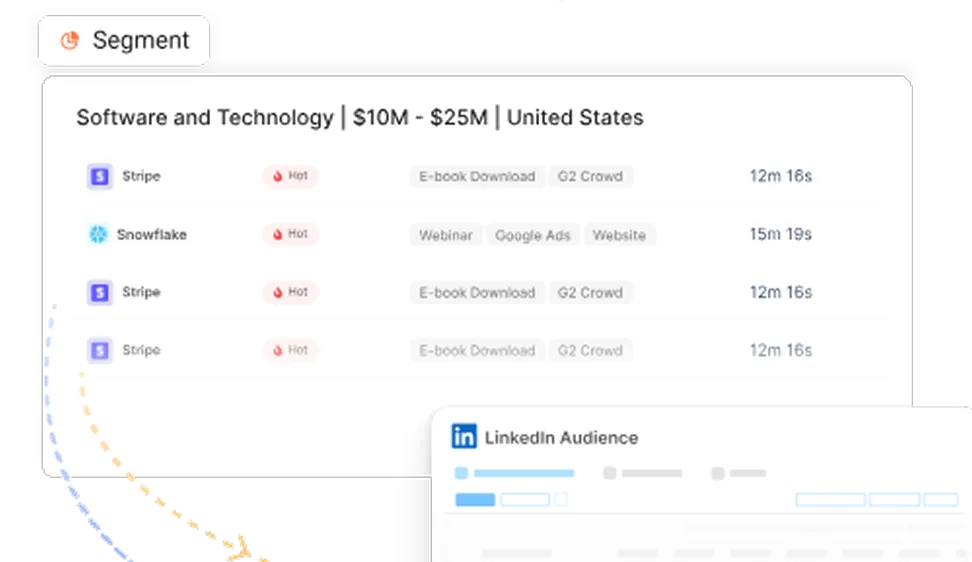
Picture a segment built automatically: every account researching attribution, engaging LinkedIn ad content about it, and showing a visible uptick in website activity over the last two weeks. A model can assemble that list and fire a relevant sequence before your SDR team even knows those accounts exist. That's the real shift, from "who should we email" to "who is actually ready to hear from us."
Personalization beyond "Hi [First Name]" (because that is SO passé)
I've said some version of this in more internal reviews than I can count. Most personalization today is still just a mail-merge field wearing a fancier outfit. Real personalization works on a few different layers at once.
Content personalization swaps the actual substance of an email, different headlines, CTAs, different angles, based on what you actually know about the reader instead of what you'd like to say to everyone. Journey personalization goes a layer deeper and adjusts the sequence itself. A VP evaluating your product has a completely different set of questions than the ops manager who'll be the one implementing it. And recommendation logic borrows straight from e-commerce, using product usage data to suggest the next feature, integration, or upsell a specific account is most likely to need.
That last one is especially strong in product-led companies, where usage data already tells you almost everything about what someone's ready for next. You just have to build the email around it instead of around a generic send calendar.
What AI actually optimizes, once the writing part is done
Most teams assume AI's job in email is generating the message. Its more valuable job is helping you send fewer emails to the right people.
Subject line testing at scale goes past a simple A/B split, evaluating dozens of variants and predicting performance before a full send even goes out. Per-recipient send-time optimization consistently beats one blanket send time for the whole list. Across hundreds of thousands of sends a quarter, even a modest lift in open-to-click rate turns into real pipeline. Frequency tuning catches the contacts who are drowning in your cadence before they unsubscribe, and also the ones who'd happily take more. Deliverability monitoring flags reputation risk early enough to suppress a low-quality segment before it damages your whole domain. And predictive engagement scoring means your best-fit contacts get the full campaign, while your long shots get something lighter instead of the identical send everyone else gets.
That last shift, from sending everyone the same thing to sending each person roughly what they've earned, is the whole game.
From reporting to prediction: what AI analytics actually changes
Reporting tells you what already happened. Prediction tells you what's likely to happen next, and that gap is the single biggest shift AI brings to email analytics.
When your analytics can flag which accounts are likely to close this quarter, your email program gets to prioritize those accounts with a higher-touch sequence today instead of next month. When it can flag early churn signals, you get to trigger a save campaign before the renewal conversation turns tense. That's the point where email stops being a broadcast channel and starts behaving like a genuinely responsive system.
Building an AI email marketing strategy that doesn't collapse in month two
A real strategy here doesn't start with picking a tool. It starts with getting the underlying data honest.
1. Start with first-party data. Your CRM, product usage, website behavior, and email history are the raw material. If that data is messy, no model fixes it for you. Clean it first.
2. Connect the behavioral signals. Link website visits, downloads, ad engagement, and email activity into one view per account, usually through a CDP or a direct integration layer.
3. Build segments around intent, not just identity. Accounts showing research activity, contacts re-engaging after going quiet, stakeholders clustering around a specific page. Each deserves different treatment than a static list could ever give it.
4. Personalize by where someone actually is, not just who they are. A cold inbound lead's first touch should look nothing like the email a champion gets after their third demo.
5. Layer in optimization once the foundation holds. Send-time, frequency, subject line testing, predictive scoring, all of it amplifies a good strategy. None of it repairs a broken one.
6. Measure against revenue, not activity. Track pipeline influence and deal velocity, not just opens. That's the only way to justify the next quarter's budget with a straight face.
This is genuinely where a platform like Factors.ai earns its place. Website visitor intelligence and account identification give your email program context it wouldn't otherwise have. A sequence can fire because an account is actually surging on your site, not because an arbitrary three-day timer ran out.
Also read: How to use AI for marketing
AI email marketing best practices worth actually following
The strongest email programs I've come across aren't fully automated. They're closely supervised.
- Don't automate a lazy strategy. AI accelerates whatever you feed it. Generic segmentation plus AI just produces generic emails faster.
- Use AI for decisions, not only content. Writing is the least interesting thing it can do here. Point it at segmentation logic and timing decisions instead.
- Build on first-party data. Third-party signal keeps getting less reliable every year. Your own product and website data is the most defensible thing you own.
- Keep a human on anything high-stakes. Routine nurtures can run on AI-generated copy fine. Product launches and renewal sequences deserve a person reading them before send.
- Test continuously, not once. More data makes the model better. Static campaigns are the one thing guaranteed not to improve.
- Report on outcomes, not activity. Opens and clicks measure effort. Pipeline and revenue measure whether any of it mattered.
The mistakes I see the most often
Understanding the theory is one thing. Avoiding the predictable traps is another, and I watch teams walk into the same few, repeatedly.
The most common one, by a wide margin, is using AI purely for copy generation and calling the whole program "AI-powered" while segmentation and measurement stay exactly as they were (I've sat through that exact status update more times than I'd like to admit). It's the equivalent of buying a genuinely fast car and only ever driving it to the grocery store.
Right behind it is skipping segmentation entirely and jumping straight to AI-written content. That produces beautifully worded emails sent to people who were never the right audience in the first place. Relevance starts with who, not with copy quality.
Then there's the personalization line that gets crossed without anyone noticing. There's a real difference between an email that feels relevant and one that feels like it's watching you. Referencing someone's exact browsing history in the body copy tips into the second category for most readers. Use the behavior for targeting decisions. Keep it out of the actual sentence.
Not tracking revenue impact is its own quiet failure mode. If your reporting stops at open rate and click-through, you're measuring effort, not outcome, and you'll juuust never know if the AI layer is earning its keep.
And the deepest one: treating AI as a replacement for strategy rather than a multiplier on top of it. It can optimize timing and personalize content extremely well. It cannot tell you what your positioning should be or which persona actually matters most this quarter. That's still your job.
Where this is heading… (nobody's fully there yet)
The direction of travel is fairly clear if you're paying attention to what's already shipping across the major platforms.
Static drip sequences are giving way to journeys that actually adapt in real time to how someone engages, rather than marching through a fixed timeline regardless of behavior. AI-generated copy itself is becoming a commodity, which means the real differentiator shifts to data quality and segmentation sophistication instead of who can write the cleverest subject line. Intent-based segmentation is turning from a nice-to-have into table stakes, and firmographic-only targeting is starting to look genuinely dated next to it.
Recommendation engines, long an e-commerce staple, are showing up in B2B feature-adoption and expansion emails. Deliverability intelligence is becoming a standard part of the stack rather than an afterthought, because inbox providers keep getting harder to read. Privacy-first personalization is gaining ground fast, too, as third-party cookies fade and first-party data becomes the only defensible foundation left. Underneath all of it, revenue attribution is finally becoming AI-powered in its own right. The conversation is shifting from "how many people opened this" to "how much pipeline did this actually touch."
The teams that win the next few years of email won't be the ones sending the most messages. They'll be the ones who can prove which of their emails actually moved revenue.
How Factors.ai fits into where email is heading
Email doesn't run in isolation anymore, and the strongest programs I've seen are informed by signals from well outside the inbox.
Factors.ai surfaces which accounts are visiting your site and what they're actually researching there, including the ones who never filled out a form. It maps that activity, alongside LinkedIn ad engagement and broader content behavior, into a single account-level view.
That context sharpens an email program in a few concrete ways. Segmentation gets built on live account activity instead of a static list. Triggers fire because of a real intent spike instead of an arbitrary delay. And attribution finally connects an email touch to the pipeline and revenue it actually influenced.
That combination, account intelligence feeding directly into email execution, is where the next real gains in this space are going to come from.
Where this leaves you…
AI email marketing was never really about sending faster. It's about making every email you do send earn its place in someone's inbox, through better segmentation, sharper timing, and measurement that tells you the truth about what's working.
If you're building this out, start with the data foundation before you touch a tool. Connect your behavioral signals into one account view. Then layer AI into the decisions, not just the drafting. The programs that hold up aren't the ones chasing every new feature. They're the ones building the judgment to use these capabilities with an actual point of view, checked constantly against revenue.
FAQs for AI email marketing
Q1. What is AI email marketing?
AI email marketing uses machine learning, predictive modeling, and natural language processing to automate decisions that used to require a human's judgment call. That includes who to email, what to show them, when to send it, and how to measure the result. It differs from basic automation because it learns from patterns in your data rather than following a fixed if-then rule someone wrote by hand.
Q2. How is AI actually changing email marketing strategy?
It's shifting email from a broadcast channel into a responsive system that adjusts per recipient. Instead of one message going to an entire list, content, timing, and frequency can all flex to the individual. Analytics move the same direction, from reporting what already happened to forecasting who's likely to convert or churn next.
Q3. What are the real benefits of using AI in email marketing?
The core gains are behavioral segmentation instead of firmographic guesswork, personalization that adapts per contact instead of stopping at a first-name token, and send-time and frequency decisions made per person. Add predictive analytics that flag what's coming next and real time saved for the team running the program, and conversion lifts without requiring more volume.
Q4. Can AI meaningfully improve email personalization?
Yes, well past inserting a name into a greeting. It can swap entire content blocks, CTAs, and messaging angles based on lifecycle stage and predicted interest. Recommendation logic can also surface the specific feature or integration a given account is most likely to need next, based on their actual usage patterns.
Q5. How does AI improve segmentation specifically?
It finds patterns manual segmentation would miss entirely, buying-committee activity across an account, intent-based cohorts built from what people are doing right now, and engagement scores that update automatically. These segments stay current as behavior changes instead of needing a manual rebuild every quarter.
Q6. What does AI-powered send-time optimization actually do?
It predicts the best time to reach each individual recipient based on their own engagement history, rather than picking one "best" time for an entire list. Delivery staggers per person so each contact gets the email closer to when they're actually likely to open it.
Q7. Does AI email marketing genuinely move ROI, or is that overstated?
It can, and the effect compounds. Better segmentation cuts wasted sends. Sharper personalization lifts engagement. Smarter timing improves opens and clicks. Predictive scoring keeps effort focused on the contacts most likely to convert. Across thousands of sends a quarter, those small lifts add up to a real pipeline difference relative to the effort involved.
Q8. What tools actually do this well?
Most major platforms, HubSpot, Salesforce Marketing Cloud, Braze, Klaviyo, now build AI-native features directly into their core product. Specialized point tools exist too, for send-time optimization or predictive scoring specifically. The right choice depends more on your existing stack and data maturity than on any single tool being universally "best."
Q9. What should I actually expect from AI email marketing?
Expect static drip sequences to keep losing ground to journeys that adapt in real time. Expect AI-generated copy to become a commodity rather than a differentiator, and intent-based segmentation to become the baseline rather than the advanced move. Revenue attribution tied to email is also becoming genuinely AI-powered, which means the conversations budget holders are asking are shifting from opens to pipeline.

See how Factors can 2x your ROI
Boost your LinkedIn ROI in no time using data-driven insights


.avif)

See Factors in action.
Schedule a personalized demo or sign up to get started for free
LinkedIn Marketing Partner
GDPR & SOC2 Type II






.svg)



.avif)

