
Best ABM Agencies for B2B Growth
Compare B2B ABM agencies across pricing and expertise to find the right partner for your ABM strategy. Find top ABM agencies that drive B2B growth through personalized campaigns.

.avif)
Content Marketer



.svg)


B2B buying cycles involve 6 to 10 decision-makers on average. Each stakeholder researches independently, consuming 13 pieces of content before engaging sales. This complexity explains why 81% of marketers report higher ROI from ABM compared to traditional marketing approaches.
Account-based marketing targets specific high-value accounts with personalized campaigns rather than generating volume through broad outreach. But, anecdotal data suggests that marketers running ABM programs struggle with execution due to technology gaps, attribution challenges, and sales misalignment.
The best ABM agencies bridge these gaps by providing specialized frameworks, proven technology stacks, and dedicated expertise.
At Factors, we've observed that successful ABM programs connect three critical elements:
- Intent data showing which accounts are actively researching
- Engagement analytics tracking multi-stakeholder interactions
- Attribution models proving revenue impact.
And the most effective agencies excel at all three. If you’re looking to hire the best ABM agency, keep reading.
What Is an ABM Agency and Why Modern B2B Teams Need One
An ABM agency specializes in identifying target accounts, orchestrating personalized campaigns across channels, and aligning marketing with sales for predictable revenue generation. Unlike traditional agencies focused on lead volume, ABM agencies measure success through pipeline velocity and revenue from specific accounts.
Full-service B2B account-based marketing agencies handle account selection, campaign creation, execution, and measurement. Specialized agencies might focus on specific areas: B2B SaaS content marketing agencies excel at product messaging, while B2B demand generation agencies concentrate on paid media orchestration.
Three signals indicate readiness for agency partnership. First, when inbound leads plateau despite increased spending, suggesting diminishing returns from volume-based tactics. Second, when sales and marketing operate with conflicting metrics and definitions. Third, when entering enterprise markets where complex buying committees require coordinated multi-stakeholder engagement.
What are The Core Services Offered by Top ABM Agencies
When hiring an ABM agency, you need to look for one that offers these core services as a bare minimum.
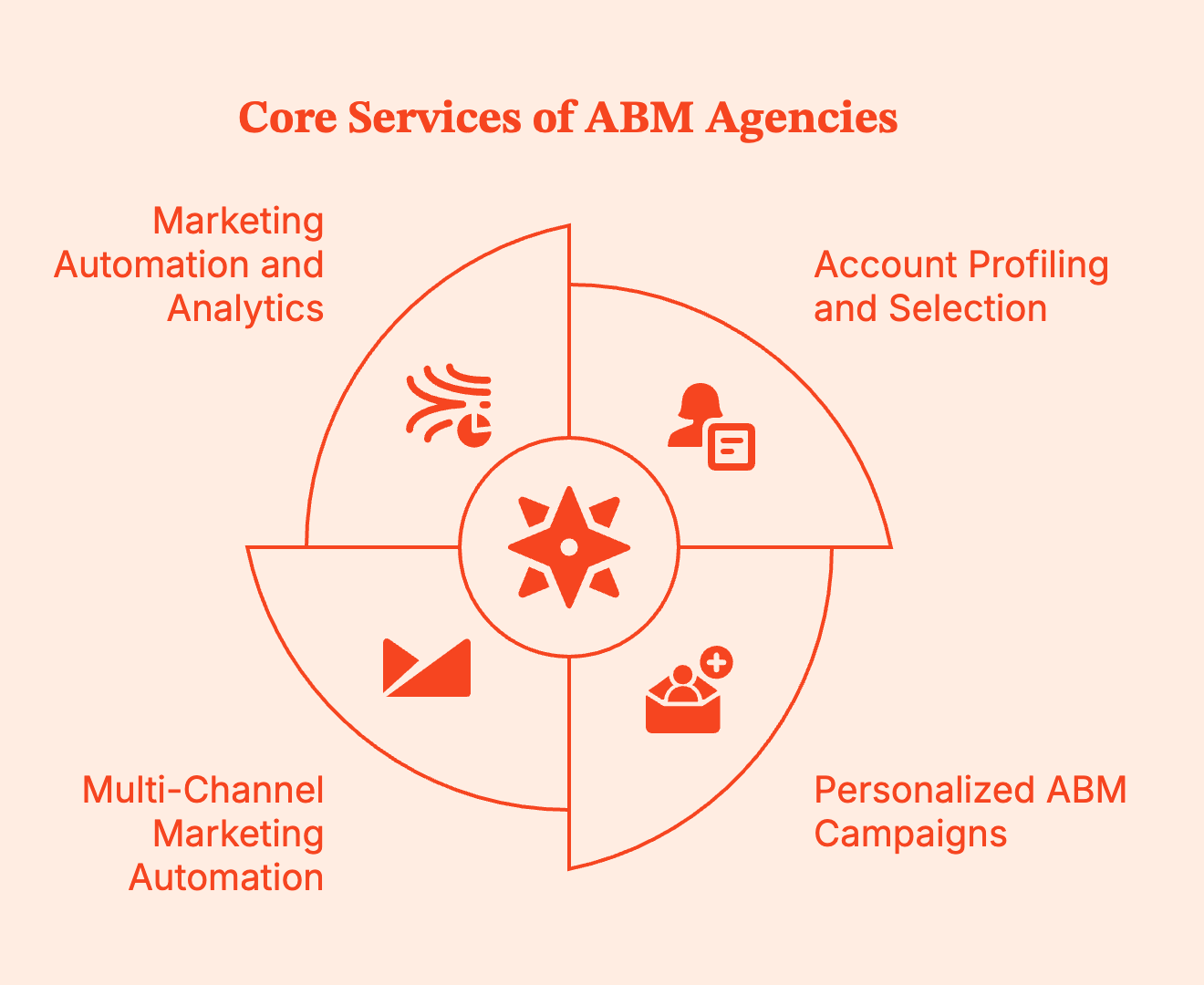
Account Profiling and Selection
Leading agencies like The ABM Agency and Heinz Marketing use firmographic data, intent signals, and engagement patterns to build tiered account lists.
- The 1:1 tier typically includes 5-10 strategic accounts receiving customized campaigns.
- The 1:few tier covers 50-100 accounts with similar characteristics.
- The 1:many tier applies programmatic techniques to hundreds of qualified prospects.
This segmentation determines resource allocation. Enterprise accounts might justify $50,000 in personalized content and executive engagement programs. Mid-market accounts receive industry-specific campaigns at $5,000-10,000 per account. While programmatic campaigns targeting broader segments could do well at $500-1,000 per account.
Personalized ABM Campaigns for B2B SaaS
Effective personalization addresses specific stakeholder concerns.
For instance, CFOs need ROI projections and payback periods. IT directors require integration documentation and security compliance. End users want workflow improvements and training resources. ABM agencies research these priorities through account scoring and competitive intelligence.
AI enables scalable customization while maintaining relevance for SaaS companies. A great example is Single Grain's LinkedIn campaigns. They achieved 8.69% engagement rates through dynamic content that adapts to viewer characteristics and behavior patterns, demonstrating modern ABM execution at scale.
Multi-Channel Marketing Automation Orchestration
Coordinated ABM campaigns span across LinkedIn advertising, display retargeting, email sequences, and direct mail. Here, timing and frequency matter. According to an Adroll survey, 60% of companies aligning ABM with account-based advertising report higher win rates, proving the value of comprehensive ABM approaches.
Tools like Factors' AdPilot and Account 360 help you with unified orchestration and measurement for these ABM campaigns. Marketing teams can sync LinkedIn audiences, trigger campaigns based on engagement thresholds, and pause advertising when accounts enter sales conversations, so there’s clear marketing alignment throughout the buyer journey.
Marketing Automation and Analytics
Integration with CRM and marketing automation platforms helps with multi-touch attribution for B2B marketing. New North connects these systems to show which campaigns influence pipeline progression. Advanced analytics reveal that ad-influenced accounts move through pipelines 234% faster than non-targeted accounts.
Measurement extends beyond campaign metrics to business growth outcomes: account engagement scores, stakeholder coverage ratios, time to opportunity creation, and marketing influence on closed-won revenue for B2B SaaS companies.
The Business Impact: Key Benefits of Partnering with ABM Agencies
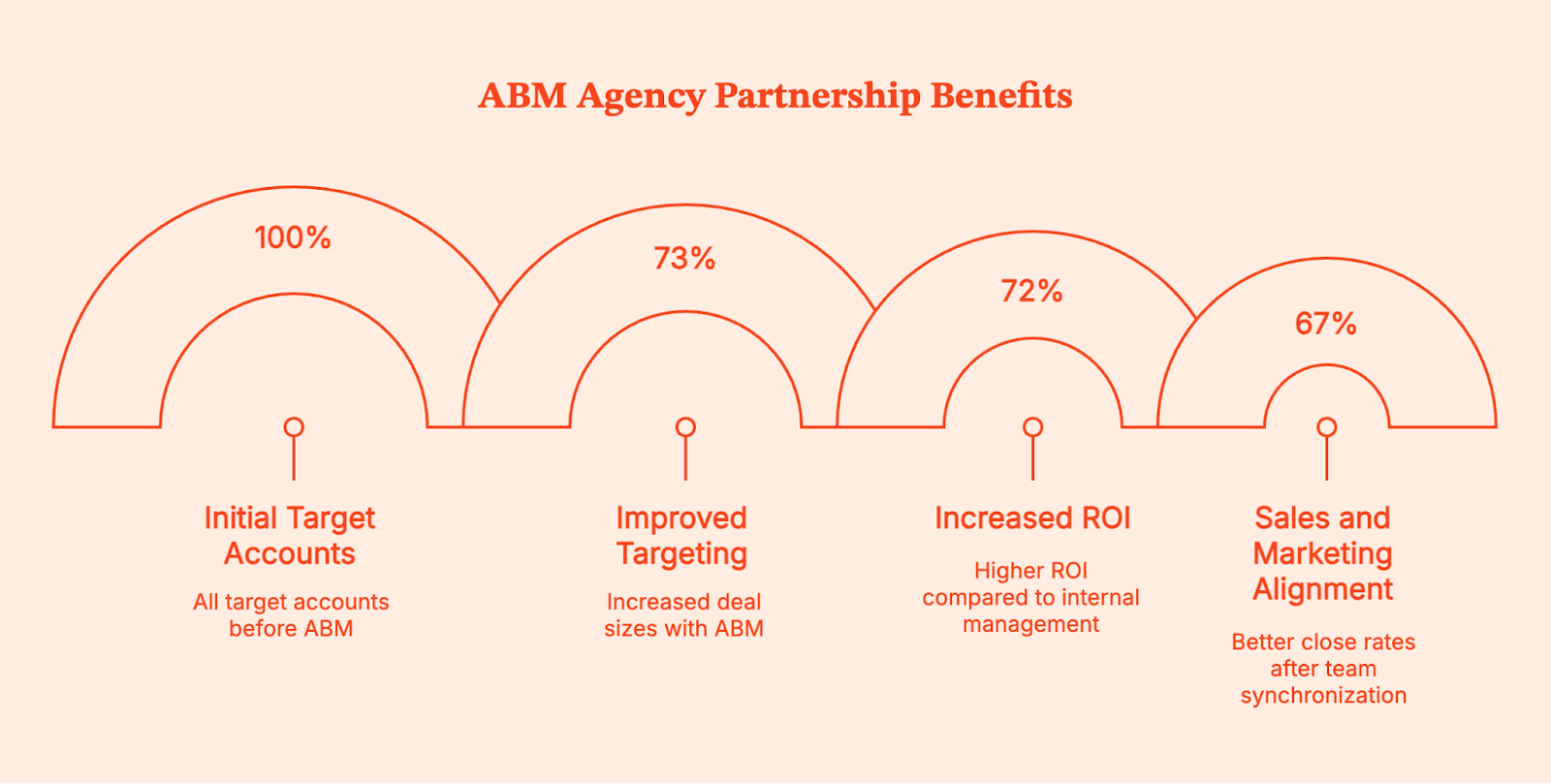
- Improved Targeting: 73% of companies using account-based marketing report increased deal sizes. When you integrate data-driven account selection, you automatically eliminate waste from pursuing unqualified prospects, achieving sustainable B2B growth.
- Increased ROI: B2B companies working with ABM agencies report 72% higher ROI compared to internal management. 93% of marketers rate agency-managed ABM programs as extremely or very successful.
- Sales and Marketing Alignment. When teams share account lists, success metrics, and revenue goals, the alignment between them improves. 67% of companies report better close rates after synchronizing sales and marketing teams through ABM strategies. Shared dashboards and regular account reviews maintain this critical marketing alignment.
- Predictable Pipeline replaces sporadic lead generation. ABM creates repeatable processes that consistently generate qualified opportunities for technology companies.
Using Factors' predictive scoring, teams identify high-intent target accounts before competitors, shortening sales cycles by 30-50%.
{{INLINE_MOFU}}
How to Choose the Right ABM Agency for B2B Success
The most difficult choice is finalizing an agency for your B2B ABM campaigns. Since most agencies have lock-ins, you want to find one that correctly aligns with your goals. Here are a few simple steps to think about the finalization process:
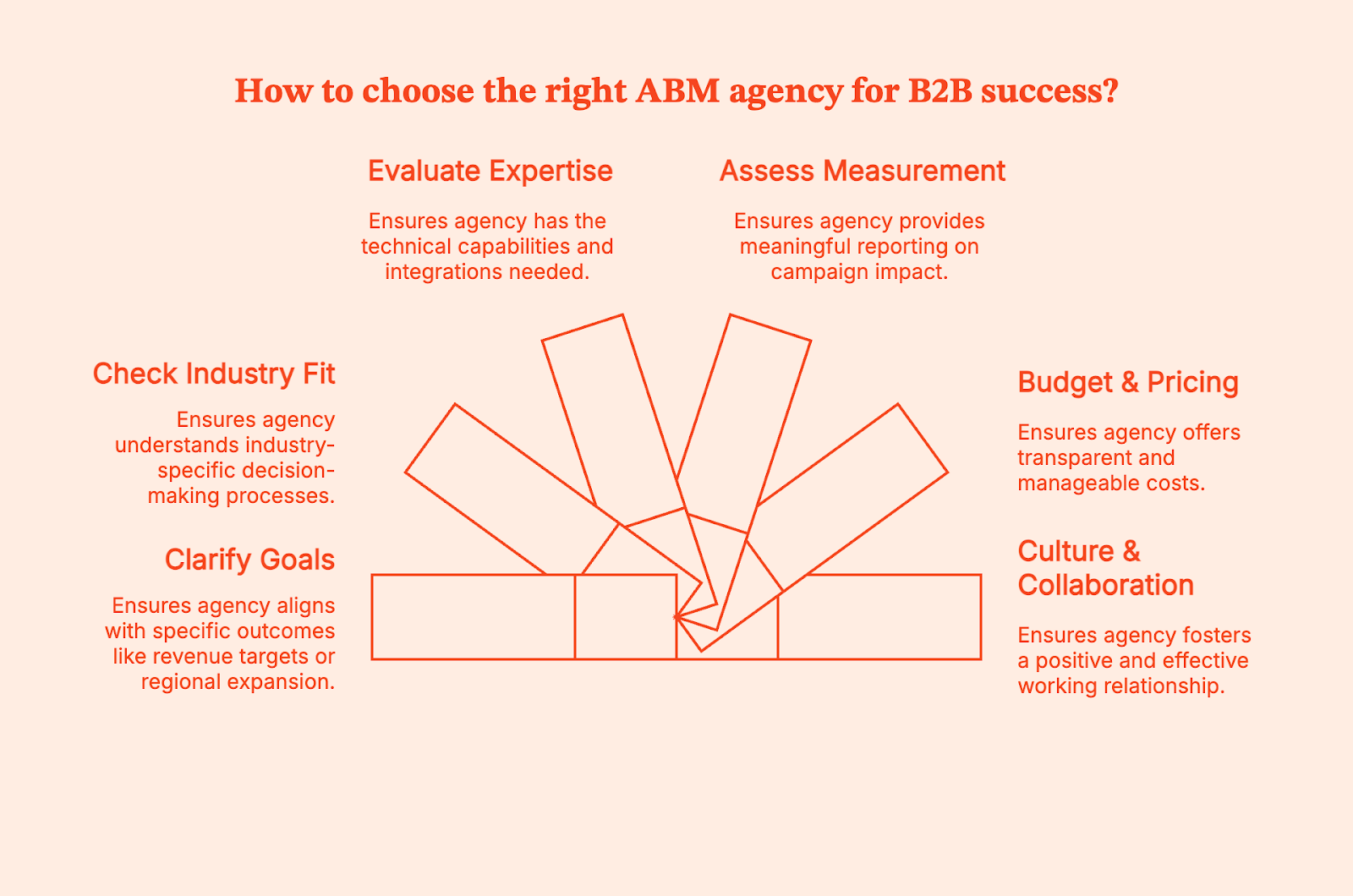
- Clarify Your Goals: Get clear on the outcomes you need, because agencies specialize in different parts of ABM. Revenue targets, account penetration, and expansion into new regions all require distinct skills. Enterprise programs call for heavy personalization, mid-market programs need repeatable execution, and geographic expansion works best with partners who already understand the local buying environment.
- Check Industry Fit: ABM shifts depending on who your buyers are and how decisions happen in your sector. For instance, healthcare involves clinical reviewers and compliance teams, financial services require security and procurement alignment, and manufacturing deals often hinge on operations and supply chain input. Agencies that work inside your vertical already know these patterns and plan campaigns around them instead of guessing.
- Evaluate Expertise: Dig into how they run ABM from a technical standpoint. Ask about their intent data platform, how they identify anonymous visitors, and the attribution methods they rely on to show revenue impact. Good agencies can walk you through their stack, their integrations, and how they keep sales and marketing working from the same account view.
- Assess Measurement & Reporting: You want a framework that tracks actual movement inside target accounts, not vanity metrics. Look for reporting on progression through buying stages, depth of engagement across stakeholders, and how campaigns contribute to pipeline and closed revenue. This tells you whether the program is influencing deals rather than just generating activity.
- Budget & Pricing Models: Costs vary widely with agencies, so insist on a clear breakdown. Monthly retainers often fall between $5,000 and $30,000, with technology subscriptions adding a few thousand a year depending on how many apps you’re subscribed to. Media spend can match or exceed agency fees, so you want everything spelled out before committing.
- Culture & Collaboration: Long ABM programs work best when both teams operate with similar expectations. So pay attention to how they communicate during early conversations, how they handle questions, and how they coordinate with sales. A good fit here keeps the work
Top ABM Agencies to Watch
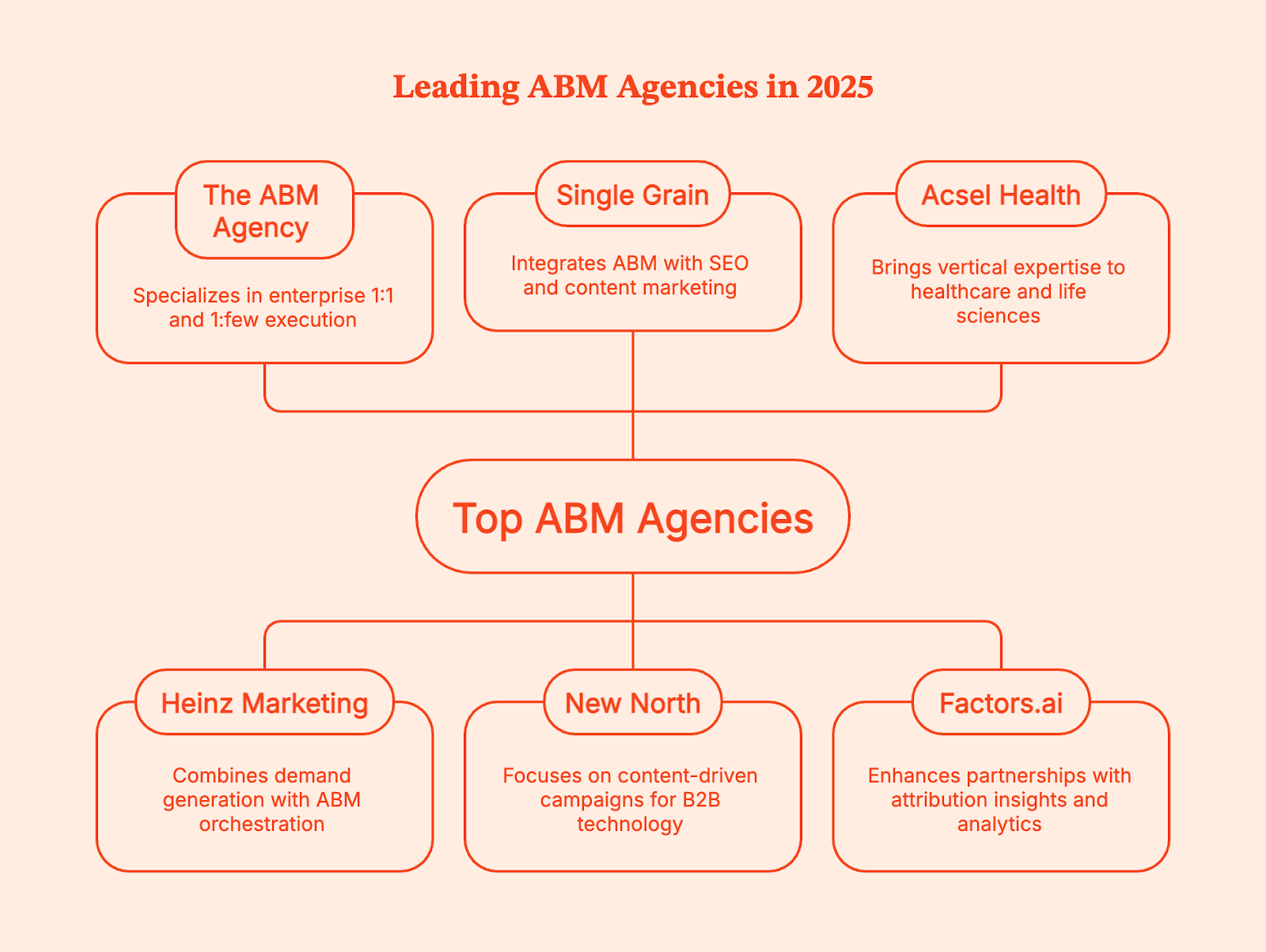
The ABM Agency
Known for precise 1:1 and 1:few programs that support long sales cycles, this team builds plans around account value and buying readiness. Their structure helps enterprises put time and budget toward accounts that move revenue.
Heinz Marketing
Strong in demand generation and ABM orchestration, they focus on creating a shared operating rhythm for sales and marketing. B2B tech firms that want a cleaner pipeline process often find their approach steady and reliable.
Single Grain
Their strength comes from pairing ABM with SEO and content marketing, so target accounts find useful material while receiving coordinated outreach. SaaS companies benefit from this mix because technical buyers usually start with research before they speak to sales.
New North
They work closely with B2B tech teams that need thoughtful content to guide engineers, product leaders, and other technical evaluators. Their campaigns give these stakeholders clear information at each stage of the buying process.
Acsel Health
With deep familiarity in healthcare and life sciences, they account for clinical reviews, regulatory concerns, and extended decision paths. This helps clients avoid generic messaging that slows down evaluations in regulated environments.
Factors
Although not an ABM agency, it enhances programs by tying engagement signals and attribution insights back to revenue. Many teams use it alongside the agencies above to keep performance visible and grounded in reliable numbers.
Account-Based Marketing vs. Traditional B2B Marketing
It’s easier to make sense of the differences when you look at them next to each other, so here’s a quick comparison between ABM campaigns vs. traditional B2B marketing.
| Account Based Marketing | Traditional B2B Marketing | |
|---|---|---|
| Primary focus | Engagement and movement inside defined accounts | Lead volume and MQL counts |
| Buying view | Non linear behavior with several stakeholders active at once | Linear funnel with predictable handoffs |
| Core metrics | Account progression, pipeline influence, revenue impact | MQLs, conversion rates, form fills |
| Typical use case | Strategic accounts and complex evaluations | Broad awareness and top of funnel capture |
| Strengths | Higher impact on qualified opportunities | Scalable reach at lower cost |
In fact, ABM delivers 14% higher pipeline conversion rates and 25% better MQL to SQL conversion compared to traditional B2B marketing approaches. The focus on quality over quantity drives these improvements for B2B brands.
How to Collaborate Effectively with an ABM Partner
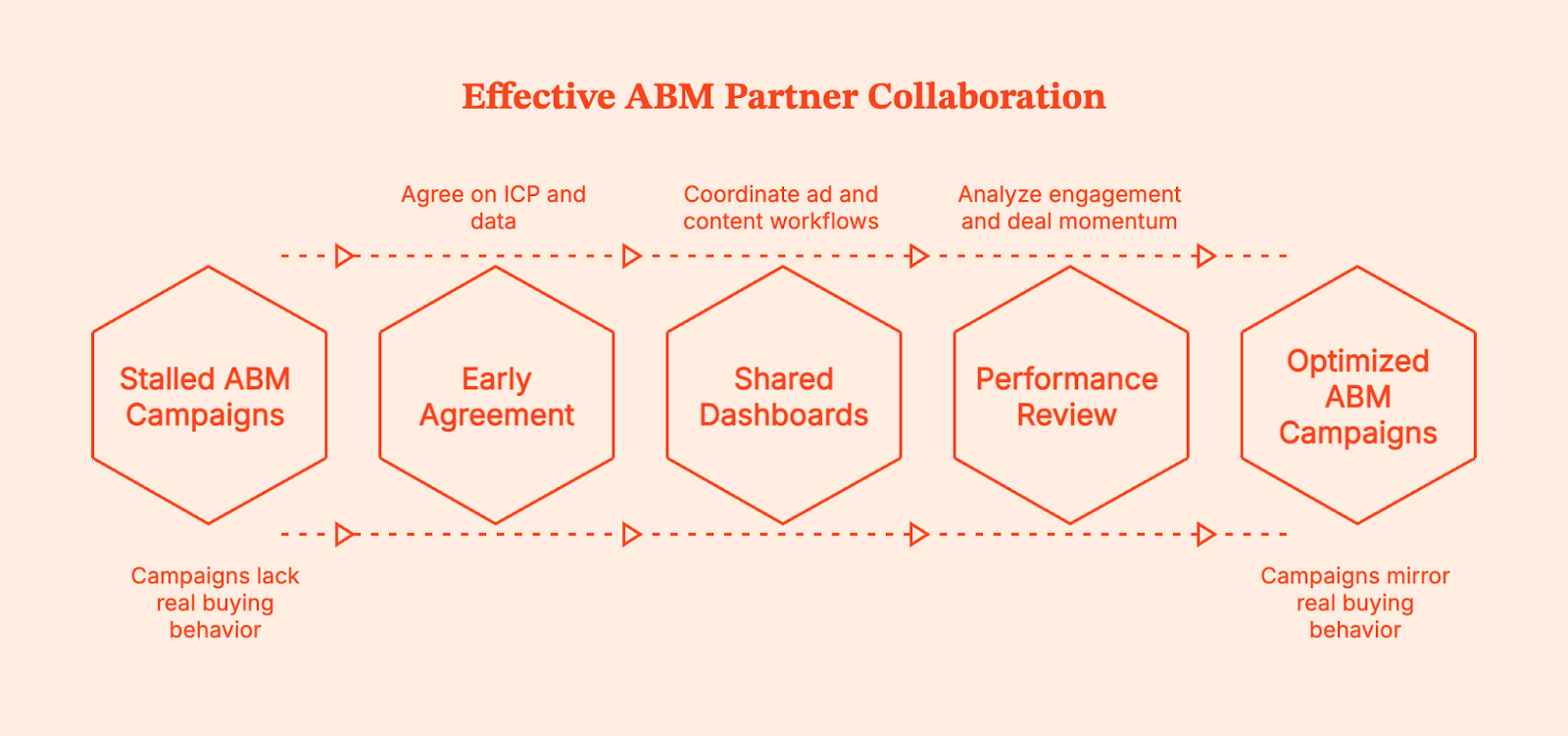
Good collaboration starts before the contract is even signed. When both sides agree on the ICP, know which data sources matter, and understand how sales works a deal from first touch to close, the agency can shape campaigns that mirror real buying behavior instead of making assumptions. Sharing this groundwork early also helps them see which stakeholders matter most and which patterns tend to signal a strong opportunity.
During execution, the day to day flow becomes just as important. Working from the same dashboards, moving content approvals quickly, and coordinating ad workflows keeps campaigns from stalling. Teams often layer in Factors.ai so the agency can see how accounts move through the buyer journey, not just whether they clicked an ad or downloaded a resource. This extra visibility shows which accounts are genuinely warming up and which ones need a different approach.
After a cycle wraps, both teams review the performance with an eye on what should shift next quarter. The most helpful conversations break down where engagement deepened, where deals gained momentum, and where the path stalled. That shared view leads to cleaner planning instead of starting from zero each time.
Measuring Successful ABM Programs
Strong ABM programs show their impact inside target accounts long before a deal closes. Pipeline generated from named accounts, the depth of touchpoints across the buying group, and changes in deal size or pacing all help paint a clear picture of progress. Looking at how much pipeline marketing sourced versus influenced adds nuance, especially when decisions involve several teams inside the account. ROI by segment then clarifies where to double down.
Factors strengthens this picture by turning scattered engagement into a single story. Milestones show how accounts move through key stages, while Account 360 lines up activity across ads, the website, and the CRM. This makes it easier to see which campaigns played a meaningful role in advancing an opportunity.
Track metrics that matter: pipeline generated from target accounts, account engagement depth, deal velocity improvements, and marketing-influenced revenue percentage. Secondary metrics include stakeholder coverage, content consumption patterns, and campaign-specific performance that indicate effective ABM execution.
The Future of B2B Account-Based Marketing
AI has taken over the heavy lifting in segmentation, predictive scoring, and identifying which accounts are starting to show intent. It gives ABM teams a clearer read on where momentum is building and which plays deserve attention. And automation is tightening the rest of the workflow by keeping audiences synced across LinkedIn, Google, and the CRM without manual work.
With privacy rules tightening, first party data is becoming an important aspect for targeting and measurement, marketers now rely on unified analytics to keep campaigns accurate even as old tracking methods fade.
Factors helps teams automate the operational side of ABM, audience updates, alerts, attribution, and performance breakdowns, so programs run smoothly without constant exporting and stitching.
FAQ
Q: What’s the difference between an ABM agency and a demand-gen agency
A: An ABM agency focuses on a fixed list of high value accounts and builds personalized programs for the people inside those companies. They measure success by account movement and revenue impact rather than lead volume. Demand gen agencies cast a wider net and optimize for reach, traffic, and top of funnel activity.
Q: How much budget should I allocate to ABM
A: You should plan for a monthly service fee plus additional budget for technology and media. The total depends on how many accounts you want to target and how personalized the campaigns need to be. Programs with deeper research, custom content, or multi channel orchestration naturally cost more.
Q: Can startups or SMBs use ABM effectively
A: Yes, smaller teams can run ABM as long as they keep the account list tight and focus on the roles that matter most. Lean programs often rely on strong messaging, targeted outreach, and lightweight personalization. This approach helps startups avoid spreading resources across accounts that aren’t ready to buy.
Q: How long before I see ABM results
A: You’ll see early engagement within the first few weeks, but meaningful pipeline movement takes a few months. Multiple stakeholders need to interact with your content before opportunities open. The clearer your ICP and messaging, the faster those signals start to compound.
Q: What KPIs should I track when evaluating ABM performance
A: The most important KPIs are pipeline from target accounts, deal progression, and revenue influenced by the program. Secondary indicators like engagement depth, buyer group coverage, and content interaction help explain why accounts move the way they do. Tracking both levels gives you a fuller picture of program health.

See how Factors can 2x your ROI
Boost your LinkedIn ROI in no time using data-driven insights


.avif)

See Factors in action.
Schedule a personalized demo or sign up to get started for free
LinkedIn Marketing Partner
GDPR & SOC2 Type II







.svg)



.avif)

