
Best Free AI Tools for Marketing
Discover the best free AI tools and free LLMs for marketing. Learn how to automate, analyze, and create smarter with Factors.ai.

Writer



.svg)


TL;DR
- Free AI tools are essential for marketing workflows across content, design, analytics, and automation.
- Key tool categories: Language/LLMs, Design AI, Social Automation, Analytics, CRM, and Chatbots.
- Top free tool examples include: Copy.ai, Notion AI, Canva Magic Studio, Buffer, Google Trends, Factors.ai, HubSpot Free CRM.
- Best free LLMs for marketers: Mistral 7B, Llama 3, Gemini 1.5 free tier, Hugging Face Spaces.
- What to look for: scalable free tiers, strong data privacy, integrations (APIs, Zapier), and active documentation.
- Common pitfalls: free-tier limitations, data privacy risks, disconnected workflows, and poor AI oversight.
- Best practices: introduce AI one workflow at a time, maintain human editing, ensure clean data, and measure everything.
- Future trends: multimodal free LLMs, autonomous AI agents, open-source innovation, and human-AI co-pilot workflows.
Remember when "AI in marketing" felt like science fiction?
Cut to now, and how the turn tables...
Now, artificial intelligence and large language models (LLMs) are table stakes for every marketer. AI is taking on everything from research to predicting campaign ROI to even code generation (yes, sometimes we need that too).
A survey found that 82% of respondents using AI tools report using them for marketing. For daily users, the average reported weekly time saved was 14 hours.
If you're a marketer, then you need to get on board with AI, especially free AI tools for marketing.
Not every free tool or free version of a paid tool can create marketing magic. But the ones listed in this article certainly can.
When used well, they allow lean startups to test, iterate, and scale ideas without going broke. You can prototype campaigns, generate visuals, and even run customer insights.
Pro-Tip: Most of these tools work at their best when you connect them to your data, strategy, and tech stack. Solutions like Factors.ai (fantastic free version available) can help do that, and turn scattered AI inputs into actionable insights.
Types of Free AI Tools Marketers Should Know
Not all free AI tools are created equal. Some will change your life. Others will ruin your day (or quarter). To start sifting, it's important to understand the categories of free AI tools.
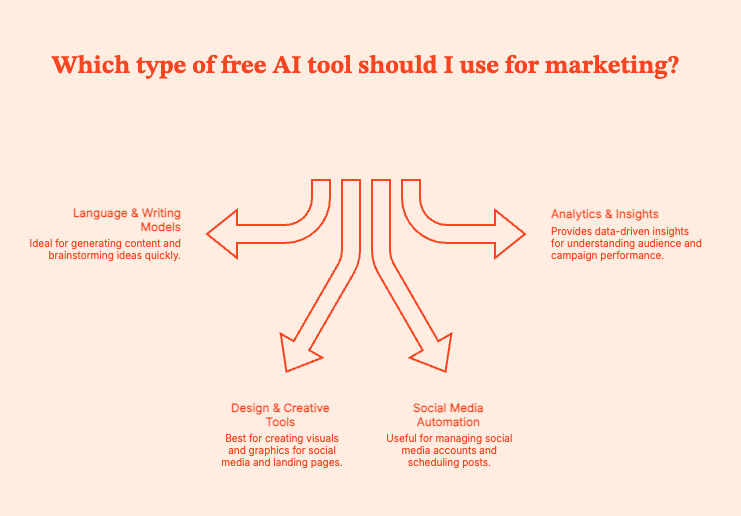
Language & Writing Models
These tools use large language models to help write everything from headlines, landing pages and long-form content (you need a human editor, though). A similarly sized model can even write emails in a specific voice. They can generate human like text, but still need your final sign-off.
If you need content support for multiple languages, filter for tools with multilingual and multimodal capabilities.
Common uses:
- Brainstorming ideas in seconds.
- Turning vague thoughts into structured content.
- Banishing writer’s block with ruthless efficiency.
Top free options:
Copy.ai, Jasper (free tier), Writesonic, Notion AI, SlateHQ
Design & Creative Tools
Can't draw a circle in PowerPoint? Proprietary models to the rescue!
These tools can generate visuals like banners, product shots, thumbnails, and ad creatives. You need a human designer to run final edits, but they'll be able to do much more in the same time.
Common uses:
- Social media graphics.
- Product visuals for landing pages.
Top free options:
Canva Magic Studio, Fotor AI, Adobe Firefly Free, Leonardo.ai
Social Media Automation
Social platforms move too fast. And some of us are old. These AI agents can step in (and stay young enough to keep up, unlike the rest of us).
AI tools can generate captions, schedule content, analyze engagement, and replicate a full social team. You will have to edit the captions.
Common uses:
- Consistent posting without burnout.
- Idea generation for captions and hooks.
- Basic analytics.
Top free options:
Buffer AI Assist, Later, Hootsuite Free
Analytics & Insights
These tools highlight what your audience wants, which keywords to target, and if/how/where your marketing efforts are paying off.
You'll get numbers that make sense. Or at least, numbers that explain why last week’s campaign flopped.
Also read: AI Market Research Tools: From Hype Threads to 10 Tools Worth Using
Common uses:
- Keyword exploration and trend hunting.
- Understanding customer intent.
- Revenue attribution, performance insights, and campaign ROI.
Top free options:
Google Trends, ChatGPT (free), Factors.ai
Pro-Tip: These tools will have to provide enhanced data security, as they will handle sensitive data (often internal team essentials). Double-check before using.
Pro-Tip II: No matter which tool you use, do not forget to account for the differences between B2B marketing funnels and B2C marketing funnels.
What to Look for in a Free AI Tool (and a Free LLM)
Every day, there’s a new “must-try” AI app promising to revolutionize your marketing, your workflow, and possibly your karma, at this point.
But not every free AI tool deserves space in your stack. A good free AI tool should fit into your marketing world, not disrupt it. The ones that do should meet the following conditions:
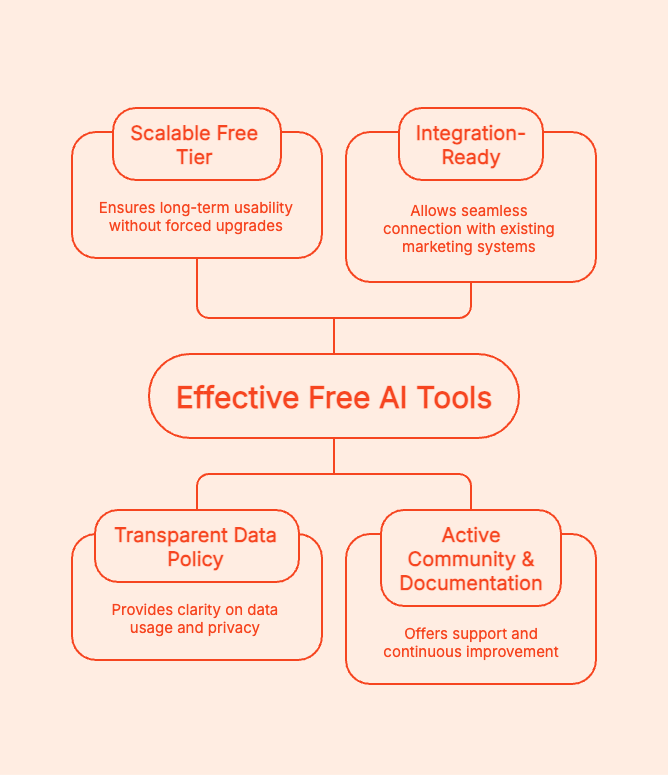
Scalable Free Tier: Does the “free” part last long enough to actually be useful, or does it expire faster than the can of chilli you bought after closing time? The right tools are ones where upgrading is a choice, not a hostage situation.
Transparent Data Policy: Does the tool use your campaign data to train its language models? Read the fine print (READ it). You should know exactly how these commercial models store, share, or reuse your data.
Integration-Ready: The tool should integrate with your CRM, analytics, and ad platforms. Ask for APIs, Zapier connectors, or built-in integrations. For instance, if it plugs into with Factors.ai, you can measure real ROI instead of “vibes.”
Active Community & Documentation: Dating's hard enough. Your tool should not also ghost you. Verify that it has an active user base, regular updates, and clear documentation. The best free tools are constantly improving based on user feedback.
For LLMs
Stay with me; it'll get a little nerdy:
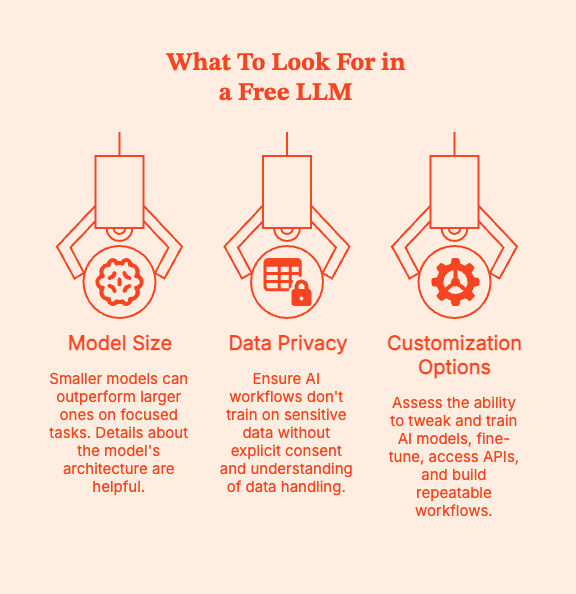
- Model Size vs. Performance Trade-offs
Certain smaller, efficient models, like Mistral 7B, can outperform giants on specific, focused tasks. If you can, get some details about the model's architecture.
- Data Privacy
Your AI workflows should not be trained on your customer list or confidential strategy deck unless you’re 100% sure how that data is handled.
- Customization Options
Can you tweak and train AI models for your brand? Can you fine-tune, gain API access, or use lightweight model hosting? Can you build repeatable workflows or automations?
{{INLINE_MOFU}}
The Best Free AI Tools for Marketing (Competence + Cost Savings)
Free AI tools will act as your intern, fellow strategist, and design assistant. You need to know which tools are worth your time, and this list can help. Start here.
Pro Tip: Before you peruse this list, have a look at the Complete Guide to Customer Journey Stages for Maximum Retention. Then, map these tools onto different stages of a marketing journey: awareness, engagement, conversion.
Pro Tip II: Be guarded with your data in the open-source LLM space. Everyone is trying to train their models, but your customers’ information is not up for grabs.
Content Generation & Copywriting
These tools will help you create robust outlines and optimize content for SEO value + engagement.
- SlateHQ: Slate is a content engineering and content refresh platform with which you can build customised workflows to automate your entire content lifecycle.
- Copy.ai : This is your brainstorming buddy.. Use it for rapid content ideation: ad hooks, blog outlines, and email subject lines.
- Notion AI: Already using Notion? This is for you. The AI agent summarizes meetings, generates blog drafts, or refines to-do lists right where your work already exists.
- Jasper (Free Trial): Jasper is built for structured, scalable workflows. It also comes with fairly competent templates for ads, landing pages, and SEO blog posts.
- Writesonic: Can produce perfectly usable drafts for blog posts, landing pages, and ads. I also like the integrated “SEO mode” that optimizes the content as you write it.
Pro tip: Use AI to research and build drafts. You still need to write, even if your tool has multilingual capabilities.
Visuals & Design
Photoshop is hard. These tools are easier with their AI wizardry.
- Canva Magic Studio: A wonderland for non-designers. It can draft captions, create custom visuals, and brand everything with your chosen fonts and colors.
- Leonardo.ai : Find the right prompt ("futuristic B2B dashboard mockup with pastel gradients") and it will deliver stunning product visuals and creative concepts.
- Adobe Firefly Free: Ideal for enterprise-grade, copyright-safe image generation. It integrates with Photoshop and Express.
- Fotor AI: Marketers, check this one out for handling background removal, headshots, and social posts.
Reality check: AI visuals can be beautiful, but you're still responsible for its brand consistency.
Social Media & Outreach
For marketers who live in 17 time zones at once. These tools will help make social posting feel less like a chore.
- Buffer AI Assist: This language model drafts captions, suggests hashtags, and auto-schedules content.
- HubSpot Free CRM + AI Writer: You can do a lot with this one: manage leads, generate outreach messages, and see insights in the same dashboard. Great for matching content creation with customer insights
Bonus Read (for extra research): HubSpot Analytics Vs. Factors.ai – Features, Limitations, Integrations & More
- Hootsuite Free: You can use the free plan to schedule, monitor engagement, and even generate post ideas. Again, single dashboard.
Market Research & Insights
You need an AI engine's superhuman analytical capabilities to understand the modern customer. It will help with finding trends, understanding audiences, and identifying what's worth the investment.
- Google Trends: The most well-known free tool out there. See trending topics, shifts with season and location-based demands.
- Factors.ai Free: Use the free version to connect your campaign data with other data banks (ads, web analytics, CRM). Zero in on the efforts that actually drive revenue.
- AnswerThePublic: Find what real people are searching for, and what to really prioritize when building SEO-friendly content.
Pro tip: Ideally, use all 3 together: Google Trends to research trends, AnswerThePublic to find the right questions, and Factors for performance.
Also read: AI marketing vs traditional marketing: What actually drives growth?
Customer Engagement & Chatbots
Customer conversations are now 24/7. No one is waiting until Monday to get their answer. They'll cancel their account or just leave. These AI tools can help brands stay responsive without losing your weekends (or minds).
- ChatGPT (Free): Great for brainstorming, scripting, or building quick responses. Train it well and it can be a chatbot + co-strategist.
- Poe by Quora: Users can switch between different AI models like GPT, Claude, and Llama from one interface. Use it to compare tone, style, and output quality.
- Hugging Face Spaces: Curious marketers, this is your playground of open-source models and experiments. Test out free LLMs before they hit the mainstream.
Free Marketing Tools for Startups
Startups run on caffeine, ambition, and free tools. When you're wearing twelve hats, answering Slack at 2 am, and trying to prove ROI, you don't need another paid tool.
So, consider these tools to automate the busywork, measure what is working, and grow faster + smarter.
CRM & Automation
- HubSpot Free CRM: Manage contacts, deals, and even trigger basic email sequences. You can get a polished customer pipeline without hiring a sales team.
Bonus Read: 9 AI Sales Strategies for Small Business Growth (2025)
- MailerLite: Minimalist. Elegant. Automate emails, landing pages, and newsletters, especially for product launches and community building.
- Brevo (formerly Sendinblue): Use this to set up your marketing command center: email, SMS, and automation workflows. The free plan lets you send 300 emails per day.
Pro tip: Use one AI copy tool to write email sequences. Once they are sent, feed engagement data back into Factors to see which messages convert.
Analytics & Measurement
Your insights need to go far beyond "the number of clicks has increased".
- Google Analytics: A reliable, battle-tested tool for understanding web traffic, user behavior, and conversion funnels. You can see where your audience is coming from and how they interact with your assets.
- Factors Free Tier: Google Analytics tells you what happened, Factors tells you why. It will connect CRM data, ad campaigns, and website activity to find the highest ROI drivers.
Bonus Read: Factors Vs. Google Analytics (GA4)
Social Media Management
Staying on top of social media is hard. Get some help from these tools:
- Buffer (Free Plan): Schedule posts across platforms, study engagement analytics, and get drafts of captions that don't sound bot-generated.
- Later (Free Plan): Highly recommended for Instagram and LinkedIn scheduling. Use the drag-and-drop visual planner to design your grid and plan a visual narrative.
Putting It All Together
Try connecting these free tools through Factors to build a marketing stack from scratch:
- Create content with AI tools (Copy.ai, Canva, Jasper).
- Distribute via Buffer, MailerLite, or HubSpot Free.
- Track engagement with Google Analytics.
- Analyze conversion and ROI inside Factors
Within days, you’ll know which campaigns attract and identify your ideal customers (ICP), which messages convert, and which ones need rework. All for free.
Pro-Tip: Get clear on the difference between the ICP vs. Buyer persona before crafting any marketing strategy.
Understanding Free LLMs (Large Language Models) in Marketing
What exactly is an LLM, and why should marketers care?
The LLM or Large Language Model is an AI engine trained on massive text datasets to understand and generate human-like language (not human language, big difference). These models power ChatGPT, Jasper, and most AI tools that interact with human users in natural language.
For marketers, LLMs can work as a very informed and competent assistant who can write drafts, brainstorm ideas, sum up reports, analyze customer tone and sentiment, personalize outreach/ad copy, and a lot more.
These models do the grunt work and first-layer thinking/research. Humans come in with strategy, creativity, and nuance.
Best Free & Open-Source LLMs
- Mistral 7B : Lightweight, insanely efficient, great for marketing copy or summaries.
- Meta’s Llama 3: Great for creative writing, analysis, and chat-based interaction. Now has better safety filters and multilingual support.
- Google Gemini 1.5 (Free API Tier): Great for experimenting with multimodal inputs (text + image). Use it for campaign ideation, performance summaries, and trend analysis.
- Hugging Face Models & Spaces: Test hundreds of LLMs for everything from summarization, tone adjustment, ad generation, to audience sentiment analysis.
Pros & Cons
Pros:
- You get access to powerful models without paying a dime. Test your workflows or build proof of concepts.
- Most open models can be fine-tuned for brand tone or audience preferences.
- Updates, extensions, and new features often come faster than in closed systems.
Cons:
- Free tiers may throttle response times or limit the complexity of tasks.
- Free LLMs often forget deep context in conversations unless your prompting stays smart.
- Many free APIs or demo store queries should not be exposed to sensitive campaign data.
Real-World Use Case: Build a Smart Feedback Loop
- Use Mistral 7B or Llama 3 to build ad copy variations for your new product launch.
- Run those campaigns across social and search.
- Feed the engagement and conversion data back into Factors.ai.
- Factors immediately highlights which copy works.
- Scale what converts.
- Repeat.
That’s the magic loop: Create → Launch → Measure → Optimize → Repeat.
Common Pitfalls When Using Free Tools
Be warned. Sometimes, free tools can hide more fine print than a SaaS contract written by lawyers on espresso. Here's what to watch out for before letting free tools run amok on your data.
- Free ≠ Limitless
Free tools are usually better for testing rather than running 24x7 operational marketing stacks. You'll hit credit caps, features locked behind paywalls, and data throttling after a certain amount of use.
This is the business model. Free tiers get you hooked, then you are nudged to upgrade.
Use these tools strategically. Test fast, validate workflows, and get out. “Free forever” is rarely scalable.
- Data Privacy Gaps
If you're not paying for a product, it's because you are the product.
Many free AI tools log prompts, store customer data, or use your content to train their models. They're great for brainstorming, but not recommended for uploading documents for client proposals or campaign briefs.
Look closely at the tool's data retention policy. Does it let you opt out of training data collection? Is there any enterprise-level encryption or compliance (GDPR, SOC 2)?
Keep your prompts generic and never enter any sensitive or proprietary data unless the tool assures data privacy.
- Disjointed Workflows
It doesn't matter if you have twenty tools at hand if they do not "talk" to each other.
What often happens is that users create content and long context tasks in one platform, design edits it in another, social posts stay in Buffer, analytics are confined to Google, and no one really knows where your CRM data is.
As a result, you get disconnected data, duplicated work, and infinite copy-paste hell.
Get your tools to communicate, or you cannot pin down which campaigns drive which leads, or how an ad actually performs.
Pro-Tip: You can align your tools with Factors. Use it as a marketing command center to connect CRM, ads, analytics, and AI content into one unified dashboard.
Best Practices for AI-Powered Marketing
AI-powered marketing only works when you play smart, strategic, and most importantly, sane. These best practices will get you there.
- One Workflow at a Time
Don’t “AI-enable” your entire marketing operation overnight.
Pick one bottleneck (blog ideation, ad copy testing, or email generation). Introduce AI here first.
Monitor any changes: Does it save time? Does quality remain consistent?
If you see improvement, expand the tool's function.
Move on to the next workflow. Repeat.
It's like leg day. Consistency counts.
- Human Oversight at Every Stage
AI can mimic creativity, but it will never be the real thing. Your audience will spot soulless automation and scroll right past it. AI can generate drafts, but human editors need to come in to check:
- Tone and emotion
- Context and accuracy
- Brand alignment
- Feed Clean Data
AI is only as smart as the data it is trained on. Feed clean prompts, inputs, and datasets, or outputs will suffer. Clean data = better answers.
Check:
- if CRM fields are consistent
- if tracking tags are applied correctly
- if you're feeding the AI tool real audience insights
Structured inputs ensure that your AI tool can surface patterns and recommendations, providing real-world value.
- Measure Everything
You have to measure results to improve performance. If your AI tools are scattered across platforms, that can be tricky. Again, Factors can help by connecting your ads, CRM, and analytics data in a single UI.
Future Trends in AI & LLM Marketing Tools
AI tools have long moved beyond being a fancier version of a typewriter or Google. It is set to collaborate, anticipate, and adapt to human needs, and you need to use every one of its abilities to your advantage.
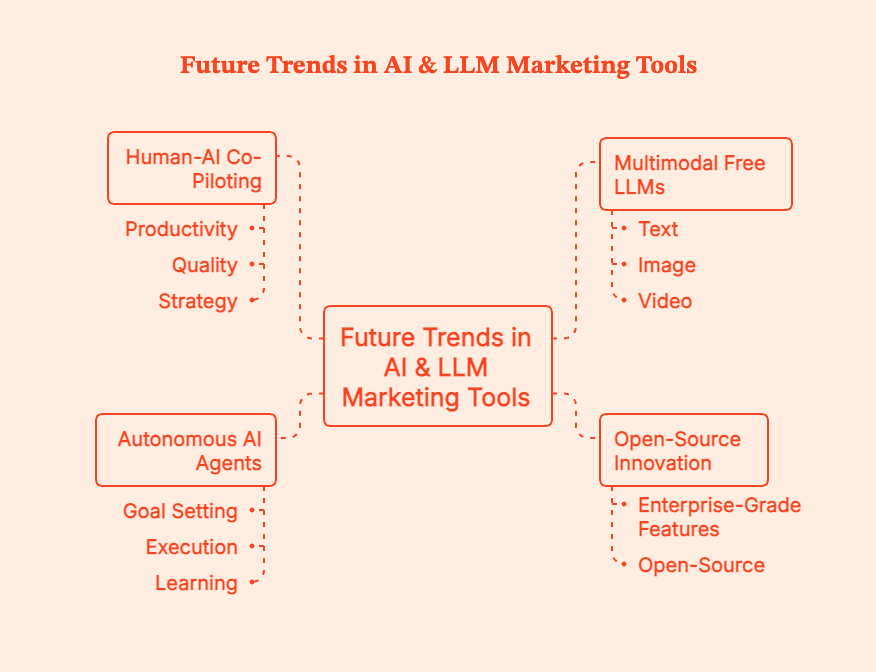
Here's how AI is set to change economic and creative landscapes globally:
- Multimodal Free LLMs (Text + Image + Video)
LLMs can now generate spoken audio, images, video, emojis, GIFs, and maybe even holograms are on the way. To use them optimally, marketers need to master multimodal inputs. For instance, marketers can use AI tools to run sentiment analysis of past customer interviews for deeper insights.
- Open-Source Innovation & Enterprise-Grade Free Tiers
Increasingly, even the free tier of many AI tools comes with enterprise-grade features, sufficient for operations at most early to mid-stage startups. Many of these are open-source and completely free of cost.
Anticipate an increase in the number of smaller, efficient LLMs you can experiment with.
- The Rise of Autonomous “AI Agents” Running Marketing Workflows
You set the goals. AI agents execute, learn, and improve.
Gartner predicts that at least 15% of day-to-day work decisions will be made autonomously through agentic AI by 2028, up from 0% in 2024. However, the same study also states that around 40% of agentic AI-driven projects will be cancelled if they do not show requisite value.
So, don't go all in. Tread cautiously.
- Human-AI Co-Piloting Becomes the Norm
AI does not replace humans. It augments us.
AI is an incredible co-pilot, built to do repetitive tasks while we delve into strategy, emotion, and insight.
A study found that: Humans in human-AI teams experienced 73% greater productivity per worker and produced higher-quality ad copy, while human-human teams produced higher-quality images, suggesting AI agents require fine-tuning for multimodal workflows.
Use AI tools to draft text, conceptualize visuals, and analyze sentiment. You refine, contextualize, and personalize it for humans.
Free AI tools for marketing have become one of the most accessible superpowers in any team's toolkit. Generate ad copy, design visuals, analyze customer behaviour, and test campaign ideas while spending zero dollars.
However, do not delude yourself: the brainwork is still all you.
Free AI models will make you faster, sharper, and more creative than ever.
Factors.ai will help you understand which content actually moves revenue.
Together, they will turn marketing chaos into insight and speed into impact.
Ready when you are.
FAQs for Best Free AI Tools for Marketing
Q. What is the difference between free AI tools and paid ones?
Free tools help you experiment; paid tools help you scale. Most free AI tools can get some real work done, like draft content, generate visuals, schedule posts, and analyze trends.
But paid tiers unlock features like higher usage limits, faster processing, advanced integrations, wider collaboration features, and improved privacy.
Q. Can startups rely only on free tools?
Yes, many do.
Early-stage teams can even run entire marketing operations on free CRMs, free AI models, free analytics, and free scheduling tools.
But free tools are mostly useful for testing strategy. Paid tools help execute that strategy at scale.
Q. Are free LLMs effective for content quality?
Yes. Open-source models like Llama 3 and Mistral 7B can help you create blog outlines, short-form copy, summaries, brainstorming, ad variations, and social captions
Q. How can Factors.ai enhance free AI workflows?
Free AI tools help create content, and Factors helps you measure how that content actually performs. Users can, for instance,
- connect their AI-generated content & campaigns to actual conversions.
- monitor which ad variations perform best.
- map revenue back to channels, ads, and creatives.
- track ICP engagement and pipeline impact.
- get unified, AI-powered analytics on their efforts.
Q. When should I upgrade from free to paid?
Upgrade when free starts costing you more than it saves. Make the shift when:
- you’re hitting usage caps every week.
- your team needs collaboration + sharing features.
- you need advanced integrations (CRM, ads, analytics).
- you want to scan paid channels or outbound.
Use AI to Make Yourself Irreplaceable
Free AI tools for marketing have become one of the most accessible superpowers in any team's toolkit. Generate ad copy, design visuals, analyze customer behavior, and test campaign ideas while spending zero dollars.
However, do not delude yourself: the brainwork is still all you.
Free AI models will make you faster, sharper, and more creative than ever.
Factors.ai will help you understand which content actually moves revenue.
Together, they will turn marketing chaos into insight and speed into impact.
Ready when you are.
Summary
Artificial intelligence has become foundational to modern marketing, with free AI tools enabling businesses to create content, design visuals, automate posting, and analyze performance without spending.
Major categories include language and writing models (Copy.ai, Jasper free, Writesonic), design tools (Canva Magic Studio, Adobe Firefly Free), social media automation (Buffer, Hootsuite Free), and analytics platforms (Google Trends, Factors.ai). There are also CRM and automation tools like HubSpot Free CRM, MailerLite, and Brevo.
The best free LLMs for marketing workflows include Mistral 7B, Llama 3, Gemini 1.5, and models available on Hugging Face.
Choosing the right AI tool requires evaluating scalability, data privacy, integrations, and community support. Marketers should avoid pitfalls such as data leakage, free-tier limits, and fragmented workflows.
Best practices include introducing AI to one workflow at a time, maintaining human oversight, feeding clean data, and measuring outcomes consistently. As AI evolves, marketers will benefit from multimodal LLMs, autonomous AI agents, and deeper human-AI collaboration.

See how Factors can 2x your ROI
Boost your LinkedIn ROI in no time using data-driven insights


.avif)

.avif)
See Factors in action.
Schedule a personalized demo or sign up to get started for free
LinkedIn Marketing Partner
GDPR & SOC2 Type II






.svg)



.avif)

