
GTM Engineering Trends 2026: What the Fastest-Growing Teams Are Doing
Explore the top GTM engineering trends shaping 2026 – AI automation, workflows, signal-based selling, and revenue efficiency for modern B2B teams.

Writer

Growth Marketer



.svg)


TL;DR
• GTM Engineering is now the backbone of high-growth teams. It connects tools, data, and workflows so revenue scales without adding more headcount.
• Signal-based selling is replacing cold outbound. Unified data, AI workflows, and smart LinkedIn automation make your GTM motion faster and more accurate.
• Buyer journeys are now non-linear and multi-threaded, which means clean signals and shared systems matter more than ever. Teams that consolidate their stacks see better alignment and lower CAC.
• The winning GTM stack for 2026 is simple. One clean CRM, one signal layer, one outbound engine, and one ads layer working together with tight workflows and strong AI automation.
There’s a typical (and an oddly familiar) rhythm to a B2B setup:
- An SDR is on Slack asking why yesterday’s demo request never reached Salesforce.
- A rep is confused about why an email sequence sent the wrong opening message.
- Marketing is trying to understand which campaign drove yesterday’s spike in traffic.
- Sales says an account is showing intent, but no one knows where that signal came from.
Everyone is busy, but nothing feels coordinated. These problems are minor on their own, but cumulatively, they slow down the entire revenue engine.
That’s the gap GTM Engineering fills. It connects your tools, data, and workflows so all the activities run in sync. It is just like an automated traffic system that keeps everything moving instead of humans directing the traffic by hand.
SDRs used to handle most of this through manual research and outreach. But that doesn’t match how quickly or non-linearly buyers move today. Today, B2B buyers respond better to contextual outreach that meets them halfway through their buying journeys. This is why high-growth teams are bringing in the best GTM Engineers before adding more SDRs to their sales team. They believe in opting for one strong builder who can set up workflows that dozens of reps can optimize on.
And that’s exactly what Factors.ai delivers. It unifies signals from ads, product usage, website activity, and the CRM, then turns them into actions your workflows can run automatically.
Why GTM Engineering is Critical for Revenue
Talk to any B2B sales team today, and they’ll unanimously agree: acquiring customers is getting more expensive. The 2025 Benchmarkit report backs this up. Companies are now spending about $2 in Sales and Marketing to earn $1 of new ARR, a 14% jump from 2024.
The buying cycle isn’t helping either. Intent shows up across channels, SDRs chase spikes, content teams build for micro segments, and ad budgets shift overnight. It feels like solving a jigsaw puzzle that keeps changing shape.
The same report also points out a 10% higher blended CAC ratio than in 2022, which means teams are spending more to earn each dollar of revenue. The only sustainable way to reverse that trend is to rely more on automation and less on headcount. Adding more sales reps won’t fix the math.
Leaders see this clearly. That’s why efficiency is a top priority for 2026. They want clean handoffs, faster reactions to signals, and workflows that don’t need constant babysitting. GTM Engineering gives them that path. It connects tools and signals, turns scattered behavior into clear actions, and helps teams grow without adding more seats.
Related read: Top GTM engineering tools
Trend 1: Signal-Based Selling Replaces Traditional Outbound
When was the last time you replied to a cold message? My guess is you’d have ignored most of them because either their timing was off or they didn’t match your discovery journey. Your prospects respond the same way. They skip your messages because they didn’t match their intent.
But what if you could ride shotgun on their buying journey? Instead of guessing, you react to what they actually do. For example:
- Someone visits your pricing page.
- Someone reads three articles back-to-back.
- Someone compares you with a competitor.
- Someone clicks a LinkedIn ad but doesn’t fill out a form.
These moments show you who is warming up. That’s the core of signal-based outreach. GTM Engineering makes it possible by pulling these signals together, adding context, qualifying them, and triggering the right action at the right moment.
ClearFeed learned this firsthand. Their team struggled with anonymous traffic, false positives, and SDRs reaching out without knowing which accounts were truly evaluating them. They needed a clearer view of the buyer’s journey, so they brought Factors.ai into their GTM engine.
Once they did, they finally saw real signals, like pricing visits, repeat content sessions, and team-level activity. Their sales assistants stopped volume-based outreach and started acting on behavior, giving them a real competitive advantage. Meetings went up, and the entire outbound motion felt sharper and more human.
Related read: Website visitor to warm outbound play using GTM engineering services.
{{INLINE_TOFU}}
Trend 2: Unified GTM Data Infrastructure Becomes the Default
Apart from the outreach problem, ClearFeed also struggled with scattered data. Ads, website analytics, and CRM details were spread across different systems. Their demand gen team worked with partial information, and marketers had to optimize campaigns without a full view of the account journey.
They aren’t alone. Most B2B stacks still run in silos, but that's starting to change. Teams are pulling all their GTM data closer to the CRM so ad data, web intent, product usage, and attribution sit in one place. The result is simple: cleaner data, faster cycles, better targeting, and lower CAC. The stack doesn’t shrink. It just behaves like one system instead of ten AI tools stitched together. Once everything lives in one place, you finally get real data activation that sends enriched, real-time intent data into every system that needs it.
ClearFeed did the same. They consolidated their data through Factors.ai. Website activity was mapped to accounts, firmographic and behavioral data were enriched and unified inside the CRM, and LinkedIn AdPilot tied ad spend directly to pipeline.
Trend 3: AI Workflows Automate Most of The Daily Go-to-Market Tasks
Follow-ups, enrichment checks, quick research, sorting priorities, refreshing audiences, managing exclusions, sending multi-touch messages. Notice how these tiny tasks steal hours of your GTM team’s time?
AI workflows now handle this layer. They take care of the repetitive work, so your team can focus on what matters. Once you set the logic and strategy, the system takes over: follow-ups, filtering low-quality leads, logging research spikes, and sending the right personalized message all happen automatically.
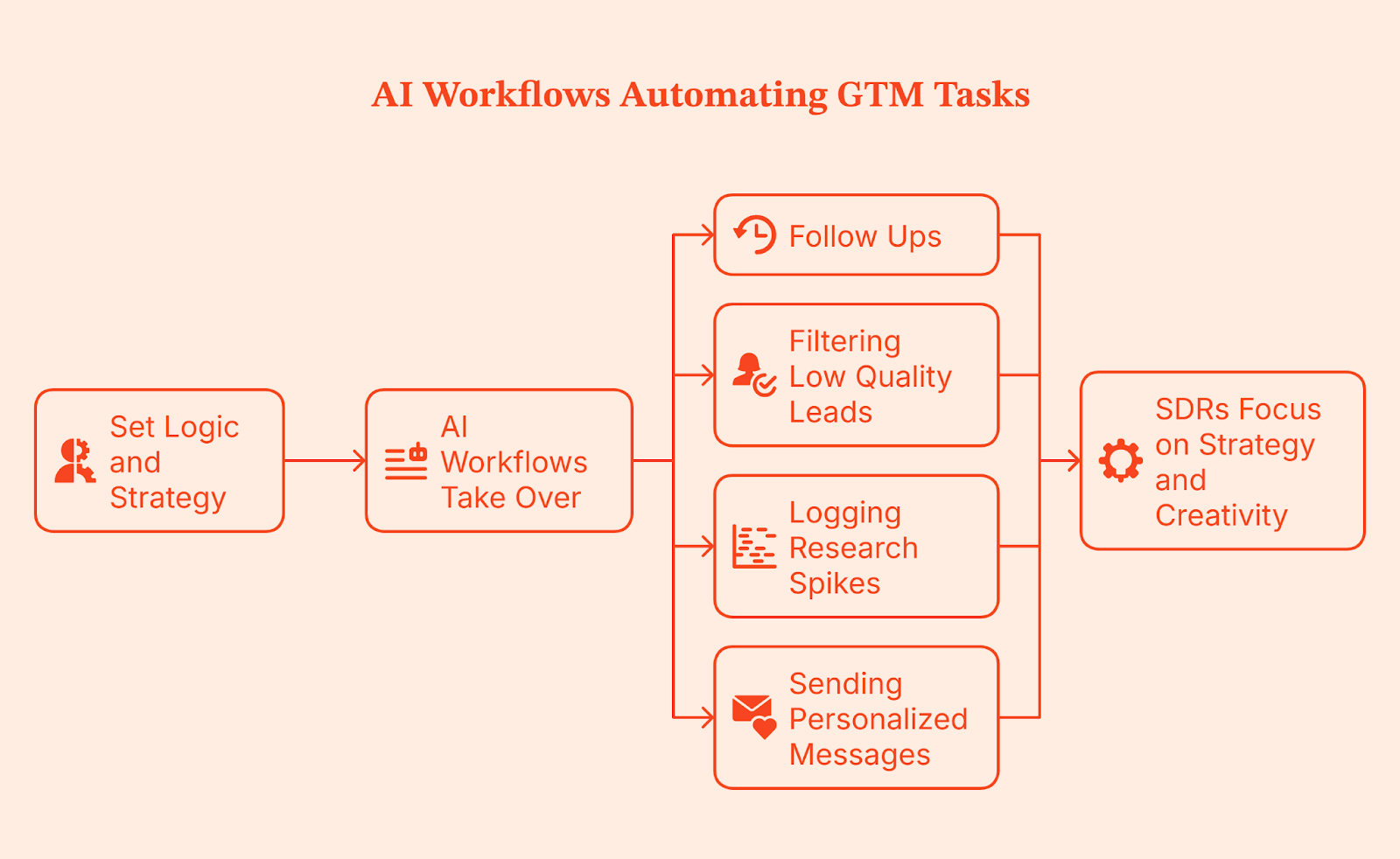
This gives your SDRs room to think. They spend less time clicking through small tasks and more time focusing on strategy and creativity. This is the same layer many teams now call AI SDR or agentic outbound, where automated agents handle research, prioritization, and first-touch tasks so humans can focus on the conversations that actually require judgment.
Trend 4: Marketing and Sales Systems Finally Converge
Raise your hand ✋ if you’ve seen this play out in your organization: Marketing calls an account warm, sales checks their tools, and sees nothing. Both sides are convinced they’re right because they’re looking at different dashboards and different definitions. This misalignment is caused by disconnected systems.
In 2026, GTM teams are moving toward shared dashboards, shared definitions, and shared signals. Website intent, ad clicks, and CRM updates show up for everyone at the same time. Data quality shifts too. It’s no longer a reactive cleanup task. Guardrails, routing rules, and automation keep the CRM clean from the start.
When this happens, the whole revenue operations motion feels lighter. Marketing, Demand-gen, and Sales teams operate from the same source of truth, handoffs become smoother, and the old back-and-forth disappears.
Trend 5: LinkedIn Ad Automation Emerges as the GTM Engine
There’s no debating it: LinkedIn keeps outperforming Google in B2B, and it has become the backbone of most GTM stacks. The catch is that LinkedIn ads can get too expensive too fast. Read more about this on our B2B LinkedIn Ads Benchmark Report.
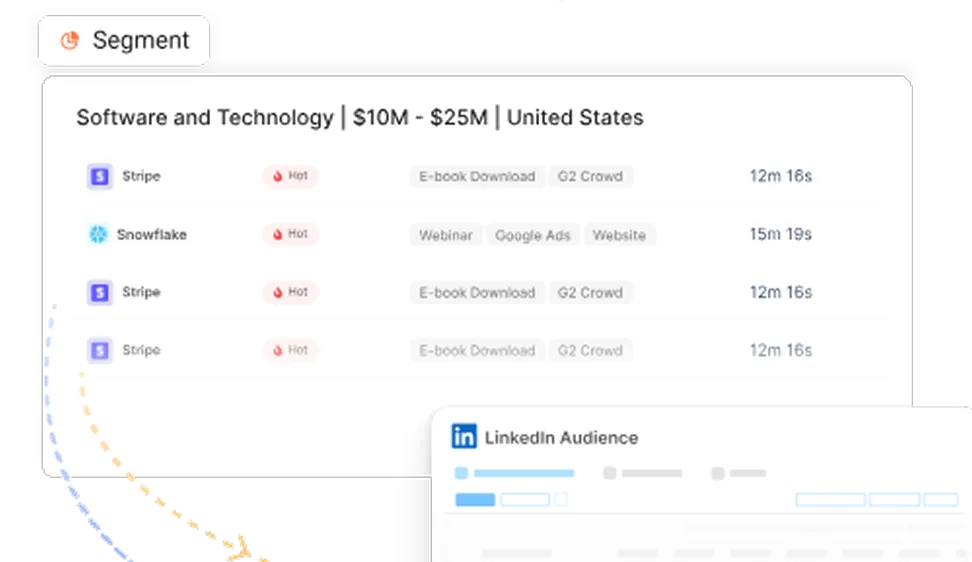
This is why companies are layering their LinkedIn with AI tools like LinkedIn AdPilot. AdPilot uses the intent and engagement signals from your GTM systems to keep your LinkedIn audiences updated, so your ads run on live data instead of static lists. It does this by pulling in real engagement signals such as pricing page visits, content sessions, and account-level activity, then updating your LinkedIn audiences as those accounts heat up.

Running LinkedIn as one connected GTM engine gives you the upper hand with clear advantages:
- Audiences refresh automatically, so you don’t spend on outdated segments.
- You avoid burning your ad budget by showing the same ad to the same person repeatedly.
- Your CRM stays in sync through clean server-side tracking.
- Retargeting becomes smarter with real intent signals.
This makes your paid, organic, and outbound finally behave like one cohesive system.
Trend 6: Buyer Journeys Become Nonlinear and Multi-Threaded
That new client you signed on yesterday? They didn’t follow a sales funnel. Someone found you on LinkedIn. Another checked a blog. Someone else saw your name in a Slack thread. They might’ve even searched for you on Google, got curious, and showed up at a webinar without ever talking to your team.
Same company. Multiple people with multiple marketing touchpoints. That’s how most B2B buying happens now.
People jump between channels based on what they need. They ask colleagues, check communities, click ads, browse your site, and read emails. No single person carries the deal. Stakeholders step in and out as they learn, compare, and validate, and some stay invisible until the very end.
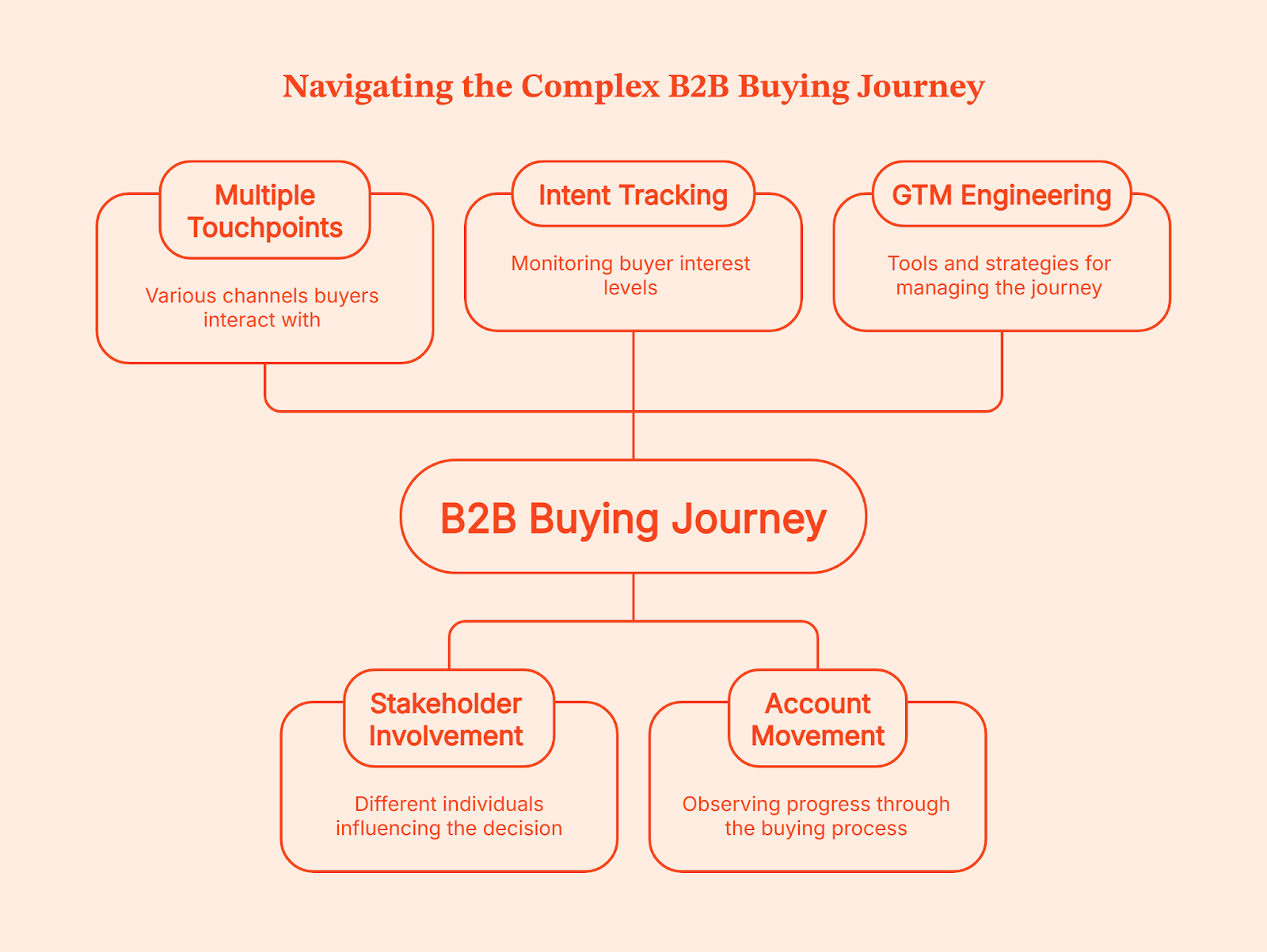
The challenge lies in connecting each touchpoint so you can see how an account is moving. This is where GTM Engineering helps. You see when intent rises, when it drops, who joins the process, and what triggered the next step. And once you have the full picture, multi-threaded selling becomes far easier and more predictable.
Trend 7: GTM Teams Shift from Tools to Platforms
Think about how you shop. If you can grab groceries, baby clothes, a new hoodie, and school supplies in one Walmart visit, you are not driving to Williams Sonoma for pots, Carter’s for onesies, Zara for fashion, and Staples for stationery. One place simply makes life easier.
GTM teams want that same experience.
Right now, most stacks look like five different stores on opposite ends of town. One tool gives you analytics. Another handles outreach. A third manages intent. A fourth stores contacts. A fifth tries to glue everything together. By the time you click through all of them, your buyer has already taken three new steps you did not see.
Teams are tired of that. They are trimming their tech stacks and cutting tools that only do one tiny job. No one wants ten vendors with ten logins and ten different versions of ‘what’s really happening’.
Platforms are winning because they bring analytics, activation, and signals into one place. You get the full picture and the action in the same view without the patchwork. Your teams spend less time managing tools and more time moving revenue. That is the shift happening across modern GTM teams, and it is only speeding up.
Trend 8: CAC Reduction Through Workflow Automation
A missed follow-up, a slow reaction, the wrong account in sequence, a campaign running longer than it should. These slip-ups look small, but they slowly inflate your customer acquisition cost. You see the same pattern in most GTM teams.
Scrut faced it firsthand: Too many tools, scattered data, no clear view of how buyers engaged. The gaps slowed everything down and created the kind of waste that makes acquisition more expensive than it should be.
Workflow automation fixes this. It follows the same idea as Toyota’s Just-in-Time system: remove waste, keep work moving, and let the system carry the load so people can focus on work that actually matters.
Time to touch goes down because the GTM system reacts the moment a qualified buyer shows up. Signal-based campaigns waste less budget because they only engage accounts that are warming up. Auto prioritization removes guesswork and lifts performance. All of this reduces CAC without adding headcount.
And with boards tracking CAC more closely than ever, cleaner workflows are no longer optional. They’re the only way to run a GTM engine that doesn’t leak time, budget, or opportunities.
Related read: GTM engineering vs RevOps
The GTM Engineering Stack for 2026
Instead of adding more tools to your GTM stack, focus on a small set that works well together. Think of this stack as your GTM development environment, where signals, activation layers, and automation run side by side instead of pulling teams in different directions.
Here’s a stack most high-performing teams are moving toward:
| Layer | Recommended Tools | What This Layer Does |
|---|---|---|
| CRM | HubSpot or Salesforce | Your central system of record. Everything flows in and out of here. Clean CRM, clean GTM. |
| Data unification and signals | Factors.ai | Pulls all journeys into one place. Captures website intent, ad engagement, product usage, form fills, and CRM activity. Triggers the right downstream actions. |
| Marketing automation | Factors.ai, HubSpot or Marketo | Handles email nurturing, lifecycle workflows and campaign management. Works best on top of clean signal data. |
| Outbound | Apollo or Clay | Helps reps research, enrich, prioritize and automate manual steps. More powerful when signals tell them who deserves attention. |
| Ads and activation | LinkedIn + Factors.ai | Factor’s LinkedIn AdPilot refreshes audiences automatically, controls ad exposure and uses CRM intent for smarter retargeting. Turns LinkedIn into a GTM engine, not a siloed channel. |
| Enrichment and routing | Clearbit or OpenAI agents | Fills missing data and ensures the right accounts reach the right rep quickly. Keeps routing accurate and clean. |
| Reporting | Factors.ai, Looker, Tableau, Power BI, or a revenue intelligence tool like Clari | Helps teams analyze performance, understand deal movement and make decisions across the GTM motion. |
Once these layers start working in sync, your GTM motion feels like an ecosystem instead of a bunch of tools bolted together.
How Factors.ai Enables GTM Engineering Services
By now, you know a strong GTM engine depends on three things: clean data, reliable signals, and workflows that move without friction. Factors.ai supports this foundation by designing and running GTM engineering services that ensure every part of your stack sees the same data and reacts at the right moment.
Here’s how it fits into the system.
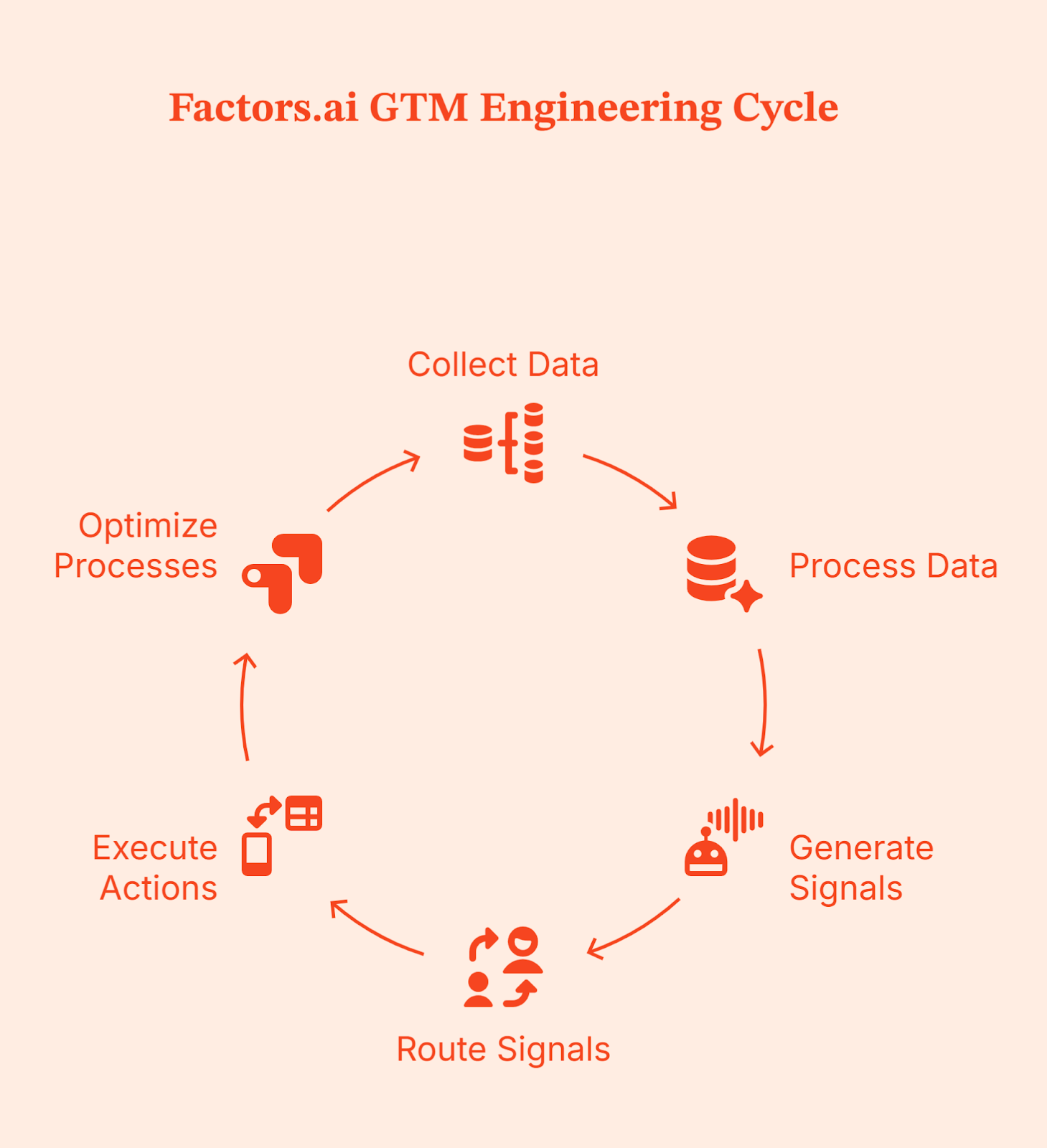
End-to-end workflow automation
Factors’ GTM engineering team builds and runs the workflows that connect your CRM, intent signals, outreach tools, and ad platforms. Instead of your ops team managing integrations and scripts, Factors handles the setup so your sales and marketing teams can act on clean signals automatically.
Signal-led insights and alerts
Factors helps you understand real buyer activity into clear signals your team can act on. When an account shows intent, your reps see why it matters and what to do next, with follow-ups triggered automatically across email, LinkedIn, or CRM tasks.
Personalized outreach at scale
Outreach is triggered by behavior. Factors sets up workflows that send the right message through the right channel based on what an account is actually doing, without your team needing to manage it manually.
AI-assisted research and prioritization
Factors uses AI to enrich accounts, summarize activity, and highlight which accounts deserve attention first. Sales reps get full context quickly so they spend less time researching and more time having meaningful conversations.
Works with your existing tools
Factors integrates with the tools you already use, like LinkedIn Ads, your CRM, email platforms, Slack, and enrichment tools. Data flows smoothly between systems so your GTM stack works like one connected platform.
A delivery model that fits your team
You can choose how you work with Factors. Either the team builds everything and hands it over to you, or they stay involved to maintain and improve workflows as your GTM motion evolves.
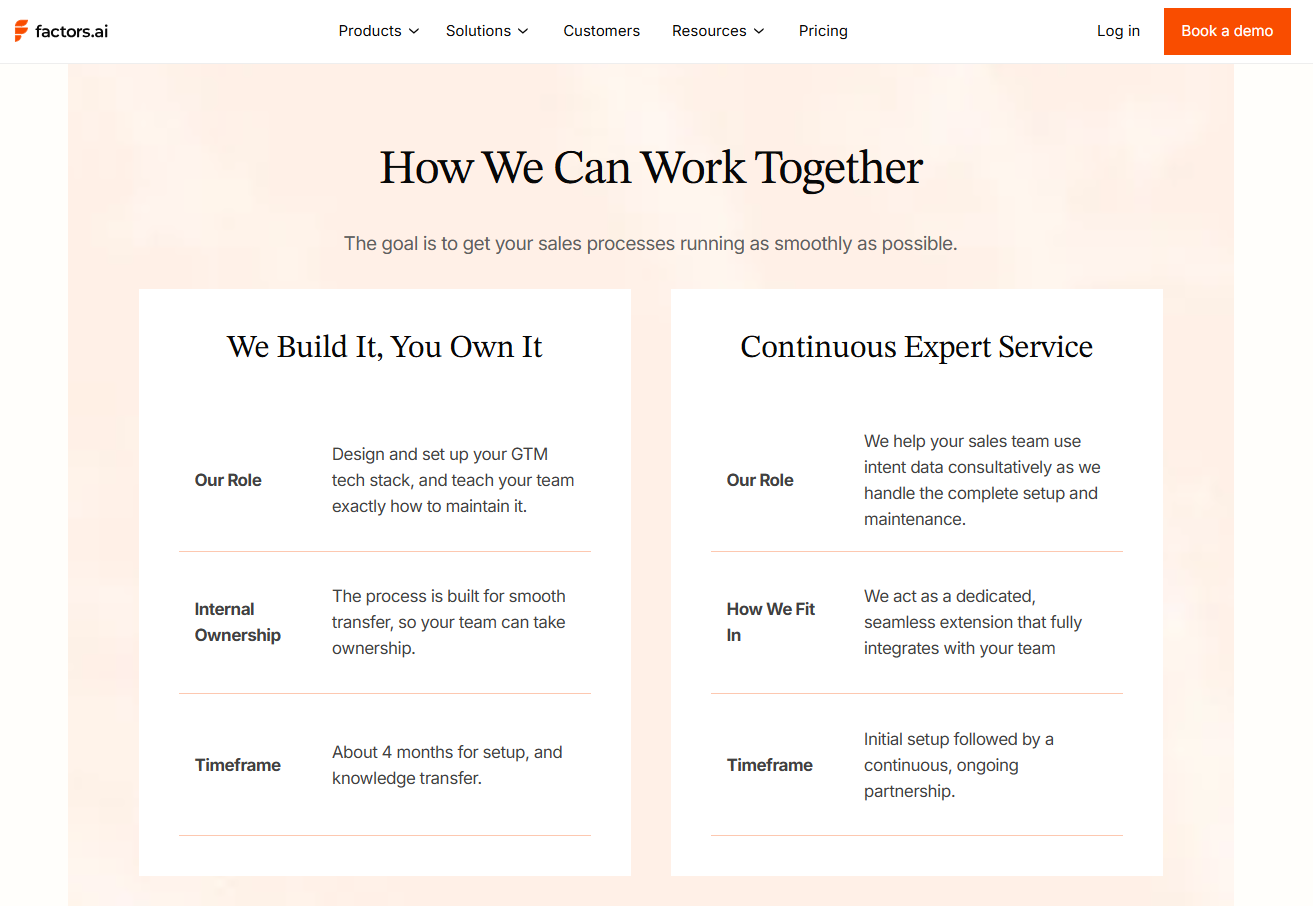
This turns Factors.ai into your GTM system of action, where accurate data drives immediate execution across ads, outreach, and CRM workflows.
Factors.ai doesn’t replace your team. It simply makes their work easier by bringing signals together and automating the steps reps shouldn’t be doing manually.
Final Recommendations
If you’re updating your GTM engine for 2026, start here. These moves consistently outperform everything else.
Step 1: Start signal-based selling early
To make outreach easier by following real buyer behavior instead of guessing.
Step 2: Unify your GTM data
To pull signals, CRM, ads, and product data into one place so that your teams see the same information consistently.
Step 3: Use AI agents for repeatable work
Let the system handle follow-ups, enrichment, and prioritization so reps can focus on real conversations.
Step 4: Build a GTM Engineering function
Instead of populating your team, opt for one strong builder who understands data and automation and reshapes the entire engine.
Step 5: Tighten your revenue stack
Choose tools that work well together and maintain data hygiene as it moves downstream.
Step 6: Invest in LinkedIn automation
LinkedIn is still the strongest B2B demand gen channel. Automation keeps spend efficient and targeting aligned with real intent.
FAQs on GTM Engineering Trends
Is GTM Engineering replacing SDR teams in 2026?
Not entirely. GTM Engineering reduces the need for heavy outbound headcount by automating research, prioritization, and early touchpoints. SDRs still matter, but their work becomes more strategic.
Which technical skills does a GTM Engineer need?
Strong workflow design, automation logic, CRM mastery, API familiarity, basic data modelling, and a good understanding of how revenue teams operate day to day.
How can small teams start with GTM Engineering?
Begin with the essentials. Unify your data, set up simple automated workflows, use low-code integrations, and start capturing intent signals. You do not need a full team on day one.
What’s the difference between a GTM Engineer and Rev Ops?
A GTM Engineer connects data, tools, and signals into workflows that run the GTM motion. RevOps handles reporting, forecasting, and process consistency. One engineers the system; the other operates it.
What channels work best for GTM Engineering?
LinkedIn for targeted reach, intent-based outbound sales for warm conversations, and AI-supported nurturing for mid-funnel engagement.
How does GTM Engineering impact CAC?
It cuts waste by speeding up reactions, improving prioritization, and reducing manual work. When the system moves faster, your cost to acquire a customer naturally drops.

See how Factors can 2x your ROI
Boost your LinkedIn ROI in no time using data-driven insights


.avif)
.avif)
See Factors in action.
Schedule a personalized demo or sign up to get started for free
LinkedIn Marketing Partner
GDPR & SOC2 Type II







.svg)



.avif)

