
SaaS Marketing Strategy: A 2026 Playbook for B2B SaaS
Learn how to build a high-performing SaaS marketing strategy in 2026, from ICP to funnels, channels, automation, and retention, designed for teams aiming to scale.

Brand Marketing Manager
.avif)
Senior Content Marketing Manager



.svg)


TL;DR
- SaaS ≠ traditional marketing: Focus on the full lifecycle: acquire, onboard, retain, expand, because recurring revenue is the real game.
- Get your foundations right: Nail your ICP, positioning, and value proposition before choosing channels or spending money.
- Build a focused, funnel-aligned strategy: Map awareness → consideration → conversion → retention → expansion, and pick 2–3 channels where your ICP actually lives.
- Measure what matters: Track LTV:CAC, payback period, activation, NRR, and expansion MRR, and use attribution tools like Factors to see what truly drives pipeline.
- Improve in controlled steps: Implement smart automation (HubSpot/Salesforce, Customer.io/Braze, Factors) and prioritize 1–2 high-impact changes over the next 90 days.
It's 2 AM. You're stress-eating leftover pizza while watching your marketing budget disappear faster than your hairline. You’ve fired up every marketing channel at once, hoping something would finally work.
Welcome to a SaaS founder's nightmare, where every marketing guru promises you the moon, but you're still stuck trying to figure out why nobody's converting.
Here's the uncomfortable truth most ‘growth hackers’ won't tell you between their LinkedIn carousel posts about ‘10X-ing your pipeline’: there's no magic trick, no growth hack that'll magically 50X your MRR by next Tuesday.
The difference between SaaS companies that scale past $10M ARR and those that sputter out like a sad fidget spinner isn't luck; it's having a marketing strategy that actually understands the game you're playing. And trust me, the SaaS game is fundamentally different from selling one-time products.
Let's fix your strategy before you become another cautionary tale on a Reddit thread.
What is a SaaS Marketing Strategy (And Why it's Actually Different from Traditional B2B Marketing)
A SaaS marketing strategy is an end-to-end system to attract, convert, onboard, retain, and expand subscription customers (emphasis on this), not just drive signups, pop champagne, and call it a day.
How subscription economics change marketing:
Traditional one-time-purchase marketing cares about acquisition. You buy once, they make their money, and everyone moves on.
But SaaS? Oh, no. SaaS is clingy. It wants commitment.
The subscription model changes everything. You're not optimizing for a single transaction; you're optimizing for recurring revenue over time. That trial signup? Meaningless if they churn in month two faster than a Game of Thrones character in season one. That enterprise deal? Only valuable if they renew and expand, otherwise, you just spent six months and thousands of dollars on a very expensive one-time fling.
Software as a Service (SaaS) vs Traditional B2B Marketing, a quick summary:
| Traditional B2B | SaaS |
|---|---|
| Sell → deliver → goodbye | Acquire → onboard → retain → expand |
| Shorter lifecycle | Long, multi-stage lifecycle |
| Value shown pre-purchase | Value proven *post-purchase* |
| Focus on leads | Focus on revenue, usage & retention |
| One channel can work | SaaS requires multi-touch |
SaaS marketing deals with longer sales cycles, requires heavy focus on product adoption and onboarding, and treats churn control as a marketing problem, not just a customer success issue. Traditional B2B marketing celebrates the sale and moves on like a one-hit wonder band after their chart-topper. SaaS growth marketing knows the sale is just the beginning of a long-term relationship, you know, the kind where you actually have to keep showing up.
This means your marketing strategy needs to work across the entire customer lifecycle: from the first blog post someone reads while procrastinating on actual work to the expansion conversation two years later. It must be full-funnel, recurring-revenue aware, and built on continuous adoption, not just acquisition.
If you're only thinking about top-of-funnel, you're leaving money on the table. And not just pocket change, we're talking ‘could've retired early’ money.
Foundations First: ICP, Positioning, Marketing Objectives, and Metrics for SaaS Companies
Before you dump another dollar into LinkedIn ads (where your sponsored content will compete with 47 thought leaders posting about their morning routines), let's talk about what actually needs to be in place.
1. ICP - Ideal Customer Profile
Get crystal clear on your ICP. And I don't mean "B2B companies that need our product" or "forward-thinking enterprises." That's like a dating profile saying you're looking for "someone with a good sense of humor and loves to travel." I mean: What is your exact target market? What industry? What company size? What specific roles are you selling to? What keeps them up at night besides their toddler and existential dread about quarterly targets?
Seasoned SaaS marketers consistently emphasize starting with ICP and buyer journey mapping before choosing channels, because shooting arrows in the dark rarely hits anything except your budget.
A real ICP includes:
- Industry & sub-industry
- Company size & maturity
- Buying roles (economic buyer, champion, influencer)
- Pain points tied to revenue or efficiency
- Existing tools in their stack
- Motivation to switch
- Triggers/events that spark buying behavior
🧠Follow-up read: ICP Marketing Strategy: Drive Business Growth with Ideal Customer Profiles
2. Positioning, Value Propositions & Messaging Hierarchy
Your positioning needs to answer three questions quickly: What do you do? For whom? Why should they care about you specifically instead of the fifteen other tools in their inbox with subject lines that all say "Quick question" or "Following up"?
Strong SaaS positioning answers:
- What you do
- For whom
- Why you’re different
- What outcome you deliver
- Why it matters right now
Clear articulation of your value proposition: what you do, for whom, and why you're different, is non-negotiable. If your positioning sounds like it was generated by ChatGPT on autopilot, back to the drawing board.
Your messaging hierarchy should span:
- Category statement (what type of tool you are)
- Value prop (the core outcome)
- 3–5 key messages (proofs & differentiators)
- Use-case messages (specific jobs-to-be-done)
- Persona messages (tailored by role)
This lets you scale across channels without rewriting your soul every quarter.
3. Goals and Metrics
Before you start playing channel roulette, define actual revenue-centric goals:
- Monthly Recurring Revenue (MRR) and Annual Recurring Revenue (ARR) growth (obviously, this is the whole point)
- Lifetime Value (LTV): Customer Acquisition Cost (CAC) ratio (aim for 3:1 or better)
- CAC payback period (under 12 months is healthy; 24+ months means you're basically running a charity)
- Activation rate (are trials actually using the product, or just signing up for the free t-shirt?)
- Expansion revenue (seat upgrades, upsells, cross-sells)
- Net revenue retention (are your existing customers growing with you, or are they quietly heading for the exit?)
🔖Explore more: 9 SaaS Marketing Metrics You Should Be Tracking
These metrics tell you if you're building a real business or just a leaky bucket with good traffic, the marketing equivalent of being TikTok famous but broke.
Look, I get it. Dashboards full of green arrows feel good. But if those arrows don't eventually lead to actual cash in the bank and customers who stick around longer than a Kardashian marriage, what’s the point of it all?

{{INLINE_MOFU}}
Map Your B2B SaaS Marketing Funnel
Your funnel isn't just ‘awareness, consideration, decision’ like some textbook from 2012 told you. The B2B SaaS marketing funnel extends far beyond awareness and conversion. The best B2B SaaS marketing strategies comprises the entire customer lifecycle from first touch through expansion.
Every solid SaaS marketing strategy needs a clearly defined B2B SaaS marketing funnel and here’s what it looks like:
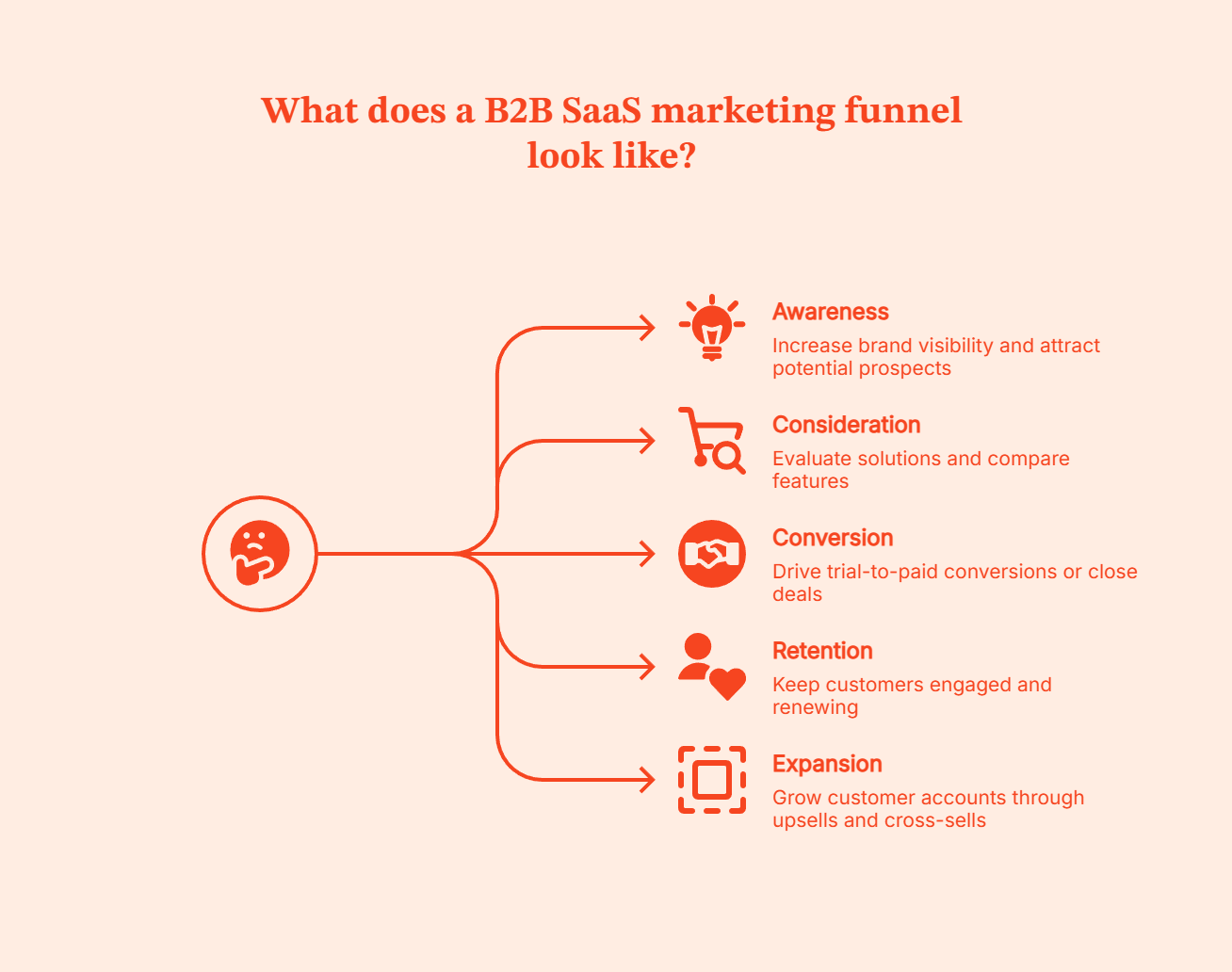
1. Awareness
At this stage, prospects are identifying their problem and exploring potential solutions. They might not know you exist yet.
Success metrics: Branded search volume, website visits, content engagement, social mentions, community presence
2. Consideration
Prospects are evaluating specific solutions, including yours. They're comparing features, reading reviews, and looking for proof points.
Success metrics: Demo requests, trial signups, comparison page visits, case study downloads, time spent on product pages
3. Conversion
The decision moment. For product-led growth models, this is trial-to-paid conversion. For sales-led models, it's closed-won deals.
Success metrics: Trial-to-paid rate, sales cycle length, win rate, average contract value
4. Retention
Now the real work begins. Can you keep customers engaged, happy, and renewing?
Success metrics: Renewal rate, product adoption, feature usage, NPS, support ticket volume, churn rate
5. Expansion
Your best customers become bigger customers through upsells, cross-sells, or seat expansion.
Success metrics: Expansion MRR, account growth rate, cross-sell conversion, average revenue per account
Align Your Marketing to Funnel Stages
The mistake many SaaS marketers make is treating all marketing activities as ‘lead generation.’ In reality, different channels and content types serve different funnel stages.
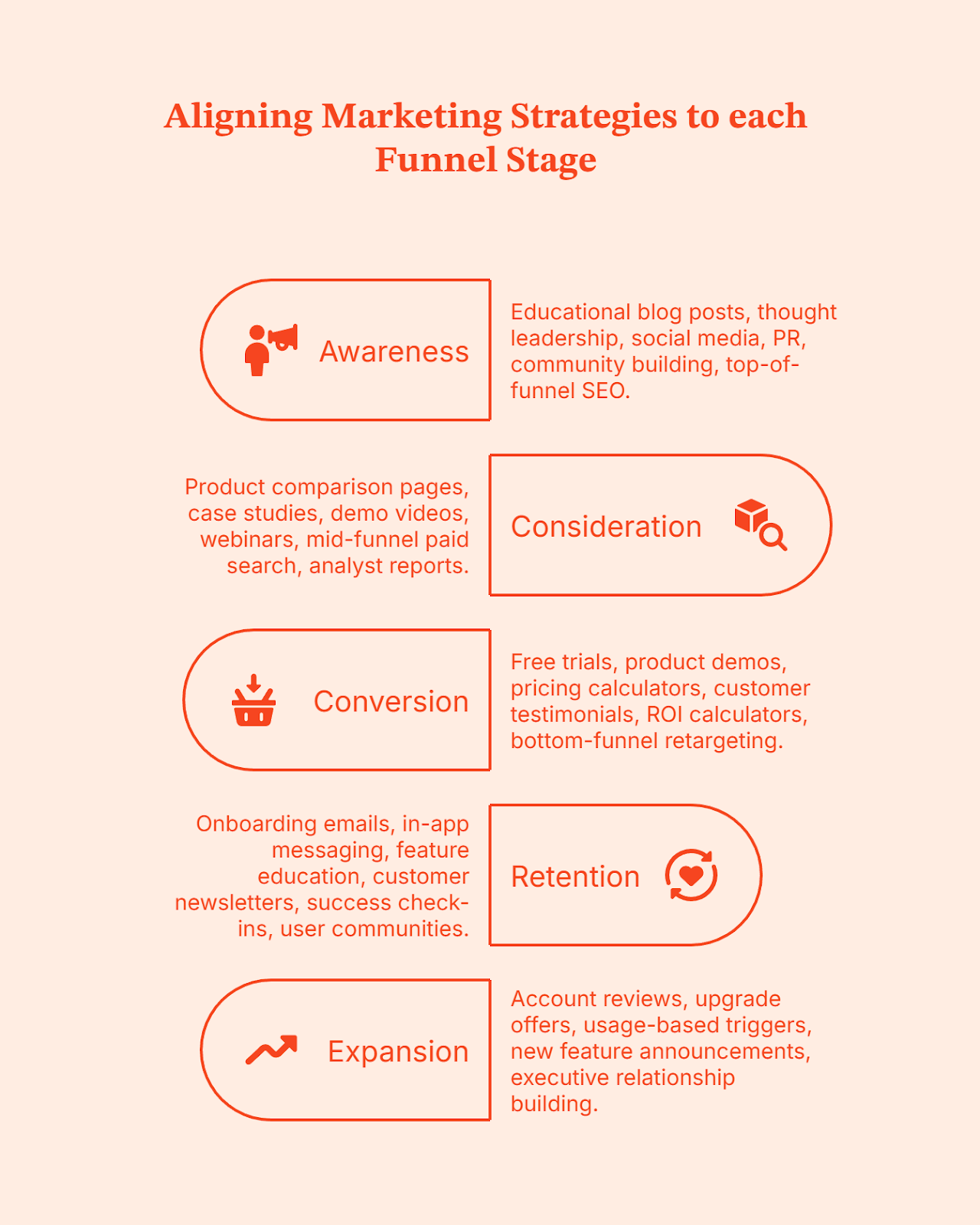
For Awareness: Educational blog posts, thought leadership, social media, PR, community building, top-of-funnel SEO.
For Consideration: Product comparison pages, case studies, demo videos, webinars, mid-funnel paid search, analyst reports.
For Conversion: Free trials, product demos, pricing calculators, customer testimonials, ROI calculators, bottom-funnel retargeting.
For Retention: Onboarding emails, in-app messaging, feature education, customer newsletters, success check-ins, user communities.
For Expansion: Account reviews, upgrade offers, usage-based triggers, new feature announcements, executive relationship building.
Building a Content Marketing Strategy for B2B SaaS
Content marketing compounds. Unlike paid channels, it builds into a lead-generation engine that keeps working long after you've stopped paying for it. For the full breakdown, content types by funnel stage, cadence, and prioritization, see our step-by-step guide to SaaS content marketing.
A useful content structure looks like this.
- Problem-awareness content, blog posts, and guides are for buyers who don't even know your product exists yet. Success here is traffic and time-on-page, not conversions.
- Comparison and evaluation content, vs. competitor pages, category guides, is for buyers actively shortlisting tools. This is also where most B2B SaaS strategies under-invest, relative to how much of the actual buying decision happens right here.
- Proof content, case studies, and ROI breakdowns are for buyers who need to justify the purchase internally. Often, to a stakeholder who has never read a single blog post.
Here's the mistake most SaaS content strategies make. They optimize almost entirely for that first category, traffic, while starving the comparison and proof content that actually moves accounts through a sales cycle stretching months. Want a deeper look at how to measure what's working? Check out Content Marketing Metrics & KPIs for SaaS.
Core B2B SaaS Marketing Channels and Tactics (And When to Use Them)
Alright, let's talk channels. Not every channel works for every SaaS company, and anyone telling you otherwise is probably selling a $5K "omnichannel strategy" course with a 47% discount if you "act now."
⚡Also understand: Which Channels Are Driving Your Form Submissions?
- SEO & Content Marketing
Search Engine Optimization or SEO compounds over time, creating a perpetual lead generation engine. Unlike paid channels, where traffic stops when spending stops, organic traffic keeps delivering.
Best for: B2B SaaS companies with clear search intent around the problems you solve. Works at any stage but requires 6-12 months to see meaningful results.
Content types that work:
- Problem-led blog posts: "How to reduce customer churn in e-commerce" targets your ICP's pain before they know your solution
- Product comparison pages: "Tool A vs Tool B" captures high-intent traffic from people actively evaluating
- Integration pages: "Integrate [Your Product] with Salesforce" targets specific tech stack users
- Case studies: Detailed customer stories that rank for "[Industry] + [use case]"
- Glossary and definition content: Captures informational searches that lead to consideration
- Targeting relevant keywords: Focus on target relevant keywords and relevant keywords with strong search volume to improve search engine rankings and drive organic traffic
Focus on content that maps to buyer intent at different funnel stages. Early-stage companies should prioritize bottom-funnel, high-intent content that converts faster. SaaS content marketing integrates multiple content formats, such as blogs, videos, and podcasts, for maximum impact across the buyer’s journey.
- Landing Pages and Conversion Optimization
Your landing page is your first, and sometimes only shot at converting a visitor. It's not a digital brochure; it's a high-stakes conversion machine that directly impacts your CAC.
Best for: Every stage. Every channel. If you're driving traffic anywhere, you need landing pages that convert.
What makes them work:
- Clear value proposition above the fold: Visitors should understand what you do and why it matters in a minute. No jargon, no corporate speak, just clarity.
- Strong, singular CTA: One clear action per page. Not "Book a demo OR start a free trial OR download our guide." Pick one. Confusion kills conversions.
- Social proof that matters: Not just any testimonials: ones from recognizable companies in your ICP. "Fortune 500 customer" means nothing. "Netflix uses us for X" does.
- Fast load times and mobile optimization: B2B buyers browse on mobile more than you think. If your page takes 5 seconds to load or looks broken, you've lost them.
Treat landing pages as living experiments. A/B test headlines, CTAs, layouts, and form lengths. Small improvements compound.
- Paid Search & Paid Social
Paid channels let you test messaging quickly and capture high-intent traffic while your SEO efforts ramp up.
Best for: SaaS companies with validated product-market fit, clear ICP, and budget for experimentation.
Channel breakdown:
- Google Search Ads: Capture high-intent keywords like "[problem] software" or "[competitor] alternative." Best for bottom-funnel conversion.
- LinkedIn Ads: Target by job title, company size, industry. Expensive but effective for high-ACV B2B SaaS targeting specific decision-makers.
- Meta (Facebook/Instagram): Less common for B2B SaaS but can work for broader audiences or lower-price-point products with strong visual stories.
Start with a small test budget, focus on your highest-intent keywords, and only scale what shows positive CAC payback within your target timeframe.
- Lifecycle Email & In-App Messaging
Email is your direct line to users at every stage. In-app messages reach users at the moment of value.
Best for: Every SaaS company at every stage. This is non-negotiable infrastructure.
Critical sequences:
- Onboarding automation: Guide new users to activation with educational content and setup assistance
- Activation triggers: If someone signs up but doesn't complete key actions, re-engage them with targeted help
- Feature education: Introduce users to capabilities they're not using yet
- Renewal reminders: Proactive outreach before subscriptions expire
- Expansion offers: When usage hits thresholds, suggest upgrades
The goal is to move people through your sales funnel systematically, removing friction and accelerating time-to-value.
- Partnerships, Integrations, and Marketplaces
Your ICP is already using other tools. Meet them where they are.
Best for: Software that integrates with popular platforms. Most effective after you have initial traction.
Tactics that work:
- Integration partnerships: Build integrations with complementary tools, then co-market
- Marketplace listings: Get listed on Salesforce AppExchange, HubSpot Marketplace, and more. .
- Co-marketing: Joint webinars, content, or campaigns with non-competing partners who serve your ICP
- Referral partnerships: Formal programs with agencies, consultants, or service providers
The key is choosing partners whose customers match your ICP and who have an incentive to recommend you.
- Community, Social, and Thought Leadership
B2B buyers increasingly discover and vet solutions through communities and social proof before ever filling out a form.
Best for: Building long-term brand and authority. Works at any stage but requires consistent effort.
Where to focus:
- LinkedIn: Where B2B SaaS buyers actually are. Share insights, engage in conversations, build your founder/exec presence
- Industry communities and platforms: Platforms where they are finding, comparing, and reviewing softwares like G2, Capterra or spaces where they are simply discussing like slack groups, Discord servers, Reddit communities, or forums where your ICP hangs out
- User community: Build your own community for customers to connect, share, and learn
- Podcasts and webinars: Thought leadership through owned and guest appearances
Don't try to fake community involvement. Provide genuine value, answer questions, and participate authentically. The leads will follow.
💡Automate LinkedIn using: Top 10 LinkedIn Automation Tools
SaaS Marketing Automation & Tools
Let's talk about automation without turning this into a boring "37 tools you absolutely MUST use in 2026!!!" listicle.
Marketing automation in B2B SaaS context handles lead scoring, nurture sequences, onboarding emails, and churn-risk triggers, basically, doing the repetitive stuff that doesn't scale when done manually. Because you, as a human, have better things to do than manually send "hey, we noticed you haven't logged in" emails to 500 people at 2 PM on a Tuesday.
You need:
- CRM + marketing automation: HubSpot, Salesforce, or something your sales team will actually use instead of their own spreadsheet. This is your central system for managing contacts and campaigns.
- Product analytics + in-app messaging: Mixpanel, Amplitude, so you can see who's using what and nudge them before they churn.
- Email automation: Whether built into your CRM or standalone, think Customer.io or Braze for those complex "if they clicked this but didn't do that" flows that make you feel like a magician.
- Attribution & funnel analytics: Factors, or other tools that actually show which channels drive pipeline and revenue.
Don't build a stack resembling Howl’s Moving Castle on day one with 47 different tools that all kinda-sorta integrate but mostly just make your engineer cry. Start simple, add complexity as you scale.
How Factors Helps You Actually Prove What's Working
You're probably stitching together data from LinkedIn Ads Manager, Google Analytics, HubSpot, your CRM, and maybe a spreadsheet or two, praying it all makes sense when your CEO asks "what's marketing actually contributing?" Spoiler: it doesn't make sense. And your board can tell.
Factors changes that conversation entirely.
From ‘We Got Traffic’ to ‘We Got Pipeline’
Factors connects your marketing activities directly to pipeline and revenue. You can see which blog posts were visited by accounts that became opportunities, which LinkedIn ad campaigns drove actual closed-won deals, and which content pieces show up repeatedly in winning buyer journeys versus the ones nobody reads.
Suddenly, your content prioritization, ad campaigns, and all marketing efforts stop being guesswork and start being a data-driven strategy.
Track Which Channels Actually Win Deals
Here's some interesting stuff Factors can do: account-level tracking across your entire buyer journey. Not just "someone clicked our ad." You see exactly which accounts from your ICP engaged, what they looked at, when they came back, and how all of that mapped to pipeline movement.
You'll know:
- Which marketing channels contribute most to your highest-value deals
- Whether accounts that engage with educational content close faster
- What the actual conversion path looks like from first touch to closed-won
- Where accounts are dropping off and why
Cross-Channel Attribution That Actually Works
Most attribution tools only track one channel at a time. LinkedIn thinks LinkedIn drove the deal. Google thinks Google did. Your content team thinks it was the blog. Everyone's taking credit; nobody knows the truth.
Factors consolidates everything: website visits, ad engagement, email opens, demo requests, sales calls, into one unified view. You see the complete story: the account that saw your LinkedIn ad, visited three blog posts, downloaded your pricing guide, requested a demo, and closed three months later.
No need to rack your brains to make sense of all disconnected data points.
Beyond First-Touch and Last-Touch
Traditional attribution models are basically useless for B2B SaaS. First-touch gives all credit to awareness. Last-touch gives it all to the demo request. Neither tells you what actually influenced the deal across a six-month evaluation.
Factors shows every touchpoint that mattered. You can finally answer questions like:
- Is this webinar series worth the effort?" (Track which attendees became pipeline vs. which ones used your webinar as passive noise)
- "Is our SEO strategy working?" (Track which content pieces appear in winning deals)
- "Are our paid campaigns worth it?" (Measure true ROI, not just click-through rates)
💡Also read: Understanding Multi-Touch Attribution Models
Built for B2B Buying Cycles
Unlike consumer-focused analytics tools that think "conversion" means someone bought a $20 product in 30 seconds, Factors understands B2B buying cycles are long, messy, and involve multiple stakeholders.
It tracks at the account level (because deals are won by companies, not individuals), integrates with your CRM and sales tools (so you see the full picture), and understands that your CMO/CTO evaluating your product in June might not convert until October after three more stakeholders get involved.
Measurement, Experimentation, and Optimization
A SaaS marketing strategy is never "done." You're constantly testing, learning, and refining.
Key Metrics to Track
Acquisition metrics:
- CAC (Customer Acquisition Cost): Total marketing and sales expense divided by new customers acquired
- CAC by channel: Understanding which channels are efficient vs. expensive
- Payback period: Months to recover CAC from customer revenue
Activation and conversion metrics:
- Trial-to-paid conversion rate: What percentage of trials become paying customers?
- Time to Activation: How long until new users reach their "aha moment"?
- Demo show rate and conversion: For sales-led models
Retention metrics:
- Net revenue retention: Revenue from existing cohort over time (including churn and expansion)
- Logo retention: Percentage of customers who renew
- Product engagement: Usage metrics that predict renewal
B2B SaaS Marketing Trends Shaping 2026
A few structural shifts worth building into your strategy this year.
- AI-driven search is changing how buyers research. More and more B2B research is happening inside AI assistants and AI-generated summaries, not just traditional search results. That means your content needs to work for AI extraction, not just rank for keywords.
- Privacy and cookie changes keep tightening. Third-party tracking keeps getting harder to rely on. That's pushing more marketing measurement toward first-party data and account-level identification instead of pixel-based retargeting alone.
- Budget scrutiny is higher, too. Marketing spend has to show pipeline and revenue impact now, not just top-of-funnel volume. Which is exactly why attribution and account-level tracking matter more than lead counts ever did.
Your Next 90 Days
You now have a framework. Most people will read this, nod along, and change nothing.
Don't be like most people.
Your action items:
- Audit your ICP and positioning: Can you explain who you serve and why you're different in under a minute? If not, fix this first.
- Map your current activities to the funnel stages: What do you have for awareness? Consideration? Conversion? Retention? Expansion? Where are the gaps?
- Pick your 2–3 core channels: Based on where your ICP actually hangs out and where you've seen early traction. Kill the rest (for now.)
- Set up proper tracking for the metrics that matter: LTV:CAC, activation rate, churn. If you're not measuring these, you're flying blind. Use tools like Hubspot, Factors, Salesforce to
- Get your tech stack in order: Start with the essentials: a CRM (HubSpot or Salesforce, a marketing automation tool (Braze or Customer.io for complex outreach and campaigns), and an attribution tool that actually tells the truth (Factors is built for this). Don’t go tool-crazy. Three solid tools that talk to each other beat ten fancy ones that don’t.
- Build or fix your lifecycle automation: At minimum - trial nurture, onboarding sequence, renewal reminders.
Audit your current SaaS marketing strategy using this framework and identify the 1–2 highest-impact changes you can make in the next 90 days. Not ten things. Not a complete overhaul. One or two things that will actually move the needle.
Companies that scale aren't doing a hundred things well. They're doing five things exceptionally well and ignoring everything else.
Now, go build something that compounds.
FAQ’s on B2B SaaS Marketing
Q. How do you market a SaaS product?
Marketing a SaaS product combines content and SEO, paid search, social media, email automation, and free trials, all tied back to a clear ICP and value proposition. The key difference from traditional marketing is the focus on the entire customer lifecycle, not just the initial sale. You're marketing to acquire, activate, retain, and expand customers over time.
Q. What is a SaaS marketing strategy?
A SaaS marketing strategy is an end-to-end plan to attract, convert, onboard, retain, and expand subscription customers. It's not just about generating leads or driving signups, it's about creating a systematic approach to building recurring revenue through the entire customer journey.
Q. Which marketing channels work best for B2B SaaS?
The most effective channels depend on your ICP and ACV, but content marketing and SEO, paid search, LinkedIn, email automation, and partnership channels consistently emerge as high-performers. Early-stage companies often see success with founder-led outreach and organic content, while later-stage companies can leverage paid channels profitably once unit economics are proven.
Q. How do you create a SaaS marketing strategy step by step?
Start by defining clear goals and target metrics, then develop detailed ICP and buyer personas. Next, establish your positioning and value proposition. Choose your channel mix based on where your ICP actually spends time, then map content and tactics to each funnel stage. Finally, implement measurement systems and commit to regular experimentation and optimization.
Q. How is SaaS marketing different from traditional product marketing?
SaaS marketing differs fundamentally due to the subscription model, emphasis on free trials, longer customer lifecycle, and high importance placed on onboarding, product adoption, and retention alongside acquisition. In traditional product marketing, the sale is the endpoint. In SaaS marketing, the sale is just the beginning of the customer relationship.
Q. What are some effective marketing strategies for SaaS startups with low budgets?
Focus on channels that scale with time, not just money: SEO and organic content, founder-led social media (especially LinkedIn), cold outreach via email, referral programs, and participation in relevant online communities. The key is choosing channels where you can invest sweat equity to build compounding assets rather than renting attention through paid ads.
Q. What metrics should a SaaS marketing team track?
Critical SaaS marketing metrics include MRR growth, CAC, LTV, LTV to CAC ratio, payback period, activation rate, logo churn, net revenue retention, and expansion MRR. These metrics tell you whether you're building sustainable, profitable growth or just creating an expensive lead generation machine that doesn't actually build enterprise value.

Powered by Bombora
Enter your domain and we'll send you a free list of companies showing buying intent in your vertical.
.avif)
Powered by Bombora
Enter your domain and we'll send you a free list of companies showing buying intent in your vertical.
.avif)

See how Factors can 2x your ROI
Boost your LinkedIn ROI in no time using data-driven insights


.avif)

See Factors in action.
Schedule a personalized demo or sign up to get started for free
LinkedIn Marketing Partner
GDPR & SOC2 Type II

.svg)



.avif)

