
SEO ROI Forecast: An SEO Playbook That Convinces Leadership, Survives Google Updates and AI chaos
AI Overviews changed SEO forecasting. Learn how to model traffic, AI visibility, and pipeline with a two-layer SEO ROI forecast that leadership trusts.

Growth Marketer
.avif)
Content Marketer



.svg)


TL;DR
- SEO forecasting now has two layers: traditional performance and AI-driven visibility. You need both.
- Traffic ≠ impact anymore. AI Overviews change clicks, so rankings alone don’t tell the whole story.
- Good forecasts are built on fundamentals: fresh data, realistic capacity, and scenario ranges, not guesses.
- The goal isn’t prediction. It’s planning for uncertainty and tying SEO to pipeline and revenue.
Imagine you walk into your quarterly planning meeting feeling optimistic. Leadership asks, “So… what will SEO deliver next quarter?” Suddenly, everyone is staring at you like you’re THE one person who knows exactly what Google will do next. (If only.)
You pull up a spreadsheet. You explain the numbers. And someone still asks, “But what about AI Overviews? And LLM search? Isn’t everything changing?”
(A fair question, but also, when does Google not change something?)
If you’ve lived through that moment before, you’re definitely not alone. And here’s a little secret, the most confident SEO managers already know:
Forecasting SEO isn’t about predicting the future. It’s about building a believable story backed by math.
And when that story shows real pipeline and revenue?
Your SEO strategy suddenly becomes the hero of the marketing team.
Let’s break down how to build an SEO ROI forecast that’s fun to present, easy to defend, and shockingly useful for planning.
Why SEO forecasting even matters (Yes, even now..)
Here’s the truth: SEO is helpful for a company because it reduces Customer Acquisition Cost, or CAC, compounds over time, and generates the kind of inbound demand that makes paid search look… well, expensive. (I’ll try not to look too pleased about that.)
But your founders don’t care about ‘rankings’ or ‘domain authority.’ They care about:
- MQLs
- Pipeline
- Revenue
- Efficiency
- Predictability
Your SEO potential forecast is the bridge between ‘here’s what we hope’ and ‘here’s what we’re planning for.’ When done well, it becomes less of a forecast and more of a business case.
(Also, when your forecast is credible, you get fewer surprise ‘urgent’ Slack messages at 9 PM. Small victories…)
Related read: B2B SEO checklist to know what steps to take before starting your SEO planning, keyword research, and strategy development.
The part most SEO forecasts now miss: SEO has two layers
Here’s where SEO changed in the last two years, and where many forecasts quietly fall apart.
SEO no longer operates as a single system. Today, every credible SEO forecast has two parallel layers:
1. The traditional performance layer
This is the familiar one:
- Rankings
- Traffic
- Conversions
- Pipeline
- Revenue
2. The AI visibility layer
This is newer, messier, and harder to measure:
- AI Overviews and zero-click answers
- LLM summaries and citations
- Brand mentions on LLM searches
- Influence that shows up before a user ever lands on your site
This layer assists conversions rather than owning them.
The mistake we all make here is forecasting only the traditional performance layer and ignoring the AI visibility layer, and not both.
So, let’s start with the foundation first.
{{INLINE_MOFU}}
What a traditional SEO forecast still needs to include
If you want your SEO forecast template to actually hold up in a meeting, it needs a few essentials:
1. Recent baseline metrics
Use your last 3 to 4 months of data, and not all of last year’s. Why? Because SEO changes fast, and old numbers lie. (Lovingly.)
2. Realistic capacity inputs
Be honest about what your team can deliver:
- How many pieces of content can you actually publish each month?
- How many technical fixes can dev genuinely handle?
This keeps your forecast grounded in reality rather than wishful thinking.
3) Real CTR and conversion data
- Skip the outdated ‘position #1 gets 30% CTR’ myths.
- Use your Google Search Console data instead; it reflects how your real audience behaves today.
4) Three scenario ranges
Make three easy versions:
- Low (Conservative): What you can hit even on a bad month
- Middle (Expected): What do you think will actually happen
- High (Ambitious): What’s possible if everything goes right
Why do this?
Because giving leadership one number is a trap. Instead, give them a range. This helps everyone stay calm when things shift, and reminds them that things always shift in SEO.
5) Clear assumptions
Write down every key assumption affecting your forecast, like:
- “We’ll publish 4 articles/month.”
- “We’ll get 6 dev hours per sprint.”
- “CTR stays stable.”
These notes save you later, especially when someone asks, “Why did this change?” and you actually have an answer.
Related read: Top free website traffic analysis tools for 2026.
How AI, AIO, GEO, AEO, and LLMs are reshaping SEO ROI forecasts
(AKA: “Everything changed and here’s how to stay sane.”)
AI isn't “disrupting search.” It's rebuilding a whole new search economy. Everything is evolving, right from traffic flows to visibility layers and the fundamental definition of ranking.
Here’s what’s actually shifting.
1) Zero-click growth & AI answer layers = fewer clicks
Generative AI layers such as AIO (AI Overviews), SGE (Search Generative Experience), and AI mode increasingly provide users with full answers in the SERP.
This means:
- Users get answers without clicking
- CTR drops the hardest on informational and research queries
- AI doesn't consistently cite the same sites that rank organically
- Forecasts based on “rank × volume × CTR” are increasingly wrong
If organic traffic used to be your golden goose, AI just built a fence around the nest.
2) AI search channels are growing, but referrals are still tiny
AI platforms do generate referrals, but they’re just small right now.
Your forecast should include:
- A small-but-growing ‘AI referrals’ line
- A qualitative measure of AI visibility (citations, mentions)
We’re in the ‘teenage years’ of AI search, so it's moody, unpredictable, and still figuring itself out.
3) New optimization targets: AEO, GEO, and LLM SEO
Classic SEO = ‘How do I rank on Google?’
Modern SEO = ‘How do I become the answer everywhere?’
The answer to the latter is:
- AEO: Answer Engine Optimization
- GEO: Generative Engine Optimization
- LLM SEO: Creating content LLMs rely on, cite, or summarize
This means
- You’re no longer forecasting just ‘traffic.’
- You’re forecasting visibility, citations, and brand lift, even when they don’t produce immediate clicks.
(Welcome to the multiverse of search.)
4) Regulatory and platform risks increase volatility
Google is being scrutinized for:
- Using publisher content without compensation
- Potential ‘zero-click monopolization’.
- How AI answers are sourced
This means your forecast must assume:
- Periodic feature rollouts
- Traffic instability
- Possible policy changes around citations
The 7-step playbook for a complete SEO forecast
Even with AI reshaping search, the mechanics of forecasting still rely on fundamentals. This is the traditional SEO, AKA the non-AI layer, and it’s where your numbers earn trust.
1) Start with a clean baseline
Pull the last 3 to 6 months of performance from GSC and GA4. Export impressions, clicks, positions, and conversions.
Why not 12 months?
Because the last few months reflect the current SERP environment and your present traffic behavior (seasonality matters, but recency matters more when SERPs are changing fast).
Practical tip: Build a sheet with ‘current monthly organic clicks’, ‘conversion rate by page type’, and ‘average LTV of an organic customer’.
2) Segment keywords by intent and SERP features
Not all keywords behave the same.
Create buckets: high-intent commercial, informational (AI-overview prone), branded, and long-tail. Apply different CTR assumptions per bucket. Informational terms will often see different click behavior when AI answers or zero-click features appear.
Practical tip: Tag queries in your GSC export and calculate CTR by bucket. This is where a decent traffic estimator helps.
3) Choose your forecasting method (or mix them)
Pick the approach that fits your data and team:
- Keyword-based: useful when you have clear target rankings.
- Traffic trend modeling: good when historical growth trends are stable.
- Back-planning from business goals: best when leadership gives a target (e.g., ‘we need 500 MQLs’).
(You can and should combine them.)
4) Be explicit about capacity and timelines
Forecasting SEO isn’t magic; it’s resourcing. Document how many articles you can publish monthly, the dev hours you can spend on technical fixes, and link-building efforts. Then map those to expected traffic lifts and timelines: most content sees meaningful movement in 3 to 6 months; technical fixes can show impact in 1 to 2 months.
Practical tip: Use an SEO forecast template with inputs for ‘articles/month’, ‘avg visits per article’, and ‘dev hours’.
5) Build three scenarios (conservative / expected / ambitious)
Because uncertainty is real.
Show a cone of probability: A narrow range near-term, wider out 6 to 12 months. Attach assumptions to each scenario for what’s required (headcount, budget) to achieve ambitious vs. conservative outcomes.
Practical tip: For each scenario, calculate leads and pipeline.
Then compute SEO ROI: (pipeline value × close rate × contribution margin) / SEO investment.
6) Add an ‘AI visibility’ and brand lift line item
LLMs and answer engines are new channels of visibility that don’t always mean direct clicks. Track LLM citations, featured-answer impressions, and branded search lift. Assign a conservative conversion proxy (e.g., treat 10–30% of AI-driven awareness as future site sessions or uplift to branded queries) until you have better data.
Practical tip: Create an ‘AI visibility to traffic’ multiplier in your model. Start conservative, iterate with data.
7) Document assumptions, cadence, and adjustment triggers
List every assumption (CTR by position, conversion rates, content velocity). Set thresholds that trigger reforecasting (e.g., >15% MoM traffic variance). Schedule monthly check-ins to recalibrate.
Practical tip: Save assumptions in a single tab of your SEO forecast template so you can show leadership what changed when numbers deviate.
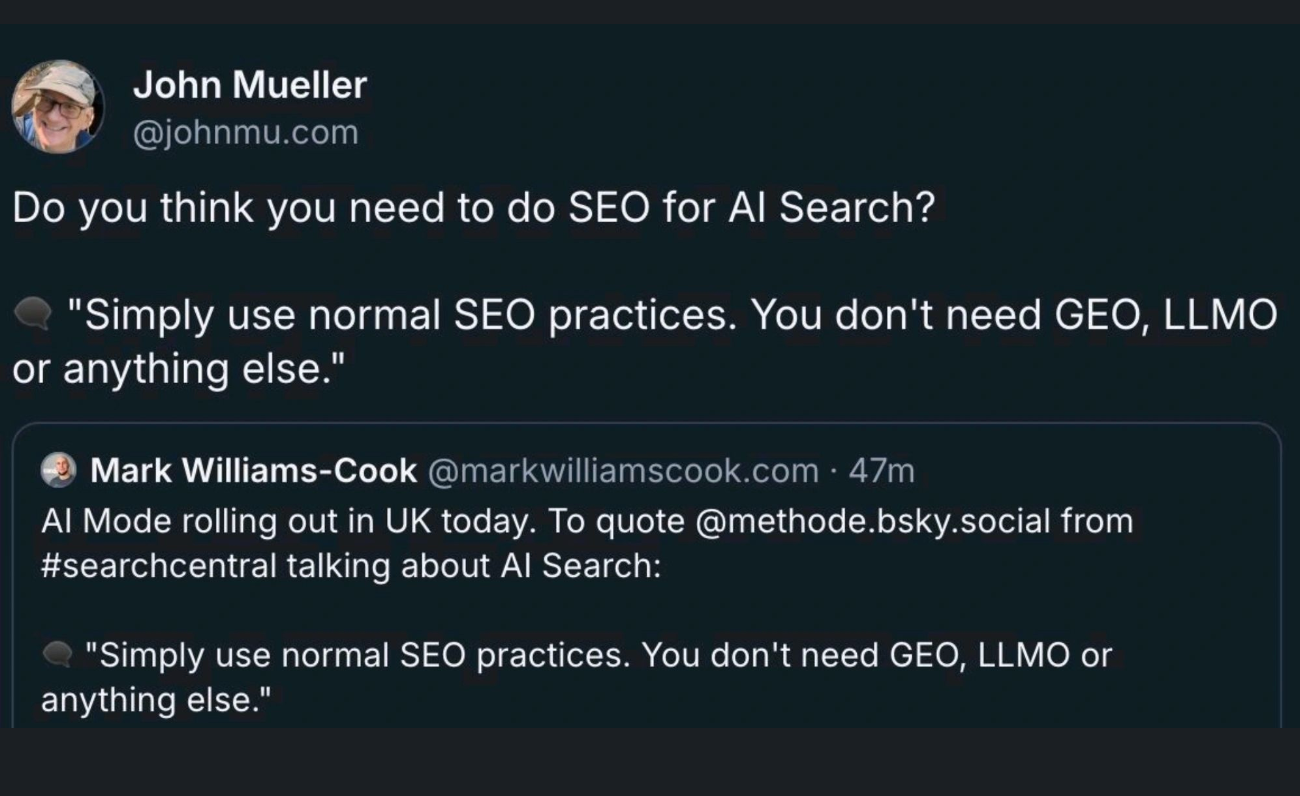
And before anyone asks, yes, we’ve heard this take too:
That you don’t need GEO, LLMO, or a shiny new acronym for every AI update; ‘good SEO is still good SEO.’
We actually agree.
But here’s the nuance:
Doing normal SEO now means understanding where your content shows up, not just where it ranks. Same fundamentals but on new surfaces.
Tools that can be used for SEO ROI forecasting
You don’t need a Frankenstein stack to forecast SEO ROI. You just need tools that answer three questions clearly:
- What’s happening?
- What’s most likely to happen?
- What’s the business impact?
Here’s a practical, non-overkill setup.
1. Google Search Console
This is your source of truth for:
- Impressions
- Clicks
- Real CTRs by query and page
- Early signs of AI Overviews impact
If your forecast ignores GSC data, it’s already shaky.
2. Google Analytics (GA4)
Use GA4 to map:
- Organic sessions → conversions
- Conversion rate by page type
- Assisted conversions and paths
This is where SEO stops being ‘traffic’ and starts being revenue-adjacent.
Optional: If you want this automated
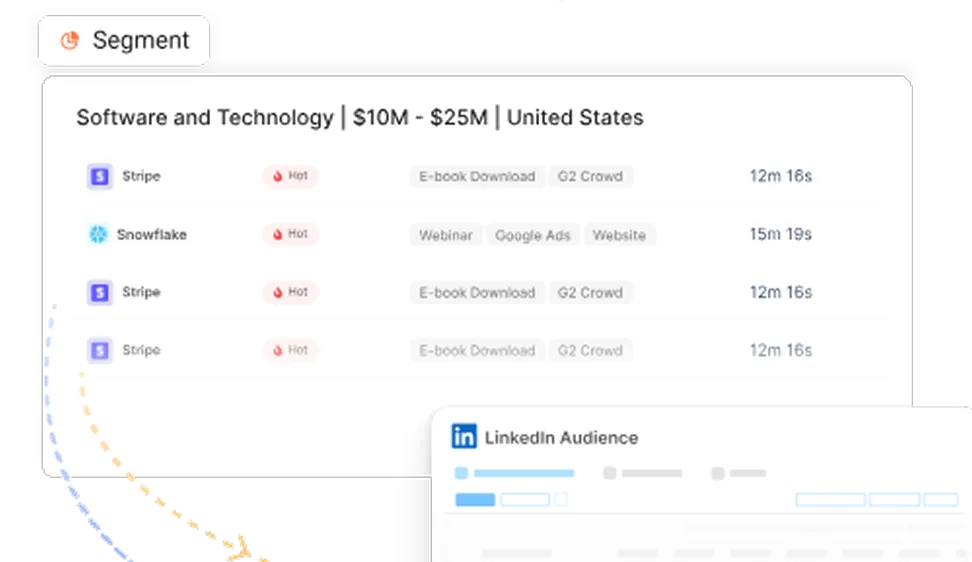
Instead of stitching data together manually, you can use Factors.ai to see traffic and page-level conversion data and performance. You also get to see how buyers actually move from first visit to demo booking across LinkedIn ads, Google ads, and other touchpoints (Yes, the non-linear customer journey using multi-touch attribution.)
3. Keyword & traffic estimation tools
Tools like Ahrefs, Semrush, and the like, help with:
- Search volume (directionally)
- Keyword clustering
- Competitive SEO benchmarking
PS: Treat these as estimators, not promises. They’re inputs, not answers.
4. Spreadsheets (still undefeated)
Your actual SEO ROI forecast will almost always live in a spreadsheet.
Why?
- You can model scenarios
- You can show assumptions
- You can explain why the numbers changed
A clean SEO forecast template with inputs, assumptions, and outputs beats any black-box dashboard.
5. AI visibility tracking (emerging, imperfect, necessary)
This part is still evolving, but you should start tracking:
- LLM citations and mentions
- Featured answer appearances
- Branded search lift over time
Even if the data is directional, leadership will appreciate that you’re measuring what’s changing and not ignoring it. Some of the AI SEO tools help you with this.
Common pitfalls that break SEO ROI forecasts
Most SEO forecasts don’t fail because SEO ‘didn’t work.’ They fail because of avoidable planning mistakes.
Here are the big ones:
1. Treating SEO as a single-channel system
- SEO is no longer just ‘you rank, people click, and they convert’
- Ignoring AI visibility, zero-click behavior, and assisted demand creates blind spots that leadership will notice.
2. Using old CTR assumptions
- Those industry CTR charts from five years ago? Well, they don’t survive AI Overviews.
- If you’re not using your own GSC data, your forecast is already outdated.
3. Forecasting ambition instead of reality
- Publishing ‘10 articles per month’ in a forecast when your team has never shipped more than four is how you end up overpromising and under-delivering.
- Capacity realism matters more than optimism.
4. Giving leadership one number
- SEO outcomes come in ranges, not guarantees.
- Single-point forecasts create unnecessary tension when things shift (and they always do).
5. Forgetting to document assumptions
If assumptions aren’t written down, every variance turns into a debate.
If assumptions are written down, variance turns into a conversation.
Big difference.
Summing it up: How to make SEO forecasting work in the ‘AI era’
SEO forecasting hasn’t become impossible; it’s just become more layered.
Today, a credible SEO ROI forecast does three things well:
1. Models the traditional performance layer
This is the familiar, measurable part of SEO.
It forecasts traffic, conversions, pipeline, and ROI using your real historical data and actual team capacity. No inflated CTRs, no best-case assumptions. Just a clear view of what SEO can realistically deliver as a revenue channel.
2. Accounts for the AI visibility layer
SEO impact now goes beyond clicks.
This layer captures zero-click exposure, LLM citations, and brand presence that influence buyers before they ever visit your website. Even when traffic doesn’t show up immediately, SEO is still shaping demand and improving downstream conversion quality.
3. Communicates uncertainty clearly
Modern SEO isn’t predictable to the decimal.
Instead of promises, the forecast uses scenarios, documented assumptions, and ranges. This sets realistic expectations, builds trust with leadership, and gives you a framework to adapt when the search landscape shifts.
And yesss.. good SEO is still good SEO.
But ‘good SEO’ now means planning for where your content appears, not just where it ranks. Same fundamentals but on newer surfaces.
And with the right forecast? Still completely manageable.
FAQs on SEO ROI forecasting
1) What is SEO forecasting, and why does it matter?
SEO forecasting is the practice of using historical performance and current trends to estimate future organic visibility, traffic, conversions, and business value. It helps marketers set realistic goals, plan resource allocation, and justify SEO investment, especially now that search behavior and SERP features are changing rapidly.
2) How do AI Overviews and generative search impact SEO forecasts?
Generative AI features like AI Overviews and answer boxes increasingly deliver answers without clicks, reducing traditional CTR. Because of this zero-click behavior, forecasts based only on rankings and expected clicks can overstate impact. Modern forecasting must include an AI visibility layer to estimate influence even when users don’t click.
3) What data do I need to build an accurate SEO ROI forecast?
A credible forecast uses:
- Recent organic performance (clicks, impressions, CTR)
- Conversion rates by channel or page
- Search intent and keyword segmentation
- Capacity assumptions (content output, dev support)
- Scenario ranges (conservative, expected, ambitious)
These inputs turn SEO planning into a business case rather than a guess.
4) How can I account for uncertainty in SEO forecasting?
SEO forecasting isn’t about absolute predictions; it’s about preparing for a range of outcomes. Use scenario ranges, regularly update assumptions (e.g., CTR, algorithm changes), and include triggers that signal when you should reforecast. This communicates confidence with realistic caveats, not blind certainty.
5) Are traditional forecasting methods still useful in 2025?
Yes, traditional forecasting using historical trends, keyword models, and CTR estimates is still valuable. But it must be augmented with AI-aware signals (like visibility in generative responses,AI Overviews, and LLM citations) because these increasingly shape user behavior and influence demand without a click. Combining both gives a fuller picture.

See how Factors can 2x your ROI
Boost your LinkedIn ROI in no time using data-driven insights


.avif)
See Factors in action.
Schedule a personalized demo or sign up to get started for free
LinkedIn Marketing Partner
GDPR & SOC2 Type II






.svg)



.avif)

