What Are Impressions on LinkedIn? Types, Benchmarks & Tips (2026)
What are impressions on LinkedIn? Learn the 3 types (organic, paid, viral), what a good number looks like in 2026, and how to track & increase them.
.avif)
Content Marketer

Growth Marketer



.svg)


TL;DR
- LinkedIn impressions are the total number of times your content (posts, articles, or ads) appears on someone's screen — regardless of whether they click or engage.
- There are 3 types: organic (free, algorithm-driven), paid (sponsored campaigns), and viral (from shares and re-engagement).
- Impressions ≠ reach. One person seeing your post 3 times = 3 impressions but only 1 unique reach.
- In 2026, the average LinkedIn post receives around 811 impressions. Personal posts typically get 1,000–5,000.
- To increase impressions: post consistently, use visuals, engage in the first hour, and optimize your profile.
LinkedIn impressions are the total number of times your content like your posts, articles, or ads, that appears on someone's screen, regardless of whether they engage with it. Each time your content is displayed in a user's feed, it counts as one impression. If one person sees your post three times, that's three impressions.
Impressions are one of LinkedIn's core analytics metrics, and understanding them is essential for measuring content visibility, refining your strategy, and growing your professional presence on the platform.
💡Did you know? LinkedIn pages that are active, receive 5x the page views.
What does an impression mean on LinkedIn?
Impressions on LinkedIn refer to the number of times a post has been viewed by other users. Essentially, it quantifies the visibility of an entity's presence on the platform. Each time someone sees your profile, encounters a post you've shared, or comes across an update you've made, it contributes to your impression count.
To put it simply, imagine you're attending a professional conference. As you mingle with other attendees, exchange business cards, and engage in conversations, you're leaving an impression on those you interact with. Similarly, on LinkedIn, each time someone encounters your content or profile, it's akin to leaving a digital footprint—a mark that signifies your presence and relevance within the professional community.

How Does LinkedIn Count Impressions?
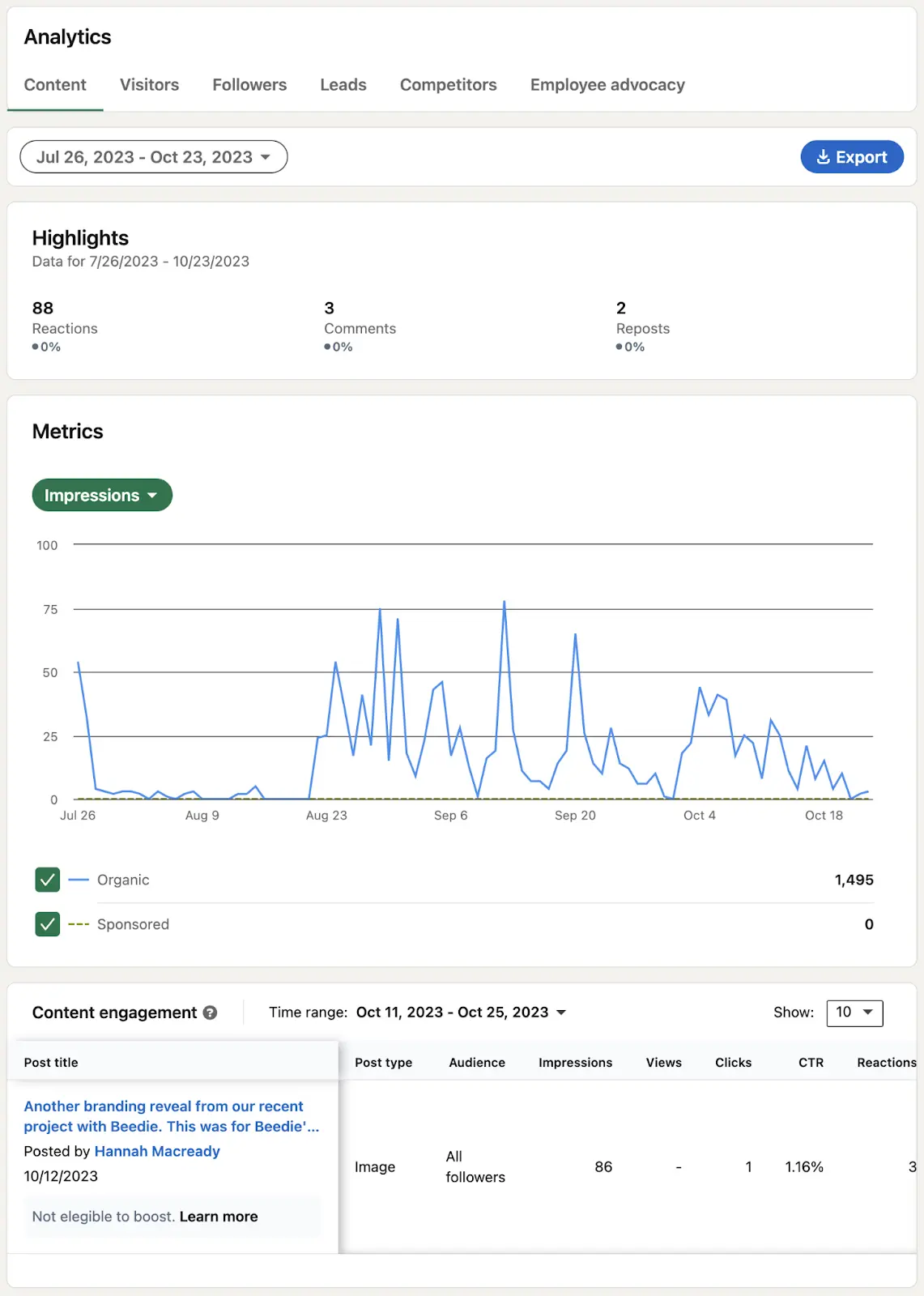
LinkedIn counts an impression the moment your post is at least half visible on a signed-in member's screen for 300 milliseconds. That's 0.3 seconds. It doesn't matter whether someone reads it, clicks it, or just scrolls past. Even a quick pause counts. That's a deliberately low bar, and it's worth sitting with, because it changes how you should read every impression number LinkedIn ever shows you.
If your post flashes by for a third of a second between two others, on a person’s phone sitting next to you, that still counts. It is the same as a post someone read start to finish and left a comment on. LinkedIn's system can't tell the difference, and it isn't trying to. Impressions measure exposure, not attention.
That gap matters more once you start comparing impressions to other numbers in your analytics. Impressions aren't the same as reach. If the same person scrolls past your post three separate times, that's three impressions from one person, not three people reached. And impressions aren't the same as engagement either. A post can rack up 10,000 impressions and 40 reactions. One measures visibility. The other measures the response.
Here's the nuance. That 1-second visibility number floating around in some guides isn't wrong. It's just describing something else: LinkedIn Sponsored Content on desktop, which follows the same viewability standard the ad industry uses more broadly, counting a display ad as viewable once at least half of it has been visible for a full continuous second. Organic post impressions and mobile ads don't run on that standard. They use LinkedIn's own 300-millisecond threshold instead, across the board. So if you've seen both numbers cited as “the” impression rule, that's why. They're answering two different questions.
Key rules to understand:
- Repeat views count: If the same person sees your post 5 times, that's 5 impressions (but only 1 unique reach).
- Self-views may count: Scrolling through your own posts on your profile can inflate your impression count — a common source of confusion.
- No engagement required: Scrolling past your content in the feed counts, even without a like, comment, or click.
- Threshold: LinkedIn uses the 0.3–1 second visibility rule (at least 50% of the post visible) to register an impression.
{{INLINE_TOFU}}
Impressions vs Views vs Reach on LinkedIn
These three metrics are often confused, but they measure different things:
- Impressions: The total number of times your content appeared on any screen. One person seeing your post 3 times = 3 impressions.
- Reach (Members Reached): The number of unique users who saw your content. One person seeing your post 3 times = 1 reach.
- Views: Typically refers to engagement-level visibility — for articles and videos, a view means someone actively clicked or watched. For posts, LinkedIn often uses 'views' and 'impressions' interchangeably in analytics.
Quick example: You publish a post. It appears on 500 screens (some people see it twice). That's 500 impressions, 400 members reached, and maybe 50 actual article views or link clicks.
Which metric matters most? Use impressions for brand awareness tracking, reach for audience growth, and engagement rate (clicks/comments/shares ÷ impressions) for content quality.
What are “unique impressions” on LinkedIn?
Unique impressions count each person exactly once, regardless of how many times your content appeared on their screen. That's the whole concept. If someone scrolls past your post three separate times this week, that's three impressions, but only one unique impression, because it's still the same person.
Here's where it gets confusing. “Unique impressions” isn't a single, consistent label across LinkedIn. It's an actual metric name, real and official, but it only lives in one specific dashboard. Everywhere else, the same idea goes by a different name.
On a personal profile, LinkedIn calls that number “members reached.” On a Company Page, it's “unique impressions” instead, because that lives in a different analytics dashboard entirely. And if you're running paid Sponsored Content through Campaign Manager, the label changes once more: there, it's called “reach,” defined as the number of unique member accounts with at least one impression.
Total impressions count every time your content is displayed, including repeats to the same person. Reach, members reached, unique impressions, whichever dashboard you're in, all count each person once, however many times they saw it.
For a Sponsored Content campaign, look for “Reach” inside Campaign Manager. It tells you your real audience size, not your total ad displays. For an organic post on your own profile, look for "Members reached" instead.
One more useful move here.
Divide impressions by reach (or members reached, or unique impressions), and you get frequency: how many times, on average, each person saw your content.
There's no official LinkedIn benchmark for what counts as healthy. But a frequency above 2 usually signals the algorithm recycling the same small audience rather than expanding your reach. A frequency near 1 means almost everyone who saw it saw it exactly once. That's either a good sign or just a small audience. Worth checking against your totals before reading too much into it.
What Is a Good Number of Impressions on LinkedIn?
There's no universal "good" number", it depends on your network size and content type. Here are 2026 benchmarks based on industry data:
By follower count:
- 500–1,000 connections: 300–500 impressions per post is strong
- 1,000–5,000 connections: 500–2,000 impressions per post
- 5,000–10,000 connections: 800–5,000 impressions per post
- 10,000+ connections: 2,000–10,000+ impressions per post
General benchmarks:
- Average post: 500–3,000 impressions
- High-performing post: 5,000–20,000 impressions
- Viral post: 50,000+ impressions
The average LinkedIn post in 2024 received around 811 impressions, up from ~696 in 2023. However, impressions alone don't tell the full story, a post with 500 impressions and 50 meaningful comments is more valuable than one with 10,000 impressions and zero engagement.
As a rule of thumb, a healthy organic impression count sits between 10% and 30% of your follower count per post. Below 10% suggests the algorithm isn't distributing your content beyond a small slice of your network; above 30% usually means a post caught real traction beyond your immediate connections.
The Significance of LinkedIn Impressions
Now that we understand what impressions entail, let's explore why they matter. Impressions serve as a key metric for gauging the reach and impact of your activities on LinkedIn. They offer valuable insights into how effectively your content resonates with your target audience and how visible your profile is within the platform's ecosystem.
Consider this scenario: you're a marketing professional aiming to promote your expertise in digital advertising. Through strategic content creation and engagement on LinkedIn, you share insightful posts, participate in relevant discussions, and optimize your profile for maximum visibility. As a result, your impression count steadily increases, indicating that more individuals are viewing your content and becoming aware of your expertise in the field.
Decoding LinkedIn Impressions: Types and Measurement
Impressions on LinkedIn can be categorized into three types: organic, paid and viral impressions. Organic impressions occur naturally, without any monetary investment, when your content appears in the feeds of other users based on factors such as relevance, engagement, and connections. On the other hand, paid impressions result from sponsored content campaigns where you allocate budget to promote your posts to a broader audience.
Organic Impressions
Organic impressions on LinkedIn refer to the number of times your content is displayed naturally in the feeds of other users, without any paid promotion or advertising. These impressions occur based on factors such as relevance, engagement, and connections, and they reflect genuine interest from your audience.
Benefits of Organic Impressions:
Authenticity and Trustworthiness
Also read: 10 Best Cognism Alternatives And Competitors
Organic impressions are perceived as more authentic and trustworthy by LinkedIn users. Since they occur naturally without any paid promotion, they reflect genuine interest from your audience, which can enhance your credibility and reputation on the platform.
Cost-Effectiveness
Unlike paid impressions, which require monetary investment, organic impressions are obtained without spending advertising dollars. This makes them a cost-effective way to increase visibility and engagement on LinkedIn, especially for individuals and businesses operating on limited budgets.
💡Did you know? 77% marketers agree that they achieve the best organic results from LinkedIn.
Long-Term Sustainability:
Building organic reach through consistent content creation and engagement fosters long-term sustainability on LinkedIn. By cultivating genuine relationships with your audience and providing value through your content, you can create a loyal following that continues to engage with your posts over time.
Community Building:
Organic impressions facilitate the organic growth of your professional network and community on LinkedIn. By connecting with like-minded individuals, participating in group discussions, and sharing valuable insights, you can foster meaningful relationships and establish yourself as a thought leader within your industry.
Limitations with Organic Impressions:
Limited Reach
One of the primary drawbacks of organic impressions is their limited reach compared to paid impressions. Since organic content relies on the platform's algorithms to determine visibility, it may not reach as wide an audience as paid content, especially if your network is relatively small or your content lacks virality.
Time-Intensive
Building organic reach on LinkedIn requires time, effort, and consistency. You need to invest significant resources into content creation, engagement, and relationship building to generate meaningful results. For individuals and businesses seeking quick visibility or immediate results, this time-intensive nature of organic growth can be a disadvantage.
Algorithm Dependency
Organic impressions are subject to the whims of LinkedIn's algorithm, which determines the visibility of your content based on various factors such as relevance, engagement, and recency. Changes to the algorithm or fluctuations in user behavior can impact the reach and effectiveness of your organic content, leading to unpredictability in your results.
Limited Targeting Options
Unlike paid impressions, which offer sophisticated targeting options to reach specific demographics, organic impressions provide limited control over audience segmentation. While you can optimize your content for relevance and engagement, you may not always reach your desired audience segments organically.
Paid Impressions
Paid impressions on LinkedIn refer to the number of times your content is displayed as a result of paid advertising campaigns or sponsored content promotions. Unlike organic impressions, which occur naturally without monetary investment, paid impressions are achieved through allocating advertising budget to promote your posts, updates, or profile to a targeted audience.
Benefits of Paid Impressions
Expanded Reach
Paid impressions offer the advantage of reaching a broader audience beyond your organic network. By investing in sponsored content campaigns, you can target specific demographics, industries, job titles, and interests, thereby increasing the visibility and exposure of your content to potential leads and prospects.
Immediate Visibility
Also read: AI marketing automation pricing comparison: what B2B teams should actually pay for
Unlike organic impressions, which rely on gradual growth and algorithmic factors, paid impressions offer immediate visibility and results. By allocating a budget to promote your content, you can ensure that it appears prominently in the feeds of your target audience, generating instant visibility and engagement.
Enhanced Targeting Options
Paid impressions provide advanced targeting options that allow you to tailor your content to specific audience segments. Whether you're targeting decision-makers in a particular industry or professionals with specific job titles, paid advertising offers precise control over who sees your content, maximizing its relevance and effectiveness.
Measurable ROI
Paid impressions provide robust analytics and tracking tools that enable you to measure the return on investment (ROI) of your advertising campaigns accurately. From click-through rates and engagement metrics to conversion tracking and lead generation, paid advertising offers transparent insights into the performance and effectiveness of your content.
Limitations of Paid Impressions:
Cost
As you may have guessed, the primary disadvantage of paid impressions is the associated cost. Running sponsored content campaigns requires a financial investment, which may be prohibitive for individuals or businesses operating on limited budgets. Additionally, the cost of paid advertising can escalate quickly, especially for competitive industries or target demographics.
Ad Fatigue
Paid impressions run the risk of audience fatigue and ad saturation, especially if your content appears overly promotional or lacks relevance to the target audience. To avoid ad fatigue, advertisers need to constantly refresh their creative assets, optimize targeting parameters, and monitor campaign performance to maintain audience engagement and interest.
Ad Blocking
With the rise of ad-blocking software and privacy concerns among internet users, paid impressions face the challenge of reaching audiences who actively block or ignore advertising content. Advertisers need to employ strategies such as native advertising, influencer partnerships, and engaging content formats to overcome ad blocking and capture audience attention effectively.
Competition and Saturation
Paid impressions operate within a competitive space where advertisers vie for the attention of the same target audience. As a result, achieving standout visibility and engagement can be challenging, especially in saturated markets or highly competitive industries. Advertisers need to differentiate their content, offer compelling value propositions, and continually optimize their campaigns to remain competitive and effective.

Viral Impressions
Viral impressions on LinkedIn refer to the number of times your content is displayed as a result of being shared by others within the platform. Essentially, when your post gains traction and is shared beyond your immediate network, it reaches a wider audience, contributing to viral impressions.
Benefits of Viral Impressions
Increased Visibility
Viral impressions amplify the reach of your content, exposing it to a larger audience than your organic network. This heightened visibility can lead to greater brand awareness and recognition among LinkedIn users.
Enhanced Engagement
When your post resonates with a broader audience, it's more likely to garner likes, comments, and shares, fostering community engagement and relationship-building. Viral content tends to spark conversations and interactions among users, leading to higher engagement rates.
Extended Reach
Viral impressions enable your content to transcend the boundaries of your immediate network, reaching users who may not have discovered your profile or posts otherwise. This expanded reach creates opportunities to connect with new leads, prospects, and industry influencers.
Limitations of Viral Impressions:
Limited Control
While viral content can significantly boost your visibility, it also entails relinquishing control over how your content is perceived and shared. Once a post goes viral, it may attract attention from a diverse range of users, including those who may misinterpret or misrepresent your message.
Also read: Generative AI marketing use cases: what actually works for B2B teams
Risk of Backlash
Viral content is susceptible to scrutiny and criticism, especially when it touches upon controversial topics or sensitive issues. In some cases, a post that goes viral may attract negative feedback or backlash from certain segments of the audience, potentially damaging your reputation or brand image.
Short-Term Impact
While viral content can generate a surge in impressions and engagement, its effects may be short-lived. Once the initial hype subsides, the visibility and momentum of the post may decline rapidly, leading to a temporary spike in metrics followed by a return to baseline levels.
Key Factors That Affect LinkedIn Impressions in 2026
LinkedIn's algorithm has evolved significantly. Here are the main factors determining how many impressions your content gets:
- Content quality and relevance: LinkedIn prioritizes content that provides genuine value to your target audience over engagement-bait.
- The Golden Hour: Engagement in the first 60 minutes after posting heavily influences how far LinkedIn distributes your content. Early likes, comments, and shares signal quality.
- Content format: Document carousels and native video tend to earn higher impressions than text-only posts. LinkedIn favors content that keeps users on the platform.
- Posting frequency: Posting more often increases total impressions but may reduce per-post impressions. LinkedIn's 2026 algorithm appears to cap distribution for accounts posting multiple times daily.
- Network size and engagement history: Larger, more engaged networks naturally generate more impressions.
- Dwell time: How long people stop and read your post matters more than ever — LinkedIn uses this as a quality signal.
How to Check Your Impressions on LinkedIn (Step-by-Step)
Method 1: Individual Post Analytics
- Go to your LinkedIn feed or profile's Activity section.
- Find the post you want to check.
- Below the post, click on the impressions/views count (e.g., '1,234 impressions').
- This opens detailed analytics: impressions, reactions, comments, reposts, and demographics of who viewed it.
Method 2: Profile-Level Analytics
- Go to your LinkedIn profile.
- Click on Analytics (visible below your profile header).
- Select Content to see impression trends across all your posts over time.
Method 3: Company Page Analytics
- Navigate to your Company Page.
- Click Analytics → Content.
- View impressions, clicks, and engagement for all company posts.
Method 4: Third-Party Tools
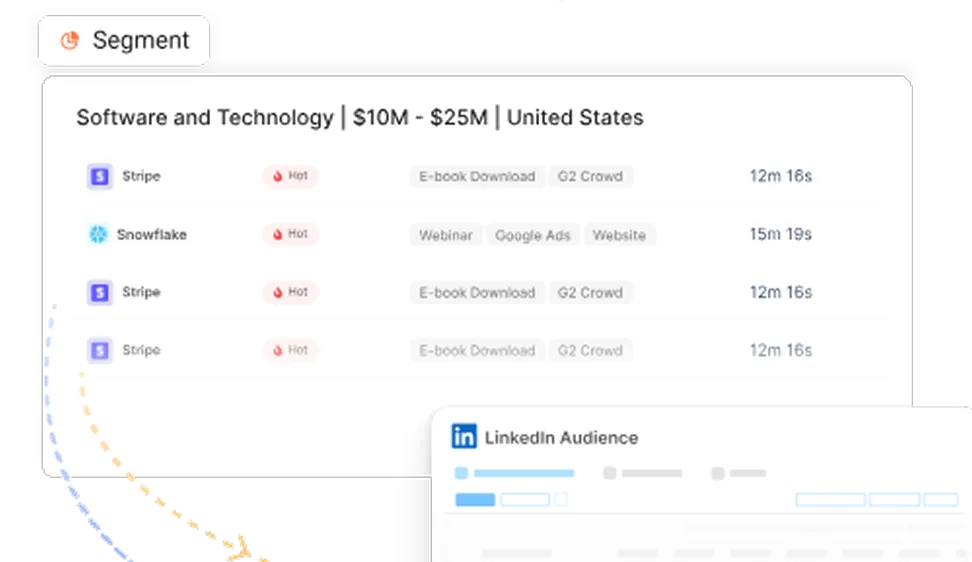
For deeper insights, ABM tools like Factors.ai can track LinkedIn miimpressions alongside website analytics, providing a unified view of how LinkedIn content drives business outcomes.

Strategies for Maximizing LinkedIn Impressions
Now that we've established the importance of impressions on LinkedIn, let's delve into actionable strategies for maximizing your impact on the platform:
Craft Compelling Content
Focus on creating high-quality, relevant content that addresses the interests and needs of your target audience. Whether it's sharing industry insights, offering actionable tips, or sharing personal anecdotes, compelling content is key to capturing audience attention and driving engagement.
Post Consistently
Maintaining an active presence on the platform increases the likelihood of your posts being seen by your connections and followers. Posting regularly also signals to the LinkedIn algorithm that you are an engaged user, potentially leading to higher placement in feed rankings and increased exposure to a broader audience. By staying active and consistent with your posting schedule, you can enhance your visibility, build credibility, and attract more engagement on LinkedIn.
💡Did you know? Posting on LinkedIn on a weekly basis brings in twice the engagement.
Optimize Visuals
Incorporate visually appealing elements such as images, videos, and infographics into your posts to enhance their appeal and encourage interaction. Visual content tends to attract more attention and elicit higher levels of engagement from LinkedIn users.
💡 Did you know? Posts with images tend to garner twice as much engagement compared to those without visuals. Moreover, larger images boast a 38% higher click-through rate, making them more effective in capturing audience attention and driving interaction.
Engage Authentically
Cultivate genuine interactions with your connections by liking, commenting, and sharing their content. Authentic engagement not only fosters meaningful relationships but also increases the likelihood of your content being reciprocated and shared within your network.
Utilize Hashtags
Leverage relevant hashtags to increase the discoverability of your content and expand its reach beyond your immediate network. By including industry-specific hashtags and trending topics in your posts, you can connect with a wider audience and enhance your visibility on LinkedIn.
Join Groups and Communities
Participate in LinkedIn groups and communities relevant to your industry or interests to connect with like-minded professionals and expand your network. Engaging in group discussions, sharing valuable insights, and offering support can help increase your visibility and establish your credibility within the community.
Consider Paid Promotion
Explore LinkedIn's advertising platform to amplify your reach and target specific demographics with sponsored content campaigns. While organic reach is valuable, paid promotion can provide an additional boost to your visibility and help you reach a broader audience.
Understanding the nuances of impressions on LinkedIn is essential for maximizing your presence and impact on the platform. Whether through organic or paid impressions, the goal remains the same: to increase visibility, engagement, and ultimately achieve your professional objectives. By leveraging the strengths of each approach and adopting a strategic approach to content creation, engagement, and advertising, you can effectively enhance your reach, build meaningful relationships, and establish yourself as a credible authority within your niche.
That said, one point to note is that success on LinkedIn is not just about the quantity of impressions, but the quality of interactions and relationships fostered along the way.
As you continue to refine your approach and adapt to the ever-evolving social media algorithm, we hope this article helps you in your journey of growth on LinkedIn.
What Real Users Say About LinkedIn Impressions
Community discussions on Reddit and LinkedIn itself reveal common frustrations and insights about impressions:
Also read: AI Marketing Software: The Best Platforms for Modern B2B Marketing Teams
The self-view debate: Many users report that LinkedIn counts your own views when scrolling through your profile's activity. As one Reddit user noted: "Impressions count when you view your own posts. Even on your own personal page, your impressions double the longer you scroll through your posts."
Impressions vs. members reached confusion: A frequent complaint is the large gap between impressions and members reached. The explanation: impressions count repeat views, while members reached counts unique users. If 100 people see your post and 20 of them see it twice, that's 120 impressions but only 100 members reached.
The vanity metric argument: Some professionals dismiss impressions as a vanity metric. The reality is more nuanced — impressions are a leading indicator. Without impressions, you can't get engagement. But impressions without engagement signal that your content is being seen but not resonating.
The 2026 impression decline: Many creators report impressions dropping 30–50% year-over-year despite growing follower counts. LinkedIn's algorithm now favors relevance-based distribution over connection-based distribution, meaning smaller but more targeted audiences.
Frequently Asked Questions
Do LinkedIn impressions really mean anything?
Yes. Impressions measure content visibility — how many times your post was shown in feeds. While they don't measure engagement quality, they're the foundation metric: without impressions, there's zero chance of getting likes, comments, or leads. Track impressions alongside engagement rate for the full picture.
What does 500 impressions mean on LinkedIn?
It means your post appeared on screens 500 times. For accounts with 500–1,000 connections, that's solid performance. For accounts with 10,000+ connections, 500 impressions would suggest the content underperformed or was posted at a poor time.
Is 1,000 impressions on LinkedIn good?
For most personal profiles, 1,000 impressions is a strong result — it's above the average of ~811 impressions per post. Company pages typically aim higher (5,000–10,000+) due to larger follower bases.
What is the difference between impressions and members reached?
Impressions count total displays (including repeat views by the same person). Members reached counts unique users. If 100 people each see your post twice, that's 200 impressions but 100 members reached.
Is engagement or impressions more important?
It depends on your goal. Impressions are best for measuring brand awareness and content distribution. Engagement (likes, comments, shares) measures how well your content resonates. For most professionals, a high engagement rate relative to impressions is more valuable than raw impression count.
Why are my LinkedIn impressions so low?
Common causes include: posting at off-peak times, low engagement in the first hour (missing the 'golden hour'), small network size, text-only content (visuals perform better), or posting too frequently (LinkedIn may throttle distribution).
Also read: Factors.ai vs Cognism: The GTM Platform Breakdown
Maximize Your LinkedIn Impressions for Greater Visibility
First things first, what does an impression mean on LinkedIn?
Understanding LinkedIn impressions is key to improving engagement and expanding your reach.
Here's a breakdown of the three types:
1. Organic Impressions: Unpaid views that reflect genuine interest in your content.
2. Paid Impressions: Views generated from sponsored posts, helping you target specific audiences.
3. Viral Impressions: Occur when your content is shared widely, extending beyond your immediate network.
Tracking impressions through LinkedIn analytics or third-party tools allows you to measure content performance and refine your strategy. To boost impressions, focus on consistent posting, compelling visuals, and strategic hashtag use - ensuring your content reaches the right audience and drives engagement.
May the LinkedIn impressions be with you!
Related Reads:

See how Factors can 2x your ROI
Boost your LinkedIn ROI in no time using data-driven insights


.avif)
See Factors in action.
Schedule a personalized demo or sign up to get started for free
LinkedIn Marketing Partner
GDPR & SOC2 Type II

.svg)



.avif)

