
A B2B CMO’s Guide to the 10 Best 6sense Alternatives
Looking for a 6sense alternative? Compare Factors.ai, Demandbase, UserGems, AdRoll, ZoomInfo, Bombora, Cognism, Apollo, Warmly, and more.

Co-founder and CMO

Associate Director of Brand and Content



.svg)


Quick Summary:
- Factors.ai is my top recommendation for teams that want most of 6sense’s core capabilities at a lower cost. Based on competitive proposals Factors.ai has reviewed, it often costs around 30% of a comparable 6sense setup.
- Demandbase is the closest traditional enterprise alternative. It is particularly strong in buying-group intelligence and B2B advertising, but may not be significantly cheaper or easier to manage.
- UserGems is better suited to teams that want transparent account and contact prioritization tied closely to sales workflows.
- AdRoll ABM and Madison Logic are stronger options when paid media and content syndication are the main requirements.
- ZoomInfo, Bombora, Cognism, Apollo, and Warmly can replace specific parts of 6sense, such as company data, third-party intent, prospecting, or website follow-up. They are less suitable when you need a complete ABM platform.
6sense is one of the most capable ABM platforms available. It helps marketing and sales teams identify anonymous buying activity, predict which accounts are moving toward a purchase, run account-based campaigns, and turn intent into sales action.
Making all of those capabilities work together, however, takes considerable effort. 6sense needs clean CRM and marketing automation data, carefully configured signals and workflows, and consistent adoption across marketing and sales.
From the conversations our team has had with companies evaluating or leaving 6sense, I’ve seen the alternatives conversation come up most often when one of those pieces breaks down. Sales may not trust the scoring, teams may be using only a fraction of the platform, or the cost becomes difficult to justify.
This guide looks at the 6sense alternatives I’d consider depending on which part of 6sense you actually need to replace.
Why trust this comparison
I’m Praveen, the Co-founder and CMO at Factors.ai. Our platform is obviously included in this list, so I’m not going to pretend this is a completely neutral comparison. I think Factors.ai is the better choice for certain use cases, but there are also cases where I’d choose Demandbase, UserGems, ZoomInfo, or another tool on this list instead.
To build the comparison, we looked at current vendor documentation, pricing data, customer reviews, public discussions, and anonymized conversations between our sales team and companies evaluating or leaving 6sense.
Factors helps more than 1,000 GTM teams run their ABM programs. Here is what a few of them have to say:
“Factors is core to our stack. We use it for ads, full-funnel engagement, and giving sales clear visibility into who’s engaging and why.” Shane Poyar, Growth Marketing and Ops at Descope. Read the success story.
“With Factors.ai, we influenced 15% of enterprise pipeline via LinkedIn and saved $205K in ad spend.” Arun Pattabhiraman, Chief Marketing Officer at Sprinklr. Read the success story.
Why do companies look for 6sense alternatives?
The search for a 6sense alternative usually begins when teams cannot explain its predictive scores, sales stops using the output, or the cost becomes difficult to defend. Here is how each issue shows up in practice.
1. Predictive scoring can feel like a black box
Predictive scoring is one of the main reasons teams question 6sense. Accounts are placed into stages from Awareness to Purchase, but users cannot see exactly how much each signal influenced the result. Marketing must defend the recommendation, while sales is expected to trust it.
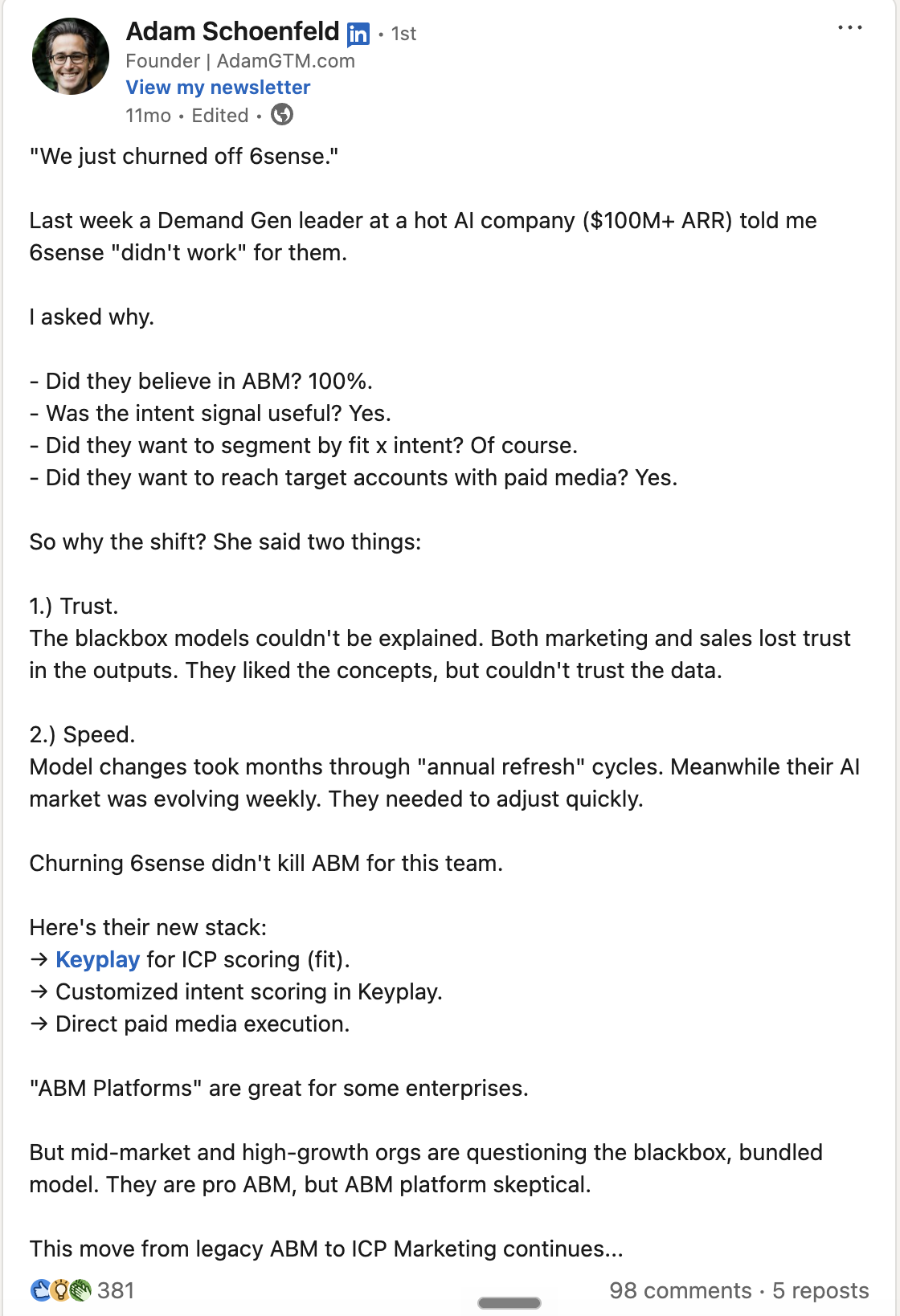
Adam Schoenfeld shared the experience of a $100M+ ARR company that left 6sense despite still believing in ABM and intent data. Marketing and sales had lost trust in the predictive outputs, while changes to the model reportedly took months.
A similar problem appeared in a Reddit discussion where a sales team stopped using 6sense after an unsubscribe visit triggered a hot-account alert.
6sense’s Model Insights documentation confirms that users cannot see the explicit ranking or importance assigned to each signal.
3. Cost becomes harder to justify when usage is limited
6sense does not publish standard pricing for its Revenue Marketing platform. Vendr reports a median annual contract value of $63,199, based on 383 purchases. The price becomes difficult to defend when sales adoption is weak or teams use only part of the platform.
Several public discussions on 6sense highlight how its cost can become a bottleneck:
- A company describing a three-month pilot found the predictions useful but was quoted around $80,000 per year for eight users. Its SDRs struggled with the interface, and the contact data did not meet expectations.
- Another firm was considering a two-year renewal at $120,000. The Americas team valued 6sense, while adoption remained low in EMEA and APAC. Regional account matching was also a concern.
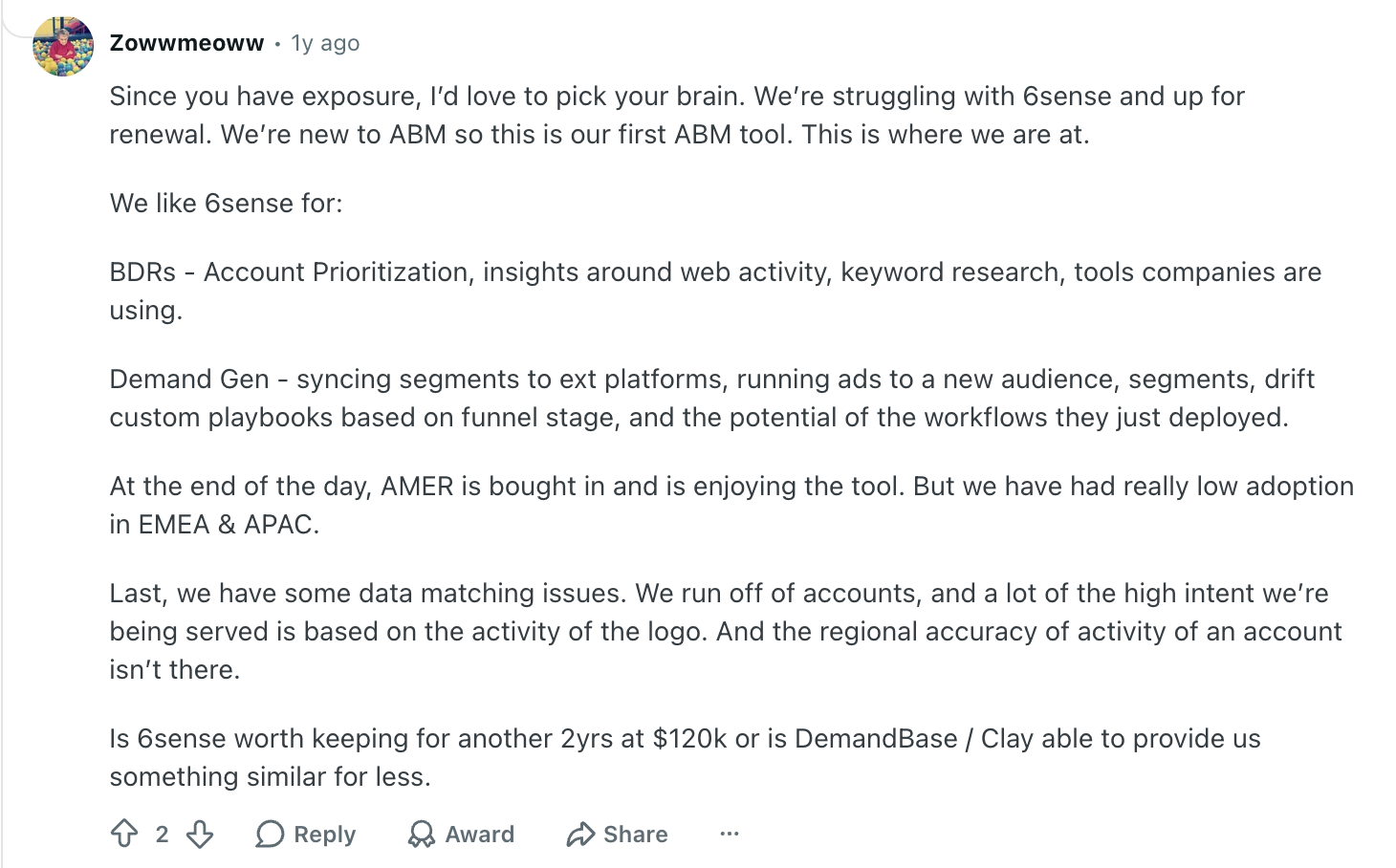
Sales adoption depends on how the insight reaches the rep
A buying stage can tell sales which account to prioritize. It does not always explain who to contact, what changed, or how to approach the account.
Based on work across hundreds of 6sense environments, Dom Colasante of 2X found that adoption suffered when keywords were too generic or the underlying signal details never reached sales. Sellers were more likely to trust the output when they helped define the signals and could see why an account had been prioritized.
Implementation requires ongoing ownership
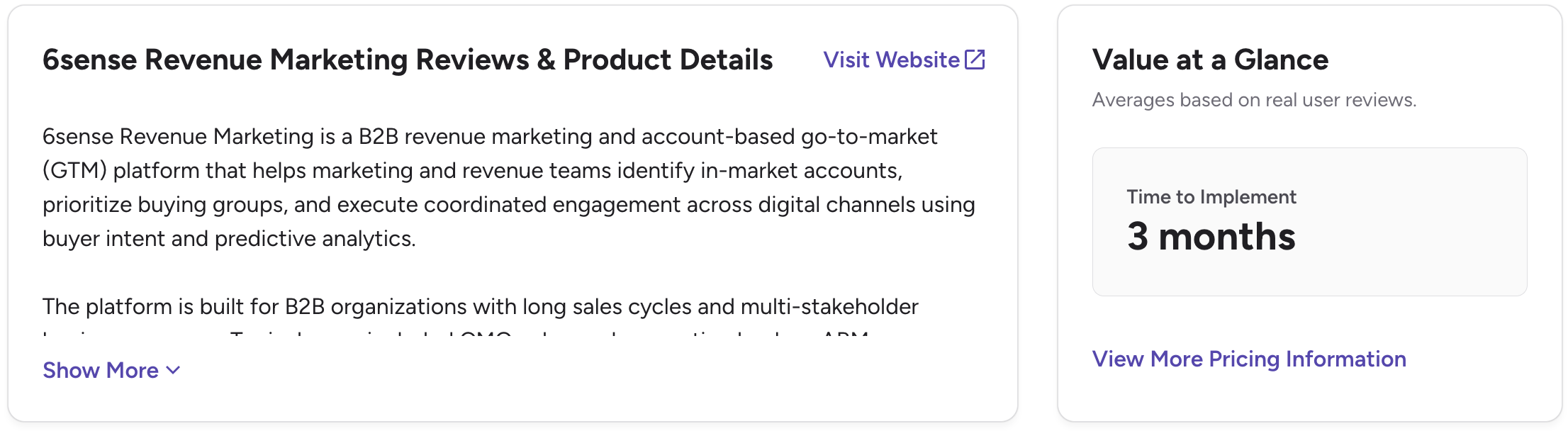
G2 reports an average implementation time of three months for 6sense Revenue Marketing. Connecting CRM data, marketing automation, website activity, external intent, advertising, and sales workflows takes time.
The work continues after launch. Data mappings, keywords, segments, workflows, model performance, and sales enablement all need an internal owner. Without dedicated RevOps or marketing operations support, companies may struggle to use enough of the platform to justify the investment.
6sense Alternatives at a Glance
The 10 best 6sense alternatives and competitors
1. Factors.ai
Factors.ai covers much of the same operating ground as 6sense. Marketing teams can identify website visitors, bring first- and third-party intent into the account journey, prioritize accounts, activate audiences, alert sales, and measure the impact on pipeline.
Scout extends this workflow beyond dashboards and alerts. Its AI agents can use CRM records, website activity, people data, and account segments to research active companies, explain why the activity matters, and trigger the next step. Factors.ai currently supports 13 agent tools, including account research, journey summaries, contact discovery, CRM lookups, and agent chaining.
Factors.ai is also an official LinkedIn Marketing Partner and Microsoft Marketing Partner.
How much does Factors.ai cost?
Factors.ai has four main pricing plans. Lite starts at $199 per month, Basic at $6,000 per year, Growth at $20,000 per year, and Enterprise at $30,000 per year.
Key features of Factors.ai
- Company identification, with person-level identification available as an add-on
- First-, second-, and third-party intent signals
- Configurable account scoring and engagement tracking
- Account journeys and multi-touch attribution
- Audience activation across LinkedIn, Google, Bing, Microsoft, and Meta
- AdPilot controls for LinkedIn and Google
- Scout AI agents for research, alerts, and workflows
How does Factors.ai compare to 6sense?
The biggest difference is control over account scoring. Factors.ai lets marketing teams decide which signals matter, assign weights, account for recency, and inspect the activity behind a score. 6sense gives teams visibility into the signals feeding its models, but the underlying mathematical weighting remains proprietary.
Factors.ai also gives teams more flexibility in how they use AI. Its MCP makes your GTM data, saved reports, and agents available to MCP-compatible AI clients, where they can also be used alongside other connected tools. 6sense has introduced its own MCP, but the current release supports read-only retrieval.
Cost is another major advantage. Factors.ai’s Growth plan is priced at $20,000 per year and includes most of the capabilities a typical 6sense customer would use. Vendr reports a median 6sense purchase of $63,199 per year. Factors.ai can cover much of the same day-to-day ABM motion at roughly one-third of that benchmark.
2. Demandbase
Demandbase is the closest like-for-like alternative to 6sense. Both platforms cover account intelligence, intent, predictive scoring, advertising, sales workflows, journey analytics, and measurement.
One area where Demandbase goes deeper is buying-group intelligence. It can use historical CRM and opportunity data to identify the roles typically involved in a deal, show which people from those roles are already engaged, and flag the ones that are still missing.
Marketing teams can use the same buying-group data for advertising. Demandbase’s native B2B DSP supports both account-level and person-level targeting, which means you can put more spend behind specific people inside an account instead of treating the whole company as one audience.
How much does Demandbase cost?
Demandbase does not publish standard pricing. Pricing depends on the products you choose, the number of users, data requirements, media spend, and services.
Key features of Demandbase
- Account intelligence and proprietary intent data
- AI-assisted buying-group creation and persona mapping
- Buying-group completeness and stakeholder-gap analysis
- Predictive account prioritization
- Native B2B demand-side platform
- Account- and person-based advertising
- Journey analytics and pipeline measurement
How does Demandbase compare to 6sense?
If buying-group intelligence is one of the main reasons you’re looking beyond 6sense, Demandbase is probably the first platform I’d evaluate.
You can see whether a likely decision-maker, champion, or technical evaluator has engaged, identify which roles are missing, and use that information to guide both advertising and sales follow-up.
There is a catch. Demandbase’s automated Buying Group Setup Agent requires at least 100 contacts tied to opportunities from the previous 12 months. If your CRM data is thin or inconsistent, you may need more manual setup before this becomes useful.
Demandbase is also unlikely to solve the cost or operational complexity that may have pushed you away from 6sense in the first place. Vendr reports a median annual purchase of $68,591, and both platforms need clean data and someone internally to manage them.
3. UserGems
UserGems helps sales teams decide which accounts and contacts are worth prioritizing. It uses CRM data, job changes, website activity, intent, and other signals to score both companies and individual people.
How much does UserGems cost?
UserGems starts at $40,000 per year for its Core plan. The Advanced plan is priced at $75,000 per year, while the Elite plan costs $150,000 per year.
Implementation is charged separately, and some intent and ABM capabilities are sold as add-ons on lower plans.
Key features of UserGems
- Account and contact scoring
- More than 600 fit criteria and signals
- Visible and editable scoring logic
- Job-change and former-champion tracking
- Contact-level intent
- Signal-specific emails and sequence enrollment
- Dynamic audience sync across LinkedIn, Meta, and Google
How does UserGems compare to 6sense?
UserGems puts more emphasis on contact-level prioritization and sales execution. It can identify a specific person worth contacting, show the signals that contributed to their score, and help sales act on that information.
The scoring logic is also visible and editable. Marketing and sales can see which signals are being used and change how much they matter instead of relying entirely on a predictive model.
Job-change tracking is another useful difference. If a former customer or champion moves to a new company, UserGems can flag the move and give sales a clear reason to reach out.
The trade-off is scope. UserGems does not replace 6sense across programmatic advertising, attribution, and broader account-journey analytics. It makes more sense when prioritization and sales follow-up are the parts of 6sense you care about most.
4. AdRoll ABM
AdRoll ABM, formerly RollWorks, is very strong on media execution. Its first-party DSP reaches target accounts across display, social, mobile, and connected TV, while buyer-intelligence products help marketers decide which accounts deserve more spend.
The platform is not limited to retargeting. Journey Prediction uses fit, intent, and engagement to estimate where an account sits in its buying process. Command Center recommends next steps, and ABM Workflows can coordinate actions across the CRM, Outreach, Salesloft, and Slack.
A marketer can move from an account signal to a campaign or seller task without exporting the list through several systems.
How much does AdRoll ABM cost?
AdRoll does not publish fixed pricing for its broader ABM packages.
Its Account-Based Retargeting option does not have a platform fee, with customers paying for media instead. Larger ABM packages require a custom quote based on the program and level of support.
Key features of AdRoll ABM
- First-party DSP across display, social, mobile, and CTV
- Journey Prediction using fit, intent, and engagement
- Account scoring and recommended actions
- Dynamic audience creation
- Cross-channel ABM Workflows
- CRM integration and account measurement
How does AdRoll ABM compare to 6sense?
AdRoll is worth considering if paid media is the main reason you are using 6sense.
You can identify the accounts you want to reach, build audiences, run ads across several channels, and use engagement data to decide where to put more spend. You are not paying for the same breadth of sales intelligence, predictive modeling, and revenue analytics that comes with 6sense.
The narrower scope is also the trade-off. AdRoll does not replace 6sense across contact data, sales intelligence, attribution, or broader account-journey analysis. If you use those parts of 6sense heavily, you will still need other tools alongside it.
Recommended Read: Factors.ai vs AdRoll
5. Madison Logic
Madison Logic belongs on the shortlist for B2B marketers investing heavily in media. Its channel mix extends from content syndication and display to LinkedIn, connected TV, and digital audio. Few alternatives in this list offer the same combination as a native part of the service.
Its Pipeline Insights reporting connects campaign activity back to opportunities. Using this, marketers can review account and buying-group engagement, see whether opportunities progressed or stalled, and examine how content, programmatic, and social activity contributed while the campaign was live.
How much does Madison Logic cost?
Madison Logic does not publish standard pricing. The final cost depends on the channels you use, campaign scope, target-account volume, and media spend.
Key features of Madison Logic
- Proprietary intent data
- Content syndication
- Programmatic display
- LinkedIn advertising
- Connected TV and digital audio
- Buying-group targeting
- Stage-by-stage pipeline measurement
How does Madison Logic compare to 6sense?
Madison Logic stands out if content syndication is an important part of your ABM strategy. You can run content syndication alongside display, LinkedIn, CTV, and audio, then measure how those campaigns are engaging target accounts and influencing opportunities.
It also offers managed support for campaign strategy and execution. This can be useful for a smaller marketing team that wants help running programs rather than taking on all of the day-to-day campaign management internally.
Lead quality, reporting detail, and channel performance should still be validated with the company’s own account list during evaluation.
6. ZoomInfo
ZoomInfo is primarily a sales intelligence and data platform. The company reports more than 500 million professional contacts and 100 million companies, along with 200 million verified business email addresses and 120 million direct-dial numbers.
This gives reps a large base for prospecting, enrichment, and finding additional stakeholders inside a target account.
ZoomInfo’s GTM Context Graph links this database with CRM records, sales conversations, marketing engagement, product activity, and buyer behavior. GTM Workspace can use the resulting context to prioritize accounts, recommend contacts, and help prepare outreach.
ZoomInfo pricing
ZoomInfo does not publish standard pricing for its paid plans. Vendr currently reports a median annual purchase of $33,500, based on 1,571 purchases. Its observed deals range from roughly $7,200 to $156,000 per year, which show how much pricing can vary depending on seats, products, data credits, and contract scope.
Recommended read: ZoomInfo Pricing Breakdown
Key features of ZoomInfo Pricing
- 500M+ professional contacts, including 200M+ verified emails and 120M+ direct dials
- 100M+ company records
- Organizational charts and stakeholder data
- Intent, company-event, and behavioral signals
- Company and eligible US person-level visitor identification
- CRM enrichment, segmentation, and routing
- Seller prospecting and outreach preparation
How does ZoomInfo compare to 6sense?
ZoomInfo is worth considering when the bigger problem is finding and reaching the right people, rather than deciding which accounts are in-market.
6sense may tell a seller that an account is showing intent, but the signal is only useful if the CRM has the right contacts and reliable ways to reach them. ZoomInfo gives sales the underlying company and contact data to find additional stakeholders, fill gaps in existing records, and prospect directly into the account.
There is still a meaningful difference in scope. 6sense goes further into predictive buying stages, account-based advertising, and journey measurement. ZoomInfo makes more sense when sales intelligence, enrichment, and prospecting are the parts of your stack that need the most improvement.
7. Bombora
Bombora is best known for Company Surge, one of the more established sources of third-party B2B intent data. It compares an account’s recent research activity with its usual behavior. A sudden increase in interest carries more weight than a company that regularly reads about the same topic.
Bombora currently tracks more than 21,600 intent topics. The data can be sent to your CRM, sales tools, advertising platforms, and other ABM products. Bombora also offers Visitor Insights for website traffic and Digital Audiences for building targetable audiences.
Factors.ai has partnered with Bombora to provide you with 20 high-intent accounts every month.
How much does Bombora cost?
Bombora does not publish standard pricing for Company Surge. Pricing depends on the number of intent topics, accounts, integrations, audience products, and how the data needs to be delivered.
Key features of Bombora
- Company Surge intent data
- Account-specific research baselines
- More than 21,600 intent topics
- Account- and buying-group-based Digital Audiences
- Activation through major DSPs and paid platforms
- B2beacon campaign measurement
How does Bombora compare with 6sense?
I’d only shortlist Bombora as a 6sense alternative if third-party intent is the part you actually want to keep.
Bombora is not a like-for-like replacement. In fact, Company Surge is already available inside 6sense and can be used alongside its predictive models, segmentation, and sales intelligence.
Buying Bombora directly lets you use that intent data with the CRM, advertising platforms, and sales tools you already have instead of paying for a much larger ABM platform.
8. Cognism
Cognism is a sales-intelligence product for teams that place a premium on phone data and European coverage. Its Diamond Data mobile numbers are checked by human researchers, and the company screens phone data against Do-Not-Call lists in 15 countries.
Along with company and contact data, the platform includes firmographic and technographic filters, hiring and funding events, job changes, and Bombora intent on its Pro plan.
How much does Cognism cost?
Cognism's current pricing page uses quote-based pricing, with Standard and Pro packages that each include five seats. Cognism's 2026 published content lists Standard from $12,750 per year and Pro from $17,000 per year.
Key features of Cognism
- Phone-verified Diamond Data
- Company and contact intelligence with firmographic and technographic filters
- Do-Not-Call screening in 15 countries
- UK and European data coverage
- Hiring, funding, M&A, and job-change signals
- Bombora intent on higher plans
How does Cognism compare to 6sense?
6sense helps teams decide which accounts may be moving toward a purchase. Cognism addresses the next practical problem by finding the people inside those accounts and giving sales a reliable way to reach them.
Cognism can be more useful when the target-account list already exists, but sellers are working with incomplete records, inaccurate phone numbers, or weak European coverage. Better contact data gives reps something they can use immediately.
The trade-off is that it does not replace 6sense across account-based advertising, attribution, or account-journey analytics. You would need to keep those capabilities elsewhere in your stack.
9. Apollo.io
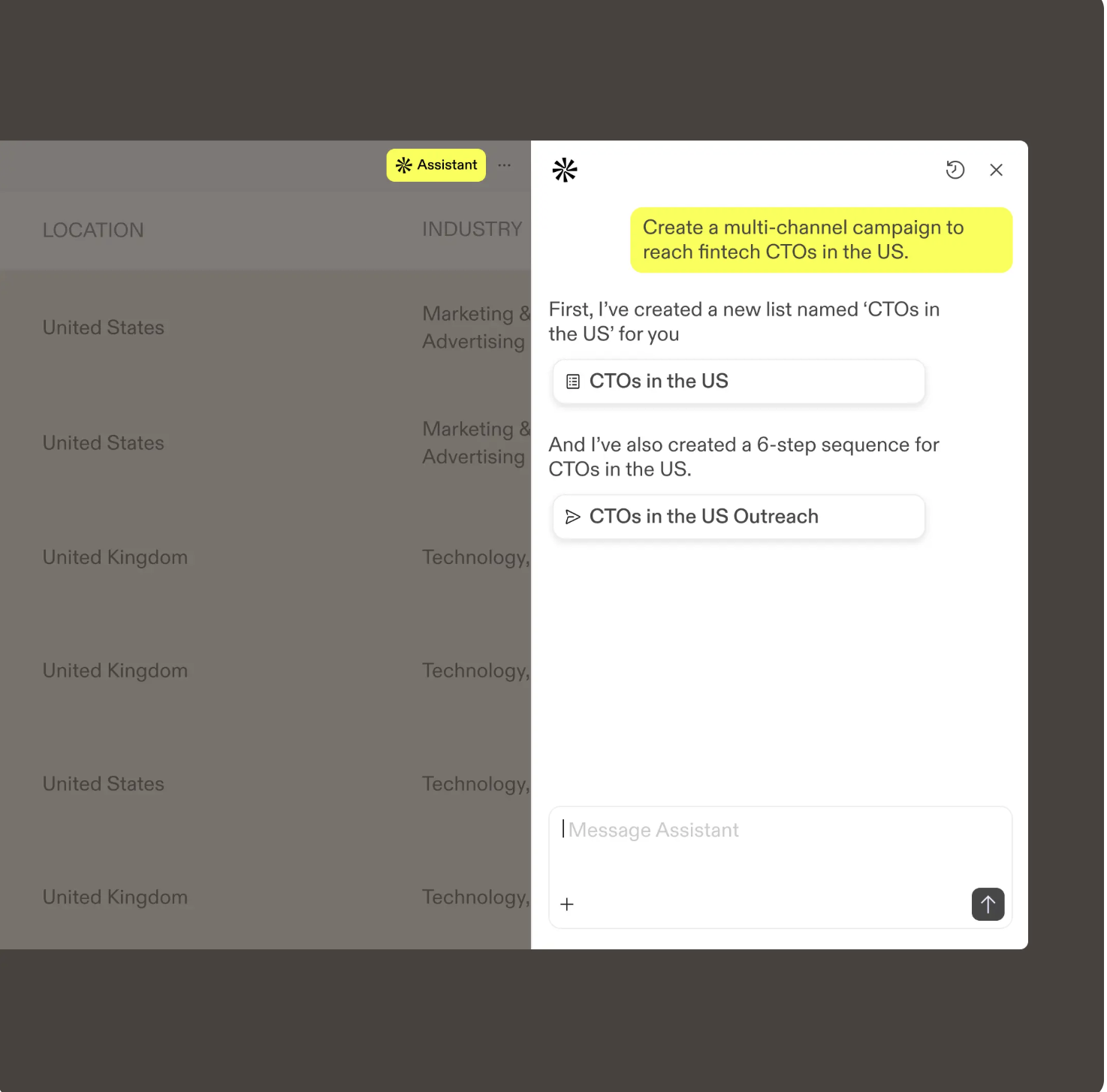
A sales rep can find a contact, fill in missing details, add the person to a sequence, place a call, and track the response without leaving Apollo.io. This connection between prospect data and outbound execution is the main reason Apollo.io belongs in a 6sense comparison piece.
Its Waterfall Enrichment model checks Apollo and connected data sources for missing emails and phone numbers. Contact-level website identification is available for US visitors through the Inbound Add-On.
How much does Apollo.io cost?
Apollo offers a free plan. With annual billing, Basic costs $49 per user each month, Professional costs $79, and Organization costs $119 with a three-user minimum. Credits and feature allowances vary by plan. The Inbound Add-On is priced separately.
Key features of Apollo.io
- Company and contact database
- Waterfall Enrichment
- Buying-intent signals
- Lead and account scoring
- Company-level website visitor identification
- US contact-level identification through the Inbound Add-On
- Email, phone, and multichannel sequences
How does Apollo.io compare with 6sense?
Apollo.io is a very different purchase from 6sense. It gives a smaller sales-led team much of what it needs to find prospects, enrich them, spot intent, and start outreach without requiring separate handoffs between marketing operations and sales.
The economics are different too. You can start with a few seats and expand as the team grows rather than committing to an enterprise ABM platform upfront.
Where Apollo falls short is on the marketing side. If you rely heavily on 6sense for native account-based advertising, sophisticated predictive models, or deeper account-journey measurement, Apollo is not a full replacement.
10. Warmly
Warmly takes action on buyer signals automatically. Its TAM Agent handles account scoring, buying-committee identification, enrichment, paid audiences, and outbound, while its Inbound Agent focuses on identifying and engaging people who visit the website.
Both agents use Warmly's Context Graph, which keeps the account's activity and previous interactions available to whichever agent acts next.
How much does Warmly cost?
Warmly's TAM Agent starts at $15,000 per year, while its Inbound Agent starts at $30,000 per year. The Full GTM plan, which combines both agents with the Context Graph and additional platform capabilities, uses custom pricing.
Key features of Warmly
- Company and person-level website identification
- Transparent intent scoring
- First- and third-party buying signals
- Buying-committee identification
- Multi-provider contact enrichment
- TAM Agent and Inbound Agent working from a shared Context Graph
- LinkedIn, Meta, and outbound activation
How does Warmly compare with 6sense?
Warmly gives teams more direct control over account scoring. Unlike 6sense, where the predictive model’s internal weighting remains proprietary, Warmly lets teams see which signals are affecting an account’s score and adjust the logic themselves.
The same difference carries into execution. Instead of surfacing an account for someone to investigate, Warmly’s agents can use that account context to route a website visitor, add relevant contacts to a paid audience, or start an outbound workflow.
6sense still goes deeper in areas such as native programmatic advertising and enterprise predictive analytics.
How to choose the right 6sense alternative
If I were evaluating these tools today, this is the shortlist I’d start with:
1. Use price to eliminate options early
The pricing differences are large enough that you should use budget as an early filter, not something you discuss after the demo.
For context, Vendr reports a median 6sense purchase of about $63,000 per year. Demandbase sits in a similar range, with a reported median purchase of roughly $69,000. UserGems starts at $40,000 per year.
At the other end, Factors Growth starts at $20,000 per year, Warmly’s TAM Agent at $15,000, and Apollo starts at $49 per user per month on annual billing. ZoomInfo does not publish list prices, but Vendr reports a median annual purchase of roughly $33,500.
These are not like-for-like packages. They are useful because they tell you which vendors are worth spending time evaluating in the first place.
2. Test the shortlist with your own accounts
Once you are down to two or three tools, stop evaluating them through vendor demos. I’d put more weight on this test than on almost anything you see in a polished product walkthrough.
Give each vendor the same sample of accounts. Include some open opportunities, a few accounts your sales team already considers high intent, and a few that you know are poor fits. Then look at what comes back.
Check whether the platform identifies the right companies and contacts, why it prioritizes one account over another, and whether sales can actually use the output without asking RevOps to interpret it first.
If advertising matters, build one real audience and see how many of your target accounts or contacts can actually be reached. If automation matters, ask the vendor to build one workflow you would genuinely use, such as routing a high-intent account to sales or adding the right contacts to a paid audience.
3. Finally, calculate what it will take to run the ABM platform
The software price is only part of the decision.
Ask who will maintain the scoring model, clean the CRM data, update intent topics, build audiences, troubleshoot integrations, and train sales when the output changes.
Also include implementation fees, media spend, data credits, extra seats, and any services you will need.
A $30,000 platform that needs a dedicated operator can easily cost more than a $50,000 platform your existing team can manage.
The best 6sense alternative is not the product with the longest feature list. It is the one that replaces the parts of 6sense your team actually uses, fixes the reason you are considering leaving, and can still be run effortlessly six months after implementation.
Frequently asked questions about 6sense alternatives
1. What is the best 6sense alternative?
Factors.ai is the best fit if you want broad ABM capabilities with more control over account scoring and a lower starting price. Demandbase is the closest enterprise alternative, while tools like UserGems, ZoomInfo, and Madison Logic make more sense for narrower requirements.
2. Is Demandbase better than 6sense?
Demandbase can be better if buying-group intelligence and B2B advertising are major priorities. 6sense may be the better fit if you prefer its predictive buying stages and broader Revenue AI platform. Neither is the obvious choice if lower cost or simpler implementation is the goal.
3. How much does 6sense cost?
6sense does not publish standard pricing. Vendr reports a median annual purchase of $63,199, although actual contracts vary based on products, users, data, advertising, and services.
4. What is the difference between Factors.ai and 6sense?
Factors.ai gives teams more control over scoring, a more flexible MCP for working with data and agents, and delivers much of the same ABM capability at roughly 30% of the cost of 6sense.
5. Are there cheaper alternatives to 6sense?
Yes. Factors.ai’s Growth plan is priced at $20,000 per year, Warmly’s TAM Agent starts at $15,000, and Apollo.io is $49 per user per month on annual billing. These products do not replace exactly the same parts of 6sense, so compare them based on the capabilities you actually use.
6. How do you replace 6sense?
Start by identifying which parts of 6sense your team actually relies on, such as scoring, intent, advertising, contact data, or sales workflows. Then shortlist tools around those requirements instead of looking for another platform with the same feature count. Test the final two or three options using your own accounts and workflows before switching.

See how Factors can 2x your ROI
Boost your LinkedIn ROI in no time using data-driven insights


.avif)

.avif)
See Factors in action.
Schedule a personalized demo or sign up to get started for free
LinkedIn Marketing Partner
GDPR & SOC2 Type II






.svg)



.avif)

