
Why Companies Are Switching From 6sense, Based on Buyer Feedback
Explore 6sense drawbacks through feedback from 83 current and former users, covering black-box scoring, data quality, adoption, cost, and contracts.

Associate Director of Brand and Content

Growth Marketer



.svg)


TL;DR
- 6sense’s black-box model scoring and intent can be difficult to evaluate when buyers cannot explain why an account was prioritized or find the research topics too broad for useful outreach.
- Teams can struggle to get enough value from 6sense when managing the platform requires more resources than they have or its recommendations fail to produce useful sales conversations.
- 6sense’s data quality and coverage can create extra verification work when company mappings, contact details, or regional coverage fall short of the team’s needs.
- The platform’s cost and contract terms become harder to justify when usage is low, particularly when buyers pay for unused capabilities.
To understand why some companies were reconsidering 6sense, we reviewed our sales conversations from July 2024 through September 29, 2026. We searched roughly 14,800 recorded meetings and their deal notes in Oliv, identifying 83 current or former 6sense users with specific complaints. We also examined 61 companies that evaluated 6sense but did not buy.
💡If you are considering replacing 6sense, read our detailed breakdown of top 6sense alternatives that can replace 6sense in your tech stack.
Four main concerns about 6sense came up repeatedly in our conversations. Here’s what buyers told us and how those issues affected their teams.
1. 6sense’s Black-box scoring and broad intent make recommendations harder to evaluate
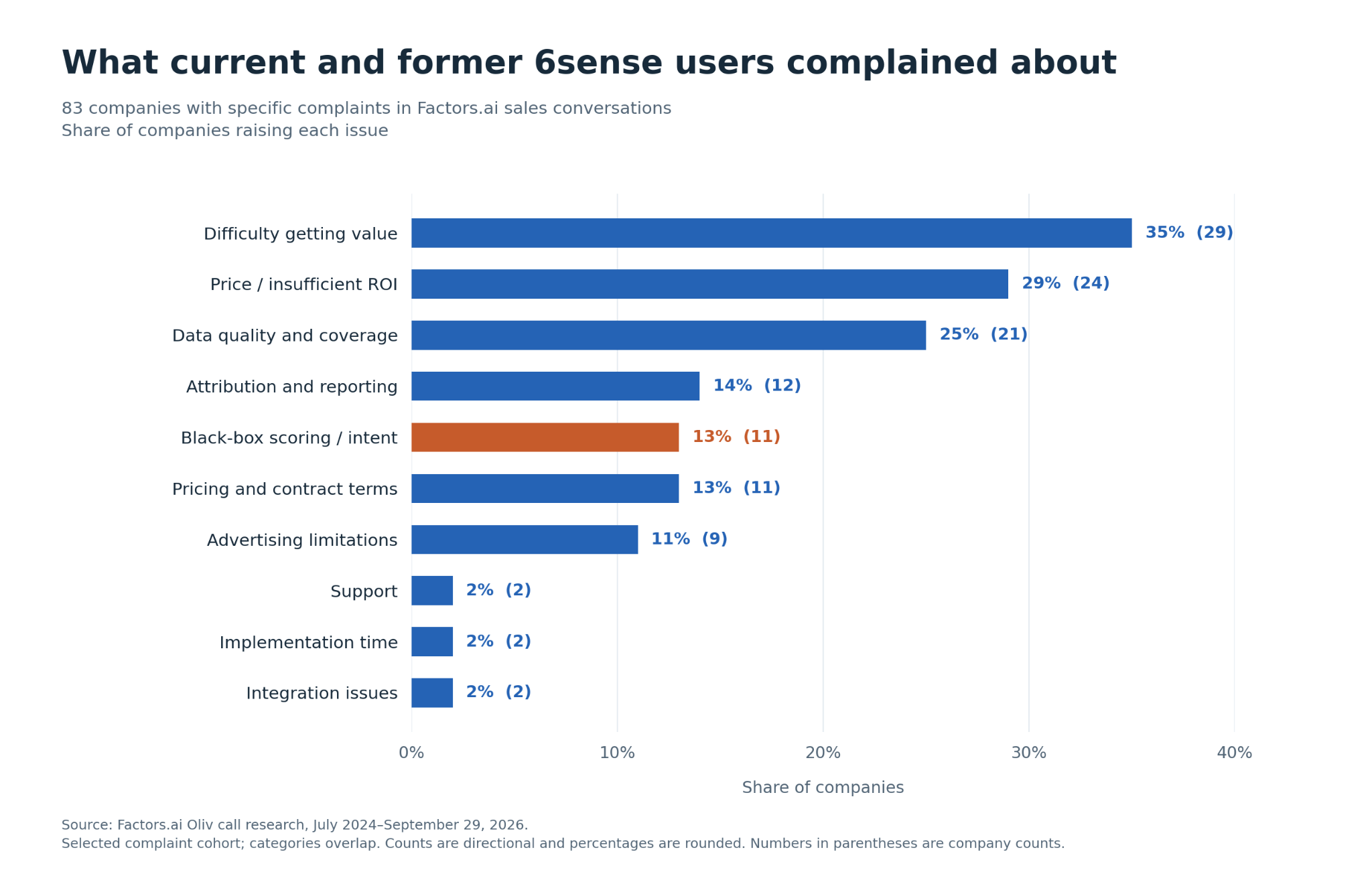
Approximately 13% of current or former users raised concerns about 6sense’s black-box scoring or intent. Buyers questioned how accounts were prioritized and whether the available signals were specific enough to guide outreach.
One buyer exploring a replacement described their experience:
“It’s a black box sometimes. We have lots of intent information all over the place. HubSpot itself does a better job with intent.”
A colleague on the same call explained the problem with topic specificity:
“Intent topics can be a little bit too vague... it doesn’t mean anything to me if a company is interested in compliance.”
Knowing a company is researching “compliance” gives a seller little direction about the requirement behind that research. It may be relevant to the product they sell, or concern something entirely different.
The scoring complaint needs a separate explanation. 6sense exposes the inputs, but not the predictive model’s internal weights. Users can configure keywords, website classifications, ICP definitions, and qualification thresholds. They can also inspect account activity and review reports comparing predictions with outcomes. However, the precise reasoning behind an individual account score is not available in the platform.
For a marketer, this limits how directly they can change the scoring logic. They can adjust the data and criteria feeding the model, but cannot decide exactly how much a particular action contributes to its prediction.
A proprietary model can still produce useful recommendations. The difficulty arises when a team questions the output and wants to trace or change the calculation behind it.
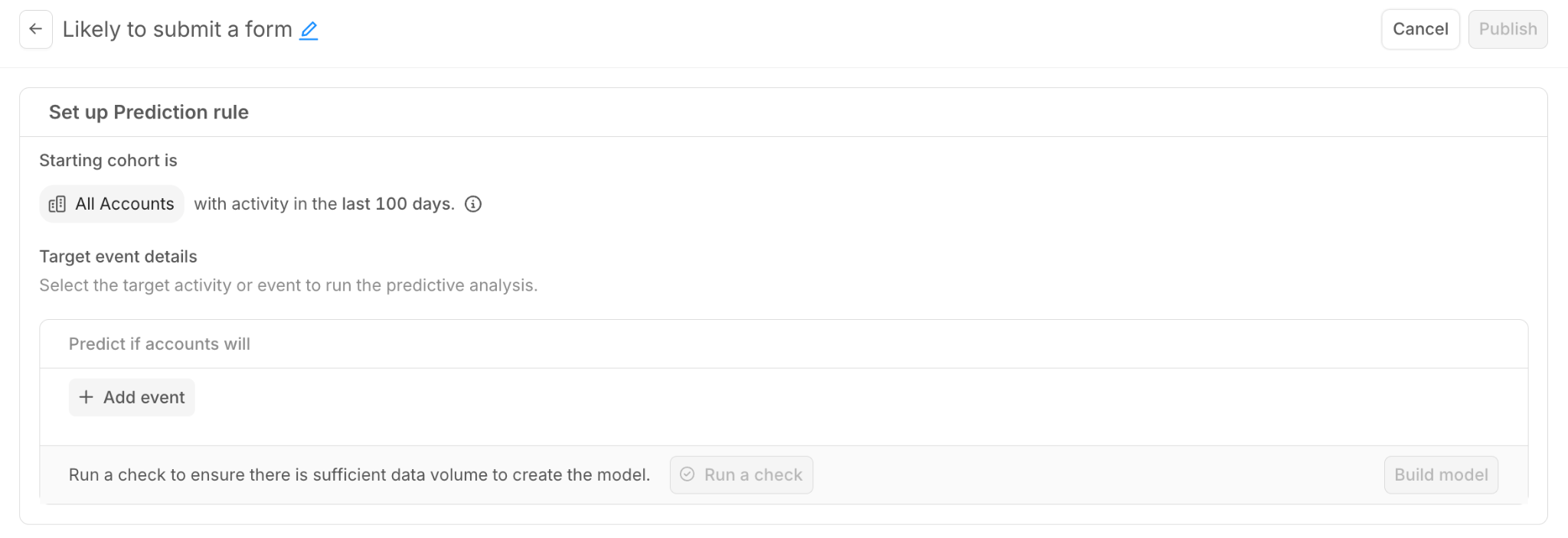
Factors.ai’s custom engagement scoring addresses that requirement by letting teams choose events, assign weights, and limit how much repeated activity contributes. Its separate predictive scoring learns from historical activity toward a selected outcome, such as opportunity creation.
Users control the rules in custom scoring; in predictive scoring, they select the outcome and review model performance rather than manually setting the learned weights.
2. Teams struggle to get enough value from 6sense
Difficulty getting value out of 6sense was the largest complaint category, raised by approximately 35% of users. Some lacked the resources to run the platform consistently. Others used it actively but were disappointed with the results.
One marketing lead described the resource gap:
“We don’t have a marketing operations team. We don’t have a sales operations team. We don’t have that team to orchestrate it at all.”
They estimated their company was only using roughly 60% of the platform’s capabilities. Another growth marketing leader described an inherited subscription as “shelfware at the moment.”
These buyers had access to more capabilities than their teams could regularly use. Maintaining audiences, reviewing accounts, coordinating follow-up, and assessing results required time they struggled to find.
Navigating the platform was another obstacle. A person responsible for their team’s day-to-day usage said:
“The entire UI UX has been a little difficult for our team to actually navigate through and pull out the data.”
But the problem wasn’t always insufficient effort or difficulty using the interface. One sales team initially worked 6sense-qualified accounts, or 6QAs, diligently, with service level agreements (SLAs) governing follow-up. Their marketing leader described what happened afterward.
“There was no trust built, because they did not see results out of it, so now the sales team is mostly distrustful of 6sense.”
The team had adopted the process. Confidence declined after reps followed the recommendations but didn't see the results they expected.
Before renewing, check why your team isn’t getting enough value from 6sense. Training may help people navigate the platform, while a dedicated owner can manage audiences and coordinate follow-up. If reps already follow the recommendations but struggle to book meetings, review which accounts are being prioritized and whether the signals justify outreach.
3. Data quality and coverage can leave teams doing extra verification
Approximately 25% of users in our sample raised data quality or coverage concerns about 6sense. Buyers reported incorrect company mappings, duplicate records, inaccurate contact details, and gaps across regions or company sizes.
One buyer described repeatedly seeing familiar accounts rather than discovering new ones:
“We're somehow seeing the same accounts that are popping up. We don't see net new accounts.”
Another buyer wanted more detail about the people behind the activity. They acknowledged the information 6sense collected, but described the missing granularity:
“Six Sense pulls all that in, so technically it should be all of it. It's just... Not at a contact level.”
Other conversations raised accuracy and coverage concerns, including incorrect account mappings and insufficient data for smaller companies, specialized industries, or markets outside the US. These complaints affected different parts of the purchase. More identified companies alone would not fix inaccurate contact details or reveal who was visiting.
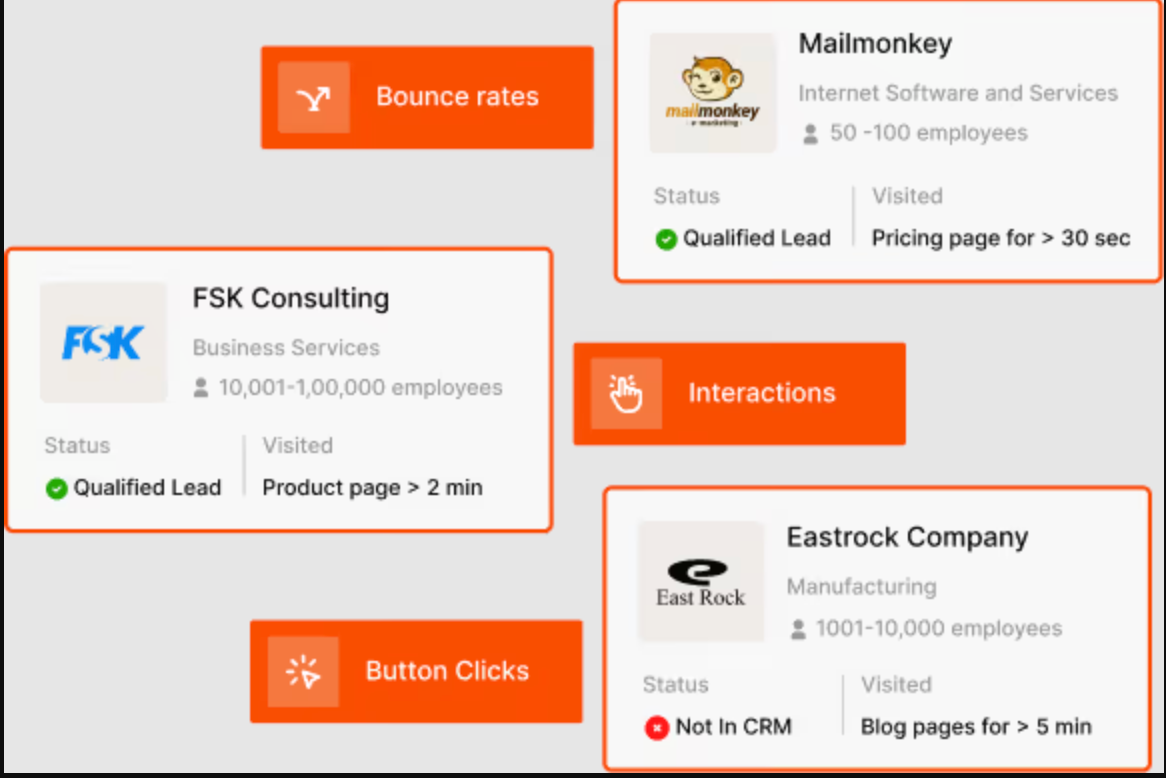
Factors.ai’s waterfall identification model uses four data sources to expand company-level account identification coverage up to 75%. Its RB2B integration adds person-level identification for eligible US-based website visitors (up to 40%), surfacing their LinkedIn profile and, where available, name, job title, and work email.
Sales can view those details alongside the visitor’s activity in the account timeline or receive them through alerts. This helps address the need to see who is engaging within an account, although RB2B identifies only a subset of US visitors.
4. 6sense’s cost and contract terms become harder to justify when usage is low
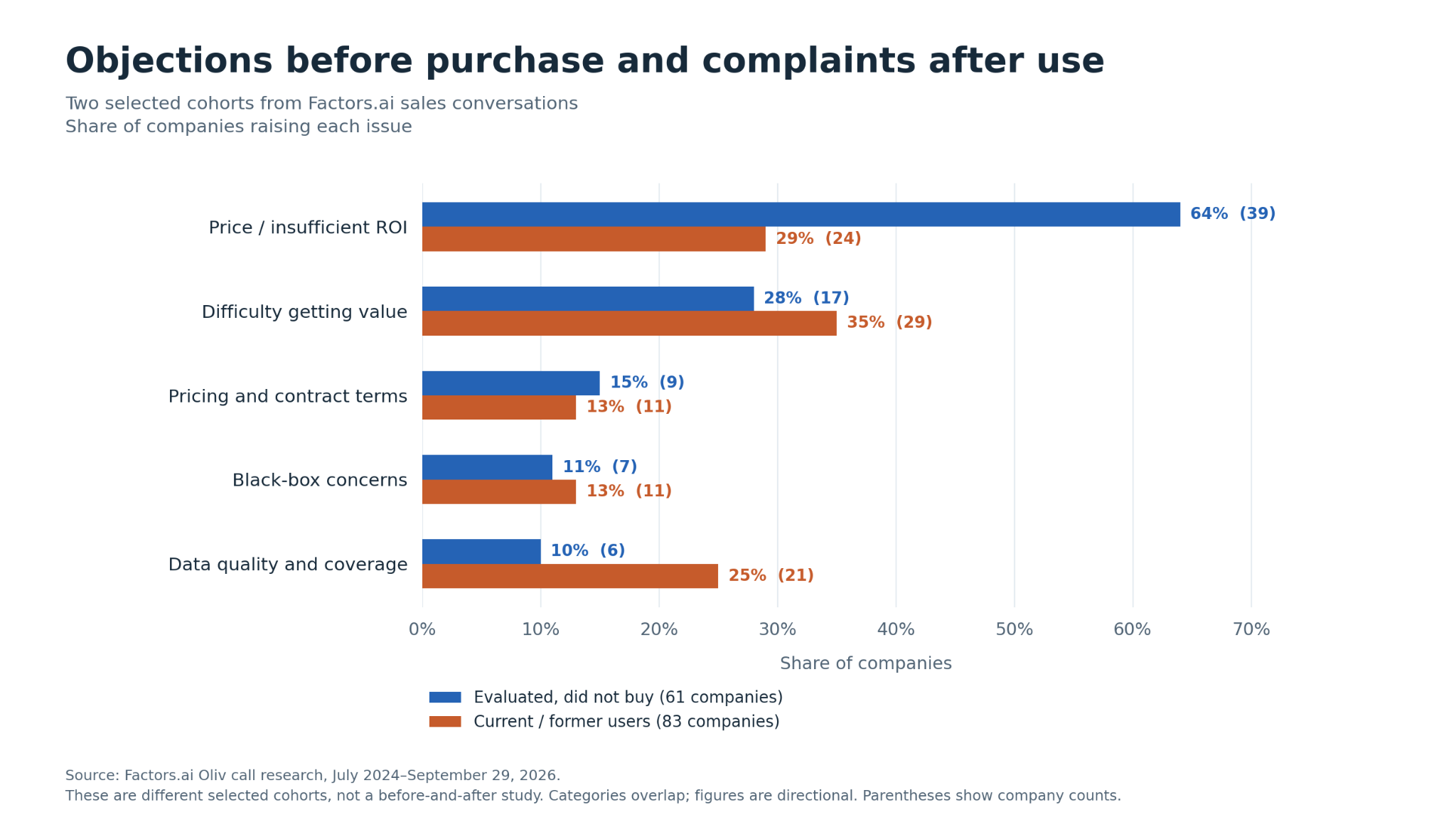
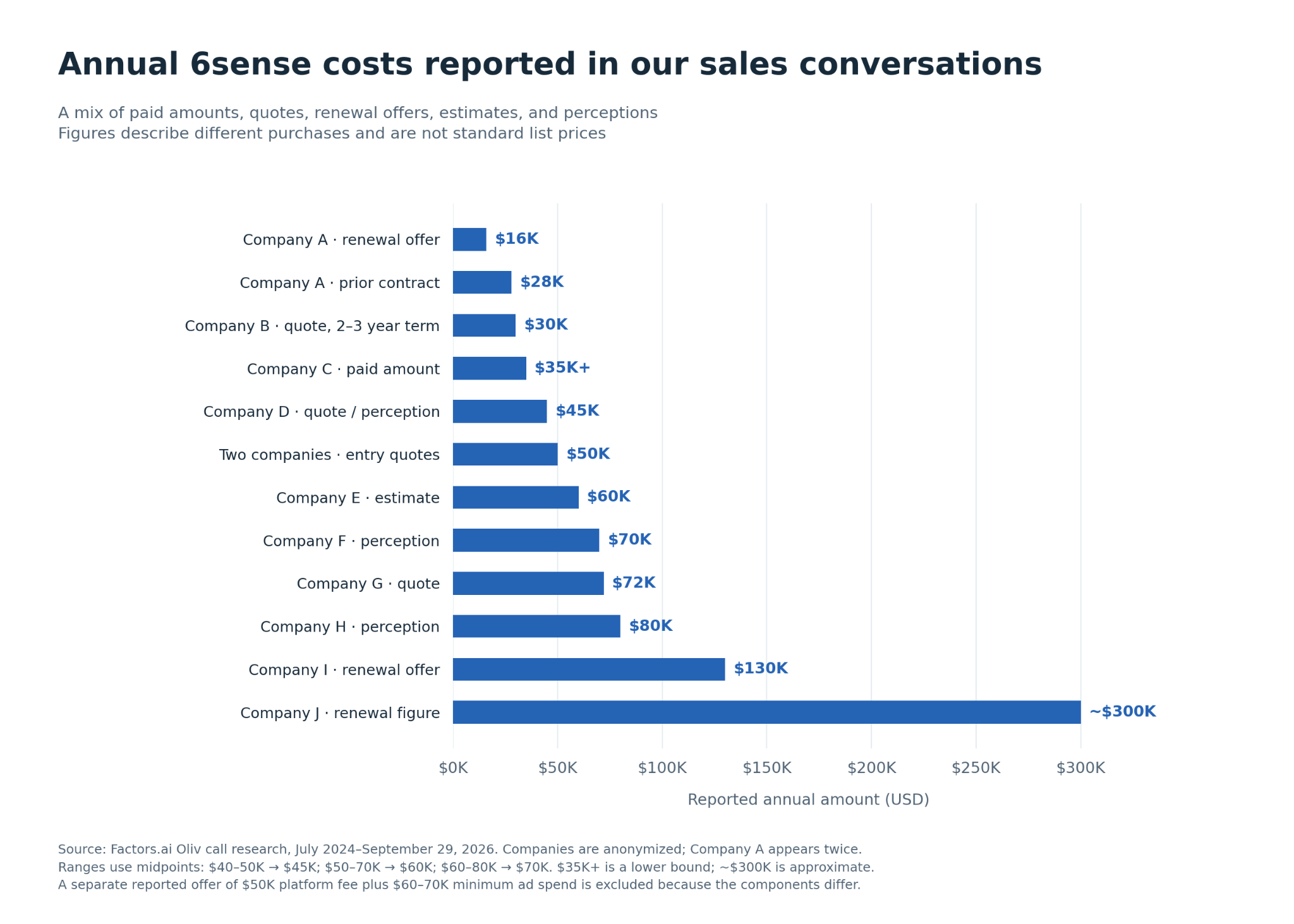
The cost of 6sense was a concern for approximately 64% of companies who evaluated it but didn’t buy, compared with 29% of current or former users. Around 13% of users also questioned seat charges, usage limits, or contract terms.
Some teams ruled out 6sense because the quote exceeded their budget. Others had already paid for it but weren’t using the platform enough or getting the results they expected.
One buyer reported paying $28,000 a year and receiving a $16,000 renewal offer, a reduction of approximately 43%. The company still canceled because it remained dissatisfied with the intent recommendations. A lower price didn’t resolve the problem it had with the product.
Objections among evaluators compared with complaints among users
Seat charges also affected how widely teams used 6sense. One marketing lead explained:
“Our adoption of 6sense is low. Because they charge us by user and we only enable the BDR team, which is five at the time.”
Contract length became a problem for another company. It had purchased the top tier, including predictive modeling, but felt sales wasn’t using it enough to justify the cost. Finance was trying to exit the second year of a two-year agreement.
For comparison, Factors.ai’s published pricing lists Growth at $20,000 a year and Enterprise from $30,000 a year, with defined seat and usage allowances. Add-ons can increase the cost, and Factors.ai typically uses annual contracts. Compare the package your team needs rather than treating these starting prices as equivalent to every 6sense purchase.
Other drawbacks those evaluating or using 6sense mentioned
Buyers also raised a few other concerns about 6sense:
- Around 14% wanted better attribution and reporting, including clearer revenue attribution, account journeys, campaign reports, and historical data.
- Around 11% questioned display-campaign results or said they had little use for the advertising features.
- Around 2% reported poor support or frequent changes in their customer success manager.
- Around 2% described implementation problems during their rollout; this figure excludes concerns evaluators raised about expected timelines.
If you are considering a better alternative to 6sense, try Factors.ai. Read the detailed comparison on Factors.ai vs 6sense before evaluating other options.
What are Reddit users saying about 6sense?
Public Reddit discussions describe similar concerns, although these are more anecdotal.
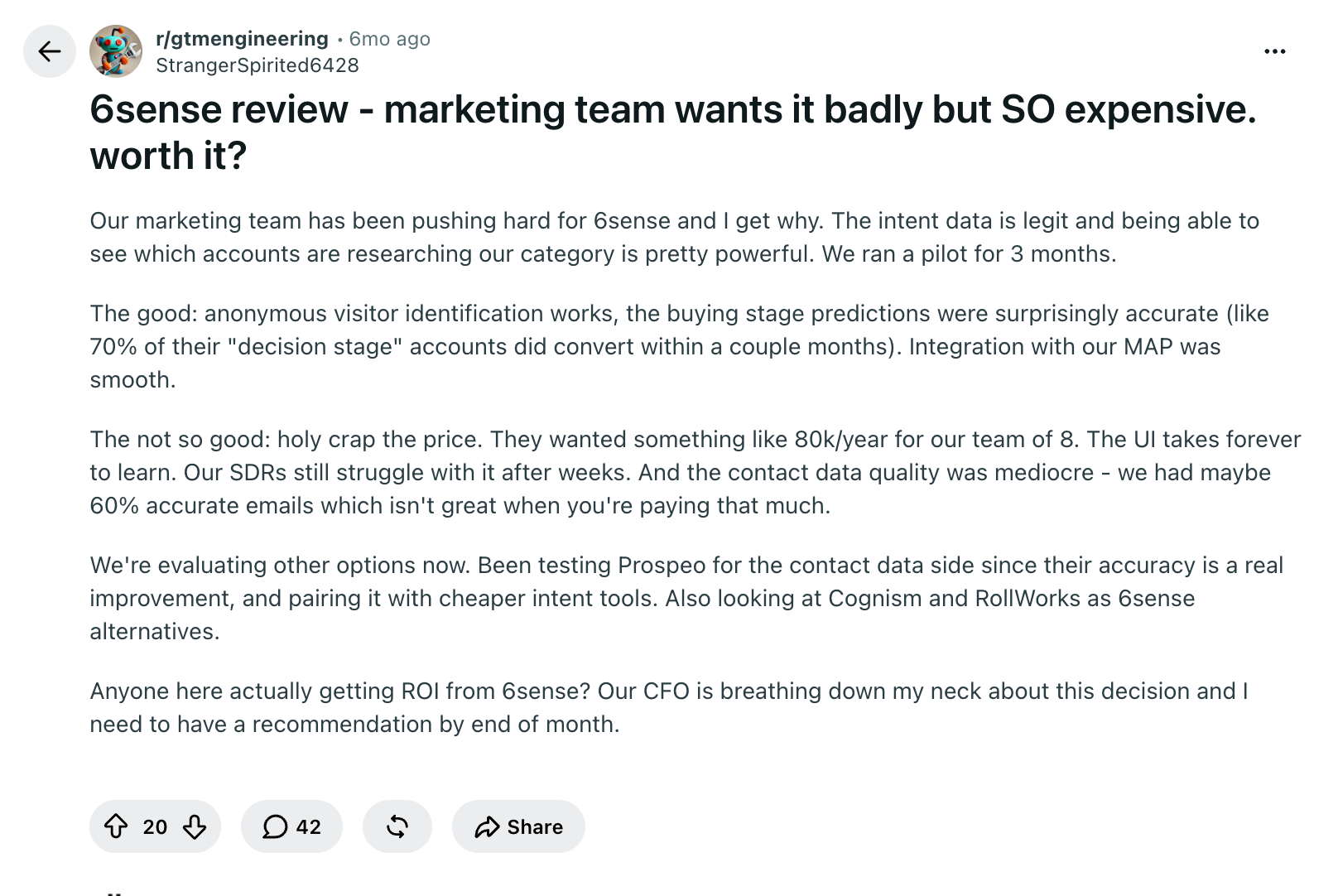
In a thread asking whether 6sense was worth the cost, the original poster described a three-month pilot. They praised identification, buying-stage predictions, and their marketing automation integration, while questioning an approximately $80,000 annual quote, the learning curve, and contact accuracy.
The buyer saw useful capabilities but remained unsure whether the complete purchase made sense for the team.
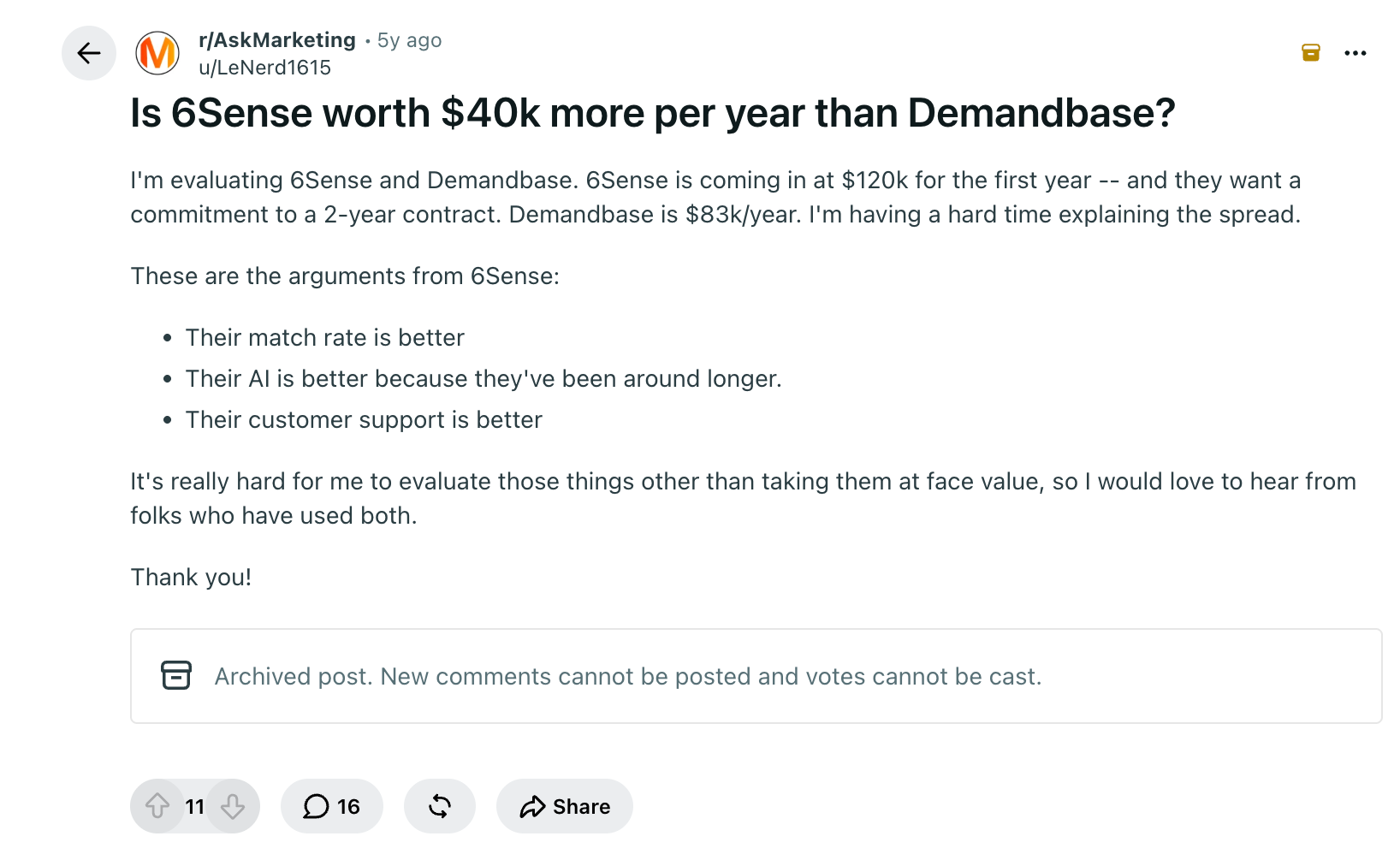
An older discussion comparing 6sense with Demandbase described a $120,000 first-year quote and a requested two-year commitment. The buyer struggled to assess claims about better matching, AI, and support.
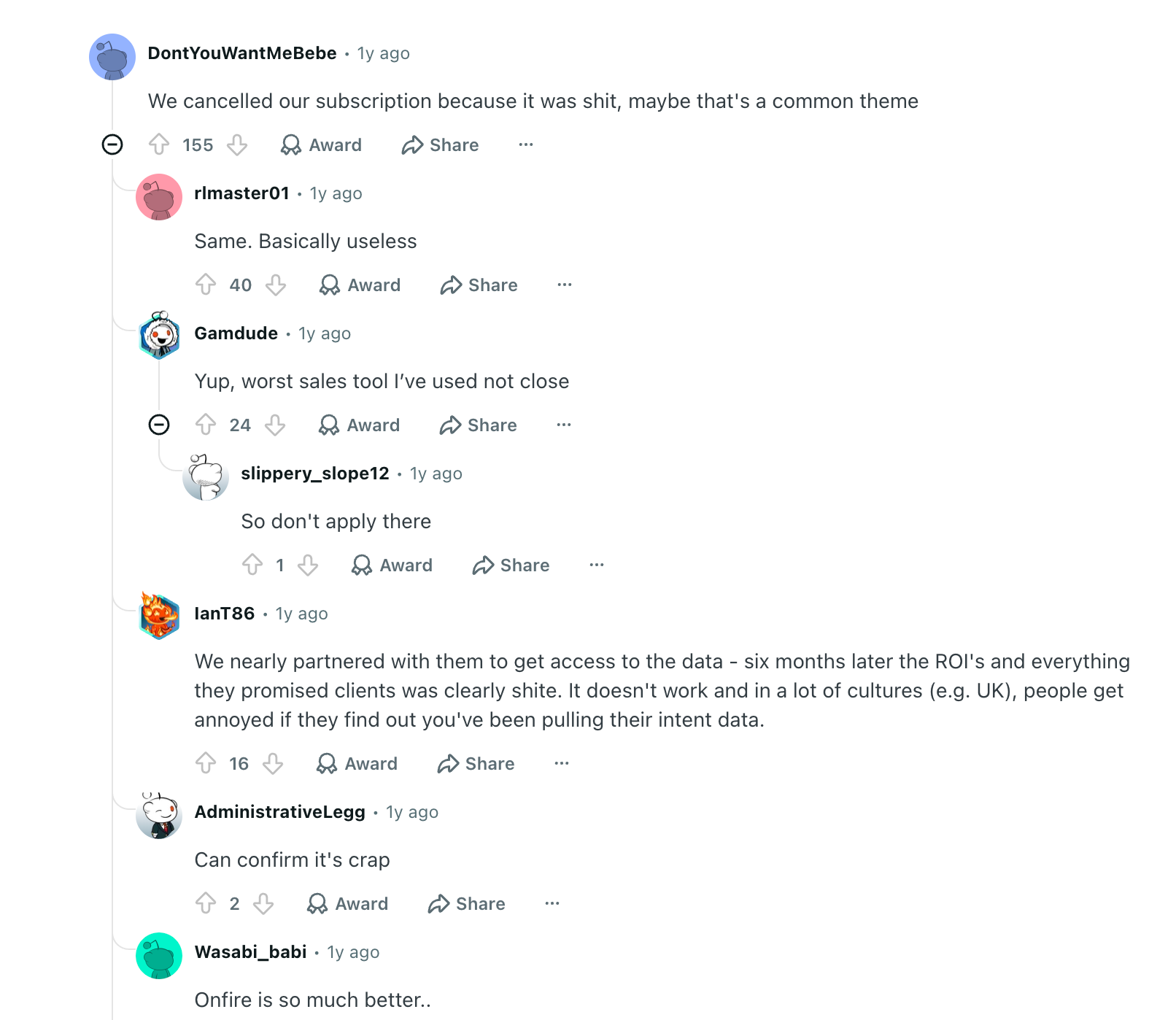
The “What’s going on at 6sense?” thread includes comments about disappointing results and account alerts that lacked enough detail for outreach. Its opening topic concerns employee departures, which should be kept separate from the product experiences discussed here.
Is 6sense the right fit for your team?
If you’re evaluating 6sense, ask the vendor to demonstrate how it would work with your accounts and data. Can the 6sense team explain the recommendations, find the contacts it needs, and turn the signals into useful outreach? Also check who will manage the platform and what the required features, seats, and usage will cost.
If you already use 6sense, compare those expectations with your experience. Look at the capabilities your team uses, the results it gets, and the work needed to keep everything running. This can help you decide whether to renew, adjust the package, or evaluate another platform.
Use the same criteria when considering Factors.ai or any other option. The right choice should meet your requirements at a cost your team can justify, with results you can assess.

See how Factors can 2x your ROI
Boost your LinkedIn ROI in no time using data-driven insights


.avif)
.avif)
See Factors in action.
Schedule a personalized demo or sign up to get started for free
LinkedIn Marketing Partner
GDPR & SOC2 Type II


.svg)



.avif)

