
How to Structure an ABM Team: Roles and Responsibilities
See how to structure an ABM team across Marketing, Sales, and RevOps. Compare lean, 1:few, and 1:1 models, roles, and responsibilities.




.svg)


TL;DR:
- Account-based marketing (ABM) focuses on high-value accounts, requiring a well-structured team and diverse skill sets
- Key team members include C-level executives, data analysts, strategists, designers, and content creators
- CEO, CMO, and CRO provide strategic direction, align ABM with company goals, and drive revenue growth
- Operations, Marketing, and Sales Managers oversee and execute various aspects of ABM campaigns
- Execution-based roles include Performance Marketers, Graphic Designers, Content Marketing and Strategy, Social Media Marketers, and Copywriters
- Proper team structure is critical for ABM success. It requires collaboration, strategic thinking, adaptability, and strong communication skills
- Tools like Factors.ai can optimize ABM efforts by providing insights into customer journeys, visitor tracking, and marketing ROI optimization
An ABM team structure defines who is responsible for the different parts of an account-based marketing program, from selecting and planning target accounts to running campaigns, working opportunities, and measuring progress.
Those responsibilities usually sit across Marketing, Sales, and RevOps rather than inside one dedicated ABM department. Marketing may coordinate the program, Sales works the accounts, and RevOps supports the data and processes both teams depend on. Other specialists can step in when a campaign or account needs them.
The exact account-based marketing team structure will vary with the type of ABM program you run and the level of attention your target accounts require. In this guide, we’ll look at the roles involved, what each person owns, and how the team should work together.
Account-Based Marketing Team Structure
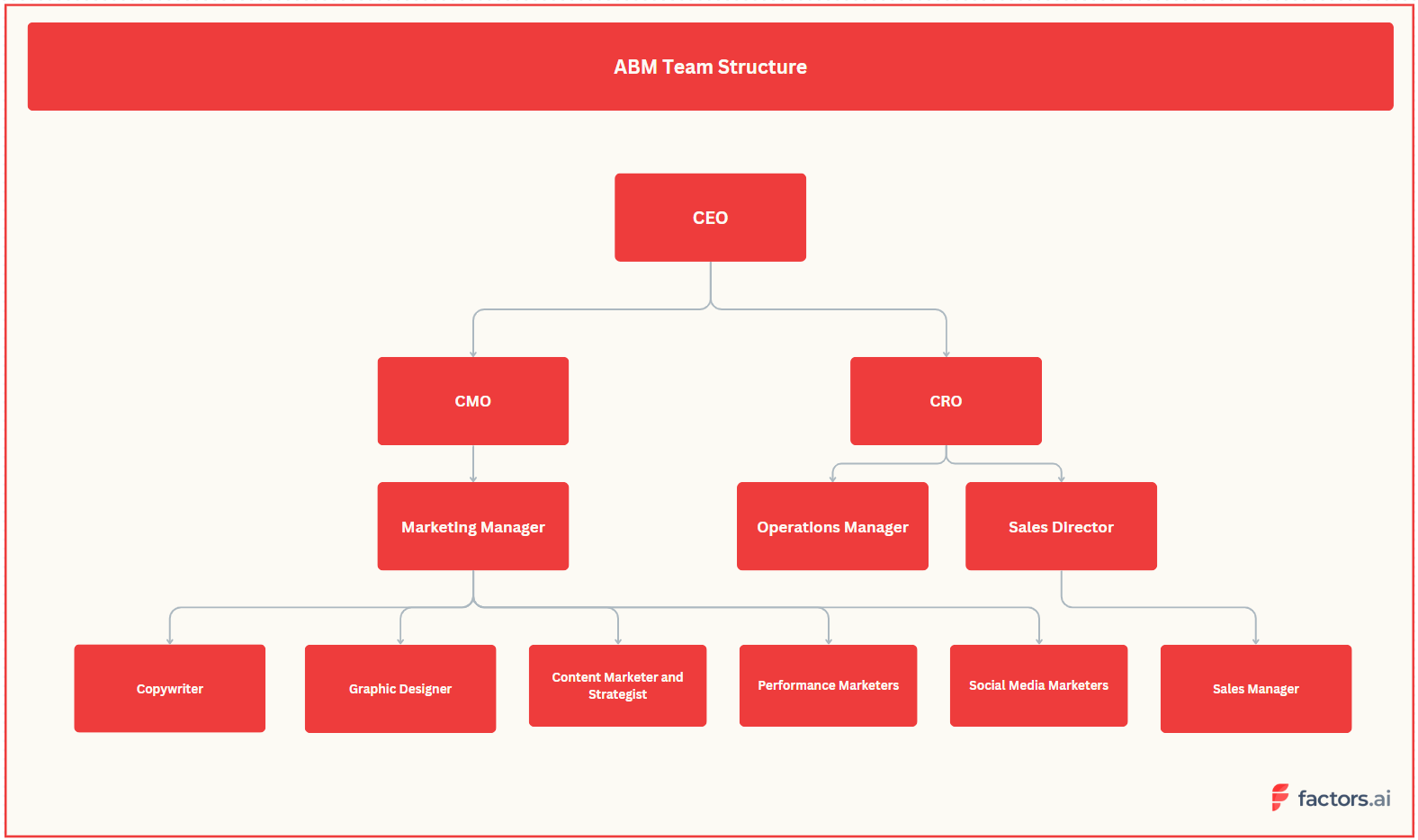
Most ABM teams are led by Marketing, with Sales and RevOps sharing responsibility for account planning, data, and execution.
Praveen, Co-founder and CMO at Factors.ai, spoke with Alexander Goodwin, Director of Demand Generation at Fingerprint, about how Fingerprint runs ABM. Alex's view on team roles and responsibilities was straightforward: “Account Based Marketing is a go-to-market motion, not a Marketing motion, the sales team needs to be involved at every step.”
Depending on the account, the wider ABM team can include leaders, managers, and execution specialists. Here’s where each can contribute.
C-Suite and Directors
The C-Suite and Directors in the ABM team have higher-level access to company information and the long-term vision to align the team towards a singular goal.
Chief Executive Office (CEO)
Before any ABM campaign is planned out, the team needs to understand the long-term vision of the company. That’s where a CEO comes into play. With the top level view of the company, the CEO can assist the ABM team plan things out, provide feedback on strategies, and assist with connecting the team to high-value accounts through their networks.
Some of the key responsibilities of the CEO in terms of the ABM team are:
- Setting the company's vision and long-term strategy
- Providing leadership and guidance to the executive team
- Building and managing relationships with key stakeholders
- Representing the company to the public and media
- Work with stakeholders for account scoring
Chief Marketing Officer (CMO)
The CMO has a critical role in the ABM team. This person helps define the strategy and keeps the ABM team aligned to the company’s goals at all times. The responsibilities may vary, but a CMO is generally involved in:
- Providing strategic direction and guidance for the ABM program
- Aligning ABM initiatives with the company's overall marketing strategy
- Collaborating with the sales team to identify target accounts and prioritize outreach efforts
- Ensuring that the ABM team has the necessary resources and tools to execute campaigns effectively
Chief Revenue Officer (CRO)
The CRO manages all things revenue and has the highest level access to the company’s inflow and outflow. A CRO can help the ABM team to:
- Bring the sales and marketing teams together to create a cohesive ABM strategy
- Ensure high-quality leads and revenue growth through the ABM program
- Approve budgets to execute campaigns as and when required
- Measure and analyzing the ROI of campaigns
- Collaborate with the marketing team to help refine the ABM strategy over time
Sales Directors
Sales directors are responsible for driving revenue growth by managing the sales team and maintaining relationships with key clients. The sales directors might be involved in:
- Collaborating with the marketing team to identify target accounts and prioritize outreach efforts
- Providing feedback on the effectiveness of ABM campaigns in generating leads and driving revenue
- Helping to refine the ABM strategy over time based on sales team feedback
- Ensuring that the sales team is aligned with the ABM program and has the necessary resources to engage with target accounts effectively.
Managerial Roles in ABM
The success of an Account-Based Marketing (ABM) campaign is heavily dependent on the leadership and management of the team. Managers oversee and help with executing various aspects of ABM campaigns.
Operations Manager
The Operations Manager oversees ABM campaigns from planning to execution. They ensure that all tasks are completed on time and that the team works efficiently. The ops manager also helps the ABM team manage the budget and execute tasks cost-effectively.
Some of the key responsibilities of the Operations Manager in ABM include:
- Overseeing the development of the ABM strategy and ensuring it aligns with the company's overall goals
- Managing the budget for the ABM campaign and ensuring that expenses are within the allocated budget
- Setting up systems and processes to track the progress of the ABM campaign
- Collaborating with the Marketing and Sales team to ensure that the campaign is effective in generating leads and revenue
- Reporting on the progress of the ABM campaign to senior management
Generally, the operations manager needs to be on top of things to ensure proper execution of the campaigns.
Depending on the org structure in the company, operations manager may also keep track of the key ABM metrics like customer acquisition, customer retention, and customer engagement.
This can help determine whether the current marketing strategies are effective and whether they need to be modified.
Marketing Manager
The Marketing Manager is responsible for the creative aspects of the ABM campaign, such as developing the messaging and designing the creatives. They work closely with the Operations Manager to ensure that the campaign is executed according to plan. Some of the key responsibilities of the Marketing Manager in ABM include:
- Developing the messaging and creatives for the ABM campaign
- Identifying the right channels to reach the target accounts
- Developing and executing marketing campaigns that align with the ABM strategy
- Measuring the effectiveness of marketing campaigns and making necessary adjustments
- Collaborating with the Sales team to ensure that marketing efforts are aligned with sales objectives
Since a major part of the marketing manager’s role is understanding analytics and data, they can greatly benefit from marketing analytics tools like Google Analytics, Factors.ai, and Microsoft Clarity.
These tools can help measure the performance of marketing campaigns, track visitors and engagement, perform revenue attribution, and identify areas for improvement.
Sales Manager
The Sales Manager is responsible for working with the Sales team to ensure that the ABM campaign is generating leads and revenue. They work closely with the Operations and Marketing Managers to ensure that the campaign is executed smoothly.
Some of the key responsibilities of the Sales Manager in ABM include:
- Collaborating with the Marketing team to identify high-value accounts
- Identifying decision-makers and key contacts within the target accounts
- Developing and executing a personalized outreach strategy for each account
- Reporting on the progress of the ABM campaign to senior management
- Nurturing relationships with key clients and ensuring their needs are met
Sales managers can also choose to employ a conversational ABM strategy to improve the sales team output. This strategy uses chatbots as the first point of contact, helping sales teams filter clients and improve conversions.
Strategy and Execution-Based Roles
While the senior-level team members provide strategic direction, the execution-based roles do the groundwork for ABM campaigns.
Performance Marketers
Performance marketers are responsible for creating and executing paid advertising campaigns. They come up with strategies to target the right audience, work with graphic designers to design ads, and monitor campaigns’ performance to optimize results. The responsibilities of performance marketers include:
- Creating the target audience and segmenting for better targeting
- Keeping track of campaign performance metrics using analytics tools like Factors and Google Analytics
- Collaborating with designers, content strategists, and copywriters to design and create ad copy and landing pages
Graphic Designers
Graphic designers play a crucial role in creating personalized and tailored designs for the ABM campaigns. But generic designs will fail to meet the standards here.
ABM designs need to capture the attention of your target audience and make a lasting impact.
Graphic designers must deliver their highest quality work, bringing creativity and innovation to the table. The designers must also have a deep understanding of the target account's preferences and expectations to truly resonate and drive engagement.
Here are some key responsibilities and qualities of a graphic designer in an ABM team:
- Collaborate with the marketing and strategy teams to create designs that resonate with target accounts
- Craft graphics for various marketing materials, such as display ads, social media posts, landing pages, and email campaigns
- Ensure that all visual elements are consistent with the company's branding and visual identity guidelines
- Optimize and repurpose graphic content for use on different social media platforms
Content Marketing and Strategy
Content is an important part of any ABM campaign. For instance, the content strategy team begins identifying topics that are important to your target audience.
The content marketing team then creates blog posts, whitepapers, and case studies around the topics to rank on search engines and be shared with the target accounts.
They may also collaborate with the sales team to identify content gaps and create additional content that speaks to the pain points of target accounts.
Some of the major responsibilities of the content marketing and strategy team may include:
- Conducting keyword research to optimize content for SEO
- Developing content that speaks to the pain points of target accounts
- Creating a content calendar to ensure consistency in messaging
- Developing and executing on a social media strategy to promote content
- Measuring and analyzing the performance of content to make data-driven decisions
Social Media Marketers
Social media marketers are responsible for ensuring regular engagement with the target accounts. They mould the social presence in a way that the target accounts find value in following your company profile—thus giving you direct access to these accounts. The responsibilities of social media marketers include:
- Creating and managing social media accounts
- Developing social media strategies that align with the ABM campaign's objectives
- Creating social media content that resonates with the target audience
- Engaging with the target audience on social media channels
Copywriters
Copywriters are responsible for creating compelling copy that resonates with the target audience. They work closely with content strategists to ensure that the copy aligns with the ABM campaign's objectives. The responsibilities of copywriters include:
- Creating copy for ad campaigns, landing pages, and other marketing materials
- Collaborating with content strategists to ensure that the copy aligns with the ABM campaign's objectives
- Conducting research to identify the pain points of the target audience
- Writing compelling copy that resonates with the target audience
Your ABM team should change with the account
Not every account needs the same level of support from the people above.
A 1:many campaign across a large account list can run with a marketing owner, Sales participation, and Operations support. A strategic 1:1 account may justify dedicated time from an AE, BDR, solutions engineer, marketer, and executive sponsor.
Fingerprint scales its team involvement this way. For its highest-value accounts, Alex describes a "full account team motion" with a marketer, AE, BDR, and SE working together. The SE can support technical outreach or workshops, while Marketing and Sales coordinate campaigns and direct outreach.
These aren't fixed staffing rules. Put more time and specialist support behind accounts where the potential value and level of personalization justify it.
Why is team structure important for ABM?
ABM decisions rarely sit with one team. Marketing may see account engagement and intent. Sales knows the relationships, conversations, and opportunity history. RevOps manages much of the data and processes connecting the two.
A clear team structure gives those people a shared way to plan and work the account.
At Fingerprint, Sales and Marketing use mutual account planning for priority accounts. The team works through questions such as:
- What is the path into the account?
- Who needs to be involved in the buying process?
- Is the company already using a competitor or an internal solution?
- What strategic initiatives is the account prioritizing?
- If we had to focus on one message for the account, what should it be?
The account plan also needs to change as new information comes in.
Fingerprint uses AE scorecards to track areas such as account engagement, outreach, and multi-threading across the buying committee. The team reviews this information every two weeks, agrees on next steps, and changes account priorities when needed.
A useful account review should leave the team with clear answers to a few questions:
- What has changed at the account?
- Are we reaching the right people?
- What has happened since the last review?
- What should happen next, and who owns it?
- Does the account still deserve the same level of investment?
The purpose of the meeting is to make decisions, not simply report activity.
{{INLINE_TOFU}}
A strong ABM team structure needs shared ownership across GTM
A strong ABM team structure keeps ownership clear without turning ABM into a Marketing-only program. Marketing can lead the motion, while Sales and RevOps stay involved where their input matters. As accounts become more strategic, bring in additional support deliberately rather than involving more people by default.
FAQs
1. What qualities should I look for when building my ABM team?
Here are some of the qualities to look for in an ABM team member.
- Strong collaboration skills
- Strategic thinking.
- Analytical mindset
- Adaptability for constantly changing environment
- Creativity
- Strong communication skills
2. How do I create an ABM team?
Creating an ABM team involves understanding your end goals and finding people to fill the talent and skill gaps within your marketing and sales teams. However, here are the general steps to build your ABM team.
- Establish the end results you want to achieve with an ABM team
- Based on the goals, identify what skills and expertise is needed for your marketing team. This could include account management, data analysis, content creation, and project management
- Hire people with the required skill sets and establish clear roles and responsibilities for each of the new team members
- Create an open environment for the team to collaborate with the stakeholders as an when required for the successful execution of your ABM campaigns

See how Factors can 2x your ROI
Boost your LinkedIn ROI in no time using data-driven insights


.avif)

.avif)

See Factors in action.
Schedule a personalized demo or sign up to get started for free
LinkedIn Marketing Partner
GDPR & SOC2 Type II


.svg)



.avif)

