
Best AI email marketing platforms for B2B teams in 2026
I compared the AI email marketing platforms B2B teams actually use in 2026, what their AI really does, and which one fits your stage.
.avif)
Content Marketer



.svg)


TL;DR
- The best AI email marketing platforms in 2026 don’t just draft your copy. They decide who gets an email, when, and whether that email should exist at all.
- HubSpot and ActiveCampaign lead for B2B, not because their AI writes better subject lines but because they're wired directly into CRM and engagement data instead of sitting off to the side.
- Content generation is table stakes now. Every platform on this list writes a decent first draft. The separation happens in segmentation, prediction, and attribution.
- Brevo and MailerLite are genuinely solid for early-stage teams, though you’ll likely outgrow them once your automation needs get more layered.
- Your AI email tool is only as smart as the data sitting underneath it. Feed it a messy list and it will optimize the mess faster, not fix it.
A few months ago, someone proudly told me they'd "AI-ified" their email marketing.
Naturally, I asked what had changed.
"We generate subject lines with AI now."
That was it.
It's funny how quickly we've lowered the bar. Somewhere along the way, we started treating AI copywriting as the finish line, when it's probably the least interesting thing AI can do inside email marketing.
The better platforms are winning because they're deciding who should receive that email, when it should arrive, and whether it's worth sending at all. That's a much harder problem to solve and a much more valuable one.
If you're comparing AI email marketing platforms in 2026, that's the lens I'd use. Not who writes the cleverest subject line, but who helps your team send fewer, smarter emails that actually move pipeline.
What’s an AI email marketing platform?
A few years back, an email service provider was basically a sending engine. You uploaded a list, built a template, hit send, and checked your open rate the next morning over coffee. Back then, “AI” mostly meant a subject line suggestion or a basic send-time nudge. That was the entire ceiling.
That ceiling has moved. AI email marketing tools now analyze buyer behavior across every touchpoint, recommend the next-best action in real time, and push personalized outreach into channels your team is already using. A platform earns the label “AI-powered” today when at least three of these are actually working together, not bolted on as marketing copy:
- AI content generation. Drafts, subject lines, and CTA copy that give you a real starting point instead of a blank page.
- AI segmentation. Dynamic audience creation and predictive clustering that update as behavior changes, not a static list you built in March.
- AI optimization. Send-time selection and engagement prediction tuned to each individual contact.
- AI workflow automation. Auto-generated journeys and nurture paths that suggest a structure instead of making you build one from scratch.
- Predictive analytics. Churn scoring, purchase likelihood, and lead scoring that tell you what’s likely to happen, not just what already did.
If a platform’s “AI” starts and ends with writing subject lines, I’d argue that’s not an AI platform. That’s a copy assistant wearing a nicer badge. The distinction matters more than it sounds, because a gorgeous email sent to the wrong segment still wastes your budget and your contact’s patience. Both are finite. Neither comes back.
Why plain automation stopped being enough
B2B teams in 2026 are dealing with a genuinely harder version of the same problem. Databases are bigger, buying committees have more people in them, and sales cycles keep stretching in the wrong direction. Meanwhile, the average inbox has become a war zone. Your prospects are getting well over a hundred emails a day and deciding whether to open or delete in under two seconds.
According to HubSpot’s 2026 State of Marketing report, 67% of marketing teams say AI saves them 10 or more hours a week, and 68% say it’s meaningfully improved their productivity. Those numbers stop being surprising once you picture what manual email operations actually look like. Building segments by hand. Writing variant after variant because someone read that testing helps. Scheduling sends on a hunch. Then stitching a report together from three dashboards that don’t talk to each other.
The harder problem shows up later, once you notice email can’t work in isolation anymore. A prospect reads your blog post on Tuesday, clicks a LinkedIn ad Thursday, checks your pricing page Saturday, and opens your nurture email the following Monday. If your email platform can’t see the website visit, the ad click, or the CRM stage, you’re marketing with one eye closed. Literally half the picture. The strongest platforms in 2026 treat email as one node in a bigger orchestration system, not a channel that operates on its own.
The AI email features that actually separate the winners
Most roundup articles hand you a feature checklist with zero context, so here’s the version I actually use when I’m evaluating a tool for a client.
- Content generation is the entry fee, not the edge
AI-generated subject lines, body drafts, and CTA variants save real time, and generative models can now draft copy based on your campaign goal and historical engagement data. But this is the layer every serious platform has solved. It’s the table stakes feature, not the reason to pick one tool over another.
- Segmentation is where the real gap opens up
Dynamic audience creation and behavior-based grouping mean the platform is deciding who sees a message, not just how the message reads. AI-suggested segments dig into your customer data to surface audiences you’d never have found manually, like likely repeat buyers or accounts quietly showing churn signals. The gap between a segment you built last month and one updating in real time is often the gap between a 2% and a 12% click rate.
- Send-time optimization is a free performance lift
Individual send timing based on engagement history is standard on most mid-tier plans now. Predictive sending studies each contact’s open patterns and schedules delivery for their personal peak window, and platforms report open-rate lifts of 10 to 15% from that alone. It’s rare to find a feature this easy to turn on that pays for itself this fast.
- Predictive analytics tells you what’s coming, not what happened
Churn prediction, purchase likelihood, and lead scoring sit at the intelligence layer. For B2B teams running long sales cycles, predictive lead scoring alone can reshape how marketing and sales work together. Suddenly both teams are looking at the same signal instead of two separate spreadsheets.
- Journey automation kills the blank canvas problem
Workflow recommendations and auto-generated nurture paths mean you’re not building a seven-step drip from nothing. The platform proposes a structure based on your goal, your audience, and what’s actually worked before.
- Revenue attribution is the layer teams skip and regret
Connecting email activity to pipeline and actual revenue is the capability most teams gloss over during evaluation, then wish they hadn’t. Reporting on the higher tiers of platforms like HubSpot lets you tie engagement directly to pipeline, which is exactly the evidence a marketing lead needs walking into a budget conversation.
The biggest mistake I see marketers make is picking a platform because it writes nice emails. The real value shows up in who receives that email in the first place, and whether you can prove it mattered.
Comparing the best AI email marketing platforms
Here’s a quick-scan comparison of the platforms that keep showing up across industry reviews, and that I’ve personally evaluated for B2B fit.
This table tells you what exists on paper. What it’s actually like to use these day to day is a different conversation, so let’s have it.
Detailed reviews of the top AI email marketing tools
- HubSpot
Best for: Scaling B2B SaaS teams that need email marketing baked into their CRM, not bolted on beside it.
HubSpot’s advantage is that email marketing is CRM-native. Every send gets logged against the contact record automatically, and the AI pulls in deal stage, last activity, and lifecycle stage to shape both content and timing. That sounds like a small detail until you’ve lived the alternative. You export a segment from one tool, import it into another, and quietly hope the sync doesn’t break something.
Breeze is HubSpot’s AI suite, rebranded from a handful of scattered AI features in late 2024. It’s the more interesting story here, partly for what it does and partly for how it’s priced. The AI Email Writer drafts subject lines and body copy inside Marketing Hub, and predictive lead scoring runs on your real engagement data rather than a generic model. The copy drafting is a decent first pass you’ll end up rewriting anyway. The subject line suggestions are genuinely useful for breaking writer’s block. The predictive features are quietly the more valuable part, because they’re learning from your actual pipeline instead of guessing.
• Pros. CRM-native architecture, strong attribution and reporting, a broad integration ecosystem, and Breeze AI that’s gotten meaningfully better through 2026.
• Cons. The jump from Starter to Professional is steep: Marketing Hub Starter runs about $9 per seat a month, Professional jumps to $800 a month, and Enterprise sits at $3,600 a month. The onboarding fee on higher tiers is also non-refundable, which I’d flag before you sign anything.
• Best use cases. B2B SaaS teams with three or more departments logging into the CRM weekly, companies that need email tied directly into pipeline reporting, and teams ready to commit to a platform they won’t outgrow for years.
- ActiveCampaign
Best for: Automation-heavy teams that want enterprise-grade logic without enterprise pricing.
ActiveCampaign has the most granular automation builder in this category, full stop. Its AI layer adds predictive sending, win probability scoring, and content recommendations on top of automation logic that was already powerful before AI touched it. If you think in branching workflows and conditional paths, this platform will feel like home almost immediately.
Its newer AI Performance Intelligence continuously analyzes campaign and automation performance against billions of signals across the platform, flagging what’s outperforming, what’s underperforming, and why. It alerts you when a campaign deviates from sector benchmarks and points to the specific creative, timing, or audience factor driving the shift.
• Pros. The deepest automation builder in the category, predictive sending that genuinely lifts open rates, a built-in CRM with deal pipelines, and AI-suggested segments that surface audiences you’d miss doing this manually.
• Cons. Pricing scales with contact count and climbs quickly. A business with 10,000 contacts pays $29 monthly for Starter, $99 for Plus, $159 for Pro, or $279 for Enterprise. The learning curve is also steeper than most of the tools on this list.
• Best use cases. B2B teams running complex, multi-step nurture sequences, SaaS companies with 1,000 to 10,000 leads, and agencies juggling several client accounts at once.
- Mailchimp
Best for: Small and mid-sized teams that want ease of use with basic AI support layered on top.
Mailchimp is still the default starting point for most teams, and its AI has genuinely improved. The AI Content Optimizer checks your draft against industry benchmarks and suggests subject lines, send times, and length adjustments before you hit send. It’s the platform most teams start with, and one many outgrow within 12 to 18 months once their automation needs get more layered than a simple drip.
Intuit Assist is Mailchimp’s AI layer, and it handles content generation and basic journey building competently enough. The drag-and-drop editor is polished, and the template library is one of the largest around. Where it falls short is deeper AI segmentation and predictive analytics, both of which stay noticeably thinner than what ActiveCampaign or Klaviyo offer.
• Pros. An intuitive interface, an extensive template library, strong brand recognition, and a genuinely usable free plan.
• Cons. AI personalization stays surface-level (merge tags and segment variants, not true individual-level adaptation), and pricing climbs fast as your list grows.
• Best use cases. Small businesses sending their first campaigns, teams that care more about design polish than automation depth, and marketers who want simplicity over complexity.
- Klaviyo
Best for: Data-rich teams that want predictive analytics and revenue attribution built into every workflow, not added as an afterthought.
Klaviyo is built for lifecycle automation and retention, designed around first-party data and event-triggered workflows. Its AI sits embedded inside segmentation, flows, and campaign optimization rather than living as a standalone feature you toggle on separately. K:AI, its built-in agent system, goes noticeably further than standard automation.
Predictive analytics is Klaviyo’s clearest differentiator. Customer lifetime value predictions, churn risk scores, and revenue attribution flow directly into segmentation and automation without you having to stitch anything together yourself. For teams feeding it clean behavioral data, the personalization it delivers is genuinely impressive.
• Pros. Best-in-class predictive analytics, deep ecommerce integrations, strong revenue attribution, and behavior-based segmentation that actually behaves.
• Cons. Pricing gets expensive at scale since it’s contact-based, and the platform leans heavily ecommerce, so B2B SaaS teams may find a chunk of the feature set less relevant to them.
• Best use cases. Ecommerce and DTC brands, B2B teams running product-led growth motions, and anyone who treats customer lifetime value as a north star metric.
- Brevo
Best for: Budget-conscious teams that need multi-channel marketing without an enterprise price tag attached.
Brevo prices around monthly email volume rather than contact count, which makes it one of the more affordable options for teams with large lists but moderate sending needs. That’s a genuine structural advantage if you’re early-stage and your list is growing faster than your budget.
Its AI content generator drafts subject lines and copy with tone adjustment, and its segmentation lets you filter by demographics, website activity, campaign engagement, and custom events. AI send-time optimization automatically delivers each email when that specific contact is most likely to engage, which is a small thing that adds up over a few hundred sends.
• Pros. Volume-based pricing that saves real money for large lists, a genuinely generous free plan, multi-channel support including SMS and WhatsApp, and a built-in CRM.
• Cons. AI features like send-time optimization need the Standard plan or higher, automation depth doesn’t match ActiveCampaign, and the free plan caps out at 300 emails a day.
• Best use cases. Startups and small businesses testing email marketing for the first time, teams needing affordable multi-channel reach, and anyone migrating off Mailchimp to cut costs.
- MailerLite
Best for: Small teams and creators who want something clean and affordable with basic AI support.
MailerLite has been named Best Email Marketing Tool for Ease of Use every year from 2023 through 2026, and using it, that tracks. The interface doesn’t fight you on formatting, which is rarer than it should be in this category.
AI features are more limited than the bigger platforms. They still include a helpful writing assistant in up to 30 languages and an MCP protocol for automating tasks through Claude and similar tools. There’s also a smart send option that picks optimal times based on subscriber history.
• Pros. Best-in-class ease of use, affordable pricing starting around $10 a month, a generous free plan, and a clean drag-and-drop editor.
• Cons. Limited AI capability compared to the larger platforms, no predictive analytics, and automation depth plateaus quickly once workflows get complex.
• Best use cases. Creators, bloggers, solopreneurs, and small teams who want to start email marketing without a steep learning curve.
- Mailmodo
Best for: Teams that want interactive email experiences powered by AMP technology.
Mailmodo entered the market with a genuinely different angle: interactive AMP emails that let subscribers fill out forms, take surveys, or complete purchases without ever leaving their inbox. That’s a real UX advantage when your whole funnel depends on reducing friction between reading an email and actually acting on it.
Its AI template generator takes a prompt and produces a full email template, complete with layout, copy blocks, and AMP widget placement. Unlike a generic AI writer, it understands AMP constraints and places interactive elements where they won’t break fallback rendering.
• Pros. Genuinely unique interactive AMP capabilities, AI-assisted campaign planning and template generation, and natural language segmentation.
• Cons. AMP emails aren’t supported in Outlook or Apple Mail, though fallbacks work, and the platform is earlier-stage compared to established competitors.
• Best use cases. Teams focused on in-email conversions, B2C brands with Gmail-heavy audiences, and SaaS companies collecting in-app surveys or feedback through email.
Which platform actually fits your team tho?
The right answer depends less on which platform has the most AI features and more on where your team sits operationally right now.
• Startups. Brevo and MailerLite give you the best feature-to-cost ratio at the earliest stages. Start here, learn what you actually need, and migrate once complexity forces your hand.
• SMBs. Mailchimp and ActiveCampaign cover the middle ground well. Mailchimp when simplicity matters more, ActiveCampaign once automation depth outweighs interface polish.
• B2B SaaS companies. HubSpot, Customer.io, and ActiveCampaign are the strongest options. HubSpot wins when CRM integration and attribution are non-negotiable. Customer.io wins for product-led teams that need messaging triggered by real app events.
• Enterprises. HubSpot Enterprise and Salesforce Marketing Cloud sit at the top of the stack. The investment is significant, but so is the infrastructure backing it.
The best platform isn’t the one with the longest AI feature list. It’s the one that matches your operational maturity, meaning your data complexity, your team’s sophistication, and the scale you’re actually building toward, not the scale on your pitch deck.
How B2B teams are actually using this stuff
Enough about the tools themselves. Here’s what the sharper B2B teams I work with are doing once they’ve picked one.
- Intent-driven nurture campaigns. Instead of dropping every new lead into the same drip, teams trigger different nurture paths based on account intent signals. A contact from a company showing high intent on pricing pages gets a case study sequence. A contact still browsing the category gets educational content instead. AI segmentation makes this possible without manually tagging every single contact by hand.
- Lifecycle automation running quietly in the background. Onboarding, activation, retention, and winback flows run continuously. The AI layer optimizes send times, subject lines, and content variants based on individual engagement patterns. The marketer sets the strategy. The platform handles the execution.
- Lead scoring that actually pulls from everywhere. AI-powered scoring pulls signals from email engagement, website visits, content downloads, and CRM activity to rank contacts by sales-readiness. Once a lead crosses a threshold, the platform triggers a handoff to sales, complete with context on which emails they’ve actually opened.
- Customer expansion campaigns. Post-sale teams use AI segmentation to spot accounts showing expansion signals, like rising product usage or engagement with advanced feature docs. Targeted campaigns introduce upsell opportunities without the awkwardness of what basically amounts to a cold email to someone who already trusts you.
- Account-based email sequences. ABM-focused teams sync account-level intent data with their email platform to trigger personalized sequences the moment target accounts show buying signals. The email becomes one touch in a coordinated play that includes SDR outreach and retargeting, all triggered by the same underlying signal.
Where an intent layer like Factors.ai fits into all this
Here’s something most “best email tool” articles skip entirely, and it’s the part I’d actually argue matters most. An email platform, however good its AI is, only knows what happens inside email. It sees opens, clicks, and replies. It doesn’t see the LinkedIn ad someone clicked, the pricing page they lingered on, or the fact that three other people from the same company visited your site last week.
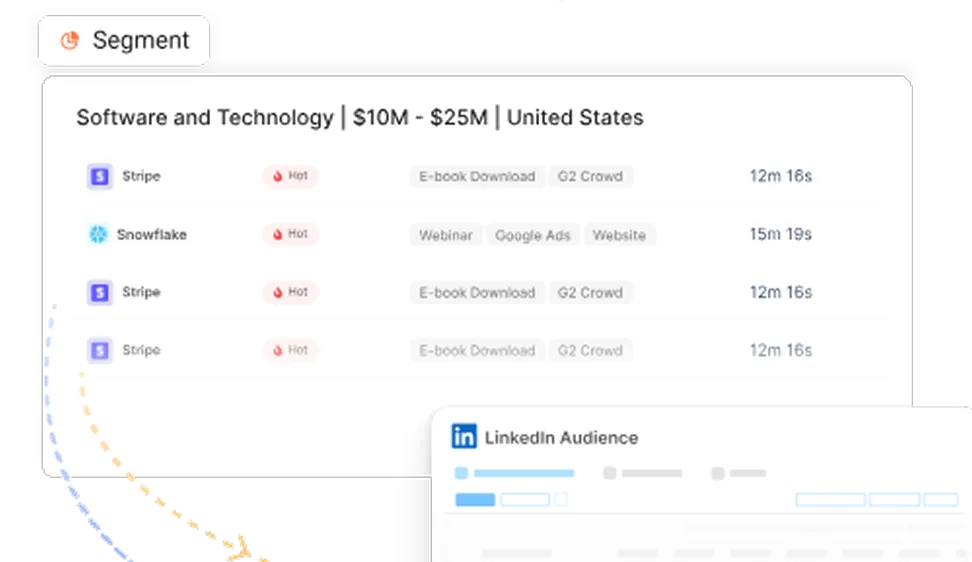
That’s the gap account-level intent data closes. Factors.ai tracks account engagement across your website, LinkedIn ads, and CRM data. It surfaces which accounts are actually showing buying behavior right now, not three weeks ago when someone last opened a newsletter. Feed that signal into your email platform’s segmentation and the nurture logic changes completely. You’re no longer targeting “downloaded an ebook once.” You’re targeting “this account has four people actively researching your category this week.”
I’ve watched teams pair Factors.ai’s intent signals with a platform like HubSpot or ActiveCampaign specifically for this reason. The email tool still handles the sending, the sequencing, and the AI-assisted copy. Factors.ai handles deciding which accounts deserve that sequence in the first place, which is arguably the harder problem of the two.
Also read: AI in marketing and sales: marketing automation examples
Common mistakes teams make choosing this kind of software
- Buying AI for the copywriting alone. If you’re picking a platform because it writes good emails, you’re solving the easiest part of this job. Writing is a commodity skill once AI can handle a first draft. Segmentation, timing, and attribution are where the actual advantage lives.
- Ignoring data quality. Your platform can only be as intelligent as what you feed it. Duplicate contacts, stale lifecycle stages, and inconsistent tagging create a garbage-in, garbage-out loop that no amount of AI fixes on its own. Clean the data before you upgrade the tool, not after.
- Skipping attribution entirely. If you can’t connect email engagement to pipeline and revenue, you can’t defend your budget when the quarterly review rolls around. (I’ve sat through enough of those reviews to know that “engagement felt strong” doesn’t survive contact with a CFO.)
- Choosing off a feature list. A platform with 47 AI features looks impressive on a comparison page. In practice, you’ll use maybe five of them regularly. Evaluate the three or four capabilities that map to your actual bottleneck, not the total count sitting on a pricing page.
- Underestimating workflow complexity. Some platforms look beautiful in a demo and turn into a genuine headache once you’re building your fifteenth automation with conditional branching. Ask vendors about their automation ceiling, not just the automation floor they show you in the sales call.
Most failed email programs I’ve reviewed weren’t caused by bad writing. They were caused by sending a perfectly good email to the wrong person entirely.
My five-layer framework for evaluating these platforms
This is the framework I’ve built over years of evaluating martech stacks for B2B clients, and I’ll admit upfront that it’s opinionated.
1. Data. Can the platform ingest behavioral data, CRM data, product usage, and website engagement into one unified profile? If it treats contacts as flat records instead of dynamic profiles, you’ve already found the ceiling.
2. Intelligence. Can it predict behavior instead of just reporting on it after the fact? Predictive lead scoring, churn risk, and engagement forecasting are what separate a real AI platform from an expensive sending engine.
3. Automation. Can it act on what the intelligence layer surfaces, without someone manually building each next step? Auto-generated workflows and AI-suggested next-best actions live here.
4. Attribution. Can it trace a single email to a pipeline opportunity, and eventually to closed revenue? Without that, you’re operating on faith, which is lovely for a personal life and useless for a marketing budget.
5. Scalability. Will it hold up at 100,000 contacts, or does it start creaking well before that? Some platforms are wonderful at 5,000 contacts and collapse under their own weight at scale. Ask about performance at 10x your current volume before you sign anything long-term.
I score each layer on a scale of 1 to 5 for every platform I evaluate. A tool scoring 5 on data and intelligence but a 2 on attribution might still be the right call if attribution isn’t your current bottleneck. Context beats checklists, every single time.
Where this is heading…
The direction is clear even if the exact timeline isn’t. We’re moving toward what I’d call agentic marketing, where AI doesn’t just assist with individual tasks. It starts creating and adjusting entire customer journeys with far less oversight than it needed even a year ago. ActiveCampaign is already positioning itself around autonomous marketing, with AI agents that strategize, execute, and optimize across channels without someone checking in at every step.
Predictive lifecycle marketing will keep replacing static drip campaigns. Cross-channel orchestration, where email, SMS, retargeting, and sales outreach are coordinated by the same intelligence layer, is becoming the default rather than the exception. Attribution will get significantly more granular too, moving from “which email touched this deal” to “which specific line in which email influenced the person who championed it internally.”
We’re not just automating email anymore. We’re automating the decision about whether that email should have been sent at all.
The teams that win the next few years won’t be the ones sending the most email. They’ll be the ones sending noticeably less, aimed noticeably better.
Where I’d land, if you’re deciding right now
If you’ve read this far, here’s what I’d actually want you to walk away with. The free plans from Brevo and MailerLite are genuinely good starting points if you’re early-stage. You won’t get deep AI capability yet, but you’ll learn what your business actually needs before spending real money finding out the hard way.
For B2B SaaS teams serious about tying email to pipeline, HubSpot’s CRM-native setup and ActiveCampaign’s automation depth are the two strongest options. Which one you pick depends on whether CRM integration and attribution matter more to you (HubSpot), or automation sophistication at a friendlier price point does (ActiveCampaign).
Run every platform through the five-layer framework: data, intelligence, automation, attribution, scalability. If a vendor can’t clearly explain how their AI handles segmentation and prediction, and only wants to talk about content generation, that’s worth noticing.
The marketers who win the next several years won’t be the ones sending the most email. They’ll consistently match the right message to the right person at the right moment. And they’ll be able to prove it in a pipeline report, not just claim it in a QBR slide.
FAQs for AI email marketing platforms
Q1. What is the best AI email marketing platform in 2026?
For B2B SaaS teams, HubSpot and ActiveCampaign consistently lead because their AI connects directly to CRM data and automation workflows. HubSpot is the stronger pick when attribution and CRM integration are non-negotiable, while ActiveCampaign wins on automation depth at a friendlier price point. The honest answer is that “best” depends on your team’s operational maturity and how clean your underlying data already is.
Q2. Which AI email marketing tools offer free plans?
Brevo, MailerLite, Mailchimp, Mailmodo, and HubSpot all offer free plans with varying AI features included. Brevo’s free plan includes 300 emails a day and up to 100,000 contacts, making it one of the more generous options in the category. MailerLite’s free tier covers up to 500 subscribers with 12,000 monthly emails and basic automation.
Q3. Can AI actually improve email open rates and conversions?
Yes, and the evidence is strongest around send-time optimization and segmentation specifically. Predictive sending alone can lift open rates by 10 to 15% by delivering emails at each contact’s individual peak engagement window. AI segmentation improves conversions further by making sure messages reach the right audience instead of broadcasting to an entire list at once.
Q4. What AI features should I actually prioritize in an email platform?
Prioritize segmentation, predictive analytics, and send-time optimization well above content generation. Content generation is available on nearly every platform now, so it’s not a real differentiator anymore. The features creating measurable performance differences are the ones deciding who receives an email, when they receive it, and how that engagement eventually connects to revenue.
Q5. Which AI email marketing platform is best for B2B SaaS companies specifically?
HubSpot is the strongest all-around choice for B2B SaaS, thanks to its CRM-native architecture, attribution capability, and the Breeze AI suite. Teams with tighter budgets but complex automation needs often find ActiveCampaign offers comparable intelligence at a lower price point. Pairing either platform with an intent data layer like Factors.ai adds account-level buying signals that make the resulting campaigns noticeably more targeted.
Q6. How does AI segmentation actually work in email marketing?
AI segmentation analyzes behavioral data, engagement patterns, purchase history, and demographic information to automatically group contacts into dynamic segments. Unlike a static list you build once and forget about, AI-created segments update continuously as new data comes in. Some platforms now support natural language queries too, where you describe the audience you want in plain English and the AI builds it for you.
Q7. Are AI email marketing tools actually worth the investment?
For teams sending more than a few thousand emails a month, the productivity gains alone usually justify the cost. HubSpot’s 2026 State of Marketing report found the majority of teams using AI report saving 10 or more hours a week. The return improves further once you factor in better segmentation, improved deliverability from cleaner lists, and the ability to tie email engagement directly to revenue.
Q8. What’s the actual difference between email automation and AI email marketing?
Email automation follows rules you set manually, like “if a contact opens email A, send email B three days later.” AI adds a prediction layer on top of that. The platform decides which email to send and when, and to whom, based on patterns it’s learned from your data. Automation executes your plan. AI helps build and continuously adjust the plan itself.
Q9. Can AI genuinely personalize emails at scale, or is that mostly marketing language?
Yes, and this is one of the clearer value propositions of AI-powered email platforms today. AI personalizes subject lines, body content, product recommendations, and send timing at the individual contact level without requiring anyone to manually build out variants. A single campaign targeting 50,000 contacts can render differently for each recipient based on their engagement history, lifecycle stage, and predicted interests.

See how Factors can 2x your ROI
Boost your LinkedIn ROI in no time using data-driven insights


.avif)

See Factors in action.
Schedule a personalized demo or sign up to get started for free
LinkedIn Marketing Partner
GDPR & SOC2 Type II






.svg)



.avif)

