
AI content personalization for B2B: what actually works when you're selling to a committee, not a person
AI content personalization for B2B marketers, built for buying committees instead of single buyers. Segmentation, email, ABM, and measurement, explained.
.avif)
Content Marketer



.svg)


TL;DR
- Most "AI personalization" in B2B is still built for a single buyer. Meanwhile, the average deal runs through six to ten people who never see the same email twice, let alone the same content.
- The technology to personalize by behavior instead of by job title has existed for a while. Most teams still aren't using it, not because it's hard to buy, but because nobody owns turning the data into an actual experience.
- Real personalization runs on four layers stacked together: who sees it, what they see, where they see it, and when. Most programs stop at layer two and call it a win.
- AI customer segmentation replaces the quarterly list refresh with something that updates while you're still in the meeting where you decided to refresh it.
- Measuring personalization by open rate is measuring the wrong thing entirely. Pipeline influence and win rate are the only numbers that tell you if it's working or just looking busy.
- The teams pulling ahead here aren't writing more content. They're getting sharper at knowing which of the eight people on a deal needs to see what, and that's a genuinely hard thing to copy.
Marketing has become remarkably good at remembering people's first names.
Less good at remembering they're part of a buying committee.
We've spent years celebrating personalized subject lines while sending exactly the same story to a CFO, a security lead, a product manager, and the person who'll actually use the software every day. That's less personalization and more enthusiastic mail merge.
The interesting part isn't that AI can generate content. Plenty of tools can do that now.
The interesting part is that AI can finally help marketers stop treating every account like one person with eight email addresses.
That changes almost everything about how B2B personalization should work.
What does AI content personalization actually mean (once you strip the buzzwords)?
Strip away the vendor language, and it comes down to this: using behavioral data and machine learning to change what a buyer sees, when, and where. The change is driven by what they're actually doing, not by what a form field says about them.
The old version of personalization was a spreadsheet dressed up as a strategy. Industry equals healthcare; send the healthcare case study. Job title contains "VP," add "Dear Leader" energy to the subject line. It wasn't wrong, exactly. It was just static, and static stopped being good enough the moment buying journeys got messy.
AI-driven personalization is different because it doesn't wait for someone to fill out a form to guess what they need. It watches what's actually happening. Repeat visits to a comparison page, three people from the same domain hitting your pricing page in the same week, and engagement that's accelerating instead of flatlining. Those are the signals that predict intent, and none of them live in a dropdown menu.also the part that gets genuinely interesting whenting once you connect it to who's doing the watching. A single visitor behaving a certain way is a data point. Five people from one account behaving that way in the same ten days is a buying committee waking up, and that distinction changes what you should be sending completely.
Why the old segmentation model stopped working…
For a long time, segment-by-industry-and-refresh-quarterly was a perfectly reasonable system, mostly because buyers had fewer places to research and less information before they ever spoke to a rep.
That system assumed behavior followed demographics closely enough that demographics were a decent proxy. It doesn't anymore. A fintech buyer three clicks from your ROI calculator and a cybersecurity buyer doing the exact same thing behave more alike than two people in the same industry. Industry stopped being the useful signal here. What predicts intent now is what someone is doing, not what box they checked on a form six months ago.
I think of this as the gap between what teams collect and what they actually use. Every team I've worked with has more data than they know what to do with: CRM fields, ad engagement, intent signals, page-level analytics. Almost none of it changes what the buyer sees. The dashboards get built, the segments get named, and then the email goes out looking exactly the same as it did before anyone built anything. It's a bit like commissioning a tailor and then wearing the same off-the-rack suit anyway (the tailor, understandably, would have questions).
How the mechanics actually work (end-to-end)
Four steps, each one feeding the next.
- Data collection pulls from every system your GTM stack touches: CRM, website behavior, ad platforms, intent tools, and product usage where relevant. The hard part isn't gathering it. It's stitching disconnected sources into one coherent view of an account, which is a job that kills more personalization projects than any technology limitation does.
- Analysis is where machine learning earns its keep. It spots correlations a person reviewing spreadsheets would never catch: this exact sequence of page visits, from this account size, tends to close in under 40 days. Predictive scoring assigns a likelihood of conversion. Behavioral clustering groups accounts by what they do, not who they are on paper.
- Segmentation flows straight out of that analysis, and this is where it stops looking like the quarterly list. Groups form based on shared behavior and shared buying signals, and they update continuously. An account can move segments mid-week if their engagement changes, which is a genuinely different cadence than "we'll revisit this at the next planning offsite."
- Delivery is the part the buyer actually experiences. Website blocks shift based on who's visiting. Ad creative adjusts by funnel stage. Nurture sequences branch instead of running everyone through the same seven emails. Sales gets a nudge on which asset to send based on what the account has already consumed.
None of this is a one-time setup you configure and walk away from. It keeps adjusting as new behavior comes in. That's the real advantage over static segmentation. It gets sharper with time instead of going stale the moment your org chart changes.
The four layers most teams only half-build
Conversations about personalization tend to collapse into "show the right content to the right person," which is true and also not remotely the whole picture.
Content personalization is where almost every team stops. Timing is where the real advantage sits, and it's the layer nobody talks about at conferences because it's less visually impressive than a slick email template. Knowing an account's engagement jumped this week and reaching them within hours instead of whenever the next scheduled send lands, changes everything. It's the difference between feeling useful and feeling like background noise nobody asked for.
AI customer segmentation: building blocks that actually update
You can't personalize what you haven't segmented well, and quarterly list-building was never built to keep pace with how fast intent shifts now.
Behavioral segments group people by what they do on your properties: page views, time on site, demo requests, repeat visits. Intent segments layer in research activity and third-party signals, the kind that tell you someone's actively comparing you to a competitor before they've said a word to your team. Account-based segments combine firmographic fit with engagement to surface who's worth prioritizing right now, not who fit your ICP spreadsheet in Q1.
Predictive segments are the one that actually changes how a team operates, because they're forward-looking instead of a rearview mirror. Grouping accounts by likelihood to convert, likelihood to churn, or expansion potential means your personalization effort chases where the revenue is heading, not where engagement happened to spike last month.
Segmentation used to be a task marketers did once a quarter and then mostly ignored until the next planning cycle (no judgment, I've done exactly this). AI-driven segmentation turns it into something closer to a living system. An account can move from one group to another between Monday and Thursday if their behavior shifts that fast.
Personalizing across the funnel, and across the committee at every stage
Personalization isn't only a top-of-funnel play, and it shouldn't stop looking like a buying committee just because a deal moves further along.
- At the top, it's about discovery. Blog recommendations shift based on what someone's already read. Educational content surfaces around the problem an account seems to be researching. Early-stage LinkedIn ads lean toward thought leadership rather than a pitch, because nobody three clicks into their first visit wants a demo link shoved at them.
- In the middle, the tone changes toward evaluation. Someone who's consumed educational content starts seeing case studies from their own industry. Comparison content appears for accounts showing competitive research signals. This is exactly where the committee reveals itself. The account that got a broad awareness ad two weeks ago might now have three different people looking at three different assets. Treating that as one undifferentiated "account stage" misses the point entirely.
- Near the bottom, everything tightens around decision support. ROI calculators pre-populate with numbers relevant to the account's size. Battlecards surface based on which competitor the account has actually been researching, not a generic list. Demo experiences shift toward the features the buying committee has shown the most interest in. A security-focused stakeholder and a budget-focused one are watching the same demo for entirely different reasons.
Post-sale personalization is where most programs stop existing, and then everyone acts surprised when expansion revenue is flat. Product education adapts to what's actually being used. Expansion campaigns target accounts showing signs of outgrowing their current plan. Customer success content shows up before someone has to file a ticket asking for it, not after.
Email personalization beyond a first name
Email is still one of the highest-leverage channels in B2B, and most teams are wayyy behind, barely past the merge-tag stage I embarrassed myself with earlier.
Send-time optimization learns when a contact tends to actually open things, instead of defaulting to a blanket 9am send. Subject lines adapt too, based on language patterns that have historically driven opens for similar accounts. Dynamic content blocks let one email template show different sections to different recipients depending on stage or interest. Industry framing shifts the proof points without rewriting the whole email from scratch.
Intent-based nurtures are the biggest departure from the old playbook. Instead of "everyone who downloaded this PDF gets the same seven emails," the sequence branches. Someone showing competitive research gets comparison content. Someone spending time on pricing gets ROI framing. Someone who's gone quiet gets something closer to a nudge than a pitch.
My honest opinion here: if every person in your nurture receives the identical email regardless of what they've done, it isn't a nurture sequence. It's a newsletter masquerading as a nurture sequence, and buyers can tell the difference even if they can't articulate why.
Where this shows up in practice
Theory is fine, but seeing it applied makes the point land harder.
In ABM, personalization touches every surface at once. Ads reference the specific challenge an account is likely facing based on its intent signals. Landing pages shift headline copy and social proof based on the account profile. Sales outreach references content the account has already engaged with instead of opening cold, which, frankly, is the bare minimum a buyer should expect by now.
On the website, a mid-market SaaS visitor sees mid-market proof points and pricing framed for their size. An enterprise account sees enterprise case studies and security documentation up front. Someone returning to read about integrations sees related content instead of the same homepage everyone else lands on. That sounds obvious until you check how many sites still show every visitor the identical hero banner.
In paid media, creative shifts by stage: educational content for early awareness, sharper calls to action once someone's clearly evaluating, objection-focused creative once they're close to a decision. It's the difference between a campaign that feels considered and one that feels like wallpaper someone forgot to update.
Content recommendation engines suggest the next asset based on what's already landed. It's the B2B equivalent of a streaming service's "recommended for you" row, except the stakes are a six-figure contract instead of a Friday night rewatch.
Building a dashboard that actually earns its keep
Personalization throws off a lot of data, and without a clear read on what's working, teams end up personalizing for the sake of it rather than for pipeline.
A dashboard worth checking daily organizes around six things: growing or shrinking segments, accounts heating up or cooling off, content that's resonating versus getting ignored, and engagement that's genuinely meaningful. Real pipeline touched and closed revenue matter most of all.
The point of a dashboard isn't knowing everything about a buyer. It's knowing enough that your next interaction is more useful than your last one. I've watched teams build genuinely impressive reporting stacks that track a dozen personalization metrics and never once change a campaign based on what any of it says. A dashboard that doesn't drive a decision is just a very well-designed screensaver.
What actually matters when choosing tools
Skip the feature checklist. Most vendor comparisons blur together by the third row anyway.
- Data quality sets the ceiling. A tool built on messy inputs produces messy personalization, no matter how good the model behind it is.
- Real-time processing matters more than it sounds. The gap between reacting to yesterday's behavior and reacting within the same session is the gap between relevant and stale.
- CRM integration needs to run both ways. A one-way sync that only pushes data in without pulling context back isn't integration, it's a data dump.
- Attribution should tie to pipeline, not just engagement. A tool that only reports clicks is answering a question nobody with a revenue target actually asked.
- Recommendation depth varies wildly. Some platforms genuinely learn from behavior. Others are rules dressed up with an AI label, and it shows the moment volume scales past what a human configured manually.
- Granularity determines usefulness. Can it personalize down to the individual stakeholder, or does it stop at "segment," which brings you right back to the demographic problem you were trying to escape?
- Scalability matters once you're running this across hundreds of accounts at once, not just the twenty you piloted with.
Where Factors.ai fits into all of this
Personalization falls apart at the first step if the signal underneath it is invisible, and that's the wall most B2B teams hit before they even start building anything dynamic. You can't personalize an ad for an account you don't know is on your site. You can't branch a nurture sequence if you don't know which member of the buying committee is actually engaged.
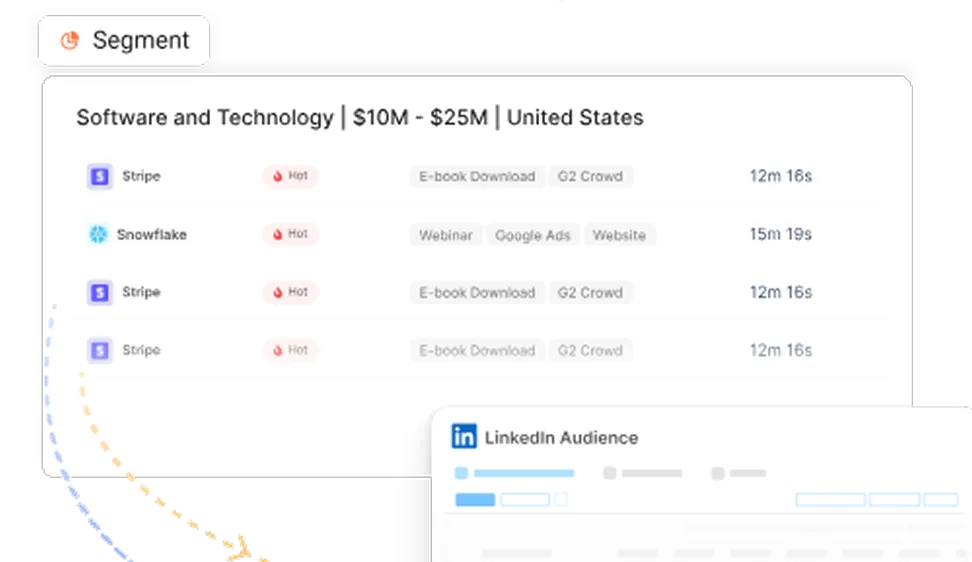
Factors.ai works by making that signal layer visible in the first place. It identifies anonymous website traffic at the account level, so you know a company is engaging before anyone fills out a form. It pulls intent signals from across the journey, ad engagement, site visits, content consumption, into one view instead of six disconnected tabs. And it maps buying committee activity specifically. That's the difference between one curious person poking around and five stakeholders from the same account showing up in the same week, which calls for a completely different response.
Once that foundation exists, personalizing stops being a data-hunting exercise and becomes a content decision. Ads can target based on account-level intent instead of a static list. Website experiences can adapt to what's actually known about the visitor. Email can branch on real behavior instead of guesses dressed up as strategy.
Here's the thing I keep coming back to after years of running demand gen programs: personalization was never really a content problem. It's a visibility problem. Teams that win aren't necessarily writing more. They're seeing more, clearly enough to know what to send and to whom, and that kind of visibility is genuinely hard for a competitor to copy overnight.
Measuring whether any of this is actually working
The single most common mistake in this whole conversation is stopping the measurement at engagement. Higher click-through rates feel good. They don't pay anyone's salary.
A framework that actually holds up covers three tiers. Engagement metrics, like CTR and time on page, confirm the content is landing at all. Pipeline metrics, like MQL-to-SQL conversion and how fast opportunities get created, tell you whether personalization is actually accelerating anything. Revenue metrics, like pipeline sourced from personalized campaigns versus generic ones, win rates on personalized touchpoints, and CAC efficiency, are the only numbers that settle the argument.
I've sat across the table from teams celebrating a jump in open rates while pipeline contribution stayed completely flat. That's not a result. That's a vanity metric that learned to dress up nicely for the board deck.
Where this goes wrong, and it does go wrong
There's a real line between "this feels relevant" and "how exactly do you know that about me," and it's thinner than most teams assume.
Over-personalizing is the most common failure. Referencing something hyper-specific in outbound, the exact minute someone spent on a pricing page, reads as surveillance rather than relevance. The signal should shape what you send, not become the subject line itself.
Bad data creates a quieter but nastier version of the same problem. Wrong firmographic data means showing enterprise messaging to a twenty-person startup, or a battlecard for a competitor the account was never evaluating. Wrong personalization actively erodes trust faster than no personalization ever would.
Consent is the risk that keeps compounding as regulation tightens and buyers get more literate about how their data gets used. And the subtlest mistake of all is personalizing everything, when sometimes a well-written, broadly useful piece of content is exactly what someone needs. Relevance doesn't always mean specificity. Sometimes it just means not overthinking it.
Also read: Will AI replace digital marketers?
Where is this headed?
The direction is clear enough, even if the exact timeline isn't. Predictive content journeys are starting to move past "what should this person see next." The new question is what sequence of experiences gets this specific committee to a decision fastest. Agentic systems that execute and adjust campaigns on their own are already in early production for a handful of teams. That's not just a slide in someone's roadmap deck anymore. Real-time website adaptation is trending toward default rather than novelty, with each visit assembling something closer to a unique page than a shared template.
The segment-of-one idea, where every stakeholder on a committee gets something built specifically for them, sounded closer to science fiction five years ago than it does now. The infrastructure to make that affordable at scale is arriving faster than most teams' internal processes are ready for it.
For most of the last decade, marketers optimized for scale. The next stretch belongs to whoever can scale relevance instead, and that's a much harder thing to fake. AI content personalization was never really about producing more. It's about shrinking the gap between what a specific person on a specific buying committee needs right now and what your marketing actually puts in front of them. Teams that build that muscle early aren't just running slightly better campaigns. They're building something structurally difficult for a competitor to replicate with a bigger budget alone.
FAQs about AI content personalization in B2B
Q1. What is AI content personalization?
It's the use of machine learning and behavioral data to change what content a buyer sees, when, and through which channel. The change is driven by what they're actually doing, not static fields like industry or job title. It spans website content, email, ad creative, and sales outreach, and it keeps adjusting as new behavior comes in instead of staying fixed after setup.
Q2. How is this different from the personalization B2B teams have used for years?
Older personalization relied on rules a person set manually: if industry equals X, send asset Y. AI-driven personalization learns from patterns across thousands of interactions instead. It picks up on intent signals and engagement velocity that a person reviewing spreadsheets would never catch at the same scale.
Q3. What data does a team actually need to start?
CRM records, website behavior, ad engagement, email interaction data, and third-party intent signals where available. You don't need every source connected on day one. You need whatever sources you have stitched into one coherent view of each account, because fragmented data is worse than incomplete data.
Q4. How is AI customer segmentation different from a standard quarterly refresh?
Traditional segmentation groups people by static attributes and gets updated on a schedule, usually quarterly. AI-driven segmentation groups by behavior and predicted outcome, and it updates continuously, sometimes moving an account between segments within days based on a shift in engagement.
Q5. How do you personalize for a buying committee instead of one person?
You track engagement at the individual stakeholder level within an account, not just at the account level. When multiple people from the same company start engaging in the same window, that's a signal the committee is forming. It calls for coordinated content across roles, not one generic sequence sent to everyone who happens to share a company domain.
Q6. Does AI email personalization actually improve conversion?
It does, mainly because it moves past first-name insertion into send-time optimization, dynamic content blocks, and intent-based branching. A nurture that adapts based on what someone's actually done converts differently than one that treats every recipient identically, and the gap tends to show up clearly in reply rates.
Q7. Can this work for account-based marketing specifically?
It's arguably where personalization matters most. AI can identify which target accounts are showing live buying signals, then personalize ads and landing pages for those accounts. It also helps sales tailor outreach around what the buying committee has already engaged with. That turns a static target list into something that actually adapts.
Q8. How should teams measure ROI from personalization?
Across three tiers. Engagement (CTR, time on page) confirms it's landing. Pipeline (MQL-to-SQL rate, opportunity velocity) confirms it's accelerating anything. Revenue (pipeline sourced, win rate, CAC efficiency) confirms it's actually worth the investment. Stopping at engagement alone tends to produce a misleadingly rosy picture.
Q9. What are the biggest risks of getting this wrong?
Over-personalizing to the point it feels invasive, acting on inaccurate data that misreads a buyer's needs entirely, and using data without clear consent as privacy regulation keeps tightening. Wrong personalization erodes trust faster than no personalization would, so accuracy matters more than volume.

See how Factors can 2x your ROI
Boost your LinkedIn ROI in no time using data-driven insights


.avif)

See Factors in action.
Schedule a personalized demo or sign up to get started for free
LinkedIn Marketing Partner
GDPR & SOC2 Type II






.svg)



.avif)

