LinkedIn ads for B2B, a performance marketer’s guide to what actually drives pipeline
A performance marketer’s guide to LinkedIn ads for B2B, covering formats, targeting, bidding and attribution, with data from $150M in LinkedIn ad spend.

Performance Marketing Lead

Associate Director of Brand and Content



.svg)


TL;DR
- This guide draws on Factors.ai's 2026 LinkedIn report, which covers 850+ B2B companies and $150M+ in LinkedIn ad spend, plus 50,000+ closed deals from companies with their CRM connected.LinkedIn ads work for B2B when your deal size can justify the cost, and in our data LinkedIn returns 1.6x on ad spend against 1.18x for Google.
- LinkedIn is the only paid channel where you can target by job title, seniority, company size, and department simultaneously, which makes it uniquely powerful for B2B and uniquely expensive if you don't know what you're doing.
- Single Image Ads and Thought Leader Ads are currently the highest-performing formats for top-of-funnel B2B, Video is underused, and Document Ads are criminally underrated for mid-funnel education.
- Bidding matters more than most teams realize. Maximum Delivery charges by the impression and usually costs more per click at average CTRs, manual CPC gives you control, and a target cost bid works once you have enough conversion data.
- Most advertisers aim at the same senior titles, with 76% of title-targeting spend on Director, VP and C-suite roles, while deals that also reach end users, influencers and technical evaluators see a 22-point lift in pipeline win rate.
- Broad targeting on LinkedIn wastes spend rather than adding coverage.
- LinkedIn’s Predictive Audiences and Matched Audiences are the two features that separate teams building pipeline from teams buying impressions they can’t attribute.
- If LinkedIn ads aren't contributing to pipeline within 90 days, the problem is usually the audience, the offer or the measurement rather than the platform.
This guide covers how I’d approach LinkedIn ads for B2B, from targeting and ad formats to bidding, creative, and attribution. More importantly, it explains how those pieces need to work together if you want LinkedIn to contribute to pipeline rather than just generate clicks and impressions.
Why is LinkedIn still one of few platforms where B2B targeting works?
Every paid channel can help you reach a broad audience. LinkedIn is different because you can narrow that audience using professional data such as job title, seniority, company size, industry, experience, and skills. If you sell a $50K product with a six-month sales cycle, that difference matters.
You can also layer those filters, upload target account lists, reach relevant people inside those companies, and exclude existing customers. That level of control is a big reason LinkedIn works so well for B2B. It is also why the channel gets expensive quickly when the audience is poorly defined.
The premium starts to make more sense when you look at revenue instead of clicks. In our 2026 report, From Benchmarks to Blueprints, we analyzed more than 850 B2B companies and over $150 million in LinkedIn ad spend. We also looked at more than 50,000 closed deals worth over $5 billion from companies that connect their CRM to Factors.ai.
Across that data, LinkedIn’s share of combined LinkedIn and Google ad budgets rose from 31.3% in Q3 2024 to 39.8% in Q1 2026. LinkedIn returned 1.6x on ad spend compared with 1.18x for Google, while LinkedIn-sourced deals had a 34% higher average contract value.
So I wouldn’t judge LinkedIn by CPC alone. You are paying more to reach a smaller group of people who are closer to the buyers you actually care about. The problem starts when teams use that expensive inventory against audiences that are too broad, then try to fix the results with bidding or campaign settings.
This guide focuses on running LinkedIn ads for B2B well. If you want the broader picture, including organic LinkedIn content and how buying committees engage on the platform, check out our LinkedIn B2B marketing guide.
The LinkedIn ad formats for B2B, ranked by what works
The format landscape has evolved significantly since 2016. Here’s an honest breakdown of what’s actually performing for B2B right now and what’s mostly campaign-padding.
If you want every format LinkedIn offers, including the ones not ranked here, our guide to types of LinkedIn ads covers them all.
1. Single image ads: the workhorse
Single Image Ads are still the format you’ll spend most of your budget on, and for good reason. They’re the simplest to produce, easiest to test, and the most forgiving in terms of audience size requirements. A single image with a punchy headline, a clear value prop, and a specific CTA will usually outperform a beautifully produced carousel if the targeting is right.
The mistake most teams make with Single Image Ads is treating them like display ads. The copy and creative need to feel like something a smart human chose to share, not something a brand committee approved. The best-performing Single Image Ads in my experience look almost like they belong in the feed organically, they don’t scream “ad.”
What’s changed: the image-to-text ratio matters less than it used to. LinkedIn doesn’t have the same restrictions Meta has. But images with faces, especially real people rather than stock photos, still significantly outperform abstract visuals or product screenshots.
2. Thought Leader Ads: the format everyone’s sleeping on
This is the format I'd test first. LinkedIn launched Thought Leader Ads in 2023, and the engagement rates are genuinely different from anything else on the platform. The format lets you take an employee’s organic post and promote it as a paid ad, so it runs from their personal profile rather than your company page.
The reason it works is obvious once you think about it. People trust people more than they trust brands. An organic-looking post from a real person at your company, talking about a real problem your buyers have, performs dramatically better than a polished brand ad with the same message. The creative is already done (you’re using something that performed well organically). The targeting is identical to your other campaigns. The only extra step is getting the employee’s approval to promote their post.
I’ve seen Thought Leader Ads run at 3–5x the CTR of equivalent Single Image Ads for the same audience. The caveat is that they work best for thought leadership content, not product-first messaging. If your CEO just wrote a post about a genuine problem in your space, that’s a Thought Leader Ad. If your company page just posted about your new integration with Salesforce, that’s a Single Image Ad.
There's something you need to be mindful of though. Alex Goodwin, who leads demand generation at Fingerprint, said his team first promoted every executive post to one broad brand audience, and engagement fell off because people don't want to read generic posts about a whole category.
What fixed it was building niche audiences and matching each post to one of them. "The topic needs to line up with the poster, which needs to line up with the audience," he said. In practice that meant deciding whether a post should come from the CEO, the CTO or an engineer based on who it was meant to reach.
3. Document Ads: criminally underrated for mid-funnel
Document Ads let you promote a PDF-style document that members can read directly in the LinkedIn feed without leaving the platform. No landing page, friction, and no gated form, the content is just there.
The genius of Document Ads is that you can see exactly how many pages someone read before stopping. Someone who reads pages 1 through 3 of a 10-page document and bounces is telling you something different from someone who reads all 10 pages and then clicks your CTA at the end. That behavioral data is gold for lead scoring and for understanding where your content loses people.
The format underperforms when teams use it to gate content they should be giving away freely. The best Document Ads are genuinely useful, frameworks, checklists, data reports, step-by-step guides. If you’d be embarrassed to give this away for free, it’s not a Document Ad, it’s a gated asset that belongs on a landing page.
4. Video Ads: high ceiling, high effort
Video Ads on LinkedIn have a consistently high completion rate if the hook is strong, but the hook has to hit in the first three seconds or you’ve lost them. The challenge is that B2B video production is expensive and most companies aren’t willing to invest in multiple versions for testing.
What’s worked well in my experience is keeping LinkedIn video short (under 60 seconds), starting with a problem statement rather than a company introduction, and adding captions, (always). The majority of LinkedIn video is watched on mobile with sound off. If your video only makes sense with audio, it’s not a LinkedIn Video Ad.
Alex's team once ran four to five minute demo videos as LinkedIn ads. In each one, an account executive walls through a use case specific to one target account. CPCs came in around $25. Over a couple of months the videos produced five conversions, all from the high-ACV accounts they were made for.
5. Conversation Ads: works once, never again
Conversation ads let you send a choose-your-own-adventure-style InMail that lives in the LinkedIn messaging inbox. The first time your audience sees one, the response rate can be genuinely impressive. By the second or third time you hit the same audience with one, they know exactly what it is and the open rate tanks.
I would recommend not using Conversation Ads on a whim; instead, time them carefully. One per quarter, to a fresh segment, with an offer that is genuinely valuable to receive in a message rather than in a feed ad. A webinar invite or an exclusive research report can work. A demo request dressed up in conversational formatting doesn’t.
For context, AJ Wilcox, founder of the LinkedIn ads agency B2Linked, puts LinkedIn's average link click-through rate at around 0.4% to 0.46%, depending on the benchmark study. A link CTR above 1% is a strong result. Head to 49:37 in the video.
Master LinkedIn ad targeting without burning your budget
LinkedIn targeting has evolved, but most B2B teams still rely on broad job titles, company size filters, and hope. The auction algorithm simply delivers impressions to whoever in that broad pool happens to be cheapest to reach in the feed right now.
Every targeting layer has a distinct commercial purpose, and each one leaks budget if you overlook the mechanics underneath.
Matched Audiences: Build from your own data instead of native filters
Native demographic filters rely on how individual members describe their jobs and how companies categorize their pages. Matched Audiences flip that dynamic by letting you bring verified records from your own CRM. LinkedIn provides three ways to build these audiences, and each comes with its own failure point.
1. Contact lists and the work email match gap
Uploading a CSV of email addresses lets you target known buyers like product signups, past webinar attendees, or stale CRM leads.
- Most professionals register their LinkedIn accounts with personal emails like Gmail or Yahoo rather than corporate addresses.
- AJ Wilcox, founder of B2Linked, finds match rates on business email lists typically sit around 30%.
- An upload of 10,000 corporate emails usually yields an active audience of roughly 3,000 members. If you rely on work addresses alone, combine them with account-level targeting.
2. Account lists and broken native industry tags
Targeting company domains is the backbone of LinkedIn ABM. You upload target accounts and filter by functional roles to reach the people sales cares about.
- Native industry categories are notoriously unreliable. Praveen, Co-founder of Factors.ai, regularly sees Airbnb categorized under software development and ADP listed under human resource services.
- Many SaaS businesses get split between software and advertising technology, making native industry filters hit-or-miss.
- Build your target account list in your CRM and include the LinkedIn company page URL alongside the domain. Matching against company page URLs eliminates fuzzy text errors and pushes match rates near 100%.
3. Website retargeting and cookie decay
The LinkedIn Insight Tag tracks page visits to build retargeting audiences from high-intent URLs like pricing or integrations. The catch is audience decay.
- Browser cookies on Safari and mobile devices expire within days, causing retargeting pools to shrink automatically.
- AJ Wilcox calls these audiences a leaky bucket because visitors disappear faster than you can replenish them, often dropping below LinkedIn's 300-member campaign delivery minimum.
- The fix is to identify the company domains visiting your website and sync them to LinkedIn as an account audience. Because account lists do not rely on browser cookies, the audience stays stable while you layer job functions over the buying group.
- Static lists decay as people change roles, so plan for a quarterly audience refresh at minimum.
Website activity is only one signal of account interest. To capture intent signals from across the web and route in-market accounts to sales, read our guide on using LinkedIn intent data in your B2B sales strategy.
Predictive Audiences for controlled expansion
When first-party lists run out, Predictive Audiences use machine learning to find prospects who resemble your best customers.
- LinkedIn retired its legacy lookalikes due to poor lead quality, replacing them with predictive modeling based on job functions, company growth signals, and platform activity.
- The seed audience requires at least 300 matched members and performs noticeably better with 1,000 or more.
- Smaller teams should exhaust their CRM matched lists before testing predictive models.
Audience sizing and auction dynamics
LinkedIn will happily spend a $10,000 monthly budget across 600,000 people without finding your true buyers. Broad audiences inflate your cost per lead on contacts who will never buy.
- Cold acquisition campaigns perform best with an audience size between 50,000 and 100,000 members to give the auction delivery room without diluting relevance.
- AJ Wilcox recommends an even tighter range between 20,000 and 100,000 members for cold acquisition.
- Retargeting and ABM lists often fall well below 10,000 members. These smaller audiences require higher manual bids to clear the auction, but every impression stays focused on viable accounts.
Buying committee targeting beyond the C-suite
Aiming entire ad budgets at senior executives is an expensive mistake.
- Based on our From Benchmarks to Blueprints report, 76% of budget is spent on job-title targeting chased directors, VPs, and the C-suite, even though those senior roles represent only 13.9% of LinkedIn profiles.
- Deals reaching an end user, an influencer, and a technical evaluator lifted pipeline win rates by 22 points.
- Steve Armenti, founder of twelfth agency, notes that senior executives rarely submit demo forms. The operational directors and managers run the evaluation, while executives step in later to approve.
- Split campaigns by seniority by serving high-level perspective and market proof to executives, and implementation guides, teardowns, and calculators to the evaluators.
For a step-by-step framework on covering these stakeholders, read our guide on building LinkedIn trust across B2B buying committees.
Account frequency capping to prevent budget skew
LinkedIn serves impressions wherever active users are online, which means large enterprises consume the bulk of an account-based budget.
- Descope uncovered a similar imbalance with 92% of target accounts receiving fewer than 100 impressions a month.
- Using Factors.ai Smart Reach to cap impressions per company, Descope redistributed 158,000 impressions to unreached accounts and lifted LinkedIn ads ROI by 22% on the same budget.
- If managing campaigns manually, monitor demographic reports weekly and separate any account taking more than 10% of total impressions into its own campaign.
Three default LinkedIn campaign settings to turn off immediately
LinkedIn automatically checks three setup toggles that prioritize platform inventory delivery over your pipeline efficiency. Turn all three off before launching.
1. Location targeting travel trap
The default setting targets people who are permanently in or recently in a location. Because LinkedIn retains location data for up to six months, summer business travelers from other continents will see your US-targeted campaigns well into autumn. Change the setting to permanent location.
2. Audience Expansion dilution
This toggle gives LinkedIn permission to show ads to users outside your targeting criteria who seem similar. It uses the same matching algorithm as retired lookalikes and burns between 5% and 15% of your spend on unqualified profiles. Uncheck the box.
3. The LinkedIn Audience Network
This placement distributes ads across third-party partner apps and mobile games. While impression costs look cheap, on-site conversion rates routinely plunge by 90% due to accidental or bot clicks. Keep your ads on LinkedIn's primary feed.
LinkedIn bidding strategy and when to use each model
The bid you set is only as good as the campaign objective that precedes it.
Two decisions govern your media costs before you enter a single dollar figure. The campaign objective dictates which bidding formats LinkedIn makes available, and the bidding model determines whether you pay for raw impressions or verified clicks.
Pick your objective first to control how you get charged
LinkedIn forces you to choose a campaign objective before anything else. In our benchmark dataset of over 100 B2B marketing teams, traditional lead generation dropped from 53.9% to 39.4% of total spend, while brand awareness and engagement objectives surged from 17.5% to 31.3%.
B2B revenue leaders are realizing that buying committees form preferences long before they fill out a form, but choosing the native Brand Awareness objective inside Campaign Manager is the most expensive way to execute that strategy.
The objective choice directly dictates how LinkedIn bills you.
- Brand awareness forces impression billing: You pay for every thousand times your ad loads on a screen, regardless of whether anyone looks at it. AJ Wilcox advises advertisers to avoid running campaigns under the brand awareness objective entirely. When his goal is awareness, he selects the website visits objective and bids per landing page click. The campaign still serves impressions in the feed, but you only pay when someone actually acts on the ad.
- Engagement objectives drain budgets on vanity clicks: Choosing engagement allows you to bid per click, but LinkedIn counts likes, comments, hashtag clicks, and expanding the post text as billable clicks. Those micro-interactions accumulate rapidly without driving evaluators to your site.
Building market awareness is critical, but you should choose an objective that charges you for verified interest rather than passive screen renders.
Maximum Delivery: Why automated bidding inflates click costs
Maximum Delivery is LinkedIn’s automated default option. In our benchmark report, the share of bottom-of-funnel campaigns using automated bidding jumped from 27.6% to 37.5% over the past year as marketing teams looked for hands-off optimization.
While automated bidding simplifies campaign launches, it exposes your budget to two serious problems.
- Auction volatility during peak periods: In competitive windows, such as major industry events or end-of-quarter budget flushes, costs per lead spike unpredictably. Because the algorithm adjusts bids behind the scenes, your reporting will never explain why costs moved.
- The hidden penalty of impression pricing: Maximum Delivery charges by the impression. What you effectively pay per click depends entirely on your link click-through rate.
At LinkedIn's average benchmark link click-through rate of 0.44%, bidding via Maximum Delivery costs roughly double what you would pay on a manual cost-per-click bid. The two options only reach price parity when your click-through rate climbs between 0.8% and 1.2%.
Only two scenarios justify switching to Maximum Delivery.
- The creative is an exceptional performer with a verified link click-through rate consistently above 1%.
- The audience is an account-based list under 3,000 members where manual bids fail to win enough auctions to spend your daily budget.
Manual CPC: Take control and ignore suggested ranges
Manual cost-per-click (CPC) bidding allows you to cap the maximum price you are willing to pay for a visit. LinkedIn buries this option behind the extra bidding choices menu during setup.
Manual bidding requires active management, but it prevents the auction algorithm from overcharging you.
- Ignore the suggested bid ranges: Campaign Manager often prefills the bid box with an inflated number like $18, accompanied by a suggested range stretching from $4.40 to $90. These ranges reflect platform revenue targets rather than campaign efficiency.
- Start with a conservative baseline: For North American audiences, enter a manual bid around $7 per click. Set your daily budget 30% higher than your actual target spend so delivery is never throttled early in the day.
- Step bids up incrementally: Check campaign delivery every two or three days. If the campaign fails to spend its budget, raise the bid by 50 cents or a dollar until delivery stabilizes at the lowest possible clearing price.
- Prioritize bid adjustments over budget edits: Bid adjustments take effect across LinkedIn’s auction immediately. Budget modifications are only processed at midnight UTC, which delays optimization by a full day.
LinkedIn representatives often tell advertisers that low bids only reach junior employees. AJ Wilcox tested that theory across more than $100,000 in ad spend, tracking lead quality across low, medium, and aggressive bids. Bidding higher produced zero improvement in lead quality or buyer seniority.
Once a campaign matures and consistently logs 30 to 50 monthly conversions at a stable acquisition cost, you can test switching to automated Cost Cap bidding.
If you do test automated bidding or Cost Caps, you must feed LinkedIn server-side conversion data through the LinkedIn Conversions API rather than relying on browser pixels alone. Passing qualified pipeline milestones like sales meetings and pipeline stages gives the algorithm verified outcomes to optimize against, which LinkedIn data shows cuts cost per acquisition by 20%.
When B2Linked migrates existing advertising accounts onto this manual CPC framework, their cost per link click and cost per conversion routinely decrease by 57%.
To see how these bid mechanics impact your overall media budget, review our complete analysis of LinkedIn ads costs.
The LinkedIn ad creative playbook that converts without looking like an ad
The aesthetic of B2B advertising on LinkedIn has fundamentally broken down. Polished corporate graphics, generic stock photography, and slick branding get scrolled past because buyers automatically recognize them as sales pitches.
At the same time, creative format distribution is shifting away from static banners. In our From Uncertainty to Opportunity: LinkedIn Benchmarks for B2B Success report, Single Image ad spend fell from 61.2% to 53.3%. Meanwhile, Document Ads surged by 67%, growing from 6.4% to 10.7% of total platform spend, and Video Ads climbed to 16.6%.
As Dylan Hey, co-founder of Hey Digital, observed in our benchmark study, static images still have a place, but document carousels and authentic video build trust faster because they deliver immediate, ungated value inside the feed.
Transforming your creative from ignorable promotion into high-performing collateral requires three operational adjustments.
1. Hook evaluators before the 150-character fold
The first two lines of your ad copy carry almost the entire weight of the click.
LinkedIn truncates post copy at roughly 140 to 150 characters on mobile and desktop feeds before hiding the rest behind the "see more" prompt. If those opening characters read like marketing brochure copy, the buyer scrolls past immediately.
A weak hook describes a platform capability: "Discover how our AI-powered analytics engine unifies marketing data and streamlines pipeline reporting for high-growth revenue teams."
A high-converting hook names an acute, recognizable problem that challenges common assumptions: "Most enterprise marketing teams cannot tell which campaigns influenced closed revenue. This breakdown is almost never an attribution tracking issue."
The second hook works because it articulates an operational headache the reader wrestled with this morning. It omits the company name, skips the product feature, and gives the reader an analytical reason to expand the post.
For full examples of pre-fold openers, review our guide on LinkedIn ad copy best practices.
2. Build account-level creative around verified business problems
When managing a high-priority account list, generic persona messaging falls flat. High-ACV enterprise accounts require creative tailored to their immediate public priorities.
Alex Goodwin, Director of Demand Generation at Fingerprint, operationalizes this by having account executives audit target account 10-K filings, quarterly earnings calls, and engineering blogs before writing ad creative. Watch from 21:48.
When Fingerprint targeted TD Bank, the research revealed the bank was navigating significant regulatory scrutiny around anti-money-laundering controls. The demand gen team used that business reality to test two distinct messaging angles.
- The direct, high-risk callout: "Struggling with AML fines? Here is how device intelligence prevents compliance exposure."
- The operational, internal initiative hook: "How platform protect teams eliminate authentication friction without breaking compliance workflows."
The second angle directly mirrored the internal name TD Bank gave to its internal security initiative.
3. Replace gated content downloads with zero-click in-feed value
The traditional B2B offer ladder is broken. For a decade, marketers ran ads promoting gated ebooks, collected business emails on a landing page, and routed those leads to sales cadences.
Our benchmark reveals that buyers now systematically reject that transaction.
- Median webinar registrations declined 42% year over year across our dataset.
- Generic ebook downloads dropped 11.8% at the median, while analyst report downloads collapsed by 42.7%.
- Bottom-of-funnel demo requests grew by 17.4% at the median over the same period.
Buyers do not want to trade their contact information for a generic PDF, especially when AI tools can synthesize category research in seconds.
Yet bottom-of-funnel demo requests remain resilient because buyers conduct independent research until they narrow down their shortlist, only reaching out to vendors when ready to evaluate pricing.
Use LinkedIn Document Ads to deliver the full framework, benchmark, or teardown directly inside the feed. When evaluators can swipe through an entire eight-page deck without submitting a form, your brand earns credibility while remaining top of mind when an internal project gets funded.
4. Tailor ad formats by buying committee seniority
Average enterprise buying committees have expanded to 13 distinct stakeholders, and each functional layer interacts with content differently. Serving an identical asset to every role on an account burns budget without building internal consensus.
Align your collateral with what each seniority tier actually needs to move an evaluation forward.
What attribution actually looks like for LinkedIn ads
In B2B advertising, UTMs only document the final click before a lead capture. When enterprise buyers research software for months across multiple devices, evaluating LinkedIn purely through last-click UTMs guarantees the channel looks unprofitable on paper. The demand that LinkedIn ads generate quietly shows up in your CRM as direct website traffic, organic search, or inbound SDR replies.
Understanding why this gap happens starts with the timeline of an enterprise deal.
The 124-day reality vs LinkedIn’s 30-day attribution window
Campaign Manager defaults to an attribution window of 30 days after a click and 7 days after a view. If an evaluator clicks an ad on day one, consults colleagues for two months, and returns through branded Google search to book a demo, your CRM credits search with 100% of the deal.
But when we analyzed 50,000 closed deals worth more than $5B on the Factors.ai platform, sustained LinkedIn engagement began a median of 124 days before deal creation in the CRM, while sustained website visits started 60 days before. The agency Hey Digital saw this same lag in its own pipeline, where target accounts regularly consumed ads for three full months before booking an introductory call.
Evaluating enterprise campaigns on a 30-day window ignores three-quarters of the buying process. Our breakdown of LinkedIn view-through conversions explains how to track that earlier exposure.
Measure account-level influence instead of single-click credit
The fix is to stop treating last-touch platform models as an objective source of truth and evaluate account-level influence across the entire buying committee.
Riley Timmins, Director of Marketing at Cacheflow, ran into this exact wall while scaling inbound demand. Despite tracking campaigns with UTM parameters, custom cookies, and offline conversion events, 30% to 40% of their pipeline showed up as untraceable direct traffic or branded search. That blind spot forced their team into tedious quarterly audits, reviewing CRM deals by hand to figure out which accounts had actually seen their ads.
Cacheflow solved this by using Factors.ai to unify account-level LinkedIn impressions and view-through data with their first-party website visits and CRM deal stages. Connecting those impression signals directly to closed revenue cut Cacheflow's unknown lead sources from 30% down to 10% and attributed 30% more closed deals directly to their LinkedIn campaigns.
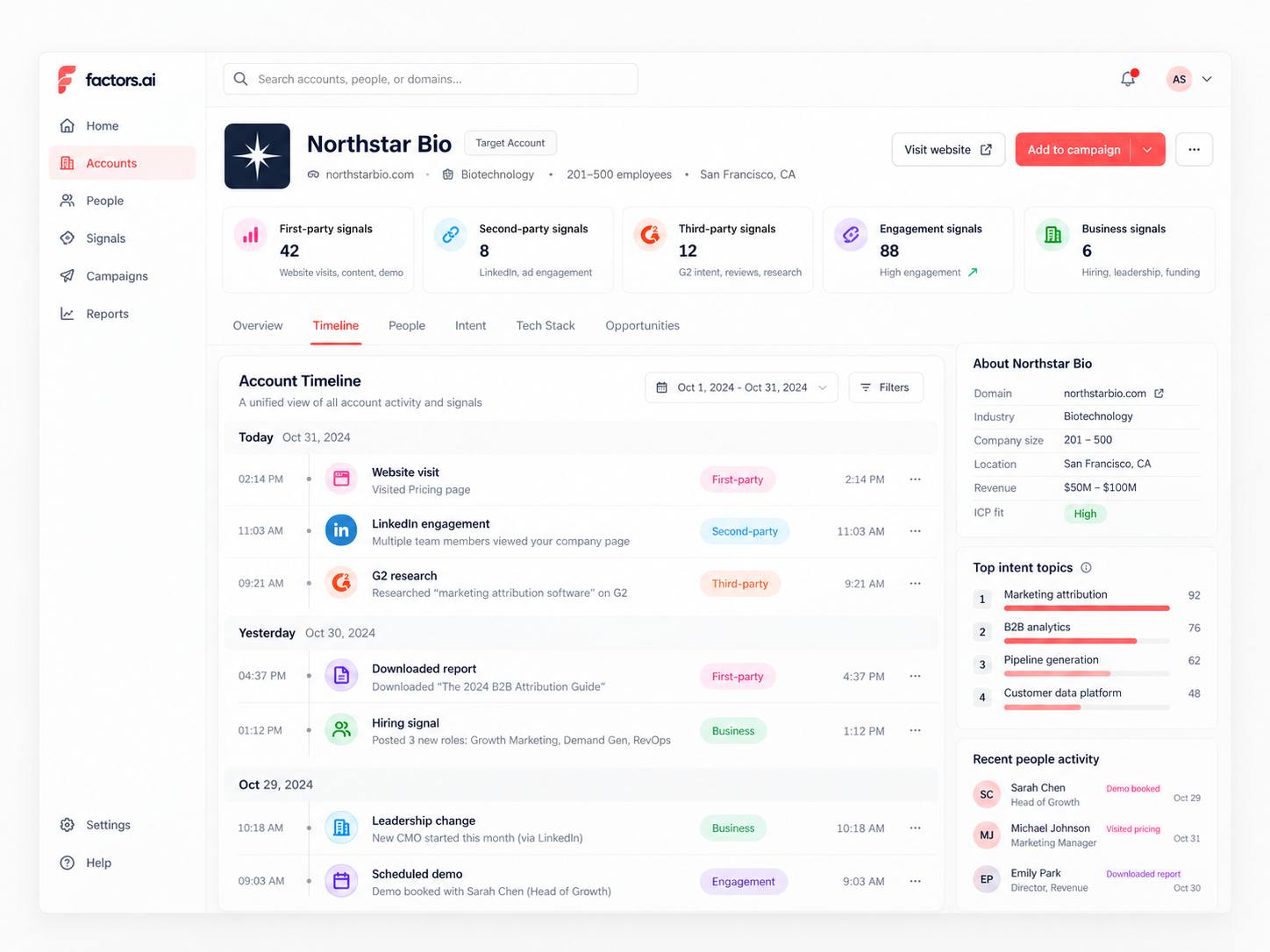
Start by defining what counts as meaningful exposure. Setting the bar at 1,000 paid impressions, five verified ad interactions, an event attendance, or five sessions on technical product pages filters out stray impressions while capturing real evaluation intent.
Across Factors.ai customers, accounts meeting that threshold showed a 64% higher meeting-to-opportunity conversion rate, a 52% higher paid search conversion rate, and a 187% higher conversion rate from content visits to demo requests.
For reporting frameworks, see our guide on LinkedIn ads analytics and reporting and our breakdown of LinkedIn revenue attribution tools.
Feed offline pipeline milestones back to LinkedIn via CAPI
Attribution also dictates campaign delivery. LinkedIn’s automated bidding algorithms need conversion signals to optimize who sees your ads next, and browser pixels miss a massive volume of activity due to ad blockers and mobile cookie limits.
Connecting the LinkedIn Conversions API sends CRM pipeline milestones back to LinkedIn via server-side syncing. Two tactical steps ensure the algorithm optimizes effectively.
- Capture the
li_fat_idparameter on your form fills: Matching offline conversions using corporate emails delivers barely a 30% match rate because members sign into LinkedIn with personal emails. Passing the platform's click ID back through CAPI gets you to a 100% match rate. - Pass conversion values weighted by ICP tier: Assigning a $5,000 value to an enterprise tier-one demo and a $500 value to a small business teaches LinkedIn’s bidding algorithm to hunt for high-ACV buying committees rather than settling for cheap, unqualified form fills.
The LinkedIn ads metrics that actually matter
Most performance dashboards on LinkedIn focus on the wrong signals. Tracking campaigns by raw cost per lead, click-through rate, and two-second video views optimizes for cheap clicks that never turn into closed revenue. A low CPL usually just means you collected form fills from students or job seekers, while two-second auto-plays register views without capturing any real buyer attention.
Instead of tracking platform activity that costs money, measure indicators that reflect account progression and pipeline value. Here are the four account-level metrics worth reporting.
1. Cost per ICP account engaged
Standard cost per lead penalizes campaigns that target actual buying committees while rewarding campaigns that harvest cheap, off-profile form fills.
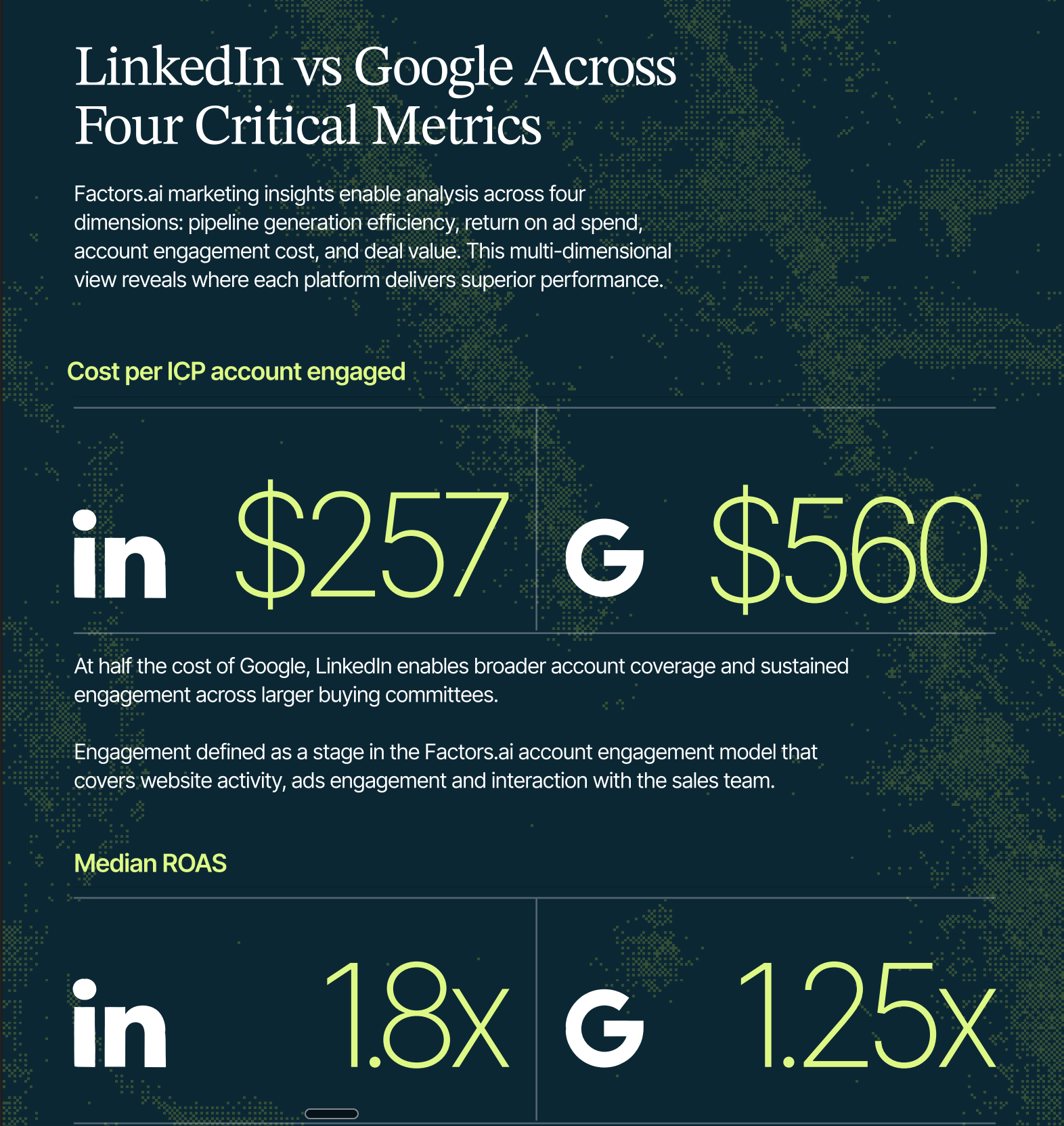
Track cost per engaged ICP account instead. Across our benchmark dataset of B2B teams, the median cost to engage an ICP account on LinkedIn was $257, compared to $560 on Google Ads. This metric unifies paid impressions, website sessions, and sales touches, measuring what it actually costs to build sustained awareness with an account that can actually buy from you.
2. Buying committee coverage across key roles
High click volume means nothing if your ads only reach a single champion at an enterprise account. Deals close when you build coverage across the wider evaluation team.
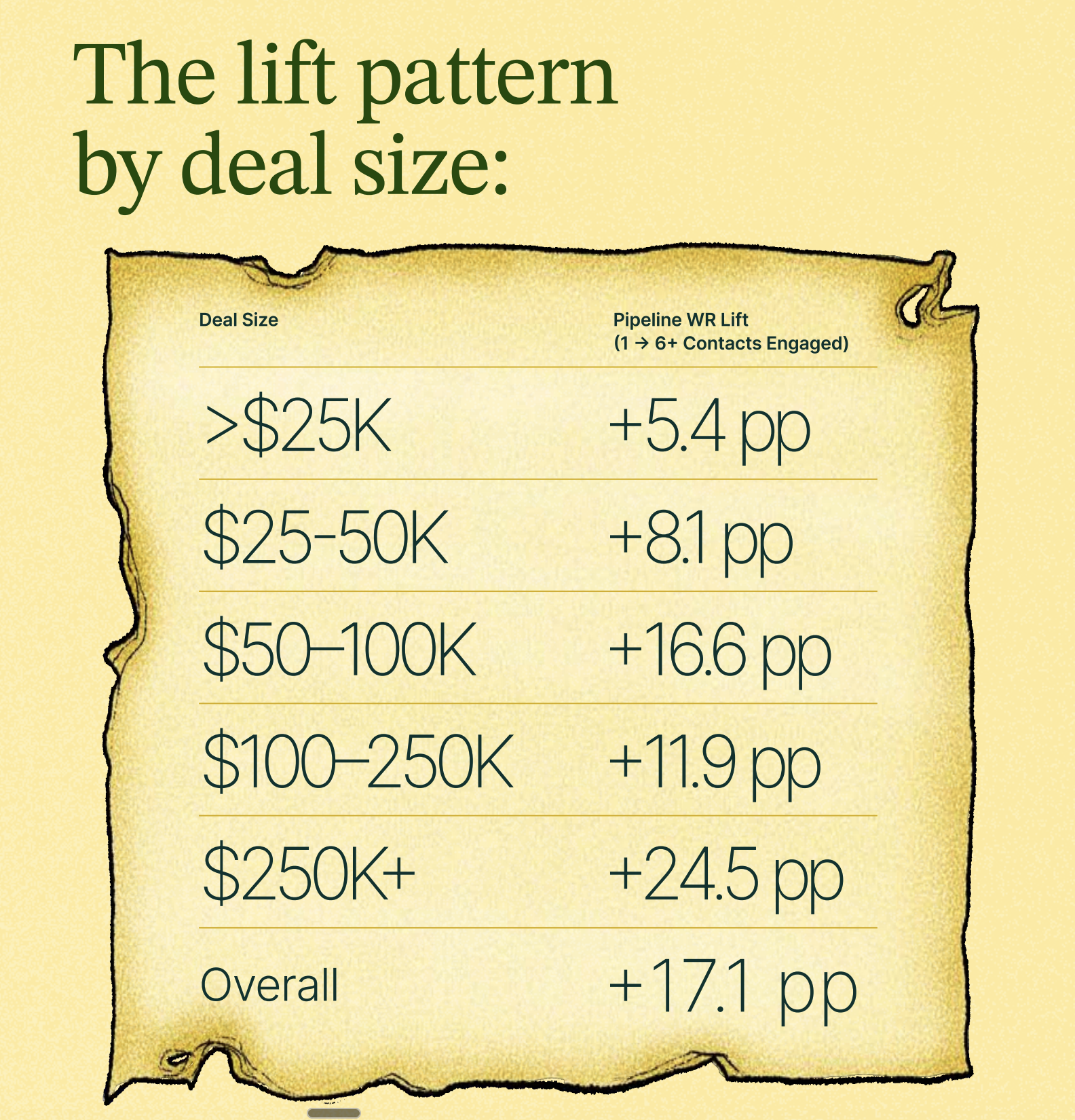
In our analysis of 50,000 closed deals, accounts with six or more engaged contacts before deal creation saw a 17.1-point lift in pipeline win rate. Adding three or more new contacts during the active sales cycle produced another 16.3-point lift, while reaching the end user, influencer, and technical evaluator together drove a 22-point jump. Measure whether your impressions penetrate engineering, finance, and operations rather than tallying clicks from a single contact.
3. Account impression distribution
Platform-reported frequency only measures how often an individual member sees an ad, which masks account delivery skew.
Because LinkedIn delivers impressions to whoever happens to be scrolling, large enterprises on your target list can easily consume 80% to 95% of your daily budget. Monitor impression share by company weekly. If any single account takes more than 10% of total campaign impressions, use frequency controls like Smart Reach to redistribute delivery across untouched accounts on your list.
4. Influenced pipeline and downstream conversion lift
LinkedIn rarely produces direct, last-click software purchases on day one. Its real commercial value is creating familiarity that lifts conversion rates across every other sales and marketing channel.
In our benchmark data, target accounts exposed to LinkedIn ads had a 43% higher meeting-to-deal conversion rate during outbound sales, and converted on paid search at a 52% higher rate. Track influenced pipeline and cross-channel lift rather than evaluating LinkedIn in a silo.
To set up this measurement framework, review our guide on measuring LinkedIn's true ROI.
How to structure a LinkedIn ads program that actually scales
Most B2B teams start LinkedIn ads with one campaign, one audience, and one piece of creative. They run it for four weeks, it doesn’t hit their CPL target, and they declare LinkedIn “doesn’t work for us.” What they’ve actually done is run one test with no control group, no creative variation, and no post-click experience optimization, and drawn a conclusion from insufficient data.
A LinkedIn ads program that scales needs three things working together: campaign architecture, creative testing, and a 90-day measurement window.
1. Campaign architecture that doesn’t make your reporting messy
Structure LinkedIn campaigns by funnel stage and audience type, not by creative. This means you should have separate campaigns for cold outreach, website retargeting, and ABM, even if they’re all running the same creative initially. When you mix audience types into one campaign, LinkedIn’s algorithm optimizes toward whoever is cheapest to reach, which is usually not your best-fit ICP.
A basic architecture for a mid-size B2B company:
- Campaign 1: Cold awareness: target accounts + job function/seniority filters, top-of-funnel offer
- Campaign 2: Website retargeting: anyone who visited the site in the last 30 days, mid-funnel offer
- Campaign 3: ABM: named account list upload, personalized creative, and offer
- Campaign 4: Contact retargeting: CRM contacts not yet in active sales conversations
2. Creative testing that produces learnings, not just data
The biggest mistake in LinkedIn creative testing is changing too many variables at once. If you launch two ads and one performs better, but they have different copy, different images, different headlines, and different CTAs, you have no idea which element drove the difference.
Test one variable at a time. Start with the image (same copy, different images). Once you have a clear winner, test the headline (same image, different headlines). Then test the CTA. Then test the offer. This takes longer but produces actual learning about your audience that compounds over time.
A practical testing timeline:
- Weeks 1–2: Image testing (minimum 2 image variants)
- Weeks 3–4: Headline testing (using winning image)
- Weeks 5–6: CTA testing (using winning image + headline)
- Weeks 7+: Offer testing (using winning creative, test different offers)
Where Factors.ai fits into your LinkedIn ads strategy
The fundamental flaw in LinkedIn’s native reporting is the post-click journey. Campaign Manager can tell you someone clicked an ad or submitted a native lead form. What it cannot show you is which closed-won enterprise accounts engaged with those ads across a four-month evaluation cycle, especially when the final conversion was an outbound sales call or an organic search visit.
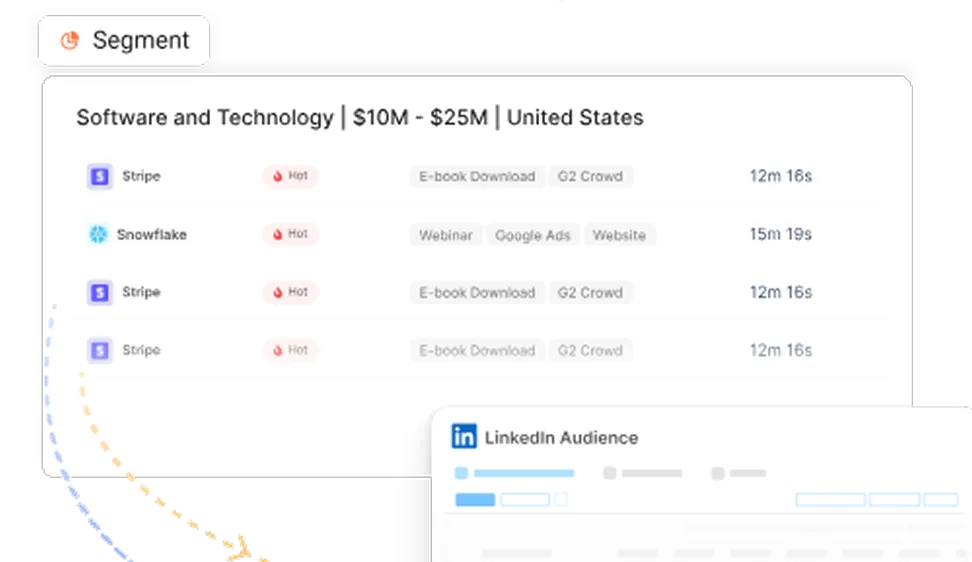
Factors.ai solves this by connecting your LinkedIn ad performance with CRM records, website interactions, and sales outreach in a single account timeline. Beyond measurement, Revenue teams can automate dynamic audience syncing, set account-level frequency caps with Smart Reach, and track revenue attribution from first impression to closed deal.
If your team lacks the internal capacity to manage complex campaign setups, partnering with an external specialist might make more sense than building the playbook alone. We evaluated the top LinkedIn ad agencies experienced in running account-based programs to help you find the right fit.
The platform mechanics are identical for every advertiser. What separates the teams that scale profitably from those that pause their campaigns is how accurately they target active buying committees, prevent wasted delivery, and prove revenue impact to leadership.
FAQs for LinkedIn ads for B2B
Q1. How much should a B2B company spend on LinkedIn ads?
There’s no universal number, but $5,000/month is roughly the floor for getting meaningful data. Below that, you won’t have enough budget to test audiences and creative simultaneously, and campaign learning will be too slow to be useful. A more realistic starting budget for a mid-market B2B company is $10,000–$15,000/month, structured across cold, retargeting, and ABM campaigns. The ceiling scales with your deal size and sales cycle length, if your ACV is $100K+ and your cycle is 9 months, the pipeline math justifies significantly more.
Q2. What’s a good cost per lead on LinkedIn ads for B2B?
Anywhere from $80 to $250 is common for a qualified lead (someone who filled out a form and met your ICP definition). Broader definitions of “lead” will give you lower CPLs that don’t mean much. The more important metric is cost per qualified lead, which means segmenting your lead gen form responses by whether they passed initial sales qualification. A $150 CPL with a 30% qualification rate is better than an $80 CPL with a 10% qualification rate.
Q3. Should I use LinkedIn Lead Gen Forms or drive traffic to a landing page?
Both work. Lead Gen Forms have higher conversion rates because they pre-fill the member’s LinkedIn data, reducing friction. Landing pages let you tell a more complete story and pre-qualify visitors before they convert. The rule of thumb I use: Lead Gen Forms for top-of-funnel offers (content downloads, webinar registrations) where you want volume; landing pages for bottom-of-funnel offers (demos, trials) where you want to filter for intent.
Q4. How long should I run a LinkedIn ad campaign before evaluating it?
At least 90 days for a meaningful read, and that’s assuming you’re spending enough to accumulate data quickly. LinkedIn’s algorithm needs 2–3 weeks of learning time per campaign, and B2B sales cycles mean that the pipeline influence from an ad impression often shows up in your CRM 60–90 days later. Teams that evaluate LinkedIn at 30 days are almost always looking at incomplete data and making premature decisions.
Q5. Why is my LinkedIn CPL so high compared to Meta or Google?
Because you’re reaching a more specific, more valuable audience on a channel where they’re in a professional mindset. LinkedIn CPLs are almost always higher in nominal terms than Meta or Google. The question isn’t whether CPL is higher, it’s whether the leads convert to pipeline at a higher rate. In most B2B cases they do, which means a $200 LinkedIn CPL that converts to pipeline at 25% is more efficient than an $80 Meta CPL that converts at 5%.
Q6. What’s the best LinkedIn ad format for ABM campaigns?
Single Image Ads with account-specific copy, combined with Thought Leader Ads from relevant employees, tend to perform best for ABM. Message Ads and Conversation Ads are also effective for ABM when the message is genuinely personalized, and that doesn’t mean “Hi [First Name], I noticed you’re in [Industry].” The key with ABM LinkedIn ads is that the creative should feel like it was made specifically for that account or persona, not just targeted to them.
Q7. How do I reduce LinkedIn ad frequency without sacrificing reach?
Set your campaign frequency cap at 5–6 impressions per member per 30 days. Rotate creative every 3–4 weeks so the same message doesn’t follow the same people indefinitely. And expand your audience slightly rather than running a very tight audience with no frequency controls, the tightest targeting on a small audience will hit frequency limits fast and damage performance.
Q8. Is LinkedIn advertising worth it for small B2B companies?
It depends on your deal size. If your ACV is under $10,000, LinkedIn’s CPLs will rarely produce a positive ROAS unless you have exceptionally high conversion rates across the funnel. If your ACV is $25,000+, the math typically works. The other factor is whether you have the content and creative to support a sustained LinkedIn program. LinkedIn ads require more content production than most companies budget for, because the same piece of creative fatigues quickly on a small target audience.
Q9. How do I measure LinkedIn’s contribution to pipeline when deals are multi-touch?
You need a tool that goes beyond last-touch attribution. The minimum viable setup is UTM tracking on all LinkedIn campaigns connected to your CRM, with a view that shows you all marketing touches on a deal, not just the last one. The more sophisticated approach is an account-level analytics platform that stitches together your LinkedIn ad data, website behavior, and CRM pipeline into a single view. This lets you see that LinkedIn influenced 40% of your closed-won pipeline in the last quarter, even when it wasn’t the last touch on those deals.

See how Factors can 2x your ROI
Boost your LinkedIn ROI in no time using data-driven insights


.avif)

.avif)
See Factors in action.
Schedule a personalized demo or sign up to get started for free
LinkedIn Marketing Partner
GDPR & SOC2 Type II

.svg)



.avif)

