Common Room Pricing: Is It Worth $30,000 a Year?
Common Room pricing starts at $30,000 a year. See what each plan includes, how credits work, and which add-ons could increase your total cost.

Associate Director of Brand and Content




Summary of Common Room Pricing
- Common Room pricing starts at $30,000 a year. The starter plan, known as Essential, includes five users and up to 100,000 contacts; Advanced and Enterprise plans require custom quotes.
- Common Room doesn’t offer monthly subscription options unlike other ABM tools like Vector.co or Fibbler.
- Common Room advertises a risk-free 14-day trial. Use the evaluation to check contact relevance and whether its signals give your sales reps useful reasons to reach out to your target accounts before committing to an annual subscription.
- The platform helps you follow people as well as companies. Job changes and champion tracking can give your reps a reason to reconnect when a former customer moves to a target account.
- It has separate research and prospecting credits. Keep in mind that having room for 100,000 contacts doesn't mean you can find or research 100,000 new people within the included credits.
- Compare Common Room with the process you'd otherwise run. Included signals can be valuable if they replace repeated data purchases and maintenance in a tool such as Clay.
We reviewed Common Room's pricing and help articles, public customer reviews, and our own buyer conversations to explain what you get, what can cost extra, and how to compare the price with your use case.
How much does Common Room cost?
Common Room’s Essential plan, which is their starter plan, costs $2,500 per month with annual billing. You need to budget for $30,000 a year before factoring in paid add-ons. Advanced and Enterprise require a sales quote.
Common Room's published pricing includes these allowances:
Credit amounts are shown as published. The pricing page does not specify their renewal period.
The Essential plan offers the lowest published entry point. Advanced and Enterprise plans allow you to scale the number of people who can use Common Room, the contacts you can keep, and the listed research and prospecting allowances.
The right plan depends on more than your team size. Three SDRs monitoring a large contact database could need different allowances from three SDRs researching a small account list.
You’ll have to estimate both the audience (accounts and contacts) you'll bring into Common Room and how your reps will use the data.
Does Common Room offer monthly billing?
Common Room does not publish a month-to-month subscription. Its Essential plan is billed annually at $30,000..
For example, if you want Common Room for a two-month outbound campaign, the advertised purchase is still the annual subscription. You need to justify a year of spend, rather than just the months your campaign runs.
The 14-day trial merely gives your team an evaluation period before that decision.
How are Common Room and Zoom Revenue Accelerator priced?
Zoom acquired Common Room in July 2026. Common Room’s pricing page now has a tab for each product, but you can buy them separately.
- Choose Common Room if you want to find buyers and prioritize outreach. It helps your reps follow signals such as job changes, website visits, and community engagement. Essential starts at $30,000 a year, billed annually.
- Choose Zoom Revenue Accelerator if you want to analyze sales conversations. It helps your team review calls, understand customer conversations, and coach sellers. Plans start at $66 per user per month, billed annually.
How do Common Room contact limits and credits work?
Common Room has different allowances for storing contacts, finding new prospects, researching accounts, and tracking website activity. They describe different things your team can do.
How many contacts can you keep in Common Room?
Common Room’s contact allowance covers the individual contact records your team stores and tracks, such as prospects, customers, and community members.
For example, a marketing director, an engineering lead, and a procurement manager at the same business represent three contacts associated with one account.
If you import 40,000 contacts from your CRM, those records count toward your contact allowance. Finding new prospects through the Prospector feature and running AI research have separate credit allowances.
When estimating how much contact capacity you need, count the people you’ll track at each target company. If you target 10,000 companies and track five people at each, you’ll need room for 50,000 contacts.
What do Common Room Prospector credits cover?
Common Room's Prospector helps you find new people and companies. You might already know which accounts you want to sell to but still need the right contacts within them.
For instance, your SDR could search for security leaders at a target company, add relevant people to Common Room, and send them into an outreach sequence.
Searching for prospects and using the results are separate steps. The Prospector documentation says you need Prospector access to add contacts, fill in missing contact details, sync records to your CRM, or send them to a sales engagement platform.
Common Room’s current plans include Prospector credits, and you can buy additional credits. Its documentation also describes access to these actions as an add-on. Your quote should make clear which actions are included and how they use your credits.
Contact capacity and prospecting credits serve different purposes. Having space to store 100,000 contacts doesn’t mean your plan includes enough credits to find and add 100,000 new prospects.
What do Common Room research credits cover?
RoomieAI research helps your team answer questions about accounts using web search and AI. You can choose an existing prompt or write a question of your own.
Common Room's organization research guide explains the feature, but the public pricing materials don't provide a complete credit consumption and renewal schedule.
For example, a rep preparing for a meeting might research a company's expansion plans or recent product announcements. Running that research for selected meetings is different from researching every account in your target list.
Your quote should define what uses a research credit, when the allowance refreshes, and what more capacity costs. Those terms determine how much research your team can run within its budget.
What website visitor identification does Common Room include?
Common Room supports company identification, tracking of known people, and enhanced identification of anonymous US visitors. Each answers a different question.
Its native tracking can identify a visitor's company from an IP address. When someone submits a form or is identified through a login or tracked email link, Common Room can connect that person's identity with their website activity. Its website tracking documentation explains the setup.
For example, a person could browse your pricing page and fill out a form later. Common Room can associate their earlier visits with their profile when the tracking is configured correctly.
For enhanced identification of US-based individuals, Common Room uses Vector. Its Vector integration guide says customers receive 1,000 Vector credits per month at no extra cost. Additional capacity is available through a paid Vector plan.
Separately, the pricing table lists annual website-activity allowances of 240,000 on Essential, 480,000 on Advanced, and 960,000 on Enterprise. These numbers aren't promises to identify that many people.
If website identification is your main use case, your quote should distinguish those allowances and explain how repeat visits count.
What can cost extra with Common Room?
Extra usage, optional features, and other tools your team keeps can increase the budget beyond Common Room's annual subscription.
Common Room names additional Prospector credits, DataAgent actions for data management, and product-signal integration among its expansion options. Public dollar prices for these additions aren't listed.
Common Room can add contacts to Outreach sequences or Salesloft cadences, where your reps manage their outreach. You’ll still need a separate subscription to Outreach or Salesloft.
Is Common Room too expensive for a small team?
Common Room’s annual commitment can make it difficult for a small team to afford. Essential costs $30,000 a year, billed annually. The advertised $2,500/month is only that annual price divided by 12. The platform doesn’t offer a month-to-month subscription.
If you’re testing outbound or planning a short campaign, you’re therefore evaluating a $30,000 purchase.
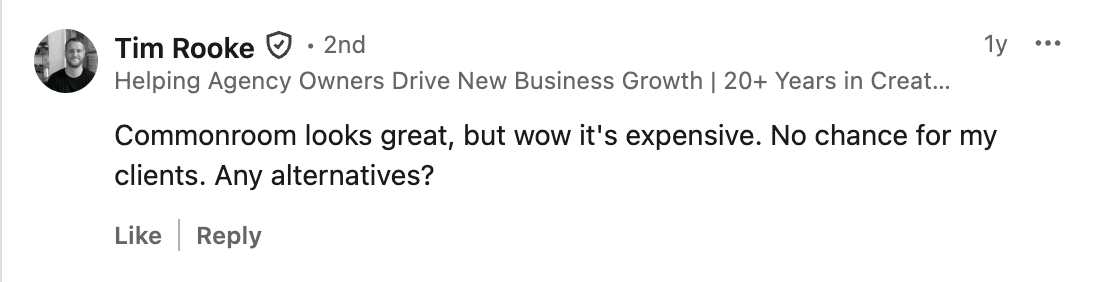
Public comments illustrate the budget pressure smaller teams face. Tim Rooke, founder of GAP, which serves small and midsize agencies, wrote, “Commonroom looks great, but wow it's expensive. No chance for my clients. Any alternatives?”
If you’re still testing whether buyer signals help your sales reps or you’re not ready for an annual commitment, an ABM tool with a monthly subscription is the way to go.
You have several options, depending on what your team needs:
- ZenABM: $69/month for Starter, billed monthly. Consider it for LinkedIn company engagement, account scoring, and campaign reporting when you want to prioritize accounts engaging with your ads.
- Fibbler: $89/month for Growth, including one user. Look into it when you want to connect LinkedIn advertising with CRM pipeline. Google and Meta attribution are paid add-ons; Salesforce requires the $129/month Unlimited plan.
- Unify: $20 per seat/month for Base, billed monthly. Consider it for job-change and hiring signals, contact enrichment, and outbound sequencing. The Base plan includes 800 credits per seat each month; website intent requires its annually billed Business plan.
- Apollo: $65 per seat/month for Basic on monthly billing. Evaluate it if your reps mainly need to find contacts and run email sequences.
What our buyer research reveals about Common Room pricing
We reviewed 72 transcripts from Factors.ai prospect and customer conversations that mentioned Common Room to understand how teams judged its cost.
Buyers discussed the cost of collecting signals, the quality of their contact database, which subscriptions they still needed, and whether their reps used Common Room regularly. The sections below explain how each affects the value you get from your Common Room subscription.
Common Room vs. Clay: Comparing the cost of collecting buyer signals
Buyers compare Common Room with Clay because both can help with contact enrichment, account research, and collecting signals such as job changes. The difference is how your team gets those insights and pays for it.
Common Room includes native signals in its subscription, with separate credits for research and prospecting. Clay’s usage model charges through Actions and Data Credits as your team runs workflows.
Using your own provider keys can avoid the corresponding Data Credit charges, but platform Actions and your provider bill remain.
One prospect explained how repeated signal checks affected their choice:
“With Clay, every time we ran it on like a set of 50,000 companies, it was 50,000 credits consumed. Whereas with Common Room all of these things come out of the box.”
If your reps need the same signals refreshed regularly, compare the ongoing cost of running those checks in Clay with Common Room’s subscription.
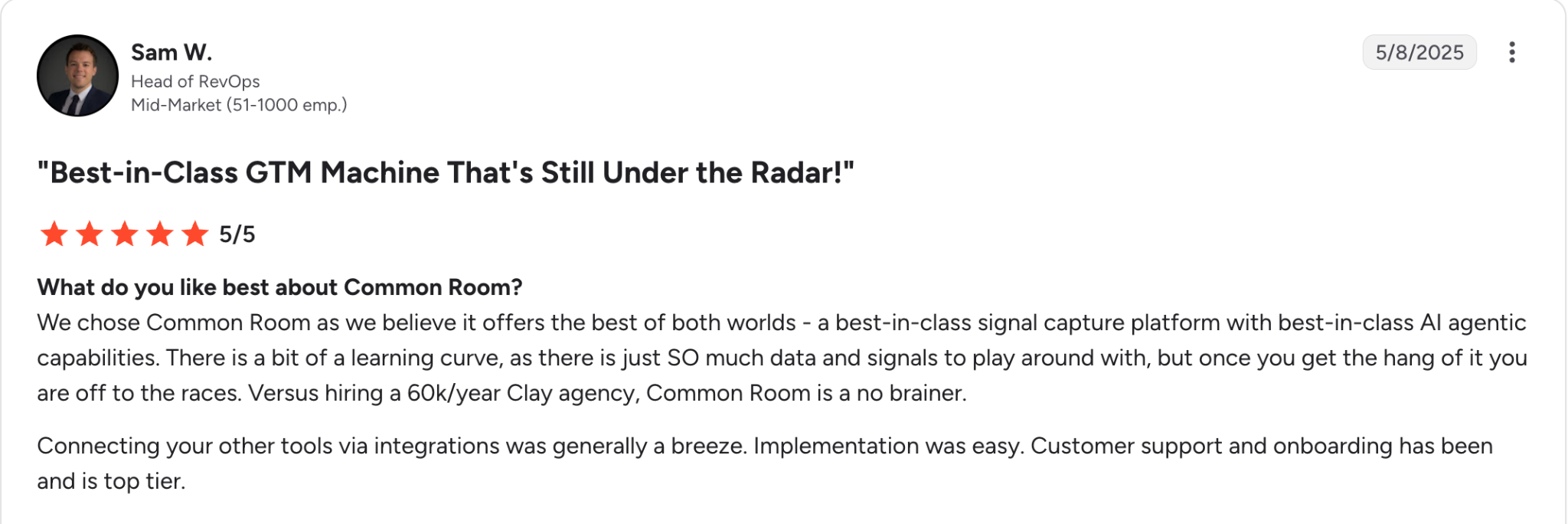
Maintaining the Clay workflows can add another expense. Sam W., a Head of RevOps at a midmarket company, said in his review of Common Room that “Versus hiring a 60k/year Clay agency, Common Room is a no brainer.”
How does contact quality affect Common Room's value?
Choose your Common Room plan based on the contacts your team needs to track, rather than the total number of records in your CRM. One buyer in our research described the main pricing lever as “the number of contacts stored in the system.”
For example, your CRM might contain years of webinar registrations alongside current prospects and customers. Records outside your target market can take up contact capacity without giving your reps useful people to contact. Keeping them could bring you closer to your plan’s limit unnecessarily.
A verified midmarket software user raised this concern in a July 2026 G2 review. They praised Common Room’s signals and support but wrote, “You have to sit with bad records in your room and it hits your bottom line.”

One buyer in our research described the main pricing lever as "the number of contacts stored in the system."
Before importing your CRM, define which contacts your campaigns need and identify records that need updating or excluding. If your relevant contacts fit within a lower plan’s allowance, you may avoid paying for extra capacity just to accommodate records your team won’t use.
When can Common Room replace other software costs?
Common Room can replace a separate data or research tool when its included capabilities cover the work you currently use that tool for. Other subscriptions may remain necessary, particularly for sending outreach or handling specialized requirements.
These are possible setups, rather than a recommendation to buy every tool listed. Common Room documents both outreach integrations and complementary use with Clay. Factors.ai provides marketing analytics and attribution.
What should you negotiate in a Common Room pricing quote?
Negotiate the total cost of the usage your team expects, including what you’ll pay at renewal. A lower first-year subscription fee may offer little saving if you need to buy additional credits soon after signing.
Focus the discussion on these terms:
- Users and contact capacity: Base the quote on who needs access and how many contacts you’ll track. Ask what additional seats and contact capacity will cost as your team grows.
- Research and prospecting credits: Confirm what consumes credits, when allowances refresh, and the price of additional credits. If your SDRs prospect every day, a larger included allowance could be worth more than a small subscription discount.
- Add-ons and setup fees: Get a breakdown of any implementation charges, paid integrations, and optional features your team needs. Ask whether one-time fees can be reduced or waived.
- Contract length and payment schedule: Common Room’s published Essential offer is billed annually. Confirm the agreement’s duration and when payments are due. Paying in installments, if offered, doesn’t necessarily shorten the commitment.
- Renewal pricing: Ask what happens when an introductory discount ends and whether you can agree on a limit to future price increases.
- Cancellation and renewal deadlines: Confirm whether the agreement renews automatically and how much notice you must give to cancel or change your plan.
Ask for the agreed terms in the written proposal. You should be able to see your first-year cost, your renewal cost, and the price of adding capacity before you sign.
How does Common Room pricing compare with Factors.ai?
Factors.ai is an AI ABM platform that helps your team identify website visitors, prioritize accounts, run advertising and sales workflows, and measure marketing’s contribution to pipeline.
This makes Factors.ai relevant when you’re evaluating Common Room pricing. Both tools support identification, enrichment, scoring, and follow-up. Factors.ai also connects those activities with advertising controls and marketing attribution, so you can evaluate it for several parts of your ABM program.
Comparing Factors.ai Pricing with Common Room Pricing based on use cases:
- Choose Common Room when people-level prospecting is the main purchase. If your reps regularly act on job changes, champion movements, and community activity, Common Room’s Essential plan combines those signals with research and prospecting allowances at $30,000/year. This is particularly relevant when your marketing measurement is already covered and your priority is finding people to contact.
- Choose Factors.ai for website identification without a large annual commitment: Its Lite plan starts at $199/month after the trial for company identification, website analytics, and alerts. The Basic plan adds segmentation, workflows, and CRM sync at $6,000/year. Eligible US visitor identification is available through the RB2B add-on.
- Choose Factors.ai when you activate accounts across multiple advertising channels: Factors.ai supports audiences across LinkedIn, Google, Reddit, StackAdapt, Microsoft and Meta. Common Room’s native Ads product only focuses on LinkedIn audience sync and engagement.
- Choose Factors.ai when you need to decide which marketing channels deserve more budget: Factors.ai connects campaign spend and recorded interactions with CRM pipeline and revenue. Common Room’s documented attribution only measures outcomes sourced or influenced by actions within Common Room.
Frequently Asked Questions on Common Room Pricing
- Does Common Room offer a free trial?
Common Room advertises a 14-day trial, but doesn’t publish whether it’s free or what usage is included. To arrange an evaluation, request a demo and ask about trial access before committing to an annual plan.
- Can you buy Common Room without Zoom Revenue Accelerator?
Yes. Common Room and Zoom Revenue Accelerator remain available separately. You can buy Common Room for buyer intelligence without buying Zoom's sales conversation analysis.
- Does Common Room charge credits for every buying signal?
No. Common Room includes native signals such as job changes and job listings in its subscription. It has separate credit allowances for RoomieAI research and Prospector. Following a contact’s job change is different from running AI research on their company or adding new prospects through Prospector. Included signals don’t mean unlimited research or prospecting.
- Can Common Room replace Clay?
Yes, if you use Clay mainly to collect signals and enrich contacts that Common Room already covers. For example, Common Room’s built-in job-change tracking could replace a Clay workflow you maintain for that purpose.
Keep Clay if your team needs custom enrichment workflows or specific data providers. You can also use both: Common Room describes sending data to Clay for enrichment and bringing the results back. You’ll save on Clay only if you can retire the workflows or subscription you currently pay for.

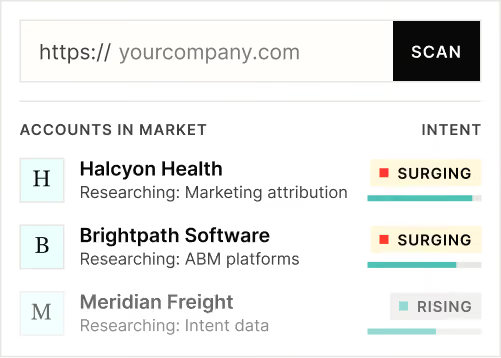
Powered by Bombora
Enter your domain and we'll send you a free list of companies showing buying intent in your vertical.
Powered by Bombora
Enter your domain and we'll send you a free list of companies showing buying intent in your vertical.

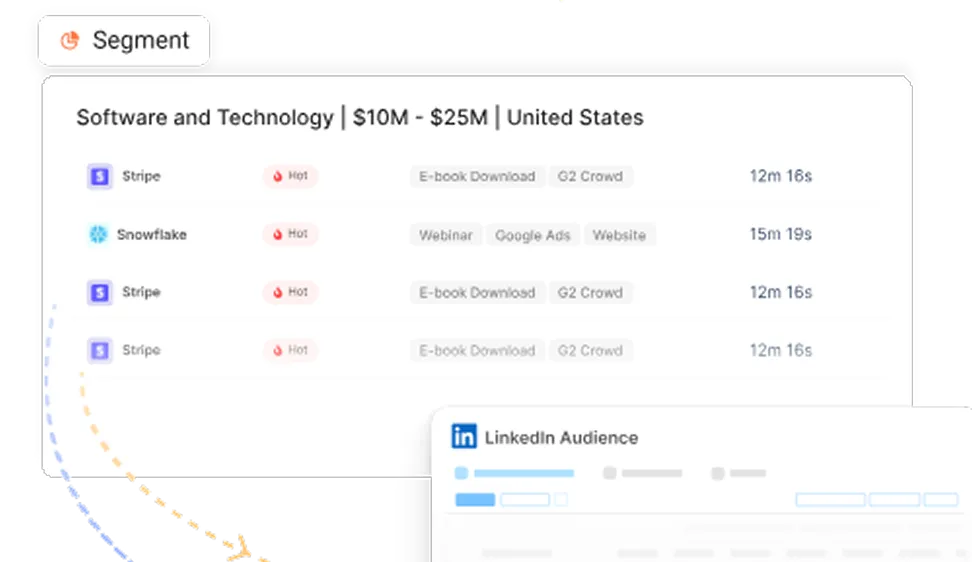
See how Factors can 2x your ROI
Boost your LinkedIn ROI in no time using data-driven insights





See Factors in action.
Schedule a personalized demo or sign up to get started for free
LinkedIn Marketing Partner
GDPR & SOC2 Type II