
Factors.ai vs UnifyGTM: Finding What Actually Works for Your GTM Motion
Read about Factors.ai as a UnifyGTM alternative and compare them across features, pricing, automation, analytics, and sales-marketing alignment in detail.
.avif)
Content Marketer

Chief Marketing Officer



.svg)


TL;DR
- UnifyGTM prioritizes speed and outbound automation, ideal for sales-led teams needing quick action on buyer intent.
- Factors.ai offers broader visibility and automation across the funnel, aligning marketing, sales, and product around shared signals.
- Analytics & Attribution: Factors.ai supports full-funnel reporting; UnifyGTM stays focused on outreach metrics.
- Decision Criteria: Choose UnifyGTM for simple, outbound-first motions; choose Factors.ai if GTM orchestration, insight, and growth scalability are priorities.
If you’ve spent even a few months inside a GTM team, you know this feeling a little too well.
You’re staring at five dashboards. Website traffic is up. LinkedIn clicks look decent. Sales says conversations feel ‘warmer.’ CRM data is… questionable. And when someone asks the simplest question… what actually moved pipeline this month? The answer is usually a pause, followed by extensive guessing (and silent cries in the shower).
I’ve sat through enough of these reviews to know that the problem isn’t effort. It’s fragmentation. Signals live everywhere, tools don’t talk, and teams end up reacting instead of operating with clarity.
This is where platforms such as Factors.ai and UnifyGTM enter the conversation.
Both promise to help GTM teams spot buying intent faster and act on it before interest fades. Both aim to reduce manual work and keep sales and marketing aligned. But they’re built for very different GTM realities.
UnifyGTM is designed for speed. It helps sales teams quickly respond to warm signals and keep outbound moving with minimal setup.
Factors.ai takes a broader view. It connects intent, ads, CRM activity, and funnel movement so teams can understand not just who showed interest, but what actually pushed deals forward.
If you’re deciding between the two, this guide breaks down how each platform works in practice, from features and pricing to automation, analytics, and long-term scalability, so you can choose what fits your GTM motion today, not just what sounds good on a landing page.
Factors.ai vs UnifyGTM: Functionality and Features
Most GTM teams don’t realize something’s missing until outbound is technically “working,” but results still feel inconsistent. Leads come in, emails go out, meetings happen… and yet it’s hard to explain why one account converted and another went cold.
That gap between activity and understanding is usually where tooling starts to matter… and also where Factors.ai and UnifyGTM come into play.
Both focus on turning intent signals into action, but their approaches differ in scale and depth.
Let’s look at how they compare.
Factors.ai vs UnifyGTM: Functionality and Features Comparison Table
| Feature | Factors.ai | UnifyGTM |
|---|---|---|
| Intent Signals | 1st-party: Website, CRM, product usage 2nd-party: LinkedIn, Google, Bing, Meta Ads, G2 3rd-party: CSV uploads | Tracks 1st and 3rd-party intent data |
| Account Identification | Identifies up to 75% of website visitors using multi-source enrichment (6sense, Clearbit, Demandbase, Snitcher) | Uses Clearbit, 6sense, Demandbase, and Snitcher for account-level identification |
| Customer Journey Timeline | Full chronological journey view | Not available |
| Account & Engagement Scoring | AI-based account scoring by ICP fit, funnel stage, and engagement | Account and engagement scoring available |
| Analytics & Reporting | Full-funnel analytics with multi-channel attribution | Basic attribution focused on sales outreach |
| G2 Buyer Intent | Official G2 integration with 10+ signals including category, pricing, and grid report views | Limited to competitor and profile views |
| Alerts | AI Alerts via Slack for real-time buyer intent | Slack alerts for new leads, audience entries, and job changes |
One thing I’ve noticed across teams is that feature lists look similar on paper, but daily usage feels very different. The real question isn’t how many signals a tool tracks; it’s whether those signals actually help someone decide what to do next.
Factors.ai Functionality and Features
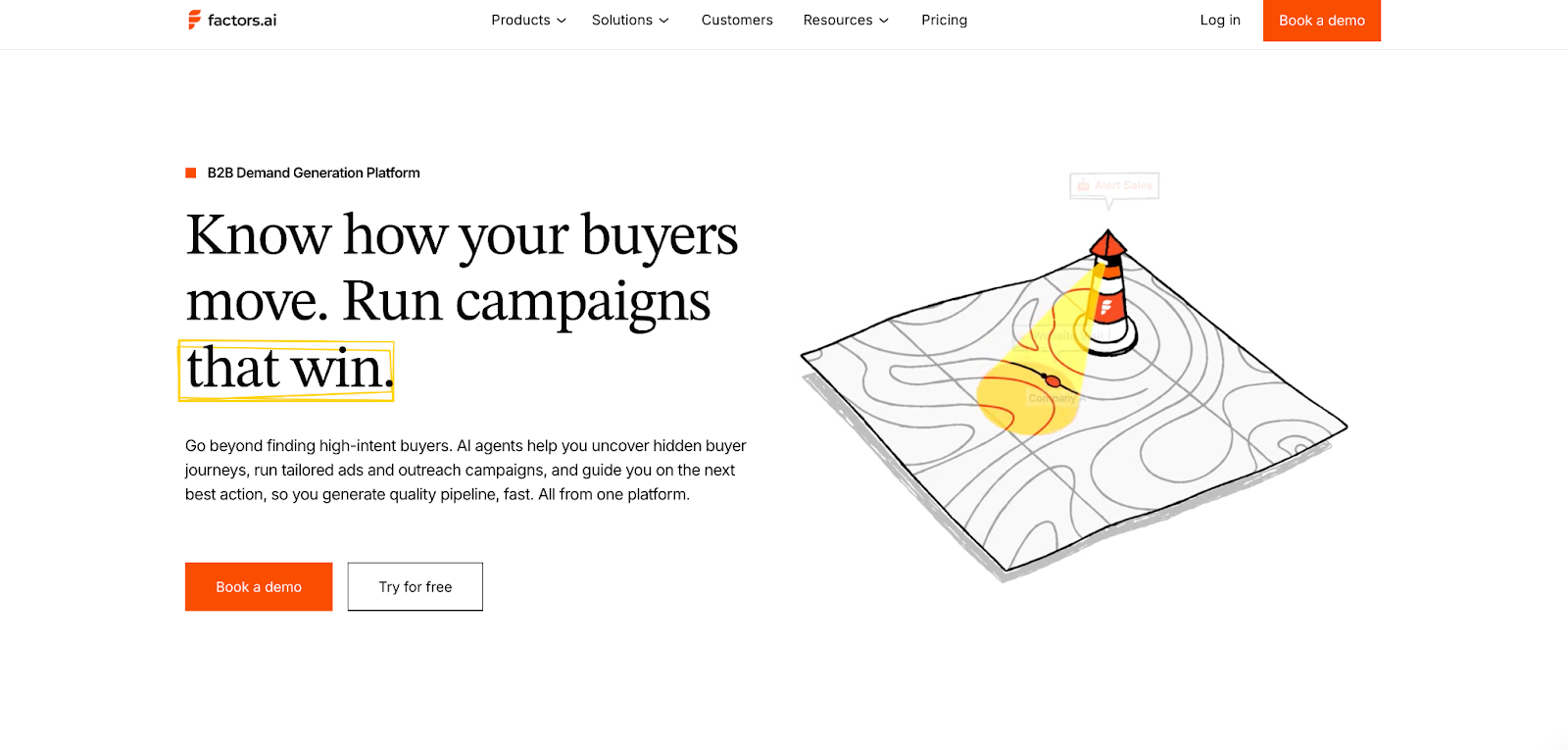
Factors.ai helps teams bring every GTM signal into one connected system.
It gives a clear view of how accounts interact across the website, ads, and CRM so teams can see where engagement is building and where it slows down.
What makes it stand out:
- Multi-Source Intent Capture
Gathers first-, second-, and third-party data from multiple channels to show which accounts are actively exploring your brand. - Account 360 View
Combines all buyer actions like visits, ad clicks, and CRM updates into one clear view of the account journey. This is especially helpful during deal reviews. Instead of relying on memory or notes, you can literally walk through how an account engaged over time, what they clicked, what they ignored, and where momentum picked up. - AI-Powered Workflows
Uses integrations like Zapier and Make to automate enrichment, outreach triggers, and campaign updates. - Funnel Analytics
Tracks how leads move through every stage and helps teams identify what drives progress or causes drop-offs. - Real-Time Alerts
Sends context-rich notifications on Slack or Teams when accounts revisit pricing, demo, or other key pages.
Teams that operate across ads, inbound, outbound, and product usually feel the biggest shift here. Once everyone is looking at the same story, alignment stops being a meeting topic and starts becoming the default.
That said, B2B teams that rely on Factors.ai tend to get better alignment between marketing, product, and sales since all activity is tracked and interpreted in one place.
UnifyGTM Functionality and Features
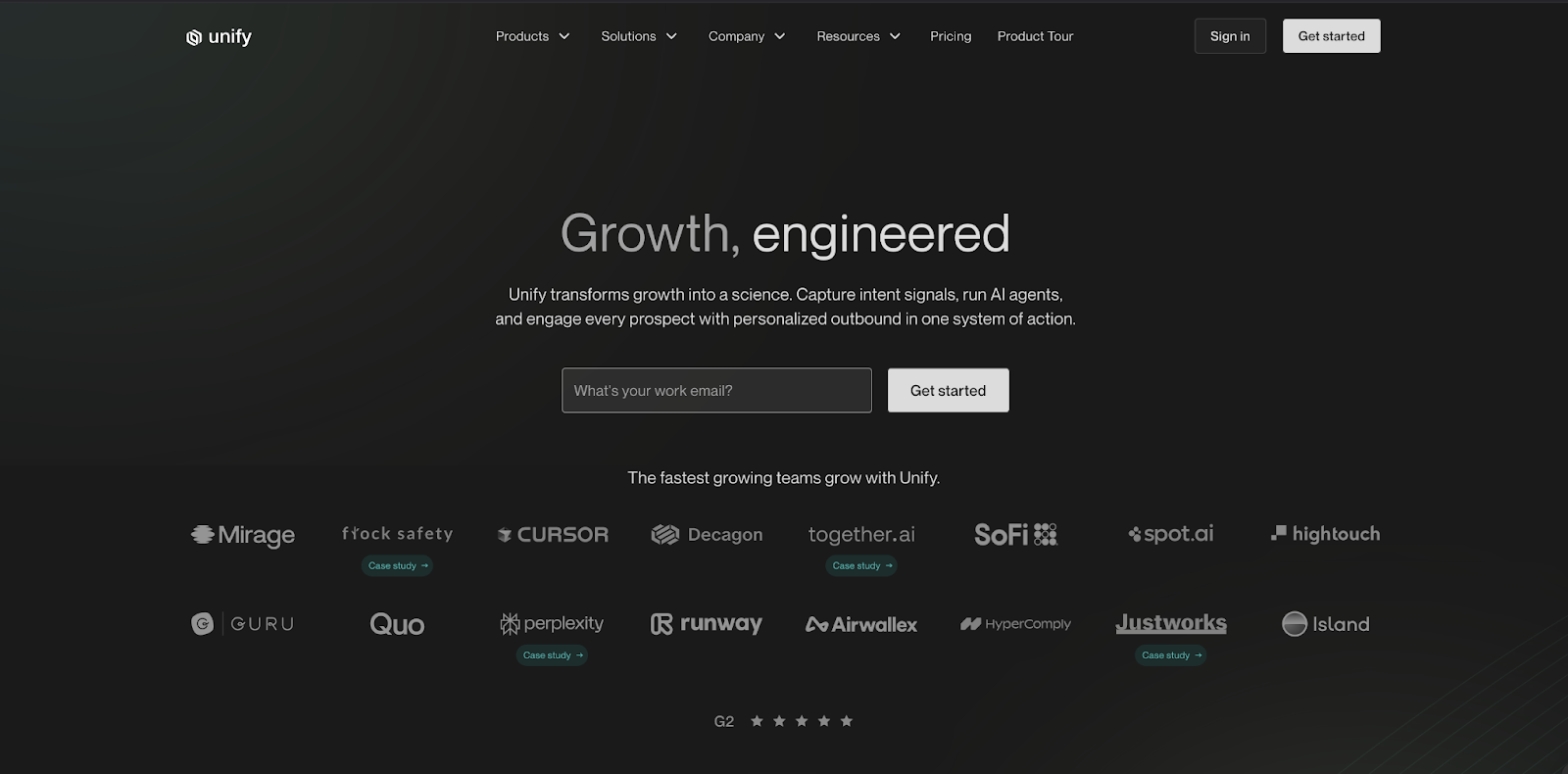
UnifyGTM focuses on helping sales teams act fast when an opportunity appears.
Its strength lies in identifying high-intent accounts quickly and automating the first outreach before interest cools down.
How it helps teams:
- Intent-Led Prospecting
Collects 25+ intent signals from CRM, website, and email engagement to find accounts showing buying behavior. - Automated Outbound
Launches prebuilt email sequences when accounts meet engagement thresholds. For teams without RevOps support or time to build custom workflows, this kind of built-in automation removes friction. - Smart Snippets
Creates short AI-generated copy for personalized email messages. - Managed Mailboxes
Maintains sender domains and deliverability scores to support reliable outbound performance. - Champion Tracking
Alerts teams when key users change roles, enabling timely follow-up.
For small and mid-sized teams that prioritize speed and consistent outreach, UnifyGTM offers a direct and easy way to stay in touch with active prospects.
Factors.ai vs UnifyGTM: Verdict on Functionality and Features
Both platforms help GTM teams use intent signals more effectively, but they focus on different goals.
Factors.ai helps you see the entire story from the first signal to the outcome without juggling multiple tools.
UnifyGTM helps you react quickly to interest and manage outbound at scale.
Your choice depends on what your team needs most right now: faster execution or stronger alignment between marketing and sales.
📑 To understand the mechanics of turning anonymous activity into usable leads, read our explainer on identifying anonymous website visitors. If you want to see how those signals drive ABM plays, our guide on buyer intent for ABM explains how intent is prioritized and acted on.
Factors.ai vs UnifyGTM: Pricing
Pricing looks simple on the surface, but what you actually get inside each plan plays a big role in how quickly a team can activate intent, run campaigns, and prove revenue impact.
Both platforms take different routes:
- Factors.ai scales by usage, seats, and feature depth
- UnifyGTM prices based on credits, users, and mailbox management
Factors.ai vs UnitfyGTM: Pricing Comparison Table
| Plan Details | Factors.ai | UnifyGTM |
|---|---|---|
| Model | Annual plans with usage- and seat-based tiers | Monthly subscription based on credits, users, and mailboxes |
| Starting Price | Free plan available. For paid plans, contact the Factors.ai team | Begins at $1,740/month (billed annually) |
| Free Plan / Trial | Yes, free plan with 200 identified companies/month | No free plan or trial |
| Focus | Full-funnel GTM orchestration with tracking, activation, and analytics | Signal-based outbound and mailbox-managed outreach |
| Support | Optional GTM Engineering Services add-on | Slack support + Growth Consultant based on plan |
Factors.ai Pricing

Factors.ai is designed to grow with the team using it.
Each plan adds more depth, from identification and tracking to orchestration and advanced analytics.
It works well for teams that want to start simple and keep adding layers as their GTM motion expands.
Plans include:
Free Plan
- Identify up to 200 companies per month.
- Includes 3 seats.
- Basic dashboards and visitor tracking.
- Slack and Microsoft Teams integration.
Basic Plan
- Identify 3,000 companies per month.
- Includes 5 seats.
- Adds LinkedIn intent signals and GTM dashboards.
- Connects with HubSpot, Salesforce, and Google Search Console.
Growth Plan
- Identify 8,000 companies per month.
- Includes 10 seats.
- Adds ABM analytics, account scoring, workflow automation, and a dedicated CSM.
Enterprise Plan
- Identify unlimited companies with up to 25 seats.
- Adds predictive scoring, AdPilot for LinkedIn and Google, white-glove onboarding, and advanced analytics.
Optional GTM Engineering Services
For teams without in-house RevOps, Factors.ai provides an additional setup and operations layer at an additional cost.
It includes:
- Custom ICP modeling and GTM playbook design.
- Set up enrichment, alert, and ad activation workflows.
- SDR enablement with post-meeting alerts and closed-lost deal reactivation.
- Ongoing review and optimization of GTM processes.
These services help teams operationalize the platform quickly and maintain consistent performance without adding internal load.
UnifyGTM Pricing
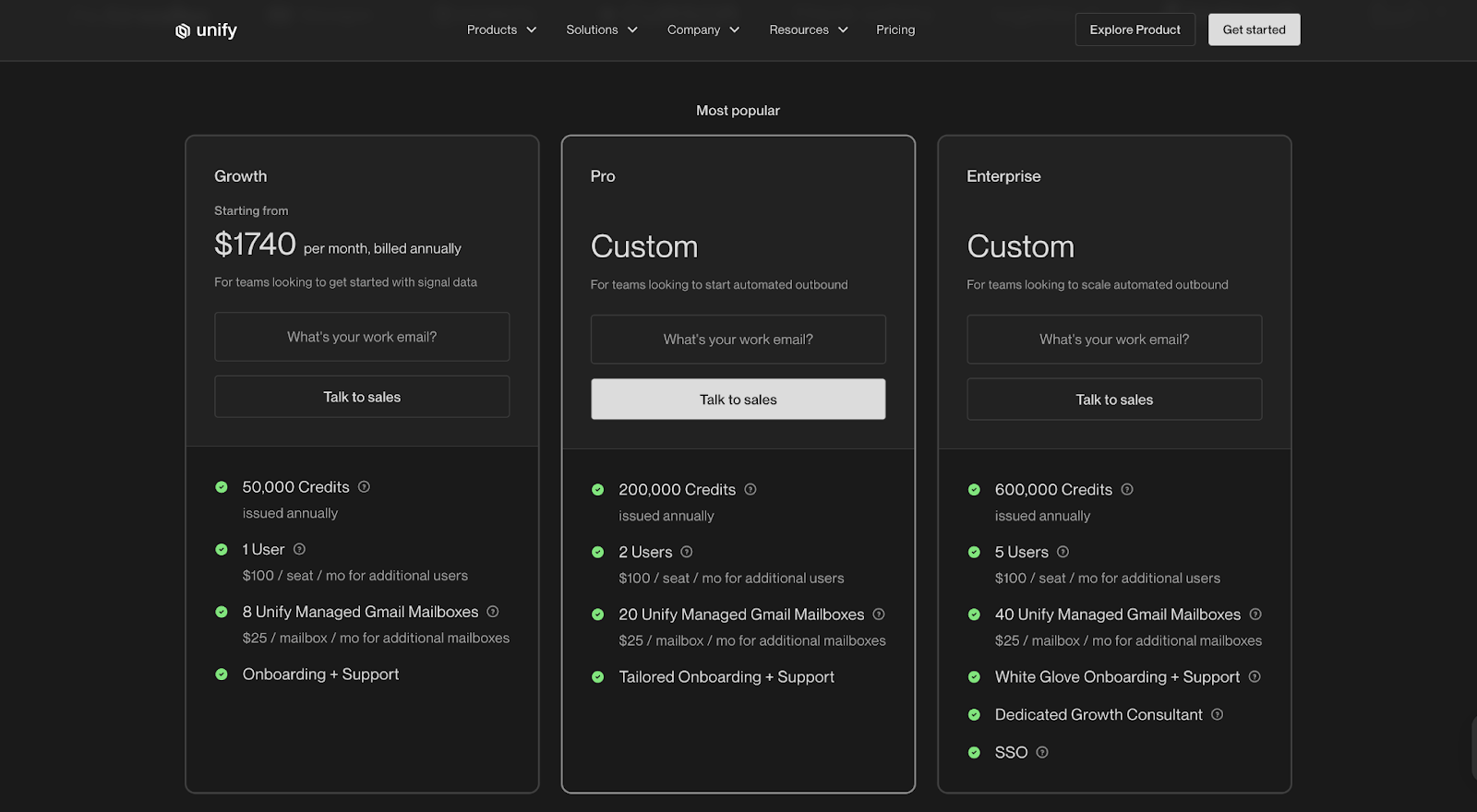
UnifyGTM has three paid plans, all billed annually. Pricing scales based on credits issued, number of users, and managed mailboxes.
Growth - $1,740/month
- 50,000 credits per year
- 1 user included (additional users $100/mo each)
- 8 managed Gmail mailboxes ($25/mailbox/month for more)
- Onboarding + support
Pro - Custom Pricing
- 200,000 credits per year
- 2 users
- 20 managed Gmail mailboxes
- Tailored onboarding + support
Enterprise - Custom Pricing
- 600,000 credits per year
- 5 users
- 40 managed Gmail mailboxes
- White-glove onboarding
- Dedicated Growth Consultant
- SSO
No free plan, no trial, and features stay mostly consistent across plans, the jump is in volume and support.
Factors.ai vs UnifyGTM: Verdict on Pricing
UnifyGTM is easier to step into if a team only needs warm outbound, buying signal detection, and inbox management. Factors.ai becomes more valuable as a GTM motion expands into multi-channel intent, scoring, ads, and funnel analytics.
If the priority is faster outbound with a predictable monthly cost, UnifyGTM fits that mold.
If the goal is to build a connected, scalable GTM system with deeper analytics, automation, and support, Factors.ai grows into that role over time.
📑 If you’re benchmarking cost models across the intent/ enrichment space, our pricing breakdowns like ZoomInfo pricing and Cognism pricing are useful for understanding where value shifts as teams grow.
{{INLINE_BOFU}}
Factors.ai vs UnifyGTM: AI Agents and Automation
Every modern GTM platform claims to be powered by AI, but what matters is how much of that intelligence actually helps teams day to day.
Both Factors.ai and UnifyGTM use automation to reduce manual work, yet the way they use it, and what it’s applied to, feels very different.
Factors.ai vs UnifyGTM: AI Agents and Automation Comparison Table
| Capability | Factors.ai | UnifyGTM |
|---|---|---|
| Purpose | Automates GTM workflows across marketing, sales, and analytics | Automates outbound qualification and prospecting |
| Scope | Covers account research, scoring, enrichment, alerts, and follow-ups | Focused on AI-led lead discovery and message creation |
| Customization | Supports workflow automation through Zapier, Make, and native integrations | Provides predefined workflows for outreach and qualification |
| Action Triggers | Uses multi-signal inputs (web, ads, CRM, G2) to recommend and trigger next steps | Triggers based on outbound intent signals like engagement or job change |
| Output | Sends actionable alerts, updates CRM, and refines audiences for ad platforms | Sends messages, builds outreach lists, and runs automated sequences |
Factors.ai’s AI Agents and Automation
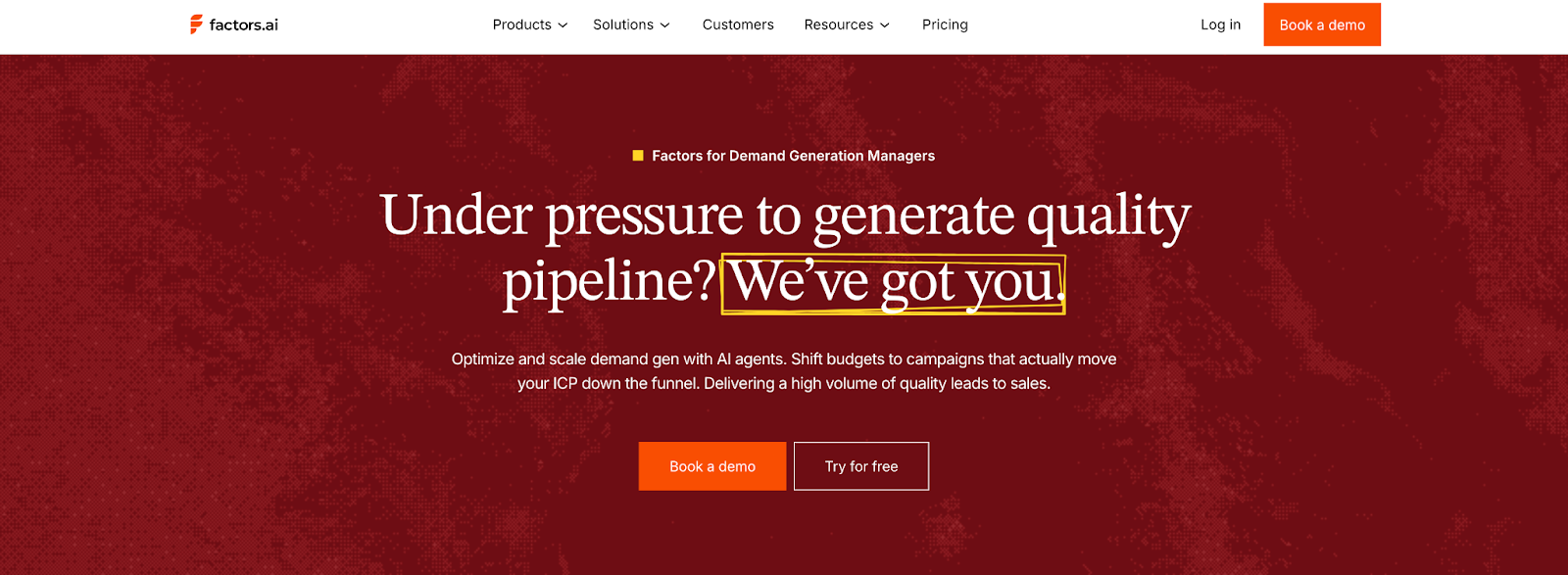
Factors.ai uses automation to keep GTM activities connected and consistent.
Instead of focusing on a single task like sending outreach, it helps teams build a flow where every buyer signal creates an action, whether that’s an alert, a workflow update, or a change in audience targeting.
Here’s how it supports automation across the funnel:
- Account Research and Enrichment
The system automatically finds key decision-makers, enriches data, and adds new contacts when signals meet ICP criteria. - Scoring and Prioritization
Accounts are scored based on fit, funnel stage, and engagement intensity so reps can focus on what matters most. - Real-Time Alerts
Notifies teams instantly when a company revisits the demo or pricing page, drops off a form, or reactivates after a gap. - Closed-Lost Reactivation
Flags accounts that return to the site after being marked closed-lost, helping SDRs re-engage quickly. - Cross-Team Sync
Connects sales and marketing systems so any activity on one side instantly updates the other, keeping follow-ups timely and relevant.
Automation in Factors.ai feels less like an add-on and more like an operating rhythm, something that runs quietly in the background to make sure no opportunity slips through.
UnifyGTM’s AI Agents and Automation
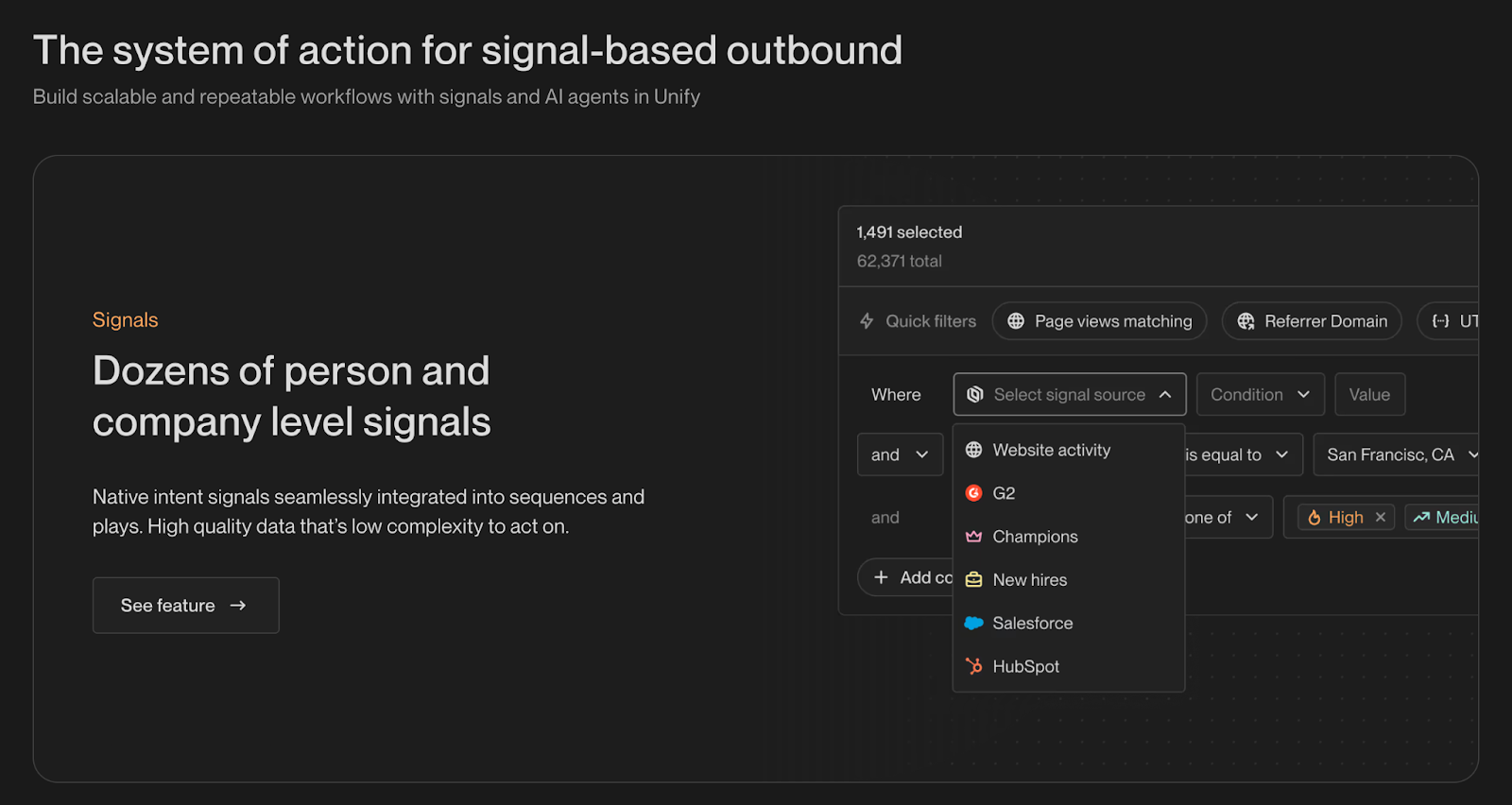
UnifyGTM takes a narrower but faster approach.
Its automation centers around outbound qualification and messaging, helping sales teams act right when a signal appears.
How it works in practice:
- AI Agent Qualification
Flags new leads when specific intent signals appear, like website visits or LinkedIn activity. - Smart Snippets
Writes short, context-aware email or message templates so reps can personalize faster. - Sequence Triggers
Automatically adds leads to campaigns when they meet defined criteria, reducing manual setup. - Activity Monitoring
Tracks replies and engagement, updating lists and priorities for the team.
UnifyGTM’s automation is simple and quick to use, providing outbound teams with speed without additional setup.
Factors.ai vs UnifyGTM: Verdict on AI Agents and Automation
Both platforms save time, but the impact depends on how your GTM team operates.
UnifyGTM helps sales teams move quickly and keep outreach running without much setup.
Factors.ai focuses on building lasting workflows that connect signals, actions, and follow-ups across the funnel.
If you want automation that simplifies outbound, UnifyGTM fits better.
If you need automation that strengthens how your whole GTM engine runs, Factors.ai does more of the heavy lifting.
Factors.ai vs UnifyGTM: Integrations and Ecosystem
No GTM platform works alone.
The real value shows up when it connects with the systems your team already uses, such as CRM, ads, analytics, or data enrichment tools.
Both Factors.ai and UnifyGTM offer integrations that enable these connections, but the depth and purpose of those integrations differ significantly.
Factors.ai vs UnifyGTM: Integrations & Ecosystem Comparison Table
| Integration Type | Factors.ai | UnifyGTM |
|---|---|---|
| CRM | HubSpot, Salesforce, Zoho, Apollo, LeadSquared | HubSpot and Salesforce |
| Marketing Automation | Marketo, HubSpot Marketing, Mailchimp | Limited, focused on outbound platforms |
| Ad Platforms | LinkedIn, Google, Meta, Bing | Not supported |
| CDP / Data Pipelines | Segment, Rudderstack | Segment only |
| Communication & Alerts | Slack, Microsoft Teams | Slack |
| API & Workflow Tools | Zapier, Make, Webhooks | Predefined workflows |
| G2 Integration | Native partnership with G2 for intent data | Pulls competitor and profile view data |
| Other Tools | Drift, Google Search Console, Clearbit, 6sense, Demandbase | Clearbit, 6sense, Demandbase, Snitcher |
Factors.ai Integrations and Ecosystem
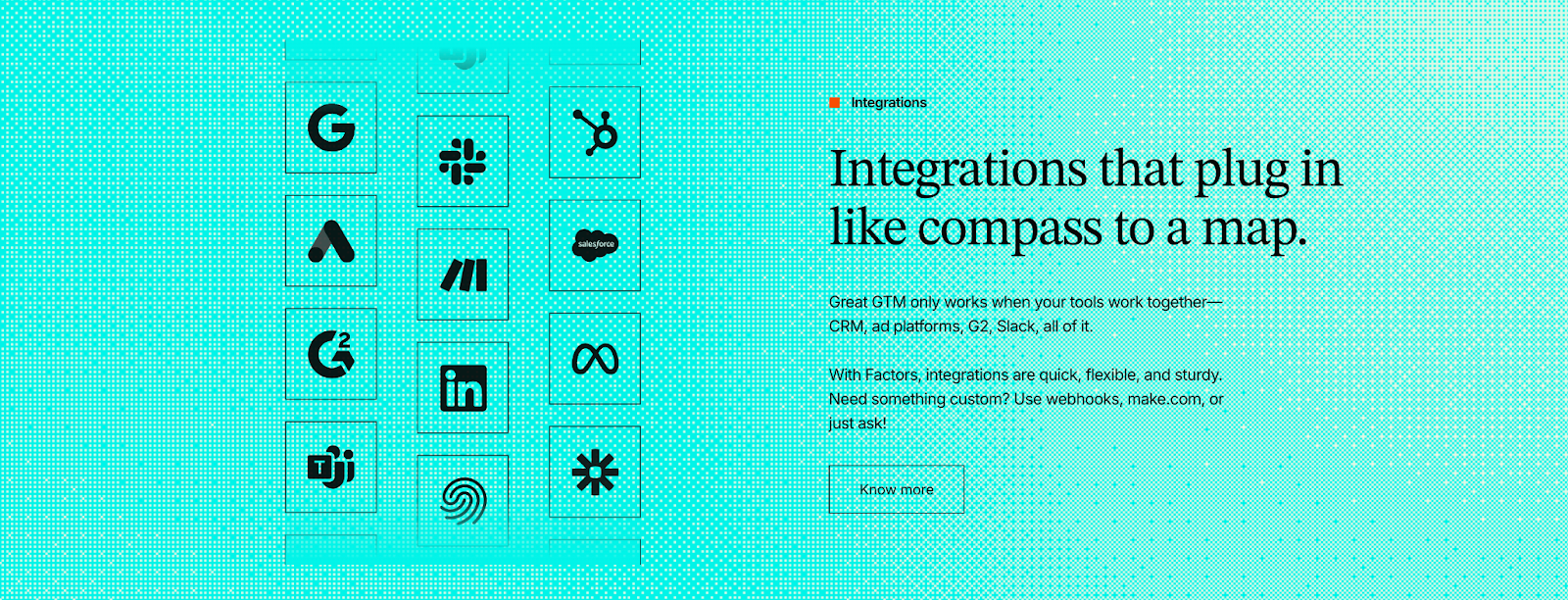
Factors.ai is designed to plug into every major touchpoint in your go-to-market workflow.
Each integration serves a specific goal, whether that’s identifying anonymous visitors, syncing CRM updates, or activating ad audiences in real time.
How the ecosystem works:
- CRM Alignment
Keeps HubSpot, Salesforce, and other CRMs updated automatically, ensuring every activity is reflected in your deal pipeline. - Ad Platform Activation
Connects directly with LinkedIn, Google, Meta, and Bing to refresh audiences daily based on account engagement and buyer stages. - CDP and Data Streams
Integrates with Segment and Rudderstack, allowing enrichment and activity data to flow across marketing and analytics tools. - Communication Integrations
Sends high-context alerts to Slack and Microsoft Teams, keeping sales and marketing aligned in real time. - Workflow Automation
Works with Zapier, Make, and custom webhooks so teams can automate sequences without heavy coding.
With these integrations, Factors.ai evolves from a standalone platform into a unified control center that synchronizes all your GTM tools.
UnifyGTM Integrations and Ecosystem
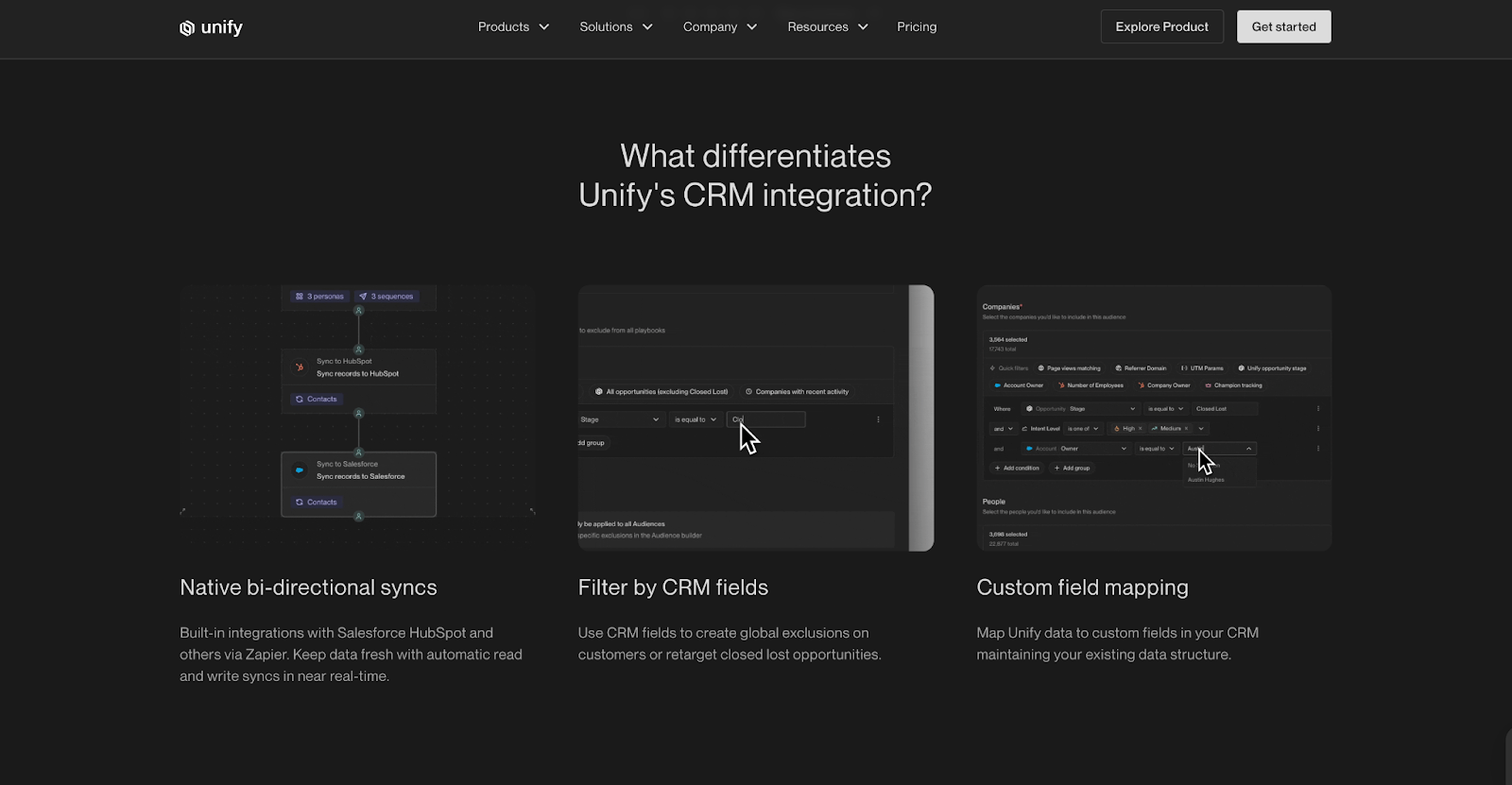
UnifyGTM takes a simpler route. Its integrations are built to support outbound workflows rather than full-funnel orchestration.
How it connects:
- CRM Sync
Works with HubSpot and Salesforce to keep prospect and deal data updated. - Data Providers
Uses Clearbit, 6sense, Demandbase, and Snitcher for account identification and enrichment. - Slack Alerts
Sends lead and job change notifications directly to Slack, helping sales respond faster. - Segment Connection
Allows basic data movement into other tools but without deep audience or event-level control.
UnifyGTM’s integration list is shorter, but it fits teams focused on outbound intent and lead-level execution.
Factors.ai vs UnifyGTM: Verdict on Integrations
Integrations shape how a GTM platform feels in day-to-day use.
UnifyGTM connects enough tools to keep outbound running smoothly, with an emphasis on speed and simplicity.
Factors.ai connects the entire GTM stack, including marketing, sales, ads, and analytics, giving teams one flow of data and action.
If your team runs a few core tools and just needs quick syncs, UnifyGTM will do the job.
If your stack spans multiple systems and you want them all to work as one, Factors.ai builds that bridge.
📑 If you want practical advice on connecting ads and intent signals, check the pieces on making LinkedIn Ads work for intent-based marketing and our analysis of whether Google Ads are worth it for B2B, so you can align integration choices with campaign goals.
Factors.ai vs UnifyGTM: Analytics and Reporting
Once everything is connected, the next question for any GTM team is simple: can you actually measure what’s working?
It’s one thing to capture signals and automate actions, but turning those activities into insights is what separates data from decisions.
Both Factors.ai and UnifyGTM offer reporting, but their focus areas differ significantly.
Let’s look at how each platform helps you track, measure, and interpret GTM performance.
Factors.ai vs UnifyGTM: Analytics and Reporting Comparison Table
| Capability | Factors.ai | UnifyGTM |
|---|---|---|
| Analytics Depth | Full-funnel analytics and attribution | Basic attribution for sales outreach |
| Data Sources | Web, ads, CRM, product usage, and G2 signals | Website and CRM-based data |
| Visualization | Account-level timelines, milestone tracking, and funnel views | Simple dashboards showing outreach and reply rates |
| Attribution Type | Multi-touch attribution with pipeline and revenue mapping | Basic first-touch visibility |
| Segmentation | Filter by ICP, region, product, or campaign | Limited segmentation options |
| Journey Tracking | Tracks every touchpoint chronologically | No timeline view |
| Reporting Output | Dashboards, custom reports, Slack summaries | Outreach metrics and activity logs |
Factors.ai Analytics and Reporting
Factors.ai gives teams a clear view of how every campaign, channel, and account contributes to pipeline growth.
It brings together analytics from ads, CRM, website, and product usage, helping you see the entire customer journey in one place.
Key capabilities include:
- Full-Funnel Analytics
Tracks movement from awareness to closed-won and highlights where accounts drop off or accelerate. - Attribution and Pipeline Mapping
Connects activities like ad clicks or demo visits directly to pipeline and revenue outcomes. - Customer Journey Timelines
Shows how each account engages over time, with every visit, form fill, and ad interaction lined up chronologically. - Segmentation and Comparison
Breaks performance by ICP, geography, or campaign type to spot patterns and strengths. - Custom Dashboards
Lets teams create tailored reports for marketing, sales, or RevOps to focus on their key metrics.
Rather than flooding teams with data, Factors.ai highlights the cause and effect behind GTM results, helping decisions happen faster and with greater confidence.
UnifyGTM Analytics and Reporting
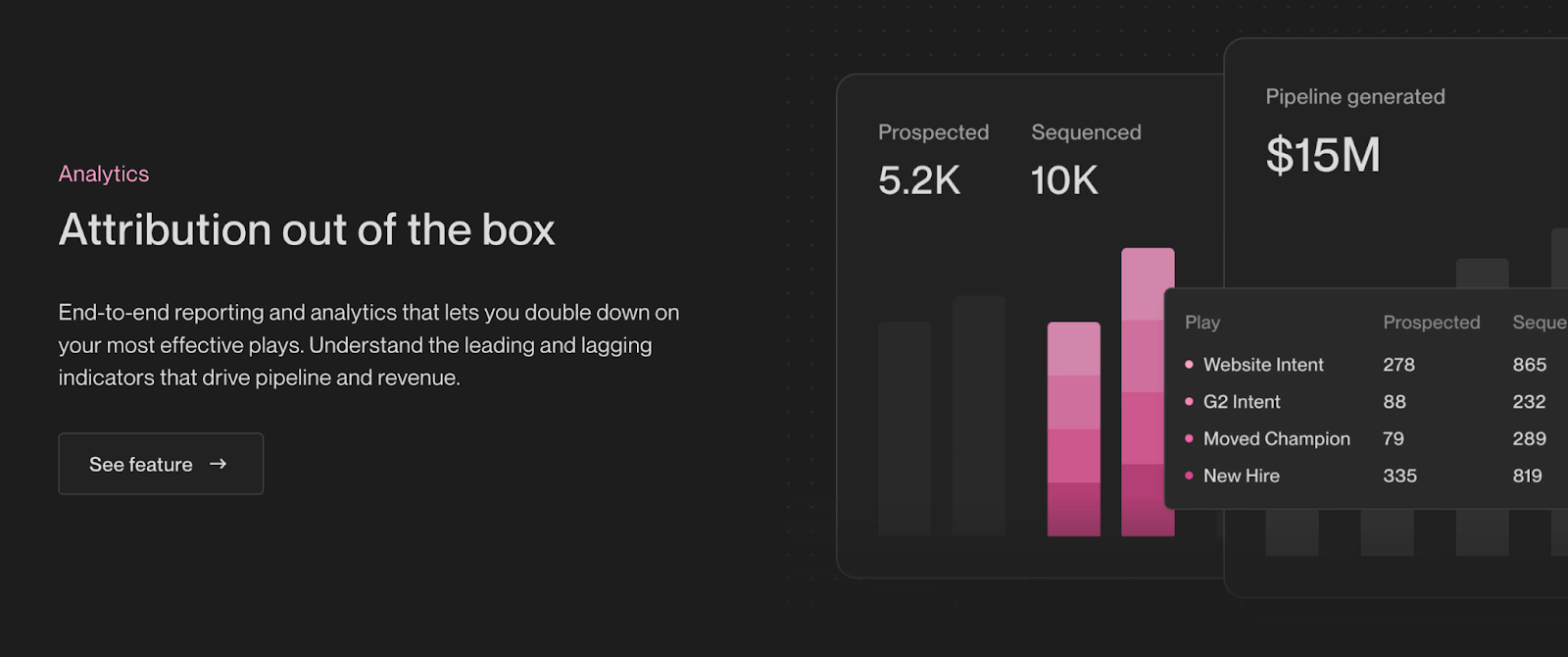
UnifyGTM stays closer to its outbound roots.
Its analytics center on sales performance and prospect engagement rather than cross-channel measurement.
Key capabilities include:
- Campaign-Level Reporting
Tracks outreach performance, reply rates, and engagement over time. - Lead Tracking
Shows which leads responded, which dropped off, and how activity changes week to week. - Basic Attribution
Connects outreach actions to new meetings or pipeline creation. - Engagement Overviews
Highlights the number of active leads, sent messages, and response quality.
For small sales teams, this level of visibility is enough to keep daily outreach aligned.
It’s built for clarity, ideal when your workflow runs mainly on outbound activity.
Factors.ai vs UnifyGTM: Verdict on Analytics and Reporting
Both tools report on activity, but they serve different purposes.
UnifyGTM shows what’s happening in outreach and who’s responding.
Factors.ai shows where momentum builds across the funnel and what’s truly driving revenue.
If your team measures success by meetings booked and engagement rates, UnifyGTM offers the basics without extra setup.
If you measure by deal flow, campaign impact, and ROI across multiple touchpoints, Factors.ai gives you that visibility end to end.
Factors.ai vs UnifyGTM: Onboarding and Support
A GTM platform is only as strong as its setup.
Even the most advanced tools can lose impact if your team struggles to configure them or doesn’t get proper guidance in the first few weeks.
Both Factors.ai and UnifyGTM provide onboarding support, but their approaches reflect the types of teams they serve.
Factors.ai vs UnifyGTM: Onboarding and Support Comparison Table
| Area | Factors.ai | UnifyGTM |
|---|---|---|
| Onboarding Type | White-glove onboarding tailored to each company’s ICP and GTM goals | Quick setup guided by a Growth Consultant |
| Support Channel | Dedicated Slack channel with direct access to the CSM | Slack channel for communication |
| Customer Success Manager | Included in all paid plans | Available through Growth Consultant meetings |
| Frequency of Support | Weekly review meetings and continuous Slack communication | Ongoing assistance through Slack |
| Additional Setup Services | Optional GTM Engineering Services for ICP design, workflow setup, and optimization | Setup guidance during onboarding |
| Documentation & Resources | Complete documentation and recorded sessions for internal team handover | Help guides and direct support via Slack |
Factors.ai Onboarding and Support
Factors.ai treats onboarding as a partnership.
Each setup begins with a detailed review of your ICP, funnel stages, and campaign objectives.
The goal is to ensure the platform fits the way your GTM team already operates instead of forcing a new structure.
What onboarding looks like:
- A dedicated Customer Success Manager helps design the setup plan.
- The team provides Slack access for real-time collaboration and troubleshooting.
- Weekly review calls focus on adoption, analytics, and optimization.
- Full documentation and recordings are shared for easy internal training.
Teams can also add GTM Engineering Services for deeper operational help from setting up enrichment and alerts to automating ad audience syncs.
As mentioned earlier, this service is useful for companies without dedicated RevOps support.
The goal is to make sure the platform doesn’t just go live but becomes part of the daily GTM rhythm.
UnifyGTM Onboarding and Support
UnifyGTM takes a faster route. Its setup process focuses on helping teams start prospecting quickly rather than on long-term workflow building.
What onboarding includes:
- Direct guidance from a Growth Consultant who walks the team through configuration.
- Slack support for any questions that come up during or after setup.
- Regular check-ins to review performance and answer queries.
The process is straightforward and light, which suits smaller sales teams or founders who want to start outreach immediately.
It’s less about long-term customization and more about ensuring the system works smoothly from day one.
Factors.ai vs UnifyGTM: Verdict on Onboarding and Support
Both platforms provide hands-on onboarding, but the experience depends on how complex your GTM motion is.
UnifyGTM makes setup fast and functional, ideal for small teams that need to move quickly.
Factors.ai invests more in long-term enablement, ensuring every part of your GTM workflow is aligned and optimized over time.
If your team values a guided setup and structured ongoing support, Factors.ai offers that foundation.
If your priority is quick deployment and steady help through Slack, UnifyGTM keeps it simple.
📑 If you want to prepare your team before committing to either model, our guides on how to build marketing workflows and the step-by-step process to turn signals into sales conversations help you estimate the internal effort required for adoption.
Factors.ai vs UnifyGTM: Compliance and Security
For any GTM platform handling customer or intent data is part of trust.
Whether you’re tracking website visitors, syncing CRM data, or running ad audiences, your platform needs to keep every interaction compliant and protected.
Both Factors.ai and UnifyGTM follow data privacy standards, but their certifications and documentation differ based on the scale of companies they serve.
Factors.ai vs UnifyGTM: Compliance and Security Comparsion Table
| Compliance Area | Factors.ai | UnifyGTM |
|---|---|---|
| Certifications | ISO 27001, SOC II Type 1 and 2 | SOC 2 compliant |
| Data Privacy Laws | GDPR and CCPA compliant | GDPR and CCPA aligned |
| Data Handling Transparency | Full documentation and signed DPA available | Basic privacy documentation on website |
| Data Enrichment Practices | Privacy-first enrichment using approved third-party data providers | Uses enrichment partners like Clearbit and Demandbase |
| Enterprise Readiness | Meets procurement and compliance checks for mid-market and enterprise accounts | Suitable for SMB and mid-market GTM teams |
Factors.ai Compliance and Security

Factors.ai operates with enterprise-grade security standards.
It holds both ISO 27001 and SOC 2 Type II certifications, covering data storage and process controls. This level of compliance means the platform can pass strict security reviews for enterprise clients without friction.
How it protects data:
- Follows GDPR and CCPA frameworks for data collection and processing.
- Uses a privacy-first enrichment model, ensuring all account data is sourced through verified providers.
- Provides Data Processing Agreements (DPAs) for customers that require formal documentation.
- Maintains regular audits to keep compliance status active and up to date.
For teams working with large datasets, especially those selling to regulated industries, this level of compliance helps shorten procurement cycles and builds trust faster.
UnifyGTM Compliance and Security
UnifyGTM aligns with key privacy frameworks like GDPR and CCPA and maintains SOC 2 compliance, ensuring data handling follows accepted security standards.
What’s covered:
- Data stored and processed through encrypted channels.
- Enrichment powered by Clearbit, Demandbase, and Snitcher within GDPR-aligned policies.
- Clear privacy documentation available on its website for customer reference.
While it doesn’t currently list ISO certification or DPA options, the existing compliance coverage is well-suited for startups and small teams managing outbound data responsibly.
Factors.ai vs UnifyGTM: Verdict on Compliance and Security
Both platforms meet essential data privacy standards, but their depth reflects their audience.
UnifyGTM covers all fundamental security needs for SMB and mid-market clients.
Factors.ai extends those standards to meet enterprise-level compliance requirements, offering more documentation and certification coverage.
If your organization needs strict audits and formal data agreements, Factors.ai is already prepared for that process.
If your focus is on outbound automation with secure data handling, UnifyGTM provides the level of compliance most small GTM teams need.
Factors.ai vs UnifyGTM: Which tool to choose when?
Both Factors.ai and UnifyGTM are built around one shared idea: helping GTM teams act faster on real buying signals.
Where they differ is in how far they go and how deeply they connect the dots.
UnifyGTM is a great choice for teams that live and breathe outbound. It helps you catch intent quickly, reach out faster, and keep engagement consistent. If your motion is sales-led and you value simplicity and speed, it gives you everything you need to stay in front of warm prospects without a heavy setup.
Factors.ai, on the other hand, fits teams that see GTM as a system, not just a series of campaigns. It ties together every layer like signals, outreach, ads, scoring, and analytics, so every touchpoint feels connected and measurable. If your goal is to scale with structure and visibility, it helps you build a foundation that keeps improving over time.
In simple terms:
- UnifyGTM keeps your outbound running smoothly.
- Factors.ai keeps your entire GTM motion aligned and measurable.
Both can bring results; the right choice depends on where your team is today and how you plan to grow next.
📑 If you’re still exploring alternatives before deciding, our roundup of UnifyGTM competitors and alternatives is a handy next stop to compare how other tools balance speed vs. system-level GTM capabilities.
FAQs for Factors.ai vs UnifyGTM
Q. What is the main difference between Factors.ai and UnifyGTM?
The biggest difference comes down to scope. UnifyGTM is designed to help sales teams act quickly on buying signals through outbound. Factors.ai looks at the entire GTM motion, intent, ads, CRM activity, scoring, and attribution, so teams can understand what’s actually driving pipeline and revenue.
Q. Is Factors.ai better suited for marketing teams or sales teams?
Factors.ai is built for cross-functional GTM teams. Marketing, sales, RevOps, and even product teams use the same data and timelines, which reduces handoffs and guesswork. It’s especially useful when multiple teams influence the buying journey.
Q. When does UnifyGTM make more sense than Factors.ai?
UnifyGTM is a strong fit for sales-led teams that prioritize fast outbound execution. If your primary goal is to spot intent quickly and launch outreach without heavy setup or analytics overhead, UnifyGTM keeps things simple and efficient.
Q. Does Factors.ai replace tools like CRMs or ad platforms?
No. Factors.ai is designed to connect and orchestrate your existing tools. It works alongside CRMs like HubSpot or Salesforce and ad platforms like LinkedIn and Google to unify data, trigger workflows, and improve decision-making.
Q. Can UnifyGTM handle multi-channel GTM strategies?
UnifyGTM focuses mainly on outbound and sales activity. While it tracks website and CRM signals, it doesn’t offer deep support for ad activation, full-funnel attribution, or multi-channel journey analysis.
Q. How do both tools handle buyer intent data?
Both platforms track intent, but in different ways. UnifyGTM uses intent signals primarily to trigger outreach. Factors.ai combines first-, second-, and third-party intent signals and maps them across the funnel, helping teams see patterns rather than isolated actions.
Q. Which platform is better for account-based marketing (ABM)?
Factors.ai is better suited for ABM programs because it supports account-level journeys, scoring, audience activation for ads, and revenue attribution. UnifyGTM can support ABM-style outbound, but it doesn’t offer full ABM analytics or orchestration.
Q. Is Factors.ai too complex for smaller teams?
Not necessarily. Many teams start with just identification and tracking, then expand into scoring, automation, and analytics as they grow. The platform is modular, so you don’t have to use everything from day one.
Q. Does UnifyGTM offer a free trial?
No. UnifyGTM does not currently offer a free plan or trial. Pricing starts with paid annual plans based on credits, users, and managed mailboxes.
Q. Does Factors.ai offer a free plan?
Yes. Factors.ai offers a free plan that allows teams to identify up to 200 companies per month, making it easier to test account identification and basic tracking before upgrading.
Q. How do the platforms differ in analytics and attribution?
Factors.ai provides full-funnel analytics and multi-touch attribution, connecting GTM activity directly to pipeline and revenue. UnifyGTM offers more basic reporting focused on outreach performance and engagement.
Q. Which tool is more enterprise-ready?
Factors.ai is more suitable for enterprise and regulated environments, with certifications like ISO 27001 and SOC II Type 2, plus detailed documentation and DPAs. UnifyGTM meets core compliance needs but is better aligned with SMB and mid-market teams.
Q. How should I choose between Factors.ai and UnifyGTM?
Start by looking at how your GTM team operates today. If speed and outbound execution are your top priorities, UnifyGTM is a solid choice. If you need visibility across channels, tighter alignment between teams, and clearer revenue attribution, Factors.ai offers a more scalable foundation.

See how Factors can 2x your ROI
Boost your LinkedIn ROI in no time using data-driven insights


.avif)

See Factors in action.
Schedule a personalized demo or sign up to get started for free
LinkedIn Marketing Partner
GDPR & SOC2 Type II






.svg)



.avif)

