
21 Best HockeyStack Alternatives & Competitors in 2026
Compare HockeyStack alternatives, including Dreamdata, Factors.ai, CaliberMind, Ruler Analytics, etc, by pricing, features, ratings, pros, and cons.

Growth Marketer

Associate Director of Brand and Content



.svg)


TL;DR
HockeyStack helps B2B teams connect marketing activity to pipeline and understand how accounts move toward a deal. It has since expanded into a larger GTM platform. That can be useful, but it may be more than you need if your priority is attribution or campaign reporting. HockeyStack pricing is not disclosed upfront, and reviews regularly mention the learning curve.
The 20 HockeyStack alternatives below include dedicated attribution tools and full-fledged ABM platforms. We explain where each one may be a better fit than HockeyStack and what you would give up by switching.
The top 6 tools that completely replace HockeyStack
Before getting into them, though, there’s something important about how I built this list.
Why are teams looking for HockeyStack alternatives?
I don't think HockeyStack is a bad product. It may simply not be the right platform for every GTM use case.
It now does much more than connect marketing activity to revenue. The platform also provides account intelligence and AI workflows. This makes sense for companies that want one product to handle it all. It may be harder to justify if your team needs only one part.
1. The steep learning curve
One recurring theme in HockeyStack reviews is complexity. The platform can do a lot, but getting comfortable with the data model, reporting logic, filters, segments, and attribution takes time.
That's fine if you have a dedicated RevOps or marketing operations person who can own it. It's less attractive if you're a five-person marketing team and just want to answer the question: 'Which campaigns are actually generating pipeline?'
2. Implementation takes work
HockeyStack says customers can receive their first attribution insights within 24 hours. That does not mean the entire implementation is finished within a day.
More tailored setups take longer because the data model has to reflect how the company defines its funnel and pipeline. Someone also needs to maintain the underlying data after onboarding and make sure the reports continue to reflect how the business operates.
3. Pricing can become difficult to justify
HockeyStack does not publish starting prices or standard packages on its pricing page. Every plan is built around the customer’s requirements.
Custom pricing does not necessarily mean the platform is overpriced. It does mean you need to speak with sales before you can understand the total cost or compare it properly with other options.
How I evaluated these HockeyStack alternatives
I didn't rank these purely by G2 rating. That would make Google Analytics look like a better HockeyStack alternative than several purpose-built B2B platforms simply because it has 1000+ reviews.
I evaluated each tool based on:
- How much of HockeyStack’s functionality it covers
- What its users say about it
- What it costs relative to the problem it solves
- How difficult it is to implement and manage
I also looked at pricing, implementation complexity, company maturity, review volume, and what users actually praise or complain about.
For the top five HockeyStack alternatives, I also looked beyond G2 where possible, using TrustRadius, Capterra, and Gartner Peer Insights. One caveat is that G2 acquired Capterra, Software Advice, and GetApp from Gartner in February 2026. So I wouldn't treat G2 and Capterra as two completely independent sources anymore.
The top 6 HockeyStack alternatives for 2026
Here are the first 5 products that I think can actually replace HockeyStack.
1. Dreamdata
G2: 4.7/5, ~270 reviews
Pricing: Free trial available; All the other advanced plans use a custom quote
Dreamdata is one of the closest HockeyStack alternatives for B2B attribution. It combines activity from your website and GTM tools into account-level customer journeys, then connects those journeys to pipeline and revenue.
That means you don’t need to completely rethink how your team measures marketing just because you switched platforms.
It also has an official LinkedIn Company Intelligence API partnership.
Key features of Dreamdata
- Dreamdata combines CRM, advertising, website activity, and product data to build one account-level customer journey.
- It supports multi-touch and algorithmic attribution models, giving teams several ways to assign credit across the funnel.
- The LinkedIn Company Intelligence integration shows which companies engage with your ads and company page.
- Audiences can be synced back to ad platforms, so the data can also be used for campaign activation.
What customers like about Dreamdata
- Reviewers like having CRM, advertising, product, and website data available in one place instead of reconciling separate reports.
- Account-level journey reporting gets strong feedback, particularly from teams dealing with long and complicated B2B buying cycles.
- BigQuery export is available on eligible plans for teams that want to build reports outside Dreamdata.
- Customers frequently praise the support team for helping them build reports and understand their attribution setup.
What customers dislike about Dreamdata
- The dashboards and attribution models still take time to learn, especially for teams that are new to B2B attribution.
- Some reviewers say they need to export data when they want more detail than the standard reports provide.
- Pricing is not transparently published on their website. Pricing can increase considerably once teams move beyond the starter plan and require more advanced functionality.
- The free plan is limited to two months of user history, five seats, three stage models, and one audience sync.
- A few reviewers feel older parts of the product don't always receive the same polish as newly launched features.
My take
Dreamdata makes sense if attribution and customer journey reporting are the main HockeyStack use cases you want to replace. The LinkedIn integration also makes it relevant for teams investing heavily in paid social.
If you are looking for a side-by-side comparison, read our Dreamdata vs HockeyStack blog.
2. Factors.ai
G2: 4.5/5, ~216 reviews
Pricing: Starts at $199/month, free trial available for the lite plan; Basic plan starts at $6000 and growth plan starts at $20,000
Disclosure: I work at Factors.ai, so I know this product more closely than the other HockeyStack alternatives on this list. I have based this assessment on current product documentation, pricing, and published customer results.
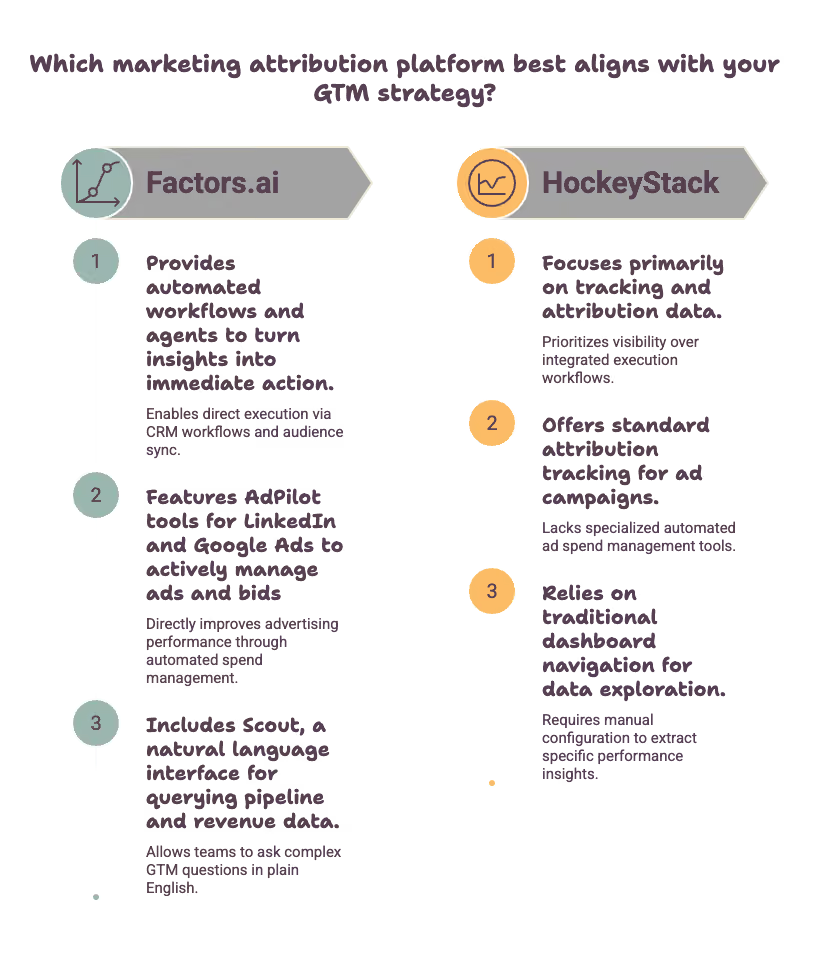
Factors.ai is an AI ABM and attribution platform. It helps marketing and sales teams identify accounts showing buying intent, understand how those accounts engage across channels, connect marketing activity to pipeline, and act on that data through advertising and sales workflows.
There is considerable overlap with HockeyStack across attribution, account intelligence, intent data, campaign reporting, and predictive scoring. Factors.ai places more emphasis on turning this data into action through audience sync, advertising optimization, account alerts, and automated workflows.
Factors.ai also has an official LinkedIn Company Intelligence API partnership.
Key features of Factors.ai
- Factors.ai identifies anonymous website traffic at the company level (up to 75% with the waterfall model) and at a contact level (up to 40% - US only), helping teams understand which accounts are researching them before a form is submitted.
- It combines first-party website behavior with intent signals from sources such as Bombora, G2, LinkedIn ads, Google Ads, Meta Ads, etc.
- Multi-touch attribution connects marketing activity back to opportunities in Salesforce or HubSpot.
- LinkedIn AdPilot and Google AdPilot help teams analyze and optimize campaign performance data.
- The LinkedIn Company Intelligence integration shows which companies/accounts engage with your LinkedIn ads, LinkedIn organic posts, and company page. This makes LinkedIn organic attribution easier.
- With Scout, the AI layer built on Factors’ data, you can query your pipeline, revenue, and other information in plain English. You can also build custom Scout agents to automate your routine tasks.
- Factors.ai can now also be accessed via ChatGPT, Claude, and other LLMs using Factors MCP.
What customers like about Factors.ai
- Customers like the speed of onboarding. They often mention the Customer Success team specifically and say they got useful reporting in place faster than expected.
- Teams can combine account identification, attribution, advertising analysis, and sales activation without implementing separate products for each use case. This is particularly useful for companies that need more than campaign reporting but are not ready for a larger enterprise ABM platform.
- Customers also highlight the company’s responsiveness to feature requests. That support can be valuable when a team needs reports or workflows adapted to its GTM process.
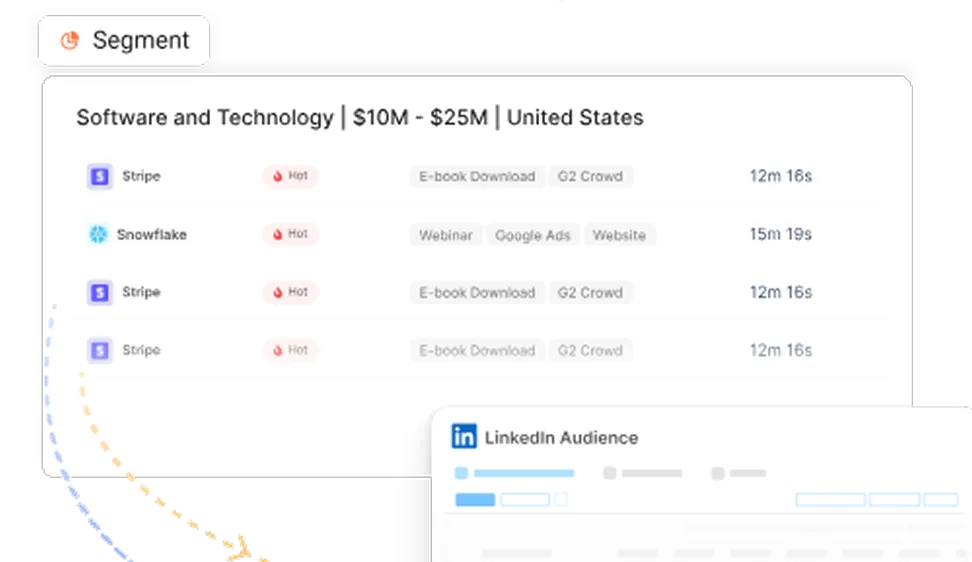
- Real-time alerts and CRM workflows make the data available to sales teams. Instead of leaving account activity inside a marketing dashboard, Factors.ai can notify the relevant representative when an account visits an important page or shows another buying signal.
What customers don't like about Factors.ai
- Factors.ai can feel technical for first-time users. Learning how its reports, segments, account timelines, and attribution models work may take time, particularly for people who do not regularly use analytics tools.
- Reporting flexibility is another area where some customers want more control, particularly around demographic reporting and search-term-level analysis.
Customer results
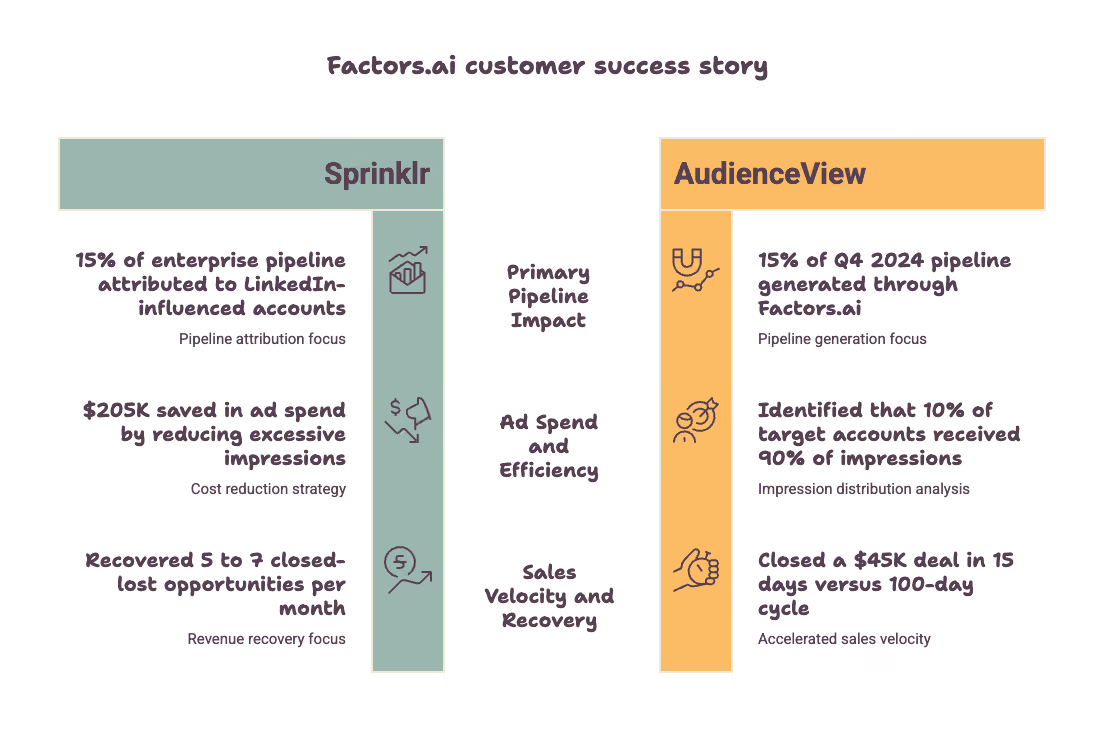
- Sprinklr improved LinkedIn spend efficiency. Factors.ai helped the company connect LinkedIn engagement to enterprise account journeys and pipeline. Sprinklr attributed 15% of its enterprise pipeline to LinkedIn-influenced accounts and saved $205,000 in ad spend by controlling excessive impressions.
- Cacheflow improved attribution and reactivated closed-lost accounts. After UTMs, cookies, and offline conversion tracking still left 30% to 40% of lead sources unidentified, Factors.ai connected LinkedIn view-through engagement with activity across the buying journey. Cacheflow reported a 30% improvement in LinkedIn Ads attribution and used account alerts to recover five to seven closed-lost opportunities worth approximately $20,000 in ACV each month.
- AudienceView used intent data to prioritize accounts. The company discovered that 10% of its target accounts were receiving nearly 90% of its advertising impressions. After adjusting its campaigns and sales outreach using Factors.ai, AudienceView generated 15% of its Q4 2024 pipeline through the platform. It also identified and closed a $45,000 deal in 15 days, compared with its typical sales cycle of more than 100 days.
My take
Factors.ai is worth considering when you need HockeyStack’s attribution and account-intelligence capabilities but want more emphasis on advertising and sales activation. It also has a lower published entry price than many enterprise ABM platforms.
Read our side-by-side breakdowns if you are looking to compare Factors.ai vs HockeyStack.
3. Usermaven
G2: 4.8/5, ~95 reviews
Pricing: 14-day free trial available; Scale starts at $199/month
Usermaven is a marketing attribution platform for B2B SaaS teams and agencies that need to measure the full customer journey, from the first campaign touchpoint to pipeline, revenue, product use, retention, and LTV.
It covers HockeyStack’s core attribution use case without expanding into a full ABM, intent-data, or sales-engagement platform. That makes it a better fit for teams that want clear answers about what is driving pipeline and revenue, without implementing a broader GTM system.
Key features of Usermaven
- Multi-touch revenue attribution: Connect channels, campaigns, ads, content, and landing pages to conversions, pipeline, and revenue. Compare multiple attribution models to understand more than the final touch before a deal.
- CRM, product, and retention analysis: Bring HubSpot or Salesforce pipeline and revenue data together with website activity, product behavior, customer journeys, and retention cohorts. This shows whether a source creates customers who activate, stay, and expand.
- Ad-platform attribution and conversion sync: Analyze Google, Meta, and LinkedIn Ads alongside CRM outcomes, then send qualified conversions back to ad platforms to improve optimization.
- Maven AI and MCP: Ask questions about attribution, CAC, LTV, pipeline, and revenue in plain language. MCP also lets approved AI agents create or update analytics inside Usermaven.
- Measurement Trust Center: Identify tracking gaps and data-quality issues before they distort attribution and reporting.
What customers like about Usermaven
- G2 reviewers frequently mention the clean interface, fast setup, and ability to find useful answers without extensive analytics expertise.
- Customers value seeing marketing attribution, website activity, product behavior, and customer journeys in one place.
- Reviewers also highlight multi-touch attribution, real-time reporting, and support when moving away from more complex analytics tools.
- The published $199/month starting price and self-serve trial make evaluation more predictable than platforms with custom-only pricing.
What customers dislike about Usermaven
- The attribution features most comparable to Hockeystack are available on the $199/month Scale plan, rather than the $84/month Growth plan.
- Teams that require third-party intent data, large-scale account identification, or sales-engagement workflows will need a dedicated ABM or sales tool alongside Usermaven.
- Some reviewers want more documentation, customization, or deeper controls in specific areas of the platform.
My take
Usermaven can be a strong HockeyStack alternative when your central question is, “Which marketing creates revenue and long-term customers?” It covers the measurement journey from acquisition to retention, adds product analytics and tracking diagnostics, and gives teams transparent starting pricing.
Choose HockeyStack if you specifically want one platform for attribution, account intelligence, intent, and GTM execution. Choose Usermaven if you want more complete marketing measurement without making your GTM stack more complex.
4. CaliberMind
G2: 4.5/5, ~186 reviews
Pricing: Pricing is not transparent, as it's hidden behind a demo with their sales team.
CaliberMind is more like a GTM data platform with attribution built on top. That makes it especially relevant for companies with mature marketing operations and data teams.
Key features
- CaliberMind uses a composable data architecture with more than 170 connectors for online and offline GTM data.
- It supports chain-based and machine-learning attribution models for teams that want more flexibility than predefined attribution rules.
- Buying-group reporting shows how multiple stakeholders inside one account engage across a long B2B deal.
- Ask Cal lets users query GTM data using natural language instead of writing SQL for every question.
- Role-based dashboards give CMOs, RevOps teams, and sales teams different views of the same underlying data.
What customers like
- Reviewers frequently praise the visibility CaliberMind gives them into buying groups and individual stakeholders.
- Teams with non-standard CRM and data setups like the flexibility to configure the platform around their existing architecture.
- Reviewers also mention that the product team is responsive to feature requests and platform improvements.
What customers don’t like
- Setup takes real effort because the data model, attribution logic, and dashboards need proper configuration. A few also have occasional concerns about data accuracy.
- G2 comparison data shows weaker ease-of-setup and ease-of-admin scores than several alternatives in this list.
- A few reviewers mention Pricing starts firmly in enterprise territory, and the implementation fee adds another cost before the platform is fully running.
My take
- CaliberMind is a strong choice if your company already thinks in terms of warehouses, data models, and custom GTM infrastructure.
- If HockeyStack’s complexity is the reason you are leaving, though, I would not assume CaliberMind will automatically feel easier.
5. 6sense
G2: 4.3/5, ~1,300 reviews
Pricing: Enterprise custom pricing. Few Vendr reports and Reddit threads suggest it can be $15K/year (entry Team tier) to $300K+/year (full Enterprise), with a median around $55K–$63K/year.
6sense is the biggest step up from HockeyStack on this list. You are no longer buying an attribution platform, but you are buying a broader ABM and revenue intelligence platform that combines intent data, predictive scoring, account orchestration, sales intelligence, and analytics.
Key features
- 6sense combines first-party behavior with third-party intent data to identify accounts that may be entering an active buying cycle.
- Predictive scoring helps sales and marketing prioritize accounts based on likelihood to buy rather than firmographics alone.
- Account orchestration lets teams trigger marketing and sales actions based on intent and engagement signals.
- The broader platform includes sales intelligence and marketing automation alongside revenue analytics.
What customers like
- Reviewers frequently say that intent and predictive signals help sales teams prioritize accounts more effectively.
- Deep Salesforce integration is a recurring positive because it keeps sales and marketing working from the same account data.
- Reviewers also like the platform’s ability to scale once it's fully implemented.
What customers don’t like
- The learning curve is steep, even for customers who ultimately like the product.
- Several reviewers describe the interface as clunky or difficult to navigate.
- Implementation can stretch from six to twelve months for larger deployments.
- Cost and operational complexity can make the platform difficult to justify for smaller or mid-market teams.
My take
- 6sense makes sense if you want to go beyond attribution and build a much broader ABM operating system.
- If your complaint about HockeyStack is that it already feels too complicated, 6sense will complicate it further.
- Plus, 6sense is way pricier than HockeyStack.
6. RevSure
G2: 4.7/5, ~40 reviews
Pricing: Starts at $4,000/month. Enterprise plan has custom pricing.
RevSure’s biggest differentiator is predictive pipeline forecasting layered on top of attribution. Most tools in this category tell you what happened. RevSure tries to answer what is likely to happen next.
Key features
- RevSure combines advertising, website, CRM, and opportunity data inside a full-funnel attribution model.
- Predictive forecasting uses that underlying attribution data to estimate future pipeline performance.
- Native integrations cover Salesforce, HubSpot, Marketo, LinkedIn, Meta, and Google Ads.
- Account de-anonymization is included alongside attribution and forecasting rather than requiring a separate product.
What customers like
- Reviewers like being able to follow performance across the full funnel rather than analyzing isolated marketing and sales stages.
- Predictive forecasting is the feature customers most often point to as different from traditional attribution platforms.
- G2’s review themes also show Customer Support and Analytics among the most frequently mentioned positives.
What customers don’t like
- The review base is small, so I would not treat the 4.7 rating with the same confidence as a score backed by hundreds of reviews.
- Customers still mention a learning curve despite generally positive feedback.
- Implementation can take several weeks even for relatively straightforward deployments.
- RevSure is younger and smaller than most of the other vendors in this shortlist, which adds more vendor risk.
My take
- RevSure is worth evaluating if forecasting is one of the main reasons you are looking beyond HockeyStack.
- I'd compensate for the smaller customer base by asking for more customer references before signing a long-term contract.
15 more HockeyStack alternatives worth considering
The remaining tools do not replace HockeyStack’s full scope as cleanly, but they can still make sense depending on the problem you are trying to solve.
Enterprise ABM and revenue platforms
7. Demandbase One
G2: 4.4/5, ~1,935 reviews
Pricing: Pricing is not transparent; you have to request a demo to get a quote
Demandbase combines account identification, intent data, advertising, orchestration, and analytics inside a full ABM platform.
What customers like
- Reviewers like having sales and marketing activity unified around accounts instead of disconnected leads.
- Intent data helps teams prioritize which accounts deserve attention.
- Salesforce and HubSpot integrations help keep account activity connected to existing GTM workflows.
What customers don’t like
- Setup and onboarding can be complex enough that some teams need external help.
- The interface contains a lot of functionality and can take time to understand.
- Pricing sits firmly in enterprise territory.
My take
- Demandbase makes sense when you want ABM execution and analytics together.
- If attribution is your only problem, it is probably more platform than you need.
8. ZoomInfo
G2: 4.5/5, 9,000+ reviews
Pricing: ZoomInfo pricing is not disclosed publicly. However, Reddit users report it costs $14,995 a year for the Professional plan, while the Elite plan is priced from roughly $35,995 and can go beyond $40,000 with add-ons. Read more about this on the ZoomInfo pricing blog.
ZoomInfo has grown far beyond contact data and now covers sales, marketing, operations, intent, and account intelligence.
What customers like
- Reviewers value the size and breadth of ZoomInfo’s company and contact database.
- Its integration marketplace covers most of the common tools used by modern GTM teams.
- Customer support is frequently described as proactive.
What customers don’t like
- Data accuracy can be weaker outside the US and in less-covered industries.
- Pricing, auto-renewals, and contract terms come up repeatedly in negative reviews.
- The platform can feel cluttered until users become familiar with it.
My take
- Choose ZoomInfo if your actual bottleneck is data quality and account intelligence.
- I wouldn't choose it if you simply need better attribution.
9. DemandScience (previously known as Terminus)
G2: 4.4/5, ~763 reviews
Pricing: I searched everywhere I could, but I did not find their pricing page. According to G2, the costs are anywhere between $10,000 and $61,000 per year
DemandScience, previously known as Terminus, combines account-based advertising, chat, email-signature marketing, and measurement in one ABM platform.
What customers like
- Reviewers like having several ABM engagement channels available inside one platform.
- Measurement Studio helps teams connect account activity to pipeline and win rates.
- The platform makes sense for teams already committed to an ABM operating model.
What customers don’t like
- Pricing is premium and largely undisclosed.
- Some campaign workflows are described as slow or clunky.
- Certain routine tasks still require support from the Terminus team.
My take
Terminus is useful if you want attribution built directly into ABM execution.
10. Adobe Marketo Measure
G2: 4.7/5, ~147 reviews
Pricing: Bundled with Marketo Engage. Pricing not publicly available. You will need to request a demo for a custom quote.
Formerly Bizible, Marketo Measure is designed for enterprise B2B attribution across online and offline channels.
What customers like
- Native Salesforce integration is a major advantage for teams already using Salesforce heavily.
- Reviewers like its every-touch and multi-touch attribution capabilities.
- Support is generally described as knowledgeable and available.
What customers don’t like
- The product makes the most sense inside the Adobe and Marketo ecosystem.
- Field mapping and UTM configuration can be difficult to get right.
- Some reviewers mention performance issues and tracking problems around manual imports.
My take
It is an obvious shortlist option for Marketo and Salesforce-heavy teams. Outside that ecosystem, I would look elsewhere.
11. Full Circle Insights
G2: 4.0/5, ~135 reviews
Pricing: According to their pricing calculator, the plan starts from $20,000. But one needs to book a demo to get the correct pricing.
Full Circle Insights provides Salesforce-native funnel reporting and marketing performance measurement.
What customers like
- Reviewers find the attribution logic relatively easy to understand.
- Closed-loop reporting helps marketing and sales work from the same funnel data.
- Campaign-member reporting provides more control than standard Salesforce reporting in some areas.
What customers don’t like
- Reporting flexibility is still limited by Salesforce’s underlying reporting model.
- Account-level and ABM reporting is weaker than the more specialized platforms in this list.
- Some reviewers feel product development has slowed.
My take
It works well for straightforward Salesforce-native reporting and is not a full replacement for HockeyStack’s account journey capabilities.
12. Ruler Analytics
G2: 4.6/5, ~30 reviews
Pricing: The base plan starts at €269 per month, and the advanced plan starts at €1349 per month.
Ruler Analytics connects website visits, forms, calls, and live chat to CRM opportunities and revenue.
What customers like
- Dynamic number insertion and call tracking are useful for businesses with a large volume of phone conversions.
- CRM integrations help connect offline activity back to revenue.
- Customer support scores well across the relatively small review pool.
What customers don’t like
- The G2 review base is small, so the 4.6 rating needs to be treated carefully.
- The interface is less modern than some of the newer tools in this category.
- The product is not designed around multi-stakeholder B2B account journeys.
My take
Ruler is worth considering if phone and offline conversions make up a meaningful part of your pipeline.
13. Attributionapp.com
G2: 4.5/5, ~51 reviews
Pricing: The base plan starts at $399 per month. You will need to request a demo for custom pricing.
Attribution.com focuses on straightforward single-touch and multi-touch attribution.
What customers like
- Reviewers frequently describe setup as simple compared with larger attribution platforms.
- Multi-touch modeling works well for teams that primarily need channel-level ROI.
- Customer support gets consistently positive feedback.
What customers don’t like
- Some integrations lack keyword-level advertising data.
- Reviewers occasionally mention leads appearing without attribution data.
- Performance can slow down when working with larger data sets.
My take
This is a reasonable option if you realize HockeyStack’s account-level functionality was more than you actually needed.
14. SegmentStream
G2: 4.7/5, ~26 reviews
Pricing: The base plan starts at $800 per month for the basic version. The enterprise plan starts at $10,000 per month (pro version). However, pricing depends on the plan and whether you choose the pro or basic version.
SegmentStream combines attribution, incrementality testing, and automated budget optimization.
What customers like
- Reviewers like the clean interface and relatively simple navigation.
- Customer support is frequently described as fast and helpful.
- Incrementality testing goes beyond what many traditional attribution platforms offer.
What customers don’t like
- The 26-review sample is too small to lean heavily on the 4.7 rating.
- Some reviewers mention slower loading times.
- The platform is built as much for ecommerce and performance marketing as it is for B2B.
My take
SegmentStream is more interesting if incrementality is the problem you are trying to solve.
Signal and execution tools
15. Warmly.ai (Now acquired by HubSpot)
G2: 4.6/5, ~250 reviews
Pricing: Pricing is subject to change after the HubSpot acquisition.
Warmly focuses on real-time website visitor identification and outbound triggers.
What customers like
- Reviewers like knowing which companies are actively visiting the website.
- HubSpot integration gets positive feedback.
- Setup is generally described as approachable for smaller teams.
What customers don’t like
- Visitor identification accuracy can vary.
- Some reviewers feel pricing is high for an SMB-focused product.
- Integrations can feel limited once teams need more advanced workflows.
My take
- Warmly solves a different problem from HockeyStack. I would pair it with analytics rather than use it as a replacement.
- The HubSpot acquisition can make existing contracts tricky, and costs may increase in the future.
16. Metadata.io
G2: 4.6/5, ~297 reviews
Pricing: Pricing is not publicly available. You need to take a demo to get custom pricing. However, according to Capterra, pricing starts at $5650.
Metadata.io focuses on B2B campaign execution and optimization across LinkedIn, Meta, and Google.
What customers like
- Campaign automation reduces manual work for paid media teams.
- The platform gives marketers one place to manage performance across several advertising channels.
- Audience targeting includes firmographic, technographic, and intent-based criteria.
What customers don’t like
- Editing live campaigns can still require work across different interfaces.
- Setup and configuration take time.
- Pricing is frequently described as high and inflexible.
My take
Metadata is better viewed as an execution tool than an analytics replacement.
17. HubSpot Marketing Hub
G2: ~4.4/5, ~14,925+ reviews
Pricing: HubSpot marketing starts at $15/month, and Enterprise starts at $3600 a month. It is highly unlikely that the price would remain in the same range as you add extra credits.
HubSpot combines CRM, marketing automation, content tools, and attribution inside one ecosystem.
What customers like
- Reviewers consistently praise the overall ease of use.
- CRM and marketing data already live together for teams that use HubSpot heavily.
- Attribution can connect marketing activity directly to influenced deals.
What customers don’t like
- Multi-touch attribution sits behind higher-priced tiers.
- Pricing increases quickly as contact volume grows.
- The product is not specifically designed around long, multi-stakeholder B2B journeys.
My take
HubSpot makes sense if most of your GTM stack already lives there. I would definitely not buy it solely to replace HockeyStack. As someone who uses HubSpot every day as a CRM tool, there is a high chance that your deal may get wrongly attributed.
18. LeanData
G2: 4.6/5, ~1,000 reviews
Pricing: The pricing is unavailable on their website. According to G2, their pricing varies between $18k and $58k per year.
LeanData is a Salesforce-native revenue orchestration platform focused on routing and buying groups.
What customers like
- Native Salesforce integration keeps routing logic close to existing RevOps workflows.
- Customer success receives positive feedback during onboarding.
What customers don’t like
- Setup takes time, particularly for complicated routing logic.
- Large routing graphs can become slow or difficult to manage.
- Pricing across modules remains relatively opaque.
My take
LeanData solves an important RevOps problem, but it is not an attribution platform.
19. InfiniGrow
G2: 4.7/5, ~54 reviews
Pricing: The base plan starts at $1500 per month; the growth plan starts at $4500 per month. The enterprise pricing is custom, and you need to book a demo first.
InfiniGrow combines attribution, budget forecasting, planning, and reporting.
What customers like
- Reviewers like the normalized data model and the trust it gives them in reporting.
- Flexible filters make it easier to analyze journeys without relying only on predefined dashboards.
What customers don’t like
- Data can load slowly in more complicated reports.
- Complex setups still involve a meaningful learning curve.
My take
InfiniGrow is worth a look if you prefer building your own reporting logic rather than working inside highly structured dashboards.
20. Google Analytics
G2: 4.5/5, ~6,700 reviews
GA4 remains the default analytics tool for many companies because it is free, familiar, and tightly integrated with Google Ads.
What customers like
- GA4 is free and already connected to the wider Google advertising ecosystem.
- Its event-based model gives teams detailed website interaction data.
- Most marketers already know how to use at least the basics.
What customers don’t like
- GA4 does not naturally roll multiple people and sessions into one B2B account journey.
- Standard data retention is too short for some longer B2B sales cycles.
- Attribution is not designed around the same account-level model as purpose-built B2B tools.
My take
GA4 is a classic and default tool for many. Once you need to answer 'which accounts?' instead of 'which sessions?', you need something else.
21. Klipfolio
G2: 4.5/5, ~255 reviews
Pricing: Starts at $140 per month; enterprise is at $690 per month
Klipfolio is a general-purpose dashboard and BI platform, not a GTM-specific analytics product.
What customers like
- Reviewers like the relatively intuitive dashboard-building experience.
- The connector library supports a wide range of common data sources.
What customers don’t like
- Visualization options are more limited than platforms such as Power BI, Looker, or Tableau.
- Data refresh frequency depends on the pricing tier.
- Your team has to build the attribution logic and account-level models itself.
My take
Klipfolio is cheap if you just need a dashboard. It can become expensive in analyst time if you expect it to behave like a purpose-built GTM analytics platform.
FAQs (Sourced from r/SaaS & RevOps Circles)
Q1. What are the best HockeyStack alternatives?
Some of the best HockeyStack alternatives for B2B teams include Factors.ai, Dreamdata, Adobe Marketo Measure, Callibermind, etc
Q2. What is a cheaper alternative to HockeyStack?
If budget is a major factor, tools such as Factors.ai's lower-tier plans or Ruler Analytics can offer a more affordable starting point, depending on your traffic and attribution needs.
Q3. What should B2B teams look for in a HockeyStack competitor?
Look for attribution accuracy, CRM integrations, implementation effort, pricing transparency, and the ability to tie activity to pipeline and revenue.
Q4. How does HockeyStack compare with Dreamdata and Factors.ai?
HockeyStack is often evaluated for attribution and GTM visibility, Dreamdata for multi-touch revenue reporting, and Factors.ai for account intelligence and multi-touch attribution.
Q5. Are all HockeyStack alternatives direct replacements?
No. Some tools, such as Dreamdata, Factors.ai, Ruler Analytics, and Adobe Marketo Measure, are closer attribution replacements. Others, such as 6sense, Demandbase, UserGems, and MadKudu, solve adjacent GTM or account-intelligence problems that may still be relevant depending on your use case.
Q6: Why do teams actively migrate away from HockeyStack?
It usually comes down to a mismatch in user personas. HockeyStack is built on its Blueprint framework, which is fantastic for analyzing sales rep activities and deal velocity. But if you are a marketing or demand gen leader trying to optimize live ad budgets on LinkedIn or unmask anonymous traffic in real time, the platform can feel over-engineered for your daily workflow.
Q7: How does Factors.ai avoid the "black box" intent scoring problem?
Most platforms hide their intent calculation behind a vague "Account Score: 82" text label. Factors.ai keeps things completely transparent. It shows you the exact underlying logs, which page they hit, what keywords they searched on G2, or which LinkedIn post they engaged with, and allows you to configure your own custom weight thresholds.
Q8: Can I run multi-touch attribution without an in-house data analyst?
If you are using enterprise tools like Bizible or CaliberMind, honestly, no, you will need dedicated ops support. But if you use an agile alternative like Factors.ai or Dreamdata, the reporting builders use a visual drag-and-drop interface that a growth marketer can easily master in an afternoon.
Q9: Does Dreamdata completely replace HockeyStack's capabilities?
From a pure historical attribution and revenue data stitching standpoint, absolutely. They diverge on actionability: HockeyStack leans toward post-sale rep tracking, whereas Dreamdata focuses purely on macro journey logs. If you want something that bridges both data worlds and includes live ad automation, look at Factors.ai
Q10: Is a free tier like GA4 enough to track B2B pipeline attribution?
No way. GA4 tracks independent anonymous web sessions, not accounts or linear pipelines. It has no native concept of a “Salesforce Opportunity” or a “HubSpot Deal Stage Change.” To tie marketing clicks to actual closed revenue dollars, you need a dedicated B2B attribution engine.

See how Factors can 2x your ROI
Boost your LinkedIn ROI in no time using data-driven insights


.avif)
.avif)
See Factors in action.
Schedule a personalized demo or sign up to get started for free
LinkedIn Marketing Partner
GDPR & SOC2 Type II

.svg)



.avif)

