.svg)


How to Choose The Best Sales Intelligence Tool in 2025?
Understanding Sales Intelligence Tools
Sales intelligence tools are now essential for sales teams. They change how businesses learn and connect with potential customers. These tools gather and analyze data to help salespeople make smart choices.
The sales intelligence market is booming, with predictions pointing to a whopping $9 billion by 2034. But it's not just about big numbers. This surge highlights a significant shift in how companies tackle sales.
Sales intelligence tools collect data about prospects, companies, and market trends. They offer real-time insights into buyer behavior, company news, and industry changes. This helps sales teams find and focus on the best leads. For instance, Factors.ai's Account Intelligence provides insights into conversion rates and user journeys, enabling better decision-making.
By the end of 2025, sales intelligence will have grown with the help of artificial intelligence and machine learning. These tools now offer predictive analytics and smart lead scoring. They can study communication patterns, predict buying intentions, and suggest next steps for sales reps.
The true benefit is in removing guesswork from sales. Sales teams can base their decisions on solid data, leading to better conversion rates and quicker sales. This proactive approach is key to staying ahead in today's fast-paced market.
TL;DR
- Sales intelligence tools improve lead targeting, engagement, and decision-making.
- Different types serve various needs, from data enrichment to predictive analytics.
- Key selection factors include data accuracy, integrations, analytics, and usability.
- Implementation requires team training, data migration, and clear success metrics.
- Measuring ROI involves tracking lead quality, conversion rates, and sales cycle efficiency.
- Future-proofing ensures adaptability to emerging AI and compliance trends.
- Choosing the right tool means balancing features, costs, and vendor support.
Types of Sales Intelligence Solutions
At their heart, Sales Intelligence tools perform three key tasks: gathering crucial customer data, analyzing buying patterns, and dishing out actionable insights. Picture this: It's like having a crystal ball that tells you exactly when a prospect is ready to make a purchase. That's the magic of top-notch sales intelligence.
Modern sales tools come in different types, each meeting specific sales needs. Data enrichment tools fill in missing details about prospects and companies, saving time on research. They gather data from many sources to create complete customer profiles, similar to what Factors.ai's Workflow Automation offers.
Predictive analytics platforms use AI to predict future buying habits and find patterns in past data. These tools help sales teams focus on leads likely to convert, making resource use better.
Lead scoring tools rank prospects based on their chance to buy, considering factors like company size and recent actions. This helps sales teams target the best opportunities first, as seen in Factors.ai's Intent Capture.
Competitive intelligence tools track competitor moves, price changes, and market positions. This helps sales teams position their offers better and handle objections well.
Customer engagement tools track how prospects interact with your content, emails, and website. They give insights into buyer behavior and help tailor sales approaches for better outcomes.
Each type meets different needs, and many companies use a mix of these tools for a complete sales intelligence setup. And the perks? Sales teams using these tools report up to a 35% increase in close rates and much shorter sales cycles.
Key Features to Consider While Buying Sales Intelligence Tools in 2025
Choosing the right sales intelligence tool in 2025 is like picking out your dream car—there are some features you can't compromise on. First and foremost, start with data quality and coverage. Ensure the tool gives accurate, current information for your target markets and industries.
Next on the list is how well the tool integrates with what you're already using. Your sales intelligence tool should get along with your current tech setup, especially your CRM. Whether you're using Salesforce, HubSpot, or another system, smooth integration is a time-saver and helps avoid those pesky data silos. For example, our Integrations page outlines how Factors.ai connects seamlessly with popular CRM systems.
Next, look for strong analytics and reporting features. They should offer customizable dashboards and real-time insights to track sales performance, pipeline health, and team productivity.
The user interface is important. A simple, straightforward design helps your sales team use the tool quickly and often. Mobile access is essential—sales reps need data on the go.
AI and machine learning features make modern tools stand out. Seek out predictive lead scoring, automated data enrichment, and smart recommendations to improve decision-making.
Don't forget about compliance and security. With data privacy laws tightening up, it's crucial your tool comes equipped with built-in compliance features to keep everything above board.
The best features match your specific needs. Avoid being distracted by flashy features that don't support your main business goals.
Top Sales Intelligence Tools in 2025
A few standout tools are really making waves. Thanks to its massive B2B database and smart AI insights, ZoomInfo is still a big player. And if you're all about building professional connections, LinkedIn Sales Navigator is still your go-to.
Here are a few other stars worth mentioning:
- Factors.ai: The only Sales Intelligence platform that deeply connects LinkedIn advertising with Web Analytics, CRM, Marketing Automation, and other tools in the GTM stack. It’s the one sales intelligence tool you need to run connected campaigns across your entire GTM stack.
- 6sense: It's all about predictive analytics and nailing account-based marketing.
- Cognism: Gets a thumbs up for its GDPR-compliant data and the ability to verify mobile numbers.
- Apollo.io: It is loved for its all-in-one platform that mixes prospecting with engagement tools.
Prices can vary quite a bit:
- For basic tools, you’re looking at around $50-100 per user each month.
- Mid-range options bump up to $150-300 per user monthly.
- If you’re going for enterprise-level, expect custom pricing, often starting at $500 per user.
When it comes to user feedback, ZoomInfo (4.4/5), Apollo.io (4.8/5), and Cognism (4.6/5) consistently get high ratings. But remember, the best tool for you really depends on what your team needs, how big it is, and what your budget is.
Selection Framework For Choosing The Best Sales Intelligence Platform
Start by assessing your business needs—document specific problems, workflow issues, and growth goals that the tool should address. Consider team size, sales processes, and current technology.
Think about the budget beyond the initial cost. Include implementation, training, and customization expenses. Some vendors charge per user, while others base pricing on database size or features.
Scalability is essential for growing businesses. Ensure the tool can handle more data, users, and complex workflows without issues. Check if you can easily upgrade plans or add features.
Security and compliance are key. Verify the vendor's data protection measures, especially if you work in regulated industries. Look for SOC 2 compliance, GDPR adherence, and regular security checks.
For vendor evaluation, consider their reputation, financial stability, and customer support. Ask for references from similar companies in your industry. Review their product roadmap to ensure it aligns with your long-term needs.
Best Practices To Implement Sales Intelligence Tool
To successfully implement a sales intelligence tool, follow a strategic approach. Begin with thorough team training. Create training modules for each role and offer hands-on practice. Appoint power users to help their colleagues during the transition.
For data migration, plan how to move customer information without disrupting daily work. Clean and standardize data before migration to ensure accuracy in the new system.
Integrate the tool with your current tech setup. Work closely with your IT team and the vendor's support to connect it with your CRM, marketing tools, and other key platforms.
Set clear performance metrics from the start. Define success, whether it's less research time, higher conversion rates, or better lead quality. These benchmarks will help you measure the tool's impact.
Implement a change management plan to address resistance and ensure adoption. Regular check-ins, progress tracking, and celebrating early wins can help maintain momentum. Create feedback channels for team members to report issues or suggest improvements.
Measuring ROI For Your Sales Intelligence Tool
To measure the return on investment for your sales intelligence tool, use a clear approach focused on specific metrics. Track key performance indicators like reduced research time per lead, increased contact accuracy, and improved conversion rates.
Regularly compare the tool's total cost (including subscription, training, and maintenance) against revenue gains. Consider both direct benefits (increased sales) and indirect benefits (time saved, improved team efficiency).
Define success metrics that match your business goals:
- Improvement in lead quality
- Shorter sales cycle
- Growth in average deal size
- Number of new opportunities
- Response rates to outreach
For long-term value, watch trends over quarters and years. Consider:
- Changes in customer lifetime value
- Sales team retention
- Market penetration
- Database growth and quality
- Pipeline speed
Some benefits may take time to appear. Set realistic timeframes for different metrics and adjust expectations based on your industry's typical sales cycles.
The Checklist For Choosing The Best Sales Intelligence Tool
Staying ahead means choosing a sales intelligence tool that can adapt to future challenges. Consider these key aspects for long-term success:
Emerging Trends
- AI-driven predictive analytics become standard
- Integration of voice and natural language processing
- Real-time intent data capture
- Stronger privacy compliance features
Scalability Considerations
- Flexible user limits
- Expandable data storage
- API call capacity
- Potential for use across departments
Innovation Roadmap
- Vendor's product development schedule
- Upcoming feature releases
- Integration with new technologies
- Investment in research and development
Vendor Partnership Evaluation
- Financial health
- Position in the market
- A track record of customer success
- Adaptation to market changes
- Growth in support infrastructure
Choose vendors who commit to innovation while staying stable. Look for those with clear upgrade plans and a history of adapting to market changes. The right partner should be transparent about their development plans and willing to include customer feedback in their evolution.
Choosing the right sales intelligence tool needs a clear plan. Here's how to decide:
Comparison Checklist
- Check if the features meet your must-have needs.
- Compare pricing and total costs.
- Look at how well it works with your current tools.
- Check security and compliance.
- Evaluate vendor support quality.
Pilot Program Guidelines
- Try it for 30 days with a small team.
- Test key features in real situations.
- See if it meets your expectations.
- Get feedback from users.
- Note any technical issues and how long they take to fix.
Contract Negotiation Tips
- Lock in pricing for several years.
- Ensure free training and onboarding.
- Include performance guarantees.
- Set clear exit terms.
- Negotiate flexible user licenses.
Implementation Timeline
- Plan a phased rollout.
- Set achievable milestones.
- Allow extra time for surprises.
- Plan for data transfer.
- Schedule team training.
Remember, the best tool isn't always the priciest or most feature-packed – it's the one that fits your organization's needs and growth plans best.
Conclusion and Next Steps
Choosing the right sales intelligence tool isn’t just about ticking off features or comparing price tags—it’s about giving your sales process a real boost. By 2025, with AI and machine learning getting even smarter, these tools aren’t just nice-to-haves—they’re must-haves if you want to stay ahead of the game.
So, how do you pick the perfect one? It’s all about finding a tool that fits your unique needs, meshes well with what you already use, and shows a clear return on investment. Whether you’re a startup just dipping your toes into lead generation or a big company needing deep market insights, there’s a tool out there just for you.
Here’s your action plan:
- Jot down the features you can’t live without.
- Set a budget that makes sense.
- Book demos with your top three picks.
- Gather feedback from your team.
- Kick things off with a pilot program.
The world of sales intelligence is always changing, but making a smart choice now sets your team up for success down the road. Take your time—find the tool that’s just right for your organization’s needs. For more insights on enhancing your sales strategies, explore Factors for B2B Sales and Intent-Based Outreach.

6 Tips to Align your Sales and Marketing Teams
Sales and marketing are like twins that don’t get along. Teams often confuse the two because they work along similar lines. In fact, both teams are often given a shared budget to divide amongst themselves.
In a study conducted by Harvard Business Review, when sales and marketing teams were asked to describe each, the two had nothing but negative comments. “Paper pusher” and “irrelevant” were the top terms used to describe the marketing team. On the other hand, some words that the marketing team used to describe the sales team included “incompetent” and “simple-minded” (Source).
Of course, this rift between sales and marketing has existed since the beginning of, well, sales and marketing.
But what if…what if…both sales and marketing could join forces to work together?
What can sales and marketing teams achieve when tightly aligned?
Well, organizations that have their sales and marketing teams on the same page enjoy the following:
- 36% higher customer retention rates
- 38% higher win rates (Source)
- 67% improvement in deal closures
- 209% more revenue from marketing (Source)
- 20% annual growth rate (Source)
- Save 30% Customer Acquisition Costs (Source)
Then the next question is—How can you get your sales and marketing teams on the same page? Here are a few tips that will help!
6 strategies to align sales and marketing
1. Align Goals to ROI
Sales and marketing teams have different ways of looking at their goals. While sales teams have monthly, quarterly, and annual deadlines, this concept is foreign to the marketing team that has never been linked to revenue performance.
Since both teams work in different styles, confining either one to follow the other process will result in unnecessary friction.
But the one thing that doesn’t change is their goals.
In the end, both their goals should be improving ROI. Taking the focus away from the journey and putting it on the result can even both the teams’ paces and unite them.
2. Employ Lead Qualification
Another area where both teams find themselves at odds is when a successful campaign from the marketing team does not translate into higher conversions for the sales team.
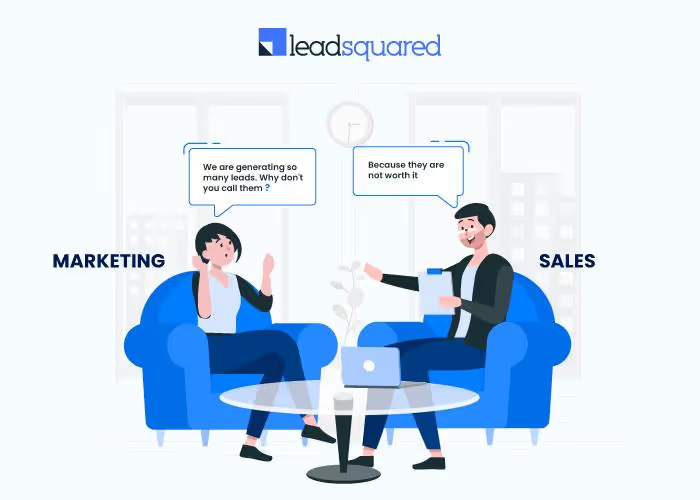
The culprit behind this is lead quality.
If the leads being generated are not interested in buying the company’s product, no matter how many prospects flow into your sales funnel, the end conversion rate will be the same.
One way to improve lead quality is by qualifying them.
Apart from this, lead qualification offers three other benefits: it help the marketing team understand whom they’re supposed to target, get both teams on the same page, and reduce the sales team’s efforts.
Then, how does one employ lead qualification?
One way to qualify a lead is to get both teams to sit together and build an ideal customer profile (ICP). An ICP is basically a customer profile of the business’s ideal buyers. It answers questions like how much they would be willing to spend, where they are more likely to live, what communication channels they are more likely to use, and what they are looking for.
The next step involves setting up a presales team that sorts the leads into invalid, uninterested, partly interested, and interested, before sending the leads forward. The invalid and uninterested leads get discarded.
The marketing team’s goal is to reduce the number of invalids and uninterested leads, whereas the sales team’s job is to convert the remaining two categories into clients.
These two steps can result in smoother operations between sales and marketing.
3. Use a CRM
Lack of communication is the biggest reason for disconnected sales and marketing teams. Since sales and marketing teams are usually swamped with their own work, it can get tricky to find time to interact with each other.
A Customer Relationship Management Software solves this problem by centralizing information. This allows different teams to access resources and monitor each other’s activities, keeping everyone on the same page.
CRMs also help nurture leads, track journeys, decrease duplication of efforts, provide deeper insights and analytics about customers, and score leads, all of which allow better decision-making and harmony between teams.
And if that isn’t enough, the software also provides sales and marketing automation, speeding up the groups’ efforts and saving them time.
4. Invest in Sales Enablement
Sales enablement is one of the most common methods companies employ to align their sales and marketing teams. How it helps companies is by:
1. Encouraging marketers and sales reps to interact
The marketing team needs to notify the sales team whenever they update new content. This forces them to reach out and interact with the sales reps. Similarly, sales reps must provide feedback on how the content helps them and what improvements can be made, thus, improving communication between the two.
2. Giving marketers and sellers an idea of what content resonates with customers the most
Once marketers create new content, they understand which content the sales team uses more and which is used less, thus helping them make better content to enable the reps.
Sales reps can also understand the type of prospects they are interacting with through the marketing team’s enablement content. This allows them to change their pitch according to the customer segment they are dealing with, which results in more closures.
3. Ensuring that the content remains on brand
When sellers have difficulty finding the right content, they might modify the material they already have to suit their sales purposes. This saves them time, but it might not necessarily be brand compliant.
Sales enablement allows representatives to modify materials on the fly using only pre-approved content. Furthermore, it gives marketers access to each modification made by each seller. This allows the marketing team to analyze what sellers are looking for in the material and which ones they are finding difficulty in navigating. This will be really beneficial for future asset optimization and improvement.
5. Attend Each Other’s Meetings
For companies that haven’t yet employed a CRM or an update tracking software, the best way for sales and marketers to keep tabs on each other’s updates is by actually attending their meetings.
Or better still, holding a dedicated joint meeting weekly or monthly can bring both teams on the same page. This ensures everyone is on the same page regarding that quarter's goals, tactics, expectations, strategies, and performance progress.
Here are some tips for holding a fruitful sales and marketing meeting
1. Set a proper agenda
Collect the agendas to be discussed beforehand and allot specific times for them to ensure all the topics are discussed. Remember to keep buffer time in case the topics drag on and the time taken to finalize a decision on that agenda.
2. Keep changing the themes
One way to avoid having complicated agendas with broad topics is by grouping them under different themes. Keeping one theme per weekly meeting can simplify the agenda and burden both teams less.
Some popular sales and marketing themes include:
- Strategies Discussion – Held to discuss the strategies that have been working and the strategies that need to be changed or dropped.
- Performance Reviews – How the teams’ efforts contribute to achieving goals and how much they have progressed.
- Buyer Behaviour – Held to discuss any changes and improvements that can be made regarding buyer engagement or to discuss the results of an already published campaign.
- CCC review – Held to review and discuss marketing and sales content, campaigns to be published or made, and any notable moves competitors have made.
And since there is a theme for each meeting, all members of both teams need not have to attend. Instead, they can look at the meeting minutes later, saving them time to do other work.
3. Share the agenda beforehand and assign representatives to speak
The last way to ensure fruitful meetings is to share the topics to be discussed beforehand. This gives both teams time to prepare in advance. Furthermore, assigning representatives saves time for reps and marketers who must sit through the entire length of the meeting to discuss minute topics.
6. Talk out the discrepancies
It’s common to have disagreements between sales reps and marketers over different issues. However, while they might seem trivial, these conflicts must be dealt with utmost care to not give the illusion that one team is favored over the other.
Another common issue is that both teams might not say out loud whether they agree or not with each other for the fear of retaliation or confrontation.
One solution to these problems is encouraging both teams to provide constructive criticism. Sales and marketing employees can be taught how to provide feedback without sounding rude.
And to ensure that the feedback is formalized and the interactions stay respectful, it can be organized on dedicated venues like forums or a weekly critics session.
The final step is to rinse and repeat these 6 steps. But remember, like all other strategies, they will soon become obsolete and ineffective if your business doesn’t regularly revisit and update them.
Ultimately, aligning both sales and marketing teams is always important, no matter how big or small a business is. While these are very effective strategies, each company knows its employees the best and, thus, should also consider additional custom methods apart from these as well.

How To Use Intent Data To Drive Pipeline (Part II)
Hey! Have you read part one yet? Check out the first stage of our intent data program here: How To Use Intent Data To Drive Pipeline Part I. We also discuss what intent data is, why it’s important, and the various tools and people you’ll need to get the most out of your intent data.

In part II, we discuss the remaining three stages of the intent program process:
- Stage 2: Enrich & Prospect
- Stage 3:Engage & Convert
- Stage 4: Measure & Report
Let’s jump right in..
2. Stage Two: Enrich & Prospect

Up until this point, we’ve identified ICP accounts visiting the website and notified sales reps with relevant details. But actually reaching out to leads within these accounts involves making an educated guess as to who may have visited. Here’s what we suggest:
Step 4: Enrich relevant contacts
Enrich account-level information with contacts that are likely to be part of the buying committee using the aforementioned enrichment tools (Apollo, Zoominfo, Lusha, etc). Key contact data includes:
- Name
- Job title
- Work email
- Phone number
For example, a martech product likely sells to marketing executives. In this case, it would make sense to find CMOs and Marketing VPs from the companies visiting your website.
Assuming you have a good idea as to what these buyer personas are for your company, identify 3-6 contacts based on their roles in the buying committee: user, champion, decision maker, influencer, and blocker.
Here’s an example of a buying committee for an account identification tool like Factors:

Step 5: Prioritize the right accounts
Based on your website traffic, you may identify thousands of ICP visitors every week. The ability to reach out to every single one of those accounts will depend on the maturity and scale of your intent program and sales team.
Assuming that most early to mid-market companies aren’t in a position to target every account, here’s our F.I.R.E 🔥 framework to help prioritize who to go after first:
1. Fitment: Divide your ICP criteria into 3 tiers (Great fit, Good fit, Poor fit) based on a combination of the following factors:
- Deal size - expected contract value
- Deal velocity - time to customer conversion
- Deal win rate - probability of closure
In general, deal size tends to increase as accounts progress from SMB to mid-market to enterprise. Similarly, the further up-market you go, the slower the deal velocity. Win rate varies based on size and industry. Once divided, it's that much easier to prioritize targeting based on company size, short sales cycle vs long sales cycle accounts, or low-hanging fruits with high win rates.
2. Intent
While a company may fit your ideal client profile, they may not be sales-ready. Some buyers may be aware of the problem but not the solution or the product, while others may be sales-ready and wholly aware of the problem, solution and product.
This is where intent data plays a huge role in determining a prospect’s readiness to buy. Here’s an example:
Gauge prospects based on what stage of the buyer journey they’re in and prioritize accounts based on buying intent.
3. Recency
Research finds that reaching out to prospects quickly dramatically raises the odds of conversion. Recency establishes how recently an account has been looking to solve a problem with your solution. This can be measured by identifying the last active time of a particular account.
For instance, a high-fit account that’s repeatedly visiting your company’s G2 reviews over the past 24 hours should be prioritized over an equally high-fit account that visited your homepage several weeks ago.
4. Engagement
Engagement is complementary to Intent but provides broader insights into where accounts are coming from and what topics they’re specifically interested in.
For example, an account reading a “what-is-xyz?” article may indicate that it is still way up in the awareness stage as compared to a visitor from a search ad on a landing page or a visitor reading a “comparison” article.
Monitoring engagement also helps understand what content appeals most to your target audience. Let’s say that SMB account seem to be especially interested in the pricing page while enterprise accounts are interested in the security compliance page. If your ICP is enterprise firms, then it might make sense to highlight privacy related content more prominently to drive conversions.

Depending on your tech stack and the complexity of processes, the Enrichment & Prioritization steps of the process can be:
- Decentralized - handled by individual sales reps
- Centralized & Manual - handled by the data & research team
- Centralized & Automated - handled by workflows set up by marketing ops & sales ops
Once you’ve prioritized your accounts using the above framework, decide whether it’ll be sales or marketing that’s reaching out to warm up target accounts. Here’s an example of one mix, but feel free to experiment with different approached:
3. Stage Three: Engage & Convert

So far, we’ve identified companies, enriched ICP accounts with relevant contacts, and prioritized target accounts based on fit and intent. Next, marketing and sales do what they do best: reach out and convert sales-ready buyers. Remember to check out the sales engagement tools recommended in Part I for this.
Step 6: Multi-channel engagement
Even though we know we’re reaching out to high-fit, high-intent accounts, we can’t be sure that we’re reaching out to the exact individual who visited our website. And regardless, no one likes a cold, out-of-the-blue sales pitch.
Do not approach contacts from high-intent, de-anonymized accounts like you’d approach inbound hand-raisers. These contacts are yet to submit a form or explicitly communicate with your business.
That being said, these accounts aren’t exactly cold either given that we have context on their intent. Marketing and sales must work in tandem to warm up these accounts with appropriate, multi-channel engagement:
Factors can measure engagement on G2, Linkedin ads, and more. Here’s a quick summary of use-cases:
- Identify which companies are viewing your ads but are yet to convert
- Track the buyer journey at an account level across ads, website, and CRM
- Fine tune messaging, targeting (and retargeting) efforts based on engagement
Here’s an example of a multi-channel sales engagement cadence:
.avif)
Here’s a sample template for prospect that show website intent:

Here’s another one for prospects that show intent from G2:

Step 7: Qualify buying intent
Earlier in this intent program, we qualified accounts based on fit and intent. But once we’ve established contact, it makes sense to qualify accounts again to know where to double down. BANT is an excellent framework for this:
Here are a few more qualifying questions to gauge customer-fit and intent:
- What triggered your search for a solution?
- How have you been solving this up until now?
- Have you explored other alternatives?
- What factors will influence your purchase decision? What are the non-negotiables?
4. Stage Four: Measure & Report
Finally, we’re at the last stage of the intent program — crunching the numbers.

Step 8: Track and optimize the intent funnel
Once qualified accounts start converting and generating pipeline, it’s important to measure every step of the funnel from accounts identified to closed won pipeline. Here’s an exhaustive list of funnel metrics to measure the health of the program:
Make sure you keep track of these metrics across all tiers/priorities of accounts to better understand the quality of conversion. It’s also important to track traditional GTM metrics such as ACV, deal velocity, and win rates so as to be able to compare the intent program against standard inbound and outbound programs.

And there you have it! Intent-data is a powerful tool to accelerate pipeline without significant additional investment. We strongly recommend the program discussed over the course of this two-part series to dramatically improve inbound, outbound, and ABM efforts across the board. Overall, we’ve seen great, real-life success with customers using similar workflows.

Curious to see how Factors in action? Book a demo with us here.

Navigating Sales In Early-Stage Start-Ups
Navigating Sales In Early-Stage Start-Ups
Building pipeline and scaling sales as a startup is not easy.
Learn about the challenges with navigating sales in early-stage start-ups — and how to overcome them. Understand the power of account-based sales with Praveen Das, Co-founder of Factors.ai and Ankit Jain, Co-founder of Clearfeed.
What we’ll cover:
- Common challenges startups face when they begin their sales journey.
- How high-growth teams like Clearfeeder overcome these challenges.
- And why account-based sales is important for early-stage businesses.
Q. As an early-stage company, you have an unknown brand. Your product-market fit is yet to be achieved. Your ICP is evolving. And there’s limited tooling and team bandwidth. Getting to those first 20 customers might seem…impossible. How should you go about it? What was that journey like?
A. Startups are like hourglasses. You start with very broad ideas and segments. Then starts the journey of going as narrow as possible: “we serve this one ICP in this one segment”. And finally, you achieve growth.
- We identified 4-5 segments we care about. Within those segments, we identified a list of relevant, high-level problems our technology could solve.
- Then, we performed customer discovery by reaching out to about 200 people in each of those segments to validate our problem-statements.
- After these conversations, we identified a “pull” towards one of these segments (Customer success teams from series B dev/infra SaaS start-ups using Slack) and ran with it.
- Based on this insight, we built a product that this specific niche of people loved — which gave us our initial boost in customers based on referrals and virality.
Q. At this stage, what did your go-to-market engine look like? Was it mostly outbound or inbound? How did you go about GTM?
A. At this point of time, we didn’t have a market team. It was just the founders and a few engineers so there was no question of inbound.
The other consideration was whether we’re creating a category or are in an established category. If it’s the latter, you can “buy your way out”. We didn’t have this back then, so it was primarily an outbound motion:
- A list of 3500 ICP accounts based on firmographics and technographics
- Reach out via sequences of mails, calls, and LinkedIn
- This approach helped land 8 meets per month, out which 2-3 convert.
A quick break from questions to discuss engagement-based sales models…
Engagement-based sales is a sales strategy that focuses on targeting highly engaged accounts and customizing the sales approach to fit the needs of each account (As opposed to a cold approach).
For context, the “old way” involved a standard process of defining ICP accounts, researching target accounts, reaching out to contacts within those accounts, and measuring success with KPIs.

The challenge with this is approach is:
- Researching target accounts involves several hours of tedious effort
- Measuring success with KPIs involves pulling data from disparate sources
- AND you’re missing out on anonymous accounts that are already engaging with your brand
This is where Factors.ai comes in. Factors identifies and unifies hidden account data across ad campaigns, product review site, website, and CRM to capture demand, monitor engagement, and personalize outreach & nurturing.

Engagement-based sales is the new way. Here’s how Factors helps:
- Identify anonymous inbound traffic across channels
- Track granular account engagement to measure intent
- Personalize outreach based on engagement and intent
- Finally, measure marketing & sales KPIs under one roof
Ankit and Clearfeed’s experience with Factors and the new approach
“Why aren’t we personalizing outreach to improve response rates?” is a standard question amongst founders and the standard answer is usually “it takes a lot of time to meaningfully personalize outreach”.
Then, the question was “how can we find which accounts are most engaged, so we can personalize outreach to them alone?”. Seems reasonable. So with Factors, we identified accounts from our top of the funnel awareness campaigns as well as organic traffic from educational content assets.
This set of accounts were, at the very least, problem aware. SDRs could now prioritize personalized outreach to this set of “higher-intent” accounts. This has resulted in a 5x improvement in response rate and our ability to book outbound meetings. Real-time alerts with Factors also helps with speed to response rates. These insights are also signals on what accounts care about or why they’re visiting our website.
Read more about how Clearbit leverage Factors here: factors.ai/customers/clearfeed
Other tips to improve outbound performance include:
- Achieve a comprehensive understanding of target accounts through their website, customers, growth, and other signals
- Pinpoint the exact channels your ICPs prefer (LinkedIn, mail, calls, communities, etc)
- Keep experiment and iterating on bottlenecks, wins, and learnings
Q. Today, Clearfeed is further along its growth journey — running ads, content, etc. How has Factors come in handy at this stage?
A. As a founder, I always want to know what’s working. With Factors, we can see what accounts that have converted interacted with pre-sales. What are their touchpoints? What pages have they visited? What topics resonate most? and more. This helps guide our content strategy, paid strategy and beyond.
The Factors advantage for engagement-based sales may be summarized as…
- Unified account data and scoring: Qualify and target the right accounts based on website engagement, intent signals, and firmographics
- Advanced analytics: Optimize demand gen and content marketing investment
- Real-time alerts: Stay on top of new ICP accounts and closed lost accounts showing engagement
.webp)
B2B Marketing Personalization: Building Tailor-Made Journeys
Now more than ever, B2B deals involve shrewd, inquisitive buyers. Generic marketing strategies are no longer sufficient to capture customer attention or loyalty. Instead, marketing personalization plays a crucial role in building trust and intent amongst buyers.
B2B marketing personalization is about creating tailor-made user experiences that convey a feeling of empathy and validation. It's about replacing broad, generic messages with personalized marketing efforts based on your target audience. The following article explores several ways to personalize your B2B marketing efforts.
B2B Marketing Personalization
Personalization is quickly becoming a buzzword in the industry but with good reason. It's a powerful marketing approach that drives better results and builds stronger connections with your audience.
Imagine you walk into a cafe, and the barista greets you by name, asks about your day, and already knows your usual order. You’d feel special, wouldn't you? You’d probably be encouraged to become a regular customer. This is, in essence, the objective of personalization; it makes customers feel valued and understood.
To personalize your marketing efforts, the first step is to gather relevant information about your customers' demographics, pain points, use cases, concerns, engagement behavior, and more. Once all this data is in place, it can be leveraged to customized experiences on your website, emails, social media, and ads.
To make the data collection easier, you can build a custom software tool that collects data of users who visit your website and integrate it into the website. Of course, there are software outsourcing companies you could task with this. The tool should be such that when users visit your website or interact with your ads, it will collect their behavior and preferences, like what they click on and what they aren’t interested in. You can then use this data to target the ads you show to them. This leads us to...
Personalized Targeted Advertising
One of the most common use cases of personalization is targeted advertising. Have you ever searched for a product online, and suddenly, ads for that exact product started following you around the internet? That's not a coincidence; it's targeting.
A lot of advertisers are now using tracking technologies to gather engagement data and leverage this information to display ads that are more relevant to users.
But personalization goes beyond just ads. It extends to the entire user experience. This level of personalization makes the shopping experience more convenient and enjoyable. And most importantly, they can sell more because of those strategies.
Personalized Mail and Content marketing
Email marketing is another opportunity to leverage personalization and enhance user experience. Do so by segmenting your audience and sending them tailored messages based on their engagement. This is far better than simply sending generic mass emails to all subscribers, regardless of their differences.
You can also leverage personalization in your content: think blog posts, videos, and social media posts. When you’ve gained insights into your audience's preferences, challenges, and goals, you can create content that resonates with them on a deeper level. This will help establish your brand as a trusted resource and help build a loyal community of followers. Even in the case of eCommerce, users delivering personalized content is the key to generate more sales. You can do this by leveraging merchandising feature of the best digital experience platforms out there.
Personalized Website Experiences
With the advent of GenAI, chatbots and virtual assistants work better than ever to provide personalized assistance based on user inquiries and previous interactions. By understanding the context and history of a customer's interaction with the brand, these AI-powered tools can offer tailored solutions and recommendations, thereby enhancing the overall customer experience.
Personalized Social Media Experience
Social media platforms also offer opportunities for personalization. Start by delivering targeted content and advertisements to the right users. Not every social media user cares about that paint ad you recently published. When you target the right ads to the right audience segment, you increase the content's relevance and maximize the impact of your marketing efforts.
Prioritize Privacy While Acquiring Data
It's essential to strike a balance with personalization. While customization can enhance the user experience, it’s of utmost importance that you respect user privacy.
Let your customers know how their data will be used and give them control over their preferences. Respecting boundaries builds trust and ensures that personalization remains a positive experience for both parties. Implementing personalization strategies requires combining technology, data analysis, and creative thinking.
Wrapping up
Leverage data and technology, and you’ll be able to deliver targeted advertisements, personalized website experiences, tailored content, and customized customer support.
However, never forget to strike a balance between personalization and privacy. Respect user boundaries and ensure transparency in data usage.