.svg)


Factors.ai X Snitcher Partnership
B2B teams invest heavily in driving website traffic, yet a large portion of that traffic remains anonymous, making it difficult to convert interest into pipeline. To help solve this, Factors.ai has partnered with Snitcher, a leading website visitor identification platform.
The result? A seamless, privacy-first integration that uncovers up to 65% of previously anonymous visitors, enabling more targeted outreach, sharper ABM, and measurable revenue impact.
By combining Snitcher’s real-time IP-based identification with Factors.ai’s advanced analytics and GTM activation capabilities, users can now go beyond just tracking traffic, they can understand and act on it.
Why Snitcher?
Snitcher stands out among website visitor identification solutions for several reasons:
- Higher match rates: Snitcher provides superior IP-to-company mapping accuracy with rich firmographic data.
- Minimal setup: No complicated implementation. Everything works out of the box within Factors.ai.
- Proven performance: One of the top-rated tools in its category on G2.
Factors integrates with Snitcher in two ways. First, through a built-in connection that lets you access Snitcher data directly within Factors, no separate Snitcher subscription needed. Second, if you already have a Snitcher account, you can connect it via API to bring your data into Factors seamlessly.
How It Works
Snitcher identifies companies visiting your website using IP intelligence, and Factors.ai enriches that data with behavioral analytics, attribution insights, and automation features. Together, they unlock several key capabilities:
1. Identify High-Intent Accounts
With Snitcher integrated, Factors.ai can now identify up to 65% of anonymous website traffic, far more than what traditional lead forms capture. This allows sales and marketing teams to understand which companies are showing interest, what pages they’re engaging with, and where they are in the buyer journey.
2. Access Rich Firmographic Data
Each identified account comes with detailed company-level attributes such as industry, employee count, and geography. Factors.ai overlays this with behavioral data, like time spent on pricing pages, engagement with content, or navigation patterns, making it easier to prioritize outreach and tailor messaging. You can also set up Slack or email alerts to notify your team when high-value accounts visit key sections of your site.
3. Track Complete Customer Journeys
Once a visitor is identified, Factors.ai generates a timeline of their journey, connecting web activity, campaign touchpoints, and CRM interactions. This provides a clear view of how accounts progress through the funnel, informing both marketing strategy and sales conversations.
Privacy-First by Design
It’s important to note: Factors.ai does not identify individual users, emails, or phone numbers. The integration is fully GDPR-compliant and only provides company-level data unless a visitor explicitly submits personal information through a form.
Use Cases Across Teams
Demand Generation
Demand gen teams often struggle to identify warm accounts without relying on gated content. With Snitcher’s identification layered into Factors.ai’s analytics, you can finally see which companies are engaging and retarget them effectively. This helps you shift from broad, generic campaigns to focused efforts with higher ROI.
Content Marketing
Understanding who consumes your content is critical to improving it. This integration reveals which accounts are reading your blogs, watching videos, or exploring case studies, enabling you to map content engagement to funnel progression and tie content performance to pipeline impact.
Product Marketing
Product marketers can see how different accounts interact with key pages like pricing, features, and integrations. By segmenting engagement by company size or industry, you can fine-tune messaging, improve positioning, and build use-case-driven narratives that resonate with target segments.
Sales Enablement
Sales teams benefit from real-time visibility into which companies are visiting demo or case study pages. This allows them to focus outreach on already-interested prospects with contextual firmographic and behavioral insights that make conversations timely and relevant.
Unlocking a New Layer of Account Intelligence
The Snitcher x Factors.ai integration offers a powerful way for B2B companies to turn anonymous visits into revenue-generating insights. Whether you’re optimizing marketing campaigns, sharpening sales outreach, or aligning your GTM motion, this partnership enables smarter decisions at every step of the funnel.
To see how this integration can enhance your ABM strategy, get in touch with our team today.
Frequently Asked Questions (FAQs)
Do I need a separate Snitcher account?
No. All capabilities are embedded directly within Factors.ai. Existing Snitcher users can integrate their account via API.
Can I use this with any Factors.ai plan?
Yes. The integration is available with Basic, Growth, and Enterprise plans.
Where can I get help enabling this integration?
Reach out to our team and we’ll walk you through the setup, no need for an additional Snitcher license.

Top 11 RB2B Alternatives
Success in B2B marketing hinges on the right tools and platforms. That said, platforms such as RB2B have become indispensable for businesses looking to enhance their strategies, streamline lead management, and strengthen connections with target accounts. They offer a wide range of features—from automated marketing and integrated CRM systems to advanced analytics and AI insights—all aimed at boosting growth and efficiency.
Choosing the right B2B platform can be overwhelming with so many options out there. Each platform has its strengths, weaknesses, and pricing models, so businesses must assess their needs and budgets carefully before deciding. To help navigate this complexity, we've put together a list of the top 10 alternatives to RB2B. Each option is detailed with an overview, key features, pros, cons, and pricing, along with our insights.
Whether you're a small business looking for scalable solutions or a large enterprise needing advanced personalization and integration capabilities, this blog will give you the clarity to choose the perfect platform.
TL;DR
- RB2B is a popular B2B marketing and sales platform, offering AI-driven analytics, CRM integration, lead scoring, and automation tools.
- However, it may not meet all business needs due to cost, complexity, or limited functionality for some users.
- Reasons to consider alternatives include changing business needs, better cost efficiency, enhanced functionality, improved user experience, superior customer support, and quicker innovation.
- When selecting an alternative, consider business goals, essential features, ease of use, scalability, system integration, customer support, pricing, security, and user reviews.
- Compare features, pros, cons, and pricing for Factors, Clearbit, Kwanzoo, Lead Forensics, Hubspot Sales Hub, 6sense Revenue AI for Marketing, Constant Contact Advance automation and CRM platform, Apollo AI, Dealfront, 6sense Revenue AI™ for Sales, ZoomInfo Sales, to see what best fits your business needs.
- Free trials and demos are recommended to test usability and ensure the platform meets your needs.
{{INLINE_CTA_A}}
Let’s Learn More About RB2B

Overview:
RB2B is a comprehensive B2B sales and marketing platform designed to enhance lead management and account-based marketing (ABM). Leveraging advanced AI, it offers real-time analytics, CRM integration, and powerful automation tools to streamline workflows and improve customer engagement. The platform is ideal for businesses seeking to optimize their sales strategies and boost ROI through data-driven decisions.
Key Features:
- AI-Powered Analytics: Advanced insights for data-driven decisions.
- CRM Integration: Seamless connection with existing systems.
- Lead Scoring: Prioritizes high-value prospects.
- Account-Based Marketing (ABM): Tailored strategies for target accounts.
- Automation Tools: Streamlines marketing and sales processes.
Pros:

- Comprehensive Analytics: Deep insights into customer behavior and trends.
- Strong CRM Integration: Enhances data management and customer tracking.
- Effective ABM: Personalized marketing strategies improve engagement.
- Automation: Reduces manual tasks, saving time and resources.
Cons:

- Complex Setup: Initial setup can be time-consuming and requires expertise.
- Learning Curve: Some users may find the platform challenging to master.
- Cost: Premium features may be costly for small businesses.
Pricing:
RB2B offers customized pricing plans based on business size and needs. Detailed pricing information is available upon request from the RB2B website.
Here’s Why You Need An RB2B Alternative
While RB2B may be a popular choice among businesses for their B2B needs, there are several reasons why you might consider exploring alternatives:
- Evolving Business Needs:
As businesses grow, their needs often evolve, and they may require different or more advanced tools than those provided by a single platform like RB2B.
- Cost Efficiency:
Some B2B platforms can be expensive, and if a company isn’t using all the features, they might seek a more affordable option. Alternative platforms might indeed offer more tailored features at a lower cost.
- Enhanced Functionality:
B2B platforms vary widely in the features they offer. If a business needs specific tools or enhanced capabilities that RB2B lacks, seeking alternatives is logical.
- User Experience:
User experience is crucial in the effectiveness of any software. If RB2B is difficult to use, switching to a more user-friendly platform could indeed boost productivity.
- Better Customer Support:
Customer support quality can differ significantly between platforms. If RB2B’s support is lacking, moving to a platform with better support is a reasonable consideration.
- Innovation and Updates:
Some platforms are quicker to adopt new technologies and features. If RB2B is slow to innovate, businesses might look for alternatives that offer more up-to-date solutions.
Exploring RB2B alternatives allows you to find a solution that better fits your current and future needs, ensuring your business stays agile, cost-efficient, and ahead of the competition.
{{INLINE_CTA_A}}
Things to Keep in Mind While Choosing the Perfect RB2B Alternative
- Business Needs and Objectives:
Clearly define your business goals and what you need from a B2B platform. Whether it's lead generation, customer relationship management, or advanced analytics, ensure the platform aligns with your objectives.
- Features and Capabilities:
Compare the features offered by different platforms. Look for features that are essential to your operations, such as CRM integration, automated marketing, AI-driven insights, and customization options.
- Ease of Use:
The platform should have an intuitive interface that your team can quickly learn and navigate. A steep learning curve can lead to reduced productivity and increased training costs.
- Scalability:
Choose a platform that can grow with your business. It should be able to handle increasing amounts of data and users without compromising performance.
- Integration with Existing Systems:
Ensure the platform can seamlessly integrate with your current systems, such as CRM, ERP, and other marketing tools. This will help in creating a unified workflow and reduce data silos.
- Customer Support and Training:
Reliable customer support is crucial, especially during the initial setup and onboarding phase. Check if the platform offers comprehensive training resources and responsive support.
- Pricing and Budget:
Evaluate the pricing models of different platforms and ensure they fit within your budget. Consider not just the initial cost but also any ongoing expenses, such as subscription fees and additional charges for premium features.
- Security and Compliance:
Data security is paramount in B2B transactions. Ensure the platform complies with industry standards and regulations, such as GDPR, and offers robust security measures to protect your data.
- User Reviews and Case Studies:
Look for reviews from similar businesses. Case studies can provide insights into how the platform has helped other companies achieve their goals.
- Trial Periods and Demos:
Take advantage of free trials and demos to get a hands-on platform experience. This will help you assess its usability and fit for your business needs.
Whether you're a small business looking for scalable solutions or a large enterprise needing advanced personalization and integration capabilities, keeping these factors in mind will help you choose the perfect RB2B alternative.
Here are the best RB2B alternatives:
1. Factors.ai

Overview
Factors is a data-driven marketing analytics platform designed to help businesses optimize their marketing strategies and drive revenue growth. By leveraging advanced AI and machine learning algorithms, Factors enables marketers to analyze campaign performance, customer journeys, and conversion paths in real-time. The platform integrates seamlessly with various data sources, providing actionable insights that empower marketing teams to make informed decisions and maximize ROI.

Key Features
- Customer Journey Mapping: Visualizes customer journeys across different touchpoints to identify key conversion paths.
- Campaign Performance Analytics: Offers in-depth analysis of marketing campaigns, helping to optimize performance and ROI.
- Multi-Touch Attribution: Tracks and attributes conversions to multiple touchpoints in the customer journey, providing a holistic view of marketing effectiveness.
- Data Integration: Integrates with various data sources such as CRM, ad platforms, and analytics tools to provide a unified view of marketing performance.
- AI-Powered Insights: Utilizes AI to generate insights and recommendations for improving marketing strategies.
- Custom Dashboards: Allows users to create and customize dashboards for monitoring key metrics and KPIs.
Here’s why Factors is a strong RB2B alternative:

- Comprehensive Analytics: Provides detailed insights into customer behavior and campaign performance, enabling data-driven decision-making.
- User-Friendly Interface: The platform is intuitive and easy to navigate, making it accessible to marketers of all skill levels.
- Seamless Integrations: Easily integrates with a wide range of tools and platforms, ensuring smooth data flow and analysis.
- Actionable Insights: AI-driven recommendations help marketers quickly identify opportunities for improvement.
- Customizable Dashboards: Allows for flexibility in reporting, with dashboards tailored to specific business needs.

Cons

- Limited Customization: Some users find the customization options for reports and dashboards to be limited.
- Complex Setup: Initial setup and integration can be complex and may require technical support.
- Learning Curve: While the interface is user-friendly, fully understanding and utilizing all features may take some time.
- Pricing: The platform can be expensive for small businesses or startups with limited budgets.

Pricing
Factors offers custom pricing based on the needs of the business. Prospective customers can request a demo and a tailored pricing plan directly from Factors. For more details, visit Factors Pricing.
Concluding Statement
Factors is a powerful tool for businesses to enhance their marketing analytics and drive growth through data-driven insights. Its AI-powered capabilities and comprehensive analytics make it particularly well-suited for organizations seeking to optimize their marketing strategies and understand customer behavior in depth. While the platform may have a steep learning curve and require some technical setup, its robust features, and seamless integrations make it a valuable asset for marketers aiming to maximize ROI.
{{INLINE_CTA_A}}
2. Clearbit

Overview
Clearbit Enrichment adds over 100 data points on a company, its technology, and its employees to every record in your database, helping you convert leads into customers faster. It integrates smoothly with HubSpot to streamline and enhance your workflows, ensuring you capture valuable leads by providing the context needed to score, route, and accelerate the buyer's journey. Clearbit allows for shorter forms by auto-filling known fields, thus boosting conversions. It leverages a reliable source of business data, optimized with machine learning and quality assurance, applicable to all companies with a web presence, not just the Fortune 500. Additionally, Clearbit Reveal identifies companies visiting your website and syncs this enriched information directly to HubSpot.
Key Features
- Data Availability
- Contact Data Availability: Extensive access to contact information.
- Company Data Availability: Comprehensive company data access.
- Industry Research Availability: Provides industry-specific research data.
- Data Accuracy
- Contact Data Accuracy: High level of accuracy in contact information.
- Company Data Accuracy: Reliable accuracy in company data.
- Features
- Lead Builder: Facilitates the creation of detailed lead profiles.
- Integration with CRM/Marketing Automation: Seamlessly integrates with CRM and marketing tools.
- Data Cleaning/Enrichment: Enhances and purifies existing data.
- Search: Advanced search capabilities.
- News/People Alerts: Alerts on relevant news and updates.
- Reporting: Comprehensive reporting features.
- Platform
- Internationalization: Supports global usage.
- Performance and Reliability: Ensures high performance and dependability.
- APIs: Provides robust APIs for integration.
- Lead Intelligence
- Lead Enrichment: Enriches lead data with extensive information.

Here’s why Clearbit is a good RB2B alternative:
- User-friendly interface.
- High accuracy in finding company owners' and senior executives' details.
- Enhances sales and marketing by identifying website visitors.
- Integrates effectively with HubSpot and Google Analytics.
- Provides additional channels for SDR teams to analyze outbound campaigns.

Cons
- Recent UX changes have made some features, like the visitor report, harder to use.
- Credit-based system can be confusing.
- Some data enrichment titles are not useful for all audiences.

Pricing
Pricing information for Clearbit is provided by the vendor or available from public sources. Final cost negotiations should be conducted directly with Clearbit.

Concluding Statement
Clearbit is a robust tool for lead enrichment and data integration, enhancing sales and marketing processes with accurate and comprehensive company and contact data. It is user-friendly and integrates well with platforms like HubSpot, despite some recent UX changes and the somewhat confusing credit system. Overall, Clearbit is a valuable asset for businesses looking to optimize lead generation and customer engagement.
3. Kwanzoo

Overview
Kwanzoo is a cutting-edge platform that offers comprehensive solutions for B2B marketers looking to streamline their account-based marketing (ABM) and demand generation efforts. Kwanzoo’s approach combines multichannel engagement, dynamic personalization, and advanced data analytics, helping businesses drive more meaningful interactions with their target accounts. With a robust suite of tools designed to enhance campaign performance and accelerate sales pipelines, Kwanzoo has positioned itself as a strong alternative to Factors for businesses aiming to optimize their B2B marketing strategies.
Key Features
- Account-Based Marketing (ABM)
- Focuses heavily on ABM strategies.
- Engages high-value accounts with personalized and targeted marketing efforts.
- Supports multichannel marketing for broader reach.
- Data-Driven Personalization
- Utilizes real-time data analytics.
- Helps craft highly personalized marketing content based on user behaviors.
- Improves engagement and conversion rates through tailored messaging.
- Omnichannel Support
- Integrates with multiple marketing channels like display ads, email, and mobile.
- Provides seamless interactions across different customer touchpoints.
- Ensures consistent messaging and engagement across platforms.
- Lead Nurturing
- Offers advanced lead nurturing capabilities.
- Ensures continuous engagement of leads throughout the sales funnel.
- Delivers relevant content to move leads closer to conversion.
- A/B Testing
- Allows A/B testing for creative content.
- Helps marketers optimize campaigns for better performance and results.
- Enables data-driven decisions on content effectiveness.
- CRM and Marketing Automation Integration
- Integrates with major CRM and marketing automation platforms, including Salesforce, Eloqua, and Marketo.
- Ensures smoother workflows and unified marketing efforts.
- Facilitates better collaboration between marketing and sales teams.
Here’s why Lead Forensics is a good RB2B alternative:
- Strong focus on ABM and personalized, data-driven marketing.
- Ensures consistent omnichannel engagement.
- Seamless integration with major CRMs and marketing automation platforms.
- Advanced A/B testing for continuous campaign optimization.

Cons
- Complex setup with a steep learning curve.
- Limited features for smaller businesses.
- Customization options for reporting and dashboards may be less flexible.

Pricing
Kwanzoo offers custom pricing plans based on the specific needs of businesses. The pricing varies depending on factors like the scale of ABM campaigns, the number of target accounts, and additional integrations. It’s best to contact Kwanzoo directly for a tailored quote that fits your marketing requirements.

Concluding Statement
Kwanzoo presents a powerful and feature-rich platform for B2B marketers who need to enhance their account-based marketing and lead nurturing efforts. Its advanced personalization and omnichannel engagement capabilities make it an excellent alternative to Factors, especially for companies targeting high-value accounts with customized campaigns. However, it’s important to consider the complexity of setup and that smaller businesses may not fully leverage all the platform’s functionalities. Overall, Kwanzoo remains a competitive option in the B2B marketing space, particularly for larger enterprises.
{{INLINE_CTA_A}}
4. Lead Forensics

Overview
Lead Forensics empowers businesses to engage with B2B website visitors in real time, capitalizing on moments when visitors are most engaged. This tool identifies who your website visitors are, their origin, their interests, and their stage within your sales pipeline. It enables quick routing of opportunities to account managers, facilitating valuable and meaningful conversations. Established in 2009, Lead Forensics operates globally with over 60,000 users and more than 400 dedicated SaaS specialists. The platform boasts an extensive matched IP database, identifying millions of IP addresses and B2B contacts. This data undergoes rigorous cleansing and verification, ensuring the highest quality and volume of matched B2B website visitors, presented in an intuitive dashboard with detailed reporting.
Key Features
- Lead Intelligence
- Provides detailed insights on leads at the account level.
- Comprehensive lead analysis and management.
- Effective segmentation and account identification.
- Marketing Campaigns
- Supports media attribution and customization.
- Utilizes natural language processing (NLP) for advanced features.
- Offers real-time intent alerts.
- Data Availability
- Extensive contact data availability.
- Access to offline data.
- Platform Additional Functionality
- Integrations with other tools.
- Topic customization capabilities.

Here’s why Lead Forensics is a good RB2B alternative:
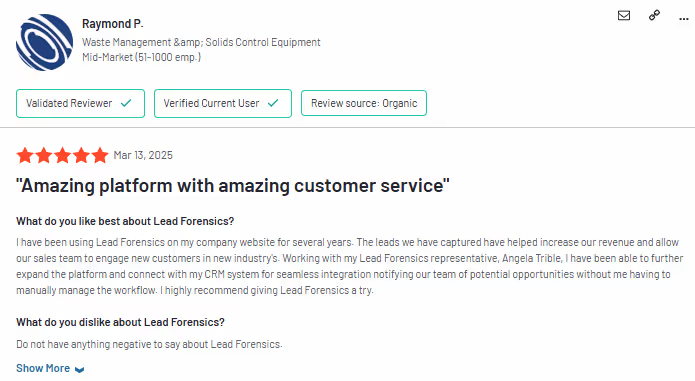
- Real-time visibility of website visits with detailed visitor information.
- Ability to categorize leads and add different statuses for efficient targeting.
- Trigger reports ensure appropriate team members follow up on relevant leads.
- Access to company data helps in creating highly targeted marketing campaigns.
- Excellent account management support with regular check-ins.

Cons
- Desire for further integration with Salesforce.
- Users feel there are many tools within the platform that they do not fully utilize due to time constraints.
Pricing
Lead Forensics offers two pricing plans. One is the Essential plan which is perfect for small and medium sized businesses, while the other is the Automate plan, perfect for enterprise businesses. You can get your free trial, expert advise, as well as custom quote from Lead Forensic’s website itself.
Concluding Statement
Lead Forensics is a powerful tool for B2B companies seeking to engage with website visitors in real time. Its ability to provide detailed insights into visitors and their behaviors, combined with robust lead management and segmentation features, makes it a valuable asset for optimizing marketing and sales efforts. Although there is room for improvement in integrations and tool utilization, the platform's comprehensive data quality and excellent support make it a reliable choice for enhancing B2B website visitor intelligence.
5. HubSpot Sales Hub

Overview
HubSpot Sales Hub is a comprehensive and user-friendly sales CRM that integrates sales engagement tools, CPQ functionality, and advanced sales analytics. Built on the HubSpot CRM platform, it unifies customer data, tools, and teams to create a single source of truth, enhancing sales rep efficiency. Utilizing the full CRM platform provides richer insights, warmer leads, and aligned enablement materials, allowing reps to operate at maximum efficiency. The platform's extensive ecosystem of app and solutions partners ensures an exceptional end-to-end customer experience. HubSpot Sales Hub is designed to scale your company without adding complexity, offering all the necessary tools for business growth.
Key Features
- Sales Force Automation
- Automates sales tasks to streamline processes.
- Contact & Account Management
- Manages customer and account information efficiently.
- Opportunity & Pipeline Management
- Tracks and manages sales opportunities and pipeline stages.
- Task / Activity Management
- Organizes and tracks sales tasks and activities.
- Territory & Quota Management
- Manages sales territories and quotas effectively.
- Desktop Integration
- Integrates with desktop applications for seamless workflow.
- Marketing Automation
- Automates marketing tasks to enhance lead generation.
- Email Marketing
- Facilitates email marketing campaigns.
- Campaign Management
- Manages and tracks marketing campaigns.
- Lead Management
- Tracks and nurtures leads throughout the sales cycle.
- Marketing ROI Analytics
- Analyzes marketing return on investment.
- Customer Support
- Provides robust case management for customer support.
- Mobile & Social
- Offers social collaboration features and mobile user support.
- Reporting & Analytics
- Provides detailed reporting, dashboards, and forecasting.

Here’s why HubSpot Sales Hub is a good RB2B alternative:

- HubSpot is user-friendly and intuitive, making it easy to manage pipelines and organize outbound processes.
- Seamless integration with other tools, such as Trellus, enhances workflow efficiency.
- Robust lead management features support effective tracking and nurturing of leads.
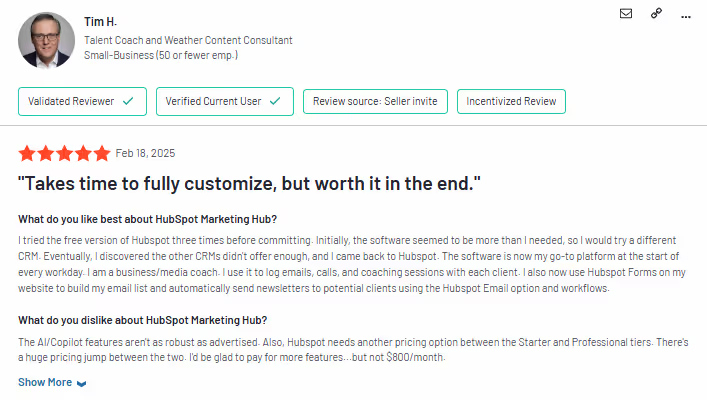
- Extensive training resources and responsive customer support help users get the most out of HubSpot.
- Highly customizable and quick to implement, offering flexibility to suit various business needs.
- Accessible for visually impaired users, with good compatibility with screen reading software.
Cons

- There is a steep learning curve for some users, particularly when adapting to new workflows.
- Certain features that might be essential for specific workflows are missing.
- Users have reported occasional email issues that need addressing.
- The cost is higher compared to some competitors, which may be a consideration for budget-conscious businesses.
- Adapting to account-based outreach approaches can be challenging with the current setup.

Pricing
There are two pricing plans available. The first one is the Sales Hub Professional plan which starts at $90/mo/seat. The second plan is the Sales Hub Enterprise plan which starts at $150/mo/seat. For detailed pricing information, please refer to the HubSpot Sales Hub pricing page.
Concluding Statement
HubSpot Sales Hub is a robust and flexible CRM solution that enhances sales processes with powerful tools and seamless integrations. While there may be a learning curve and higher costs, the platform's ease of use, extensive features, and excellent customer support make it a valuable investment for growing teams. HubSpot Sales Hub enables businesses to scale efficiently and effectively, providing a solid foundation for sustained growth.
6. 6sense Revenue AI for Marketing

Overview
6sense transforms how organizations manage and convert pipeline to revenue. Their Revenue AI captures anonymous buying signals, identifies optimal accounts, and recommends tailored channels and messages to enhance revenue performance. By eliminating guesswork and streamlining sales efforts, 6sense empowers teams to improve pipeline quality, accelerate sales velocity, increase conversion rates, and predictably grow revenue. Learn more at 6sense.com.
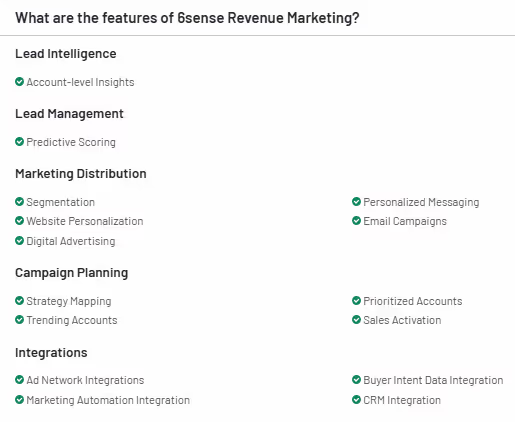
Key Features
- Lead Intelligence
- Provides detailed insights on leads and accounts.
- Enables predictive scoring and effective lead management.
- Marketing Distribution
- Facilitates personalized messaging and website personalization.
- Supports digital advertising and comprehensive campaign planning.
- Platform Additional Functionality
- Integrates with major platforms including ad networks, buyer intent data sources, marketing automation, and CRM systems.
Here’s why HubSpot Sales Hub is a good RB2B alternative:

- Utilizes powerful intent data for targeted marketing efforts.
- User-friendly interface for ease of use.
- Effective audience targeting and solution effectiveness.
- Strong customer support and extensive integrations.

Cons

- Potential for inaccuracies in data.
- Complexity in managing multiple creatives in campaigns.
- Issues with data quality and slow performance at times.
Pricing
Pricing information is customized and not publicly available. Interested parties must contact 6sense for detailed pricing.
Concluding Statement
6sense Revenue AI for Marketing stands out for its ability to leverage intent data effectively in driving account-based marketing strategies. It offers robust features for lead intelligence, personalized marketing campaigns, and seamless integrations with major platforms. While it commands a premium price and faces challenges with data accuracy and integration limitations, 6sense remains a leading choice for organizations aiming to implement successful account-based revenue strategies.
7. Constant Contact Advanced Automation & CRM Platform

Overview
Constant Contact offers powerful digital marketing tools tailored for small businesses, focusing on simplifying and enhancing digital marketing efforts. Whether it's driving sales, expanding customer bases, or engaging audiences, Constant Contact aims to foster strong connections and deliver impactful results.
- Grow your audience: Quickly build your email list using landing pages, social media lead ads, and more.
- Deepen customer relationships: Engage with customers via text, email, or social media—all from a single platform—to drive better engagement and outcomes.
- Simplify social media: Manage social posts and ads effortlessly to boost awareness, generate leads, and foster growth.
- Sync with existing apps: Seamlessly integrate with your current digital tools to accelerate business growth and online sales.
Key Features
- Reporting & Analytics: Provides basic reporting and web analytics.
- Email Marketing: Create, personalize, and send outbound emails, manage email deliverability, and automate responses.
- Online Marketing: Includes mobile-optimized landing pages, forms, and tools for lead management, segmentation, scoring, nurturing, and online behavior tracking.
- Automated Alerts and Tasks: Automate alerts and tasks to streamline workflows.
Here’s why Constant Contact is a good RB2B alternative:

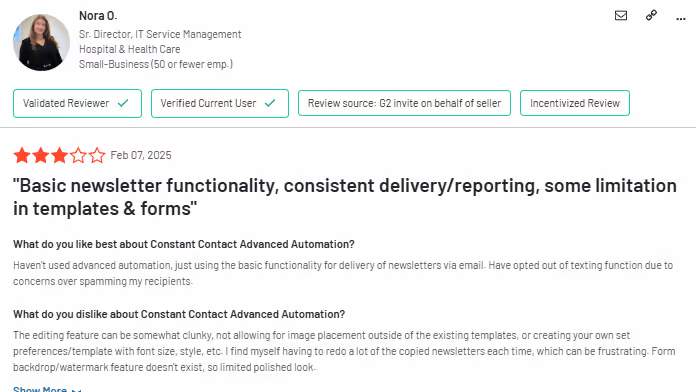
- Easy to use interface, especially for email marketing.
- Excellent customer support.
- Robust automation features.
- Simplifies the creation of marketing materials.

Cons

- Some template issues were reported.
- Occasional missing or limited features.
- Initial learning curve for new users.
- Issues with email functionality.
Pricing
Constant Contact offers three pricing plans:
- Lite: Starting at ₹990/month (price varies based on number of contacts).
- Standard: Starting at ₹2,888/month (price varies based on number of contacts).
- Premium: Starting at ₹6,600/month (price varies based on number of contacts). For detailed pricing information, visit Constant Contact Pricing.
Concluding Statement
Constant Contact Advanced Automation & CRM Platform is an essential tool for small businesses looking to streamline and amplify their digital marketing efforts. It excels in simplifying email marketing, offering robust automation capabilities, and providing excellent customer support. While there are occasional template issues and a learning curve for new users, the platform's adaptability and integration with tools like Canva make it a versatile choice for enhancing marketing strategies and customer engagement.
{{INLINE_CTA_A}}
8. Apollo.io

Overview
Apollo.io is a comprehensive sales intelligence platform designed to assist in prospecting, engaging, and driving revenue growth. It provides tools for discovering new customers, connecting with contacts, and establishing effective go-to-market strategies. With a robust B2B database containing over 275 million contacts and 73 million companies, Apollo.io ensures teams have access to accurate and extensive data. The platform also offers an Engagement Suite to scale outbound activities and sequences efficiently, along with an Intelligence Engine that provides recommendations and analytics to optimize sales processes.
Key Features
- Data Availability
- Extensive availability of contact, company, and industry research data.
- Data Accuracy
- Ensures high accuracy in both contact and company data.
- Features
- Comprehensive search capabilities.
- Tools for lead intelligence, validation, enrichment, and analysis.
- Browser extension for seamless integration.
- Integrated workflows and task management.
- Email tracking and automation.
- CRM integration for enhanced workflow management.
- AI-driven automation and lead prioritization.

Here’s why Apollo.io is a good RB2B alternative:

- Organizational tools and powerful filters facilitate precise audience targeting.
- Simplifies the creation of sequences and touchpoints across multiple channels.
- Offers a range of features that enhance overall sales effectiveness.

Cons

- Some inaccuracies in phone numbers were sourced from online data.
- Issues with email deliverability and occasional bans from email providers like MS Outlook.

Pricing
Apollo.io offers four pricing plans ranging from a free plan to $119 per month for the Organization plan, accommodating different user needs and budgets. A free trial option is also available.
Concluding Statement
Apollo.io stands out as a versatile sales intelligence platform that empowers businesses to streamline their sales efforts effectively. With its vast database, powerful engagement tools, and AI-driven insights, Apollo.io supports organizations of all sizes in maximizing their outreach and conversion efforts. While it excels in organizing and targeting leads, improvements in data accuracy and email deliverability would enhance its overall utility for sales and marketing professionals.
9. Dealfront (formerly Echobot & Leadfeeder)

Overview
Dealfront is a comprehensive Go-to-Market Platform designed to empower sales and marketing teams with the tools needed to attract leads and close deals effectively.
Born from the merger of Germany’s Echobot and Finland’s Leadfeeder, Dealfront leverages advanced algorithms and data insights that surpass traditional tools, all while adhering to Europe’s stringent regulations. By integrating sales and marketing processes into a unified platform, Dealfront creates a perpetual optimization cycle that enhances accuracy, provides real-time Ideal Customer Profiles (ICPs), and converts more leads into successful deals.
Key Features
- Data Availability
- Extensive availability of contact, company, and industry research data.
- Data Accuracy
- High accuracy in both contact and company data.
- Features
- Lead Builder: Constructs detailed lead profiles.
- Integration to CRM/Marketing Automation: Seamlessly integrates with existing systems.
- Data Cleaning/Enrichment: Enhances data quality.
- Data Segmentation/Filtering: Allows for precise data organization.
- Search: Advanced search functionalities.
- News/People Alerts: Provides timely alerts on relevant updates.
- Platform
- Internationalization: Supports global operations.
- User, Role, and Access Management: Ensures secure and efficient platform usage.
- Performance and Reliability: Offers robust performance and reliability.
- APIs: Facilitates extensive integration capabilities.

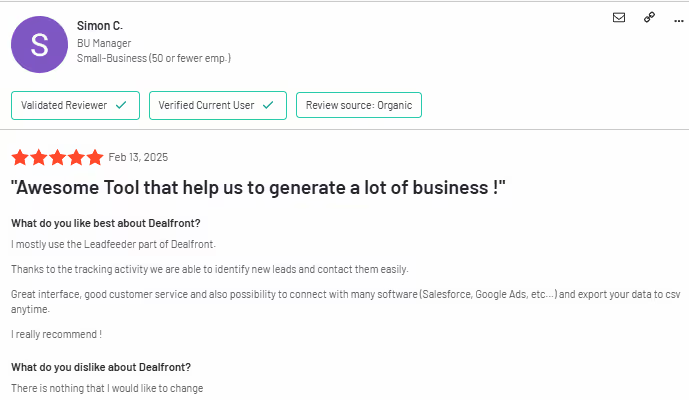
Here’s why Dealfront is a good RB2B alternative:

- Easy setup with valuable insights on website leads.
- Helps map user journeys and optimize website performance.
- Provides detailed source information on website visits.
- Useful filters and labeling for focused information.
- No additional costs for adding extra users, enhancing team collaboration.

Cons

- Lack of automatic integration with certain tools like Brevo.
- Manual setup for integrations can be time-consuming.
- Potential for errors in manual configurations.
Pricing
Dealfront offers flexible pricing packages tailored to specific business needs. For detailed pricing information, visit Dealfront Pricing.
Concluding Statement
Dealfront (formerly Echobot & Leadfeeder) stands out as a robust Go-to-Market Platform that integrates essential sales and marketing functionalities into a single, cohesive solution. Despite some limitations in automatic integrations, its strong API capabilities and comprehensive data insights make it a valuable asset for businesses looking to optimize their lead generation and conversion processes effectively.
Also Read: Leadfeeder (Dealfront) Vs. Factors: Compare Pricing and Features
10. 6sense Revenue AI™ for Sales

Overview
6sense Revenue AI™ for Sales provides a centralized digital platform where sellers can quickly gather account and buying team intelligence. It emphasizes insights into the “Dark Funnel,” where a significant portion of B2B research happens anonymously, ensuring sellers can capitalize on potential deals they might otherwise miss. The platform offers direct access to recommended actions, persona mapping, detailed people and company profiles, a Chrome extension, prioritization dashboards, and alerts.
Key Features
- Data Availability
- Comprehensive availability of contact and company data.
- Access to industry-specific research.
- Data Accuracy
- High accuracy in contact and company data.
- Features
- Lead Builder for creating detailed lead profiles.
- Seamless integration with CRM and marketing automation tools.
- Data cleaning, enrichment, and segmentation/filtering capabilities.
- Advanced search functionalities and real-time alerts.
- Robust reporting capabilities.
- Platform
- User, role, and access management features.
- Reliable performance with detailed reporting and dashboards.

Here’s why 6sense Revenue AI for Sales is a good RB2B alternative:

- Provides visibility into new accounts through 6QA.
- Offers detailed intelligence on each account.
- User-friendly UI with seamless implementation.
- Excellent customer support and training from dedicated CSMs.

Cons

- Persona Map functionality may sometimes lack accurate contact information.
- Issues with synchronization of sales activities, affecting reporting accuracy and adoption rates.

Pricing
6sense Revenue AI™ for Sales offers customized packages tailored to specific features and enterprise needs. It includes unlimited insights into technology, company, and leads, along with features like custom alerts, saved filters, CSV exports, Salesforce & HubSpot integration, and dedicated success management.
Concluding Statement
6sense Revenue AI™ for Sales stands out as a powerful tool for B2B sales teams aiming to enhance their prospecting and sales efforts with deep account and buying team intelligence. While it offers robust features and reliable performance, improvements in persona mapping accuracy and better enablement training for new interfaces would further elevate its effectiveness. Overall, it is a comprehensive solution suited for teams of all sizes looking to optimize their sales processes through advanced data insights and streamlined workflows.
Also Read: 6Sense+Factors Visitor Identification & Account Analytics
11. ZoomInfo Sales

Overview
ZoomInfo Sales is a comprehensive go-to-market platform designed for B2B companies. It features a vast, accurate, and frequently updated database of insights, intelligence, and purchasing intent data about companies and contacts. The platform enhances this intelligence with tools like conversation intelligence (Chorus), sales engagement (Engage), and data orchestration (RingLead), facilitating better prospect and customer engagement. By integrating these tools with your existing systems, ZoomInfo Sales equips your go-to-market teams to close more deals efficiently.
Key Features
- Data Availability
- Comprehensive access to contact and company data.
- Industry-specific research data availability.
- Data Accuracy
- High accuracy in contact and company data.
- Features
- Lead Builder for creating detailed lead profiles.
- Integration with CRM and marketing automation platforms.
- Data cleaning and enrichment capabilities.
- Advanced data segmentation and filtering.
- Powerful search functionalities.
- News and people alerts.
- Detailed reporting features.
- Platform
- High performance and reliability.
- Analytics for deeper insights.
- Import/export functionalities.
- Lead monitoring capabilities.

Here’s why ZoomInfo Sales is a good RB2B alternative:

- User-friendly interface with easy access and implementation.
- Seamless integration with centralized CRM platforms.
- Comprehensive filtering options and strategic filters.
- Regular updates with new and useful features.

Cons

- Inconsistent performance of the Chrome pop-out extension.
- Limited support and occasional delays in resolving issues.
- Data accuracy can vary, requiring verification.
- Limitations in mobile app functionalities.

Pricing
Custom pricing is available upon inquiry with ZoomInfo Sales.
Concluding Statement
ZoomInfo Sales stands out as a robust solution for B2B companies aiming to streamline their sales processes and improve customer engagement. With its extensive database and integrated tools, it empowers teams to access accurate data, enhance targeting capabilities, and achieve higher sales effectiveness. While facing challenges like occasional technical issues and data accuracy concerns, ZoomInfo Sales continues to innovate and provide valuable features that support business growth and efficiency.
How can Factors help?
Factors is an advanced B2B sales and marketing platform that leverages cutting-edge AI technology to provide actionable insights and optimize lead management. Here’s how Factors stands out:
- Advanced AI-Driven Insights
Factors uses artificial intelligence to analyze massive datasets, uncover hidden patterns, and predict future trends. This allows businesses to make data-driven decisions and refine their strategies based on actionable insights.
- Enhanced Lead Scoring
The platform offers sophisticated lead scoring algorithms that evaluate lead quality more accurately. By assessing various factors such as engagement, behavior, and fit, Factors helps prioritize high-value prospects, ensuring sales teams focus their efforts on the most promising opportunities.
- Integration and Automation
Factors seamlessly integrates with existing CRM systems and marketing tools, streamlining workflows and automating repetitive tasks. This integration enhances efficiency by reducing manual data entry and ensuring that all systems are aligned.
- Personalized Marketing Campaigns
The platform provides tools for creating highly personalized marketing campaigns based on deep customer insights. This personalization increases the effectiveness of marketing efforts and improves customer engagement.
- Real-Time Analytics
Factors delivers real-time analytics and reporting, enabling businesses to track the performance of their campaigns and make quick adjustments as needed. This ensures that marketing strategies remain effective and responsive to changing market conditions.
- Scalability
Whether you're a small business or a large enterprise, Factors scales to meet your needs. Its flexible features and robust infrastructure support businesses of all sizes, adapting to varying demands and complexities.
- LinkedIn AdPilot
Factors has launched LinkedIn AdPilot, a platform that enables marketers to double down on their LinkedIn ROI. AdPilot’s capabilities such as Smart Reach, Audience Builder, Campaign Automation, View-Through Attribution, and Factors’ CAPI integration enable markteres to up their LinkedIn Ads game.
- G2 Intent
With G2 Intent integration, Factors provides insights into potential customers' buying intent. This feature allows businesses to identify and target prospects actively researching similar solutions, enhancing the precision and timing of marketing efforts.
- Account Intelligence and Analytics
Factors offers comprehensive account intelligence and analytics, giving businesses a deeper insight into their target accounts. This includes insights into account behavior, engagement levels, and key decision-makers, enabling more effective account-based marketing strategies.
Find the best RB2B alternative today
Choosing the right RB2B alternative can significantly impact your business's ability to attract, engage, and convert leads. Each of the alternatives listed above offers unique features and benefits, catering to different business needs and budgets. By evaluating these options based on their key features, pros, cons, and pricing, you can make an informed decision that aligns with your company's goals and growth strategy. Whether you're looking for advanced ABM capabilities, robust marketing automation, or comprehensive sales intelligence, there's a solution out there that can help you succeed in the competitive B2B landscape.
Ready to transform your B2B sales and marketing strategy with cutting-edge technology? Request a demo today and see how Factors.ai can help!
{{INLINE_CTA_A}}

ABM vs. Inbound Marketing
Imagine ABM as your precision sniper, targeting high-value accounts with laser focus, while Inbound Marketing is like casting a wide net to reel in various leads with irresistible content.
Enterprise B2B marketers often face the dilemma: Should you choose ABM marketing or inbound marketing for the best ROI? Many teams waste resources by either chasing unqualified leads or overlooking key accounts that could boost revenue. This challenge leads to frustration: generic campaigns don't reach decision-makers, while personalized outreach seems slow or costly to scale. The solution lies in understanding each approach's strengths and how they align with your goals.
Marketers find higher ROI with ABM for key accounts, while inbound marketing excels in scalable lead generation and brand building. But which strategy works better for enterprise B2B? This guide offers a clear comparison of ABM marketing and inbound marketing, helping you make informed choices, avoid mistakes, and create a marketing plan that drives growth.
TD;LR
Account-Based Marketing (ABM) and Inbound Marketing are distinct strategies for driving leads and sales. ABM targets a few high-value accounts with personalized campaigns ideal for complex sales cycles and high-value clients. Inbound marketing attracts a broad audience with valuable content perfect for scalable lead generation and nurturing. Choosing between them depends on your business model, sales cycle, and budget. A hybrid approach can leverage both methods' strengths, offering precision targeting and broad audience reach. Factors can support both strategies with comprehensive analytics and insights.
What is Account-Based Marketing (ABM)?
Account-Based Marketing (ABM) is a highly targeted, strategic marketing approach designed for B2B businesses focusing on high-value accounts. ABM treats these accounts as individual markets, building personalized marketing campaigns to engage key decision-makers and drive conversions. The goal is not to generate a broad range of leads but to ensure the engagement of a smaller, more defined group of prospects, resulting in higher ROI and stronger relationships.
Understanding ABM Marketing in Enterprise B2B
ABM marketing is a focused strategy for B2B companies. In ABM, marketing and sales teams collaborate to target a specific list of high-value accounts. Instead of casting a wide net, ABM zeroes in on companies that fit your ideal customer profile, delivering personalized campaigns and content tailored to each account’s needs.
ABM relies on deep research, identifying decision-makers, understanding their challenges, and crafting messages that align with their business goals. This approach often uses various channels, such as personalized emails, LinkedIn campaigns, targeted ads, and custom events.
ABM is particularly effective for enterprise B2B companies with complex sales cycles, large deals, and multiple stakeholders. It allows precise measurement of engagement and ROI at the account level, making it easier to justify marketing spend. However, ABM requires close teamwork between sales and marketing, careful planning, and investment in data and technology. When executed well, ABM can shorten sales cycles, increase win rates, and build long-term relationships with your most valuable clients.
Inbound Marketing for Enterprise B2B
Inbound marketing attracts potential enterprise B2B buyers by creating and sharing valuable content that meets their needs. Instead of sending out messages, inbound marketing draws prospects in with helpful blog posts, whitepapers, webinars, and social media updates that address real business challenges.
This approach focuses on understanding your target audience’s problems and offering solutions at each stage of their buying journey. Effective inbound marketing uses search engine optimization (SEO), content marketing, and automated email workflows to nurture leads. Over time, this builds a steady flow of qualified leads interested in your business.
For enterprise B2B companies, inbound marketing is scalable and cost-effective. It helps build brand authority and trust in crowded markets. It works well for companies that want to educate their audience, increase organic website traffic, and generate leads without aggressive sales tactics. However, inbound marketing requires patience, regular content creation, and ongoing improvements to see results. When done well, it can provide a growing return on investment and support long-term growth for B2B organizations.
Key Components of ABM:
- Account Identification
Marketing and sales teams collaborate to identify high-value accounts with the greatest revenue potential. These accounts typically fit an ideal customer profile (ICP) based on factors like company size, industry, revenue, and specific pain points.
- Personalization
ABM emphasizes creating personalized content, messages and offers that directly address the unique needs and challenges of each target account.
- Sales and Marketing Alignment
Successful ABM requires close collaboration between marketing and sales teams. Both departments must work together to ensure a consistent, seamless customer experience throughout the buyer's journey.
- Data and Insights
ABM relies heavily on data to inform its strategies. Marketers use advanced analytics to understand each account's buying behavior, map out key stakeholders, and tailor their outreach accordingly.
Key Benefits of ABM:

- Higher ROI
ABM provides a more focused and effective approach to marketing by concentrating resources on high-value accounts. According to a report by ITSMA, 87% of marketers say ABM delivers a higher return on investment than any other marketing strategy.
- Enhanced Personalization
ABM allows marketers to create personalized experiences for each account, increasing the likelihood of conversion. This personalized approach is especially important for B2B businesses with complex sales cycles, where multiple decision-makers are involved.
- Better Alignment with Sales
Since ABM targets specific accounts, it naturally aligns marketing efforts with sales goals, ensuring that both teams are working toward the same objectives. This improves communication and coordination between departments.
- Shorter Sales Cycles
By focusing on accounts already identified as high potential, ABM helps shorten the sales cycle. Personalized content and engagement strategies move prospects more quickly through the sales funnel, often skipping the awareness and consideration stages of the buyer’s journey.
What is Inbound Marketing?
Inbound marketing is a broad, scalable marketing strategy that focuses on attracting potential customers by creating valuable content and experiences tailored to their interests. Instead of targeting specific accounts, inbound marketing seeks to attract a wider audience by offering educational and informative content that addresses the pain points and needs of prospective buyers.
Inbound marketing is built on the principle that businesses should offer value to potential customers before asking for their business. By providing helpful content through various digital channels, such as blogs, eBooks, social media, and webinars, companies can build trust and credibility with their audience, nurturing leads through the sales funnel until they’re ready to make a purchase.

Key Components of Inbound Marketing:
- Content Creation
The foundation of inbound marketing is creating valuable, relevant content that educates, informs, or entertains your target audience. This content can take many forms, including blog posts, eBooks, whitepapers, videos, and infographics.
- Search Engine Optimization (SEO)
To attract organic traffic, inbound marketing relies on SEO strategies to ensure that content ranks well in search engines. By optimizing content with relevant keywords and phrases, businesses can increase their visibility and reach more potential customers.
- Lead Nurturing
Inbound marketing emphasizes nurturing leads over time by providing them with the information they need at every stage of the buyer’s journey. This often involves using automated email campaigns, drip marketing, and personalized content recommendations.
- Conversion Optimization
Once visitors are drawn to a company’s website, the goal is to convert them into leads. Inbound marketing uses tools like landing pages, forms, and calls-to-action (CTAs) to capture lead information and move prospects further along the sales funnel.
Key Benefits of Inbound Marketing:
- Scalability
Inbound marketing can reach a broad audience without significant incremental effort. Once content is created, it attracts and engages potential customers over time, providing a long-term ROI.
- Cost-Effectiveness
Inbound marketing is often more cost-effective than outbound marketing methods or even ABM. Companies can reduce their reliance on paid advertising by focusing on organic traffic generation through SEO and content creation.
- Lead Nurturing
Inbound marketing excels at nurturing leads through the buyer’s journey. By offering valuable content at every funnel stage, businesses can build relationships with prospects, increasing their chances of converting leads into customers.
- Long-Term Benefits
High-quality content created for inbound marketing has long-term value. Blog posts, videos, and social media content can continue to attract visitors and generate leads long after their initial publication.
Key Differences Between ABM and Inbound Marketing
Choosing Between ABM and Inbound Marketing: Which is Best for Your Business?

The choice between ABM and inbound marketing depends on several factors, including your business model, target audience, sales cycle, and revenue goals. Here are some key considerations:
- Target Audience Size
ABM may be the better choice if your company operates in a niche market with a small number of high-value accounts. On the other hand, if your business targets a broad market, inbound marketing’s wide reach may be more effective.
- Sales Cycle Complexity
ABM is often the better option for businesses with complex sales cycles involving multiple decision-makers. The personalized approach helps build stronger relationships with key stakeholders. In contrast, inbound marketing works well for businesses with shorter sales cycles, where potential customers can self-educate and move quickly through the funnel.
- Budget Considerations
Inbound marketing is generally more cost-effective, especially for smaller companies with limited marketing budgets. While providing higher ROI for specific accounts, ABM often requires more resources to execute effectively, as it involves tailored content creation and personalized engagement strategies.
- Long-Term vs. Short-Term Focus
Inbound marketing’s long-term approach is ideal for businesses building brand awareness and nurturing leads over time. Conversely, ABM is well-suited for businesses looking to generate immediate impact with high-value accounts.
When to Use ABM Marketing or Inbound Marketing in Enterprise B2B?
Deciding between ABM marketing and inbound marketing depends on your goals, market size, and deal complexity. ‘
Use ABM Marketing When:
- You're targeting a small number of high-value enterprise accounts.
- Your sales cycles are long and involve multiple decision-makers.
- Personalization is critical, like in SaaS, IT, or professional services.
- You need custom content, tailored messaging, and focused outreach for each account.
- Your goal is to expand existing accounts or win large, strategic deals.
Use Inbound Marketing When:
- You want to build brand awareness and attract a broad set of leads.
- You're targeting mid-market or SMBs with simpler buying journeys.
- You aim to educate the market and nurture prospects over time.
- Your strategy relies on content marketing, SEO, and social media to drive traffic.
- You need a scalable lead generation engine for sustained pipeline growth.
When to Combine Both:
- You want to fill the top of the funnel with inbound and convert high-value prospects through ABM.
- Your team has the resources and alignment to balance personalized outreach with broader demand generation.
- You need to support both volume-based marketing and targeted enterprise growth.
Many successful enterprise B2B companies use both methods, using inbound to fill the funnel and ABM to convert high-value prospects, maximizing returns throughout the customer journey.
Hybrid Approach: Combining ABM and Inbound Marketing
In some cases, businesses may benefit from a hybrid approach that combines the strengths of both ABM and inbound marketing. For example, inbound marketing could attract a broad range of leads at the top of the funnel, while ABM tactics could target high-value accounts later in the buyer’s journey. This allows companies to capitalize on the scalability of inbound marketing while still delivering personalized experiences for critical accounts.
Which Strategy is Better for Your Business?
Businesses need to assess their unique needs and goals when deciding whether to focus on ABM, inbound marketing, or a hybrid strategy. While both approaches offer distinct advantages, the right choice depends on several factors:
- Revenue Goals
If your company’s revenue is driven by a few large accounts, ABM might be the best option since it focuses on high-value, high-potential clients. Inbound marketing, on the other hand, works well for companies looking to build a broad, sustainable pipeline of leads that can be nurtured over time.
- Marketing Team Size
ABM strategies can be more resource-intensive, requiring significant coordination between sales and marketing, as well as dedicated content for specific accounts. Companies with smaller marketing teams may find inbound marketing easier to execute, as it allows them to focus on creating scalable content that can be repurposed across various channels.
- Customer Lifetime Value (CLV)
Companies with high CLV often benefit from ABM strategies, as the potential payoff from winning a key account justifies the cost and effort involved in highly personalized marketing. In contrast, businesses with lower CLV or a larger customer base may find inbound marketing a better fit, as it scales more easily across numerous prospects.
- Sales Cycle Length
ABM is often more effective for businesses with long, complex sales cycles that involve multiple decision-makers. It provides the personalized touch needed to guide prospects through each stage of the buyer’s journey. Inbound marketing works better for companies with shorter sales cycles, where prospects can make purchasing decisions with minimal sales intervention.
- Marketing Budget
ABM generally requires a higher upfront investment since it targets a smaller number of high-value accounts with highly personalized campaigns. Inbound marketing is often more cost-effective, mainly when businesses focus on organic traffic, SEO, and content creation.
Measuring ROI: Which Delivers Better Results for Enterprise B2B?
ABM focuses on account-level metrics:
- Tracks deal size, engagement depth, pipeline velocity, and influenced revenue.
- Measures success through how high-value accounts progress through the funnel.
- Ideal for long sales cycles and complex B2B purchases.
Inbound marketing measures broader performance indicators:
- Looks at website traffic, content engagement, lead volume, and conversion rates.
- Can generate more leads at a lower cost-per-lead.
- May produce many unqualified leads in enterprise contexts.
ABM delivers stronger ROI for enterprise deals:
- 87% of marketers report higher ROI with ABM for enterprise-level accounts.
- Personalized outreach and alignment with sales make it more effective in closing large deals.
Inbound remains essential for top-of-funnel growth:
- Builds brand awareness and attracts a wide audience.
- Helps nurture prospects who may not be ready to buy but show future potential.
Best results come from combining ABM + Inbound:
- Inbound fills the pipeline with engaged contacts.
- ABM narrows the focus to convert top-tier accounts into customers.
The best results often come from combining both approaches, where inbound fills the funnel and ABM turns high-value opportunities into revenue.
Factors: Enhancing Both ABM and Inbound Marketing with Data-Driven Precision
Factors is designed to elevate both Account-Based Marketing (ABM) and Inbound Marketing strategies, providing businesses with the insights and tools to optimize their B2B marketing efforts. Here's how Factors supports both approaches:
- Unified Analytics Across Strategies
Factors offers comprehensive analytics that unify marketing and sales data, delivering actionable insights across ABM and inbound marketing. Whether you're evaluating account-level engagement in ABM or tracking the performance of inbound marketing content, the platform helps marketers make informed decisions and drive better results.
- Powerful ABM Features
For businesses focusing on ABM, Factors simplifies account tracking by providing in-depth insights into account engagement. The platform identifies key decision-makers, monitors multi-channel interactions, and measures the impact of personalized campaigns across targeted accounts. This enables companies to focus on high-priority accounts, ensuring efficient resource allocation.
- Optimizing Inbound Marketing Campaigns
With Factors, businesses can enhance their inbound marketing efforts by leveraging advanced content analytics. The platform helps you track which types of content engage your audience, how leads progress through your funnel, and the effectiveness of SEO strategies. This data-driven approach ensures that your inbound marketing initiatives are continuously optimized for better engagement and higher conversion rates.
- Bridging Sales and Marketing Alignment
A common challenge in both ABM and inbound marketing is aligning sales and marketing teams. Factors bridges this gap by providing a transparent view of both teams' activities, facilitating better coordination and collaboration. This alignment is critical for delivering a cohesive customer experience and driving revenue growth, regardless of your marketing approach.
- Customizable Dashboards for Targeted Insights
Factors empowers businesses with customizable dashboards, allowing marketers to monitor the most relevant metrics for their ABM or inbound marketing efforts. Whether you're tracking specific content performance or account-level engagement, these dashboards offer the flexibility to stay aligned with your strategy.
By seamlessly integrating with both ABM and inbound marketing strategies, Factors becomes the perfect partner for businesses looking to refine their B2B marketing efforts.
In a Nutshell
Both Account-Based Marketing and Inbound Marketing offer unique advantages for businesses, but they are fundamentally different strategies. ABM is best suited for targeting specific high-value accounts with personalized campaigns. It is ideal for companies with longer sales cycles, high customer lifetime value, and a focused target audience. On the other hand, inbound marketing is perfect for businesses looking to cast a wider net and attract a broad audience by providing valuable content that nurtures leads over time.
The key to success in today’s competitive B2B environment is not choosing one strategy over the other but finding a balance. Combining the personalized precision of ABM with the scalable power of inbound marketing allows businesses to reach a wider audience while still delivering tailored experiences for key accounts.
With the help of platforms like Factors, businesses can optimize both ABM and inbound marketing strategies, ensuring that they are driving the highest possible ROI from their marketing efforts. Whether you’re looking to target specific accounts, nurture leads through inbound marketing, or do both, Factors provides the tools and insights you need to succeed.
.avif)
Factors vs. Triblio (Foundry ABM)
Choosing the appropriate platform is key, whether you're focused on targeting high-value accounts or enhancing multi-channel engagement within your Account-Based Marketing (ABM) strategies. Two notable options in this space are Foundry ABM and Factors—each offering distinct capabilities that cater to different marketing objectives.
Before diving into a comparison of their ABM features, it's essential to understand each platform's core purpose. Foundry ABM (formerly Triblio) is crafted for businesses implementing ABM strategies, offering a comprehensive suite for personalized, multi-channel engagement. In contrast, Factors initially focused on marketing analytics and attribution, equipping businesses with insights to understand campaign performance and make informed adjustments.
This article will explore each platform's key features, strengths, use cases, and pricing structures.
TL;DR
- Foundry ABM (formerly Triblio) is an Account-Based Marketing platform that integrates account-targeted ads, personalized web experiences, and sales insights.
- It’s ideal for mid-to-large B2B companies running complex multi-channel campaigns aimed at engaging high-value accounts, with a strong emphasis on intent data and sales alignment.
- Factors.ai, by contrast, is a marketing analytics and attribution platform focused on multi-touch attribution and customer journey mapping.
- It’s best suited for B2B marketers tracking ROI across channels and gaining AI-driven insights to optimize campaign performance.
- Foundry ABM is designed for ABM execution, while Factors.ai specializes in in-depth marketing performance analysis.
- Your choice hinges on whether your primary goal is campaign orchestration (Foundry ABM) or understanding and enhancing marketing ROI (Factors.ai).
Overview of Foundry ABM

Foundry ABM, previously known as Triblio, is crafted to help companies engage high-value accounts through a unified marketing approach. It integrates account-based advertising, web personalization, and sales activation to deliver personalized experiences, optimizing account engagement across multiple channels.
Core Features:
1. Account-Based Advertising: Foundry ABM enables highly targeted advertising by aligning ads with specific accounts, leveraging intent and behavioral data to identify key decision-makers within targeted accounts, and ensuring only relevant stakeholders see the ads.
2. Web Personalization: Foundry ABM allows for account-specific web experiences by tailoring content based on account-level data, ensuring each target account encounters content relevant to its current stage in the buyer’s journey.
3. Sales Activation: The platform enhances sales and marketing alignment by equipping sales teams with insights into account activity, enabling them to focus on accounts most likely to convert.
4. Campaign Orchestration: Foundry ABM enables marketers to design and execute multi-channel campaigns across advertising, email, web, and other channels, providing a consistent experience for target accounts throughout the buyer journey.
5. Intent Data Integration: The platform leverages intent data from third-party sources, helping marketers prioritize accounts based on buying intent allowing for more precise targeting and efficient resource allocation.

Strengths:
- Comprehensive ABM Capabilities: Foundry ABM is an all-in-one platform that merges advertising, web personalization, and sales activation into a cohesive ABM strategy.
- Robust Integrations: It integrates with major CRMs like Salesforce and marketing automation tools like HubSpot and Marketo, streamlining workflows.
- Data-Driven Targeting: The use of intent data focuses marketing efforts on accounts most likely to convert.
- Multi-Channel Campaign Management: Foundry ABM's ability to orchestrate multi-channel ABM campaigns is ideal for B2B marketers prioritizing high-value accounts.
Weaknesses:
- Complexity: Its extensive features and capabilities may overwhelm smaller teams or those new to ABM.
- Pricing: Foundry ABM's pricing can be high, making it more suited to mid-sized to large enterprises with established marketing and sales teams.


Overview of Factors.ai
Factors.ai is a marketing analytics and attribution platform tailored to provide B2B marketers with deep insights into their campaigns' performance. It aims to help businesses assess the effectiveness of their marketing efforts through tools for multi-touch attribution, customer journey mapping, and behavioral analysis.

Core Features:
- Attribution Modeling: Factors.ai excels in multi-touch attribution, enabling marketers to track the impact of various touchpoints along the customer journey. This helps businesses discern which marketing activities drive conversions and identify channels that deliver the highest ROI.
- Customer Journey Mapping: The platform visually represents the customer journey, allowing marketers to analyze how leads navigate through the funnel and pinpoint the most influential touchpoints for conversions.
- AI-Driven Insights: Utilizing artificial intelligence, Factors.ai automatically identifies underperforming campaigns and highlights opportunities for improvement. This minimizes the manual effort required for data analysis and empowers marketers to make data-driven decisions quickly.
- Predictive Analytics: The platform's capabilities allow marketers to forecast future performance based on historical data, facilitating effective campaign planning and resource allocation.
- Collaboration Features: Factors.ai includes built-in tools that enhance collaboration among marketing teams for data analysis and campaign planning, making it particularly beneficial for larger teams coordinating across different regions or business units.

Strengths:
● Deep Insights into Marketing Performance: Factors.ai delivers detailed insights into how various channels and touchpoints contribute to overall marketing success.
● AI-Driven Automation: The platform's AI capabilities streamline marketing data analysis, enabling marketers to focus on strategy and execution.
● Predictive Capabilities: Factors.ai aids marketers in forecasting future campaign performance, optimizing resource allocation accordingly.
Weaknesses:
● Narrower Focus: While Factors.ai is a robust analytics tool, it lacks the comprehensive account-based marketing capabilities that Foundry ABM offers.
● Complex for Smaller Teams: Similar to Foundry ABM, Factors.ai can be intricate, particularly for teams lacking a dedicated data analyst or marketing operations specialist.

When to Choose Foundry ABM
You should consider Foundry ABM if:
● You require multi-channel campaign orchestration that includes personalized web experiences and targeted ads.
● Your marketing team collaborates closely with sales, and you need tools that activate sales and provide insights into account activity.
● Intent data is critical to your account targeting strategy, and you want to leverage third-party data to prioritize accounts based on buying signals.
Use Cases for Foundry ABM:
● A large B2B enterprise looking to personalize its marketing efforts for high-value accounts.
● A mid-sized business aiming to scale its ABM program and integrate its marketing and sales efforts.
● A marketing team seeking a platform capable of managing complex, multi-channel campaigns across web, ads, and email.
When to Choose Factors.ai
You should choose Factors.ai if:
● Your primary focus is marketing analytics and attribution, and you need to track campaign performance across multiple channels.
● You want to map out the customer journey and gain deep insights into which touchpoints drive conversions.
● Your team needs AI-driven insights to identify underperforming campaigns and optimize future marketing strategies quickly.
● Predictive analytics is important for your marketing planning, and you want a platform that can forecast future performance based on historical data.
Use Cases for Factors.ai:
● Your primary focus is marketing analytics and attribution, and you need to track campaign performance across multiple channels.
● You want to map out the customer journey and gain deep insights into which touchpoints drive conversions.
● Your team needs AI-driven insights to identify underperforming campaigns and optimize future marketing strategies quickly.
● Predictive analytics is important for your marketing planning, and you want a platform that can forecast future performance based on historical data.
In a Nutshell
Foundry ABM (Triblio) and Factors.ai serve different yet complementary roles in the marketing technology stack. Foundry ABM is a powerful ABM platform, ideal for companies focusing on personalized account-based campaigns, while Factors.ai excels in marketing analytics, attribution, and journey mapping.
Foundry ABM is the way to go if your goal is to drive personalized engagement with high-value accounts. Conversely, if your business needs to optimize marketing performance and understand which touchpoints lead to conversions, Factors.ai provides the necessary tools for detailed analysis.
Both platforms cater to B2B marketers, but the choice depends on your team’s needs—ABM execution vs. analytics and attribution.

Top 11 Servicebell Alternatives
Servicebell is a real-time customer engagement tool that allows businesses to interact with website visitors. Whether answering questions or offering assistance, Servicebell helps companies provide exceptional customer service at critical touchpoints. However, as businesses evolve, they might require more tailored tools or a platform that integrates additional features. Luckily, many viable alternatives offer different capabilities to suit varied business needs.
TL;DR
- Servicebell is a real-time customer engagement tool, but businesses may need alternatives with broader capabilities, such as automation, analytics, and sales optimization.
- Among the top alternatives:some text
- Factors.ai is ideal for businesses focused on data-driven marketing. It offers AI-driven analytics, multi-channel attribution, and workflow automation. Its CRM and marketing platform integrations, especially for LinkedIn campaigns, make it a top choice for B2B companies aiming to optimize outreach and sales strategies.
- Apollo.io offers powerful sales automation and lead generation with a large contact database and CRM integration.
- ZoomInfo Sales is a premium option with high-quality B2B data and sales intelligence for optimizing pipelines.
- HubSpot Sales Hub combines CRM, sales automation, and lead nurturing, making it a versatile tool for small businesses.
- Salesforce Marketing Cloud Account Engagement (formerly Pardot) is a robust, high-end marketing automation platform for larger enterprises.
Each platform offers unique strengths, so the best alternative depends on your specific business goals, from live chat engagement to comprehensive analytics and sales optimization. Factors.ai stands out for businesses needing deeper marketing insights and automation.
About Servicebell

Servicebell allows businesses to engage visitors directly through live chat and video calls on their website. It's ideal for companies looking to provide immediate, personalized support and increase conversions through real-time communication.
Key Features:
- Live Chat & Video Calls:
Connect with website visitors instantly, offering assistance or product support as they browse.
- Targeted Engagement:
Customize how and when to engage visitors based on behavior or specific triggers.
- Visitor Insights:
Track visitor behavior, such as time spent on pages, to understand customer needs and improve engagement strategies.
{{INLINE_CTA_A}}
Pros:
- Easy to use for live communication.
- Enables personalized visitor interactions.
- Simple setup for instant website integration.

Cons:
- Limited in terms of automation compared to some competitors.
- Primarily focused on engagement rather than broader marketing and sales tools.
Pricing:
Servicebell has a free plan with limited features, while its paid plans start at around $49 per month, offering more customization and engagement capabilities.
Top Servicebell Alternatives
Let’s explore some alternatives to Servicebell that provide enhanced capabilities for customer engagement, lead generation, and marketing automation.
1. Factors.ai

Factors.ai is a cutting-edge AI-driven marketing analytics platform that helps businesses analyze and optimize their marketing efforts. It uses AI to provide actionable insights into customer behavior, making it a great alternative to Servicebell for companies focused on marketing analytics and customer journey optimization.
Key Features:
- AI-Driven Analytics: Leverage AI to analyze customer interactions and optimize marketing strategies.
- Journey Mapping: Visualize and understand the customer journey in real-time.
- Campaign Performance Tracking: Measure the effectiveness of marketing campaigns across different channels.
- Detect Churn Signals: With Factors, you can detect churn signals such as your existing customers visiting competitors’ G2 pages. With such insights you can also prevent customer ch

Pros:
- Excellent for businesses focused on data-driven decision-making.
- Provides deep insights into customer behavior, which can enhance engagement strategies.
- Intuitive interface with easy-to-understand visualizations.
Cons:
- Not as focused on real-time customer interaction as Servicebell.
- Some features may be complex for businesses with limited technical expertise.
Pricing:
Factors.ai offers custom pricing based on business needs, and it provides a free trial for new users.
{{INLINE_CTA_A}}
2. ZoomInfo Sales

ZoomInfo Sales is a market intelligence platform designed to improve your sales team's prospecting efforts by providing detailed data on potential customers and their buying behaviors.
Key Features:
- B2B Database: Access to rich company and contact data.
- Sales Intelligence: Provides insights into buying signals and intent data.
- Pipeline Management: Helps track and optimize the sales pipeline.

Pros:
- Extensive database with high-quality B2B data.
- Advanced search filters for precise targeting.
- Integrates with popular CRM platforms.
Cons:
- Can be expensive, especially for small businesses.
- Complex data interface, which can be overwhelming for beginners.
Pricing:
ZoomInfo Sales starts at $10,000 annually for its most basic plan.
{{INLINE_CTA_A}}
3. FlashRev

FlashRev is a customer engagement tool that specializes in enabling real-time interaction with website visitors, making it a great alternative to Servicebell for businesses focused on immediate customer support and lead generation.
Key Features:
- Live Interaction: Offers chat, voice, and video communication with website visitors.
- Behavioral Targeting: Engage users based on real-time activity and behavior.
- Analytics: Provides insights into visitor behavior and engagement success.

Pros:
- Easy to use, with quick setup.
- Real-time visitor engagement to boost conversions.
- Affordable for small businesses.
Cons:
- Lacks the depth of automation seen in larger platforms.
- Limited integrations with CRMs.
Pricing:
FlashRev offers competitive pricing starting from $29 per month.
4. HubSpot Sales Hub

HubSpot Sales Hub is a robust platform that combines CRM, sales automation, and lead nurturing tools, making it a versatile solution for businesses looking to streamline both their marketing and sales efforts.
Key Features:
- Free CRM: HubSpot offers a free CRM with basic features for managing customer data.
- Sales Automation: Automate repetitive sales tasks, such as follow-up emails.
- Pipeline Management: Keep track of all stages of the sales process.

Pros:
- User-friendly interface, even for beginners.
- Free CRM and affordable paid plans for small businesses.
- Wide range of integrations, including marketing tools.
Cons:
- Some features, like reporting, are limited in the free version.
- Scaling may require upgrading to more expensive tiers.
Pricing:
HubSpot Sales Hub offers a free plan, with paid plans starting at $50 per month.
{{INLINE_CTA_A}}
5. Adapt

Adapt offers B2B contact data, lead generation, and sales intelligence tools for businesses looking to scale their outreach and prospecting efforts.
Key Features:
- Lead Generation: Access to over 300 million contacts across various industries.
- Data Quality: Adapt’s database is regularly updated to ensure accuracy.
- Email Sequencing: Automate outreach campaigns with tailored email sequences.

Pros:
- Affordable compared to other lead generation tools.
- Good for small businesses and startups.
- Decent contact data for scaling prospecting efforts.
Cons:
- Data quality can sometimes vary.
- Limited CRM integrations compared to competitors.
Pricing:
Adapt has a free version, with paid plans starting at $99 per month.
6. Salesforce Marketing Cloud Account Engagement

Salesforce Marketing Cloud Account Engagement (formerly Pardot) is a marketing automation platform that enables businesses to create personalized customer journeys and drive sales through highly targeted campaigns.
Key Features:
- Marketing Automation: Create personalized email campaigns, nurture leads, and manage prospects.
- CRM Integration: Seamless integration with Salesforce CRM for lead tracking and sales management.
- Lead Scoring: Identify high-quality leads through advanced lead scoring.

Pros:
- Perfect for larger businesses needing comprehensive marketing automation.
- Highly customizable for different marketing and sales needs.
- Seamless Salesforce integration.
Cons:
- Expensive compared to smaller tools.
- Requires more technical expertise to use advanced features.
Pricing:
Salesforce Marketing Cloud Account Engagement plans start at $1,250 per month.
{{INLINE_CTA_A}}
7. Talkdesk

Talkdesk is a cloud-based contact center platform that enables businesses to improve their customer service through AI-driven solutions and multichannel communication.
Key Features:
- Omnichannel Communication: Handle customer queries via phone, email, chat, and more.
- AI-Powered Analytics: Leverage AI for customer insights and service improvements.
- Integrations: Supports integration with various CRMs and sales tools.

Pros:
- Great for scaling customer support operations.
- Offers AI-driven insights for better service.
- Strong multi-channel support.
Cons:
- Can be expensive for smaller companies.
- Requires some technical know-how to set up advanced features.
Pricing:
Talkdesk offers pricing upon request based on company needs.
8. Nice CXone

Nice CXone is an omnichannel cloud contact center solution that enables businesses to offer exceptional customer experiences through AI-driven interactions.
Key Features:
- Omnichannel Contact Center: Manage interactions across phone, chat, email, and social channels.
- AI-Powered Automation: Automate repetitive customer interactions to improve efficiency.
- Workforce Optimization: Tools for managing and optimizing customer service teams.

Pros:
- Comprehensive contact center features for large enterprises.
- AI-driven capabilities for better customer experiences.
- Scales easily with business growth.
Cons:
- Expensive and complex for small businesses.
- Requires in-depth technical knowledge for optimal use.
Pricing:
Nice CXone offers custom pricing based on business needs.
{{INLINE_CTA_A}}
9. Popl - Digital Business Card Platform

Popl is a digital business card platform that allows users to share contact details and information instantly with a simple tap, reducing the need for traditional business cards.
Key Features:
- Digital Business Cards: Share contact info via NFC or QR code.
- Mobile App: Manage and customize your business card through a user-friendly app.
- CRM Integration: Sync contacts with popular CRMs.

Pros:
- Eco-friendly and reduces the need for physical cards.
- Easy to use and customizable.
- Ideal for networking at events and conferences.
Cons:
- Limited features for deeper lead management.
- Primarily useful for individual professionals rather than larger sales teams.
Pricing:
Popl offers a free basic plan, with paid plans starting at $4.99 per month for additional customization and CRM integration features.
10. Keap

Keap (formerly Infusionsoft) is an all-in-one CRM and marketing automation tool for small businesses. It helps teams manage contacts, automate follow-ups, and streamline sales processes.
Key Features:
- Marketing Automation: Automate emails, workflows, and tasks to nurture leads and customers.
- CRM: Manage contacts, segment your audience, and track interactions.
- Appointment Scheduling: Easily schedule appointments with clients and prospects.

Pros:
- Affordable solution for small businesses looking to streamline sales and marketing.
- Excellent customer support and onboarding.
- Simple drag-and-drop email automation builder.
Cons:
- Limited features for larger companies or more complex workflows.
- Some users find the interface slightly dated compared to competitors.
Pricing:
Keap’s pricing starts at $129 per month for its basic plan, and it also offers a free trial.
{{INLINE_CTA_A}}
11. Apollo.io

Apollo.io is an all-in-one sales platform that provides access to a vast database of leads and customers, combined with powerful automation features. It's designed for teams looking to automate prospecting and streamline outreach.
Key Features:
- Lead Generation: Access millions of verified contacts and companies.
- Sales Automation: Automated email sequencing and follow-ups to ensure no leads fall through the cracks.
- CRM Integration: Seamlessly integrates with major CRMs, such as Salesforce and HubSpot.

Pros:
- Comprehensive contact database for effective prospecting.
- Robust sales automation tools.
- Offers analytics to measure campaign performance.
Cons:
- Can be overwhelming for beginners due to its vast features.
- The higher learning curve for new users.
Pricing:
Apollo.io offers a free plan with basic features, while paid plans start at $39 per user per month for more advanced capabilities.
Here’s a quick overview of the top alternatives to Servicebell:
Alternative
Key Features
Starting Price
Apollo.io
Sales automation, lead generation, CRM integration
$39/user/month
ZoomInfo Sales
B2B database, sales intelligence, pipeline management
$10,000/year
FlashRev
Real-time communication, behavioral targeting, analytics
$29/month
HubSpot Sales Hub
CRM, sales automation, pipeline management
Free; $50/month for paid plans
Adapt
Lead generation, email sequencing, data quality
$99/month
Salesforce Marketing Cloud Account Engagement
Marketing automation, lead scoring, Salesforce CRM integration
$1,250/month
Talkdesk
AI-powered customer support, omnichannel communication
Custom pricing
Nice CXone
Omnichannel contact center, AI-driven automation, workforce optimization
Custom pricing
Popl
Digital business cards, mobile app, CRM integration
Free; $4.99/month for paid plans
Keap
CRM, marketing automation, appointment scheduling
$129/month
Factors.ai
AI-driven marketing analytics, customer journey mapping, campaign tracking
Custom pricing
Why Factors.ai is the Best Servicebell Alternative
Factors.ai stands out as an advanced platform designed specifically for revenue-driven teams. It offers a robust suite of features for marketing attribution, analytics, and account intelligence. It is a top contender for those seeking an alternative to Servicebell, especially for businesses that optimize their go-to-market (GTM) strategies.
Key Features and Benefits:
- Marketing Attribution & Analytics:
Factors.ai excels at providing attribution models that help track the performance of multi-channel campaigns. The platform integrates various data points, offering in-depth insights into customer journeys, making it easier to assign ROI accurately to different marketing efforts.
- Automation of Workflows:
One of Factors.ai's standout features is its ability to automate key processes. It allows you to create repeatable playbooks that streamline outreach and engagement, making it a powerful tool for sales and marketing teams.
- Integration Capabilities:
The platform supports seamless integration with CRMs, marketing automation tools (MAPs), and other intent data sources like LinkedIn and G2. This integration allows businesses to have all the necessary insights in one place, simplifying reporting and reducing manual work.
- LinkedIn AdPilot:
Factors.ai provides advanced LinkedIn ad campaign management with features like frequency capping and view-through attribution. This ensures that ad spend is optimized and ROI is maximized, which is crucial for businesses heavily reliant on LinkedIn ads for lead generation.
- Customer Support & User Experience:
Factors.ai has received high ratings for its ease of use and customer support. Its intuitive interface allows teams to set up and begin tracking campaigns quickly, while their support team swiftly addresses any challenges.
While Servicebell focuses more on customer engagement through live interactions, Factors.ai takes a comprehensive approach to help B2B companies engage and convert leads by providing full-funnel analytics. Its automation features make it ideal for teams looking to scale without increasing manual labor, making it a superior choice for businesses looking to streamline marketing and sales processes.
{{INLINE_CTA_A}}
In a Nutshell
Businesses have a wide range of options when looking for alternatives to Servicebell, depending on their specific needs. Whether real-time visitor engagement, AI-powered marketing analytics, or robust sales automation, tools like Apollo.io, Factors.ai, and ZoomInfo Sales offer tailored solutions, even though Servicebell remains an excellent tool for immediate customer interaction, these alternatives can provide more comprehensive features, deeper integrations, and improved scalability for businesses looking to enhance customer engagement and lead-generation efforts.

Lead Generation KPIs: The Metrics That Matter for Optimizing Your Strategy
Lead generation is like the fuel that keeps your business engine running. But here’s the thing - getting leads is just the start. It’s like having all the ingredients for a great dish, but you still need to cook it right! To truly grow your business, you’ve got to keep tweaking and optimizing your strategy.
That’s where Lead Generation KPIs (Key Performance Indicators) come in. Think of them as your marketing GPS - they guide you with data-driven insights, helping you figure out what’s working, what’s not, and where to head next. Without them, you’re flying blind!
Effective lead generation KPIs answer critical questions such as:
- Are your campaigns targeting the right audience?
- How effective is your sales funnel?
- Are you getting a positive return on investment (ROI)?
- Where are the gaps in your lead nurturing efforts?
This blog covers the key metrics that help marketers refine their strategies and drive better results.
TL;DR
- Lead Generation KPIs are vital for evaluating the effectiveness of your marketing strategies and ensuring sustained business growth.
- Key KPIs include Attribution, which tracks touchpoints across the customer journey; Cost Per Lead (CPL), which measures the efficiency of lead generation campaigns; and Customer Acquisition Cost (CAC), which determines the total investment required to convert a lead into a customer.
- Other important metrics like Lead Conversion Rate (LCR), Customer Lifetime Value (CLV), and Time to Conversion help refine strategies and increase ROI.
- Factors offer automation and AI-powered analytics to simplify tracking. They enable businesses to track KPIs with real-time data, improve multi-touch attribution, and gain predictive insights for more effective decision-making.
Why Lead Generation KPIs Matter
Lead generation goes beyond accumulating contacts—it’s about attracting qualified prospects who have the potential to become long-term customers. In today’s competitive market, companies need to track and analyze performance metrics to determine which campaigns are delivering results and which are failing.

Lead Generation KPIs provide critical insights into your marketing activities, helping to:
- Optimize Campaigns in Real Time: With the right data, you can identify what’s working and quickly adjust strategies for better performance.
- Enhance Sales and Marketing Alignment: KPIs like lead quality and conversion rates ensure the marketing team generates leads that the sales team can convert.
- Improve ROI: Tracking KPIs such as cost per lead (CPL) and customer acquisition cost (CAC) ensures that marketing dollars are being spent effectively.
- Forecast Growth: KPIs like average lead value and customer lifetime value help companies predict future revenue based on current lead generation efforts.
Let’s dive deeper into the most critical KPIs that should be on every marketer’s radar.
Top Lead Generation KPIs to Track
1. Cost Per Lead (CPL)
CPL is one of the most fundamental KPIs for assessing the cost-effectiveness of your lead generation campaigns. It is calculated by dividing the total marketing spend by the number of leads generated. A high CPL could indicate that your campaigns are inefficient or do not target the right audience.
For example, if you spend $5,000 on a Google Ads campaign and generate 100 leads, your CPL is $50. Comparing CPL across channels (such as paid search, social media, or organic efforts) helps you identify which marketing channels provide the best ROI.
- Why it matters: A low CPL indicates efficient lead generation, while a high CPL may highlight a need to revisit campaign strategies or targeting efforts.
2. Customer Acquisition Cost (CAC)
CAC goes beyond CPL by calculating the total cost of converting a lead into a customer. It includes all marketing expenses, sales efforts, and customer onboarding costs. This KPI is calculated by dividing your total marketing and sales costs by the number of new customers gained over a specific period.
For example, if your company spent $20,000 and gained 40 new customers, your CAC would be $500.
- Why it matters: CAC allows businesses to assess the efficiency of their sales funnel. A rising CAC may signal inefficiencies in lead nurturing or gaps in the sales process.

3. Lead Conversion Rate (LCR)
The Lead Conversion Rate measures the percentage of leads that convert into customers. To calculate LCR, divide the number of conversions by the total number of leads and multiply by 100. For instance, if you generate 1,000 leads and 50 of them become paying customers, your LCR is 5%.
- Why it matters: LCR is crucial because it indicates the overall efficiency of your lead generation strategy. A low conversion rate could signal a disconnect between marketing and sales or gaps in your lead nurturing process.
4. Average Lead Value (ALV)
ALV helps estimate the potential revenue each lead could generate. This KPI is calculated by dividing your total revenue by the number of leads. For example, if you earned $1,000,000 from 1,000 leads, the ALV would be $1,000.
- Why it matters: ALV provides insight into the financial value of your lead generation efforts and helps align your strategy with revenue goals.
5. Customer Lifetime Value (CLV)
CLV predicts a customer's total revenue over their relationship with your business. It’s calculated by multiplying the average customer lifespan by the average monthly revenue per customer minus the CAC. For instance, if a customer typically spends $200 per month for two years, with a CAC of $500, their CLV would be $4,300.
- Why it matters: Understanding CLV helps businesses forecast revenue and determine how much to invest in acquiring new customers.
6. Time to Conversion
This metric measures the average time it takes for a lead to move through the sales funnel and convert into a paying customer. A shorter time to conversion indicates that your sales process is efficient, while a longer time could indicate bottlenecks in lead nurturing or sales engagement.
For instance, if a lead takes an average of 60 days to convert, you can analyze touchpoints to identify where delays occur.
- Why it matters: A long time to conversion can indicate inefficiencies in your lead nurturing strategy or friction in your sales process.
7. Return on Ad Spend (ROAS)
ROAS measures the revenue generated from your advertising campaigns for every dollar spent. It’s calculated by dividing total revenue generated from ads by the amount spent on those ads. For example, a ROAS of 5:1 means that your business earned $5 in return for every dollar spent on advertising.
- Why it matters: ROAS helps marketers assess the effectiveness of their advertising campaigns, identify high-performing channels, and ensure that ad spend drives meaningful revenue.
8. Monthly Recurring Revenue (MRR)
For companies with subscription-based business models, MRR is an essential KPI that measures the total predictable revenue generated from subscriptions each month. MRR is calculated by multiplying the number of active subscribers by the average subscription price.
- Why it matters: Tracking MRR provides businesses with a clear view of their revenue streams, helping with financial planning and growth forecasting.
9. Web Traffic and Lead Quality
While web traffic is not a direct indicator of lead quality, it’s still an important metric for understanding how your marketing campaigns drive interest. High web traffic with low conversions could mean your targeting or content strategy needs refinement. On the other hand, low traffic with high-quality leads suggests that your messaging is resonating with the right audience.
- Why it matters: High-quality web traffic leads to more meaningful interactions, better leads, and higher conversion rates.
Optimizing Lead Generation with Factors
While tracking KPIs manually can be time-consuming, tools like Factors make the process seamless. Factors automates KPI tracking and provides in-depth analytics on customer journeys, lead attribution, and campaign performance. By utilizing artificial intelligence, the platform helps businesses identify trends, predict future outcomes, and adjust strategies in real-time.
Some key features of Factors include:
- Multi-touch Attribution: Factors tracks every interaction across a lead's journey, allowing you to see which channels and content drive the most conversions.
- Real-time Analytics: The platform provides real-time insights, enabling marketers to make data-driven decisions on the fly.
- Predictive Analytics: Factors uses AI to predict future trends, helping businesses forecast revenue and identify high-value leads.
- Customizable Dashboards: Marketers can create custom dashboards to track the KPIs that matter most to their business.
Businesses can optimize their lead generation strategies by leveraging Factors, ensuring every marketing dollar is spent efficiently and effectively.
Additionally, Factors offers several powerful tools to enhance ABM and lead generation efforts:
- AdPilot: Automates ABM advertising to ensure high-value accounts are targeted with personalized content at the right time.
- Segments: Provides detailed insights into precisely defined customer segments, enabling more accurate targeting and engagement.
- Workflows: Streamlines marketing and sales processes by automating key tasks and optimizing team collaboration for better efficiency and faster results.
Businesses can optimize their lead generation strategies by leveraging Factors, ensuring every marketing dollar is spent efficiently and effectively.
In a Nutshell
Lead generation is the backbone of business growth. It ensures a steady influx of potential customers and drives sales opportunities.
Integrating advanced tools like Factors can significantly simplify the KPI tracking and optimization process. Factors automates the measurement of important KPIs, provides in-depth analytics, and offers AI-driven insights into trends and campaign performance. With its multi-touch attribution and real-time analytics capabilities, businesses can quickly identify which marketing strategies work and make data-driven decisions to improve lead quality and conversion rates.
By leveraging the power of such advanced tools, companies can ensure that every marketing dollar is spent efficiently, resulting in higher returns on investment (ROI). These insights empower businesses to optimize their lead generation strategies continuously, leading to better short-term outcomes, long-term growth, and sustainability.
Proper tracking, optimization, and AI-powered tools like Factors enable businesses to refine their lead generation process, improving lead quality, increasing conversion rates, and ultimately driving sustained business success.