
Good Reads
Fix pipeline pains. Solve GTM puzzles. Read strategic brain dump.
Written for marketers who want real solutions to a leaking pipeline (and their dark circles).
Want to read more from us?


I’m looking for…

ABM Marketing for Small Teams: Strategies That Don’t Require Enterprise Resources
Learn how small B2B teams can implement effective ABM marketing with limited resources. Includes practical tactics, affordable tools & real examples.

TL;DR
- Define a clear scope: target a small list of high-value accounts instead of spreading resources thin.
- Align sales and marketing teams early to ensure unified goals and shared insights.
- Build a Target Account List (TAL) using criteria like fit, potential revenue, and engagement signals.
- Use low-cost tactics: personalize emails, leverage existing content, and engage across multiple channels (social, email, LinkedIn).
- Create tailored campaigns for each account’s unique pain points and track engagement at the account level.
- Regularly refine your ABM approach based on results and feedback from sales.
- With focus, creativity, and the right tools, small teams can achieve enterprise-level ABM results without enterprise resources.
For small B2B marketing teams, delivering big results with limited resources is a constant challenge. The pressure to drive growth, engage key accounts, and collaborate with sales can feel overwhelming without a large budget or dedicated ABM department. However, ABM Marketing offers a solution.
By focusing on the accounts that matter most, small teams can achieve significant results. This guide will explore how small teams can leverage ABM with practical tactics and affordable tools to win more deals, build stronger relationships, and grow their business confidently.
Understanding ABM Marketing for Small Teams
ABM Marketing is a B2B strategy where sales and marketing teams focus on specific high-value accounts. Instead of broad campaigns, ABM creates personalized experiences for each account, tailoring messages, content, and outreach to their unique needs. This approach fosters stronger relationships and delivers better results.
Why Small Teams Should Consider ABM?
For small teams, ABM maximizes limited resources by concentrating efforts on high-potential accounts. This focus saves time and budget, simplifies tracking success, and allows for strategic adjustments. With fewer accounts, teams can offer a personal touch, leading to quicker sales and loyal customers. ABM enables small teams to compete and succeed in the B2B space, even without extensive resources.
To learn more about choosing the right ABM tool, read our blog on how to choose the right ABM software.
{{INLINE_CTA_A}}
Setting the Foundation: ABM Marketing Without Enterprise Resources
Small teams can launch ABM initiatives with a smart, focused approach.
- Start with a Focused Strategy: Choose a small number of high-value accounts that closely match your ideal customer profile. A narrow focus allows for more meaningful outreach with limited resources.
- Align Sales and Marketing Teams: Schedule regular check-ins and create shared KPIs. Agreement on target accounts and engagement strategies ensures both teams work in sync toward the same outcomes.
- Build a Target Account List (TAL): Use a mix of CRM data, sales feedback, and market research to identify top prospects. Keep your TAL short and precise to maintain clarity and actionability.
- Leverage Simple, Impactful Tools: Even without enterprise tech, tools like a webinar platform can drive engagement. Host targeted webinars to deliver value and build trust with accounts on your TAL.
- Prioritize Quality Over Quantity: Avoid spreading efforts too thin. High-touch, personalized experiences, like account-specific webinars, are more effective than broad outreach.
By keeping your strategy lean, collaborative, and tightly aligned with your TAL, small teams can run successful ABM programs, even without enterprise-level resources.
Low-Cost and No-Cost ABM Marekting Strategies
Some of the low-cost and no-cost ABM strategies are:
- Use Personalized Outreach: Craft tailored emails or LinkedIn messages for each account, addressing specific pain points and opportunities. Personalization builds trust and increases response rates without extra cost.
- Repurpose Existing Content: Adapt blog posts, whitepapers, and case studies for your target accounts. Adding account-specific context makes the content feel custom without requiring new production.
- Engage Across Free Channels: Connect with prospects on LinkedIn, Twitter, and through email marketing. These channels are free or low-cost and offer multiple touchpoints for engagement.
- Use Lightweight ABM Tools: Leverage free plans from tools like Leadfeeder to identify account-level traffic, and use Google Analytics to track engagement. Tools like Factors can help streamline follow-ups and segment your outreach.
- Host Targeted Webinars: A webinar platform can help you deliver tailored presentations or demos to select accounts. Even low-budget tools can support this format, helping drive engagement at scale.
- Foster Sales-Marketing Collaboration: Keep both teams aligned on messaging, timing, and next steps to ensure every touchpoint reinforces your ABM strategy.
By implementing these low-cost strategies, small teams can create a personalized ABM experience that drives engagement and conversions without requiring large budgets.
{{INLINE_CTA_A}}
Creating Account-Focused ABM Marketing Campaigns
Here’s how to create account-focused campaigns:
- Focus on Relevance Over Reach: Small teams should prioritize high-impact messaging for fewer, high-value accounts rather than broad outreach. Personalization wins over volume.
- Segment by Shared Traits: Group target accounts by industry, company size, or pain points. This allows you to tailor messaging and adapt content in a way that feels custom without creating everything from scratch.
- Use Affordable Ad Platforms: Launch small, focused ad campaigns using tools like LinkedIn AdPilot. With precise targeting and a compelling message, even modest budgets can drive solid results.
- Personalize Web and Email Experiences: Implement personalization tools that greet website visitors by company name or surface solutions based on industry. Email tools with dynamic content can offer the same benefit at scale.
- Incorporate Webinars Into Campaigns: Use your webinar platform to host industry- or account-specific sessions that speak directly to your audience’s needs. These can serve as high-value content offers or demo opportunities.
- Measure and Refine Constantly: Track results by account. Use insights to fine-tune your content, targeting, and cadence, ensuring your efforts are focused where they’ll have the most impact.
Choosing the Right ABM Marketing Tools for Small Teams
Selecting the right ABM tools is essential for small teams aiming for impact without overspending. Here’s how to choose the best one:
- Focus on Essentials, Not Extras: Select tools that align with your core ABM needs, like account targeting, engagement tracking, and outreach automation, without overwhelming features or enterprise pricing.
- Ensure CRM Compatibility: Choose tools that integrate seamlessly with your existing CRM and marketing stack. Smooth data flow between platforms, like your webinar platform, CRM, and analytics, improves tracking and campaign efficiency.
- Explore Budget-Friendly Options: Platforms like Factors offer affordable plans tailored for small teams. These tools help identify anonymous visitors, group key accounts, and launch targeted campaigns without large investments.
- Prioritize Usability and Support: Look for tools with intuitive interfaces, simple setup, and responsive customer service. This reduces onboarding time and ensures your team can execute quickly.
- Test Before You Commit: Take advantage of free trials and live demos to ensure a tool fits your workflow and goals. Choose platforms that can scale with your team as your ABM program matures.
- Integrate With Your Webinar Platform: Select tools that can sync with your webinar platform to track attendee behavior, trigger post-webinar actions, and personalize follow-ups within your ABM campaigns.
By investing in the right mix of simple, scalable tools, small teams can execute high-performing ABM strategies without overspending or adding unnecessary complexity.
{{INLINE_CTA_A}}
Common Challenges and How to Overcome Them
Small teams often face specific challenges with ABM marketing. Some are:
- Limited Resources: Budget and bandwidth are top constraints for small teams. Focus on a select few high-value accounts and prioritize actions with strong ROI, like personalized email outreach or targeted webinar campaigns using a webinar platform.
- Data and Integration Gaps: Without enterprise-grade tools, data quality and system integration can suffer. Use affordable platforms like Factors, which offer simplified integrations and account-tracking features tailored for smaller teams.
- Scaling Personalization: Personalization often feels time-consuming. Instead of customizing everything from scratch, create modular content blocks, reusable templates for emails, landing pages, or presentations that can be lightly tailored for each account.
- Sales-Marketing Misalignment: Small teams can’t afford silos. Schedule regular syncs between sales and marketing to align on account lists, outreach strategies, and insights. Shared dashboards or simple CRM tagging systems can help both teams stay in sync.
- Managing Multiple Channels: Juggling email, ads, social, and webinars can stretch a small team thin. Automate where possible, especially follow-ups from your webinar platform, to ensure consistent touchpoints without manual effort.
By addressing these hurdles with practical strategies and the right lightweight tools, small teams can run efficient, high-impact ABM programs, even without enterprise-level resources.
Winning at ABM Marketing with a Small Team and the Right Tool
ABM marketing isn't exclusive to large companies with big budgets. Small B2B teams can succeed by focusing on the fundamentals: collaborating closely with sales, targeting a few high-value accounts, and leveraging affordable tools like Factors. By emphasizing quality, small teams can create personalized campaigns that resonate with decision-makers and accelerate sales.
Start simple, identify your best accounts, create tailored content, and engage on the channels your prospects use most. Measure your results and adjust your approach based on what works. With the right mindset and strategy, small teams can build strong relationships with target accounts and drive growth. Thoughtful ABM marketing empowers small teams to compete effectively in the B2B world. With Factors, you can find, engage, and nurture your top accounts without the hassle or cost of big platforms.
About Factors
Small teams don’t only need fewer problems. They need better tools.
That’s where we come in.
Factors is built for B2B marketing teams that want clarity, control, and conversion without getting buried under 10 tools and 20 dashboards. Whether you're identifying high-intent accounts, running lean ABM campaigns, or aligning tightly with sales, Factors gives you everything you need to make smarter decisions and move faster.
Here’s what we bring to the table:
- Account-level tracking to see which companies are visiting your site, what they’re engaging with, and where they’re dropping off.
- Segmentation and orchestration so you can target the right accounts across ads, email, and sales outreach—automatically.
- Campaign analytics to understand what’s working, what’s not, and where to double down.
- CRM and marketing tool integrations that just… work. No duct tape or manual patchwork.
Most importantly? You don’t need a full-time RevOps team to get started. Our platform is designed to be plug-and-play for small teams and scale as you grow.
Want to see how Factors fits into your ABM strategy?
10 Proven Marketing Automation Trends To Follow In 2026
Marketing automation is the use of software to scale campaigns. Discover the top 10 trends for 2026, from AI insights to predictive analytics.
.avif)
TL;DR
- AI-powered insights and predictive analytics are reducing customer acquisition costs (CAC) by automatically identifying pipeline drop-offs.
- Smarter chatbots and voice-assisted shopping are turning cold user interfaces into high-converting 24/7 dialogues.
- Automated email drips and dynamic website experiences deliver up to 6x higher transaction rates by leveraging real-time behavioral data.
- Unifying your messaging across social, mobile, and web channels boosts purchase rates by up to 287% compared to single-channel campaigns.
Feeling overwhelmed by the constantly changing world of marketing automation? This article curates 10 cutting-edge marketing automation trends you can implement right away. These trends will help you enhance customer engagement, streamline operations, and boost your ROI.
By the end of this read, you’ll know which trends fit well with your business goals. You’ll have the actionable knowledge to implement them and stay ahead of the competition. Let’s get into it.
The 10 Marketing Automation Trends Dominating 2026

75% of marketers report increased ROI within a year of implementing automation. To understand how they do it, let’s dive into these 10 innovative trends.
1. Stay On Top Of The Funnel With AI Insights
Leveraging AI for sales funnel insights is one of the latest marketing automation trends. AI eliminates the need for manual pivot tables and labor-intensive data manipulation.
Today, you have tools like Factors.ai to deep dive into the buyer’s journey. These tools aggregate customer interactions with path analysis and timelines, helping you understand what works at each stage of the buyer's journey.
Moreover, you get weekly insights that highlight funnel performance and predict drop-offs. This approach increases your chances of converting leads into the pipeline.

2. Smarter Chatbots
Chatbots save time and reduce your annual customer service costs by up to $8 billion. Use chatbots on your websites, social media, and messaging apps for tasks like:
- Order tracking
- Answering FAQs
- Product recommendations
You can also use chatbots during high-traffic periods. Or when live support isn't available to provide 24/7 assistance. They are particularly effective in eCommerce to guide your users in the purchasing process.
Additionally, chatbots collect and analyze data from customer interactions. This gives valuable insights into customer preferences. So, consider integrating chatbots into marketing platforms, CRM systems, and social media channels. It will ensure a unified and automated customer experience across all touchpoints.

While you are using chatbots, make sure to have a customer service team to handle complex issues that require a human touch. Agents can handle sensitive situations, and offer personalized solutions that chatbots can't. Use platforms like Upwork or Genius to hire skilled professionals who can manage escalations, and build customer relationships over time.
3. Shop With Your Voice
71% of consumers use voice assistants to research products. With the use of smart devices like Amazon Echo, Google Home, and Apple's Siri, voice-based shopping is becoming more accessible. These devices integrate seamlessly with online shopping platforms. So that users can browse, compare, and purchase products using simple voice commands.
Voice-based shopping reduces the steps required to complete a transaction. Users can add items to their cart, check out, and confirm orders all through voice commands. This efficiency reduces friction in the buying process. It’s one of the reasons the voice shopping market is expected to reach $40 billion by 2024 in the U.S. alone.
You can implement voice shopping with these 5 strategies:
- Ensure your product listings and website content are optimized for voice search.
- Partner with platforms like Amazon Alexa, Google Assistant, and Apple's Siri for voice-based shopping.
- Use data from voice interactions to personalize recommendations and offers.
- Streamline the checkout process to make transactions via voice commands quickly.
- Leverage analytics tools to gain insights from voice interactions. It will help you refine your marketing strategies and better understand customer needs.
4. The Power Of Predictive Analytics
Gartner predicts that by 2024, 75% of businesses will use predictive analytics in their marketing strategies. When you analyze past behaviors and patterns, you can predict what products your customers will want. Then, you can tailor your marketing strategies accordingly.
Predictive analytics not only helps in acquiring new customers but retains existing ones. It helps you identify at-risk customers and understand the factors that contribute to churn like:
It provides insights into the factors contributing to customer churn, such as:
- Dissatisfaction with a product
- Lack of customer engagement
- Better offers from the competitors
- Poor customer service experiences
- Unmet expectations by your product or service.
With this information, you can take proactive measures to retain your customers like:
- Address product issues promptly to improve satisfaction.
- Implement strategies to re-engage customers through targeted campaigns.
- Create attractive offers to counter competitors' deals and retain your customers.
- Train your support team to provide excellent service and resolve issues efficiently.
- Ensure your marketing efforts set accurate expectations to prevent dissatisfaction.
5. From Data To Dialogue: Generative AI At Work
Generative AI can deliver 30% to 50% efficiency. It can create new content by learning from existing data. For instance, GPT-4 can generate blog posts, social media updates, and personalized emails that sound human-like. It mimics human creativity. You can produce large volumes of content quickly using AI tools. This process is also cost-effective.
Applications In Marketing:
- Generative AI can automate your content creation process. Create articles, product descriptions, and social media posts.
- Generative AI can create personalized content that resonates with individual preferences.
- You can tailor AI-generated ad copy to different audience segments.
- Tools like DALL-E, also by OpenAI, can generate unique images and graphics. It gives marketers fresh and innovative visual content.
6. Nurture Leads On Autopilot With Email Drip Campaigns
Businesses using automated email campaigns see a 320% increase in revenue. These pre-scheduled emails nurture leads, onboard new customers, and re-engage inactive subscribers.
Start by segmenting your audience based on behaviors, preferences, and purchase history. Then, personalize content so that it resonates with each segment. This increases open and click-through rates.
Drip campaigns are perfect for guiding potential customers through the sales funnel. They also keep your audience engaged with consistent, and relevant communication. For new customers, automate onboarding sequences to ensure a smooth brand introduction.
Additionally, use drip campaigns to re-engage inactive subscribers with targeted messages. The automation behind drip campaigns frees up your marketing team to focus on strategic initiatives.
A great example is Going’s highly personalized, automated emails. Each email contains the flight deals tailored to the subscriber’s preferred departure airports and destinations. This ensures better chances of relevance and high engagement.

7. Get Personal With Your Marketing
80% of consumers prefer to buy when brands offer personalized experiences. Moreover, personalized emails deliver 6x higher transaction rates compared to non-personalized emails. So, personalize your marketing content to make your emails, ads, and website experiences feel relevant.
This added relevance increases open rates, click-through rates, and ultimately, sales. For instance, personalized email subject lines can boost open rates by 26%.
To achieve this, leverage tools like CRM systems and marketing automation platforms like Hubspot. They offer segmentation and content capabilities to automate sending the right message to the right person, at the right time.
5 Creative Strategies To Get Personal With Your Marketing
- Use customer purchase history to send personalized product recommendations.
- Send personalized emails with special discounts on customers' birthdays.
- Create location-based offers like local events or weather-related products.
- Set up automated emails when a customer abandons carts, or sign up for newsletters.
- Use dynamic content in emails to display different images, text, or offers based on individual recipient preferences.
A prime example of this is website product recommendations. For example, if you’re browsing an online store and come across a tailored dress shirt. As you view this product, the website dynamically generates a "You May Also Like" section. This section features similar shirts in different colors or sizes.

This personalized approach increases the likelihood of additional purchases by presenting items that align with your buyers’ interests.
8. Automated Social Media Marketing
Businesses that automate their social media marketing see a 25% boost in sales conversions. That’s because automation maintains a consistent and engaging online presence. And that with minimal manual intervention. Here’s a step-by-step guide on how to implement automated social media marketing.
8.1 Plan & Schedule Content
Automate your content calendar by scheduling posts in advance.
- Create a content calendar to organize your posts for the week or month. This includes captions, images, and hashtags.
- Schedule posts using tools like Hootsuite or Buffer to schedule your content. These tools let you set specific times and dates for your posts. This ensures your posts go live when your audience is most active.
8.2 Automate Engagement
Automate routine interactions to keep your followers engaged.
- Use tools like ManyChat or Sprout Social to automate responses to common queries. You can also set up automated instant replies for common comments and direct messages.
8.3 Analyze Performance
Understand how your content performs to refine your strategy. Automated social media marketing tools come with analytics features that track performance metrics. For example, likes, shares, comments, and click-through rates.
- Use Sprout Social and Hootsuite to track key metrics like engagement rates and click-through rates.
- Use these tools to generate custom reports. They give insights into what’s working and what needs improvement.
8.4 Target Your Advertising
Automate your ad campaigns to reach the right audience with the right message at the right time.
- Use Facebook Ads Manager to create and manage ads, make sure to set targeting parameters, and optimize your ad spend.
- Use Google Ads to automate your search and display ads. This way you will target specific demographics and interests to maximize ROI.
8.5 Maintain Consistent Branding
Gen Z adults in the US are willing to shop on TikTok, YouTube, and Instagram. So, maintain a consistent brand image across all platforms for recognition. Automated tools ensure that your posts adhere to your brand guidelines. They also give a unified and professional appearance.
- Automate posting with tools like Later to keep your visual content consistent and aesthetic.
9. Full-funnel Omnichannel Marketing For A Unified Shopper Experience
Marketers who use three or more social marketing channels see a 287% higher purchase rate compared to those using single-channel campaigns.
Customers can interact with your brand across multiple channels and marketing funnel stages. While this variety offers incredible opportunities to expand your reach. It also gets challenging to give a unified experience across all touchpoints. That's why omnichannel marketing is a major marketing automation trend for 2025.
Creating a seamless experience across various channels and funnel stages to meet customer expectations. Given the complexity, automation is crucial for implementing omnichannel marketing successfully. Use tools like Factors.ai to get insights into every stage of your funnel, including impressions, clicks, and website traffic.
A great example of full-funnel omnichannel marketing is Transparent Labs. They use a mobile app that customers can download by scanning a QR code available on their website and packaging. This app provides personalized product recommendations and exclusive offers.

They also leverage social media marketing to share user-generated content and promote their products on Instagram, Facebook, and Twitter. They also use chatbots on their website to handle common customer queries. It gives instant customer support.
10. Optimize Campaigns With Mobile-Optimized Marketing
60% of global website traffic comes from mobile devices, and this number is only expected to grow. As consumers increasingly rely on their smartphones for shopping, you must optimize your marketing strategies to cater to this trend.
Deliver tailored messages and offers directly to users through mobile apps and push notifications. Personalized push notifications increase engagement by 9.6 times compared to generic messages. This level of personalization helps build stronger relationships with customers and boosts conversion rates.
Moreover, leverage Google Ads, Facebook Ads Manager, and mobile-specific platforms like AppsFlyer to create and manage projects for mobile-centric campaigns. These tools provide analytics to optimize your strategies for better results.
Besides tools, you can use a texting service like DialMyCalls to send promotional text messages in bulk. Select your specific niche from their catalog like eCommerce business texting, church texting, or school texting. Then, you can send SMS campaigns to your entire contact list in just minutes. Afterward, you'll receive a campaign performance report that tells you what happened with each text message that was sent.
Marketing Automation Tools You Should Use In 2026
Evaluate each tool based on your specific needs, goals, and budget. Make sure you take advantage of free trials to test the functionality and ease of use.
I. Factors.ai: Ideal For Data-Driven Marketing Optimization

Factors.ai identifies customer drop-offs and refines demand-generation strategies. Use it to aggregate customer interactions, perform path analysis, and optimize your marketing efforts with actionable data.
Key Features
- Optimize return on ad spend RoAS with AI-led insights.
- Re-engage with returning accounts to boost conversion rates.
- Funnel optimization to reduce customer acquisition costs (CAC).
- Target high-intent accounts to drive more effective marketing campaigns.
II. HubSpot: Comprehensive Marketing Automation

HubSpot continues to be a leader in the marketing automation software market. It helps manage your entire marketing funnel with an all-in-one platform. It integrates email marketing, social media management, CRM, and analytics seamlessly. Use HubSpot to centralize your marketing activities, enhance campaign tracking, and gain deeper customer insights.
Key Features
- Personalized email campaigns with advanced segmentation.
- Seamless integration with HubSpot CRM for better customer management.
- Detailed insights into marketing campaign performance and customer behavior.
- Schedule and manage social media posts across multiple platforms.
III. Marketo: Advanced Automation for Enterprise

Marketo, now a part of Adobe, is ideal for larger enterprises looking for advanced marketing automation solutions. It optimizes email marketing and personalized customer journeys. Use Marketo to automate complex workflows, and improve lead nurturing.
Key Features
- Comprehensive lead scoring and nurturing capabilities.
- Data-driven insights to optimize marketing strategies.
- Personalized marketing for key accounts.
- Advanced email personalization and automation features.
IV. ActiveCampaign: Perfect For Small To Mid-Sized Businesses

ActiveCampaign combines email marketing, sales automation, and CRM to personalize customer interactions. Its advanced segmentation and automation capabilities are standout features. Use ActiveCampaign to deliver tailored marketing messages and automate customer workflows.
Key Features
- Automated email sequences and personalized content.
- Integrated CRM to manage customer relationships and sales.
- Tools to enhance customer journey and engagement.
- Track and analyze campaign performance.
V. Mailchimp: User-friendly & Versatile

Mailchimp offers intuitive email marketing automation and social media ad management. It’s perfect for small to medium-sized businesses. It stands out for its ease of use and robust analytics. Use Mailchimp to design targeted campaigns, track engagement metrics, and enhance audience reach.
Key Features
- Easy-to-use email templates and automation workflows.
- Create and manage ads on various social media platforms.
- Design and launch landing pages without needing a developer.
- Track and analyze email and ad performance.
{{INLINE_TOFU}}
The 5 Definitive Automation Tools for 2026
To help you choose the right engine for your marketing stack, here is a direct comparison matrix of the market leaders:
| Tool | Core Strengths | Ideal Business Profile |
|---|---|---|
| Factors.ai | AI ABM platform, intent data tracking, multi-touch attribution, and autonomous GTM agents. | Data-driven B2B teams wanting to connect ad spend directly to pipeline revenue. |
| HubSpot | All-in-one CRM, unified marketing automation, and advanced audience segmentation. | Mid-market companies looking to centralize marketing, sales, and service under one roof. |
| Marketo | Enterprise workflow design, predictive lead scoring, and deep account-based data analytics. | Large enterprise corporations managing complex, multi-layered buyer journeys. |
| ActiveCampaign | Integrated email flow building, sales automation, and highly flexible user CRM tracking. | Small to mid-sized businesses requiring powerful behavioral segmentation without enterprise bloat. |
| Mailchimp | Highly user-friendly email templates, social ad management, and rapid landing page creation. | Early-stage teams and eCommerce businesses focusing heavily on fast, clean email newsletters. |
Staying Ahead in 2026: Key Marketing Automation Trends for Business Growth
Marketing automation is evolving rapidly, and businesses that embrace new trends can enhance customer engagement, streamline operations, and improve ROI. Staying ahead requires understanding the technologies driving this evolution and integrating them into your strategy.
AI-powered insights now play a crucial role in optimizing sales funnels, automating data analysis, and predicting performance. Smart chatbots offer 24/7 support while gathering customer behavior data. Predictive analytics helps businesses anticipate customer needs, reducing churn and improving retention. Generative AI automates content creation, boosting efficiency and personalization. Automated email drip campaigns nurture leads and re-engage customers with minimal effort.
Personalization remains essential, as tailored experiences increase conversion rates and customer loyalty. Mobile-optimized strategies meet growing consumer demand for on-the-go solutions.
Businesses should evaluate these trends based on their goals, customer behavior, and available resources. Implementing the right mix of automation tools can drive growth, improve efficiency, and position your business ahead of competitors.
Looking for an automation tool to enhance your marketing efforts? Factors.ai helps you monitor and optimize sales and marketing performance and KPIs. So, you can make data-driven decisions to streamline your campaigns, enhance customer engagement, and boost your ROI. Start your free trial with Factors.ai now and watch your business thrive.
.avif)
A (non-exhaustive) list of limitations with GA4 In 2026
Discover the potential drawbacks and limitations of Google Analytics 4 with Factors.ai's comprehensive list. Stay informed to make the most of your data!

With GA4 here to stay, here’s why you might want to leave
[July 5th 2023 Update] As of this month, GA4 has been sunsetted. What's more? Sweden has recently announced a comprehensive ban of Google Analytics due to security concerns. The Swedish Authority for Privacy Protection has cautioned users against the use of GA as a result of privacy risks posed by the U.S. government. This makes Sweden one of several European nations to have elected to ban Google Analytics in recent months.
It’s official — on July 1st, 2023, GA4 will permanently replace Universal Analytics (GA3) as Google’s primary marketing analytics platform. While ga4 vs universal analytics (ua) is still hotly debated, the general verdict emerging within the marketing community is that ga4 falls short in several, fundamental aspects. Criticism ranges from ga4’s exceptionally unintuitive UI to limitations around ga4 events, event parameters, and reporting mechanisms. The following article lists out a few of these major drawbacks to highlight why it may be time for B2B marketers to consider ga4 alternatives.
I usually can find my way round any piece of software quickly. But Google Analytics 4 is making me cry...
I've never seen a tool upgrade that made simple things sooo complicated :face_palm: Non-tech business owners were already struggling to use it. But now they have NO chance.
Gill Andrews (@StoriesWithGill)
GA4 migration challenges
The most pressing issue with migrating to GA4 is that the platform is not ready for independent use as of yet. Several bugs continue to persist, third-party integrations are scarce, and many features, including core ones like internal filtering, continue to remain under development. To be fair, ga4 is likely to squash these issues by the time it's standardized in 2023. But at the moment, ga4 is a half baked product.
How to set-up GA4? Well, the logistics of migrating to ga4 isn’t all that straightforward either. While former universal analytics users have the option to upgrade for free, this facility is not available for all ua properties. Depending on your Google Tag Manager implementation, setting-up GA4 can take significant time and effort (depending on developer bandwidth) — in some cases, as long as a month!
Marketing analytics on GA4
Missing metrics and reports on GA4
A big change from UA to ga4 is the shift away from sessions and pageviews. Hit types like page views, social, transaction, use-timing, and more have been consolidated into a single measurement property on ga4 — events. Familiar metrics like average session duration and bounce rate have been stripped as well. The latter is an especially jaring loss because it’s a valuable metric for marketers to understand and compare landing page performance.
Standard reports have also taken a hit in google analytics update from UA to ga4. For instance, acquisition reporting on UA had as many as 30 standard reporting techniques. This included useful features such as traffic acquisition reports and source/medium reports. Unfortunately, ga4 has adopted only 10% (just 3) of its predecessors standard reports! One explanation for this is that ga4 is transitioning from a full fledged marketing analytics platform to a solution that enables you to capture and transport data elsewhere for further analysis.
Conversion tracking on GA4
Universal analytics offered 4 types of goals — session duration, page/sessions, destination, and event. Conversion goals could easily be configured, for example, a “thank you” page could be tagged as the destination to measure form-fill conversions, in a matter of seconds. Because ga4 misses out on this “destination” goal type, ga4 requires tedious, manual GTM configurations to set-up “form-fills” as a conversion goal. In fact, Zack Duncan from the Root and Branch Group found that it takes around 16 minutes (along with adequate knowledge of GTM) to configure submission tracking on GA4 (as compared to a minute on UA). This is a major limitation for B2B SaaS websites and marketers as a significant proportion of leads come through demo form fills.
Event collection on GA4
Other Ga4 mechanisms have also faced significant backlash for a couple of reasons. Let’s start with event collection limits. As a rule, ga4 will not log events, event parameters, and user properties that exceed these limits:
- Distinctly named events: 500 per app instance
- Event parameters per event: 25 event parameters only
- User properties: 25 properties only
While these limits may suffice for early-stage teams, event collection on ga4 will almost certainly become an issue once the organizations starts to scale and garner complex events on relatively high-traffic websites.
Character limits on GA4
What’s especially concerning is that on ga4, distinctly named events and user properties can not be deleted/updated if you’re close to hitting their limits. In addition, ga4 heavily restricts character length on event and user names and values. For example, ga4 will truncate page names to a maximum of 300 characters. So, if your landing page has a url longer than 300 characters (which is far from uncommon), it will consider only the first 300 characters and perform attribution and analytics based on that. This could also mean that the entirety of the UTM may not be sent to google analytics servers, which in turn means a significant loss in data.

Data sampling and Processing time on GA4
Credit where credit is due — ga4 has taken a big step in the right direction by eliminating data sampling for standard reports. The keyword here, however, is standard. Advanced reporting (explore, advertising, configure) on ga4 continues to sample data under certain conditions. These advanced reports include core techniques like funnel exploration, path exploration, user explorer and more.
A drawback of unsampled data analytics on ga4 is the processing time. Standard ga4 claims up to 24 hours of processing time for intraday reporting and as much as 48 hours for complex features like multi-channels funnels and attribution modeling. To put this in perspective, Factors.ai delivers standard reports near instantly and will require at most 24 hours (half that of ga4!) for multi-touch attribution reporting.
While on the topic of data, it’s worth mentioning that ga4 offers data-retention for up to 14 months only. What’s more? XL properties are limited to a measly 2 months! This can be of great hindrance to B2B SaaS marketing analytics — wherein customer journeys can easily stretch across a couple of years.
Custom events, properties, and dimensions on GA4
As of today, GA4 supports only 2 scopes for custom dimensions: event scopes and user scopes. This is two less than UA’s custom scopes which covered session and product dimensions as well. What’s worse is that the pair of custom dimensions offered on GA4 are heavily limited (even with GA360!). Here’s how the limits break down for standard GA4:

- Event-scoped custom dimensions: Max 50
- User-scoped custom dimensions: Max 25
- Custom metrics: Max 50
If you reach the ceiling on these custom dimensions, unfortunately your only option on ga4 is to archive infrequently used dimensions and hope for the best.
Google Analytics 4 (GA4) introduces a new interface and shifts away from Universal Analytics, creating challenges for teams adapting to the change.
1. Key Issues: Steep learning curve, limited functionality, and reduced cross-platform support.
2. Challenges for Users: Many teams are facing difficulties with GA4’s non-intuitive interface.
3. Strategic Move: Exploring alternatives that focus on ease of use and better integration can streamline analytics processes.
Adopting a more user-friendly analytics solution can help businesses maintain efficiency and data accuracy.
{{INLINE_TOFU}}
And there you have it…
This article explicitly covers a non-exhaustive list of shortcomings with GA4. Other concerns include useability, privacy-risks, lack of third-party integrations, and challenges at scale. While Google Analytics has dominated the marketing and web analytics space for years now (mostly because it’s a free tool), its limitations are starting to catch up with it. With dozens of robust Google Analytics alternatives emerging from the market, now is the time to replace ga.
Factors is an end-to-end marketing analytics and revenue attribution platform that goes above and beyond the likes of Google Analytics to help you make sense of (and optimize) your marketing efforts. Here’s how Factors compare to Google Analytics.
Interested in learning more? Book a personalized demo here!
A/B Testing: A Beginner’s Guide
Learn the basics of A/B testing and how it can help optimize your marketing campaigns with this beginner's guide from Factors.ai. Boost your results today.

Here's a handy beginner's guide on the basics of A/B testing that covers what A/B testing is, why it's important, how to perform a robust test, and more! This should be a great introduction for those looking to dive into the world of optimisation.
What Is A/B Testing?
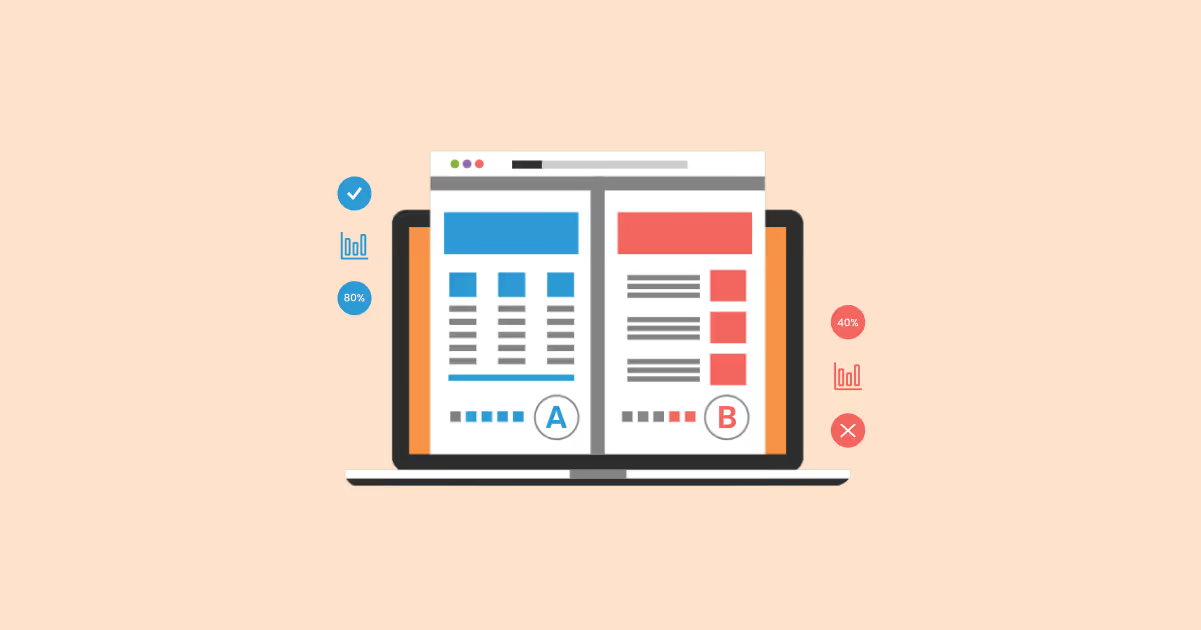
A/B testing is a strategy that, simply put, allows you to compare two versions of something and find out which version performs better.
Marketers use this technique to compare two or more versions of their websites, adverts, emails, pop-ups, or landing pages against each other to see which version is most effective. In A/B testing, A refers to ‘control’ or the original version and B refers to ‘variation’ or the new version. A/B tests can provide both qualitative and quantitative insights for the marketer. It usually falls under the larger umbrella of Conversion Rate Optimization or CRO.
To illustrate an example, you might test two different Google Ads to see which one drives more purchases or you might want to test two versions of a CTA button on a webpage to see which version leads to more webinar sign-ups. The version that drives more visitors to take the desired action (click on the ad, sign up for the webinar, etc) is the winner.
Why Does it Matter?
A/B testing is a great way to field-test ideas before finalising implementation. A/B testing helps you track impact of the changes on key metrics like conversion rates, drop off rates, etc. Thereby providing key insights on how effective the changes are going to be. Secondly, leaders don’t want to make decisions unless there is strong evidence for them, particularly when they have to incur costs. A/B testing helps databack ideas and decide where and how to invest the marketing budget. It is a great tool for creating effective marketing strategies.
Where do marketers use A/B testing?
Almost any style or content element that is a customer-facing item can be evaluated using A/B testing.
Some common examples include:
- Website design and layout
- Email campaigns and personalised emails
- Social media marketing strategies
- Paid Adverts
- Newsletters
In each category, A/B tests can be conducted on multiple elements. For example, if you want to test your website design, you can test the colour scheme, layout, headings and subheadings, pricing page, special offers, CTA button designs, etc, amongst many other elements.
While the metrics for conversion are unique to each website, A/B tests can be used to collect data and understand user behaviour, user actions, the pain points, reception to new features, satisfaction with existing features, etc. The metrics however depend on the industry and type. For example, the metrics for B2B (new leads or deals won) will be different from their B2C and D2C counterparts (cart abandonment rate, total purchases, etc).
{{INLINE_TOFU}}
The Primary Types of A/B tests:
1. Split URL testing:
The simplest in concept — in split URL testing, two versions of a webpage url are compared with each other using webpage traffic to see which performs better on key metrics. It is the primary testing method for most organisations vying for website optimisation. However, this is not the best method to compare between two changes. It is mostly used to compare the original version with the new version that has some changes. More importantly, you can’t learn more about how different changes or elements interact with each or what combinations perform best.
2. Multivariate testing (MVT):
Multivariate testing allows the experimenter to compare multiple variables in the same test. This helps further what split URLs can do by overcoming their main limitation. Here, you can compare various combinations of the elements whose impact you’re trying to test. Good multivariate tests can combine all possible permutations to find which combination produces the best results. However, a large traffic is needed to be able to divide the traffic to face all the permutations of the webpage that is created by the traffic.
3. Multi-page testing:
Multi-page, as the name suggests, implements the changes being studied over multiple pages instead of a single page as is seen with simple split A/B tests. This helps understand how the changes impact the visitors in terms of how they interact with the different pages that they encounter on the website. This also helps maintain consistency when a visitor is met with a new variation that is being tested.
How to perform an A/B test
The A/B testing process can be summarised as follows...
1. Data Collection:
In the first stage, the marketers or experimenters collect data from their analytics softwares to look out for numbers like high and low traffic areas, pages with high and low conversion rates, and or drop-off rates. This helps understand how the webpage is currently performing.
2. Decide what features you want to test:
Here marketers decide what features on the website or webpage they want to track and identify the goals. In other words, the determining the key conversion metrics that they want to improve for those features.
3. Formulate hypothesis:
Here, one starts generating A/B testing ideas and formulating a hypothesis for why the changes will perform better in terms of impact on the metrics being tracked.
4. Create variations:
After the hypothesis has been created, giving direction and clarity to the marketer’s goals, create variations that will be tested against the current version. This is where the marketer will choose the method of testing as well as the A/B tool used for testing.
5. Run test:
After everything is in place, the only thing left to do is to run the test. Most A/B testers suggest around two weeks of testing on average. However, it varies based on the campaign, industry and traffic.
6. Analyse results:
Once the test is complete, the experimenter can interpret the results given by the A/B test. It is important to ensure that the result is statistically significant. In other words, if one version saw better results than the other version, the changes can be confidently attributed to the new changes (and not coincidences).
7. Make changes:
Finally, now that the marketer has data backing their new ideas or proposed changes, they can go ahead and implement them to reap the reward of a more effective variation on metrics such as conversion rates, drop off rates, click-through rates and so on.
How do A/B testing tools work?
In short, every A/B testing tool has a piece of code that decides which variation of the webpage, email or ad each visitor sees. It also collects the data for the visitors of each variation which helps you compare and analyse visitor behaviour.
This code works by incorporating the URL of the page(s) that are being tested. It also incorporates the metrics that you want to test. The results from this will determine which variation performs better. The tool’s cookies track visitors and opt them into the experiment. It will divert the traffic where half the visitors see version A (the control) and half see version B (the variant). The cookies track which version a particular visitor is opted into and measures their actions on the webpage towards the specified goal.
There are several tools on the market today for A/B testing including Hubspot’s A/B testing tool, Google Optimize, VWO, and Optimizely.

6sense & Factors.ai Partnership Announcement
With our collaboration with 6sense, Factors.ai now delivers visitor identification, intent data, and our existing advanced ABM analytics.
We’re thrilled to announce our partnership with industry-leading account-based marketing platform, 6sense.
With this deep-rooted collaboration, Factors.ai now delivers state-of-the-art account identification, firmographics, and intent data along with our existing ABM analytics and attribution capabilities.
Users can expect to tap into 6sense’s extensive databases with Factors.ai to discover upto 64% of anonymous companies visiting the website — including account-level website behavior, purchase intent, and timelines.
Account Identification + Account Analytics = ABM Magic
This article highlights what the partnership means for our users, along with a few use-cases and testimonials. If you can’t already tell, we’re really excited for the immense value this collaboration brings to our customers.
.png)
A few common questions
Why partner with 6sense over other alternatives?
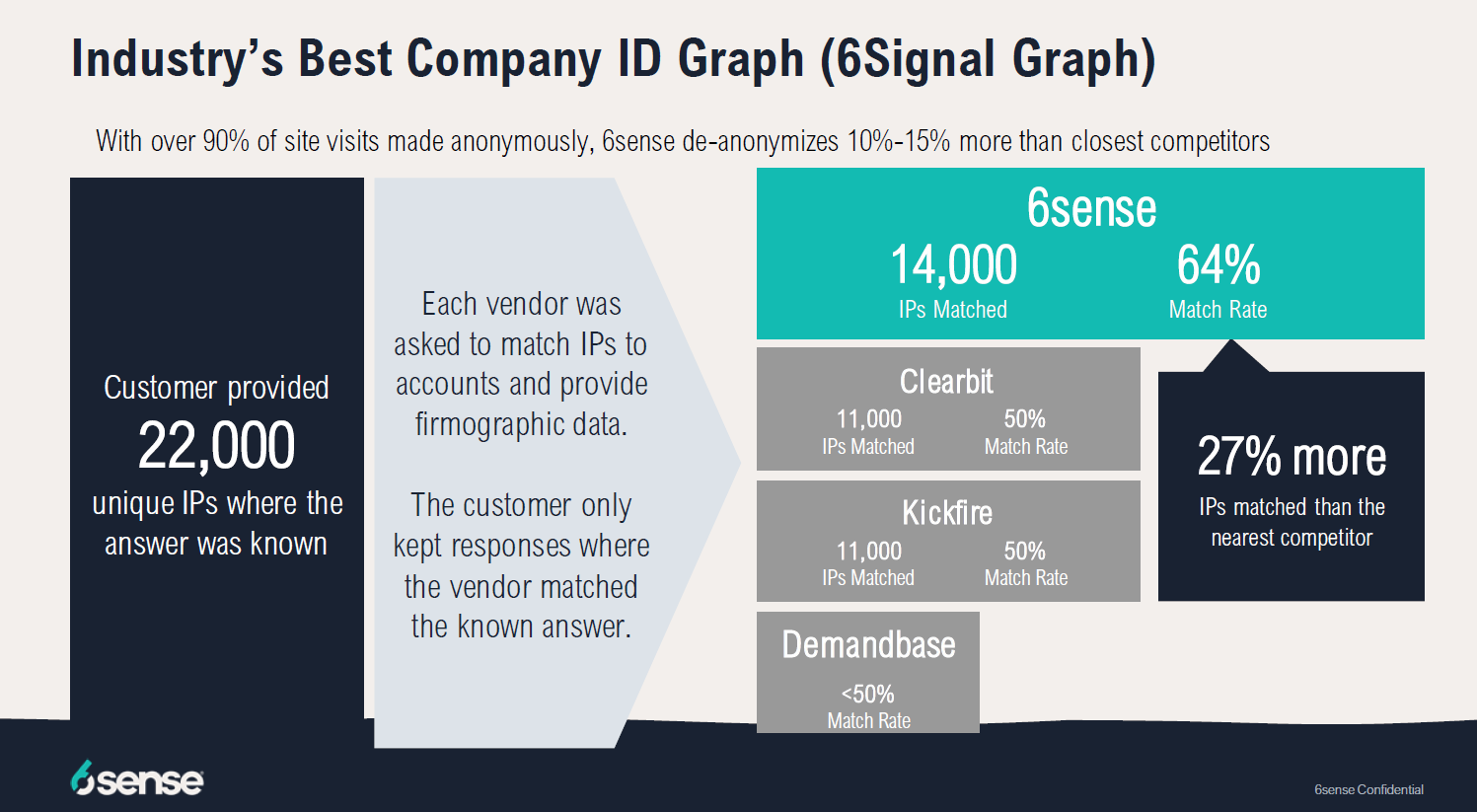
Rigorous comparative testing with over 20,000 IPs reveals that 6sense is far ahead of the game in terms of data quality, volume, consistency, and pricing. The infographic below highlights 6sense's ability to identify up to 27% more accounts than the closest alternative. Also, it doesn't hurt that 6sense is one of the leading ABM platforms in the market today.
Do users need a separate 6sense account to use account identification with Factors?
Nope! you do not have to be a 6sense customer to use account identification with Factors. Simply reach out to our team to enable this integration within your Factors project — without signing up or paying independently for a 6sense account.
If you are an existing 6sense customer, simply integrate your 6sense account to Factors using the API key.
Can Factors identify email IDs or phone numbers of anonymous website visitors?
No. Factors is a privacy-first, GDPR compliant solution. It only discovers IP-to-Company-level data. Factors does not identify individual website visitors or personal information like phone numbers or mail IDs unless the user chooses to share this information through form submissions.
How does pricing work?
Read more about our pricing details here: factors.ai/pricing
6sense & Factors.ai: What’s in it for you?
As B2B go-to-market teams continue to adopt account-based marketing strategies, there’s a growing demand for both account analytics and account intelligence. Here’s how the 6sense x Factors.ai partnership helps with both:
.png)
Factors's real-time Slack Alerts for accounts identified via 6sense's visitor identification technology have helped our Sales Team be proactive. Roughly 25% of last month's new revenue for Clearfeed is due to the outbound outreach done by the SDRs based on Factors data.
1. Account Identification
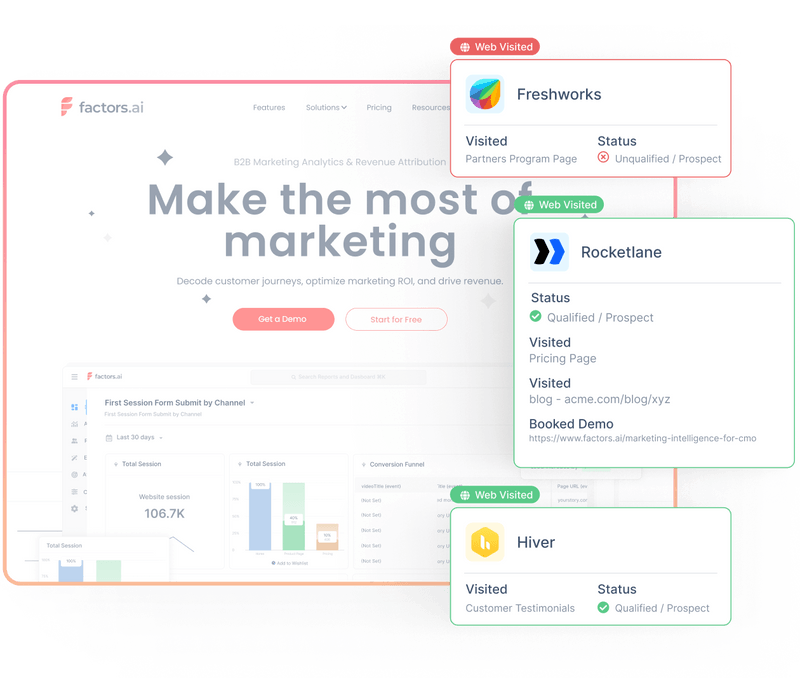
B2B companies invest significant resources towards driving high-intent website traffic. Unfortunately, only about 4% of this traffic comes to light through forms or signups. With 6sense, Factors.ai can identify up to 64% of anonymous companies using industry-standard IP-lookup technology!
As we’ll cover in following sections, this provides sales and marketing teams with the ability to identify and target the right opportunities, personalize the customer experience, and measure the impact of campaigns.
2. Firmographics + Advanced Analytics
In addition to identifying company names, 6sense enriches visitor data with detailed firmographics such as domain, industry, headcount, location, and more. This information is continually optimized with proprietary machine learning and human QA. Firmographic data, in conjunction with Factors.ai’s advanced website analytics — button auto captures, page time spent, scroll percent, etc — helps effectively identify high-intent accounts, well-resonating website content, and points of friction along the customer journey.
The cherry on top: configure real-time Slack alerts when target accounts land on specific web pages to reach out to leads while the iron’s still hot. Research finds that contacting leads quickly significantly improves the odds of conversion. Our early adopters have been seeing real value delivered to their sales reps and ABM marketers.
3. Account Journeys & Timelines
A crucial element of account-based marketing is tracking how target accounts are progressing along the customer journey. Upon identifying companies visiting your site, Factors.ai creates an intuitive account-level timeline of the journey in real-time — across campaigns, website, and CRM.
On one hand, this provides retrospective insight into what campaigns and assets drive conversions. On the other hand, it provides forward looking inputs to optimize retargeting efforts and personalize sales pitches based on the account’s previous interactions.
Struggling to identify more than 5% of your anonymous traffic? See how Factors.ai can help your business reveal upto 64% of website traffic over a personalized demo.
{{INLINE_TOFU}}
Use-cases: Account Identification, Firmographics, and Intent Data
1. For Demand Gen
With this partnership, demand gen teams can see which marketing initiatives and assets are driving high-intent accounts to their website. Rather than relying on expensive spray and pray tactics, teams can reallocate resources to targeted efforts that bring in the right kind of buyers.
On the flip side, demand gen folk can reveal companies visiting the website and retarget the right, ICP accounts based on firmographic and intent. In a time when teams are asked to do more with less, Factors offers to optimize marketing ROI and make tight budgets go a long way.

A game changer for B2B Marketers for Account Analytics. Factors' advanced analytics combined with 6sense visitor identification allows us to build a complete understanding of the Account Journey including the dark funnel. We are now able to plan our marketing campaigns and content efforts with clear visibility into what is driving conversions and pipeline.
2. For Content Marketers
B2B companies tend to invest heavily in content without actually knowing who the end consumers are. With Factors, content marketers can pin-point who’s reading ungated assets such as blogs and case studies.
For one, this helps discern what content resonates with different audiences. Content teams can guide their strategy based on what resonates best with their target personas. For another, content marketers can tie their efforts back to bottom line metrics like pipeline by showcasing timelines as buyers progress from blogs, to demos, to trials, and finally, to deals.

Combining 6sense visitor identification with Factors' advanced analytics has unlocked insightful views for our product and content marketing teams. We now have a clear view of how our content performs across key audience segments — and the opportunities to optimize user journeys and conversions further.
3. For Product Marketers
Product marketers continually iterate on messaging for core pages such as the home page, pricing page, and features page. While standard web analytics and A/B testing tools provide insight into whether a certain message is working for overall traffic, this partnership empowers product marketers to experiment and tailor messaging for known visitors.
For instance, account identification and firmographics may reveal that larger companies are more interested in privacy compliance material while smaller teams may care about transparent pricing. Based on who the PMM is looking to target, they may alter messaging accordingly.
4. For Sales
The benefits of account identification and analytics is especially apparent in the case of sales teams. For one, sales reps can tap into a net-new pool of business from existing website traffic with zero additional spend. Within this set of accounts, sales can target the right ones based on intent and engagement insights. Finally, rather than spending hours trying to contact cold prospects, sales reps can improve direct engagement by reaching out to accounts while they’re on the site through real-time Slack alerts.
Overall, the workflow encouraged by the 6sense x Factors partnership dramatically improves sales productivity.
.png)
A dream solution for B2B marketers to unfold user journeys. When we chalk plans for a campaign, we love valuable insights. Even better when I have it diced & sliced. We get it all here & engage with our audience. The granularity of data is perfect & the mining engine of Factors with 6sense has unbelievable match rates for de-anonymizing accounts.
Curious to see 6sense and Factors.ai in action? Book a personalized demo here!
Related reading:
Factors.ai has teamed up with 6sense to boost its account-based marketing (ABM) features. This partnership enables Factors.ai to provide advanced visitor identification, firmographic data, and intent signals, helping users identify up to 64% of previously anonymous website visitors. With these insights, B2B teams can focus on high-intent accounts, tailor their outreach, and refine marketing strategies. The integration is seamless, with no need for a separate 6sense account, and it complies with GDPR by using IP-to-company data instead of personal identifiers.
5 Ps of Marketing Explained
Master the 5 Ps of Marketing (Product, Price, Promotion, Place, People) to create winning strategies that engage customers, boost sales, & build loyalty
While most of us may have studied or heard about the 5 Ps of marketing, a quick revision wouldn’t hurt, right?
This time, imagine marketing your grandma’s secret recipe - each ingredient is carefully chosen to create a yummy dish that leaves you craving for more. In her special recipe marketing, there's a tried-and-true formula that has stood the test of time: the 5 Ps. Think of it as your secret mix for success in the kitchen!
Did you know?
Prof. James Culliton of Harvard University cooked up this concept in the 1940s. He called it the "4 Ps of the marketing mix." But just like any great recipe, it evolved, adding one more essential ingredient to the mix.
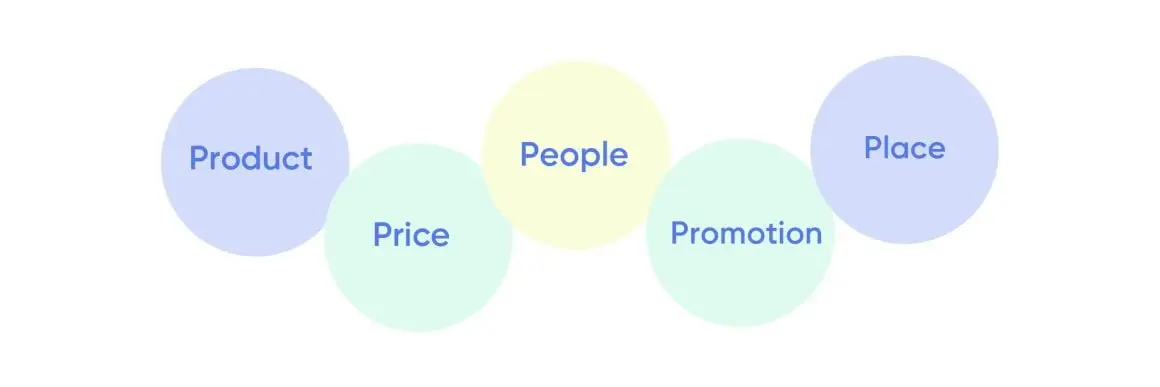
These five Ps are
1. Product
The main dish that everyone's here to taste.
2. Price
Price sets the tone, like the price tag on a menu, signalling whether it's a budget-friendly meal or a gourmet treat.
3. Promotion
Promotion is your chef's special, the aroma that draws customers in, whether it's through flashy ads or word-of-mouth.
4. Place
The cozy restaurant tucked away on a street corner or the trendy food truck parked in the heart of the city. It's all about convenience and accessibility, making sure your customers can feast on your offerings wherever they are.
5. People
The friendly faces behind the counter, the enthusiastic servers, and the satisfied customers and influencers singing your praises. They're the ones who bring your brand to life, turning first-time visitors into loyal fans with every interaction.
As legendary marketer Seth Godin once said, "Marketing is no longer about the stuff that you make, but about the stories you tell." And the 5 Ps? Well, they're the mix that helps you cook up those irresistible stories, leaving your customers hungry for more.
So, grab your apron and sharpen those knives. Let's dive right in to uncover the secrets to crafting a recipe for success.
I. Product
The product is the essence of any business; it's what you offer to fulfill your customers' needs or desires. Without a compelling product, the other elements of marketing lose their significance. Your product is at the heart of your brand identity and the primary way you create value for your customers.
Your product encompasses everything from the physical attributes of what you're selling to the intangible benefits it provides. This includes features, design, quality, branding, packaging, and even the customer experience associated with your offering. It's about crafting something that meets a specific need or solves a particular problem for your target audience.
Types of Products
- Digital Products
As you may already know, these are intangible goods or services delivered electronically. Examples include software, e-books, online courses, and digital downloads. Digital products offer scalability, low distribution costs, and the ability to deliver instant gratification to customers.
- Physical Products
These are tangible goods that customers can touch, feel, and use. Examples range from consumer goods like electronics and apparel to industrial products like machinery and equipment. Physical products often involve manufacturing, inventory management, and distribution logistics.
Points for Consideration
- Product Development Activities
These include market research, ideation, prototyping, testing, and refinement. By understanding your target market's preferences and pain points, you can develop products that resonate with them. Continuous improvement based on customer feedback ensures that your offerings remain relevant and competitive.
- Product Lifecycle
Products go through distinct stages – introduction, growth, maturity, and decline – each requiring different strategies. Understanding where your product stands in its lifecycle helps you anticipate market dynamics and plan accordingly. It also informs decisions about product extensions, updates, or discontinuations.
- Distribution Channels
How you deliver your product to customers is crucial. Distribution channels can include direct sales, retail stores, e-commerce platforms, wholesalers, or a combination of these. Choosing the right channels depends on factors like target market preferences, geographic reach, and cost considerations.
Example
Let's consider the example of a smartphone. The product itself encompasses the physical device – its design, features, and specifications. However, it also includes intangible elements such as the brand reputation, user interface, and ecosystem of apps and services. Product development activities for a smartphone might involve market research to identify consumer preferences, iterative design processes to refine the user experience, and testing to ensure reliability and performance. Throughout its lifecycle, the smartphone may be distributed through various channels, including retail stores, telecom carriers, and online marketplaces. In a digital era, smartphone manufacturers also leverage software updates and app ecosystems to enhance the product's value proposition and longevity.
II. Price
Pricing entails setting a monetary value for your product or service that reflects its perceived worth to customers. It involves considering factors like production costs, competitor pricing, market demand, and customer willingness to pay. Effective pricing strategies align with your business objectives, target market, and positioning in the marketplace.
Price is crucial because it determines the value exchange between you and your customers. It's not just about putting a number on your product or service; it's about finding the sweet spot that balances what customers are willing to pay with the profitability of your business. Price directly influences consumer perceptions, purchase decisions, and your overall competitiveness in the market.
Factors that help brands make pricing decisions
- Cost-based Pricing
Calculating the total cost of production, distribution, and marketing, and adding a markup to ensure profitability.
- Value-based Pricing
Assessing the perceived value of the product or service to the customer and pricing accordingly.
- Competitive Pricing
Analyzing competitor pricing strategies and positioning your product accordingly in the market.
- Demand-based Pricing
Setting prices based on supply and demand dynamics, adjusting prices to maximize revenue during peak periods or to stimulate demand during off-peak times.
- Psychological Pricing
Leveraging pricing tactics such as charm pricing (ending prices in 9 or 99), prestige pricing (setting high prices to convey luxury or exclusivity), or price bundling (offering multiple products or services for a single price) to influence consumer perception and behavior.
Pricing Strategies
- Dynamic Pricing
This strategy involves adjusting prices in real-time based on factors like demand, seasonality, competitor pricing, and customer behavior. Airlines, hotels, and ride-sharing services often use dynamic pricing algorithms to optimize revenue.
- Pricing Tiers
Offering multiple price points allows you to cater to different customer segments with varying needs and budgets. For example, software companies may offer tiered pricing plans with basic, standard, and premium features to appeal to different user groups.
- Subscription-based Pricing
Subscriptions offer customers ongoing access to a product or service for a recurring fee. This model provides predictable revenue streams for businesses and fosters customer loyalty through continuous value delivery. Examples include streaming services like Netflix and software-as-a-service (SaaS) platforms like Adobe Creative Cloud.
- Minimum Pricing and Maximum Ceiling
Establishing a floor price prevents undervaluing your product or service, maintaining brand integrity and profitability. Similarly, setting a maximum ceiling ensures that prices remain competitive without alienating price-sensitive customers.
- Deferred Payments
Allowing customers to pay for products or services over time through installment plans or financing options can increase affordability and purchasing flexibility. However, it's essential to assess credit risk and ensure timely payments.
- Discounts and Coupons
Offering temporary price reductions or promotional incentives can stimulate sales, attract new customers, and reward loyalty. Whether through seasonal sales, loyalty programs, or referral discounts, discounts and coupons can create a sense of urgency and incentivize action.
Example: Coffee Shop
Let's consider the example of a coffee shop. The price of a cup of coffee may vary based on factors such as the quality of beans, location, and competition. The coffee shop may implement dynamic pricing during peak hours, increasing prices to capitalize on high demand and maintain profitability.
Additionally, they may offer pricing tiers for different coffee sizes or specialty drinks, catering to varying customer preferences and budgets. To encourage repeat business, the coffee shop could introduce a subscription model, where customers pay a monthly fee for unlimited coffee refills or exclusive discounts. They may also participate in price comparison sites to showcase their competitive pricing and attract new customers searching for the best deals.
Finally, the coffee shop could offer discounts or coupons during off-peak hours to drive traffic and boost sales during slower periods. Through a strategic approach to pricing, the coffee shop maximizes revenue while delivering value to customers.
Example: Netflix Subscription Tiers
Netflix's pricing strategy for its subscription-based streaming service is a prime example of catering to diverse customer needs while maximizing revenue. Netflix offers multiple subscription tiers, each tailored to different usage levels and budget preferences.
The basic tier offers access to standard-definition content on one screen at a time, making it an affordable option for individual users. In contrast, the premium tier provides access to ultra-high-definition content on up to four screens simultaneously, catering to families or users who value premium features.
Furthermore, Netflix adjusts its pricing periodically to reflect changes in content offerings, market demand, and competitive pressures. This dynamic pricing approach allows Netflix to optimize its revenue while providing value to its diverse customer base.
By offering a range of pricing options and periodically adjusting its rates, Netflix effectively balances affordability with value, ensuring a competitive edge in the crowded streaming market.
{{INLINE_TOFU}}
III. Promotions
Promotions encompass all activities aimed at communicating the value proposition of a product or service to the target audience. This includes advertising, public relations, sales promotions, personal selling, direct marketing, and digital marketing efforts.
Your promotions play a crucial role in the marketing mix because they serve as the primary means of communication between businesses and consumers. While the product addresses customer needs, the price reflects the perceived value, and the place ensures accessibility, promotions amplify these elements and influence consumer perception and behavior.
The goal of promotions is to create awareness, stimulate interest, generate desire, and ultimately drive action or purchase intent among consumers. Effective promotions can differentiate a brand, build brand equity, and ultimately drive sales and revenue.
Distribution Channels for Promotions
Promotions can be distributed through various channels, both traditional and digital, depending on the target audience, budget, and marketing objectives.
Common distribution channels for promotions include:
- Television, radio, and print advertisements
- Social media platforms (Facebook, Instagram, Twitter, LinkedIn)
- Online display ads and search engine marketing (Google Ads)
- Email marketing campaigns
- Influencer partnerships and collaborations
- Public relations activities (Press Releases, Media Events)
- Sales promotions (Discounts, Coupons, Rebates)
Factors to consider while choosing the Promotional Channel
Choosing the right promotional channels requires careful consideration of various factors, including
- Target Audience
Understanding the demographics, psychographics, and media consumption habits of your target audience helps identify the most effective channels to reach them.
- Budget
Assessing the available budget and cost-effectiveness of different channels helps prioritize promotional activities and allocate resources accordingly.
- Objectives
Aligning promotional channels with specific marketing objectives – whether it's building brand awareness, driving website traffic, or increasing sales – ensures that efforts are focused and measurable.
- Reach and Frequency
Evaluating the reach and frequency potential of each channel helps maximize exposure and engagement with the target audience.
- Competitive Landscape
Analyzing competitors' promotional strategies and presence across different channels can inform decisions about where to allocate resources for maximum impact.
- Integration and Consistency
Ensuring consistency and synergy across promotional channels and messaging helps reinforce brand identity and enhance the overall customer experience.
Example: Clothing Brand
Let's consider the example of a clothing brand launching a new product line targeting young adults. To promote the new collection, the brand might leverage a mix of promotional channels
- Social Media
Launching teaser posts on Instagram and Facebook to build anticipation, followed by sponsored ads showcasing the products and directing users to the brand's website.
- Influencer Marketing
Partnering with fashion influencers and bloggers to create sponsored content featuring the new collection and sharing their reviews and styling tips with their followers.
- Email Marketing
Sending out targeted email campaigns to subscribers announcing the product launch, offering exclusive discounts, and inviting them to shop the collection online. Here are Google’s latest guidelines for bulk email senders (2024).
- Pop-Up Events
Hosting experiential pop-up events in trendy locations frequented by the target audience, where customers can preview and purchase the new collection while enjoying music, refreshments, and interactive activities.
- Public Relations
Securing media coverage in fashion magazines, blogs, and online publications to generate buzz and raise awareness about the brand and its new collection.
Example: Nike's "Just Do It" Campaign
Nike's "Just Do It" campaign stands as a timeless example of effective promotion that transcends traditional advertising to inspire and motivate consumers. Launched in 1988, the campaign features iconic slogans and powerful imagery that resonate with athletes and non-athletes alike.
Through compelling storytelling and endorsements by prominent athletes like Michael Jordan and Serena Williams, Nike positions itself as a brand that champions determination, perseverance, and excellence. The campaign's message of empowerment transcends mere product promotion, fostering a deep emotional connection with consumers.
Moreover, Nike's strategic use of multiple promotion channels, including television commercials, print ads, social media, and sponsorships, ensures widespread visibility and engagement. By leveraging the power of storytelling and aligning its messaging with core brand values, Nike's "Just Do It" campaign continues to inspire and resonate with audiences worldwide.
IV. Place
Place, also known as distribution, encompasses the methods and channels through which products or services are made available to customers. It involves everything from the physical locations where products are sold to the logistical processes involved in getting them there. Place ensures that products are accessible and convenient for customers to purchase.
So why is ‘place’ so important?
Place is critical because even the most innovative product, compelling price, and effective promotion are futile if customers can't access or obtain the product conveniently. It ensures that the right product is available at the right time, in the right quantity, and in the right location.
The ‘place’ is where the transaction between the business and the customer occurs, making it a pivotal part of the marketing mix.
Types of Distribution Channels
Distribution channels refer to the pathways through which products move from the manufacturer to the end consumer. Fulfillment is the process of receiving, processing, and then delivering customer orders.
Common distribution channels and fulfillment methods include
- Direct Distribution
Involves selling products directly from the manufacturer to the end consumer without intermediaries. Examples include company-owned retail stores, e-commerce websites, and direct sales representatives.
- Retail Stores
Brick-and-mortar stores where customers can physically browse, purchase, and take immediate possession of products. Examples include department stores, specialty shops, and supermarkets.
- E-commerce Platforms
Online marketplaces and websites where customers can browse, select, and purchase products remotely. E-commerce platforms offer convenience, 24/7 accessibility, and the ability to reach a global audience.
- Indirect Distribution
Involves one or more intermediaries between the manufacturer and the end consumer. Indirect distribution channels can include wholesalers, distributors, retailers, and agents.
- Wholesale
Selling products in bulk quantities to retailers or other businesses for resale to end consumers. Wholesale distribution involves negotiating contracts, managing inventory levels, and coordinating shipments to distributors or wholesalers.
- Multichannel Distribution
Utilizes multiple distribution channels simultaneously to reach different customer segments or markets. For example, a company may sell its products through both retail stores and e-commerce platforms to cater to diverse customer preferences.
- Intensive Distribution
Aims to make products available in as many outlets as possible to maximize market coverage and accessibility. Intensive distribution is common for everyday consumer goods like beverages, snacks, and personal care products.
- Selective Distribution
Involves carefully selecting a limited number of retail outlets or distributors based on specific criteria such as geographic location, target market demographics, or brand image. Selective distribution is typical for products with higher prices or specialized features.
- Exclusive Distribution
Grants exclusive rights to a single distributor or retailer to sell a product within a particular geographic area or market segment. Exclusive distribution is often used for luxury or high-end products to maintain exclusivity and prestige.
That said, businesses must keep the logistics and supply chain management in mind while formulating their distribution strategies. Managing the flow of products from suppliers to warehouses to distribution centers to retail stores or customers' doorsteps. Effective logistics ensure timely delivery, accurate inventory management, and cost-efficient operations.
Example: Starbucks Retail Stores
Starbucks' retail stores exemplify strategic placement and meticulous attention to the customer experience. With over 30,000 stores worldwide, Starbucks has established a ubiquitous presence in high-traffic locations, including urban centers, shopping malls, and transportation hubs.
The placement of Starbucks stores is carefully curated to maximize convenience and accessibility for customers, ensuring that they can easily find and frequent their favorite coffee destination. Whether it's a bustling city street or a suburban neighborhood, Starbucks' presence is felt in diverse locations, catering to a broad demographic of coffee enthusiasts.
Moreover, Starbucks' emphasis on creating inviting and comfortable environments further enhances the appeal of its retail stores. From cosy seating areas to free Wi-Fi access, Starbucks stores offer more than just coffee – they provide a welcoming space for customers to relax, socialize, and enjoy the Starbucks experience.
V. People
People are at the heart of every marketing endeavor. It's the people who drive demand for products or services, make purchase decisions, and ultimately determine business success.
People refer to all individuals involved in the marketing process, including customers, employees, partners, stakeholders, and influencers. It encompasses understanding their needs, preferences, motivations, and behaviors to create meaningful interactions and relationships.
Understanding and catering to the needs and preferences of people – whether they are customers, employees, or partners – is essential for creating value, fostering loyalty, and achieving sustainable growth.
Moving Beyond your Sales Team
- Sponsorships
Sponsorships involve partnering with individuals, organizations, events, or causes to promote brand awareness, enhance brand image, and reach target audiences. Sponsorship opportunities can include sports events, concerts, festivals, charity initiatives, or industry conferences. By associating with relevant sponsorships, businesses can increase visibility, credibility, and engagement with their target market.
- Cross-promotions
Cross-promotions entail collaborating with complementary businesses or brands to promote each other's products or services. This can involve joint marketing campaigns, co-branded promotions, or product bundling arrangements. Cross-promotions leverage the existing customer bases and brand equity of both parties to expand reach, drive sales, and create mutual benefits.
- Influencer marketing
Influencer marketing involves partnering with individuals or social media personalities who have a significant following and influence over their audience. Influencers can endorse products or services through sponsored content, reviews, or endorsements, leveraging their credibility and authority to sway purchase decisions. Influencer marketing can be particularly effective for reaching niche audiences, generating authentic engagement, and building brand advocacy.
Significance of having industry influencers for B2B selling
In B2B selling, industry influencers play a crucial role in driving credibility, trust, and thought leadership. B2B buyers often rely on industry experts, thought leaders, and influencers for insights, recommendations, and validation when making purchasing decisions. Partnering with industry influencers can provide access to decision-makers, enhance brand visibility, and position the business as a trusted authority in the industry.
Example: Fitness Apparel
Let's consider the example of a fitness apparel brand aiming to target health-conscious millennials. They could leverage people-focused strategies such as
- Influencer Marketing
Partnering with fitness influencers and lifestyle bloggers to showcase their products in action, share workout routines, and promote healthy living tips to their followers. By aligning with influencers who embody their brand values and resonate with their target audience, the apparel brand can increase brand awareness and drive sales.
- Cross-Promotions
Collaborating with fitness studios, gyms, or wellness brands to offer joint promotions, such as discounted gym memberships with apparel purchases or co-branded fitness events. These cross-promotions create synergy between complementary businesses and provide added value to customers.
- Sponsorships
Sponsoring local fitness events, charity runs, or wellness festivals where their target audience is likely to participate. By associating with these events, the brand can demonstrate its commitment to health and fitness, engage with the community, and build positive brand associations.
Example: Tesla's Sales and Service Representatives
Tesla's sales and service representatives exemplify the importance of knowledgeable and customer-centric personnel in driving sales and fostering brand loyalty. Unlike traditional car dealerships, Tesla's approach to sales and customer service emphasizes direct engagement with knowledgeable representatives who are passionate about electric vehicles.
Tesla's sales representatives are trained to provide personalized guidance and support to customers throughout the purchase process, from test drives to vehicle customization options. Their expertise in electric vehicle technology and commitment to customer satisfaction differentiate Tesla's sales experience from traditional automotive retail.
Furthermore, Tesla's service representatives play a crucial role in maintaining customer satisfaction and loyalty by providing prompt and efficient support for vehicle maintenance and repairs. With a focus on transparency and proactive communication, Tesla's service team ensures that customers receive the highest level of care and attention.
By investing in knowledgeable and customer-focused personnel, Tesla not only enhances the sales and service experience but also strengthens its brand reputation and fosters long-term customer relationships.
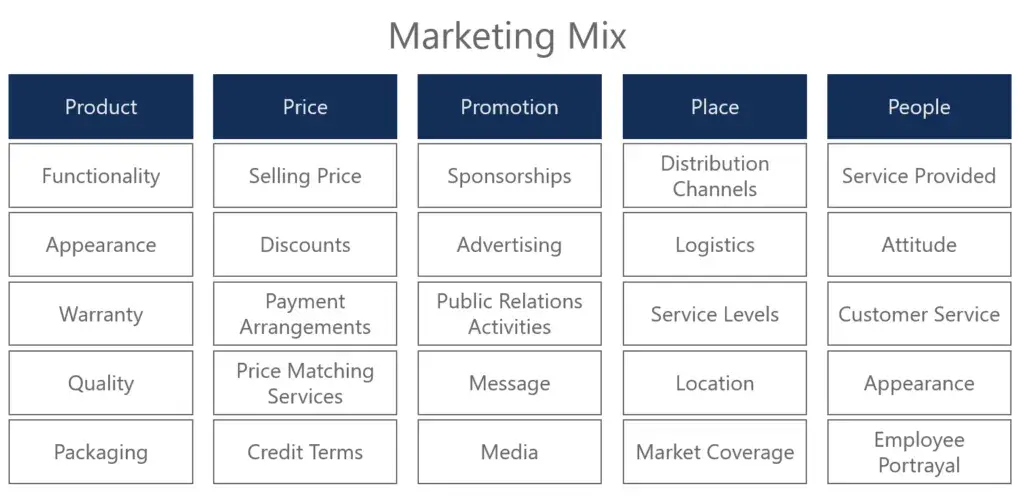
As we come to a close, it's clear that the 5 Ps of Marketing bring their own unique strengths to the table. By stitching these elements together, we create a strategy that captivates audiences, drives sales, and builds relationships that stand the test of time.
If you’re looking to read and learn more about marketing terms, read our blog on 102 Essential B2B Terms.

8 Common Revenue Attribution Mistakes You Should Avoid
Learn about 8 common revenue attribution mistakes and optimize your strategy for better results. Don't miss out on valuable insights!

Marketing’s transformation from a cost-centre to a revenue powerhouse — coupled with a boom in digital channels — means that marketers, now more than ever, require a granular account of their influence on pipeline and revenue.
Enter: Revenue Attribution.
B2B companies are prioritizing revenue attribution to measure their marketing performance and ROI, and track customer journeys. In fact, 76% of all marketers find that they currently have or will have in the next 12 months, the capability to employ a robust revenue attribution platform (Think with Google). Conceptually, the function of attribution is straightforward, but there are several mistakes that could easily skew your results and limit your progress when it comes to accurate, actionable revenue attribution analysis.
With that in mind, here are 8 common mistakes to avoid for your revenue attribution regime:
1. A lack of an attribution strategy
Despite the automation solutions that are embedded in most attribution tools today, it becomes easy to forget that your input plays a huge part in producing relevant results. Formulating a strategy is essential in being able to derive actionable insights from your attribution. At the end of the day, the relevance of tracking different channels and campaigns in a customer’s conversion journey is incumbent upon you.
Get organised! Start by cataloguing relevant channels to track as per your conversion goals. Label your channels and campaigns and assign budgets so that all your data across all your tools is coherent. Tracking irrelevant channels (or not tracking relevant ones) is a part of trial and error, but reliance on such incomplete data is a big red flag. One common example of this is: tracking only the performance of ad campaigns without testing its performance relative to other channels.
Communicating with the appropriate personnel and others involved in the strategy to gain better insight on what to track and what not to is a good start.
2. Excessive reliance on preliminary revenue attribution models
The tendency to rely on preliminary attribution models — single-touch models like first and last touch or the popular last-click model — may produce quick and simple results to measure your ROI. This, however, can be an expensive mistake. Don’t get it twisted, single-touch models have their use cases — attributing PPC and short sales cycles to name a couple. But relying solely on preliminary models for all your marketing decisions will likely do more harm than good. Single-touch models are linear in nature, which is not conducive to most customer behaviour. Attribution is more effective when you strive to get as close as possible to analysing a customer’s journey across several touch-points. And having one touchpoint attributed to a customer’s conversion gives a vague, and often inaccurate, image of their journey.
3. Not testing multiple attribution models
This mistake is likely to be a consequence of the previous point — excessive reliance on preliminary models. But why is it important to test other models? When it comes to rule-based attribution and multi-touch attribution models, the general reasoning behind adopting a model is the nature of the product, the number of marketing channels, the length of the sales cycle, etc. While there’s nothing explicitly wrong with this, we cannot only rely on those factors.
There are several omitted variables around the intent of your attribution — measuring the functionality of different campaigns in conjunction with other channels, the relative probability of channel interaction, opportunity cost of campaigns, or just simply mapping out the most influential channel and ROI. Even the type of campaigns and the medium through which the customer interaction occurs could affect your decision in choosing a model. Some models are more applicable than others in producing reliable results, and the only way we’ll identify this is by testing out what works and what doesn’t.
{{INLINE_TOFU}}
4. Not understanding the limits of rule-based modelling
In practice, administering a combination of rule-based attribution and data-driven attribution is an effective way of producing reliable results. That being said, if you’re for the most part dependent on rule-based modelling, you’re unlikely to have transparent results. Rule-based modelling is limited, as the weights in the models would need to perfectly represent the influence of each channel in a customer’s conversion journey. This is highly unlikely as no two customers are the same. For example, a time decay attribution model will assign credits in ascending order regardless of the type of campaign or prospect’s actual behaviour. So, to help identify your most influential channels on average, data-driven attribution can be used to give credibility to different channels by assessing their KPI’s. This in turn will help you draft a custom model that makes sense to your attributing pattern.
5. Misaligning attribution data and customers/lead quality
In the pursuit of using your attribution data to aid your marketing decision making, sometimes you forget to categorize our data considering the customers involved or their lead quality. To make better sense out of your attribution data, we need to pair the interactions with customer IDs to avoid duplication of leads and accurate credit distribution across marketing channels.
Tracking our customers even helps assess the quality of their leads. What this means is some customers are likely to be more interactive and engaged with your brand than others. This even dictates if some of them become recurring customers or only ever interact with your business once. Tracking customer interactions helps you distinguish the quality of their leads. These values also contribute to calculating the LTV (Lifetime Value) of your customers.
6. Ignoring the bias
These mistakes have to do with certain biases that might compromise your decision-making pertaining to attribution. The most common ones are:
Correlation Bias
When attributing credit to different channels along your customer journey, there is a possibility for certain interactions to conceive other interactions (or at least a level of other interactions). One could over/underestimate the influence of channels with other channels simply because of the natural conversion of targeted customers. A conscious consideration of correlation vs causation must always be kept in mind.
Confirmation Bias
A confirmation bias is the proclivity to seek out information, and the interpretation of said information, to favour your results and personal beliefs. This type of bias is prevalent in attribution as it involves having to attribute your channels in accordance with the result that favour you. This would eliminate the organic element of attribution to favour your marketing ideals, ultimately leading to inaccurate findings and conclusions.
7. Failure to understand the channel intent
When you fail to recognize your channel’s intent, you fall short in gauging how much it facilitated a customer’s conversion. This could lead to poor decision making as a consequence. Some channels facilitate interactions with other channels more than they do sales — like a blog versus a targeted email campaign. Hence, it would be unfair to discredit the channels that did not directly contribute to sales — or other predominant goals — but probably contributed significantly to a customer’s decision to convert.
8. Attribution is not the Be-All End-All of your marketing analytics journey
As convenient and resourceful as attribution is, they will never provide a holistic, extensive picture. While attribution is valuable in showcasing a blueprint of your campaigns, channels, and marketing performance. You still require other analytics tools — Funnel analysis, Anomaly detection, SEO optimization, CRM, and other web analytics tools that help assess channels using premeditated metrics. These tools will ultimately compliment your data-driven attribution for a far more comprehensive analysis of your campaign and channel performance. In order to do this effectively, you will have to use these tools cooperatively and in real-time.
Acknowledging these limitations and making a conscious effort to mitigate them will help equip and optimize your marketing attribution journey. Don’t let the idea that there is so much that could go wrong make you apprehensive about trying out marketing attribution to begin with. Undoubtedly, it’s a steep learning curve, but the rewards far outweigh the risk involved.
And there you have it! If you’re interested in understanding how some of the most popular single-touch and multi-touch attribution models work, you might enjoy this blog piece.
Avoiding common revenue attribution mistakes matters more than people think. It is the difference between “looks good on a dashboard” and “actually helps us make money.”
Most teams slip up early. They do not define a clear attribution strategy. They depend on single touch models even when their buyers have long, messy journeys. They never test different attribution frameworks, so they keep trusting the same model even when the data keeps changing.
Some mistakes happen later. Teams match attribution data to volume, not to customer quality. They forget that rule based models come with limits. They ignore offline touchpoints that influence deals but never show up in the CRM.
Other mistakes are cultural. Marketing and sales do not sync on what “good” looks like. Data hygiene takes a backseat. And then everyone is shocked when the numbers look off.
A multi touch attribution approach fixes most of this. It looks at the entire customer journey. It highlights which campaigns create real movement and which ones just make noise. And it helps teams measure ROI with confidence, instead of guessing their way through decisions.

5 Reasons Why CMOs Should Care About B2B Marketing Attribution
Discover the top 5 reasons why B2B marketing attribution is crucial for CMOs. Learn to optimize your marketing strategy & drive better results with Factors.
B2B Marketing Attribution (or B2B Revenue Attribution) empowers demand gen teams to map out their customer journeys and connect the dots between marketing and revenue. At a high level, attribution weaves the story that your marketing data is trying to tell about the influence of each touchpoint on core business objectives. As multitouch attribution technology improves, B2B attribution is becoming an increasingly powerful tool for CMOs to wield. Here are 5 way in which CMOs and marketing leaders can take advantage of B2B marketing attribution.
1. A Bird’s Eye View Of Marketing Efforts
B2B marketing attribution empowers marketers to capture nearly every touchpoint across the customer journey. This is valuable information as most B2B buyers are already halfway through the sales cycle before they explicitly engage with a sales rep.
Your customers have likely interacted with plenty of marketing channels and content before being picked up by the sales team. Moreover, many of these customers become high intent buyers even before sales or marketing identifies them as such. In such a case, it becomes important to know:
- Which touchpoints help them make their decisions
- What content or marketing activity influences them to further pursue a product or engage with your company
- What content helps users narrow down your product over your competitors
- At which touchpoint do customer generate buyer intent,
- At what touchpoint do customers lose this intent
This helps CMOs understand user journeys as well as the efficiency of various marketing efforts in influencing customer decisions. It gives insight into the precise point in the funnel during which to target customers and optimize conversion rates, which campaigns to allocate budget to, which touchpoints are weak links in the buyer journey, and more.
2. Achievable Targets
Marketing attribution, being the data-driven technique that it is, helps CMOs undertake goals in terms of achievability and feasibility. More importantly, attribution uses metrics that can be used to track the progress as well as the success of various campaigns across various channels. This also helps in planning larger goals as well as yearly sub-goals with forecasting, tracking and analysis of campaigns and their impact on revenue. Such goal-setting is not vague as it is thoroughly backed by data.
3. Improve Productivity and Alignment Across Demand Gen
As your business grows and your marketing campaigns and sales processes start to scale, it can be challenging to track which campaign brought in which leads. Sales and marketing activities tend to become more siloed and communication gaps between the two teams can widen. This can lead to a lot of inefficiencies in the handing over of leads from marketing to sales. Marketing may have insights on which touchpoints impacted most positively to a certain lead that can help sales reps during their engagement. Conversely, sales reps may have insights through their engagements on what information or campaign content helped customers make their buying decision. CMOs can use marketing attribution to align the processes of these teams and improve the productivity of each campaign and each SDR by unifying customer journey reports and touchpoints onto one platform.
{{INLINE_TOFU}}
4. Accountability and Reporting
With attribution, marketing leaders can easily generate reports of the most important metrics for their business and board. Moreover, it’s convenient for CMOs to track the performances of their various teams and understand the contributions of each team on conversions, pipeline, and revenue. For example, if a certain blog posts incurs recurring URLs for all leads that have converted, then it is a good idea to give more resources to the content team and perhaps even hire more writers. Attribution gives you hard data on metrics like website traffic and what pages they visited and how much time they spent, whether they filled a form or if they left without any activity, whether they clicked on a discount code or a free whitepaper or if they were not able to notice it — this can give a CMO a good idea on the interface and content of the website. In essence, attribution helps you hold each team accountable by getting a data-backed view of their performances.
5. Driving Growth
Marketing attribution recognizes trends and makes sense of the confusing quagmire of touchpoints in any marketing and sales funnel. Data is unequivocally important in driving sustained, scalable growth. If there is seasonality to when you get more qualified leads or there are specific blog posts, ad campaigns or social media platforms bringing in higher traffic and driving growth, attribution makes it easy to identify these high performing channels and take advantage of them. Most attribution tools have built-in integrations for various ad platforms, social media sites, CRMs and website tracking tools that ensure that regardless of how big you grow, you always have a handle over your customer tracking and don’t lose out on important insights that may get lost in high volumes of data.
In conclusion,
B2B Marketing attribution is a powerful tool for any CMO in 2022 to get the best insights from both internal and external data sources that an organization has. Forecasting, tracking trends, revenue impact, ensuring accountability, saving time and human resources on reporting to focus more resources on analysis and implementation, ensuring accuracy in reporting — are all foundational to building and executing powerful marketing campaigns. With marketing attribution, CMOs can make data-driven, informed decisions and enable their teams to deliver more with less spending and better, useful insights.

6 B2B marketing mistakes to avoid
Maximize your B2B marketing efforts by avoiding these common mistakes. Read Factors.ai's latest blog post for valuable insights and tips.

As a B2B marketing team, there are a few common mistakes that should be avoided. Not focusing on branding enough, or ignoring the potential solid audience research holds for your brand can all negatively affect your brand's growth in the long run.
The growth of online marketing strategies, various tools, and software, and even a shift in audience preferences have all led to a change in B2B business's marketing journeys. However, there are timeless mistakes that every B2B marketer should know about while crafting a marketing strategy.
In this blog, we'll cover the top 6 mistakes that a majority of B2B marketers make - mistakes you should try not to make throughout your marketing journey.
#1 A Lack of Focus on Branding
You may think, "What's branding got anything to do with B2B? Isn't branding only needed when interacting with a non-business audience like B2C brands?" This notion could not have been farther from the truth. Most B2B brands do not focus on branding as much as they should, since they do not see the contribution it provides to your brand and your customers in the long run. Put simply - branding is important. Creating a strong connection with your present and potential customers with a solid brand identity, voice, and emotion-centric branding efforts is the best way you as marketing can avoid making this first mistake. Tips:
- Creating a brand from scratch takes the same (if not more) amount of effort as creating a company.
- Emotion is key. The more you relate to your customers' feelings, emotions, and needs, the more customer-centric your brand will be able to be.
- Consistency is key. Creating a brand is not an overnight process, so putting in effort regularly is the best thing you can do for your B2B brand.
#2 Being unaware of your true target audience
Be it a business or an individual on social media, knowing what your target audience is essential for B2B success. B2B brands often miss out on defining their target audience early on in their marketing efforts, simply because it does not seem important at that stage. However, businesses too, comprise your target audience and need personalized, impactful marketing efforts that might motivate them to opt for your brand's products/services. Understanding your target audience is highly useful for your marketing, advertising, sales, product development, and even service departments, as the better you know who and what your audience comprises, the better you will be able to cater to their needs.
Tip: Buyer personas are a must. Take some time out to divide your customers into personas that you can use to create better targeted and more efficient marketing campaigns. After all, better B2B marketing efforts potentially lead to better brand and revenue growth!
#3 Using unnecessary jargon
Often, B2B brands (and marketers) use unnecessary jargon to sound more "authoritative and professional" in front of their target audience. However, this is the biggest mistake you could make as a B2B marketer. Content marketing efforts such as a company blog, weekly newsletters, free industry resources, and whitepapers are a goldmine for B2B brands. No matter how useful and valuable the content inside each of these may be, using jargon and complicated terms to interact with your audience will be nothing but negative for your brand growth.
Keeping it simple, not bland, is a mantra every B2B marketer should know.
Here are a couple of ways to stop making this mistake.
- Write like your audience. Conduct thorough research on the types of content your audience prefers, and create content accordingly. It always helps to keep in mind their preferred level of technicality, subject understanding, and voice in mind!
- Ensure you ask for lots of feedback from your audience after they view/interact with the content you've put out. Asking for feedback before publishing the content is a great way to ensure you don't publish content that is not audience-friendly in the long run.
{{INLINE_TOFU}}
#4 Analytics, analytics, analytics
(or a lack thereof)
As any B2B marketing will tell you, analytics tools are THE way to track and measure brand performance over time. Be it website conversions, newsletter sign-ups, or even the number of visitors that signed up for a demo call, analytics are essential for a rocking marketing strategy. B2B brands often ignore this aspect of marketing, which is perhaps the most important one - tracking results. Understanding which channels are bringing in better, more promising leads, and which channels need optimizing are useful insights to have while allocating budgets and brainstorming strategies for each of these channels.
Opting for the right analytics software based on your brand needs is equally important, and the only way you can do this is by conducting lots of research on the various options available. Social media platforms too, provide separate analytics dashboards for business accounts, and these are a great place to understand audience behavior.
#5 A Poor Definition of your Brand’s USP
Your brand's USP, or Unique Selling Proposition, is what sets it apart from your competitors. Not understanding your USP leads to poor use of marketing potential, and a potential dip in the amount of traffic your sales funnel sees. What's more, marketing your USP well creates a lasting impression on your audience, which is nothing but beneficial for your B2B brand. Understand your audience's needs, tie them in with your USP, and market it in a way that makes it about what your brand can do for them.
#6 Ignoring UI and Design
Here's a TL;DR - If your User Interface sucks, you're not doing it right. Apart from your service or product, your overall user experience is what helps clinch the deal. Be it a mobile application or your website, focusing on a smooth, user-friendly, and responsive design is key for a glowing UX.
Ensure you test out all of your website pages, applications, and landing pages on multiple devices and network speeds. Optimize your images and videos so that they load quickly on slower networks, and ensure that your website is accessible (and readable) on both desktop and mobile devices.
.avif)
4 practices B2B marketers can adopt from their B2C counterparts
Learn more about B2C marketing. Discover 4 practices B2B marketers can adopt to improve engagement and drive more conversions.
Contemporary B2B marketing is closing the gap
In the marketing realm, it’s a common precedent to pit B2B and B2C marketing against each other. And rightly so, given their inherently dissimilar attributes with who they’re selling to, how long it takes to make a purchase, etc. With that said, research and technology have proven there are a lot alike between the two. They might be subtle but understanding those subtleties are impactful for the long haul.
Technology has shown us the prevalence of digital customers in B2B buyer personas is similar to that of B2C. With B2B marketing showing a progressive interest in becoming more brand-oriented, research has shown us the importance of emotional connection at higher levels of a B2B element value. Like in B2C, building a social media presence or making more personalized content to promote branding has shifted the agenda of B2B marketing. To emphasize further, here are 4 things B2B marketing could adopt from B2C marketing.
{{INLINE_TOFU}}
4 things b2b could adopt from b2c marketing
1. Marketing to People:
This translates to the personalisation of your marketing strategy that will tend to customers’ emotional and logical needs. B2C marketing for the longest time has honed the art of delivering personalized messages to individual prospects. While historically B2B marketing has been informational/educational akin to the needs of the several decision-makers involved. B2B prospects are nurtured with their need to research.
You’ll be surprised to know that adding a personal element to your interaction in your marketing promotes perceived brand value. In fact, B2B customers are 50% more likely to convert when they see personal value, and are 8x likely to pay a premium for a comparable service. The use of dynamic content that corresponds with a user’s needs on a website, and B2B email marketing to establish a personal tone, are some examples of personalisation. This isn’t to diminish the informational/professional element of B2B marketing but to add a personal touch to the same.
2. Building a Community Around the Brand:
From a business relationship to fans of the brand. Presumably, this is much harder for a B2B organization to achieve, while it’s second nature for most B2C brands. OnePlus for example built a community forum that gives users access to news, discussion and social features. This not only promotes the brand and its products but also allows for more customer engagement.
There are different channels through which B2B companies can build their communities. This can include creating a subreddit and uploading infographics on YouTube. Using these mediums could prove to be more useful than building your own forum thanks to the already well established B2B marketing communities within them. If you are keen on building one with a more tight-knit approach, consider forming a public discord server or a public slack channel.
When it comes to building a social media presence in B2B, having a social media presence alone won’t cut the mustard. Instead, a continual effort to build through customer engagement is key. B2C brands often create community posts and polls on Twitter, create short quizzes, answer queries, etc. This dynamic however is hard to build over the professional overtone, but adopting its practice should facilitate some creative and original content. It is also important to utilize a wide array of social media platforms, and not ones that might generate the most prospects.
Influencer marketing is something B2C marketing is all too familiar with. And for good reasons, people are more likely to purchase something with more credibility. But before you do so, you would have to sell the product to your influencer first, which involves a great deal of good faith and trust. The influencer marketing space in B2C is cataclysmically large, to scale the same for B2B would be pretty impractical. Instead, an affiliate program that incentivises existing customers to recommend the product or service to others. Even leaving reviews on authentic platforms like G2 increases the credibility of your brand by having other brands and marketing leaders vouch for it.
3. Buyer Personas and B2B Mobile Traffic:
Building a strong buyer persona is something B2B marketing could use to improve its content strategy and create more engaging content that addresses its challenges. This means understanding your target audience. In B2B this represents all the decision-makers involved, their pain points, goals and most importantly intent data. Research shows that B2B companies that utilize buyer personas in their content strategy perform better.
Speaking of buyer personas, it’s not unusual to expect a large portion of B2C buyers to use their mobile devices for research and queries. But what if I told you the use of mobile phones is gradually becoming the source of a lot of B2B search queries, over 50% of it to be precise. More buyers are using their phones for B2B research during work and leading organizations are generating 40% of revenue through it. Considering that mobile-first B2B generates higher engagement, site traffic, search queries and leads. Maybe it’s worth adopting from our B2C cousins.
4. Privacy and Privacy first marketing:
Becoming a privacy-first business is a big deal in this current digital climate. Given that the customer pool for the average B2C marketer is larger and its not so admirable track record with data security and privacy. More B2C marketers are becoming more proactive with their data and how they interact with it. This concerns B2B marketers as well, from a business perspective, data security is paramount. Educating yourself in B2C data security practices can be useful as most of the regulations governing these practices and the use of cookies stems from B2C practices in the past. To learn more about becoming a privacy-first business refer to this blog.
It's not hard to believe that the line between B2B and B2C marketing is getting blurry. At the very least they share the same goals. To generate as many leads and convert them. While contemporary B2B marketing adopts features of B2C marketing, the same could be said the other way around. Their culmination of experience in lead generation and conversion brings a lot to the table for the future of marketing methodology.

We don’t just write about demand gen. We deliver it.
Our AI Agents help you uncover high-intent accounts, run campaigns that actually convert, and keep your GTM motion in sync.
1000+ GTM teams have already scaled their pipeline with Factors.
*Includes built-in peace of mind. And fewer late-night funnel audits.

.svg)









.png)