
10 Best Cognism Alternatives And Competitors
Is Cognism pricing too high, and are yearly contracts not cutting it? Here are 10 Cognism alternatives worth evaluating, including Factors.ai, Apollo, ZoomInfo, and more.
.avif)
Content Marketer

Growth Marketer



.svg)


TL;DR
- Cognism customers report paying around $15,000 to $30,000 a year, with opaque, quote-only pricing and annual contracts with no monthly option.
- Its biggest strength is EMEA data quality and GDPR compliance. Outside Europe, Cognism’s alternatives consistently outperform it.
- Factors.ai is the top Cognism alternative for B2B teams that need account intelligence, ad activation, and full-funnel attribution beyond contact data.
- The right Cognism alternative depends on whether you need contact data, intent signals, outreach automation, or a full GTM platform.
Imagine this… You're mid-evaluation. Someone on your team found Cognism, loved the EMEA data quality, then opened the pricing page and found... nothing. No numbers or tiers… just a "book a demo" button.
Welcome to the Cognism experience. (This also reminds me of the Jet2 Holiday meme for some reason, this one…)

To be fair, Cognism is a genuinely good platform if your ICP is parked in the UK, DACH, or the Nordics. The Diamond Data phone-verified numbers are real, the GDPR compliance is solid, and the connect rates in Europe are hard to beat.
For teams outside EMEA, or teams that need more than a contact database, that math is very hard to justify.
So if you're evaluating Cognism competitors, you're probably asking one of three questions: Is there something with better US/APAC coverage? Is there something more affordable? Is there something that does more than just contact data?
This list answers all three.
Why are teams looking for Cognism alternatives?
Before getting into the list, it's worth naming what actually drives teams to search for Cognism competitors in the first place. It's rarely about Cognism being bad.
The top complaints across 1,318 G2 reviews break down as follows: 99 mentions of "Inaccurate Data," 62 of "Incorrect Numbers," 58 of "Outdated Contacts," 57 of "Incorrect Information," and 55 of "Missing Information." That's a significant volume of negative signal for a platform that leads with data quality.
Beyond data issues, the other recurring pain points are:
- No built-in outreach. Cognism is a data-only platform. You still need Outreach, Salesloft, or Apollo to actually send anything, which adds cost and complexity.
If you are looking for a workflow to convert website visitors, read this blog on warm outbound using website visitors - Rigid contracts. Annual prepayment, auto-renewal clauses, and limited credit flexibility frustrate smaller teams and agencies.
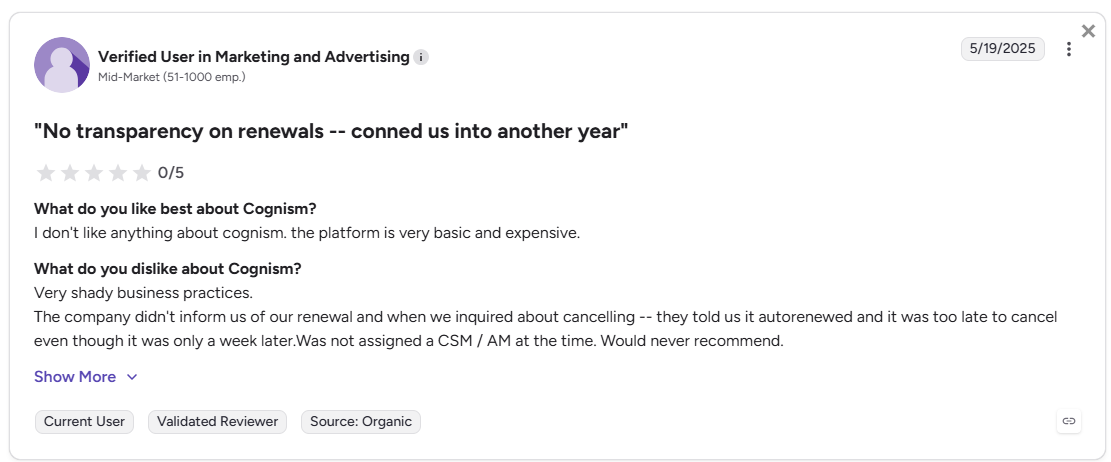
- US and APAC gaps. Cognism's EMEA coverage is its moat. For teams selling into North America or Asia-Pacific, the data quality drops noticeably.
- Opaque pricing. Cognism doesn't publish its prices. For a B2B sales intelligence platform, that single fact tells you a lot about who the product is built for, and who it isn't. And you don’t have to believe it because I’m telling you, because here are some G2 reviews.
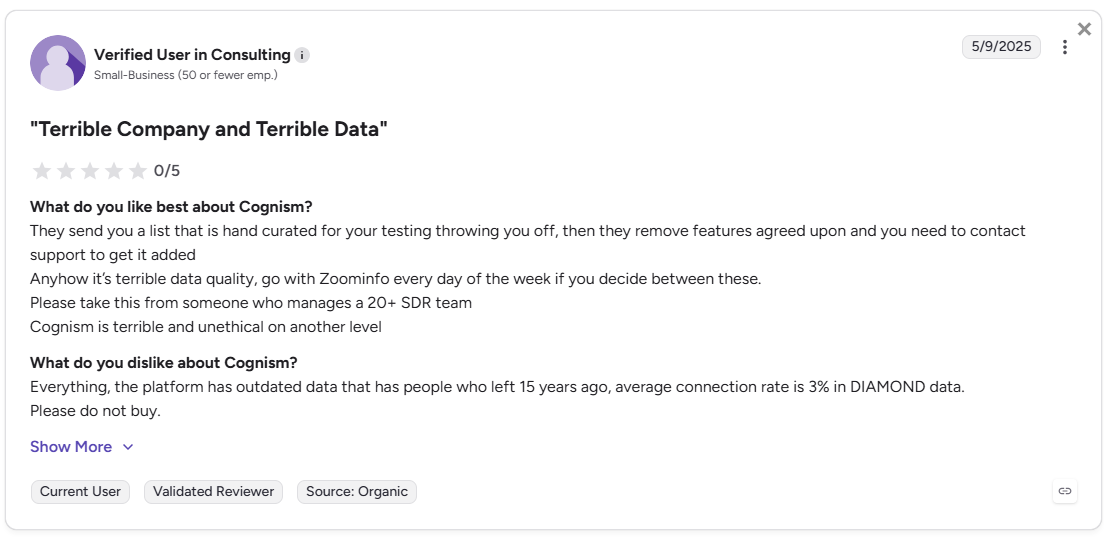
With that framing in mind, here are the 10 best Cognism alternatives.
The 10 best Cognism alternatives in 2026
1. Factors.ai: Best for B2B teams that need more than contact data
If Cognism is a database with a compliance layer, Factors.ai is an ABM platform with a database beneath it. The distinction matters enormously at the bottom of the funnel.
Factors.ai identifies more than 75% of companies visiting your website and tracks how those accounts move across pages, channels, and campaigns. What’s more, Factors.ai also offers person-level ID via RB2B for US-based B2B visitors; it surfaces name, title, work email, LinkedIn URL, and firmographics directly.
This gives marketing and sales teams a reliable account-level view of buyer activity, even when visitors never fill out forms.
Factors.ai goes WELL beyond identifying who is on your site. It tells you what they did, which campaigns touched them, and how to activate that signal across LinkedIn and Google Ads.
What makes Factors.ai different from Cognism
| Capability | Factors.ai | Cognism |
|---|---|---|
| Account-level and person-level visitor identification | 75%+ coverage via waterfall enrichment Also offers up to 40% person-level identification (via RB2B for US traffic); pulls name, title, LinkedIn URL, and work email | Not available |
| Contact database | Integrates with Apollo, ZoomInfo via API | Core product (440M+ contacts, phone-verified) |
| Intent signal sources | Website, CRM, G2, LinkedIn, Google Ads, Bombora | Bombora intent add-on only |
| Ad activation | LinkedIn AdPilot + Google AdPilot (native) | Not available |
| Multi-touch attribution | Full-funnel, MQL → Closed Won | Not available |
| Built-in outreach sequences | No (integrates with outreach tools) | Cognism Engage (basic native sequencer) |
| CRM integration | Bi-directional, HubSpot/Salesforce/Marketo | HubSpot/Salesforce/Outreach/Salesloft |
| Pricing transparency | Tiered plans, published | Quote-only, no public pricing |
| Free plan | Yes (200 companies/month) | No |
Key capabilities
- Account 360. Every account gets a unified view combining website visits, CRM stages, ad interactions, and product usage. No spreadsheet juggling.
- LinkedIn AdPilot + Google AdPilot. Native ad activation based on live buying signals. Audiences update automatically. Impressions are capped at the account level so you're not over-serving cold accounts.
- Scout AI agents. Automate account research, email drafting, campaign optimization, and list maintenance. Not a chatbot, an actual workflow layer.
- Multi-touch attribution. Tracks every touchpoint from first anonymous visit to closed deal across all your channels, not just LinkedIn clicks.
What G2 users say
"Factors.AI solves this problem by helping us identify website visitors and their level of engagement. When the data is synced with our CRM, we can see additional signals and intent metrics, which allows us to prioritize high-potential leads."
- G2 review, verified user
"The platform's unsampled analytics and attribution capabilities give us granularity we couldn't get anywhere else. We can finally prove which campaigns actually move pipeline."
- G2 review, verified user
Pricing
- Free plan: 200 companies/month, 3 seats, visitor tracking + Slack integration
- Basic: 3,000 companies/month, LinkedIn intent signals, HubSpot/Salesforce integration
- Growth (most popular): 8,000 companies/month, ABM analytics, account scoring, G2 intent, dedicated CSM
- Enterprise: Unlimited companies, 25 seats, LinkedIn AdPilot, Google AdPilot, predictive scoring, white-glove onboarding
Best for: B2B SaaS, enterprises and mid-market teams that run LinkedIn and Google Ads, need account-level intelligence, and want attribution that connects to revenue (not just top-of-funnel data).
2. Apollo.io: Best for startups and budget-conscious teams
Apollo is the answer to the question: "What if I could get a contact database AND outreach sequences in one tool, without spending $22K/year?"
Apollo.io is a strong choice for startups that want prospecting, sequencing, and outreach in one platform. Its database covers 275M+ contacts, and the sequencing tools let SDRs run multichannel outreach without a separate Outreach or Salesloft subscription.
Also, read: Best sales prospecting tools for B2B teams
What to know before buying
- Data accuracy sits around 80–85%, lower than Cognism's Diamond Data for phone numbers
- Email bounce rates can run higher than enterprise alternatives
- The free plan (100 credits/month) lets you test data quality before committing
- Paid plans start at ~$49/user/month for the Basic tier
Best for: Early-stage teams, solo SDRs, and companies that want prospecting + outreach in one affordable package, especially for US-focused outbound.
3. ZoomInfo: Best for enterprise teams with deep US coverage needs
ZoomInfo is where you go when Apollo's data accuracy isn't good enough, and Cognism's EMEA-first focus isn't the right fit. ZoomInfo starts at $14,995 per year, but the actual total cost for enterprise teams with full feature access runs significantly higher.
Also, read ZoomInfo pricing in 2026
What justifies the price? The US contact database is the deepest in the market. Org charts, technographic data, intent signals (proprietary), and conversation intelligence through Chorus.ai are all available in one platform.
If you are currently using ZoomInfo and are looking to switch, you might also want to read the ZoomInfo alternatives blog.
Cognism vs ZoomInfo, in plain terms
- ZoomInfo wins on US data depth, org chart coverage, and proprietary intent signals
- Cognism wins on EMEA data quality, GDPR compliance, and verified mobile numbers in Europe
- Many enterprise teams end up using both, which tells you something (duh)
Best for: Large sales orgs with primarily North American pipelines who need deep company intelligence, org charts, and integrated conversation intelligence.
4. Lusha: Best for small teams that need quick, affordable contact data
Lusha positions itself as the accessible middle ground: better than a basic email finder, more affordable than ZoomInfo or Cognism. Lusha starts at $36 per month per user with a credit-based model and a clean LinkedIn Chrome extension that SDRs tend to love.
The platform covers 280M+ B2B contacts, including direct dials and validated email addresses. The AI-powered prospecting layer helps prioritize outreach, and the LinkedIn integration is genuinely smooth.
Related read: Lusha alternatives and competitors
Where it falls short
- Credit limits on lower tiers run out faster than expected for high-volume teams
- Intent data isn't as deep as Cognism's Bombora integration
- Company-level intelligence is thinner compared to ZoomInfo or 6sense
Best for: Small sales teams and SDRs who need fast, affordable contact enrichment with a clean LinkedIn workflow, without committing to enterprise contracts.
5. LeadIQ: Best for LinkedIn-native prospecting workflows
LeadIQ is built for the SDR who lives in LinkedIn Sales Navigator. The platform captures prospect data directly from LinkedIn, pushes it into CRM and sequencing tools, and tracks "job changes" triggers so reps know when to re-engage warm contacts.
LeadIQ offers free and paid plans based on user count and monthly credits, with tiered pricing that scales with usage. LeadIQ is easier to use and more focused on data capture than Apollo, but Apollo offers more automation.
The job change tracking feature is underrated. When a champion moves to a new company, LeadIQ flags it so you can reach them before a competitor does.
Where it falls short
- Data volume is lower than ZoomInfo or Cognism
- Limited intent signal depth beyond LinkedIn activity
- Not built for non-LinkedIn prospecting workflows
Best for: SDR teams running LinkedIn-heavy outbound who want frictionless data capture and CRM sync without a complex platform.
6. SalesIntel: Best for teams that need human-verified US contact data
SalesIntel takes a different approach to data quality: human researchers verify contacts rather than relying solely on algorithmic validation. The ResearchOnDemand feature lets teams request verification for specific contacts within hours.
SalesIntel is a great alternative to Apollo.io for teams that value human-verified contact data. It blends automation and manual verification to maintain data quality, making it ideal for teams who rely heavily on accurate phone numbers and job titles.
The platform also includes technographic data, intent signals, and buying committee identification, making it a more complete ABM tool than a pure contact database.
Best for: Mid-market US sales teams that run high-volume cold calling and need verified phone numbers with better accuracy than Apollo can deliver.
7. UpLead: Best for transparent, credit-based contact enrichment
UpLead makes one strong promise: 95% data accuracy, with credits refunded for any email that bounces. That kind of guarantee is genuinely rare in this category and earns serious trust from smaller teams burned by bad data elsewhere.
The platform is credit-based, with transparent monthly/annual plans, no platform fees added on top, and a free trial with real data access before you buy. For teams that want to validate quality before committing, that process is faaaar cleaner than what Cognism offers.
What it doesn't do
- No built-in outreach sequencing
- No deep intent data or ABM features
- Database size is smaller than ZoomInfo or Apollo
Best for: SMBs and lean teams that want clean, verified contact data at a transparent price without the complexity of enterprise platforms.
8. Seamless.AI: Best for high-volume list building with real-time verification
Seamless.AI's positioning is simple: real-time data verification means you're pulling contact information that's being checked as you pull it, not data that was verified six months ago and may have changed.
The platform is built for SDR teams that need to move fast. The Chrome extension works across LinkedIn, company websites, and other directories, and the contact volume is generous on paid tiers.
The trade-off
- Real-time verification is a genuine differentiator for freshness
- Data accuracy reviews are mixed, with some users reporting more bounce rates than expected
- Lacks the GDPR compliance infrastructure that makes Cognism valuable for European teams
Best for: High-volume prospecting teams in North America who prioritize quantity and recency over deep enrichment or compliance features.
9. Clearbit (now Breeze Intelligence by HubSpot): Best for HubSpot-native teams
Clearbit was acquired by HubSpot in 2024 and rebranded as Breeze Intelligence. If your CRM is HubSpot, this integration is now the tightest available: real-time enrichment of form fills, company identification, and contact data all flowing natively into your HubSpot records.
The data model is firmographic and technographic first. Intent signals are limited compared to dedicated intent platforms, but the enrichment quality for the HubSpot ecosystem is strong.
Related read: Clearbit alternatives for 2026
Best for: HubSpot-first teams that want frictionless enrichment without managing a separate data vendor or integration layer.
10. Clay: Best for building highly personalized, AI-enriched outbound lists
Clay is not a traditional contact database. It's a data orchestration platform that pulls from 75+ data sources (including Cognism, Apollo, LinkedIn, and more) and uses AI to enrich and personalize outreach at scale.
The typical use case: build a highly targeted list using firmographic and technographic filters, auto-enrich each company with recent news, funding data, and technographics, then generate personalized first lines for cold emails, all in one workflow.
Why it's on this list
Teams switching from Cognism often discover they were paying for data they could access through Clay at a fraction of the cost, with more sources and better personalization workflows attached.
Where it's different
- Not a plug-and-play prospecting tool. Requires setup and a learning curve.
- Data access requires credits per row per enrichment column
- Best paired with a sequencing tool for outreach execution
Best for: Ops-savvy teams and agencies that want maximum data flexibility, AI-powered personalization, and the ability to build custom enrichment workflows without being locked into one data provider.
If you are actively looking for more tools that have similar capabilities to Clay, you might also want to read Clay alternatives for GTM teams
How to choose the right Cognism alternative for your team?
No listicle makes this decision for you. Here's a simple decision tree.
| If your primary need is… | Go with… |
|---|---|
| Full GTM platform with ad activation + attribution | Factors.ai |
| Affordable all-in-one prospecting + outreach | Apollo.io |
| Deep US enterprise data + conversation intelligence | ZoomInfo |
| Fast LinkedIn-native contact capture | LeadIQ or Lusha |
| Human-verified US phone numbers | SalesIntel |
| Transparent credits, strong accuracy guarantee | UpLead |
| HubSpot-native enrichment | Clearbit / Breeze Intelligence |
| AI-enriched outbound list building | Clay |
| High-volume real-time verification | Seamless.AI |
| Staying with Cognism for EMEA-heavy outbound | Cognism |
Look… most teams are NOT choosing one tool; they're choosing a primary platform and pairing it with something for the gaps. Factors.ai + Apollo, ZoomInfo + Cognism for EMEA, Clay + any sequencer- these combinations are common for a reason.
What matters is knowing which capability you need most, before you start talking to sales reps who will happily convince you their platform does everything.
FAQs for Cognism alternatives
Q1. What are the main reasons teams switch from Cognism?
The three most common drivers are geographic coverage gaps (weak outside EMEA), opaque pricing and rigid annual contracts, and the lack of built-in outreach sequencing. Teams selling into North America or APAC often find competitors offer better contact accuracy at a lower price. Teams that need outreach automation alongside contact data tend to move to Apollo or a combined Factors.ai + outreach stack.
Q2. How much does Cognism actually cost in 2026?
Cognism doesn't publish pricing. Based on third-party procurement data, the platform fee runs $15,000–$25,000/year before per-seat costs of $1,500–$2,500 per user annually. A 5-person team on the Grow plan typically runs ~$22,500/year. Elevate (Diamond Data tier) for the same team runs ~$37,500+. Onboarding, intent topic add-ons, and annual renewal increases push the real first-year cost higher.
Q3. Is Factors.ai a direct Cognism competitor?
Not exactly, and that distinction matters. Cognism is a contact database with compliance features. Factors.ai is an account intelligence and GTM platform that identifies companies visiting your website, activates those accounts through LinkedIn and Google Ads, and attributes revenue across channels. If you need phone numbers for cold calling, Factors.ai isn't the replacement. If you need to know which accounts are in-market, how to reach them through paid channels, and which campaigns are actually driving pipeline, Factors.ai does things Cognism can't.
Q4. Does Apollo.io have better data than Cognism?
For Europe: no. Cognism's EMEA coverage and Diamond Data phone verification are genuinely superior. For North America and global SMB coverage: Apollo is more affordable and comparable in accuracy for most use cases, though Cognism's verify rate on mobile numbers is higher. Apollo's data accuracy sits around 80–85%, and Cognism's Diamond Data verification is closer to 98% for verified numbers (though that verified set is smaller than Apollo's total database).
Q5. What's the best Cognism alternative for small teams or startups?
Apollo.io is the most practical choice at the lower end of the market: it combines contact data and outreach sequencing in one tool, offers a free plan, and paid tiers start at ~$49/user/month. UpLead is the better pick if outreach automation isn't needed and data accuracy is the priority, with transparent credit-based pricing and a 95% accuracy guarantee.
Q6. Can Clay replace Cognism?
Clay can access Cognism's data as one of its 75+ source integrations, so technically yes… you can pull Cognism contacts through Clay. But Clay is a workflow tool, not a standalone database. Teams that switch from Cognism to Clay typically do so because they want to combine multiple data sources, not because Clay's own data is superior. Expect a learning curve and budget for credits per enrichment.
Q7. What if I need GDPR-compliant data but Cognism's pricing is too high?
Factors.ai's GDPR-compliant tracking covers company-level identification without storing personal data. Kaspr is another alternative for European teams at a lower price point, particularly for LinkedIn-based prospecting. Dealfront (formerly Echobot + Leadfeeder) is specifically built for GDPR-compliant European coverage. For teams that primarily need website visitor identification from European accounts,
Q8. Does Factors.ai require a contact database to be useful?
Factors.ai identifies accounts at the company level. Most teams pair it with Apollo, ZoomInfo, or Lusha for contact enrichment. The combination is powerful: Factors.ai tells you which companies are in-market and engaging; your contact database tells you who to call there. Separately, each covers half the picture. Together, they replace the guesswork.

See how Factors can 2x your ROI
Boost your LinkedIn ROI in no time using data-driven insights


.avif)
See Factors in action.
Schedule a personalized demo or sign up to get started for free
LinkedIn Marketing Partner
GDPR & SOC2 Type II






.svg)



.avif)

