The LinkedIn B2B Marketing Strategy We’d Build After Studying 50,000+ Closed Deals and $150M+ in Ad Spend.
A 5-step framework to build a LinkedIn B2B marketing strategy that reaches active buying committees, protects deal velocity, and drives influenced pipeline.

Demand Generation Lead

Associate Director of Brand and Content



.svg)


TL;DR
- This research looks at how LinkedIn B2B marketing actually works, using two Factors.ai datasets. The first one is 850+ B2B companies representing $150M+ in LinkedIn ad spend, and the second one is 100+ CRM-connected companies with 50,000+ closed deals worth $5B+.
- Sustained LinkedIn engagement starts 124 days before deal creation, so ICP accounts belong in your campaigns months before they ask for a demo.
- Engaging six or more contacts at an account before deal creation is associated with a 17.1-percentage-point higher win rate than engaging one.
- Accounts that engage through both organic and paid have a win rate 10.8 points above baseline, higher than either channel on its own.
- Executives, VPs and directors, and practitioners respond to different offers: original research, peer events, and practical resources, respectively.
- Deals that engage three or more new contacts after the opportunity opens have win rates 16.3 points higher than deals that engage one.
- Influenced pipeline, buying-group coverage, and movement between engagement bands show whether LinkedIn is working before deals close.
In our previous benchmark study on why B2B marketers are shifting ad budgets to LinkedIn, we tracked ad dollars moving toward the platform in volume. The appeal was obvious, because no other network offered comparable firmographic targeting.
Moving budget, however, is not the same thing as having a workable LinkedIn B2B marketing strategy.
In our latest analysis of 850+ advertisers, direct lead generation absorbed 38% of total spend, more than any other campaign objective. On top of that, 76% of title-targeted budgets chased directors, VPs, and the C-suite. The default plan for most teams is straightforward. Find the person who signs off on the budget and get them to fill out a form.
I get why. A form fill is easy to count, and executives do approve purchases. But when we matched LinkedIn activity to closed deals, the form turned out to be a narrow view of how those deals were won. Accounts engaged months before anyone filled out a form, and winning deals usually had several people paying attention, many of them nowhere near the C-suite.
This guide turns those findings into a five-step LinkedIn B2B marketing strategy. The full analysis, including deal-size breakdowns and sales cycle timing, is in our report, From Benchmarks to Blueprints: The LinkedIn Revenue Engine for B2B.
What is a LinkedIn B2B marketing strategy?
A LinkedIn B2B marketing strategy is an operating plan for coordinating organic posts, employee networks, and paid ads to reach the people evaluating a business purchase. It builds familiarity while buyers diagnose their problems and supports your sales motion until the deal closes.
In practice, three pillars work together:
- Founders and leaders share clear, interesting viewpoints on problems in their niche.
- Internal practitioners explain how they solve those operational hurdles day to day.
- Paid campaigns distribute the strongest arguments to target accounts, while sales reps use account engagement context to guide outreach.
Why a LinkedIn strategy matters (and why search is not enough)
Search is great at capturing demand when someone is actively looking for a tool. But enterprise software is evaluated by committees over months, long before anyone types a query into Google.
Reaching those people by company, function, and seniority is why LinkedIn advertising is crucial for B2B marketing. It gives you a way to build familiarity across the entire buying team while they are still shaping their requirements.
In our comparison of LinkedIn Ads vs. Google Ads vs. Facebook Ads, LinkedIn has higher front-end click costs, but clicks alone do not close enterprise contracts.
Because LinkedIn builds trust across multiple evaluators in an account, downstream returns are significantly stronger. In our From Benchmarks to Blueprints report, we found that LinkedIn delivered a 1.6x return on ad spend against Google’s 1.18x, and sourced deals were 34% larger on average.
Campaign setup, ad formats, and bidding mechanics are covered in our guide to LinkedIn ads for B2B.
Here is how to build that LinkedIn B2B marketing strategy in six steps, based on what 50,000+ closed deals show works.
1. Start engaging on LinkedIn before the account is in your CRM
Accounts start engaging on LinkedIn about four months before a deal shows up in your CRM, and roughly two months before they begin returning to your website with any consistency.
We only counted repeat activity across the 50,000+ closed deals we analyzed, filtering out one-off impressions and stray website bounces. That means 124 days before deal creation marks the point where accounts began paying attention on purpose.
Why does engagement start on LinkedIn so far in advance? Because buyers do not log into LinkedIn with a corporate credit card ready to buy tools. They are in research and observation mode.
Our co-founder Praveen explained why when he hosted AJ Wilcox, founder of the LinkedIn ads agency B2Linked, for our webinar on advanced LinkedIn ad hacks.
“What I’ve seen is that primarily LinkedIn as a channel is an awareness channel. People are not on LinkedIn to really buy software in that sense, so most of the people there are not actively in a buying journey.”
So, pushing a demo form at them off the bat is an expensive way to get ignored. Instead here’s what you can do.
What to show accounts during the pre-pipeline window
Accounts in this early stretch are still deciding whether an internal friction is worth budget and what approaches exist to fix it. I would swap the direct product pitch for assets they can actually use today.
One technical setting trips marketers up here. Awareness is the objective, but AJ Wilcox avoids LinkedIn's Brand Awareness objective entirely. He says, "Please never, ever run a campaign in the brand awareness objective on LinkedIn. It’s an absolute waste."
His reasoning is practical. Brand Awareness forces you to pay by impression, which burns budget rapidly. He instead runs awareness campaigns under Website Visits using cost-per-click bidding instead.
Prioritize the accounts that keep coming back
Accounts with 30 or more website sessions before deal creation had win rates 14.1 percentage points higher than accounts with fewer than three.
All win-rate figures in this guide reflect absolute percentage points, meaning the straight difference between two rates.
The type of activity matters as much as the volume, because what an account reads tells you what they need to see next.
Factors.ai’s account timeline brings website visits, LinkedIn ad interactions, and sales touches into one combined feed, making it easy to spot when an account shifts from early research to technical validation. Predictive scoring models rank those accounts against historical conversion patterns so revenue teams can spot high-intent accounts weeks before anyone fills out a form.
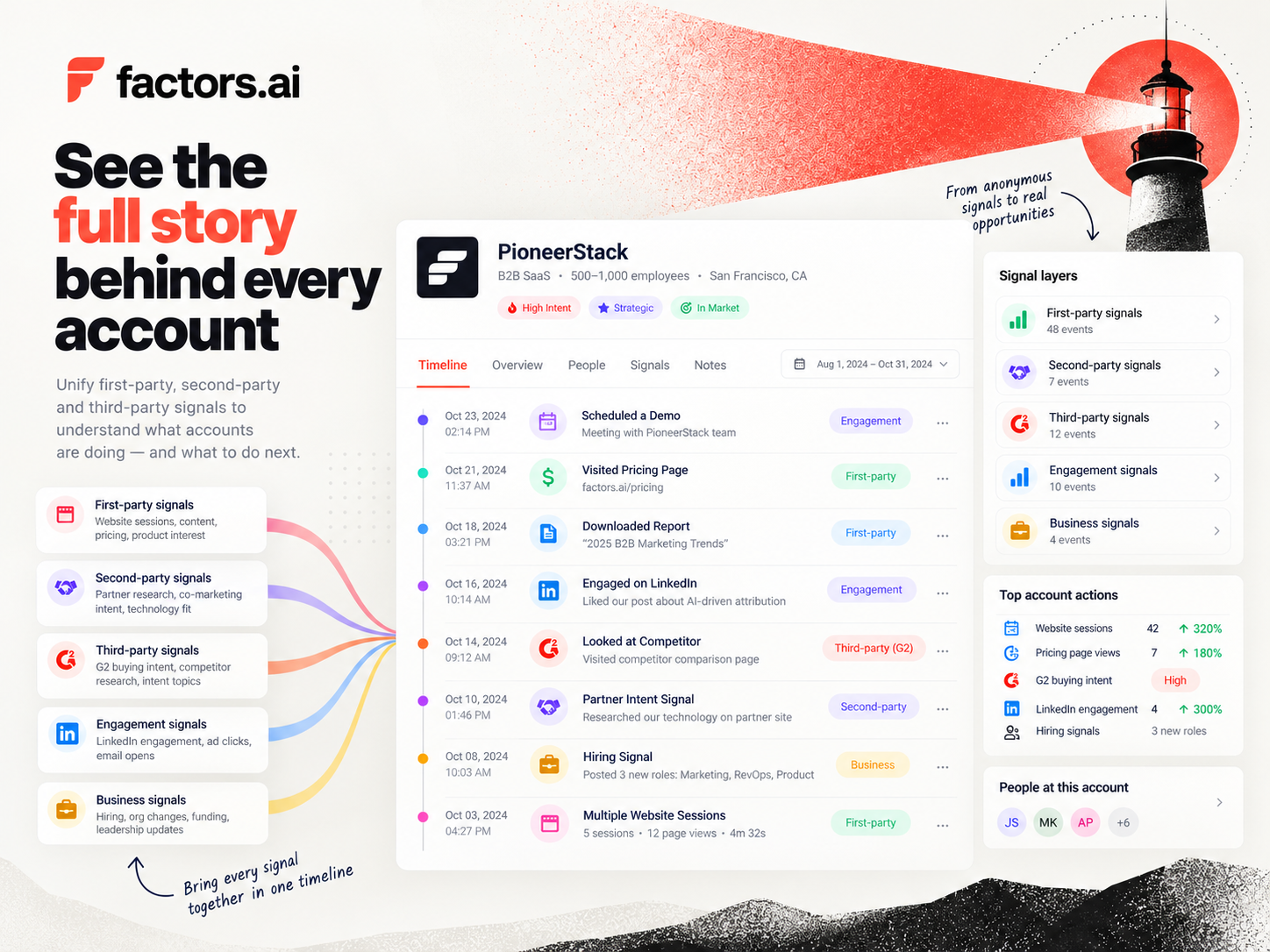
For the exact playbook on routing these accounts to your sales team, read our guide on using LinkedIn intent data in your B2B sales strategy.
2. Target the entire B2B buying committee instead of chasing executive titles
Win rates climb as more people at an account engage, yet most marketing budgets target a tiny slice of the company.
- Accounts with six or more engaged contacts before the deal had a 17.1-point higher win rate than accounts with one. On deals of $250K or more, that gap widened to 24.5 points.
- 76% of title-targeting spend went to director, VP, and C-suite titles, which make up just 13.9% of job titles on LinkedIn.
- The role combination linked to the biggest lift (+22.0 percentage points) was the end user, influencer, and technical evaluator. The budget holder was not in it.
Spending three-quarters of your budget on one in seven titles drives up LinkedIn ads costs while ignoring the people who actually decide whether a tool gets adopted.
Steve Armenti, founder of twelfth agency and former marketer at Google, broke this down during a conversation with Ganesh, Factors.ai’s Associate Director of Content and Brand. In his work building LinkedIn marketing strategies for enterprise SaaS brands, the CRM records consistently show that senior executives rarely initiate product evaluations.
"Your senior ICP, CIO, CISO, CHRO, they do not sign up for demos. That person’s going to be a director, maybe a senior manager. All of the decision-making and all of the research and all of the actual sales is happening at a more junior level."
In his experience, the executive shows up in the second or third meeting to approve a project that has mostly been decided below them.
To move past broad job titles, read our guide on targeting B2B audience intent on LinkedIn and explore our framework for building LinkedIn trust across B2B buying committees.
Segment LinkedIn campaigns by operational role and seniority
To reach the entire committee, split campaigns by seniority while keeping the core problem consistent.
A CFO looking at marketing spend might want a revenue benchmark, while the ops manager on the same deal wants to see how tracking is configured.
Alex Goodwin, Director of Demand Generation at Fingerprint, uses LinkedIn specifically to solve this committee puzzle. While his sales reps cast a wide net across an account with email outreach, he concentrates Fingerprint's paid advertising on LinkedIn directly on engineering and product leaders.
Those are the practitioners who have to implement the software and put it on their development roadmap. If engineering rejects the product, no executive can force it through. To get their attention on LinkedIn, his team ran five-minute technical walkthroughs with account executives breaking down real use cases. The clicks were expensive, but high-value accounts converted because the ads spoke directly to the technical team's daily problems.
Trying to close an enterprise contract by retargeting the same single champion with more ad impressions never works. You have to work with sales to identify which technical, financial, or security roles are absent from the evaluation, then serve role-specific collateral to pull them into the conversation.
Most of those operational leads will never follow your company page organically, which is why paid distribution becomes essential.
3. Run LinkedIn organic and paid as one program
Organic publishing and paid campaigns perform very different commercial jobs in our research, and accounts exposed to both delivered the highest win rates across the board.
Three takeaways stand out from those numbers:
- Organic content builds genuine credibility with the people who encounter it, but feed algorithms reach only a fraction of your target accounts. It produces a higher win-rate lift than paid working by itself, yet accounts for less than a tenth of influenced pipeline.
- Paid campaigns can reach your entire target list, touching nearly two-thirds of pipeline, but convert at lower rates when running in a vacuum.
- The two motions reinforce each other. Paid distribution guarantees delivery across target accounts, while organic content provides the authentic proof buyers look for when evaluating an ad.
(The pipeline-share column tracks where influenced deals came from historically, so treat it as an observation of buyer behavior rather than a recommended budget split.)
Why this combination of organic and paid LinkedIn works
When Alex spoke to our CMO Praveen, he mentioned how paid ads on their own can easily feel transactional
"Whenever you see an ad on LinkedIn, I think the experience is massively improved if when you click on the company logo and you go to the company page, you see a ton of proprietary research, you see all of their executives posting, and they post unique things that are really actionable and insightful." says Alex.
His team also found where sponsored posting hits a wall. When Fingerprint promoted every executive update to a broad brand audience, engagement dropped off quickly.
"What I see work the most effectively on LinkedIn is targeted content that speaks to a small group of individuals with a high level of depth." Alex reinforces.
The organic and Thought Leader Ads discussion starts around the 47-minute mark.
Here is how to run both organic and paid LinkedIn as a single engine.
- Write for specific operational roles, with founders and internal practitioners leading the arguments.
- Watch who engages in the comments instead of tracking total number of likes. Questions from engineers or directors at target companies show where positioning is actually landing.
- Sponsor the posts that resonated with target accounts using LinkedIn Thought Leader Ads.
- Hook cold audiences before the fold by following proven LinkedIn ad copy best practices. A prospect scrolling their feed will not expand a post unless the first two lines address a problem they recognize immediately.
- Evaluate sponsored posts on account progression and site visits rather than assuming a post that worked with existing followers will resonate with buyers who don't know your company.
Cap impressions per account to prevent budget concentration
Paid campaigns only add value if ad delivery spreads across your account list, and LinkedIn's default auction does the opposite.
AJ Wilcox ran into this while managing ABM campaigns for his own agency against a list of 400 target companies.
"Those three top ones, Google, Facebook, and I think Twitter at the time, like 96% of my impressions went to those three companies, and that means none of the other companies were even getting hit by the ads." AJ explains.
The LinkedIn auction simply serves impressions to whichever accounts have active users in the feed right now. If a few large enterprises on your target list employ thousands of people, their employees soak up your entire daily budget while the rest of your list gets almost nothing. Knowing what an impression actually means on LinkedIn makes that skew fatal, because an impression only tracks an ad loading on a screen, not real buyer attention.
Most legacy ABM tools and native LinkedIn campaign settings cannot solve this problem because they lack account-level frequency controls.
Factors.ai built Smart Reach inside its LinkedIn AdPilot suite to eliminate this blind spot. The platform monitors impressions per company domain in real time.
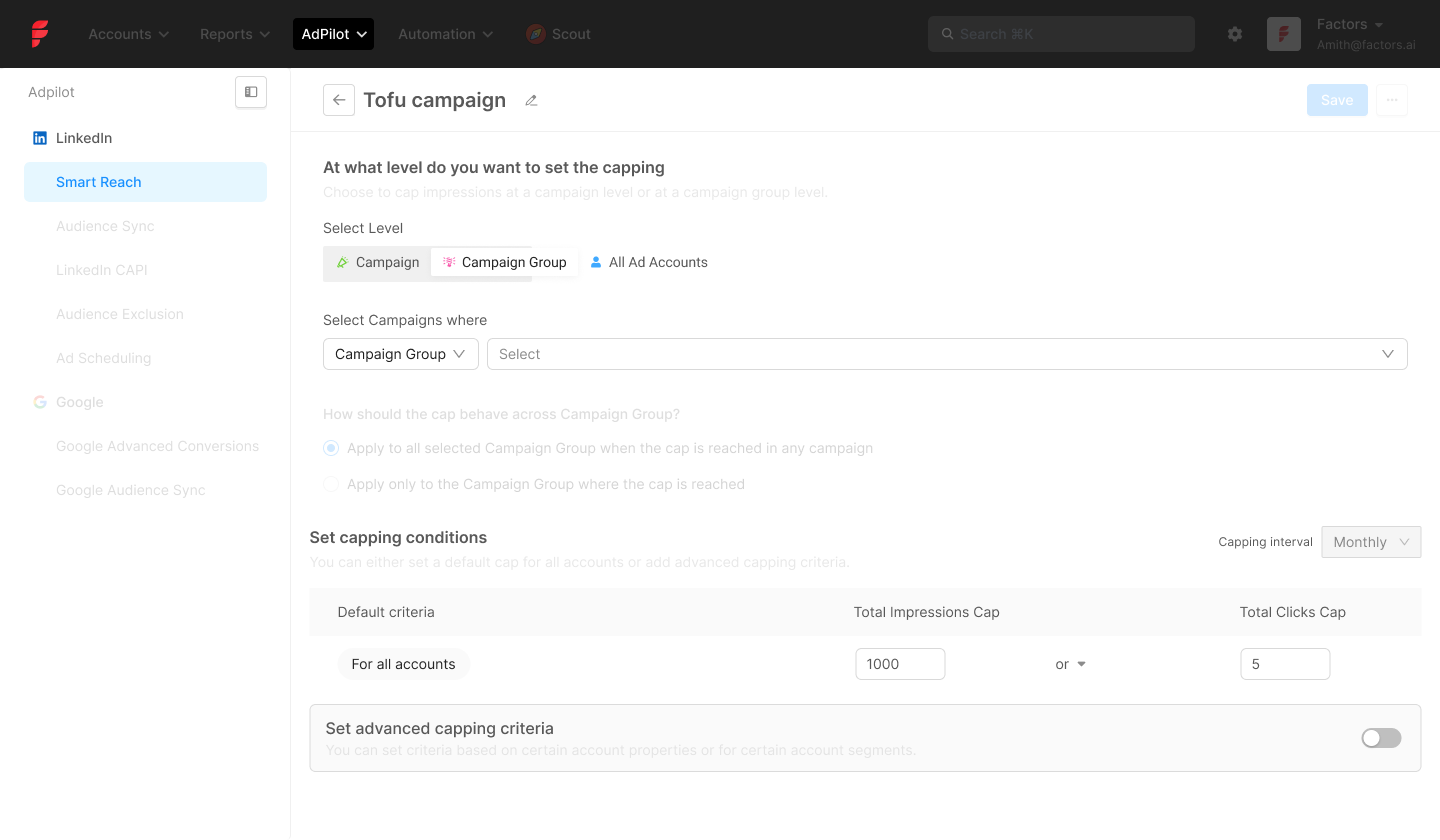
Factors.ai lets you cap impressions per account on LinkedIn
Once an account in your target list hits your designated frequency cap, delivery pauses for that company until the budget window resets. This way, impressions get spread across accounts, making sure your LinkedIn ABM programs achieve genuine list-wide coverage.
Descope used Smart Reach to solve this exact delivery bottleneck. By capping over-served accounts, they redistributed more than 158,000 impressions to unreached companies on their list, lifting LinkedIn ads ROI by 22% on the same overall spend.
4. Keep running LinkedIn marketing campaigns even after the deal opens
Most marketing teams treat LinkedIn purely as a net-new acquisition engine. The moment an opportunity opens in Salesforce or HubSpot, they hand everything over to sales.
Our data in the From Benchmarks to Blueprints report shows why shutting off LinkedIn at the deal creation stage stalls pipeline.
- 55.6% of closed deals engaged zero new contacts during the active sales cycle.
- Another 20.7% engaged just one.
- Deals that engaged three or more new contacts after opportunity creation won 16.3 percentage points more often than deals that engaged only one.
Roughly three in four deals add one person or nobody after opening. That is where evaluations die, because the people who sign off on the purchase later in the cycle, such as security, compliance, procurement, and finance, bring concerns the initial champion never had to address.
Leaving your sales rep to handle those late stakeholders through cold emails introduces friction. A complete LinkedIn B2B marketing strategy stays live across the entire buying committee until the contract signs.
Shift LinkedIn creatives as accounts advance through your CRM
Your LinkedIn creative needs to reflect the account's stage in your pipeline.
This is where standard pixel retargeting fails. A browser cookie only follows the single person who previously visited your website, and that cookie usually expires in days. You cannot run stage-specific LinkedIn ads to an incoming CFO or security architect if they have never visited your site.
Understanding pixel-based vs. account-based LinkedIn retargeting solves this. Instead of tracking browsers, an account-based marketing platform syncs your CRM opportunity stages directly into LinkedIn matched audiences.
This allows you to apply LinkedIn’s job-function filters to reach the exact roles surrounding your champion, even if those people have never interacted with your marketing material before.
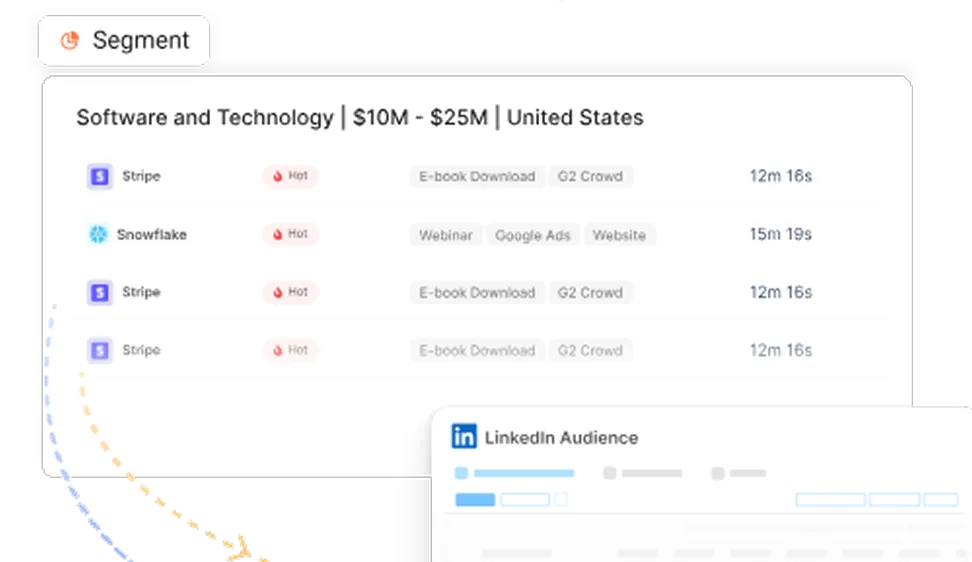
In Factors.ai, Audience Builder syncs dynamic CRM rules directly into LinkedIn Campaign Manager, updating your matched audiences as deal stages advance.
Document Ads are particularly effective here because stakeholders can swipe through a five-page security brief or implementation plan directly in their LinkedIn feed without filling out a form or clicking away from the platform.
Review our breakdown of the types of LinkedIn ads to align each asset with the right visual format, and reference our guide on structuring LinkedIn retargeting ads for maximum B2B ROI to keep frequencies balanced across active opportunities.
Use LinkedIn distribution to revive deals going quiet
Account disengagement accounts for 27.1% of documented lost deal value across our dataset, jumping to 49.5% on deals between $250K and $1M. These are rarely deals lost to competitors. They are evaluations that quietly slipped away because the buying committee went dark.
When an account stops responding, the default reaction across most sales floors is to ramp up outbound pressure. Reps send "just checking in" emails, bump old threads, and start messaging other people at the company.
But if a deal stalled because of internal politics, budget reshuffling, or implementation anxiety, another sales follow-up only pushes the buyer away.
LinkedIn ads give you a way to stay present without cornering the committee. While sales steps back to give the account breathing room, targeted campaigns keep running quietly in the background. Serving a peer case study, an implementation blueprint, or a compliance overview keeps your platform top of mind while the team works through whatever stalled the project internally.
None of this mid-deal acceleration shows up in traditional sourced-pipeline reports, because the account entered your database months earlier. But keeping LinkedIn campaigns live across active opportunities protects win rates where deals get decided.
5. Measure LinkedIn influenced pipeline and account lift instead of direct leads
If you evaluate your LinkedIn B2B marketing strategy purely on direct form fills, you will underinvest in the channel every time.
B2B buyers research products in groups over several months, frequently converting through organic search, direct website traffic, or sales calls after being influenced by paid campaigns.
Track these three indicators instead to evaluate how your campaigns move accounts before a contract signs.
Influenced pipeline
Track influenced pipeline by setting a strict threshold for what counts as meaningful exposure.
Counting every account that received a single ad impression inflates your numbers with false positives. Useful baseline thresholds include, for instance, five distinct content engagements, a webinar attendance, or more than five visits to technical evaluation pages.
Evaluating this journey requires dedicated LinkedIn revenue attribution to connect top-of-funnel ad exposure directly to CRM opportunities.
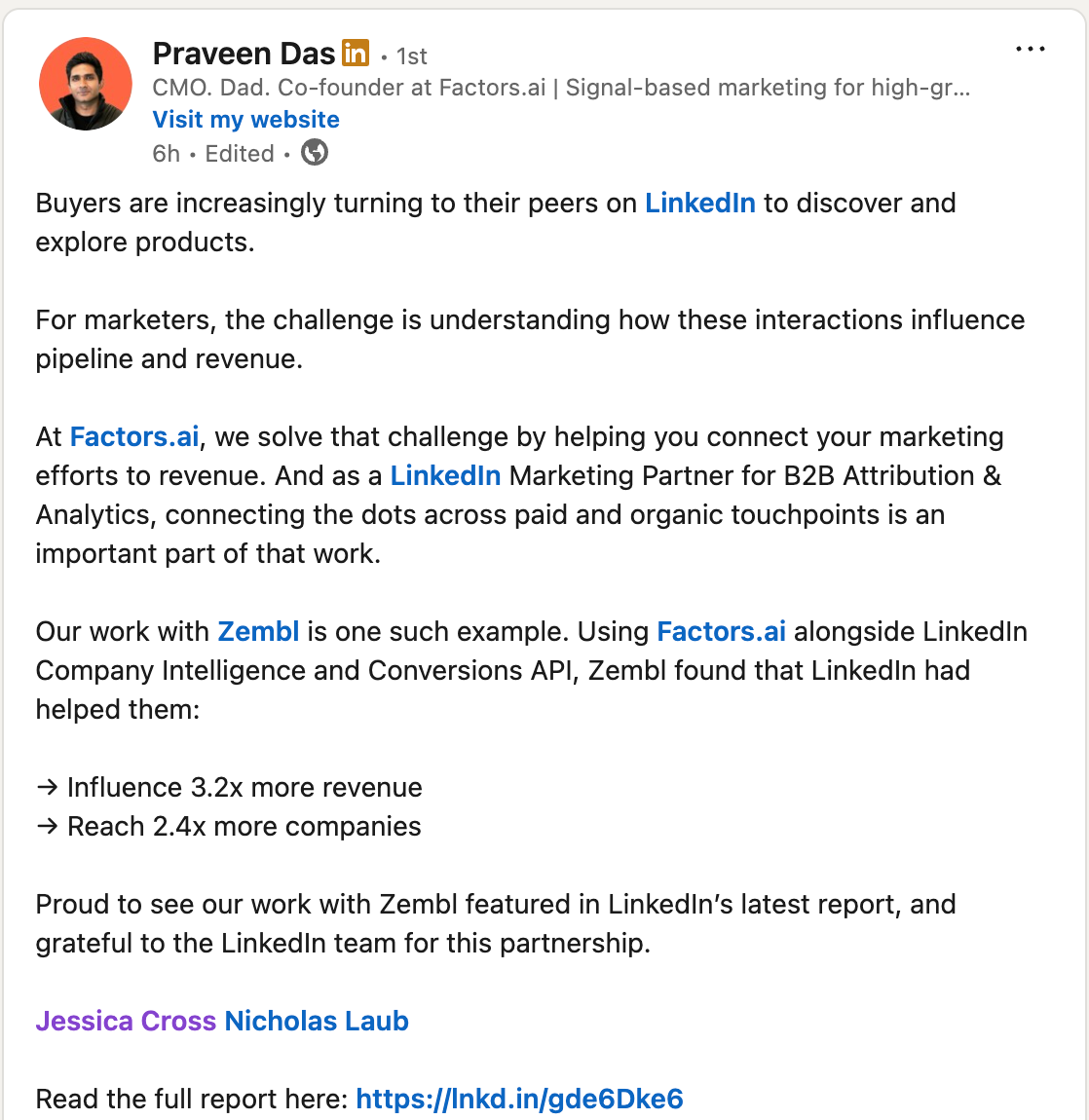
At Sprinklr, Chief Marketing Officer Arun Pattabhiraman faced this exact challenge across long enterprise sales cycles. "LinkedIn allows us to engage accounts early in their journey, and events accelerate that engagement," he explained. "The challenge is proving this connected journey in a way sales and leadership can trust." By using Factors.ai to track cross-channel account touches, Sprinklr verified that LinkedIn directly influenced 15% of their enterprise pipeline.
Factors.ai brings company-level paid and organic activity into a unified account feed through its LinkedIn Company Intelligence integration. This connection records impressions that never produced an immediate click, tying feed exposure back to active deals. Our guide to LinkedIn view-through conversions and B2B attribution explains how to measure that influence accurately.
Our CMO, Praveen Das, even spoke about how the partnership with LinkedIn is helping companies tie LinkedIn Engagement to pipeline and revenue.
Engagement bands
Influenced pipeline reveals what LinkedIn touches, but engagement bands tell you whether accounts are warming up before revenue enters the forecast.
Set up an engagement scoring framework in three steps.
- Pull closed-won and closed-lost opportunities from a single target segment over the last twelve months.
- Group those accounts into low, medium, and high engagement bands based on ad interactions, site visits, and the number of stakeholders reached.
- Compare win rates across the bands to identify the minimum engagement threshold an account needs to close.
Alex Goodwin uses this model at Fingerprint to guide sales and marketing reviews. His team defines what a warm account looks like, tracks which target companies hit that threshold, and scores accounts on how well campaigns are multithreading across engineering and product teams.
Cross-channel conversion lift
LinkedIn campaigns often do their best work by lifting the performance of other channels.
When we analyzed multi-touch journey data across B2B teams using Factors.ai, ICP accounts that engaged with LinkedIn ads converted on paid search at a 52% higher rate than accounts that never saw an ad.
A standard last-touch report, however, gives Google Search 100% of the credit for those conversions. In reality, buyers see an ad on LinkedIn, remember your positioning, and later search for your brand directly on Google.
To prove this lift in your own data, compare search conversion rates for target accounts that saw LinkedIn impressions against a control group of accounts that received none over the same quarter.
What to report each month
Consolidate these indicators into a monthly scorecard to track whether your campaigns are building pipeline momentum.
For dashboard templates and reporting structures, check out our B2B LinkedIn ads analytics and reporting framework.
Stop optimizing for form fills and fix your real pipeline bottleneck
Treating LinkedIn as an expensive direct-response lead engine guarantees frustration. If your entire measurement model depends on capturing an email address on the first visit, you will underinvest in the channel, bid on the wrong titles, and shut off campaigns right when buying committees need them most.
Enterprise buyers do not buy software through impulse clicks. They research in groups, build internal consensus over months, and convert when the risk of adoption feels managed.
To build an effective LinkedIn B2B marketing strategy, pull an audit of your active opportunities and closed-lost deals from the last two quarters. Identify where your pipeline actually breaks down, and fix the operational gap first.
Explore LinkedIn AdPilot to see how account-level frequency caps, intent-driven audience building, and pipeline attribution work together inside a single platform.
If you liked this guide on LinkedIn B2B Marketing, check out these:
- Campaign execution: B2B LinkedIn Ads: The Complete Execution Guide
- Dynamic audiences: Targeting B2B Audience Intent on LinkedIn
- Attribution and measurement: LinkedIn View-Through Conversions and Attribution
Frequently asked questions on LinkedIn B2B Marketing
1. Is LinkedIn effective for B2B marketing?
In our data, LinkedIn returned 1.6x on ad spend against 1.18x for Google, and LinkedIn-sourced deals were 34% larger on average. How well it works depends on whether you reach the full buying group and engage accounts before they enter the CRM pipeline.
2. How long does a LinkedIn B2B marketing strategy take to show results?
It depends on your sales cycle, but sustained LinkedIn engagement began an average of 124 days before deal creation in our data. Expect account engagement to show up months before pipeline does, and track influenced metrics in the meantime.
3. Who should B2B companies target on LinkedIn?
B2B companies should target the whole buying group, not only senior titles. The strongest role combination - based on our From Benchmarks to Blueprints report - was the end user, influencer, and technical evaluator, linked to a 22-point win-rate lift.
4. How do you measure LinkedIn B2B marketing?
Track influenced pipeline and revenue alongside sourced leads, and set engagement bands from your own past deals. This shows which accounts are getting warmer before they contribute to revenue.

See how Factors can 2x your ROI
Boost your LinkedIn ROI in no time using data-driven insights


.avif)

.avif)
See Factors in action.
Schedule a personalized demo or sign up to get started for free
LinkedIn Marketing Partner
GDPR & SOC2 Type II

.svg)



.avif)

