
Good Reads
Fix pipeline pains. Solve GTM puzzles. Read strategic brain dump.
Written for marketers who want real solutions to a leaking pipeline (and their dark circles).
Want to read more from us?


I’m looking for…

Top 4 Oribi Alternatives For B2B Marketing Teams
This article highlights the top 4 alternatives to Oribi and how they fare in terms of their features (pros and cons), pricing, integrations, and user reviews.

Why did Linkedin acquire Oribi?
On March 31st 2022, Linkedin announced its acquisition of Oribi — an Israel-based marketing analytics company, for over $80 million. Oribi was a marketing analytics platform that offers seamless integration and automated event tracking for your website without the need for coding. They provide a user-friendly platform that combines several conversion rate optimization (CRO) features, including customer journey funnels and event correlations, making it easy for users to access and utilize these tools.
An agreement was reached with Oribi CEO, Iris Shoor, after several conversations about product and value alignment. Linkedin’s purchase of Oribi is part of a larger strategy to expand features across Linkedin Marketing Services (LMS). LMS includes a range of strategies, techniques and tools used to promote advertisements, profiles and other businesses on LinkedIn. This helps advertising firms and recruiters to get actionable insights into their posts and advertisements.
With this acquisition LinkedIn aims to position itself strongly in the advertising and marketing analytics domain. With a 43% growth in the marketing service revenue on yearly basis, LinkedIn wants to grab on to the momentum of the growth trajectory of the marketing revenue. It aims to provide its users with keen insights with more data analytics and attribution in order to stronghold itself as a competitor to Google Ads services.
But what are the implications of this acquisition? and how does this affect former-Oribi customers? Let’s find out.
“Understanding which channels and messages have the greatest impact on the decision to take a desired step, such as a buyer requesting a product demo or a job seeker applying to a job posting, is critical to the effectiveness of any marketing campaign. Through the integration of Oribi’s technology into our marketing solutions platform, our customers will benefit from enhanced campaign attribution to optimize the ROI of their advertising strategies” - Tomer Cohen, CPO, LinkedIn
How will Linkedin use Oribi’s technology?
As previously mentioned, Linkedin acquired Oribi with the intention of expanding its LMS portfolio with industry-leading marketing and web analytics software. In particular, Linkedin was expected to employ Oribi to improve LMS insights tag implementation, drive audience insights for retargeting and CRO, and create customer journey funnels for Linkedin campaigns. Campaign attribution and ROI reporting are other Oribi use-cases Linkedin seeks to leverage for LMS.
As part of the agreement, Linkedin opened its very first office in Tel Aviv. The majority of the Oribi team has already joined Linkedin’s LMS division as well. LinkedIn’s action also came with a series of layoffs. According to some reports, 17 Oribi employees working in customer facing verticals(sales, marketing etc) were fired post acquisition.
“Oribi’s team brings deep analytics expertise that will help us accelerate the capabilities of our attribution technology across our lines of business – from helping a marketer find better leads to a recruiter identifying the right candidates. The acquisition will expand our international presence so we can continue delivering products that meet the evolving needs of our global customers and members.” - Tomer Cohen, CPO, LinkedIn
What does Linkedin’s acquisition of Oribi mean for customer data?
A couple of things. First, any data captured following Oribi’s integration remains in the control of customers and adheres to all commitments set by Linkedin’s standard ads agreement. This means that LinkedIn will not use, edit or tarnish the data already captured by Oribi for its existing users. Second, Linkedin will not be combining legacy personal data between Oribi and Linkedin. This means that the data captured by Oribi prior to the acquisition will not be used by LinkedIn in any way, therefore, the existing customers data will not be scrutinized by LinkedIn post integration.
Finally, there are no plans for Linkedin to alter the data it currently collects from users — simply to enhance existing data using Oribi’s technology. This implies that LinkedIn will not change or update its data collection policy from its users post integration with Oribi. Therefore, LinkedIn users should not be worried about collection of additional data points to enhance Oribi’s functionality.
{{INLINE_CTA_A}}
What does Linkedin’s acquisition of Oribi mean for former Oribi users?
According to several reports, Oribi shut down services and canceled customer contracts just weeks after the agreement was reached. Based on conversations with former Oribi-users, its revealed that Oribi has offered its customers a couple of options:
- Try out Oribi/LMS’s early-stage pilot program
- Switch to an alternate marketing/web analytics solution
The problem with the first option is that as a result of Linkedin’s acquisition, the pilot program is heavily limited. Integrations with third-party ad platforms like Google and Facebook look likely to be restricted as well. Therefore, the customers will not be able to get the ultimate benefit of marketing analytics, and integration features post acquisition. Accordingly, option 2 is the popular choice. Especially since historical data will not be preserved, now seems to be the best time to switch to an alternative solution for Oribi.
Best Oribi Alternatives in 2025
Since the acquisition of Oribi by LinkedIn, significant changes have taken place. Although it was anticipated that LinkedIn would leverage Oribi's capabilities to improve its marketing analytics, many users believe that the acquisition did not turn out to be favorable for Oribi.

Many users were not happy with acquisition, as they anticipated a large number of Oribi features to be eliminated post acquisition. Therefore, many Oribi customers are out scouting for viable alternatives for their needs.
There are a host of platforms to consider for replacing Oribi including Factors, Heap (which is a powerful solution, but suited more for product analytics), Wicked Reports, and Plausible.
Let's compare some of the top alternatives to Oribi and see how they fare in terms of their features (pros and cons), pricing, integrations and user reviews.
- Factors.ai
Fcators.ai is a marketing analytics tool which specializes in multi touch attribution with a focus on account based analytics and visitor identification.
Oribi does not offer the concept of dashboarding, making it difficult to group and visualize reports efficiently. Factors provides customizable dashboards where all reports are conveniently organized and displayed, simplifying the process of data grouping and visualization. It allows users to consolidate essential data in a single location, enabling easy tracking, analysis, and generation of insights to optimize marketing campaigns effectively.
Factors offers account-based analytics which includes campaign analytics, website analytics, and funnel analytics. With Factors, marketers can enhance their understanding and optimization of website conversions with automated tracking of buttons, detailed page analytics, access to unsampled data, and the ability to track custom domains. Factors provides end-to-end journey analysis with Funnels, letting the user add as many filters as they like to easily customize their data and dashboards.
What’s more is that Factors consolidates various metrics such as CPC, CTR, ROI, impressions, and more at different levels like channels, campaigns, ad groups, and keywords, enabling more detailed data-driven marketing strategies, this was not possible in Oribi.
Moreover, Oribi has limited integration with HubSpot, only allowing the push of web data into the CRM. In contrast, Factors integrates with both HubSpot and SalesForce, enabling the connection of campaign and web data with contact data, offline events, and revenue metrics from the CRM. This integration empowers comprehensive analysis and attribution throughout the customer journey.
Factors can be set up within 30 minutes and offers no-code integrations with ad platforms, CRMs, MAPs, and CDPs.

Both Oribi and Factors deliver intuitive web analytics, CRO, attribution, and funnels. On top of this, Factors also provides end-to-end customer journey mapping across campaigns, web, & CRMs. You can learn more about how Factors compares against Oribi here.
PROS:
- Unlike Oribi which only provided website attribution, Factors provide attribution at every relevant touchpoint from ads and website interaction to offline interaction using CRM integration. With customizable reports across channels, campaigns, and keywords, Factors can be moulded to any need which the user might have.
- Factors has an impeccable 64% visitor identification rate which is the highest in this category.. Along With its robust visitor identification feature complemented by multi-touch attribution, you can perform various attributions including offline touchpoints to identify the various sources from where visitors come to your website.
- Factors is now the official Marketing Partner of LinkedIn. With this collaboration, the users can get complete information about who is viewing Linkedin ads, clicking on them, and how this leads to conversions. With this partnership, users can optimize their campaigns with AI driven insights for all of their marketing efforts..
CONS:
- Factors cannot automatically send data back into Hubspot or Google Analytics like Oribi. Therefore, it may not be a good fit for you if you are looking for data orchestration rather than analytics.
- Factors does not support integration with ActiveCampaign, Mailchimp, and Klaviyo. Therefore, the user may miss out on the use cases relevant to these integrations
Integrations:
- Google Search Console
- Google Ads
- Facebook Ads
- LinkedIn Ads
- Hubspot
- Salesforce
- Clearbit
- Segment
Pricing:

Factors offers a free 14 day trial with no credit card requirement. Visitor Identification and Website Analytics plans start at 99/month, while it has a separate pricing plan for Multi-Touch Attribution starting at $399/month.
Reviews:

{{INLINE_CTA_A}}
2. Plausible Analytics
Plausible Analytics is a cookieless web analytics tool designed specifically for a wide range of businesses including small and medium-sized enterprises (SMEs), startups, content creators, bloggers, and e-commerce websites.. As an open-source tool, Plausible offers a transparent and customizable solution that empowers businesses to track website performance without compromising user privacy. It offers intuitive data analytics with traffic segmentation, shareable dashboard and real time notifications. Plausible aims to provide simple web analytics at a glance without any complex layering of data with menus, and complex reports. Instead of tracking every imaginable metric, Plausible focuses only on relevant and most important data points. Like Oribi, Plausible provides intuitive data analytics features which are compressed in a 1KB script.
Plausible’s script size is smaller than 1KB, ensuring that website loading time is reduced. With a script size which is 45 times smaller than Google analytics, plausible occupies less space and gets easily installed.

PROS:
- One of the standout features of Plausible Analytics is its incredibly lightweight script, clocking in at less than 1KB. This means that implementing the tool won't slow down your website's loading time, ensuring a seamless user experience for your visitors.
- Plausible complies with GDPR, CCPA, and PECR.. It offers real time slack and email updates which are customizable based on the user’s needs.
CONS:
- Plausible does not provide multi touch attribution but only last click attribution. This leaves you unsure of where the leads actually come from.
- Since Plausible Analytics does not collect or store personally identifiable information (PII) and avoids the use of cookies, it means they do not retain historical data beyond a 30-day period. This could pose a challenge if your tasks involve long-term data analysis or trend tracking, as the limited data retention may affect your ability to derive insights and perform comprehensive analysis
Integrations
- Bubble.io
- Carrd
- Hubspot
- Google Data Studio
- Google Search Console
- Notion
- Wordpress
Pricing

The tool provides a free trial, and the paid plans start from just $9 per month for 10K visitors. Furthermore, users can get a 2-month free subscription if they pay annually.
Reviews

- Heap
Heap is an analytics tool that automatically captures, tracks, and visualizes visitor engagement with the website to provide actionable insights. Heap collects data and collates it into easy to read graphs and funnels.Heap focuses on enhancing customer engagement and tracking their activity throughout their journey with a brand. Heap offers a diverse array of capabilities, like automatic event tracking, retroactive data capture, and real-time reporting. It empowers businesses to segment their data based on users, sessions, and events, simplifying the process of identifying trends and patterns within the data. For Oribi users, Heap could be a good fit since it provides customers with funnels, real time reporting, and a host of data visualization features.

PROS:
- Heap offrs intuitive and customizable dashboards to coordinate important metrics for the business and help drive insight driven actions. It allows businesses to segment their data by users, sessions, and events, making it easier to identify trends and patterns.
- Heap provides user segmentation, which helps categorize users based on their characteristics and behavior. This feature allows businesses to track users retroactively, gaining insights into their past interactions and activities. With user segmentation, companies can better understand their audience and tailor their strategies to meet specific user needs.
- With the user timeline feature, Heap enables marketers to see detailed user level data as to how each user interacts with the website/app. The timeline of this activity can be adjusted from the last 7 days to the date the user first interacted with the website/app.
CONS:
- Heap occupies a large amount of space due to its many features and comprehensive data storage features.. When you have a lot of data stored, it becomes more challenging to calculate the costs associated with data privacy and protection, storage and archiving, and regularly backing up the data. The complexity increases as the amount of data grows, making it important to carefully manage and allocate resources to ensure data security and accessibility.
- Heap only focuses on the website traffic, user activity on the particular site and conversions. It does not factor in the role of paid ads, organic reach on search engines and other touchpoints. Here is where a tool like Factors comes into play as it gives you a complete and in depth overview of the data attribution and visitor identification across multiple touchpoints.
Integrations:
- Shopify
- FullStory
- Clearbit
- RedShift
- Eloqua
- Hubspot
- Salesforce
Pricing

The tool provides a free trial and a free package for up to 10K monthly sessions. The growth package is priced at $3600/YEAR for 3OOk sessions per year.
Reviews

{{INLINE_CTA_A}}
4. Wicked Reports
Wicked Reports is a marketing attribution platform with a wide assortment of campaign analytics features. Some of its unique features include the ability to include/exclude subscription revenue, distinguish new sales from recurring sales revenue, and new leads from re opt-ins.
Attribution in Wicked Reports is its standout feature, primarily used for generating ROI reports. Users can pick from various attribution models provided by this platform like, linear attribution, last click, first click attribution, full impact attribution etc. Wicked Reports also generates insights into customer lifetime value and cohort analysis.

Pro:
- Wicked Reports offers cohort analysis capabilities, allowing you to analyze the behavior and performance of specific groups of customers over time. The platform helps in the visual representation of the monetary value and ROI of the customer, illustrating their profitability and financial performance over time..
CONS:
- Wicked Reports cannot be used to visualize customer funnel journeys. This means that marketers will not be able to locate where leads are lost. Customizing and visualizing of funnels is possible with tools like Factors.ai.
- Wicked Reports primarily focuses on marketing attribution rather than web-level attribution. It specializes in attributing marketing efforts to revenue and ROI, helping marketers understand the impact of their various marketing channels and campaigns. However, when it comes to granular web-level attribution, such as tracking specific user actions on a website, Wicked Reports may not provide extensive capabilities in that area
Integration
- Hubspot
- Mail Chimps
- Shopify
- Google Ads
- Facebook Ads
- Snapchat
- Paypal
Pricing

Reviews

LinkedIn Acquires Oribi: Implications & Top Alternatives
LinkedIn’s acquisition of Oribi in March 2022 enhances its marketing solutions with better campaign attribution and ROI optimization. Former Oribi users may seek alternative analytics platforms.
1. Top Alternatives: Google Analytics, Semrush, SE Ranking, and Similarweb.
2. Key Features: Website traffic analysis, keyword research, competitive insights, and conversion tracking.
3. Strategic Benefits: Optimize marketing performance, track audience behavior, and improve SEO visibility.
These platforms offer valuable analytics solutions to replace Oribi, helping businesses refine their marketing strategies effectively.
{{INLINE_CTA_A}}
In conclusion
LinkedIn’s acquisition of Oribi came at a crucial time for the marketing analytics and attribution space. With a keen focus on positioning itself as a strong rival to Google Ads services, LinkedIn aims to utilize the marketing analytics and attribution features offered by Oribi. LinkedIn wants to focus on its campaign manager which has now become more and more relevant to analyze marketing campaigns.
That said, Oribi can definitely improve its interface and analytics capabilities especially with the continued support of Microsoft. With the acquisition now completed, LinkedIn now has in its coffers a host of features to drive its marketing analysis and attribution arm. As a result, LinkedIn will now be able to offer recruiters and advertisers complete analytics of their ads and posts fueled by AI-driven insights.
Now, more than ever, marketers feel the need and importance of monitoring their efforts and making data-driven decisions to ensure they’re getting the most bang for their buck. The role of marketing analytics will only become increasingly important as even conventionally offline events like seminars and conferences turn digital.
Although the acquisition proved fruitful for LinkedIn and its marketing analytics tool, existing customers did not like it as much. Post acquisition, Oribi shut down its customer-facing vertical, culling out numerous features and also fired customer-facing employees.The existing employees of Oribi especially the sales and marketing vertical had to bear the brunt. Additionally, the existing customers had to venture out in search of alternatives to replace Oribi, which resulted in additional costs, and wastage of time.
The search for an Oribi alternative ends here with Factors. Factors has proven to be a highly effective marketing analytics and attribution platform for B2B marketers. Try it for free or schedule a personalized demo to witness its impact on your campaigns and website conversions today!
FAQ:
- Why did LinkedIn acquire Oribi?
With Oribi’s acquisition, LinkedIn was looking forward to optimizing its marketing and advertising service. LinkedIn aimed to solidify its global presence by providing marketers and recruiters a keen insight into their campaigns. According to Tim Cohen (Chief Product Officer at LinkedIn), marketing services grew about 43% on a yearly basis, with Oribi in its coffers, LinkedIn aims to drive this growth potential and position itself as a reliable source of advertising and marketing services.
Furthermore, LinkedIn aims to position itself as a firm competitor against Google's ads and marketing service.
- What are the best Oribi alternatives?
Some of the best Oribi alternatives for 2023 are Factors.ai, Heap, Plausible Analytics,and Wicked Reports. Some other platforms to look out for are Mixpanel, Amplitude and Fullstory. Oribi carved out a strong position in this market due to its no code and easy to use market attribution feature which housed loads of CRO features. One should look out for relevant attribution services with an easy to use interface in order to match the experience of Oribi.
Top 10 Leadinfo Alternatives and Competitors in 2026 (Updated)
Explore the top Leadinfo alternatives: comparing features, pricing, and limitations for Warmly, Leadinfo, KickFire - A Foundry Company, LeadMagic, among others.
.avif)
Leadinfo is an innovative software company specializing in B2B marketing data solutions. Utilizing advanced technology, Leadinfo excels in uncovering latent opportunities within website traffic through the analysis of sophisticated intent data.
Throughout the entire customer journey, from initial awareness to decision-making stages, Leadinfo offers in-depth insights. Businesses benefit from the ability to discern potential buyers and tailor engagements according to their preferences.
So, why look for a Leadinfo Alternative?
- Prospect Coverage Limitations:
Scenario: Leadinfo may fall short in capturing smaller prospects, impacting its effectiveness for businesses engaging with a diverse range of potential clients.
Consideration: Companies aiming for comprehensive prospect coverage may explore alternatives with a broader reach and a more inclusive approach to diverse market segments.
- Integration Challenges:
Scenario: Leadinfo's integration capabilities, especially in marketing automation, may have room for improvement, impacting the seamless execution of holistic marketing strategies.
Consideration: Businesses seeking a more integrated marketing tech stack may consider alternatives offering robust compatibility with various platforms, enhancing overall operational efficiency.
- Pricing Sensitivity:
Scenario: While Leadinfo provides a free demo, perceived costliness after the trial period may lead businesses, particularly those with budget constraints, to explore more cost-effective alternatives.
Consideration: Companies prioritizing marketing automation may explore alternatives with advanced features that seamlessly align with their marketing strategies for optimal results.
Factors to consider in the alternative
- Prospect Coverage Precision:
Evaluate the alternative's capability to comprehensively capture a diverse range of prospects, ensuring no segment is overlooked.
- Integration Flexibility:
Assess the alternative's integration capabilities, particularly with marketing automation tools, to guarantee a cohesive and integrated tech stack.
- Cost-Effectiveness:
Consider the pricing structure beyond the trial period, ensuring it aligns with the business's budget while delivering the necessary features and functionalities.
- User Identification Accuracy:
Scrutinize the alternative's precision in identifying and categorizing website visitors, aiming for higher accuracy in lead identification.
- Marketing Automation Enhancement:
Examine the alternative's capabilities in marketing automation, ensuring it meets or exceeds the desired level of functionality for streamlined and automated campaigns.
{{INLINE_CTA_A}}
Today, we’ll be comparing:
- LeadMagic
- Factors AI
- Warmly
- Leadlander
- PearlDiver
- Clearbit
- Demand
- Lead Forensics
- Dealfront (Formerly Echobot and Leadfeeder)
- Snitcher
Before we start, here’s a little about Leadinfo

Leadinfo Features
- Lead Capture Forms:
Leadinfo simplifies the creation of personalized lead generation forms, utilizing visitor information to boost positive responses and improve lead conversions.
- Browsing Activity Tracking:
By monitoring visitors' journeys on the website, Leadinfo enables sales and marketing teams to interpret visitor intent, effectively qualifying them as potential leads.
- User-Friendly Layout:
Leadinfo features an intuitive inbox-style layout, reminiscent of email interfaces, providing a clear and user-friendly overview of each website visitor. This design enhances the tool's usability, making it easily adaptable for teams.
- Seamless Integrations:
Leadinfo seamlessly integrates with over 60 platforms, including Asana, Discord, Freshworks, Insightly, HubSpot, Zoho, and Slack, offering versatile compatibility for diverse business needs.

Leadinfo Pricing
The cost of using Leadinfo is determined by the total number of monthly unique visitors to your website. Users can input their data into the pricing page to determine the corresponding cost for their specific needs.

Leadinfo Limitations
- Integrations:
There is room for improvement in integration development to enhance functionality, particularly in the implementation of marketing automation. This refinement would streamline the execution of marketing strategies for optimal results.

- Pricing
While the free demo period grants access to all features, certain functionalities are disabled upon account creation, leading to a substantial increase in payment. The perceived costliness of Leadinfo is a consideration for potential users.

- Prospect Coverage Limitations:
Leadinfo may not capture all smaller prospects or clients, potentially limiting its coverage and effectiveness for businesses engaging with a diverse range of prospects.

1. LeadMagic

LeadMagic Features:
- Visitor Identification:
The platform assists in recognizing noteworthy accounts that visit a website, ensuring timely communication to sales and marketing teams through Slack messages.
- Lead Scoring and Prioritization:
Using engagement levels as a basis, LeadMagic intelligently assesses and prioritizes leads, promoting a targeted approach to the most promising prospects.
- Lead Nurturing and Automated Workflows:
Streamline lead nurturing campaigns through the platform's automation capabilities, fostering relationships with potential clients.
- Lead Generation Services:
Benefit from customized lead generation strategies, encompassing nurturing, qualification, and strategic outreach facilitated by the platform.
- Digital Marketing Solutions:
Comprehensive digital marketing solutions covering SEO, social media marketing, and PPC advertising, ensuring optimal visibility and engagement for your brand.
- Customer Engagement Programs:
The platform covers diverse digital marketing aspects, including search engine optimization (SEO), social media engagement, and pay-per-click (PPC) advertising, ensuring optimal brand visibility.
- Strategic Consulting:
Specializing in marketing strategy development, data analytics, and insights, the platform aids in campaign performance measurement for informed decision-making.
- Technology Integration:
The platform contributes to marketing effectiveness through technology integration, ranging from marketing automation implementation to interfacing with customer data platforms.

LeadMagic Pricing:
The pricing model is determined by the monthly identification of companies, excluding ISPs and low-quality traffic. Starting at an upfront annual fee of $139, the pricing is adapted to suit various business sizes and web traffic volumes.
Pricing for Visitor Identification with LeadMagic:


LeadMagic Limitations:
- Currency Limitation:
Presently, the platform accepts payments exclusively in USD, with potential future considerations for billing in AUD.

- Interface Improvement:
Acknowledging room for improvement, the platform developers actively integrate customer feedback to enhance the interface.

2. Factors.ai

Factors.ai Features
- Anonymous Account Identification:
Our platform excels in identifying anonymous website traffic, offering comprehensive insights into company details, industry, location, and online behavior.
- Opportunity Generation and Audience Segmentation:
Facilitating opportunity generation and audience segmentation, our platform becomes a catalyst for refining targeting strategies, and empowering precise sales and marketing approaches.
- Seamless Integration:
Integration is achieved through direct compatibility with various marketing and sales platforms, ensuring efficient audience management and enhancing overall sales cycle efficacy.
- Automated Workflow:
Integrating audiences into marketing and sales services is streamlined, boosting marketing activities and providing a robust workflow.
- Opportunity Management and Real-Time Notifications:
Our platform offers unparalleled visibility, expediting deal tracking, identifying buying signals promptly, and notifying users in real-time when existing customers re-enter the market.

Factors AI Pricing
The Free plan, available at $0 per month and requiring no credit card, offers a perpetually free option to users. The Basic Plan, priced at $149 per month and billed annually, offers a comprehensive set of features designed to meet more advanced needs.

Factors AI Limitations
- Documentation and Tutorials:
While existing resources are available, user reviews suggest the need for more comprehensive guides. Clear and instructive documentation would empower users to maximize the potential of Factors.AI, creating a more user-friendly environment.

- User Interface and Experience:
The user interface could benefit from increased intuitiveness, clearer navigation, and visual cues, as indicated by user feedback. Enhancing the overall user experience is vital for new users to comprehend and effectively use the platform's features, contributing to a smoother onboarding process and higher satisfaction.

- Integration Options:
Currently relies on webhooks, specifically through Zapier, for integration instead of native integrations. While webhooks offer a workaround, the absence of native integrations may limit connectivity with a broader array of tools, posing a challenge for users seeking seamless integration.
{{INLINE_CTA_A}}
3. Warmly

Warmly Features
- Comprehensive Access:
Obtain access to enrichment and intent data for streamlined automation.
- Unified Buyer Experience:
Merge intent insights with immediate action for effective engagement with decision-makers.
- Autonomous Sales Orchestration:
Bridge the gap between intent signals and outreach to enhance competitiveness.
- Effortless Integration:
Seamlessly integrate Warmly with existing tools, converting high-intent website visitors into leads.
- Reveal & Enrich:
Build real-time comprehensive profiles of site visitors, linking them to opportunities.
- Orchestrated Workflows:
Trigger automated prospecting campaigns based on site activity.
- Intent-Driven Playbooks:
Integrate insights to prioritize accounts and orchestrate effective next steps.
- Convert Prospects:
Utilize AI chat for engagement, involving sales when visitors signal readiness for a conversation.
- Attribution & ROI:
Gain real-time visibility into driving ideal customer profile (ICP) traffic and understand conversion rates.
- Unified Revenue Team:
Automate handover to sales, enhance pipeline creation efficiency and align sales-marketing efforts.

Warmly Pricing:
Warmly offers a free account with access to 500 leads per month. The Business plan, starting at $805 per month, provides users with access to 25,000 leads monthly.

Warmly Limitations:
- Bot Traffic and Noise:
Recognition of the challenge of distinguishing valuable leads from bots or short-duration visitors, suggests a need for enhanced filtering.

- Limited User Identification:
Some users have pointed out limitations in identifying every user, proposing solutions such as code additions to marketing emails for improved identification.

- Filter Challenges:
Users report occasional difficulty in filters, sometimes displaying existing customers as leads, particularly in intent data.

- Reporting Features Development:
Users acknowledge ongoing development in reporting features and anticipate improved data integration into the CRM for more informed decision-making.

4. Leadlander

Leadlander Features
- Identification of Business Website Visitors:
Emphasizes the identification of corporate-based website visitors, providing valuable insights into the audience frequenting business websites.
- Verified Contact Profiles:
Furnishes verified contact profiles, encompassing details such as name, email, title, and other critical data points for employees at companies exploring your website, facilitating actionable connections.
- Analytics and Reporting Services:
Provides specific details about each website visitor, transforming anonymous visits into actionable contacts. Offers insights into customer journeys, connections to conversions, and intent data.
- Sales Platform Integration:
Effortlessly integrates with widely used platforms like Salesforce, Mailchimp, HubSpot, and Slack, streamlining the sales process for optimal effectiveness.
- Support Services:
Offers dedicated and responsive service and support to maximize the return on investment for users.
- User-Friendly Interface:
Facilitates real-time delivery of actionable data through tailored reports, alerts, and online access for convenient utilization.
- Intent and Corporate Data Access:
Supplies intent data to unveil individual prospects and their details, along with access to key contacts at prospect companies.

Leadlander Limitations:
- Integration Challenges:
Some users encounter difficulties integrating WebVisitor Insights with specific platforms, restricting the utility of collected data.
- Data Accuracy Concerns:
While providing accurate tracking data, some users express concerns about the precision of metrics, such as the count of unique visitors.
- User Interface Usability:
Users, especially those with limited technical experience, find the interface of WebVisitor Insights challenging to navigate and comprehend.
- Technical Support Quality:
Issues with the quality and availability of technical support have been reported, making it challenging to receive assistance when needed.
- Cost Considerations:
While cost-effective, some users perceive WebVisitor Insights as expensive, particularly for businesses with limited budgets.

{{INLINE_CTA_A}}
5. PearlDiver

PearlDiver Features
- Identification of Anonymous Website Visitors:
Pearl Diver excels in discerning anonymous website traffic, providing in-depth insights into company details, industry, location, and online behavior for a comprehensive understanding.
- Opportunity Generation and Audience Segmentation:
Facilitating the generation of opportunities and segmentation of audiences, Pearl Diver catalyzes refining targeting strategies and enabling precise sales and marketing approaches.
- Direct Platform Integration:
Seamless integration is achieved through compatibility with various marketing and sales platforms via Zapier. This functionality ensures efficient audience management, enhancing the overall efficacy of the sales cycle.
- Automated Workflow:
The integration of audiences into marketing and sales services is streamlined through Zapier or by exporting them to email as CSV files. This automation enhances marketing activities, providing a robust workflow.
- Opportunity Management and Real-Time Notifications:
Pearl Diver offers unparalleled visibility, expediting deal tracking, promptly identifying buying signals, and providing real-time notifications when existing customers re-enter the market. Advanced tracking capabilities contribute to proactive opportunity management.

Pearl Diver Pricing
The introductory plan for Pearl Diver starts at $387 per month. At present, the platform does not offer a free trial option.
Pearl Diver Limitations
- Restricted Geographic Coverage:
Pearl Diver currently operates exclusively within the United States, limiting data capture for businesses predominantly operating in Australia and other countries.

- Manual Data Download Process:
Daily manual downloads of data to Excel are a requirement, which may cause inconvenience. However, ongoing efforts suggest the potential introduction of an API setup to streamline this process.

- Challenges in the Onboarding Process:
Users have reported difficulties during the onboarding process, citing concerns about cleanliness. This may pose hurdles for users in the initial stages of adopting the platform.

6. Clearbit

Clearbit Features
- Clearbit's Target Accounts:
Clearbit's Target Market builder provides businesses with access to a comprehensive audience of every B2B company on the internet, extending beyond simple target account lists. This feature aids in understanding the true B2B target market.
- Intent Revelation and Pipeline Conversion:
Clearbit's solution helps identify anonymous website visitors, revealing buying intent from high-fit companies. This enables prompt action to convert intent into a pipeline, transforming website visitors into potential leads and customers.
- Access to Verified B2B Contact Database:
Offers access to a global B2B contact database with over 30 million verified contacts. This extensive database ensures broad coverage across the US, APAC, and EMEA, guaranteeing accurate B2B contact data for converting intent into a pipeline.
- Integration with HubSpot:
Integrates with HubSpot, facilitating the easy export of data to the HubSpot Customer Platform. This integration ensures instant deduplication of data, ready for campaigns, providing a streamlined prospecting experience.

Clearbit Pricing
The Free Plan, priced at $0, offers users 25 credits each month. The Growth Plan, priced between $50 and $275, offers credit tiers ranging from 125 to 1,000 credits monthly. The Enterprise Plan is customized, and organizations are encouraged to contact the sales team to discuss specific requirements and obtain tailored pricing details.

Clearbit Limitations
- Pricing:
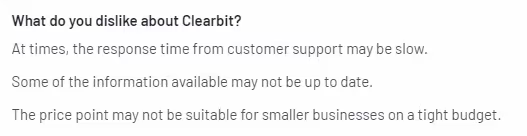
Some users find Clearbit's pricing relatively high, posing challenges for early to mid-stage startups. Credits are quickly depleted, requiring additional purchases for more detailed information, and limiting exploration of features and data.
- Performance Issues:
Clearbit faces occasional lag or unexpected closures without prior notification, causing interruptions and inconvenience. This unpredictability affects overall reliability and user experience.

- Feature Gap vs LinkedIn Sales Navigator:
Clearbit lacks features like InMail to prospects and real-time notifications for key decision-making updates, potentially limiting functionality compared to LinkedIn Sales Navigator.
- Inability to Customize:
The dashboard needs more customization options, hindering the ability to tailor the user interface to individual preferences and suggesting room for improvement in alignment with industry standards.

7. Demand

Demand Features
- Identify Website Visitors:
With Demand, businesses can identify and engage with anonymous website visitors, enhancing lead nurturing and conversion opportunities through automated engagement on LinkedIn and via email.
- LinkedIn Automation:
Demand's advanced automation for LinkedIn streamlines outreach, personalizing messages, and facilitating demo bookings, boosting sales team productivity with AI-powered automation.
- Technology Signals Analysis:
Leveraging technology signals, Demand enables businesses to target and engage potential leads based on the technologies they use, ensuring a more targeted and personalized approach to prospect engagement.
- Automated Sentiment Analysis and Actions:
Demand's AI capabilities include automated sentiment analysis, allowing effective handling of positive, neutral, and negative responses, ensuring leads are not overlooked, and enabling CRM sync for efficient lead management.
- Social Selling Engagement:
Enabling social selling at scale, Demand facilitates lead monitoring and engagement on LinkedIn, brand building, and personalized outreach, aligning sales and marketing efforts for an accelerated sales process.
- AI-Powered Sales Assistant:
Demand's AI sales assistant, trained with a vast database, crafts personalized messages using live data, improving acceptance rates and automating personalized outreach for enhanced sales efficiency.
- Automation and Task Management:
The platform offers user-friendly automation and task management features, streamlining communication, task assignment, and project management to simplify the sales process and boost productivity.
- Comprehensive Training and Support:
Demand provides comprehensive training resources, including tutorial videos and educational content, ensuring users can maximize the platform's potential to achieve their sales and marketing goals.
Demand Pricing
Demand offers three plans, starting from $59/user/month, along with a free 7-day trial with a cancel-anytime option.

Demand Limitations
- Limited Support Responsiveness:
Support may not be readily available, with extended waiting times, and there might be instances where support tickets go unanswered.
- Support Effectiveness:
Support replies may not always be helpful, requiring extensive back-and-forth before problem resolution. Lack of responses when support lacks an answer is reported.
- Knowledge Base:
Users express a need for a more detailed knowledge base to facilitate self-help, enhancing the user experience.
- UI and Speed:
The UI is criticized for its appearance, and occasional sluggishness may impact user experience, although the overall functionality is considered good.

- Manual Tracking Process:
Users note a manual process for excluding personal emails from CRM tracking, suggesting room for improvement in automation.

{{INLINE_CTA_A}}
8. Lead Forensics

Lead Forensics Features
- Visitor Tracking:
Lead Forensics monitors and records the activities of both companies and individuals visiting a business website, providing detailed insights into their browsing behavior, viewed pages, and key contacts within visiting companies.
- Contact Information:
The platform excels in revealing contact details of website visitors, enabling businesses to initiate contact with potential leads who have shown interest in their products or services.
- Lead Scoring:
Lead Forensics utilizes an effective lead scoring system to prioritize efforts on leads with the highest likelihood of conversion based on website visitor behavior.
- Integration Capabilities:
The platform seamlessly integrates with CRM systems and marketing automation tools, streamlining lead management for both sales and marketing processes.
- Real-time Alerts:
Lead Forensics stands out by offering real-time notifications when high-potential leads are identified, enabling prompt engagement with interested prospects.
- Detailed Analytics:
Lead Forensics provides in-depth analytics and reporting, offering valuable insights into website visitor patterns and the ROI of various marketing initiatives.

Lead Forensics Pricing
While specific pricing details are not available, Lead Forensics offers two plans - Essential Plan for small to medium-sized businesses and Automate Plan for enterprise businesses.

Lead Forensics Limitations
- Unintuitive UI:
Despite being a pioneer in visitor identification software, Lead Forensics faces criticism for its unintuitive user interface, with users expressing concerns about complicated functionality in analysis, dashboards, and filters.

- Navigation Challenges Across Multiple Domains:
Navigating across multiple domains may be glitchy, occasionally requiring a complete log-out/log-in, impacting the user experience, especially when managing multiple domains.

- Pricing:
Cost may be a concern for smaller businesses, as the pricing structure may not align with budget constraints, posing a challenge for those seeking more budget-friendly options.

9. Dealfront (Formerly Echobot and Leadfeeder)

Dealfront Features
- Website Visitor Tracking:
Dealfront delivers robust website visitor tracking capabilities, providing insights into the companies and individuals visiting the website.
- Lead Scoring and Qualification:
Dealfront includes tools for lead scoring and qualification, empowering users to prioritize and qualify leads based on website behavior.
- Integration with CRM and Marketing Automation Platforms:
Offers integration with popular CRM and marketing automation platforms streamlines lead data synchronization, enhancing sales and marketing processes.
- Real-Time Lead Notifications:
Users receive real-time notifications with Dealfront when target companies or leads visit their websites, facilitating prompt and strategic follow-ups.
- Detailed Visitor Information:
Dealfront offers detailed information about website visitors, including pages visited, time spent, and available contact information.
- Custom Feeds and Filtering:
Users can create custom feeds and apply filters to segment and analyze website visitor data, simplifying the identification and targeting of ideal prospects.
- Dealfront for Agencies:
Tailored features for marketing and sales agencies empower them to provide exceptional value through enhanced lead generation and visitor tracking.

Dealfront Pricing
Dealfront offers a free plan with no time limit. The paid plan starts at € 198 per month, paid annually.

Dealfront Limitations
- LinkedIn Ads Tracking Limitation:
Inability to track companies visiting the website from LinkedIn ads, especially when individuals engage through mobile devices, preventing linkage to company IP addresses.

- Integration Errors with Microsoft CRM:
Two documented integration errors persist between Dealfront and Microsoft CRM for about a year, with no certain resolution timeline.
- Incorrect Assignment of Dealfront Visits in CRM:
Dealfront visits transfer to CRM, but the tool assigns the wrong person during the transfer, rendering the feature unusable. Changing the owner in CRM doesn't reflect in Dealfront.
- Service and Error Resolution Concerns:
Lack of resolution for reported errors and perceived non-existent service make the tool challenging to recommend. Alternative solutions are being explored.

- Manual Steps and Lack of Interface:
Dealfront Target involves manual steps due to the absence of an interface with the CRM, resulting in time loss.
- Data Timeliness and Quality Issues:
Issues with data timeliness and general data quality surrounding contacts may not always meet expectations.

{{INLINE_CTA_A}}
10. Snitcher

Snitcher Features
- Dynamic Account Identification and Monitoring:
Snitcher employs advanced identification technology to dynamically monitor anonymous website visitors in real time. This cutting-edge capability empowers effective engagement with potential leads as they navigate through online platforms.
- Lead Exploration, Assessment, and Prioritization for Sales Units:
Snitcher provides sales teams with a robust system for exploring, assessing, and prioritizing high-intent leads efficiently. The inclusion of real-time notifications ensures that sales teams stay proactive, consistently replenishing and optimizing their pipelines.
- Account-Centric Marketing Intelligence:
Centered around accounts, Snitcher delivers comprehensive insights for marketing teams aiming to engage their target audience strategically. This strategic approach enhances website personalization, refining retargeting efforts, and ultimately boosting conversion rates.
- Customizable Agency Solution:
Agencies leverage Snitcher's customizable white-label solution to gain early insights, diversify revenue streams, and access qualified leads. This strategic implementation enhances client ROI, elevating the agency's overall value proposition.
- Seamless Integration with a Vast App Ecosystem:
Snitcher seamlessly integrates with an extensive ecosystem of over 5,000 apps, augmenting campaigns and fortifying sales pipelines. This integration versatility plays a pivotal role in streamlining processes and enhancing overall workflow efficiency.
- Spotter - Real-time Identification API:
Spotter, Snitcher's Real-time Identification API, provides users with full control, enabling flexible utilization of identification data tailored to individual needs. This customizable approach ensures adaptability and seamless integration.
- Reliable Customer Support:
Benefiting from good data quality, Snitcher offers responsive customer support and regular feature updates, ensuring users receive consistent assistance and stay abreast of the latest capabilities.
- Optimize Revenue Generation Within Existing Budgets:
Snitcher empowers B2B sales and marketing teams worldwide with invaluable insights to optimize campaigns and maximize revenue generation efforts, effectively leveraging existing budgets for enhanced outcomes.

Snitcher Pricing
Snitcher offers pricing that is tailored to your needs, starting at USD 39 per month. The platform offers an estimate based on your business size and web traffic. Users can also use the 14-day free trial before getting started.

Snitcher Limitations
- Pricing Concerns
The pricing may seem a bit high for smaller organizations. Allowing subscriptions to lower plans with performance visibility would address this concern.

- Unpredictable Costs
Paying per identified visitor, with no upper limits, could lead to concerns about potentially large bills with a surge in web traffic in a given month.

- Categorization Challenges
Snitcher sometimes faces challenges categorizing businesses accurately, resulting in businesses from one industry appearing in multiple categories.

- URL and Industry Details
Under company details, sometimes the URL doesn't work due to HTTP/HTTPS issues. Improvements in this aspect, along with visible industries in company details, would enhance user experience.

Find the Right Leadinfo Alternatives
Exploring Leadinfo alternatives can help overcome limitations in prospect coverage, integration, and pricing.
1. Key Considerations: Look for solutions with better prospect identification, seamless integrations, and cost-effectiveness.
2. User Identification: Ensure accurate tracking to enhance lead insights.
3. Marketing Automation: Choose tools with advanced automation features for improved engagement.
By evaluating these factors, businesses can select the best-fit solution to optimize lead generation and drive better results.
Key Takeaways
While Leadinfo offers innovative B2B marketing data solutions, exploring alternatives reveals a diverse landscape. Platforms like Warmly, LeadMagic, Leadlander, Pearl Diver, Clearbit, Demand, Factors AI, Lead Forensics, and Dealfront present varied features, pricing models, and limitations.
Warmly excels in buyer experience, LeadMagic in visitor identification, and Leadlander in verified contact profiles. Pearl Diver focuses on discerning anonymous traffic, Clearbit on a comprehensive B2B audience, and Demand on LinkedIn automation.
Factors AI emphasizes opportunity generation, Lead Forensics offers detailed analytics, and Dealfront excels in robust website tracking. Each alternative has unique strengths and limitations, demanding careful consideration based on specific needs like pricing, integration, and user interface.
As businesses enhance B2B marketing strategies, exploring these Leadinfo alternatives allows informed decisions for improved lead identification, engagement, and overall success.
{{INLINE_CTA_A}}
%2520(1).avif)
LinkedIn ABM: Using LinkedIn Ads to Scale Your ABM Efforts
Discover how you can use LinkedIn to optimize your ABM campaigns

We’ve worked with many SaaS companies across the world, and every marketer seems to have this one question:
“How do we improve our ABM campaigns?”. While many folks resort to Google Ads for ABM, they miss out on LinkedIn. Since LinkedIn is the ideal place to reach your decision-makers, you can run ads to influence their buying decisions.
But how do you get started with LinkedIn ABM? In this article, we will explore how B2B companies can effectively use LinkedIn ads to scale their ABM efforts, from setting up targeted account lists to measuring success and overcoming challenges.
Understanding Account-Based Marketing (ABM) on LinkedIn
As the world's largest professional network, LinkedIn provides a unique platform for B2B companies to connect with decision-makers and influencers. With its robust targeting capabilities and professional user base, LinkedIn is an ideal channel for executing ABM campaigns.
LinkedIn offers detailed targeting options based on location, job roles, company size, and interests. Unlike platforms like Meta, where you can use filters to focus on specific accounts and decision-makers, where you advertise to a much broader audience.
Setting Up Your LinkedIn ABM Campaign
Creating a target account list for your ABM campaign
The first step in launching a successful LinkedIn ABM campaign is to create a target account list. This list should include high-potential accounts that align with your ideal customer profile and have the potential for significant revenue impact.
P.S: You can use our Audience Builder feature to create a high-intent audience list 📑

LinkedIn's account targeting features for precision
LinkedIn offers advanced targeting features such as Company Size, Industry, Job Title, and Seniority, allowing marketers to target decision-makers within the identified accounts precisely. The Sales Navigator tool also provides even more granular targeting options for reaching specific individuals within target companies.
Crafting Compelling Content for LinkedIn ABM
Developing personalized content for targeted accounts
Personalization is key in ABM, and LinkedIn provides various opportunities to tailor content for specific accounts. From personalized InMails to targeted sponsored content, B2B companies can create tailored messages that resonate with decision-makers.
Leveraging LinkedIn's ad formats for maximum impact
LinkedIn offers a variety of ad formats, including Sponsored Content, Sponsored InMail, and Text Ads, each suited for different stages of the buyer's journey. By utilizing these ad formats strategically, marketers can engage target accounts with compelling content.
💡Check out our list explaining the different Types of LinkedIn Ads
{{INLINE_TOFU}}
Optimizing Your LinkedIn ABM Campaign
Monitoring and analyzing campaign performance
Continuous monitoring of campaign performance is crucial for optimizing LinkedIn ABM efforts. Marketers should track key metrics such as engagement, click-through rates, and conversions to identify areas for improvement.
Implementing A/B testing for continuous improvement
A/B testing different ad creatives, messaging, and targeting parameters can provide valuable insights for optimizing campaign performance. By testing and iterating different campaigns, B2B companies can refine their LinkedIn ABM strategy for better results.
You can also use our CAPI feature to scale and optimize campaigns to get maximum results ↗️

Measuring Success in LinkedIn ABM
Identifying key metrics for evaluating ABM campaign success
In addition to traditional metrics like click-through rates and conversions, B2B marketers should focus on account-level metrics such as pipeline velocity, deal size, and account engagement to measure the impact of their LinkedIn ABM campaigns.
LinkedIn's Campaign Manager provides detailed analytics for tracking the performance of ABM campaigns. Marketers can gain insights into audience demographics, engagement metrics, and ROI to assess the effectiveness of their efforts.
You can use our True ROI feature to measure how each ad campaign contributes to revenue.
Integrating LinkedIn ABM with Your Overall Marketing Strategy
Aligning LinkedIn ABM with other marketing initiatives
LinkedIn ABM should be integrated seamlessly with other marketing efforts to ensure a cohesive, consistent experience for target accounts. Alignment with content marketing, email campaigns, and sales outreach is essential for maximizing impact.
Leveraging LinkedIn's integration capabilities with CRM and marketing automation platforms
Integrating LinkedIn with CRM and marketing automation platforms enables seamless data synchronization and lead nurturing. By connecting LinkedIn ABM efforts with existing systems, B2B companies can streamline their marketing and sales processes.
Best Practices for LinkedIn ABM Success
Tips for effective targeting and personalization
- Research and understand the pain points and challenges of the target accounts
- Tailor messaging and content to address the specific needs of each account
- Leverage LinkedIn's targeting options to reach decision-makers with precision
Strategies for maximizing ROI on LinkedIn ABM campaigns
- Focus on building long-term relationships with target accounts
- Test different ad formats and messaging to identify what resonates best
- Continuously refine targeting parameters based on campaign performance
Overcoming Challenges in LinkedIn ABM
Addressing common hurdles and obstacles in LinkedIn ABM implementation
- Difficulty in identifying and prioritizing high-potential target accounts
- Ensuring alignment between sales and marketing teams for effective execution
- Measuring and attributing ROI to ABM efforts accurately
Strategies for overcoming challenges and optimizing ABM campaigns on LinkedIn
- Implementing a collaborative account selection process involving both sales and marketing teams
- Establishing clear communication and alignment between sales and marketing for coordinated outreach
- Utilizing multi-touch attribution models to measure the impact of ABM efforts across the entire buyer's journey
Use AdPilot to Improve Your LinkedIn ABM Efforts
Factors’ new AdPilot offering gives marketers a complete view of how they can best use LinkedIn for their ABM campaigns. They can:
- Build highly-targeted audience lists to import directly into LinkedIn campaign manager
- Use our Smart Reach feature to ensure that ad impressions are evenly distributed across all accounts in the audience list.
- Leverage LinkedIn Conversion API to send conversion data from websites, campaigns, CRM, and other sources directly to LinkedIn's ad platform to train your Ads algorithm better.
- Measure LinkedIn’s true impact thanks to view-through attribution.
💡Check out how Cacheflow Improved LinkedIn Ads Attribution by 30% with Factors.ai

This article outlines how B2B companies can enhance their ABM strategies on LinkedIn. It highlights the use of LinkedIn's targeting features, such as Company Size, Industry, and Job Title, to effectively reach key decision-makers. Additionally, it underscores the importance of crafting personalized content and utilizing ad formats like Sponsored Content and Sponsored InMail to engage prospects throughout their journey. By applying these tactics, businesses can improve engagement and boost conversions in their LinkedIn ABM campaigns.
Wrapping Up
Using LinkedIn for ABM offers B2B companies a powerful platform for executing targeted and personalized marketing campaigns. By leveraging LinkedIn's robust targeting capabilities, ad formats, and analytics tools, B2B marketers can scale their ABM efforts effectively. As the landscape of B2B marketing continues to evolve, integrating LinkedIn ABM with overall marketing strategies and staying ahead of emerging trends will be crucial for sustained success.
LinkedIn remains a valuable asset for reaching and engaging key decision-makers. As B2B companies navigate the complexities of modern marketing, leveraging LinkedIn for successful ABM campaigns will be essential for driving growth and building lasting customer relationships.
Book a demo today to find out how you can use AdPilot to 2x your LinkedIn ROI

What is Lift Analysis?
Learn how B2B marketers use lift analysis to track true campaign performance. Go beyond clicks, measure incremental pipeline, revenue, and buyer progression.
TL;DR
- Lift analysis isolates real campaign impact by comparing performance between those who saw your ads and those who didn’t.
- It’s ideal for B2B, where decision cycles are long, involve multiple stakeholders, and attribution often misfires.
- Key metrics include conversion lift, incremental leads, and pipeline impact (not just clicks or CTRs.)
- Platforms like Factors’ AdPilot help automate testing, prevent data contamination, and visualize which campaigns are worth scaling.
You know that moment when you launch a campaign, open the dashboard, stare at the numbers, and immediately question every life choice that got you here? Yeah… same.
Fifteen form fills are cute and all. But were they driven by your ads, or were they just bored interns downloading stuff for sport?
Meanwhile, your traffic report is yodeling its heart out… and your pipeline is weeping in silence.
ALL this because in B2B, buyers don’t convert… they wander 🧑🦯 They lurk, bookmark, discuss with teammates, revisit your pricing page at 2 am… and maybe three fiscal quarters later, they finally ask for a demo.
So if all you’re tracking is clicks, you’re basically reading newspaper horoscopes and calling it ✨analytics✨.
But then comes lift analysis… it measures impact… it doesn’t ask, “did this campaign run?” but “did this campaign matter?”
Whether you're running ads on LinkedIn or Google, lift analysis helps you identify which campaigns actually drive pipeline and which ones just burn budget.
In this blog, we’re breaking down how B2B lift analysis works, how to set it up without summoning your entire RevOps team into a mess, and why high-performing GTM teams treat it like a mandatory filter before they scale anything.
Ufff… that’s a lot, so let’s get started.
What is lift analysis? (and why you should care)
Lift analysis helps you understand the actual impact of your marketing campaigns by comparing behavior between two groups of people:
- One group sees your ads (test group)
- The other does not (control group)
This comparison shows the extent of change resulting from the campaign. In other words, it gives you the true incremental effect of your marketing.
In B2B, this becomes even more crucial because your buyer journey isn’t linear, and surface-level metrics like clicks and impressions often reveal veryyy little… basically, it’s a group project where only 2 out of 6 people are actually doing any work.
Lift analysis allows you to answer questions like:
- “How many opportunities did we gain because of this campaign?”
- “Are leads from this channel more likely to move to the next stage?”
- “What portion of the pipeline was influenced directly by ad exposure?”
Side-note: You can FINALLY stop asking “Did people click or not???”
The idea is simple… find out what effect your campaigns have on business outcomes.
How does lift analysis differ from traditional attribution?
Most attribution models assign credit to marketing touchpoints based on timing or position in the journey. For example, first-touch attribution assigns full credit to the first interaction, while multi-touch attribution allocates credit across multiple interactions.
This approach doesn’t always reveal whether a campaign was truly useful. Some interactions would have happened even without a campaign running in the background.
But lift analysis shifts the focus.
It asks a more fundamental question: what would the results look like if no one saw the campaign? You get a clear benchmark by comparing the test and control groups.
For example:
- If the control group generated 100 leads
- And your test group generated 140 leads
Then 40 leads were added because of your campaign. That’s a 40% ‘lift’.
Again… this method works particularly well in B2B, where customers see ads, get outbound emails, and visit your site over extended periods. Attribution often struggles to connect the dots correctly, especially when interactions span days or weeks.
Lift analysis doesn’t try to split credit among channels; instead, it zeroes in on what changed because you spent money and ran the campaign. It simplifies measurement and keeps your focus on impact (instead of touchpoint tracking errors).
Traditional Attribution vs. Lift Analysis
| Category | Traditional Attribution | Lift Analysis |
|---|---|---|
| What it measures | Assigns credit to touchpoints based on when/where they occurred | Measures the incremental impact of a campaign |
| Core question | “Which touchpoint should get credit?” | “What would have happened if no one saw the campaign?” |
| How it works | Distributes credit across first-touch, last-touch, or multi-touch models | Compares performance between exposed and control groups |
| Key limitation | Can over-credit interactions that would’ve happened anyway | Requires clean test/control setup but gives clearer causality |
| Best for | Understanding the journey and mapping interactions | Understanding true lift, what changed because money was spent |
| Common issues in B2B | Long journeys, multiple stakeholders, and delayed conversions make attribution messy and inaccurate | Works well even with long cycles because it measures difference, not touchpoints |
| Output example | “This campaign influenced 140 leads” (even if some were already likely to convert) | “This campaign created 40 incremental leads” (40% lift) |
| Decision-making value | Helps visualize journeys but doesn’t confirm impact | Helps reallocate budget based on what actually drove outcomes |
{{INLINE_TOFU}}
How to run a lift analysis?
1. Start with a clear hypothesis
Before spending a single dollar, define:
- What you want to lift (demos, SQLs, trials…)
- Where you expect to see the lift (top/mid/bottom funnel)
- What success looks like
Example:
“Accounts exposed to our LinkedIn retargeting should generate 20% more SQLs within 30 days.”
A simple hypothesis upfront saves you from running a test you can’t use later.
2. Setting up a valid test and control design for B2B campaigns
Your lift analysis is only as good as your test design. Without a solid design, it becomes difficult to trust the results.
Start by defining two groups:
- Test - sees ads
- Control - absolutely does NOT
These groups should be similar in all ways except for exposure to your campaign. They should share characteristics like company size, industry, or region. This often means creating audience lists at the account or firm level.
For example:
If you are targeting 1,000 accounts on LinkedIn, you might expose 500 to your campaign and keep 500 as a control group
Note: Avoid overlap. If someone in your control group is accidentally served one of your ads, the data becomes blurry. This is especially important when running campaigns across multiple platforms like Google and LinkedIn.
Note 2.0: Ensure your sample size is large enough to show meaningful differences
With a properly designed test-and-control framework, you can validate that the lift is meaningful and actionable rather than just random fluctuation.
3. Run your campaign long enough (B2B ≠ D2C)
B2B conversions take time (A LOT of it). People don’t click today and book a demo tomorrow.
Use this as your guide:
- Top funnel: 2–4 weeks
- Mid funnel: 4–6 weeks
- Bottom funnel: your full sales cycle
A short test might feel efficient, but it won’t tell the real story.
4. Measure beyond vanity metrics
Look deeper than CTR.
Track things like:
- Faster opportunity progression
- Higher-quality SQLs
- Better ACVs
- More buying-committee engagement
- Dormant accounts waking up
If all you measure is clicks, your lift test won’t have much to say.
5. Tie lift to real business outcomes
Your exposed vs. control comparison should map directly to revenue movement:
- Pipeline created
- Demo requests
- SQLs
- Opportunity creation
- Win rates
- Revenue
For example:
“Exposed group generated 31% more opportunities and moved to SQL 22% faster.”
That’s the kind of data that will make your CMO smile like this… 😀
6. Reallocate budgets based on lift
This is the part most teams say they’ll do and then… don’t. But it’s where lift analysis actually pays off.
Use your lift results to make cleaner, bolder decisions:
- High spend + low lift:- cut, pause, or rethink your offer. Something isn’t landing.
- Low spend + high lift:- scale confidently. You’ve found a pocket of efficiency.
- Moderate lift:- experiment with creative, sequencing, or audience refinement to unlock more impact.
The goal is NOT to optimize for cheaper clicks or prettier dashboards. It’s to shift money toward the campaigns that move accounts closer to revenue… and away from the ones that only look busy.
7. Use lift to fix funnels and messaging
Lift results don’t just show what worked… they show why.
Examples:
- Strong demo lift? → messaging is landing, scale it.
- Strong mid-funnel lift but no SQLs? → check your hand-off to sales.
- No lift at all? → revisit audience, creative, offer, or channel-stage fit.
Lift tells you exactly where the blockage is.
8. Build lift analysis into quarterly planning
This is what separates mature GTM teams from the rest.
Use lift insights to:
- Decide which channels belong at ToFu/MoFu/BoFu
- Build better sequencing (awareness → engagement → intent)
- Forecast expected outcomes
- Set better budgets
- Refresh messaging
Over time, lift tests create your team’s version of “GTM instinct,” but backed by data.
9. Use automation tools (like AdPilot) to turn insights into action
Instead of manually stitching exposed vs. control data:
- Auto-create test groups
- Track exposure across channels
- Isolate audiences
- Measure incremental conversions
- Suggest budget shifts
- Visualise lift clearly
With this, you’ll spend less time wrestling spreadsheets and more time optimising (you can thank me later… or get me Vietnamese iced coffee NOW).
10. Rinse, repeat, refine
Lift analysis isn’t a “run it once and forget about it” thing. Your market shifts, your messaging evolves, your product matures, and all of that affects how your campaigns perform.
So your lift will change too.
The teams that win are the ones that treat lift analysis like an ongoing habit, not a quarterly chore. Run it consistently, compare results over time, and use those patterns to make sharper, faster decisions.
That’s where the compounding returns kick in.
Key metrics and calculations
Once your test and control groups are set up, you can begin calculating how much value your campaign truly added. Again, the idea is to isolate incremental performance as results that wouldn’t have happened without the campaign.
- Conversion Rate Lift
Shows the difference in conversion performance between test and control groups. It gives you a baseline sense of effectiveness.
Formula:
Lift % = (Test Conversion Rate - Control Conversion Rate) / Control Conversion Rate × 100
Quick Example:
- Test group: 6% conversion
- Control group: 4% conversion
- Conversion lift: 50%
This difference reflects actual influence and is beneficial when conversions lead to revenue-generating conversations like demos or consultations.
- Incremental Conversions
This metric shows the number of leads, sign-ups, or actions that happened due to the campaign itself.
Example:
- Test group: 120 leads
- Control group: 80 leads
- Incremental leads: 40
Incremental conversions help you understand volume impact and how it affects upper/mid-funnel goals.
- Pipeline Impact
For most teams, success is defined by pipeline impact, especially how it grows with different campaigns.
Example:
- 40 incremental leads
- 25% lead-to-opportunity conversion rate
- $10,000 average opportunity value
Pipeline lift:
40×0.25×$10,000 = $100,000 added to pipeline
Tracking this metric over time helps justify campaign budgets and shape future experiments.
Common pitfalls in lift analysis (and how you can avoid them)
Even well-constructed lift studies can go wrong if certain issues are overlooked.
- Small sample size
Tiny samples create fake confidence. A 30% lift means nothing if it came from five accounts. Always check whether your exposed and control groups are big enough to reflect real buying behavior. If not, your results are just telling stories that might never come true.
- Contamination between groups
If your control group accidentally sees your ads (via retargeting, broad targeting, or overlapping campaigns), the whole test collapses. Map out every channel touching your audience and tighten exclusions so your control group stays truly untouched.
- Missing context
Lift (and life) doesn’t exist in a vacuum. A new competitor entered the market? Quarter-end discounts running? Major product launch? All of these can inflate or suppress lift. Annotate your test window with surrounding activity so you don’t over- or under-credit your campaigns.
- Short test windows
B2B buying cycles are slow and dramatic. If your usual lead-to-demo cycle is 30–45 days, a 10-day test will only capture… nothing. Set your test duration based on your actual CRM conversion timelines to measure the full journey from exposure to opportunity.
- Focusing only on top-level metrics
Also, lift doesn’t always show up at the top of the funnel. Sometimes it shows up as cleaner SQLs, faster deal velocity, or higher win rates. Track mid- and bottom-funnel behaviors as well, because that’s where the real revenue impact lies.
Using lift analysis to optimize your campaigns and budget
The real work begins once you’ve run your first test and have clear lift results. Think of those results as directional signals… they tell you where to invest more, where to cut back, and where to experiment next.
Here’s how to turn those signals into action:
1. Double down where lift is strongest
If a segment, channel, or creative theme shows meaningful lift (demo requests, SQLs, pipeline velocity), increase investment there. This is how you scale efficiently, not emotionally.
2. Fix what’s underperforming
Low lift doesn’t always mean “kill the campaign.” It usually tells you what to fix:
- Wrong audience
- Weak offer
- Creative not resonating
- Mismatch between channel and funnel stage
Lift results show you where the leak is, not just that a leak exists.
3. Compare channels using the same lens
Raw metrics (CTR, CPC, impressions) won’t tell you which platform is working. But lift will.
Example:
- LinkedIn → higher incremental demo lift
- Google → higher incremental pipeline value
This helps you plan channel roles and sequencing instead of treating all channels the same.
4. Build smarter sequencing
If awareness campaigns show strong top-funnel lift but weak SQL lift, don’t scrap them… pair them with stronger mid-funnel nurture. Lift helps you see what stage each campaign actually impacts.
5. Use lift to improve hand-offs
If your exposed group engages heavily but doesn’t progress to SQL, your issue isn’t ads. It’s the sales follow-up or qualification process. Lift highlights operational gaps you’d never catch through attribution alone.
6. Inform quarterly planning
Lift results help you:
- Predict which channels will drive next quarter’s pipeline
- Set realistic targets
- Decide budget splits
- Update ICP or audience logic
- Refresh messaging based on what actually converts
This is how revenue teams get out of “random acts of marketing.”
7. Turn lift into a continuous loop
Teams that optimise regularly outperform teams that optimise reactively. Run lift tests across new segments, new creatives, and new funnel stages. Over time, you build your own internal ‘GTM playbook’ based on real data from your brand, not generic marketing wisdom.
Applying lift analysis to LinkedIn Ads
LinkedIn helps you speak directly to people in specific roles, industries, or companies, and decision makers.
Here's how you can use lift analysis for LinkedIn Ads:
- Start with a segmented audience, based on intent, demographics, industry, interest groups, etc.
- Split those accounts into test and control groups
- Run sponsored content, lead gen forms, or other ad formats to the test group only
- Track outcomes such as form fills, demo requests, or high-intent page visits, and ad views that led to pipeline.
You can use LinkedIn’s built-in reporting and your CRM and website data together to track lifts in performance. For example, compare how many opportunities came from companies that saw ads versus those that didn’t.
Don’t launch another LinkedIn campaign without keeping these in mind:
- LinkedIn can be expensive, so measure what your spending actually does from the get-go
- Ensure your CRM connects campaign exposure with pipeline actions
- Watch out for people who see LinkedIn ads and later visit your site without clicking. Then, use the LinkedIn Insight tag to capture that view-through behavior
Wait, our LinkedIn AdPilot can help scale your ads, here’s how…
LinkedIn AdPilot helps you:
- Build dynamic, real-time ICP audiences
- Control impression pacing and creative reach
- Understand true pipeline influence, even for view-through conversions
“With Factors, our LinkedIn Ads went from a guessing game to a laser-focused strategy.”
- Riley Timmins, Director of Marketing at Cacheflow
Applying lift analysis to Google Ads
Whether you’re running Display, Search, or YouTube ads, you can use lift analysis to measure effectiveness.
Here’s how you can use lift analysis for Google Ads:
- Use conversion lift testing (where available) or geo-based experiments
- Pick a region and audience segment to serve ads to
- Hold back ads from a similar segment to serve as your control
Google lets you compare conversion results between exposed and non-exposed groups.
A few tips for your Google Ad campaigns:
- Ensure your tracking catches form fills or calls from higher-level interactions, not just easy-to-attribute clicks
- Use a consistent conversion window that matches your normal sales cycle
- Build segments based on firmographics if possible, not just generic remarketing groups
Once the test is complete, compare your performance metrics. This shows exactly how much of your conversion or pipeline growth came from advertising with Google platforms. You can then make smarter decisions about where to allocate budgets and which types of campaigns drive real value for B2B buyers.
Wait, our Google AdPilot can also help scale your Google Ads, here’s how…
Google AdPilot ensures:
- Search and display budgets are better directed toward ICP-fit accounts
- Google algorithms are trained with more conversion and account-level data
- Funnel-level metrics track what really matters: revenue from the right accounts
Both platforms were built for revenue-focused marketers who want no guesswork and no wasted spend.
“Before AdPilot, nearly 50% of our Google Ads spend went to non-ICP accounts. That meant wasted budget and poor conversion signals back to Google. With AdPilot, we can focus only on our ICP accounts, the ones most likely to convert, and feed Google the right data to optimize for high-value deals."
- Mansi Peswani, Demand Generation Lead at Factors.ai
👉 Explore how marketing teams use Factors AdPilot to strengthen their channel ROI and prove real impact: Book a demo →
In a nutshell
Lift analysis helps you go beyond surface-level metrics and uncover the actual business impact of your B2B campaigns. For companies running LinkedIn Ads or Google campaigns, it’s a smarter way to know whether what you’re doing is creating real pipeline, or just clicks.
If you're looking to:
- Validate your spend across different platforms,
- Connect your campaigns to meaningful revenue outcomes, and
- Fine-tune your channel mix with real incremental data,
... it’s time to add lift analysis to your stack.
But tracking and optimizing multi-channel results is only half the story. The right platform can take that insight and turn it into action, automatically.
FAQs for lift analysis
Q. What is lift analysis in marketing?
Lift analysis measures the incremental impact of a marketing campaign by comparing performance between two groups: those exposed to the campaign (test group) and those who weren’t (control group). This helps you understand the true effect of your efforts beyond what would have happened anyway.
Q. How is lift analysis different from traditional attribution?
Traditional attribution models credit conversions based on touchpoints, like last-click or multi-touch. Lift analysis goes further by comparing outcomes between exposed and non-exposed audiences, giving you a clearer picture of what the campaign actually drove.
Q. Can you use lift analysis for B2B marketing?
Yes. Despite longer sales cycles and complex buying teams, lift analysis works well in B2B. It helps isolate the real impact of campaigns across stages like engagement, lead generation, and pipeline outcomes.
Q. How do I apply lift analysis to LinkedIn Ads or Google AdPilot?
For LinkedIn: build test and control groups using matched audiences and measure outcomes like conversions or qualified leads. For Google AdPilot: use conversion lift testing or account-based geo-experiments to run similar comparisons.
Q. What metrics should I track in a lift analysis?
Focus on conversion rate lift, incremental conversions, average deal value, and even pipeline impact. In B2B, metrics like ROAS uplift, deal velocity, and pipeline growth matter most.
Q. What are common mistakes in lift analysis?
The most common ones include poorly matched control groups, too few data points, cross-channel contamination, and stopping the test too early, especially if your sales cycle spans weeks or months.

Turn G2 Buyer Intent into Revenue with Factors.ai Integration
See how B2B teams convert G2 intent into pipeline by syncing it with website and CRM data using Factors.ai. Activate prospects at the right time, every time.

TL;DR
- G2 data alone offers limited visibility — it highlights intent but omits other crucial buyer behaviors across channels.
- Factors.ai fills the gap, unifying G2 signals with website, LinkedIn, CRM, and ad interactions for full-funnel tracking.
- Automations drive real outcomes — think Slack alerts, LinkedIn retargeting, CRM updates, and tailored sales sequences.
- Performance can be measured end-to-end: track which G2 interactions lead to pipeline, deals, and revenue acceleration.
Over 90 million users visit G2 to learn more about a software before they buy it.
If you sell software, it’s critical to have an updated and well-thought-out G2 profile to attract in-market users who might become your customers.
Now, to make your life easier in justifying your investment into G2, the review platform offers ‘Buyer Intent Data’ — a tool that helps you see when and how users view your software on the G2 platform.
But here’s the catch.
G2 Data Alone Isn’t Enough
While Buyer Intent Data is a great step forward in getting better visibility into the companies interested in your software — it doesn’t give you the complete picture of how the user has engaged with outside of the G2 review platform.
For instance, a typical G2 user browses through G2 product pages, sees pricing on product profiles, visits the software vertical page, and compares different products. But that’s not all. The user might also visit your website to learn more, send emails with questions, go to your events, or even click on your ads. All these steps are part of how they decide which software to choose.
That leaves a huge visibility gap. To close it, you need to combine G2 insights with broader engagement data — and that’s where Factors.ai comes in.
The Solution: G2 + Factors.ai = End-to-End Buyer Visibility
Factors is an account intelligence and analytics tool that helps B2B teams identify, qualify, and convert high-intent accounts engaging with their brands across G2, LinkedIn, website, and more.
Read on to see how integrating G2 and Factors unlocks more opportunities for your company.
{{INLINE_TOFU}}
Before we start…
💡Knowing the basics is crucial when you’re trying to set things up. Follow the steps mentioned in our help docs to integrate Factors and G2.
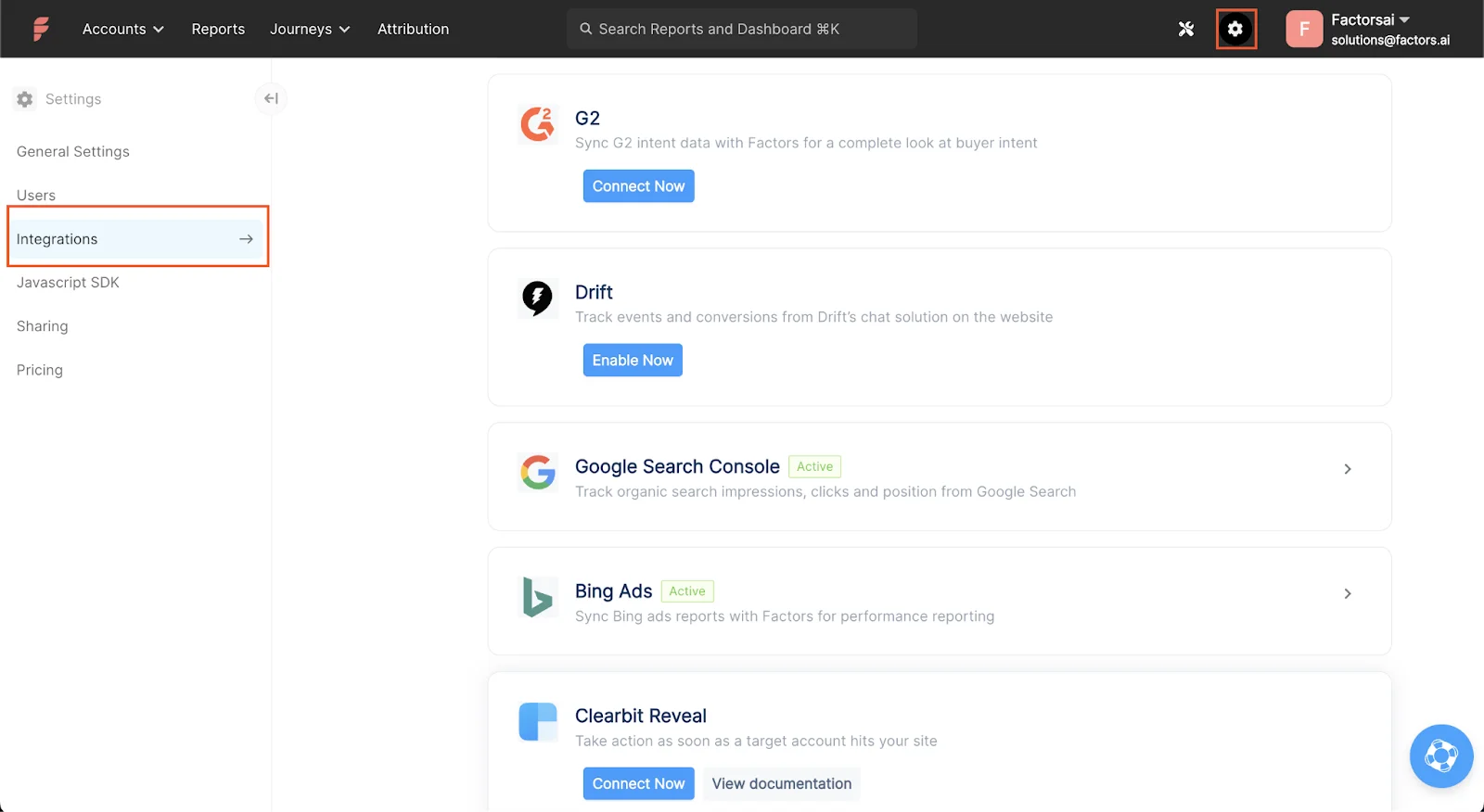
How to make the most out of your G2 subscription
Factors helps you trigger powerful automations by combining Buyer Intent Data from G2 with engagement data collected by Factors. Here are some common use cases:
- Capture intent signals from G2.
- Automate activating accounts based on G2 Buyer Intent Signals
- Get engagement-based alerts in the channel of your choice
- Generate leads from G2 engagement
- Measure and analyze G2’s on revenue
Let’s drill deeper to understand each of these use cases.
1. Centralize All Buyer Activity (G2 + Website + LinkedIn)
Capture every interaction in-market users take with you on G2 inside Factors. Be it interacting with your G2 profile page, comparing your product to a competitor, or viewing alternatives in the G2 product category.
But that’s not all.
Factors also combines engagement data from your website, LinkedIn, and CRM into a single source of truth to analyze how far along your prospects are in their buying journey.
You can use it to filter and find prospects early in their buying journey, along with those who have found your product and are still comparing it with similar products.
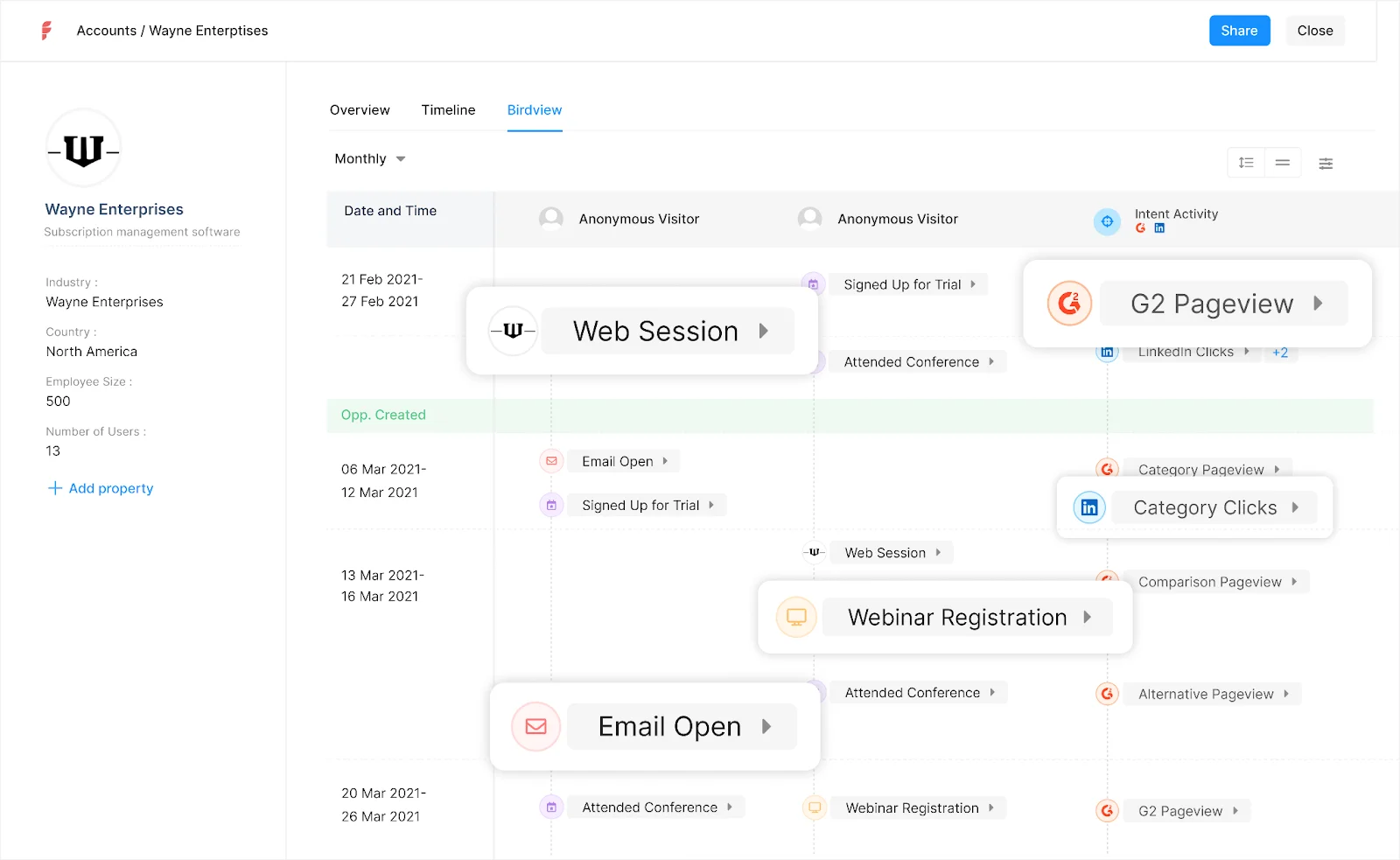
Pro Tip: Use this unified view to segment early-stage vs. high-intent accounts.
2. Automate Lead Activation Based on G2 Signals
You can run an automation to help you create lists of accounts that interact with you on G2. You can narrow this list by adding filters like if they saw your pricing page or compared your product.
Then, have the automation push these lists to create custom-matched audiences on LinkedIn.
You can set up ads to deliver custom messages to specific job titles in the target accounts based on what they saw on G2.
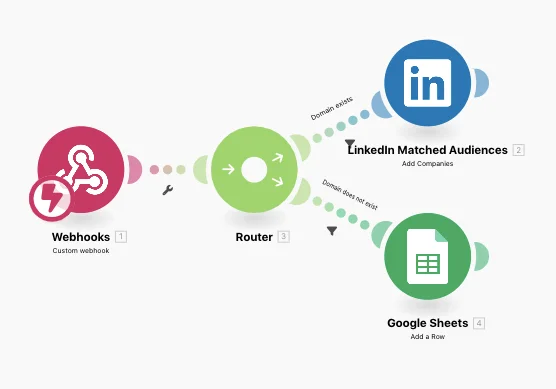
You can also set up custom automated emails based on what a user saw on G2. You can also automatically update your CRM with enriched contact info.
For instance, If a user from Company 1 saw your product’s pricing, you can run an automation that pulls in contact information from Apollo or Outreach [based on job titles from company], add the contacts to your CRM, and trigger custom sales sequences.
Simple, right?
3. Get engagement-based alerts in Slack or Teams
You can set up real-time notifications to alert you across Slack or Teams the moment a prospect performs a predetermined action on G2.

Set up real-time alerts for when:
- A key account views your G2 comparison page.
- Someone in your ICP checks pricing page.
- An in-market company visits both G2 and your website.
Your sales team gets instant Slack or Teams notifications — enabling timely follow-up.
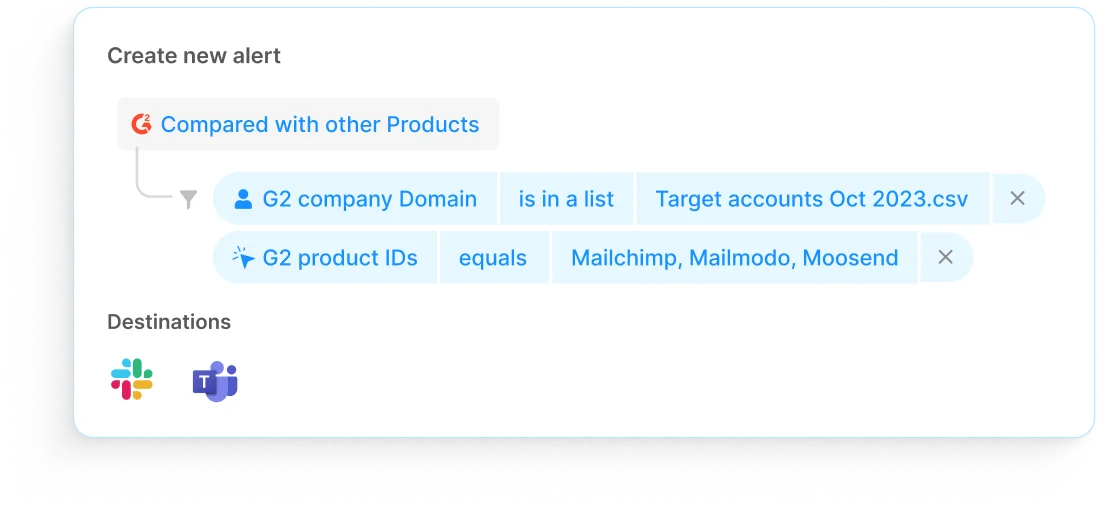
Measure G2’s impact on revenue
As with all go-to-market initiatives, you must measure how your G2 profile contributes to building revenue.
Are the leads coming through G2 actually ready to purchase your product? Does your profile stand out in all relevant categories? Without the right data, it’s tricky to understand what parts of your G2 activities are bringing results.
Buyer intent is only useful if it drives revenue. Factors helps you track:
- Which G2 interactions lead to deals
- Funnel conversion from G2-engaged accounts
- Performance of G2 leads vs. cold outreach
Bonus: Use this data to optimize your G2 listing and ABM strategy.
With Factors, you can effortlessly track your G2 efforts and identify how you can optimize them to generate more pipeline.
{{CTA_BANNER}}
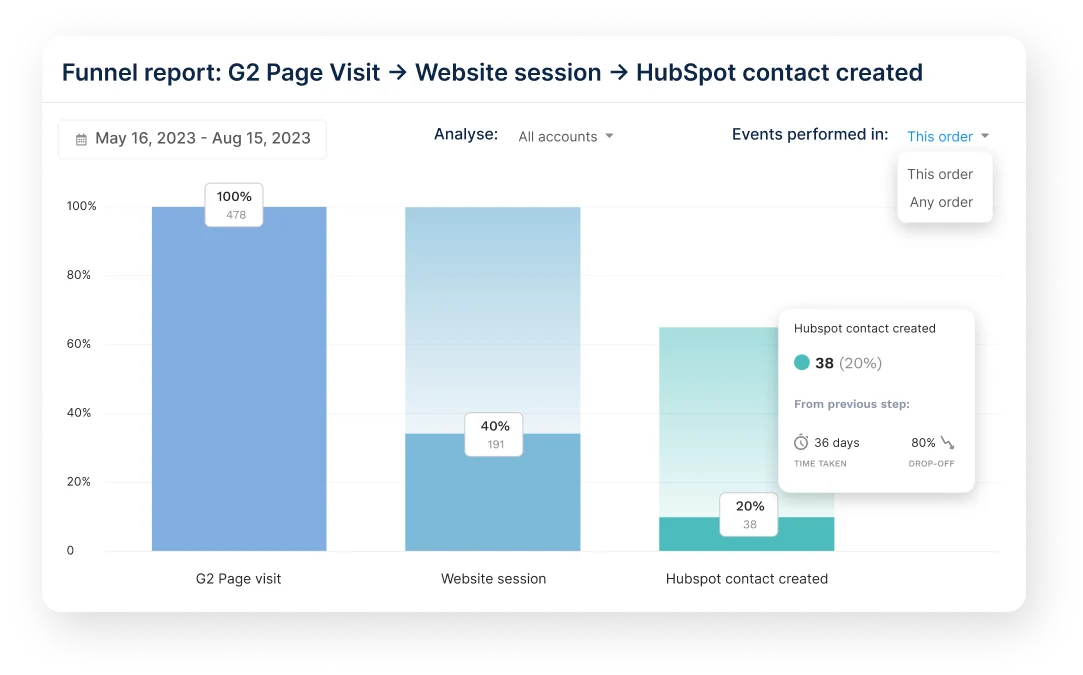
Best Practices for Using Intent Data
To get the most out of visitor data, keep these in mind:
- Identify Your Best Customers: Use website visitor data to better define your ideal customer profile (ICP) by analyzing who visits your website and the content they’re most interested in.
- Focus Your Efforts: Develop targeted sales and marketing strategies based on each buying stage and the specific content that attracts different customers.
- Make it Personal: Create custom outreach messages based on their behavior on G2 and your website.
- Prioritize Active Buyers: Focus on companies that show multiple signals and exhibit strong engagement.
Real-World Results: How One Company Increased Sales
Here’s a quick example: A software company using Factors and G2 gets notified instantly in Slack when a high-value account views its G2 pricing page. Simultaneously, the account is added to a LinkedIn retargeting campaign, and the sales team triggers a personalized sales sequence. The result? More meetings booked and faster sales cycles.
Get Full-Funnel B2B Visibility with G2 + Factors.ai
Over 90 million buyers visit G2 to evaluate software — yet G2's Buyer Intent Data only shows a portion of their journey. While it's a strong signal of interest, it lacks visibility into what happens beyond the platform — like visits to your site, ad clicks, or CRM activity. This blind spot limits your ability to act on buying signals at the right time.
Enter Factors.ai — a revenue analytics platform that enriches G2 intent with multichannel engagement data. By connecting the dots across LinkedIn, your website, CRM, and more, you gain a real-time view of where each account stands in its decision process. That means smarter segmentation, timely outreach, and precise campaign activation.
From triggering Slack alerts when ICPs hit your G2 pricing page, to syncing high-intent leads directly into sales sequences, this pairing transforms passive data into actionable outcomes. More than just tracking — it’s about orchestrating meaningful touchpoints that convert awareness into revenue.
With this approach, your team doesn’t just see interest — you act on it, personalize it, and close faster.
Boost Your Pipeline With Factors.ai and G2
Integrating G2 Buyer Intent Data with Factors.ai empowers B2B teams to transform intent signals into actionable insights. While G2 highlights product interest, Factors enriches this data by combining it with website interactions, CRM activities, and ad engagements, offering a holistic view of the buyer's journey.
This integration enables real-time automations, such as Slack alerts, LinkedIn retargeting, and CRM updates, ensuring timely engagement with high-intent prospects. By unifying these data points, businesses can track the progression from initial interest to revenue generation, optimizing their go-to-market strategies for greater efficiency and impact.
Ready to improve your go-to-market approach? Sign up for a free trial of Factors.ai today.
Integrating G2 Buyer Intent Data with Factors.ai empowers B2B teams to transform intent signals into actionable insights. While G2 highlights product interest, Factors.ai enriches this data by combining it with website interactions, CRM activities, and ad engagements, offering a holistic view of the buyer's journey.
This integration enables real-time automations, such as Slack alerts, LinkedIn retargeting, and CRM updates, ensuring timely engagement with high-intent prospects. By unifying these data points, businesses can track the progression from initial interest to revenue generation, optimizing their go-to-market strategies for greater efficiency and impact.

Leveraging Factors.ai and Tapistro for Data-Driven Growth
Discover how combining Factors' data enrichment with Tapistro's multi-channel automation can enhance marketing, sales, and customer engagement.
TL;DR
- Businesses can leverage Factors and Tapistro to boost growth by combining real-time data insights with automated, multi-channel marketing.
- Factors enrich account data and track behavioral signals, while Tapistro automates personalized campaigns across email, social media, and other platforms.
- Together, they streamline marketing workflows, improve targeting, and foster collaboration between sales and marketing teams.
- This integration ensures a data-driven approach to engaging leads at the right time through channels, optimizing overall business efficiency and customer conversion rates.
Ever find yourself scratching your head, wondering how you can use data to up your sales and marketing game? Well, destiny has led you to just the right answer (read: article): Factors and Tapistro. These two platforms work like a duo to help your business reach new heights. Instead of treating them like separate tools, imagine them as collaborators that turn data into actionable insights, streamline your workflows, and optimize your customer targeting.
In this blog, we’ll explore the individual features of Factors and Tapistro, show you how they complement each other perfectly, and provide some real-life use cases of how they help businesses win big when used together.
Buckle up and get ready to see how this power combo can transform your marketing and sales approach!
Overview of Factors and Tapistro
Both Factors and Tapistro are AI-driven tools that target the needs of marketing, sales, and customer success teams. They share a common goal: to provide businesses with real-time, data-enriched insights while automating and optimizing various aspects of customer engagement. However, their approaches and features differ slightly, making them more powerful.
Factors: Intent-Driven Optimization
Factors is a B2B intelligence platform that empowers businesses by enriching their customer and prospect data with real-time insights. It integrates seamlessly with multiple data sources such as CRMs, marketing automation platforms, and social channels like LinkedIn. By collecting data from these various touchpoints, Factors helps marketing and sales teams build a unified view of their target accounts.
- Real-time Account Enrichment: One of Factors’ core functionalities is the ability to enrich account data in real-time. Using data from first-party and third-party sources helps businesses understand their prospects better. This enables marketing teams to create highly personalized and relevant campaigns.
- LinkedIn Ads optimization: This data also integrates with LinkedIn intent data, helping sales teams identify key decision-makers actively engaging with relevant content or topics on the platform.
- Using G2 Intent Data for LinkedIn campaigns: Our partnership with G2 helps you integrate G2 buyer intent signals seamlessly with your existing first—and third-party intent data. This unlocks more accurate targeting, personalized outreach, and real-time campaign activation.
- Behavioral and Intent Data: Factors use behavioral data to track customer journeys, intent signals, and engagement patterns, allowing teams to identify and target high-quality leads. It captures both LinkedIn and G2 intent data separately, offering a unique perspective on how prospects engage across these platforms. LinkedIn intent data focuses on social engagement and content consumption, while G2 data highlights product research and evaluation patterns. Additionally, Factors provides segment-specific insights, enabling more granular targeting of different market sectors or customer segments based on behavior and intent. This insight enables sales and marketing teams to make informed decisions and tailor their outreach strategies.
- Advanced Reporting: With comprehensive analytics and reporting capabilities, Factors allows businesses to measure the performance of their campaigns. By analyzing key metrics, teams can continuously optimize their strategies for better engagement and conversions. This includes in-depth reporting on how different segments respond to specific campaigns, enabling businesses to refine their approach for maximum effectiveness.
Tapistro: Orchestrate Multi-Channel Campaigns
Tapistro excels in automating and orchestrating real-time multi-channel marketing and sales campaigns. The platform enables businesses to engage with customers through personalized email, social media ads, and paid media channels like LinkedIn and Google. Tapistro is equipped with AI-powered workflows, which streamline repetitive tasks and allow teams to focus on more strategic initiatives.
- AI-Powered Workflow Automation: One of the standout features of Tapistro is its ability to automate marketing and sales workflows using AI. The platform uses machine learning to predict customer behavior, automate outreach, and create highly personalized content. For example, once a lead is identified and enriched by Factors, Tapistro can take over to automate email campaigns and paid ads and even set up alerts for the sales team to take action.
- Cross-Platform Integration: Tapistro integrates with popular platforms like Salesforce, HubSpot, and Google Workspace, allowing businesses to orchestrate their marketing efforts seamlessly. It enables multi-channel engagement, so when Factors identifies a high-intent prospect, Tapistro can launch targeted campaigns across various channels, ensuring consistent communication with potential clients.
- Real-Time Personalization: Personalization is critical in today’s marketing landscape, and Tapistro delivers hyper-personalized campaigns in real-time. Whether crafting personalized emails or tailoring LinkedIn ads based on behavioral insights from Factors, Tapistro ensures that prospects receive relevant content at the right time.
How Factors and Tapistro Complement Each Other
When combined, Factors and Tapistro offer a comprehensive, end-to-end solution for marketing, sales, and customer success teams. Instead of working in silos, these platforms complement each other, creating a powerful synergy that improves targeting, personalization, and overall efficiency. Let’s dive deeper into how they work together:
Data Enrichment and Personalization
One of Factors' key strengths is its ability to provide real-time data enrichment and behavioral insights. This data is then fed into Tapistro, which uses it to create personalized outreach campaigns. For example, Factors can identify a prospect’s role, company size, and purchasing intent, while Tapistro uses this information to craft a hyper-personalized email or social media ad. This combination of real-time data and AI-driven personalization increases engagement rates and helps businesses convert more leads into customers.
Tapistro's automated workflows also ensure that the right message is sent to the right person at the right time. As soon as Factors enriches an account with new information, Tapistro can trigger a workflow that sends personalized content through the appropriate channels, such as email, LinkedIn, or paid ads.
Multi-Channel Orchestration and Automation
In the modern marketing environment, a multi-channel approach is essential. Prospects engage with brands across various platforms, and businesses must maintain a consistent presence. Factors help companies to identify the most effective channels for each prospect by analyzing engagement and intent data. Once this information is gathered, Tapistro orchestrates multi-channel campaigns, ensuring each prospect is engaged through their preferred platform.

For example, Factors may identify that a prospect is highly engaged with your company’s LinkedIn content. Tapistro can automate a LinkedIn ad campaign targeting that prospect alongside an email nurturing sequence using this insight.
This real-time orchestration across multiple platforms ensures businesses can maintain consistent engagement with prospects, which is crucial for converting leads into customers.
Enhanced Collaboration Between Teams
Factors and Tapistro foster greater collaboration between marketing, sales, and customer success teams. With Factors providing real-time insights into account activity and Tapistro automating outreach, teams can work from the same data, align their strategies, and ensure that no prospect falls through the cracks.
For example, when a lead shows high intent based on Factors' insights, the sales team can be notified via Tapistro, which can automatically assign the lead to a sales rep. Meanwhile, the marketing team can launch a nurturing campaign to engage the lead further. This level of collaboration improves efficiency and ensures that teams are working toward the same goal: converting prospects into loyal customers.
{{INLINE_TOFU}}
Real-World Use Cases of Factors and Tapistro
To fully understand the power of Factors and Tapistro, let’s explore some real-world use cases where businesses have leveraged both platforms to drive growth and improve efficiency.
1. Account-Based Marketing (ABM)
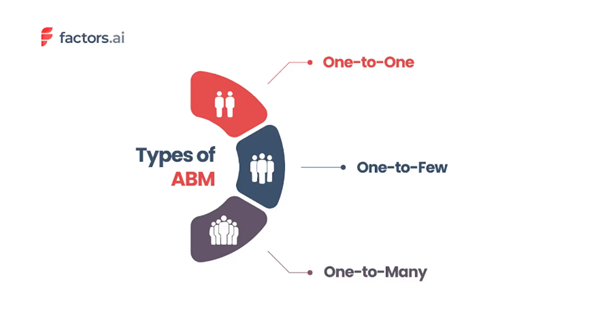
Account-based marketing is a strategy that requires highly personalized engagement with target accounts. Factors provide the insights needed to identify and prioritize high-value accounts, while Tapistro automates customized outreach. For example, Factors can identify an account showing high intent based on its engagement with your website, social media, and emails. Tapistro then automates a personalized email campaign targeting decision-makers at that account, followed by a LinkedIn ad campaign to further engage them. This seamless integration helps businesses increase their chances of converting high-value accounts.
2. Lead Generation and Nurturing
The combination of Factors and Tapistro provides a powerful solution for businesses focused on lead generation. Factors identify potential leads by analyzing their behavior on your website and social media channels. Once these leads are identified, Tapistro automates a nurturing sequence, sending personalized content to the leads via email, social media, or paid ads.
This automated process ensures that no lead is left behind and that each prospect is engaged with relevant content at every stage of the buyer’s journey.

3. Sales Enablement
In many organizations, sales teams need help accessing real-time insights about their prospects. With Factors, sales teams can receive real-time updates about account activity, including which pages prospects have visited, what content they’ve downloaded, and how engaged they are with the brand. Tapistro then helps sales teams follow up with personalized emails and alerts, ensuring timely and relevant outreach.
For example, suppose Factors identifies that a prospect has spent significant time on a pricing page. Tapistro can automatically alert the sales team in that case, prompting them to reach out with a personalized offer.
By combining Factors.ai and Tapistro, B2B teams can unlock data-driven growth through seamless integration of real-time account intelligence and automated outreach.
- Factors.ai enhances account data, capturing crucial behavioral signals from platforms like CRM and LinkedIn.
- Tapistro takes it further by automating personalized multi-channel campaigns—email, social media, and more.
This dynamic duo streamlines workflows, sharpens targeting, and aligns sales and marketing teams for maximum impact. The result? Better engagement and higher conversion rates.
In a Nutshell
In a world where data drives business success, leveraging the combined strengths of Factors and Tapistro can give companies a competitive edge. Businesses can increase engagement, improve efficiency, and ultimately drive growth by using Factors to enrich account data and provide real-time insights and Tapistro to orchestrate personalized, multi-channel campaigns.
Rather than viewing these platforms as separate tools, businesses should focus on how they complement each other to create a holistic, data-driven approach to marketing and sales. Factors and Tapistro empower teams to make better decisions, collaborate more effectively, and engage with prospects meaningfully.
For more information, you can visit Factors and Tapistro to explore their capabilities in more detail.
.avif)
Leadfeeder vs Albacross: Compare Features, Pricing & More
Compare Leadfeeder and Albacross to see which lead generation solution is the best fit for your business.

Leadfeeder and Albacross are well established lead generation platforms that help B2B teams identify, enrich, and convert anonymous website traffic. There’s no doubt that both tools are great at what they do — but which one is the right choice for you? And might there be an even better alternative?
This blog highlights everything you need to know about Leadfeeder vs Albacross — and why you might want to consider Factors.ai as well.
Leadfeeder vs Albacross - Pricing
Before diving into features, benefits, and limitations, let’s get the most obvious consideration out of the way: pricing.
Leadfeeder Pricing
Leadfeeder [Now Dealfront]’s pricing plans start at €139/mo (or ≅$150/mo) and is scaled based on the number of accounts you wish to identify and enrich. Here’s how pricing plans are scaled at Leadfeeder:
| Number of companies identified | Monthly cost: billed monthly | Monthly cost: billed annually - 30% off |
|---|---|---|
| Upto 100 | €198 / $208 | €139 / $146 |
| 101-200 | €238 / $250 | €167 / $176 |
| 201 – 400 | €358 / $377 | €251 / $264 |
| 401 – 700 | €538 / $566 | €377 / $397 |
| 701 – 1,000 | €678 / $715 | €475 / $500 |
| 1,001 – 2,000 | €878 / $925 | €615 / $648 |
| 2,001 – 3,000 | €1,118 / $1,178 | €783 / $825 |
| 3,001 – 5,000 | €1,498 / $1,578 | €1,049 / $1106 |
| 5,001 – 10,000 | €1,949 / $2,053 | €1,499 / $1,580 |
| 10,001 – 20,000 | €2,989 / $3150 | €2,299 / $2,424 |
| 20,001 – 40,000 | €3,899 / $4110 | €2,999 / $3162 |
Note that Leadfeeder also offers a free plan with barebones features that’s limited to up to 100 companies identified with only 7 days of data storage. While this plan will almost certainly be insufficient, it’s a great way to get started for free.
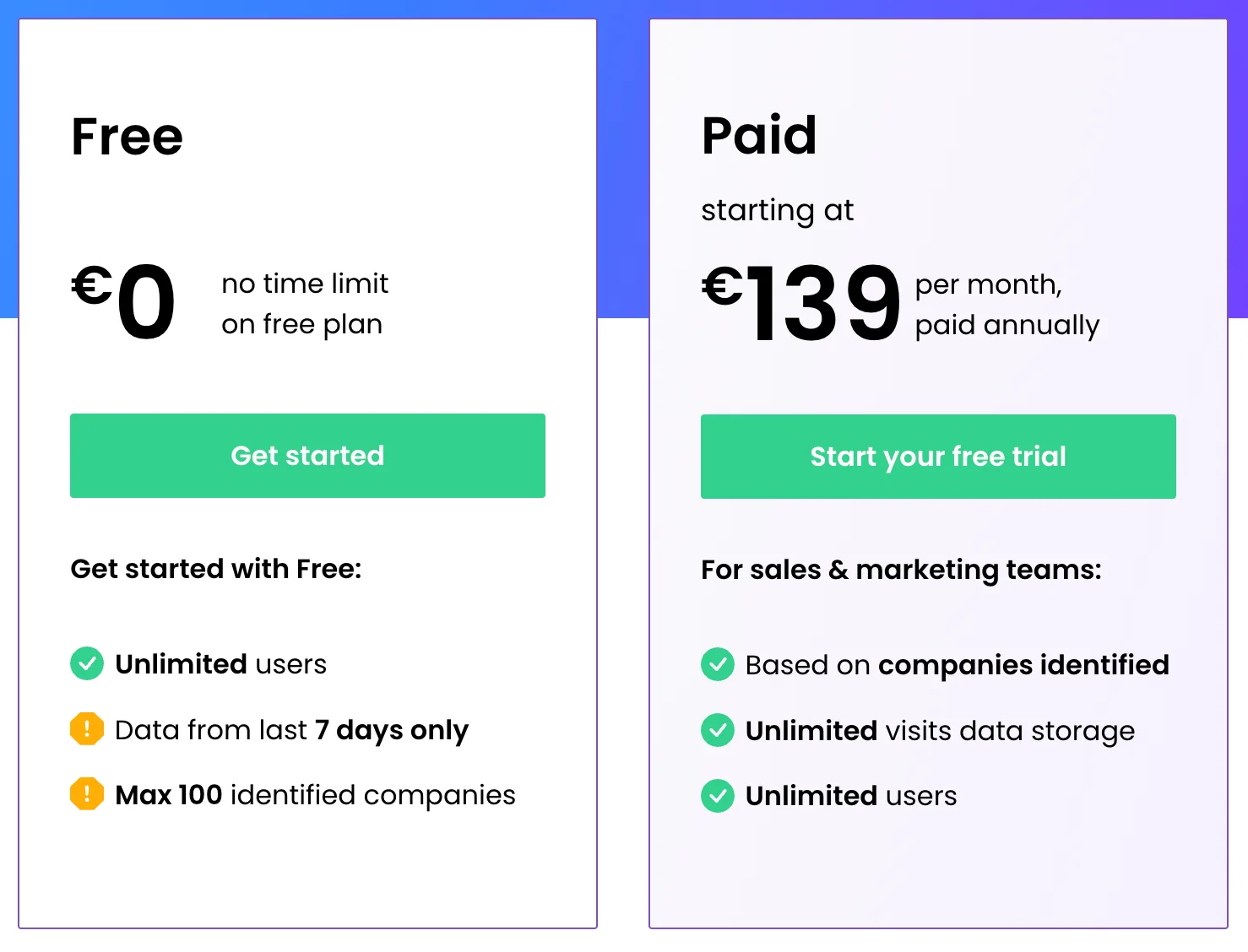
Albacross Pricing
Albacross does not openly reveal as much about its pricing plans, but it’s fair to say that they are at least comparable to Leadfeeder. Here’s what we do know about its pricing:
Albacross paid plans start at €79/mo (or $83/mo). Like Leadfeeder, it is scaled up based on the number of accounts you choose to identify and enrich.
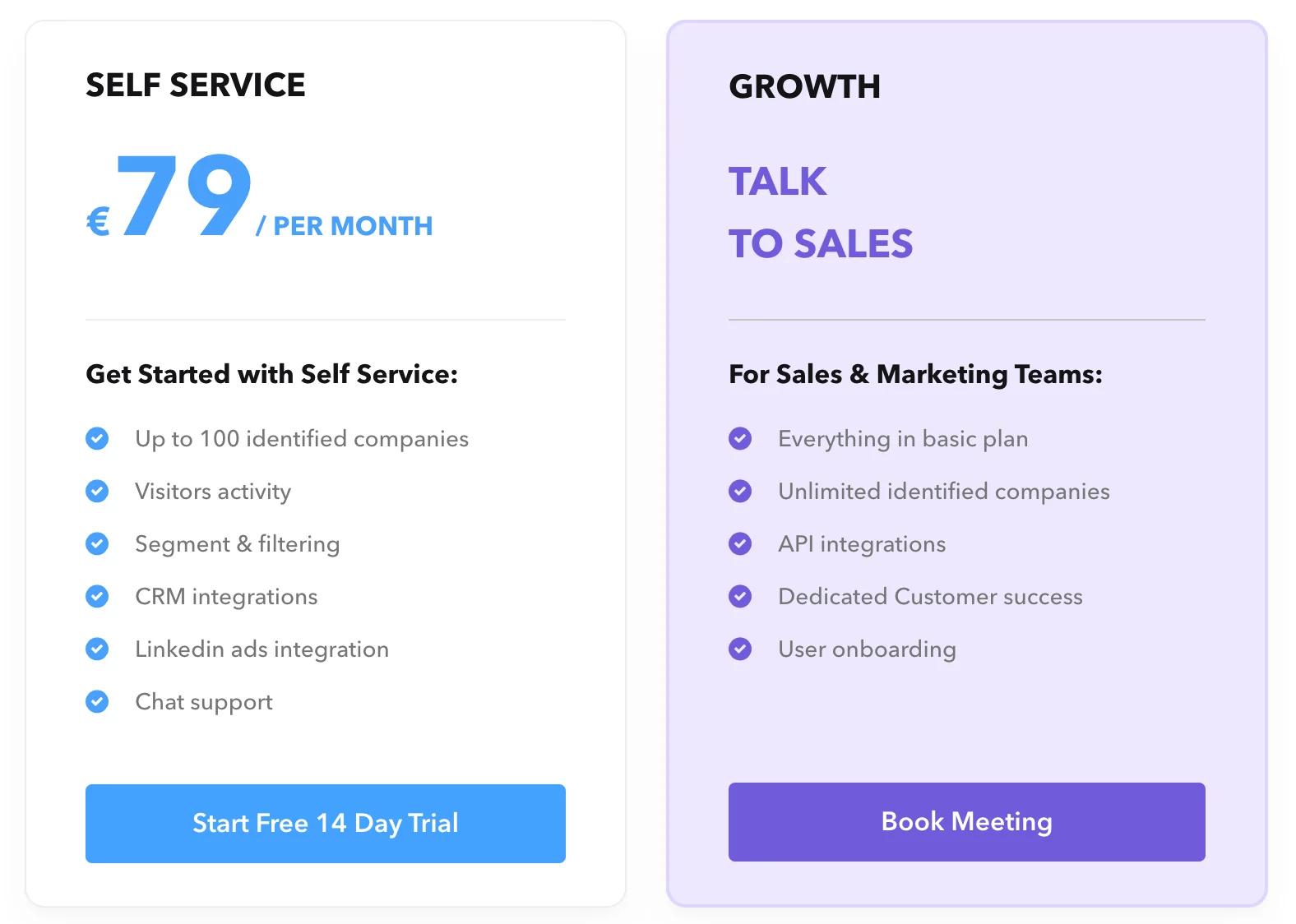
Both Leadfeeder and Albacross offer 14-day free trials. While it seems that Albacross has a marginal advantage in terms of pricing, it’s only fair to determine which product is the better fit based on features, benefits and limitations as well.
Leadfeeder vs Albacross - Features
Let’s explore how Leadfeeder and Albacross compare in terms of features
Shared Features
Given that Leadfeeder and Albacross are direct competitors to each other, it’s only natural that they share product features and use-cases. Here’s a breakdown of a few core, common features between the two tools:
1. Company identification
Company identification is at the core of what both products do. Rest assured, Leadfeeder and Albacross are more than capable of accurately identifying and enriching anonymous accounts visiting your website. More context, around this:
Leadfeeder/Dealfront likely wins the spot for the best Europe-specific company data. The now Germany-based company claims coverage of over 66M+ companies across the world, with nearly half of that being from Europe alone. Within its European coverage, it provides deep data (sourced from national trade registers and chambers of commerce) in certain geographies:
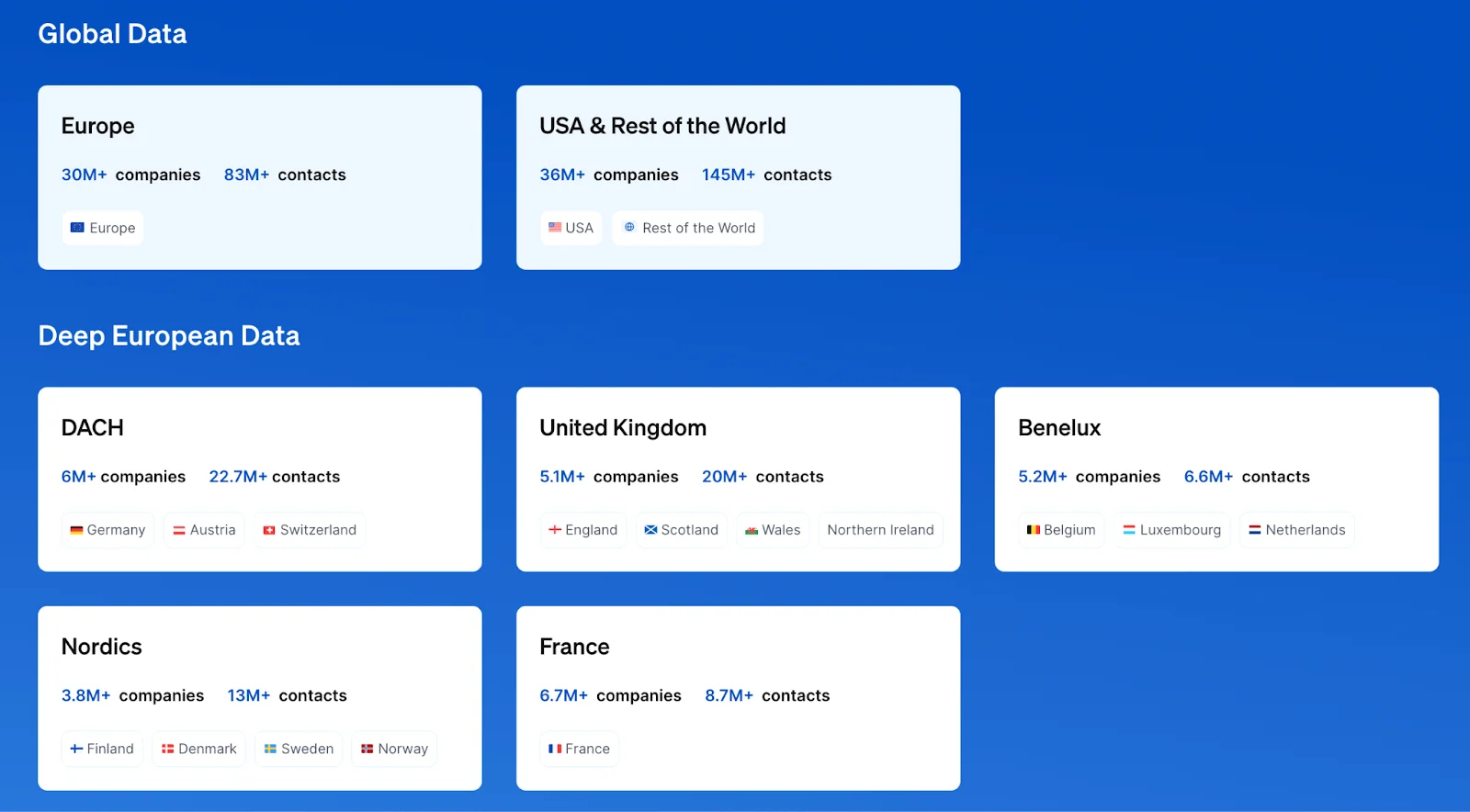
Albacross does not openly share as much about its database but is likely comparable to Leadfeeder. In fact, Albacross claims to have built out the largest proprietary IP-to-company mapping database globally with over 100+ B2B attributes. This, however, is challenging to verify without the numbers.
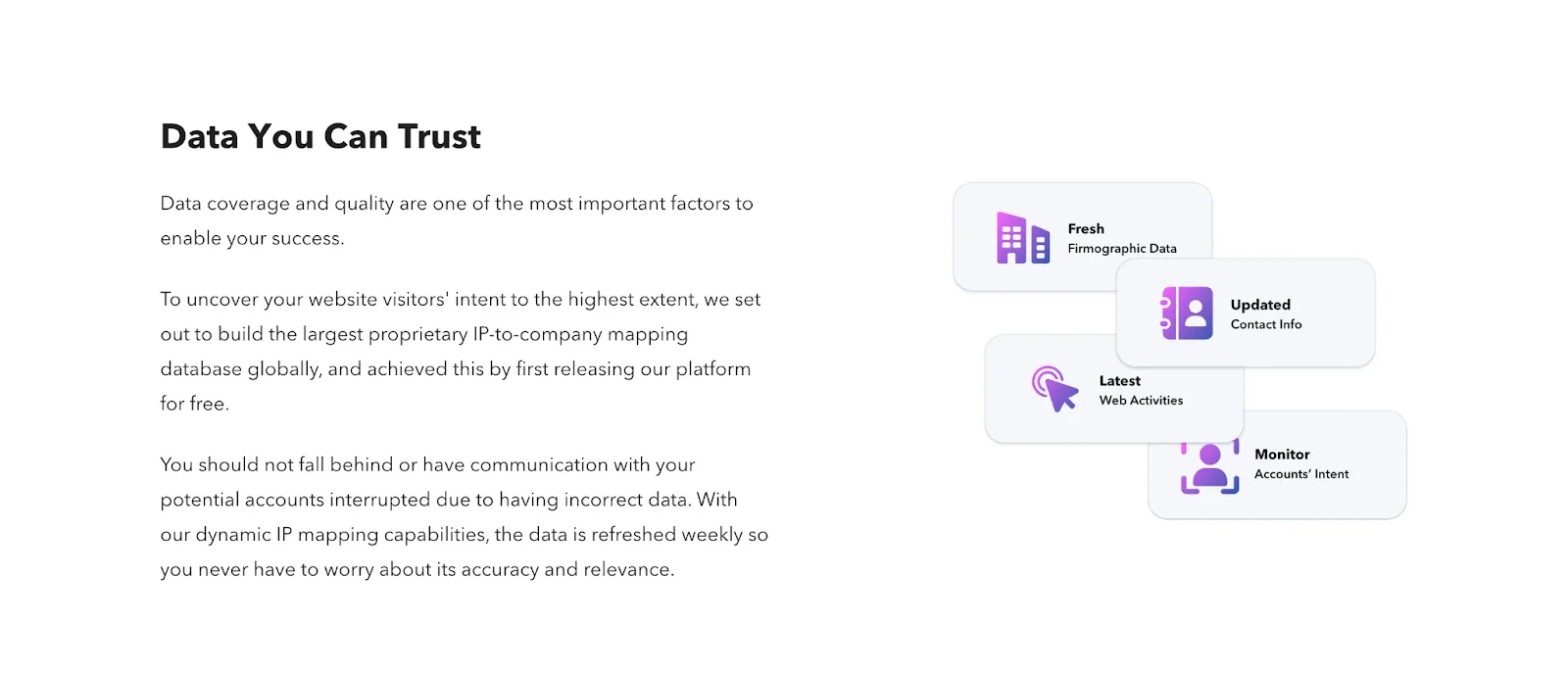
2. Filtering, segmentation & scoring
Of course, not every account visiting your website would be sales-ready ICP companies. To help break through the noise, Leadfeeder and Albacross offer comprehensive filtering, segmentation, and lead scoring functionalities.
This helps automatically filter total identifies traffic down to a few in-market, high-fit accounts based on their firmographic properties (industry, revenue, headcount, etc) and engagement levels (page views, clicks, etc)
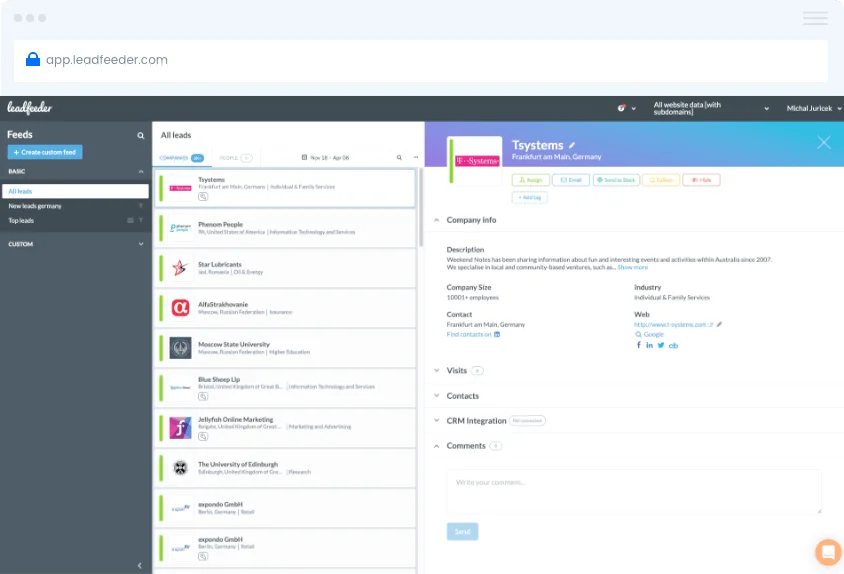
3. Integrations
Leadfeeder and Albacross provide a wide range of integrations with CRMs (HubSpot, Salesforce), MAPs, Slack/MS Teams, and other everyday go-to-market tools. In addition, integrations with Zapier helps both tools push data back into any other solution that they don’t natively integrate with.
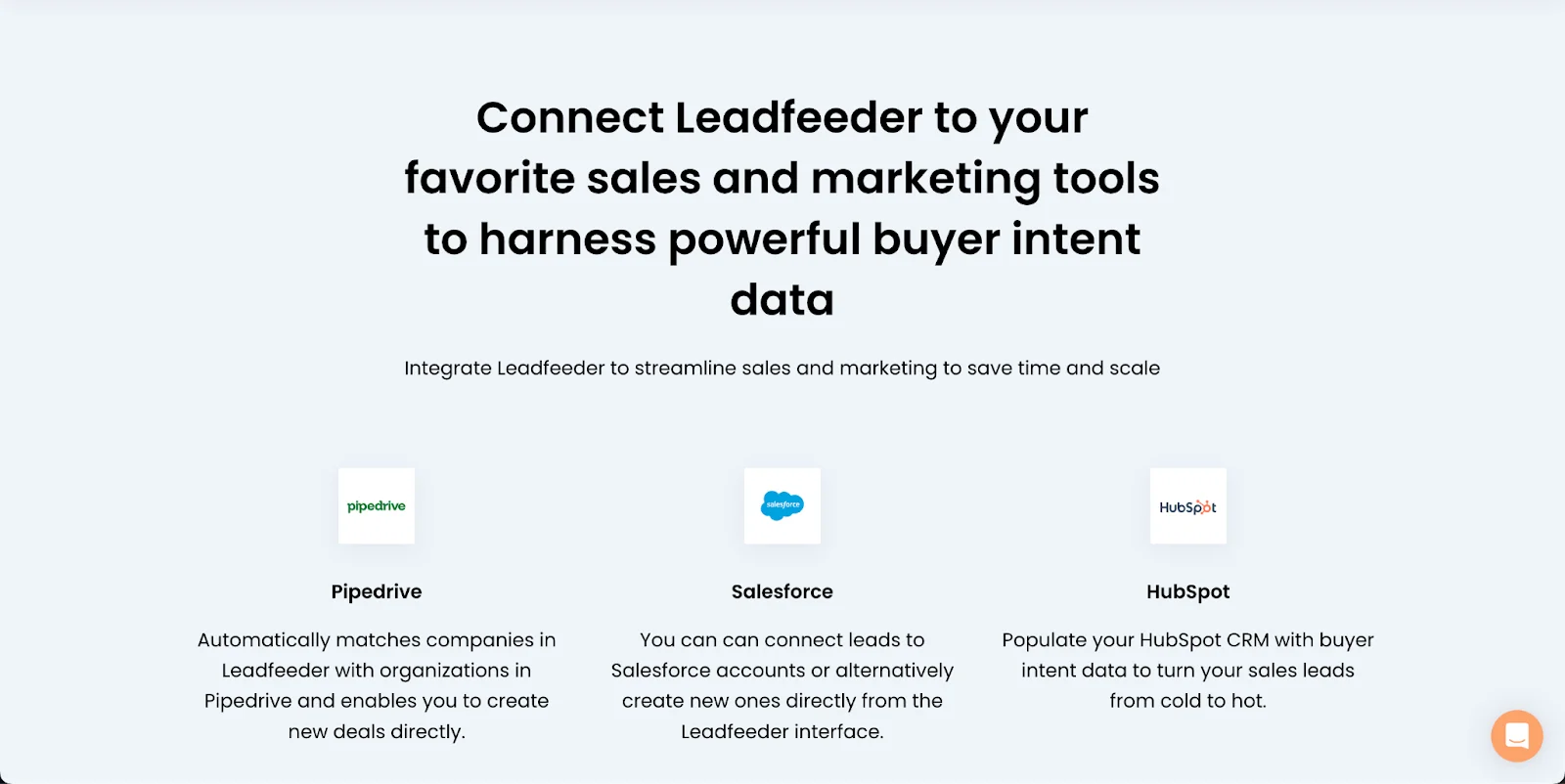
Integrations are an important consideration when choosing a lead generation tool as it helps eliminate tedious, manual workflow management and empowers automated trigger based actions such as real-time Slack alerts, LinkedIn ads retargeting, CRM updation, and more.
Of course, there’s more to it than just this. But the previous three points cover the crux of what both platforms help with: account intelligence and activation features. Now, let’s look at why you might want to choose one over the other.
Why Leadfeeder over Albacross?
1. Contact database
Although Albacross also provides contact data (mail IDs, phone numbers, etc) based on the accounts visiting your website, it’s only included as part of its premium tier plans. Leadfeeder, on the other hand, provides access to over 200M+ contact-level data points across the board. Note that neither tool can tell exactly who is visiting your website at a user-level. Instead, they provide best-bet recommendations from independent contact databases.

2. User interface
Based on our secondary research, Leadfeeder has a considerable edge over Albacross in terms of user interface. While customers rave about Leadfeeder’s UI, Albacross faces some criticism over its useability:
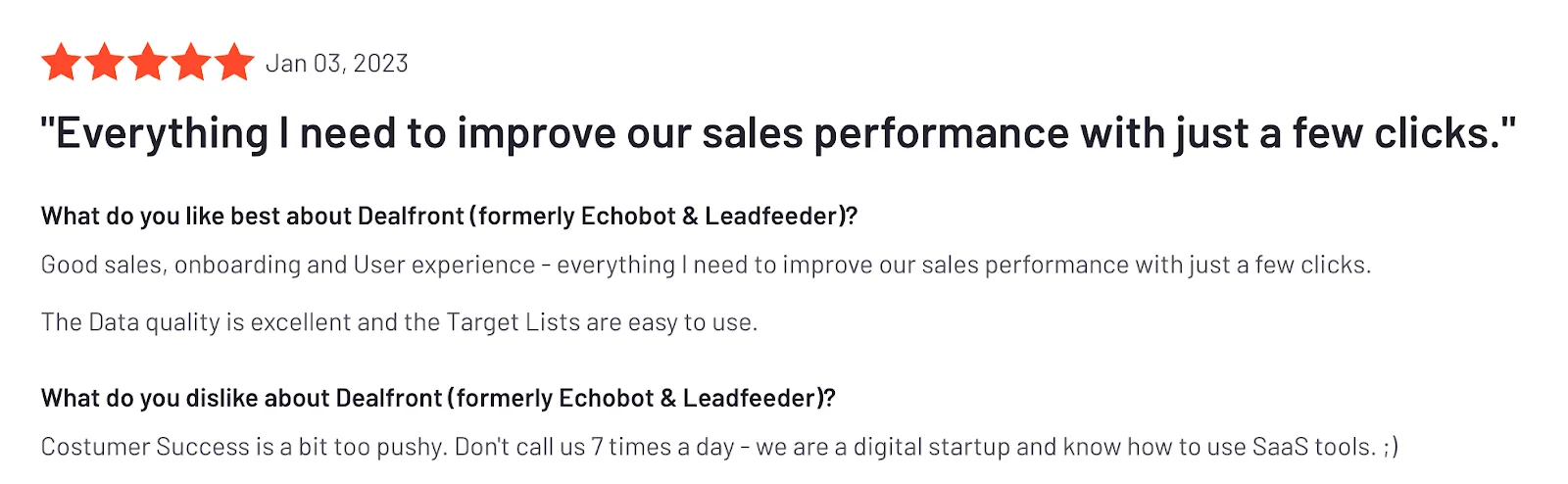
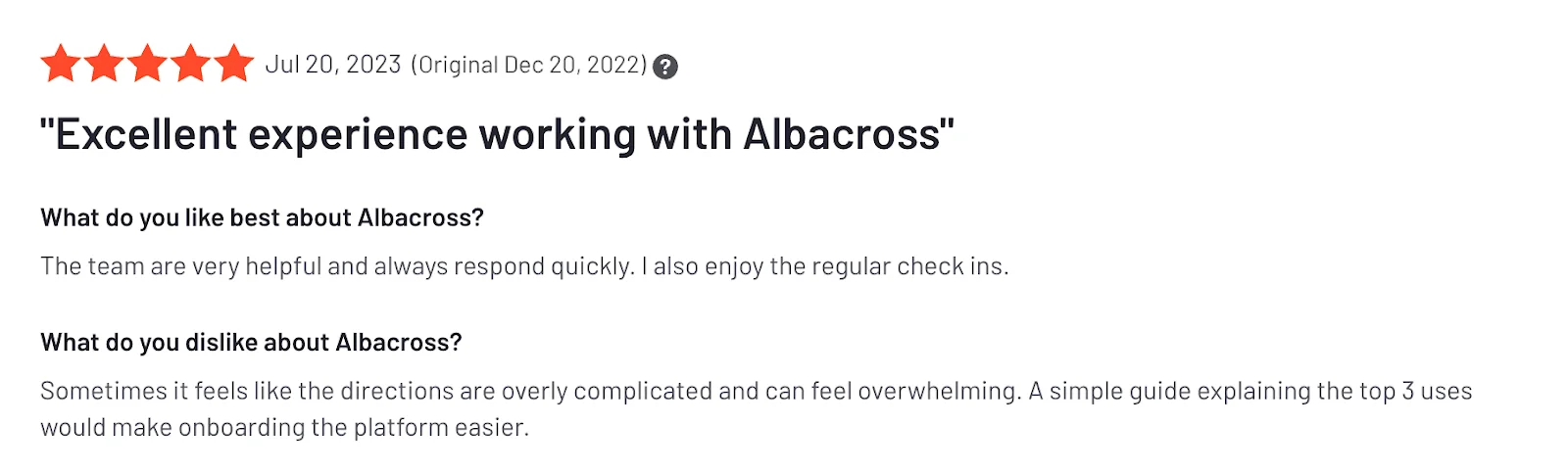
3. Website analytics
Leadfeeder takes another point over Albacross when it comes to website analytics. While neither tool is especially great at tracking website behavior, Leadfeeder has the advantages of form tracking, video tracking, download tracking, time-spent on page, and other, more granular metrics to gauge accounts engagement.
{{INLINE_BOFU}}
Why Albacross over Leadfeeder?
1. Pricing
The most obvious advantage Albacross has over Leadfeeder is its pricing. While Leadfeeder technically does offer a few more features, Albacross is unequivocally the budget-friendly option for teams that are early in their ABM journey. If you already use a contact database such as Apollo or Zoominfo, Albacross should be a good starting point for your company identification needs.
2. Lead history
Lead history includes activity data, source of visit, time-spent on page etc. If you’re a company with especially long sales cycles, you probably want to track lead history over several weeks, if not the entire quarter. At the moment, Leadfeeder falters in this regard while offering only up to 30 days of lead history. Albacross, on the other hand, extends history to up to 90 days.
3. Website personalization
Albacross offers nifty website personalization features via integration with VWO and Google Optimize to empower A/B testing based on the nature of accounts visiting your website. This is a valuable tool for product marketers to experiment with different positionings for different buyer personas.
Why Factors over the rest?
And there you have it. A run down of how Leadfeeder and Albacross compare against each other. Before dropping off however, we would be remiss without sharing a little about why Factors might make an even better fit for your lead generation and account intelligence requirement than the latter two.
{{CTA_BANNER}}
In short, Factors does everything Leadfeeder and Albacross do — along with so much more. Here are a few clear advantages Factors has:
1. Data accuracy
Data accuracy is probably the most important consideration when picking an intelligence tool. Without accurate data, you have nothing to work with. Factors partners with industry-leading marketing and sales intelligence solutions 6sense and Clearbit to provide unmatched identification rates of up to 64% — including highly enriched firmographics and technographics data.
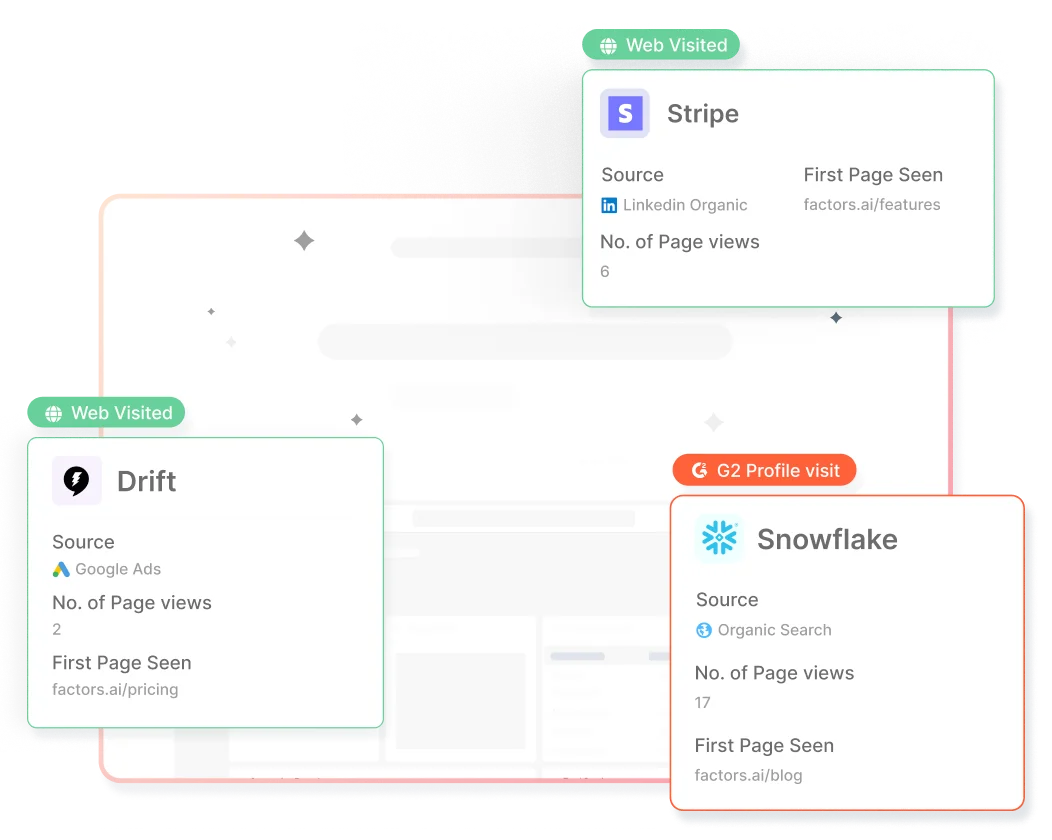
2. Lead history (again)
Maintaining lead history and account timelines for longer periods of time can be crucial to B2B teams with longer sales cycles. Leadfeeder maintains lead history for up to 30 days. Albacross maintains lead history for up to 90 days. And Factors maintain lead history — including touch points across ad campaigns, website, CRM, sales interactions, and more — for as long as 1 full year (365 days!) That's more than 4 times as long as the closest alternative.
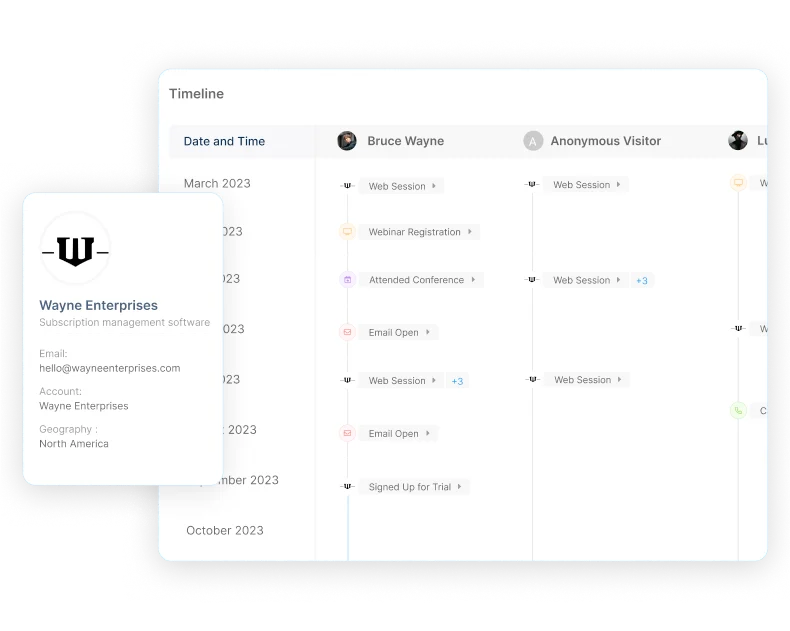
3. Analytics & attribution
Factors is built upon strong analytics and attribution foundations — which means it provides far more functionality, customization and granularity when it comes to account-level reporting. Among several other features, this includes account scoring, path analysis, funnels, timelines, attribution, KPI reporting and more across campaigns, website, CRM etc.
Leadfeeder vs. Albacross: Choosing the Right B2B Lead Generation Tool
- Leadfeeder: Offers CRM integrations, detailed analytics, and visitor tracking, starting at €139/month for 100 identified companies.
- Albacross: Provides similar visitor identification at a lower cost (€79/month) but with fewer integrations and analytics features.
- Key Considerations: Budget, integration needs, and depth of analytics required for lead generation.
Selecting the right tool depends on balancing cost with essential features for effective B2B outreach.
Comparison Table
To summarize, here’s a quick comparison table of all three platforms for your consideration:
| Feature | Leadfeeder | Albacross | Factors |
|---|---|---|---|
| Company identification | ✅ | ✅ | ✅ |
| Account & lead scoring | ✅ | ✅ | ✅ |
| Firmographics database | ✅ | ✅ | ✅ |
| Contact database | ✅ | 🟡 | 🚫 |
| Segment & filterting | ✅ | ✅ | ✅ |
| CRM & MAP integration | 🟢 | 🟡 | 🟢 |
| Real-time alerts | ✅ | ✅ | ✅ |
| Engagement tracking | ✅ | ✅ | ✅ |
| Workflow automations | 🟢 | 🟡 | 🟢 |
| Path analysis | 🚫 | 🚫 | ✅ |
| Account timelines | 🚫 | 🚫 | ✅ |
| Multi-touch attribution | 🚫 | 🚫 | ✅ |
| Funnels | 🚫 | 🚫 | ✅ |
| G2 intent + Ads integrations | 🚫 | 🚫 | ✅ |
| CDP integrations | 🚫 | 🚫 | ✅ |
| GDPR compliance | ✅ | ✅ | ✅ |
| Account history | 30 days | 90 days | 1 year |
| Starting price | $146/mo | $83/mo | $99/mo |
Leadfeeder vs. LeadLander
Compare Leadfeeder and LeadLander to discover their key features, pros, pricing, and limitations. Find out which website tracking tool suits your business needs for lead generation and detailed analytics.
TL;DR
- Leadfeeder and LeadLander are website visitor tracking tools that help businesses convert web traffic into actionable leads.
- Leadfeeder is user-friendly, affordable, and integrates well with CRMs, making it suitable for small to mid-sized businesses. Leadfeeder is ideal for basic lead tracking and real-time alerts.
- LeadLander provides advanced analytics and reporting, making it more appropriate for larger enterprises. LeadLander excels in detailed visitor behavior analysis.
- Your choice between the two depends on your business size, budget, and data needs.
Businesses often choose between platforms like Leadfeeder and LeadLander when choosing a website visitor tracking tool. Both tools offer valuable insights for companies tracking website traffic and converting visitors into actionable leads. However, they have distinct features, pricing, and integrations that make each platform suitable for different use cases.
This comparison aims to explore both tools more deeply, drawing on user feedback, key capabilities, and practical applications.
| Feature | Leadfeeder | LeadLander |
| Visitor Tracking | Yes, with company identification | Yes, with more detailed engagement tracking |
| CRM Integrations | HubSpot, Salesforce, Pipedrive, Zoho | Salesforce, Pipedrive, Zoho |
| Google Analytics | Integrated for enhanced data | Not directly integrated |
| Email Alerts | Real-time notifications | Real-time notifications |
| Custom Reports | Yes, it is filterable by user behavior | Advanced custom reporting |
| Ease of Use | Easy, beginner-friendly interface | Requires a bit more technical knowledge |
| Pricing | Starts at $79/month, free trial available | Custom pricing, typically higher |
| Ideal For | Small to mid-sized businesses | Larger enterprises |
Side-by-Side Comparison between Leadfeeder and LeadLander
Leadfeeder Overview

Leadfeeder is an intuitive lead generation software designed to track website visitors and identify the companies they work for. By leveraging company details from IP addresses, Leadfeeder helps businesses understand who is visiting their website, what pages they interact with, and how long they stay. These insights allow companies to personalize their marketing and sales efforts more effectively.
Key Features of Leadfeeder

- Company Identification: Leadfeeder tracks the IP addresses of companies visiting your website. This is especially useful in B2B environments, as it gives insights into companies' interest in your services or products. Unlike other platforms, Leadfeeder goes beyond just showing the traffic; it identifies organizations and their potential interest-based on-site engagement.
Pro: Helps to narrow down anonymous visitors to specific companies, enhancing targeted marketing.
Limitation: It doesn’t provide personal data about the individuals visiting the site unless they’ve voluntarily submitted their information, making it less effective for B2C tracking. - CRM and Marketing Tool Integrations: Leadfeeder integrates smoothly with major CRM systems like Salesforce, HubSpot, Zoho, and marketing tools like Mailchimp. This integration ensures that lead data flows seamlessly between marketing and sales departments, which can drastically improve your team's follow-up processes.
Pro: Excellent for streamlining lead nurturing processes.
Limitation: Depending on the CRM platform you use, the depth of integration might be limited, requiring additional manual input. - Real-Time Alerts: Leadfeeder lets you set up real-time alerts when key target companies visit your site. These notifications are particularly beneficial for sales teams that want to reach out to potential leads while the company’s interest is fresh.
Pro: Helps sales teams act quickly on leads.
Limitation: Real-time alerts can sometimes lead to an overload of information if your website has high traffic but low conversion. - Custom Reporting and Google Analytics Integration: Leadfeeder’s ability to generate tailored reports and integrate with Google Analytics offers users comprehensive data insights. You can segment your visitors by criteria such as behavior, company size, or industry, allowing marketing teams to target campaigns more effectively.
Pro: Customization allows businesses to align reports with specific KPIs.
Limitation: Integrating with Google Analytics can be complex for users unfamiliar with configuring advanced analytics features.
Leadfeeder Pros:
- Affordable Pricing: Leadfeeder starts at $79/month, ideal for small- and medium-sized businesses.
- Ease of Use: Its user-friendly interface makes it easy for marketing and sales teams to quickly adopt the software.
- Comprehensive CRM Integrations: Supports multiple CRMs, allowing for a more fluid sales process.
- Real-Time Alerts: Enables sales teams to respond promptly to potential leads.

Leadfeeder Limitations:
- Limited Personal Data: Since Leadfeeder identifies companies, not individual visitors, it can be easier to directly engage with specific people if they opt in through other channels (e.g., contact forms).
- Analytics Dependence: Heavy reliance on Google Analytics integration can be limiting for teams unfamiliar with GA.
User Interface and Experience
Leadfeeder offers a simple user interface that is well-suited for beginners and marketing teams with basic technical expertise. Its dashboard provides easy access to important data like the number of visitors, pages viewed, and companies that visited. The setup is quick, and integrations like Google Analytics and CRMs provide instant value.
Integrations and Compatibility
Leadfeeder shines in its integration capabilities, especially with CRM systems and Google Analytics. This makes it easy to blend visitor tracking data into the workflows of marketing and sales teams, allowing for more personalized engagement with potential leads.
Pricing Models and Value for Money
Leadfeeder offers a 14-day free trial and then charges around $79 per month. This makes it affordable for small and medium-sized businesses, particularly those looking to identify and track companies visiting their websites without needing advanced reporting capabilities.
{{INLINE_BOFU}}
LeadLander Overview

Like Leadfeeder, LeadLander provides visitor tracking capabilities but is known for its more comprehensive data analytics. It enables businesses to track website visitors and measure user interactions better to understand the potential leads' behavior on the website. LeadLander breaks down traffic by page views and visit duration, offering more granular details on visitor engagement.
Key Features of LeadLander

- Detailed Visitor Behavior Analytics: LeadLander offers more granular data about user behavior on your website. It tracks the pages visited, time spent on each page, and visitor journey, allowing businesses to understand how visitors interact with their content.
- Pro: Provides deep insights into visitor engagement.
- Limitation: The wealth of information can overwhelm smaller teams, especially those without a dedicated data analyst.
- Customizable Reporting: LeadLander allows users to create and export highly customizable reports. This feature is essential for businesses that need specific metrics and want to segment their visitors based on behavior or demographic data.
- Pro: Great for businesses that require detailed analytics and regular reporting.
- Limitation: Custom reports can take time to configure, especially if the user isn’t well-versed in data analysis.
- IP Address Lookup and Company Identification: Like Leadfeeder, LeadLander uses IP address tracking to identify the companies visiting your site. However, LeadLander provides even more detailed company information, including the specific pages visited and the duration of time spent on each page.
- Pro: Offers more detailed company behavior tracking.
- Limitation: IP identification could be better, and LeadLander can sometimes misattribute visitors from larger organizations with dynamic IP addresses.
- CRM Integrations: LeadLander integrates with CRMs such as Salesforce and Pipedrive, making it easy to sync website traffic data with your sales team’s workflow.
- Pro: Strong CRM integration supports smooth lead management.
- Limitation: Fewer CRM platforms than Leadfeeder are available, which can be restrictive for businesses using non-mainstream CRMs.
LeadLander Pros:
- Granular Visitor Data: Offers detailed insights into user behavior, including time on page, bounce rates, and specific visitor paths.
- Custom Reports: Tailored reporting allows for highly targeted lead tracking and segmentation.
- Advanced Analytics: Particularly useful for businesses that require in-depth behavioral tracking of visitors.

LeadLander Limitations:
- Higher Pricing: LeadLander is generally more expensive, making it less accessible for smaller businesses.
- Complexity: The wealth of data can make the platform more complex for less experienced teams, requiring dedicated personnel to manage reports and analysis.
User Interface and Experience
LeadLander has a more data-heavy interface. While this makes it powerful for users looking to dive deep into visitor behavior, it may be overwhelming for smaller teams or businesses that don’t have a dedicated data analyst. However, the platform’s advanced reporting and visitor tracking tools make it a powerful enterprise option.
Integrations and Compatibility
While LeadLander offers CRM integration, it does not integrate with Google Analytics, which might be a downside for teams that heavily rely on Google's tools for traffic analysis. However, it compensates by offering more in-depth data on visitor behavior, which can be useful for sales outreach.
Pricing Models and Value for Money
LeadLander, on the other hand, tends to have a higher price point, which is private on their website. According to user feedback on platforms like G2, LeadLander is generally more expensive but offers detailed data tracking and insights suitable for larger enterprises.
Which tool is the best option for you?
Leadfeeder is ideal for businesses that need an affordable, easy-to-use solution for identifying potential leads and integrating visitor data into existing sales and marketing workflows. Its strength lies in providing real-time notifications and CRM integrations, making it perfect for small and medium-sized companies that need to streamline their marketing efforts.
On the other hand, LeadLander is better suited for larger enterprises that need detailed analytics and deeper insights into visitor behavior. Its custom reporting features and data-rich interface make it ideal for companies requiring a more granular look at how visitors engage with their websites.
Both tools identify anonymous website visitors, but differ in key features and capabilities.
1. Platform Differences: Leadfeeder excels in integration ease, while LeadLander offers deeper data insights.
2. Pricing and Flexibility: Choose based on your need for simplicity or advanced lead intelligence.
3. Strategic Fit: Whether you prioritize plug-and-play setup or detailed analytics, select the tool that best aligns with your goals.
Consider your business needs to determine which platform provides the most value.
In a Nutshell
Both Leadfeeder and LeadLander offer distinct advantages depending on your business's specific needs. Leadfeeder excels in ease of use, affordable pricing, and CRM integrations, making it a strong choice for small to mid-sized businesses looking for straightforward lead-tracking solutions. LeadLander, with its advanced reporting and granular visitor data, is better suited for enterprises that need detailed analytics and have the resources to interpret the data.
If you’re looking for simplicity, real-time alerts, and affordability, Leadfeeder is likely the better option. On the other hand, if your business requires deep visitor tracking with advanced analytics and is willing to pay a premium, LeadLander will provide the insights needed to optimize your marketing and sales strategies.
Ultimately, your choice will depend on your business size, budget, and the level of detail you need in visitor data.
FAQs
- Which tool is better for small businesses: Leadfeeder or LeadLander?
Leadfeeder is generally better suited for small businesses due to its affordable pricing, ease of use, and seamless CRM integrations. It offers essential features like real-time alerts and company identification without the complexity of advanced analytics that may overwhelm smaller teams.
- Does LeadLander integrate with Google Analytics like Leadfeeder?
No, LeadLander does not offer direct integration with Google Analytics. While it compensates with advanced reporting and granular visitor behavior insights, teams relying heavily on Google Analytics might find Leadfeeder more convenient.
- Can both tools identify individual visitors or only companies?
Both tools primarily identify companies visiting your website by tracking IP addresses. However, they only provide personal details of individual visitors if they voluntarily provide this information through contact forms or other interactions on your site.
- Which tool offers better reporting capabilities?
LeadLander excels in advanced custom reporting, providing detailed insights into visitor behavior and engagement. While Leadfeeder also offers customizable reports, its reporting features are more streamlined and beginner-friendly, making it ideal for businesses with less complex data needs.
![Leadfeeder [Dealfront] Vs. Factors.ai: Compare Pricing & Features](https://cdn.prod.website-files.com/6898fdb2a8e6d57199082db3/698c59658910dc4477266047_643909a54809353f93126425_Leadfeeder%2520vs%2520Factors.avif)
Leadfeeder [Dealfront] Vs. Factors.ai: Compare Pricing & Features
Compare Leadfeeder vs Factors.ai in terms of features, benefits, and pricing to help determine why one might make more sense for you over the other.
Leadfeeder is a well-established B2B lead generation software that helps go-to-market teams identify and enrich anonymous website traffic. Leadfeeder has recently joined forces with another sales intelligence platform, Echobot, to form Dealfront — a Europe-centric B2B data platform.

As a result of this collaboration, Leadfeeder has consolidated multiple products, increased pricing plans, and limited the number of seats per account. Accordingly, several former-Leadfeeder users are considering switching to IP intelligence alternatives.
While Factors is a relatively new player in the account identification space, it’s quickly emerging as a popular alternative to Leadfeeder given its cost-effective plans and industry-leading match rates of up to 64%. That being said, every platform has its unique advantages and limitations that must be considered before making a purchase decision.
This blog compares Leadfeeder vs Factors to highlight features, benefits and drawbacks of each tool — and explore why one might make more sense for your use-cases over the other.
Leadfeeder vs. Factor.ai
Before diving into the differences between Leadfeeder and Factors, it’s worth highlighting a few commonalities between both tools given that they’re close alternatives to each other.
1. Account identification
Needless to say, identifying anonymous accounts on your website is a core functionality of both Leadfeeder and Factors. Both visitor identification tools use IP-based targeting technology to match anonymous traffic with company IPs so users can see who’s visiting their website without the need of form submissions or gated content.
This provides valuable insights into the nature of website traffic as well as which accounts to go after with retargeting ads or outbound outreach.
While both Leadfeeder and Factors rely on similar technologies, the accuracy with which they identify visitors can vary dramatically based on their respective databases. More on this later.
2. Account-level enrichment
Along with identifying company names, both Leadfeeder and Factors deliver robust account-level firmographic enrichment data such as industry, employee headcount, geography, revenue-range, and much, much more.
Account-level enrichment helps go-to-market teams quickly qualify whether a lead fits the target audience or ideal customer profile. This in turn helps focus marketing initiatives and sales outreach to a highly targeted set of accounts — as opposed to expensive and ineffective spray and pray tactics.
3. Implementation
Given that Leadfeeder and Factors employ similar IP-lookup technology to identify and track visitors, the implementation process is more or less identical. Both tools have quick and intuitive onboarding that involves the insertion of a light-weight code script onto the website. The script will soon start identifying visitors once activated.
Overall, the entire implementation process takes no more than 10min for either solution.
4. Real-time alerts
A really nifty feature offered by Leadfeeder and Factors is the ability for users to receive real-time Slack notifications when high-intent accounts are live on the website. These alerts can be configured to go off only when specific visitor criteria are met. For instance, teams can be notified only when a visitor is from a US-based SaaS platform with at least 100 employees and is on a high-intent page such as pricing.
Research suggests that contacting leads quickly dramatically improves chances of conversions. Accordingly, this is an especially valuable feature for sales reps looking to strike while the iron’s still hot.
5. Privacy-compliance
Leadfeeder and Factors are 100% privacy compliant. Both tools adhere to GDPR and CCPA privacy policies. Factors is also SOC2 type II certified. SOC2 information about Leadfeeder is not publicly available so we refrain from commenting on this.
With common features out of the way, let’s discuss what each visitor identification solution does better than the other.
What Factors does better than Leadfeeder
Here are a few reasons to consider Factors over other alternatives:
1. Data accuracy (outside Europe)
Rigorous comparative testing over a sample size of 20,000 domains reveals that Factors achieves industry-leading match rates of up to 64%.
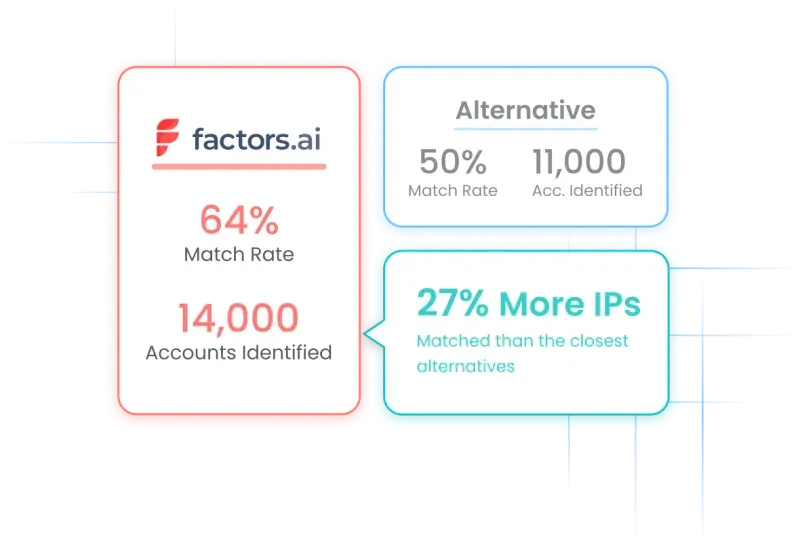
No doubt, both Leadfeeder and Factors boast impressive IP databases. In fact, Leadfeeder is at the forefront of IP-matching for Europe-specific data. Challenge with Leadfeeder may surface when targeting companies from US and other geographies outside Europe:
Leadfeeder records IPs for a whopping 26 millions companies in Europe but only about 8.5 million companies in the US and the rest of the world. Factors, on the other hand, covers almost double this figure with over 15 million companies.
Accordingly, if your business solely focused on the EU market, Leadfeeder is likely the better choice. But for global business, including the US, Factors should be the default. It taps into a relatively larger IP database to identify a wider range of companies from the rest of the world.
2. Account timelines
Account timelines is a feature unique to Factors that helps users visualize customer journeys and touchpoints in real time at an account and user level.
This is a powerful tool, especially in conjunction with visitor identification, to identify what influences different stakeholders within the same account to move from the awareness stage of the customer journey to closing the deal.

3. Advanced analytics
Factors is built upon strong analytics and attribution foundations. As a result, it’s capable of far more granularity in terms of reporting metrics and KPIs as compared to other marketing intelligence tools.
Factors auto-tracks website KPIs including:
- Page views
- Button clicks
- Percentage scroll depth
- Session duration
- Funnels (Eg: Homepage >> Pricing >> Blog >> Features)
- Custom KPIs and more
In addition to these out-of-the-box analytics, Factors integrated with ad platforms, website, CDPs, and CRMs to deliver powerful multi-touch attribution, path analysis, automated AI-fuelled insights, and more. In short, when it comes to analytics, Factors sheds light on what you need to know to drive more pipeline with less spend.
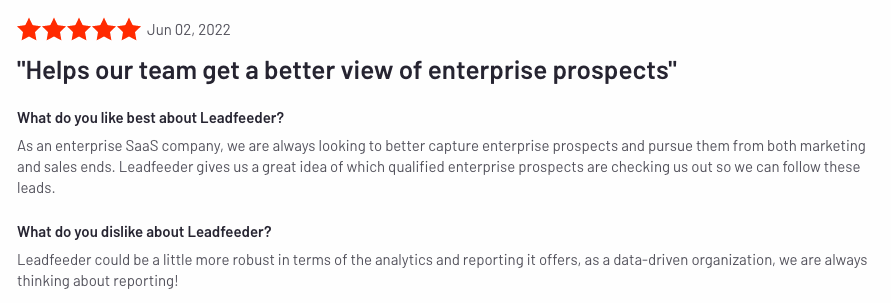
4. Customer success
While both Leadfeeder and Factors are relatively intuitive platforms, there’s no denying that they’re sophisticated products with at least some learning curves. With such products, it’s imperative to have onboarding support and dedicated customer success management — both of which Factors takes great pride in offering.

What Leadfeeder does better than Factors
Here are a few reasons to consider Leadfeeder over other alternatives:
1. Contact enrichment
While no solution can identify exactly who’s visiting your website at a user level, Leadfeeder natively provides users with a list of ideal prospects from the companies visiting a website.
For example, a fintech company may target the finance team from SaaS companies with over 10M in ARR. In this case, Leadfeeder can more or less find the contact info of CFO, VP finance, finance manager etc from companies already visiting your website — even though these professionals may not actually be the ones visiting.
This is useful for teams who’d rather not rely on specialized sales intelligence tools like Zoominfo or Apollo for dedicated contact-level data.
At the moment, Factors integrates with Apollo to provide this contact-level information. Since the majority of users rely on third-party service providers for contact information, this does not tend to be a blocker.
2. Integrations
Leadfeeder provides several native two-way integrations with popular sales and marketing tools including:
- Pipedrive
- Salesforce
- Activecampaign
- Mailchimp
- HubSpot
- Zapier
This helps users automatically upload account and contact information directly to their go-to-market tools and CRMs.
Factors integrates deeply with ad platforms, CRMs, CDPs, and more. While Factors does not provide native integrations with the full range of solutions Leadfeeder supports, it does integrate with Zapier/Make.com to support data pushback via Webhooks. At the moment, users can download csv files from Factors and upload them back into their preferred CRM, MAP, etc.
3. Native campaigns & promotions
Leadfeeder’s Promote feature allows users to target specific company IP-addresses with programmatic display ads across Google, Rubicon, Appnexus, and Pubmatic.
While the efficacy of display ads continues to be hotly debated, this may be a useful way to target companies that already visit your website and fit the ideal customer profile. The primary metrics to track these campaigns are impressions, CTR, and website visits.
{{INLINE_BOFU}}
Compare Leadfeeder Pricing
Leadfeeder is a relatively inexpensive solution as compared to established Leadfeeder alternatives such as Clearbit and Albacross. That being said, its recent collaboration with Echobot has revised pricing:

Now, Leadfeeder plans start at €139/mo ($152) to identify up to 100 accounts per month
Factors, on the other hand, continues to remain one of the most cost-effective marketing intelligence tools out there with plans starting as low as $99/month for up to 350 accounts identified and enriched per month. Factors pricing is based on the number of monthly website visitors and follows a gradient. Learn more about our pricing here: factors.ai/pricing
What’s the right tool for you?
This blog has compared Leadfeeder vs Factors.ai in terms of features, benefits, and drawbacks. Depending on your use-cases, one is likely to make a better fit for you than the other. Here are a couple of considerations:
- If data accuracy outside of Europe, cost-effectiveness, and holistic account scoring is a priority to you, Factors is likely better choice.
- If Europe-centric data and native contact enrichment is a priority to you, then Leadfeeder may be a better fit.
If you’d like to see how Factors achieves industry-leading match rates of up to 64%, book a demo here: See Factors in action
Top B2B Lead Generation Tools
Lead generation tools help businesses identify and enrich website traffic, enabling more precise targeting and increased conversions.
1. Top Platforms: Factors.ai and Leadfeeder.
2. Key Features:
- Factors.ai: Industry-leading match rates (up to 64%), extended lead history (up to 365 days), and integrations with multiple data providers.
- Leadfeeder: Merged with Echobot to form Dealfront, offering account identification and firmographic enrichment, but with limited account seats and increased pricing plans.
3. Strategic Benefits:
- Factors.ai: Enhanced data accuracy, longer lead history retention, and cost-effective plans.
- Leadfeeder: Useful for tracking website visitors but has faced changes that may make alternatives like Factors.ai more appealing.
Implementing these lead generation tools enables businesses to improve visitor identification, streamline outreach, and boost overall lead quality.

Lead Tracking: Meaning, Methods, and Benefits
Learn about lead tracking in sales and marketing, the difference between lead tracking vs. lead scoring, the benefits and challenges of lead tracking.
Business success isn’t just about attracting leads—it's about converting them into loyal customers. That's where lead tracking comes in. With lead tracking, you can seamlessly monitor and analyze customer interactions across all touchpoints, from social media to email campaigns. You can determine who's interested in what you're offering and how likely they will buy from you.
Without much ado, let’s understand more about lead tracking.
Lead Tracking Vs. Lead Scoring
While many use “lead tracking” and “lead scoring” interchangeably, they’re distinct concepts. Here is a list of differences between the two:
| Lead Tracking | Lead Scoring |
|---|---|
| Systematically monitor and document interactions between potential customers (leads) and your business throughout the sales process. | Evaluate and assign a numerical value or score to leads based on their behavior, attributes, and engagement with your brand. |
| Keep a record of every touchpoint and engagement, from initial contact to final sale or beyond. | Prioritize leads based on their score, focusing resources on those with the highest potential to convert into customers. |
| Provide insights into the behavior and preferences of leads, enabling tailored marketing and sales efforts. | Enable sales teams to maximize efficiency and ROI by focusing their time and resources on leads most likely to result in a successful sale. |
Read more about lead scoring software tools for B2B SaaS here.
Consider a software company specializing in customer relationship management (CRM) solutions. The company can leverage lead tracking to monitor when prospects download a lead magnet on your website. Subsequently, these leads receive targeted emails with relevant content and invitations to attend webinars on CRM best practices. Meanwhile, lead scoring assigns higher scores to leads who engage with multiple resources, attend webinars, and request product demonstrations, indicating a higher likelihood of conversion.
So, are the two interrelated?
Lead tracking and scoring are closely intertwined and complement each other in several ways. Here’s how:
1. Data Collection
Lead tracking provides the necessary data and insights for lead scoring. Businesses gather valuable information about lead behavior, interests, and engagement levels, which serves as the basis for lead scoring by monitoring and documenting lead interactions.
2. Behavioral Analysis
Lead tracking allows businesses to observe how leads interact with various marketing channels, content, and touchpoints. This behavioral data forms the basis for lead scoring criteria, helping identify key indicators of lead interest and readiness to purchase. For example, if a lead spends time on your pricing page, watches a demo, and engages with your emails, they're likely ready for a personalized sales pitch.
3. Scoring Criteria Refinement
As businesses track leads' interactions and analyze their behavior over time, they gain insights into which actions and behaviors correlate most strongly with conversion. This information can be used to refine and optimize lead scoring criteria, ensuring that the scoring model accurately reflects lead quality and likelihood of conversion.
4. Continuous Improvement
Lead tracking and lead scoring are iterative processes that feed into each other. The data collected through lead tracking informs lead scoring models, while the results of lead scoring provide feedback that informs adjustments to lead tracking strategies and criteria. This continuous cycle drives ongoing improvement in lead qualification and conversion rates.
5. Effective Lead Management
lead tracking and lead scoring enable businesses to manage leads more effectively throughout the sales funnel. Businesses can ensure that their sales teams focus their efforts where they are most likely to yield results by identifying high-value leads early in the process and prioritizing follow-up based on lead score and behavior.
Why do Sales and Marketing need Lead Tracking?
Lead tracking is the backbone of effective sales and marketing strategies. It provides valuable insights into customer behavior, preferences, and engagement levels, allowing teams to tailor their efforts accordingly. By tracking leads, sales and marketing teams can:
Maximize Efficiency
In the hustle and bustle of daily operations, time is money. Lead tracking streamlines the process by allowing teams to zero in on high-value prospects. Instead of casting a wide net and hoping for the best, sales and marketing teams can focus on leads with the highest potential for conversion. This targeted approach reduces time wasted on unqualified leads, allowing teams to allocate resources more efficiently.
Improve Conversion Rates
At the end of the day, it's all about conversions. Lead tracking provides valuable insights into lead behavior, preferences, and pain points, enabling teams to tailor their communication and follow-up strategies accordingly. By delivering personalized messages at the right time and through the right channels, teams can significantly increase the likelihood of converting leads into paying customers. It's all about striking the right chord and nurturing relationships that lead to conversions.
Enhance Customer Experience
Lead tracking enables teams to understand leads' needs and interests on a deeper level. Armed with this knowledge, teams can deliver relevant and timely information, providing a seamless and satisfying experience for potential customers. Whether it's sending a personalized email, offering a tailored solution, or addressing a specific pain point, lead tracking allows teams to create meaningful interactions that leave a lasting impression.
Optimize Resource Allocation
Every dollar counts in sales and marketing. Lead tracking helps teams identify which marketing channels and campaigns are yielding the best results. Teams can pinpoint the most effective strategies and allocate their resources accordingly by analyzing lead data and conversion metrics. Whether it's doubling down on a successful social media campaign or tweaking the messaging of a lackluster email campaign, lead tracking empowers teams to make informed decisions that maximize ROI.
Measure Performance
You can't improve what you can't measure. Lead tracking provides teams with comprehensive data on lead interactions, conversions, and sales pipeline progression. Armed with this data, teams can evaluate the effectiveness of their sales and marketing efforts and make data-driven decisions for improvement. Whether it's identifying bottlenecks in the sales process, optimizing the performance of a landing page, or fine-tuning the messaging of a sales email, lead tracking enables continuous improvement and optimization.
{{INLINE_TOFU}}
Understanding the Sales Funnel to Track Leads
The sales funnel represents the journey that prospects undertake from initial awareness of a product or service to make a purchase decision. While the exact steps may vary depending on the industry and business model, the typical stages include:
1. Awareness
At this stage, prospects become aware of a company's products or services, often through marketing efforts such as advertisements, content marketing, or social media.
2. Interest
Prospects show interest in the offerings and seek more information. They may visit the company's website, download resources, or subscribe to newsletters.
3. Consideration
In this phase, prospects evaluate the value proposition and compare the company's offerings with competitors. They may communicate directly with sales representatives or request product demos.
4. Decision
Prospects reach a decision point where they decide whether to make a purchase. This stage often involves negotiating terms, addressing objections, and finalizing the transaction.
After making a purchase, customers enter the retention phase, where efforts focus on providing excellent post-sales support, fostering customer loyalty, and encouraging repeat business.
By aligning lead tracking efforts with the stages of the sales funnel, organizations can tailor their communication strategies to address prospects' specific needs and move them seamlessly through the buying journey.
Retention
After making a purchase, customers enter the retention phase, where efforts focus on providing excellent post-sales support, fostering customer loyalty, and encouraging repeat business.
By aligning lead tracking efforts with the stages of the sales funnel, organizations can tailor their communication strategies to address prospects' specific needs and move them seamlessly through the buying journey.
Capturing Leads: Where and How?
Before we start tracking leads, it’s important to understand where and how to capture these leads. Capturing leads involves enticing potential customers to provide their contact information or engage with your brand in some way.
Here are some common channels and methods for capturing leads:
Website Forms
Embedding lead capture forms on your website allows visitors to submit their contact information in exchange for valuable content, such as ebooks, whitepapers, or webinars.
Landing Pages
Designing dedicated landing pages optimized for lead generation can help capture leads from specific marketing campaigns or promotions.
Social Media
Leveraging social media platforms to promote gated content and engage with followers can generate leads and foster relationships with potential customers.
Email Marketing
Including calls-to-action (CTAs) and lead capture forms in email campaigns encourages subscribers to take the next step and provide their contact information.
Events and Webinars
Hosting events, webinars, or workshops provides opportunities to capture leads from attendees interested in your topic or industry.
Networking and Referrals
Building relationships with industry peers and existing customers can lead to referrals and introductions to potential leads.
By diversifying lead capture channels and methods, organizations can reach a broader audience and generate a steady stream of leads for their sales and marketing efforts.
Types of Leads for Tracking
Not all leads are created equal, and it's essential to track different types of leads based on their stage in the buyer's journey and their level of engagement. Some common types of leads to track include
Cold Leads
These are leads who have shown minimal interest or engagement with your brand. Tracking cold leads allows teams to nurture them over time and gradually build trust and rapport.
Warm Leads
Warm leads have shown some level of interest or engagement with your brand, such as downloading a whitepaper or attending a webinar. Tracking warm leads helps teams prioritize follow-up efforts and tailor their messaging to address specific needs and pain points.
Hot Leads
Hot leads are highly engaged and have demonstrated a strong intent to purchase, such as requesting a product demo or submitting a contact form. Tracking hot leads allows teams to capitalize on buying signals and expedite the sales process.
Qualified Leads
Qualified leads meet specific criteria set by the organization, such as budget, authority, need, and timeline (BANT). Tracking qualified leads helps teams focus their efforts on prospects who are most likely to convert into customers.
By tracking different types of leads, sales and marketing teams can tailor their approach to each segment of their audience, delivering personalized and relevant content and increasing the likelihood of conversion.
Collecting Lead Infomation
Collecting lead information involves gathering relevant data points about potential customers to facilitate communication and relationship building.
Here are some key pieces of information to collect from leads:
Basic Contact Information
This includes name, email address, phone number, and company name, enabling teams to initiate and maintain communication with leads.
Demographic Information
Gathering demographic data such as location, industry, job title, and company size helps teams segment and target their audience more effectively.
Behavioral Data
Tracking lead interactions with your website, emails, and marketing campaigns provides insights into lead engagement and interests, allowing for more personalized and relevant communication.
Lead Source
Identifying how leads found your company, whether through organic search, social media, referrals, or other channels, helps measure the effectiveness of your marketing efforts and allocate resources accordingly.
Purchase Intent
Assessing the level of interest and intent to purchase allows teams to prioritize follow-up activities and tailor their messaging to meet the needs of each lead.
When collecting lead information, it's important to strike a balance between gathering enough data to personalize communication and respecting the lead's privacy and preferences. Providing clear and transparent explanations of how their information will be used and giving them control over their data builds trust and fosters positive relationships with potential customers.

How to qualify leads and prospects?
Qualifying leads involves determining their suitability and readiness to engage with your sales team and move through the sales process.
But wait, why qualify leads?
By qualifying leads effectively, sales and marketing teams can focus their efforts on leads with the highest potential for conversion, improving efficiency and driving revenue growth. This, in turn, prevents the organization’s resources from being drained out.
Now since that’s out of the way, here are some common criteria and methods for qualifying leads:
BANT Criteria
BANT stands for Budget, Authority, Need, and Timeline. Assessing leads against these criteria helps determine their readiness to purchase and their fit with your product or service.
Lead Scoring
Assigning numerical values to various lead attributes, such as engagement level, company size, and purchase intent, allows teams to prioritize leads based on their likelihood of conversion.
Behavioral Signals
Monitoring lead behavior, such as website visits, content downloads, and email interactions, provides insights into their level of interest and engagement, guiding qualification decisions.
Qualification Questions
Asking specific questions during lead capture or follow-up conversations helps uncover key information about the lead's needs, challenges, and buying timeline.
Sales and Marketing Alignment
Establishing clear criteria and processes for lead qualification ensures alignment between sales and marketing teams, preventing leads from falling through the cracks and maximizing conversion opportunities.
Methods of Lead Tracking
Lead tracking can take various forms, depending on the nature of the business and the preferences of the organization. Some common methods of lead tracking include
Manual Tracking
This involves recording lead interactions and information manually, using spreadsheets, notebooks, or other documentation methods. While simple, manual tracking can be time-consuming and prone to errors.
CRM Software
Customer Relationship Management (CRM) software automates lead tracking processes, capturing and organizing lead information in a centralized database. CRM systems offer features such as lead scoring, activity tracking, and pipeline management, streamlining lead management and improving efficiency.
Marketing Automation Platforms
Marketing automation platforms automate lead tracking and nurturing processes, allowing teams to create targeted campaigns, track engagement metrics, and analyze lead behavior. These platforms integrate with CRM systems to ensure seamless data synchronization and workflow automation.
Website Analytics
Website analytics tools track visitor behavior on a company's website, providing insights into traffic sources, page views, and conversion rates. By analyzing website data, teams can identify patterns and trends and optimize their website for better lead generation and conversion.
Call Tracking
Call tracking allows organizations to attribute inbound calls to specific marketing campaigns, enabling accurate measurement of campaign effectiveness. By recording and analyzing phone calls, businesses gain valuable insights into customer conversations, helping to refine sales approaches and improve the overall customer experience. Integrated with CRM systems, call tracking enhances lead management, streamlines the sales process, and facilitates effective lead qualification, ultimately driving revenue growth.
Lead Tracking Metrics
By measuring key metrics, businesses gain valuable insights into the effectiveness of their lead generation efforts, the health of their sales pipeline, and the overall performance of their sales and marketing initiatives. Let's explore some of the essential lead tracking metrics that organizations need to measure to drive success.
1. Lead Generation Metrics
- Number of Leads
This metric quantifies the volume of leads generated within a specific timeframe, providing a high-level overview of lead generation efforts.
- Lead Source
Understanding where leads are coming from—organic search, social media, email marketing, or paid advertising—helps organizations optimize their marketing channels and allocate resources effectively.
- Conversion Rate
The conversion rate measures the percentage of leads that convert into qualified prospects or customers. It provides insights into the effectiveness of lead generation strategies and the quality of leads being generated.
2. Lead Quality Metrics
- Lead-to-Opportunity Ratio
This metric compares the number of leads generated to the number of opportunities created, highlighting the quality of leads and the effectiveness of lead qualification efforts.
- Sales Accepted Leads (SAL)
SALs are leads that meet specific criteria and are accepted by the sales team for further follow-up and engagement. Tracking SALs helps measure lead quality and alignment between sales and marketing efforts.
- Marketing Qualified Leads (MQL) and Sales Qualified Leads (SQL)
MQLs and SQLs are leads that meet specific criteria and are deemed ready for marketing or sales engagement, respectively. Measuring MQL and SQL conversion rates provides insights into lead nurturing and qualification processes.
3. Sales Pipeline Metrics
- Pipeline Velocity
Pipeline velocity measures the speed at which leads move through the sales pipeline, from initial contact to closing. It helps identify bottlenecks and inefficiencies in the sales process and informs sales forecasting efforts.
- Average Deal Size
This metric calculates the average monetary value of closed deals, providing insights into the revenue potential of individual leads and the overall health of the sales pipeline.
- Win Rate
The win rate measures the percentage of leads that successfully convert into customers. It helps evaluate sales effectiveness and the quality of lead management practices.
4. Lead Engagement Metrics
- Email Open Rate and Click-through Rate (CTR)
These metrics measure the effectiveness of email marketing campaigns in capturing leads' attention and driving engagement.
- Website Traffic and Engagement
Tracking website traffic, page views and engagement metrics such as bounce rate and time on the page provides insights into lead behavior and interests.
- Social Media Engagement
Metrics such as likes, shares, comments, and click-throughs on social media posts help gauge audience engagement and the effectiveness of social media marketing efforts.
5. Customer Lifetime Value (CLV)
CLV quantifies the total revenue generated from a customer over their entire relationship with the organization. By understanding CLV, businesses can prioritize high-value leads and tailor their marketing and sales strategies accordingly.
6. Return on Investment (ROI)
ROI measures the profitability of lead generation and marketing campaigns by comparing the revenue generated to the cost of acquiring leads. It helps organizations evaluate the effectiveness of their marketing spend and allocate resources to initiatives that deliver the highest ROI.
Benefits of Lead Tracking for Businesses
The benefits of lead tracking extend far beyond merely organizing contact information.
Let's see why lead tracking is essential for business success:
Improved Targeting
Lead tracking enables organizations to segment their audience based on demographics, behavior, and interests, allowing for personalized communication and targeted marketing campaigns.
- Enhanced Lead Nurturing
By tracking interactions with leads over time, businesses can identify their interests, pain points, and preferences, enabling more effective lead nurturing and relationship building.
- Optimized Resource Allocation
Lead tracking helps prioritize leads based on their level of engagement and likelihood of conversion, allowing sales teams to focus their efforts on high-value opportunities and maximize their productivity.
- Data-Driven Decision Making
With comprehensive data on lead interactions and conversion metrics, organizations can make informed decisions regarding marketing strategies, product development, and sales tactics.
- Increased Revenue
By effectively tracking and managing leads, businesses can streamline the sales process, reduce lead leakage, and ultimately increase revenue through higher conversion rates and customer retention.

Why should you care about Lead Tracking?
When customer acquisition costs are rising, and customer loyalty is increasingly elusive, lead tracking has become a necessity.
Here are some reasons why businesses of all sizes should prioritize lead tracking
- Gain Insights into Customer Behavior
Lead tracking provides valuable insights into customer behavior, preferences, and pain points, enabling organizations to tailor their marketing messages and sales pitches for maximum impact.
- Maximize Marketing ROI
By tracking the effectiveness of various marketing channels and campaigns in generating leads and conversions, businesses can allocate their marketing budget more efficiently and achieve a higher return on investment (ROI).
- Shorten Sales Cycle
With timely and targeted follow-ups based on lead tracking data, businesses can accelerate the sales cycle and minimize the time between initial contact and conversion, thus increasing revenue and improving cash flow.
- Build Long-Term Relationships
Effective lead tracking allows businesses to nurture relationships with prospects over time, earning their trust and loyalty, which can result in repeat business, referrals, and positive reviews.
- Stay Ahead of the Competition
Lead tracking gives businesses a competitive edge by enabling them to anticipate customer needs, adapt quickly to market trends, and deliver exceptional customer experiences.
Challenges of Lead Tracking
From data management woes to organizational alignment hurdles, navigating the complexities of lead tracking requires a strategic approach and a deeper understanding of potential roadblocks.
Here are some of the key challenges of lead tracking and how organizations can overcome them.
- Data Overload and Management
One of the most significant challenges of lead tracking is dealing with a deluge of data. With leads coming in from multiple channels and touchpoints, organizations often struggle to manage and organize the vast amounts of information effectively. From contact details and interaction history to demographic data and behavioral insights, keeping track of it all can quickly become overwhelming.
Solution
Implement a robust CRM system that centralizes lead data and provides tools for segmentation, categorization, and analysis. Invest in data management best practices, such as regular data cleansing, deduplication, and data validation, to ensure data accuracy and integrity.
- Lack of Integration and Siloed Data
In many organizations, lead tracking systems and processes operate in silos, leading to disjointed data and fragmented insights. Marketing teams may use one platform for lead generation, while sales teams rely on another for lead management, resulting in a disconnect between departments and duplication of efforts.
Solution
Foster cross-departmental collaboration and alignment by integrating lead tracking systems with other sales and marketing tools, such as marketing automation platforms, email marketing software, and customer support systems. Establish clear processes and communication channels to ensure that lead data is shared seamlessly across departments.
- Inaccurate or Incomplete Data
Maintaining data accuracy and completeness is another common challenge in lead tracking. Leads may provide inaccurate or incomplete information during the initial capture process, leading to errors and inefficiencies downstream. Additionally, data decay over time can result in outdated or stale lead information, diminishing the effectiveness of lead tracking efforts.
Solution
Implement data validation mechanisms, such as real-time form validation and automatic data enrichment, to ensure that leads provide accurate and complete information during the capture process. Regularly update and cleanse lead data to remove duplicates, correct errors, and refresh outdated information.
- Difficulty in Lead Attribution
Attributing leads to specific marketing campaigns or channels can be challenging, especially in multi-channel marketing environments. With leads interacting with multiple touchpoints and engaging in cross-channel journeys, accurately attributing conversions to the appropriate source can be a daunting task.
Solution
Implement multi-touch attribution models that assign credit to multiple touchpoints along the customer journey, rather than relying solely on last-click attribution. Utilize advanced analytics and tracking tools to track and analyze lead interactions across various channels and touchpoints, providing a holistic view of the customer journey.
- Ensuring Compliance with Data Privacy Regulations
With the increasing focus on data privacy and security, organizations must navigate a complex landscape of regulations and compliance requirements when collecting and managing lead data. From GDPR in Europe to CCPA in California, failing to comply with data privacy regulations can result in hefty fines and reputational damage.
Solution
Stay informed about relevant data privacy regulations and ensure compliance with applicable laws and regulations when collecting, storing, and processing lead data. Implement robust data protection measures, such as encryption, access controls, and data anonymization, to safeguard lead data and mitigate the risk of non-compliance.
Lead Tracking and Accuracy
While lead tracking offers a multitude of benefits, its effectiveness hinges on the accuracy and reliability of the data collected.
Here are some strategies for ensuring accuracy in lead tracking
- Standardize Data Collection
Establish standardized processes for capturing and recording lead information across all touchpoints, ensuring consistency and accuracy in data entry.
- Use Automation Tools
Leverage automation tools such as customer relationship management (CRM) software to streamline lead tracking processes, minimize manual errors, and ensure data integrity.
- Regular Data Cleansing
Conduct regular audits of lead data to identify and rectify inaccuracies, duplicates, and outdated information, maintaining a clean and reliable database.
- Train Sales and Marketing Teams
Provide training and ongoing support to sales and marketing teams on the importance of accurate lead tracking practices and the use of CRM tools effectively.
- Monitor Key Metrics
Continuously monitor key metrics such as lead conversion rate, lead velocity, and lead-to-opportunity ratio to assess the quality and accuracy of lead tracking efforts and identify areas for improvement.
Consistency in Lead Tracking
Consistency is paramount in lead tracking to ensure that no potential opportunities slip through the cracks.
Here are some strategies for maintaining consistency in lead tracking
- Establish Clear Processes
Document standardized processes and workflows for lead tracking, outlining roles, responsibilities, and timelines to ensure consistency and accountability.
- Implement Cross-Departmental Collaboration
Foster collaboration between sales, marketing, and customer service teams to ensure seamless handoffs and continuity throughout the customer journey.
- Regular Communication
Facilitate regular communication and alignment between sales and marketing teams to ensure that lead tracking efforts are aligned with overall business objectives and strategies.
- Utilize Technology
Leverage technology solutions such as CRM software, marketing automation platforms, and communication tools to facilitate real-time collaboration and information sharing among team members.
- Monitor and Measure Performance
Track and measure key performance indicators (KPIs) related to lead tracking, such as lead response time, follow-up frequency, and conversion rates, to identify any deviations from established processes and address them promptly.
Lead Tracking: Enhancing Sales Efficiency
Lead tracking systematically monitors and records interactions between potential customers and a business throughout the sales process.
- Core Process: Captures every touchpoint from initial contact to final sale, offering insights into lead behavior and preferences.
- Key Benefits: Improves lead nurturing, enhances sales forecasting, and optimizes resource allocation.
- Strategic Impact: Enables personalized marketing and sales efforts, increasing conversion rates and overall efficiency.
Implementing effective lead tracking strategies helps businesses streamline their sales processes, improve decision-making, and drive sustainable growth.
Conclusion
As you can tell, lead tracking is all about understanding your audience, anticipating their needs, and delivering value every step of the way. It’s an indispensable tool for sales and marketing teams, enabling them to understand customer behavior, optimize lead generation efforts, personalize communication, and drive revenue growth.
By using different methods of lead tracking, capturing relevant lead information, qualifying leads effectively, and integrating call tracking into the lead tracking process, businesses can maximize the value of their leads and achieve sustainable growth in today's competitive marketplace.
We hope this article helped you understand lead tracking and become an ally in your sales and marketing journey.
Happy Tracking!
Leadfeeder & Lead Forensics Alternative: How Factors.ai Delivers Better Account Intelligence
Looking to switch from Leadfeeder or Lead Forensics? Discover how Factors.ai provides better account identification, unified data, actionable intelligence, and flexible activation for better marketing and sales results.

TL;DR
- Factors.ai integrates with multiple best-in-class data providers, providing users with better coverage to identify website visitors.
- Currently, Factors.ai offers up to 75% account intelligence coverage with a waterfall model. It also offers up to 40% person level identification coverage for the US traffic.
- Beyond website tracking, Factors.ai unifies CRM, intent, and product usage data, giving a 360-degree view of account behavior.
- Deep integrations with LinkedIn, Google, and CRM platforms allow users to activate account data for targeted campaigns and sales workflows.
- Factors.ai is the superior alternative to Leadfeeder and Lead Forensics with respect to account intelligence coverage, ad activation, Ad ROI optimization and attribution
Are you using Leadfeeder or Lead Forensics to identify companies visiting your website? While these tools can provide basic company identification, they often leave you wanting more accuracy, context, and control. Simply knowing a company visited your site isn't enough. You need a complete picture of the account behavior and the ability to activate that data where and when it matters most.
That’s where Factors comes in.
Factors is a next-generation account intelligence platform designed to help you go beyond basic identification and truly understand your target accounts. We’re not just another website visitor tracker but a comprehensive solution built to help your marketing and sales teams. If you're ready to move beyond the limitations of traditional solutions, read on to discover how Factors is different.
Also, check out our listicle on best Leadfeeder alternatives for website visitor identification.
The Problem with Limited Data
Some website identification tools like often rely on a single data source for IP-to-company mapping. This means you're working with incomplete and potentially inaccurate data, missing out on a large portion of your potential customer base. This results in:
- Missed Opportunities: You're not seeing all the companies engaging with your website, limiting your outreach potential.
- Inaccurate Targeting: You might be targeting companies that aren't a good fit or misunderstanding their interests.
- Wasted Resources: Spending time and money on leads that aren’t as qualified as they appear.
Are you curious to understand how website visitor identification works? Check out our blog for a detailed breakdown!
Factors.ai: A Multi-Source Approach to Superior Account Identification
Unlike those tools, Factors partners with multiple best-in-class data providers and leverages a sophisticated waterfall system. This means we're not relying on a single source for IP matching, but instead, we combine data from multiple providers to ensure the most accurate and comprehensive company identification possible.
Here's how we're different:
- More Accounts Identified: Our multi-source waterfall approach, offers more account intelligence coverage of up to 75%, thus expanding your total addressable market.
- Higher Accuracy: With multiple sources of truth, Factors.ai reduces the risk of incorrect company identifications, leading to more targeted outreach.
- Increased Scale: You'll gain a wider view of your website visitors, giving you a more robust understanding of your market.
Interested in how Factors.ai compares to Leadfeeder? Check out our detailed Leadfeeder vs. Factors.ai comparison! Find how Factors stands out and which tool best fits your needs.
{{INLINE_CTA_A}}
Beyond Website Visits: The Power of Unified Account Data
Identifying accounts is just the first step. To truly understand your potential customers, you need a complete picture of their behavior. Factors brings together all your relevant account data, breaking down silos and enabling a holistic view.
Here's how we unify data:
- Website Behavioral Data: We track website activity, providing insight into which pages are viewed, how long they spend on each page, and what they are clicking on.
- CRM Integration: Deep integrations with HubSpot and Salesforce pull in marketing and sales data, including emails, lists, form submissions, and sales activities.
- Intent Data: We integrate with G2 and LinkedIn to capture buyer intent signals from reviews and ad engagements.
- Custom Intent Data: Bring in lists from providers like Capterra and Gartner to add another dimension to your targeting.
- Product Data: Integrate with Segment or Rudderstack to capture valuable product usage data, which is especially crucial for product-led growth (PLG) businesses.
From Data to Intelligence: Turning Insights into Action
By unifying data, Factors converts raw information into actionable intelligence, giving your teams the insights needed for meaningful engagement.
Key intelligence features include:
- Account Scoring: Automatically score accounts based on engagement and other defined criteria, prioritizing the most promising prospects.
- Interest Groups: Organize your marketing content into themes and understand what topics each company is most interested in. Are they looking at your cloud offerings, specific features, or use cases?
Activate Your Data Where It Matters Most
Factors enables you to activate your data where it matters most, driving better marketing campaigns and more effective sales outreach.
- Marketing Activation: Deep integrations with LinkedIn, Google, and Reddit enable highly targeted ad campaigns with features like conversion value feedback and frequency capping. Go beyond retargeting to build audiences based on specific engagement patterns.
- Sales Workflows: Flexible, customizable sales workflows allow you to automatically route and prioritize leads within your CRM, ensuring that sales teams receive the right information, at the right time. You decide the trigger point and the resulting actions.
- Professional Services: Our team will help you design custom integrations with tools like Clay, Make, and Zapier to build powerful automated workflows without disrupting your existing sales processes.
{{INLINE_CTA_A}}
Comprehensive Account Analytics & Reporting
Factors isn’t just about identifying accounts, it’s about understanding and measuring their journey. Our built-in account analytics and reporting solution provides the following:
- Traffic Analysis: See your website traffic broken down by companies, industries, and employee ranges. You can also measure ICP qualified traffic.
- Funnel Reporting: Understand which accounts are more likely to convert on your website using the Funnel Reports.
- Churn Detection: Identify accounts at risk of churn based on their website activity.
- Customizable Dashboards: Build dashboards to visualize the metrics that are most important to your business.
The Factors Advantage: Why Choose Us Over Leadfeeder and Lead Forensics?
- Superior Identification: Multi-source data for unmatched accuracy and scale.
- Unified Data Platform: A 360-degree view of your accounts, not just website visits.
- Actionable Intelligence: Data-driven insights, not just raw data.
- Flexible Activation: Integrate seamlessly with your marketing and sales tools.
- Comprehensive Analytics: Measure what matters with deep account-level reporting.
Why Factors is a Better Alternative to Leadfeeder & Lead Forensics
Traditional website identification tools like Leadfeeder and Lead Forensics provide basic company tracking but lack accuracy, depth, and activation capabilities. Factors goes beyond simple visitor tracking by integrating multi-source data, unifying account behavior, and enabling actionable insights for marketing and sales teams.
Unlike tools that rely on a single IP-to-company mapping source, Factors aggregates data from 6Sense, Demandbase, Clearbit, and Snitcher, identifying twice as many accounts while reducing inaccuracies. It also unifies website activity, CRM data, intent signals, and product usage to give a 360-degree view of target accounts.
With account scoring and automated workflows, Factors helps businesses prioritize leads, optimize marketing campaigns, and drive revenue growth. If you're still using Leadfeeder or Lead Forensics, it's time to upgrade to Factors for smarter account intelligence. 🚀
If you're currently using Leadfeeder or Lead Forensics, you're only scratching the surface of what's possible with account intelligence. Factors can help you to move beyond basic identification and truly understand your target accounts, driving better marketing campaigns and more effective sales outreach.
Ready to see the Factors difference for yourself? Book a demo with our experts today!
{{INLINE_CTA_A}}
.avif)
11 Lead Scoring Software Tools For B2B SaaS In 2026
Are you looking for a way to score leads for your B2B SaaS? Discover the best lead-scoring platforms for identifying prospects and boosting your sales.

TL;DR
- Lead scoring helps identify and prioritize high-value prospects based on engagement, attributes, and behaviors.
- When evaluating solutions, look for predictive lead scoring, account intelligence, journey analytics, and integrations.
- Factors.ai provides the most comprehensive account intelligence to optimize targeting and engagement. It goes beyond essential scoring to analyze account health, revenue potential, and more with AI.
- Salesforce Einstein leverages AI and machine learning to deliver real-time insights, next-best-action recommendations, and content within workflows. However, it lacks flexibility with integrations.
- HubSpot combines powerful CRM, marketing automation, email marketing, and analytics in one platform. It offers robust features but needs more AI capabilities.
- Aligning sales and marketing with shared CRM and automation tools improves conversions.
The race to find the most effective lead-scoring software in 2023 is on.
The competition to convert prospects into customers pushes marketers to use advanced lead-scoring tools to gain an edge.
Lead scoring software platforms analyze behavioral data and activity to identify hot leads, route them faster, and boost sales. But the important part is to pick the most effective one.
In this guide, we look at the top 11 platforms heating the lead-scoring arena. We'll uncover the unique features of each and help you identify the one lead-scoring tool that can take your lead gen to the next level.
Let’s get started.
What Should You Look for in a Lead Scoring Tool?
When it comes to driving sales, not all lead-scoring tools are created equal. But what should you look for when evaluating options? Let’s go through the must-have features of an excellent lead-scoring tool.
- Predictive Lead Scoring: Rule-based lead scoring is old school. And while it may work, predictive lead scoring is where we’re now. These tools use artificial intelligence and machine learning to analyze data points to predict which leads will most likely convert. Unlike the rule-based approach, predictive lead scoring helps you “set-it-and-forget-it”. .
- Comprehensive Account Intelligence: You need more than just names and emails to understand your leads. Comprehensive account intelligence gives you a 360-degree view of their behavior, needs, and potential value. This allows you to create hyper-targeted campaigns that convert like crazy.
- Insight Into Customer Journeys: Understanding the journey leads take through your sales funnel provides a roadmap to conversion. It helps you see exactly how and when to engage each lead to boost conversions. This is especially useful for account-based marketing teams who need to track touchpoints.
- Integrations With Other Tools: Your scoring tool can't live in a silo. It must play nicely with your other martech tools like CRM, email, and analytics. Look for a range of integrations to connect the dots seamlessly.
- Intuitive UI: An intuitive user interface helps your team focus on what matters most—converting and leads. Complicated UIs slow everyone down and lead to errors. Make sure it's human-friendly!
- Customizable Reporting Options: Granular data and customizable reporting help uncover the insights you need to optimize your strategy. Track specific KPIs, monitor campaign performance, and more with the flexibility to slice and dice.
Top 11 Lead Scoring Software of 2023
Let’s start with the top lead-scoring software tools in 2023.
1. Factors

Factors is an AI-powered account intelligence platform tailored to the needs of B2B sales and marketing teams. It goes beyond essential lead scoring to provide comprehensive account insights that drive revenue growth.
{{CTA_BANNER}}
With Factors, you get a 360-degree view of your target accounts by analyzing behavioral, firmographic, and technographic data signals. The platform uses predictive analytics and machine learning to model account health, engagement, and revenue potential.
This actionable intelligence lets you identify high-value accounts, uncover growth opportunities, and personalize engagement across channels. If you're looking to boost ABM impact and align sales and marketing on what matters most, Factors is a go-to solution.
“Factors lead generation and nurturing capabilities have been instrumental in helping us identify and engage with high-value prospects. By providing us with real-time insights into website visitor behavior, we can quickly identify and nurture leads and move them along the funnel.” — Soumya M.
Key Features
- Predictive Lead & Account Scoring: Factors analyzes multiple attributes with AI to model account potential and prioritize your outreach accurately.
- Account Intelligence Engine: Get a comprehensive view of your target accounts, including firmographic and technographic profiles, churn predictions, win probability, and more.
- Advanced Behavioral Analytics: Track channel engagement to inform your account-based strategies and campaigns. Identify areas of momentum and weakness.
- Journey Analytics: Analyze accounts' steps to optimize conversion touchpoints through your funnel. Factors' "Explain" feature highlights trends driving account progression.
What Users Say About Factors
“Factors has successfully optimized our marketing and sales procedures by centralizing our data, encompassing both marketing and sales data, into a single, convenient platform. This consolidation has not only saved us valuable time but also valuable resources. Consequently, we have witnessed a notable increase in our return on investment (ROI), owing to the significantly reduced time required to engage with potential clients and the ability to create more precisely targeted campaigns.” — Ashok D.
Factors.ai Integrations
Factors.ai integrates with a wide range of platforms to streamline your data collection and analytics:
- Segment
- Leadsquared
- Rudderstack
- G2
- Google Ads
- Facebook Ads
- Bing Ads
- Google Search Console
- Slack
- Microsoft Teams
- Hubspot
- Salesforce
- Webhooks
- Webhooks with Zapier
- Webhooks with Make.com (formerly, Integromat)
Pricing
Factors offers four pricing tiers:
- Free Plan: Ideal for small businesses or individuals just starting out. This plan allows you to track up to 100 monthly accounts at no cost.
- Basic Plan: Priced at $99/month when billed annually, the Basic Plan is designed for growing businesses. It offers additional features like custom events, KPIs, and onboarding support.
- Growth Plan: For established businesses looking to scale, the Growth Plan costs $499/month when billed annually. This plan introduces account lead scoring and provides a Priority Customer Success Manager (CSM).
- Professional Plan: Aimed at large enterprises, the Professional Plan is priced at $999/month when billed annually. It includes advanced features like multi-touch attribution, AI-fueled explanations, and a dedicated CSM.
Higher tiers provide more identified accounts, tracked users, advanced features, and additional integrations. Custom enterprise pricing is also available.
2. ZohoCRM

Zoho CRM is a comprehensive customer relationship management platform engineered to streamline various business processes, including sales, marketing, customer support, and engagement. It offers a centralized system where businesses can store customer data, track sales activities, manage marketing campaigns, and provide timely customer support.
Key Features:
Zoho CRM features robust features to optimize lead management, including:
- Lead scoring - Automatically score and prioritize leads based on profile attributes, behavior, and engagement. Helps sales teams identify and focus on hot leads.
- Predictive lead scoring - Leverages AI and machine learning to analyze data patterns and behaviors to predict lead outcomes and suggest optimal next steps.
- Workflow automation - Set up triggers and actions to nurture leads through customized journeys. Automates repetitive tasks to boost efficiency.
- Sales insights - Real-time analytics provide visibility into deal performance, sales activities, and more to inform data-driven strategy.
What Users Say About Zoho CRM
"Zoho CRM helps us bring our organization together–pieces fragmented across emails, notebooks, and different applications are now centralized. Zoho CRM is a game changer for us and Indian businesses of the digital era." - Suresh Iyer, CIO, Blue Star Limited
“Zoho CRM can be overwhelming for new users. The user interface is not very intuitive, and it takes some time to understand how to navigate and use all of the features. The reporting functionality could be improved, as it is not as robust as some of its competitors.” — Juan E.
Integrations
- Gmail
- Outlook
- Slack
- Hubspot
- Mailchimp
- Zapier
- Quickbooks
- Google Analytics
Pricing
Zoho CRM offers four main pricing tiers, each designed to cater to different business needs:
- Standard Plan: Priced at $14/user/month when billed annually. This plan focuses on automating and optimizing your sales cycle.
- Professional Plan: Costs $23/user/month when billed annually. Aimed at improving customer acquisition and accelerating growth.
- Enterprise Plan: Priced at $40/user/month when billed annually. Designed for managing global customer experience operations.
- Ultimate Plan: Costs $52/user/month when billed annually. This plan allows businesses to scale exponentially with dedicated Business Intelligence capabilities.
3. Salesforce Einstein
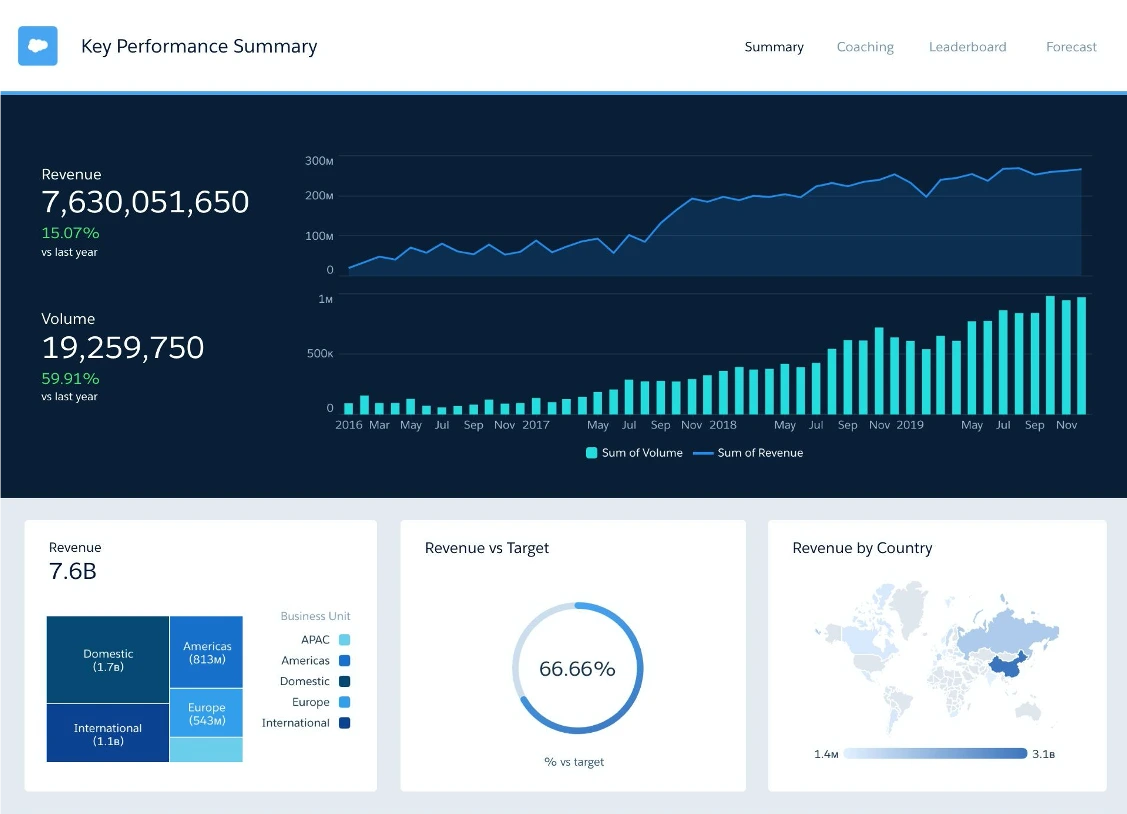
Salesforce Einstein provides an end-to-end AI solution to help companies adopt AI. It offers predictions and generates content to assist with marketing emails or content. Deeply integrated with Salesforce, Einstein uses data from CRM and other apps to deliver real-time insights, predictions, and content within your workflows.
Key features
- Einstein Prediction Builder allows you to create custom AI models to predict outcomes like churn or lifetime value. This is useful for scoring leads based on different criteria.
- Einstein Next Best Action delivers recommendations to employees and customers within Salesforce apps. You can define strategies and build models to suggest the next steps for nurturing leads.
- Einstein Discovery uncovers patterns in your data and provides AI insights for solving problems. This can help identify high-value leads or understand lead behavior.
- Einstein Language uses natural language processing to understand customer sentiment and intent. It can route inquiries and optimize workflows to prioritize leads based on interactions.
What users say about Salesforce Einstein
“Salesforce.com is our source of truth database for customer relationship management activities. With the Salesforce.com enablement features we have bought and the third-party vendors we work with sitting on top of our Salesforce.com, we can do all client interactions within Salesforce.com. Because of this, we have robust data on our sales and customer activities.” — Anonymous user
“I dislike that if you want a channel that isn't covered out of the box it's so difficult to use your own connectors. Also, it's extremely hard to bring your own bot to the party.” — Marilyn M., Senior Director
Integrations
Salesforce supports an extensive list of integrations as they have a complete marketplace to help you seamlessly integrate your stack. And because Einstein is part of the Salesforce ecosystem, you get the same integrations with Einstein.
Some popular integrations include:
- Google Data Studio
- GraphSQL
- Zapier
- And much more
Pricing
- Salesforce Cloud Einstein is priced at $50/user/month and charged annually. This includes unlimited requests for its lead-scoring-focused features.
4. HubSpot

HubSpot is an all-in-one sales and marketing software that helps businesses attract, engage, qualify, and convert leads at every sales funnel stage. It combines a full suite of tools to streamline and automate the sales process. HubSpot also offers powerful lead scoring features that can be a great way to prioritize your marketing campaigns, especially ABM.
Key features
- Lead Management & Prospecting: Manage leads and upcoming sales activities in one workspace.
- Email Tracking: Get real-time notifications when a lead opens an email.
- Sales Automation: Automate follow-up tasks and emails to keep leads engaged.
- Sales Analytics & Reporting: Full visibility into the sales process for effective forecasting.
- Predictive Lead Scoring: Available in the Enterprise plan, this feature helps prioritize leads.
What Users Say About Hubspot
“Hubspot Marketing Hub is our go-to tool for all our Marketing Initiatives. The best about Hubspot Marketing Hub is its User Experience. It is pretty much simple and their to-the-point approach (not showing too many options) is very beneficial.
The main red flag in Hubspot is its lack of Artificial Intelligence capabilities. Hubspot do have generative AI for Content creation but it lacks AI functionalities in Analytics and Database cleansing. We are tedious process especially if you have a huge database.” — Karthick M.
Integrations
HubSpot, like Salesforce, has a marketplace of integrations that allows you to integrate with hundreds of different tools. Some popular ones include:
- Google Suite
- WordPress
- Microsoft Suite
- Eventbrite
- And more
Pricing
- Free CRM plan with basic features
- Starter plan at $45/month for 1-10 users
- Professional plan at $800/month for advanced features
- Enterprise plan starting at $1,600/month with predictive lead scoring, A/B testing, and more
5. Freshsales
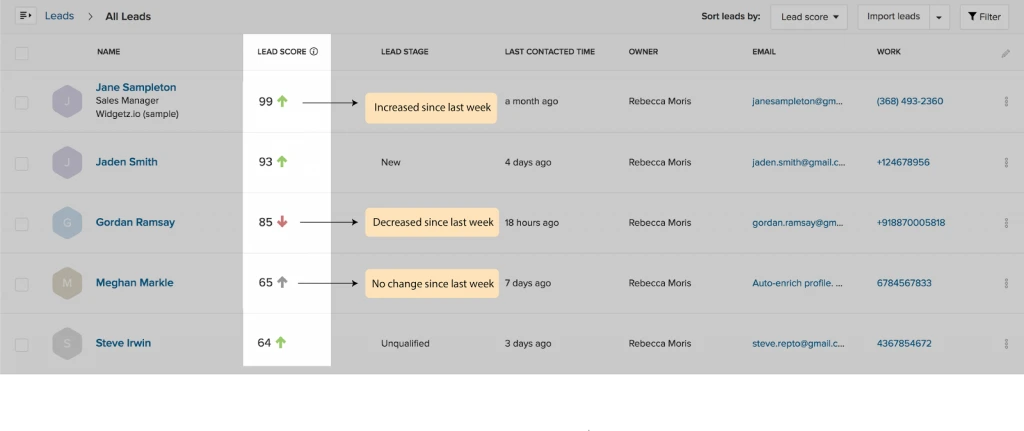
Freshsales is a powerful CRM platform designed to maximize business sales pipelines and revenue. It equips teams with robust features, including multiple sales pipelines, revenue analytics, CPQ capabilities, and AI-powered automation. This enables in-depth visibility into the sales process and intelligent prioritization of high-value deals.
Key Features
- Contact Scoring: Freddy AI assigns scores to prospects based on positive and negative signals to identify sales-ready leads.
- Deal Insights: Predictions on deal closure based on historical data, engagement, and activities to focus on high-value opportunities.
- Sales Sequences: Set up personalized outreach campaigns with triggers to effectively nurture prospects.
- Workflows: Automate repetitive sales tasks to reduce manual work and focus on qualified leads.
- Territory Management: Segment and prioritize prospects with rules to pursue leads likely to convert.
What Users Say About Freshsales
“Freshsales is a userfriendly CRM that is constantly looking for ways to improve. I like that they not only take feedback, but actually implement it. It syncs up easily to your email and allows for seamless work across different platforms like Google calendar/Gmal and Acuity.
I wish it would not ask to duplicate leads when they have different locations. Sometimes there will be a lot of leads with the same name (i.e. Jennifer Smith) and FS will automatically assume it is a duplicate. If it was somehow able to identify a difference in, say, location or company name, it would make the AI work in our favor with more ease.” — a reviewer on G2.
Integrations
Freshsales has a marketplace of integrations and these are some of the most popular ones.
- Mailchimp
- Trello
- Magento 2
- QuickBooks
- HubSpot
- PandaDoc
- Xero
- Stripe
- DocuSign
Pricing Plans
- Free Plan: $0 for up to 3 users with basic features.
- Growth Plan: $15/user/month billed annually or $18/user/month billed monthly. Includes contact scoring and sales sequences.
- Pro Plan: $39/user/month billed annually or $47/user/month billed monthly. Includes multiple pipelines and deal insights.
- Enterprise Plan: $69/user/month billed annually or $83/user/month billed monthly. Advanced customization and governance.
6. ActiveCampaign

ActiveCampaign is an end-to-end marketing automation platform designed to help businesses grow by streamlining the entire customer experience. It offers powerful capabilities, from email marketing to advanced lead scoring and sales automation.
Key Features
- Lead Scoring: Scores leads based on behaviors and attributes to identify and prioritize hot prospects for outreach.
- Win Probability: Uses machine learning to analyze past interactions and estimate the likelihood of closing a deal.
- Salesforce Integration: Enables robust scoring models by incorporating CRM data.
- Attribution Reporting: Provides insights into effective marketing channels for conversions.
What Users Say About ActiveCampaign
What I love about AC is they don't try to be the "only tool" you use. They get that we all use dozens of tools and instead work with that. We integrated in our Calendly, our Segment, our Bonjoro and many other integrations and they worked seamlessly. Not even Zapier required. — Casey H.
“Main downside we have experienced to date has been around Active Campaign support and responsiveness to issues. We have had our developer design and build the flows we are seeking but our main automation that has been set up is not working properly and a ticket has been logged with support for a number of days and no response or contact has been received.” — James C., Director
Top Integrations
- Salesforce
- WordPress
- Facebook Ads
- Slack
- Shopify
- WooCommerce
- Calendly
- Google Analytics
- Zapier
Pricing
- Plus Plan: $49/month annually for 3 users. Includes basics like WooCommerce integration.
- Professional Plan: $149/month annually for 5 users. Adds AI, Salesforce integration, and more.
- Enterprise Plan: Custom pricing for 10 users. Advanced features like custom reporting.
7. EngageBay

EngageBay is an intuitive all-in-one CRM and marketing automation platform tailored for small and midsize businesses. It combines a robust feature set on one seamless platform to maximize sales and revenue growth by aligning marketing and sales.
However, it contains multiple add-ons that you may require for proper analytics tracking which are not part of the complete package.
Key Features
- Marketing Automation: Create targeted campaigns and workflows to nurture prospects with relevant content and offers for better lead qualification.
- Lead Scoring: Automatically score leads based on demographics, behaviors like email opens/clicks, and other criteria to identify sales-ready prospects.
- Segmentation: Divide contacts into groups based on attributes like location, firmographics, interests, and behaviors for highly targeted marketing.
- Email Broadcast: Send customized emails to contacts and subscriber lists to drive engagement, which can be tracked for lead scoring.
- Deal Management: A centralized pipeline provides visibility into deal stages to score leads accordingly and focus efforts on closing deals.
What Users Say About Engagebay
“I love how you can manage your deals (sales pipeline) with email automations associated with those deals from the same platform. This is essential as it saves my sales and account management team a ton of time and effort with regards to admin work” — Rahul C.
“One thing I dislike about EngageBay is that the All-in-one suite does not actually include everything. There is a new really cool feature which allows you to track website activity, but it is an add-on. EngageBay charges extra for this feature.” — Marcin R.
Integrations
- Zapier
- SendGrid
- Mailgun
- Mandrill
- Xero
Pricing
- Free Plan: $0 per user/month, includes 250 contacts, basic CRM, and email marketing.
- Basic Plan: Starts at $12.74 per user/month, includes 500 contacts and lead scoring.
- Growth Plan: Starts at $42.49 per user/month, includes 5000 contacts and advanced features like custom domain.
- Pro Plan: Starts at $84.99 per user/month, and offers unlimited contacts and advanced analytics.
8. Adobe Marketo

Adobe Marketo Engage is a comprehensive marketing automation platform for B2B and B2C companies looking to optimize customer engagement and accelerate revenue. It combines robust email marketing, advanced lead management, and data-driven analytics in one powerful solution.
Marketo helps marketing and sales teams work cohesively to attract prospects, identify hot leads, and guide customers through personalized journeys from discovery to conversion. AI-powered capabilities provide actionable insights to engage people at the right time.
Key Features
- Lead Management: Nurture and qualify prospects through tailored content and the sales funnel.
- Account-Based Marketing: Coordinate marketing and sales to target high-value accounts.
- Scoring, Routing & Alerts: Prioritize and route leads based on engagement metrics and behaviors.
- Advanced Journey Analytics: Uncover customer insights across touchpoints to improve lead scoring.
- Predictive Audiences: Use AI to build customized audiences based on predicted behaviors.
What Users Say About Adobe Marketo
“It is a fairly complete tool, focused on marketing automation composed of webinars, form editor, landing templates, which significatly help you to elaborate reports though the management and analysis of programs that contains Adobe Marketo Engage, being this has a quite striking workflow management, taking into account that this engine is what makes this software quite attractive.” — Marco P.
“The user experience of building emails and campaigns can be very frustrating. For example, spacing surrounding email components appears much differently in the Marketo email preview than it does in your inbox. About 50% of the time, when you add an image, link, or token to your email, it disappears upon saving and you need to add it a second time. Almost every time you add a line break in your email, you have to save the component, open it again, and save it again before Marketo will reflect the space you added in the email preview.” — Jordan M.
Integrations
Like Salesforce and HubSpot, Adobe Marketo has a marketplace for all the tools that can be integrated with it. Here are some of the popular ones.
- Adobe Experience Cloud
- Salesforce
- Microsoft
- SAP
- Google and Facebook
- Event tools
- And more
Pricing
- Growth: Core email, segmentation, automation. Custom pricing.
- Select: Essential automation and measurement. Custom pricing.
- Prime: Advanced lead management, journey analytics, AI. Custom pricing.
- Ultimate: Robust marketing automation capabilities. Custom pricing.
With powerful automation, intelligence, and analytics, Marketo enables personalized cross-channel experiences to convert more prospects and drive revenue.
9. Monday.com

Monday.com is a flexible and customizable sales platform designed for sales teams looking to streamline processes, boost productivity, and centralize customer data. It brings key sales capabilities like pipeline visibility, forecasting, email integration, and activity tracking into one intuitive platform.
Key Features
- Email Sync & Tracking: Sync Gmail/Outlook to log emails and get notifications when prospects open or reply.
- Sales Forecasting: Set deal values and probabilities to track forecast vs. actual sales.
- Activity Management: Log activities like calls, meetings, and notes with leads and contacts.
- Team Goals: Manage and track team quota attainment over time.
- Lead Capturing: Integrate with other tools or add website forms to capture leads.
What Users Say About Monday
“I like how monday.com helps us create almost instanly more efficient team no matter the approach you take: be it Kanban, Scrum, Scrumban or any other predictive or agile enviroment, Monday.com is full of templates and views to show the data in all those approaches. Automations make the job of a project lead much easier and allows you track performance, SLAs, etc. You can assign owners, up to two, limit the work in progress, link with Gmail, etc” — Milton Adalberto A.
It takes a long time to set up exactly how you want it, truly you need a dedicated person to be able to get it going perfectly. Otherwise, you will be tweaking constantly to get it fully operational and customized. — Megan M., Director of Operations
Integrations
- DocuSign
- Aircall
- PandaDoc
- MailChimp
- Hubspot
- Facebook Ads
- Salesforce
Pricing
- Basic CRM: $10/user/month billed annually, unlimited contacts, custom pipelines.
- Standard CRM: $14/user/month billed annually, 2-way email, CRM automation.
- Pro CRM: $24/user/month billed annually, sales analytics, mass emails.
- Enterprise CRM: Contact for pricing, lead scoring, analytics, and security.
10. Platformly
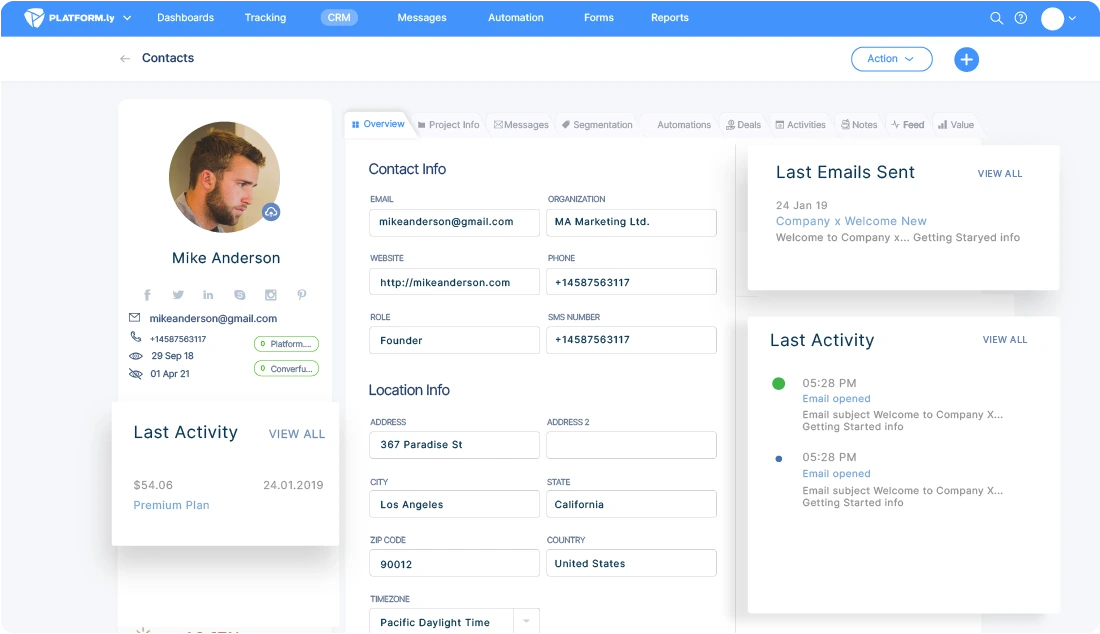
Platformly is an intuitive marketing automation platform designed to help online businesses centralize, automate and scale their operations for growth. It combines email marketing, basic CRM, behavioral tracking, analytics, and more to streamline processes and convert leads.
Key Features
- CRM: Automatically record and update customer information like contact details, interactions, and recent social media activity.
- Segmentation: Divide your contacts into groups with shared attributes to send targeted campaigns.
- Sales Pipelines: Visualize deal stages to understand where leads are in the funnel and focus efforts on pushing them through.
What Users Say About Platformly
“Platformly is perfect because it always allows you to save time. It offers many features in one tool: marketing automation, emails, forms... and more. On top of that, it has many integrations with other tools! The other great thing is support. This is important to me. I don't like waiting too long for support.” — Thomas K.
“The well-defined interface is rather complicated and confusing. Their documentation is primarily technical documentation and less about use case scenarios to help train and guide in optimal usage.” — Peter K., CEO and Co-Founder
Top Integrations:
- ClickBank, PayPal, Paddle, Stripe
- WooCommerce, Shopify
- Twilio & Nexmo
Pricing
- Starter Plan: $69/month for up to 10K contacts, 10K emails/month, 1 dashboard, 5 integrations.
- Growth Plan: $49/month extra for 100K emails/month, 5 dashboards, unlimited integrations.
- Unlimited Plan: $99/month extra for unlimited emails, dashboards, integrations.
11. Pardot

Pardot combines a suite of capabilities, including email marketing, lead nurturing, lead scoring, and seamless CRM integration with Salesforce. Automated and personalized campaigns allow you to engage prospects with the right message based on their interests and behaviors at the right time.
Robust analytics provide insights to refine campaigns and strategies for optimal ROI continuously. The platform is optimized to find, nurture, and convert more prospects into customers.
Key Features
- Marketing Automation: Automate tasks to identify and engage with hot leads.
- Marketing Analytics: Focus efforts on high-value prospects based on conversion data.
- Sales & Marketing Alignment: Salesforce Engage connects sales with qualified leads from marketing.
What Users Say About Pardot
Complexity, Cost, Learning Curve, Limited Social Media Integration. Despite these potential downsides, many organizations find the benefits of Pardot when it comes to enhancing their marketing efforts and customer engagement — Deepak R.
Pardot requires knowledge of HTML, which is a nice way of saying that your time working on email campaigns is going to be complex, frustrating, and time-consuming. Formatting and styling are Pardot's pain points. Source reporting, and reporting in general, are famously awful. Don't take my word for me - check around, and you'll find out that Pardot is dead last in the market regarding providing useful data and insights. — Ian B., Growth Marketing Manager
Integrations
Similar to Salesforce, Pardot integrates and works with all the tools that Salesforce integrates with.
Pricing
- Account Engagement: $1,250/month for up to 10K contacts annually.
- Plus: $2,750/month for up to 10K contacts annually.
- Marketing Analytics: $3,000/user/month annually.
- Sales & Marketing Alignment: $50/user/month annually.
{{INLINE_MOFU}}
Lead scoring tools are crucial for B2B SaaS companies to prioritize high-value prospects and boost sales efficiency.
1. Factors.ai: AI-driven account intelligence that segments, scores, and analyzes high-intent accounts for optimized targeting.
2. MadKudu: Predictive lead scoring based on fit and engagement, helping SaaS businesses accelerate growth with customer data.
3. Salesmate: Customizable scoring models, CRM integration, and real-time analytics to enhance lead management and ROI.
4. HubSpot: Combines CRM, marketing automation, and analytics for effective lead scoring and sales alignment.
5. ActiveCampaign: Advanced lead scoring, marketing automation, and Salesforce integration for streamlined sales processes.
These tools help B2B SaaS companies identify and engage high-potential leads, driving growth and improving sales performance.
Key Takeaways
- Implementing lead scoring is critical to identify and prioritize hot prospects most likely to convert. The right software solution can analyze engagement, attributes, and behaviors to accurately predict lead potential.
- Look for AI-powered predictive scoring, actionable account intelligence, and intuitive journey analytics when evaluating lead scoring platforms. These capabilities optimize targeting, conversions, and revenue growth.
- Platforms like Factors utilize advanced AI and machine learning to provide unparalleled accuracy in predicting outcomes. Comprehensive account profiles and Explain features uncover trends driving progression.
- Seamless CRM and marketing automation integrations align sales and marketing around high-value targets. Shared tools and data foster engagement, coordination, and conversions.
- Solutions range from specialized scoring to end-to-end suites. Assess your needs and stack compatibility when selecting. All-in-one platforms can maximize efficiency.
- Carefully evaluate capabilities, ease of use, customer support, and pricing models. Many offer multiple tiers based on features, users, and contacts.
For enterprises seeking a powerful yet intuitive lead scoring and account management platform, Factors is a clear choice. Book a demo with Factors to learn how cutting-edge AI can uncover revenue opportunities.
Lead Sourcing for B2B Companies
Discover effective lead sourcing strategies for B2B companies, from utilizing databases to AI-driven tools like Factors for optimized sales pipelines and growth.
TL;DR
- Lead sourcing is proactive, identifying potential customers, while lead generation attracts leads via marketing.
- It helps target the right prospects, speeds up sales cycles, and improves conversion rates.
- Effective strategies include using B2B databases, leveraging social media, attending industry events, and Account-Based Marketing (ABM).
- AI and automation tools enhance lead sourcing by streamlining processes.
- Challenges include ensuring data quality, compliance with privacy laws, and resource limitations.
- Best practices include defining an Ideal Customer Profile (ICP), segmenting leads, using multiple channels, and analyzing results.
- Tools like Factors optimize lead sourcing with AI-driven insights and real-time reporting.
In B2B sales, competition is fierce, and the stakes are high. But lead sourcing can be your secret sauce for business growth. Think of it as your business's matchmaking service, where you proactively seek out and identify potential customers waiting to fall in love with your product or service.
But let’s clear the air—lead sourcing isn’t the same as lead generation. While lead generation is about attracting leads through snazzy content and killer marketing campaigns, lead sourcing is where you roll up your sleeves and hunt for those golden contacts who fit your ideal customer profile.
Understanding Lead Sourcing
Lead sourcing is the first step in the B2B sales funnel. It is a crucial activity that helps sales teams identify potential customers and build a pipeline of qualified leads. Effective lead sourcing involves research, data analysis, and the use of various tools and platforms to gather information about potential customers.
Lead Sourcing vs. Lead Generation
It is essential to distinguish between lead sourcing and lead generation. While both are integral to the sales process, they serve different purposes:
- Lead Sourcing
The process of identifying and gathering potential customer data. It is an outbound activity where sales teams actively search for leads using various tools and techniques.
- Lead Generation
The process of attracting potential customers through marketing efforts. It is an inbound activity where leads come to you through content, social media, webinars, and other marketing channels.
Understanding this distinction is key to developing a comprehensive sales strategy that leverages both lead sourcing and lead generation.
{{INLINE_TOFU}}
Importance of Lead Sourcing in B2B Sales
For B2B companies, lead sourcing is a foundational activity that directly impacts the success of sales efforts. Here’s why lead sourcing is essential:

- Targeted Outreach
Lead sourcing allows you to identify and target specific companies or decision-makers who are most likely to benefit from your product or service.
- Faster Sales Cycles
By sourcing leads who are already a good fit for your offering, you can accelerate the sales cycle and reduce the time it takes to close deals.
- Improved Conversion Rates
High-quality leads are more likely to convert into paying customers, leading to better conversion rates and higher ROI.
- Better Use of Sales Resources
With a well-curated list of leads, your sales team can focus on engaging with potential customers who are genuinely interested in your product rather than spending time on unqualified leads.
Strategies for Effective Lead Sourcing
Lead sourcing requires a strategic approach to ensure that the leads you gather are of high quality and relevant to your business. Here are some effective strategies for B2B lead sourcing:
1. Utilize B2B Databases
B2B databases are a goldmine for lead sourcing. These platforms provide access to extensive lists of companies and decision-makers across various industries. Some popular B2B databases include:
- LinkedIn Sales Navigator: LinkedIn is a powerful tool for lead sourcing, allowing you to search for companies, industries, and specific roles.
- ZoomInfo: ZoomInfo offers detailed contact information and company data, making it easier to find the right leads.
- Cognism: Cognism is another excellent tool for B2B lead sourcing, offering real-time data on companies and decision-makers.
When using B2B databases, it’s important to filter your search based on your ideal customer profile (ICP) to ensure that the leads you gather are relevant.
2. Leverage Social Media
Social media platforms, particularly LinkedIn and Twitter, are valuable resources for B2B lead sourcing. These platforms allow you to engage with potential leads and gather information about their interests, challenges, and needs.
- LinkedIn: Use LinkedIn’s advanced search features to find leads based on industry, company size, job title, and other relevant criteria. Joining LinkedIn groups related to your industry can also help you connect with potential leads.
- Twitter: Twitter is useful for identifying leads who are actively discussing topics related to your industry. By following relevant hashtags and engaging in conversations, you can find leads who may be interested in your offering.
3. Attend Industry Events and Conferences
Industry events, trade shows, and conferences are excellent opportunities for lead sourcing. These events bring together professionals and decision-makers from your target industries, providing a platform to network and gather leads.
To maximize your lead sourcing efforts at events:
- Pre-Event Planning: Research attendees and identify key prospects before the event. Use social media and event apps to connect with them in advance.
- Networking: Engage in meaningful conversations with attendees, exchange contact information, and follow up after the event.
- Post-Event Follow-Up: Send personalized emails or LinkedIn messages to the leads you met at the event. Reference your conversation and offer additional value to keep the dialogue going.
4. Implement Account-Based Marketing (ABM)

Account-Based Marketing (ABM) is a strategic approach that focuses on targeting specific companies (accounts) rather than individual leads. ABM allows you to personalize your outreach and tailor your messaging to the needs of each account.
- Identify Target Accounts: Start by identifying a list of high-value accounts that are a good fit for your product or service.
- Research Decision-Makers: Use LinkedIn and B2B databases to find the key decision-makers within each target account.
- Personalize Your Outreach: Create personalized messaging and content for each account, addressing their specific pain points and challenges.
- Engage Across Multiple Channels: Use a combination of email, social media, direct mail, and phone calls to engage with decision-makers within your target accounts.
5. Use AI and Automation Tools
AI and automation tools can significantly enhance your lead sourcing efforts by streamlining the process and improving accuracy. These tools can help you identify leads, gather contact information, and even predict which leads are most likely to convert.
- AI-Powered Lead Scoring: AI tools can analyze data and assign scores to leads based on their likelihood of converting. This allows you to prioritize high-quality leads.
- Automated Data Enrichment: Automation tools can enrich your lead data by filling in missing information, such as email addresses, phone numbers, and job titles.
- Chatbots and Conversational AI: Chatbots can engage with website visitors in real-time, collecting information and qualifying leads on the spot.
Challenges in Lead Sourcing
While lead sourcing is critical for B2B sales success, it is not without its challenges. Understanding these challenges can help you develop strategies to overcome them.
1. Data Quality
One of the biggest challenges in lead sourcing is ensuring data quality. Inaccurate or outdated contact information can lead to wasted efforts and missed opportunities.
- Solution: Regularly clean and update your lead database to ensure accuracy. Use data enrichment tools to fill in missing information and verify contact details.
2. Lead Relevance
Not all leads are created equal. Some leads may not be a good fit for your product or may not have the authority to make purchasing decisions.
- Solution: Develop a clear Ideal Customer Profile (ICP) to guide your lead sourcing efforts. Focus on sourcing leads that match your ICP criteria.
3. Compliance and Privacy Concerns
With the increasing emphasis on data privacy, lead sourcing activities must comply with regulations such as GDPR and CCPA.
- Solution: Ensure that your lead sourcing practices comply with data privacy laws. Obtain consent where necessary and be transparent about how you use and store lead data.
4. Time and Resource Constraints
Lead sourcing can be time-consuming, especially if you don’t have the right tools or resources.
- Solution: Invest in automation tools to streamline the lead sourcing process. Consider outsourcing lead sourcing to specialized agencies if internal resources are limited.
Best Practices for Lead Sourcing
To maximize the effectiveness of your lead sourcing efforts, follow these best practices:
1. Define Your Ideal Customer Profile (ICP)

Before you start sourcing leads, it’s essential to define your Ideal Customer Profile (ICP). Your ICP should outline the characteristics of your best customers, including factors such as industry, company size, location, and pain points.
Having a well-defined ICP ensures that you are targeting the right leads and increases the likelihood of conversion.
2. Segment Your Leads
Not all leads are at the same stage of the buying journey. Segment your leads based on their level of interest, engagement, and decision-making authority. This allows you to tailor your outreach and messaging to each segment, increasing your chances of success.
3. Leverage Multiple Channels
Don’t rely on a single source for leads. Instead, use a combination of channels, including B2B databases, social media, email, events, and webinars, to gather leads. This multi-channel approach ensures that you are reaching a broader audience.
4. Track and Analyze Your Results
Regularly track and analyze your lead sourcing efforts to determine what’s working and what’s not. Use analytics tools to measure key metrics such as lead quality, conversion rates, and ROI. This data-driven approach allows you to optimize your lead sourcing strategy over time.
How Factors Can Help with Lead Sourcing for B2B Companies
Effective lead sourcing requires robust tools and strategies. Factors enhances your efforts by providing account-level insights and analytics.
- Engagement Scoring
Factors scores account based on engagement data, helping prioritize sales-ready opportunities.
- Behavioral Insights
The platform offers detailed engagement metrics to understand account interactions with your content.
- Multi-Channel Attribution
Factors identifies which channels drive the most engagement and conversions.
- Data Enrichment
It automates account-level intelligence, ensuring your data is comprehensive.
- Intent Signals
The platform uses engagement data to highlight accounts with high purchase intent.
- CRM Integration
Factors integrates with major CRMs for seamless data synchronization.
- Real-Time Reporting
Customizable dashboards provide real-time insights into account engagement.
Lead Sourcing: Strategies, Benefits & Challenges
A proactive approach in B2B sales to identify and engage high-quality prospects.
1. Effective Strategies: Utilize B2B databases, leverage LinkedIn, attend industry events, and implement Account-Based Marketing (ABM).
2. Key Benefits: Targeted outreach, shortened sales cycles, and improved conversion rates.
3. Challenges & Solutions: Ensure data accuracy, comply with privacy laws, and invest in automation tools for efficiency.
Optimizing lead sourcing enhances sales performance, accelerates conversions, and drives business growth.
In a Nutshell
Lead sourcing is a vital component of any B2B company’s sales strategy. It involves the proactive identification and gathering of potential customer information, essential for building a robust sales pipeline. Companies can enhance their lead-sourcing efforts and drive business growth by leveraging various strategies such as utilizing B2B databases, leveraging social media, attending industry events, and implementing Account-Based Marketing (ABM).
However, lead sourcing has challenges, including data quality issues, compliance concerns, and time constraints. To overcome these challenges, it is important to follow best practices such as defining your Ideal Customer Profile (ICP), segmenting leads, using multiple channels, and continuously tracking and analyzing your results.
Incorporating advanced tools like Factors.ai can further optimize your lead sourcing efforts. With its AI-powered lead scoring, behavioral insights, multi-channel attribution, and predictive analytics, Factors provides B2B companies with the tools and insights they need to source high-quality leads and accelerate their sales cycles.
By combining strategic lead sourcing techniques with powerful analytics and automation tools, B2B companies can build a steady pipeline of qualified leads, improve conversion rates, and ultimately achieve their growth objectives.
.avif)
Top 10 Lead Forensics Competitors for Visitor Identification in 2026
Looking for a visitor identification tool? Check out this blog that lists the top 10 lead forensics competitors in 2026
Looking for Lead Forensics competitors to better identify and enrich anonymous accounts engaging with your business? You're in the right place. Here's our review of the top 10 Lead Forensics alternatives in 2026
In this article, we’ll cover:
- Lead Forensics' features, limitations, and pricing
- Top 9 Lead Forensics competitors — including their features, limitations, and pricing
- Factors you should consider when investing in an account intelligence tool
About Lead Forensics
Lead Forensics is a popular visitor identification software that works with over 60,000 customers worldwide. The tool helps businesses identify companies visiting a website using reverse IP-lookup technology.
Some of its key features include:
- Real-time website visitor tracking
- Large database regularly updated with B2B IP addresses
- Access to contact-level data such as email IDs and phone numbers
Lead Forensics offers two plans: Essential and Automate
Although there’s not much clarity about the pricing on their website, here’s our comprehensive breakdown of Lead Forensics Pricing
Why look for a Lead Forensics Alternative?
Lead Forensics is a widely used tool in the account intelligence space. That being said, no solution is without its flaws. Here are a few reasons why B2B marketers and sales folk consider Lead Forensics competitors.
Lead Quality issues: Users mention they face accuracy issues in companies identified and some even mention the contact information can be outdated.
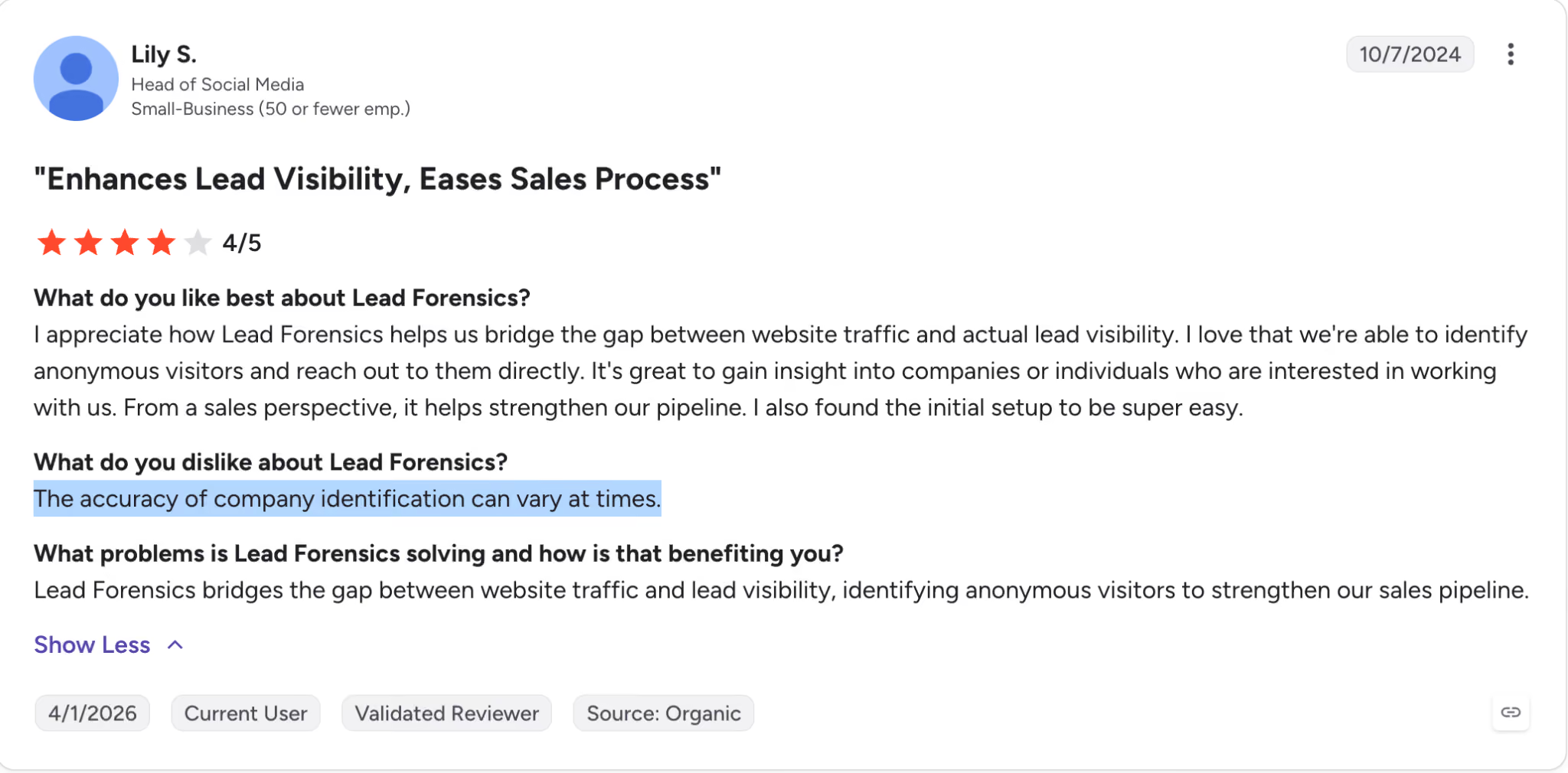
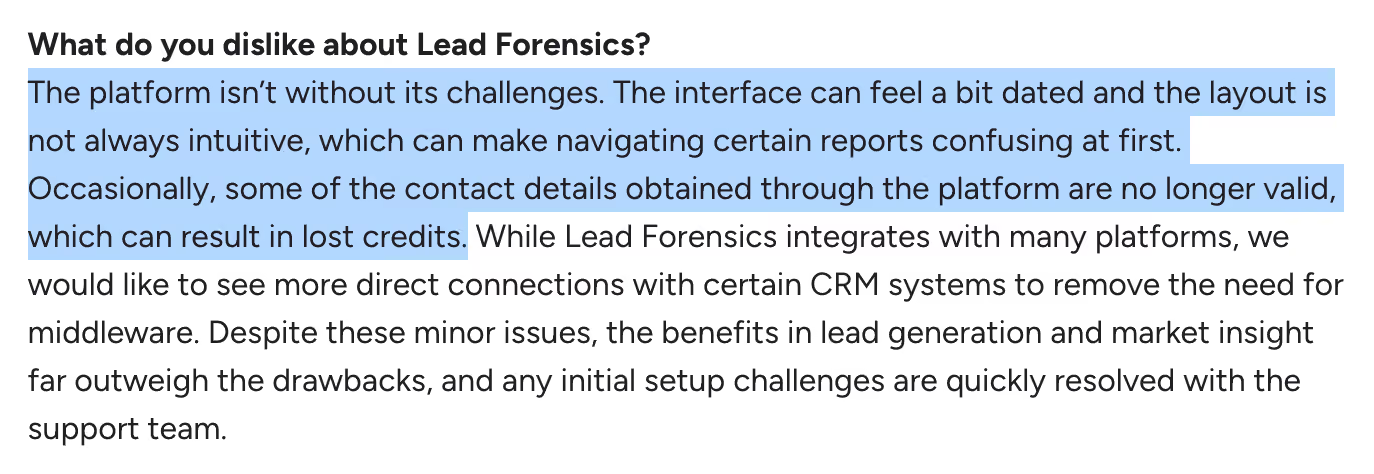
Missing information: Some users on G2 mention that Lead Forensics does not tell you the exact person visiting your website.


Platform issues: A few users have mentioned that the platform is not very intuitive and they find the navigation clunky.


What to Look for in a Lead Forensics Alternative
- Granular Data: Look for a solution that offers in-depth insight into when a high-fit and high-intent account visits your website. This means access to technographic and firmographic data as well.
- Real-Time Notifications: Ensure your sales and marketing teams act right when target accounts visit your website. Select a tool that sends real-time alerts on Slack and MS Teams instead of just emails.
- Robust Integration Options: Invest in a platform that allows flexible integration with existing tools in your tech stack.
- Ease of Use: Make sure you select a platform that is easy to navigate and has a clean UI
- Broader ABM functionality: While identifying web visitors is one part, taking actionable steps with this data is equally important. Opt for a tool that gives you the ability to execute your ABM strategy without the need to switch between multiple platforms
- Account and Engagement Scoring: Find a tool that tells you how much your prospects engage with your website so you can appropriately target your marketing and sales efforts
- Intent Data from Multiple Platforms: Your LinkedIn and G2 profiles are lead-generation goldmines, so invest in a solution that gives you
{{INLINE_CTA_A}}
Top 10 Lead Forensics Competitors in 2026
There are many Lead Forensics competitors in the market today, but we’ve researched and hand-picked the best ones for you. Here’s all you need to know about the top 10 visitor identification and account intelligence tools among B2B companies ⬇️
1. Clearbit

Clearbit is a marketing intelligence tool for B2B businesses that offer users visitor deanonymization, along with intent data, contact data of leads & firmographic data. The tool offers users a large collection of data sets, using publicly available data on the internet, proprietary data, and a large language model (LLM) that organizes unstructured data into usable, standardized modes of information.
Key Features
Clearbit offers B2B companies a three-part solution: Enrich, Reveal, and Capture.
- Enrichment: Clearbit’s vast database comprises over 250 data sources and millions of data points, allowing users to easily obtain novel leads.
- Reveal: The tool uses AI-powered deanonymization with data in multiple languages to help users recognize lucrative advertising initiatives and high-intent accounts.
- Capture: Clearbit’s seamless integration capabilities allow it to capture all relevant information from your CRM and streamline sales and marketing processes.
💡Check out Factors’ new partnership with Clearbit
Limitations
- Relatively high pricing compared to other tools offering similar capabilities

- Users find Clearbit’s integrations immensely useful. However, they find that its data accuracy levels could be higher.

Pricing
TrustRadius lists Clearbit’s pricing as $20,000 annually, but the company does not have publicly available pricing information on its website. Clearbit offers flexible pricing on its website, which depends on the user’s contact creation needs, web traffic, and database size.
{{INLINE_CTA_A}}
2. Visitor Queue

Visitor Queue is a visitor identification tool that businesses use to identify prospective clients. You can then use it to reach out to decision-makers from the companies that you’re targeting.
The tool also provides names, contact information, location, and social media links for the businesses visiting your website. It ensures compliance with local and international privacy laws by relying entirely on publicly available data pulled from a variety of sources.
Key Features
Visitor Queue offers its clients:
- Real-time visitor identification
- Website personalization
- Anonymous website visitor tracking.
Limitations
- It does not have as large a database of companies as many competitors
- It sometimes identifies internet service providers (ISPs) as visiting businesses.

Pricing
Visitor Queue offers five payment tiers depending on the number of leads a client requires from them per month. Here are Visitor Queue’s payment plans:
.avif)
3. Factors.ai
Factors is an account intelligence and analytics solution that connects with industry-leading data partners to provide IP-based deanonymization. It also provides robust account analytics functions including multi-touch attribution, account scoring, path analysis, and more.
Key Features
Factors offers its clients versatile, comprehensive features, including:
- IP-based B2B account identification across the website, product reviews & ad impressions, with match rates powered by 6sense and Clearbit
- Real-time alerts across Slack & MS Teams to stay on top of high-intent accounts are live and engaging
- Account scoring where you can create your own scoring rules to score and qualify and segment high-intent accounts based on cross-channel engagement
- G2 and LinkedIn intent signals to identify how prospects are engaging with your profile
- Workflow automation that allows you to push high-fit and high-intent prospects to mail sequencing tools, push to LinkedIn retargeting audience, and more with webhooks
- Robust analytics and attribution that gives you complete overview on how buyers act at each stage of the customer journey.
-
💡Check out how Factors helped Drivetrain 3x their sales engagement
Limitations
- Factors doesn’t offer native contact enrichment unlike other the more established platforms on this list but integrates with major enrichment tools like Apollo and Zoominfo

Pricing
Factors offer a free plan along with 3 other tiers:
- Free
- Basic
- Growth
- Custom
Learn more about our pricing here
{{INLINE_CTA_A}}
4. Happierleads
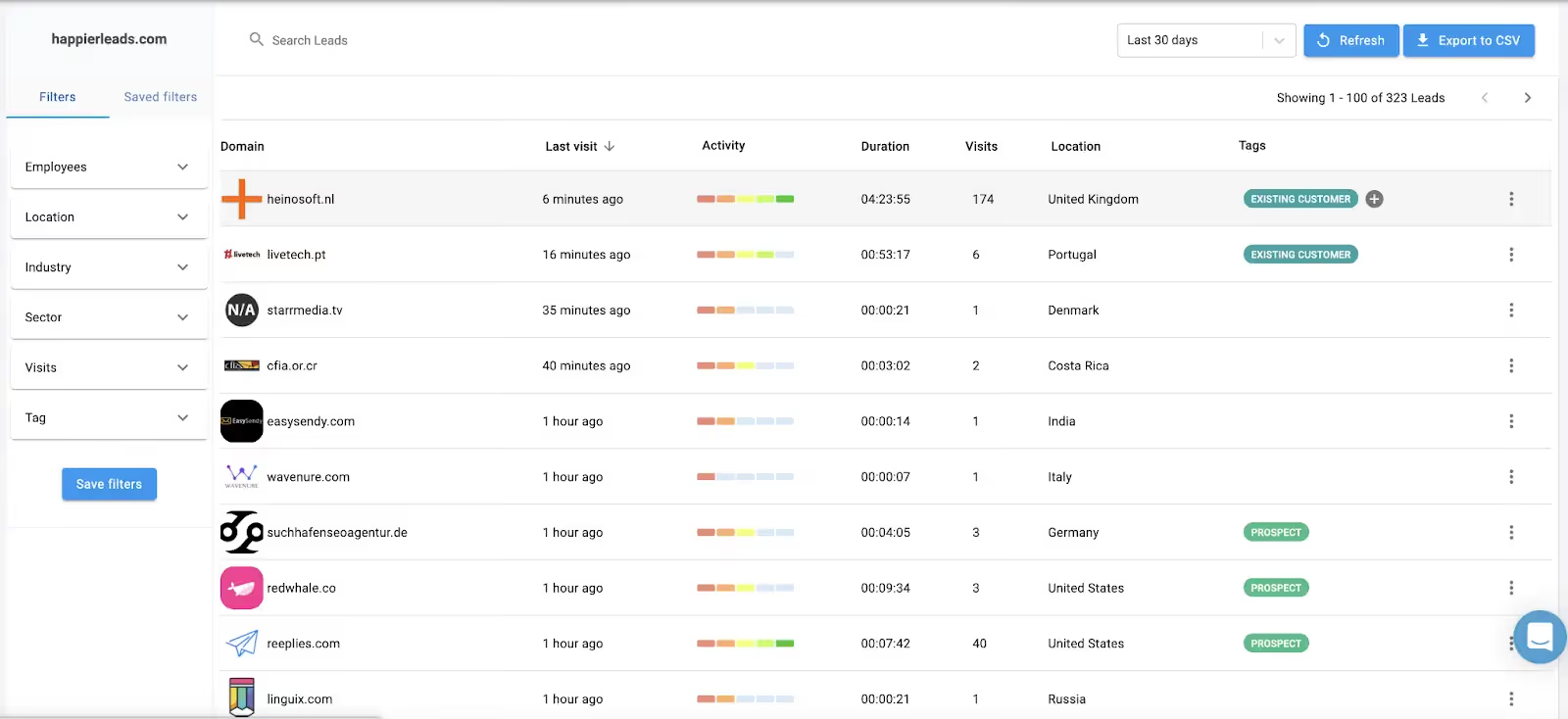
Happierleads’ visitor identification tool enables you to reach out to, and target leads that aren’t currently converting into clients. Happierleads’ automated solutions enable users to follow up with visitors and retarget them on autopilot. Its large database of companies also makes for quicker, easier visitor identification.
Key Features
Happierleads offers users four solutions:
- Web Visitor Identification, which helps clients understand which visitors to target
- Prospector, a solution that enables users to contact decision-makers for over 60 million companies
- Enrichment, which adds missing information about leads
- Outreach Software, which sends cold emails to target prospects
Limitations
- Users have reported that the platform can be unintuitive and difficult to navigate

- Does not offer dedicated engagement analytics
Pricing
Happierleads offers 4 different pricing plans based on the company’s growth stage:

5. KickFire (now part of Foundry)
KickFire identifies leads who are engaging with your company and segments them according to intent. KickFire allows you to prioritize leads based on intent segmentation. It also allows users to see which types of content resonate the most with their target audiences. It is now a part of Foundry as of 2024.
Key Features
KickFire offers users the following features:
- Data verified by humans and normalized across the sales and marketing platforms
- Prompts that offer actionable sales and marketing insights
- Easy installation and buyer identification.
Limitations
- Customers have reported that the filtered results aren’t accurate and lack granularity when compared to other tools in the market

Pricing
KickFire does not offer pricing information publicly.
{{INLINE_CTA_A}}
6. LeadLander

LeadLander’s visitor identification solution gives you employee contact information for priority leads. The tool offers users contact profiles and key data points that can help companies close more deals. It also provides user journey information and the web pages each visitor has seen.
Key Features
- De-anonymization
- Customer behavior and journey data
- Key contact information for high-priority leads
Limitations
- Sometimes gives cable or ISP addresses in place of visitor data
- Account scoring and engagement scoring capabilities are limited

Pricing
LeadLander offers 2 pricing plans:

7. LeadInfo

LeadInfo de-anonymizes website visitors for B2B clients using their extensive data set. They match the visitor’s IP address against their vast database. Their clients obtain an overview of website users, the companies they belong to, and their behaviors.
It offers users various one-click integrations and worldwide coverage to ensure seamless lead generation. It also lets B2B companies view website visitors in real-time.
Key Features
Leadinfo’s key features include:
- A vast dataset of companies
- Global coverage
- 60+ one-click integrations
- Real-time website visitor information
Limitations
- Limited dashboard capabilities
- Users state that pricing is slightly on the higher end compared to tools with similar capabilities

Leadinfo Pricing
Leadinfo’s pricing model uses a sliding scale based on the number of unique companies recognized per month on their clients’ websites.
.avif)
{{INLINE_CTA_A}}
8. Albacross

Albacross’s account intelligence offerings help users nurture leads visiting their websites. They help clients discover unseen purchasing intent through their deanonymization feature, thereby generating more pipeline and accelerating sales.
Key Features
Albacross offers its users:
- Visitor deanonymization
- Real-time alerts for priority prospects
- A global database of companies
Limitations
- Albacross doesn’t offer as many integrations as its counterparts
- Software has a relatively steep learning curve
- Doesn’t offer workflow automation

Albacross’s interface helps users organize data intuitively. However, small businesses have found that the tool may be more suited to larger organizations due to informational gaps in Albacross’s database.
Pricing
Albacross offers users two pricing models: Self-service and Growth.

9. Leadfeeder (now Dealfront)
.avif)
Leadfeeder’s visitor identification capabilities help users convert page views into valuable pipeline.
Leadfeeder’s four-step plan to uncover hidden leads visiting their users’ websites is to identify, qualify, collect, and send leads. This ensures that their users obtain high-value leads that have a better chance of converting.
Key Features
Leadfeeder’s features include:
- Website visitor tracking
- Account-based marketing, and
- Sales prospecting.
Limitations
- Limited integrations
- Does not offer real-time alerts for website visitors
- Lack of engagement scoring and workflow automation

Pricing
Leadfeeder offers users two payment plans:

💡Compare Albacross and Leadfeeder
{{INLINE_CTA_A}}
10. Warmly

Warmly is a sales orchestration platform that uses AI to identify, track, and connect with website visitors who are actively looking to buy. They offer workflow features that automate sales prospecting for SMB-sized revenue teams.
Key Features
- Autonomous Sales Orchestration
- Automated Intent-Driven Outreach
- Website deanonymization
Limitations
- Massive pricing jump from the free plan
- Customers have mentioned they would like additional filters to better segment their data
- Users have reported that the tool has a steep learning curve

Pricing
Warmly offers a free plan along with a business plan for $1200/mo and an enterprise custom pricing.

Top Lead Forensics Alternatives
Visitor identification software helps businesses track website visitors and generate leads through reverse IP lookup.
- Top Alternatives: ZoomInfo Sales, Visitor Queue, Clearbit, Salespanel, and Leadfeeder.
- Key Features: Real-time visitor tracking, lead scoring, CRM integration, and enhanced B2B contact data.
- Strategic Benefits: Improve lead generation, personalize outreach, and streamline sales processes.
Choosing the right alternative depends on data accuracy, integration capabilities, pricing, and business-specific needs to optimize lead identification and conversion.
{{INLINE_CTA_A}}
Choose the Right Account Intelligence Tool For You
Deanonymization is essential for B2B companies to expand and target high-value prospects. Your account intelligence tool should also help you qualify and activate high-intent accounts visiting your website. Factors analytics and attribution platform helps you evaluate and iterate your sales and marketing campaigns so you can turn prospects to paying customers in no time.
Its no-code integrations and robust reporting make for an easy user experience with a minimal learning curve.
Get in touch with us today to find out how Factors’ account intelligence capabilities can help your company minimize pipeline leakage and increase efficiency and revenue.

Lead Scoring and Enrichment in GTM Engineering with Clay
Learn how to build lead scoring models in Clay to automate lead routing and scoring, enrich data, and convert website visitors into revenue-ready leads.
Back in 2010, selling B2B was a different experience. A sales rep would have maybe ten leads come in all week. They had time to open each one, stalk the person on LinkedIn, read their company blog, and craft the perfect email. They had time to care.
But today, if you run a SaaS company, you’re likely getting hundreds of new leads daily.
If you ask a human to manually review 200 leads a day, you are setting money on fire. According to Salesforce's 2024 State of Sales report, sales reps spend about 70% of their week doing admin work, digging through data, and fixing messy CRMs. They aren't selling. They are janitors for your bad data.
Lead scoring fixes this. With this, you’re sorting the diamonds from the dust before your sales team ever logs in. I’ve built these systems for years, and right now, Clay is the tool changing how we do it.
What Are Lead Scoring Models and Why They Matter in GTM
Lead scoring is a technique for ranking prospects based on their likelihood to buy. A system that scores leads based on specific criteria assigns points based on two input categories:
- Explicit signals are firmographic data points you can verify, like the company size, industry, job title, annual revenue, and technology stack. A VP of Engineering at a 200-person fintech company scores higher than a marketing coordinator at a 10-person agency. These signals measure fit.
- Implicit signals track behavioral patterns like website visits, content downloaded, email opens, webinar attendance, and time on site. A prospect who viewed your pricing page three times and downloaded a case study shows stronger purchase intent than someone who read one blog post. These signals measure engagement.
Traditionally, scoring relied on rule-based models. Teams assign point values manually: C-level title earns 15 points, a company with 500+ employees adds 10, a pricing page visit contributes 5. Leads crossing a threshold route to sales. You can also implement negative scoring to subtract points for non-ideal traits, like students or competitors.
Predictive lead scoring uses machine learning to identify patterns humans miss. According to HubSpot's 2024 State of Sales report, 36% of sales teams now use AI tools for forecasting, lead scoring, and sales pipeline analysis.
| Scoring Approach | How It Works | Best For | Conversion Impact |
|---|---|---|---|
| Rule-Based | Manual point assignments based on predefined criteria | Teams with clear ICP definitions and limited data volume | Baseline improvement over no scoring |
| Predictive (ML) | Algorithm identifies patterns across thousands of data points | Organizations with historical conversion data to train models | 75% higher conversion rates vs. traditional |
| Hybrid | Rules for explicit fit + ML for behavioral intent | Mid-market companies scaling beyond manual processes | Balances control with automation |
The scoring threshold determines routing. Leads above a set number go directly to account executives as hot leads. Those in the middle range enter nurturing sequences. Low-scoring contacts stay in awareness campaigns until engagement increases.
How GTM Engineering Automates Lead Qualification and Routing
GTM engineers design, build, and maintain an automated lead routing system connecting data sources to sales actions. RevOps sets strategy and governance. GTM engineering builds the technical infrastructure to rank leads based on priority.
According to ZoomInfo's research, SMB and mid-market companies using engineered GTM workflows experienced a 31% reduction in CAC, while enterprise teams saw a 42% reduction.
Observe closely, and you’ll notice this automated qualification process follows a pattern:
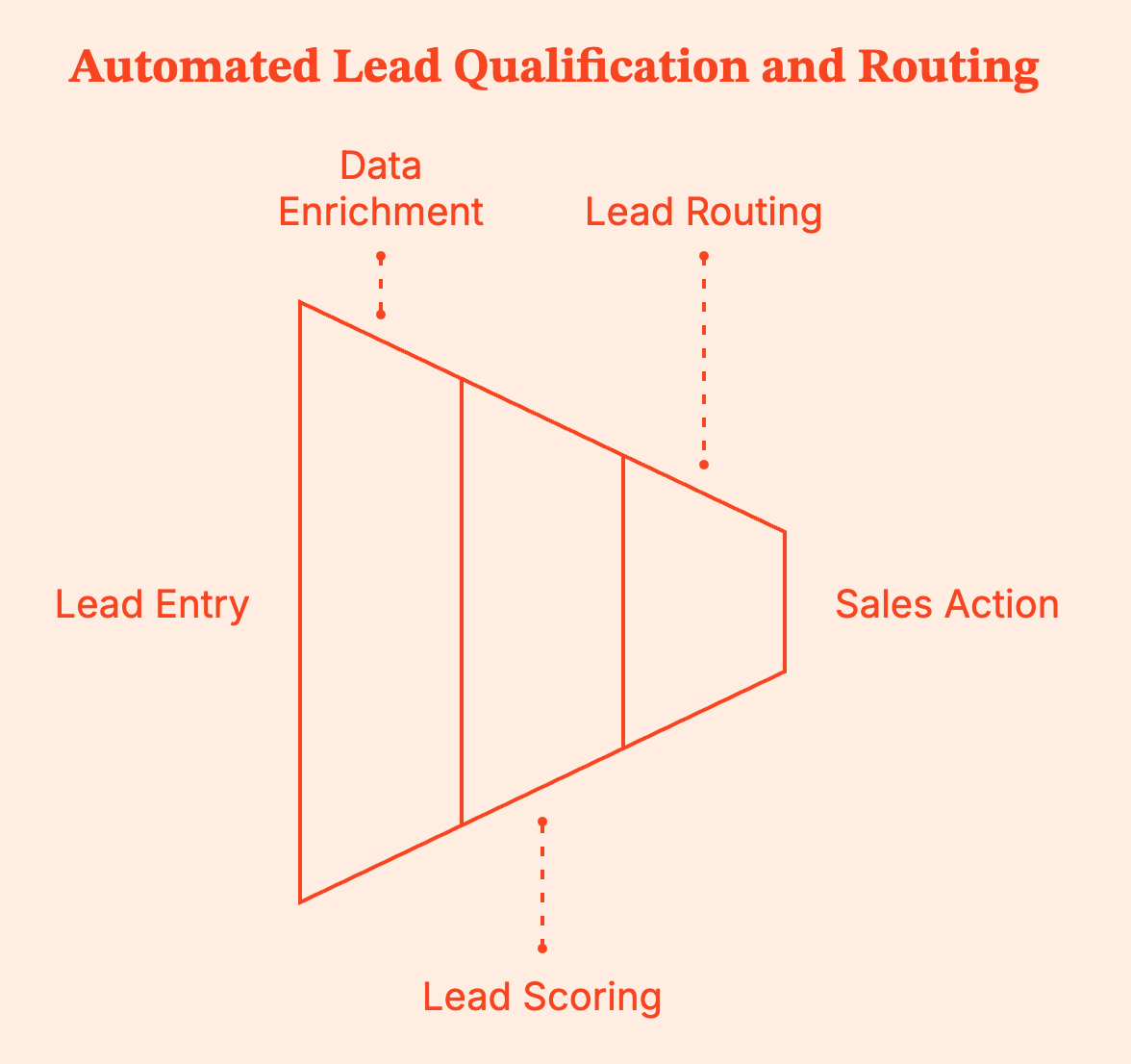
- An incoming lead enters through form submission, third-party import, or website visitor identification.
- The system pulls enrichment data and contact data from connected providers (company size, funding status, tech stack, employee count).
- Scoring formulas are applied to the enriched record and produce a numerical score.
- Routing rules direct the lead based on that score.
But you absolutely need to respond to your leads within the first 5 minutes to get the most out of your lead generation efforts. Automation makes this sub-five-minute response the default rather than the outlier, effectively bridging the gap between sales and marketing.
GTM engineers also build feedback loops into scoring systems. When sales mark a lead ‘closed-won’ or ‘disqualified,’ that outcome feeds back into the model, refining future predictions.
Why Clay Works Well for Lead Scoring in B2B Marketing
Clay consolidates data enrichment, scoring, and routing into one platform. Instead of connecting separate sales automation tools for firmographic data, email verification, intent signals, and CRM updates, GTM teams build complete workflows in a single interface.
The platform aggregates 100+ data providers into a waterfall enrichment model. When one source fails to return a phone number or email in your contact database, Clay automatically queries the next provider. This approach doubles or triples match rates compared to single-provider setups.
Clay raised $40M in Series B at a $1.25B valuation following 6x growth in 2024. The adoption came from teams consolidating fragmented enrichment stacks into one fully automated system.
- Lead Scoring: Clay uses formula columns to build point-based models, assigning scores based on enriched data and custom signals like Employee count, Funding stage, Technology stack, and Job title seniority.
- Advanced Scoring: Behavioral data from connected intent providers can be layered onto the point-based models to identify the hottest prospects.
- Routing Logic: The platform supports conditional logic for multi-path routing.
- High-Scoring Enterprise Leads are instantly routed to a named Account Executive (AE) with a Slack notification.
- Smaller Companies with similar engagement enter an automated email sequence.
- Instant Updates: Routing and actions happen instantly when lead records are updated.
CRM integrations push enriched, scored leads into Salesforce, HubSpot, and other systems. Bi-directional syncs update Clay tables when CRM fields change, creating closed-loop feedback on model accuracy.
{{INLINE_TOFU}}
Building Lead Scoring Models in Clay: A Step-by-Step Guide
Before opening Clay, define your scoring criteria. What are the explicit attributes correlating with closed deals: company size ranges, industries, job functions, and technologies used?
Then identify behavioral signals indicating product interest: specific page visits, content consumption patterns, and email engagement.
Step 1: Capture and Normalize Lead Data
With Clay, you can either import existing data via CSV uploads, CRM syncs, webhook inputs, or direct integrations with form providers. You can even import data from Google Sheets or use web scraping to find new prospects.
Or if you don't have data, you can also find people, companies, and jobs, and even local businesses, directly from within Clay.
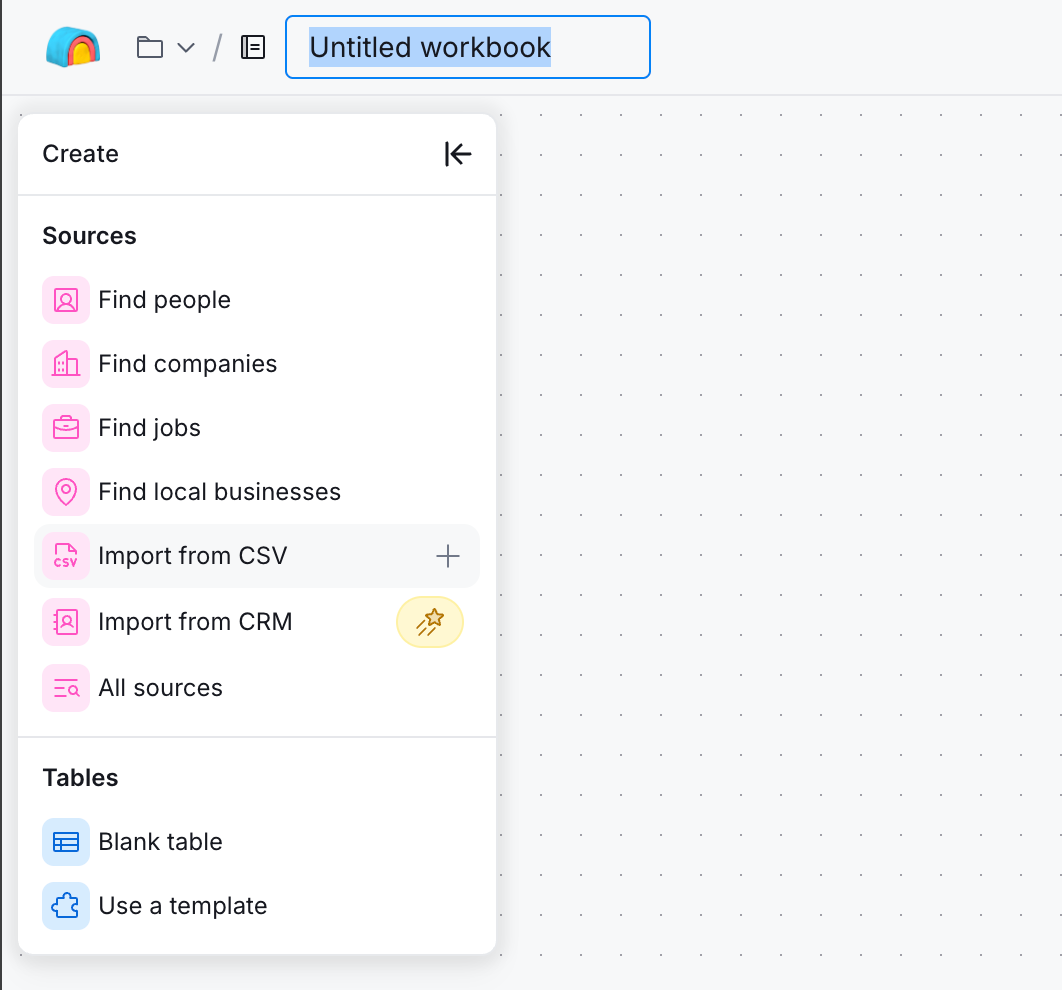
Once you have the data, you can use Clay’s built-in AI to enrich and standardize it for later use in the sales process.
Step 2: Configure Enrichment
Import the data that you have collected into an existing or a new table, and the actions column should show you enrichment workflows.
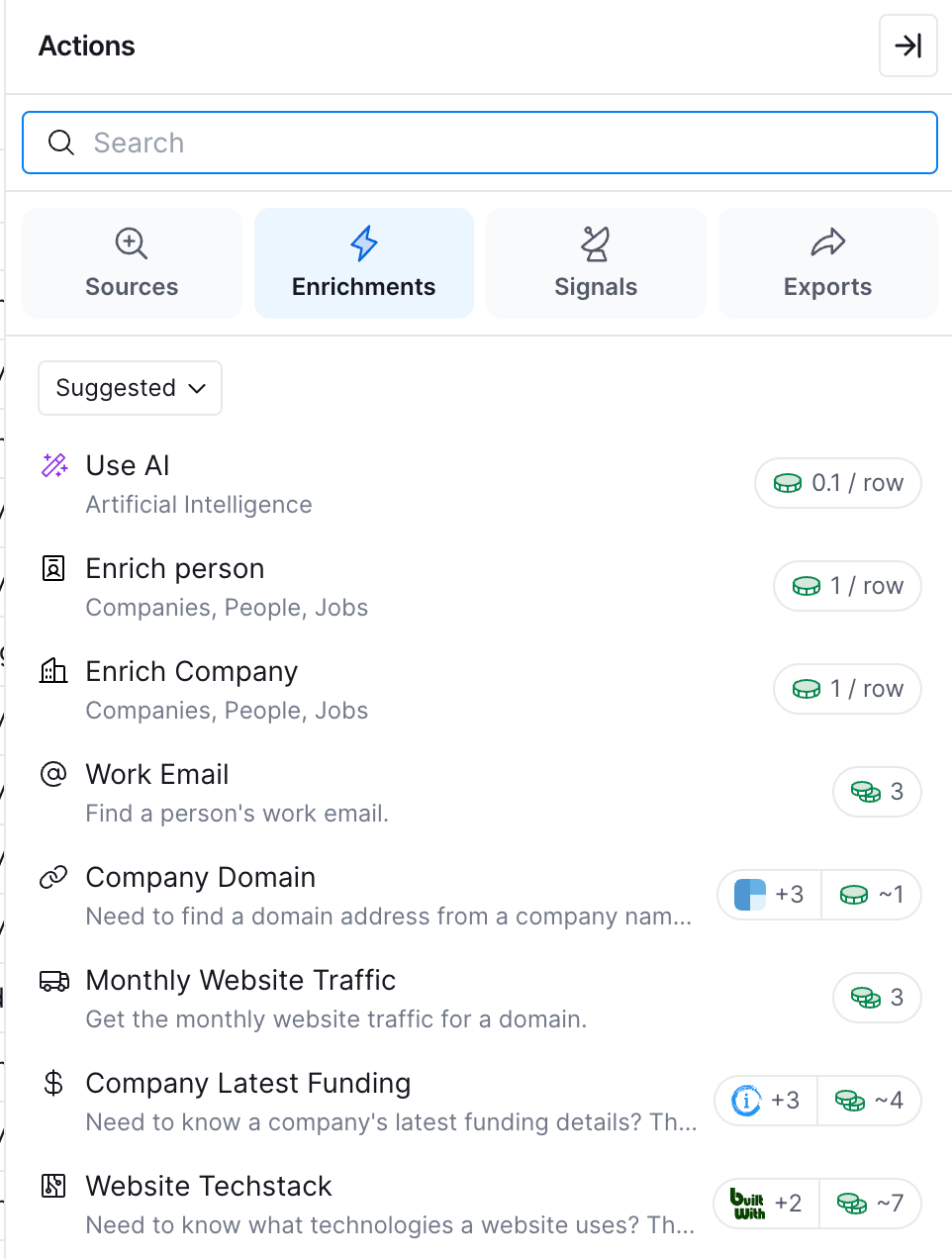
You can pick enrichments like employee count, annual revenue, funding status, and technology stack to form a solid firmographic foundation for your qualified leads.
Step 3: Build Scoring Formulas
Now, on to the actual lead scoring. Create a formula column that assigns points based on the following criteria.
Here’s sample logic for a B2B SaaS targeting mid-market companies:
| Attribute | Criteria | Points |
|---|---|---|
| Company Size | 100–500 employees | 20 |
| Company Size | 501–2000 employees | 15 |
| Funding Stage | Series B or later | 10 |
| Tech Stack | Uses a competing tool | 15 |
| Job Title | Director or above | 10 |
| Behavior | Visited pricing page | 10 |
| Behavior | Downloaded case study | 5 |
Sum these columns into a total score field. Define threshold bands: 60+ points routes to sales, 30–59 enters nurture sequences, and below 30 stays in top-of-funnel awareness.
Once you have the scores populated, it's time to move to routing.
Step 4: Configure Routing Actions
Clay has multiple ways for you to route based on your data from your table to your email tool, CRM, or even a webhook. Use a routing system to ensure leads get to the right rep.
For instance, a lead hitting 60 points should immediately:
- Create or update a CRM record with all enriched data
- Send a Slack notification to the assigned rep
- Log the scoring rationale for the sales context
Lower-scoring leads trigger different actions: add to email sequence, update marketing automation tags, or hold for future re-scoring. You can even distribute leads evenly using a round robin logic for your sales team.
Best Practices for Automating Lead Routing and Scoring
- Run continuous data quality checks. Enrichment providers return stale or incorrect data more often than vendors acknowledge. Build verification steps that flag records with mismatched signals—For example, a 5-person company claiming $500M revenue. The Salesforce State of Sales report found that only 35% of sales professionals completely trust the accuracy of their organization's data. Better data hygiene directly improves scoring accuracy and sales efforts.
- Score fit and intent separately. A lead with strong firmographic fit but no behavioral engagement differs from one showing active research patterns across different buyer journeys. Two-axis scoring rates both dimensions independently. High-fit plus high-intent gets priority. High-fit with low-intent gets targeted nurturing.
- Match follow-ups to behavior. Someone who visits your competitor comparison page needs different information than someone browsing case studies. Build a routing system connecting lead behavior to appropriate messaging sequences, whether it's for cold outreach or warm follow-ups. The HubSpot 2024 State of Sales report found that 59% of sales reps now say leads from their marketing efforts are high quality—a significant improvement from previous years. Better targeting and personalization drove that change.
- Close the feedback loop. Sales must report back on lead quality, and that data must inform scoring adjustments. If leads scoring 55–60 points consistently fail to convert while those at 70+ perform well, your threshold needs recalibration. Review scoring accuracy quarterly to overcome common challenges in alignment.
From Website Visitor to Warm Outbound Play: Workflow Examples
Only 1-5% of B2B website traffic converts through forms. The remaining 95% leaves without identifying themselves.
If you want to make the best of this anonymous traffic, using the right tools like a website visitor identification tool can recover a portion of that invisible pipeline by matching anonymous IP addresses to company databases and, in some cases, to individual contacts.
Factors.ai uses a waterfall model combining data from 6sense, Clearbit, Demandbase, and Snitcher to identify up to 64% of anonymous visitors at the account level. For individual contacts, geo-location and job title triangulation can pinpoint roughly 30% of visitors. That coverage exceeds what any single-source competitor provides.

When Factors identifies a high-intent visitor, the data can be sent directly to Clay for enrichment and scoring via the Factors API.
Here are three workflows you can implement to see how this works.
1. Inbound Form → Enrichment → Score → Route
A prospect submits a demo request. The form data triggers a webhook to Clay, which enriches the record with employee count, funding stage, tech stack, and verified contact details.
Scoring formulas run automatically. Leads crossing the threshold route to an AE's calendar for immediate booking, allowing reps to focus on closing. Below-threshold leads enter a nurture sequence matched to their industry and company size.
2. High-Intent Page Visit → Personalized Outreach
Factors detect a target account visiting the pricing page multiple times in one week. That behavioral signal, combined with firmographic fit, triggers a webhook to Clay.
Clay uses the company domain and its waterfall enrichment to identify decision-makers: the VP of Engineering, the Head of Product, and the relevant director. Each contact gets enriched with a LinkedIn profile, direct email, and recent company news. The contacts score above the threshold and trigger personalized outreach referencing the pricing page activity.
The sequence works because Factors captures the intent signal (company X is actively researching) and Clay identifies who to contact at that company to generate more leads.
3. Buying Committee Signal → Real-Time BDR Alert
Factors tracks engagement patterns, indicating multiple stakeholders are involved. The same company visits the integrations page, the case studies section, and the security documentation within a short window. That pattern suggests a buying committee is forming.
Then, Factors pushes the account via webhook to Clay, and Clay enriches the company record, identifies contacts matching your buyer personas (engineering leadership, procurement, security), and pulls contact details for each. A Slack alert notifies the assigned BDR with full context: company name, pages visited, engagement frequency, and the list of relevant contacts to pursue from your ad platforms or organic traffic.
These workflows depend on two tools doing what they do best: Factors capturing account-level intent signals, and Clay enriching and identifying the right people to contact.
Measuring Success: KPIs and Optimization Strategies
Track these metrics to gauge scoring effectiveness:
- Lead-to-SQL Conversion Rate: Measure the conversion rate before and after the scoring implementation to quantify impact. Track conversion rates by score bracket to validate the model.
- Pipeline Velocity: Track average time from lead capture to first sales conversation. Automated scoring and routing should compress this window. Target benchmark based on the HBR research: first contact within one hour for high-scoring inbound leads.
- Score Accuracy: Compare conversion rates between high-scoring and low-scoring leads. The gap should be substantial. If leads scoring 40 points convert at the same rate as those scoring 80, the model needs recalibration.
- Manual Hours Saved: Calculate rep time previously spent on lead research and qualification. The Salesforce State of Sales found that reps spend 70% of their week on non-selling tasks. Effective scoring automation returns a portion of those hours to actual selling.
- Score Distribution Trends: Monitor how your lead population scores over time. Sudden shifts indicate market changes, data quality issues, or lead-source problems that warrant investigation.
Bringing It Together
As much as we’d like it, we can't just set lead scoring up and walk away. The market changes, and so should your scoring. This is the ultimate guide to staying agile.
Every quarter, sit down with your sales lead. Ask them, ‘Who are the best deals we closed this month?’ Then look at the data. If you closed three deals with hospitals but your model assigns them zero points, the calibration is wrong. Update the formula for the scores.
The goal here is response speed: Automation buys you speed, and speed gets you deals.
So start small. Identify five attributes of a good customer and build that table in Clay. Add website visitor enrichment with Factors, and you have a working lead gen engine.
FAQs for Lead Scoring and Enrichment in GTM Engineering with Clay
Q: What is a lead scoring model, and how does it work?
A: Think of lead scoring as a ranking system for your potential customers. It assigns a numerical point value to every lead to tell you who is ready to buy and who is just browsing. It works by combining two types of data:
- Fit (Who they are): Do they match your ideal customer profile? (e.g., right industry, company size, job title). 2. Behavior (What they did): Did they visit your pricing page, download a case study, or open your emails?
You set up the rules like "+10 points for a CEO" or "+20 points for requesting a demo." When a lead crosses a certain score threshold (say, 60 points), they get flagged as "Sales Ready," so your team knows who to call first.
Q: Can Clay automate both enrichment and routing?
A: Yes, that is exactly what it's built for. Clay handles the entire pipeline in one place. First, it enriches the data by sourcing information from over 100 providers (e.g., a lead's phone number or a company's revenue). Then, it runs your scoring logic against that new data. Finally, it handles the routing: automatically sending high-scoring leads to your CRM (like Salesforce), messaging a rep on Slack, or dropping lower-scoring leads into an email nurture sequence.
Q: How does automated lead scoring improve GTM velocity?
A: It removes the "research tax" that slows sales reps down. Without automation, reps waste hours manually searching for companies and checking LinkedIn to determine whether a lead is good. With automated scoring, that data is instantly available. Companies that respond to a lead within one hour are seven times more likely to qualify them than those who wait. Automation ensures you hit that one-hour window every single time, turning interest into conversations instantly.
Q: What’s the difference between rule-based and AI scoring?
A: Rule-based scoring is manual. You sit down and decide, "I think a VP title is worth 10 points." It’s great for control but relies on your best guess. AI (predictive lead scoring) uses machine learning. It looks at your history of closed deals and finds patterns you might miss. It might notice, for example, that leads who use a specific obscure technology convert 3x faster, and it automatically assigns them a higher score.
Q: How often should lead scoring rules be reviewed?
A: You should do a deep dive quarterly. Markets shift, and buyer behavior changes. So if you notice your sales team is rejecting a lot of "high-scoring" leads, your model is broken. If the sales team tells you leads scoring 50 points are closing better than leads scoring 80, you need to adjust your weightings immediately.

Unlocking the Secrets of Lead Scoring Models
Learn About lead scoring models And Their Types. Discover best practices for effective lead scoring models on Factors.ai's blog.

What do you do when you’re stuck nurturing countless leads that drive few conversions? Lead scoring has emerged as an effective solution forthis customer conversion challenge. Studies show that B2B organizations that utilize lead scoring realize a 77% increase in lead generation ROI compared to those that don't. If this piques your interest, know that scoring your leads and determining a lead scoring model is not a cut and dry process. The following post explains what lead scoring is and explores some commonly used lead scoring models.
What Is lead scoring?
Lead scoring is the procedure of quantifying the conduciveness of a lead generated by a business. To put it simply, it is used to determine if a lead is more likely to convert or not by assigning scores to the leads. By doing so, you ensure that both your marketing and sales teams are seeding the right prospects, all while getting to understand who your ideal lead is in the process.
So far, it seems simple right? Well, scoring leads is not all black and white. Figuring out your buyer persona is a multifaceted challenge. It not only requires a boatload of data but constant revisions and maintenance over time as well.
To help with that, here is how you build your lead scoring model:
Determining lead scores
First, we need to figure out the criteria for scoring, and how many points to reward or deduct for each criterion. Here are a couple of steps to establish that:
1) Picking your KPIs and Traits: The first step in lead scoring is selecting what you need to be judging. This involves the KPIs (key performance indicators) and common traits of leads that convert. An example of this would be that an important KPI is the number of views on the review page for a product. And a common trait could be a particular company size.
2) Assigning the Value: It is important to understand which traits are more significant than others — like the lead’s company size over the industry. This way you can reward certain traits higher than others. You should even determine the points to be rewarded per trait — which company size converts the most and which ones convert the least, etc. You can do this by calculating the conversion rates of the leads with different levels of the same trait and comparing them to the average. The same can be done for KPIs as well.
With all these in place, you can now determine the score for each lead attribute. Remember that you must never only rely on one attribute to score your leads. The more the merrier, as the following lead scoring models deal with a wide variety of data.
{{INLINE_TOFU}}
Lead scoring models
A lead scoring model is nothing but the basis of evaluation for your scoring or the system on which it is predicated. With that said here are some common lead scoring models:
1) Implicit Scoring (Activity/Engagement): Implicit scoring is used to grade leads based on their level of activity and engagement with the business, its brand and its content. It utilizes a lot of tracking data across several platforms and compared to explicit scoring it is a continual process. Here are some examples of implicit scoring:
- Number of webpage visits or leads that visited the pricing page.
- Content engagement, including views, downloads, etc.
- Email engagement, email click-through rate and bounce rate.
- Social media interactions, involving likes, comments, followers, etc.
- Leads that requested for product demos and free trials.
- Leads that attended webinars.
- Form submissions, and more
2) Explicit Scoring (Suitability): Explicit scoring is used to evaluate a lead based on their business-related profile like the lead’s company size and job title. This information is used to determine the suitability of your lead’s business profile to that of a lead that converts. Explicit scoring is more commonly used in B2B interactions, given the importance of assessing the companies they deal with. Here are some examples of explicit scoring:
- Company size, which can allude to how many decision-makers are involved in the buying decision.
- Job titles that are awarded different points depending on the level of influence.
- The company’s revenue could help identify companies that are more in line with your average contract value.
- The lead’s company industry.
- The location and other demographics of the lead.
3) Matrix (Combination of Implicit and Explicit Scoring): This model is called a matrix model because it uses an incidence matrix combination of implicit and explicit scoring. This means that we evaluate a lead based on combinations of implicit and explicit traits at varying degrees. For example: A lead that is considered highly suitable based on explicit business profile traits like company size and industry can be scored poorly due to its low activity and engagement levels. The same could be said about a lead with high activity but low suitability.
The importance of both these dimensions varies based on your ideal client profile (ICP). The use of this matrix model, including models with other dimensions, are quite common in lead scoring solutions used today. Like Silverpop’s scoring system.
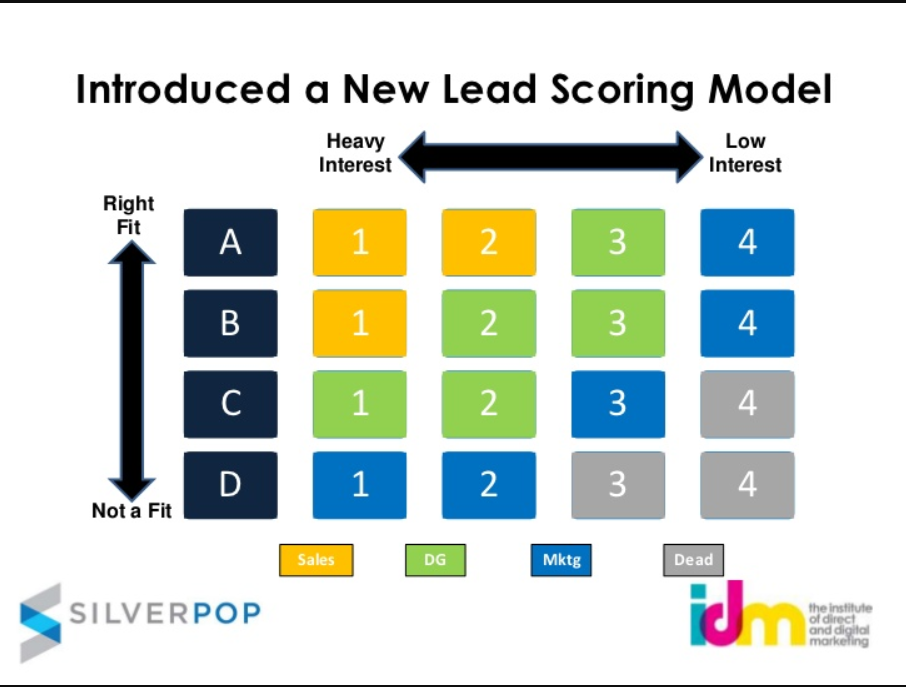
4) Negative Scoring: A negative scoring model implements a deduction of points to your lead scores based on unfavorable interactions and intentions. Negative scoring involves a multitude of aspects. From the low levels of activity or interest found in leads, to prospects consuming your content for all the wrong reasons. The biggest advantage of implementing this model is that it avoids inflating a lead’s score. And allows your sales team to focus more on better leads. Here are some examples of negative scoring:
- Inactive or stagnant leads that have not interacted with the business in a while.
- Leads that unsubscribe to your company newsletter.
- Rival companies researching your company.
- Visitors that consume your content with no interest in the product, but for other reasons (academic/employment)
Regardless of which model you pick, you’re more likely to adopt a combination of these models so long as it meets your scoring requirements. And as long as you fine-tune your method in conjunction with newer customer data, you can ensure that your lead scores will always stay credible.
Lead scoring streamlines sales by identifying high-value prospects.
1. How It Works: Assign scores based on engagement levels and demographic fit.
2. Sales Enablement: Helps teams focus on leads most likely to convert.
3. Strategic Benefits: Boost efficiency, shorten sales cycles, and increase conversion rates.
Effective lead scoring aligns marketing and sales, maximizing impact across the funnel.
Lead Forensics Pricing, Reviews & Overview
Everything you need to know about Lead Forensics Pricing. See how much Lead Forensics will Cost, Features, Reviews and More.
Looking to learn more about Lead Forensics pricing, features, and more? The following article provides a comprehensive overview of everything you need to know about Lead Forensics pricing.
Lead Forensics is a popular B2B website visitor identification tool that reveals anonymous companies visiting a website and surfaces relevant contact details (Email, Phone numbers, etc) within those companies for outreach and targeting. Lead Forensics is used primarily by B2B marketers, sales folk, and agencies to leverage existing website traffic to drive sales revenue and marketing ROI.
Lead Forensics Pricing & Plans
Lead Forensics offers two plans: Essential and Automate. Essential is designed for small to medium sized businesses to identify anonymous businesses viewing your website, unlock relevant contact data (phone numbers, mail ID, etc) and manage existing leads. Automate offers all this, plus additional features such as custom workflows, sequence actions (or as they call it, The Orchestrator), advanced CRM integrations and Fuzzy matching algorithm to maintain data hygiene.

Here’s a detailed feature overview of how the two plans compare to each other:
| Feature | Essential | Automate |
|---|---|---|
| List of business visitors | Yes | Yes |
| Contact data | Yes | Yes |
| Categorization | Yes | Yes |
| Real-time notifications | Yes | Yes |
| Trigger reports | Yes | Yes |
| Conversion tracking | Yes | Yes |
| Customizable dashboard | Yes | Yes |
| Data export | Yes | Yes |
| Named Customer Success Manager | Yes | Yes |
| Import and manage data files | Yes | Yes |
| Lead manager | Yes | Yes |
| Lead scoring | Yes | Yes |
| Integrate with CRM | Yes | Yes |
| Advanced integration with CRM | No | Yes |
| Automate CRM reports | No | Yes |
| Prospect pipeline reports | No | Yes |
| Key account behavior tracking | No | Yes |
Note that:
- Lead Forensics offers a 7-days free trial
- Lead Forensics does not offer a free plan
Unfortunately Lead Forensics does not openly reveal its pricing details. You’ll have to reach out to their sales team for an accurate quote based on your requirements and scale. That being said, we’ve dug deep to find what we can about Lead Forensics’ pricing:
Anecdotal evidence suggests that Lead Forensics pricing runs between around $250 to several thousand per month, depending on the volume of website traffic. Multiple reviews also highlight that obtaining contact data (phone numbers, email addresses, etc) cost an additional fee on top of the monthly platform subscription fee


To be fair, the few reviews that do provide hints into Lead Forensics pricing are…well, unhappy customers. Ignoring their not-so-great opinions of the product, we can see that Lead Forensics charges these users approximately £209 + vat per month (or $260/mo) and $500 per month respectively.


“To ensure a right sized solution for each of our clients, our pricing model is based upon relevant B2B traffic to a website or specified web pages. We offer a free trial period to ascertain the traffic volumes over a one week period. After which time, we will produce a bespoke proposal tailored to your business and your visitor traffic levels. We are committed to producing the right package and proposal for your business, which is why we don't have an off the shelf pricing model.” - Lead Forensics
Lead Forensics Reviews
Lead Forensics claims to maintain one of the world’s largest B2B IP-databases. But how do Lead Forensics customers find the platform to be on a day-to-day basis? Here’s what reviews have to say about user experience with Lead Forensics:
In Summary
Lead Forensics Benefits:
- Intuitive onboarding
- Customer support
Lead Forensics Drawbacks:
- Data inaccuracy
- Cost
Lead Forensics Rating:


Lead Forensics Alternatives
There are several account identification and intelligence solutions out there. Here are a few common Lead Forensics alternatives to consider:
- Factors.ai - for data-accuracy and advanced analytics, scoring, and attribution
- Leadfeeder (Now Dealfront) - for EU-centric account intelligence
- Clearbit - for accounts and contact level intelligence

Factors is a leading account intelligence solution that helps B2B teams identify, qualify, and convert anonymous website traffic. Factors works with industry-standard data partners to provide accurate, cost-effective account intelligence. Why Factors over Lead Forensics?
- Better data: Factors identifies up to 64% of anonymous traffic — that’s 27% more accounts than the closest alternatives.
- Better intent signals: Factors stands out from alternatives in that it captures intent signals (ad views, impressions, page views) from LinkedIn and G2 in addition to website activity for holistic account engagement tracking.
- Better deals: While Lead Forensics doesn't openly reveal prices, internal demos reveal that Factors provides far more cost-effective plans. Learn more here: factors.ai/pricing
- Better analytics: Factors is built upon strong analytics and attribution foundations. As a result, it provides granular website tracking, path analysis, timelines, and more.
{{INLINE_BOFU}}
Lead Forensics Pricing Plans
Lead Forensics offers flexible plans tailored to different business sizes and needs.
1. Pricing Tiers:
- Essential: For SMBs, includes visitor identification, contact details, and lead management.
- Automate: For enterprises, adds CRM integration, customizable workflows, and AI-driven sequencing.
2. Key Features:
Anonymous visitor tracking, advanced lead insights, and automated engagement workflows.
3. Pricing Estimates:
Ranges from $200 to $2,000+ per month based on traffic and feature requirements.
For accurate pricing, businesses should contact Lead Forensics directly to receive a customized quote.
FAQ
1. What does Lead Forensics do?
Lead Forensics tracks business IPs to identify anonymous website traffic at an account-level. Once a visiting company has been identified, Lead Forensics also shares relevant contact information such as mail IDs and phone numbers to streamline outreach and targeting.
2. What is the lead forensic code?
The Lead Forensics code is a tiny piece of code placed on a business website. It’s this code that enables users to identify websites visitors’ business IP addresses. This IP is then matched with an IP database to reveal business names and properties.
%2520(1).avif)
Top 13 Koala Alternatives In 2026
Koala shut down after the Cursor acquisition. Here are the 13 best B2B intent data alternatives for 2026 — with features, pricing, and migration tips.
TL;DR
- Factors.ai — Best for unified GTM execution with AI Agents, multi-source intent, and account scoring. One platform for alerts, workflows, and ad activation.
- Common Room — Best for community-led signals and Koala migration (matching Koala's pricing tiers).
- 6sense — Best for enterprise ABM with predictive intelligence and account-level intent.
- ZoomInfo — Best for large contact databases combined with intent data.
- Warmly — Best for real-time visitor engagement with AI SDRs and chat.
- Clay — Best for flexible prospecting workflows with 130+ data sources.
Update: Koala's been acquired!
In a recent development announced on July 18, 2025, Koala was acquired by Cursor (parent company Anysphere). The platform will officially shut down by September 2025, despite having raised a $15 million Series A funding earlier this year.
Koala's founding team is now working closely with Common Room to help customers transition, with Common Room even matching Koala's existing pricing tiers for equivalent feature packages.
If you've come across this article, chances are you're exploring intent data platforms that can help you generate pipeline and strengthen your GTM motion. You're in the right place as we've rounded up the best alternatives you can consider this year.
| Feature Category | Factors.ai | Others (at a glance) |
|---|---|---|
| AI Agents & Actionable Insights | ✅ Real-time alerts, enrich leads, trigger campaigns automatically | Most tools only provide alerts or data enrichment; limited execution |
| Custom GTM Workflows / Milestones | ✅ Dedicated support builds workflows, funnel stage analytics, prioritize plays, tailor messaging, validate experiments | Rarely available; other platforms mostly pre-built automation |
| Account & Contact Scoring | ✅ Prioritize by ICP fit, funnel stage, and intent intensity | Mostly missing or limited scoring |
| Multi-Source Intent Data | ✅ Website, CRM, ads, LinkedIn, communities, product usage | Often single-source or anonymous signals only |
| Customer Journey & Timelines | ✅ Chronological view across all touchpoints, full visibility of funnel progression | Partial or limited insights in other tools |
| Person-Level Identification | ✅ Pinpoint likely visitors (~30% coverage) using geo, job title, company, persona | Mostly anonymous or partial enrichment |
| Dynamic Ad Activation & Google Integration | ✅ Sync audiences to LinkedIn/Google Ads, Google CAPI, ICP-targeted campaigns | Rarely available in other tools |
| Multi-Threading & Buying Group Identification | ✅ Identify and engage multiple decision-makers | Rarely available |
| AI-Driven Contact Insights | ✅ Surface right contacts, generate personalized outreach insights | Most tools only enrich data, no actionable recommendations |
| Slack / MS Teams Alerts | ✅ Instant notifications for high-intent actions like demo visits or pricing page revisits | Limited or unavailable |
| Ease of Use / Unified Platform | ✅ Single dashboard; all GTM execution, analytics, and alerts in one place | Others often require multiple tools or steep learning curves |
Koala (getkoala.com) was acquired by Cursor in July 2025 and shut down by September 2025. All former Koala users need a replacement for B2B intent data and visitor identification. Note: This article is about getkoala.com, the B2B intent data platform — not Koala AI (koala.sh), which is a separate AI writing tool.
5 Factors to consider when looking for a Koala alternative
- Robust integration options: Since Koala only offers integrations to Hubspot, Salesforce, and Apollo, you must look for a tool that seamlessly integrates with your existing tech stack.
- Custom workflow automations: Find a tool that allows you to build custom workflows that automate your sales and marketing processes across your CRMs to save time.
- AI-powered insights: Don't just consolidate data and reports; understand the 'why' behind your numbers and learn how you can improve with AI-powered insights.
- AI Agents: Look for AI agents that can take action on these insights, automatically triggering alerts, enriching leads, or launching campaigns, so your team can focus on strategy, not manual busywork.
- Extract intent data from multiple platforms: Your prospects conduct research beyond your website before they make a purchase. Invest in a solution that gives you intent signals from relevant sources such as LinkedIn, review sites, communities, and the like.
{{INLINE_BOFU}}
Top Koala Alternatives
1. Factors.ai

Factors.ai is designed to help B2B teams grow a quality pipeline with AI Agents, from identifying high-intent accounts to mapping the customer journey, automating GTM campaigns, and measuring what works. Everything happens in one unified platform, making it easier for sales and marketing teams to act on intent signals in real time.
Core Offerings
- GTM Engineering
- Dedicated support team builds custom workflows.
- AI Agents alert reps in real time, pull account research, identify and multi-thread buying groups, revive closed-lost deals, and track post-meeting engagement.
- Milestones: Funnel stage analytics show which actions and content drive stage progression. Helps prioritize plays, tailor messaging, diagnose drop-offs, and validate GTM experiments.
- Account 360: Unified view of all sales and marketing touchpoints. Aligns GTM teams and ensures no high-intent account slips through the cracks.
- AI Alerts: Real-time alerts for optimal outreach. Includes closed-lost reactivation, form-fill drop-offs, and post-demo browsing history.
- Google CAPI: Sends richer conversion signals to Google Ads, optimizing for high-value accounts rather than low-quality leads.
- Google Audience Sync: Retarget ICP-fit accounts, suppress low-value clicks, expand keywords safely, run buyer-stage campaigns, and refresh audiences daily.
- Account & Contact Scoring: Prioritize accounts by ICP fit, funnel stage, and intent intensity.
- Customer Journey Timelines: A Chronological view of buyer actions across the website, ads, product, and CRM.
- AI-Driven Contact Insights: Surface the right contacts, generate personalized outreach insights, and monitor deal progress.
- Dynamic Ad Activation: Sync audiences to LinkedIn and Google Ads for efficient targeting, in-funnel retargeting, and ABM campaigns.
- Slack/MS Teams Alerts: Instant notifications for high-intent actions like demo visits, pricing page revisits, or document views.
- Multi-threading & Buying Group Identification: Engage multiple decision-makers to reduce deal risk.
- Person-Level Identification: Pinpoint likely visitors without invasive tracking using geo, company, job title, and buyer persona filters (~30% coverage).
Limitations
- Factors doesn't offer information at a user level due to privacy and compliance regulations.

Pricing

2. Common Room

Common Room is a natural fit as Koala's team has partnered with the company to support users during the transition. It pulls in intent signals from social platforms, communities, CRMs, and more. Best of all, it's honoring Koala's pricing tiers to make the switch smooth and budget-friendly.
Core Offerings
- RoomieAI™ Capture: Always-on AI agent that tracks 50+ signal sources, like product usage, website visits, and social activity, to surface warm prospects in real time.
- Person360™ Enrichment: Industry-leading AI-powered waterfall enrichment and identity resolution that turns anonymous signals into fully identified accounts and unifies the buyer journey.
- RoomieAI™ Activate: Automates outbound campaigns and personalizes messages based on context from buying signals, turning every rep into a top performer.
- Multi-Source Signal Integration: Pulls intent signals from social platforms, communities, CRMs, hiring trends, and dark funnel activity to ensure you never prospect cold.
Limitations:
- Navigation isn't intuitive. Many users find the interface steep and challenging to use without dedicated onboarding or support

- Lacks built-in A/B testing and advanced analytics as users have flagged limited in-platform customization, especially around workflow edits and analytics depth

Pricing

3. Clearbit
Clearbit, now a part of HubSpot, is a data enrichment platform that helps businesses get clean, reliable, and standardized customer data. It gathers information from public sources, its own proprietary data, and AI models to build precise datasets that B2B teams can use to go-to-market more effectively.
Core Offerings
- Data Enrichment: Enriches records of leads, contacts, and accounts with accurate, global coverage.
- Lead Scoring and Routing: Helps teams score and route leads in real-time using granular industry info, corporate hierarchies, and role/seniority mapping.
- Intent Tracking: Identifies anonymous website visitors with IP intelligence and highlights companies that match your ICP.
- Dynamic Form Shortening: Reduces form fields by auto-populating details, so users only need to enter essentials like an email address.
Limitations
- The credit-based pricing model can be confusing, as costs vary depending on usage.
- Setup can be tricky, especially for features like form shortening that often need developer support.
- Since it is now part of HubSpot, standalone use is limited, which can be restrictive for teams not using HubSpot.
Pricing
Clearbit doesn't list its pricing publicly. For exact costs, businesses need to get in touch with their sales team.
4. Leadfeeder (now Dealfront)

Leadfeeder (now known as Dealfront) identifies anonymous companies that visit your website and turns them into leads for your sales team.
Core Offerings:
- Website Visitor Identification: Transforms anonymous visitors into company names, revealing who's exploring your site even without form fills
- Behavioral Tracking: Monitors pages visited, time spent, and browsing patterns to understand visitor intent.
- Smart Filters & Custom Feeds: Allows segmentation of visits by criteria like geography, industry, campaign, or engagement, with customisable feeds.
- Real-Time Alerts & Notifications: Sends instant alerts (via email or Slack) for new or returning visits, helping reps act quickly.
- CRM & Analytics Integration: Syncs visitor data with CRMs (e.g., Salesforce, Pipedrive) and tools like Google Analytics and Looker Studio for seamless follow-up and reporting.
- Lead Scoring & Prioritization: Automatically ranks leads based on engagement and firmographic data to surface high-intent companies.
Limitations
- No mobile app, and no real-time tracking for free users (updates hourly/below). Dealfront Help Center
- Customer support is often slow or unresponsive, multiple users report delays and poor resolution when seeking help

Pricing

Also read: 5 Leadfeeder Alternatives For Visitor Identification
5. Lead411

Lead411 is a B2B data provider that delivers insights into potential buyers by leveraging verified contact information and buyer intent data from Bombora. It's designed to help businesses identify and connect with prospects who are actively showing interest in their products or services.
Core Offerings
- Intent topics: You can classify and set between 5-25 intent topics.
- Lead prospecting: Lead411 has an in-built prospecting tool to streamline the outbound process.
- CRM Enhancer: Automatically update your CRM with the latest data.
Limitations
- Users have found that even verified contacts may not be accurate at times

- The data can be difficult to manage because the platform doesn't have the capabilities to sort it out into multiple manageable lists.

Pricing

6. Snitcher
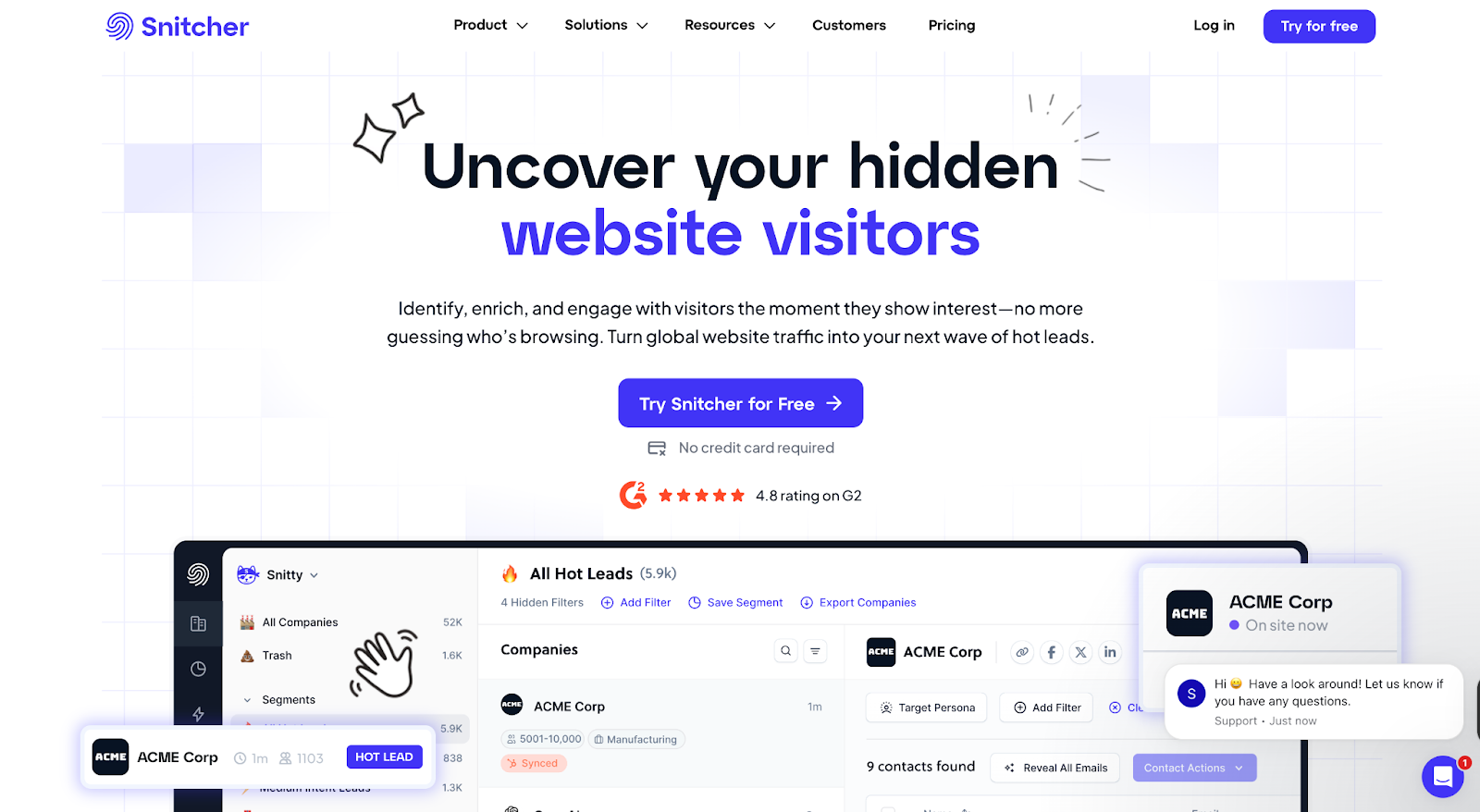
Snitcher unmasks anonymous companies visiting your website. The platform helps you understand their interests and convert them into qualified leads by tracking visitor behavior and enriching leads with details.
Core offering:
- Website deanonymization: Sintcher's "identify" turns your anonymous website traffic into actionable leads and information in real-time.
- Google Analytics enrichment: Snitcher adds context to Google Analytics data by enriching the numbers with company identifications.
- Lead segmentation: You can segment your leads into audiences and run relevant marketing campaigns.
Limitations
- Users have reported that the filtering setup can be improved to navigate the platform easily.

- The pricing is higher than most account intelligence tools since they charge with usage-based pricing

Pricing

7. Warmly
Warmly is an AI-powered sales orchestration platform that identifies anonymous website visitors, captures buying intent, and engages them automatically.
Core offerings:
- AI SDRs & AEs that run personalized outreach across email, LinkedIn, and chat.
- Multi-threaded engagement to scale conversations without extra headcount.
- Website chatbots that proactively engage visitors using real-time company data.
- Tech stack orchestration with Salesforce, HubSpot, LinkedIn, Slack, and more.
Limitations
- If you're looking for a product with more marketing-related use cases, Warmly may not be the best option.
- The pricing is higher than most of the tools on this list. Users have stated that it's a huge jump from the free plan

Pricing
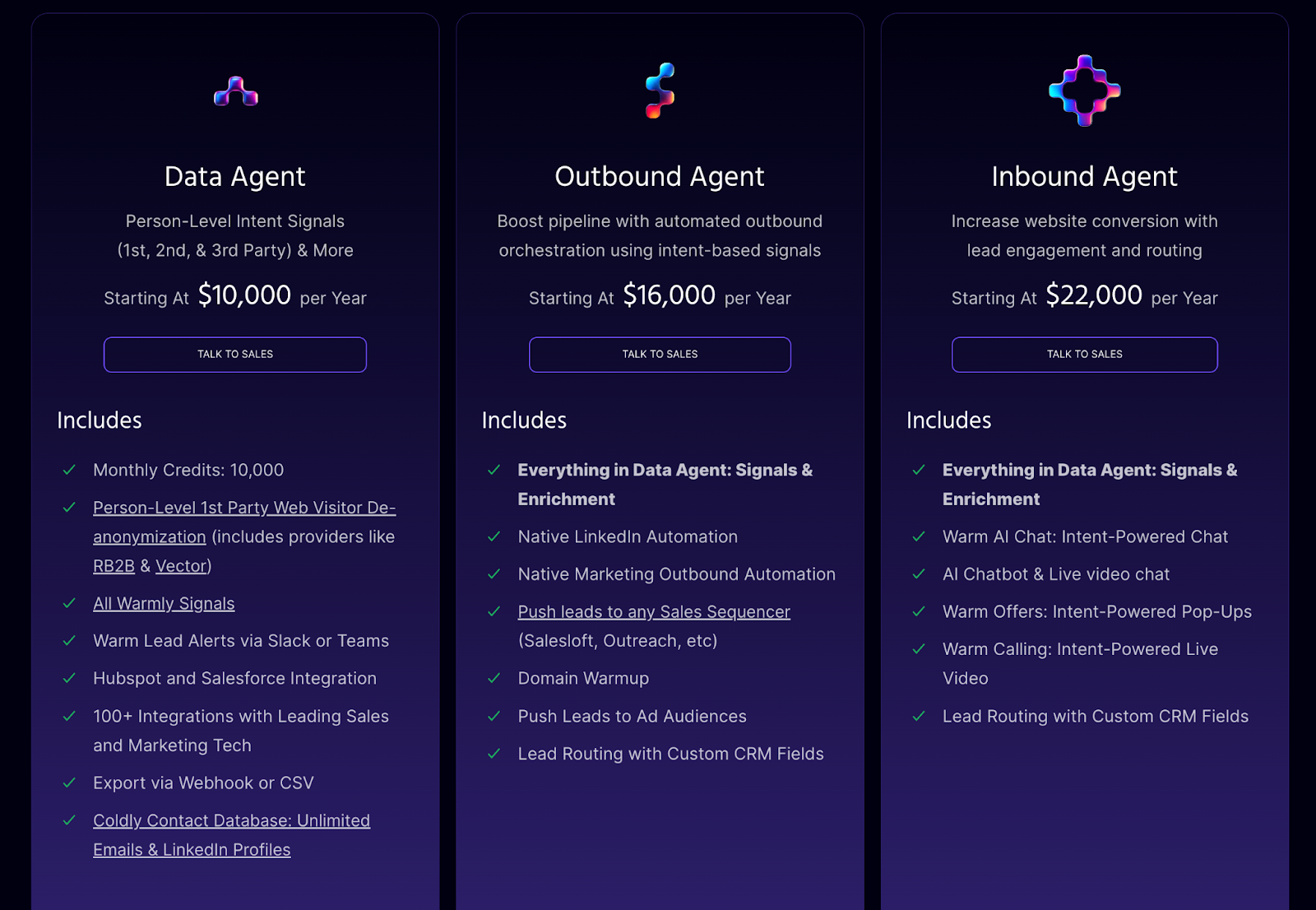
8. Zoominfo

ZoomInfo is a comprehensive B2B go-to-market platform that combines AI-driven automation with SalesOS, MarketingOS, and Copilot features to help sales and marketing teams identify high-intent prospects, enrich their CRM, and orchestrate multi-channel outreach. And for those needing a heavyweight, all-in-one GTM platform, ZoomInfo remains the most established player
Core Offerings:
- AI-Powered Account Intelligence: Use real-time insights to uncover key decision-makers, organizational changes, pain points, and usage trends, helping teams prioritize high-value accounts and expansion opportunities.
- CRM & Tech Stack Enrichment: Automatically enrich and cleanse contact and company records across your CRM and tech stack, keeping data accurate, compliant, and always sales-ready.
- Multi-Channel Outreach: Coordinate campaigns across email, LinkedIn, chat, and other channels, guided by AI-driven prioritization and buyer intent signals.
- Workflow Automation: Automate repetitive tasks, from lead routing to campaign execution, so reps can focus on building relationships and closing deals faster.
Limitations
- Multiple users on G2 have stated that the tool has a steep learning curve, which isn't ideal for agile marketing teams who want to use the platform for their day-to-day activities
- The contacts provided by the tool could be outdated, thus hampering your outreach efforts

Pricing
Since Zoominfo doesn't publicly display its pricing, you can learn about it here: ZoomInfo Pricing, Alternatives & Overview
9. 6sense
6sense is an enterprise-grade ABM platform that uses AI and predictive analytics to identify in-market accounts before they ever visit your website. It detects and analyzes 500B+ intent signals per month, making it one of the most data-rich intent platforms available.
Core Offerings
- Revenue AI: Predictive models that score and prioritize accounts based on buying stage and intent signals.
- Account Identification: Matches anonymous web traffic to accounts using a proprietary graph of company data.
- Intent Data: Tracks research activity across the web, not just your site, to surface accounts showing buying behavior.
- Orchestration: Automates multi-channel campaigns across ads, email, and sales outreach based on intent signals.
- Segments & Audiences: Build dynamic account lists for ABM campaigns based on intent, firmographics, and technographics.
Limitations
- Enterprise pricing makes it inaccessible for SMBs — typically $25K+/year.
- Steep learning curve and complex setup require dedicated RevOps resources.
- Some users report that the intent signals can be noisy at scale.
Pricing
6sense doesn't publicly list pricing. Plans are custom and typically start at $25K+/year. Contact their sales team for a quote.
10. Demandbase
Demandbase One is an account-based go-to-market platform that combines intent data, advertising, and sales intelligence into a single platform. It's built for mid-market and enterprise B2B teams running ABM programs.
Core Offerings
- Account Intelligence: Combines first-party and third-party intent data to identify accounts actively researching your category.
- ABX (Account-Based Experience): Orchestrates personalized experiences across ads, web, and sales touchpoints.
- B2B Advertising: Built-in DSP for targeting accounts with display and programmatic ads.
- Sales Intelligence: Provides account-level insights and alerts directly in CRM and sales tools.
Limitations
- Complex platform that requires significant onboarding and training.
- Pricing is enterprise-tier — not suitable for startups or SMBs.
- Some users report data accuracy issues with smaller or international accounts.
Pricing
Demandbase uses custom enterprise pricing. Contact their sales team for details.
11. Pocus

Pocus is an AI-powered revenue intelligence platform built for product-led growth (PLG) teams, combining product usage data, CRM insights, and buyer intent to surface high-value opportunities and automate workflow.
Core Offerings:
- Unified Account Intelligence: Aggregate internal and external signals, including product usage, emails, CRM notes, and structured/unstructured enablement content, to understand your accounts deeply and provide actionable insights.
- Timely Alerts & Smart Nudges: AI agents monitor accounts 24/7 to highlight relevant events like promotions, product launches, or strategic shifts, ensuring reps focus on the highest-intent opportunities without signal overload.
- Prescriptive Guidance & AI Recommendations: Suggests next-best actions, org charts, and engagement strategies while generating AI-powered drafts for LinkedIn, email, and cold call scripts, keeping reps focused on closing deals.
- Action Integration: Eliminates tab toggling and manual copy-pasting, allowing reps to act on insights with one click directly within Pocus.
- Customizable Playbooks: Tailor workflows to your GTM motion with PLG-specific playbooks, automating first-level reasoning, and scaling personalized engagement across accounts.
Limitations
- If your company doesn't lean into product-led growth, Pocus may not be the best fit.

- Many users point out problems like inaccurate data, mismatched details, and system bugs that make the platform harder to use

Pricing
As of now, Pocus does not publicly disclose its pricing information on its website. Check out their website for more.
12. Clay

Clay is an AI-powered workspace for prospecting that centralizes data, automates workflows, and helps GTM teams act on high-quality insights without bouncing between tools.
Core Offerings:
- Multi-Provider Data Enrichment: Access and combine data from 130+ sources, including contact information, firmographics, technographics, funding, and more, to ensure comprehensive lead coverage.
- AI Research Agents: Automate research at scale with agents that can flag fraudulent domains, summarize documents, score leads, and enrich SMBs, turning raw data into actionable insights.
- Intent Signal Tracking: Monitor customer events like job changes, promotions, funding announcements, and product news in real time, so you can time outreach perfectly and never prospect cold.
- Flexible, Automated Workflows: Build iterative GTM workflows with AI-powered conditional logic, routing, and multi-channel actions to push enriched data into any CRM, email sequencer, or other tool in your tech stack.
- CRM Enrichment & Maintenance: Keep your Salesforce or other systems up-to-date automatically, saving hours of manual work while improving outbound performance and campaign accuracy.
Limitations
- Clay uses credits for actions, which can get expensive as you scale.

- Steep learning curve for new users, many users find the platform complex and overwhelming until they're familiar with workflow logic and table structures.

Pricing
Clay offers credit-based pricing model without long-term contracts. For more, check their website.
13. Visitor Queue

Visitor Queue is a B2B lead generation and website visitor tracking tool that identifies the companies visiting your website and shows what pages they viewed, how long they stayed, and where they came from. It's a user-friendly, SMB-focused alternative used by companies in sales, marketing, and demand gen teams.
Why Visitor Queue is a good alternative to Koala
Visitor Queue is ideal if you're looking for a simpler, budget-friendly tool with strong lead enrichment features.
Its native integrations with CRMs like HubSpot and Salesforce make it easy to push account data into your pipeline without manual effort.
You also get access to firmographic filters to qualify leads faster.
Limitations
- There are fewer advanced features for deeper funnel analysis.
- UI and report customization options are limited compared to enterprise-level tools.
Pricing
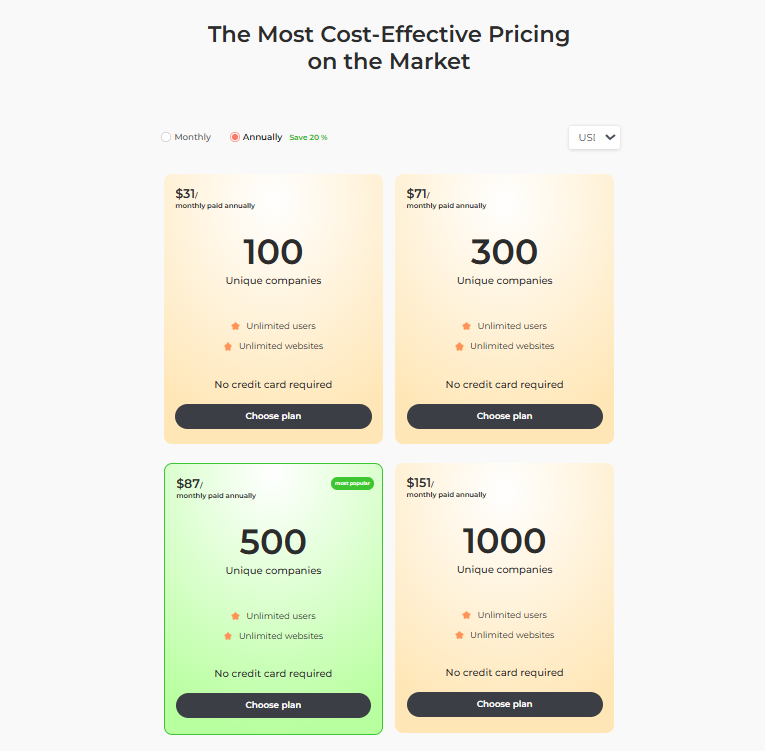
How to Choose the Right Koala Replacement
With so many options, here's a quick decision framework based on your team size and needs:
- Startup / SMB (under $500/mo budget): Start with Factors.ai or Snitcher for affordable visitor identification with intent signals.
- Mid-Market (sales + marketing alignment): Factors.ai or Common Room for multi-source intent data and workflow automation.
- Enterprise ABM: 6sense or Demandbase for predictive intelligence and large-scale orchestration.
- Sales-led outbound: ZoomInfo or Clay for contact databases combined with intent.
- Product-led growth: Pocus for product usage signals combined with buyer intent.
- Migrating from Koala specifically: Common Room (official migration partner, matching Koala's pricing tiers).
Why Factors is the Best Koala Alternative
If you've scrolled through this list, you might be wondering: "With so many options, what tool should I choose?" Well, Factors is a great choice here. Why? Because all the tools we've covered have their strengths, but Factors is built to solve real challenges B2B teams face every day, not just provide data.
With Factors, you're not juggling multiple dashboards or piecing together signals from different platforms. Everything lives in one place, along with the AI Agents that take action on the insights. That means your reps get real-time alerts, enriched leads, multi-threaded engagement, and custom GTM workflows without manual busywork. The platform also gives you full visibility into the customer journey, scoring accounts, tracking funnel progression, and pinpointing high-intent buyers, all tailored to your ICP.
We get it, other tools can enrich data or alert you to anonymous visitors, but most stop there. Factors goes a step further, combining AI-driven insights with actionable execution. It's not just about knowing what's happening; it's about knowing what to do next, and actually doing it.
In short, if your goal is to grow pipeline with confidence, automate tedious processes, and make smarter GTM decisions, Factors is designed to be your co-pilot, so your team can focus on strategy and revenue instead of manual tasks.
Speak to our team today to find out how you can best use intent data for your marketing campaigns.
In a Nutshell
With Koala shut down following its Cursor acquisition, B2B teams need a reliable replacement for intent data and visitor identification. The best alternative depends on your team size, budget, and GTM motion. For unified intent + execution in one platform, Factors.ai combines AI Agents, multi-source signals, and workflow automation. For enterprise ABM, consider 6sense or Demandbase. For a smooth Koala migration, Common Room is the official partner. Whichever tool you choose, prioritize multi-source intent signals, CRM integration, and actionable workflows over raw data.
FAQs on Koala Alternatives
Q1. What is Koala used for?
Koala is an AI-powered intent data platform that helps businesses identify high-potential prospects based on website activity and engagement.
Q2. Why look for a Koala alternative?
While Koala is a good entry-level tool, it lacks some features like multi-source intent signals, deeper integrations, and advanced workflow automation. Additionally, Koala was acquired by Cursor and shut down in September 2025, making a replacement essential.
Q3. Which are the best Koala alternatives in 2026?
Top Koala alternatives include Factors.ai, Common Room, Clearbit, Lead411, Dealfront (formerly Leadfeeder), Warmly, Snitcher, ZoomInfo, 6sense, Demandbase, Pocus, and Clay.
Q4. What features should I look for in a Koala alternative?
Key features include CRM integration, multi-platform intent signals (like LinkedIn or G2), lead scoring, enrichment, and customizable automations.
Q5. Is Koala suitable for enterprise marketing teams?
Koala may work for startups, but enterprises may find it limited in integrations, automation, and cross-platform intent visibility.
Q6. What happened to Koala (getkoala.com)?
Koala was acquired by Cursor (parent company Anysphere) in July 2025 and officially shut down by September 2025. The founding team partnered with Common Room to help customers transition.
Q7. Is Common Room the official Koala replacement?
Yes, Common Room is the official migration partner. They are matching Koala's existing pricing tiers for equivalent feature packages to make the transition easier.
Q8. What's the difference between Koala and Koala AI?
Koala (getkoala.com) was a B2B intent data and visitor identification platform for sales and marketing teams. Koala AI (koala.sh) is a separate AI writing tool. This article covers alternatives to getkoala.com.

We don’t just write about demand gen. We deliver it.
Our AI Agents help you uncover high-intent accounts, run campaigns that actually convert, and keep your GTM motion in sync.
1000+ GTM teams have already scaled their pipeline with Factors.
*Includes built-in peace of mind. And fewer late-night funnel audits.






.svg)



.avif)

