
AI marketing automation platforms: a buyer’s framework
A practical framework for comparing AI marketing automation platforms. Categories, costs, evaluation criteria, and where Factors.ai fits.
.avif)
Content Marketer



.svg)


TL;DR
- Most teams shopping for AI marketing automation platforms don’t actually have a tooling gap. They have a decision-making gap, and no amount of AI fixes that until someone names it.
- The market has split into four genuinely different categories, and comparing HubSpot to Factors.ai is like comparing a Swiss army knife and a scalpel.
- Data quality predicts AI success far more reliably than how advanced the AI itself is, and only 16% of RevOps professionals say they trust their own data.
- Buyers keep shopping for the company they hope to become instead of the one they currently run, which is how a 40-person startup ends up paying enterprise prices for enterprise complexity it doesn’t need yet.
- The platforms that are set up for success are the ones that help teams decide faster and with better information on what to do next.
The AI marketing software market has become the streaming services of B2B… you start with one platform because it solves a specific problem.
A year later, you've added another one for attribution. One for intent data, one for workflows, one because someone at a conference said it was ‘game-changing.’ Suddenly, you're paying for five subscriptions and still exporting everything into Excel before your Monday’s pipeline meeting.
So now we know, the problem was never a lack of AI… it was knowing which decisions deserved better information in the first place.
What do people mean when they say ‘AI marketing automation platform’?
Here’s the thing that gets lost in most of these conversations: marketing automation was never really the problem. Teams have been automating tasks since Marketo showed up over a decade ago. What they couldn’t automate was judgment, the constant stream of small decisions about which account to chase, which campaign to kill, which lead is actually worth a sales rep’s morning.
Traditional automation runs on rules you write once and mostly forget about. If a prospect downloads a whitepaper, send email two. If they click, send email three. It’s a script, and it assumes prospects will follow it (they mostly don’t, but I’ll get to that).
AI marketing automation platforms work differently because they’re reading live signals instead of executing a fixed sequence. Intent data, engagement patterns, pipeline movement, and account-level behavior across channels, all of it feeding into decisions about who to prioritize and when. The shift isn’t really about speed. It’s about which decisions get made with current information instead of last quarter’s assumptions.
Underneath that umbrella term sit three distinct levels, and conflating them is where most buying conversations go sideways.
- Rules-based automation. Pure if/then logic. Reliable, predictable, and increasingly blind to how buyers actually behave.
- AI-assisted automation. A prediction layer sits on top of the rules, helping a human marketer make a faster, better-informed call. The human still decides.
- Agentic automation. The system identifies the problem, picks an action, and executes it without waiting for someone to approve a workflow. This is where the conversation is heading now, even though most teams aren’t fully there yet.
That third category matters more than the marketing around it suggests, mostly because it changes who (or what) is actually accountable for a decision. Worth sitting with that for a second before you get excited about it.
Why has the old playbook stopped working?
I spent a good chunk of my career building nurture sequences with branching logic that looked beautiful on a whiteboard. Scoring models calibrated to the decimal point. And then the actual data came back, and it turned out most leads had taken a path the workflow never accounted for in the first place.
The platforms weren’t broken, but the buying process underneath them changed, and nobody updated the assumptions.
Also read: How marketing intelligence tools turn buyer data into revenue
According to 6sense’s 2025 B2B Buyer Experience Report, buyers now complete roughly 61% of their research before a seller ever hears from them. By the time your perfectly timed nurture sequence reaches someone, there’s a real chance they’ve already decided.
Separately, research from Gartner and Forrester puts "dark funnel" activity, critical research that happens completely outside a vendor's tracking architecture, such as peer chats, private Slack channels, and anonymous browsing at 70% to 80% of the total B2B buying journey.
Compounding this visibility gap, the joint Dreamdata and LinkedIn B2Believe Benchmarks Report clocks the average B2B customer journey at 211 days, spanning an astonishing 76 tracked touchpoints.
Read those numbers together, and you’ll realize static marketing workflows cannot react to signals they were never built to see. Manual segmentation cannot keep pace with buying committees that move in complex loops rather than linear funnels. And a generic nurture sequence personalized only to an ‘industry’ and ‘job title’ feels almost insulting next to what modern buyers now expect.
The four AI marketing automation platform categories nobody separates clearly enough
Most “best AI marketing automation platform” roundups throw every tool into one giant bucket, which is how a company ends up seriously comparing HubSpot to Factors.ai as if they’re solving the same problem. They’re not. Before you look at a single vendor, sort the market into these four buckets first.
Category 1: traditional platforms that bolted AI on top
HubSpot, Adobe Marketo Engage, and Salesforce Marketing Cloud all fall here. These are mature execution engines, built originally for email and campaign automation, now layered with predictive and generative AI features. HubSpot’s Breeze AI brings together content generation, prospecting, and customer-facing agents under one umbrella. Marketo Engage leans on predictive audiences and buying-group scoring built into Adobe’s broader ecosystem.
These platforms are strong at execution: email, CRM sync, campaign workflows. They’re noticeably weaker on account-level intelligence and the kind of intent-based orchestration that ABM-focused teams actually need.
Category 2: revenue and ABM intelligence platforms
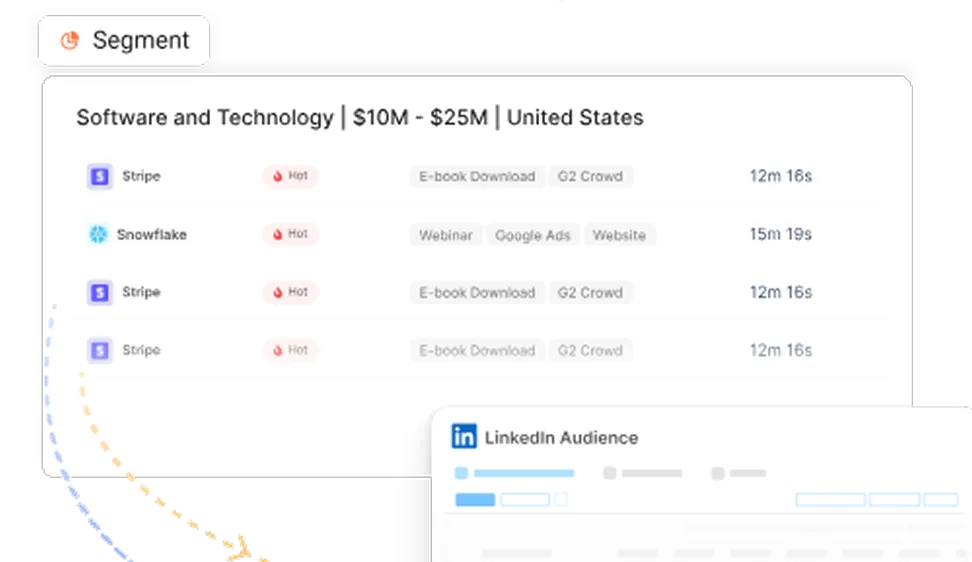
Factors.ai, 6sense, and Demandbase sit in a different category entirely, built around account intelligence and pipeline attribution rather than email sequencing. 6sense’s core bet is identifying which accounts are actively researching before they raise a hand. Demandbase leans into tightly coordinated account-level advertising. Factors.ai unifies account intelligence, web analytics, multi-touch attribution, and ad activation into one connected layer, identifying upwards of 75% of the companies visiting your site even when nobody fills out a form.
If your team runs an account-based motion and needs visibility into buyers who never identify themselves, this is the category to start in.
Category 3: workflow infrastructure
n8n, Make, and Zapier live at the plumbing layer. They don’t run campaigns. They connect the tools you already have and let you stitch together custom AI workflows your core platform doesn’t support natively. Genuinely useful, genuinely not a replacement for a platform with built-in intelligence, and genuinely going to require someone on your team who’s comfortable with the technical setup.
Category 4: agentic platforms
The newest, least settled category, and the one generating the most noise. Agentic platforms use AI agents that manage campaigns, shift budget, and test creative with minimal step-by-step instruction. By most projections, agentic systems will handle a meaningful share of marketing execution by the end of this year, including audience-based media planning and synthetic testing. Early days still, but the direction is clear enough to take seriously.
How do the major platforms compare?
There’s no single “best” AI marketing automation platform. There’s only the one that matches your GTM motion, and pretending otherwise is how teams end up with six-figure software they use for 15% of its capability.
| Platform | AI capabilities | Pricing range | Best for | Platform | AI capabilities |
|---|---|---|---|---|---|
| HubSpot (Breeze AI) | Content generation, predictive scoring, AI agents | Free to $3,600+/mo | Mid-market teams wanting marketing, sales, and service in one system | HubSpot (Breeze AI) | Content generation, predictive scoring, AI agents |
| Adobe Marketo Engage | Predictive audiences, generative content, buying-group scoring | Custom enterprise pricing | Enterprise teams with mature marketing ops | Adobe Marketo Engage | Predictive audiences, generative content, buying-group scoring |
| Salesforce Marketing Cloud | Einstein AI predictions, journey optimization | Custom enterprise pricing | Teams already deep in Salesforce | Salesforce Marketing Cloud | Einstein AI predictions, journey optimization |
| Factors.ai | Account intelligence, predictive scoring, intent-driven ad optimization | Growth plan from ~$15K/yr, custom enterprise | B2B teams prioritizing account intelligence and ABM activation | Factors.ai | Account intelligence, predictive scoring, intent-driven ad optimization |
| 6sense | Predictive buying-stage models, AI-driven orchestration | $60K to $250K+/yr | Enterprise sales-led teams needing deep intent data | 6sense | Predictive buying-stage models, AI-driven orchestration |
| Demandbase | Account intelligence, advertising optimization | $50K to $200K+/yr | Enterprise teams running ABM advertising as a primary motion | Demandbase | Account intelligence, advertising optimization |
A table like this can make the decision look cleaner than it is. Feature lists across this market have converged enough that the real differentiator is rarely a missing checkbox. It’s whether the platform fits how your team actually operates, not how good the demo looked.
Where AI is actually changing the day-to-day work
The biggest shift here isn’t AI writing your emails (that part got boring fast). It’s AI changing what gets your attention first, every single morning, before your 9am pipeline review.
- Lead scoring that looks at behavior
Traditional scoring assigns numbers for actions: downloaded a whitepaper, opened three emails, visited pricing. AI-driven scoring instead asks whether an account’s pattern of behavior resembles the accounts that actually closed last quarter. Same inputs, fundamentally different question. - Audiences that update themselves
A static segment is stale the moment you finish building it. An account showing low intent yesterday can spike after three stakeholders hit your pricing page this morning, and a dynamic audience engine pushes that account into your high-priority campaigns without anyone touching a spreadsheet. - Coordination across the whole buying committeeLegacy automation thinks in individual leads. Modern platforms increasingly think in accounts, so when one contact engages with a webinar, the system can trigger ads for their colleagues, flag sales, and move the account’s pipeline stage, all in the same motion.
- Personalization that uses real signals instead of guesses
Content matched to industry, buying stage, and what specific people are actually researching reads as helpful. Content matched to nothing but a job title field reads as a mail merge with extra steps. - Budget decisions that respond to pipeline
AI increasingly reallocates spend toward what’s driving pipeline rather than what’s generating clicks, and revenue forecasts that blend marketing and sales signals give leadership a far more honest picture than either dataset alone.
A scorecard for evaluating any platform on this list
The mistake I see most often, and I mean most often, is teams getting excited about AI features before checking whether their data can support any of it. Bad data plus AI doesn’t produce intelligence. It produces confidently wrong decisions, faster than before.
Only 16% of RevOps professionals say they trust their own data accuracy. Any evaluation that skips data readiness as step one is already off track.
- Data foundation
How cleanly does the platform connect to your CRM, ad platforms, and website analytics? Does it improve your data over time or just add another inconsistent source to reconcile? - Depth of the AI layer
Evaluate prediction (can it forecast outcomes), recommendation (does it surface a next step worth taking), and execution (can it act without a human triggering it). Agentic capability is the newest and least mature of the three. - Measurement
Multi-touch attribution tied to your actual CRM pipeline, not a vanity dashboard of clicks and impressions, is the floor here, not a bonus feature. - Usability and governance
How long does implementation realistically take? Clean handoffs between marketing automation and CRM data typically take 6 to 14 weeks per nurture flow, and multi-program rollouts stretch to 3 to 9 months when the underlying data isn’t already clean. For enterprise buyers, governance questions matter too: who owns the AI’s decisions, and how do you audit them?
Matching the platform to where your company actually is
Most companies shop for the size they hope to be in three years, not the size they are right now. That mismatch is behind more failed implementations than any actual product limitation.
- Startups, under 50 people. Speed and simplicity win here. HubSpot’s Marketing Hub with Breeze AI is often the practical default because CRM, automation, and AI live in one system without needing a dedicated ops hire. If you’re product-led or already running paid ABM with consistent traffic, Factors.ai works well at this stage too, particularly if attribution and account intelligence matter more to you than email sequencing.
- Mid-market, 50 to 500 people. This is where the gap between platforms starts to show. You’re likely running campaigns across LinkedIn, Google, email, and webinars, and you need something connecting the dots between them. Factors.ai tends to fit well here, giving teams the account intelligence and attribution layer traditional MAPs don’t offer, without the enterprise price tag of a 6sense or Demandbase implementation (both of which can run $50K to $300K+ a year before you’ve even finished onboarding).
- Enterprise, 500+ people. Governance, security, and multi-channel orchestration at scale become the priority. Marketo Engage, Salesforce Marketing Cloud, and platforms like 6sense or Demandbase are built for this complexity, with annual licensing typically running $15,000 to $300,000+ and implementation adding another $25,000 to $200,000 depending on scope. At this size, organizational readiness matters nearly as much as the feature set.
The mistakes I keep watching companies make
I’ve made some of these myself, which is exactly why I notice them now.
- Buying AI before fixing the data underneath it. Industry data puts the AI initiative failure rate at 42 to 54% in 2025, largely from integration failures and bad data, not weak models. Clean the data first. There’s no shortcut here, believe me, I’ve looked.
- Optimizing for features instead of outcomes. A platform with 200 features your team uses 12 of loses to one with 50 features your team actually runs daily. Ask what outcome you need before asking what the platform does.
- Treating attribution as optional. If the platform can’t tell you which campaigns influenced pipeline, you’re flying blind with fancier instruments. That’s not a nice-to-have. It’s the feedback loop everything else depends on.
- Automating a broken process and calling it progress. A thirteen-branch nurture sequence nobody can explain doesn’t become smart because AI runs it. Fix the process. Then automate it.
- Measuring leads instead of revenue. If your dashboard still leads with MQL volume, your AI platform is optimizing for the wrong number, and it’ll keep doing that very efficiently.
- Assuming AI replaces strategic thinking. It doesn’t, and it shouldn’t have to. AI handles pattern recognition and execution at a scale no human team can match. It doesn’t decide which market to pursue or how to position the product. Hand it the wrong strategy and it will optimize beautifully toward the wrong outcome.
Building the stack instead of buying one tool to do everything
The strongest setup I’ve seen isn’t a single platform doing everything. It’s a layered system where each layer has one job and feeds the next.
- Data layer. Your CRM, data warehouse, and customer data platform. Salesforce, HubSpot CRM, Snowflake, BigQuery, whatever holds the unified record. Nothing downstream works if this layer is a mess.
- Intelligence layer. Where intent data, account scoring, and predictive models live, answering “who deserves our attention right now?” Factors.ai sits here, built on a first-party data foundation that identifies more than 75% of companies visiting your website and tracks how those accounts move across pages, channels, and campaigns, even when nobody ever fills out a form.
- Activation layer. Where campaigns actually run. This layer only earns its keep when it’s informed by the intelligence layer instead of operating on its own assumptions. Factors.ai’s LinkedIn AdPilot adjusts ad targeting automatically based on account activity and funnel stage, its Google AdPilot uses Google’s conversion API to feed performance data back into targeting, and audience sync keeps lists current across CRM, website, and ad platforms daily.
- Measurement layer. Attribution, pipeline reporting, and revenue analytics close the loop, feeding insight back into the layers above instead of sitting in a static dashboard nobody opens after the first week.
Factors.ai shows up across several of these layers not because it tries to be everything, but because it was built to connect intelligence, activation, and measurement specifically for B2B teams running account-based motions. That’s a meaningfully different design choice than trying to be the entire stack in one product.
Where is this market headed next?
According to research from McKinsey & Company, implementing an agentic AI framework can directly automate and power as much as 60% of core marketing workflows, ranging from content generation and synthetic audience simulation to complex media planning. Organizations deploying these continuous, always-on AI orchestration layers are realizing an estimated 30% lift in marketing ROI alongside substantial revenue growth from hyper-personalized campaigns.
This shift is part of a broader enterprise trend: driven by autonomous systems and sophisticated containment bots, global AI-handled customer interactions are projected to skyrocket from roughly 3.3 billion to over 34 billion by 2027.
Buying-committee intelligence, where platforms track entire committees rather than individual leads, is moving from a premium feature to a baseline expectation. Signal-based marketing, where actions trigger real buyer behavior rather than a calendar, is steadily replacing the campaign calendar as the default operating model for sophisticated teams. And 88% of senior executives say they’re increasing AI budgets specifically to fund agentic initiatives.
None of that means the team that spends the most wins. It means the team that builds AI literacy earliest, understands what these platforms genuinely do versus what the sales deck claims, and gets the data foundation right before anything else, wins. Spending more on AI without fixing what’s underneath it is just an expensive way to automate confusion.
The takeaway (in case you skipped the whole article)
AI marketing automation platforms have split into four real categories, and figuring out which one solves your actual problem matters more than comparing individual features across all of them at once. Your evaluation should start with data quality, not AI sophistication, since close to half of AI initiatives in 2025 failed for exactly that reason. Match the platform to your team’s size and motion today, not the company you’re hoping to become. And measure success on pipeline and revenue, never on lead volume or how many features you’ve technically turned on.
The best platform is always the one your team will actually use, running on data they actually trust, producing outcomes they can actually point to in a pipeline review.
FAQs for AI marketing automation platforms
Q1. What’s the real difference between traditional marketing automation and AI marketing automation?
Traditional automation runs on rules you set manually, like sending an email three days after a whitepaper download. AI marketing automation platforms add a layer that reads behavioral and intent signals and adjusts continuously, instead of waiting for you to rebuild the workflow. The most advanced platforms go a step further into agentic territory, where the system pursues a goal you’ve set rather than following a sequence you’ve built step by step.
Q2. Which platform makes sense for a small B2B team?
For teams under 50 people, simplicity usually wins over sophistication. HubSpot with Breeze AI is a solid starting point since CRM, automation, and AI live in one place without requiring a dedicated ops hire. If you’re already running paid campaigns and need account-level intent data, Factors.ai offers a lighter entry point that doesn’t demand an enterprise budget.
Q3. How much should I budget for an AI marketing automation platform?
It varies a lot by category. HubSpot’s Marketing Hub ranges from free to several thousand dollars a month. Mid-market platforms like Factors.ai typically start around $15,000 a year. Enterprise ABM platforms like 6sense and Demandbase usually start at $50,000 to $80,000 annually and can climb past $200,000 for full deployments, with implementation adding another $25,000 to $200,000 depending on complexity.
Q4. Why do most AI marketing automation rollouts fail?
Data quality is the leading cause, by a wide margin. When CRM data is duplicated, inconsistent, or incomplete, AI trained on it produces unreliable recommendations no matter how good the underlying model is. Roughly 42 to 54% of organizations scrapped AI initiatives in 2025 specifically because of integration failures and bad data. Clean and unify your data before activating AI features, not after you’ve already gone live.
Q5. Are agentic marketing platforms worth paying attention to right now?
Worth understanding, not necessarily worth betting your whole stack on yet. Agentic platforms let AI agents plan, execute, and optimize campaigns toward a goal without explicit step-by-step instructions. Most teams will encounter agentic features as additions inside platforms they already use, rather than as standalone products. Get your data foundation and core automation right first, then evaluate agentic capability as it matures.
Q6. Should I buy an all-in-one MAP or a specialized intelligence platform?
It depends on where the actual pain is. If your biggest need is campaign execution, email automation, and CRM integration, an all-in-one platform like HubSpot or Marketo fits better. If your real challenge is knowing which accounts are in-market or connecting marketing activity to pipeline, a specialized platform like Factors.ai, 6sense, or Demandbase will move the needle further. A lot of mid-market and enterprise teams end up running both, one for execution and one for intelligence.
Q7. What should I check first before comparing any vendors?
Start with your data foundation, before you look at a single AI feature. Confirm the platform integrates cleanly with your CRM, ad platforms, and analytics, and that it improves your data quality rather than adding another inconsistent source. The most advanced AI capability is worthless running on fragmented or inaccurate data, so this step isn’t optional, even when it’s the least exciting part of the evaluation.
Q8. Can these platforms replace a marketing strategist?
No, and treating them like they can is how teams end up with beautifully optimized campaigns aimed at the wrong audience. AI platforms are genuinely excellent at pattern recognition and execution across thousands of accounts at once, far beyond what any human team could process manually. What they can’t do is decide which market to pursue, how to position the product, or what story actually needs telling. The best teams let AI absorb the operational complexity so the humans can focus on the decisions that require real judgment.
Q9. Where does Factors.ai fit if I already have a MAP?
Factors.ai sits at the intersection of account intelligence, attribution, and ad activation rather than replacing your existing MAP or CRM. It identifies which companies are engaging with your site and campaigns, scores accounts on intent signals pulled from CRM, web, and ad data, ties multi-touch attribution back to pipeline, and activates audiences on LinkedIn and Google through AdPilot. In a layered stack, it works as the intelligence and measurement layer feeding your activation tools, which makes it a particularly strong fit for B2B teams trying to connect anonymous website activity to actual pipeline outcomes.

See how Factors can 2x your ROI
Boost your LinkedIn ROI in no time using data-driven insights


.avif)

See Factors in action.
Schedule a personalized demo or sign up to get started for free
LinkedIn Marketing Partner
GDPR & SOC2 Type II

.svg)



.avif)

