
AI marketing automation: the complete B2B guide
What AI marketing automation actually means for B2B teams: maturity levels, highest-ROI use cases, agentic workflows, tool comparison, and how to build a strategy that works.
.avif)
Content Marketer



.svg)


TL;DR
- The gap between "we use AI in marketing" and "AI is embedded in how our pipeline runs" is enormous, and most B2B teams are still parked firmly on the wrong side of it.
- Rule-based triggers and first-name personalization are not AI marketing automation; they're just a scheduled email with a PR problem.
- The highest-ROI use cases for AI in B2B are buying group detection, pipeline risk monitoring, and intent-based activation, things that solve revenue problems, not creative ones.
- You cannot buy your way to an AI marketing automation strategy; the data layer has to come first, or the AI just optimizes faster toward the wrong outcomes.
- B2B teams that will win the next two years will be the ones that have figured out which repetitive decisions should belong to machines and which ones should stay human.
Okay… story time.
Someone on my team forwarded me a vendor one-pager last year titled "AI-Powered Marketing Automation for the Modern GTM Stack." I read it twice. By the second read, I realized what it was actually describing was an email sequence with a lead score attached. Nothing in it was powered by AI in any meaningful sense. The word ‘AI’ appeared eleven times. The word ‘pipeline’ appeared ZERO times.
We’ve all been sitting with such one-pagers ever since because they capture something that's become a genuine problem in how B2B teams think about marketing automation. We've dressed up fairly ordinary workflows in very fancy language, and now nobody's sure what the real thing looks like.
That's what this guide is trying to fix and truly asking: what AI marketing automation actually means now, where it creates real commercial leverage, and how to build toward it without getting distracted by everything vendors want you to believe.
Okay, what is AI marketing automation, really?
AI marketing automation is the use of machine learning, predictive analytics, large language models, and increasingly autonomous AI agents to execute, optimize, and orchestrate marketing activities that previously required manual human effort.
Traditional marketing automation follows rules you write. If a lead downloads this PDF, send that email. When they visit the pricing page, their score increases by 10 points. The system does exactly what you tell it, nothing more. AI-assisted automation adds a layer of intelligence: predictive scoring that learns from your CRM data, dynamic content recommendations based on behavior, send-time optimization that adapts to engagement patterns.
The frontier in 2026 is what the industry is calling agentic marketing automation. AI agents are software systems that plan, execute, and optimize activities autonomously. Instead of programming "if X, then Y," you give an agent a goal like "increase qualified pipeline from this ICP segment by 15%" and let it determine the steps. Here's a maturity map worth bookmarking:
| Level | Type | How it actually works |
|---|---|---|
| Level 1 | Rule-based automation | Static triggers and linear workflows. If this, then that. |
| Level 2 | Predictive automation | ML scores leads and surfaces recommended actions, but humans still execute. |
| Level 3 | AI-assisted automation | AI generates content, optimizes timing, personalizes at scale within human-defined workflows. |
| Level 4 | Agentic automation | AI agents pursue goals autonomously, reasoning through multi-step execution and learning from outcomes. |
Most B2B teams I've observed are operating between Level 1 and Level 2. The conversations about AI sound like Level 4. The actual implementation is faaaar behind that. The global AI marketing market reached $47.32 billion in 2026, and still only about one-third of organizations have moved past isolated experiments to scale AI across their operations.
Why is traditional marketing automation starting to crack?
Traditional marketing automation was built for a buyer who moved linearly. Someone visits your site, fills a form, enters a nurture sequence, gets scored, gets handed to sales. The whole system was architected around the MQL, a single contact progressing through predictable stages.
In 2026, that's not how most buying happens. Modern buying committees average 6 to 10 people across end users, champions, technical evaluators, finance, procurement, and executive stakeholders. Forrester's research puts the average at 13 stakeholders per enterprise B2B purchase, crossing multiple departments.
These buying groups do not move through your nurture track in sequence. They consume content across channels, disappear for three weeks, reappear on your pricing page at 11 PM on a Tuesday, consult AI search engines like Perplexity, compare notes in Slack communities, and generally behave in ways that make your five-step drip sequence look like it was designed for a different planet.
Here's where most automation systems show their age:
- Static nurture journeys. Built around a fixed path from awareness to purchase, with no mechanism to adapt when a buying group goes quiet or suddenly spikes in activity.
- Lead scoring models built on assumptions. Downloading an ebook gets 15 points, regardless of whether the account is actually in-market or a grad student doing research.
- Manual segmentation. Breaks down the moment your database grows past a few thousand contacts and becomes a maintenance nightmare.
- Generic personalization. First name and company name in the subject line is not personalization. That's mail merge with ambitions.
- Siloed reporting. Can't tell you whether the LinkedIn campaign influenced the same account your webinar touched last month.
- Marketing-to-sales handoff gaps. Context evaporates at the handoff, and the rep is starting from scratch.
The modern AI marketing automation stack, explained…
If you're building or rebuilding your marketing automation stack in 2026, the architecture looks meaningfully different from even two years ago. And the order in which you build the layers matters more than the specific tools you choose.
- The foundational layer is your data infrastructure: CRM, customer data platform, and identity resolution. Without clean, unified data, every AI tool you add produces AI-powered confusion rather than insight.
- The signal layer sits above that: intent data, website visitor identification, behavioral tracking, and engagement scoring. This is where platforms like Factors.ai fit into the stack. Factors.ai unifies account intelligence, web analytics, multi-touch attribution, and ad optimization so GTM teams can see which companies are engaging, map their journeys across channels, and surface high-intent accounts before competitors do.
- The orchestration layer connects signals to actions: your marketing automation platform, workflow tools, and increasingly, AI agents that can take autonomous action based on signals without waiting for a human to build a workflow for each scenario.
- The intelligence layer is where AI models do the heavy lifting: predictive scoring, content personalization, campaign optimization, and pipeline forecasting.
How AI changes every stage of the B2B funnel
One of the biggest misconceptions I encounter regularly: that AI marketing automation only helps at the top of funnel. The highest ROI from AI-powered tools often appears later in the journey, at pipeline acceleration, deal prioritization, and expansion revenue. Those are revenue problems, not content volume problems.
- Awareness
At the top of funnel, AI transforms audience discovery by analyzing your best-fit customers and finding lookalike accounts across intent data sources. AI-driven PPC bid management can reduce wasted ad spend by around 37% and increase ad ROI by roughly 50%.
- Consideration
This is where buying group detection becomes genuinely valuable. AI can identify when multiple stakeholders from the same account are engaging with your content, visiting your website, or researching your category on review platforms like G2. Dynamic content recommendations adapt what each persona sees based on their role and what they've already engaged with.
- Decision
Account prioritization is where AI marketing automation delivers its most immediate commercial value. Instead of sales reps manually scanning a list of MQLs, AI models score accounts based on fit, intent, and engagement, surfacing the ones most likely to convert right now.
- Expansion
After the sale, AI turns its attention to churn prediction, upsell opportunity detection, and customer health scoring. This is the stage most marketing teams ignore entirely, which is precisely why it offers disproportionate returns for teams willing to invest here.
Most articles on this topic open with "AI can write your emails faster." Most CMOs don't care. Here's the list organized around business outcomes.
- Predictive lead and account scoring. AI models analyze historical conversion data to predict which accounts are most likely to become opportunities. 63% of B2B companies using AI for lead scoring report significant improvements in lead quality.
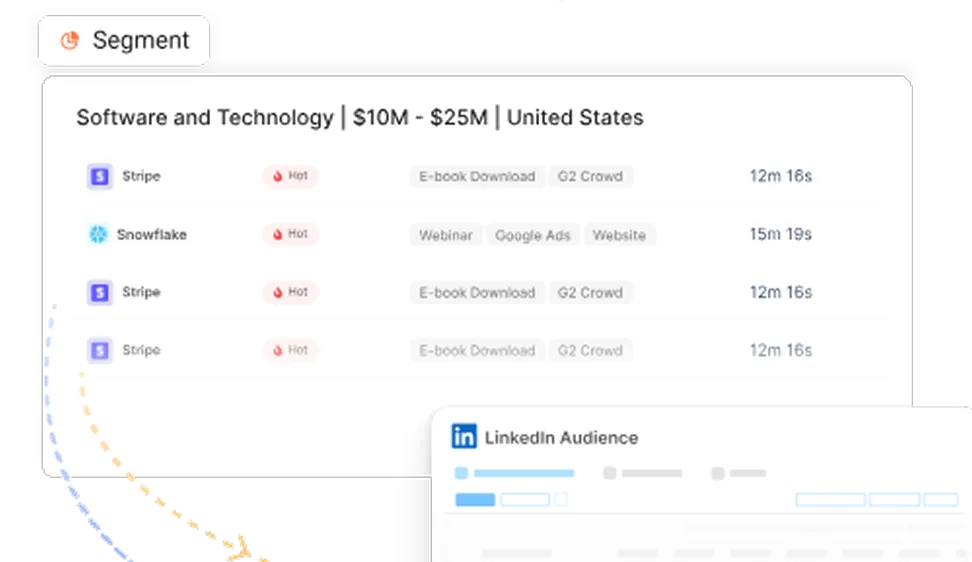
- Intent-based ad activation. When an account shows intent signals, AI can automatically add them to ad audiences on LinkedIn or Google. Factors.ai's AdPilot products connect intent signals directly to paid media activation so your ad spend follows the buying signal rather than a static audience list.
- Dynamic ICP audience creation. AI continuously refines your ideal customer profile by analyzing which accounts convert at the highest rates. ICP definition stops being a quarterly offsite exercise and becomes a living model.
- Pipeline risk monitoring. AI monitors deal velocity, engagement patterns, and historical stage-duration data to flag opportunities at risk of stalling. Early warning, not end-of-quarter autopsy.
- Buying committee detection. AI identifies when multiple personas from the same target account are engaging across channels, signaling that a buying group is forming.
- Content personalization at scale. AI tailors content recommendations and email content based on account-level attributes and engagement history.
- Adaptive nurture journeys. Instead of static email sequences, AI-driven automation builds journeys that change based on how the account is actually behaving.
- Revenue forecasting. AI models analyze pipeline data, engagement trends, and historical win rates to generate more accurate revenue forecasts than spreadsheet math or gut instinct.
AI agents vs traditional automation (and what’s actually different)
This is where things get genuinely interesting, and where the future is being written. Agentic AI spending is expected to reach $201.9 billion in 2026. Gartner forecasts that 40% of enterprise applications will embed AI agents by the end of 2026, up from less than 5% in 2025. (No, I did not make those numbers up.)
| Traditional workflow | Agent workflow |
|---|---|
| Trigger → action → end | Goal → reasoning → multi-step execution → learning |
| Form fill → send email | Detect intent spike → research account → build target list → launch audience → alert sales → track influence |
| Human designs every step | Human sets the objective and guardrails |
| Breaks when conditions change | Adapts when conditions change |
A traditional automation workflow is like a train on a fixed track. It goes exactly where you've laid the rails, every single time, even when the destination has changed. An AI agent is more like a navigator who can reroute around obstacles, take a detour when something better appears, and still get you where you're going.
The primary commercial benefit of agentic AI is the decoupling of output from human hours. Autonomous agents can execute thousands of personalized interactions simultaneously. That doesn't mean you fire your marketing team (duh). It means your team focuses on strategy, creative direction, and the decisions that require judgment while agents handle the orchestration layer.
FYI, your Zapier stack is about to get a lot smaller
Deliberately overstated, but the direction is real. The future of marketing automation isn't more workflows. It's fewer workflows and smarter agents. Multi-agent marketing systems are emerging where specialized agents collaborate: one handling audience research, another managing creative optimization, a third orchestrating cross-channel distribution.
How do you actually build an AI marketing automation strategy?
One pattern I've seen fail repeatedly: teams attempt a complete AI transformation before proving a single use case. The organizations that succeed start small, prove something, and then expand.
1. Audit existing workflows. Map every automated workflow you currently run. Figure out which ones are producing results and which are running on autopilot with no clear outcome attached.
2. Map repetitive decisions. Look for places where a human is making the same call over and over. Repetitive decisions are the best candidates for AI.
3. Identify high-impact automation opportunities. Rank candidates by potential pipeline impact, not by implementation ease.
4. Connect your data sources. Before deploying any AI model, make sure the data it needs is clean, connected, and accessible.
5. Deploy AI on one workflow. One use case. Prove the AI-powered approach outperforms the manual one.
6. Measure outcomes, not activity. Did AI-scored accounts convert at a higher rate? Revenue outcomes matter more than efficiency metrics.
7. Scale gradually. Once one use case is validated, expand to the next highest-impact opportunity.
The temptation to skip to step five is enormous, especially when vendors are promising pipeline transformation in 30 days… resist it.
Best AI marketing automation tools: a useful comparison
CRM and automation platforms
• HubSpot. Most accessible entry point for mid-market B2B teams. Its AI features (Breeze AI) are increasingly embedded across the platform, from content generation to predictive lead scoring.
• Salesforce Marketing Cloud. The enterprise standard. Its Agentforce platform represents one of the most ambitious pushes into agentic marketing automation.
• ActiveCampaign. Integrates 30+ AI agents focused on email marketing, customer journey automation, and predictive analytics with 900+ tool integrations. Best suited for SMBs.
ABM and revenue intelligence
Factors.ai. Unifies account identification, intent signals, multi-touch attribution, and ad optimization in a single platform. Connects account-level data from ads, website behavior, CRM, G2, and other intent sources so GTM teams can see who is in-market and how campaigns are contributing to pipeline.
Demandbase. Broad enterprise ABM capabilities with intent data, account-based advertising, and sales intelligence at scale.
6sense. Focuses on predictive intelligence and buying stage prediction, helping teams identify anonymous buying behavior and prioritize accounts.
Workflow and agent automation
- Zapier. Still the connective tissue for many marketing stacks, integrating thousands of tools with trigger-based workflows.
- Make. Offers more complex multi-step automations with a visual builder for teams building sophisticated workflows without code.
- Gumloop. Emerging as a purpose-built AI agent platform for marketing tasks, with native AI model access and continuous automation capabilities.
AI content and personalization
- ChatGPT and Claude. The generalist LLMs most marketing teams use for content drafting, research, and brainstorming. Both require editorial oversight to maintain brand voice.
- Jasper. Has evolved from a writing assistant into a creative agent that manages content workflows, proactively repurposing assets across formats while adhering to brand guidelines.
Measuring AI marketing automation ROI
One of the most expensive mistakes marketers make is measuring AI by content output. The board doesn't care if AI wrote 50 blog posts last month. The board cares whether pipeline increased and whether the cost to acquire a customer went down.
Efficiency metrics (table stakes, not the headline)
• Hours saved per week. HubSpot's AI Trends 2026 report finds marketers recover 6.1 hours weekly on average. Real numbers, but not the ones that win budget approval.
• Reduction in cost-per-campaign or cost-per-asset
• Campaign velocity from brief to live
Pipeline metrics (this is where the conversation gets serious)
• AI-influenced pipeline: opportunities where AI-driven touchpoints were part of the journey
• Pipeline acceleration: how much faster deals move through stages with AI-prioritized engagement
• Opportunity creation rate from AI-scored or AI-prioritized accounts
Revenue metrics (what the CFO wants to see)
• Win rate changes on AI-prioritized versus manually prioritized accounts
• Customer acquisition cost reduction
• Revenue directly influenced by AI-driven campaigns
AI visibility metrics (the newest category)
• Whether your brand appears in AI Overviews, gets cited by LLMs like ChatGPT or Perplexity, and shows up in generative search results. Marketing automation programs return $5.44 per dollar spent on average, per Forrester benchmarking.
The mistakes that are killing your AI automation projects
- Buying tools before fixing data. Mistake number one, every time. If your CRM has duplicate records, your website analytics can't identify accounts, and your ad platforms report in different attribution windows, no AI tool will save you.
- Automating broken processes. If your lead scoring model is already wrong, automating it with AI just makes it faster at being wrong. Fix the process, then automate it.
- Ignoring governance. 29% of attempted agent deployments are abandoned within 90 days, per Gartner, with the top failure modes being unclear success criteria, poor data access, and brand-voice drift.
- Over-personalization. There's a point where personalization stops feeling helpful and starts feeling unsettling. Personalize at the account and segment level, not at the "we know you visited our pricing page at 3:47 AM" level.
- No human oversight. The best AI marketing automation systems still have humans reviewing outputs, approving high-stakes actions, and correcting course when the model drifts.
- Disconnecting sales and marketing. If your sales team doesn't trust the scores, doesn't act on the alerts, or doesn't feed back outcome data, the entire loop breaks.
AI marketing automation best practices for B2B teams
- Start with pipeline problems, not tool problems. Don't ask "what AI tool should we buy?" Ask "where is our pipeline leaking and can AI help plug it?"
- Focus on buying groups, not individual leads. Build your automation around account-level engagement rather than individual contact activity.
- Create shared sales-marketing metrics. Agree on qualified pipeline, stage conversion rates, and influenced revenue rather than separate MQL and closed-won targets.
- Build a single source of truth. CRM, marketing platform, intent data, and analytics need to flow into a unified view.
- Use AI to augment human judgment, not remove it. Humans set the strategy. AI handles execution.
- Measure continuously. AI models drift. Build review cycles into your automation rather than deploying and forgetting.
Where is AI marketing automation heading next?
The next generation of marketing automation won't revolve around emails. It will revolve around decisions.
Autonomous campaign optimization will move from "AI suggests changes and a human approves" to "AI continuously optimizes within defined guardrails and escalates only when it encounters something genuinely novel." AI-powered buying group orchestration will become the default operating model for enterprise B2B marketing. Real-time account journey management will mean every touchpoint, from the first anonymous website visit to the closed deal, is visible and actionable in a single dashboard.
And then there's the buyer-side shift that still doesn't get enough attention. Buyers are increasingly using AI search engines and AI assistants to research solutions. When your prospect asks ChatGPT "what's the best account intelligence platform for mid-market B2B?" and your brand doesn't appear in the answer, you've lost a touchpoint that no amount of email automation can recover.
The organizations that win at AI marketing automation won't necessarily have the most tools. They'll have the clearest systems for turning signals into action before competitors even notice the signals exist, and they'll have built the institutional discipline to tell the difference between what's real and what's a very expensive slide deck with "AI" in the title.
FAQs about AI marketing automation
Q1. What is AI marketing automation?
AI marketing automation is the application of machine learning, predictive analytics, natural language processing, and AI agents to execute and optimize marketing activities that traditionally required manual effort. It goes beyond rule-based automation by enabling systems to make decisions, learn from outcomes, and adapt without explicit reprogramming. In B2B contexts, it covers everything from predictive lead scoring and intent-based ad targeting to autonomous campaign optimization and pipeline forecasting.
Q2. How is AI marketing automation different from traditional marketing automation?
Traditional marketing automation follows pre-defined rules: if a lead takes action X, trigger action Y. AI marketing automation adds decision-making capability, where the system analyzes patterns, predicts outcomes, and adapts its approach based on results. The most advanced form, agentic automation, pursues goals autonomously rather than waiting for step-by-step instructions. The practical difference shows up in flexibility: traditional workflows break when conditions change, while AI-driven systems adapt.
Q3. What are the best AI marketing automation tools in 2026?
The right answer depends on your stack, team size, and primary use case. For CRM-integrated automation, HubSpot and Salesforce Marketing Cloud lead the market. For ABM and revenue intelligence, Factors.ai, Demandbase, and 6sense offer account-level intent and attribution. For workflow automation, Zapier and Make remain popular, while Gumloop is emerging for AI-native agent workflows. Evaluate based on pipeline impact and integration quality, not feature lists.
Q4. How can AI improve B2B lead generation?
AI improves lead generation by shifting from volume-based approaches to signal-based ones. Predictive models identify which accounts match your ICP and show active buying intent, so you focus resources on high-probability opportunities rather than broadcasting to everyone who fits a rough demographic profile. AI also enhances lead generation through dynamic audience creation for paid campaigns, automated content personalization, and real-time alert systems that notify sales when a target account shows engagement surges.
Q5. What is the ROI of AI marketing automation?
ROI varies significantly based on implementation maturity, but the benchmarks are meaningful. Marketing automation programs return an average of $5.44 per dollar invested according to Forrester, and organizations using AI strategically report 10 to 20% improvements in sales ROI according to McKinsey's 2026 research. The teams seeing the highest returns are those connecting AI directly to pipeline outcomes, not just measuring productivity gains like hours saved or content volume produced.
Q6. How do AI agents work in marketing automation?
AI agents receive a goal and autonomously plan the steps to achieve it. They can research accounts, build target lists, activate ad audiences, personalize outreach, alert sales teams, and track influence without a human manually building each workflow step. Agents learn from outcomes and refine their approach over time. The key difference from traditional automation is that agents reason through problems rather than following pre-programmed rules.
Q7. How does AI marketing automation support ABM?
AI strengthens account-based marketing by enabling account identification at scale, scoring accounts based on fit and intent signals, detecting buying group formation across channels, personalizing content for specific accounts, and attributing pipeline to specific touchpoints. Platforms like Factors.ai connect these capabilities so ABM teams can see which accounts are in-market, what's influencing them, and how campaigns contribute to pipeline rather than just clicks.
Q8. Is AI marketing automation replacing B2B marketers?
No. AI is changing what marketers spend their time on. Repetitive execution tasks like data analysis, campaign reporting, and templated content production are increasingly handled by AI, while strategic work like positioning, creative direction, brand building, and relationship management remains human. The most effective teams in 2026 use AI to handle operational volume so their people can focus on the work that requires judgment, context, and creative thinking.
Q9. What should B2B teams prioritize first when adopting AI marketing automation?
Fix your data layer before buying any AI tool. Identify one high-impact repetitive decision that, if automated, would move pipeline. Prove the AI-powered approach outperforms the manual one on that single use case. Then scale. The teams that try to automate everything at once consistently underperform the ones that prove a single use case first and build from there.

See how Factors can 2x your ROI
Boost your LinkedIn ROI in no time using data-driven insights


.avif)

See Factors in action.
Schedule a personalized demo or sign up to get started for free
LinkedIn Marketing Partner
GDPR & SOC2 Type II

.svg)



.avif)

