
AI marketing funnel: a practical guide to building revenue-generating B2B funnels
Learn how to build an AI marketing funnel that drives pipeline, improves conversion rates, and aligns marketing with revenue outcomes.
.avif)
Content Marketer



.svg)


TL;DR
- An AI marketing funnel is a system that identifies which accounts actually matter, predicts conversion likelihood, and allocates resources based on revenue potential, not vanity metrics.
- Traditional B2B funnels are collapsing because buyers complete the majority of their research anonymously, and your CRM captures almost none of it.
- The teams creating significantly better pipeline are optimizing for signals, accounts, intent, and revenue, in that order.
- If you use AI to optimize your marketing funnel but don’t connect it to pipeline outcomes, you’re just automating bad processes faster. Uncomfortable, but true.
- Building an AI marketing funnel step by step starts with ICP definition and ends with continuous measurement. Most teams skip straight to tools and then wonder why nothing improves.
Imagine going on a first date and deciding, before they even arrive, exactly what you're going to say every five minutes for the next three months… sounds ridiculous, I know.
Yet that's how a surprising number of B2B marketing funnels still work.
Someone downloads an ebook and immediately gets dropped into the exact same email sequence as everyone else. It doesn't matter what pages they visit next, whether five colleagues from the same company suddenly show up, or whether they've already started comparing competitors.
The funnel keeps marching forward because that's what it was told to do.
AI changes that. Instead of forcing buyers through predefined steps, it lets the funnel adapt to what buyers are actually doing.
What is an AI marketing funnel, really?
Most articles define an AI marketing funnel as an “automated customer journey,” which sounds fine until you try to build pipeline with it and realize you’ve described a workflow, not a system.
A traditional funnel is a linear progression. Someone sees an ad, clicks it, fills out a form, gets dropped into an email sequence, and eventually ends up on a sales call. The marketer’s job is to push more people into the top and hope a reasonable percentage survives to the bottom. An AI marketing funnel works differently in almost every respect. Instead of treating every visitor as a generic lead, it uses machine learning to identify which accounts are worth pursuing, predict which ones are likely to convert, personalize their experience based on where they actually are in the buying process, and route them to the right team at the right moment.
There’s also some vocabulary worth clarifying because the terms get thrown around interchangeably, and they shouldn’t. A marketing funnel captures demand. A sales funnel qualifies and converts it. Pipeline is the dollar value sitting in active opportunities. A revenue funnel connects all of them into a single system that tracks how marketing activity translates to closed deals. AI is the connective tissue that makes those handoffs intelligent instead of arbitrary.
If AI isn’t helping you create more pipeline, you don’t have an AI funnel; you have a workflow tool with good branding.
Why are traditional B2B funnels falling apart?
The funnel model most B2B teams still use was designed for a world where buyers followed a predictable sequence: discover, evaluate, engage, buy. That world no longer exists, and the data is pretty damning about it.
Buying committees have ballooned to 13 or more stakeholders spanning IT, operations, finance, and end users. 73% of the B2B buying journey happens anonymously before a buyer ever contacts a vendor, and 83% of the total buying journey happens without vendors in the room at all. On top of that, 84% of CMOs now use AI tools like ChatGPT, Claude, and Perplexity for vendor discovery, and 68% of those CMOs start their searches in AI tools before they even open Google.
For years, marketers optimized MQL funnels. Meanwhile, buyers were reading review sites, visiting pricing pages anonymously, watching webinars, clicking LinkedIn ads, and asking ChatGPT for vendor recommendations. Most of that activity never appeared in CRM. MiQ’s global research finds that 87% of consumers switch between digital activities at least once an hour, and 42% say their path to purchase feels entirely random.
The linear funnel wasn’t just leaking. It was fundamentally blind to the majority of buyer activity happening outside its walls. The biggest funnel leak in B2B isn’t conversion. It’s invisibility. You can’t optimize what you can’t see, and traditional funnels were never designed to see what modern buyers are actually doing.
The modern AI marketing funnel framework
Funnels should no longer be viewed as ToFu, MoFu, BoFu. That framework treats buyers like they’re descending through a well-organized staircase, when in reality they’re bouncing between channels, stakeholders, and research methods at the same time. The real AI marketing funnel framework looks more like this.
- Signal capture. This is where everything starts. Website visits, ad engagement, intent data, content consumption, and even interactions with AI search tools all generate signals. The goal is to capture as many of these signals as possible, even when the visitor is anonymous.
- Account identification. Signals without identity are noise. De-anonymization technology, company identification, and ICP matching turn anonymous traffic into identifiable accounts. This is where most traditional funnels fail entirely, because they wait for a form fill that may never come.
- Prioritization. Not every identified account is worth pursuing. AI-driven lead scoring, account scoring, and intent scoring separate the accounts that are actively researching from the ones that happened to stumble onto your blog at 2am.
- Personalization. Once you know who matters and how ready they are, you can tailor messaging, content recommendations, and dynamic journeys to match their actual buying stage. This isn’t mass email segmentation. It’s account-level precision.
- Pipeline acceleration. Sales alerts, ad retargeting, and revenue attribution close the loop. Marketing doesn’t just hand off leads at this stage. It actively accelerates deals by keeping the right accounts engaged through the right channels.
That shift from Signals to Accounts to Intent to Engagement to Pipeline to Revenue is what separates modern demand generation teams from lead factories.
How does AI transform the awareness stage?
Top-of-funnel has traditionally been a volume game: produce content, run ads, generate impressions, and hope the right people see it. AI changes this from a broadcasting exercise into a targeting one, and I think that’s a genuinely significant shift for how B2B teams should think about content investment.
Content personalization is the most obvious application. AI can analyze which topics resonate with specific audience segments and recommend content clusters that match their research patterns. But the deeper impact is in paid media optimization. AI-driven lookalike audience modeling on platforms like LinkedIn can identify companies that resemble your best customers, and campaign optimization algorithms can shift budget toward ad variants that generate engagement from ICP accounts rather than just clicks from anyone.
AI-assisted content creation also plays a role here, though it’s worth being honest about its limits. AI can help generate campaign variants, test headline options, and produce first drafts at scale. What it can’t do yet is replace the strategic thinking behind which content to create and why. The teams that use AI well at the awareness stage combine volume with intelligence, producing more content that reaches fewer but better accounts.
Account intelligence adds another layer entirely. Platforms that combine visitor identification with intent data can reveal which companies engage with your content before any conversion event occurs. That’s a fundamentally different data set than what your Google Analytics dashboard provides, because it tells you who is paying attention, not just how many people visited.
How AI reshapes the consideration stage
Most nurture programmes are built around what marketers want to send. The best AI-powered nurtures are built around what buyers are actually researching. The distinction sounds subtle, but it’s usually the difference between pipeline movement and unsubscribes.
Behavioral personalization is the core capability here. Instead of dropping every MQL into the same six-email drip sequence, AI can analyze what a specific account has consumed, what pages they’ve visited, how frequently they’re returning, and which personas within the company are engaging. That data informs what to send next, when to send it, and whether to send anything at all.
Website personalization extends this further. When a returning visitor from a target account lands on your site, AI can surface relevant case studies, adjust messaging to reflect their industry, or prioritize a demo CTA over a whitepaper download. The visitor experience adapts based on what the system knows about them, even before they’ve identified themselves.
AI chat experiences are becoming increasingly effective in this stage as well. Rather than a generic chatbot that opens with “How can I help you?” (which tells me nothing and helps no one), AI-powered chat can tailor its conversation based on the visitor’s company, their engagement history, and the specific pages they’ve browsed. It shifts from reactive support to proactive qualification.
Lead scoring also matures at this stage. Companies implementing machine learning lead scoring report 75% higher conversion rates compared to traditional scoring methods. That improvement comes from AI’s ability to weigh hundreds of behavioral signals simultaneously, rather than relying on static rules that count form fills and email opens as equivalent evidence of intent.
AI at the intent and evaluation stage…
This is where AI delivers its biggest impact on pipeline, and where most B2B teams are still flying genuinely blind.
Intent signals are the behavioral breadcrumbs that indicate an account is moving toward a buying decision. Pricing page visits, demo request page views, competitor research activity, and repeat engagement over a short time window are all high-value intent signals. The problem is that traditional marketing tools capture only a fraction of these. When a buyer asks an LLM to compare your product with three competitors, that interaction leaves no trace in Google Analytics. The dark funnel is getting darker.
AI-powered platforms can aggregate intent signals from first-party data (your website, your content) and third-party data (review sites, industry publications, search behavior) to build a composite picture of account readiness. Companies using predictive intent models report being able to identify high-value accounts three to four weeks earlier than competitors using traditional methods. In long B2B sales cycles, that head start translates directly to pipeline velocity and win rates.
Buying committees make this even more complex. 92% of B2B buying decisions are made by groups of two or more people, and there’s an average of 27 engagements with seller-related content across a buying group. AI helps by tracking engagement across multiple personas within the same account, scoring collective readiness rather than individual lead behaviour, and detecting when new stakeholders enter the research phase.
CRM enrichment, sales readiness detection, and automated sales alerts all flow from this intelligence layer. When an ICP-matched account crosses an intent threshold, the system doesn’t just log it in a dashboard. It triggers the right action: a sales alert, a retargeting campaign, a personalized outreach sequence. Website visitor identification, dynamic account audiences, and intent-based routing turn what used to be guesswork into something closer to precision.
AI at the opportunity and pipeline stage
Marketing’s job doesn’t end at MQL. A campaign that creates 500 leads and zero pipeline is not successful, I don’t care how good the open rates looked. A campaign that creates 10 opportunities and three deals is successful. AI gives marketers the ability to optimize for outcomes instead of activity, and that is arguably the biggest structural shift happening in B2B marketing right now.
AI pipeline management works on several levels. Opportunity prioritization uses machine learning to rank active deals by likelihood of closing, factoring in engagement recency, stakeholder coverage, competitive signals, and deal velocity. Deal progression analysis identifies stalled opportunities before they go cold, flagging accounts that have stopped engaging or where key contacts have gone quiet.
Sales activity recommendations are the next frontier. Instead of relying on reps to decide their next move based on instinct and inbox anxiety, AI can suggest the most effective action based on what has worked for similar deals in the past, whether that’s sending a case study, scheduling a multi-stakeholder demo, or re-engaging a dormant champion.
Predictive forecasting ties everything together. When AI models can predict pipeline outcomes based on current signals, marketing teams gain the ability to adjust campaign spend and targeting in real time. If predictive models show a shortfall in next quarter’s pipeline, marketing can shift budget toward high-intent accounts today rather than discovering the gap three months later during a rather unpleasant revenue review.
AI-powered funnel optimization: where most teams get it wrong…
The fastest way to waste money with AI is to automate bad processes. If your funnel leaks today, AI will help it leak faster, and with more expensive tooling. This is where I see the most costly mistakes happening, and they’re almost always rooted in the same handful of assumptions.
- Mistake 1: Using AI only for content generation. Content matters, but AI’s highest-value application in marketing is signal detection, scoring, and routing. Using AI exclusively to write blog posts is like hiring a data scientist to format spreadsheets.
- Mistake 2: Optimizing lead volume. According to Forrester, fewer than 10% of leads generated by marketing are ever contacted by sales. Generating more leads that sales ignores doesn’t improve pipeline. It erodes trust between teams, slowly but very effectively. AI should help you generate fewer, better leads that actually convert.
- Mistake 3: Ignoring account-level signals. Individual lead scoring misses the forest for the trees. When five people from the same company visit your pricing page in one week, that’s a buying signal at the account level that individual lead scores won’t capture at all.
- Mistake 4: No attribution framework. Without attribution, you can’t tell which campaigns create pipeline and which ones just create activity. AI can enhance attribution by connecting touchpoints across channels, but it needs a framework to work within. Attribution debates sometimes resemble group projects where everyone claims credit for the final result (wow, never thought I’d say that), and without a model, nobody learns anything.
- Mistake 5: Treating AI as a standalone tool. AI works best when it’s embedded into existing workflows. A standalone AI tool that doesn’t connect to your CRM, ad platforms, and website analytics is just another data silo pretending to be a solution.
How to build a marketing funnel using AI, step by step
Building an AI marketing funnel isn’t a weekend project. It’s an ongoing system that improves over time. But there is a clear sequence, and skipping steps is exactly how most teams end up with expensive tools and mediocre results.
- Define your ICP first (everything else depends on it)
If you don’t know which accounts are worth pursuing, no amount of AI will help. Your ideal customer profile should include firmographic criteria (industry, company size, revenue), technographic signals (tech stack, current tools), and behavioral patterns (buying triggers, common pain points). This step sounds obvious, but most teams treat it as a one-time exercise rather than a living definition they revisit.
- Map every buying signal you can identify
Identify every signal that might indicate an account is moving toward a purchase. This includes first-party signals (website visits, content downloads, email engagement) and third-party signals (intent data, review site activity, job postings that suggest budget allocation). The more signals you map before you build, the better your scoring models will be from day one.
- Set up account identification
Implement technology that can de-anonymize website visitors at the company level. 73% of the B2B buying journey happens anonymously, so if you’re only tracking known contacts, you’re missing the vast majority of buyer activity. This is a non-negotiable infrastructure piece.
- Implement scoring models
Start with rules-based scoring and layer in machine learning as your data matures. Score both individual leads and accounts, weighting intent signals more heavily than demographic fit alone. Companies implementing lead scoring achieve 138% ROI on lead generation compared to 78% for those without scoring. The difference is significant enough to justify the investment in setting it up properly.
- Connect CRM, ads, and website data
Your scoring models are only as good as the data feeding them. Break down the silos between your CRM, ad platforms, website analytics, and content management system. This is often the hardest step operationally, and it’s where integration platforms earn their keep. It’s also where most teams discover that their data is in worse shape than they realized.
- Create AI-powered routing rules
When an account crosses a scoring threshold, define exactly what happens next. Sales alerts, ad retargeting triggers, personalized outreach sequences: these should all be pre-defined and tested. Speed matters here too. Responding within 60 seconds can boost conversions by 391%, while the average B2B team takes nearly two days to follow up.
- Build measurement dashboards that track pipeline, not just activity
Track metrics that connect marketing to revenue: pipeline generated, pipeline influenced, opportunity rate, sales velocity, and revenue attribution. If your dashboard only shows clicks and impressions, it’s measuring the wrong things entirely.
- Optimize continuously: this is the part most teams skip
AI models improve with feedback. Review scoring accuracy monthly, adjust routing rules quarterly, and run funnel audits that examine each stage’s conversion rates and leak points. The teams that win with AI marketing funnels aren’t the ones that built the best initial system. They’re the ones who iterated on it the most consistently.
AI marketing funnel diagram: from anonymous visitor to revenue
A clear AI marketing funnel diagram makes the framework tangible. Here’s how modern AI marketing funnels flow from first signal to closed deal:
| Stage | What happens | AI's role |
|---|---|---|
| Anonymous visitor | Unknown person lands on your site | De-anonymise, identify company |
| Company identification | Account is matched to a known entity | ICP matching, firmographic enrichment |
| ICP match | Account confirmed as ideal customer profile | Automatic qualification, score assignment |
| Intent scoring | Behavioural signals indicate buying interest | Aggregate first-party and third-party intent data |
| Personalised engagement | Tailored content, ads, and outreach delivered | Dynamic journeys, content recommendations |
| MQL / MQA | Marketing qualifies the lead or account | Scoring threshold triggers handoff |
| Sales accepted opportunity | Sales validates and accepts the opportunity | CRM enrichment, stakeholder mapping |
| Pipeline | Active deal with defined value and timeline | Deal progression analysis, stall detection |
| Revenue | Closed deal, attributed back to originating campaigns | Revenue attribution, ROI calculation |
For comparison, here’s how the traditional funnel stacks up against the AI-powered version:
| Traditional funnel | AI marketing funnel |
|---|---|
| Relies on form fills for identification | Identifies accounts before any form fill |
| Scores individuals based on demographics | Scores accounts based on behavioral signals |
| Same nurture sequence for everyone | Personalized journeys based on intent |
| Marketing hands off at MQL, walks away | Marketing stays engaged through pipeline |
| Measures leads generated | Measures pipeline created |
| Attribution is an afterthought | Attribution is built into the system |
| Quarterly optimization cycles | Continuous, real-time optimization |
The visual difference is noticeable, but the operational difference is wayyy bigger. One model counts people entering the top. The other tracks revenue exiting the bottom.
The AI tools powering modern marketing funnels
The AI tools for optimizing marketing funnels can be organized into a few core categories, each solving a different piece of the puzzle:
1. Visitor identification and de-anonymization. These platforms reveal which companies visit your website, even without form fills. They turn anonymous traffic into actionable account data.
2. Intent data providers. Third-party intent platforms track research activity across the web, identifying which accounts are actively exploring topics related to your solution.
3. Lead and account scoring platforms. These tools use machine learning to rank leads and accounts by conversion likelihood, combining fit, behaviour, and intent signals.
4. Marketing automation and personalization. Platforms that dynamically adjust content, email sequences, and website experiences based on account-level intelligence.
5. Attribution and pipeline measurement. Tools that connect marketing activity to pipeline and revenue outcomes, enabling multi-touch attribution across channels.
6. Ad activation and retargeting. Platforms that use account and intent data to target advertising toward in-market accounts, rather than broad demographic audiences.
The most effective modern platforms combine several of these capabilities, merging visitor identification, intent data, attribution, ad activation, and pipeline measurement into a single workflow. That consolidation matters because every handoff between disconnected tools is a place where data gets lost and context disappears. Every. Single. One.
When evaluating tools, focus less on feature lists and more on integration depth. A tool that connects natively to your CRM, ad platforms, and website analytics will deliver more value than a technically superior tool that lives in isolation.
Metrics you should measure in an AI marketing funnel
I’ve never been in a board meeting where someone celebrated a high email open rate. I’ve been in plenty where someone asked: “How much pipeline did marketing create?” That’s the metric AI should help improve, and it’s where the gap between traditional funnel reporting and revenue-aligned measurement becomes painfully obvious.
Here’s how traditional metrics compare to the ones that drive real decisions:
| Traditional metrics | Revenue metrics |
|---|---|
| Click-through rate (CTR) | Pipeline generated |
| Cost per click (CPC) | Pipeline influenced |
| Email open rate | Opportunity rate |
| Page views | Account engagement score |
| MQLs generated | Sales velocity |
| Form submissions | Revenue attribution |
Traditional metrics measure activity. Revenue metrics measure outcomes. The difference sounds theoretical until you’re sitting in that quarterly review trying to explain why 4,200 leads produced a flat pipeline.
Sales velocity is particularly worth understanding. It combines deal value, win rate, number of opportunities, and cycle length into a single metric that tells you how quickly pipeline converts to revenue. AI can influence every component: better scoring improves win rate, faster routing shortens cycle length, and predictive targeting increases deal value by focusing on higher-fit accounts.
No attribution model answers every question perfectly, and anyone who tells you otherwise is probably selling one. But having an imperfect model is infinitely better than having no model at all, because it gives you a starting point for optimization and something concrete to argue about with your sales team.
Common AI funnel mistakes B2B teams make
Beyond the strategic errors covered earlier, there are operational mistakes that quietly drain the value from even well-designed AI marketing funnels.
- Too many tools. The average B2B marketing stack has more integrations than a regional airport has gates. Every additional tool adds data latency, maintenance overhead, and another place where records fall out of sync. Consolidate where possible.
- Poor data quality. AI models are only as reliable as the data they consume. Duplicate records, outdated contacts, and inconsistent naming conventions in your CRM will produce unreliable scoring and inaccurate attribution. Clean your data before you build models on top of it. I urge you.
- No sales alignment. If sales doesn’t trust the leads marketing sends, no amount of AI scoring will fix the relationship. Sales and marketing need shared definitions of qualified opportunities, agreed-upon handoff criteria, and regular feedback loops that actually happen.
- Measuring leads instead of revenue. This bears repeating because it’s the most persistent mistake in B2B marketing. If your marketing team is rewarded for lead volume, they’ll optimise for lead volume. Align incentives with pipeline and revenue (duh).
- Ignoring attribution. Without attribution, you can’t tell which channels and campaigns create pipeline. With AI-enhanced attribution, you can tell, but only if you’ve invested in the infrastructure to track touchpoints across the full journey.
- Over-automating personalization. Personalization is powerful, but hyper-personalized outreach generated entirely by AI without human oversight can feel robotic and miss important nuance. The best AI-powered personalization combines machine intelligence with human editorial judgment.
The future of AI marketing funnels
The next generation of funnels won’t be built around forms. They’ll be built around signals, and the teams that understand that now will have a structural head start that’s faaaar harder to replicate than any individual campaign.
Agentic marketing is already emerging as a serious category. These are autonomous systems that don’t just assist with tasks but independently plan, execute, and optimize complex marketing workflows. Gartner estimates 40% of enterprise applications will feature task-specific AI agents by the end of 2026, up from less than 5% in 2025. That’s a structural shift, not an incremental one.
Autonomous optimization will mean that AI doesn’t just recommend budget adjustments, it makes them. Predictive revenue systems will flag pipeline shortfalls before they materialize and reallocate spend accordingly. AI buying assistants will change how prospects research vendors entirely. 94% of B2B buyers now use LLMs during their buying process, and that percentage will only increase.
AI-driven account orchestration will coordinate messaging across email, ads, sales outreach, and website personalization into a single, adaptive journey for each target account. Rather than separate campaigns running in parallel, the entire go-to-market motion will function as one system that responds to real-time account behavior.
The winning marketing teams won’t be asking “How many leads did we generate?” They’ll be asking: which accounts are moving toward a buying decision right now, and what should we do next? AI makes that question answerable. The teams that build the infrastructure to answer it consistently will have built something that takes competitors years to catch up to, not months.
In a nutshell…
An AI marketing funnel replaces the traditional lead-volume model with a system built on signals, account identification, intent scoring, and pipeline-centric measurement. The framework progresses from anonymous visitors through company identification, ICP matching, intent scoring, personalized engagement, and ultimately to revenue, with AI acting as the intelligence layer at each stage.
The practical steps are clear: start with a well-defined ICP, map every buying signal you can capture, implement account-level scoring, connect your data sources, and measure everything against pipeline rather than leads. The most common mistakes, too many tools, poor data quality, no sales alignment, measuring activity instead of outcomes, are all preventable with intentional design upfront.
The marketers who win the next decade won’t be the ones who adopt the most AI tools. They’ll be the ones who build systems that consistently translate marketing activity into revenue, using AI to see what was previously invisible and act on what was previously impossible.
FAQs for AI marketing funnels
Q1. What is an AI marketing funnel?
An AI marketing funnel is a system that uses machine learning and predictive analytics to identify high-value accounts, score their readiness to buy, personalise their experience, and optimise the path from first interaction to closed revenue. Unlike traditional funnels that rely on manual segmentation and static email sequences, AI marketing funnels adapt in real time based on behavioural signals and intent data. The key distinction is that they’re built around account-level intelligence rather than individual lead demographics.
Q2. How does AI improve a B2B marketing funnel?
AI improves a B2B marketing funnel by automating account identification, scoring leads and accounts based on behavioural signals rather than just demographics, personalising content and outreach to match buying stage, and connecting marketing activity to pipeline outcomes. The result is fewer wasted leads, faster sales cycles, and better alignment between marketing spend and revenue creation. It also surfaces buying signals that traditional tools miss entirely, which is arguably where it has the most impact.
Q3. How can AI help with pipeline management?
AI pipeline management tools analyse active opportunities to predict close probability, detect deal stalls before they become losses, recommend next-best actions for sales reps, and forecast pipeline outcomes based on current engagement signals. This shifts pipeline management from a reactive reporting exercise to a proactive optimisation system. Marketing teams specifically gain the ability to see which campaigns are influencing active deals, not just generating initial interest.
Q4. What are the best AI tools for optimising marketing funnels?
The best AI tools for optimising marketing funnels fall into clear categories: visitor identification platforms, intent data providers, machine learning scoring tools, marketing automation platforms with AI personalisation, multi-touch attribution platforms, and account-based ad activation tools. The most effective solutions combine several of these capabilities into integrated platforms rather than requiring separate point solutions for each function. Integration depth matters more than any individual feature.
Q5. How do you build a marketing funnel using AI?
Building a marketing funnel using AI requires a deliberate sequence: define your ICP, map buying signals, set up account identification, implement scoring models, connect your CRM and ad data, create routing rules for qualified accounts, build measurement dashboards, and optimise continuously based on pipeline outcomes. Skipping the foundational steps, especially ICP definition and data integration, is the most common reason AI funnel projects underperform. Tools can’t compensate for a missing strategy.
Q6. Can AI improve lead qualification?
Yes, significantly. AI-driven lead scoring models analyse hundreds of behavioural and firmographic signals to predict conversion likelihood with considerably higher accuracy than rule-based systems. Qualified leads identified through AI scoring convert at substantially higher rates because the models weight intent signals and buying patterns that static rules miss entirely. The biggest improvement I’ve seen comes from account-level scoring, which catches buying signals that individual lead scores overlook.
Q7. What metrics should marketers track in an AI marketing funnel?
The most important metrics are pipeline generated, pipeline influenced, opportunity rate, account engagement score, sales velocity, and revenue attribution. Traditional metrics like CTR, CPC, and email open rates still have diagnostic value for understanding what’s working at each stage, but they shouldn’t be the primary measures of funnel success. Pipeline and revenue metrics are the ones that connect marketing activity to actual business outcomes.
Q8. How does AI impact account-based marketing?
AI makes account-based marketing dramatically more scalable by automating account identification, intent scoring, and personalisation at the individual account level. Rather than limiting ABM to a handful of named accounts that receive manual attention, AI enables teams to apply account-level intelligence across hundreds or thousands of accounts simultaneously, identifying which ones deserve the most resources at any given moment. The economics of ABM change considerably when you’re not doing everything by hand.
Q9. What is the difference between AI marketing funnels and marketing automation?
Marketing automation executes predefined workflows: if someone downloads a whitepaper, send email A, then email B, then email C. AI marketing funnels use machine learning to decide which action to take, when to take it, and for whom, based on real-time signals. Automation follows rules. AI learns patterns, predicts outcomes, and adapts continuously. One is a tool. The other is an intelligence layer that sits on top of your entire marketing operation and makes everything smarter over time.

See how Factors can 2x your ROI
Boost your LinkedIn ROI in no time using data-driven insights
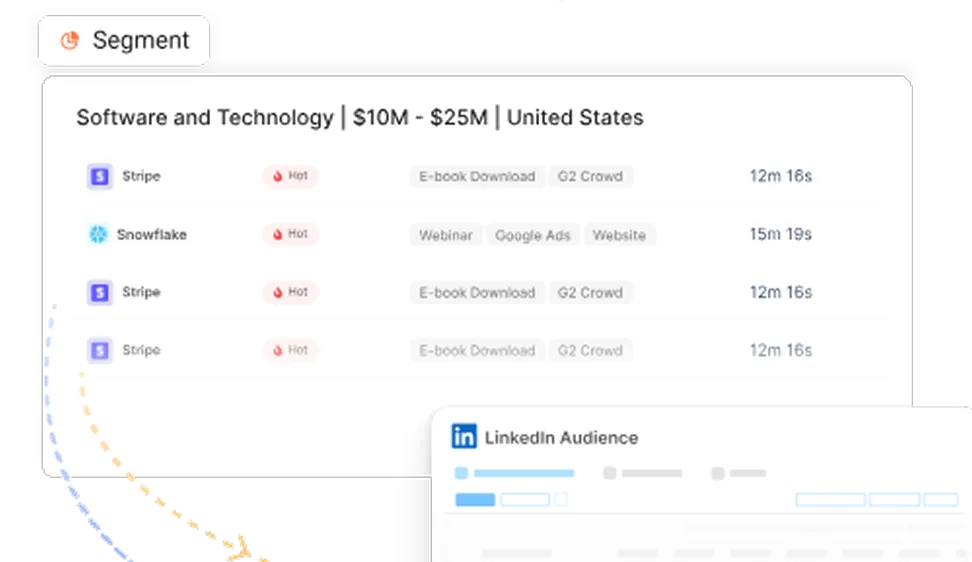


.avif)

See Factors in action.
Schedule a personalized demo or sign up to get started for free
LinkedIn Marketing Partner
GDPR & SOC2 Type II

.svg)



.avif)

