
AI marketing personalization: how B2B teams scale relevance without losing the human touch
Learn how AI marketing personalization works, top use cases, tools, frameworks, and examples to drive pipeline, not just engagement.
.avif)
Content Marketer



.svg)


TL;DR
• AI marketing personalization is now a signal interpretation problem, and most B2B teams are still personalizing the wrong things at the wrong stage.
• Behavior beats demographics almost every time; two buyers in different industries researching the same problem often have more in common than two buyers in the same industry with different priorities.
• The best personalization tool is often the one connected to the most trustworthy data, because bad data in means bad personalization out, full stop.
• Gartner's 2025 research found that traditional personalization generates negative experiences for 53% of customers; the line between "relevant" and "creepy" is thinner than most teams realize.
• The companies winning in 2026 won't necessarily know more about their buyers. They'll act on signals faster than everyone else, and that structural speed advantage is the real competitive moat.
Spotify knows I'm about three sad songs away from listening to an entire album I haven't touched in five years.
It doesn't know me because I filled out a survey… but knows me because it pays attention to patterns.
B2B marketing has spent years trying to personalize experiences by asking buyers to fit neatly into industries, personas, and nurture tracks. Buyers, unsurprisingly, refused to cooperate.
AI flips that approach. Instead of asking who someone is on paper, it watches what they're actually doing. Which pages do they revisit? Which problems are they researching? Which signals suggest they're getting ready to buy?
That's the kind of personalization that moves pipeline, and it's very different from adding someone's first name to an email.
Come, let’s get into it.
What does AI marketing personalization mean?
AI marketing personalization uses machine learning and behavioral data to deliver relevant content, messaging, and experiences to individual buyers rather than broad segments. That's the clean definition. The more honest version is that it's the practice of figuring out what a buyer actually cares about at this moment, then acting on it before the moment passes.
Traditional personalization ran on rules. If a lead matches industry X and job title Y, drop them into email sequence Z. That logic was adequate when buying was linear and data was limited. It falls apart when a single B2B buying committee involves close to a dozen stakeholders, each consuming content across different channels on completely different timelines.
Personalization, segmentation, and customization are not the same thing, though they're often used interchangeably. Segmentation groups people by shared traits. Customization lets users configure their own experience. Personalization predicts what someone needs and delivers it proactively. AI-driven personalization goes a step further by layering predictive models, behavioral signals, and real-time adaptation on top of that, at a scale no human team could replicate manually.
A few concepts worth clarifying early. Predictive personalization uses historical patterns to anticipate what a buyer will need next. Behavioral personalization responds to what someone is doing right now, like which pages they're visiting or what content they're spending time on. Intent-driven personalization goes a level deeper, interpreting research behavior to infer where someone sits in their decision process. Real-time personalization combines all three and acts on them instantly, across channels.
Why is the old playbook falling apart?
For years, B2B teams built personalization strategies on static buyer personas, fixed nurture tracks, and industry-based segmentation. Those methods worked when buying was simpler and the bar for "relevant" was lower. Neither of those conditions holds anymore.
Static personas are typically updated once a year, constructed from internal assumptions and occasional surveys, then published as PDF documents that most of the organization ignores within a week. By the time they're distributed, buyer behavior has already shifted. The document describes who your buyers were, not who they are now.
One thing I've noticed after years of running campaigns: marketers consistently overestimate how much industry matters and underestimate how much behavior matters. Two SaaS buyers in the same segment can have wildly different priorities. Meanwhile, a SaaS marketer and a fintech marketer both researching multi-touch attribution may have almost identical intent patterns. AI exposes this gap without mercy, because it doesn't care about the categories you've built. It looks at what people are actually doing.
The data availability problem compounds this. Many B2B marketers are still grappling with a foundational gap: 18% cite incomplete data as their single biggest barrier to confident decision-making. You can have the most sophisticated personalization engine in the market, but if the data feeding it is patchy, you're just automating irrelevance faster.
How does the AI personalization stack actually work?
The technology powering AI-powered personalization has evolved from a single tool into a layered system. Think of it as a framework with five stages: Data, Signals, Intelligence, Personalization, Measurement. Weakness in any one of them degrades everything downstream.
The data layer includes your CRM, website analytics, product usage data, ad engagement metrics, and email patterns. The signals layer extracts meaning from that data, identifying patterns like increased page visits from a specific account, repeated engagement with pricing content, or a buying committee showing up at three consecutive webinars. The intelligence layer is where AI models sit, interpreting those signals and predicting outcomes like conversion likelihood or expansion potential. The personalization layer acts on those predictions across channels. And the measurement layer closes the loop by attributing results back to specific personalization efforts.
AI personalization engines sit at the center of this stack. They ingest data from multiple sources, apply machine learning models, and output decisions about what content or experience to deliver and when. They replace the hundreds of manual rules teams used to build and maintain, which is genuinely one of the most underrated operational benefits of AI personalization.
Factors.ai fits into this stack by combining website behavior, company intelligence, CRM stages, campaign engagement, and attribution data into a single layer. That combination creates richer personalization opportunities because the system isn't working with fragments. It sees the full picture: which accounts are showing intent, where they are in the pipeline, and which touchpoints are driving progression.
How does AI marketing personalization actually work?
There's a persistent misconception that AI creates personalization. It doesn't. AI identifies patterns humans would never find manually. The personalization is the output. Understanding that distinction changes how you evaluate tools, set expectations, and measure success.
• Step 1: Collect signals. AI systems ingest behavioral data from every available touchpoint, including page visits, ad clicks, webinar attendance, content downloads, and email interactions. The broader and more connected the data, the better the signal quality.
• Step 2: Identify patterns. Once data flows in, AI detects clusters of behavior that indicate buying intent, account interest, or likely next actions. This is where machine learning earns its place, by surfacing correlations across thousands of interactions that no analyst could spot manually.
• Step 3: Predict outcomes. Pattern recognition feeds prediction models that estimate conversion likelihood, pipeline creation probability, and expansion potential. AI-driven sales forecasting now achieves 79% accuracy compared with 51% using traditional methods. That gap isn't minor.
• Step 4: Trigger personalized experiences. Predictions become actions: ads, website content, email sequences, sales outreach scripts, chatbot conversations. The best systems coordinate these so the buyer experiences a coherent journey rather than disconnected touchpoints from different tools that don't talk to each other.
Ten high-impact AI personalization use cases in B2B marketing
AI-powered personalized marketing campaigns show up across nearly every B2B function now. Here are the ten use cases where the impact is most tangible.
- Dynamic website experiences. AI adjusts what a visitor sees based on their company, behavior, and funnel stage. A first-time visitor from an enterprise account might see case studies from similar companies. A returning visitor from a known account sees pricing details and demo CTAs.
- AI personalized email marketing. Instead of fixed nurture tracks, AI selects the next communication based on engagement patterns and predicted interest. Subject lines, send times, and content blocks all adapt dynamically.
- Account-based advertising. AI matches ad creative and messaging to specific accounts based on intent signals and engagement history. AI-driven ABM delivers 10 times higher engagement rates and faster pipeline velocity.
- Sales outreach personalization. AI generates context-rich talk tracks and email templates for sales reps based on what the account has been researching and engaging with. Personalized outreach achieves 15% to 25% response rates compared with 3% to 5% for generic approaches.
- Content recommendations. AI surfaces the most relevant next piece of content based on consumption history and funnel stage, replacing static resource libraries with something that actually adapts to the reader.
- Conversational AI. By 2026, topical AI assistants guide prospects through complex buying decisions, personalize content recommendations, and qualify leads without human handoff. They've moved well past answering FAQs.
- Lead scoring. AI replaces manual scoring models with dynamic models that incorporate behavioral signals, intent data, and engagement velocity. Companies using AI-driven lead scoring have seen a 51% increase in lead-to-deal conversion rates.
- Journey orchestration. AI maps and adjusts buyer journeys in real time, coordinating touchpoints across marketing and sales so the buyer experiences a connected path rather than isolated campaigns.
- Predictive nurture streams. Instead of moving everyone through fixed sequences, AI predicts the optimal next action for each individual. Some contacts skip stages entirely. Others receive different content than their segment peers because their behavior warrants it.
- AI content personalization. AI content personalization tools dynamically assemble pages, emails, and assets from modular content blocks based on who's viewing them. This is where the concept moves from interesting to operational.
23% of B2B marketers are already using AI specifically to hone messaging and develop campaigns that meet buyers where they are. Each of these use cases compounds when multiple systems share the same data layer, which is why data architecture matters more than any individual tool.
Personalizing across the full buyer journey, not just the end of it
Most companies personalize too late. They wait until the demo request or the hand-raise form, then scramble to make the experience feel tailored. By that point, the buyer has already formed opinions, compared competitors, and probably built a shortlist. B2B buyers now make first contact at 61% of the journey, down from 69% the year before. The shortlist is often locked before you even know someone's looking.
The best AI personalized marketing strategies start at the first anonymous website visit, before a form is filled, before a name is captured. AI can identify the company behind an anonymous visit, infer intent from pages viewed, and trigger an appropriate response, whether that's adjusting website content, adding the account to a targeted ad campaign, or alerting a sales rep.
| Buyer journey stage | Personalization opportunity | AI role |
|---|---|---|
| Awareness (anonymous) | Website content adaptation, account-level ad targeting | Company identification, behavioral clustering |
| Consideration (known) | Content recommendations, personalized email sequences | Intent scoring, next-best-action prediction |
| Decision (engaged) | Custom demos, tailored ROI models, rep outreach | Pipeline prediction, buying committee mapping |
| Post-sale (customer) | Expansion content, usage-based triggers, renewal campaigns | Churn prediction, upsell scoring |
Why static buyer personas are making your targeting worse
Traditional buyer personas fail for a specific, predictable reason: they're frozen in time. Built from surveys and internal assumptions, updated maybe once a year, and often distributed as static PDFs that live on a shared drive nobody opens. They represent what buyers were rather than what they are right now.
AI-driven buyer personas work differently. Instead of starting with demographics and guessing at behavior, AI starts with behavior and lets clusters emerge naturally. These behavioral clusters form around intent patterns, content consumption trends, and buying committee signals, not job titles and revenue ranges.
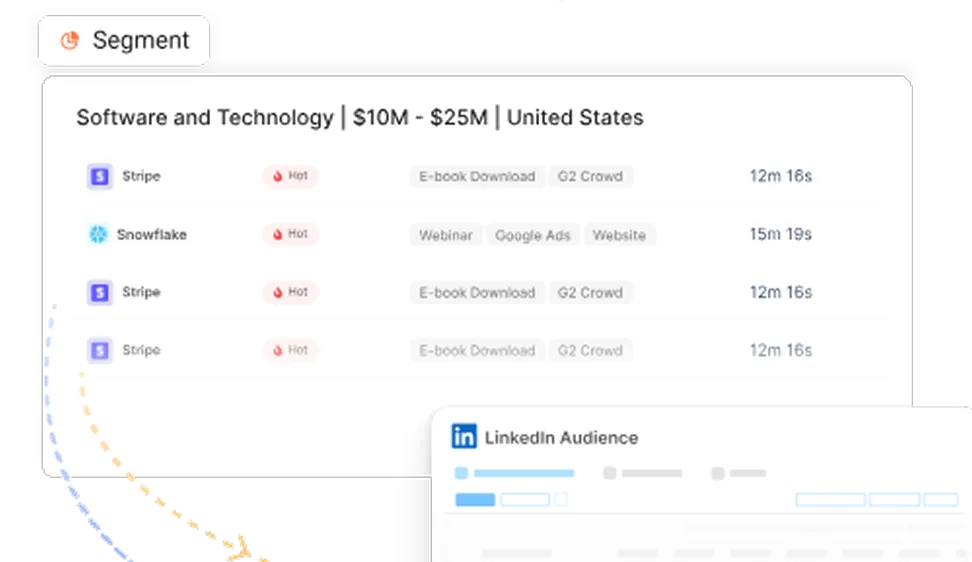
Factors.ai enables this shift through dynamic ICP scoring, which updates continuously as new signals arrive. Intent-based account prioritization surfaces the accounts showing real research activity, not just the ones that look right on paper. Behavioral account segmentation groups accounts by what they're doing, which often reveals buying patterns that firmographic-only segmentation completely misses.
The future of buyer persona development isn't better PDFs. It's living definitions that evolve every day based on real behavior. When your ICP definition changes automatically as market conditions shift, you stop chasing yesterday's buyers and start engaging today's.
The AI personalization tools worth knowing about
| Category | Tools | What they do |
|---|---|---|
| Website personalization | Optimizely, Dynamic Yield, Bloomreach | Adapt on-site content, CTAs, and layouts based on visitor data |
| Email personalization | HubSpot, ActiveCampaign, Customer.io | Dynamic email content, optimized send times, behavioral triggers |
| ABM personalization | Factors.ai, 6sense, Demandbase | Account identification, intent-based targeting, buying group analysis |
| Content personalization | Mutiny, PathFactory | Personalized landing pages, content recommendations, guided journeys |
| Enterprise personalization engines | Salesforce Einstein, Adobe Experience Platform, SAP Emarsys | Full-stack personalization, cross-channel orchestration, AI decisioning |
The best AI-driven marketing personalization tools are almost always the ones connected to the most trustworthy data. Sophisticated AI plus bad data still produces bad personalization. The evaluation process for any personalization tool should start with data connectivity: can it access your CRM, your ad platforms, your website analytics, and your product usage data?
What do the best AI personalization campaigns look like?
AI marketing personalization examples are more instructive when you study the pattern behind them rather than the brand name attached.
Adobe has built its entire marketing stack around Experience Platform, which uses AI to unify customer profiles and orchestrate personalized experiences across web, email, and advertising. They introduced the Experience Platform Agent Orchestrator at Summit 2025, with ten purpose-built agents for specific challenges. HubSpot has embedded AI deeply into its CRM and email tools, making AI personalized email marketing accessible to mid-market teams who don't have dedicated data science resources.
On the B2C front, consumer brands such as Netflix and Amazon offer lessons that B2B teams consistently underestimate. Netflix's recommendation engine drives over 80% of the content watched on its platform, not because it knows more about viewers than competitors, but because it acts on that knowledge faster.
The pattern worth borrowing for B2B: recommendation engines, continuous experimentation, and real-time adaptation aren't consumer luxuries. They're infrastructure worth building toward.
How to actually measure whether AI personalization is working
My biggest issue with personalization reporting is that most teams stop at opens and clicks. If personalization doesn't improve pipeline quality, it's decoration.
- Level 1: Engagement metrics. Open rates, click-through rates, time on page, content consumption depth. These are table stakes, useful for signal validation but dangerous if treated as end goals.
- Level 2: Revenue metrics. Influenced pipeline, opportunity creation rates, average deal size changes. These tell you whether personalization is affecting deals that actually matter.
- Level 3: Pipeline metrics. Win rates, deal velocity, stage progression rates, sales cycle compression. These measure whether personalization is making the buying process faster, not just more engaging.
- Level 4: Efficiency metrics. Cost per opportunity, marketing-sourced versus marketing-influenced pipeline ratios, CAC trends. These tell you if personalization is improving unit economics, not just top-line volume.
An AI marketing personalization dashboard should present these four levels in relationship to each other, because isolated metrics deceive. A 40% increase in email clicks means nothing if pipeline velocity hasn't moved. The dashboard that earns executive trust is the one that speaks in pipeline and revenue, not engagement proxies.
Building an AI marketing personalization strategy that doesn't stall at month three
- Phase 1: Audit data sources (Days 1-15). Map every source of buyer data your organization has access to: CRM records, website analytics, ad platform data, product usage, email engagement, and intent signals. Identify gaps, duplicates, and integration barriers. You can't personalize what you can't see.
- Phase 2: Identify personalization opportunities (Days 16-30). Based on your data audit, determine where personalization can create the most friction reduction. Focus on the moments that matter: the first website visit, the transition from mid-funnel to bottom-funnel, the handoff from marketing to sales.
- Phase 3: Prioritize revenue impact (Days 31-45). Not all personalization opportunities are equal. Rank them by expected impact on pipeline velocity, conversion rates, and deal size. Start with the one or two use cases that connect most directly to revenue.
- Phase 4: Implement AI models (Days 46-60). Deploy AI tools for your highest-priority use cases. This might mean activating intent-based ad targeting, building dynamic email sequences, or implementing website personalization for target accounts.
- Phase 5: Measure incremental lift (Days 61-75). Compare personalized experiences against non-personalized baselines. Measure at the pipeline level, not just engagement. If personalization isn't moving revenue metrics, adjust the models or the data inputs before expanding.
- Phase 6: Scale across channels (Days 76-90+). Once you've validated lift in one channel, extend the same data and intelligence layer to adjacent channels. This is where Factors.ai adds particular value, because intent signals, account intelligence, attribution data, and ad activation can work together inside a unified workflow.
Enterprise teams typically need six to twelve months for full-stack personalization deployment, primarily because data governance, privacy compliance (GDPR, CCPA, EU AI Act), and organizational alignment add complexity. The key is maintaining momentum by showing pipeline impact at each stage.
AI personalization trends
The AI personalization trends landscape is shifting in ways that go well beyond incremental improvement. Here's what I'd actually pay attention to.
- From segments to individuals. Agentic AI makes true 1:1 personalization operationally feasible for brands that have the behavioral data infrastructure to support it. We're moving from segment-based logic to genuine individual-level decisioning.
- Real-time personalization as table stakes. By 2026, buyers expect personalized touches at every stage of their journey. If you're not doing this already, you're behind baseline, not ahead of the curve.
- Agentic personalization. AI agents are taking on autonomous roles in marketing by performing complex tasks like data analysis, personalization, and campaign optimization independently. 34% of enterprise marketing teams already run at least one autonomous agent in production.
- Cross-channel journey orchestration. The convergence of adtech and martech means personalization becomes universal. The same intelligence powering your email should power your media, your website, your offers, and your sales conversations.
- Predictive content experiences. AI doesn't just recommend existing content. It predicts what content should exist based on gaps in the buyer's consumption pattern, then helps generate it.
- Intent as the primary trigger. Intent data is replacing firmographic data as the default starting point for personalization. ABM programs built from the ground up with AI at their core will outperform those with AI bolted on.
The AI marketing personalization story for 2026 isn't about more personalization. It's about faster personalization. The companies that win won't necessarily know more about buyers. They'll simply act on signals faster than everyone else, and that speed becomes a structural advantage competitors can't easily replicate.
FAQs for AI marketing personalization
Q1. What is AI marketing personalization?
AI marketing personalization is the use of machine learning and behavioral data to deliver tailored content, messaging, and experiences to individual buyers across channels. It goes beyond rule-based personalization by continuously learning from buyer behavior, predicting what each person needs next, and adapting in real time without requiring manual intervention for every decision. The difference from traditional personalization is adaptiveness: instead of a fixed sequence, the experience evolves based on what the buyer is actually doing.
Q2. How does AI improve personalization in marketing?
AI improves personalization by processing thousands of behavioral signals simultaneously, detecting patterns that human analysts can't see, and predicting outcomes with increasing accuracy. It enables personalization to operate at individual scale rather than segment scale, and it collapses the time between recognizing a buying signal and acting on it. In competitive B2B markets, that speed matters more than most teams realize.
Q3. What are the best AI marketing personalization tools?
The best tools depend on your use case. For website personalization, Optimizely, Dynamic Yield, and Bloomreach lead the category. For email, HubSpot and ActiveCampaign offer strong AI capabilities. For ABM and account-based personalization, Factors.ai, 6sense, and Demandbase are the key players. For enterprise-wide orchestration, Salesforce Einstein and Adobe Experience Platform provide the deepest feature sets. The right choice comes down to data connectivity and integration depth with your existing stack.
Q4. Can AI personalize B2B marketing campaigns?
AI can personalize virtually every element of a B2B marketing campaign, from the ads a target account sees, to the website experience they receive, to the email sequences they're enrolled in, to the sales outreach they get. The key requirement is connected data. AI needs access to behavioral signals, CRM data, and intent data to deliver relevant personalization, and without that foundation, the results will be underwhelming regardless of the tool.
Q5. How does AI content personalization work?
AI content personalization works by dynamically assembling content experiences from modular blocks based on who's viewing them. Rather than creating entirely unique pages for each visitor, AI selects and arranges pre-built content components, like headlines, case studies, CTAs, and product descriptions, based on the viewer's company, behavior, funnel stage, and predicted needs. The result is an experience that feels individually relevant without requiring a unique page for every account.
Q6. What's the difference between AI personalization and traditional segmentation?
Traditional segmentation groups buyers into static categories based on demographics or manual rules, and delivers the same experience to everyone in the segment. AI personalization starts with individual behavior and dynamically adjusts experiences based on real-time signals. Segmentation is a snapshot. AI personalization is continuous and constantly evolving based on what each buyer is doing right now. One is built on who someone is on paper, and the other is built on what they're actually doing.
Q7. How do you measure the ROI of AI personalization?
Measure ROI across four levels: engagement metrics (opens, clicks, time on page), revenue metrics (influenced pipeline, opportunity creation), pipeline metrics (win rates, deal velocity, stage progression), and efficiency metrics (cost per opportunity, CAC trends). The most important measurement is the pipeline-level impact. If personalization improves email clicks but doesn't accelerate deals or increase win rates, it's not delivering real ROI regardless of what the engagement dashboard shows.
Q8. What are examples of AI-powered personalized marketing campaigns?
Adobe uses its Experience Platform Agent Orchestrator to manage specialized AI agents that personalize website content, experimentation, and offer management at scale. HubSpot's AI-powered email tools dynamically adjust content, subject lines, and send times based on individual engagement patterns. In B2B SaaS, companies using Factors.ai combine intent signals with account intelligence to trigger personalized ad campaigns and sales outreach for accounts showing active research behavior, connecting anonymous website activity to downstream pipeline outcomes.
Q9. How can enterprise marketing teams implement AI personalization safely?
Start with a data governance framework that defines what data AI can access, what decisions it can make autonomously, and where human review is required. Comply with GDPR, CCPA, and the EU AI Act from day one. Deploy AI in bounded, low-risk areas first, like content recommendations or email optimization, and expand decision authority as you validate outputs and build organizational trust. Privacy compliance isn't just a legal requirement. It's a competitive advantage that builds buyer confidence over time.

See how Factors can 2x your ROI
Boost your LinkedIn ROI in no time using data-driven insights


.avif)

See Factors in action.
Schedule a personalized demo or sign up to get started for free
LinkedIn Marketing Partner
GDPR & SOC2 Type II

.svg)



.avif)

