
Good Reads
Fix pipeline pains. Solve GTM puzzles. Read strategic brain dump.
Written for marketers who want real solutions to a leaking pipeline (and their dark circles).
Want to read more from us?

I’m looking for…

What is GTM Engineering
Learn how GTM engineering automates sales and marketing workflows using AI, data, and systems thinking, turning buyer intent into real pipeline.

TL;DR
- GTM engineering automates your GTM motion, connecting data, AI, and workflows to replace manual revenue processes.
- It goes beyond traditional RevOps; GTM engineers build systems that trigger real seller actions, not just dashboards.
- Real-time orchestration means faster pipeline: website visitor identification, contact and account scoring, and next-step triggers fire within minutes.
- Skills span both code and conversion: GTM engineers wire APIs and AI while knowing what drives meetings and deals.
If your go-to-market still runs on spreadsheets, heroics, and ‘’just one more manual export,’’ GTM engineering is how you swap duct tape for durable systems.
Good news, there is a better way to do it. GTM engineering blends technical chops with revenue strategy to automate and scale buying journeys, from the first signal of intent to a closed-won deal (and the renewals after). Put simply, you create systems that help the work get done, not just dashboards that tell you what’s happening.
Introduction to GTM engineering
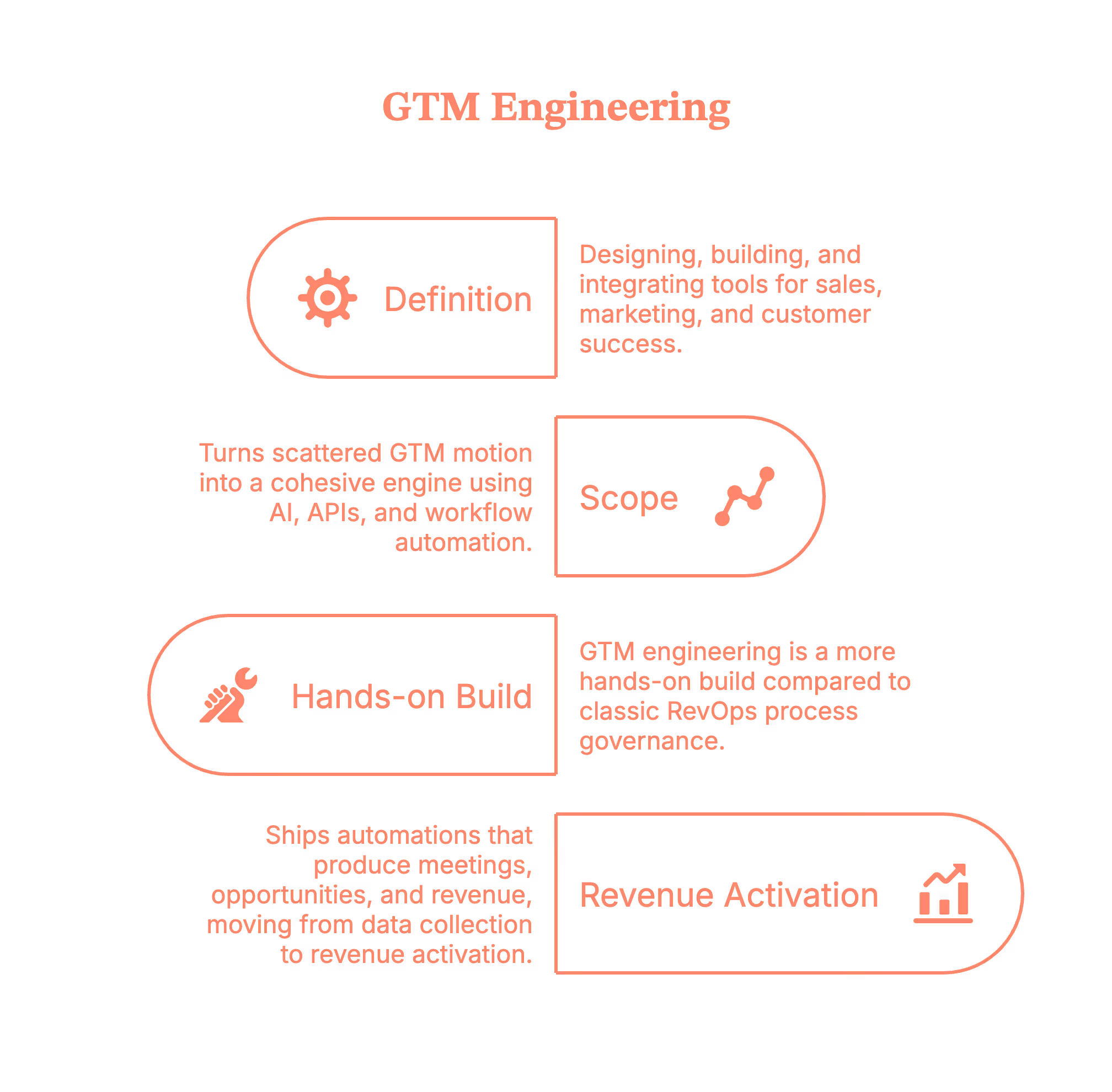
GTM engineering is the discipline of designing, building, and integrating the tools, data pipelines, and automations that power sales, marketing, and customer success. It turns scattered GTM motion into a cohesive engine using AI, APIs, and workflow automation.
Not ‘just RevOps.’ Compared to classic RevOps process governance, GTM engineering is a more hands-on build: it ships automations that produce meetings, opportunities, and revenue, moving from data collection to revenue activation.
Why has GTM engineering surged since 2023
AI agents, better enrichment, and a rising appetite for automation proved that more effort won’t fix manual research, slow campaigns, or dirty data; better systems will. Teams that adopted GTM engineering began connecting intent signals to seller actions in minutes, rather than days.
In plain English, a GTM engineer connects the dots between intent signals, AI agents, and your stack so your team acts faster, smarter, and at scale.
Related read: Top GTM engineering tools for marketing teams.
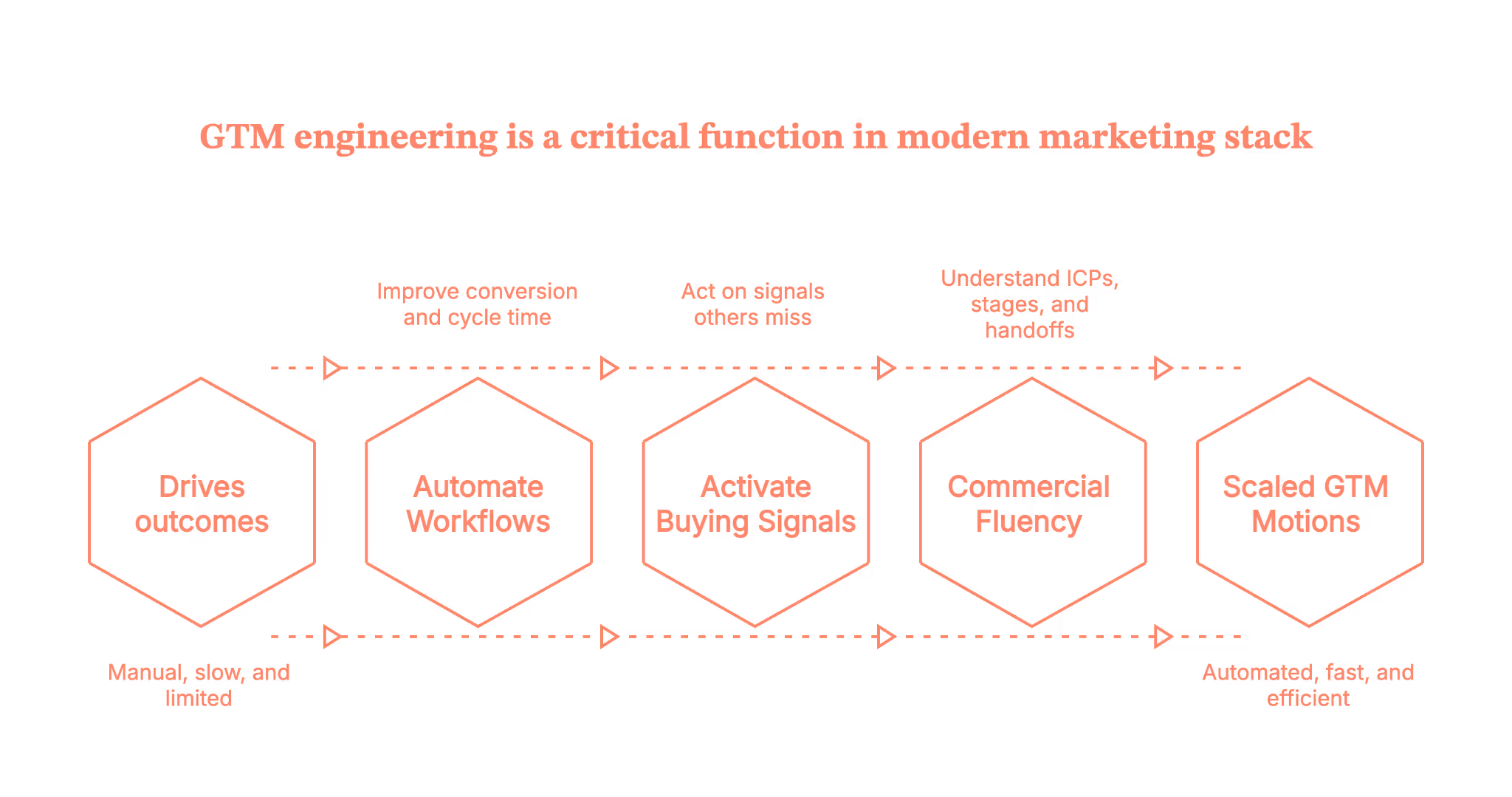
GTM engineering is a critical function in your modern marketing stack (and why it matters)
- Drives outcomes, not just visibility. Workflows improve conversion and cycle time (vs. more reporting).
- Automates & scales GTM motions (lead capture, enrichment, scoring, routing, outreach, follow-ups) with AI and integrations.
- Creates advantage by activating buying signals others miss, or can’t act on quickly.
- Requires commercial fluency across ICPs, stages, and handoffs; it’s technical and revenue-literate.
In practice, this is real-time intent alerts, with waterfall enrichment, and agents that identify website visitors, prioritize contacts, and trigger outreach, without headcount chaos.
The GTM engineer’s role in RevOps (Revenue Operations)
GTM engineers sit inside/alongside RevOps and work with Sales, Marketing, and CS to turn strategy into systems:
- Design & implement automations for enablement, scoring, and deal-flow orchestration (score → route → sequence → alert).
- Own data hygiene (normalization, de-dupe, identity resolution) and build repeatable processes that scale.
- Integrate AI & 3rd-party data to increase pipeline velocity and lift conversion rates.
Copy-paste-able patterns you can ship:
- Instant Slack/Teams intent alerts when target accounts spike.
- Website Visitor Identification → infer likely account + roles/geo/pages → trigger compliant outreach. Read more about this on our blog Website visitor to warm outbound play using GTM engineering services.
- Contact relevance & tiering agents → surface buying-committee contacts with talking points + priority scores.
- Account tiering & ICP qualifiers combine job changes, hiring, and funding signals to prioritize and route.
GTM engineering pods & collaboration (How teams actually work)
A modern GTM pod typically includes GTM engineers + AEs/SDRs + Growth/Marketing + RevOps:
- Engineers build the data/automation backbone.
- Sales & SDRs act on actionable signals (not noisy alerts).
- Marketing fuels and personalizes customer journeys with the right content at the right moment.
CS is stage two of the pipeline: post-meeting engagement alerts, closed-lost re-engagement when old opps return, and nurture flows that share the same orchestration fabric, so handoffs feel seamless.
What great GTM engineers know (skills that move revenue)
- Software/data engineering basics to wire APIs, webhooks, events, and identity resolution.
- AI/automation: design agents and low/no-code workflows (LLMs, enrichment, routing, content).
- Commercial judgment across ICP, stages, attribution, and prioritize what creates the pipeline.
- Enrichment that activates revenue: use waterfall enrichment to lift coverage, then pipe verified data into CRM for scoring and triggers (vs. letting fields rot).
The GTM tech stack for the growth teams
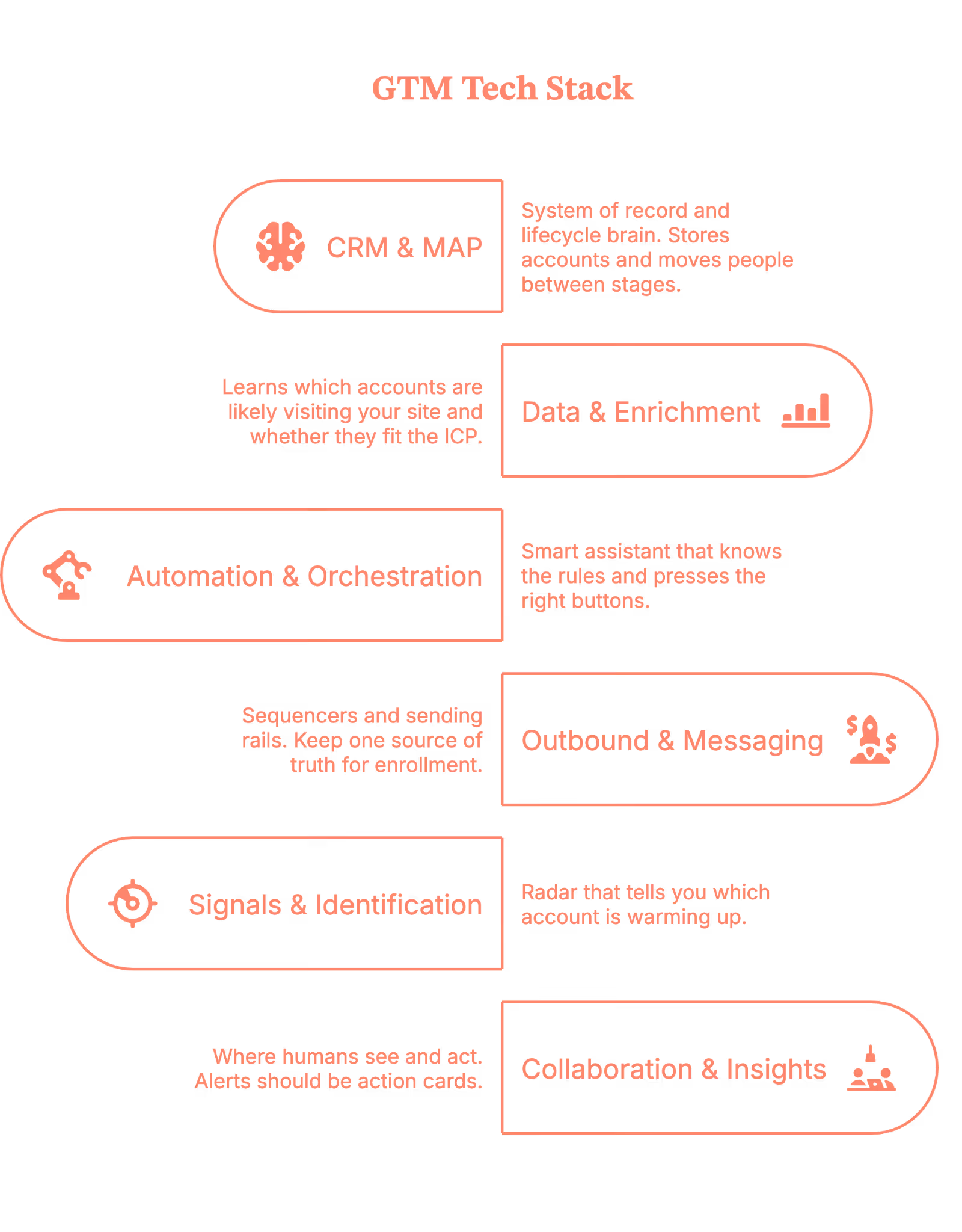
Here’s the GTM tech stack in plain language, what each layer actually does, how they work together, and what ‘good’ looks like.
1. CRM & MAP (Salesforce/HubSpot + lifecycle automation)
- Your system of record and lifecycle brain. It stores accounts/contacts/opportunities and moves people between stages (Lead → MQL/SQL → Opportunity → Customer).
- When a form is submitted or a meeting is booked, lifecycle rules update status, owners, and SLAs.
Tip: Keep fields opinionated, enforce deduplication on email and domain, and make lifecycle state changes idempotent so that retried events don’t double-create leads.
2. Data & Enrichment (Clay + providers, Clearbit/ZoomInfo/Factors.ai equivalents, product telemetry)
- This is how you learn which accounts are likely visiting your site and whether they fit the ICP.
- Use waterfall enrichment (try provider A, then B, then C) and log provenance.
- Bring in product telemetry (such as trials and feature use) as an intent signal, not just web visits.
- Treat each attribute with a trust tier (e.g., Tier 1 = verified, Tier 2 = inferred), so your account scoring and routing can prefer higher‑confidence data.
3. Automation & Orchestration (Make/Zapier; LLM agents for research, message generation, routing)
- You can think of this like a smart assistant. When something happens, it knows the rules and presses all the right buttons for you across your tools.
- LLM agents can draft research, prioritize contacts, or propose next steps, but wrap them with guardrails (templates, allow‑listed claims, retrieval) and idempotency (an action key so the same event won’t trigger twice if it’s retried).
4. Outbound & Messaging (Outreach/Salesloft/Apollo, Smartlead, LinkedIn workflows)
- Your sequencers and sending rails. Keep one source of truth for enrollment to avoid double‑sequencing someone from two tools.
- Personalize with structured snippets (why now, why us) coming from the decision engine rather than free‑text improvisation.
5. Signals & Identification (website visitor ID, job‑change alerts, funding/hiring signals)
- This is your radar. Reverse‑IP/site ID and partner/product signals tell you which account is warming up.
- External signals (job changes, funding, hiring) add a ‘why now’ context. Debounce short‑burst activity so a 3‑page refresh doesn’t look like a spike.
6. Collaboration & Insights (Slack/Teams alerts, dashboards, pre‑call intelligence)
- Where humans see and act. Alerts should be action cards (account, reason, recommended next step, SLA timer) rather than FYIs.
- Dashboards display system health (coverage, routing accuracy, and p95 time-to-first-touch) and business impact (meetings/100 ICP visits and win rate by tier).
How GTM Engineers Drive Impact (with examples)
- Faster speed‑to‑lead: real‑time alerts + auto‑assembled context → SDRs act in minutes, not days.
- Higher coverage: visitor identification + relevance & tiering agents surface the right people inside the right accounts.
- Predictable routing & follow‑through: ICP qualification and geo rules route to the right owner with no manual triage.
- Closed‑lost resurrection: alerts when old prospects return, with page‑level intent for tailored follow‑up.
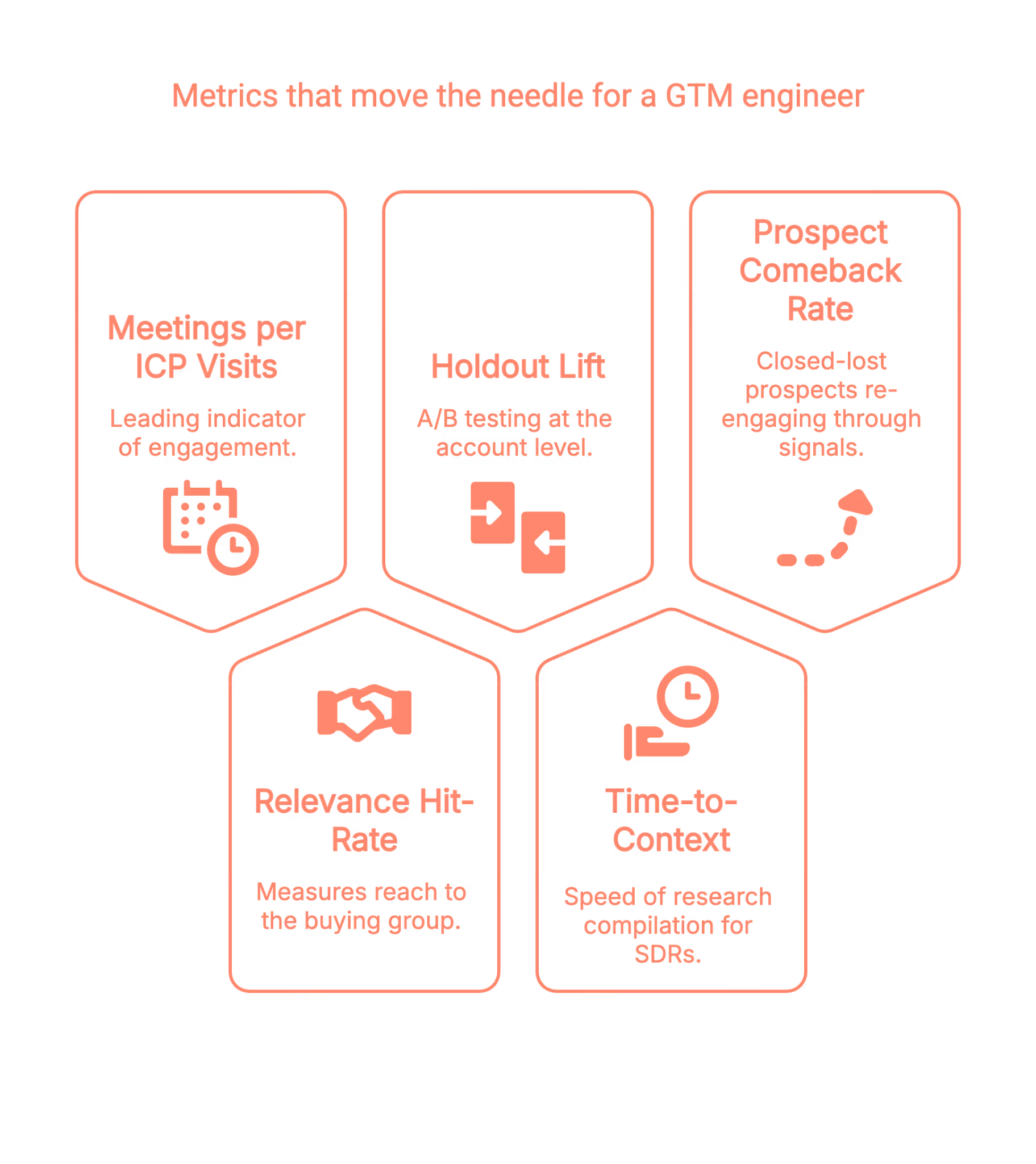
Metrics that actually move the needle for a GTM engineer
- Meetings per 100 ICP visits (leading indicator).
- Relevance hit‑rate (did we reach the buying group?).
- Holdout lift (A/B at account level).
- Time‑to‑context (seconds to compile research for an SDR).
- Prospect comeback rate (closed‑lost that re‑engaged through signals).
Introducing GTM Engineering services from Factors.ai
Picture this: your SDR opens Slack to a single alert that says which account just spiked, who likely visited, why they care, and the next best step.
That’s Factors.ai’s GTM Engineering in action, real-time alerts, ICP-aware scoring, and write-backs to your CRM so warm outbound actually scales.
Here’s the kicker: we don’t just ‘alert and pray.’ Factors.ai identifies up to 75% of visiting accounts (versus ~8–10% with person-level tools), and even pinpoints up to 30% of the likely contacts behind those visits, so reps reach the right people quickly. Teams using these workflows engage up to 3× more high-fit accounts and see better ROI without adding headcount chaos.
What you get (done-for-you, not DIY): Website Visitor ID, Contact Relevance & Tiering, Account Tiering, Account Map, Meeting Assist, and Closed-Lost Re-engagement, all tailored to your ICP, sales motion, and stack, and maintained by us like an extension of your team.
Clear roles, documented workflows, and milestone tracking included (so this doesn’t die in someone’s Notion).
If you want your intent data to turn into booked meetings (not just pretty charts), book a demo, and we’ll show your accounts lighting up, with the exact contacts and talk tracks your reps can use today.
GTM Engineering Explained: The Engine Behind Scalable Revenue
GTM (Go-To-Market) Engineering is a specialized discipline that builds the technical infrastructure behind revenue operations, automating sales, marketing, and customer success activities that drive actual outcomes. Unlike traditional RevOps, which often focuses on process governance and reporting, GTM engineering is hands-on: writing automations, connecting APIs, and turning noisy signals into seller actions that generate meetings, pipeline, and revenue.
The rise of AI agents, enrichment tools, and real-time signal tracking since 2023 has made GTM engineering indispensable. It enables near-instant response to buyer intent, surfacing high-fit contacts and routing them through a streamlined system that personalizes outreach, scores leads, and triggers smart engagement, without bloated headcount or spreadsheet sprawl.
It requires a rare blend of technical fluency (in data pipelines, APIs, and LLMs) and commercial acumen (understanding ICPs, funnel stages, and conversion triggers). From website visitor ID to deal orchestration, GTM engineers build the ‘invisible systems’ that accelerate time-to-context and maximize every high-intent signal, powering both speed and precision at scale.
FAQs on GTM Engineering
Is this just RevOps with a shiny title?
No. RevOps sets rules and reporting; GTM engineering builds the software-like workflows that create pipeline. Many teams need both.
How is this different from ‘growth engineering’?
Growth engineering classically focused on product-led activation/retention; GTM engineering focuses on revenue systems across sales/marketing/CS. An overlap exists, but the scope and outputs differ.
What tools do I need?
Start with CRM, enrichment, orchestration, outreach, and alerts; add LLM agents where they remove research/writing toil.
If you have to remember just one thing, it should be this: GTM engineering turns intent signals into seller actions reliably and at scale. When the system works, your representatives talk to the right people at the right moment with the right context. The rest is just… plumbing you no longer think about.

What does the acronym SEO stand for? Explained Simply
Learn what the acronym SEO stands for, how it works, and why it’s essential for business growth and marketing success.

TL;DR:
- SEO stands for Search Engine Optimization. It is the process of improving a website’s visibility on major search engines through technical, content, and authority enhancements.
- SEO attracts organic traffic, establishes trust and credibility, and builds long-term ROI. No paying for every click.
- It operates at three levels: Technical (site performance), On-Page (content & keywords), and Off-Page (backlinks & reputation).
- Local SEO helps businesses boost visibility in location-based searches.
- AI & voice search are redefining how users discover brands. It is no longer enough to just optimize for relevant keywords and search engines.
- Tools like Google Analytics, Search Console, and Ahrefs track SEO success. A tool like Factors.ai connects SEO performance directly to revenue.
I’ve been in digital marketing for a decade. During this tenure, I’ve heard “SEO” being used to describe everything from keyword research to outright witchcraft.
You know, when people say, “Let’s do some SEO and make it rank!” like it’s a magic spell.
So, let’s clear the air.
SEO stands for Search Engine Optimization.
Those three words carry a world of discipline, art, and analytics. It can even occasionally bring you a headache or two.
But SEO is the wall between a business being found or forgotten by the right people.
Let’s talk about that.
What Does SEO Stand For?
SEO seems simple enough, but it carries the power to impact every brand’s online visibility.
Before the linguists beat me up…Yes, I know SEO is an initialism, not an acronym.
But in marketing circles, it kinda means the same thing. Please let us live; we have to optimize all day, as it is.
So when people ask, “What does the acronym SEO stand for?” what they really mean is, “What’s behind this mysterious three-letter thing every marketing person keeps mentioning?
In business, the SEO acronym for business or the SEO abbreviation has become shorthand for all the activities that help your brand get discovered online. It covers a wide range of activities, from fine-tuning a website so search engines read it better to creating content that your potential customers actually want to read.
You don’t want to miss knowing about these 5 mistakes to avoid when measuring content marketing ROI.
Imagine your website as a brilliant new restaurant hidden in a quiet street. SEO is the combination of street signs, maps, lighting, and reviews that help hungry customers find it.
Note: It’s more than “SEO = ranking higher on search engine results,”. The real story comes after the search results get you a click.
How do those visitors behave? Which pages do they engage with? Which blogs or landing pages attract the right accounts, not just random page views?
At Factors, SEO is about understanding the buyer’s digital journey and connecting it directly to revenue. We optimize for algorithms as well as outcomes.
Why SEO Matters for Every Business
Most businesses now live online. For them, search engine optimization (SEO) is marketing oxygen.
About 68% of online experiences begin with a search engine.
That means most people who click an ad, follow you on LinkedIn, or read a blog have asked Google a question to get there. If your website isn’t showing up in those results, you’re irrelevant.
I like to think of SEO as ‘digital gravity’ rather than a marketing channel. It pulls the right audience to your brand, whether you're a SaaS company in Bengaluru or a bakery in Belarus.
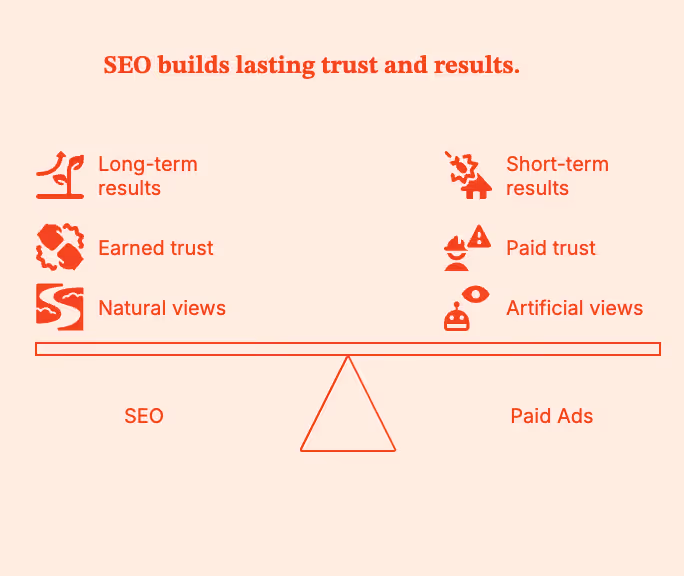
- Unlike paid ads, SEO keeps driving results in the long term. Every bit of optimization, every blog post, every backlink will keep attracting an audience.
Read: Are Google Ads Worth It? Pros, Cons & Considerations
- End-users also trust organic results more than ads, as the former are not paid for. With SEO, you don’t pay your way up on any search engine results page. You earn your spot. And nothing gathers customer trust like authenticity.
- So, “SEO acronym business” is more than a keyword. At the business level, you can’t pay your way to natural views and engagement. Instead, you help marketing and sales teams actually see how search queries can drive traffic that converts (what we do at Factors) from anonymous visitors to qualified leads.
For practically every user-facing business, SEO is a growth engine. It drives sustained, efficient outcomes and often becomes the smartest investment in the marketing budget.
The Three Words That Built the Web: Search · Engine · Optimization
The term ‘SEO’ expands into three words that really hold up the modern web (especially for businesses) as we know it. Search engine optimization is the invisible infrastructure of the internet.
So let’s break down each word for a closer look.
- Search: This is the whole reason the web exists. Forget algorithms; the foundation of the internet is humans with questions.
Every “how to,” “best software,” or “near me” reveals that a future customer is looking for a solution, an idea, or even reassurance that they’re not alone with their problem.
Good SEO starts with empathy. You have to understand what your buyer is looking for. Once you gauge the intent behind the words, you’ve won half the battle.
You need to understand user intent as closely as possible, and these Top 15 Intent Data Platforms to Boost Your B2B Sales should help.
If you’re looking for even deeper intelligence, consider this piece on Intent Scoring via Website Visitor Identification.
Note: If you can provide someone with an answer in the exact moment they have the question, you’re not selling. You’re helping.
- Engine: The “engine” in SEO is basically a top-tier matchmaking system. Search engines crawl billions of pages daily, index them like an ace librarian, and rank them based on which best answers user intent.
You can’t bribe search engines (unless you’re running ads, but they will declare it as a paid ad), but you can earn their trust by playing by certain rules.
SEO engines actually don’t care if you’re a startup or a Fortune 500 giant. If you provide better value and relevance, you zoom to the top.
- Optimization: This is what separates amateurs from pros. Your storytelling must meet science.
You can’t just sprinkle keywords and compress images to get SEO wins. Along with quality content, web pages must be fast, relevant, secure, and actually useful.
Pro-Tip: It's a good idea to take a course or do some research about how search engines work, under the hood. It gives you a serious edge over competitors when tracking and analyzing search engine rankings and algorithmic shifts.
Optimization means refining every digital molecule. This includes metadata, headings, links, load time, and content tone. The goal is to make the experience feel effortless for both search engines and people.
Here’s how to discover valuable insights about your website traffic with Factors.ai.
How SEO Works: The Three Levels You Need to Know
If you ask me, “How does SEO actually work?”, I usually answer, “like juggling flaming torches while riding a unicycle.”
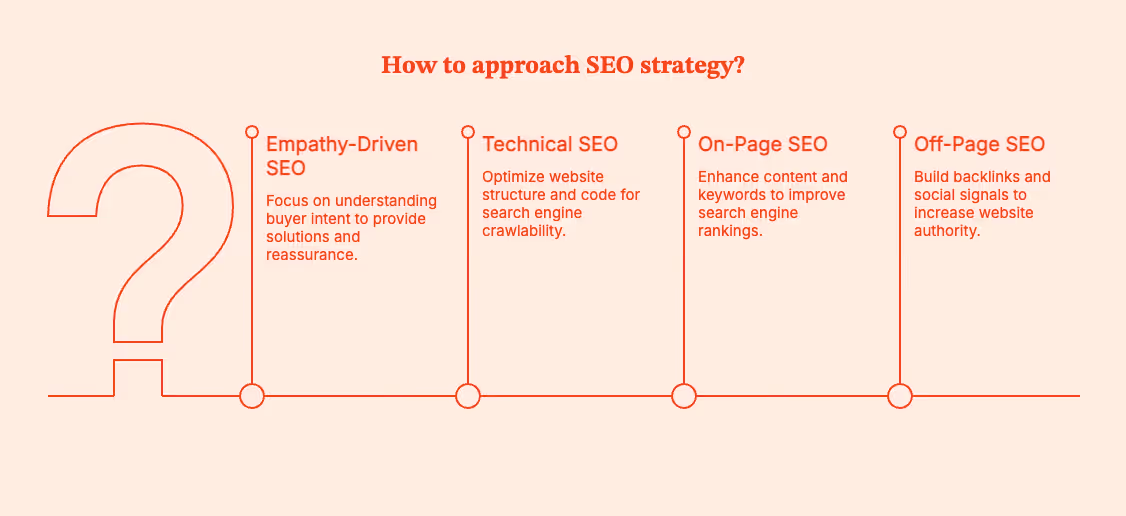
Jokes aside, SEO generally comprises three operational levels: Technical, On-Page, and Off-Page. These constitute 90% of organic growth. The rest is caffeine, and keeping up with Google’s mood swings.
Technical SEO
This is the foundation of your website’s SEO success. The best content won’t work if search engines cannot understand it. That’s where technical SEO comes in.
Here’s what to look for when optimizing technical SEO:
- Crawlability: Can search bots access your pages without hitting dead ends or redirects? Fix broken links, create a sitemap, and keep robots.txt clean to help them do so.
- Mobile-Friendliness: In the second quarter of 2025, mobile devices (excluding tablets) accounted for 62.54% of global website traffic. Your website needs to load fast and work seamlessly on mobile.
- Page Speed: Ideally, your web page should load in 2.5 seconds or less to score well on SEO parameters. Every extra second can cause users to bounce without a second glance.
- Schema Markup: The markup tells the search engine what a piece of content means. It is a standardized vocabulary of code you can add to a website's HTML so search engines really understand what they’re reading.
On-Page SEO
On-page SEO covers content quality, structure, and intent alignment.
- Write for humans, not algorithms. Your content must teach, entertain, or solve a problem.
- Keywords are not scorecards. They are meant to help search engines understand context. Prioritize clarity.
- Treat title tags and meta descriptions like billboards advertising a business on the digital highway. They should be click-worthy without being misleading.
- Use the right hyperlinks to interconnect your web pages with each other. It lets visitors find more relevant content, reduces bounce rates, and increases engagement. Google crawlers also use these links to find related pages, rank them by priority, and gauge link equity.
Off-Page SEO
These are all the actions taken outside the business website to improve its visibility, authority, and credibility in search results. Think of it as your digital reputation.
Largely, it covers:
- Quality backlinks. Don’t chase quantity. A single mention for a respected website matters more than a hundred random directory links from 2010.
- Online references. If folks online are talking about your brand organically, Google realizes that it is more credible.
- Seek (within reason and ethics) social proof in the form of reviews and positive engagement. Users trust brands that other users trust.
To stand any chance at success in the gladiatorial matches (sorry, I meant digital marketing), you have to measure SEO metrics across its three levels…and tie optimization back to ROI.
At Factors.ai, we connect the dots between SEO and business outcomes by highlighting:
- technical fixes that improved organic conversions.
- content pages that delivered qualified leads.
- backlinks that generated new opportunities in the pipeline.
B2B Teams, just starting out on SEO? Here’s a B2B SEO checklist to help you set up and hit the ground running.
Local SEO: Winning Where It Matters Most
Local SEO covers the operations you undertake so that your business shows up for customers in a specific area. For instance, does your website appear in search results when someone types “best coffee near me,” or “B2B analytics firm in Chicago” or similar search intent?
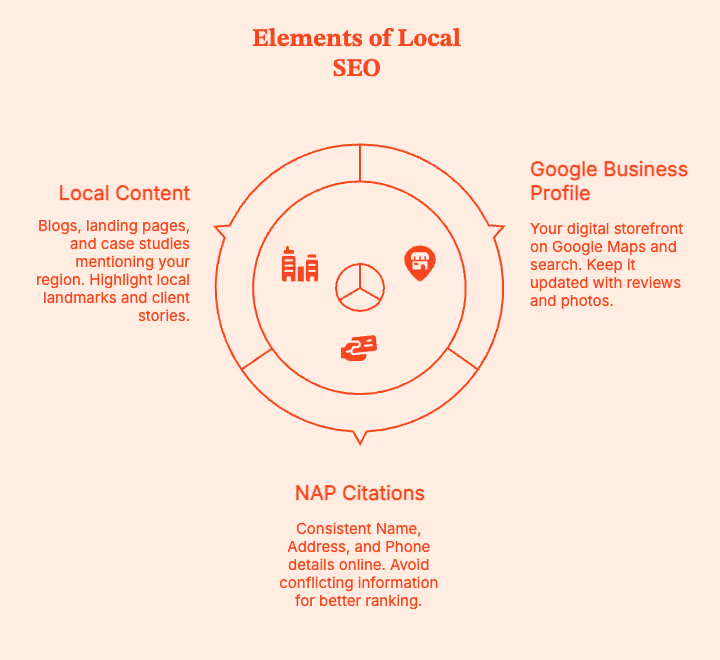
If not, you need more local SEO for your search engine marketing. Here are the basics:
- Google Business Profile (GBP): This is your digital storefront. It shows up in Google Maps, the web, and search engines to describe your business. Users will also see reviews, photos, and directions. Be sure to keep the profile updated.
- NAP citations: This includes details on your Name, Address, and Phone. These should be consistent anytime they show up online. If Google finds three different versions of your address, it will get confused and eventually de-rank your profiles or pages.
- Local content: Create blogs, landing pages, and case studies that mention your region, landmarks, or local client stories.
Local SEO works particularly well for brick-and-mortar stores, service providers, and regional B2B companies that want to capture demand close to their physical location.
At Factors.ai, we map local SEO traffic to account-level signals, so you can see which companies in which regions are engaging. With this insight, you can turn region-based visibility into sales activation.
SEO vs. SEM: How does it impact search results?
A few years ago, whenever I heard someone say, “We’ll do some SEO ads,” I wanted to correct them…with a coffee mug… to their head.
I’m calmer now. Tea helps.
SEO and SEM are related, but not the same thing.
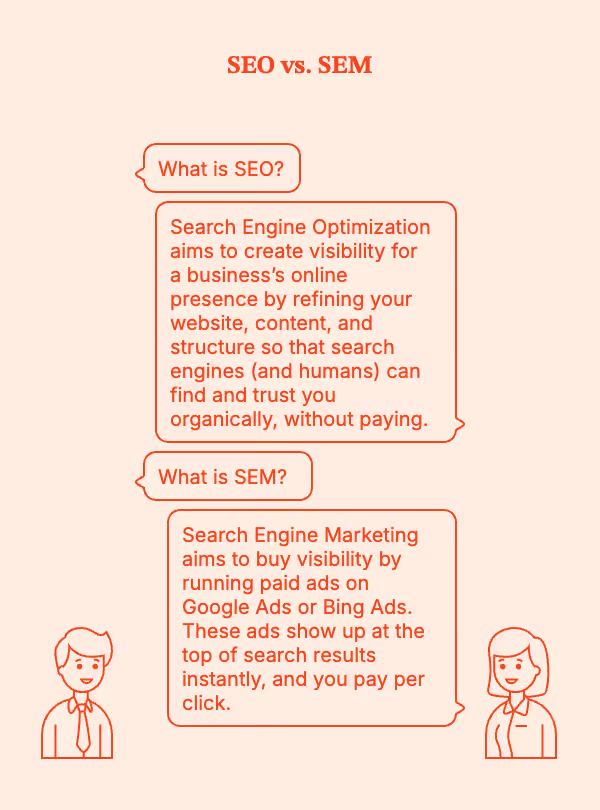
- SEO (Search Engine Optimization) aims to create visibility for a business’s online presence. You refine your website, content, and structure so that search engines (and humans) can find and trust you. And you do this organically, without paying. It’s the very definition of playing the long game.
- SEM (Search Engine Marketing) aims to buy visibility. It involves running paid ads on Google Ads or Bing Ads. These ads show up at the top of search results instantly. You pay per click.
Both are useful tactics, best combined together. SEO builds trust and long-term visibility. SEM drives quick wins and tests which ad copy converts.
Your first time with SEM? You might like our Dummies Guide to Google Ads Management.
With Factors, you can track both organic (SEO) and paid (SEM) touchpoints for a unified funnel view. You can see, for instance, how someone might first discover your brand via a blog post, click a retargeting ad later, and finally convert after an email.
Tools & Metrics: How to Measure SEO Success
You can’t manage what you don’t measure. The right tools and metrics will take SEO from a guessing game to a growth engine.
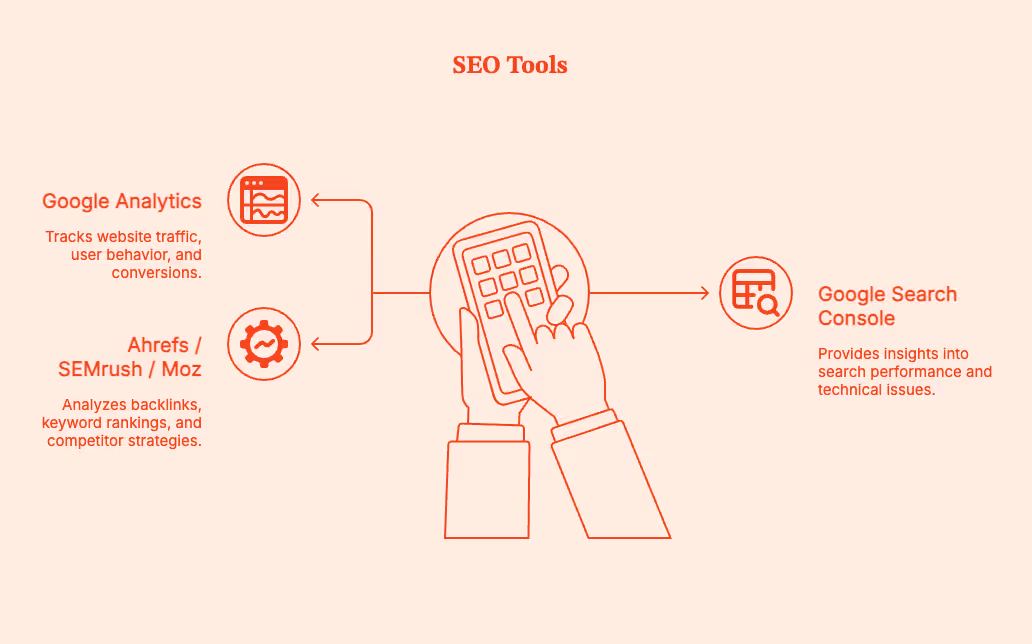
Your toolkit should have:
- Google Analytics: It tells you who’s visiting, where they came from, and what they did next. Link it with goals or events to track conversions from organic sessions.
- Google Search Console: It shows which keywords triggered impressions, what your CTR looks like, and whether technical issues might be blocking Google from indexing any pages.
- Ahrefs / SEMrush / Moz: These tools analyze backlinks, track keyword rankings, monitor domain authority, and study what’s working for competitors.
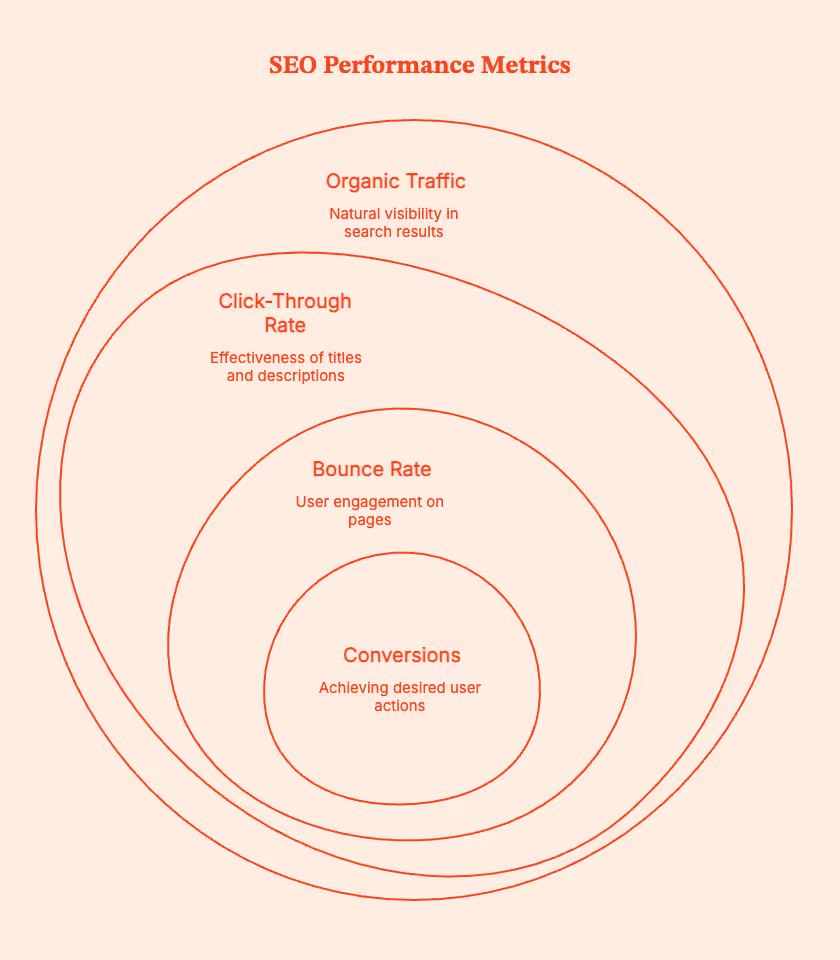
KPIs that actually matter:
- Organic traffic: Are more people finding you online naturally?
- Click-Through Rate (CTR): Are your titles and descriptions getting enough people to click on them?
- Bounce rate: Are visitors spending some time on your page, or bouncing off within seconds?
- Conversions: Are your organic visitors taking desired actions (sign up, get demo, buy)?
Factors.ai will map organic sessions to account-level data and pipeline outcomes. It will show which keywords and landing pages actually drive qualified leads. Now, instead of just saying, “SEO is working”, you can say, “SEO is directly generating $50K in pipeline this month.”
The Future of SEO: From Algorithms to AI (What It Means for Marketers)
SEO was tricky when all you had to manage was Google shuffling rankings based on keywords and backlinks. Now, search engine guidelines have gone full sci-fi (X-Files theme plays).
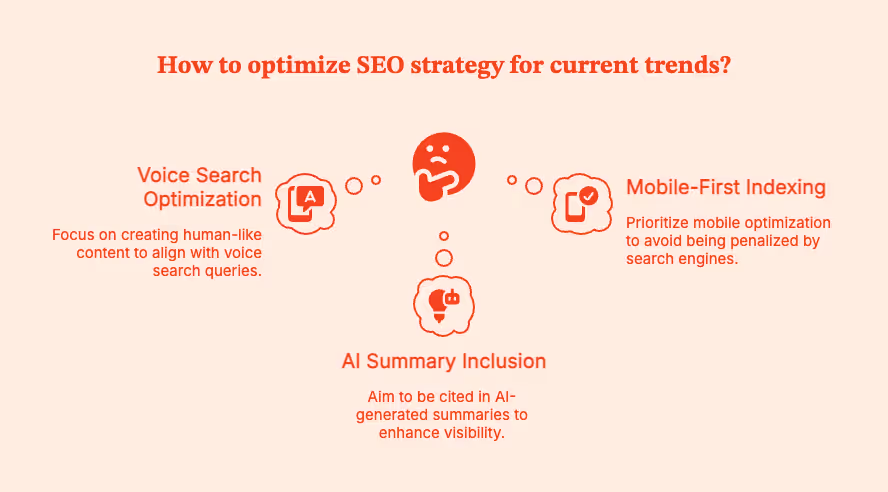
Now, we have to manage AI-driven search, voice assistants, and zero-click results. You have to expect that your audience might expect an answer before they reach your website.
Now, you’ll have to optimize for:
- Voice Search: Increasingly, people ask their AI assistants (I like Siri, but Google Home isn’t bad) questions like “What’s the best CRM for B2B marketing?” . Your content needs to sound human, not robotic. You need to write in the same way people talk.
- AI-Generated Summaries: Google’s AI Overviews now surface synthesized answers to questions on the results page. As a result, ranking logic has changed. You must aim to be cited or featured in AI summaries.
- Mobile-First Indexing: This isn’t new, but many brands still treat mobile optimization as an afterthought. Big mistake.
AI SEO is redefining what optimization means. Search engines aren’t just matching text. They can now interpret intent and context. To meet these standards, content and web page optimization have to be clearer and more structured than ever before.
More AI content also means that readers will have more trust issues around the authenticity of results. You have to work harder to establish the credibility needed for organic search traffic.
The Takeaway
Great SEO still comes down to this: create something genuinely useful, make sure people can find it, and measure the results obsessively.
SEO powers visibility, trust, and quantifiable ROI. It can help startups outshine industry giants, and local businesses dominate their competitors. When done right, SEO can be the most compounding investment in digital marketing. Each optimized page, backlink, and piece of content builds on the last.
At Factors, we focus on turning SEO into a revenue engine. We connect organic performance to pipeline, qualified accounts, and closed revenue.
In a nutshell… what does the acronym SEO stand for?
SEO stands for Search Engine Optimization. It covers all activities undertaken to improve a website’s visibility on popular search engines (Google, Bing).
These refinements help the right audiences find your brand/business naturally without paying for attention or clicks.
At its core, SEO focuses on three levels:
- Technical SEO: Checking that your site is fast, secure, mobile-friendly, and easy for search engines to crawl.
- On-Page SEO: Structuring content, meta tags, headings, and keywords to match user intent.
- Off-Page SEO: Generating trust and authority through backlinks, brand mentions, and social signals.
SEO drives organic traffic, improves brand credibility, and reduces customer acquisition cost (CAC). It delivers compounding returns. Every optimized page will continue to draw in qualified visitors long after it’s published.
Marketers must also account for Local SEO for geographic searches. They also have to optimize for AI-driven SEO, where voice queries, zero-click results, and LLM-powered search engines help people discover information.
It is essential to optimize for both humans and algorithms.
Measuring SEO success must cover the following metrics: organic traffic, CTR, engagement, and conversions. Factors.ai lets marketers connect SEO-driven sessions directly to revenue, closely measuring business impact.
SEO is a strategic growth lever. It helps your business show up when it matters most, build trust over time, and turn discovery into demand.
FAQs for what does Search Engine Optimization stand for
Q. What does SEO stand for in marketing?
SEO stands for Search Engine Optimization. It refers to the process of improving a website’s visibility in search engines. SEO techniques cover technical, on-page, and content improvements…with the intent to help your brand show up when potential customers are looking for answers.
Q. Is SEO an abbreviation or an acronym?
Technically, SEO is an initialism (each letter is pronounced separately). But in business and marketing circles, most people call it an acronym. Grammar purists, just breathe through the pain.
Q. What are the different levels of SEO?
There are three primary levels:
- Technical SEO: The foundation. Covers site speed, crawlability, and structure.
- On-Page SEO: What’s on your site. Includes content, keywords, and meta tags.
- Off-Page SEO: What’s off your site? Covers backlinks, authority, and reputation.
Q. How does SEO impact business growth?
SEO drives organic visibility, which brings in qualified traffic. It reduces Customer Acquisition Cost (CAC), and creates long-term brand equity.
Q. Can SEO be measured in revenue terms?
100% yes.
Platforms like Factors.ai will link SEO-driven traffic and content engagement to pipeline and conversions. Marketers can now use real numbers to prove measurable business impact.

What is Heap Analytics? Heap.io Overview
Heap Analytics (now part of Contentsquare) auto-captures user behavior on web and mobile. Compare pricing tiers, pros & cons, real user reviews, and top alternatives like Factors.ai in this 2026 guide.

TL;DR
- Heap Analytics is a product analytics platform (now owned by Contentsquare) that auto-captures every user interaction — no manual event tagging required.
- Best for: B2C/ecommerce product teams needing retroactive analysis and journey mapping.
- Pricing: Free plan (up to 10K sessions), then custom pricing for Growth, Pro, and Premier tiers (~$3,600+/year).
- Key limitation: Only tracks website/app data — no LinkedIn, G2, or CRM/MAP signals like Factors.ai provides.
- Bottom line: Strong for product analytics, but B2B teams needing full-funnel GTM visibility should consider Factors.ai.
Now more than ever, marketing analytics is essential to B2B organizations. A robust analytics framework is a must to better understand how prospects make decisions in the buying journey and plug gaps in the sales funnel.
However, B2B marketing teams rarely have the resources to build out this framework to collect, analyze, and present data in-house. This is where analytics software comes into play.
Heap is a product and web analytics tool that helps you visualize the buyer journey. But is tracking web analytics enough to get clarity on how prospects make buying decisions?
In this blog, we discuss everything you need to know about Heap and whether it's the right fit for your business needs.
What is Heap Analytics?
Heap was founded in 2013 in San Francisco and has since become one of the top product analytics software for brands across various niches.
Heap collects data from every part of your website and collates it into easy-to-grasp data analysis using line graphs and funnels. It focuses on customer engagement and activity, highlighting areas in the customer's journey that are not-so-smooth—actionable insights that every brand must own.
What does Heap do well?
- Real-time tracking
Perhaps Heap's most significant advantage is its real-time data collection and analysis, which allows marketers to view visitor activity reports in real time.
This feature can be particularly useful after a website's UI change or a new marketing campaign. Tracking activity in real time can provide immediate insights on what's going well, whether there are any glitches in the customer journey and quick updates on campaign performance across the website.
- Retroactive analysis
Heap performs retroactive analysis, which means it tracks every click and action your visitor takes on your website without you having to instruct it to do the same.
This feature saves an enormous amount of time and effort and provides a large data library for reference at any point in time. Once you integrate Heap with your website, you can examine all of your site's activity and derive insights accordingly—all of this without having to manually set up Heap to track each type of user activity!
- Multiple devices
It's no surprise that users interact differently with a website on a mobile phone than they do on a desktop or laptop. Optimizing one's website for various device types is a great way to ensure a good visitor experience without losing viewers to glitchy interfaces or incomplete website layouts.
Heap's software tracks website performance across various device types to help you understand where improvement is needed. Marketers can greatly benefit from this feature because solid insights guarantee an effective action plan, which in turn leads to better customer engagement.
- Events + Filters
Customizable building blocks are the greatest tool for any marketer, as each brand has unique goals it wishes to fulfill via an analytics tool. For example, while one brand might want to use Heap to identify friction in the sales funnel, another might want to understand its website heatmap after a marketing campaign and improve website traffic.
Heap offers features called "Events" and "Filters," which help you visualize your customer journey exactly as you want it, from Stage X to Stage Y, for example.
- AI-Powered Insights (Sense AI)
Heap's Sense AI is an AI-powered assistant available on Growth plans and above. It helps non-technical users get insights by asking questions in natural language, surfacing anomalies, and recommending areas to investigate — reducing the time from data to action.
- Integrations & Data Warehousing
Heap integrates with data warehouses like Snowflake and BigQuery for advanced analysis, and supports data imports from tools like HubSpot and Salesforce. On Premier plans, Heap functions as a lightweight customer data platform (CDP), though it's not a full replacement for dedicated CDPs like Segment.
Heap Pricing Plans (2026)
Heap offers four pricing tiers. While exact costs for paid plans require contacting sales, here's what each tier includes:
PlanPriceKey FeaturesFree$0Core analytics, up to 10K monthly sessions, 6-month data history, SSOGrowthCustomSense AI assistant, unlimited users & reports, 12-month data history, email supportProCustomAccount analytics, engagement matrix, report alerts, session replay (add-on)PremierCustomData warehouse integration (Snowflake, BigQuery), behavioral targeting, dedicated CSM, region-specific storage
Does Heap have a free plan? Yes — Heap's free tier supports up to 10,000 monthly sessions with core analytics features and 6 months of data history.
Does Heap offer a free trial? Yes — you can try paid features before committing.
Note: Reddit users frequently report that Heap "gets very expensive, very quickly" once you exceed the free tier, with annual contracts required for paid plans.
Heap Analytics: Pros and Cons
Pros
- Auto-capture everything: Tracks every click, pageview, and form interaction without manual setup
- Retroactive analysis: Define new events after the fact and analyze historical data
- Real-time tracking: View visitor activity reports as they happen
- Cross-device monitoring: Track across mobile, desktop, and tablet
- No-code/low-code: Non-technical teams can explore data without engineering
- AI-powered insights: Sense AI assistant surfaces insights faster (Growth+ plans)
Cons
- Expensive at scale: Free tier limited to 10K sessions; annual contracts required
- Steep learning curve: UI is complex, not beginner-friendly
- Post-acquisition quality concerns: Users report bugs and reduced support since Contentsquare acquisition
- Website-only analytics: No LinkedIn, G2, review site, or CRM signals
- Data governance challenges: Auto-capturing everything can create messy data
- Limited B2B capabilities: Primarily for B2C/product analytics
What Real Users Say About Heap
We analyzed recent Reddit discussions to understand how real users feel about Heap in 2026:
On pricing:
"Heap has a tiny free tier and gets very expensive, very quickly, and forces you to sign annual contracts." — r/ProductManagement
On post-acquisition quality:
"Heap has gone way down hill since the acquisition by Contentsquare. Extremely buggy and support is meh." — r/ProductManagement
On alternatives:
Users frequently mention PostHog (open-source, pay-as-you-go), Mixpanel, and Amplitude as alternatives. PostHog is often recommended for teams that want similar auto-capture capabilities without annual contract lock-in.
The general consensus: Heap is powerful when it works, but pricing and post-acquisition quality decline are pushing teams to evaluate alternatives — especially for B2B use cases where tools like Factors.ai provide broader GTM analytics beyond just product/website data.
Heap Analytics vs. Alternatives
Why Heap May Not Be The Best Choice
While Heap offers many effective analytics features, there are a few disadvantages that every website owner must consider when choosing it or any other analytics tool.
Costs of Data Storage
Due to its size, storing all of this data can be a hassle for a tool that tracks every single movement across your website, including footer buttons, web page scrolls, hovers, etc. The more data you have in your store, the more complicated it can get to calculate data privacy and protection costs, storage and archiving, and backing up data after regular intervals. Heap may be a good option if you're prepared to store large amounts of website data.

Tricky UI
Not all marketers are tech wizards, and Heap's UI, although highly interactive and comprehensive, is difficult to master. The learning curve for anyone wanting to manage their site's Heap dashboard well is quite steep, which is why many marketers opt for analytics tools that are beginner-friendly, user-friendly, and easy to learn, such as Factors and Oribi.

Limited to website analytics
Website data is just one aspect of tracking analytics. If you truly want to know how prospects make buying decisions, you must capture intent signals from multiple sources, such as LinkedIn and review sites like G2. Only when you get the complete picture can you optimize your marketing campaigns and sales outreach, thereby growing your revenue.
Why Factors.ai over Heap?
Helps build overall GTM motion
While Heap is an excellent tool to uncover the customer journey, Factors gives your entire GTM team the insights it needs to build out its sales and marketing engine. Factors offers actionable insights through accurate attribution, making it the perfect tool for your sales and marketing teams to identify and optimize the channels contributing to revenue.
Comprehensive tracking and reporting
While your website plays a crucial role in attracting prospects, you need deeper insights into how you can turn website visitors into paying customers. Combined with account intelligence and attribution features, Factors allows you to track and consolidate data across your website, CRMs, and MAPs to get a full overview of how you can optimize your offering on your website – a feature currently unavailable in Heap.
Factors also has robust reporting capabilities, where you can track your KPIs for specific channels. Heap does not track any data beyond your website, so you'll only get pieces of the puzzle and not the completed picture.
💡Learn how you can use Factors to measure the impact of your marketing campaigns
Cost Effectiveness
Heap offers a free tier (up to 10K monthly sessions), but paid plans (Growth, Pro, Premier) use custom session-based pricing that requires contacting sales. Community feedback suggests costs escalate quickly — Reddit users note that Heap "gets very expensive, very quickly" with mandatory annual contracts.
Factors offers a more cost-effective solution for companies looking to track their performance not just on their website but also in overall marketing efforts.
Invest in the right analytics tool
If you're looking for a tool to track website analytics, Heap is a good place to start. However, if you want to go beyond the ordinary and grow pipeline for your business, your search ends with Factors. Speak to our team today to understand how Factors can help you turn intent signals into sales.
Frequently Asked Questions About Heap Analytics
Q1. What is Heap software used for?
Heap is used for product analytics — it automatically captures user interactions (clicks, page views, form submissions) on websites and apps to help teams understand user behavior, optimize conversion funnels, and improve the digital experience. Over 10,000 companies use Heap.
Q2. Is Heap Analytics free?
Yes, Heap offers a free plan with core analytics features, supporting up to 10,000 monthly sessions with 6 months of data history. Paid plans (Growth, Pro, Premier) require custom pricing and annual contracts.
Q3. What happened to Heap Analytics?
Heap was acquired by Contentsquare in September 2023. Since the acquisition, some users have reported declining quality and support, though the platform continues to operate independently at heap.io.
Q4. What are the best Heap Analytics alternatives?
Top alternatives include: Factors.ai (best for B2B GTM analytics with multi-channel attribution), PostHog (open-source, pay-as-you-go), Mixpanel (event-based product analytics), Amplitude (enterprise product analytics), and Google Analytics (free web analytics).
Q5. Does Heap track mobile apps?
Yes, Heap supports both web and mobile (iOS and Android) analytics with auto-capture capabilities across devices.
Heap Analytics Overview
Founded in 2013 and now owned by Contentsquare, Heap Analytics is a product analytics platform that auto-captures user interactions across websites and mobile apps.
1. Core Capabilities: Real-time tracking, retroactive analysis, cross-device monitoring, and AI-powered insights via Sense AI.
2. Key Features: Automatic event tracking, session replay (add-on), heatmaps, funnel analysis, and integrations with Snowflake, BigQuery, and HubSpot.
3. Pricing: Free plan (up to 10K sessions), plus Growth, Pro, and Premier tiers with custom pricing.
4. Best For: B2C product teams and marketers who need deep behavioral analytics without manual event tagging.
5. Key Limitation: Website/app analytics only — for full-funnel B2B GTM visibility, consider Factors.ai.
Heap helps businesses understand user behavior, optimize conversion funnels, and improve the digital experience — but B2B teams may need additional tools for a complete analytics picture.

What is performance marketing?Definition, Types & Examples (2026)
Performance marketing is a results-driven strategy where you only pay for measurable actions — clicks, leads, or sales. See types, examples, KPIs and 2026 trends.
TL;DR
- Performance marketing is a digital marketing strategy where you pay only for measurable actions like clicks, leads, sales, or installs and not impressions.
- The different types of performance marketing includes PPC (search/social ads), PPL (lead-gen), PPS/CPA (affiliate), PPI (apps), and CPM (impressions, hybrid use).
- Top KPIs for performance marketing includes ROAS, CAC, CPA, CTR, conversion rate, LTV.
- Best for: E-commerce, SaaS, and lead-gen brands that need provable ROI in 30–90 days.
- 2026 reality: Generative AI is automating bid management; CTV is the fastest-growing performance channel; first-party data is replacing cookies.
If you're paying for digital advertising in 2026, you're either paying for outcomes or you're paying for hope. Performance marketing is the model that ensures you're paying for outcomes.
Below: a complete breakdown of what performance marketing is, the five pricing models that define it, the KPIs that matter, how it compares to digital and brand marketing, and what's actually changed in 2026 — with FAQs and quotes from operators running real budgets.
What is Performance Marketing?
Performance marketing is a results-driven digital marketing strategy where advertisers pay only when a specific, measurable action is completed — a click, lead, sale, app install, or other conversion event.
Unlike traditional advertising (billboards, print, TV) where you pay upfront for exposure, performance marketing ties every dollar spent to a quantifiable outcome you actually want.
For example, a brand may decide upon a featured ad on Instagram, paying a certain amount only when a user clicks on the post and is taken to the brand's official website. Not only does this model provide marketing efforts that are easy on the bank, but ensure easily measurable outcomes as well.
A brand would find it much harder to track how many users viewed, engaged with, and responded to an ad in a newspaper. On the other hand, paying only when a user clicks on their ad helps form better, more actionable insights using various analytics tools and costs much, much less.
Performance Marketing vs Digital, Brand & Affiliate Marketing
These terms get used interchangeably, but they describe different things. Here's the cleanest way to tell them apart:
AspectPerformance MarketingDigital MarketingBrand MarketingAffiliate MarketingPayment modelPay per action (click/lead/sale)Mix of upfront + performanceUpfront for impressions/reachPay per sale or lead via partnerPrimary goalConversions & ROIReach + conversionsAwareness, recall, equityDistribution + conversionsTime horizon30–90 daysMixed6–24+ months30–90 daysTop metricsCPA, ROAS, conversion rateCTR, sessions, conversionsBrand lift, share of voiceConversion rate, EPCRisk borne byPublisher / partnerAdvertiserAdvertiserAffiliate / partnerRelationshipA subset of digital marketingThe umbrella termComplementary, not oppositeA channel within performance
Bottom line: Performance marketing is a measurement-and-payment philosophy applied across digital channels. Affiliate marketing is one channel within it. Brand marketing is its long-term complement — you usually want both.
Why is performance marketing preferred over other methods?
Performance marketing's appeal comes down to four practical advantages traditional advertising can't match:
- You pay for outcomes, not exposure. Every dollar maps to a click, lead, or sale — not a guess at how many people noticed.
- Real-time optimization. Bad creative or targeting gets paused in hours, not at the end of a quarter.
- Granular attribution. You can see which keyword, audience segment, or affiliate drove which conversion — and reallocate budget the same day.
- Scalable budget control. Start at $50/day, scale to $50k/day on the same campaign once unit economics work.
Relatively Risk-Free
When a brand invests before seeing results, there's always a factor of high risk and a low ROI. Questions like
"What are the chances of this campaign running successfully?", "What if we do not receive our target CTR?"
"Will we have to focus on other KPIs if our investment in this campaign is not returned well?"
are asked during all stages of campaign launches. However, utilizing channels that allow brands to pay only once a desired action is completed by the user eliminates a substantial amount of risk.
Better, Clearer Insights
Analytics tools track a wide range of customer insights, starting from their engagement with a brand touchpoint (such as a blog, social media ad, emails, etc).
Traditionally, marketing experts predict/expect a certain CTR, lead conversion, and, customer acquisition based on past campaigns and customer engagement. However, performance marketing takes the "guessing" out of campaign analytics, by showing clearer, more accurate insights of successful click-throughs, downloads, shares, sign-ups, and purchases.
These insights are much more meaningful, as they provide actionable information on the brand's performance, based on the actions (such as signing up for a newsletter, downloading a product guide) the brand's needs and goals.
How does performance marketing work?
Now that we've covered the how's and why's, let's take a look at the various types of performance marketing, and how your brand can utilize these based on your campaign goals.
PPC - Pay-Per-Click
Perhaps the most popular type of performance marketing, PPC is a great way to ensure that your brand spends a certain amount only when your campaigns/ads receive a click from the user, taking them to your target landing page.
A great example of PPC is paid ads on search engines such as Google. Once you bid for your ad campaign to show up in search results every time your target audience searches for a relevant keyword, you end up paying only when they click on your ad - an extremely cost-effective method to ensure you only pay for genuine, promising leads.
PPM - Pay-Per-Impression
The number of impressions your ad has is the number of views it has gained on a platform, such as Instagram or Youtube. CPM involves a brand paying a certain base rate for, say, every 100 views. So, if your campaign received 500 views, you only pay an amount equal to your base rate x 5.
PPL - Pay-Per-Lead, PPS - Pay-Per-Sale & PPA - Pay-Per-Acquisition
In CPL, an advertiser pays only when an action that helps convert a viewer into a lead is undertaken, for example, paying every time a person signs up for a product demo, or a consultancy call with your brand.
Cost-Per-Sale is used most widely in affiliate marketing, when the advertiser pays only when a sale was carried out successfully, after converting a consumer into a lead. Often, influencers and affiliate marketers use referral codes to direct their audience to the company's website, receiving a certain percentage of profits gained through sales.
CPA, on the other hand, is more generalized in nature. The company pays when any desired action is carried out by the consumer, be it visiting the landing page, sharing their email ID, signing up for event reminders, etc.
Key KPIs in Performance Marketing
Because you're paying for outcomes, the metrics matter more than in any other marketing discipline. These are the six you should be reporting weekly:
1. ROAS (Return on Ad Spend)
Revenue generated for every dollar spent. ROAS = Revenue / Ad Spend. A 4:1 ROAS is a common B2C benchmark; B2B SaaS often targets pipeline ROAS of 3–10:1.
2. CAC (Customer Acquisition Cost)
Total spend divided by new customers acquired. Healthy SaaS businesses aim for CAC payback under 12 months and an LTV:CAC ratio of 3:1 or better.
3. CPA (Cost Per Acquisition / Action)
The average cost of one converting action. Lower CPA over time is the textbook signal of a healthy performance program.
4. Conversion Rate
Percentage of sessions or clicks that complete the target action. Median paid-search conversion rate sits around 4–7% across industries.
5. Click-Through Rate (CTR)
Clicks divided by impressions. CTR signals creative-and-targeting fit; on Google Search, 6–8%+ is strong.
6. LTV (Customer Lifetime Value)
The total revenue you expect from a customer. Performance marketing without LTV context is just optimizing for cheap leads instead of profitable customers.
Where Can You Use Performance Marketing?
Digital marketing is an extremely diverse space, with efforts being distributed across social media platforms, search engines, and emails. Performance marketing, too, can be utilized across a wide range of digital mediums to ensure your marketing campaign reaches your target audience quickly, effectively, and can translate into long-term gains for your growth.
Here are a few niche spots you can target with the strategies mentioned above -
Affiliate Marketing
Got a product or service to sell? Bring in affiliates to help spread the word! Affiliate marketing is a fast-growing method that ensures better reach, boosted sales, as well as higher customer engagement due to local and personalized reach. Establishing a PPS framework with affiliates is the best way to move forward.
Social Media
With over 5.4 billion people — roughly 64% of the global population — on social media in 2026 (DataReportal), social platforms remain the highest-volume performance channel for consumer brands. Designing solid social media strategies on popular platforms such as Instagram, Pinterest, Facebook and TikTok and directing interested users to a relevant campaign can do wonders for your brand. What's more, you only pay when a user completes an action you want them to carry out — visiting your website, downloading your newsletter, etc.
Targeting Search Engine Results
For search engine marketing, there's two ways your brand can gain more visibility -
- Organic efforts (SEO) and
- Paid ads and features
Search Engine Optimization, or SEO, is a tool that you can use as part of your content strategy to boost organic growth over time. Targeting the right keywords for your brand, including them in your content, metadata, headings, and descriptions can help your website rank higher every time a user searches for a relevant keyword or phrase.
On the other hand, designing ad campaigns on search engines such as Google help drive greater traffic to your website due to its high visibility. To top that, ad campaigns are usually based on a PPC model, so that means you pay a certain amount only when a user clicks on your ad!
Connected TV (CTV)
Streaming ads on Hulu, Roku, YouTube TV, and similar platforms now offer conversion-level attribution, making CTV a true performance channel — not just brand. Best for higher AOV products with longer consideration windows.
Native Advertising
Sponsored content placed in editorial feeds (Outbrain, Taboola, social-native ads). Pay-per-click or pay-per-engagement. Best for top-of-funnel performance plays that still need conversion attribution.
Retail Media Networks (RMNs)
Amazon Ads, Walmart Connect, and similar in-retailer networks where you pay for clicks or sales directly inside the buying environment — the fastest-growing performance category in 2026.
What's Changed in Performance Marketing in 2026
The fundamentals are the same, pay for outcomes; but the playbook has shifted significantly in the last 18 months. Three trends now define what good looks like:
1. Generative AI is rewriting the operator's job
Bid management, creative variants, audience clustering, and even budget reallocation are increasingly automated. The performance marketer's role has shifted from button-pusher to growth architect: setting up the right inputs (offer, ICP, signal) and letting AI handle the in-flight optimization.
2. CTV (Connected TV) is the fastest-growing performance channel
Streaming-first households have made CTV a true performance medium with conversion-grade attribution — not just an awareness play. Expect to see CTV dollars cited next to Meta and Google in 2026 budgets.
3. First-party data and signal-based targeting replace cookies
With third-party cookies effectively gone and iOS/ATT permanently in place, performance teams now win or lose on the quality of their first-party signals — CRM events, product usage, and intent data piped into ad platforms via server-side conversions APIs and CAPI/CAPI-equivalents.
What Practitioners Are Actually Saying in 2026
We pulled the loudest themes from recent LinkedIn and Reddit threads from senior performance marketers. Three honest takes worth internalizing:
"It's not either/or. It's AND. World-class brand marketing AND razor-sharp performance marketing." — Jonathan Mildenhall, on the false brand-vs-performance dichotomy
"Performance marketing isn't broken. But most people's definition of it is." — Paul Evans, on the over-narrowing to last-touch attribution
"Performance marketing in 2026 = Meta + Google. They've spent decades perfecting scale, reliability, data, and targeting." — Ben Heath, on channel concentration realities
Common complaints from real operators:
- Last-click attribution undervalues upper-funnel work and creates flawed budget decisions.
- Rising CPCs in saturated markets (Google/Meta) erode efficiency — making first-party data and signal-based targeting the new edge.
- Many "performance marketers" struggle with technical setup like GTM, server-side tracking, and CAPI — the gap between strategy and execution is widening.
Performance Marketing FAQs
Q1. What is meant by performance marketing?
Performance marketing is an umbrella term for digital marketing programs in which advertisers pay only when a specific, measurable action occurs — a click, lead, sale, app install, or subscription.
Q2. What is an example of performance marketing?
A SaaS company running Google Search ads on the keyword "CRM software" and paying $4 per click is a classic PPC performance marketing example. An e-commerce brand paying an Instagram creator a 15% commission per sale via an affiliate link is another.
Q3. Is PPC the same as performance marketing?
No. PPC (pay-per-click) is one pricing model within performance marketing. Performance marketing also includes pay-per-lead, pay-per-sale, pay-per-install, and pay-per-acquisition models. All PPC is performance marketing, but not all performance marketing is PPC.
Q4. Is SEO part of performance marketing?
SEO is generally considered adjacent to, not inside, performance marketing because there is no per-action payment to a publisher. However, SEO content optimized for conversion KPIs (CAC, pipeline) is often managed alongside performance channels in a unified growth team.
Q5. How does performance marketing work?
You define a measurable goal (e.g., booked demos), launch ads on a publisher or affiliate network with a pricing model tied to that goal (CPA, CPC, CPL), track conversions via pixels and analytics, then continuously optimize creative, audience, and bid based on real-time data.
Q6. What does a performance marketer do?
A performance marketer plans, launches, and optimizes paid campaigns across channels like Google, Meta, LinkedIn, and TikTok, with full ownership of conversion goals, attribution, and ROAS. The role increasingly blends creative testing, data analysis, and budget allocation.
Average US base salary is approximately $90k–$130k for a senior performance marketer (Glassdoor, 2026); in India, ranges typically run ₹6.8L–₹8.3L per AmbitionBox.
Q7. What are the 4 main types of performance marketing?
The four most common pricing models are: PPC (pay-per-click), PPL (pay-per-lead), PPS/CPA (pay-per-sale or cost-per-acquisition), and PPI (pay-per-install). Some practitioners add CPM (cost-per-thousand-impressions) when used alongside conversion guarantees.
Q7. Does performance marketing suit small businesses?
Yes — it's arguably the best paid-media model for SMBs because you pay only for outcomes. Start with one channel (usually Google Search or Meta), set a daily budget you can afford to lose, and scale up only after CPA stabilizes below your target.
Things to keep in mind
While performance marketing may seem like the solution to all of your marketing issues, keep in mind that not all of your campaigns should be focused on performance-based models. Clearly defining your company's overall and campaign goals is essential before charting out a marketing strategy.
Here are a few questions you should ask yourself before venturing into performance marketing -
- What are my goals for this campaign?
- Is it to drive more user traffic?
- Is it to rank higher on search engine results?
- Is it to boost sales of a certain product/service?
- How much risk am I willing to take with this campaign?
- Who is my target audience? What are their needs?
- Is my campaign addressing their needs or simply promoting a product or service?
Performance marketing focuses on paying for outcomes like clicks, leads, or conversions to maximize ROI.
1. Core Approach: Advertisers pay based on specific user actions, not just impressions.
2. Key Requirements: Set clear goals, implement robust tracking, and optimize continuously.
3. Strategic Benefits: Improve ad spend efficiency, enhance campaign performance, and ensure measurable growth.
Adopting performance marketing ensures accountability, data-driven decision-making, and higher returns on investment.
The Bottom Line
Performance marketing isn't a tactic — it's a measurement-and-payment philosophy you can apply to almost any digital channel. Done well, it gives you provable ROI inside one quarter. Done badly, it optimizes you into a corner of last-click attribution and rising CPCs.
The teams winning in 2026 pair performance discipline with brand investment, capture first-party signals as their competitive moat, and let AI handle the in-flight optimization while humans set strategy.
Modern performance marketing stacks typically pair an ad platform (Google, Meta, LinkedIn) with a measurement layer (e.g., Factors.ai for B2B account-level attribution and signal capture), an experimentation tool, and a server-side conversion API like CAPI for first-party data piping.
If you're running B2B performance campaigns and need account-level visibility into which ads, channels, and accounts actually drive pipeline, see how Factors.ai connects ad spend to revenue.
If you're a performance marketer at a B2B SaaS company and you're spending meaningful budget on paid channels, you need attribution that tells the truth. That is where Factors.ai comes in.
Specifically, Factors.ai tends to be a game-changer if you're:
- Running LinkedIn or Google campaigns and struggling to connect them to the pipeline.
- Frustrated that Sales can't see the touchpoints that warmed up an account.
- Tired of defending your budget using metrics that Finance doesn't actually care about.
- Working in a longer sales cycle where multi-touch journeys are the norm, not the exception.
What Factors.ai Actually Does for Performance Marketers
1. It tells you who's on your site, even when they don't fill out a form
Here's a stat that should haunt every performance marketer: roughly 97% of your website visitors never submit a form. Factors.ai uses waterfall enrichment across multiple data sources to identify up to 75% of anonymous website visitors at the account level. You find out which companies are showing up, what pages they're visiting, how often they return, and what their behavior actually signals about intent.
So that LinkedIn campaign you ran last month? You can now see which target accounts it drove to your site, even if none of them converted.
2. It stitches together cross-channel attribution, automatically
Paid search. LinkedIn ads. Email nurture. SDR outreach. Organic content. Events.
A typical B2B deal touches all of these before closing. And most attribution tools give you a clean but completely fictional version of that journey.
Factors.ai pulls data from every channel into a single, unified timeline for each account. Multi-touch attribution that doesn't require a data engineering team to set up. No more stitching spreadsheets at 11 p.m., trying to figure out if that webinar “influenced” the deal.
3. It connects marketing activity to pipeline and revenue
This is the one every performance marketer needs in their next budget conversation.
Factors.ai tracks how accounts move from first touch to closed-won, with full visibility into which campaigns and channels influenced the deal. Defensible, multi-touch pipeline attribution that breaks down by channel, segment, and stage.
Book a demo with our experts to get more ROI on every 1$ spend.

Best Website Visitor Identification Software (2026): 13 Tools Reviewed
Compare the best website visitor identification software for 2026. We review 13 B2B tools — including RB2B, Factors, Lead Forensics and more — with pricing, features, and pros/cons.
TL;DR
The key to attracting new customers and retaining existing ones is by providing a personalized experience. That is true in the case of B2C, as proven by many studies and surveys.
But what about B2B? Does offering personalized emails, sales calls, or website content make a positive impact?
Well, it seems it does! As Abe Aswathi, Principal – Customer & Marketing at Deloitte, points out in an article.
"Business customers are heavily influenced by their experiences as consumers. These consumers, many of whom are younger professionals, now seek the same experiences in their business interactions."
Now that we've established that personalization drives results for B2B buyers, let's explore how we can go about personalizing B2B marketing efforts with account identification.
In this article, we will be looking at
- What are visitor identification tools?
- The difference between company-level and person-level identification
- 13 visitor identification software tools for 2026 that can help you understand your users better.
What Are Visitor Identification Tools?
Visitor identification tools help businesses identify anonymous companies visiting a website — without the need for form submissions. These tools use advanced IP-tracking technology to associate IPs with their respective companies. Additionally, the tools can track website behavior and journey through the sales cycle and provide insight into how they engage with web content.
Sales and marketing teams can leverage this information to create personalized emails, web content, and more to engage with key decision-makers in the identified companies. Doing so results in higher engagement rates, conversions, and customer satisfaction.
Company-Level vs Person-Level Identification: What's the Difference?
Not all visitor identification tools work the same way. Before choosing a tool, it's important to understand the two main types:
Company-Level Identification matches a visitor's IP address to a company record. You learn which company visited your site — their name, industry, size, and location — but not the specific individual. Most tools on this list (Factors, Lead Forensics, Dealfront, Albacross) use this method.
Person-Level Identification goes further, matching the visitor to an individual's identity — including their name, job title, email, and LinkedIn profile. This is harder to achieve and typically relies on identity graphs, email pixel matching, or LinkedIn data. RB2B is the leading tool for person-level identification for US-based visitors.
Which should you choose?
- Choose company-level if you run ABM campaigns and need to identify target accounts visiting your site.
- Choose person-level if your sales team does high-velocity outbound and needs individual contacts to reach out to immediately.
13 Visitor Identification Software Tools for 2026
Our list is based on extensive market research. We shed some light on what the tools do, their key features and the integrations they offer. In addition, we also show some critical user reviews and pricing of these tools.
1. Factors
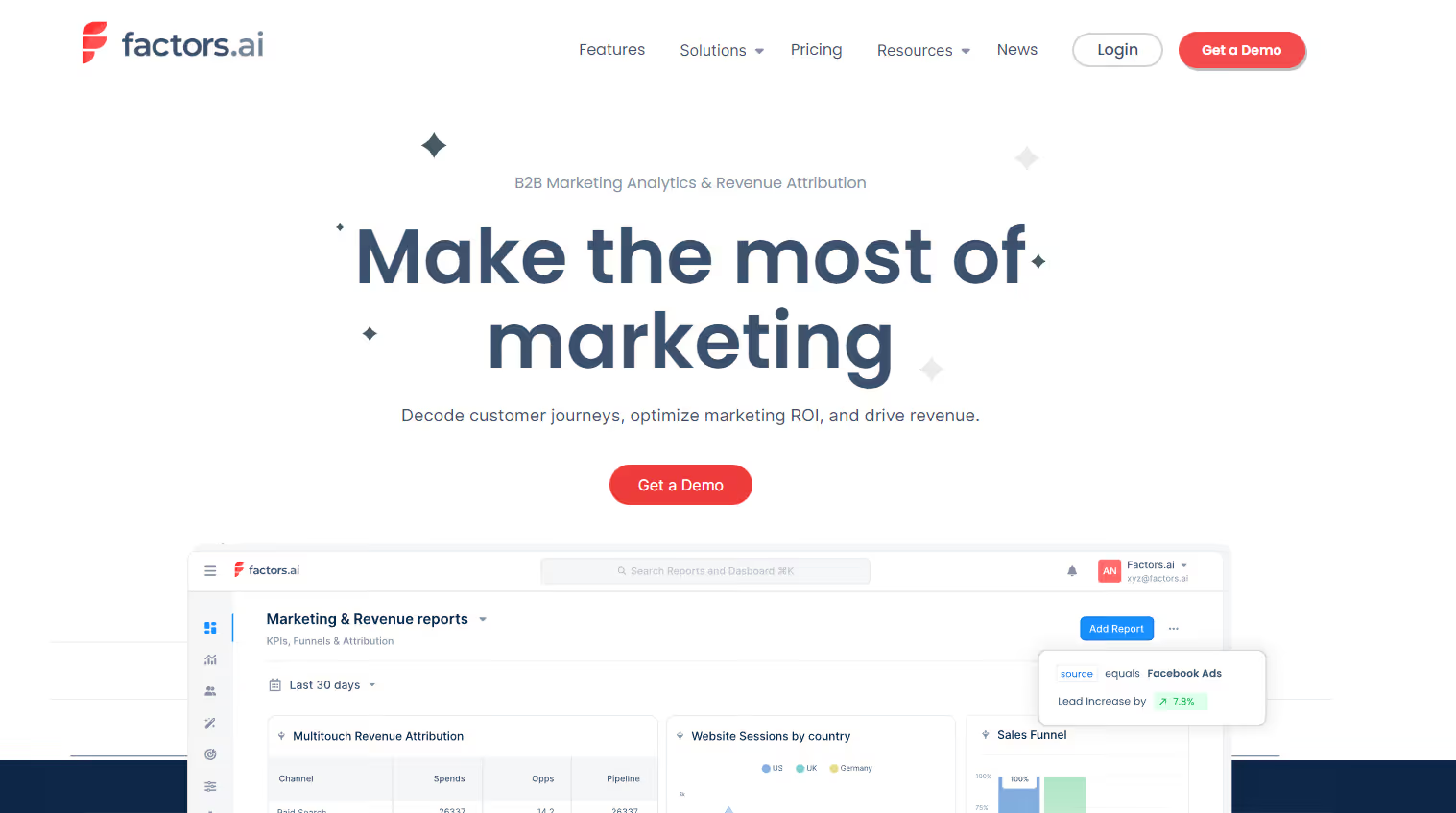
Factors is an AI-powered account identification and analytics software that helps teams discover, qualify, and convert anonymous companies visiting their website.
The tool's marketing analytics and attribution platform enables sales and marketing teams, irrespective of size, to analyze, attribute and optimize their efforts and drive revenue to new heights.
Factors also tracks account-level website behavior and progress through the buyer's journey. Right from the initial visit, helping inbound marketing teams get a clear picture of the campaigns that are driving engagement and bringing in qualified leads.
Content teams also benefit from this tool as they can easily measure prospects' engagement with website content and discover what is bringing in MQLs.
Product marketing teams are able to narrow down and plan their marketing strategy based on the vast information Factors provided.
Features
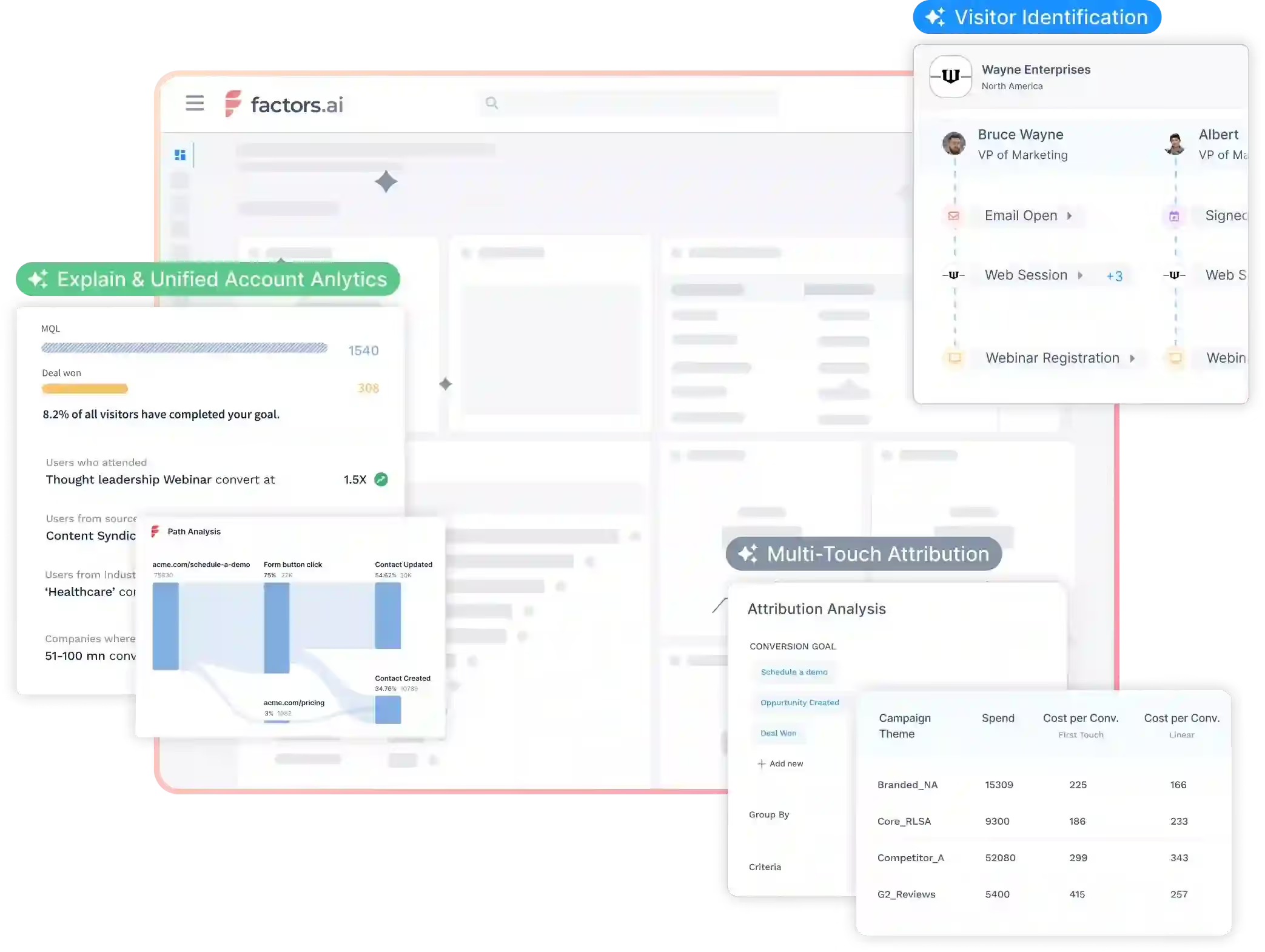
- ACCOUNT IDENTIFICATION: Factors account identification capability powered by 6Sense enables businesses to identify anonymous website traffic, analyze website engagement, and target high-intent accounts with ease. Factors delivers the highest match rates in the industry, revealing up to 64% of companies visiting your website.
- MULTI-TOUCH ATTRIBUTION: Factors' account identification technology, combined with integrations with CRM and MAP, allows marketers to map the complete customer journey at an account level. It allows users to draw data-driven conclusions by comparing various attribution models, win rates, and deal sizes side by side.
- UNIFIED ACCOUNT ANALYTICS: Factors offers a wide range of complementary features such as end-to-end marketing analytics, user and account journey mapping, path analysis, and more. All these features help sales and marketing teams measure and analyze their efforts while gaining insights into website traffic. Based on this information, they can optimize their effort to improve conversion rates.
- AI-POWERED FEATURE "EXPLAIN": 'Explain' empowers marketers with automated insights and root cause analysis on any conversion goal so they can understand what's working and not working.
Integrations
Factors seamlessly integrates with the following list of tools and softwares.
- Hubspot
- Facebook Ads
- Google Ads
- Salesforce
- Segment
- Bing Ads
- Rudderstack
- Marketo
- 6Sense
- Clearbit
- Leadsquared
Reviews

Pricing
Factors offers three services, each with its own pricing:
Deanonymization: Where you can identify anonymous companies that are visiting your website, analyze user behavior, and generate high-intent leads. Pricing starts at
- Starter – $99/Month.
- Professional – $149/Month.
- Growth – $499/Month.
- Enterprise – Contact for quote.
Analytics & Attribution: This offers website analytics, events and form tracking, multi-touch attribution, and more. The pricing for this is as follows:
- Starter – $399/Month.
- Growth – $799/Month.
- Custom and Agency – Contact for quote.
Professional Services: Get expert analytics, consulting, and technical support that is tailor-made for your B2B marketing team.
- Tier 1 – $500 for 10 hrs/Month.
- Tier 2 – $900 for 20 hrs/Month.
- Tier 3 – $1200 for 30hrs/Month.
2. RB2B
RB2B is a person-level website visitor identification tool that reveals the LinkedIn profiles of individual visitors to your website — not just the company. Unlike most tools that only show which company visited, RB2B pushes real individual contact details directly to Slack in real time.
Features
- PERSON-LEVEL IDENTIFICATION: RB2B matches website visitor IPs to individual LinkedIn profiles, revealing name, job title, LinkedIn URL, and company — enabling immediate, personalized outreach.
- SLACK INTEGRATION: Identified visitors are pushed instantly to your Slack channel, so your sales team can act within minutes of a prospect visiting your site.
- US-BASED VISITORS: RB2B's identification works best for US-based visitors, making it a top choice for companies with a US-focused GTM motion.
Integrations
RB2B integrates with:
- Slack
- HubSpot
- Salesforce
- Zapier
Pricing
- Free – Up to 100 identified contacts/month.
- Pro – $39/Month.
3. HubSpot Breeze Intelligence (formerly Clearbit)
HubSpot Breeze Intelligence is HubSpot's native B2B data enrichment and visitor identification product, built on Clearbit's technology after HubSpot acquired Clearbit in 2023. It provides company and contact enrichment directly within the HubSpot CRM ecosystem.
Features
- DATA ENRICHMENT: Access to 200M+ buyer profiles and 20M+ companies to automatically enrich CRM records with firmographic, technographic, and contact data.
- BUYER INTENT (REVEAL): Identifies companies visiting your website and matches them to HubSpot CRM contacts and companies for immediate follow-up.
- FORM SHORTENING: Automatically shortens forms by pre-filling known contact data, reducing friction and increasing conversion rates.
Integrations
Native to HubSpot CRM — also connects with:
- Salesforce
- Marketo
- Segment
- Slack
Pricing
- Included with HubSpot Marketing Hub (Professional/Enterprise).
- Breeze Intelligence credits sold separately — starting at $30/month for 100 credits.
4. Dealfront (formerly Leadfeeder)
Dealfront is a European-focused go-to-market platform formed by the merger of Leadfeeder and Echobot in 2022. It helps B2B businesses identify companies visiting their website, qualify leads, and connect with key decision-makers — with a strong emphasis on GDPR compliance for European markets.
Features
- QUALIFY HIGH POTENTIAL LEADS: Dealfront scores each visitor account based on web activity, firmographics, and buying signals, helping sales teams prioritize best-fit accounts.
- CONTACT DISCOVERY: Identify the right people to reach out to within a qualified company, with direct contact details sourced from Dealfront's European B2B database.
- AUTOMATIC CRM SYNC: Seamlessly syncs visitor and lead data with your CRM to keep your pipeline up to date in real time.
Integrations
Some of Dealfront's popular integrations are:
- Salesforce
- HubSpot
- Pipedrive
- Zapier
- Slack
Pricing
- Free plan available (limited features).
- Paid plans start at €165/month.
5. Warmly
Warmly is an AI-powered revenue orchestration platform that combines website visitor identification with automated outreach. It goes beyond just identifying who is visiting — it enriches visitor data and automatically triggers personalized outreach sequences via email, LinkedIn, and ads.
Features
- VISITOR IDENTIFICATION & ENRICHMENT: Warmly identifies companies and individuals visiting your website and enriches them with firmographic, technographic, and contact data from 10+ data providers simultaneously.
- AI OUTREACH AUTOMATION: Once a visitor is identified, Warmly can automatically trigger personalized outreach — adding contacts to email sequences, LinkedIn campaigns, or ad audiences — without manual intervention.
- INTENT SIGNALS: Warmly aggregates first-party (website behavior) and third-party intent signals to surface accounts that are actively in-market, helping sales teams focus on the highest-priority prospects.
Integrations
Warmly integrates with:
- Salesforce
- HubSpot
- Outreach
- Salesloft
- Apollo
- Clay
Pricing
- Free – Up to 500 identified visitors/month.
- Startup – $700/Month.
- Business – $1,500/Month.
6. Lead Forensics

Lead Forensics is another well-known website visitor identification software. The tool can help B2B businesses uncover information about anonymous website visitors. Additionally, Lead Forensics also helps sales and marketing teams discover high-intent leads and get detailed insights into the prospects' web behavior.
Features
- VISITOR IDENTIFICATION: Lead Forensics claims to have the world's largest, wholly-owned B2B-matched IP address database with over 1.4 bn records. The tool uses this information to process and discover website visitor accounts in real-time.
- DEEP VISITOR INSIGHT: The tool tracks web activity at an account level as well as user-level, showing how many times they visited the website, which pages they viewed, how much time they spent, and more. Sales and marketing teams can use this information to further personalize and optimize their efforts.
- MOBILE APP: Lead Forensics has a mobile app that keeps users updated on the website activity of high-intent visitors on the go.
Integrations
Some of the popular integrations are:
- Salesforce
- Mailchimp
- Square
- Zoho
Reviews

Pricing

Lead Forensics offers two plans, get in touch with them to get a price quote.
7. VisitorQueue
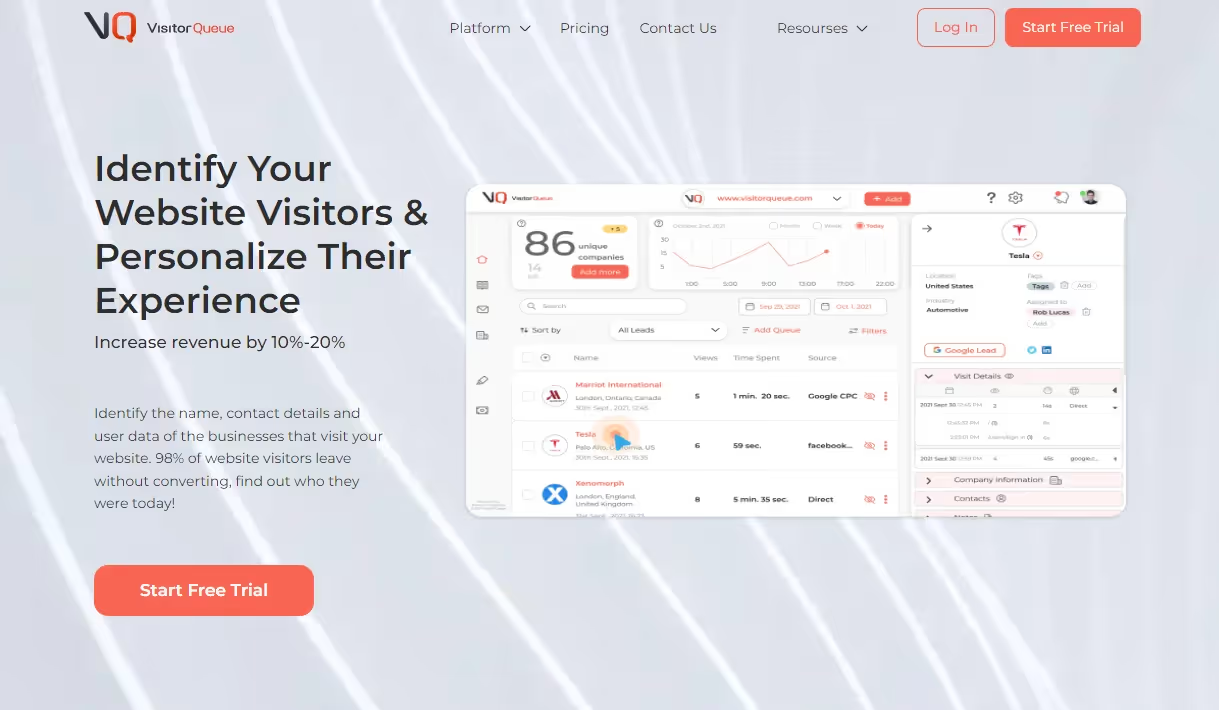
Visitor Queue is another popular tool that helps identify website visitors in real-time. Additionally, the tool also helps businesses customize their website to personalize the experience for their website visitors.
Features
- USER-FIRST DESIGN: The platform is designed with the user in mind, it features a simple and intuitive design making it easy for sales and marketing teams to use Visitor Queue.
- WEBSITE PERSONALIZATION: This is currently an invite-only feature, but Visitor Queue allows businesses to tailor their website to provide a personalized experience for their visitors.
- LEAD INTELLIGENCE: The tool provides a wide range of data and insights on leads, such as web activity and contact information. With this information, marketing and sales teams can streamline their efforts.
Integrations
Some of the available integrations are:
- Salesforce
- Slack
- Zapier
- HubSpot
Reviews

Pricing

VisitorQueue has five paid plans based on the number of unique monthly companies visiting your website.
- For 100 Unique companies/Month – $49/Month.
- For 300 Unique companies/Month – $99/Month.
- For 500 Unique companies/Month – $199/Month.
- For 1000 Unique companies/Month – $209/Month.
- For 2000 Unique companies/Month – $309/Month.
8. Albacross
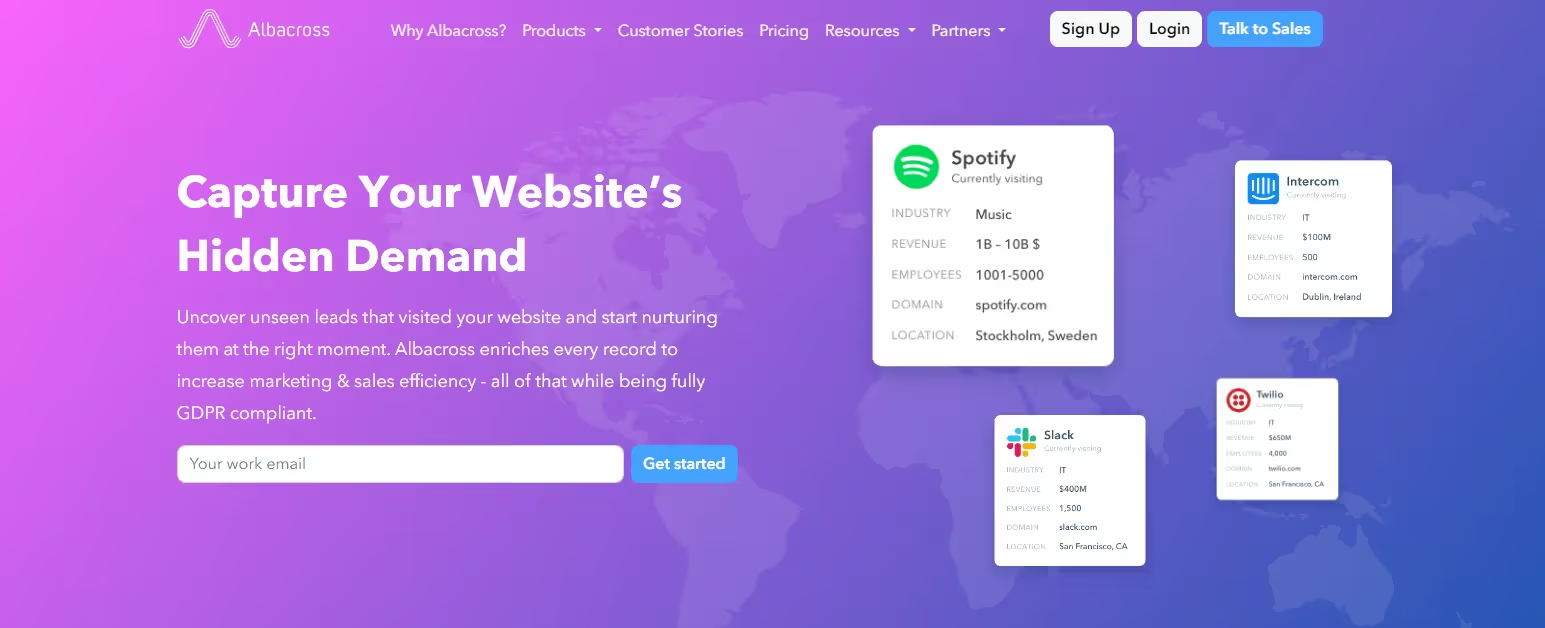
Albacross is a visitor identification tool that deanonymizes B2B website visitors. The tool uses first-party intent data to provide insights on high-quality leads. Sales and marketing teams can tailor and optimize their efforts based on the information to get better results.
Features
- ANALYTICS ENRICHMENT: Albacross's analytics platform helps marketing teams track and measure KPI metrics. The platform also enables teams to prove their efforts with accurate revenue attribution.
- PERSONALIZATION ENRICHMENT: Albacross helps businesses tailor web content, email, ad campaigns, and more to provide a personalized experience to visitor accounts.
- DEEP INSIGHTS: By tracking account and user engagement, Albacross can provide insights such as the pages they frequent, the amount of time they spend on each page and website, the channels and campaigns driving engagement, etc. With these insights, marketing teams can optimize their strategy to increase conversion rates and drive the acquisition of qualified leads.
Integrations
Some of the available integrations are:
- Slack
- Pipedrive
- Google Analytics
- HubSpot
Reviews
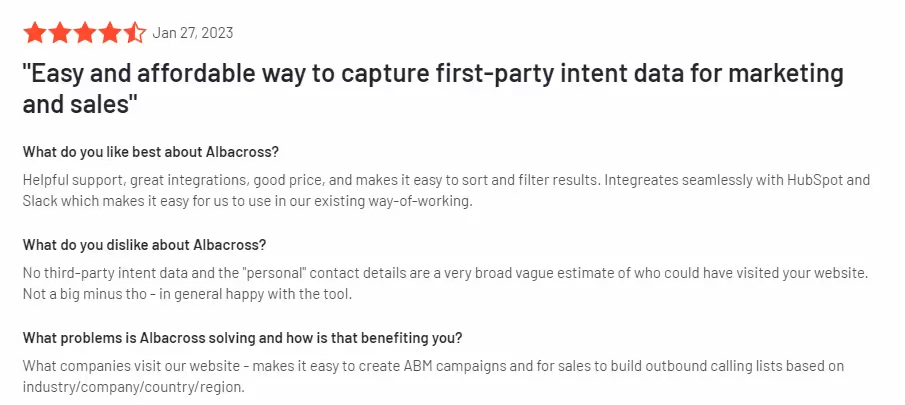
Pricing

Contact Albacross to know more about the pricing of their product.
9. Leadinfo

Leadinfo helps businesses by transforming anonymous website visitors into leads. The tool helps business teams to observe and respond to leads in real-time, this means businesses are able to capitalize as soon as an opportunity presents itself.
Features
- LEAD CAPTURE FORMS: Sales and marketing teams can use visitor information to create personalized lead gen forms in Leadinfo. By creating data-backed personalization, website visitors are more likely to respond positively and turn into leads.
- TRACK BROWSING ACTIVITY: Leadinfo also tracks visitors' journeys through the website. Sales and marketing teams can use this information and determine visitors' intent and qualify them.
- INTUITIVE LAYOUT: Leadinfo's inbox-type layout provides an intuitive view of every website visitor in the same way you view your email. It makes it easier for teams to get accustomed to the tool.
Integrations
Some of Leadinfo's available integrations are:
- Asana
- HubSpot
- Zoho
- Slack
Reviews
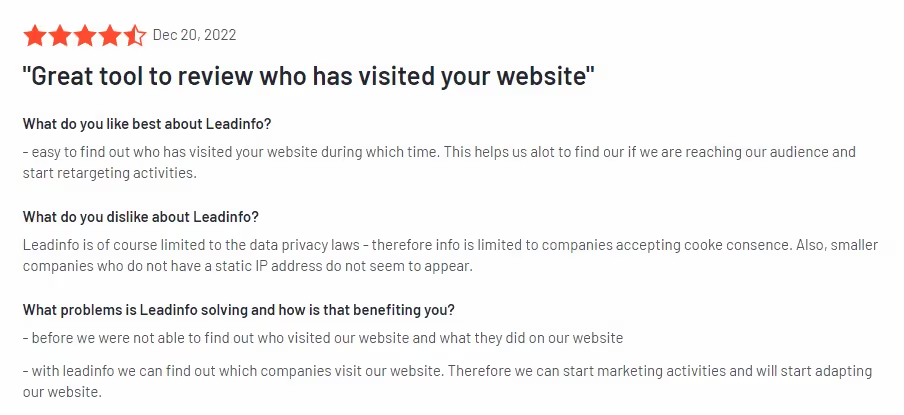
Pricing

Leadinfo's pricing model is based on the number of monthly unique visitors to your website. You can input this data into their pricing page and see what it would cost you.
10. Happierleads

Happierleads helps identify B2B website visitors and helps businesses generate leads. This tool empowers sales and marketing teams to identify anonymous visitors, segment leads, and retarget high-intent visitors with effective marketing campaigns.
Features
- PROSPECTOR: This feature helps businesses identify prospects in the company that matches their ICP criteria. Its database holds details such as direct-dial phone numbers, up-to-date business emails, job titles, and more for over 60M businesses.
- SEGMENT & QUALIFY: Sales and marketing teams can segment accounts and leads according to their ICP with the various behavioral and demographic filters. Once segmented, Happierleads allots a score to each account based on website activity, making it easier for teams to identify the best fit, high-intent accounts.
- EMAIL OUTREACH: Happierleads has an internal email campaigning and outreach tool. Sales and marketing teams can work on prospecting and outreach without having to export their data elsewhere.
Integrations
Happierleads integrates with
- Zapier
- HubSpot
- Fullstory
Reviews

Pricing

Happierleads have a unique pricing page. Input your requirements to get a custom quote.
11. Leadlander

LeadLander is a website visitor identification software that enables sales and marketing teams to generate leads and monitor web analytics. This tool has a vast database of contacts of key decision-makers from over 60 million companies worldwide that businesses can use to prospect and outreach to their visitors.
Features
- INTUITIVE DASHBOARD: LeadLander provides an overview of all the accounts and users visiting the website in a single dashboard. With information readily available, sales and marketing teams can make better decisions.
- VISITOR IDENTIFICATION: LeadLander is able to deanonymize website visitors in real-time. The tool uncovers visitors' journey through the website and reveals the visitors' company details like the website, physical address, and phone number.
- EMAIL NOTIFICATIONS: LeadLander notifies its users via email when high-intent companies visit their websites. LeadLander also sends daily and weekly summaries of website visitors and their activity.
Integrations
LeadLander uses Zapier to integrate with other software.
Reviews

Pricing

You have to get in touch with the company to know more about its pricing.
12. KickFire (a Foundry company)

KickFire is a B2B sales and marketing intelligence platform acquired by Foundry in 2021. The platform also identifies and tracks user and account behavior. Sales and marketing teams can use this information to understand their audience better and improve their efforts.
Features
- INTENT DATA: Foundry Intent combines the intent of website visitors and accounts from multiple sources to showcase meaningful buyer behavior. Business teams can use this data to create prospecting and outreach campaigns with confidence.
- LEAD NURTURING: Selling Simplified is Foundry's product suite designed to identify, nurture and qualify sales reading leads. Sales teams are able to identify the purchase intent of target users and accounts at an early stage, allowing them to focus their efforts.
- ACCOUNT-BASED MARKETING: Triblio is Foundry's ABM platform designed to help businesses scale their ABM capabilities. This proprietary platform identifies accounts showing high-intent accounts based on their monthly interactions.
Integrations
Some of the available integrations are:
- HubSpot
- Salesforce
- ConnectWise
- MS Dynamics
Reviews

Pricing

Kickfire, now a part of Foundry, does not have an open pricing policy. So you'll have to get in touch with them over a demo to receive a quote.
13. LeadMagic

LeadMagic is a lead generation and visitor identification platform that helps businesses deanonymize visitors to their websites. It uses AI algorithms to analyze visitor behavior and provide insights on how to best engage with your visitors.
Features
- VISITOR IDENTIFICATION: LeadMagic can identify high-value accounts visiting a website. The tool sends messages on slack to keep sales and marketing teams updated.
- LEAD SCORING AND PRIORITIZATION: Based on the engagement level, LeadMagic can score and prioritize leads. This ensures that your sales and marketing focus their efforts on the most valuable leads.
- LEAD NURTURING AND AUTOMATED WORKFLOWS: With LeadMagic, you can create and automate lead nurturing campaigns to build meaningful and engaging relationships with your prospects and easily move them through the sales funnel.
Integrations
Leadmagic integrates with:
- Slack
- Zapier
- Segment
- Google Analytics
Reviews

Pricing

LeadMagic has three premium plans for its visitor identification tool.
- LeadMagic Solopreneur – $79/Month.
- LeadMagic Basic Plan – $249/Month.
- LeadMagic Pro Plan – $499/Month.
Which Visitor Tracking Software Should You Choose?
The right tool for you depends on your use case and the scenario. Each tool in this list has its own unique features, capabilities, and limitations.
But if you are looking to uncover account-level information about your website visitors, then a tool with deanonymization capabilities is a must. That said, you should also look for easy setup, user-friendliness, and integration with the existing MarTech stack.
In addition to the above, customizability is a huge necessity. Being able to customize your reports and dashboards ensures that you get to track metrics that matter. It goes without saying, but a great tool with a poor support team is just money down the drain.
Know Your Visitors Better With Factors
Now that you know what to look out for in a visitor identification tool. Let us show you how Factors.ai can help elevate your marketing efforts with AI-powered analytics & attribution.
Factors ensure that you can easily decode visitor journeys at the user and account levels. This, coupled with the powerful attribution and marketing analytics features, helps you make decisions faster.
Throw intuition out the window and optimize marketing efforts with data-driven insights, and drive revenue to new heights. With the complete flexibility of customizing your reports and dashboards, you can track and monitor KPI metrics that are important to your business.
Factors acts as an extension of your marketing team, so you get unmatched support. A dedicated team of customer success managers is ready to support your team at any time.
With Factors, the entire onboarding lasts no longer than 30-mins. Lastly, our transparent pricing policy ensures that you pay for what you need and you get what you pay for.

Top Website Visitor Identification Tools
Visitor identification tools help businesses uncover anonymous website visitors by analyzing IP addresses and matching them to company data, enabling targeted engagement.
- Leading Tools: Factors, Leadfeeder, and Albacross.
- Key Features: Real-time analytics, CRM integration, lead scoring, data enrichment, and automated alerts.
- Strategic Benefits: Gain visitor insights, personalize outreach, and enhance lead generation efforts.
Implementing visitor identification tools improves conversion rates, strengthens marketing strategies, and boosts overall business growth.
FAQs
1. How can I track anonymous website visitors?
To track anonymous website visitors, you can use visitor identification software. Tools such as Factors.ai, Albacross, and Visitor Queue work by collecting data on your website visitors in compliance with Data Protection Laws. You can get information about their location, browsing behavior, the company they are from, and much more.
2. Can a website owner see my IP address?
Yes, the owner of a website or server administrator can see the IP address of every visitor. However, it is worth noting that IP addresses are not always directly linked to you. Your ISP may use a dynamic IP address, an address that keeps changing periodically.
3. Which two technologies do websites use to track visitors?
Websites commonly use Cookies and Web Beacons or Tracking Pixels.
Cookies are text files that are stored locally on a website visitor's device. The server receives cookies when visitors revisit the website. This allows the website to recognize them and track their behavior.
A web beacon is a small, transparent image (one square pixel in size) that is embedded in a website's code. When a user visits a website, the beacon tracks the user's IP address, time spent on the site, pages they visit, browser information, and more.
4. Are website visitor identification tools worth the investment for B2B companies?
Yes — for most B2B companies, visitor identification tools deliver strong ROI. The average B2B website converts only 2-3% of visitors via forms. That means 97%+ of your traffic leaves anonymously. Visitor identification tools let you capture and act on that otherwise-lost intent data.
The ROI case is strongest when:
- You have meaningful website traffic (500+ monthly visitors)
- Your sales team does outbound or ABM
- Your average deal size is $5,000+
For companies with high deal values and an active sales team, even identifying and converting 1-2 additional accounts per month from anonymous traffic can generate 10-20x the cost of the tool.
5. Are there any free website visitor identification tools?
Yes — several tools on this list offer free plans:
- RB2B — Free plan identifies up to 100 individual visitors/month with LinkedIn profile data. Best free option for US-focused B2B teams.
- Dealfront (formerly Leadfeeder) — Free Lite plan with limited data retention and features. Good for small teams just getting started.
- Warmly — Free plan supports up to 500 identified visitors/month with basic enrichment.
- HubSpot Breeze Intelligence — Available at no extra cost to HubSpot Free CRM users for basic visitor tracking.
Free plans are typically limited by the number of identified companies or contacts per month. If you have high traffic or need CRM integrations and alerts, a paid plan will deliver significantly more value.
6. Which visitor identification tools work without requiring forms?
All the tools on this list identify visitors without requiring them to fill out a form. This is the core value proposition of visitor identification software — it reveals anonymous visitors using IP matching, identity graphs, and first-party data, not form submissions.
Here's how the main methods work without forms:
- IP-to-company matching (Factors, Lead Forensics, Albacross): A tracking pixel captures the visitor's IP address and matches it against a database of known company IP ranges.
- Identity graph matching (RB2B, Warmly): Cross-references the visitor's device, email cookies, and behavioral data against a network of known identities to match them to an individual.
- Pixel + LinkedIn matching (RB2B): Specifically matches US visitors to their LinkedIn profiles using a proprietary identity network.
The key distinction: IP-to-company tools identify the company without a form. Identity graph tools can identify the individual person without a form.
7. Is website visitor identification software legal under GDPR and CCPA?
Generally yes — with important caveats.
Under GDPR (EU): Most visitor identification tools identify companies (legal entities), not individuals. Identifying a company visiting your website is generally considered legitimate interest under GDPR and does not require consent. However, if you are identifying individual people (person-level ID), you must ensure compliance with data subject rights and may need to update your privacy policy.
Under CCPA (California): Similar rules apply. Company-level identification is broadly compliant. If you collect personal data linked to California residents, you must provide opt-out mechanisms.
Best practices for compliance:
- Update your website privacy policy to disclose visitor identification
- Use tools with built-in GDPR/CCPA compliance features (Dealfront is specifically built for European compliance)
- Avoid storing personally identifiable information beyond what is necessary
- Consult your legal team before deploying person-level identification tools
Note: This is not legal advice. Consult a qualified attorney for guidance specific to your situation.

Account-Based Marketing (ABM): The Complete 2026 Guide
Account-Based Marketing (ABM) is a B2B strategy that treats each high-value account as a market of one. Learn the 3 types of ABM, real examples, and how to build an ABM program in 2026.

TL;DR
- Account-Based Marketing (ABM) is a B2B strategy that treats each high-value account as a 'market of one,' focusing sales and marketing resources on a defined list of target companies.
- There are 3 types of ABM. They are One-to-One (deep personalization, ~10–50 accounts), One-to-Few (clustered, 50–200), One-to-Many (programmatic, 200+).
- Why does ABM work? Higher win rates, larger deals, shorter cycles for engaged accounts, but only when sales and marketing share the same target list.
- ABM strategy can be used for High-ACV deals, enterprise/mid-market buyers, long sales cycles, TAM under ~5,000 accounts.
- What kills ABM programs: Tool bloat, fake sales-marketing alignment, and 'ABM' that's really demand gen with the same message for everyone.
- Time to ROI: Plan for 6–9 months before meaningful pipeline impact; 9–12 for full ROI.
The ideal scenario for every business is to sell to high-intent customers and not waste time on unqualified leads. This is achievable through ABM - Account-Based Marketing.
ABM helps weed out companies that do not fit a business's ICP (Ideal Customer Profile). Doing so ensures that the efforts of marketing and sales teams align to convert best-fit customers.
According to Forrester's 2025 ABM benchmark, 87% of B2B marketing teams now run an ABM program of some kind, up from 54% five years ago, making ABM one of the dominant B2B go-to-market strategies in 2026.
What is ABM?
Account-Based Marketing (ABM) is a B2B marketing strategy that treats each high-value account as a 'market of one', this means concentrating sales and marketing resources on a defined list of target companies and personalizing every touchpoint to the decision-makers within them. Account Based Marketing strategy focuses on a specific set of target accounts to build awareness and engagement amongst them and eventually convert them into customers. Unlike traditional lead-based marketing, that treats every account the same way, ABM flips the funnel. ABM identifies the accounts most likely to drive revenue first, then build campaigns specifically for them.
What does ABM stand for?
ABM stands for Account-Based Marketing — a B2B marketing approach that focuses on a defined list of target accounts rather than individual leads. You'll also see it called ABM marketing, account-based marketing strategy, or key account marketing. They all refer to the same thing.
ABM vs. Traditional Marketing: What's the Difference?
The simplest way to understand ABM is to compare it to traditional B2B lead generation:
ABM doesn't replace traditional marketing — most successful B2B teams run both. ABM concentrates resources on the 50–200 accounts most likely to drive revenue, while inbound continues filling the broader top of funnel.
Types of ABM
There are broadly 3 ways to execute ABM: One-to-One, One-to-Few, and One-to-Many. For each type, we have listed the top engagement programs & metrics used for tracking

1. One-to-One ABM
In this highly customized approach, the engagement is focused on a small set of accounts (Average: 39, Median: 14)* with the highest revenue potential. Existing customers are mostly targeted here (~80%).
Engagement Programs
- One-on-one Meetings, Workshops, Lunch and Learn Meetings to build relationships
- Highly personalized content via emails, advertisements, and dedicated microsites
- Extensive and consistent research on account for gathering actionable insights
Key ABM Metrics
- Pipeline
- Revenue
- Number of Target Accounts engaged meaningfully (showed high intent such as demo request).
- Number of Accounts where a specific Persona (say VP, Finance) has been engaged.
2. One-to-Few (or Sales Addressable Market)
In this approach, the engagement is performed in a segmented fashion by grouping accounts with similar characteristics. The average number of accounts in this list is 177, with a median of 50*. Both new and existing accounts are targeted here at an equal share.
Engagement Programs
- One-on-one Meetings, roadshows, and virtual events
- Digital advertising, custom email campaigns, and microsites with segment-specific communication
- Tailored outreach campaigns
Key ABM Metrics
- Pipeline
- Revenue
- Number of Target accounts engaged meaningfully.
- Average Number of Contacts Engaged within a Target Account.
- Number of Accounts where a specific Persona has been engaged.
3. One-to-Many (or Total Addressable Market)
In this approach, the engagement takes place at a larger scale, with hundreds to thousands of accounts having the lowest revenue potential. The focus is greater on new customers (70%) than on existing ones (30%).
Engagement Programs
- Virtual events and roadshows
- Targeted demand-generation campaigns with lower customization levels
Key ABM Metrics
- Pipeline
- Revenue
- Number of Leads from ICP.
- Number of ICP accounts engaged.
- Number of Touchpoints from ICP Accounts.
- Average Number of contacts engaged within a Target Account.
- Number of Accounts where a specific Persona has been engaged.
How ABM Reshapes the Sales Function
In ABM, sales reps don't work whatever lead arrived last — they work a shared, named list of target accounts agreed with marketing. The day-to-day looks different:
- SDRs prospect named accounts only, with research-led outreach (not high-volume cold).
- AEs receive only ABM-qualified accounts that have shown engagement signals across channels.
- CSMs participate in expansion ABM — running 1-to-1 plays inside existing customer accounts.
- Sales-marketing standups review the target list weekly: which accounts moved to engaged, which stalled, which need an executive touch.
The biggest cultural change: sales stops asking 'how many leads did marketing send?' and starts asking 'how many target accounts are engaged this quarter?'
Benefits and Trade-offs of Account-Based Marketing (ABM)
Benefits of ABM
1. Personalized marketing at the account level
Account-based marketing focuses on providing personalized campaigns that directly address the pain points of high-value accounts. This personalization helps empathize with the prospects and show that the business understands their challenges and can provide valid solutions.
2. Build and nurture executive-level relationships
ABM also involves engaging prospects with customized messages at each stage of the sales cycle. By engaging with them at every stage, businesses can build a deep understanding of their needs and challenges and provide more personalized solutions. By doing so, businesses can build strong and credible relationships with their prospects.
3. Tighter sales-marketing alignment
With ABM, the marketing initiative will be more targeted and purposeful for the sales team to align directly with marketing goals. By doing so, both teams can keep each other accountable for their specific goals.
4. Higher ROI vs. traditional B2B marketing
ABM focuses on a set of high-value accounts that meet your ICP criteria rather than focusing on a broader audience. By targeting these high-value accounts with personalized campaigns, ABM can reduce the overall marketing cost and increase the likelihood of converting these accounts into paying customers. Therefore, the ROI of ABM campaigns is higher than traditional marketing campaigns that focus on a wider audience.
5. Larger average deal size and higher win rates
Because ABM concentrates resources on accounts most likely to convert and engages decision-makers throughout the buying committee, programs typically see larger average contract values and stronger win rates compared to broad-based demand gen.
Trade-offs to consider
- ABM requires significant investment and 6–9 months of patience before results.
- Identifying decision-makers within large accounts is hard without intent data.
- ABM does NOT replace lead generation — it complements it.
Account-Based Marketing Examples
Here are three real ABM programs that delivered measurable revenue impact:
1. GumGum's personalized 'T-Mac Book' for T-Mobile
GumGum wanted T-Mobile as a customer. Instead of cold outreach, they created a custom comic book featuring T-Mobile's CEO as a superhero, mailed it to key decision-makers, and won the deal.
Outcome: Deal closed; the campaign became a textbook 1-to-1 ABM example.
2. Snowflake's 'Data Cloud Tour' for enterprise accounts
Snowflake ran in-person executive briefings for ~100 named enterprise accounts, paired with personalized landing pages and dedicated SDR outreach.
Outcome: Significant pipeline acceleration in target segments and shorter sales cycles for engaged accounts.
3. Factors.ai customers using account intelligence to convert anonymous traffic
B2B teams using Factors identify which target accounts are visiting their website (even without a form fill), prioritize them based on engagement signals, and trigger personalized SDR outreach.
Outcome: Customers report 2–5x improvement in pipeline from existing website traffic.
Every successful ABM example combines (1) a tight target account list; (2) personalization that goes beyond first name; (3) sales-marketing coordination on a shared account list.
Is ABM the right marketing strategy for you?

Even though ABM has been trending for some time now and many organizations have seen success using it, you should always take a step back and analyze where your business stands before moving forward. Here's a small checklist for you:
Annual Contract Value (ACV)
Since ABM involves a significant investment, calculate the ACV for your target accounts and determine the resulting ROI. Then ask yourself, is it worth the effort?
In case you're at crossroads and have only 3-4 high-value accounts, you can also follow a mixed approach wherein you adopt ABM for those accounts and other strategies like Demand Gen for others.
Total Addressable Market (TAM)
Your TAM is the revenue opportunity available for your product in the entire market. If you have a small TAM, ABM might be a good fit since you can easily personalize your engagement strategy for the target accounts.
In case you have a large TAM, consider using ABM. You will need to put in more effort to narrow down target accounts and, thereafter, create personalized engagement strategies.
Established vs. New Product Category
Similarly, if you have a product in a new category for which the initial demand is bound to be low, ABM will be a good strategy for you.
You can identify the key accounts and engage with them with tailored programs. In case your product belongs to an established category, you can still use ABM to target the top 15-20 accounts generating the most revenue for you.
SMB vs. Mid Market vs. Enterprise
If your target market is SMB, Inbound marketing rather than ABM might be a better fit for you. It is based on the assumption that the ROI from this market for ABM is lower.
If your target market is Mid-Market, ABM can be considered for high-revenue potential accounts while using Inbound as one of the primary channels.
If your target market is an Enterprise, you should definitely adopt a highly tailored ABM plan for each account in the target list. Converted accounts should be given equal focus to improve retention rates and advocacy.
You may experiment with ABM and then scale based on your results. However, the key to ABM is patience. It may take a significant amount of resources, both in terms of time and people, before you actually see the results (depending on your sales cycle). Therefore, it is worth gauging all metrics before beginning with ABM.
Introduction to ABM Platforms
Account Based Marketing (ABM) platforms are tools that help businesses run focused marketing campaigns. They help identify, engage, and convert important accounts through tailored marketing.
ABM technology has grown from simple targeting tools to advanced platforms using artificial intelligence. Since 2004, these platforms have added features like intent data analysis and predictive analytics.
In today's B2B marketing, ABM platforms automate account selection, customize content delivery, and track campaign success. These tools shift the focus from individual leads to high-value accounts. According to Forrester's 2025 ABM benchmark, 87% of B2B marketing teams now run an ABM program of some kind, making these platforms vital for effective marketing.
Understanding ABM Platform Capabilities
Modern ABM platforms have key features that are crucial for effective account-based marketing. These main features include:
Core Features:
- Identifying and targeting accounts
- Managing campaigns across channels
- Personalization tools
- Monitoring intent data
- Tools for analytics and reporting
Integration Capabilities:
- CRM systems (like Salesforce, HubSpot)
- Marketing automation tools
- Analytics platforms
- Content management systems
AI and Machine Learning Components:
- Predictive scoring of accounts
- Automated personalization
- Behavioral analysis
- Processing intent signals
- Algorithms for prioritizing accounts
These features combine to form a complete ABM technology stack that supports advanced marketing strategies
Key Features to Look for in ABM Platforms
When you evaluate ABM platforms in 2026, look for these key features:
Account Identification and Selection
- AI account scoring
- Firmographic and technographic data analysis
- Custom ICP modeling
Cross-Channel Orchestration
- Unified campaign management across channels
- Automated workflow triggers
- Multi-touch attribution tracking
Personalization Capabilities
- Dynamic content customization
- Account-specific messaging
- Real-time personalization
Analytics and Reporting
- Account engagement metrics
- ROI tracking and reporting
- Custom dashboards
Intent Data Integration
- Third-party intent data
- Behavioral tracking
- Predictive analytics
CRM Integration
- Two-way sync with major CRMs
- Automated data enrichment
- Real-time lead routing
These features ensure effective ABM campaign management and clear results.
Implementing an ABM Platform
To implement an ABM platform well, follow a clear plan:
Choosing the Right Platform
- Check if it fits with your current tools
- Look at your team's skills and resources
- Make a list of vendors that meet your needs
- Try out demos and test the platforms
Best Practices for Implementation
- Begin with a small test program
- Set clear goals for success
- Plan the rollout in stages
- Write down the steps and workflows
Common Challenges
- Issues with data quality and consistency
- Problems syncing with CRM systems
- Resistance from users
- Limited technical resources
Training and Adoption
- Create clear training guides.
- Hold regular training sessions.
- Find platform champions within your team.
- Set up ways to get user feedback.
- Track how people use the platform and fix any issues.
Take your time and use enough resources for a smooth implementation. Rushing can lead to poor use and lower returns.
Common ABM Challenges (and How to Avoid Them)
Most ABM programs that fail share the same five issues:
1. ABM that's really demand gen in disguise. If every account on your target list sees the same email and the same ad, you're not running ABM — you're running better-segmented demand gen.
Fix: Build at least 3 personalization tiers (1-to-1, 1-to-few, 1-to-many) with distinct messaging for each.
2. Tool stack bloat. Teams often buy a CDP, an ABM platform, intent data, and a chat tool, .then can't get them to talk.
Fix: Start with one source of truth (usually your CRM) and add tools only when you've outgrown what you have.
3. Sales and marketing aren't actually aligned. Marketing builds an ICP list; sales works whatever lead came in last.
Fix: Co-create the target account list, agree on engagement-stage definitions, and review accounts together weekly.
4. Hard-to-reach decision-makers. Senior buyers don't fill out forms.
Fix: Use anonymous-visitor identification (e.g., reverse-IP + 1st-party data) so you know which target accounts are researching you, even before they convert.
5. Vanity metrics over revenue metrics. Reporting 'engaged accounts' without tracking pipeline impact.
Fix: Tie every ABM metric back to qualified pipeline, opportunity created, and closed-won revenue.
What B2B Marketers Are Actually Saying About ABM
We analyzed Reddit threads (r/b2bmarketing, r/ABM), LinkedIn discussions, and community forums to surface the unfiltered view on ABM in 2026. Here's what practitioners actually say:
Where the community sees real wins:
- Trigger-based personalization (responding to specific buying signals, not just firmographics) — consistently named the most effective tactic.
- Sales and marketing finally working from the same target list — cited as the underrated, biggest cultural shift.
- Higher win rates on engaged accounts — community-reported figures often line up with vendor claims.
Where the community is skeptical:
- 'Most ABM programs are just demand gen with extra steps.' If every target account sees the same campaign, it isn't ABM.
- 'Tool bloat is killing ROI.' Buying a CDP + ABM platform + intent data + chatbot before fixing alignment is a recurring mistake.
- 'Stop telling sales reps to do ABM without training them.' SDR enablement is consistently underfunded.
The under-discussed pain point: scaling personalization. One-to-one ABM works; one-to-many ABM works at the platform level. The middle (one-to-few) is where most teams stall, too many accounts to write custom emails, too few to justify automation.
Measuring Success with ABM Platforms
To measure ABM platform success, focus on these key metrics:
Key Performance Indicators (KPIs)
- Account engagement scores
- Pipeline velocity
- Deal size and win rates
- Marketing-qualified accounts (MQAs)
- Sales acceptance rates
ROI Measurement
- Cost per acquired account
- Customer lifetime value (CLV)
- Campaign ROI by account tier
- Resource use efficiency
Account Engagement Metrics
- Website visit frequency
- Content consumption patterns
- Event participation
- Email response rates
- Social media interactions
Attribution Models
- Multi-touch attribution
- First-touch vs. last-touch
- Account-based attribution
- Cross-channel impact analysis
Track these metrics regularly and adjust strategies based on data. ABM success often takes 6-9 months to show significant results, so maintain consistent measurement and reporting. For more on measuring success, check our Funnel Conversion Optimization page.
Cost Considerations and ROI
Most ABM platforms use these pricing models:
- Annual Subscription: Costs depend on accounts, users, or features.
- Usage-Based: Charges rely on engagement or data use.
- Tiered Pricing: Offers different features at various prices.
Total Cost of Ownership includes:
- Platform subscription fees
- Implementation costs
- Training expenses
- Integration with existing tools
- Ongoing maintenance
ROI Calculation Methods:
- Account engagement rates
- Pipeline speed
- Deal size growth
- Customer lifetime value
- Revenue influenced by marketing
Budget Planning Tips:
- Start with a pilot program
- Consider hidden costs
- Plan for growth
- Set aside funds for training,
- Include integration costs
Most companies see positive ROI within 6-9 months, with average returns of 25-50% reported by successful programs.
4 Steps to Streamline Your ABM Efforts
ABM is all about connecting with the right buyer at the right time with the right message. You can increase the efficiency of your ABM efforts by following a few steps.
- Gather your data sources for a complete view of account activity from the visitor's very first interaction. It will enable you to make decisions on account-level customizations.
- Prepare a list of target accounts based on revenue potential and intent data.
- Develop a concise engagement plan (content, ad communication) for all the accounts/segments. While planning, consider how advanced the account is in the buyer funnel.
- Measure and analyze the impact of ABM on your KPIs and plan the next steps based on the results.
Account-Based Marketing (ABM): A Strategic Approach
ABM focuses on high-intent accounts, aligning sales and marketing efforts for targeted engagement and higher conversions.
1. Core Strategy: Identifies and prioritizes high-value accounts, delivering personalized campaigns to drive engagement.
2. Ideal Use Cases: Best suited for enterprise sales, expanding within existing accounts, and converting key prospects.
3. Key Requirements: Strong sales-marketing alignment and ABM tools for tracking, organization, and execution.
4. Business Impact: Enhances demand generation, increases brand awareness, and boosts profitability by focusing resources on the most promising opportunities.
Implementing ABM ensures efficient marketing spend, maximized conversions, and sustained revenue growth.
Frequently Asked Questions About ABM
Q1. What is meant by account-based marketing?
Account-Based Marketing (ABM) is a B2B marketing strategy in which sales and marketing teams work from a shared list of high-value target accounts and run personalized campaigns for each, instead of generating leads at scale.
Q2. What is an example of account-based marketing?
A classic example: a SaaS company identifies 50 enterprise accounts in their ICP, builds a custom landing page for each company, runs LinkedIn ads targeting the buying committee, and has SDRs send personalized outreach referencing each account's specific business goals.
Q3. What are the 3 types of account-based marketing?
There are three: One-to-One (Strategic ABM) for the highest-value accounts (10–50 accounts, deep personalization), One-to-Few (ABM Lite) for clusters of similar accounts (50–200), and One-to-Many (Programmatic ABM) which uses automation to scale across hundreds or thousands.
Q4. Is ABM the same as B2B marketing?
No. B2B marketing is a category; ABM is a specific strategy within it. ABM is best-suited for B2B companies selling to a defined set of high-value accounts, particularly with long sales cycles and high ACV.
Q5. How is ABM different from inbound marketing?
Inbound attracts a wide audience and converts the interested ones; ABM identifies the accounts you want, then orchestrates outreach to them. Most modern B2B teams run both — inbound for top of funnel, ABM for high-priority accounts.
Q6. How long does ABM take to show results?
Most programs see meaningful pipeline impact in 6–9 months, with full ROI typically in 9–12 months. ABM is not a quick-win channel.
Q7. What's the average ROI of ABM?
Reported returns vary widely; ITSMA found 80%+ of ABM marketers say ABM delivers higher ROI than other strategies, with successful programs reporting 25–50% returns and individual campaigns occasionally hitting 300–450%.
Q8. Do I need an ABM platform to do ABM?
No, you can pilot ABM with a CRM, LinkedIn, and a target account list. ABM platforms become valuable once you scale beyond ~50 accounts and need automated personalization, intent signals, and orchestrated reporting. But if you are looking for a ABM tool to begin your ABM program, Factors.ai might be a right fit for you to start your ABM function.
Conclusion
This brings us to the end of this article. It's quite easy to get lost in the discussion of what ABM is, its various advantages, and its benefits. The key objective of ABM is to show that you empathize with your target audience's pain points and provide a solution that alleviates their pain.
ABM analytics software such as Factors can help you identify various high-intent accounts visiting your website. It can also track their journey on the website and provide insights into how they engage with the content. Sales teams can use this information to tailor email campaigns, sales calls, and other efforts to target those accounts individually and improve engagement and conversions.
How Factors fits into the ABM stack: Factors is an account intelligence and analytics platform built for B2B teams running ABM. It (1) identifies anonymous companies visiting your website without requiring a form fill, (2) scores accounts based on engagement across web, ads, CRM, and intent data, and (3) triggers SDR outreach the moment a target account shows buying intent. Teams use it alongside their CRM (Salesforce, HubSpot) and ABM advertising tools (LinkedIn Ads, 6sense, Demandbase) to close the loop between web traffic and pipeline.
Engage with high-profile accounts regularly as they progress through the buyer journey. Monitor your metrics and optimize your ABM efforts based on the revenue generated. Continuously engaging and putting effort into building meaningful relationships with your visitors and leads will make your ABM strategy more effective and efficient.

What is a Lead in Marketing?
Learn what a lead in marketing is, how to define MQLs and SQLs, and why lead generation, scoring, and qualification are critical to driving B2B sales.
.avif)
Picture this.
Someone reads your blog, downloads your checklist, signs up for your webinar, and finally gives you their email.
You, meanwhile, do a polite corporate twerk because your pipeline just moved from “send help” to “okay, maybe it’s not thaaat bad, we’re fine.”
Now… the person who caused this little wiggle is a ‘lead’.
Come… let’s get into it.
Sooo, what really is a lead in marketing?
A lead in marketing is a person or organization that has shown interest in your product or service by interacting with your marketing efforts and, crucially, providing contact information.
Basically, leads are just strangers who’ve inched close enough to say, “Okay, fiiiine, tell me more,” which in B2B is basically a love confession. And since 45% of marketers are still wrestling with lead gen like it's an HIIT workout from Chloe Ting, getting this right matters (A LOT).
Here's what makes someone a lead:
- They've moved beyond being anonymous website traffic
- They've engaged with your brand in some meaningful way
- You have a way to reach them (email, phone number, LinkedIn profile)
- They're not yet an active sales opportunity
Think of leads as the bridge between awareness and conversion. They know you exist, they've shown interest, but they haven't committed to buying yet.
A few quick examples:
- Someone downloads your ebook after filling out a form
- A visitor signs up for your weekly newsletter
- A potential customer requests a product demo
- Someone attends your webinar and leaves their email
- A prospect fills out a ‘contact us’ form asking for more information
The key difference between a lead and random website traffic is the level of intentionality and identifiability (is that a word?!).
When someone becomes a lead, they've deliberately chosen to engage with you and share their information, and I think that’s beautiful.
Why do leads matter?
To make it more obvious than it is… marketing exists to turn attention into revenue. Leads enable that transformation.
According to recent research, 85% of marketers say lead generation was their top measure in 2024, and for good reason. Without a steady flow of qualified leads, your sales team has nothing to work with. Your CRM sits empty. Your revenue forecasts become guesswork.
Here's where leads fit in a basic funnel:
Visitor -> Lead -> MQL -> SQL -> Opportunity -> Customer
- Visitor: Someone browsing your website, reading your blog, or seeing your ad. Anonymous.
- Lead: They've shown interest and given you their contact info. Identified.
- Marketing Qualified Lead (MQL): Marketing has vetted them as a good fit worth nurturing.
- Sales Qualified Lead (SQL): Sales has confirmed they're ready for a direct conversation.
- Opportunity: An active deal in your pipeline with a potential revenue value.
- Customer: They've signed the contract and made a purchase.
Different CRMs and organizations might label these stages differently. HubSpot calls them lifecycle stages. Salesforce uses lead status fields. But the concept remains consistent: leads are the top of your revenue engine, and everything downstream depends on the quality and volume of leads flowing through.
Not every lead will become a customer, and that's fine. Understanding how leads fit into your customer journey helps you set realistic expectations. The goal is to generate enough high-quality leads that your sales team can focus their time where it counts.
Types of leads
Not all leads are the same… some are barely interested, while others are sitting with signed blank cheques (okay, that’s a bit much, but you get it). But knowing the difference between the two helps you prioritize your time and resources effectively.
- Cold or unqualified leads
These are leads with very minimal demonstrated intent. Maybe they downloaded a top-of-funnel resource, subscribed to your blog, or were added to your database through a list purchase. They know your name, but they're not actively looking to buy.
Cold leads need education and nurturing before they're ready for sales outreach. Pushing them too hard too soon can backfire.
- Information-qualified or engaged leads
These people have interacted with your brand multiple times. They've opened several emails, visited key pages on your website, maybe even attended a webinar or two. They're showing interest but haven't crossed the threshold into serious buying intent yet.
This is where your nurture campaigns come in. Keep them warm with valuable content, case studies, and social proof until they're ready to take the next step.
- Marketing Qualified Leads (MQLs)
An MQL is a lead that marketing has identified as having enough interest and fit to potentially become a customer. They've met certain criteria based on their behavior and profile, things like pages visited, content downloaded, company size, industry, and job title.
Lead generation is the third most important metric used when measuring the effectiveness of content marketing strategies, and MQLs represent the output of those efforts.
For example, your MQL criteria might be:
- Works at a company with 50+ employees
- Downloaded two or more resources
- Visited your pricing page
- Opened at least three nurture emails in the past month
Again, the specific definition will vary by company, but the goal is the same: separate leads who are worth sales' time from those who aren't ready yet.
If you want to understand the full distinction between MQLs and SQLs, check out our detailed guide on MQL vs SQL.
- Sales Qualified Leads (SQLs)
An SQL is a lead that sales has vetted and confirmed as ready for direct outreach. They've shown strong purchase intent through actions like requesting a demo, asking for pricing, or directly reaching out to your sales team.
SQLs are hot. They're actively evaluating solutions, comparing vendors, and making buying decisions. This is when your sales team needs to move fast, because your competitors are probably in their inbox too.
Other lead types worth knowing
- Product Qualified Leads (PQLs): Common in SaaS, these are leads whose behavior in a free trial or freemium product indicates they're likely to convert to paid. For example, someone using key features regularly or hitting usage limits.
- Service Qualified Leads: Leads who've indicated to your customer service team that they're interested in becoming a paying customer, perhaps during a support interaction or consultation.
Basically… you can call the stages whatever you want, just ensure everyone knows what they actually mean and when a lead should go to the next one.
Marketing Leads vs Sales Leads vs Prospects vs Contacts (so, everything vs everything)
Here's where things get confusing. Teams use these terms interchangeably, but they actually mean different things, and mixing them up leads to miscommunication and missed opportunities.
Let's clarify:
- Contact: Any person in your database. They might be a lead, a customer, a partner, or just someone who signed up for your newsletter three years ago and never engaged again. Contact is the broadest category.
- Lead (marketing lead): A contact who has shown some level of interest in your product or service. They've engaged with your marketing, given you their information, and are being tracked as a potential customer.
- Prospect: A lead that fits your ideal customer profile and is being actively worked by sales. They're qualified enough that someone is spending time trying to move them toward a deal. Not all leads become prospects.
- Sales lead / SQL: A lead that sales has qualified as ready for direct sales engagement. They've shown strong intent and meet the criteria for a sales conversation.
The progression typically looks like this:
Contact → Lead → Prospect → Sales Lead / SQL → Opportunity → Customer
Different organizations define these stages differently. Some use ‘prospect’ and ‘sales lead’ interchangeably. Others have entirely different naming conventions. But what matters most is that your marketing and sales teams agree on the definitions and use them consistently.
Segmented email campaigns drive 30% more opens and 50% higher click rates than non-targeted batches, which is why proper lead categorization matters so much for effective nurturing and outreach.
How marketing generates leads (and what 'lead marketing' means)
Lead generation, sometimes called lead marketing, is the set of strategies and tactics used to attract and capture leads. The basic exchange is simple: you offer something valuable (content, tools, insights), and in return, people give you their contact information and permission to follow up.
Here are the most common ways marketing teams generate leads:
- Content & SEO: Publishing blogs, guides, whitepapers, and case studies that attract organic traffic. When visitors find value in your content, they're more likely to subscribe or download gated resources.
- Paid ads and landing pages: Running targeted ads on Google, LinkedIn, Facebook, or other platforms that drive traffic to dedicated landing pages with clear calls-to-action.
- Social media & webinars: Building an audience through social content and hosting events where attendees register with their contact information. Multi-channel marketing campaigns achieve a 31% lower average cost per lead than single-channel outreach.
- Email marketing & nurturing flows: Once someone becomes a lead, email sequences help keep them engaged and move them toward a purchase decision.
- Lead magnets: Downloadable resources, like ebooks, templates, checklists, or tools, that require an email address to access.
The quality of leads matters more than ‘raw’ volume. You can generate thousands of leads through aggressive tactics, but if they're the wrong fit or have low intent, your sales team will waste time chasing people who'll never buy.
Read more on building targeted strategies in our guide on how to build your ideal customer profile.
This is where lead scoring comes in.
Lead quality, lead scoring, and the handoff to sales
Not all leads are worth the same amount of effort. Lead scoring helps you prioritize by assigning points based on fit (do they match your ICP?) and behavior (are they showing buying intent?).
A basic lead scoring model might look like this:
Fit criteria (who they are):
- Company size matches ICP: +20 points
- Job title is decision-maker: +15 points
- Industry matches target: +10 points
Behavior criteria (what they've done):
- Visited pricing page: +20 points
- Downloaded case study: +10 points
- Attended webinar: +15 points
- Opened 3+ emails: +5 points
When a lead hits a certain threshold, say 60 points, they become an MQL and enter a nurturing track. If they cross 80 points, they become an SQL and get routed directly to sales.
Marketing and sales need to agree on:
- What qualifies as an MQL
- What qualifies as an SQL
- When and how the handoff happens
- SLAs around follow-up time (e.g., sales must contact SQLs within 24 hours)
Without clear definitions and processes, leads fall through the cracks. Marketing thinks they're sending quality leads, sales thinks they're getting garbage, and nobody's happy. If your teams need better alignment, our post on B2B sales and marketing alignment can help.
This is why internal documentation matters. Write down your lead stages, scoring criteria, and handoff processes. Share them with everyone. Update them regularly based on what's working.
'The lead market': Buying and selling leads (yes, that’s a thing)
When people talk about ‘the lead market,’ they're usually referring to the industry built around generating, buying, and selling leads.
Here's how it works: specialized companies generate large volumes of leads through content, ads, or other tactics, then sell those leads to businesses. You might pay per lead, per qualified lead, or through a subscription model.
The appeal is obvious: instant access to a list of potential customers without doing the work yourself.
But there are big downsides to that:
- Lower quality: Purchased leads often have weak intent or poor fit
- Consent issues: Many leads don't remember signing up or didn't agree to hear from your company specifically
- Competition: The same lead might be sold to multiple companies simultaneously
- Wasted budget: Low conversion rates mean expensive cost-per-acquisition
Most of us prefer permission-based, inbound lead generation. When someone comes to you organically, learns about your solution, and voluntarily gives you their information, they're much more likely to convert than someone whose email address was scraped from a list.
But but but… there are exceptions.
I’ll take the liberty of taking a non-B2B example here. In some industries (insurance, home services, financial services), lead buying is still common and can work if you have a strong follow-up process. But for most B2B SaaS and professional services companies, building your own lead generation engine delivers better long-term results.
Common misconceptions (straight from real marketers like you and me)
If you've ever scrolled through marketing forums or Slack communities, you'll see the same confusions pop up again (and again.)
- Myth: Any email address = a lead
Reality: An email address alone doesn't make someone a lead. If they haven't shown interest in your specific product or given you permission to contact them about it, you're just spamming. A real lead has context, they know who you are and why you're reaching out.
- Myth: Marketing leads and sales leads are the same thing everywhere
Reality: Every company defines these stages differently. What HubSpot calls an MQL might be what Salesforce calls a qualified lead. What matters is that your organization has clear, documented definitions that everyone uses consistently.
- Myth: Buying a list is the same as generating leads
Reality: Purchasing a list gives you contacts, not leads. Without prior engagement or expressed interest, those people haven't raised their hand for your specific solution. Conversion rates from purchased lists are typically far lower than from organically generated leads.
In a nutshell
A lead in marketing is someone who has shown interest in your product or service and provided contact information. They're not customers yet, but they're not strangers either. They sit at the critical inflection point where marketing hands off to sales, where awareness transforms into action.
Understanding the different types of leads (cold, warm, MQL, SQL) helps you prioritize resources and personalize your approach. Building a clear lead qualification process, complete with scoring criteria and agreed-upon definitions, ensures marketing and sales work together instead of against each other.
Only 18% of marketers felt that their outbound lead generation efforts provided valuable leads, which means the future belongs to teams who can attract, qualify, and convert leads through inbound strategies, not interruptive tactics.
Your next step? Write down your team's definition of a lead, MQL, and SQL. Share it with marketing and sales. Make sure everyone's speaking the same language. Because when your teams are aligned on what a lead actually is, everything else, nurturing, scoring, handoffs, revenue gets a whole lot easier.
For more on turning your lead generation process into a predictable revenue engine, explore our content on lead scoring models and how Factors helps identify website visitors.
PS: 'Marketing Lead' (person) vs 'Marketing Lead' (job title)
Quick note on terminology: when people search for ‘marketing lead,’ they might mean two completely different things.
- Marketing lead (person): A potential customer who has shown interest in your product. This is what we've been talking about throughout this article.
- Marketing Lead (job title): A manager or senior role that oversees marketing campaigns and teams responsible for generating and converting leads. Think Marketing Lead, Product Marketing Lead, or Demand Generation Lead.
Throughout this article, when we say ‘marketing lead,’ we're talking about the potential customer, not the job title. Just wanted to clear that up before anyone gets confused.
FAQs for what is a lead in marketing?
Q. What is a lead in marketing?
A lead in marketing is a person or organisation that has shown interest in your product or service, usually by interacting with your marketing and providing some contact information (for example, filling out a form or signing up for a newsletter).
Q. What is a marketing lead vs a sales lead?
A marketing lead is someone who has engaged with marketing activities and is being nurtured, while a sales lead (or SQL) has shown stronger intent and has been qualified by sales as ready for a direct sales conversation.
Q. What is a marketing qualified lead (MQL)?
A marketing qualified lead is a lead that meets agreed criteria (fit + behaviour) suggesting they're more likely than others to become a customer, so marketing passes them to sales for follow-up.
Q. What is the difference between a lead, contact, prospect, and opportunity?
A contact is anyone in your database; a lead is a contact who has shown interest; a prospect is a lead that fits your ideal customer profile and is being actively worked on; an opportunity is a qualified deal in progress with potential revenue.
Q. How do marketers generate leads?
Common lead generation tactics include content and SEO, paid ads to landing pages, webinars, events, email campaigns, and lead magnets (like ebooks or templates) offered in exchange for contact details.
Q. When does a lead become a customer?
A lead becomes a customer when they've agreed to purchase, and a transaction is completed; in many CRMs, this is when an opportunity is marked 'closed-won,' and the contact moves into a customer lifecycle stage.
Q. What is 'the lead market'?
'The lead market' usually refers to the ecosystem of companies and platforms that specialise in generating, buying, and selling leads (e.g., lead-gen agencies or affiliate networks), rather than the leads themselves.
What Are Impressions on LinkedIn? Types, Benchmarks & Tips (2026)
What are impressions on LinkedIn? Learn the 3 types (organic, paid, viral), what a good number looks like in 2026, and how to track & increase them.
TL;DR
- LinkedIn impressions are the total number of times your content (posts, articles, or ads) appears on someone's screen — regardless of whether they click or engage.
- There are 3 types: organic (free, algorithm-driven), paid (sponsored campaigns), and viral (from shares and re-engagement).
- Impressions ≠ reach. One person seeing your post 3 times = 3 impressions but only 1 unique reach.
- In 2026, the average LinkedIn post receives around 811 impressions. Personal posts typically get 1,000–5,000.
- To increase impressions: post consistently, use visuals, engage in the first hour, and optimize your profile.
LinkedIn impressions are the total number of times your content like your posts, articles, or ads, that appears on someone's screen, regardless of whether they engage with it. Each time your content is displayed in a user's feed, it counts as one impression. If one person sees your post three times, that's three impressions.
Impressions are one of LinkedIn's core analytics metrics, and understanding them is essential for measuring content visibility, refining your strategy, and growing your professional presence on the platform.
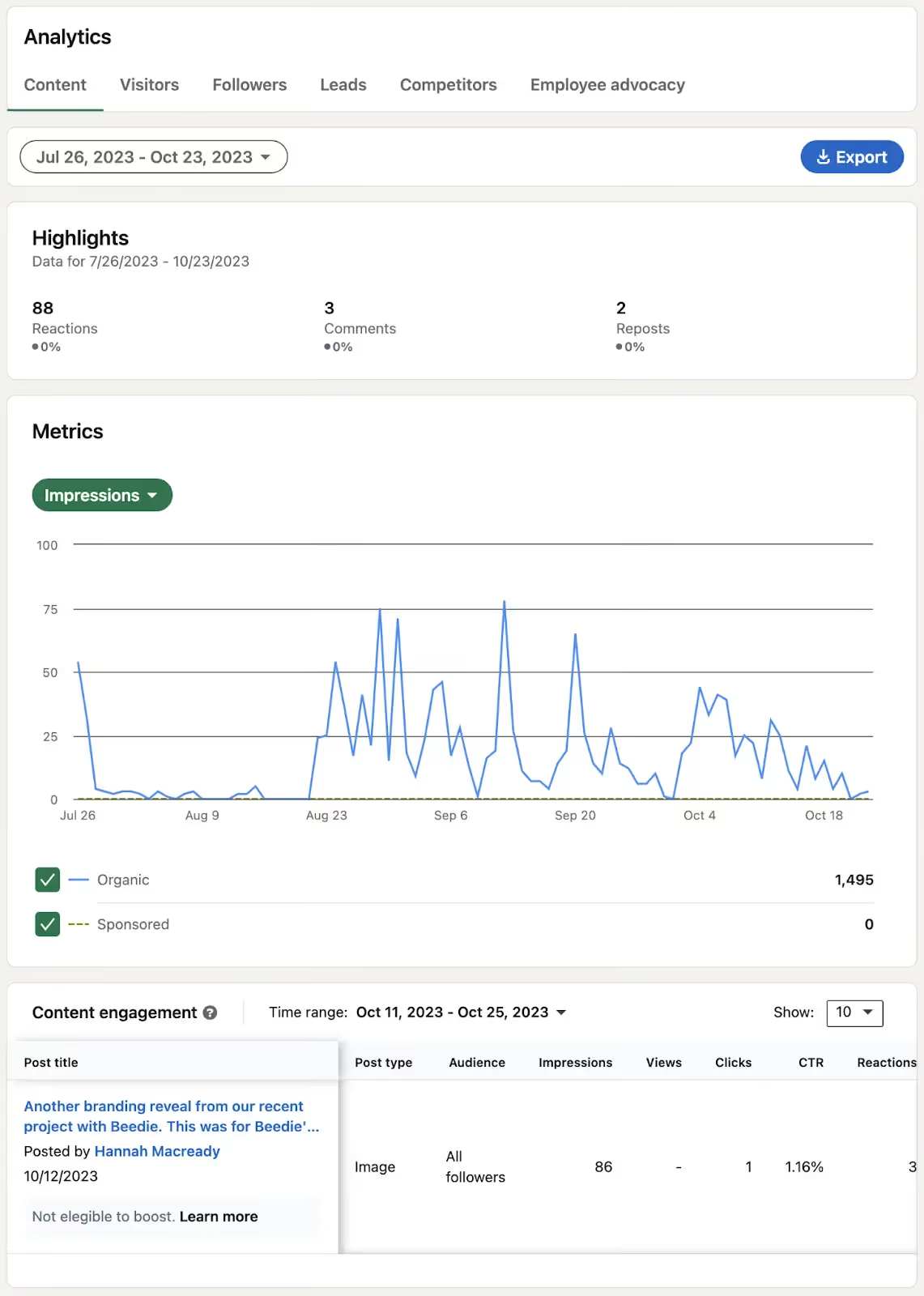
💡Did you know? LinkedIn pages that are active, receive 5x the page views.
What does an impression mean on LinkedIn?
Impressions on LinkedIn refer to the number of times a post has been viewed by other users. Essentially, it quantifies the visibility of an entity's presence on the platform. Each time someone sees your profile, encounters a post you've shared, or comes across an update you've made, it contributes to your impression count.
To put it simply, imagine you're attending a professional conference. As you mingle with other attendees, exchange business cards, and engage in conversations, you're leaving an impression on those you interact with. Similarly, on LinkedIn, each time someone encounters your content or profile, it's akin to leaving a digital footprint—a mark that signifies your presence and relevance within the professional community.
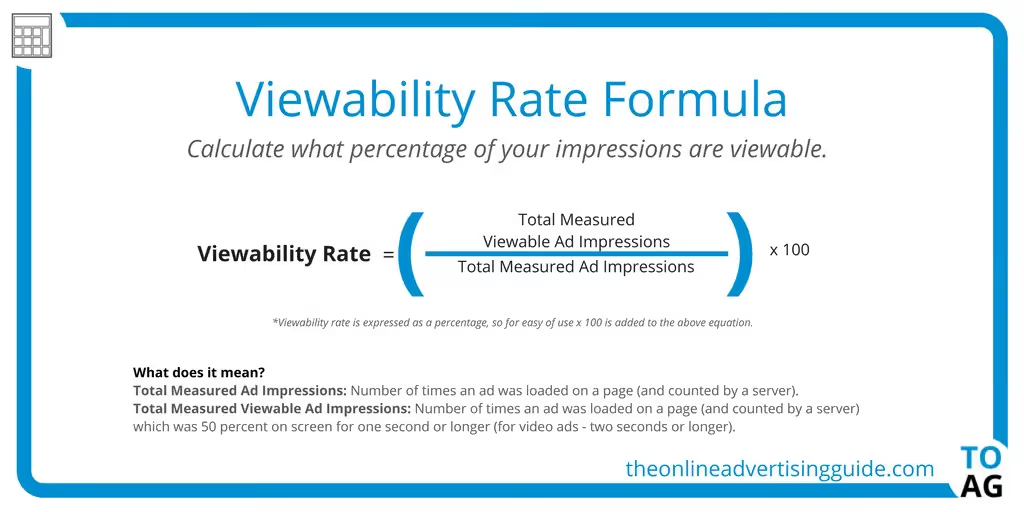
How Does LinkedIn Count Impressions?
LinkedIn counts an impression when at least 50% of your content is visible on a user's screen for at least 1 second. This is the technical threshold — your post doesn't need to be fully read or engaged with to count as an impression.
Key rules to understand:
- Repeat views count: If the same person sees your post 5 times, that's 5 impressions (but only 1 unique reach).
- Self-views may count: Scrolling through your own posts on your profile can inflate your impression count — a common source of confusion.
- No engagement required: Scrolling past your content in the feed counts, even without a like, comment, or click.
- Threshold: LinkedIn uses the 0.3–1 second visibility rule (at least 50% of the post visible) to register an impression.
Impressions vs Views vs Reach on LinkedIn
These three metrics are often confused, but they measure different things:
- Impressions: The total number of times your content appeared on any screen. One person seeing your post 3 times = 3 impressions.
- Reach (Members Reached): The number of unique users who saw your content. One person seeing your post 3 times = 1 reach.
- Views: Typically refers to engagement-level visibility — for articles and videos, a view means someone actively clicked or watched. For posts, LinkedIn often uses 'views' and 'impressions' interchangeably in analytics.
Quick example: You publish a post. It appears on 500 screens (some people see it twice). That's 500 impressions, 400 members reached, and maybe 50 actual article views or link clicks.
Which metric matters most? Use impressions for brand awareness tracking, reach for audience growth, and engagement rate (clicks/comments/shares ÷ impressions) for content quality.
What Is a Good Number of Impressions on LinkedIn?
There's no universal "good" number — it depends on your network size and content type. Here are 2026 benchmarks based on industry data:
By follower count:
- 500–1,000 connections: 300–500 impressions per post is strong
- 1,000–5,000 connections: 500–2,000 impressions per post
- 5,000–10,000 connections: 800–5,000 impressions per post
- 10,000+ connections: 2,000–10,000+ impressions per post
General benchmarks:
- Average post: 500–3,000 impressions
- High-performing post: 5,000–20,000 impressions
- Viral post: 50,000+ impressions
The average LinkedIn post in 2024 received around 811 impressions, up from ~696 in 2023. However, impressions alone don't tell the full story — a post with 500 impressions and 50 meaningful comments is more valuable than one with 10,000 impressions and zero engagement.
The Significance of LinkedIn Impressions
Now that we understand what impressions entail, let's explore why they matter. Impressions serve as a key metric for gauging the reach and impact of your activities on LinkedIn. They offer valuable insights into how effectively your content resonates with your target audience and how visible your profile is within the platform's ecosystem.
Consider this scenario: you're a marketing professional aiming to promote your expertise in digital advertising. Through strategic content creation and engagement on LinkedIn, you share insightful posts, participate in relevant discussions, and optimize your profile for maximum visibility. As a result, your impression count steadily increases, indicating that more individuals are viewing your content and becoming aware of your expertise in the field.
Decoding LinkedIn Impressions: Types and Measurement
Impressions on LinkedIn can be categorized into three types: organic, paid and viral impressions. Organic impressions occur naturally, without any monetary investment, when your content appears in the feeds of other users based on factors such as relevance, engagement, and connections. On the other hand, paid impressions result from sponsored content campaigns where you allocate budget to promote your posts to a broader audience.
Organic Impressions
Organic impressions on LinkedIn refer to the number of times your content is displayed naturally in the feeds of other users, without any paid promotion or advertising. These impressions occur based on factors such as relevance, engagement, and connections, and they reflect genuine interest from your audience.
Benefits of Organic Impressions:
Authenticity and Trustworthiness
Organic impressions are perceived as more authentic and trustworthy by LinkedIn users. Since they occur naturally without any paid promotion, they reflect genuine interest from your audience, which can enhance your credibility and reputation on the platform.
Cost-Effectiveness
Unlike paid impressions, which require monetary investment, organic impressions are obtained without spending advertising dollars. This makes them a cost-effective way to increase visibility and engagement on LinkedIn, especially for individuals and businesses operating on limited budgets.
💡Did you know? 77% marketers agree that they achieve the best organic results from LinkedIn.
Long-Term Sustainability:
Building organic reach through consistent content creation and engagement fosters long-term sustainability on LinkedIn. By cultivating genuine relationships with your audience and providing value through your content, you can create a loyal following that continues to engage with your posts over time.
Community Building:
Organic impressions facilitate the organic growth of your professional network and community on LinkedIn. By connecting with like-minded individuals, participating in group discussions, and sharing valuable insights, you can foster meaningful relationships and establish yourself as a thought leader within your industry.
Limitations with Organic Impressions:
Limited Reach
One of the primary drawbacks of organic impressions is their limited reach compared to paid impressions. Since organic content relies on the platform's algorithms to determine visibility, it may not reach as wide an audience as paid content, especially if your network is relatively small or your content lacks virality.
Time-Intensive
Building organic reach on LinkedIn requires time, effort, and consistency. You need to invest significant resources into content creation, engagement, and relationship building to generate meaningful results. For individuals and businesses seeking quick visibility or immediate results, this time-intensive nature of organic growth can be a disadvantage.
Algorithm Dependency
Organic impressions are subject to the whims of LinkedIn's algorithm, which determines the visibility of your content based on various factors such as relevance, engagement, and recency. Changes to the algorithm or fluctuations in user behavior can impact the reach and effectiveness of your organic content, leading to unpredictability in your results.
Limited Targeting Options
Unlike paid impressions, which offer sophisticated targeting options to reach specific demographics, organic impressions provide limited control over audience segmentation. While you can optimize your content for relevance and engagement, you may not always reach your desired audience segments organically.
Paid Impressions
Paid impressions on LinkedIn refer to the number of times your content is displayed as a result of paid advertising campaigns or sponsored content promotions. Unlike organic impressions, which occur naturally without monetary investment, paid impressions are achieved through allocating advertising budget to promote your posts, updates, or profile to a targeted audience.
Benefits of Paid Impressions
Expanded Reach
Paid impressions offer the advantage of reaching a broader audience beyond your organic network. By investing in sponsored content campaigns, you can target specific demographics, industries, job titles, and interests, thereby increasing the visibility and exposure of your content to potential leads and prospects.
Immediate Visibility
Unlike organic impressions, which rely on gradual growth and algorithmic factors, paid impressions offer immediate visibility and results. By allocating a budget to promote your content, you can ensure that it appears prominently in the feeds of your target audience, generating instant visibility and engagement.
Enhanced Targeting Options
Paid impressions provide advanced targeting options that allow you to tailor your content to specific audience segments. Whether you're targeting decision-makers in a particular industry or professionals with specific job titles, paid advertising offers precise control over who sees your content, maximizing its relevance and effectiveness.
Measurable ROI
Paid impressions provide robust analytics and tracking tools that enable you to measure the return on investment (ROI) of your advertising campaigns accurately. From click-through rates and engagement metrics to conversion tracking and lead generation, paid advertising offers transparent insights into the performance and effectiveness of your content.
Limitations of Paid Impressions:
Cost
As you may have guessed, the primary disadvantage of paid impressions is the associated cost. Running sponsored content campaigns requires a financial investment, which may be prohibitive for individuals or businesses operating on limited budgets. Additionally, the cost of paid advertising can escalate quickly, especially for competitive industries or target demographics.
Ad Fatigue
Paid impressions run the risk of audience fatigue and ad saturation, especially if your content appears overly promotional or lacks relevance to the target audience. To avoid ad fatigue, advertisers need to constantly refresh their creative assets, optimize targeting parameters, and monitor campaign performance to maintain audience engagement and interest.
Ad Blocking
With the rise of ad-blocking software and privacy concerns among internet users, paid impressions face the challenge of reaching audiences who actively block or ignore advertising content. Advertisers need to employ strategies such as native advertising, influencer partnerships, and engaging content formats to overcome ad blocking and capture audience attention effectively.
Competition and Saturation
Paid impressions operate within a competitive space where advertisers vie for the attention of the same target audience. As a result, achieving standout visibility and engagement can be challenging, especially in saturated markets or highly competitive industries. Advertisers need to differentiate their content, offer compelling value propositions, and continually optimize their campaigns to remain competitive and effective.

Viral Impressions
Viral impressions on LinkedIn refer to the number of times your content is displayed as a result of being shared by others within the platform. Essentially, when your post gains traction and is shared beyond your immediate network, it reaches a wider audience, contributing to viral impressions.
Benefits of Viral Impressions
Increased Visibility
Viral impressions amplify the reach of your content, exposing it to a larger audience than your organic network. This heightened visibility can lead to greater brand awareness and recognition among LinkedIn users.
Enhanced Engagement
When your post resonates with a broader audience, it's more likely to garner likes, comments, and shares, fostering community engagement and relationship-building. Viral content tends to spark conversations and interactions among users, leading to higher engagement rates.
Extended Reach
Viral impressions enable your content to transcend the boundaries of your immediate network, reaching users who may not have discovered your profile or posts otherwise. This expanded reach creates opportunities to connect with new leads, prospects, and industry influencers.
Limitations of Viral Impressions:
Limited Control
While viral content can significantly boost your visibility, it also entails relinquishing control over how your content is perceived and shared. Once a post goes viral, it may attract attention from a diverse range of users, including those who may misinterpret or misrepresent your message.
Risk of Backlash
Viral content is susceptible to scrutiny and criticism, especially when it touches upon controversial topics or sensitive issues. In some cases, a post that goes viral may attract negative feedback or backlash from certain segments of the audience, potentially damaging your reputation or brand image.
Short-Term Impact
While viral content can generate a surge in impressions and engagement, its effects may be short-lived. Once the initial hype subsides, the visibility and momentum of the post may decline rapidly, leading to a temporary spike in metrics followed by a return to baseline levels.
Key Factors That Affect LinkedIn Impressions in 2026
LinkedIn's algorithm has evolved significantly. Here are the main factors determining how many impressions your content gets:
- Content quality and relevance: LinkedIn prioritizes content that provides genuine value to your target audience over engagement-bait.
- The Golden Hour: Engagement in the first 60 minutes after posting heavily influences how far LinkedIn distributes your content. Early likes, comments, and shares signal quality.
- Content format: Document carousels and native video tend to earn higher impressions than text-only posts. LinkedIn favors content that keeps users on the platform.
- Posting frequency: Posting more often increases total impressions but may reduce per-post impressions. LinkedIn's 2026 algorithm appears to cap distribution for accounts posting multiple times daily.
- Network size and engagement history: Larger, more engaged networks naturally generate more impressions.
- Dwell time: How long people stop and read your post matters more than ever — LinkedIn uses this as a quality signal.
How to Check Your Impressions on LinkedIn (Step-by-Step)
Method 1: Individual Post Analytics
- Go to your LinkedIn feed or profile's Activity section.
- Find the post you want to check.
- Below the post, click on the impressions/views count (e.g., '1,234 impressions').
- This opens detailed analytics: impressions, reactions, comments, reposts, and demographics of who viewed it.
Method 2: Profile-Level Analytics
- Go to your LinkedIn profile.
- Click on Analytics (visible below your profile header).
- Select Content to see impression trends across all your posts over time.
Method 3: Company Page Analytics
- Navigate to your Company Page.
- Click Analytics → Content.
- View impressions, clicks, and engagement for all company posts.
Method 4: Third-Party Tools
For deeper insights, tools like Factors.ai can track LinkedIn impressions alongside website analytics, providing a unified view of how LinkedIn content drives business outcomes.
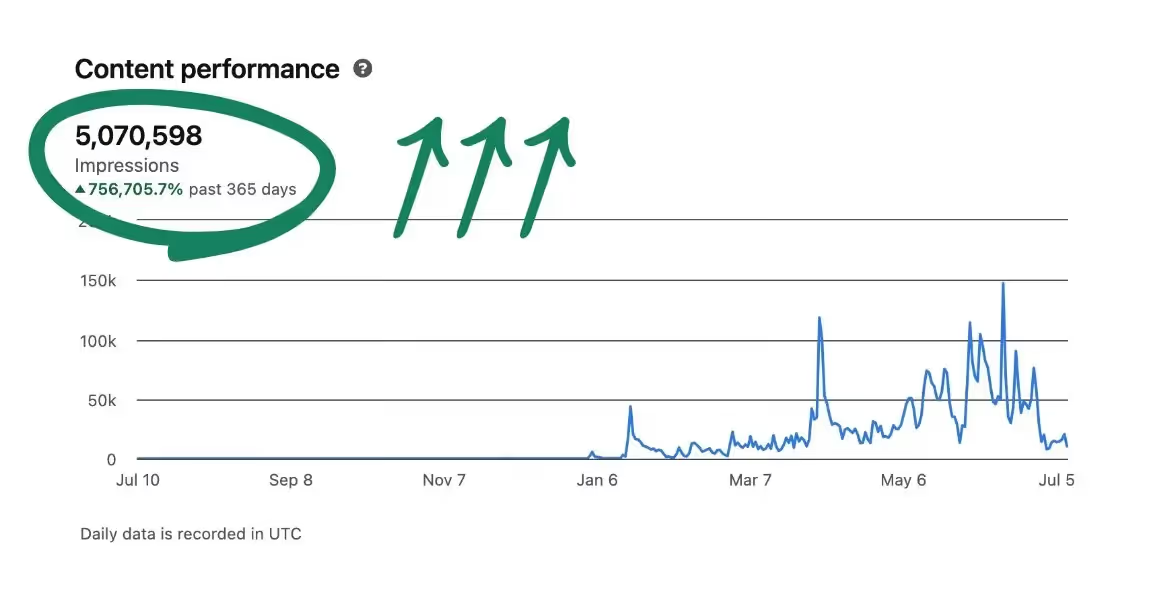
Strategies for Maximizing LinkedIn Impressions
Now that we've established the importance of impressions on LinkedIn, let's delve into actionable strategies for maximizing your impact on the platform:
Craft Compelling Content
Focus on creating high-quality, relevant content that addresses the interests and needs of your target audience. Whether it's sharing industry insights, offering actionable tips, or sharing personal anecdotes, compelling content is key to capturing audience attention and driving engagement.
Post Consistently
Maintaining an active presence on the platform increases the likelihood of your posts being seen by your connections and followers. Posting regularly also signals to the LinkedIn algorithm that you are an engaged user, potentially leading to higher placement in feed rankings and increased exposure to a broader audience. By staying active and consistent with your posting schedule, you can enhance your visibility, build credibility, and attract more engagement on LinkedIn.
💡Did you know? Posting on LinkedIn on a weekly basis brings in twice the engagement.
Optimize Visuals
Incorporate visually appealing elements such as images, videos, and infographics into your posts to enhance their appeal and encourage interaction. Visual content tends to attract more attention and elicit higher levels of engagement from LinkedIn users.
💡 Did you know? Posts with images tend to garner twice as much engagement compared to those without visuals. Moreover, larger images boast a 38% higher click-through rate, making them more effective in capturing audience attention and driving interaction.
Engage Authentically
Cultivate genuine interactions with your connections by liking, commenting, and sharing their content. Authentic engagement not only fosters meaningful relationships but also increases the likelihood of your content being reciprocated and shared within your network.
Utilize Hashtags
Leverage relevant hashtags to increase the discoverability of your content and expand its reach beyond your immediate network. By including industry-specific hashtags and trending topics in your posts, you can connect with a wider audience and enhance your visibility on LinkedIn.
Join Groups and Communities
Participate in LinkedIn groups and communities relevant to your industry or interests to connect with like-minded professionals and expand your network. Engaging in group discussions, sharing valuable insights, and offering support can help increase your visibility and establish your credibility within the community.
Consider Paid Promotion
Explore LinkedIn's advertising platform to amplify your reach and target specific demographics with sponsored content campaigns. While organic reach is valuable, paid promotion can provide an additional boost to your visibility and help you reach a broader audience.
Understanding the nuances of impressions on LinkedIn is essential for maximizing your presence and impact on the platform. Whether through organic or paid impressions, the goal remains the same: to increase visibility, engagement, and ultimately achieve your professional objectives. By leveraging the strengths of each approach and adopting a strategic approach to content creation, engagement, and advertising, you can effectively enhance your reach, build meaningful relationships, and establish yourself as a credible authority within your niche.
That said, one point to note is that success on LinkedIn is not just about the quantity of impressions, but the quality of interactions and relationships fostered along the way.
As you continue to refine your approach and adapt to the ever-evolving social media algorithm, we hope this article helps you in your journey of growth on LinkedIn.
What Real Users Say About LinkedIn Impressions
Community discussions on Reddit and LinkedIn itself reveal common frustrations and insights about impressions:
The self-view debate: Many users report that LinkedIn counts your own views when scrolling through your profile's activity. As one Reddit user noted: "Impressions count when you view your own posts. Even on your own personal page, your impressions double the longer you scroll through your posts."
Impressions vs. members reached confusion: A frequent complaint is the large gap between impressions and members reached. The explanation: impressions count repeat views, while members reached counts unique users. If 100 people see your post and 20 of them see it twice, that's 120 impressions but only 100 members reached.
The vanity metric argument: Some professionals dismiss impressions as a vanity metric. The reality is more nuanced — impressions are a leading indicator. Without impressions, you can't get engagement. But impressions without engagement signal that your content is being seen but not resonating.
The 2026 impression decline: Many creators report impressions dropping 30–50% year-over-year despite growing follower counts. LinkedIn's algorithm now favors relevance-based distribution over connection-based distribution, meaning smaller but more targeted audiences.
Frequently Asked Questions
Do LinkedIn impressions really mean anything?
Yes. Impressions measure content visibility — how many times your post was shown in feeds. While they don't measure engagement quality, they're the foundation metric: without impressions, there's zero chance of getting likes, comments, or leads. Track impressions alongside engagement rate for the full picture.
What does 500 impressions mean on LinkedIn?
It means your post appeared on screens 500 times. For accounts with 500–1,000 connections, that's solid performance. For accounts with 10,000+ connections, 500 impressions would suggest the content underperformed or was posted at a poor time.
Is 1,000 impressions on LinkedIn good?
For most personal profiles, 1,000 impressions is a strong result — it's above the average of ~811 impressions per post. Company pages typically aim higher (5,000–10,000+) due to larger follower bases.
What is the difference between impressions and members reached?
Impressions count total displays (including repeat views by the same person). Members reached counts unique users. If 100 people each see your post twice, that's 200 impressions but 100 members reached.
Is engagement or impressions more important?
It depends on your goal. Impressions are best for measuring brand awareness and content distribution. Engagement (likes, comments, shares) measures how well your content resonates. For most professionals, a high engagement rate relative to impressions is more valuable than raw impression count.
Why are my LinkedIn impressions so low?
Common causes include: posting at off-peak times, low engagement in the first hour (missing the 'golden hour'), small network size, text-only content (visuals perform better), or posting too frequently (LinkedIn may throttle distribution).
Maximize Your LinkedIn Impressions for Greater Visibility
First things first, what does an impression mean on LinkedIn?
Understanding LinkedIn impressions is key to improving engagement and expanding your reach.
Here's a breakdown of the three types:
1. Organic Impressions: Unpaid views that reflect genuine interest in your content.
2. Paid Impressions: Views generated from sponsored posts, helping you target specific audiences.
3. Viral Impressions: Occur when your content is shared widely, extending beyond your immediate network.
Tracking impressions through LinkedIn analytics or third-party tools allows you to measure content performance and refine your strategy. To boost impressions, focus on consistent posting, compelling visuals, and strategic hashtag use - ensuring your content reaches the right audience and drives engagement.
May the LinkedIn impressions be with you!
Related Reads:
![How Can Visitor Tracking Help Marketing Teams? [Hint: It’s Not Just for ABM]](https://cdn.prod.website-files.com/6898fdb2a8e6d57199082db3/698c668c2b75176d163c6781_644aede80eb8d6ae93e18286_How%2520Can%2520Visitor%2520Tracking%2520Help%2520Marketing%2520Teams.avif)
How Can Visitor Tracking Help Marketing Teams? [Hint: It’s Not Just for ABM]
De-anonymization, customer journey mapping, and more. Discover the top 7 ways how you can use visitor tracking to enhance your marketing campaigns.

Understanding your target audiences have never been more critical. But at the same time, it has become harder to achieve that.
As you may well know, more and more users are opting to browse anonymously. Also, with users rejecting cookies, it has become harder to keep track of the visitors' sources. Though visitors like the content your website offers, they don't want to be identified.
This means that visitor tracking efficiency at the user level has become obsolete.
Now, this raises the question.
How can you understand your target audience if you can't even track your website's visitors?
Is there an alternative way to keep track of the visitors? Yes, there is. Visitor tracking at an account level.
It helps marketers gain valuable information about their website's visitors without compromising the users' anonymity.
In this blog, we will discuss
- Why marketers need to know their visitors,
- The legal aspect of visitor tracking,
- Its benefits,
- and how Factors can help.
Why do marketers need to know who's visiting the website?
Consider this. You are a CMO at an enterprise providing software solutions for large businesses. You and your marketing team have worked round the clock to implement an actionable marketing campaign. Together, you have pushed SEO-focused blogs, eBooks, guides, newsletters, and other offline campaigns.
Finally, after six months, it's time to analyze the results.
The traffic has risen, the bounce rate has lowered, and the ranking has climbed. But above all these positives, you found the conversion rate to be the same.
On average, out of the 100 visitors, only three fill out forms or sign up for demos/newsletters.
Even after everything, you couldn't convert any more than earlier.
The thought of submitting the report to the CEO and stakeholders is frustrating. The more frustrating part will be explaining why there is such a low number of conversions.
If only you could know why. Yeah, sure, it might be because your campaign didn't attract the intended audience. But how can you say that without knowing who your visitors are?
Exactly!
This is where visitor identification comes into play.
By tracking visitors at an account level, you can identify the companies your users come from. Along with that, you get to know more about these companies, including their industry, the number of employees, and their revenue range.
So when considering our example, you will be able to pinpoint users from large businesses. Furthermore, you can tailor your marketing efforts and effectively communicate with them.
There are three major benefits of visitor identification:
- Allows marketing teams to plan campaigns and sales outreach by analyzing individual companies.
- Company-level visitor identification allows real-time engagement through website and chatbot personalization.
- Allows measurement of inbound marketing efforts like Ad campaigns, content marketing, etc.
So, which metric should you track to focus more on conversion?
The metrics like website traffic, number of clicks, etc., have proven to be vanity metrics. What you want is quality leads; for that, the metric to focus on is Qualified Traffic.
We define Qualified traffic as the percentage of website visitors who meet your ICP criteria, specified by your company-level attributes such as industry, revenue range, number of employees, etc.
When considering our example, the qualified traffic will be the percentage of visitors who belong to large businesses. [Keep in mind that we only added the type of business for examples purpose]
But...Is visitor tracking even legal?
In short, yes, it's legal.
As per the data protection laws such as GDPR and CCPA, every website operator must obtain consent from their users before collecting and processing data. Also, they must provide clear and transparent information about the data collected and how they will use it. Therefore, as long as everyone complies with these laws, visitor tracking is considered legal.
With that said, de-anonymization tools do not track or identify individual users. Instead, it simply identifies the companies the visitors belong to. This is achieved by analyzing the IP addresses and other data from the visitors' web browsers.
And by tracking and analyzing the users' website activities, you can get valuable information about the interests and needs of a prospective company.
Consider the same example from the previous section. You are the CMO of an enterprise providing software solutions to large businesses. Using marketing analytics tools like Factors, you have tracked your website's visitors. They were mostly from large businesses, more specifically from the healthcare industry.
So, considering this, you can create a customized marketing strategy targeted at the healthcare industry, like ebooks, blogs, ad campaigns, etc., on regulatory software solutions and how they can help healthcare companies comply with regulations.
Furthermore, this should help you convert more traffic and identify how to get more visitors from these companies in the first place.
How visitor tracking can be the secret ingredient to better marketing efforts

As we discussed, visitor tracking is an invaluable part of marketing teams. It provides insights into your website visitor's behavior, which helps you make sound decisions & improve your marketing efforts.
Let's see how it can make your marketing campaigns better.
Sheds light on the entire customer journey
Companies cannot collect their visitor's data without their consent. Also, nowadays, almost all users prefer to browse anonymously. They are reluctant to share details like email IDs and phone numbers and often choose to decline third-party cookies. This makes it harder for marketers to track their target customer's journey.
By combining de-anonymization technology with an advanced web analytics platform, marketers can identify the accounts the visitors belong to, even if they browse anonymously. Thereby enabling marketers to
- Identify the qualified traffic sources [Initial contact]
- Understand user behaviors within a website [Customer path]
- Connect conversions to all prior interactions[Final contact]
You can also determine the effectiveness of offline campaigns with visitor tracking. For example, consider an offline event you organized. Representatives from multiple companies interacted with you during the event. And they have shown interest in your product/service.
You upload the information about these attendees, including the companies, into the CRM. And now, by using de-anonymization, you can keep track of users from those companies who visit your website. Thus, enabling you to analyze the impact of the offline event quickly.
Metrics such as an increase in website visitors from target accounts and an increase in engagement (time on site, number of pages viewed) can serve as early indicators of the performance of offline campaigns.
Allows you to identify which pieces of content resonate with your audience
Visitor tracking allows you to track how people use your website.
You can see which pages your audience visits, the time they spend on each page, and their path within the website. Thus, it enables you to understand the type of content your audience wants and determine low-performing web pages.
Leveraging these information, you can make your content more appealing and relevant to your target audience. This can attract more qualified traffic, improve engagement, and increase conversion opportunities.
Consider our example. You see that your users have gone through a series of blogs. More specifically, blogs focusing on the use of regulatory software in healthcare. So, as a marketer, your best move to convert them now will be to focus on that particular niche. Provide case studies or success stories of your business in the healthcare industry, which could build trust in your business, thus, helping with conversion.
Helps improve your buyer personas with visitor information

The buyer persona is a crucial part to consider for marketing teams. It provides a better understanding of your target audience, including their pain points and goal. Moreover, with a good buyer persona, you can align your marketing effort to improve customer satisfaction.
What visitor tracking can help you with is taking the guesswork out of the way. When creating a buyer persona, there is no room for guesswork. With that said, visitor tracking can help you create a data-driven buyer persona. The following are some crucial data it can provide you with.
- The type of business
- The industry
- The employee range
- The location
- The revenue range
Furthermore, it can provide insight into the prospect's behavior and journey within the website.
Consider the same example. During the early stage of your growth, you focused on the buyer persona of B2B businesses in the IT industry with revenue greater than $100 million.
However, as you take a closer look with the help of deanonymization, you find a new section of your visitors. They are from the Healthcare industry, searching for regulatory software solutions, and have a revenue ranging between $5 - $25 million.
Combining this with the visitors' location, content consumption pattern, and conversion trends, you can now create an additional customer persona to expand into.
Lets you embrace the power of retargeting

By combining visitor tracking data with CRM data, companies can create focused marketing campaigns directed at accounts based on their buyer journey. And retargeting would be more effective as you will be targeting accounts already aware of your business.
In a B2B context, retargeting can effectively increase conversions and return on investment (ROI). In addition, research shows that retargeted ads have a higher click-through rate (CTR) than other digital ads, primarily because of brand familiarity.
Though retargeting specific individuals is possible, it's limiting in a B2B context. In a B2B business, multiple stakeholders are involved in the buying decision. Hence it will be a more effective strategy to track the accounts from a specific business. This way, you can understand the high-intent pages they are visiting and engage with the entire buying committee from these accounts on platforms like Linkedin.
So, when considering our example, once you know the companies your visitors are coming from, you can run targeted ads on social media platforms like LinkedIn to your relevant buyer personas and increase your CTR and conversions.
Paves the way for account-based marketing
By identifying the online behavior and preferences of specific accounts on your website, you can customize future marketing campaigns for higher effectiveness.
Now consider our example. Visitors from healthcare companies are showing interest in information security. So, when creating marketing campaigns for these companies, consider emphasizing security and compliance. This way, you can appeal to their pain points and concerns and enhance the effectiveness of your marketing campaigns.
You can further personalize your campaigns depending on the prospect's stage in their buying journey.
For example, suppose the users are looking into top-of-the-funnel topics. In that case, you can target LinkedIn ads with topics like "10 Ways Regulatory Software Can Boost Efficiency in the Healthcare Sector". And for those looking into the bottom-of-the-funnel topics, you can drive ads with pricing plans and discounts.
Thus, website visitor tracking ultimately paves for account-based marketing.
Guides your optimization efforts
Visitor tracking helps provide insight into the customer journey. We have already discussed this. You can know how the users interact, what they interact with, how long they stay, etc.

By analyzing this data, you can identify and remove areas of friction in the customer journey.
For example, consider a landing page for a software solution. Let's say you found the bounce rate for that particular web page from Google Analytics to be 75. The score is high and not good, so obviously, your next step will be to update this page.
But is it viable? You don't know for sure that all the visitors coming to that web page are your target audience. No, not with Google Analytics. You can't.
This is where de-anonymization comes in. You can filter out the visitors to this page according to your required parameters. Since, in the example, we consider large businesses to be the target audience, we can add revenue range and the number of employees to filter out the rest.
Now with only the target audience, you see that the bounce rate of the landing page is 50, which is good. This also means that the landing page is working for your intended users. So, there is no reason to update this anymore.
And the only reason for the bounce rate to increase was the visit of users from small and medium businesses. Thus, website visitor tracking helps you understand your website performance and lets you know whether it needs optimization or not.
Also, by understanding which sources drive qualified traffic, you can improve your existing marketing strategies and make them more targeted.
Helps you curate specialized offers
Suppose the visitor tracking data shows several companies in a particular niche repeatedly visiting your website. In that case, providing special offers catering to those companies can help them make decisions faster.
Consider our example. You are seeing a high percentage of visitors from the Healthcare vector visiting specific landing pages. In that case, you can create a specialized offer with those features for that industry. And these target offers can increase the likelihood of converting a customer.
Your offers could be discounts, free trials, or even a bundle offer.
Track your website's visitors with Factors
Factors is a unified platform that provides robust capabilities for analyzing marketing and revenue data, with powerful integrations across campaigns, web, CRM, chatbot, and more.
Our platform offers a range of features to help marketers and businesses gain insight into website visitor behavior. Also, with Factors,
- You can easily track the overall traffic to your website,
- Filter out the qualified traffic from them.
- And the de-anonymization feature helps identify the companies your visitors are from and further helps map the customer journey of these visitors.
The crux of defining a targeted marketing campaign is to understand the customers. You need to know who they are, their steps before converting, and more. Thus, helping you focus on qualified traffic to increase lead generation and conversions.
Get in touch with our team for a demo, or sign up here for free and use Factors to get the most out of visitor tracking and elevate your marketing efforts.
Bonus FAQs
Can Google Analytics track individual users?
Yes, in a way.
If your website includes a login system, Google Analytics can track individual users using its User ID tracking feature. But you have to assign each user by yourself, which is time-consuming and laborious.
How can I use visitor tracking for lead generation?
Visitor tracking enables you to gain valuable information about your website's visitors. You can understand
- Where your visitors are from,
- How they interact with your website,
- The type of content they are interested in,
- Their journey within the website,
- Which pages are driving conversions, and more.
By using this information, you can create more relevant content and run marketing campaigns that are more targeted. This can help generate more leads and increase opportunities for conversions.

From Website Visitor to Warm Outbound Play: How to Use GTM Engineering Services for Intent-Driven Outreach
Learn how to turn anonymous website traffic into sales pipeline using visitor identification, intent data, and GTM engineering workflows, powered by Factors.ai.
TL;DR
- Visitor ID + Intent Data = Real Pipeline: Identify ICP-fit companies visiting your site using reverse IP and intent filters, even if they don’t fill out a form.
- GTM Engineering Automates Everything: From enrichment to outbound handoff, custom workflows eliminate manual busywork and trigger timely outreach.
- Prioritization Drives Focus: Accounts are tiered by fit and intent, allowing reps to focus efforts where they matter most, not just on who clicks first.
- Human Touch, AI Assist: AI-generated summaries and contact bundles give reps the context they need to personalize without guesswork or delay.
Let’s be honest: traffic and MQLs don’t pay the bills. Pipeline and revenue do.
Here’s the truth: your best prospects are probably already on your website. They’re comparing features, peeking at pricing, and reading that one blog you’re weirdly proud of. But only ~3% of visitors fill out a form. The other 97%? Anonymous..unless you can identify the company, recognize buying intent, and trigger smart outreach automatically.
This article shows you how to do exactly that with website visitor identification, intent data, and a layer of GTM engineering that turns signals into ready-to-send outbound and, ultimately, qualified conversations.
We’ll keep it practical, human, and zero-fluff. (Coffee optional. Results, not.)
And yes, we’ll show how Factors does the heavy lifting, tooling, data, and workflows included.
TL;DR: This is the fastest way to build pipeline without ballooning ad budgets or headcount.
But first, the basics.
What is intent data?
Intent data is any signal that shows a buyer might be researching your category or solution. There are four types of intent data:
- Zero-party: They tell you directly (e.g., a demo form).
- First-party: You observe it on your assets (e.g., web sessions, page views, clicks).
- Second-party: Another company’s first-party data (e.g., G2 page visits, LinkedIn Ads views).
- Third-party: Aggregated across many sites (e.g., Bombora-type data).
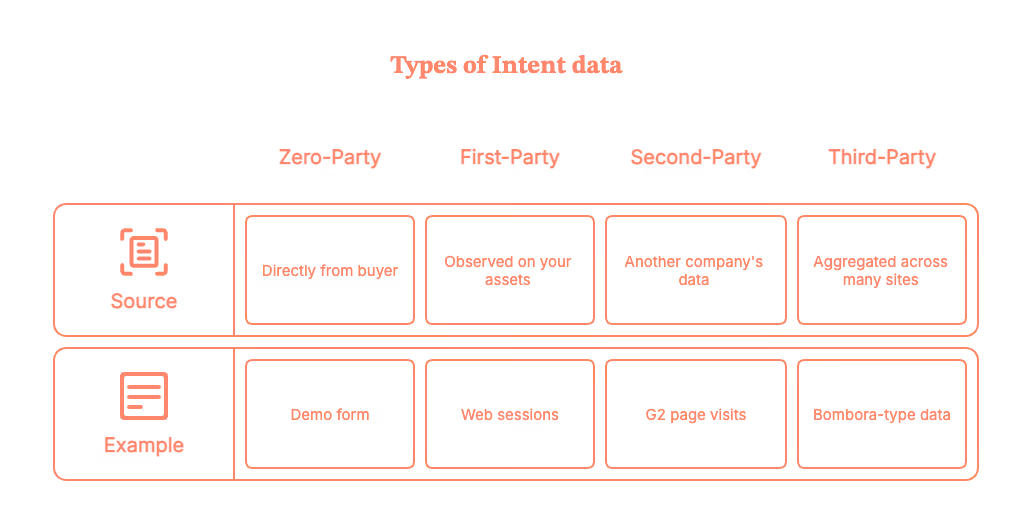
Why it matters: Studies suggest buyers are ~57% through their journey before they talk to sales. You need to engage earlier, when intent shows up, not when a form arrives.
What is website visitor identification?
It’s how you de-anonymize company-level traffic on your site (without personal PII). Tools like Factors.ai use industry-leading reverse IP technology and enrichment to reveal who’s on your site (company, industry, size, tech, etc.) and what they’re doing (pages, sessions, engagement depth).
Factors.ai offers best-in-class coverage for website visitor identification. It identifies more than 75% of anonymous website visitors using sequential waterfall enrichment.
What is GTM engineering?
GTM engineering is the missing link between knowing who’s interested and acting on it in real time. It’s the setup of automated workflows (with AI where helpful) that connect your data sources, website, ad platforms, CRM, Apollo, Slack, and more, to trigger instant, contextual outbound plays.
With Factors’ GTM Engineering services, you don’t just get software; you get a managed system that:
- Detects intent signals in real time
- Identifies which companies are visiting your site
- Enriches contact data automatically via Clay and Apollo
- Scores and prioritizes accounts (AI-enabled predictive scoring included)
- Sends ready-to-act Slack alerts and email drafts to SDRs/Sales in minutes (not next Tuesday).
- Automate outreach via LinkedIn InMails, calls, and emails
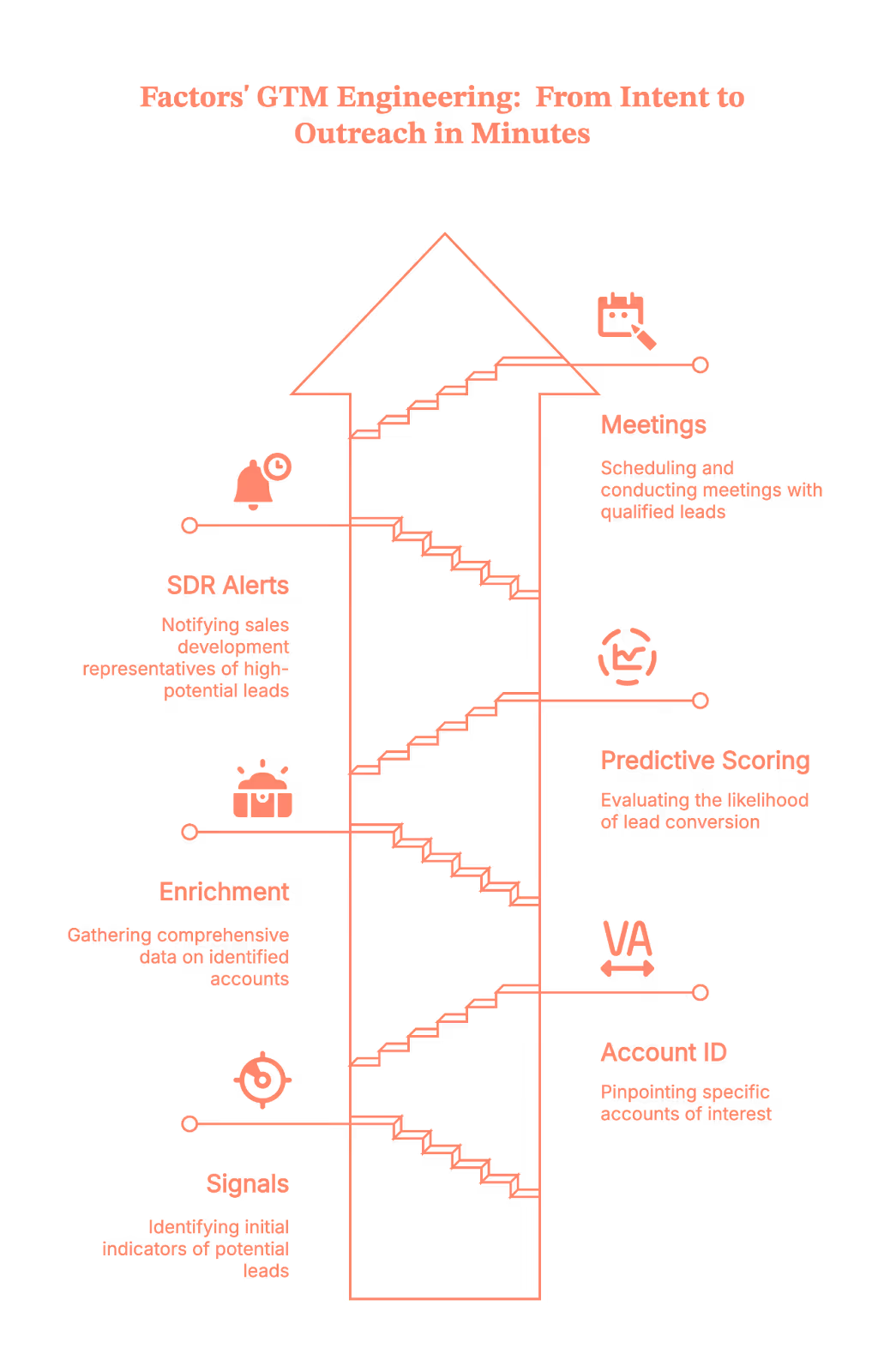
Okay, but why does this matter now? Because everyone’s doing it (Just kidding)
- Speed wins. Buyers do a lot of research before talking to sales. If you reach out first (and with context), you're more likely to make the shortlist.
- Efficiency is everything. Ad budgets are tight; headcount isn’t infinite. Intent + automation = more meetings per rep, with less chaos.
- Sales teams need clarity, not ‘heads-up’ pings. A good alert says who, why now, who to contact, and what to say. (Not ‘someone from Acme visited lol.’)
The 5-Step Playbook to Turn Visitors into Warm Outbound Play (Run this today)
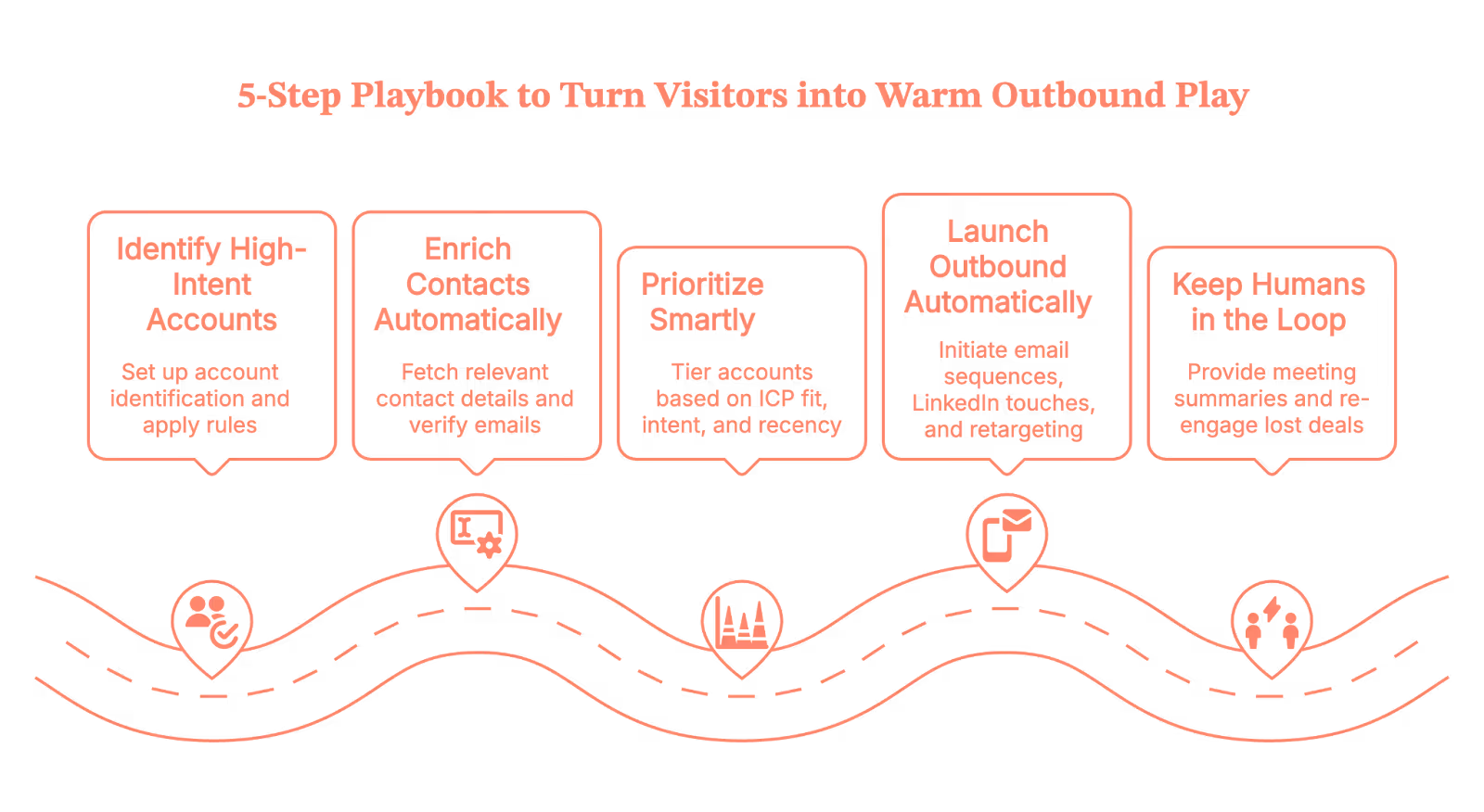
1) Identify high-intent accounts (with Factors)
Set up account identification on your site so you see company, industry, size, location, and what they did (pricing page, comparison page, sessions, etc.). Then add simple rules:
- ICP fit: e.g., Software/IT/Education, US/Canada, 50–500 employees
- Intent filters: e.g., ‘viewed pricing or product pages for ≥60 seconds,’ ‘multiple sessions in 24 hours,’ or ‘visited competitor comparison’
Pro tip: Start with two high-yield streams:
- High-intent ICP (net-new)
- Closed-lost/churned revisits (exclude super-recent losses so you don’t look clingy)
When an account matches, Factors fires real-time alerts and links directly to the account’s journey (so reps see context in one click).
(Because ‘context switching across 12 tabs’ isn’t a growth strategy.)
2) Enrich contacts automatically (this is where GTM engineering shines)
Identifying the company is half the job. The other half is finding the right people with verified emails, without sending SDRs on a copy-paste safari.
Here’s the flow your GTM engineering layer runs behind the scenes:
- Trigger: A Factors alert hits your orchestration tool (Make.com, Zapier, or Clay).
- Journey pull: Fetch last-30-day activity from Factors (pages, sessions, ad touches) into a working sheet.
- Apollo enrichment: Call Apollo to fetch relevant titles/regions/seniority; capture work emails and verification status.
- CRM hygiene: Check HubSpot/Salesforce for duplicates; tag new/existing; write updates.
- Prep the alert: Bundle the journey + top contacts so Slack shows reps who to email first (and why).
Net result: Your team gets verified contacts from the right account, in minutes, without manual chasing.
3) Prioritize smartly (so reps take the next best action)
Not every account deserves a same-day call. Use lightweight tiering so your team focuses on impact, not volume:
- ICP Fit: Expected ACV, win rate, segment (SMB/MM/ENT)
- Intent: Page depth, frequency, topics (pricing/competitor pages > ‘what is’ blogs)
- Recency: Last activity (fresh beats stale)
- Engagement: Channels and content they cared about (ad → landing page ≠ casual blog skim)
Factors’ Account Tiering and Contact Relevance agents do this automatically, grouping buying committees, ranking contacts, and even generating ‘why this person’ reasons.
Tier 1 goes to Sales now; Tier 2 gets Sales + Marketing; Tier 3 goes into the nurture phase.
(Think of it as ‘do the clever things first.’)
4) Launch outbound automatically (without being creepy)
Once you have account + contacts + context, GTM engineering fires multichannel plays:
- Email sequences (via Apollo or Smartlead), personalized to the topic/page cluster
- LinkedIn touches (connection requests and light interactions via tools like HeyReach/Trigify)
- Precision retargeting (show the right creative to live ICP visitors)
- Slack alerts so reps can jump in when Tier 1 accounts are active
Messaging rule of thumb: reference adjacent, observable signals (‘teams like yours comparing X/Y often ask about…’) instead of ‘we saw you on the pricing page at 3:17 pm.’(Because… yikes.)
5) Keep humans in the loop, then measure like a hawk
Automation should tee up great conversations, not replace them.
- Meeting Assist: AEs get pre-meeting summaries (firmographics, interest areas, pre/post-visit pages) for tailored follow-ups.
- Closed-lost re-engage: If a lost deal resurfaces, reps get the journey + refreshed contacts (and a reason to re-open the thread).
- Daily digest: Leadership sees which regions and tiers are heating up.
Track the entire intent funnel, not just opens:
- Identified → ICP → Enriched → Assigned → Contacted → Replied → SQL → Demo → Opp → Closed-Won/Lost
- Compare tiers, personas, channels, and sequences. Tweak filters (who we target) and copy (what we say) each week.
A 3-minute micro-play (to show how this feels)
Let’s say a closed-lost account, ‘Acme Corp’, revisits your pricing page (You feel that little heartbeat spike, right?)
Here’s how that moment turns into a meeting, automatically:
- Trigger (instant): Factors spots the visit and tags it as a Closed-Lost Revisit, no manual digging, no delays.
- Collect & Enrich (under the hood): Make.com flow pulls the last 30 days of journey data from Factors, then calls Apollo to fetch role-relevant, verified marketing and sales contacts. Duplicates get checked against your CRM, so records stay clean.
- AI Assist (context you can use): OpenAI summarizes the journey (top pages, themes) and prioritizes contacts by geo, title, and seniority, so reps know exactly who to hit first.
- Slack Handoff (minutes later): Your SDR receives a ready-to-act card with the next best step already included.
- Action (human, fast): The rep tweaks a line or two and hits send. Warm, informed, and perfectly timed.
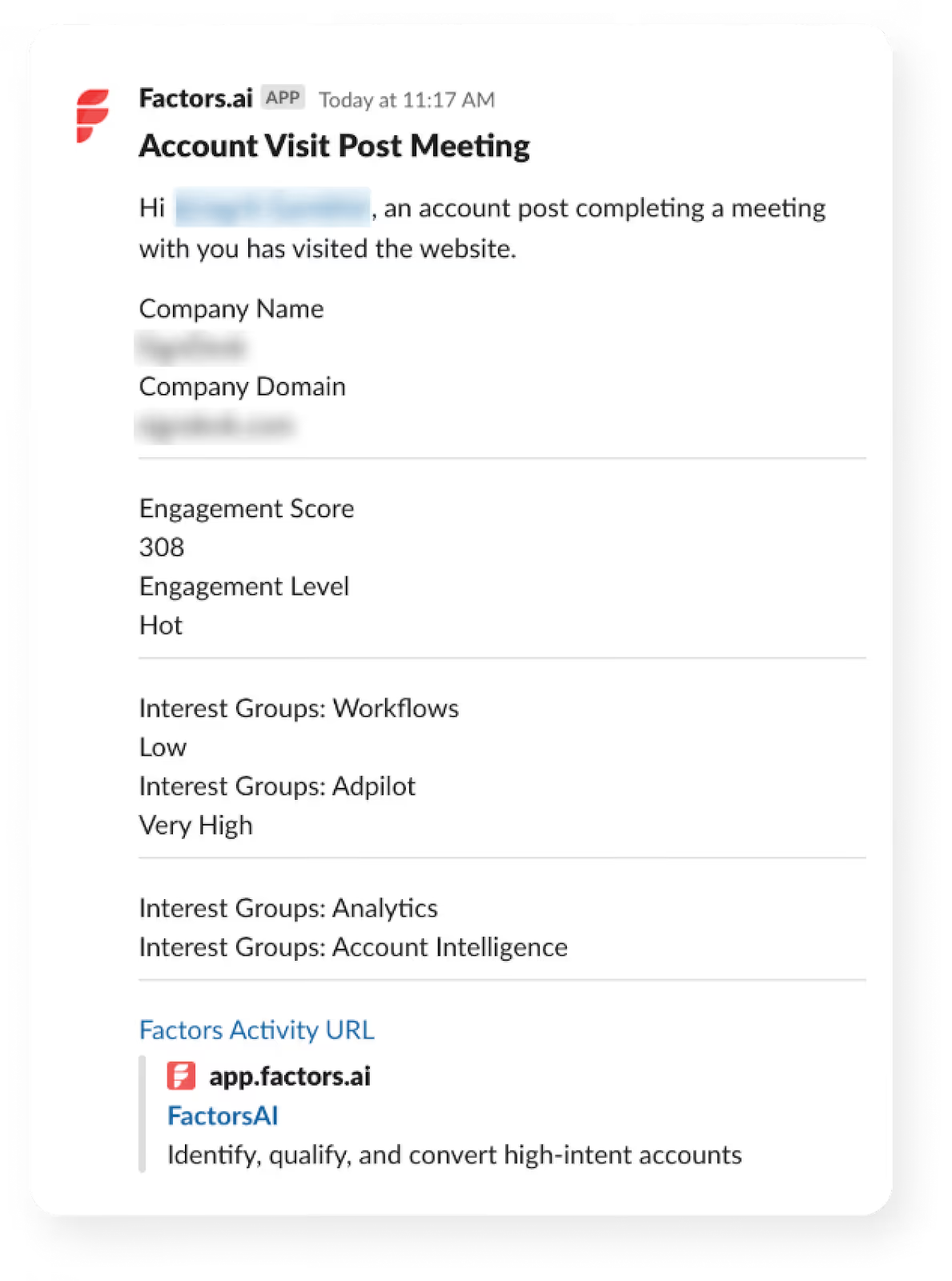
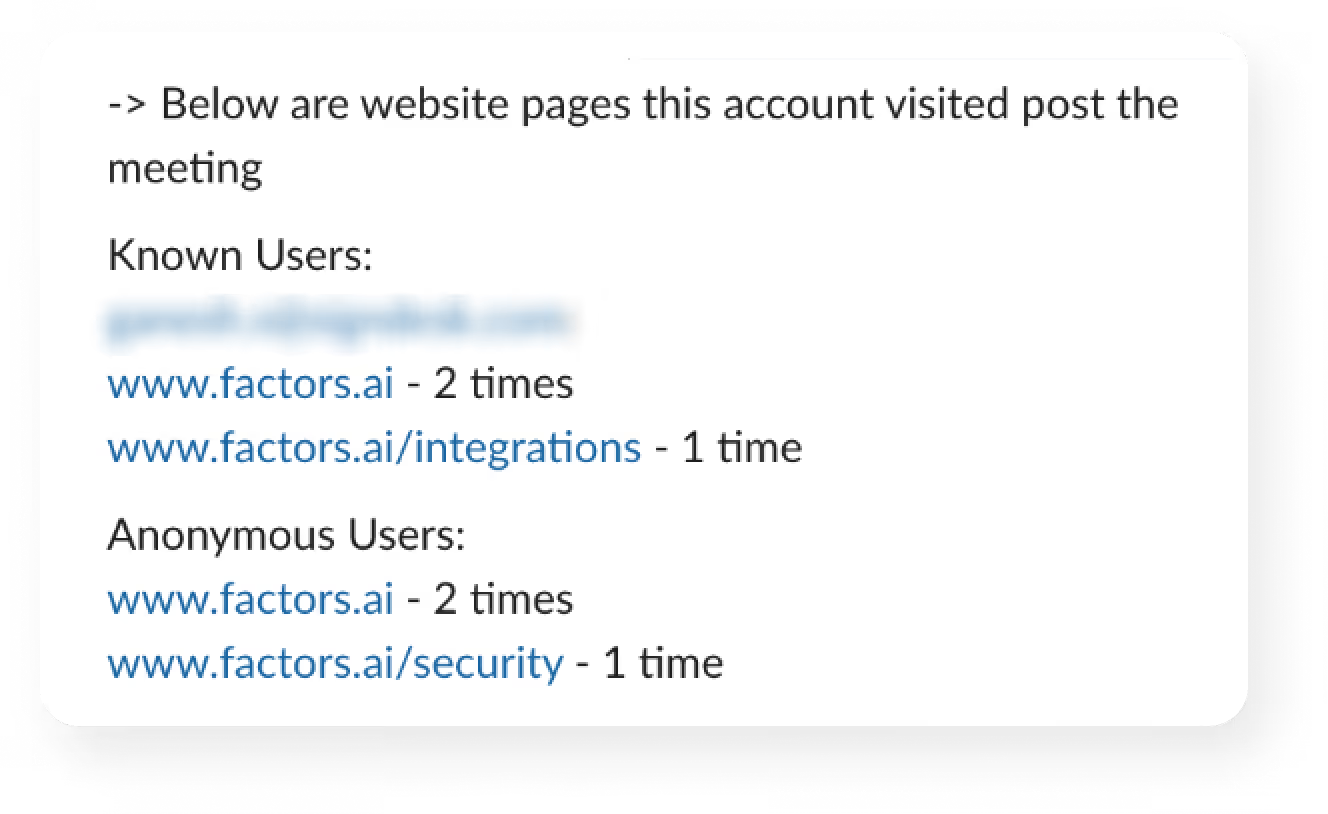
Ready to catch the next one?
Why teams pick Factors.ai for intent-driven outbound
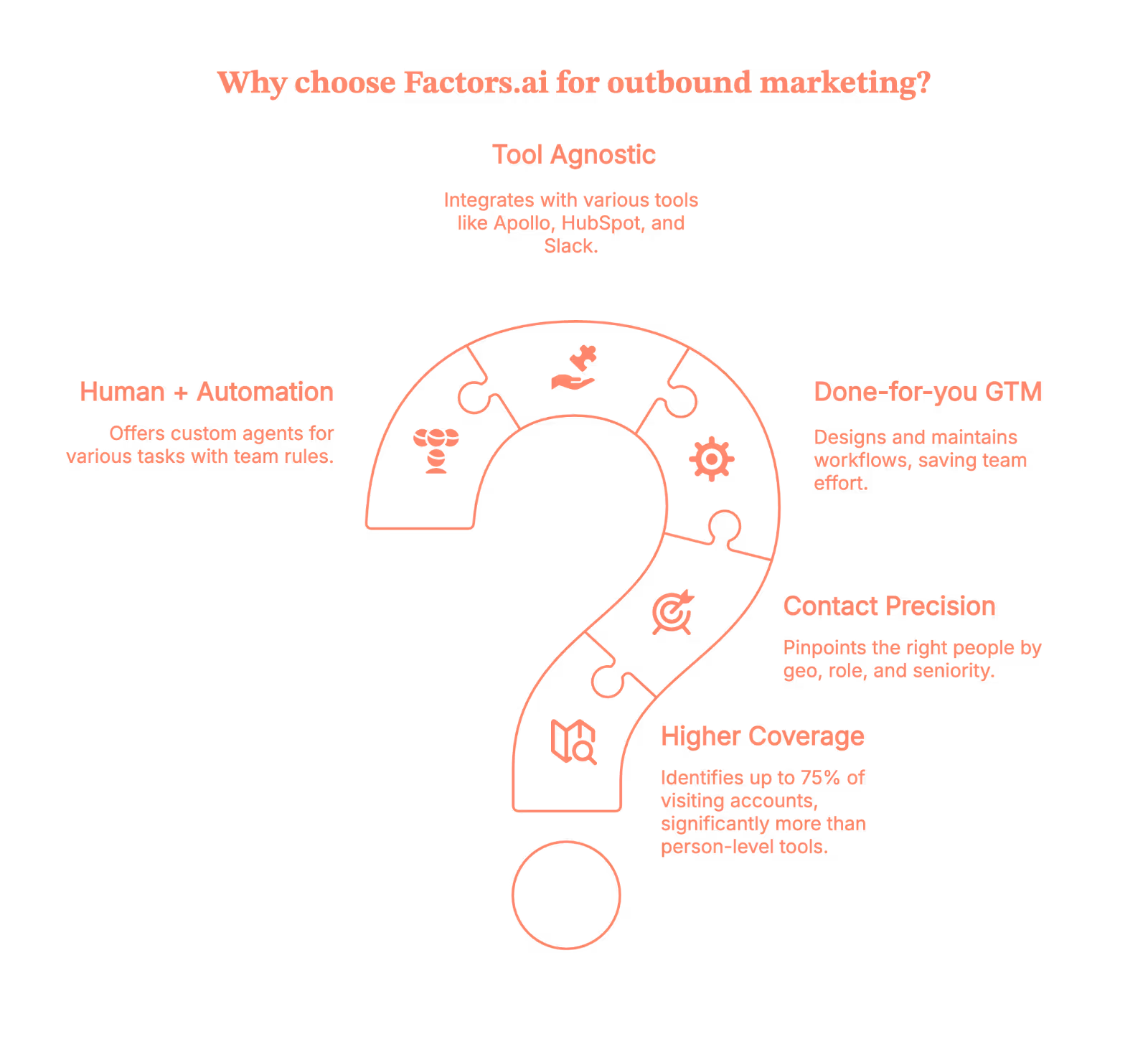
- Higher coverage: Identify up to 75% of visiting accounts (vs 8–10% person-level tools).
- Contact-level precision: Pinpoint the right people by geo, role, seniority, and buying group using user geo + job title triangulation.
- Done-for-you GTM engineering: We design, build, and maintain the workflows, so you don’t.
- Tool-agnostic, outcome-first: Use Factors with Apollo, HubSpot/Salesforce, Slack, Make/Zapier/Clay, Google Sheets, and your ad stack.
- Human + automation: Custom agents for Account Qualification, Contact Relevance, Account Tiering, Account Mapping, Meeting Assist, and Closed-Lost Alerts, with your team’s rules baked in.
(Short version: fewer ‘busywork’ pings, more booked meetings.)
Now, your move
If you’ve got traffic but not enough conversations, you don’t need ‘more leads.’ You need to activate the intent you already have, and do it automatically.
Factors identifies who’s on your site, uses GTM engineering to enrich and prioritize accounts, and delivers ready-to-send outreach to your reps in minutes.
Book a demo, and we’ll show you your high-intent accounts, the exact contacts to reach, and the workflows that make outbound feel (almost) effortless.
You’re closer to your next best deal than you think. Let’s go get it.
Quick FAQ on GTM engineering services from Factors.ai (because your team will ask)
Q. Will this spam Slack?
A. No, alerts are filtered by ICP + intent + tier. Everything else goes to a digest.
Q. Are the emails any good?
A. We use context from buyer journeys and your rules to generate short, human drafts. Reps keep the voice; automation kills the busywork.
Q. What if our ops team is small?
A. That’s why GTM engineering services exist. We build and maintain the flows; you enjoy the pipeline.
Top 11 RB2B Alternatives
Find the top 11 RB2B alternatives for effective B2B marketing and lead management. Learn how Factors.ai can enhance your strategy with predictive analytics and seamless integrations.
TL;DR
- RB2B is a popular B2B marketing and sales platform, offering AI-driven analytics, CRM integration, lead scoring, and automation tools.
- However, it may not meet all business needs due to cost, complexity, or limited functionality for some users.
- Reasons to consider alternatives include changing business needs, better cost efficiency, enhanced functionality, improved user experience, superior customer support, and quicker innovation.
- When selecting an alternative, consider business goals, essential features, ease of use, scalability, system integration, customer support, pricing, security, and user reviews.
- Compare features, pros, cons, and pricing for Factors, Clearbit, Kwanzoo, Lead Forensics, Hubspot Sales Hub, 6sense Revenue AI for Marketing, Constant Contact Advance automation and CRM platform, Apollo AI, Dealfront, 6sense Revenue AI™ for Sales, ZoomInfo Sales, to see what best fits your business needs.
- Free trials and demos are recommended to test usability and ensure the platform meets your needs.
Success in B2B marketing hinges on the right tools and platforms. That said, platforms such as RB2B have become indispensable for businesses looking to enhance their strategies, streamline lead management, and strengthen connections with target accounts. They offer a wide range of features—from automated marketing and integrated CRM systems to advanced analytics and AI insights—all aimed at boosting growth and efficiency.
Choosing the right B2B platform can be overwhelming with so many options out there. Each platform has its strengths, weaknesses, and pricing models, so businesses must assess their needs and budgets carefully before deciding. To help navigate this complexity, we've put together a list of the top 10 alternatives to RB2B. Each option is detailed with an overview, key features, pros, cons, and pricing, along with our insights.
Whether you're a small business looking for scalable solutions or a large enterprise needing advanced personalization and integration capabilities, this blog will give you the clarity to choose the perfect platform.
Let’s Learn More About RB2B

Overview:
RB2B is a comprehensive B2B sales and marketing platform designed to enhance lead management and account-based marketing (ABM). Leveraging advanced AI, it offers real-time analytics, CRM integration, and powerful automation tools to streamline workflows and improve customer engagement. The platform is ideal for businesses seeking to optimize their sales strategies and boost ROI through data-driven decisions.
Key Features:
- AI-Powered Analytics: Advanced insights for data-driven decisions.
- CRM Integration: Seamless connection with existing systems.
- Lead Scoring: Prioritizes high-value prospects.
- Account-Based Marketing (ABM): Tailored strategies for target accounts.
- Automation Tools: Streamlines marketing and sales processes.
Pros:

- Comprehensive Analytics: Deep insights into customer behavior and trends.
- Strong CRM Integration: Enhances data management and customer tracking.
- Effective ABM: Personalized marketing strategies improve engagement.
- Automation: Reduces manual tasks, saving time and resources.
Cons:

- Complex Setup: Initial setup can be time-consuming and requires expertise.
- Learning Curve: Some users may find the platform challenging to master.
- Cost: Premium features may be costly for small businesses.
Pricing:
RB2B offers customized pricing plans based on business size and needs. Detailed pricing information is available upon request from the RB2B website.
Here’s Why You Need An RB2B Alternative
While RB2B may be a popular choice among businesses for their B2B needs, there are several reasons why you might consider exploring alternatives:
- Evolving Business Needs:
As businesses grow, their needs often evolve, and they may require different or more advanced tools than those provided by a single platform like RB2B.
- Cost Efficiency:
Some B2B platforms can be expensive, and if a company isn’t using all the features, they might seek a more affordable option. Alternative platforms might indeed offer more tailored features at a lower cost.
- Enhanced Functionality:
B2B platforms vary widely in the features they offer. If a business needs specific tools or enhanced capabilities that RB2B lacks, seeking alternatives is logical.
- User Experience:
User experience is crucial in the effectiveness of any software. If RB2B is difficult to use, switching to a more user-friendly platform could indeed boost productivity.
- Better Customer Support:
Customer support quality can differ significantly between platforms. If RB2B’s support is lacking, moving to a platform with better support is a reasonable consideration.
- Innovation and Updates:
Some platforms are quicker to adopt new technologies and features. If RB2B is slow to innovate, businesses might look for alternatives that offer more up-to-date solutions.
Exploring RB2B alternatives allows you to find a solution that better fits your current and future needs, ensuring your business stays agile, cost-efficient, and ahead of the competition.
{{INLINE_CTA_A}}
Things to Keep in Mind While Choosing the Perfect RB2B Alternative
- Business Needs and Objectives:
Clearly define your business goals and what you need from a B2B platform. Whether it's lead generation, customer relationship management, or advanced analytics, ensure the platform aligns with your objectives.
- Features and Capabilities:
Compare the features offered by different platforms. Look for features that are essential to your operations, such as CRM integration, automated marketing, AI-driven insights, and customization options.
- Ease of Use:
The platform should have an intuitive interface that your team can quickly learn and navigate. A steep learning curve can lead to reduced productivity and increased training costs.
- Scalability:
Choose a platform that can grow with your business. It should be able to handle increasing amounts of data and users without compromising performance.
- Integration with Existing Systems:
Ensure the platform can seamlessly integrate with your current systems, such as CRM, ERP, and other marketing tools. This will help in creating a unified workflow and reduce data silos.
- Customer Support and Training:
Reliable customer support is crucial, especially during the initial setup and onboarding phase. Check if the platform offers comprehensive training resources and responsive support.
- Pricing and Budget:
Evaluate the pricing models of different platforms and ensure they fit within your budget. Consider not just the initial cost but also any ongoing expenses, such as subscription fees and additional charges for premium features.
- Security and Compliance:
Data security is paramount in B2B transactions. Ensure the platform complies with industry standards and regulations, such as GDPR, and offers robust security measures to protect your data.
- User Reviews and Case Studies:
Look for reviews from similar businesses. Case studies can provide insights into how the platform has helped other companies achieve their goals.
- Trial Periods and Demos:
Take advantage of free trials and demos to get a hands-on platform experience. This will help you assess its usability and fit for your business needs.
Whether you're a small business looking for scalable solutions or a large enterprise needing advanced personalization and integration capabilities, keeping these factors in mind will help you choose the perfect RB2B alternative.
Here are the best RB2B alternatives:
1. Factors.ai

Overview
Factors is a AI ABM and data-driven marketing analytics platform designed to help businesses optimize their marketing strategies and drive revenue growth. By leveraging advanced AI and machine learning algorithms, Factors enables marketers to analyze campaign performance, customer journeys, and conversion paths in real-time. The platform integrates seamlessly with various data sources, providing actionable insights that empower marketing teams to make informed decisions and maximize ROI.

Key Features
- Customer Journey Mapping: Visualizes customer journeys across different touchpoints to identify key conversion paths.
- Campaign Performance Analytics: Offers in-depth analysis of marketing campaigns, helping to optimize performance and ROI.
- Multi-Touch Attribution: Tracks and attributes conversions to multiple touchpoints in the customer journey, providing a holistic view of marketing effectiveness.
- Data Integration: Integrates with various data sources such as CRM, ad platforms, and analytics tools to provide a unified view of marketing performance.
- AI-Powered Insights: Utilizes AI to generate insights and recommendations for improving marketing strategies.
- Custom Dashboards: Allows users to create and customize dashboards for monitoring key metrics and KPIs.
Here’s why Factors is a strong RB2B alternative:

- Comprehensive Analytics: Provides detailed insights into customer behavior and campaign performance, enabling data-driven decision-making.
- User-Friendly Interface: The platform is intuitive and easy to navigate, making it accessible to marketers of all skill levels.
- Seamless Integrations: Easily integrates with a wide range of tools and platforms, ensuring smooth data flow and analysis.
- Actionable Insights: AI-driven recommendations help marketers quickly identify opportunities for improvement.
- Customizable Dashboards: Allows for flexibility in reporting, with dashboards tailored to specific business needs.

Cons
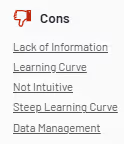
- Limited Customization: Some users find the customization options for reports and dashboards to be limited.
- Complex Setup: Initial setup and integration can be complex and may require technical support.
- Learning Curve: While the interface is user-friendly, fully understanding and utilizing all features may take some time.
- Pricing: The platform can be expensive for small businesses or startups with limited budgets.

Pricing
Factors offers custom pricing based on the needs of the business. Prospective customers can request a demo and a tailored pricing plan directly from Factors. For more details, visit Factors Pricing.
Concluding Statement
Factors is a powerful tool for businesses to enhance their marketing analytics and drive growth through data-driven insights. Its AI-powered capabilities and comprehensive analytics make it particularly well-suited for organizations seeking to optimize their marketing strategies and understand customer behavior in depth. While the platform may have a steep learning curve and require some technical setup, its robust features, and seamless integrations make it a valuable asset for marketers aiming to maximize ROI.
{{INLINE_CTA_A}}
2. Clearbit

Overview
Clearbit Enrichment adds over 100 data points on a company, its technology, and its employees to every record in your database, helping you convert leads into customers faster. It integrates smoothly with HubSpot to streamline and enhance your workflows, ensuring you capture valuable leads by providing the context needed to score, route, and accelerate the buyer's journey. Clearbit allows for shorter forms by auto-filling known fields, thus boosting conversions. It leverages a reliable source of business data, optimized with machine learning and quality assurance, applicable to all companies with a web presence, not just the Fortune 500. Additionally, Clearbit Reveal identifies companies visiting your website and syncs this enriched information directly to HubSpot.
Key Features
- Data Availability
- Contact Data Availability: Extensive access to contact information.
- Company Data Availability: Comprehensive company data access.
- Industry Research Availability: Provides industry-specific research data.
- Data Accuracy
- Contact Data Accuracy: High level of accuracy in contact information.
- Company Data Accuracy: Reliable accuracy in company data.
- Features
- Lead Builder: Facilitates the creation of detailed lead profiles.
- Integration with CRM/Marketing Automation: Seamlessly integrates with CRM and marketing tools.
- Data Cleaning/Enrichment: Enhances and purifies existing data.
- Search: Advanced search capabilities.
- News/People Alerts: Alerts on relevant news and updates.
- Reporting: Comprehensive reporting features.
- Platform
- Internationalization: Supports global usage.
- Performance and Reliability: Ensures high performance and dependability.
- APIs: Provides robust APIs for integration.
- Lead Intelligence
- Lead Enrichment: Enriches lead data with extensive information.

Here’s why Clearbit is a good RB2B alternative:
- User-friendly interface.
- High accuracy in finding company owners' and senior executives' details.
- Enhances sales and marketing by identifying website visitors.
- Integrates effectively with HubSpot and Google Analytics.
- Provides additional channels for SDR teams to analyze outbound campaigns.

Cons
- Recent UX changes have made some features, like the visitor report, harder to use.
- Credit-based system can be confusing.
- Some data enrichment titles are not useful for all audiences.

Pricing
Pricing information for Clearbit is provided by the vendor or available from public sources. Final cost negotiations should be conducted directly with Clearbit.

Concluding Statement
Clearbit is a robust tool for lead enrichment and data integration, enhancing sales and marketing processes with accurate and comprehensive company and contact data. It is user-friendly and integrates well with platforms like HubSpot, despite some recent UX changes and the somewhat confusing credit system. Overall, Clearbit is a valuable asset for businesses looking to optimize lead generation and customer engagement.
3. Kwanzoo

Overview
Kwanzoo is a cutting-edge platform that offers comprehensive solutions for B2B marketers looking to streamline their account-based marketing (ABM) and demand generation efforts. Kwanzoo’s approach combines multichannel engagement, dynamic personalization, and advanced data analytics, helping businesses drive more meaningful interactions with their target accounts. With a robust suite of tools designed to enhance campaign performance and accelerate sales pipelines, Kwanzoo has positioned itself as a strong alternative to Factors for businesses aiming to optimize their B2B marketing strategies.
Key Features
- Account-Based Marketing (ABM)
- Focuses heavily on ABM strategies.
- Engages high-value accounts with personalized and targeted marketing efforts.
- Supports multichannel marketing for broader reach.
- Data-Driven Personalization
- Utilizes real-time data analytics.
- Helps craft highly personalized marketing content based on user behaviors.
- Improves engagement and conversion rates through tailored messaging.
- Omnichannel Support
- Integrates with multiple marketing channels like display ads, email, and mobile.
- Provides seamless interactions across different customer touchpoints.
- Ensures consistent messaging and engagement across platforms.
- Lead Nurturing
- Offers advanced lead nurturing capabilities.
- Ensures continuous engagement of leads throughout the sales funnel.
- Delivers relevant content to move leads closer to conversion.
- A/B Testing
- Allows A/B testing for creative content.
- Helps marketers optimize campaigns for better performance and results.
- Enables data-driven decisions on content effectiveness.
- CRM and Marketing Automation Integration
- Integrates with major CRM and marketing automation platforms, including Salesforce, Eloqua, and Marketo.
- Ensures smoother workflows and unified marketing efforts.
- Facilitates better collaboration between marketing and sales teams.
Here’s why Lead Forensics is a good RB2B alternative:
- Strong focus on ABM and personalized, data-driven marketing.
- Ensures consistent omnichannel engagement.
- Seamless integration with major CRMs and marketing automation platforms.
- Advanced A/B testing for continuous campaign optimization.

Cons
- Complex setup with a steep learning curve.
- Limited features for smaller businesses.
- Customization options for reporting and dashboards may be less flexible.

Pricing
Kwanzoo offers custom pricing plans based on the specific needs of businesses. The pricing varies depending on factors like the scale of ABM campaigns, the number of target accounts, and additional integrations. It’s best to contact Kwanzoo directly for a tailored quote that fits your marketing requirements.

Concluding Statement
Kwanzoo presents a powerful and feature-rich platform for B2B marketers who need to enhance their account-based marketing and lead nurturing efforts. Its advanced personalization and omnichannel engagement capabilities make it an excellent alternative to Factors, especially for companies targeting high-value accounts with customized campaigns. However, it’s important to consider the complexity of setup and that smaller businesses may not fully leverage all the platform’s functionalities. Overall, Kwanzoo remains a competitive option in the B2B marketing space, particularly for larger enterprises.
{{INLINE_CTA_A}}
4. Lead Forensics

Overview
Lead Forensics empowers businesses to engage with B2B website visitors in real time, capitalizing on moments when visitors are most engaged. This tool identifies who your website visitors are, their origin, their interests, and their stage within your sales pipeline. It enables quick routing of opportunities to account managers, facilitating valuable and meaningful conversations. Established in 2009, Lead Forensics operates globally with over 60,000 users and more than 400 dedicated SaaS specialists. The platform boasts an extensive matched IP database, identifying millions of IP addresses and B2B contacts. This data undergoes rigorous cleansing and verification, ensuring the highest quality and volume of matched B2B website visitors, presented in an intuitive dashboard with detailed reporting.
Key Features
- Lead Intelligence
- Provides detailed insights on leads at the account level.
- Comprehensive lead analysis and management.
- Effective segmentation and account identification.
- Marketing Campaigns
- Supports media attribution and customization.
- Utilizes natural language processing (NLP) for advanced features.
- Offers real-time intent alerts.
- Data Availability
- Extensive contact data availability.
- Access to offline data.
- Platform Additional Functionality
- Integrations with other tools.
- Topic customization capabilities.

Here’s why Lead Forensics is a good RB2B alternative:
- Real-time visibility of website visits with detailed visitor information.
- Ability to categorize leads and add different statuses for efficient targeting.
- Trigger reports ensure appropriate team members follow up on relevant leads.
- Access to company data helps in creating highly targeted marketing campaigns.
- Excellent account management support with regular check-ins.

Cons
- Desire for further integration with Salesforce.
- Users feel there are many tools within the platform that they do not fully utilize due to time constraints.

Pricing
Lead Forensics offers two pricing plans. One is the Essential plan which is perfect for small and medium sized businesses, while the other is the Automate plan, perfect for enterprise businesses. You can get your free trial, expert advise, as well as custom quote from Lead Forensic’s website itself.
Concluding Statement
Lead Forensics is a powerful tool for B2B companies seeking to engage with website visitors in real time. Its ability to provide detailed insights into visitors and their behaviors, combined with robust lead management and segmentation features, makes it a valuable asset for optimizing marketing and sales efforts. Although there is room for improvement in integrations and tool utilization, the platform's comprehensive data quality and excellent support make it a reliable choice for enhancing B2B website visitor intelligence.
5. HubSpot Sales Hub

Overview
HubSpot Sales Hub is a comprehensive and user-friendly sales CRM that integrates sales engagement tools, CPQ functionality, and advanced sales analytics. Built on the HubSpot CRM platform, it unifies customer data, tools, and teams to create a single source of truth, enhancing sales rep efficiency. Utilizing the full CRM platform provides richer insights, warmer leads, and aligned enablement materials, allowing reps to operate at maximum efficiency. The platform's extensive ecosystem of app and solutions partners ensures an exceptional end-to-end customer experience. HubSpot Sales Hub is designed to scale your company without adding complexity, offering all the necessary tools for business growth.
Key Features
- Sales Force Automation
- Automates sales tasks to streamline processes.
- Contact & Account Management
- Manages customer and account information efficiently.
- Opportunity & Pipeline Management
- Tracks and manages sales opportunities and pipeline stages.
- Task / Activity Management
- Organizes and tracks sales tasks and activities.
- Territory & Quota Management
- Manages sales territories and quotas effectively.
- Desktop Integration
- Integrates with desktop applications for seamless workflow.
- Marketing Automation
- Automates marketing tasks to enhance lead generation.
- Email Marketing
- Facilitates email marketing campaigns.
- Campaign Management
- Manages and tracks marketing campaigns.
- Lead Management
- Tracks and nurtures leads throughout the sales cycle.
- Marketing ROI Analytics
- Analyzes marketing return on investment.
- Customer Support
- Provides robust case management for customer support.
- Mobile & Social
- Offers social collaboration features and mobile user support.
- Reporting & Analytics
- Provides detailed reporting, dashboards, and forecasting.

Here’s why HubSpot Sales Hub is a good RB2B alternative:

- HubSpot is user-friendly and intuitive, making it easy to manage pipelines and organize outbound processes.
- Seamless integration with other tools, such as Trellus, enhances workflow efficiency.
- Robust lead management features support effective tracking and nurturing of leads.
- Extensive training resources and responsive customer support help users get the most out of HubSpot.
- Highly customizable and quick to implement, offering flexibility to suit various business needs.
- Accessible for visually impaired users, with good compatibility with screen reading software.

Cons

- There is a steep learning curve for some users, particularly when adapting to new workflows.
- Certain features that might be essential for specific workflows are missing.
- Users have reported occasional email issues that need addressing.
- The cost is higher compared to some competitors, which may be a consideration for budget-conscious businesses.
- Adapting to account-based outreach approaches can be challenging with the current setup.

Pricing
There are two pricing plans available. The first one is the Sales Hub Professional plan which starts at $90/mo/seat. The second plan is the Sales Hub Enterprise plan which starts at $150/mo/seat. For detailed pricing information, please refer to the HubSpot Sales Hub pricing page.
Concluding Statement
HubSpot Sales Hub is a robust and flexible CRM solution that enhances sales processes with powerful tools and seamless integrations. While there may be a learning curve and higher costs, the platform's ease of use, extensive features, and excellent customer support make it a valuable investment for growing teams. HubSpot Sales Hub enables businesses to scale efficiently and effectively, providing a solid foundation for sustained growth.
6. 6sense Revenue AI for Marketing

Overview
6sense transforms how organizations manage and convert pipeline to revenue. Their Revenue AI captures anonymous buying signals, identifies optimal accounts, and recommends tailored channels and messages to enhance revenue performance. By eliminating guesswork and streamlining sales efforts, 6sense empowers teams to improve pipeline quality, accelerate sales velocity, increase conversion rates, and predictably grow revenue. Learn more at 6sense.com.
Key Features
- Lead Intelligence
- Provides detailed insights on leads and accounts.
- Enables predictive scoring and effective lead management.
- Marketing Distribution
- Facilitates personalized messaging and website personalization.
- Supports digital advertising and comprehensive campaign planning.
- Platform Additional Functionality
- Integrates with major platforms including ad networks, buyer intent data sources, marketing automation, and CRM systems.

Here’s why HubSpot Sales Hub is a good RB2B alternative:

- Utilizes powerful intent data for targeted marketing efforts.
- User-friendly interface for ease of use.
- Effective audience targeting and solution effectiveness.
- Strong customer support and extensive integrations.

Cons

- Potential for inaccuracies in data.
- Complexity in managing multiple creatives in campaigns.
- Issues with data quality and slow performance at times.
Pricing
Pricing information is customized and not publicly available. Interested parties must contact 6sense for detailed pricing.
Concluding Statement
6sense Revenue AI for Marketing stands out for its ability to leverage intent data effectively in driving account-based marketing strategies. It offers robust features for lead intelligence, personalized marketing campaigns, and seamless integrations with major platforms. While it commands a premium price and faces challenges with data accuracy and integration limitations, 6sense remains a leading choice for organizations aiming to implement successful account-based revenue strategies.
7. Constant Contact Advanced Automation & CRM Platform

Overview
Constant Contact offers powerful digital marketing tools tailored for small businesses, focusing on simplifying and enhancing digital marketing efforts. Whether it's driving sales, expanding customer bases, or engaging audiences, Constant Contact aims to foster strong connections and deliver impactful results.
- Grow your audience: Quickly build your email list using landing pages, social media lead ads, and more.
- Deepen customer relationships: Engage with customers via text, email, or social media—all from a single platform—to drive better engagement and outcomes.
- Simplify social media: Manage social posts and ads effortlessly to boost awareness, generate leads, and foster growth.
- Sync with existing apps: Seamlessly integrate with your current digital tools to accelerate business growth and online sales.
Key Features
- Reporting & Analytics: Provides basic reporting and web analytics.
- Email Marketing: Create, personalize, and send outbound emails, manage email deliverability, and automate responses.
- Online Marketing: Includes mobile-optimized landing pages, forms, and tools for lead management, segmentation, scoring, nurturing, and online behavior tracking.
- Automated Alerts and Tasks: Automate alerts and tasks to streamline workflows.
Here’s why Constant Contact is a good RB2B alternative:

- Easy to use interface, especially for email marketing.
- Excellent customer support.
- Robust automation features.
- Simplifies the creation of marketing materials.

Cons
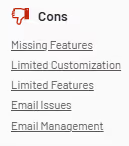
- Some template issues were reported.
- Occasional missing or limited features.
- Initial learning curve for new users.
- Issues with email functionality.

Pricing
Constant Contact offers three pricing plans:
- Lite: Starting at ₹990/month (price varies based on number of contacts).
- Standard: Starting at ₹2,888/month (price varies based on number of contacts).
- Premium: Starting at ₹6,600/month (price varies based on number of contacts). For detailed pricing information, visit Constant Contact Pricing.
Concluding Statement
Constant Contact Advanced Automation & CRM Platform is an essential tool for small businesses looking to streamline and amplify their digital marketing efforts. It excels in simplifying email marketing, offering robust automation capabilities, and providing excellent customer support. While there are occasional template issues and a learning curve for new users, the platform's adaptability and integration with tools like Canva make it a versatile choice for enhancing marketing strategies and customer engagement.
{{INLINE_CTA_A}}
8. Apollo.io

Overview
Apollo.io is a comprehensive sales intelligence platform designed to assist in prospecting, engaging, and driving revenue growth. It provides tools for discovering new customers, connecting with contacts, and establishing effective go-to-market strategies. With a robust B2B database containing over 275 million contacts and 73 million companies, Apollo.io ensures teams have access to accurate and extensive data. The platform also offers an Engagement Suite to scale outbound activities and sequences efficiently, along with an Intelligence Engine that provides recommendations and analytics to optimize sales processes.
Key Features
- Data Availability
- Extensive availability of contact, company, and industry research data.
- Data Accuracy
- Ensures high accuracy in both contact and company data.
- Features
- Comprehensive search capabilities.
- Tools for lead intelligence, validation, enrichment, and analysis.
- Browser extension for seamless integration.
- Integrated workflows and task management.
- Email tracking and automation.
- CRM integration for enhanced workflow management.
- AI-driven automation and lead prioritization.

Here’s why Apollo.io is a good RB2B alternative:

- Organizational tools and powerful filters facilitate precise audience targeting.
- Simplifies the creation of sequences and touchpoints across multiple channels.
- Offers a range of features that enhance overall sales effectiveness.

Cons

- Some inaccuracies in phone numbers were sourced from online data.
- Issues with email deliverability and occasional bans from email providers like MS Outlook.

Pricing
Apollo.io offers four pricing plans ranging from a free plan to $119 per month for the Organization plan, accommodating different user needs and budgets. A free trial option is also available.
Concluding Statement
Apollo.io stands out as a versatile sales intelligence platform that empowers businesses to streamline their sales efforts effectively. With its vast database, powerful engagement tools, and AI-driven insights, Apollo.io supports organizations of all sizes in maximizing their outreach and conversion efforts. While it excels in organizing and targeting leads, improvements in data accuracy and email deliverability would enhance its overall utility for sales and marketing professionals.
9. Dealfront (formerly Echobot & Leadfeeder)

Overview
Dealfront is a comprehensive Go-to-Market Platform designed to empower sales and marketing teams with the tools needed to attract leads and close deals effectively.
Born from the merger of Germany’s Echobot and Finland’s Leadfeeder, Dealfront leverages advanced algorithms and data insights that surpass traditional tools, all while adhering to Europe’s stringent regulations. By integrating sales and marketing processes into a unified platform, Dealfront creates a perpetual optimization cycle that enhances accuracy, provides real-time Ideal Customer Profiles (ICPs), and converts more leads into successful deals.
Key Features
- Data Availability
- Extensive availability of contact, company, and industry research data.
- Data Accuracy
- High accuracy in both contact and company data.
- Features
- Lead Builder: Constructs detailed lead profiles.
- Integration to CRM/Marketing Automation: Seamlessly integrates with existing systems.
- Data Cleaning/Enrichment: Enhances data quality.
- Data Segmentation/Filtering: Allows for precise data organization.
- Search: Advanced search functionalities.
- News/People Alerts: Provides timely alerts on relevant updates.
- Platform
- Internationalization: Supports global operations.
- User, Role, and Access Management: Ensures secure and efficient platform usage.
- Performance and Reliability: Offers robust performance and reliability.
- APIs: Facilitates extensive integration capabilities.

Here’s why Dealfront is a good RB2B alternative:
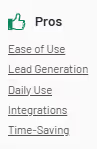
- Easy setup with valuable insights on website leads.
- Helps map user journeys and optimize website performance.
- Provides detailed source information on website visits.
- Useful filters and labeling for focused information.
- No additional costs for adding extra users, enhancing team collaboration.

Cons

- Lack of automatic integration with certain tools like Brevo.
- Manual setup for integrations can be time-consuming.
- Potential for errors in manual configurations.

Pricing
Dealfront offers flexible pricing packages tailored to specific business needs. For detailed pricing information, visit Dealfront Pricing.
Concluding Statement
Dealfront (formerly Echobot & Leadfeeder) stands out as a robust Go-to-Market Platform that integrates essential sales and marketing functionalities into a single, cohesive solution. Despite some limitations in automatic integrations, its strong API capabilities and comprehensive data insights make it a valuable asset for businesses looking to optimize their lead generation and conversion processes effectively.
Also Read: Leadfeeder (Dealfront) Vs. Factors: Compare Pricing and Features
10. 6sense Revenue AI™ for Sales

Overview
6sense Revenue AI™ for Sales provides a centralized digital platform where sellers can quickly gather account and buying team intelligence. It emphasizes insights into the “Dark Funnel,” where a significant portion of B2B research happens anonymously, ensuring sellers can capitalize on potential deals they might otherwise miss. The platform offers direct access to recommended actions, persona mapping, detailed people and company profiles, a Chrome extension, prioritization dashboards, and alerts.
Key Features
- Data Availability
- Comprehensive availability of contact and company data.
- Access to industry-specific research.
- Data Accuracy
- High accuracy in contact and company data.
- Features
- Lead Builder for creating detailed lead profiles.
- Seamless integration with CRM and marketing automation tools.
- Data cleaning, enrichment, and segmentation/filtering capabilities.
- Advanced search functionalities and real-time alerts.
- Robust reporting capabilities.
- Platform
- User, role, and access management features.
- Reliable performance with detailed reporting and dashboards.

Here’s why 6sense Revenue AI for Sales is a good RB2B alternative:

- Provides visibility into new accounts through 6QA.
- Offers detailed intelligence on each account.
- User-friendly UI with seamless implementation.
- Excellent customer support and training from dedicated CSMs.

Cons

- Persona Map functionality may sometimes lack accurate contact information.
- Issues with synchronization of sales activities, affecting reporting accuracy and adoption rates.

Pricing
6sense Revenue AI™ for Sales offers customized packages tailored to specific features and enterprise needs. It includes unlimited insights into technology, company, and leads, along with features like custom alerts, saved filters, CSV exports, Salesforce & HubSpot integration, and dedicated success management.
Concluding Statement
6sense Revenue AI™ for Sales stands out as a powerful tool for B2B sales teams aiming to enhance their prospecting and sales efforts with deep account and buying team intelligence. While it offers robust features and reliable performance, improvements in persona mapping accuracy and better enablement training for new interfaces would further elevate its effectiveness. Overall, it is a comprehensive solution suited for teams of all sizes looking to optimize their sales processes through advanced data insights and streamlined workflows.
Also Read: 6Sense+Factors Visitor Identification & Account Analytics
11. ZoomInfo Sales

Overview
ZoomInfo Sales is a comprehensive go-to-market platform designed for B2B companies. It features a vast, accurate, and frequently updated database of insights, intelligence, and purchasing intent data about companies and contacts. The platform enhances this intelligence with tools like conversation intelligence (Chorus), sales engagement (Engage), and data orchestration (RingLead), facilitating better prospect and customer engagement. By integrating these tools with your existing systems, ZoomInfo Sales equips your go-to-market teams to close more deals efficiently.
Key Features
- Data Availability
- Comprehensive access to contact and company data.
- Industry-specific research data availability.
- Data Accuracy
- High accuracy in contact and company data.
- Features
- Lead Builder for creating detailed lead profiles.
- Integration with CRM and marketing automation platforms.
- Data cleaning and enrichment capabilities.
- Advanced data segmentation and filtering.
- Powerful search functionalities.
- News and people alerts.
- Detailed reporting features.
- Platform
- High performance and reliability.
- Analytics for deeper insights.
- Import/export functionalities.
- Lead monitoring capabilities.

Here’s why ZoomInfo Sales is a good RB2B alternative:

- User-friendly interface with easy access and implementation.
- Seamless integration with centralized CRM platforms.
- Comprehensive filtering options and strategic filters.
- Regular updates with new and useful features.

Cons

- Inconsistent performance of the Chrome pop-out extension.
- Limited support and occasional delays in resolving issues.
- Data accuracy can vary, requiring verification.
- Limitations in mobile app functionalities.

Pricing
Custom pricing is available upon inquiry with ZoomInfo Sales.
Concluding Statement
ZoomInfo Sales stands out as a robust solution for B2B companies aiming to streamline their sales processes and improve customer engagement. With its extensive database and integrated tools, it empowers teams to access accurate data, enhance targeting capabilities, and achieve higher sales effectiveness. While facing challenges like occasional technical issues and data accuracy concerns, ZoomInfo Sales continues to innovate and provide valuable features that support business growth and efficiency.
How can Factors help?
Factors is an advanced B2B sales and marketing platform that leverages cutting-edge AI technology to provide actionable insights and optimize lead management. Here’s how Factors stands out:
- Advanced AI-Driven Insights
Factors uses artificial intelligence to analyze massive datasets, uncover hidden patterns, and predict future trends. This allows businesses to make data-driven decisions and refine their strategies based on actionable insights.
- Enhanced Lead Scoring
The platform offers sophisticated lead scoring algorithms that evaluate lead quality more accurately. By assessing various factors such as engagement, behavior, and fit, Factors helps prioritize high-value prospects, ensuring sales teams focus their efforts on the most promising opportunities.
- Integration and Automation
Factors seamlessly integrates with existing CRM systems and marketing tools, streamlining workflows and automating repetitive tasks. This integration enhances efficiency by reducing manual data entry and ensuring that all systems are aligned.
- Personalized Marketing Campaigns
The platform provides tools for creating highly personalized marketing campaigns based on deep customer insights. This personalization increases the effectiveness of marketing efforts and improves customer engagement.
- Real-Time Analytics
Factors delivers real-time analytics and reporting, enabling businesses to track the performance of their campaigns and make quick adjustments as needed. This ensures that marketing strategies remain effective and responsive to changing market conditions.
- Scalability
Whether you're a small business or a large enterprise, Factors scales to meet your needs. Its flexible features and robust infrastructure support businesses of all sizes, adapting to varying demands and complexities.
- LinkedIn AdPilot
Factors has launched LinkedIn AdPilot, a platform that enables marketers to double down on their LinkedIn ROI. AdPilot’s capabilities such as Smart Reach, Audience Builder, Campaign Automation, View-Through Attribution, and Factors’ CAPI integration enable markteres to up their LinkedIn Ads game.
- G2 Intent
With G2 Intent integration, Factors provides insights into potential customers' buying intent. This feature allows businesses to identify and target prospects actively researching similar solutions, enhancing the precision and timing of marketing efforts.
- Account Intelligence and Analytics
Factors offers comprehensive account intelligence and analytics, giving businesses a deeper insight into their target accounts. This includes insights into account behavior, engagement levels, and key decision-makers, enabling more effective account-based marketing strategies.
Find the best RB2B alternative today
Choosing the right RB2B alternative can significantly impact your business's ability to attract, engage, and convert leads. Each of the alternatives listed above offers unique features and benefits, catering to different business needs and budgets. By evaluating these options based on their key features, pros, cons, and pricing, you can make an informed decision that aligns with your company's goals and growth strategy. Whether you're looking for advanced ABM capabilities, robust marketing automation, or comprehensive sales intelligence, there's a solution out there that can help you succeed in the competitive B2B landscape.
Ready to transform your B2B sales and marketing strategy with cutting-edge technology? Request a demo today and see how Factors.ai can help!
FAQs on RB2B Alternatives
Q1. How does the RB2B tool identify anonymous website visitors?
RB2B uses a proprietary publisher network and a massive database of "hashed" identities. When a user visits your site, the RB2B tool cross-references their browser cookies and IP address against this network to match them to a LinkedIn profile. In 2026, it is specifically optimized for US-based traffic
Q2. Is the RB2B tool legal and GDPR compliant?
The RB2B tool is primarily designed for the U.S. market and complies with CCPA by using publicly available and permissioned data. However, for GDPR (Europe), it sits in a “gray area.” Most legal experts on Reddit suggest that while RB2B doesn't store PII (Personally Identifiable Information) directly in a way that violates the letter of the law, you should use "Legitimate Interest" disclosures in your privacy policy if you plan to use it for EU visitors.
Q3. RB2B vs Apollo vs Clearbit: Which tool is better for visitor intent?
Users are constantly looking for the best stack and wondering if RB2B replaces their current tools.
- Apollo is best for finding new leads (outbound).
- Clearbit is best for enriching existing data within your CRM.
- RB2B is good for first-party intent, seeing exactly which specific human is on your site right now.
A better alternative is Factors.ai, which is GDPR compliant. You can use Factors.ai to get up to 75% coverage on website visitor identification. Factors.ai uses Geo and job-title-level triangulation to identify the person who likely visited your website.
Q4. What is the RB2B pricing for the Pro plan in 2026?
As of early 2026, the RB2B tool offers a tiered structure:
- Free Plan: Provides company-level identification only (who is visiting, not the specific person).
- Starter ($79/mo): Person-level ID but no direct email access.
- Pro Plan ($149+/mo): This is the “sweet spot” that opens business emails and direct CRM integrations (HubSpot/Salesforce). Prices scale based on your monthly resolutions (matched visitors).
Q5. How accurate is the data from the RB2B tool?
With the rise of VPNs and privacy-first browsers, people are skeptical of data quality.
Feedback from a sub-reddit r/sales suggests that while the RB2B tool is incredibly fast (often sending a Slack notification within seconds of a visit), it is not 100% perfect. Users report that about 1 in 5 matches might be a “stale” profile or someone using a shared IP.
What Are The Two Types Of Remarketing You Can Use on Google Display Ads?
Learn the key differences between standard and dynamic remarketing in Google Display Ads. Find out which strategy best suits your B2B marketing goals and how to maximize ad effectiveness for increased conversions.
TL;DR
- Remarketing through Google Display Ads helps you reconnect with past website visitors. There are two key types of Google Display Ads remarketing: standard and dynamic.
- Standard remarketing uses pre-defined ads to boost brand awareness and encourage actions, making it ideal for promoting offers to a broad audience.
- Dynamic remarketing personalizes ads based on user behavior, showcasing specific products or services that users have previously shown interest in. This targeted approach increases engagement and conversion rates.
- By selecting the right remarketing strategy and following best practices, businesses can enhance their Google Display Ads campaigns and drive more conversions.
In B2B marketing, reconnecting with potential clients who have previously visited your website is crucial. It enhances the advertising efforts by targeting the right audience. And the most effective way to do this is through remarketing.
Remarketing with Google Display Ads lets you strategically position your ads in front of past visitors. You can bring them back to your website, strengthen your connection, and improve your conversions.
There are two types of remarketing strategies used on Google Display Ads: standard remarketing and dynamic remarketing. Each serves distinct purposes and aligns with specific business goals.
This blog post will explore the key differences between standard and dynamic remarketing and help you determine which approach best fits your business strategy.
Also, check out Google Ads for SaaS.
Google Ads Standard Remarketing
Standard remarketing uses pre-defined ad variations to target users who have previously visited your website. This method is ideal for increasing brand awareness and prompting users to complete specific actions.
How Do You Set Up Standard Remarketing Ads?
To set up standard remarketing ads:
- Install the Google remarketing tag on your website.
- When someone visits your website, a small piece of code, known as a ‘cookie,’ is placed on their device's browser.
This enables you to advertise your products or services to previous visitors as they browse other sites within the extensive Google Display Network.

How Does a Standard Remarketing Ad Work?
Imagine, a user visits your website, explores the features page, and leaves without signing up for a demo. Here is what happens.
- A cookie is added to their device.
- As users browse other websites within the Google Display Network, such as YouTube and Gmail, they are shown remarketing ads about your products/services.
This targeted reminder can encourage the user to return and complete the action they initially skipped.
What Are The Benefits of Standard Google Ads Remarketing?
Standard remarketing in Google Ads offers several benefits for B2B marketers, including:
1. Easy Setup and Broad Targeting
Standard remarketing is simple to implement without complex configurations. It allows you to quickly target all past website visitors, regardless of which specific pages they visited.
2. Expanded Audience Reach and Increased Brand Awareness
By re-engaging potential customers who have shown interest in your offerings, you can expand your audience reach. Consistent exposure to these ads ensures your brand remains top-of-mind for your target audience.
3. Diverse Ad Formats
You can choose from various ad formats, such as text, image, or video ads to capture your audience's attention effectively.
Read more: Benefits of Google Ads.
What Are The Disadvantages of Standard Remarketing?
1. Lack of Audience Relevance
Standard remarketing targets all website visitors, including those who have already converted or made a purchase. This can result in showing irrelevant ads to existing customers.
2. Wasted Ad Spend
By displaying ads to all website visitors, including those who have already become customers, standard remarketing can lead to a wasted ad budget due to targeting the wrong audience segment.
These are the two main disadvantages of using a standard remarketing strategy.
Also, read our article on B2B Google Ads Strategy for 2026.
Dynamic Remarketing Google Ads
Dynamic remarketing goes further by leveraging user behavior data on your site to deliver personalized ads. It is particularly effective for targeting users interested in specific products or services. This customized approach makes the ads more relevant, increasing the chances of re-engaging visitors and driving conversions.
How Do You Set Up Dynamic Remarketing Ads?
- To set dynamic remarketing ads, install the Google remarketing tag on your website.
- Assign dynamic values to key website events, such as the products viewed or e-books downloaded, and visitors' specific actions, like filling out forms or requesting demos.
- Map these events throughout the customer journey and assign dynamic values accordingly.
- Create a feed in Google Ads that includes details such as product descriptions, pricing, and relevant identifiers.
- Google Ads will use this data to retarget users with personalized ads based on their previous interactions with your site, enhancing engagement and driving conversions.
This strategy allows B2B marketers to precisely re-engage potential customers, improving ad performance and ROI.
How Does A Dynamic Remarketing Ad Work?
Imagine you have a company that provides two main services: Traffic De-Anonymization and Intent Capture. When someone visits your website, you track their interactions with these services.
- You assign dynamic values to different key events on your site, like when users:
- View information about Traffic De-Anonymization (e.g., which pages they visit, what products or features they look at).
- Check out the details for Intent Capture.
- These "dynamic values" are essentially data points that help you personalize the ads based on what the user interacts with.
- Each key event, like visiting the Traffic De-Anonymization page, is tagged with specific values unique to that service, such as details about pricing, benefits, or features. When a user who looked at these services leaves your website without taking further action (like signing up for a demo), you can use dynamic remarketing ads to re-engage them.
- The ad content will be tailored specifically to the services they showed interest in, which helps make the ads much more relevant and effective at getting them back to your website to complete the desired action.
- Dynamic values allow you to create more specific, targeted ads. These ads show potential customers the exact services they previously engaged with, making it more likely they’ll convert (e.g., request a demo, make a purchase, etc.).
What Are The Benefits of Dynamic Remarketing Ads?
Dynamic remarketing in Google Ads offers several advantages in B2B marketing.
1. Higher Ad Relevance For Users
Dynamic remarketing shows ads featuring products or services that users have already expressed interest in, enhancing ad relevance and personalization.
2. Improved Engagement
Highly relevant ads lead to better engagement, as users are more likely to click on ads tailored to their behavior.
3. Higher Conversion Rates
Since dynamic remarketing targets high-intent users who are further along in the buying process, conversion rates will be higher compared to standard remarketing.
Disadvantages of Dynamic Remarketing Ads
1. Complex Set-Up Process
Setting up dynamic remarketing ads can be complicated. It requires configuring multiple components, including a detailed product feed, accurate dynamic value assignment, and user behavior tracking, which demands significant time and resources.
2. Risks of Incorrect Value Assignment
Incorrectly assigning dynamic values can lead to ad campaigns that fail to deliver the desired results, reducing the effectiveness of your marketing efforts.
3. Ad Fatigue
Repeated exposure to similar dynamic ads can cause ad fatigue, making the audience to desensitized and less responsive over time.
Also, read the guide to Google Ads management.
Standard Remarketing Vs. Dynamic Remarketing in Google Ads
Here's a comparison table highlighting the differences between standard and dynamic remarketing ads in Google Ads.
How To Choose The Right Remarketing Strategy For Your Business?
When choosing between standard and dynamic remarketing for Google Ads, weighing the pros and cons is important. Standard remarketing is effective for building brand awareness and encouraging broad audience engagement, but it may lead to wasted ad spend by targeting users who have already converted. On the other hand, dynamic remarketing offers highly personalized ads, increasing relevance and conversion rates, but requires a more complex setup and can lead to ad fatigue if users are overexposed.
Ultimately, standard remarketing is best for increasing general visibility, while dynamic remarketing works well for high-intent users interested in specific products or services.
Also, read how to do a Google Ads audit.
FAQs on Remarketing on Google Display Ads
Q1. What are the key differences between standard and dynamic remarketing in Google Display Ads?
Standard remarketing uses predefined ads to target all past website visitors, aiming to increase brand awareness. Dynamic remarketing, however, delivers personalized ads based on user's previous interactions with your site, making it more suitable for targeting high-intent users and increasing conversions.
Q2. When should I use standard remarketing over dynamic remarketing?
Standard remarketing is ideal for increasing brand awareness and targeting a broad audience. It works best for businesses that want to promote general offers or discounts to all past visitors, regardless of specific products they viewed.
Q3. What are the pros and cons of using dynamic remarketing?
Dynamic remarketing offers higher ad relevance, improved engagement, and better conversion rates by personalizing ads based on user behavior. However, it has a more complex setup, requires detailed tracking and feed management, and can lead to ad fatigue if users are repeatedly exposed to similar ads.

What are Lead Magnets?
Want to skyrocket your marketing efforts? Learn all about lead magnets, how to identify scope, & create them. Steps to ensure your lead magnet delivers.
What are Lead Magnets?
Lead Magnets are ‘gated’ content pieces that are created with the aim of providing useful information to users in exchange for their contact details (Email IDs/Mobile Nos). Content pieces such as newsletters, guides, white papers and other informational documents are used for this purpose.
The captured leads are then nurtured through customized email sequences in order to improve funnel progression and conversion rates.
Here’s a classic example of a lead magnet:
Let’s say you’re browsing a business website that provides sales intelligence to other companies. Just as you reach the middle of the page, you see a link to an insightful and informational guide. To access it, you click on the Call-To-Action button ‘Download Now’, which then triggers a popup asking for your email ID. Upon successfully entering the ID, you’d have access to the guide while the marketing team at the other end would add your ID to a mailing list for the purpose of nurturing.
Why Don’t We Give All Content For Free?
To answer this question, let’s analyze the pros and cons of not having any gated content on the website:
- Pros:
- High Accessibility: With no form in place, users will be able to access content without filling any form, thus reducing drop-offs
- Helps with SEO: If you’re not gating content, it means it lies in its full form on the website. This helps improve SEO score through strategic keyword placement within the content.
- Better Content Tracking: Since the content is not gated, metrics such as session time duration, page time, bounce rate and so on can be calculated to gauge the effectiveness of the content
- Cons:
- No Leads Acquired: The contact details of the user reading the content will not be known. Thus, the nurturing process cannot take place.
- Losing out to competitors: It is highly likely some other competitors will be using gated content with structured nurturing sequences and could end up winning a customer even though their content may not have had a similar impact.
Thus, while the accessibility and visibility of your brand increases with ungated content, you lose out on leads which other competitors may be able to capture.
Mixed Gating Strategy - Intent Driven
A mixed gating strategy involves using both gated and ungated policies based on the type of content.
When your focus is on improving the top funnel such as website visits, content that indicates low intent can be ungated. For example, a document on ‘What is Marketing Analytics?’ would be considered low intent since the vast majority of the users would be in the exploration phase and not ready for a sales call yet . This helps in avoiding the generation of leads with low quality who are not in the buying process yet thus allowing Sales Reps. to focus on high quality leads.
When you’re focusing on generating high intent leads, gated content can be utilized. For example, a guide on ROI analysis . Since such content indicates high intent, you can expect the lead volume to be low and the quality to be high.
A good way to connect the two gating policies would be re-marketing campaigns. All users who have visited the ungated content can be re-targeted with promotions for high intent gated content. Leads generated from these campaigns can be then expected to have higher quality in terms of conversion rates.
Account Level Tracking - Isn’t It Sufficient?
Many businesses that have adopted account-based marketing would argue that a mere visit to the website on any of the content pages would be enough to create a user profile with details such as location, company of the user, etc via IP address identification tools. This would seem to solve the gated/ungated content conundrum.
However, there are two points to be considered here. One, most IP address tools are not 100% accurate leading to missing or sometimes even wrong data. Two, even if you have been able to correctly identify the user’s location and company, how would you go about contacting them? It could be a marketing specialist belonging to a large corporation with 10K+ employees or a software engineer of a mid-sized company. Either way, with no email address, there would be no way to determine who read your content.
Thus, account level tracking gives limited understanding of who is reading your content, but is not enough to get contact information that can be used for customized nurturing sequences.
Finally, it’s important to focus on the content quality and the value it adds to the readers. There should be a strong enough reason for a user to submit their Email ID in exchange for the content. Good quality content will leave a lasting impression on the reader and aid towards brand recall.
How to Identify Website Visitors While Respecting Privacy
Get practical guidance on website visitor identification that respects privacy. Learn the difference between personal and company-level identification, and discover why company-level tracking is the smarter choice for B2B businesses.

TL;DR
- You can track website visitors by identifying individuals or companies, but company-level tracking is safer and privacy-compliant.
- It avoids legal risks, complies with GDPR, and helps in B2B by targeting multiple stakeholders within a company.
- To implement this ethically, use clear cookie notices, transparent privacy policies, and provide easy opt-out options.
- Ethical tracking builds trust, ensuring compliance and long-term success in B2B marketing.
I’ve been reflecting on website visitor tracking and identification, especially with all the privacy concerns swirling around. If you’re trying to figure out who’s visiting your website in a legal and ethical way, here’s what you should know.
Two Approaches to Website Visitor Identification
There are two main methods companies use to track website visitors:
- Personal Identification: Collecting details like names, emails, and LinkedIn profiles.
- Company Identification: Identifying the company a visitor works for without collecting personal data.
The first approach is legally questionable. Privacy laws, like GDPR, haven’t explicitly addressed it yet, leaving it in a gray area. On the other hand, identifying companies is much safer. Since no personal data is collected, you can avoid concerns with GDPR, CCPA, and other privacy laws, both now and in the future, regardless of the region.
Why I Recommend Sticking to Company-Level Tracking
Knowing exactly who’s visiting your website might sound appealing, but here’s why I believe company-level tracking is the smarter choice:
- You’ll engage with multiple people at the company anyway.
- You avoid privacy and legal challenges.
- It future-proofs your business against evolving privacy laws.
How to Implement Website Visitor Tracking Ethically
To ensure your tracking practices are both effective and compliant, follow these steps:
1. Use Proper Cookie Practices
Don't try to sneak your tracking cookies in as "essential"
- Label your tracking cookies as marketing cookies and let visitors opt-out.
- Avoid IP tracking, as it doesn’t provide an opt-out option for users.
- Stick with cookies—users are familiar with them, and regulations around cookies are clearer.
2. Be Transparent About Your Tracking
Make it clear what you’re doing by providing:
- A detailed terms of use page for your website.
- A cookie notice that explains how you use tracking cookies.
- A privacy policy that outlines your practices clearly.
3. Make Data Access and Deletion Easy
Set up a dedicated privacy@yourcompany.com email or a simple form for requests.
Allow users to view or delete their data without unnecessary hurdles.
4. Filter Out Small Businesses
Exclude companies with fewer than five employees to avoid inadvertently identifying individuals at very small businesses.
Also, read Implementing website visitor identification a detailed guide.
Should You Use Person-Level Identification?
If you're thinking about using tools that identify individual visitors, you need to weigh some factors:
- How many visitors can you accurately identify?
- How accurate is the data?
- Is it worth the privacy risks?
In most cases, company-level tracking is sufficient. It allows you to see which businesses are interested in your product and reach out to the right people through appropriate channels.
How Factors Ensures Privacy and Security
Factors takes your privacy & security very seriously.
- SOC Type II and GDPR compliant.
- Customer data hosted on Google Cloud Platform (GCP).
- Comprehensive Privacy Policy and Data Processing Policy.
Identifying site visitors can boost marketing performance, when done responsibly.
1. Best Practices: Anonymize data, secure user consent, and apply compliant tracking methods.
2. Compliance Focus: Align with privacy laws like GDPR and CCPA to protect user rights.
3. Strategic Benefits: Gain behavioral insights without compromising trust or legal standing.
Ethical visitor identification enhances targeting while preserving data integrity and user confidence.
Bottom Line
Here’s the bottom line: you want to know who’s interested in your product without crossing any lines. Focus on identifying companies, be transparent about your tracking practices, and give people control over their data.
It’s not just about staying compliant, it’s about building trust. And in B2B, trust is everything.
If you have any questions, feel free to reach out. I’m always happy to discuss how to balance effective marketing with respecting privacy.
%2520(1).avif)
Top 8 UnifyGTM Alternatives & Competitors for 2026
UnifyGTM costs $1,460–$1,740/mo and takes 1+ week to onboard. Compare 8 cheaper, faster UnifyGTM alternatives — Clay, Apollo, Warmly, 6sense, SyncGTM, Factors AI, ZoomInfo, Common Room — by features, pricing, and best fit.

TL;DR
- UnifyGTM is a signal-based B2B GTM platform priced at $1,460–$1,740/mo — strong on AI agents and intent triggers, weak on price and onboarding speed (1+ week to first value).
- Top 3 alternatives by use case: Clay (deepest enrichment, 100+ providers), Warmly (real-time visitor ID + signals), Apollo.io (budget all-in-one with free tier).
- Best for marketing attribution + ABM: Factors AI — LinkedIn AdPilot, multi-touch attribution, and account journey analytics that signal-only tools lack.
- Best for enterprise ABM: 6sense; Best mid-market all-in-one: SyncGTM ($99/mo); Best for SDR teams: MarketBetter.ai.
- Cheapest path off UnifyGTM: Apollo.io free tier or Salesforge ($48/mo).
Signal-based GTM has gone from 2024 buzzword to 2026 standard — and UnifyGTM helped define the category. But at $1,460–$1,740/mo with a 1+ week onboarding ramp, UnifyGTM isn't the right fit for every team. Reddit threads in r/gtmengineering describe it as 'the closest to what the form should exist' — great vision, slow time-to-value.
If you're evaluating UnifyGTM and want to compare it against Clay, Apollo, Warmly, 6sense, SyncGTM, Factors AI, ZoomInfo, or Common Room, this guide breaks down the eight best UnifyGTM alternatives in 2026 by features, pricing, and best fit.
About Unify: Pros, Cons, and Pricing
UnifyGTM is a signal-based B2B GTM platform that automates 'warm outbound' — surfacing in-market accounts via intent signals and engaging them through AI agents and multi-channel sequences. It's known for high-profile customer outcomes (Perplexity reportedly generated $1.7M in pipeline within 3 months) and is widely respected on Reddit's r/gtmengineering as 'the closest to what the form should exist' for buyer-intent tools.

Where UnifyGTM tends to fall short:
- Time to first value: 1+ week of onboarding before signals start firing
- Pricing: $1,460–$1,740/mo entry point excludes SMBs
- Data provider stack: narrower than Clay (100+ providers) or SyncGTM (50+)
- CRM depth: integration is functional, not industry-leading
Key features:
- Intent signals from multiple sources such as website, G2 with CRM integration
- Contact database of 120M contacts
- Auto-personalized sales email sequences based on intent data
- Use intent, enrichment, and CRM data to build audiences and trigger playbooks.
UnifyGTM Pricing (2026):
- Pro: $1,460/mo — includes intent signals, basic CRM sync, core AI agents
- Premium: $1,740/mo — adds custom playbooks, advanced enrichment, priority support
- Enterprise: Custom pricing
No free trial or self-serve plan. The $1,460+/mo entry makes UnifyGTM costly for SMBs.
G2 reviews highlight:


{{INLINE_CTA_A}}
What to look for in a UnifyGTM alternative
1. Customizable Reporting & Dashboards
Tailoring reports to specific go-to-market (GTM) metrics and key performance indicators (KPIs) is essential. A platform that offers real-time updates and automated data visualization allows marketers to track performance effortlessly ensuring timely adjustments to strategy.
2. Cross-Channel Attribution
Advanced algorithms that help prioritize potential customers are invaluable for targeting the right leads. Platforms with support for account-based marketing (ABM) that offer robust scoring models make it easier for teams to focus on high-value accounts.
3. Campaign Automation & Management
A tool that automates workflows for launching, managing, and optimizing campaigns, along with built-in collaboration tools for campaign planning, can save time and improve coordination across teams.
4. Funnel Analysis
The ability to break down customer funnels into detailed stages helps marketers identify drop-off points and optimization opportunities. Ideally, the platform should allow customization of funnel stages to match unique GTM strategies.
5. Audience Segmentation
Platforms with advanced segmentation options based on behavioral data, demographics, firmographics, or custom attributes enable personalized targeting. The ability to create dynamic, real-time segments ensures that marketing efforts are always relevant.
6. LinkedIn intent data
LinkedIn is the place to B2B for most of your ICP. Thus, LinkedIn plays a crucial role in generating revenue for your org. Choose a tool that gives you LinkedIn intent data so you can make smarter decisions with your ad campaigns.
Quick Comparison: 8 UnifyGTM Alternatives at a Glance
ToolBest ForStarting PriceSignals SourceFree TierFactors AIMarketing attribution + ABMCustom (from $999/mo)Website, CRM, MAP, LinkedIn, G2Yes (limited)ClayDeepest enrichment$149/mo100+ providers, custom workflowsFree trial6senseEnterprise ABMCustom ($50k+/yr)Native intent + 3rd-partyNoApollo.ioBudget all-in-one$0 / $49/mo265M-contact DB + intentYesWarmlyReal-time visitor ID$700/moWebsite + intent signalsYes (500 visitors)SyncGTMMid-market workflow$99/moWaterfall enrichment (50+ providers)TrialZoomInfo SalesEnterprise dataCustomNative + BomboraNoCommon RoomCommunity / dev signals$999/moDiscord, LinkedIn, GitHubYes
Top 8 UnifyGTM alternatives for signal-based marketing
1. Factors.ai

Factors AI is a B2B marketing analytics and attribution platform that identifies anonymous website visitors, consolidates intent signals across LinkedIn / G2 / website / CRM / MAP, and ties them to pipeline impact.
Why Factors is a good UnifyGTM alternative:
- Only solution on this list with LinkedIn AdPilot — a one-stop solution to improve LinkedIn ad ROI
- Multi-touch attribution and account journey analytics that signal-only tools (UnifyGTM, Warmly) lack
- Custom workflow automations between CRMs and MAPs without tool-switching
Limitations:
- Doesn't offer person-level contact information unless integrated with tools like Apollo or Bombora
- Smaller native contact database than Apollo or ZoomInfo
Pricing: Custom, with self-serve plans starting from $999/mo. Free tier available with limited features.
Best for: B2B marketing and RevOps teams that want signal-based GTM plus attribution and ABM analytics in one platform.
{{INLINE_CTA_A}}
2. Clay
Clay is a data-enrichment and workflow platform that integrates 100+ data providers to surface, score, and route signals through customizable AI agents. It's the most-named UnifyGTM alternative on Reddit and Perplexity in 2026.
Why Clay is a good UnifyGTM alternative:
- Waterfall enrichment across 100+ providers (vs UnifyGTM's narrower stack)
- AI agents for research, qualification, and personalization
- More flexible than UnifyGTM — build any signal-driven workflow without engineering
Limitations:
- Steeper learning curve than UnifyGTM
- Pricing scales with credits used — can exceed UnifyGTM at high volume
Pricing: Starter $149/mo, Pro $349/mo, custom Enterprise.
Best for: RevOps and growth teams that want maximum data flexibility and custom enrichment workflows.
3. 6sense
6sense is an AI-powered ABM platform with native intent signals, predictive scoring, and account orchestration — the enterprise standard for signal-based GTM.
Why 6sense is a good UnifyGTM alternative:
- Predictive AI for in-market account identification (broader than UnifyGTM's intent triggers)
- Mature ABM orchestration including programmatic ad targeting
- Enterprise integrations across Salesforce, HubSpot, and major MAPs
Limitations:
- Custom enterprise pricing — typically $50k+/yr; not for SMBs
- Heavier implementation than UnifyGTM
Pricing: Custom (typically $50k–$120k/yr based on revenue and seats).
Best for: Enterprise ABM teams that need predictive intent + programmatic ad orchestration.
4. Apollo.io

Apollo is a sales intelligence and engagement platform with over 265 million contacts. It provides access to rich buyer data, analytical insights, and automated personalized outreach workflows.
Why Apollo is a good UnifyGTM alternative:
- Better quality prospect data than UnifyGTM's contact database
- Cost-effective compared to UnifyGTM ($49/mo Basic vs $1,460/mo Pro)
- Generous free tier including limited credits and email outreach
Limitations:
- Difficult to navigate the platform due to the vast range of features
- Reporting features can be improved
Pricing: Free / Basic $49/mo / Professional $79/mo / Organization $119/mo / Enterprise custom.
Best for: Budget-conscious SDR / outbound teams that want a single platform for prospecting, enrichment, and engagement.
5. Warmly

Warmly is a sales orchestration platform built for sales and marketing teams looking to unlock their website's revenue potential through real-time visitor identification and intent signals.
Why Warmly is a good UnifyGTM alternative:
- Great for sales teams to reach out to ready-to-buy accounts in real time
- Identifies accounts and contacts visiting your website
- Free tier covers up to 500 visitors/mo
Limitations:
- Doesn't offer LinkedIn or G2 intent data
- Pricing is higher than other tools offering similar features at scale
Pricing: Free (500 visitors) / Business $700/mo / Pro $1,250/mo / Enterprise custom.
Best for: Sales teams that want real-time visitor identification + signal-based outreach orchestration.
💡Also read: Top 10 Warmly.AI Alternatives | Compare Pros, Cons & Pricing
6. ZoomInfo Sales

ZoomInfo Sales pairs a comprehensive B2B contact database with sales workflow tools — email automation, engagement tracking, and CRM integration — in one enterprise platform.
Why ZoomInfo is a good UnifyGTM alternative:
- Beyond just data, ZoomInfo integrates with sales workflows, offering tools like email automation and engagement tracking
- Extensive contact database — a feature gap in UnifyGTM
- Native + Bombora intent data layered on top
Limitations:
- UnifyGTM is a better fit for signal-based marketing since ZoomInfo's prime focus is on lead management
- No automated outreach based on intent triggers — a feature UnifyGTM has
Pricing: Custom (typically $15k–$30k+/yr). See our detailed breakdown: ZoomInfo Pricing, Alternatives & Overview
Best for: Enterprise sales teams that need a massive contact database plus integrated workflow tools.
{{INLINE_CTA_A}}
7. Lusha

Lusha is an AI-powered sales tool that allows businesses to enrich, qualify, and reach out to high-intent prospects and close deals faster.
Why Lusha is a good UnifyGTM alternative:
- Access to high-quality contact data (email, phone)
- Chrome extension that scrapes contact data from LinkedIn and other sources
- Self-serve onboarding — productive in hours, not weeks
Limitations:
- Limited intent data from LinkedIn vs. dedicated intent platforms
- According to multiple reviews, costlier than other tools that offer similar features at scale
Pricing: Free (5 credits) / Pro $29/mo / Premium $51/mo / Scale custom.
Best for: SDRs who need fast contact enrichment and a Chrome-extension prospecting workflow.
8. Common Room

Common Room is a customer intelligence and community engagement platform that consolidates and analyzes signals from Discord, GitHub, LinkedIn, and other digital touchpoints — strongest for dev-focused and community-led GTM.
Why Common Room is a good UnifyGTM alternative:
- Common Room offers signals for Dev teams, a feature unavailable in UnifyGTM
- Intent signals from Discord, LinkedIn, GitHub, and YouTube
- Strong community-led GTM workflows
Limitations:
- Common Room doesn't offer a contact database
- Steeper learning curve than other tools in the space
Pricing: Free / Team $999/mo / Enterprise custom.
Best for: Dev tool / community-led GTM teams that need to track and act on signals from Discord, GitHub, and LinkedIn.
💡Also read: Top 7 Common Room Alternatives for Signal Detection & GTM Strategy
FlowStateGTM (Newer entrant to watch)
FlowStateGTM is a 2025-launched UnifyGTM competitor founded by SK Karanam, focused on signal-based outbound automation with a leaner UI than UnifyGTM. While newer and less proven, it's the most frequently compared head-to-head with UnifyGTM in late-2025/2026 buyer searches.
Why teams evaluate FlowStateGTM vs UnifyGTM:
- Lighter onboarding than UnifyGTM's 1+ week ramp
- Lower entry pricing
- Similar AI-agent + signal-trigger architecture
Limitations:
- Newer product — less battle-tested at scale
- Smaller integration ecosystem than UnifyGTM
Pricing: Custom — contact for current tiers.
Best for: Teams that want UnifyGTM's architecture without the onboarding tax — if you can tolerate a younger product.
{{INLINE_CTA_A}}
Why Factors takes the win
Unlike most of the tools mentioned above, Factors allows you to extract signals from multiple sources, such as your website, CRMs, MAPs, LinkedIn, and G2. You can consolidate these signals and gauge how each channel contributes to revenue.
You can also use our advanced report-building capabilities to track the buyer journey and analyze account engagement at every stage of the funnel.
Book a demo today to learn more about how Factors can empower your signal-based GTM motion.
FAQs about UnifyGTM Alternatives
What is UnifyGTM?
UnifyGTM is an AI-powered B2B GTM platform that uses intent signals, AI agents, and multi-channel sequences to automate outbound. It's known for the 'warm outbound' workflow — surfacing in-market accounts and engaging them automatically.
How much does UnifyGTM cost?
UnifyGTM starts at $1,460/mo (Pro) and goes up to $1,740/mo (Premium), with custom Enterprise pricing. There is no free tier or self-serve plan.
What are UnifyGTM's main limitations?
The most-cited complaints on Reddit and G2 are: (1) 1+ week onboarding before first value, (2) pricing is too high for SMBs, (3) limited CRM integration depth, (4) narrow data-provider stack vs Clay or SyncGTM.
How does UnifyGTM compare to Clay?
Clay is broader and cheaper for enrichment ($149/mo vs $1,460+/mo) and integrates 100+ data providers; UnifyGTM is more vertically integrated and includes AI-agent outbound out of the box. Choose Clay if you want maximum data flexibility; UnifyGTM if you want a turnkey signal-to-outbound system.
How does UnifyGTM compare to Apollo.io?
Apollo is cheaper ($49/mo entry vs $1,460+/mo), has a 265M-contact database, and includes outreach. UnifyGTM has stronger native intent signals and AI-agent automation. Apollo wins on price and data scale; UnifyGTM wins on signal sophistication.
Does UnifyGTM offer a free trial?
No — UnifyGTM does not currently offer a free trial or free tier. Demo-driven sales motion only.
What is the cheapest UnifyGTM alternative?
Apollo.io's free tier and Salesforge ($48/mo) are the cheapest entry points. SyncGTM ($99/mo) and Clay ($149/mo) offer the best price-to-feature ratio against UnifyGTM's $1,460+/mo.
Is FlowStateGTM a viable UnifyGTM alternative?
FlowStateGTM is a newer (2025) competitor with similar architecture but a lighter onboarding ramp and lower entry pricing. Less battle-tested at scale than UnifyGTM — evaluate carefully if you're an enterprise buyer.
Best UnifyGTM Alternatives for Signal-Based GTM
Looking for UnifyGTM alternatives to enhance your GTM strategy? Several tools offer better reporting, intent data, and automation — often at a fraction of UnifyGTM's $1,460+/mo price.
1. Factors AI: Marketing attribution + ABM with LinkedIn AdPilot
2. Clay: Deepest data enrichment (100+ providers)
3. 6sense: Enterprise ABM with predictive intent
4. Apollo.io: Budget all-in-one with 265M contacts
5. Warmly: Real-time visitor ID + revenue orchestration
6. SyncGTM: Mid-market workflow at $99/mo
7. ZoomInfo Sales: Enterprise data + multichannel workflows
8. Common Room: Dev / community signals (Discord, GitHub)
Factors AI stands out by consolidating multi-channel signals and tying them to attributed pipeline. If you need deeper insights and better attribution than UnifyGTM offers, these alternatives are scalable, cheaper, and faster to onboard.
{{INLINE_CTA_A}}

8 Essential Website Visitor Identification Metrics In 2026
Learn the 8 crucial metrics for measuring website visitor identification success, from engagement scoring to conversion tracking.
TL;DR
- Focus on identifying actual companies, not ISPs, and prioritize traffic that matches your Ideal Customer Profile (ICP).
- Analyze traffic by segments like industry, company size, and engagement to ensure you’re attracting the right audience.
- Track re-engagement opportunities like closed-lost accounts or returning prospects.
- Use engagement tiers and trend analysis to prioritize high-value leads and refine strategies for better conversions.
After working with hundreds of B2B companies on website visitor identification strategies, I have noticed a pattern: most teams track too few metrics and, most often, not the right ones. Let me share what I've learned about the metrics that actually matter.
1. Quality of Identification
First things first: you need to know if your website visitor identification solution is actually working. But here's the catch - it’s not just about how much of your traffic is being identified. Let me break this down into what you should be measuring:
- Raw identification rate: What percentage of total traffic is being identified?
- Clean identification rate: What percentage of that identified traffic is actual companies, not ISPs like Verizon or AT&T?
Why does this matter? If your solution tells you it's identifying 50% of your traffic, but half of those are ISPs like Verizon or AT&T, you're only getting 25% useful data. You want the end company, not the internet service provider they use.
2. Traffic Quality by Segment
Here’s where things get interesting. Don’t just focus on overall numbers—break down your identified traffic by:
- Industry
- Employee range (company size)
- Average time on site per segment
- Average pages viewed per segment
This segmentation helps you understand if you're attracting the right audience. For instance, are you mainly getting SMB traffic when you're targeting enterprises? Are mid-market companies spending more time on your site than enterprise ones? These insights are invaluable for fine-tuning your marketing strategy.
3. Qualified Traffic Metrics
Here's something that often gets overlooked: the difference between identified traffic and qualified traffic. Let me give you an example:
Say you're identifying 30% of your website traffic - sounds impressive, right? But if only 5% of that traffic matches your Ideal Customer Profile (ICP), the other 25% is just noise. I see this often when companies focus on high identification rates without assessing traffic quality.
For instance, if a significant portion of your traffic comes from universities, but your product isn’t tailored for the education sector, that data won’t drive meaningful results. Identification without relevance doesn’t help your bottom line.
4. Target Account Engagement
For those running ABM programs, you need to track:
- Percentage of target accounts identified on the website
- Engagement levels of those target accounts.
- Trends in target account visits over time to identify patterns and growth.
See how website visitor identification enhances ABM strategies by engaging high-intent accounts in our guide: Why Website Visitor Identification is Critical for ABM Success.
5. The ‘Second Chance’ Metrics
This is my favorite set of metrics because they’re often overlooked gems. Keep an eye on:
- Closed-lost accounts that become active again.
- Dropped pipeline opportunities returning to your website.
- Previous demo requests that are showing new engagement.
These are your second-chance opportunities. If an account you lost last quarter is now spending time on your pricing page, that’s a signal you can’t afford to miss.
6. Conversion Rate Comparisons
Here’s where you demonstrate the value of your identification efforts. Focus on tracking:
- Conversion rates from website visits to inbound inquiries, comparing qualified vs. unqualified traffic.
- Conversion rates by employee range and industry to spot patterns and refine targeting.
For example, I’ve seen qualified traffic convert at 12% while unqualified traffic lags at 2%. This kind of data makes a strong case for investing in more targeted marketing strategies.
7. Engagement Levels
Don't treat all identified accounts equally. I recommend creating a four-tier classification:
- Hot (highly engaged)
- Warm (showing interest)
- Cool (minimal engagement)
- Ice (single touch)
This helps you prioritize follow-ups and assess the quality of your identified traffic. For example, hot accounts might average 3+ page views per visit, while ice accounts bounce after viewing just one page.
8. Trend Analysis
Finally, don't view these metrics in isolation. Track how they evolve over time to uncover meaningful insights:
- Month-over-month changes in identification rates.
- Trends in traffic quality among identified accounts.
- Shifts in engagement patterns across different segments.
This ongoing analysis helps you spot opportunities, adjust strategies, and stay ahead of changes.
Making This Actionable
Here's how to put this into practice:
- Start by setting up proper tracking for all these metrics (Factors makes it easier)
- Create a weekly or monthly dashboard to monitor trends over time.
- Set benchmarks for each metric based on your first month's data.
- Review and adjust your targets quarterly to align with evolving goals and insights.
Wrapping Up
The key isn't just collecting this data - it's using it to make better decisions. For example, if you see qualified traffic converting at 6x the rate of unqualified traffic, it’s time to double down on targeted campaigns. If closed-lost accounts are returning to your site, it’s your signal to re-engage.
Remember, the goal of tracking these metrics isn’t to create pretty charts—it’s to uncover the signals that help you convert the right traffic into revenue.
Do you have thoughts on these metrics or others? Let’s discuss them on Linkedin.
Related Reads: Website Visitor Identification, Intent Scoring & LinkedIn Ads
Explore more about website visitor identification, intent scoring, and LinkedIn Ads with these guides:
Website Visitor Identification
- How Website Visitor Identification Works – Understanding how it helps track anonymous visitors.
- Website Visitor Identification & Privacy – Compliance with GDPR, CCPA, and data security.
- How to Choose a Website Visitor Identification Tool – Comparing tools to find the right fit.
- Implementation Guide – Steps to set up visitor identification.
CRM & ROI Optimization
- Integrating Website Visitor Identification with CRM – Connecting visitor insights with sales and marketing.
- ROI of Website Visitor Identification – Measuring impact and justifying investment.
- Website Visitor Identification for ABM – How it supports Account-Based Marketing.
Intent Scoring & LinkedIn Ads
- Intent Scoring Using Website Visitor Identification – Ranking accounts based on website activity.
- Using LinkedIn Ads for B2B Intent Targeting – Aligning ad strategy with buyer intent.
Website Visitor Identification: Detailed Implementation Guide
Expert tips on how to implement and roll out website visitor identification to improve Sales & Marketing outcomes.
TL;DR
- Focus on specific channels, regions, and high-intent pages to identify ~1,000 high-value accounts.
- Segment accounts, run LinkedIn campaigns, and pass the top 10% engaged accounts to SDRs for outreach.
- Track metrics, update intent signals, and avoid duplicate data for smooth sales and marketing alignment.
- Assess account identification, engagement, and pipeline impact before scaling campaigns and SDR efforts.
The important thing about implementing website visitor identification software is not just about buying and installing the software. It's about fundamentally changing your go-to-market strategy. When done right, website visitor identification tools enable you to shift to a more targeted account-based approach with intent-based outreach and campaigns. But how do you implement them effectively? Let me walk you through it.
Choosing the right website visitor identification tool requires balancing accuracy, integrations, privacy compliance, and scalability. Learn how to do this right by reading our guide on How to Choose the Right Website Visitor Identification Tool.
How to Start Small and Scale Big with Website Visitor Identification
When you first implement visitor identification on your website, the sheer volume of data can feel overwhelming. Imagine having 50,000 visitors and suddenly getting information about 30,000 companies – it's like drinking from a firehose. Instead, I recommend limiting your initial scope in three key areas:
- Channel Focus: Pick one marketing channel (such as LinkedIn) and one sales channel (typically one SDR).
- Geographic Focus: Limit your efforts to a specific region, such as North America, to streamline execution.
- Page Focus: Initially track only high-intent pages like pricing, demo requests, and other conversion-focused pages.
Understand how website visitor identification technology tracks and identifies anonymous traffic to improve marketing and sales efforts. Dive into the details in our guide: How Does Website Visitor Identification Technology Work?.
Why This Approach Works
By starting small, you can effectively identify approximately 1,000 high-intent accounts and monitor their website activity within your target market. This manageable scope allows your marketing and sales teams to execute strategies effectively without becoming overwhelmed by data.
The Three-Month Plan to Implement Website Visitor Identification
Month 1: Setup and Segmentation
Start by segmenting your identified accounts based on industry or employee size ranges. Why? Because your value proposition likely varies across these segments. Create customized LinkedIn campaigns with messaging that addresses each segment's specific needs and pain points.
Don't forget about your paid search landing pages. These visitors are particularly valuable because they've actively searched for relevant keywords before landing on your site. Use this search intent data to further refine your LinkedIn campaign targeting.
Month 2-3: Campaign Execution and Sales Integration
Run your LinkedIn campaigns for at least a quarter. During this time, you'll notice some accounts showing increased engagement by returning to your website multiple times. This is when you bring in the sales muscle.
Select the top 10% most engaged accounts (about 100 from your initial 1,000) and hand them over to your SDR. But here's the crucial part – don't let your SDR cut corners. They should:
- Research the full buying group within each company
- Conduct detailed account research to understand their needs.
- Craft highly personalized outreach messages tailored to each account.
Intent scoring starts with website visitor identification, helping you prioritize high-intent accounts based on real engagement. Learn how it works in our guide: Intent Scoring via Website Visitor Identification.
CRM Integration: The Foundation of Success
Your CRM integration strategy needs to handle both new and existing accounts effectively. Here's how:
For New Accounts:
- Create company records with "Website Visitor Identification" as the source
- Track key metrics like pages viewed, number of visits, and total time spent
- Pull relevant contacts from tools like Apollo for sales outreach.
For Existing Accounts:
- Update intent signals without duplicating records
- Track the first and last dates of identified intent
- Log anonymous browsing activity, focusing on product pages and case studies
- Expand the contact list to include the full buying group
Special Considerations:
- For accounts with an assigned Account Executive (AE), route intent alerts directly to them.
- For unassigned accounts, use a round-robin distribution to assign them to SDRs.
- Implement governance policies to prevent conflicting outreach efforts.
How to Measure Success After Three Months
After three months, assess your implementation by evaluating performance across the entire funnel. Key metrics to track include:
- Number of accounts identified.
- LinkedIn campaign engagement rates.
- Inbound inquiries from target accounts.
- SDR meeting booking rates.
- Overall pipeline contribution.
Once you’ve proven success with this focused approach, consider scaling up by:
- Expanding the number of accounts tracked on your website.
- Increasing your LinkedIn campaign reach.
- Growing the involvement of your SDR team.
Integrating Website Visitor Identification Software into Your Strategy
Website visitor identification software is just one piece of the puzzle. The real value comes from integrating it into a systematic go-to-market approach. Start small, take a methodical approach, and prioritize quality over quantity. While this measured process may feel slow initially, it is the most reliable way to achieve successful implementation and create long-term value.
The key is to view this not as a simple software implementation but as a catalyst for significantly improving your go-to-market strategy. When implemented correctly, it allows you to shift from broad-based marketing to targeted, intent-driven engagement that delivers measurable results.
Identifying website visitors helps businesses understand user behavior and tailor marketing efforts effectively.
1. Core Process: Integrate tools to track and analyze visitor interactions in real-time.
2. Key Advantages: Boost lead generation, personalize experiences, and uncover audience preferences.
3. Compliance Focus: Ensure data accuracy while aligning with privacy regulations like GDPR and CCPA.
Proper implementation transforms anonymous traffic into actionable insights, driving smarter marketing decisions.

Why Website Visitor Identification is Critical for ABM Success
Discover how website visitor identification helps prioritize high-value accounts, measure ABM success, and refine your strategy with actionable insights.
TL;DR
- Website visitor identification helps prioritize high-engagement accounts, measure campaign success, and allocate resources effectively in ABM.
- It can be used to build data-driven ABM lists by analyzing historical engagement and firmographics.
- It bridges the gap in tracking hard-to-measure ABM channels like ads and organic content.
- Focus on top-engaged accounts to drive smarter, more effective ABM strategies.
Let's talk about something that comes up in almost every conversation we have with B2B marketing leaders: the role of website visitor identification in Account-Based Marketing (ABM). After working with hundreds of companies on their ABM programs, we've noticed there are two distinct scenarios businesses typically face —and website visitor identification plays a critical but unique role in each.
The Two ABM Scenarios You'll Face
Scenario 1: Your Target Account List is Set in Stone
You've got your 1,000 target accounts locked and loaded in your CRM. Sales and marketing are aligned, and the accounts are set—now it’s all about execution. You might assume visitor identification isn't crucial at this stage - but let me explain why it's a game changer.
First, it shows whether your campaigns are working. For example, let's say you're running two different sales sequences:
- Sequence A with 100 accounts
- Sequence B with another 100 accounts
Visitor identification helps you see which sequence drives more companies back to your website. The one with better engagement? That’s your winner.
The same applies to all your marketing campaigns - LinkedIn, content syndication, or anything else you're running. Your first priority is to know whether you’re capturing mindshare with these companies. Are they remembering you enough to come back to your website?
Here’s where it gets even more interesting. Even with a fixed list of 1,000 accounts, you shouldn’t treat them all equally. This is where smart prioritization makes a difference:
- Which 100 accounts are showing the most engagement?
- Where should your sales team focus their limited bandwidth?
- How should you allocate your marketing budget effectively(e.g., LinkedIn ads, dinner events)?
You want to pour fuel on the fire where there's already heat - focusing on the accounts that are actively engaging and in the buying cycle.
Scenario 2: Building Your ABM List from Scratch
This can be more challenging. Say you have a total addressable market of 10,000 companies, but you need to narrow it down to 1,000 accounts for your ABM program this quarter. This is where website visitor identification software, like Factors, becomes your secret weapon.
Instead of guessing, you can analyze historical website engagement patterns to identify your most promising accounts—those that have consistently shown interest in your solutions. Take it a step further by combining this data with non-website insights to create a truly data-driven ABM list that ensures your focus is on the right accounts.
Why Visitor Identification is the Missing Piece in ABM
Here's something crucial that many people miss: most ABM channels aren't directly trackable. Think about it:
- Brand advertising
- Display ads
- Organic LinkedIn content
- Gifting programs
- Customer referral initiatives
These channels rarely drive direct clicks to your website. Instead, people:
- See your brand repeatedly.
- Remember you over time.
- Visit your website later when they're ready.
This is why website visitor identification becomes the linchpin of ABM measurement. It's often the only reliable way to track the effectiveness of your ABM programs, as most other channels are inherently difficult to measure.
Making This Actionable for Your Team
Based on my experience, here's how to make the most of visitor identification in your ABM strategy:
- For Fixed Account Lists:some text
- Track campaigns separately for different account segments.
- Implement a scoring system to measure engagement levels.
- Define clear thresholds to trigger accelerated sales outreach.
- Use engagement data to review and reallocate your marketing spend.
- For Building Account Lists:some text
- Analyze 3–6 months of historical website engagement.
- Combine this data with firmographic and intent signals.
- Create tiered account lists based on engagement levels.
- Focus your initial ABM efforts on the most engaged tier.
The Bottom Line
Whether you're working with a fixed account list or building one from scratch, website visitor identification isn't just another tool in your ABM stack - it's the foundation for measuring success and making smart resource allocation decisions.
In B2B, especially with ABM, the path to purchase is rarely linear. Prospects engage with your brand across multiple channels long before filling out a form. The ability to track and measure these interactions through website visitor identification isn’t just a nice to have—it’s essential for modern ABM success.
Have thoughts on this? I'd love to hear how you measure ABM success in your organization. Let’s connect on LinkedIn and keep the conversation going.
Want to get the most out of website visitor identification, intent scoring, and LinkedIn Ads? Check out these essential guides:
Website Visitor Identification 101
- How Website Visitor Identification Works – The fundamentals of uncovering anonymous website visitors.
- Key Metrics for Website Visitor Identification – What to track and how to measure effectiveness.
- Privacy & Compliance in Website Visitor Identification – Everything you need to know about GDPR, CCPA, and data security.
- Choosing the Right Website Visitor Identification Tool – A comparison guide to help you decide.
- Step-by-Step Implementation Guide – How to set up visitor identification on your website.
Turning Visitor Insights into Business Growth
- Integrating Website Visitor Identification with Your CRM – Sync visitor insights with your CRM for smarter sales process.
- Measuring the ROI of Website Visitor Identification – How to justify and optimize your investment.
Advanced Strategies: Intent Scoring & LinkedIn Ads
- How Intent Scoring Works with Website Visitor Identification – Prioritize accounts based on engagement signals.
- Using LinkedIn Ads to Target B2B Buyer Intent – Improve ad performance with intent-driven targeting.

We don’t just write about demand gen. We deliver it.
Our AI Agents help you uncover high-intent accounts, run campaigns that actually convert, and keep your GTM motion in sync.
1000+ GTM teams have already scaled their pipeline with Factors.
*Includes built-in peace of mind. And fewer late-night funnel audits.

.svg)









.png)