
AI for marketing campaign optimization: a practical B2B playbook
Learn how B2B teams use AI for marketing campaign optimization to improve targeting, budget allocation, personalization, and pipeline outcomes.
.avif)
Content Marketer



.svg)


TL;DR
• Most B2B campaign optimization is still broken because teams are measuring clicks and CPLs when they should be measuring pipeline. AI shifts the decision-making upstream, which is the part that actually matters.
• AI for marketing campaign optimization isn’t a bidding robot. It helps marketers make structurally better decisions with messy, fragmented data, not just faster versions of the same bad call.
• The teams pulling ahead are doing five things simultaneously: refining audience selection, reallocating budgets dynamically, testing creative at scale, automating workflow overhead, and finally, fixing their attribution.
• If your campaign data can’t tell you which spend turned into pipeline, you’re not optimizing. You’re decorating.
• The most common AI campaign optimization mistake is automating a broken process and being genuinely surprised when the output is still broken.
Imagine going to a doctor who orders every test imaginable.
Blood work, scans, heart rate, and blood pressure. Pages and pages of numbers.
At the end of it all, they slide the report across the table and say, "Interesting. Let me know what treatment you'd like."
That's roughly how a lot of marketing analytics works today.
We've become incredibly good at collecting data and surprisingly average at turning it into decisions. AI has the potential to change that, not by generating another email subject line, but by helping marketers answer the questions that actually matter: Who should we target? Which accounts deserve budget? Which campaigns should we stop? Which ones deserve more investment?
That's what this guide is really about.
What does AI marketing campaign optimization mean?
To understand the shift AI represents, it helps to remember what “optimizing a campaign” looked like for most of the 2010s. You’d adjust bids on underperforming keywords. You’d test two subject line variants. You’d look at CTR every Friday and shift budget from the channel that looked weak to the one that looked strong. Reasonable. Methodical. Reactive.
The rhythm was always: launch, wait, check, adjust. And the quality of those adjustments depended on the marketer’s ability to spot patterns in noisy dashboards, often while also managing five other campaigns, a content calendar, and a quarterly planning doc.
AI changes this loop in three meaningful ways. First, it enables continuous optimization rather than periodic check-ins. Second, it brings pattern recognition across simultaneous data streams that no human can synthesize fast enough to act on in real time. Third, and this is the real shift, it moves decision-making from reactive to predictive. Instead of responding to what already happened, you can allocate resources based on what’s likely to happen next.
There’s a distinction worth drawing here between automation and optimization, because I see these collapsed into each other constantly. Automation means doing a task without human effort. Optimization means doing a better version of the task, often with AI surfacing the recommendation and a human approving it. Sending a nurture email automatically is automation. Identifying which accounts are three signals away from a sales conversation and shifting budget toward them is optimization. The second one is faaaar more interesting.
Generative AI and predictive AI also serve different roles here. GenAI helps you produce copy variations, creative assets, and content at volume. Predictive AI figures out where those assets should go, who should see them, and when you should act. The strongest AI marketing campaign optimization strategies combine both, but the predictive layer is where the durable competitive advantage lives.
Why is most campaign optimization still broken?
I’ve been in B2B marketing long enough to notice a pattern: most teams don’t actually struggle with running campaigns. They struggle with knowing whether those campaigns worked. And the root cause is almost always the same trio of problems. Optimization happens too slowly. It’s tracking the wrong metrics. And the data is scattered across too many disconnected systems.
Think about a typical B2B stack. Ad performance lives in LinkedIn and Google. Leads and contacts live in HubSpot or Salesforce. Website behavior runs through GA4 or something similar. Email engagement sits in your marketing automation platform. And pipeline data, the only number that genuinely reflects business impact, lives in the CRM where marketing often has read-only access and patchy visibility. Assembling a coherent buyer journey from all of that is a technical project, not a Friday afternoon task.
So teams optimize for what they can see: click-through rates, cost-per-click, cost-per-lead. These metrics are easy to pull, easy to present, and easy to improve. They’re also dangerously easy to game, and in complex B2B sales cycles, they correlate poorly with revenue. I’ve seen campaigns with stellar CPLs that generated zero pipeline. I’ve also seen campaigns with “expensive” leads that closed at remarkable rates. Surface metrics hide this completely.
There are three traps I see teams fall into so consistently that I’ve started mentally labeling them in meetings.
- Trap 1: Optimizing for clicks instead of buyers. A campaign can generate hundreds of clicks from people who will never be your customers. If you’re optimizing for CTR, you’ll keep feeding budget to those audiences, because the metric looks healthy even when the downstream pipeline impact is zero.
- Trap 2: Treating channels like separate countries. LinkedIn gets its own budget, Google gets its own goals, email gets its own reporting. But buyers don’t experience your marketing in silos. They see a LinkedIn post, visit your website, open an email, and then respond to a sales call. Optimizing each channel in isolation misses the interaction effects that actually move people through the funnel.
- Trap 3: Letting last-touch attribution write the story. Last-touch gives all the credit to whatever happened immediately before a conversion. That’s convenient for dashboards and deeply misleading for strategy. The webinar that introduced your product six months ago, invisible. The blog post that built enough trust to warrant a demo request, also invisible.
Most teams don’t need more dashboards. They need fewer numbers and sharper decisions. That’s a structural problem, and it’s one AI is genuinely well-positioned to address.
The five layers of AI marketing campaign optimization
Before getting into each area individually, it helps to see the full picture. I think of AI campaign optimization as operating across five distinct layers. The organizations seeing the biggest results aren’t treating these as separate projects to tackle one at a time. They’re building across all five simultaneously.
| Layer | What it covers | AI’s role |
|---|---|---|
| Audience and account selection | ICP scoring, intent signals, account prioritization | Predict which accounts deserve budget now |
| Budget and channel optimization | Spend allocation, cross-channel balancing, bid management | Reallocate toward high-converting segments in near-real time |
| Creative and messaging optimization | Ad copy, landing pages, personalization, creative testing | Generate variations and surface what’s actually working |
| Execution and workflow automation | Campaign launches, segmentation, nurture flows, monitoring | Cut coordination overhead, enable faster iteration |
| Measurement, attribution, and pipeline | Multi-touch attribution, revenue tracking, pipeline forecasting | Connect campaign spend to actual revenue outcomes |
Most teams start with budget and creative optimization because those produce visible, quickly-measurable wins. The teams that compound their advantage over time are the ones investing heavily in the audience and measurement layers, because that’s where the strategic edge accumulates.
- AI for audience and account selection
Most campaign performance problems start before the campaign launches. When the wrong accounts enter your funnel, the best creative in the world won’t save you. You can write an objectively excellent ad, and if it’s reaching accounts that aren’t remotely close to your ICP, you’re just burning spend with good taste.
Predictive ICP scoring addresses this directly. AI analyzes your historical closed-won data, looking at which accounts converted, which ones churned quickly, and what characteristics separated your best customers from your worst. It builds a scoring model that ranks incoming accounts by their likelihood to convert, based on your actual outcomes rather than industry benchmarks that may or may not reflect your market.
Intent signal analysis adds the behavioral dimension. Instead of relying only on firmographic fit, you layer in signals: which accounts are visiting your website, consuming your content, clicking your ads, or researching topics adjacent to your solution. When you combine strong ICP fit with active buying intent, you get a meaningfully sharper picture of where to concentrate campaign spend.
From there, account prioritization becomes tractable at scale. High-intent, high-fit accounts get direct campaign investment. Medium-fit accounts enter nurture tracks. Low-fit accounts get deprioritized rather than soaking up budget. Doing this manually across thousands of accounts either doesn’t happen, or happens once a quarter and goes stale almost immediately.
Lookalike modeling rounds this out. AI identifies accounts that resemble your best customers but haven’t shown up on your radar yet. This is different from the blunt lookalike targeting you get inside ad platforms. It’s model-driven expansion built on your own conversion data, which tends to be far more precise for B2B use cases.
Platforms like Factors.ai play directly here, offering ICP scoring, account intelligence, intent signal collection, and visitor identification that maps anonymous website traffic to real accounts. When your audience strategy is built on these signals rather than static lists, every downstream campaign decision improves because the inputs are better.
- AI for budget and channel optimization
Budget allocation is where AI delivers some of its most immediate, measurable value, and it’s also where I see teams still operating on quarterly autopilot. The standard approach goes something like this: set budgets at the start of the quarter, run campaigns for a few weeks, review performance, shift spend around. That cycle might happen monthly, bi-weekly if the team is organized and disciplined.
The problem is obvious once you name it. Markets move faster than monthly reviews. An account that was deep in research mode last Monday might have already signed with a competitor by Friday. A channel that looked weak last week might be picking up velocity because a competitor pulled their spend. Static monthly optimization can’t keep up with any of that.
AI-driven budget optimization works on a completely different cadence. Modern systems can reallocate spend daily, sometimes hourly, based on what the data is actually saying. They track which audiences are converting, which channels are generating the best cost-per-opportunity rather than cost-per-lead, and which accounts are showing live buying signals. Then they move budget accordingly, either automatically or pending human approval depending on how much autonomy you’re comfortable giving the system.
Cross-channel optimization is where this genuinely gets interesting. When AI can see performance across LinkedIn, Google, Meta, and email simultaneously, it surfaces allocation decisions that no single-channel dashboard would ever reveal. Maybe LinkedIn is driving the awareness that converts through branded search two weeks later. A channel-siloed view systematically undervalues LinkedIn. A cross-channel AI view catches that relationship and adjusts for it.
Predictive budget planning takes this further still. Instead of forecasting from last quarter’s averages, AI models simulate how different spend levels will affect pipeline and revenue. You can run scenarios before committing, which makes quarterly planning conversations considerably more useful than debating gut feelings with spreadsheets.
- AI for creative and messaging optimization
The biggest misconception I keep running into is that AI is here to replace creative teams. That’s not what’s happening. AI’s best role in creative is removing the production constraint so strong creative teams can test fifty ideas instead of five. The talent bottleneck in most B2B marketing organizations isn’t a shortage of skilled writers and designers. It’s that those skilled people can only produce so much output, which limits how many directions you can genuinely explore.
AI-powered creative variation generation changes that math. Instead of three headline options for a LinkedIn campaign, you have thirty. Instead of one landing page per persona, you have dynamic variations across industry, funnel stage, and account tier. The creative team still sets the strategy, defines the voice, and reviews what comes out. AI removes the production ceiling that limits how much you can test.
Dynamic personalization compounds the advantage. At scale, you can match messaging to industry, to buying stage, to individual accounts for your most important targets. A VP of Engineering at a manufacturing company sees something meaningfully different than a CMO at a SaaS company, even within the same campaign. That level of personalization was technically possible before AI. The manual effort made it impractical for anyone outside the enterprise with a six-figure tools budget.
Predictive creative analysis is the less flashy but arguably more valuable piece. AI can tell you which creative elements are driving actual conversions, not just clicks, and identify patterns across campaigns that would take a human analyst months to surface. Maybe question-format headlines consistently outperform benefit statements for your audience. Maybe case study copy converts enterprise accounts at significantly higher rates than feature-led copy. These patterns live in your existing data. Surfacing them manually almost never happens outside of annual reviews, which is one reason the same creative mistakes keep recurring.
- AI for campaign execution and workflow automation
Marketing teams don’t lose time creating campaigns. They lose time coordinating them. The gap between “let’s launch this campaign” and “the campaign is actually live and tracking correctly across all channels” is filled with audience list pulls, upload errors, approval chains that stall over a single comma in the copy, UTM parameters someone set up three ways across three platforms, and Slack threads that branch into unrelated conversations.
AI-powered campaign automation compresses that coordination layer. Launches can go live with pre-configured targeting, creative, and tracking, triggered by workflow logic rather than manual effort. Audience segmentation stays current as new intent signals or engagement data arrive, so you’re not running a campaign against a list that was accurate six weeks ago and increasingly isn’t.
Nurture flows adapt based on how individual accounts actually behave. If an account hits your pricing page twice in a week, the nurture accelerates. If engagement drops off, messaging adjusts or outreach pauses. These aren’t basic if-then rules. AI-driven nurture reads engagement patterns across multiple channels simultaneously and decides the next best action per account.
Automated monitoring is the unglamorous piece that pays real dividends. Instead of someone checking dashboards every morning, AI systems can flag anomalies when they surface: a conversion rate that’s dropped faster than expected, a cost-per-click spike, a channel burning through budget ahead of schedule. Problems get caught early enough to actually fix rather than discovered at the next weekly review when it’s too late.
The emerging frontier here is agentic marketing workflows, AI agents handling specific optimization tasks with human oversight. An agent monitors performance, identifies a problem, formulates a recommendation, and executes after approval rather than adding another item to someone’s to-do list. We’re genuinely early here, but the direction is clear: AI shifts from a tool you use to a collaborator that acts.
- AI for measurement, attribution, and pipeline optimization
Campaign optimization without attribution is like trying to navigate by feel. You might be going the right direction. You genuinely don’t know. In B2B, where sales cycles run across quarters and buying committees involve multiple stakeholders, this problem is severe.
The metrics most teams rely on, CTR, CPL, CPC, measure how efficiently you’re generating activity. Not how effectively you’re generating revenue. A campaign producing $200 leads might look worse than one generating $50 leads until you discover the $200 leads close at three times the rate. Without attribution connecting campaign spend to downstream outcomes, you’d optimize toward the cheaper leads and quietly hurt your pipeline.
AI-powered attribution models solve this by mapping campaign touchpoints to actual revenue outcomes. Multi-touch attribution simply means distributing credit across multiple interactions rather than letting one channel claim the whole win. AI enhances these models by weighting touchpoints based on their actual predictive value learned from your historical data, rather than applying rules someone decided felt fair in 2018.
Opportunity attribution and revenue attribution take it further. Instead of asking which campaign generated the most leads, you ask which campaign generated the most pipeline and which influenced the most closed-won revenue. Those are different questions with different answers, and the answers regularly surprise people. Factors.ai operates in exactly this space, connecting anonymous website visits, ad interactions, and CRM outcomes into a view that lets marketing actually see its fingerprints on revenue.
Pipeline forecasting is the predictive layer on top of attribution. Once AI can model how your campaigns influence revenue, it can project future pipeline based on current performance and live intent signals. That gives marketing leaders something most of them have never had before: a data-backed, defensible projection of how campaign investment translates to business outcomes.
AI marketing campaign optimization techniques that actually work
These ten techniques are the ones I’ve watched deliver real results in B2B environments. Not theoretical. Practical.
- Predictive account scoring. AI ranks accounts by conversion likelihood using your historical closed-won patterns. Your campaign budget flows toward accounts that actually resemble your best customers rather than accounts that match a broad and vague ICP description.
- Intent-based audience creation. Build audiences from behavioral signals like website visits, content engagement, and topic research rather than static firmographic filters. In-market accounts convert better because they’re in the market.
- Dynamic budget allocation. AI shifts spend across channels and audiences based on real-time performance signals, moving budget toward what’s producing results without waiting for a monthly review to make it official.
- Creative clustering. AI groups your creative assets by theme, messaging angle, and performance pattern. This reveals which strategic directions work, not just which individual ad happened to win a single A/B test.
- Automated bid optimization. AI manages bids across search and social simultaneously, adjusting for time of day, audience segment, device type, and competitive dynamics at once. This is mature technology at this point and it’s genuinely table stakes.
- Frequency optimization. AI monitors how often individual accounts see your ads and adjusts caps to avoid oversaturation. In B2B, showing the same ad sixty times doesn’t build brand awareness. It builds resentment.
- Pipeline-based optimization. Optimize for pipeline contribution rather than leads or clicks. This requires attribution data, but once you have it, the campaigns that get scaled and the ones that get cut look very different.
- Journey-stage personalization. AI matches messaging and content to where each account sits in the buying journey. Early-stage accounts see educational content. Late-stage accounts see case studies and competitive comparisons. The transitions happen as engagement signals evolve rather than on a fixed schedule someone built in a spreadsheet.
- View-through conversion analysis. AI tracks accounts that saw your ads without clicking, then later converted through another channel. This surfaces the awareness value of campaigns that appear to underperform on click-based metrics alone.
- Revenue-weighted optimization. Instead of treating all conversions equally, AI weights them by deal size and close probability. A $200K opportunity matters more than a $10K one, and your optimization logic should know that.
Each of these works better when layered together. The compounding effect of sharper targeting, smarter allocation, better creative, and solid measurement is where the actual competitive moat forms.
Building an AI-powered campaign optimization framework
Knowing these techniques exist is one thing. Building a process that doesn’t create chaos while implementing them is another. Here’s a six-stage framework that gives teams a repeatable path from fragmented optimization to AI-driven decision-making.
Stage 1: Data consolidation
Before AI can optimize anything, it needs clean, connected data. Integrate your CRM, ad platforms, website analytics, and marketing automation into a unified data layer. This is the least glamorous stage and the most important one (duh).
Stage 2: Signal collection
Once your data infrastructure is solid, you build the signal set AI needs: intent data, engagement signals, firmographic attributes, and pipeline outcomes. The goal is to move beyond lead form submissions as your primary measurement of audience quality.
Stage 3: Predictive modeling
With clean data and rich signals, you can build predictive models for account scoring, conversion likelihood, and pipeline forecasting. These models learn from your historical outcomes and improve as they ingest more data over time.
Stage 4: Optimization rules
Define the rules governing how AI makes decisions. What triggers a budget reallocation? What threshold moves an account from nurture to active campaign? What performance signal pauses a campaign automatically? These rules translate business logic into AI-actionable guidelines.
Stage 5: Human review layer
AI recommends, humans approve. In the early stages especially, every significant optimization decision should pass through a human checkpoint. As trust builds and models prove reliable, you can gradually expand the autonomy boundary. Skipping the human layer entirely before trust is established is a reliable path to expensive mistakes.
Stage 6: Continuous learning
The framework isn’t a one-time setup. AI models decay as market conditions shift. Build a quarterly review cadence to evaluate model accuracy, update training data, and refine optimization rules as your market evolves.
90-day roadmap to get started
- Month 1: Data and attribution. Consolidate your data sources, implement multi-touch attribution, and establish baseline pipeline metrics. Nothing downstream works without these foundations in place.
- Month 2: Audience and budget optimization. Deploy predictive account scoring, implement intent-based audience creation, and activate dynamic budget allocation across your primary channels.
- Month 3: Creative and workflow optimization. Scale creative testing with AI-generated variations, automate campaign monitoring and alerting, and implement journey-stage personalization. By end of month three, you should have a functioning optimization loop connecting audience signals to campaign execution to revenue outcomes.
Best AI marketing campaign optimization tools and platforms
The tools landscape is expanding fast, so rather than listing features, I’ll focus on the categories that matter and what should actually drive your evaluation.
- Ad optimization platforms. Google’s AI-powered bidding (Performance Max, Smart Bidding) and Meta’s Advantage+ handle in-platform optimization well. They’re strong at automating bids and audience targeting within their own ecosystems but can’t optimize across platforms or connect to your CRM pipeline data.
- CRM intelligence. HubSpot’s AI features and Salesforce Einstein bring predictive capabilities into your CRM layer. Valuable for lead scoring and pipeline forecasting, though they typically have limited visibility into ad platform performance or anonymous website behavior.
- Attribution and revenue intelligence. This is where Factors.ai sits. It connects the dots between anonymous website visitors, campaign touchpoints, and pipeline outcomes. If your core problem is understanding which campaigns actually drive revenue rather than just leads, this is the category to evaluate first.
- Campaign automation. Adobe’s suite and similar enterprise platforms offer strong workflow automation and cross-channel orchestration. Generally strong at execution, often weaker at the predictive and attribution layers.
- Agentic marketing. The emerging category to keep your eye on. AI agents that autonomously manage specific optimization tasks, like budget reallocation or audience adjustment, with human oversight. We’re early, but the direction is clear.
When evaluating any of these platforms, three questions matter more than any feature comparison. Can it connect to your actual pipeline data? Can it optimize across channels rather than just within one? Does it help you make better decisions, or just execute existing ones faster?
Common mistakes teams make with AI optimization
I’ve watched enough AI optimization rollouts to recognize the patterns that lead to disappointment. These five come up with remarkable consistency.
- Mistake 1: Optimizing for engagement metrics. If your AI system is optimizing for clicks and opens, you’ll get more of both. That sounds obvious. But a significant number of teams deploy AI optimization without ever connecting it to pipeline or revenue data, and then wonder why business impact doesn’t follow.
- Mistake 2: Skipping attribution. Without attribution, AI optimization is working with incomplete information. The system can’t learn which campaigns drive revenue if you’ve never told it which campaigns drove revenue. Build attribution before you invest in AI optimization, or you’ll reach the wrong conclusions faster and with more confidence.
- Mistake 3: Feeding AI bad data. AI amplifies the system it’s operating in. If your CRM data is messy, your UTM tracking is inconsistent, and your lead source data is unreliable, AI will optimize diligently based on those garbage inputs. No algorithm fixes a data quality problem, no matter what the vendor says.
- Mistake 4: Automating before standardizing. Teams sometimes jump to automation before they’ve agreed on campaign naming conventions, tracking parameters, and reporting definitions. When inputs aren’t consistent, outputs won’t be either. Standardize first, then automate.
- Mistake 5: Treating AI as a strategy substitute. AI executes and optimizes strategy. It doesn’t create one. If you don’t know which accounts you’re targeting, what your messaging pillars are, or how you define success for a given campaign, AI can’t resolve that ambiguity. It’ll help you pursue the wrong things very efficiently.
What’s in the future for AI-driven campaign optimization?
A few directional shifts are worth tracking because they’ll reshape how B2B teams think about this over the next few years.
Optimization is moving upstream. Today, most AI optimization happens after campaigns launch. The coming shift is AI influencing planning: which campaigns to run, which audiences to prioritize, which channels to fund, all based on predictive models rather than last quarter’s numbers.
Account-level optimization is becoming the default. Lead-level thinking is giving way to buying committee thinking. AI looks at engagement across an entire account, not just individual contact activity, which maps far better to how B2B purchasing actually works.
Revenue-based bidding is expanding. Google and Meta already offer conversion-value optimization within their platforms. The next step is connecting those signals to CRM revenue data, so ad platforms optimize for deal value rather than conversion volume.
Agentic campaign management is growing. AI agents that autonomously handle specific optimization tasks with human oversight will become standard within a few years. The human role shifts from executing optimizations to defining the rules and reviewing outcomes.
Real-time optimization becomes the baseline. Monthly review cycles will start feeling archaic. Continuous optimization based on live data will be the expectation for any serious B2B marketing operation.
In a nutshell
The central argument here is straightforward: most B2B teams are optimizing campaigns for the wrong metrics, on the wrong cadence, with data that’s scattered across disconnected systems. AI addresses that by enabling continuous optimization tied to pipeline and revenue rather than vanity metrics, but only when it’s connected to the right data and optimizing for the right outcomes.
The five layers of AI campaign optimization, audience selection, budget allocation, creative testing, workflow automation, and measurement, compound when they’re connected into a single system. Start with data consolidation and attribution because nothing else works without them. Layer on predictive audience scoring and dynamic budget allocation. Then scale creative testing and implement agentic workflows.
The marketers who win over the next few years won’t be the ones with the most AI tools in their stack. They’ll be the ones who connect AI, data, attribution, and revenue into a coherent operating system and make structurally better decisions than their competitors, consistently, every week.
FAQs for AI marketing campaign optimization
Q1. What is AI for marketing campaign optimization?
AI for marketing campaign optimization means using machine learning and predictive models to make better campaign decisions across targeting, budget allocation, creative testing, and measurement. In B2B, this specifically means connecting campaign activity to pipeline and revenue outcomes rather than treating clicks and impressions as proxies for success.
Q2. How does AI actually optimize marketing campaigns?
AI analyzes performance data across channels, identifies patterns that would take humans too long to spot manually, and acts on them faster. It can reallocate budget in real time, predict which accounts are most likely to convert, generate and test creative at scale, and connect campaign touchpoints to downstream revenue through multi-touch attribution. The key word is continuously, not just when someone schedules a review.
Q3. What are the best AI marketing campaign optimization tools?
It depends entirely on where your biggest gaps are. For in-platform ad optimization, Google Smart Bidding and Meta Advantage+ are the incumbents. For CRM intelligence and lead scoring, HubSpot AI and Salesforce Einstein add meaningful predictive capability. For attribution and revenue intelligence, Factors.ai connects campaign data to pipeline outcomes in a way most tools don’t. The most important question in any evaluation is whether the tool can connect to your actual revenue data, not just ad platform metrics.
Q4. Can AI genuinely improve B2B campaign performance?
Yes, but with a condition: the AI needs to be optimizing for the right outcomes. AI optimizing for leads will get you more leads. AI optimizing for pipeline will get you more pipeline. B2B teams see the strongest results when AI is deployed across audience selection, budget allocation, and attribution simultaneously, because those three layers reinforce each other.
Q5. How does AI help with budget optimization specifically?
AI monitors performance across channels continuously and shifts spend toward what’s working and away from what isn’t, without waiting for a human to schedule a review. It adjusts for live changes in intent signals, competitive dynamics, and conversion patterns. The difference between monthly human-driven reallocation and daily AI-driven reallocation is significant when your market moves fast.
Q6. How does AI improve campaign targeting?
By building predictive ICP models from your historical conversion data, layering in real-time intent signals like website visits and content engagement, and identifying lookalike accounts that resemble your best customers. This shifts targeting from static list-based approaches to dynamic, signal-driven audience building that adapts as new data arrives.
Q7. What’s the difference between marketing automation and campaign optimization?
Automation handles execution: sending emails, triggering workflows, managing sequences without manual effort. Optimization determines what to execute, who to target, and when to act. Automation handles the “how.” Optimization handles the “should we, and for whom?” AI brings predictive intelligence to the optimization layer, which automation platforms alone don’t provide.
Q8. How do you actually measure ROI from AI campaign optimization?
Track pipeline and revenue outcomes, not efficiency metrics. Compare your cost-per-opportunity and cost-per-closed-won deal before and after AI implementation. Track pipeline velocity, stage conversion rates, and revenue attribution by campaign. If those numbers improve, AI is working. If only your CPL improved, you optimized for the wrong thing.
Q9. What are the biggest risks of AI-driven campaign optimization?
Optimizing for the wrong metrics is the most common one. Poor data quality is a close second because AI models trained on messy inputs produce unreliable outputs. Over-automation without a human review layer can generate budget waste or off-brand messaging. And treating AI as a substitute for having a coherent strategy is the failure mode that’s hardest to recover from, because the AI will execute your bad strategy very diligently. Starting with clean data, clear goals, and a human checkpoint on significant decisions mitigates most of the risk.

See how Factors can 2x your ROI
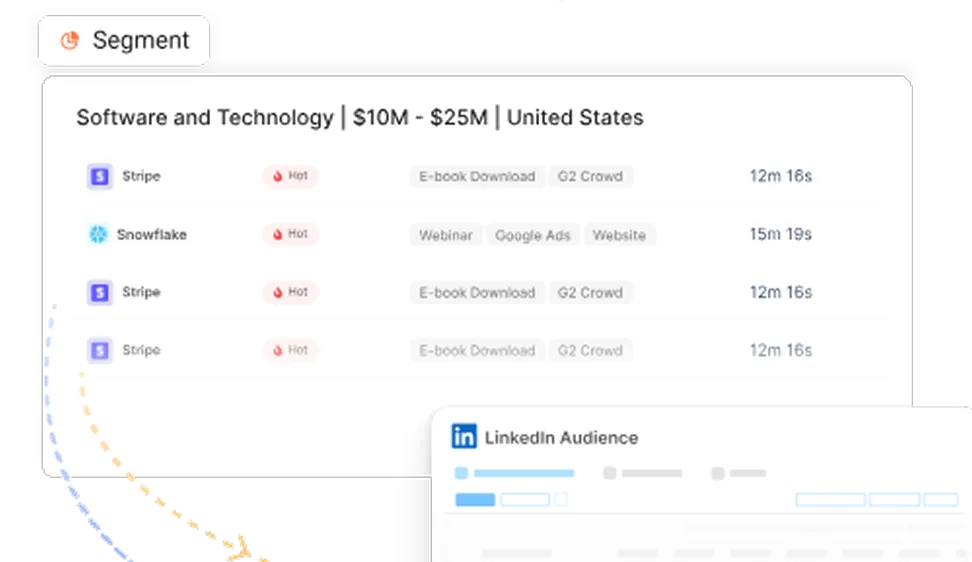
Boost your LinkedIn ROI in no time using data-driven insights


.avif)

See Factors in action.
Schedule a personalized demo or sign up to get started for free
LinkedIn Marketing Partner
GDPR & SOC2 Type II

.svg)



.avif)

